Magazine Section
pp. 59-60 · Read in the full issue
Territories Talk-Talk
By "Tolala"
TIPPING the Colour Scale to the dis advantage of the white man in the Pacific seems to be a favourite prac tice of the Australian Press in this en
lightened age.
A recent example occurred in Sydney, when one of the big papers ran the story of a memorial service, held at St. Andrew’s Cathedral, for those who perished in the motor ship Fairwind. A bold double column heading announced “Cathedral Service Honours Papuans,” and then went on to record, also in bold type, that mem bers of three churches attended the service to 12 Papuans. Almost as an after-thought, it was noted that “tribute was also paid to the white crew of Fair wind and to missionaries whom the Jap anese had killed during the Pacific War.”
The whole idea of this glamorising the native is wrong, and gives the reading public quite an erroneous angle of the whole set-up.
I am glad to see that Osmar White (PIM Sept. p. 83) is endeavouring to rec tify this journalistic tendency in his article on “Debunking Fuzzy Wuzzy,” As a mat ter-of-fact “Fuzzy Wuzzy” (as I have pointed out previously) correctly refers to Sudanese warriors, a term popularised by Rudyard Kipling—and that was a few years ago!
Reports, such as that of the memorial service, give one the impression that it is high-pressure publicity for Foreign Mis sion collections. I don’t say that it is; but it gives one that impression.
THE first issue of “South Pacific Post,” published by Les Brodie in Port Moresby, was a welcome sight, and he is to be congratulated on having over come the many hurdles which I am sure took some jumping before the first issue came off the Press. I was, perhaps, a little disappointed that the issue did not con tain more local items of news. Actually, a local paper is not depended upon, in these days of radio, for world’s news so much as the local happenings.
Says the editorial: “One of the most important features of defence in any land is a well-informed public,” and it hopes to fill that want . . . Providing there is no censorship!
Says the Administrator, in his Message; “I know that the editorial policy of the newspaper will take into consideration, as the Government must, the interests of the whole of the inhabitants of the Territory.”
It is to be hoped that it will not neglect the interests of the Europeans, at any rate. There are aplenty cyclostyled sheets taking care of the natives’ interests already.
THE presence of “Blue” Allan at the copra conference on August 31 is a good sign for two reasons: It shows he is still taking an interest in public matters, and the Powers That Be recog nise him as being an appropriate spokes man for the individual’s interests in the Territory.
It is nearly 30 years since “Blue” first arrived in TNG. He had some good ex perience on an East Coast New Ireland plantation for a start, before he took to the Goldfields. His experiences have been varied, and what he doesn’t know about native labour isn’t worth knowing.
They were a happy crowd along the East Coast of NI in those early days— all of them Returned Diggers from the First War. And how some of them used to speed along Bulominski’s Highway on their red motor bikes! There was “Blue” and his brother, K. T., Herk Braddon, Tony Edgell, Bill Watson and Tom Prince.
Only “Blue” and Tom returned to live in the Territory after War 11.
AND, talking of roads —than which there has never been a better one than Bulominski’s built 40 years ago—l see that, as a result of the visit of the UN Trusteeship Council mission to NG, it said: “Permanent progress was impos sible without a system of main roads.
“Well, that will mean some years will elapse before that target is reached.
Meantime the good old plane will probably meet most requirements—as it has done in the past.
THE Rabaul Sub-Branch of the RSL has very properly taken over the main tenance of the Montevideo Maru Memorial in Rabaul. The Battlefields
Memorial Commission, how ever, thinks that the present structure of cement, erected by the Army, is not of suffi cient permanency and one of stone, with suitable inscrip tions should be erected.
The Sub-Branch is quite prepared to fall in with this idea, I understand, and will raise the necessary funds, but thinks the decision should be left finally to the widows of the men who went down in that ill-fated vessel. Most of the men were Diggers of the First War.
The Sub-Branch might also consider including a tribute to those civilians who were lost in Rabaul after the vessel sailed: Vic Pratt and his party; Albert Evensen, Bill Korn, and Chauncy, and others who spent years in the Rabaul prison camp, and then disappeared.
SUCH a memorial must needs be a fitting one to so many of the Terri tory’s old, one-time residents for, as time goes on, I can foresee many pilgrimages made by the loved ones they left behind. Already the Sal vation Army HQ in Sydney has been asked to organise a pilgrimage to the war graves in NG.
ANEW departure in the Dutch New Guinea argu ment is the use by the Press of the word “Papuan” when referring to the natives of DNG. Both the Dutch and the Indonesians are using that old Portuguese equiva lent of “Fuzzy Wuzzy.”
The Australian Council for the World Council of Churches has now joined the argument and has asked Minister Spender to suggest
placing DNG under the UN Trusteeship in order that bad relationships should not exist between Australia and Indonesia.
And who will hold the trusteeship?
THE department of Works and Housing is still urgently seeking tradesmen for Manus Island, according to news paper advertisements.
What a lot of headaches could have been avoided if the Yanks had only been allowed to retain the base as they wanted to do! And what a feeling of security it would have given Australians to know that, in that vital strategic spot, there was an effective bulwark erected against the ever-boiling cauldron in our near North!
THE Territories are receiving a lot of publicity these days. If it is not a rare eagle, or bird-of-paradise for the Zoo, it’s air-borne timber from Bulolo to Lae. The latest story is about “Papua’s First Professional Boxer,” one Tommy Otari (an 18-year-old lad who, “weary of pearl-shell diving,” has taken to the ring) recently fighting at the Junee Show with a touring troupe.
(Continued next page.)
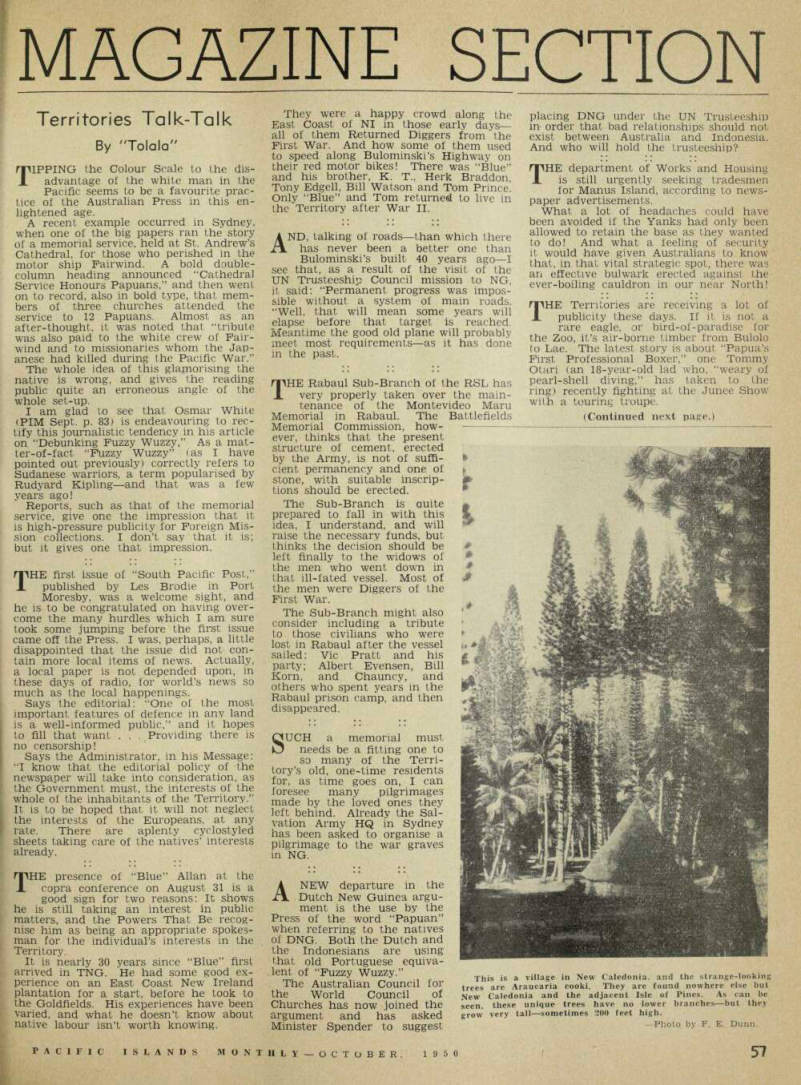
This is a village in New Caledonia, and the strange-looking trees are Araucaria cooki. They are found nowhere else but New Caledonia and the adjacent Isle of Pines. As can be seen, these unique trees have no lower branches—but they grow very tall—sometimes 200 feet high.
Photo by F. E. Dunn.
Whether this sort of education is ap proved by the UN Trusteeship Council I wouldn’t know, but, to my mind, it should not be encouraged. There was a time when native lads from Up Yonder were carefully guarded and guided away from the fleshpots, when allowed into Australia for short periods, so that they might not take back any wrong ideas of the white man’s civilisation.
Talking of natives boxing, reminds me that it was in 1914 that the first lad donned the gloves in Rabaul. when the Aussie troops were in occupation there and the Regimental blacksmith, named Lyons, introduced the art to several promising dusky champs. Local sahibs took a very dim view of the matter. The same Lyons, by-the-way, later became the well-known Don Athaldo, of physical cul ture fame.
CSIRO experts are reported doing re search work in NG to find new drugs.
They should contact some of the old native quacks, who have some re markable potions, none the less effective because they are not bottled and labelled.
They have contraceptives down to a fine art. One of the finest native cures I ever struck for blackwater fever was a brew made from pandanus roots. It worked like magic.
DEATH of J. M. Maughan, DSO, last month recalls an incident of the First War when the Australian Forces, commanded by Maughan, went down to capture Kieta (Bougainville).
Rumours, filtering through BSI and reaching Melbourne HQ, reported Kieta strongly defended and prepared to put up a fight. As a result the Force to capture Kieta was delayed three months—arriving in December, 1914, on the old island steamer Meklong, only to find Doellinger, the German DO. and his family anxiously awaiting the arrival of the Force, with bags and boxes, which had been packed for the past three months. There was never any intention to resist. ’Twas all a furphy. I know: I lived in that neck of the woods in those days.
A RECENT mention by a Sydney paper of E. J. Wauchope, of Awar planta tion, and his guest, Lord Moyne, re calls the pygmies the latter “discovered” un the Sepik, and which caused quite a flutter in European anthropological dove cotes at the time, until Father Kirsch baum (God rest his soul) pointed out he had written about them years before in a European journal. Both Lord Moyne and the Father had tragic deaths. The former was assassinated in Egvpt. where he was British Commissioner and the latter was killed in an air crash at Sek.
THE Queensland macadamia nut is be coming a dollar-earner in the US.
Personally, I’ve never tasted it, but I’m prepared to wager it is not more tasty than the old galip nut of the Islands. This is the nut that could make New Guinea famous if properly marketed.
BITS AND PIECES: E. W. P. Chinnery, old-time anthropologist and Director of District Services in TNG, has been making an up-to-date survey of territorial conditions. Speaking of village councils he said ’twas sad to find bribery, corrup tion and extortion in these councils equal to that in our own more civilised ones. . . .
“Chin” must have found a big difference in the post-war native, to make a state ment like that. . . . When Mrs. E. J. Hall strom returned last month from a holi day in Moresby she exhibited paintings she had done on the trip. . . . Peter, only son of the late A. A. Chauncy and Mrs. J.
Goldhill. was married on October 6 to Miss Jill Throsby of NSW.