Islands Under
pp. 62-63 · Read in the full issue
the Wind
By Clifford Kruse
THE lies sous le Vent, or “islands under the wind,” are the Leeward group of the Society Islands: Raiatea, Hua hine, Tubai Manu, Tahaa, Maupiti, Bora bora and Tupai.
Passage to the islands is from Papeete by either the Hiro or the Vaihinano, ferry type schooners, sans sails, usually making one round trip apiece each week. Ordin arily they cast their lines off Papeete wharf about six o’clock in the evening and come aside of the fine concrete wharf in Fare harbour, on Huahine, about three o’clock the next morning. From Huahine to Raiatea is about a two-hour jaunt. After a several hours’ stop at Raiatea the schooners go on to Bora bora. From here they make the return trip over the same route.
If you want to visit the other islands of the Group, you must wait your chance.
To get to Tahaa you can catch the weekly mail boat which runs on Wednesdays from Uturoa, principal port on Raiatea.
This vessel, the Monatai, is a 25-foot launch operated by a Raiatean. To get to Maupiti and Tupai you must contact Ah Yu Pei, a Chinese merchant in Uturoa, who owns the little motor scow. Manuia.
Ah Yu Pei, a likeable young trader, is Maupiti’s only contact with the outside world. He also is labour boss for the copra plantation on diminutive Tupai.
Occasional native sailing canoes, which run hellbent for election, can also be used to get from island to island. One seldom can reach Tubai Manu (or Maiao), which has only a pittance of copra and a bit of firewood to make it attractive to the outside world. It is at present being used as an experimental area for the American elephantiasis re search team working out of Tahiti.
RAIATEA is the largest island and the principal centre for the entire Lee ward group. Its chief town, Uturoa, is the second largest settlement in French Oceania. Though there is a hospital, an electric generating plant and a theatre there, the only street is a collection of Chinese shops featuring a variety of goods from Hong Kong and Canton sufficient to make glad the heart of any son or daughter of the Middle Kingdom. All of Uturoa’s Chinese are from the Kwan tung peninsula of China and speak the Haka dialect, in contrast to the majority of Chinese found keeping shops through out the South Pacific who come from merchandising Canton, Many of Raiatea’s Chinese residents have become wealthy in the past decade on raising, drying and selling vanilla, Raiatea’s most important crop.
Despite Raiatea’s importance in the French Oceanian picture, there is no motor road around the island. One can drive just so many kilometers west and so many south of Uturoa, which sits on the north side of the island. Conse quently on Wednesday, market day, much
of Uturoa’s produce comes to town in large native sailing canoes from the out lying districts. After their produce is sold or exchanged, the natives gather in Yves Sanquer’s Bar which has the in teresting name of Vairahi (“great water”) or at Tutu Orbeck’s Hotel Croix du Sud (Southern Cross).
The first time I walked into the Vairahi which was shortly after I disembarked’, I found myself engaged in a game of “horses” with some dice-happy residents.
First flip of the galloping dominoes I rolled five aces out of the leather cup.
A hand of applause followed from the in terested bystanders and a great, “Maitai'”
Not being aware of the rules of the house, I figured I had done myself a fine turn.
Five aces wasn’t the easiest thing in the world to throw in one flip.
How sadly mistaken I was! It wasn’t long before I learned that there is a penalty attached to the “tupapau” who throws five aces on the first roll. He must be in league with the devil. It meant, ac cording to the tradition of the establish ment, that I had to set up drinks for the house. The bar was packed with custo mers. Fortunately I had just had my monthly handout from the bank and I could splurge. I bought the round of drinks, had my name added to the suckers’ honour roll and vowed I’d not be playing any such games again.
RAIATEA is generally regarded as the cultural and religious centre of Polynesia. Here it is that many of the ancient voyagers called to pay their respects at the huge international marae or worshipping platform known as taputa puatea. This shrine is known among the Polynesians of New Zealand, Hawaii, Samoa and the Cooks. Thousands of human skulls formerly were to be seen sitting atop the marae, but they have long since disappeared. An occasional skull can be seen, however, hidden down in some dark crevice between
the rocks. These skulls were ,the property of warriors ■caught in battle who paid the penalty of sacrifice to the ‘hungry gods of the Poly
nesians.
The marae is also the centre ,of the Umu-ti, the fire walkers. whose feat of .parading slowly across a pit of white-hot stones still am azes onlookers. The same ceremony is performed in the south of China and in India, and is still without scientific explanation. Originally a religious rite, the ceremony is now put on only once every other year, about Christmas time, and principally for the benefit of tourists.
Raiatea, with its low coastal flats and scrub-covered.hills, is
not an attractive island by comparison with the others in the Group. Tahaa, which is enclosed inside the same fringing reef as Raiatea, has far more to offer the
sight-seeing tourist in the way of natural scenic beauty. In the inner deep-water passage around Tahaa one can see the most colourful display of coral formations
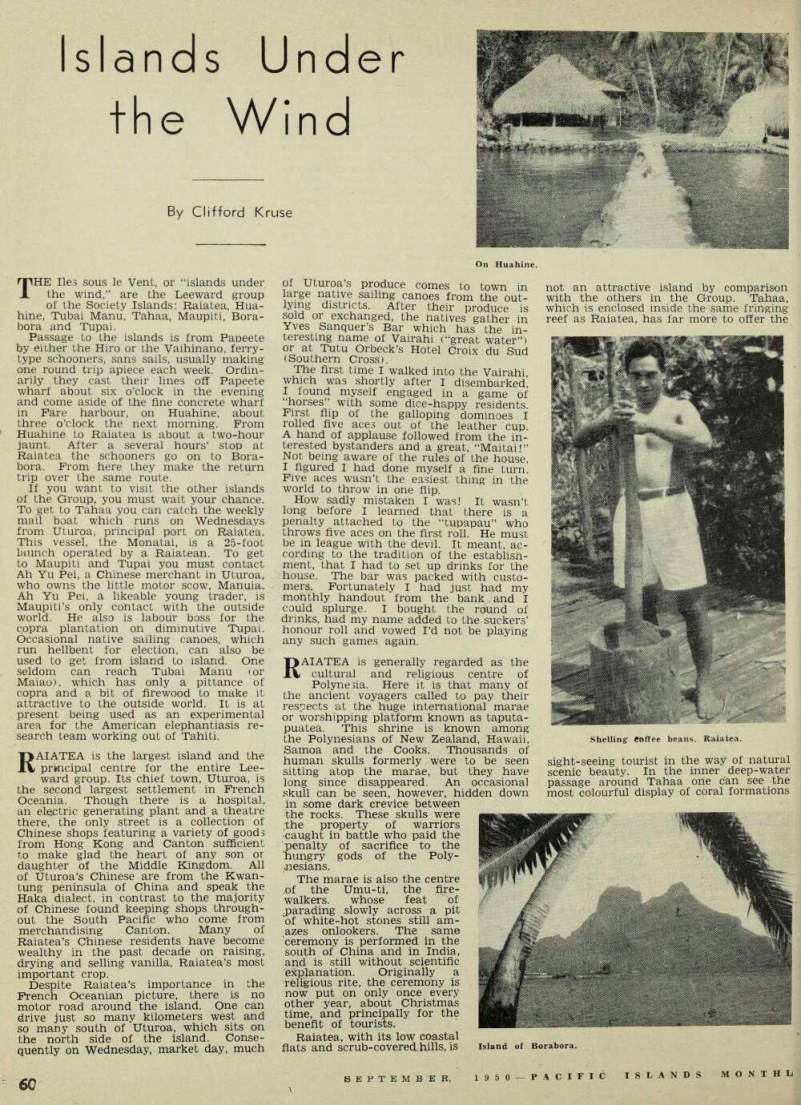
On Huahine.
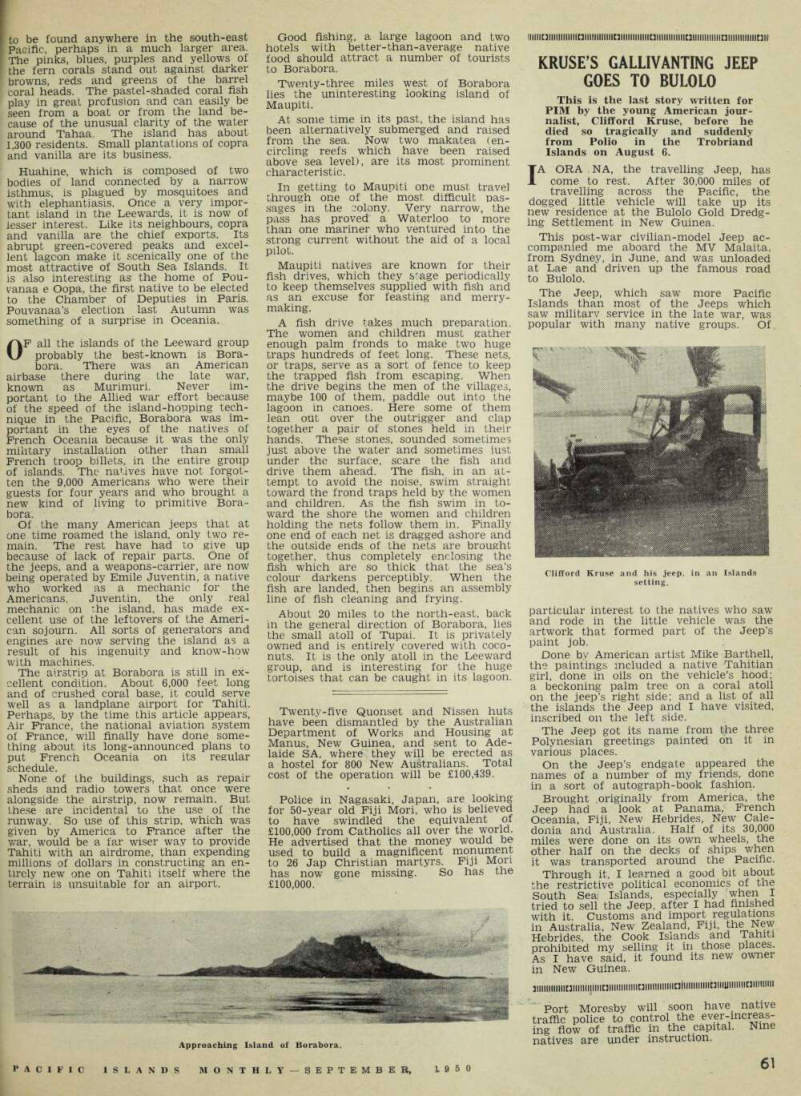
Shelling Coffee beans, Raiatea.
Island of Borabora.
to be found anywhere in the south-east Pacific, perhaps in a much larger area.
The pinks, blues, purples and yellows of the fern corals stand out against darker browns, reds and greens of the barrel coral heads. The pastel-shaded coral fish play in great profusion and can easily be seen from a boat or from the land be cause of the unusual clarity of the water around Tahaa. The island has about 1,300 residents. Small plantations of copra and vanilla are its business.
Huahine, which is composed of two bodies of land connected by a narrow isthmus, is plagued by mosquitoes and with elephantiasis. Once a very impor tant island in the Leewards, it is now of lesser interest. Like its neighbours, copra and vanilla are the chief exports. Its abrupt green-covered peaks and excel lent lagoon make it scenically one of the most attractive of South Sea Islands. It is also interesting as the home of Pou vanaa e Oopa, the first native to be elected to the Chamber of Deputies in Paris.
Pouvanaa’s election last Autumn was something of a surprise in Oceania.
OF all the islands of the Leeward group probably the best-known is Bora bora. There was an American airbase there during the late war, known as Murimuri. Never im portant to the Allied war effort because of the speed of the island-hopping tech nique in the Pacific, Borabora was im portant in the eyes of the natives of French Oceania because it was the only military installation other than small French troop billets, in the entire group of islands. The natives have not forgot ten the 9,000 Americans who were their guests for four years and who brought a new kind of living to primitive Bora bora.
Of the many American jeeps that at one time roamed the island, only two re main. The rest have had to give up because of lack of repair parts. One of the jeeps, and a weapons-carrier, are now being operated by Emile Juventin, a native who worked as a mechanic for the Americans. Juventin, the only real mechanic on the island, has made ex cellent use of the leftovers of the Ameri can sojourn. All sorts of generators and engines are now serving the island as a result of his ingenuity and know-how with machines.
The airstrip at Borabora is still in ex cellent condition. About 6,000 feet long and of crushed coral base, it could serve well as a landplane airport for Tahiti.
Perhaps, by the time this article appears, Air Prance, the national aviation system of France, will finally have done some thing about its long-announced plans to put French Oceania on its regular schedule.
None of the buildings, such as repair sheds and radio towers that once were alongside the airstrip, now remain. But these are incidental to the use of the runway. So use of this strip, which was given by America to France after the war, would be a far wiser way to provide Tahiti with an airdrome, than expending millions of dollars in constructing an en tirely new one on Tahiti itself where the terrain is unsuitable for an airport.
Good fishing, a large lagoon and two hotels with better-than-average native food should attract a number of tourists to Borabora.
Twenty-three miles west of Borabora lies the uninteresting looking island of Maupiti.
At some time in its past, the island has been alternatively submerged and raised from the sea. Now two makatea (en circling reefs which have been raised above sea level), are its most prominent characteristic.
In getting to Maupiti one must travel through one of the most difficult pas sages in the colony. Very narrow, the pass has proved a Waterloo to more than one mariner who ventured into the strong current without the aid of a local pilot.
Maupiti natives are known for their fish drives, which they stage periodically to keep themselves supplied with fish and as an excuse for feasting and merry making.
A fish drive takes much preparation.
The women and children must gather enough palm fronds to make two huge traps hundreds of feet long. These nets, or traps, serve as a sort of fence to keep the trapped fish from escaping. When the drive begins the men of the villages, maybe 100 of them, paddle out into the lagoon in canoes. Here some of them lean out over the outrigger and clap together a pair of stones held in their hands. These stones, sounded sometimes just above the water and sometimes just under the surface, scare the fish and drive them ahead. The fish, in an at tempt to avoid the noise, swim straight toward the frond traps held by the women and children. As the fish swim in to ward the shore the women and children holding the nets follow them in. Finally one end of each net is dragged ashore and the outside ends of the nets are brought together, thus completely enclosing the fish which are so thick that the sea’s colour darkens perceptibly. When the fish are landed, then begins an assembly line of fish cleaning and frying.
About 20 miles to the north-east, back in the general direction of Borabora, lies the small atoll of Tupai. It is privately owned and is entirely covered with coco nuts. It is the only atoll in the Leeward group, and is interesting for the huge tortoises that can be caught in its lagoon.
Twenty-five Quonset and Nissen huts have been dismantled by the Australian Department of Works and Housing at Manus, New Guinea, and sent to Ade laide SA, where they will be erected as a hostel for 800 New Australians. Total cost of the operation will be £100,439.
Police in Nagasaki, Japan, are looking for 50-year old Fiji Mori, who is believed to have swindled the equivalent of £lOO,OOO from Catholics all over the world.
He advertised that the money would be used to build a magnificent monument to 26 Jap Christian martyrs. Fiji Mon has now gone missing. So has the
£Loo,Ooo.
Port Moresby will soon have native traffic police to control the ever-increas ing flow of traffic in the capital. Nine natives are under instruction.
Approaching Island of Borabora.