Strange Artifacts of Old Papua
pp. 61-65 · Read in the full issue
By A. P. Lyons
AS most of the artifacts described and pictured by “Daika” in the Feb ruary issue of the PIM were found on the present surface, in recent years, in the Highlands of New Guinea, it may interest readers to learn something about the relics that were discovered in the Territory of Papua, between about 1890 and 1911.
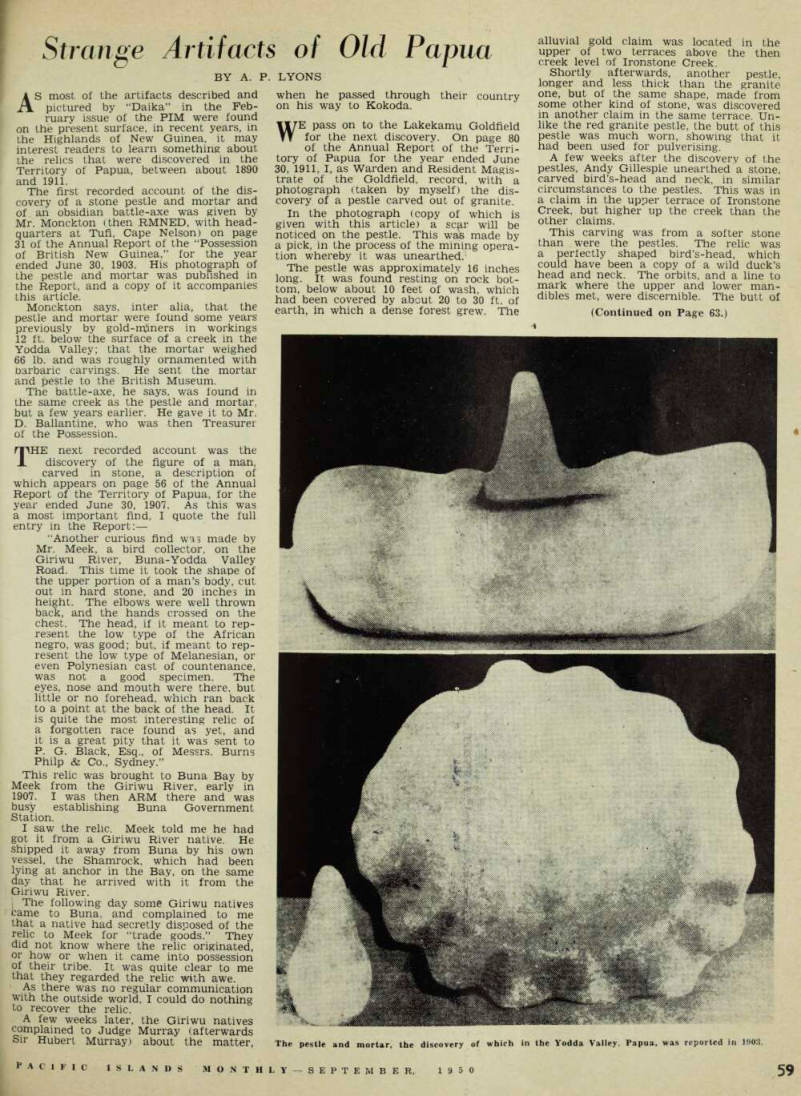
The first recorded account of the dis covery of a stone pestle and mortar and of an obsidian battle-axe was given by Mr, Monckton (then RMNED, with head quarters at Tufi, Cape Nelson) on page 31 of the Annual Report of the “Possession of British New Guinea,” for the year ended June 30, 1903. His photograph of the pestle and mortar was published in the Report, and a copy of it accompanies this article.
Monckton says, inter alia, that the pestle and mortar were found some years previously by gold-miners in workings 12 ft. below the surface of a creek in the Yodda Valley; that the mortar weighed 66 lb. and was roughly ornamented with barbaric carvings. He sent the mortar and pestle to the British Museum.
The battle-axe, he says, was found in the same creek as the pestle and mortar, but a few years earlier. He gave it to Mr.
D. Ballantine, who was then Treasurer of the Possession.
THE next recorded account was the discovery of the figure of a man, carved in stone, a description of which appears on page 56 of the Annual Report of the Territory of Papua, for the year ended June 30, 1907. As this was a most important find, I quote the full entry in the Report:— “Another curious find was made by Mr. Meek, a bird collector, on the Giriwu River, Buna-Yodda Valley Road. This time it took the shape of the upper portion of a man’s body, cut out in hard stone, and 20 inches in height. The elbows were well thrown back, and the hands crossed on the chest. The head, if it meant to rep resent the low type of the African negro, was good; but, if meant to rep resent the low type of Melanesian, or even Polynesian cast of countenance, was not a good specimen. The eyes, nose and mouth were there, but little or no forehead, which ran back to a point at the back of the head. It is quite the most interesting relic of a forgotten race found as yet, and it is a great pity that it was sent to P. G. Black, Esq., of Messrs. Burns Philp & Co., Sydney.”
This relic was brought to Buna Bay by Meek from the Giriwu River, early in 1907. I was then ARM there and was busy establishing Buna Government Station.
I saw the relic. Meek told me he had got it from a Giriwu River native. He shipped it away from Buna by his own vessel, the Shamrock, which had been lying at anchor in the Bay, on the same day that he arrived with it from the Giriwu River. . The following day some Giriwu natives came to Buna, and complained to me that a native had secretly disposed of the relic to Meek for “trade goods.” They did not know where the relic originated, or how or when it came into possession of their tribe. It was quite clear to me that they regarded the relic with awe.
As there was no regular communication with the outside world, I could do nothing to recover the relic.
A few weeks later, the Giriwu natives complained to Judge Murray (afterwards Sir Hubert Murray) about the matter,
when he passed through their country on his way to Kokoda.
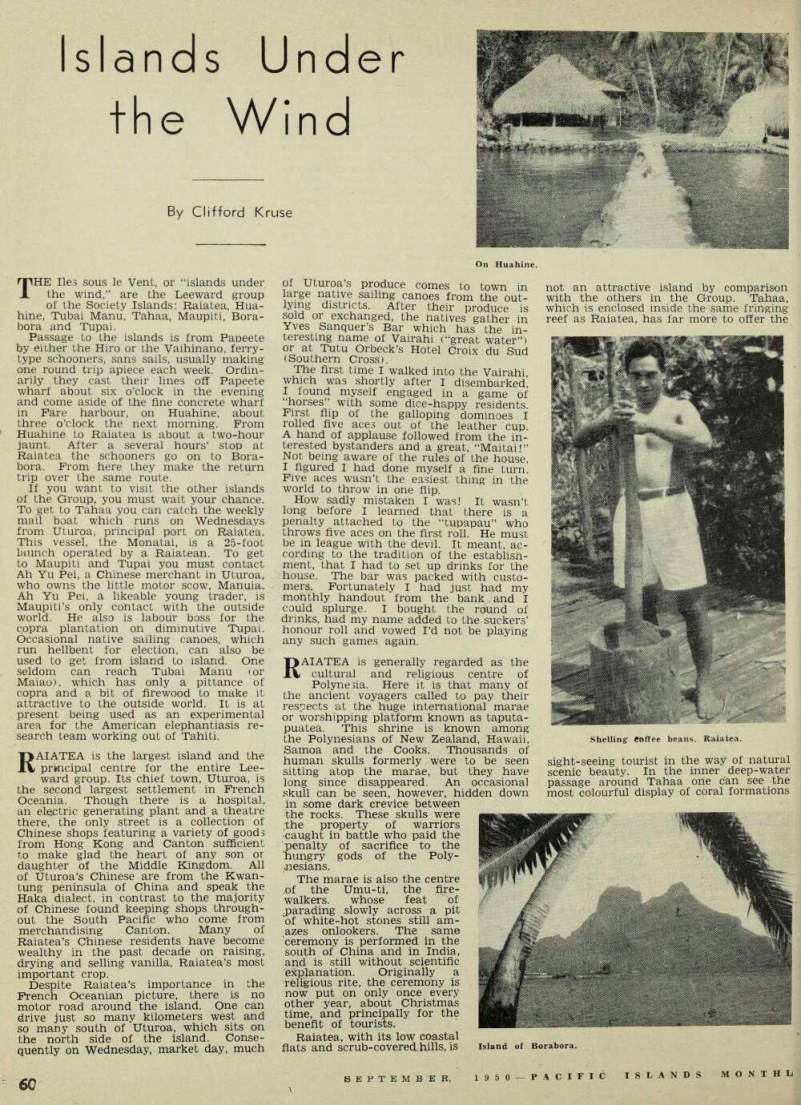
WE pass on to the Lakekamu Goldfield for the next discovery. On page 80 of the Annual Report of the Terri tory of Papua for the year ended June 30, 1911, I, as Warden and Resident Magis trate of the Goldfield, record, with a photograph (taken by myself) the dis covery of a pestle carved out of granite.
In the photograph (copy of which is given with this article) a scpr will be noticed on the pestle. This was made by a pick, in the process of the mining opera tion whereby it was unearthed.
The pestle was approximately 16 inches long. It was found resting on rock bot tom, below about 10 feet of wash, which had been covered by about 20 to 30 ft. of earth, in which a dense forest grew. The
alluvial gold claim was located in the upper of two terraces above the then creek level of Ironstone Creek.
Shortly afterwards, another pestle, longer and less thick than the granite one, but of the same shape, made from some other kind of stone, was discovered in another claim in the same terrace. Un like the red granite pestle, the butt of this pestle was much worn, showing that it had been used for pulverising.
A few weeks after the discovery of the pestles, Andy Gillespie unearthed a stone, carved bird’s-head and neck, in similar circumstances to the pestles. This was in a claim in the upper terrace of Ironstone Creek, but higher up the creek than the other claims.
This carving was from a softer stone than were the pestles. The relic was a perfectly shaped bird’s-head, which could have been a copy of a wild duck’s head and neck. The orbits, and a line to mark where the upper and lower man dibles met, were discernible. The butt of
(Continued on Page 63.)
The pestle and mortar, the discovery of which in the Yodda Valley, Papua, was reported in 1903.
the neck was level and there was nothing on it to suggest that it might have been attached to a stone body or anything else.
Stood upright on its butt, it measured ap proximately six inches high. Gillespie told me he intended sending it to the British Museum.
The last relic to be discovered on the Lakekamu Goldfield while I was in charge there, was a double-bladed and flat stone
axe. A hole was bored through the middle of the flat surface. It was found by Jim Mulholland, in his claim, situated beneath the lower terrace of Ironstone Creek but further down that creek than where the other relics were unearthed. The axe was much corroded.
It will be as well for me to say that I saw all of these relics and the places where they were found, shortly after their discovery.
HAVING related some facts, I will pro ceed to theorise on the origin of both the Lakekamu and Giriwu dis coveries.
Upon looking at the photograph of the granite pestle found at the Lakekamu Goldfield, it suggests that it was intended to represent a phallus. That being so, where was it most likely to have come from? Clearly, from an Asiatic country whose inhabitants —or some of them, at any rate —were followers of the Phallic Rite. It is well known that some of the inhabitants of both Java and India prac tised Phallic worship, and perhaps still do. The curious may still see many phal lic carvings in those countries.
It is also well known that many Asiatic peoples, down the ages, have been expert handicraftsmen in working with gold and other metals. Their prospectors would travel far afield to search for gold in
mountains and valleys, at the headwaters of rivers, as we do to-day.
Therefore, it is reasonable to suppose that prospectors of some Asiatic race, who were Phallic worshippers, made voyages along the south coast of the island of New Guinea to search for gold in the high mountains of the interior. And they would try to find a river that would take them by the shortest route to those moun tains.
They would find such a route by either the Lakekamu or Tauri Rivers, which flow into the Gulf of Papua within a few miles of each other. They would bring with them symbols of their worship; and I be lieve the pestles and bird’s-head found at the Lakekamu Goldfield were some of those symbols.
These prospectors would most certainly come into contact with the aborigines, establish friendly relations with them, and even intermarry with them and have off spring. Both aborigines and the off spring would learn, amongst other things, to make rough imitations of the Phallic symbols they saw, and it is these imita tions that have been found on the surface of New Guinea in recent years.
Someone steeped in the ancient culture of Asiatic countries could tell us more about the probable origin of the Giriwu stone man. To me, its general appearance suggested that it was of Asiatic origin.
FOOTNOTE: A copy of the Catalogue of the Black Collection of Islands Arti facts (which consisted of over 6,000 articles, contained in some 40 cases) is in the Pacific Islands Monthly library. It does not mention the stone carving re ferred to by Mr. Monckton.
The Rev. J. R. Metcalfe who has been a Methodist missionary in ESI since 1920, has been designated by the NZ Foreign Mission Board to succeed the Rev. J. F.
Goldie, as chairman of the Solomon Islands district, when Mr. Goldie retires in 1951. Mr. Metcalfe has been in charge of Methodist mission activities on Choiseul Island for a number of years.
Mrs. Metcalfe has had even longer mis sionary experience than her husband and for the past 33 years has been one of the outstanding Methodist women workers in the BSI.
Rabaul and Kokopo, New Guinea, have started a rugby league club. Training has already commenced and a Rabaul- Kokopo match will be staged shortly. A high standard of play is anticipated. Mr.
Tony Normoyle, who was outstanding in Queensland GPS football in 1949, will be among the players.
The ancient pestle unearthed on the Lakekamu goldfield, about 1911. It was photographed beside a beer bottle, to give an idea of size.