Sepik Survey
pp. 60-62 · Read in the full issue
ALTHOUGH the really unknown places of the earth are becoming fewer each year, the mighty Sepik River of the New Guinea mainland, still comes within that category. With its many tributaries—most of them full-grown rivers in their own right—its tenacious people living their amphibious lives, its teeming crocodiles, it is an area seldom written about—and little known out side a small circle of missionaries, Administration officials and a few recruiters. This present article, by S. H. Gander, a visiting missionary, tells a little of the life that is lived among the mud and mosquitoes of three of the big river’s tributaries—the Yuat, the Keram and the Karawari.
WE have returned from an interesting journey up the Yuat River which flows into the Sepik 101 miles from its mouth. The Yuat is distinct from all other Sepik tributaries in that the course is less winding and the banks less swamped. Where it joins the Sepik it is about 140 yards wide and upstream for 32 miles generally not under 100 yards.
After this first 30-odd miles are the first hills—Lookout Mountains being close to the river on the west side. Just south of these hills the river narrows to 80 yards and the current, even in normal water conditions, is considerable. There are many villages along both banks and these extend to the plain on both sides.
The people are able to grow such food as yams, greens, taro, eschalots, and to matoes, having better garden land than the natives on the Sepik proper. They plan their crops so that their main food —yam—is taken out before the “high.” In the wet season the river rises 20 feet and overflows its banks and the gardens.
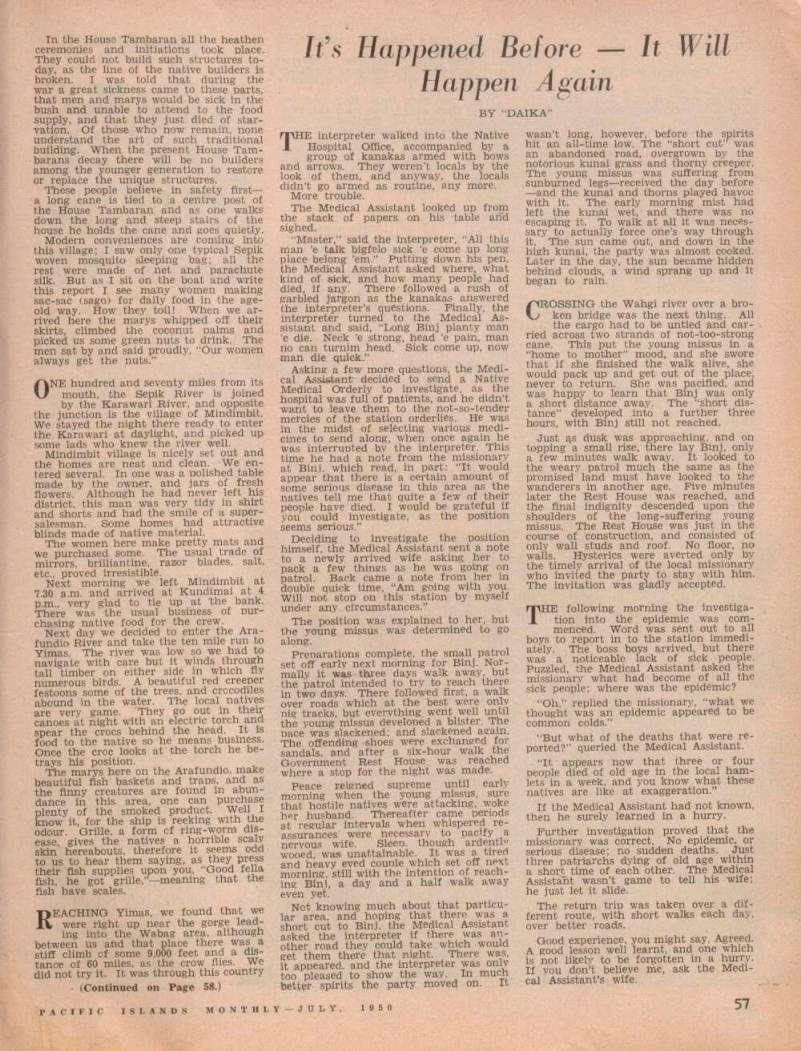
Houses are flooded to a depth of three feet, although they are all built high up from the ground. During the five months of the “high” the natives live on their store of yams. At this writing the high has hardly begun but it is Interesting to see the river banks breaking and high trees falling into the river; and one sees
how much the river changes its course -50 yards in some places. Wherever the banks break they build up on the opposite side. We travelled through one channel 50 yards wide that was only a canoe barad
five feet wide a year ago. It would be 20 feet deep now.
WE called at many villages and found the people very friendly. We had a party of natives on board —it pays to have locals along because of the tricky navigation. We anchored at Biwat and spent the night there. Our draught was too great for the hazards ahead. But we were only 80 miles from Wabag and would have liked to go on.
We returned down-stream next day, spent the week-end at Moim on the Sepik, near the Yuat mouth.
After visiting Angoram to receive and send mail we next paid attention to the Keram River. The trip was scenically beautiful and as I write this we are 50 miles upstream and anchored with the Bobtain people.
It is a strain to be at the wheel of a boat on a river with as many bends as this one. “One good turn deserves an other” would apply here. When we ar rived at 3.45 p.m. I had had it. There is a current of three knots with which to contend, also submerged trees and sand banks. Always in my mind is the thought that these ships cost money, and the handling of the craft is therefore a re sponsibility. No matter how good the native, he fails to realise the value of such a ship and if left to himself is in clined to take risks.
THE Keram River flows into the Sepik 73 miles from its mouth and another stream—the Clay—flows into the Keram 32 miles from its mouth.
Yesterday we anchored at Kambot and there examined the greatest native struc tures I ever expect to see in this Terri tory. We first examined the house of the Tultul (or secondary chief). It is 178 feet long by 40 feet and is decorated with paintings and carvings that astonished me. The front porch, which is 20 feet up above the ground, has a huge roof like the mouth of a crocodile, and on what would be the roof of the mouth is a paint ing of a man about 15 feet in height.
There are carvings of doves and other birds —a work of art.
I thought I had seen something that could not be surpassed but then they in vited me to visit the House Tambaran.
This building was the same size as the one already described, with centre posts three feet in diameter planted 18 feet in the ground, with a total length of 70 feet.
The paintings are something to see, so are the carvings. The ridging and rafters are decorated with carvings and coloured drawings. The place is colossal and took five years to build.
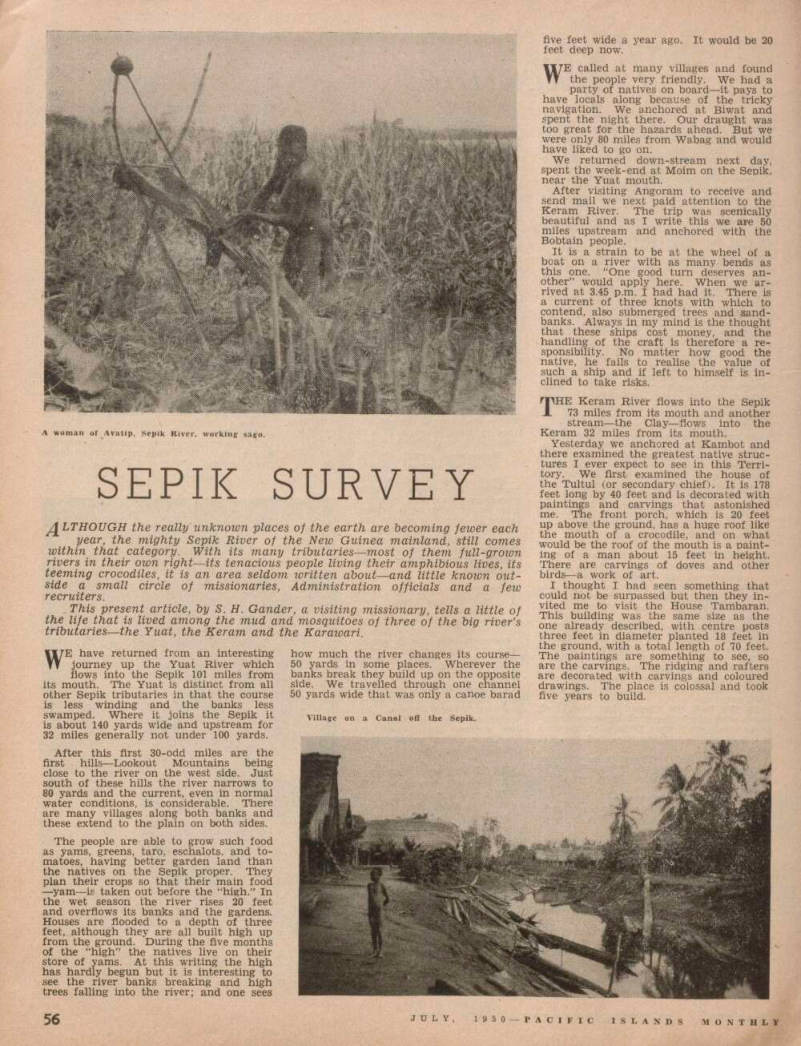
A woman of Avatip, Sepik Kiver, working sago.
Village on a Canal off the Sepik.
In the House Tambaran all the heathen ceremonies and initiations took place.
They could not build such structures to day, as the line of the native builders is broken. I was told that during the war a great sickness came to these parts, that men and marys would be sick in the bush and unable to attend to the food supply, and that they just died of star vation. Of those who now remain, none understand the art of such traditional building. When the present House Tam barans decay there will be no builders among the younger generation to restore or replace the unique structures.
These people believe in safety first — a long cane is tied to a centre post of the House Tambaran and as one walks down the long and steep stairs of the house he holds the cane and goes quietly.
Modern conveniences are coming into this village; I saw only one typical Sepik woven mosquito sleeping bag; all the rest were made of net and parachute silk. But as I sit on the boat and write this report I see many women making sac-sac (sago) for daily food in the age old way. How they toil! When we ar rived here the marys whipped off their skirts, climbed the coconut palms and picked us some green nuts to drink. The men sat by and said proudly, “Our women always get the nuts.”
ONE hundred and seventy miles from its mouth, the Sepik River is joined by the Karawari River, and opposite the junction is the village of Mindimbit.
We stayed the night there ready to enter the Karawari at daylight, and picked up some lads who knew the river well.
Mindimbit village is nicely set out and the homes are neat and clean. We en tered several. In one was a polished table made by the owner, and jars of fresh flowers. Although he had never left his district, this man was very tidy in shirt and shorts and had the smile of a super salesman. Some homes had attractive blinds made of native material.
The women here make pretty mats and we purchased some. The usual trade of mirrors, brilliantine, razor blades, salt, etc., proved irresistible.
Next morning we left Mindimbit at 7.30 a.m. and arrived at Kundimai at 4 p.m., very glad to tie up at the bank.
There was the usual business of pur chasing native food for the crew.
Next day we decided to enter the Ara fundio River and take the ten mile run to Yimas. The river was low so we had to navigate with care but it winds through tall timber on either side in which fly numerous birds. A beautiful red creeper festoons some of the trees, and crocodiles abound in the water. The local natives are very game. They go out in their canoes at night with an electric torch and spear the crocs behind the head. It is food to the native so he means business.
Once the croc looks at the torch he be trays his position.
The marys here on the Arafundio, make beautiful fish baskets and traps, and as the finny creatures are found in abun dance in this area, one can purchase plenty of the smoked product. Well I know it, for the ship is reeking with the odour. Grille, a form of ring-worm dis ease, gives the natives a horrible scaly skin hereabouts, therefore it seems odd to us to hear them saying, as they press their fish supplies upon you, “Good fella fish, he got grille,”—meaning that the fish have scales.
REACHING Yimas, we found that we were right up near the gorge lead ing into the Wabag area, although between us and that place there was a stiff climb of some 9,000 feet and a dis tance of 60 miles, as the crow flies. We did not try it. It was through this country
- (Continued on Page 58.)
during the war that a priest and some nuns escaped from the Japs, taking five months to reach Bena Bena, in the Cen tral Highlands. The Japanese penetrated right up into Yimas.
The river bends are sharp, and as the river is narrow, about sixty feet at times, the trees are almost touching the masts.
This area has many lakes teeming with fish and Gouria pigeons are found in abundance in the bush.
We were warmly welcomed by the natives and they were sorry to see us leave. It was here that I decided to put on races for the children and although a very big rain came up during the night and filled our ship’s tanks and brought the river up two feet, naked and shiver ing, the children were at the boat at 6 a.m. Rain? What of it!
The good folk of Australia who gave me the nice things I distributed would have been delighted to hear the screech ing and see them slithering in the mud.
Mum and Dad joined in, because after all, they are only children. The races were a huge success and we pulled away in the blinding rain.
The current of three knots sent us downstream at speed and we all relaxed as we entered the larger Karawari two hours later.
Our trip was not all joy, however. In one village there is a bomb crater filled with ninety skeletons. The hands of the unfortunate victims were tied behind their backs and they had been butchered with tomahawks and spears and thrown into the crater and left uncovered. This atrocity was committed by natives in the
presence of and under instructions from the Japanese.
Although 150 miles from Angoram, and the sawmill, the people at Yimas are co-operating in the Sepik’s new timber milling venture.
While we were there they had two rafts of trees, with houses on board, com plete and ready for the journey. The three-knot current takes them down and they will be a week on the trip. Even mothers and babies go along. The huge logs roped together make a solid raft and provide a comfortable trip, as well as finance for all.