Tropicalities
pp. 59-62 · Read in the full issue
THAT readable book, Anatomy of Para dise, by J. C. Furnas, was reviewed in PIM many moons ago—but that was the American edition. The English edition has just reached Australia.
Some reviewers are now wondering, as we have wondered, how the book came to have such a silly name—American publishers usually have more salesman ship than that and can be relied upon to glamorise and dress up the dish nicely for the consuming public. They seem, however, to have become bemused by this word “Paradise” in connection with the Pacific, which seems ridiculous to plain citizens who live there. There was, you remember, Lambert’s Doctor in Para dise (as well as Furnas’ current number); and that well-known Hawaiian monthly, orientated mostly now towards tourism although it was founded in 1888, is called Paradise of the Pacific.
This is what John Hetherington, Mel bourne Herald reviewer, has to say about Anatomy of Paradise:— “A reader of no more than average timorousness might well shy away from a book of 541 pages entitled “Anatomy of Paradise,’’ with a dust-jacket adver tising it as a study in racial relations.
“Mr. Furnas will be unfortunate if he loses readers for this reason. Australians who pass up his book on the susnicion roused by the evidence I have mentioned will be even more unfortunate. For Mr.
Furnas has written not only one of the most informative, but also one of the most entertaining books to come this re viewer’s way in many months. He takes material which would be dull stuff even in the hands of most skilled writers and makes it enchantingly alive.” • SOMETHING of a sensation was caused in Australia in June (at least it was mentioned in metropolitan news papers and over the ABC), when an In dian woman from Fiji mistook the Customs Hall at Mascot airport for a dressing room.
They say her name was Solochini Hub dar and, with her husband, she was on the way back to Fiji from a visit to Cal cutta. They arrived on one of Sydney’s wet days (it rained over 25 inches in June) and on the way from the plane to the Customs Hall she got her thin white sari very wet.
In the hall she opened her bag, took out a pink confection and, ignoring every body else, put it on. With a wiggle and a bit of string tugging she shed her wet garments.
Officials yelled: “There is a dressing room over there, madam!” But Solochini Hubdar took no notice. She does not speak English.
One paper said Western ideas of modesty “were shocked.” Apparently Aus tralian newspaper editors do not frequent Bondi beach in summer. * MISS AILEEN ALLEN, of South Aus tralia. has returned after several months visit to New Guinea, fas cinated at the combination of the primitive and the modern labour-saving devices used there. Miss Allen has been with her brother. Mr. Robert Allen, at Baiune. near Bulolo (Bulolo Gold Dredg ing, Ltd., get electricity from Baiune) and this, no doubt, explains the “modem labour-saving devices”—life in the rest of New Guinea may be fascinating but it contains few mod. cons.
One thing that surprised Miss Allen was the way natives, who had lived in
the most primitive surroundings, took to modern devices. The boys, most of them first-class cooks, picked up the timing and principles of cooking with electricity quickly.
“It was amusing,” she said, “to watch a comparatively new hand nonchalantly regulating the stove and then, having abandoned further worry over the meal, playing football until it was ready.” * CAN it be true?
The Adelaide Advertiser, in reporting that Dr. and Mrs. M. P. Glaessner have returned to live in Adelaide after living in Port Moresby, say that Mrs.
Glaessner, who trained at a Moscow ballet school and later as a dancer in Moscow’s Bolshoi Theatre, “took ballet to New Guinea.”
Starting out with a class of 29 children of Port Moresby residents, she later had a class of 16 young girls then “young men civil servants, planters and others.”
We always thought their hobby was drinking beer. * AND while on the subject of beer—the Norfolk Island annual report, pre sented to the House of Representa tives in June, showed that the two chief exports of the island were;— Bean seed, worth £4,125.
Returned empties, worth £3,909.
There is no hotel on Norfolk. It is
another of those Pacific paradises where one can ob tain liquor only on a permit issued by the Administration.
It is only fair to point out however, that the “empties” include other things but beer bottles —petrol drums and the like. ♦ THERE are prizes for this: If, in the next few months, any Island dweller finds a small bottle on his beach and within it a message from the Seamen’s Church Institute of New York, he may receive a prize of a miniature ship in a bottle.
Hundreds of these messages will be cast forth in bottles by the United States Line freighter, Pioneer Gulf, on her current trip across the Pacific. (She sailed from New York on June 17.) *
HERE is something fur
ther to round-off Mr.
William Courtenay’s story of the late Dr. G. H.
Vernon (Feb. PIM ). It is
from Eti, of Mangaia, Cook
Islands: The book that the .late Dr. Vernon missed the end ing of was banned in NZ when it appeared about 30 years ago, but I managed to get hold of a copy. It is called Kimono: author, John Paris. I’m a little hazy now, myself, as to the exact end ing, but as far as I recall, the European’s Japanese wife, whose fortune was de rived from the notorious Yoshiwara (or red-light dis trict of Tokio), waived her
share of the ill-gotten lucre, and lived happily ever after.
The book is not at all pornographic, and I, for one, am puzzled to see why such a fuss was made about it. As far as I know, it is still in print. * BRITAIN’S luxury, dollar-earning ship. 34,000-ton Caronia, is scheduled to make a trip to Australia, New Zea land and the South Pacific Islands, in cluding the Solomons, early next year.
If the Solomons, in their present state, do not rattle these American dollar mil lionaires out of their mink coats and dia monds, then nothing will. Presumably, inclusion of BSI in the itinerary is to show the folks back home Guadalcanal, where the US Marines first put a crimp in the Japs’ tails.
Caronia has been done up regardless to attract dollar tourists. The best suites cost something like the equivalent of £7,000 stg. for a 10-weeks cruise. In a recent cruise of Europe, Africa and the two Americas, Caronia earned £750,000 sterling—in dollars. Food was lush, but, complained the stewards, much of it was spurned. There seems to have been a high proportion of ulcers on board and their owners fed exclusively on plain milk and biscuits. * THE new Resident Commissioner of the BSIP (Mr. H. G. Gregory-Smith) is spending only the minimum time necessary for administration at Honiara and is systematically touring the Pro tectorate in the Government’s 60-foot vessel, Mary. " "
He has received a warm welcome every where, and a few surprises. One of these came during a recent visit to Sikiana,
(Continued on Page 58.)
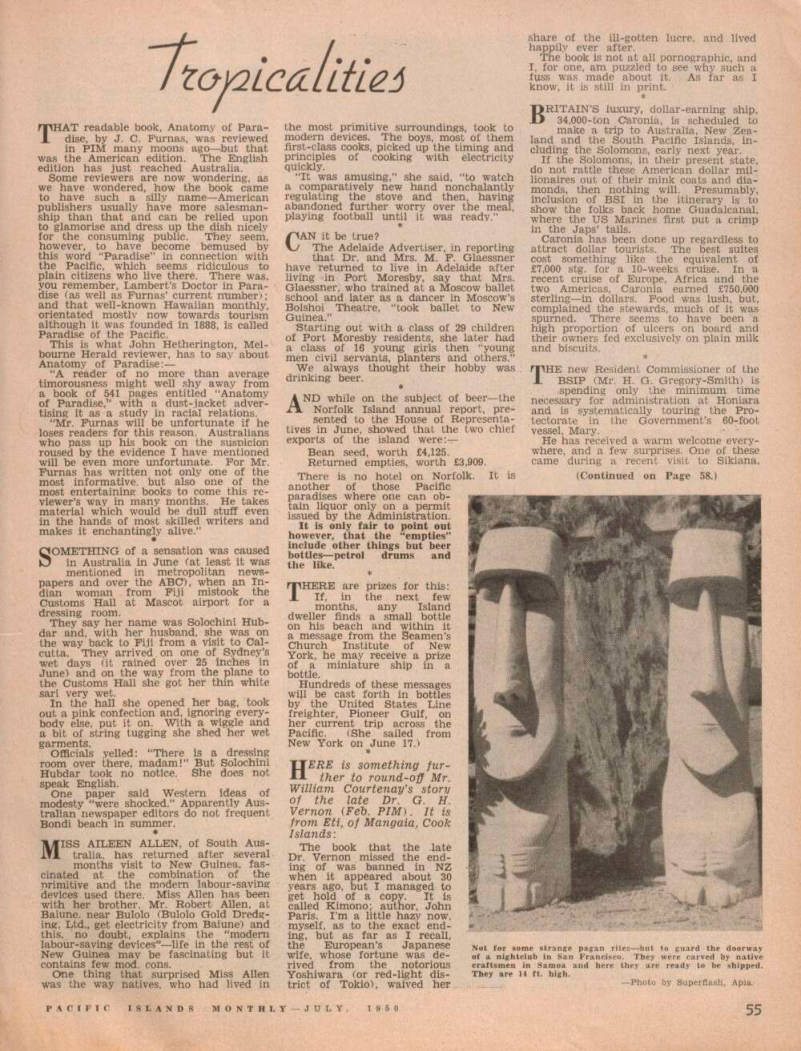
Not for some strange pagan rites—but to guard the doorway of a nightclub in San Francisco. They were carved by native craftsmen in Samoa and here they are ready to be shipped.
They are 14 ft. high.
Photo by Superflash, Apia.
when he was seized unexpectedly by a bunch of brawny Sikiana men and re spectfully dunked in the sea. Only his moustache and the tip of his nose re mained above water. This ceremony is a great honour, rarely accorded to visitors.
It was conferred also on Bishop Baddeley when he was in the Solomons. The Resi dent Commissioner very much appre ciated the spirit in which this honour was done to him. But he said that, if he had been expecting it, he would have taken his tobacco out of his pocket and his watch off his wrist first. —K.
THE recent visit paid to the NZ Navy warship, Rotoiti, by Mangaian Girl- Guides has caused some unsettle ment in those well-educated young Polynesian ladies’ minds about the one ness of the British Empire.
The NZ Navy is, apparently, not over strong in NZ-born personnel, and aboard the ship were many Scots, and not a few of the Tyneside-Merseyside types known by the generic title of “Geordie,” whose
patois greatly resembles that of famous Gracie Fields, only more so.
The pulchritudinous Guide-Captain (a Euronesian damsel), who functioned as interpreter for the lads in blue, was faced, upon taking up her duties, with the prob lem of finding first some linguist to trans late into NZ-ese, for her benefit, the riverside dialects cited. This not being forthcoming, the interpreter made some what heavy weather of conveying, for jolly Jack Tar, the welcome of the ship to its young guests and later, their thanks for the Naval entertainment.
The young ladies left the ship under the impression, till corrected, that the “Jocks” and the “Geordies” were some kind of foreigners—possibly European DP’s, who had been permitted to join HM New Zealand Navy!—EG.