Tropicalities
pp. 56-57 · Read in the full issue
THERE should be no excuse for couples in Papua-New Guinea to dispense with the blessing of the church. In a recent Papua-New Guinea gazette some 380 clergymen were listed, all of whom were registered to celebrate marriages in the two territories—l3o for Papua and 250 for New Guinea.
The matrimonial knot can be tied ac cording to the rites of the Roman Catho lic church, Anglican, Seventh Day Ad ventist, Methodist, Lutheran, Congrega tional or by a member of the Unevange lised Fields Mission or the Bamu River Mission.
Or you may take your choice of clergy men according to nationality—British, American, German, Austrian, French, Irish or South Sea Islander. Two of the clergymen are, in fact, clergywomen—Mrs.
Eva Standen of the Bamu River Mission and Mrs. Suzannah Rankin of the Lon don Missionary Society (Congregational).
With all this choice of talent open to you, you can, of course, still patronise the local District Officer. ♦ ♦ ♦ THE faithful old schooner, Tiara Toporo, made her last call at Man gaia, Cook Is., in November, after decades of reliable service, and her pass ing is discussed with regret.
The Tagua is sold, the Taipi aground at Palmerston Is.; and now, the Tiare has made her last appearance off Man gaia Reef. She has been replaced by the splendid new oil-vessel Charlotte Donald, which is said to be the last word in inter island passenger comfort and freight capacity. An improvement, no doubt; but to the old-timer, there is little ro mance in a ship without canvas.
Our doughty Captain Andy Thompson was heard to say, here, that he intended to retire and keep pigs; but the wireless later gave his name as the skipper of the new Charlotte D.. though Mangaians found it hard to imagine the captain, be reft of his khaki and ancient topee, pac ing the steamer’s bridge in blue serge and brass buttons, and with never a rope to haul on.
Captain Thompson has, in the long years that he has served the Group, been responsible for many useful innovations.
He brought to the Cl that noble animal, the guinea-pig, an article of diet in the Societies, but a museum curio here. Man gaia’s quota all fell victim to maraud
mg cats and village dogs. With his Gambusia minnows for the destruction of mosquito larvae in the swamps, and his “itiki” eels from Mitiara, our Andy had better luck—these are a feature of the island to-day.
A sturdy and virile man, although no longer young. Andy is a sail-man, who got his training in the hard school of the full-rigged ships. He has many thrilling tales to tell of that era, beside which the sea-faring conditions of to day appear very tame indeed. * * * /
'J'HE American magazine, Time,
takes up the story of Cat Island {page 50, February PIM) and in its issue of November 7 says: IN the July issue of Coronet (circ. 2,650,000), readers got a beguiling glimpse of Cat Island—a South Pacific “paradise you may have for the asking,” complete with palm trees and coral beaches. There was only one catch, reported Author Lucille Beckhart; the island was inhabited and ruled by hordes of ferocious cats.
According to Author Beckhart, Cat Island, which she located as “near Tahiti,” had first been invaded by rats from a sinking ship. To get rid of them, a French traveller imported hundreds of cats. When the cats in turn multiplied and grew vicious, the natives were forced to desert the island.
Fascinated by the Coronet account, Re porter William Kennedy of the Los Angeles Herald & Express tried to find Cat Island on a map, but couldn’t; he asked Coronet and was referred to the governor of Tahiti. To Los Angeles Mirror Columnist Fred Beck, who promptly told his readers all about it, Kennedy and two friends confided their tongue-in-cheek plans for Cat Island.
They would bomb it with poison gas to kill the cats, then build a comfortable hotel for tired newsmen (The Cat House) and start a profitable local industry (catgut).
But Kennedy wiped away the grin when a Pasadena millionaire made a serious offer to underwrite a vacation trip to Cat Island in his 136-ft. schooner. Last week, as the expedition got ready to sail, a disillusioning cable arrived from Tahiti’s governor: THERE IS NO SUCH
Island . . .
The story, which cat-napping Coronet
had printed as fact, was fiction. Where did Mrs. Beckhart, a fortyish California X-ray therapist and housewife who writes freelance articles “as a hobby,” get the yarn? Said she last week: “A friend of mine, a very well-travelled person, told me about it. Unfortunately, he has since died ...” * * * A BRETT HILDER study of Mrs. Alice Allen Innes, of Vaucluse, Sydney, once of Fiji, Papua and New Guinea. The artist’s impression (which we cannot bet ter) was of “a lively little person with an
all-pervading kindliness.”
She met Allen Innes in Fiji and, after
he returned from World War I, went with him to Papua. In the early 20’s they were amongst the first pioneers of the Morobe goldfields area, New Guinea. After 20 years in the Territories they retired to Sydney.
AAl’s stories and verses are well-known to PIM readers but family (including four grand-daughters, all under three; and a multitude of friends keep her from getting much writing done these days. ♦ * * MORE about those Coco vores (Feb.
PIM», Mr. L. W. Vance, of Mosman.
Sydney, suggests “Could this be merely an extension from such a word as ‘carnivora’? It is conceivable that some person might coin such a word by extension from carni vora to coco vores— to mean ‘coconut eaters’.”
This seems a reasonable explanation.
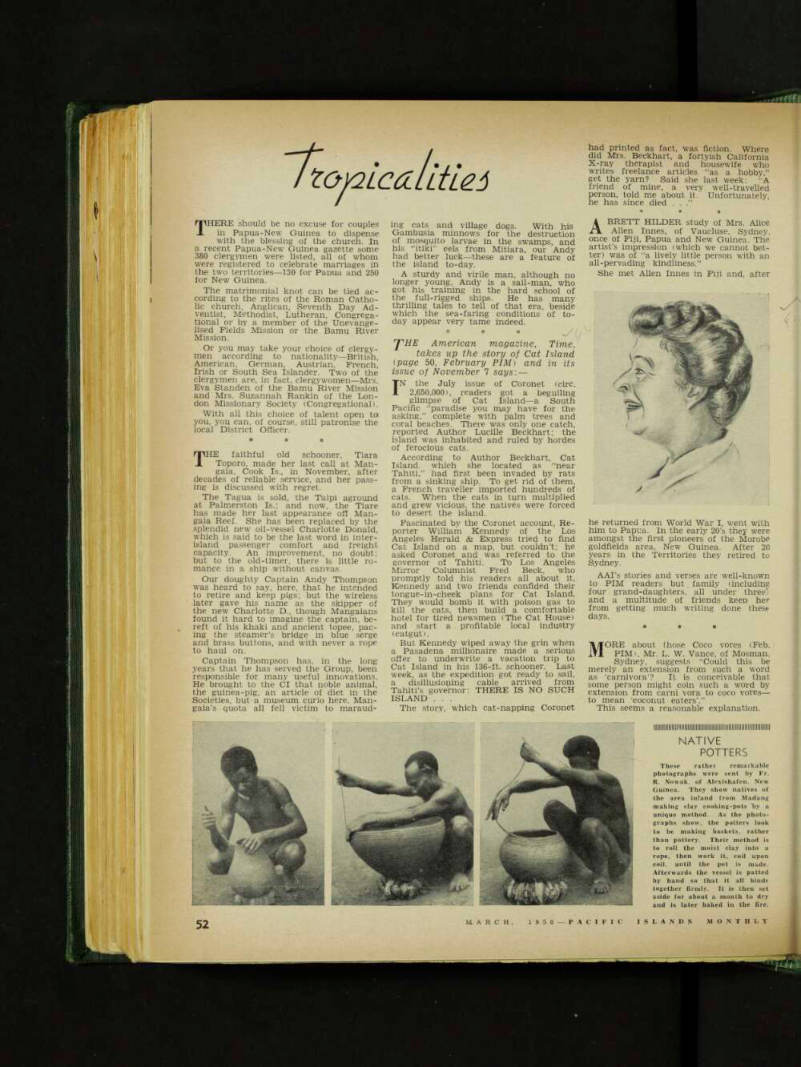
Native
Potters
These rather remarkable photographs were sent by Fr.
R. Nowak, of Alexishafen, New Guinea. They show natives of the area inland from Madang making clay cooking-pots by a unique method. As the photo graphs show, the potters look to be making baskets, rather than pottery. Their method is to roll the moist clay into a rope, then work it, coil upon coil, until the pot is made.
Afterwards the vessel is patted by hand so that it all binds together firmly. It is then set aside for about a month to dry and is later baked in the fire.
Anglo-American Relationships Dept.:
TWO young Americans, Mr. and Mrs. J.
Michener, journalists and authors, have spent the last five or six months in a wander through the South Pacific. Writing from Auckland on Feb ruary 21 to the editor of the PIM, Mr.
Michener says a few charming words of thanks and farewell:— MAY I take this opportunity of thank ing the multitude of South Pacific people who made my visit to these waters so happy and so instructive?
If friendly hospitality of the kind I re ceived from Tom Harris, in Espiritu San to: Fred Archer, in Rabaul; Eddie Lund and Lew Hirshon, in Tahiti; Captain Moore, at Guadalcanal; young Eric Cretier and his truck, in Lae; and Cap tain Morck, of the SS Thor; is standard in the islands, then the reputations of other parts of the world for hospitality are not deserved.
You may be interested in a few brief impressions: The place my wife wants to re-visit— New Guinea.
The place I would like to see more of — Guadalcanal.
The place I remember best —Rabaul.
The best houses I saw —the government houses on the ridge at Honiara.
The best public living—the remarkably fine Club Civil at Espiritu Santo.
The best singing I heard—Tonga.
The most surprising thing I saw—two Chinese basketball teams in Tahiti play
ing as well as most American high school teams.
The intellectual thing that excited me most—the chance that Fred Archer might some day write a book.
The most gifted man I met—Captain Brett Hilder.
The most beautiful girls—still Tahiti.
My most pleasant surprise—the wonder ful care I got at the hospital in Espiritu Santo, where I had malaria. • ♦ ♦ AND, at almost the same time, we re ceived the following from FPA.
I read with mild interest the paragraph in October PIM which said that Mr. and Mrs. J. A. Michener, well-known Ameri can journalists, were visiting the South Pacific Islands. Then I read in the Sydney Bulletin that, in addition to writ ing the successful Tales from the South Pacific, he was an ex-Professor at Har vard and Colorado Universities, and at present was Associate Editor of the Edu cation Department of the McMillan Pub lishing Co. of New York. Quite a guy.
And then, when in Rabaul in Novem ber, I found myself sitting at table with a stout, bespectacled American and his fair wife. I bid them “good morning” and he rose, extending his hand with the remark: “The name is Michener, sir!
And meet my wife!” So I met them in this unexpected manner. Mrs. Michener listens a lot and talks very little.
I was much interested in all he told me about his book, which sold a million copies, but as so many were in the cheaper editions it brought in no fortune.
However, the play founded on the story has been most successful on Broadway.
I knew many of the men he had to do with at Guadalcanal, Munda and at Bougainville so we were off to a good start.
The Bulletin says “He is as modest as they are met” and I would add that he has a lot of patience and forbearance!
We had at the table a gent who for some days had been partaking of strong waters, which gave a stimulus to what I would describe as a natural gift for talking. He was, so he stated, a sawmiller and also interested in politics. This would about describe it, for he talked endlessly about sawmills, bonny logs, Chifley, super feet of timber and the Labour Party, until my brain reeled. However, James Michener, bore with it all and remained polite, whereas he would have been thoroughly justified in crowning the pest with a plate. I admit to having had an inclina tion that way myself.
When, after a week at Rabaul. they left by plane for Honiara, Guadalcanal, to retrace his footsteps thereabouts, I felt glad to have had the opportunity of meeting a much travelled, well informed and courteous man. ♦ * ♦ MR. P. A. SNOW, of Fiji, who cap tained the Fijian Cricket Team which toured NZ in 1948, recently became the successful author of a book which he called Cricket in Fiji.
The book was eiven a good reception in Fiji and New Zealand and, in Febru ary, was given considerable space in the Svdney Morning Herald weekly book re views.
Mr. Snow may count this a feather in his cap. The SMH is not called Granny for nothing, and its literary columns are devoted to the works of literary giants in general rather than to books that one might imagine would have a purely sectionalised appeal. ♦ ♦ ♦ THE wife of a prominent Government official in Apia had noticed for some time that the pasteurised milk sup plied by the New Zealand Reparation Estate’s Vailele Plantation was very watery and thin. She complained to the manager and also had the milk analysed whereupon it was found that a large proportion of water had been mixed with it.
On investigation, the two Samoans run ning the milk delivery truck confessed that for a considerable time past they had drunk milk from the bottles to be delivered and had then filled them up with water from a large container they kept on the truck for the purpose. The two milk lovers now face a Court charge and will be off a milk diet for the time being.—G.
A son was born recently to the Rev. and Mrs. Rodger Brown, well-known Methodist missionaries of New Guinea.
By the Matua, on February 18, a much travelled visitor arrived in Apia, Western Samoa, from Auckland, in the person of Dr. Elizabeth Meyer, who is a student of Eastern art, philosophy and religion.
She is an authority on graphology—the analysis of handwriting for character reading—which is used in vocational guidance, in law courts, and bv insurance companies. She has given lectures on graphology in Australia and New Zea land and in many other countries. Dr.
Meyer has also written a number of plays and poems and she speaks four languages. In addition to all these talents she is a painter. She has travelled extensively in Europe, in China, Japan and Indonesia for the last 15 years, and has also visited Egypt and India. This was her first visit to the South Pacific Islands.