Artist Dobell Finds New Guinea
p. 55 · Read in the full issue
by Colin Simpson
DON’T be surprised if William Dobell packs up his paints and brushes and goes off for a lengthy stay in a re mote part of New Guinea to paint a new kind of Dobell picture.* And, although art is unpredictable, don’t be surprised if Dobell does his best and most important work while liv ing in a bamboo-and-grass hut.
Last year I was hut-mates with Bill Dobell, at Nondugl, in the Wahgi Valley of New Guinea. We were two of the guests flown up from Sydney by Mr. E.
J. Hallstrom, about whose sheep project for the natives I was doing a radio “Walkabout” feature for the ABC. Bill Dobell came along for the ride and the look-around; he hadn’t even brought his oils or brushes, or any canvas.
He had never flown before; and at Mascot he said, with the good-humoured frankness which makes him so likeable: “You’re always doing this sort of thing, but I’m scared stiff!”
As soon as we were air-borne he ac cepted flying in the same way that he fits into any company.
HE had never before walked further, he said, than from King’s Cross to the city—about a mile—but in New Guinea he walked 60 miles in two days.
That was from Nondugl to Mount Hagen, with Dan Leahy. Most of the way he walked in his underpants; and he waded some sizeable and fast-flowing creeks.
When the rest of us flew off from Non dugl with Mr. Hallstrom, Bill Dobell stayed on. He had fallen for the place completely, and for the native people.
He stayed for three weeks with Neptune (Ned) and Mrs. Blood, who manage Non dugl for Mr. Hallstrom. He did not re
turn to Sydney until two months later. And he tells me he wants to go back. In fact, he feels he must go WHAT, you may wonder is there for Dobell—the very civilised and sophisticated Dobell of the Joshua Smith and Margaret Olley nortraits —in a lot of near-naked savages? He is not the kind of artist to fall for a snlash of barbaric colour, pierced noses and bare bosoms, as such. This exotica can be very well por trayed with a colour camera.
I asked Dobell why he was so interested.
“First of all,” he said, “what appealed to me was the dignity of the people—a surprising dignity. They had character that I didn’t ex pect.”
That is not to say that Dobell has turned the good old primitivist somersault, explaining “Ah, Rousseau!
Ah, noble savage!” He is too intelligent for that.
“They lend themselves to such beautiful design. And they are originals. I feel that anything I have done in the past has been done by some other artist, but these subjects have not been done.
I can get something entirely new.”
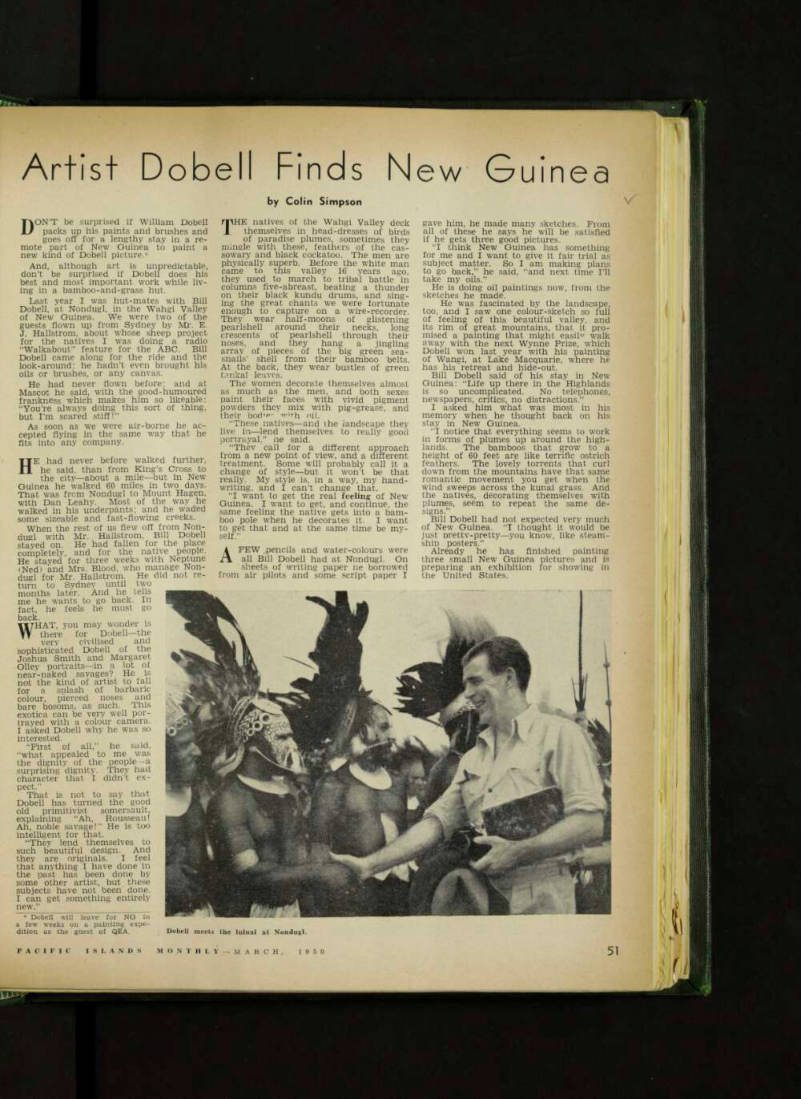
mHE natives of the Wahgi Valley deck L themselves in head-dresses of birds of paradise plumes, sometimes they mingle with these, feathers of the cassowary and black cockatoo. The men are physically superb. Before the white man came to this valley 16 years ago, jw* to march to tribal tattle in columns five-abreast, beating a thunder on their black kundu drums, and singi n g the great chants we were fortunate enough to capture on a wire-recorder, They wear half-moons of glistening pearlshell around their necks, long crescents of pearlshell through their noses, and they hang a jingling array of pieces of the big green seasnails’ shell from their bamboo belts, At the back, they wear bustles of green tanka! leaves.
The women decorate themselves almost as much as the men, and both sexes paint their faces with vivid pigment powders they mix with pig-grease, and their bod’p- w’*h oil.
“These natives—and the landscape they llve m—lend themselves to really good portrayal,” he said.
“Thev call for a different approach from a new point of view, and a different treatment. Some will probably call it a change of style—but it won’t be that really. My style is, in a way, my handwriting, and I can’t change that.
“j wan t to get the real feeling of New Guinea. I want to get, and continue, the same feeling the native gets into a bamboo po i e W h en he decorates it. I want to get that and at the same time be myself.” ..
A FEW .pencils and water-colours were 2\ all Bill Dobell had at Nondugl. On sheets of writing paper ne borrowed from air pilots and some script paper I
gave him, he made many sketches. From all of these he says he will be satisfied if he gets three good pictures, ‘‘l think New Guinea has something for me and I want to give it fair trial as subject matter. So I am making plans to go back," he said, “and next time I’ll take my oils.”
He is doing oil paintings now, from the sketches he made.
He was fascinated by the landscape, too, and I saw one colour-sketch so full of feeling of this beautiful valley, and its rim of great mountains, that it pro mised a painting that might easih r walk away with the next Wynne Prize, which Dobell won last year with his painting of Wangi, at Lake Macquarie, where he has his retreat and hide-out.
Bill Dobell said of his stay in New Guinea: “Life up there in the Highlands is so uncomplicated. No telephones, newspapers, critics, no distractions.”
I asked him what was most in his memory when he thought back on his stay in New Guinea I notice that everything seems to work in forms of plumes up around the high lands. The bamboos that grow to a height of 60 feet are like terrific ostrich feathers. The lovely torrents that curl down from the mountains have that same romantic movement you get when the wind sweeps across the kunai grass. And the natives, decorating themselves with plumes, seem to repeat the same de signs.”
Bill Dobell had not expected very much of New Guinea. “I thought it would be just prettv-pretty—you know, like steam ship posters.”
Already he has finished painting three small New Guinea pictures and is preparing an exhibition for showing in the United States.
* Dobell will leave for NG in a few weeks on a painting expe dition as the guest of QEA,
Dobell meets the luluai at Nondugl.