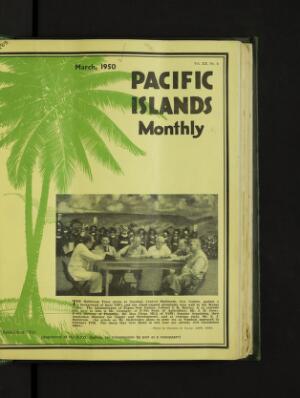
Pacific
Islands
Monthly
March, 1950
Vol. XX. No. 8
Established 1930.
I Registered at the G.P.0., Sydney, jer transmission by post as a ]
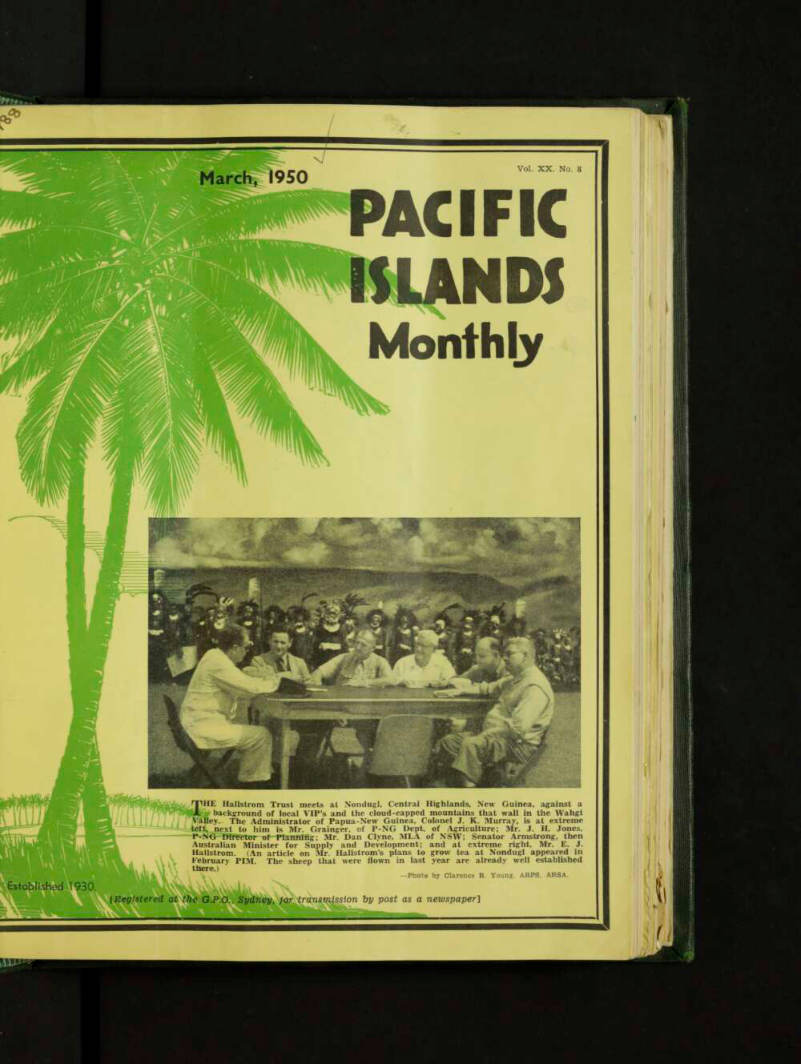
THE Hallstrom Trust meets at Nondugl, Central Highlands, New Guinea, against a background of local VlP’s and the cloud-capped mountains that wall in the Wahgi Valley, The Administrator of Papua-New Guinea, Colonel J. K. Murray, is at extreme left, next to him is Mr. Grainger, of P-NG Dept, of Agriculture; Mr. J. H. Jones, P-NG Director of Planning; Mr. Dan Clyne, MLA of NSW; Senator Armstrong, then Australian Minister for Supply and Development; and at extreme right, Mr. E. J.
Hallstrom. (An article on Mr. Hallstrom’s plans to grow tea at Nondugl appeared in February PIM. The sheep that were flown in last year are already well established there.) —Photo by Clarence B. Young. ARPS, ARSA.
Advertisements & other items, pp. 2-4 (1 item)
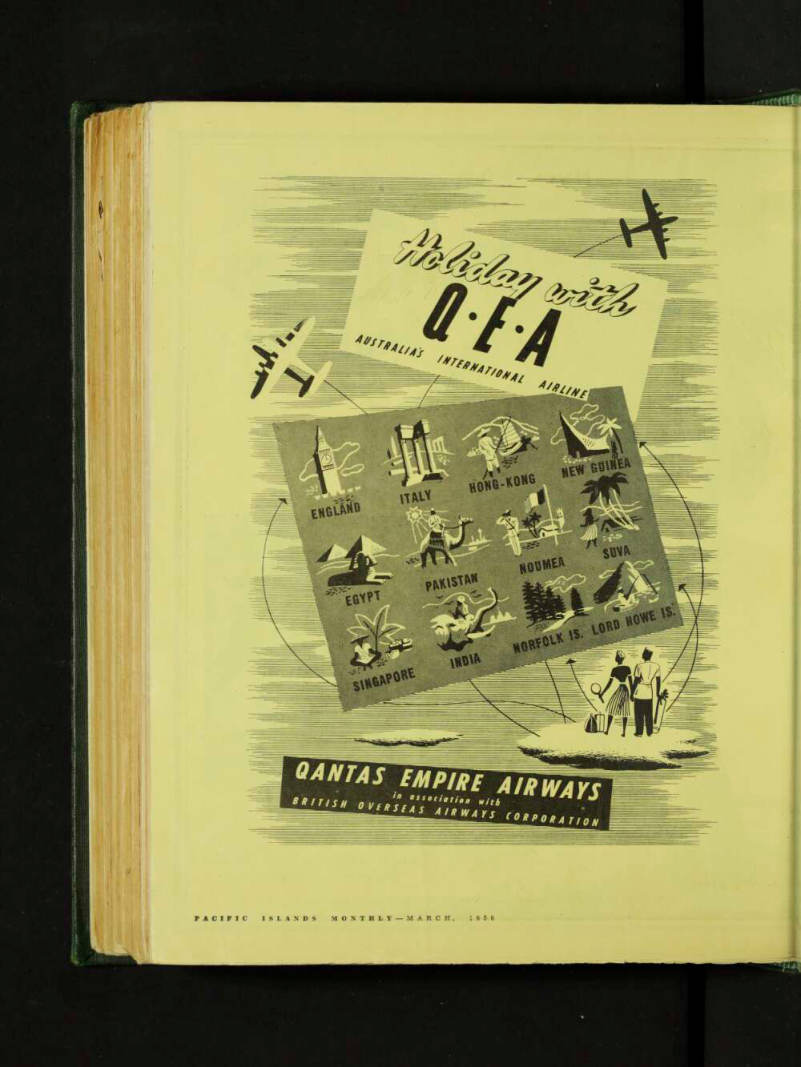
QANTAS empire airways
(J / CJ *4 f/ *S m Vi u""' rfifi c 5 % m
d a I* . ,n OSSociatin* ...•*! *■ " *r 0 V tore ocation with
*'*WAYS CORPORA!, OH
BRITISH
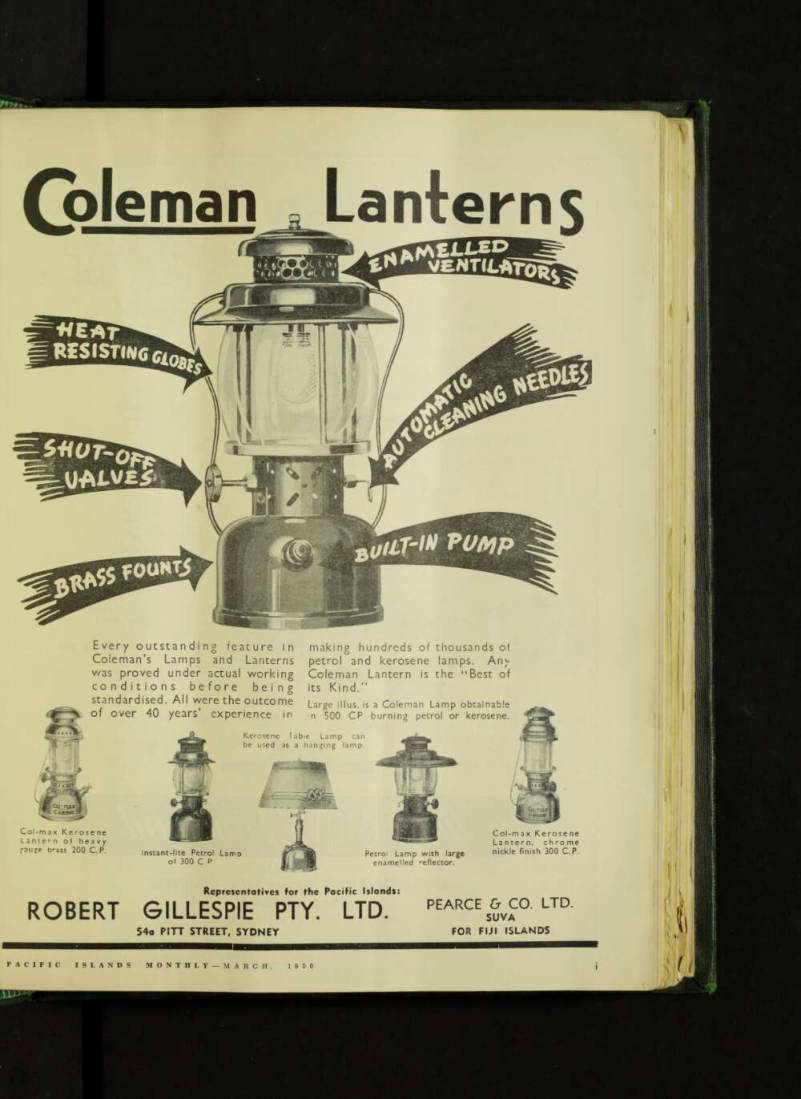
fbleman Lanterns
r# > / Cg..
Every outstanding feature in
Coleman’s Lamps and Lanterns was proved under actual working conditions before being standardised. All were the outcome of over 40 years’ experience in making hundreds of thousands of
petrol and kerosene lamps. Any
Coleman Lantern is the “Best of its Kind.”
Large illus. is a Coleman Lamp obtainable n 500 CP burning petrol or kerosene.
Col-max Kerosene Lantern of heavy gauge brass 200 C.P.
Kerosene Table Lamp can be used as a hanging lamp.
Instant-lite Petrol Lamo of 300 C P f m.
Petrol Lamp with large enamelled reflector.
Col-max Kerosene Lantern, chrome nickle finish 300 C.P.
Representatives for the Pacific Islands:
ROBERT GILLESPIE PTY. LTD
540 PITT STREET, SYDNEY
PEARCE & CO. LTD.
SUVA
FOR FIJI ISLANDS
GOING WEST? w 2
Tour the beautiful countryside of the British Isles in a smooth
riding STANDARD VANGUARD.
With its very roomy boot and seating accommodation for six adults, this 18 H.P. Saloon is ideally suited to your holiday needs and comfort. o H O m o & a We can arrange for you to take delivery of your VANGUARD, “Under Bond,” in Sydney or Brisbane.
WE WILL ATTEND TO ALL THE
FORMALITIES.
Your holidays will be something to remember with pleasure for a long time after your return to the Territory.
We DO, however, require advance notice of your intentions to permit us to finalise all details.
MODELS AVAILABLE:
SALOON
ESTATE CAR
\/AM GUARD
PICK-UP UTILITY
DELIVERY VAN
Z z x 2
G. G. SMITH & COMPANY LIMITED
PORT MORESBY
Distributors for Papua and New Guinea.
Index to Advertisers
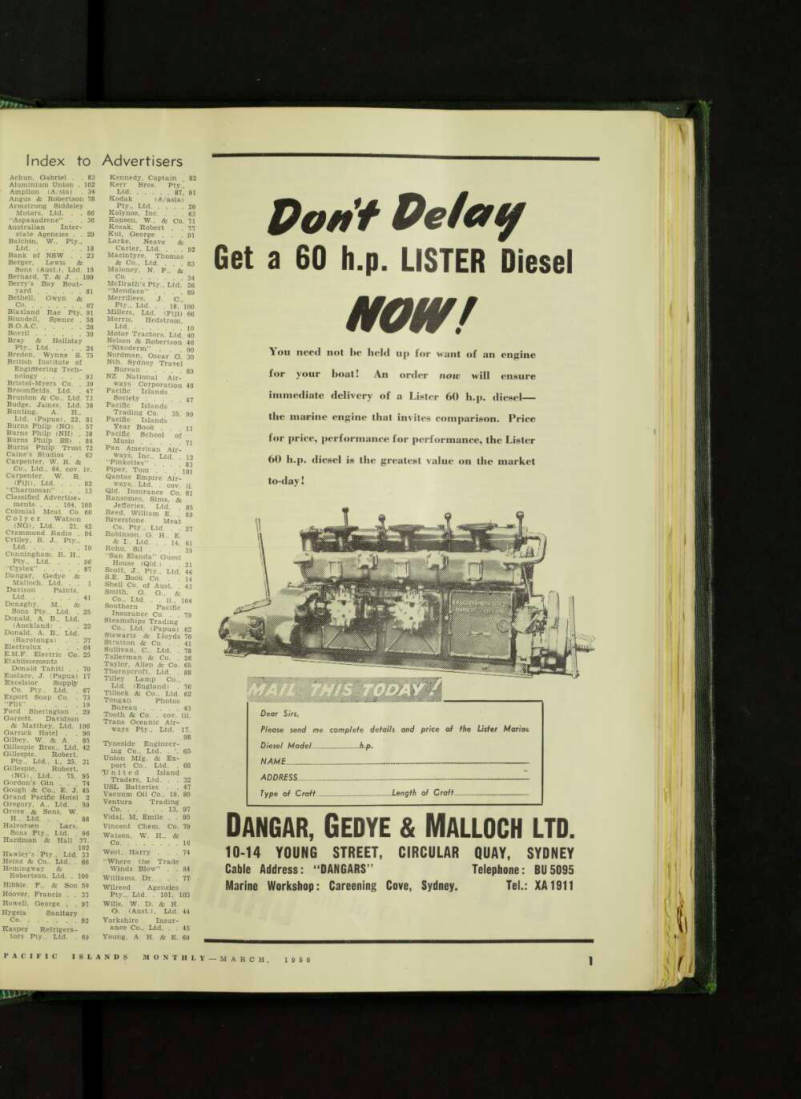
Achun, Gabriel . . 83 Aluminium Union . 102 Amplion (A/sia) . 34 Angus & Robertson 78 Armstrong Siddeley Motors, Ltd. . . 86 “Aspaxadrene” . . 36 Australian Inter state Agencies . . 29 Balchin, W., Pty., Ltd 18 Bank of NSW . . 23 Berger, Lewis & Sons (Aust.), Ltd. 15 Bernard, T. & J. . 100 Berry’s Bay Boat yard 81 Bethell, Gwyn & Co 67 Blaxland Rae Pty. 91 Blundell, Spence . 58 8.0.A.C. ... 28 Bovril 30 Bray & Holliday Pty., Ltd 24 Breden, Wynne S. 75 British Institute of Engineering Tech nology 93 Bristol-Myers Co. . 39 Broomfields. Ltd. . 47 Brunton & Co., Ltd. 73 Budge. James, Ltd. 38 Bunting, A. H., Ltd. (Papua), 22, 81 Burns Philp (NG) . 57 Burns Philp (NH) . 38 Burns Philp SS) .84 Burns Philp Trust 72 Caine’s Studios . . 63 Carpenter, W. R. & Co., Ltd., 64, cov. iv.
Carpenter, W. R. (Fiji), Ltd. ... 82 “Charmosan” ... 13 Classified Advertise ments . . . 104, 105 Colonial Meat Co. 60 Colyer Watson (NG). Ltd. . 21, 42 Crammond Radio . 94 Crilley, R. J., Pty., Ltd 19 Cunningham, R. H., Pty., Ltd. ... 96 “Cystex” 87 Dangar, Gedye & Malloch, Ltd. . . 1 Davison Paints, Ltd 41 Donaghy, M., & Sons Pty., Ltd. . 25 Donald, A. 8., Ltd. (Auckland) . 22 Donald. A. 8., Ltd. (Rarotonga) . 37 Electrolux ... 64 E.M.F. Electric Co. 25 Etablissements Donald Tahiti . . 70 Eustace, J. (Papua) 17 jExcelsior Suppljy Co. Pty., Ltd. . 67 Export Soap Co. . 73 “Flit’’ 19 Ford Sherington . 29 Garrett, Davidson & Matthey, Ltd. 106 Garrick Hotel . . 90 Gilbey, W. & A. . 85 Gillespie Bros., Ltd. 42 Gillespie, Robert, Pty.. Ltd., i„ 25. 31 Gillespie, Robert, (NG), Ltd. . 75, 95 Gordon’s Gin ... 74 Gough & Co., E. J. 45 Grand Pacific Hotel 2 Gregory, A., Ltd. . 59 Grove & Sons, W.
H., Ltd 88 Halvorsen Lars, Sons Pty., Ltd. . 96 Hardman & Hall 37. 102 Hawley’s Pty.. Ltd. 33 Heinz & Co., Ltd. . 66 Hemingway & Robertson. Ltd. . 100 Kibble. F., & Son 59 Hoover, Francis . . 33 Howell, George . . 97 Hygeia Sanitary Co 92 Kasper Refrigera tors Pty., Ltd. . 69
Kennedy, Captain . 82 Kerr Bros. Pty.’
Ltd 87, 91 Kodak (A/asia) Pty., Ltd 20 Kolynos, Inc. ... 63 Kopsen, W., & Co. 71 Kosak, Robert . . 77 Kui, George ... 91 Larke, Neave & Carter, Ltd. ... 92 Maclntyre, Thomas & Co., Ltd. ... 83 Maloney, N. F., & Co. 34 Mcllrath’s Pty., Ltd. 26 “Mendaco” ... 89 Merrillees, J. c.,
Pty., Ltd. . . is, ’loo
Millers, Ltd. (Fiji) 66 Morris, Hedstrom, Ltd 10 Motor Tractors, Ltd. 40 Nelson & Robertson 46 “Nixoderm” . . . 90 Nordman, Oscar G. 30 Nth. Sydney Travei Bureau g 9 NZ National Air ways Corporation 48 Pacific Islands Society ... 47 Pacific Islands Trading Co. . 35, 99 Pacific Islands Year Book . u Pacific School of Music 71 Pan American Air ways, Inc., Ltd. . 12 “Pinkettes” ... 83 Piper, Tom . . . ' 101 Qantas Empire Air ways,. Ltd. . cov. ii.
QJd. Insurance Co. 61 Ransomes, Sims, & Jefferies, Ltd. . 85 Reed. William E. . 89 Riverstone Meat Co. Pty., Ltd. . . 27 Robinson, G. H., E. & 1., Ltd. . . 14,’ 61 Rohu, Sil . . 35 “San Elanda’’ Guest House (Qld.) . . 21 Scott, J., Pty., Ltd. 46 S.E. Book Co. . . 14 Shell Co. of Aust. . 43 Smith, G. G., & Co., Ltd. . . ii.. 104 Southern Pacific Insurance Co. . . 79 Steamships Trading Co., Ltd. (Papua) 62 Stewarts & Lloyds 70 Stratton & Co. . . 41 Sullivan, C., Ltd. . 78 Tallerman & Co. . 26 Taylor, Allen & Co. 65 Thornycroft, Ltd. . 88 Tilley Lamp Co., Ltd. (England) . 76 Tillock & Co.. Ltd. 62 Tongan Photos Bureau 43 Tooth & Co. . cov. iii.
Trans Oceanic Air ways Pty., Ltd. 17, 98 Tyneside Engineer ing Co., Ltd. . *. 65- Union Mfg. & Ex port Co., Ltd. . 68 *U n i t e d Island Traders, Ltd. . . 32 USL Batteries . . 47 Vacuum Oil Co., 19, 80 Ventura Trading Co 13, 97 Vidal, M. Emile . . 95 Vincent Chem. Co. 79 Watson, W. H., & Co 16 West, Harry ... 74 “Where the Trade Winds Blow” . . 84 Williams, Dr, . . . 77 Wilreed Agencies Pty., Ltd. . 101, 103 Wills. W. D. & H.
O. (Aust.), Ltd. 44 Yorkshire Insur ance Co., Ltd. . . 45 Young, A. H. & E. 69
Advertisements & other items, p. 5 (1 item)
Pou f Pe/eftf
Get a 60 h.p. LISTER Diesel
NOW!
for your boat! An order now will ensure immediate delivery of a Lister 60 h.p. diesel— the marine engine that invites comparison. Price for price, performance for performance, the Lister 60 h.p. diesel is the greatest value on the market to-day!
Dangar, Gedye & Malloch ltd.
10-14 YOUNG STREET, CIRCULAR QUAY. SYDNEY
You need not be held up for want of an engine Dear Sirs, Please send me complete details and price of the Lister Marine Diesel Model h.p.
NAME
ADDRESS.
Type of Craft.
Length of Craft.
Cable Address: “DANGARS”
Marine Workshop; Careening Cove, Sydney.
Telephone: 8U5095
Tel.: XAI9II
In This Issue:
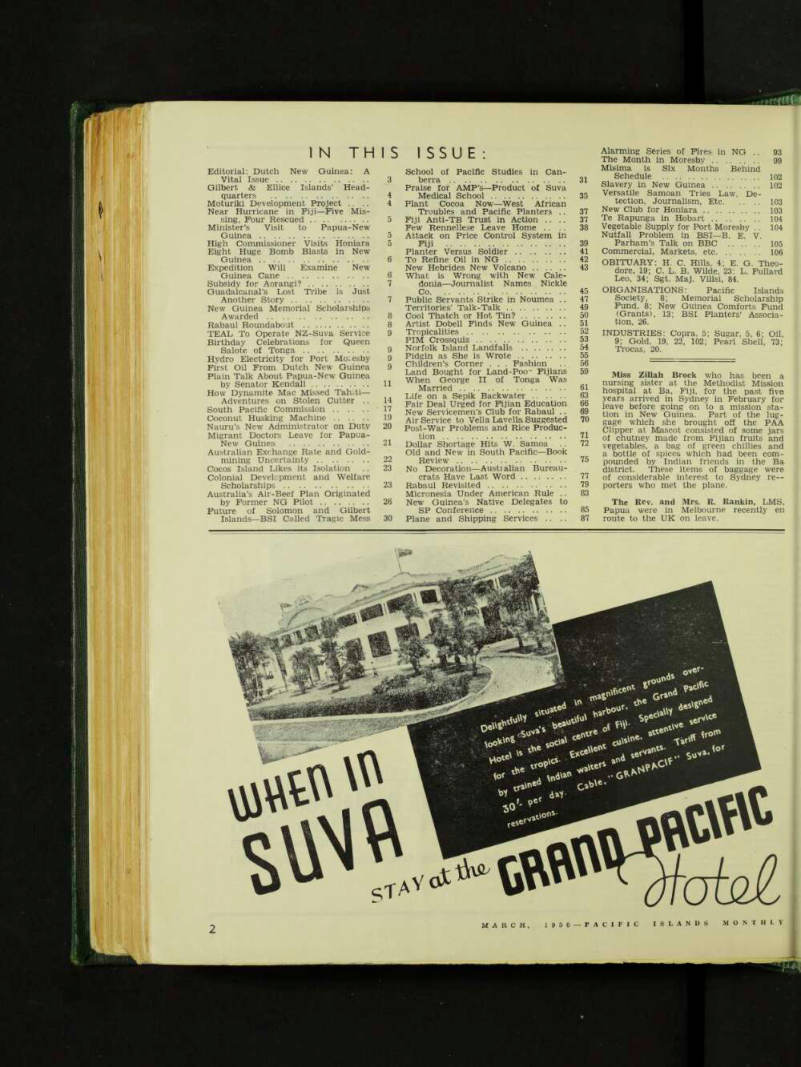
Editorial: Dutch New Guinea: A Vital Issue 3 Gilbert & Ellice Islands’ Head quarters 4 Moturiki Development Project ... 4 Near Hurricane in Fiji—Five Mis sing, Four Rescued 5 Minister’s Visit to Papua-New Guinea 5 High Commissioner Visits Honiara 5 Eight Huge Bomb Blasts in New Guinea 6 Expedition Will Examine New Guinea Cane 6 Subsidy for Aorangi? 7 Guadalcanal’s Lost Tribe is Just Another Story 7 New Guinea Memorial Scholarships Awarded 8 Rabaul Roundabout 8 TEAL To Operate NZ-Suva Service 9 Birthday Celebrations for Queen Salote of Tonga 9 Hydro Electricity for Port Moresby 9 First Oil From Dutch New Guinea 9 Plain Talk About Papua-New Guinea by Senator Kendall 11 How Dynamite Mac Missed Tahiti— Adventures on Stolen Cutter .. 14 South Pacific Commission 17 Coconut Husking Machine 19 Nauru’s New Administrator on Duty 20 Migrant Doctors Leave for Papua- New Guinea 21 Australian Exchange Rate and Gold mining Uncertainty 22 Cocos Island Likes its Isolation .. 23 Colonial Development and Welfare Scholarships 23 Australia’s Air-Beef Plan Originated by Former NG Pilot 26 Future of Solomon and Gilbert Islands—BSl Called Tragic Mess 30
School of Pacific Studies in Can berra 31 Praise for AMP’s—Product of Suva Medical School 35 Plant Cocoa Now —West African Troubles and Pacific Planters .. 37 Fiji Anti-TB Trust in Action ... 37 Few Rennellese Leave Home ... 38 Attack on Price Control System in Fiji 39 Planter Versus Soldier 41 To Refine Oil in NG 42 New Hebrides New Volcano 43 What is Wrong with New Cale donia —Journalist Names Nickle Co 45 Public Servants Strike in Noumea .. 47 Territories’ Talk-Talk 49 Cool Thatch or Hot Tin? 50 Artist Dobell Finds New Guinea .. 51 Tropicalities 52 PIM Crossquiz 53 Norfolk Island Landfalls 54 Pidgin as She is Wrote 55 Children’s Corner . . . Fashion .. 56 Land Bought for Land-Poo Fijians 59 When George II of Tonga Was Married 61 Life on a Sepik Backwater 63 Fair Deal Urged for Fijian Education 66 New Servicemen’s Club for Rabaul .. 69 Air Service to Vella Lavella Suggested 70 Post-War Problems and Rice Produc tion 71 Dollar Shortage Hits W. Samoa .. 72 Old and New in South Pacific—Book Review 75 No Decoration —Australian Bureau crats Have Last Word 77 Rabaul Revisited 79 Micronesia Under American Rule .. 83 New Guinea’s Native Delegates to SP Conference 85 Plane and Shipping Services ... 87
Alarming Series of Fires in NG .. 93 The Month in Moresby 99 Misima is Six Months Behind Schedule 102 Slavery in New Guinea 102 Versatile Samoan Tries Law, De tection, Journalism, Etc 103 New Club for Honiara 103 Te Rapunga in Hobart 104 Vegetable Supply for Port Moresby .. 104 Nutfall Problem in BSI—B. E. V.
Parham’s Talk on BBC 105 Commercial, Markets, etc 106 OBITUARY: H. C. Hills, 4; E. G. Theo dore, 19; C. L. B. Wilde, 23; L. Fullard Leo, 34; Sgt. Maj. Vilisi, 84.
ORGANISATIONS: Pacific Islands Society, 8; Memorial Scholarship Fund, 8; New Guinea Comforts Fund (Grants), 13; BSI Planters’ Associa tion, 26.
INDUSTRIES: Copra, 5; Sugar, 5,6; Oil, 9; Gold, 19, 22, 102; Pearl Shell, 73; Trocas, 20.
Miss Zillah Brock who has been a nursing sister at the Methodist Mission hospital at Ba, Fiji, for the past five years arrived in Sydney in February for leave before going on to a mission sta tion in New Guinea. Part of the lug gage which she brought off the PAA Clipper at Mascot consisted of some jars of chutney made from Fijian fruits and vegetables, a bag of green chillies and a bottle of spices which had been com pounded by Indian friends in the Ba district. These items of baggage were of considerable interest to Sydney re porters who met the plane.
The Rev. and Mrs. R. Rankin, LMS, Papua were in Melbourne recently en route to the UK on leave.
Advertisements & other items, p. 6 (1 item)
St Avt^
/r*m e
AS o>,Cr .ACCO 1 &T ° Un A ?^ C & * V Grao , es^ « 0 ' SpetW 'le s od se^ f .. S uv- <or a\o ed c^ C ’ er . v cr
Pacific Islands Monthly
The Newspaper-Magazine of the South Seas
IRegistered at the G.P.O., Sydney , for transmission hy post as a newspaper 1 Published Once Each Month and Circulated in Australia and New Zealand and in the following Pacific Territories and Islands Groups:
Australian Territory of Papua.
Trustee Territory (Australia) of New Guinea.
Australian Territory of Norfolk Island.
New Zealand Territory of Cook Islands.
Trustee Territory (NZ) of Western Samoa.
British Colony of Fiji.
British Solomon Islands Protectorate.
British Protectorate of Tongan Islands.
British Crown Colony of Gilbert and Ellice Islands.
Trustee Territory of Nauru.
British and French Condominium of New Hebrides.
French Colony of New Caledonia.
French Colony of Oceania (Tahiti, etc.).
American Territory of Eastern Samoa.
American Territory of Hawaiian Islands.
Owned and Produced by Pacific Publications Pty., Ltd., Union House, 247 George Street, Sydney.
Telephone: General Office and Advertising.
BW 5037.
P.O. Box 3408
Registered Address for Telegrams, Radiograms, and Cables: “Pacpub,” Sydney.
Contributions.
Articles, Stories, and Photographs dealing with Pacific Islands subjects are invited and will be paid for on publication.
Subscription Rates.
Per Annum, Pre-paid, Including Postage.
In Australia, New Zealand, Fiji New Guinea, Papua, Western Samoa, Cook Islands, Tonga, British Solo mons, Gilbert and Ellice Colony, Nauru, New Hebrides, and United Kingdom 18 0 Elsewhere $2.50 £1 1 o Single Copies 19
Editor and Publisher:
R. W. Robson, F.R.G.S.
Assistant Editor: JUDY TUDOR.
General Office: Union House, 247 George Street, Sydney. Telephone: BW 5037.
Business Manager: Selwyn Hughes.
Representative In London.
J. T. Wallis, Coronation House, 4 Lloyd’s Avenue, London, E.C.3, from whom may be obtained copies of Pacific Islands Monthly, Pacific Is. Year Book, advertising schedules, etc.
Representative In U.S.A.
Pacific Islands Trading Co., 244 California St., San Francisco, U.S.A.
Agents.
The following are authorised to receive sub scriptions for Pacific Islands Monthly:— Burns, Philp & Co., Ltd., and Burns Philp (South Sea) Co., Ltd. All branches.
W. R. Carpenter & Co., Ltd. All branches.
Morris, Hedstrom, Ltd. All branches.
Steamships Tiding Co., Papua. All branches.
Steele’s Central Store, Suva, FIJI.
Adams Pharmacies Pty., Lautoka, Fiji.
Cook Islands Trading Co., Rarotonga, Cook Is.
A. Vercoe, Apia, Western Samoa.
Oscar Nordman, Papeete, Tahiti.
Islands Branches and Representatives of W. H.
Grove & Sons, Ltd., Auckland, New Zealand.
Ed. Pentecost, Noumea, New Caledonia.
Societe Gubbay Kerr et Cie, Noumea, New Caledonia.
Vol. XXI. No. 8.
March, 1950.
Price
c 1/9 Per Copy.
Prepaid, p.a.; 18/- Aust.
In USA, p.a.: $2.50.
Dutch New Guinea : A Vital Issue
ISLAND affairs generally, and the New Guinea area in particular, have had more attention from Australian Press and radio in the past month than ever be fore. Recent events at last have awakened publicists to the danger that lies immediately northwest of Australia.
And the fact that between overcrowded Asia and under-populated Australia there is now nothing except an anti-European Indonesion “republic” is of equally vital interest to the South Pacific com munities eastward of Australia.
For a long time, it has been apparent that there is great danger to Australia in overcrowded Asia. When the Japanese, using Western war technique, came swarming southwards in 1942, we had fullest justification for all the warn ings issued in the previous 20 years. The Americans broke Japan, and sent the in vader scuttling home; but, to-day, the danger is greater than ever. The menace of a militarist, Imperialistic Japan has been replaced by a hungry Asia that is more than half Communist, and is directed from Moscow by the arch enemies of Western civilisation.
It will be a miracle if the Communists, in the next year or two, do not over-run Southeast Asia—lndo-China, Siam, Burma and possibly Malaya. In such an event, the Communist penetration of the so-called Republic of the United States of Indonesia would be inevitable. With out the protection of America, our hope of ultimate survival, here in the South Pacific, will be feeble.
THAT is why there are already mani festations of strong feeling in rela tion to Dutch New Guinea. Because Western New Guinea is in no way con
nected with Indonesia—and also, prob ably, because of its new oilfields —the Dutch were careful, when framing The Hague Agreement last November, to ex clude New Guinea from the new State of Indonesia. It was agreed that the future status of Dutch New Guinea should be settled during 1950.
Australia noted this arrangement with satisfaction. It meant that Indonesia would approach no nearer the Australian coast than western Timor. It would not have been pleasant to have had Indo nesians, reacting to anti-European and pro-Communist influences, just across Torres Strait, and alongside Australian New Guinea.
But, from the very day the Indonesian flag was hoisted in Batavia, the noisy little spokesmen of the so-called republic have been clamouring for possession of Dutch New Guinea. As part of their campaign, they have been trying to induce the United Nations Organisation to approve the idea that the whole island of New Guinea (Australian Trustee Territory, Australian Papua, and Dutch New Guinea) should be placed under a United Nations Trusteeship, in which Australia, Netherlands and (of course) Indonesia would be jointly concerned.
Both the Dutch and the Australians have frowned upon the idea—it is quite certain that the new Australian Govern ment would not consider it for a moment —but it is indicated that one or two of the little mischief-making Leftist group of UNO are quite intrigued with the plan.
As this is written, Dutch and Indo nesian delegates are assembling in Batavia (Jakarta) for the first of the Dutch-Indonesian meetings provided for
in The Hague Agreement; and, already, there are reports that the Indonesians want the Dutch New Guinea question to be first item on this agenda. The impu dence of these people, in trying to pick a quarrel with Netherlands and Australia over western New Guinea, while they still have to show themselves capable of governing the huge territories which have been placed in their care by The Hague Agreement, has a certain sig nificance.
CABLING on March 8, Mr. Osmar White, well-known correspondent of Melbourne Herald, having completed a tour of Dutch New Guinea, says that large numbers of Dutch and part-Dutch people, who fled from Indonesia when the natives assumed control, are practic ally starving. He says that in Manok wari, there are 1,000 persons trying to subsist on weevily rice and native food stuffs; that, in other centres, hundreds of people are living under conditions that he calls “horrifying”; that scores are arriving on every boat; and that the efforts of the Dutch to deal with a most difficult situation are being systematic ally defeated by an Indonesian blockade of food cargoes intended for New Guinea.
The blockade, he says, extends even to mail.
Only three centres, says Mr. White, have an adequate, if very poor diet. The rest are living a miserable and almost hopeless existence, plagued by malaria and other tropical diseases. A large pro portion of the new arrivals from Indo nesia are office workers and small busi ness men unsuited to New Guinea con ditions; but, they say, they would rather perish in the jungles than return to the humiliation and terror of the new Indo nesia.
Other newspapers, and the Australian
Parliamentarians, have had nothing to say about these disclosures. But Osmar White has done a great service to Aus tralia by showing Australians—and Pacific dwellers generally—what they can expect if ever they find themselves alongside the Indonesian set-up.
Another newspaper correspondent has siezed the occasion to remind Australia that it was Australia’s Dr. Evatt—ably supported by organised gangs of Com munist-led wharf labourers—who did more than any other man in the United Nations to force the Dutch out of Indo nesia, and transfer the vital achipelagoes to Indonesian control.
I'he Dutch New Guinea issue is very important, in itself; but, as an indication of xuture Euxopean-Indonesian relation ship, it has great significance.
Headquarters
G. and E. Colony’s Headquarters
IT appears that, after apparently end less delays, a decision has been reached, by the governing authority in the Gilbert and Ellice Islands Colony, to build the new headquarters of the Administration on Bonriki Islet, on Tarawa atoll.
Before the war, administration head quarters were on Ocean Island, and there were district headquarters on Betio Islet, in Tarawa. The Government establish ment on Ocean Island was destroyed by the Japs, and all the buildings and most of the trees on Betio were swept away in the terrible Battle of Tarawa.
Administrative headquarters were placed on Betio, and on the adjoining islet of Bairiki, when the archipelago was recovered from the Japs, but the ar rangements made were only temporary.
It was decided that there should be no return to Ocean Island; and that Betio, or Bairiki, was too small to carry the whole establishment.
Endless arguments ensued while of ficials examined other atolls and dis cussed building materials and plans. A decision to put the establishment on Abemama atoll, southward of Tarawa, was reached, and subsequently abandoned.
It as then agreed to remain at Tarawa; but no one could decide upon the best type of building material.
Finally, it has been decided to place the establishment upon Bonriki where, it is said, conditions are good, and there is room for the Government buildings, a new hospital, a radio department, a large school, etc. It is stated that cement blocks will be largely used in the con struction.
Bonriki has one serious disadvantage.
It is about 7 miles away from Betio, in the shallower section of the lagoon, and only small ships can anchor there. Larger ships, which come three or four times a year to Tarawa, will have to pick up the atoll’s only product, copra, as formerly, at Betio.
The G & E Colony’s medical depart ment, many months ago, became weary of the long delay and finally established its hospital at Abaokoro Islet, on the western side of Tarawa atoll —said to be a very suitable location. The establish ment, however, will now move to Bonriki.
In 1949, Salialevu retained its record as the wettest place in Fiji. The total rain fall for the year was 312.44 inches, which was nearly 99 inches above the average and over 33 inches above the previous record for a whole year. This record had remained unbroken since 1914.
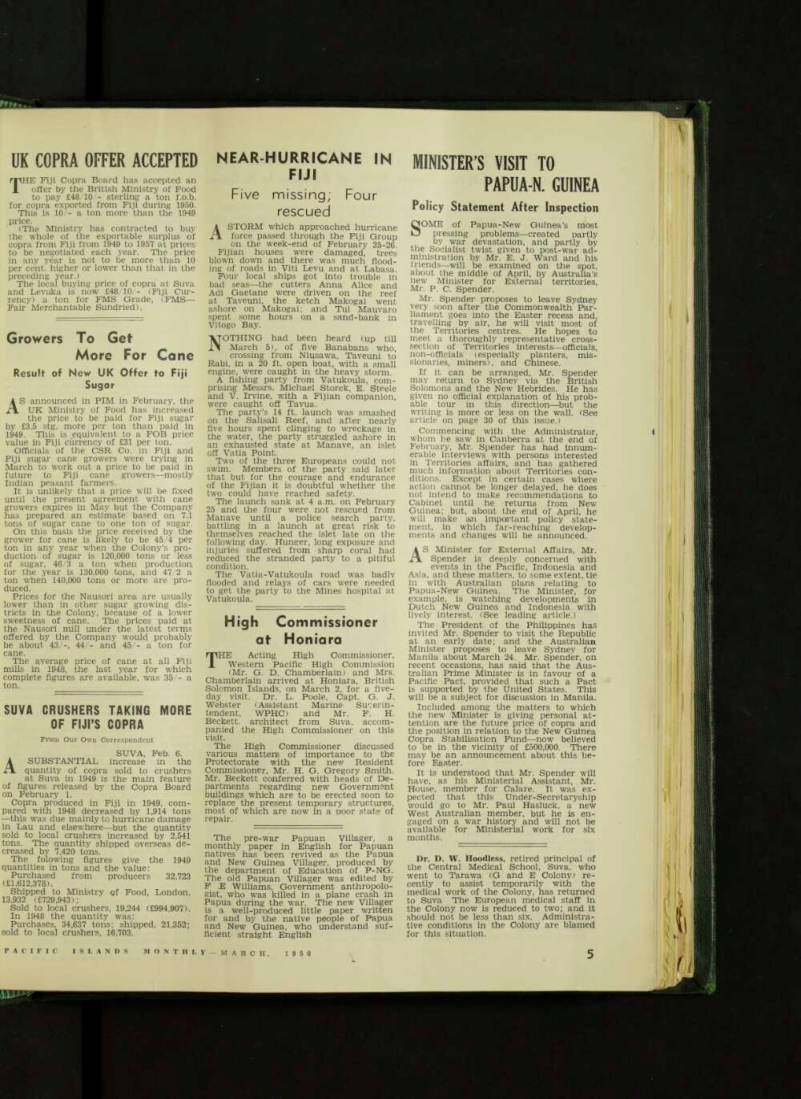
Matua Passengers
Among passengers who arrived hi Suva, Fiji, from NZ on the Matua on February 11, were (left to right): Mr. and Mrs.
G. Dearnley—Mr. Dearnley is anew master at Queen Victoria School, Fiji. Miss V. Eyre, who had spent several months holiday in NZ. Mr. and Mrs. A. C. A. Bryant who have just left the UK—Mr. Bryant will join the WPHC staff. Mr. R.
Genge, seen greeting his young daughter—he was manager of the Suva yacht crew at the Empire Games. Mr. V. Irwin, of Emperor Goldmining Cos., Fiji, returned from leave in NZ.
Mr. A. G. Reay, who also has been on NZ leave. Mrs. E. A.
Davis who has been visiting a daughter in the Dominion.
Mrs. J. Brown and her daughter—they have been in New Zealand for the past year where Miss Brown has been study ing stenography.
Moturiki Development Project
Preliminary Survey Being Made
THE team that has been chosen to carry out the Moturiki Development Project left Suva for the island on February 14. They will make a prelim inary survey.
The experiment on Moturiki, a small island off the Viti Levu coast, which will be conducted by the Government of Fiji as part of a South Pacific Com mission project, was described at some length in the December PIM and is, briefly, planned community development.
The members of the team that will organise the project are: Eliki Seru (leader) 32 years old Organising Teacher of the Fiji Education Department: Lusciana Boilam, an Assistant Nurse; Saiasa Seru, an Agricultural Field As sistant; Pataresia Vosavakarua, handi crafts and homecrafts instructress; Apo rosa Duwai, Instructor in carpentry; Nemani Drue, anti-filariasis worker m the Fiji Health Department. A forest guard is also to be included in the team.
Late News
Canberra, Mar. 22.
OFFICIALLY announced British-Aus tralia copra agreement reached, providing £4B/10/- stg. per ton (increase of 10/- stg.) from March 1, 1950. Prices paid New Guinea copra producers are now being reviewed by the Department of Ex ternal Territories. (New UK price represents only 10/ per ton stg. increase but it is expected that Australian Territories Department will re duce present deductions for charges and stabilisation fund.)
Captor
Death Of Von Lugkner’S
MR. H. C. HILLS, who as a police officer stationed in Levuka, Fiji, was responsible for the capture of Count Von Luckner, during the 1914-1918 war died in Auckland on March 4 at the age of 65.
Von Luckner was in command of the German raider Seeadler, which was wrecked on an island in the Society Group. With five of his crew, he travelled more than 2,000 miles in the ship’s launch to Fiji. The narty reached Wakaya, where they were seen by Cap tain Kini Macpherson, of the cutter Eleaner A.
He reported to the authorities at Levuka that he was sure that the six men in the launch at Wakaya were Ger mans. He was told to go back to Wakaya to watch developments. Meanwhile the steamer Amra arrived from Taveuni, and Mr, Hills with a party of Fijian police went aboard and set out for Wakaya.
The Amra lay across the passage to prevent Von Luckner’s launch from get ting away, and Mr. Hills and his police men set out in the ship’s boat to inter cept Von Luckner and a companion who had been on shore when the Amra appeared. Von Luckner surrendered without opposition, but later was ex tremely annoyed when he found that Mr.
Hills’ revolver whs not loaded and that the Amra was not armed. He himself had a machine gun, thousands of rounds of ammunition, grenades and rifles on his launch.
He said afterwards that he thought that the square ports in the bows of the Amra were gun-ports. They were actually spaces left to give air to the cattle being carried on board.
Uk Copra Offer Accepted
THE Fiji Copra Board has accepted an offer by the British Ministry of Food to pay £4B/10/- sterling a ton f.o.b. for copra exported from Fiji during 1950.
This is 10/- a ton more than the 1949 price. (The Ministry has contracted to buy the whole of the exportable surplus of copra from Fiji from 1949 to 1957 at prices to be negotiated each year. The price in any year is not to be more than 10 per cent, higher or lower than that in the preceding year.) The local buying price of copra at Suva and Levuka is now £4B/10/- (Fiji Cur rency) a ton for FMS Grade, (FMS — Fair Merchantable Sundried).
Growers To Get
More For Cone Result of New UK Offer to Fiji Sugar
AS announced in PIM in February, the UK Ministry of Food has increased the price to be paid for Fiji sugar by £3.5 stg. more per ton than paid in 1949. This is equivalent to a FOB price value in Fiji currency of £3l per ton.
Officials of the CSR Co. in Fiji and Fiji sugar cane growers were trying in March to work out a price to be paid in future to Fiji cane growers—mostly Indian peasant farmers.
It is unlikely that a price will be fixed until the present agreement with cane growers expires in May but the Company has prepared an estimate based on 7.1 tons of sugar cane to one ton of sugar.
On this basis the price received by the grower for cane is likely to be 45/4 per ton in any year when the Colony’s pro duction of sugar is 120,000 tons or less of sugar, 46/3 a ton when production for the year is 130,000 tons, and 47 2 a ton when 140,000 tons or more are pro duced.
Prices for the Nausori area are usually lower than in other sugar growing dis tricts in the Colony, because of a lower sweetness of cane. The prices paid at the Nausori mill under the latest terms offered by the Company would probably be about 43/-, 44/- and 45/- a ton for cane.
The average price of cane at all Fiji mills in 1948, the last year for which complete figures are available, was 35/- a ton.
Suva Crushers Taking More
Of Fiji’S Copra
From Our Own Correspondent
Suva, Feb. 6.
A SUBSTANTIAL increase in the quantity of copra sold to crushers at Suva in 1949 is the main feature of figures released by the Copra Board on February 1.
Copra produced in Fiji in 1949, com pared with 1948 decreased by 1,914 tons —this was due mainly to hurricane damage in Lau and elsewhere—but the quantity sold to local crushers increased by 2,541 tons. The quantity shipped overseas de creased by 7,420 tons.
The folowing figures give the 1949 quantities in tons and the value: Purchased from producers 32,723 (£1.612,378).
Shipped to Ministry qf Food, London, 13,932 (£729,943); Sold to local crushers, 19,244 (£994,907).
In 1948 the quantity was: Purchases. 34,637 tons; shipped, 21,352; sold to local crushers, 16,703.
Near-Hurricane In
Fiji
Five missing; Four rescued
A STORM which approached hurricane force passed through the Fiji Group on the week-end of February 25-26.
Fijian houses were damaged, trees blown down and there was much flood ing of roads in Viti Levu and at Labasa.
Pour local ships got into trouble in bad seas—the cutters Anna Alice and Adi Gaetane were driven on the reef at Taveuni, the ketch Makogai went ashore on Makogai; and Tui Mauvaro spent some hours on a sand-bank in Vitogo Bay.
NOTHING had been heard (up till March 5), of five Banabans who, crossing from Niusawa, Taveuni to Rabi, in a 20 ft. open boat, with a small engine, were caught in the heavy storm.
A fishing party from Vatukoula, com prising Messrs. Michael Storck, E. Steele and V. Irvine, with a Fijian companion, were caught off Tavua.
The party’s 14 ft. launch was smashed on the Salisali Reef, and after nearly five hours spent clinging to wreckage in the water, the party struggled ashore in an exhausted state at Manave, an islet off Vatia Point.
Two of the three Europeans could not swim. Members of the party said later that but for the courage and endurance of the Fijian it is doubtful whether the two could have reached safety.
The launch sank at 4 a.m. on February 25 and the four were not rescued from Manave until a police search party, battling in a launch at great risk to themselves reached the islet late on the following day. Hunger, long exposure and injuries suffered from sharp coral had reduced the stranded party to a pitiful condition.
The Vatia-Vatukoula road was badly flooded and relays of cars were needed to get the party to the Mines hospital at Vatukoula.
High Commissioner
at Honiara
THE Acting High Commissioner, Western Pacific High Commission (Mr. G. D. Chamberlain) and Mrs.
Chamberlain arrived at Honiara, British Solomon Islands, on March 2. for a five day visit. Dr. L. Poole, Capt. G. J.
Webster (Assistant Marine Superin tendent, WPHC) and Mr. F. H.
Beckett, architect from Suva, accom panied the High Commissioner on this visit.
The High Commissioner discussed various matters of importance to the Protectorate with the new Resident Commissioner, Mr. H. G. Gregory Smith.
Mr. Beckett conferred with heads of De partments regarding new Government buildings which are to be erected soon to replace the present temporary structures, most of which are now in a noor state of repair.
The pre-war Papuan Villager, a monthly paper in English for Papuan natives has been revived as the Papua and New Guinea Villager, produced by the department of Education of P-NG.
The old Papuan Villager was edited by F .E Williams, Government anthropolo gist, who was killed in a plane crash in Papua during the war. The new Villager is a well-produced little paper written for and by the native people of Papua and New Guinea, who understand suf ficient straight English
Minister’S Visit To
Papua-N. Guinea
Policy Statement After Inspection
SOME of Papua-New Guinea’s most pressing problems—created partly by war devastation, and partly by the Socialist twist given to post-war ad ministration by Mr. E. J. Ward and his iriends—will be examined on the spot, about the middle of April, by Australia’s new Minister for External territories, Mr. P. c. Spender.
Mr. Spender proposes to leave Sydney very soon after the Commonwealth Par liament goes into the Easter recess and, travelling by air, he will visit most of the Territories centres. He hopes to meet a thoroughly representative* cross section of Territories interests—officials, non-officials (especially planters, mis sionaries, miners), and Chinese.
If it can be arranged, Mr. Spender may return to Sydney via the British Solomons and the New Hebrides. He has given no official explanation of his prob able tour in this direction—but the writing is more or less on the wall. (See article on page 30 of this issue.) Commencing with the Administrator, whom he saw in Canberra at the end of February, Mr. Spender has had innum erable interviews with persons interested in Territories affairs, and has gathered much information about Territories con ditions. Except in certain cases where action cannot be longer delayed, he does not intend to make recommendations to Cabinet until he returns from New Guinea; but, about the end of April, he will make an important policy state ment, in which far-reaching develop ments and changes will be announced.
AS Minister for External Affairs, Mr.
Spender is deeply concerned with events in the Pacific, Indonesia and Asia, and these matters, to some extent, tie in with Australian plans relating to Papua-New Guinea. The Minister, for example, is watching develooments in Dutch New Guinea and Indonesia with lively interest. (See leading article.) The President of the Philippines has invited Mr. Spender to visit the Republic at an early date; and the Australian Minister proposes to leave Sydney for Manila about March 24. Mr. Spender, on recent occasions, has said that the Aus tralian Prime Minister is in favour of a Pacific Pact, provided that such a Pact is supported by the United States. This will be a subject for discussion in Manila.
Included among the matters to which the new Minister is giving personal at tention are the future price of copra and the position in relation to the New Guinea Copra Stabilisation Fund—now believed to be in the vicinity of £500,000. There may be an announcement about this be fore Easter.
It is understood that Mr. Spender will have, as his Ministerial Assistant, Mr.
House, member for Calare. It was ex pected that this Under-Secretaryship would go to Mr. Paul Hasluck, a new West Australian member, but he is en gaged on a war history and will not be available for Ministerial work for six months.
Dr. D. W. Hoodless, retired principal of the Central Medical School, Suva, who went to Tarawa (G and E Colony) re cently to assist temporarily with the medical work of the Colony, has returned to Suva The European medical staff in the Colony now is reduced to two; and it should not be less than six. Administra tive conditions in the Colony are blamed for this situation.
Eight Huge Bomb Blasts
Destruction of Half Million Pounds’ Worth of Munitions In N. Guinea
By K. H. Mccoll
Aitape, Feb. 22.
A FEW hundred acres of devastated scrub, and eight huge craters, mark the spot where the much-discussed Tadji Bomb Dump once stood.
The demolition of nearly 4,000 tons of bombs has been completed, and the last scars of the Pacific War now await the quick growth of the Tropics to cover their nakedness.
The actual demolition took place in eight “blows,” over a period of a month.
On certain days there were no explosions, so that air-craft could use the Tadji strip, and maintain communication with Wewak.
Under the able direction of F/Lt. E. S.
Banks, OIC, RAAF Bomb Demolition De tachment, the whole operation went off without accident or discomfort to either Europeans or natives in the area.
In Aitape, 7 miles from the scene, very little blast or noise was apparent, but we had a good view of the spectacle.
The final blow, in particular, was most spectacular. Comprising about 1,500 tons of 1,000, 500, and 250 pounders, in one long “street,” it was the biggest single explosion of the operation. When it oc curred, a sheet of red flame shot up; then spear-points of intense fire, like the points of the rising sun badge, whipped out from the main flame, the points reaching about 2,000 feet. Around this blast the atmosphere condensed into a white ring, which was whirled away with the flash.
Then a huge cloud of black smoke rose, in a great pillar, followed by a cloud of steam from the surrounding swamp. This column rose to approximately 8,000 feet, and drifted slowly away to sea.
BY courtesy of P/Lt. Banks, I was able to accompany the party, and take some photographs of them “fusing up” one of the dumps. This was very in teresting: but I must admit that I was the first into the jeep when the fuse was lit, and I cast many an apprehensive look backwards as we drove away from the place.
The method of fusing the dump was very interesting. Certain bombs in each pile were marked for fusing. The main lines of Primer Cord were run out over each heap, with shorter lengths, running to the noses of the “exploder” bombs, joined on. These shorter pieces were equipped with detonators, which were in serted into the “exploder” bombs—an operation which caused me many fearful moments.
About the centre of the main Primer Cords, a slab of TNT was placed on the cord itself; then a length of ordinary delay fuse, with detonator, was inserted into this slab.
When the TNT exploded, it in turn exploded the Primer Cord, and every “exploder” bomb was detonated instan taneously.
The Primer Cord has a core of high explosive which, when detonated, flashed at approximately 8,000 metres per second.
THIS dump, where I witnessed the fusing, comprised 470 tons of mixed stuff, including several incendiary bombs. My photograph, taken from the Raihu strip, 5 miles away, shows the white feathers of the burning incen diaries, thrown to a height of about 2,000 feet, and sailing out to sea.
Very little metal was thrown onto the Tadji air-strip; but after the big dump (1,500 tons) went off, the roadways, up to about a mile radius, were impassable to motor traffic, as fragments of all sizes completely littered the roads and sur rounding ground.
Round about the explosion areas, the
ground has been completely denuded of vegetable growth. Big trees and scrub have been demolished and the blasts have blown them into tangled heaps around the area. The blast itself went on into the scrub to a depth of half a mile, leav ing twisted and broken trees and sago palms.
The last blow of 1,500 tons of bombs, which were ranged in a line about half a mile long, has left a “canal” of that length; while some of the other blows have left great craters 20 feet deep, and up to 80 yards across.
And so £500,000 worth of explosives are now just a memory.
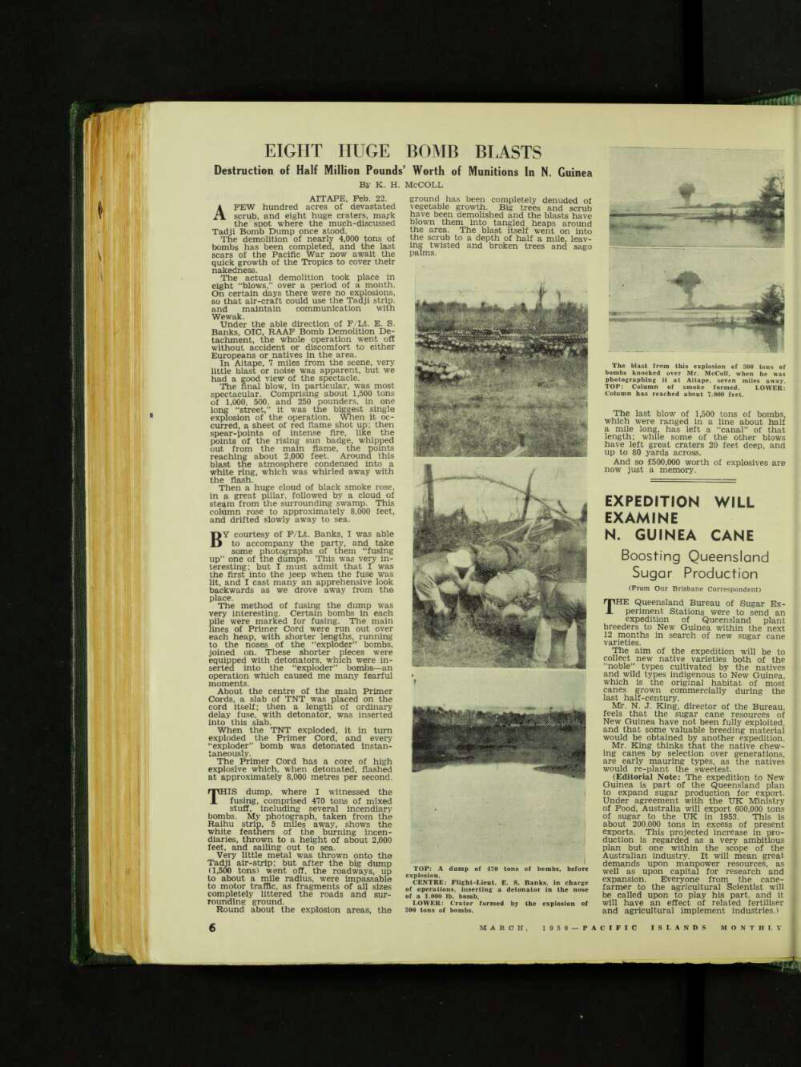
TOP: A dump of 470 tons of bombs, before explosion.
CENTRE: Flight-Lieut. E. S. Banks, in charge of operations, inserting a detonator in the nose of a 1,000 lb. bomb.
LOWER: Crater formed by the explosion of 300 tons of bombs.
The blast from this explosion of 300 tons of bombs knocked over Mr. McColl, when he was photographing it at Aitape, seven miles away.
TOP: Column of smoke formed. LOWER: Column has reached about 7,000 feet.
Boosting Queensland
Expedition Will
Examine
N. Guinea Cane
Boosting Queensland Sugar Production
(Prom Our Brisbane Correspondent) THE Queensland Bureau of Sugar Ex periment Stations were to send an expedition of Queensland plant breeders to New Guinea within the next 12 months in search of new sugar cane varieties.
The aim of the expedition will be to collect new native varieties both of the “noble” types cultivated by the natives and wild types indigenous to New Guinea, which is the original habitat of most canes grown commercially during the last half-century.
Mir. N. J. King, director of the Bureau, feels that the sugar cane resources of New Guinea have not been fully exploited, and that some valuable breeding material would be obtained by another expedition.
Mr. King thinks that the native chew ing canes by selection over generations, are early mauring types, as the natives would re-plant the sweetest. (Editorial Note: The expedition to New Guinea is part of the Queensland plan to expand sugar production for export.
Under agreement with the UK Ministry of Food, Australia will export 600,000 tons of sugar to the UK in 1953. This is about 200.000 tons in excess of present exports. This projected increase in pro duction is regarded as a very ambitious plan but one within the scope of the Australian industry. It will mean great demands upon manpower resources, as well as upon capital for research and expansion. Everyone from the cane farmer to the agricultural Scientist will be called upon to play his part, and it will have an effect of related fertiliser and agricultural implement industries.)
Subsidy For Aorangi?
Difficulies of Maintaining Service
THE Canadian-Australasian Line (a subsidiary of Union Steamship Com pany of New Zealand) has asked the Governments of Australia, New Zealand and Canada for an operational subsidy to maintain their trans-Pacific passenger service with Aorangi.
This was stated by the Prime Minister of New Zealand at the end of February.
He said that the three Governments concerned had not yet conferred, but the proposal was under consideration by New Zealand.
Aorangi is the only passenger ship on the Australasia-North America run.
Before the war there were about half a dozen, of which two were the American liners Mariposa and Monterey, Aorangi returned to the run after the war and a two year’s refit which cost well over £1 million. She made her first post-war voyage in August, 1948.
During refitting much of the former passenger accommodation was converted to better crew accommodation. There fore Aorangi carries fewer passengers these days. Furthermore, due to dollar restrictions, there is comparatively little freight to be carried between North America and Australasia. Running costs and wages have more than doubled, time spent in ports trebled. There is active competition from three trans-Pacific air services The difficulties of running the Aorangi can be said to be similar to those en countered now by all overseas shipping companies. Whatever the cost, however, the Aorangi should be kept running. If she were withdrawn trans-Pacific com munications would slip further back into the dark ages than they were 100 years ago.
Landing Trucks On Mangaia
Full Of Thrills
MANGAIA, Cook Is.
ALTHOUGH more than half-a-dozen motor-trucks have been successfully lightered, balanced precariously be tween two whaleboats or large canoes, over Mangaia’s dangerous coral-reef, up to the last Maui Pomare’s call none of those engaged in unloading them suffered injury. This fortunate record was, how ever, broken in late November, when a native constable had one of his feet crushed by a truck that was being lowered onto the lighters.
Swinging a three-ton truck overside, as must be done here, and lowering it with exact nicety on two narrow floating plat forms, is a job requiring no little skill both aboard the steamer and the lighters.
Any miscalculation would mean the precious vehicle diving to disaster in Davy’s damp locker. Conversely, any unhandy work by the boatmen may re sult in one or more of them receiving the weight of the heavy truck on limb or body.
In spite of the accident, the truck was brought to the beach, and is now in Ad ministration service.
Oil Exploration In Papua
AUSTRALASIAN Petroleum Company Pty., Ltd., reports the following progress for the month of Feb ruary:— HOHORO: The hole has been deepened 672 feet from 3,760 feet to 4,432 feet.
UPOIA: 131 inch casing has been ce mented at 2,597 feet. The hole has been deepened 490 feet from 2,662 feet to 3,152 f cot WAN A AND MALALAUA: Rig erection is in progress.
ORLOLI; An access route to the rig has been selected.
Suva Cathedral
Work has begun on the founda tions of Fiji’s Anglican Cathedral.
Contractors are Whan Construction Co. Large notice board says: “£lO,OOO urgently needed now, will you help?"
Photo by Stinson’s Studios.
Guadalcanal's Undiscovered People
Just Another Tall Tale
By A. H. Wilson, Formerly Commissioner of Land in British Solomon Islands.
TO the Question of whether an undis covered people inhabit the moun tains of central Guadalcanal (Feb.
PIM), my answer is an emphatic No!
The subject has cropped up at regular intervals over the past 30 years, to my knowledge. I first heard it discussed in May, 1919, while undergoing a term of quarantine on the SS Mindini in Sydney Harbour, prior to my first trip to the British Solomon Islands Protectorate.
Some of the old hands on board amused themselves by recounting to the new chum, hair-raising tales of life in the Solomon Islands, of which the Guadal canal “Mumu” man was one.
During my early years in the Protector ate I frequently heard mention of the matter, both from natives and Europeans.
As my work took me into some of the most remote places, I was sufficiently in terested to test out some of these rumours, but invariably arrived at the stage where “somebody had heard the details from somebody else who had &c. &c.”
On more than one occasion a sample of material purporting to be the hair of these strange humans was produced, and I know of instances of gullible Europeans having purchased these from natives as curios. One such sample, exactly similar to others I had seen, found its way to Tulagi in 1935 or thereabout, with fear some stories of the manner in which it had come into the possession of its native owner. Examination by an Officer of the Department of Entomology very quickly revealed that the sample was of vegetable origin.
Prior to the discovery of gold on Guadalcanal by S. F. Kajewski, very little was known of the interior of the island.
Beyond a vary rare trip by the Govern ment Officer, or a not-so-rare trip by certain missionaries, Europeans had not ventured very far beyond the coastal fringes of the island. The gold discovery, however, changed all that. Prospectors penetrated to the very rough and mountainous area said to be the habitat of the mystery race, but brought back no information of anything out of the ordinary in the way of human life.
MY official duties took me into the in terior of Guadalcanal fairly fre quently between 1932 and the early war years. In 1938, while on an inspection trip, I made an attempt, from one of the prospecting camps, to locate a route to the top of the highest mountain on Guadalcanal, erroneously known as “Popomanasui,” shown on the Admiralty chart as being 8,005 feet high. As my route would traverse the area said to be the home of the Mumu race, I took the op portunity on that occasion of investigat ing the story so far as I was able.
I failed in the attempt to reach the
top of the mountain, the correct name of which is “Hai-a-cha,” but from the top of a lower mountain range, at an altitude of about 6,000 feet (the real “Popoman asui ’) I was able by observation to locate a route by which the higher mountain was later climbed by Charles Kuper, son of Henry Kuper, who recently died at Santa Anna, BSI.
I had as a guide a very old but sur prisingly active chief named Rangaki bona, from the central mountain district of Guadalcanal, with a number of his retainers as carriers. During the five days trip I questioned these natives very closelv on every aspect of the possibility of exist ence of any strange race, past or present and learned that the majority of natives of that area do firmly believe that such a race exists at the present time, and in the country we were traversing.
These unusual people are known as Mumu, Moka, or Mola, and are supposed lon g-baired, large-eyed creatures with long sharp teeth and finger-nails.
Their mode of progression is to hop on the toes of both feet simultaneously, with hands carried at waist level and finger nails pointed forward. (A demonstration given). When hungry or disturbed they emit a cry somewhere between the wail ing of a baby and the bark of a large savage dog. (Attempts at imitation, but rather unsuccessful).
One was said to have been burned to death when the natives of Vololo, a village below Lion’s Head Mountain, fired a grass patch.
When was this? “Comparatively re cently,” I was told. * Could I visit the place and perhaps re trieve some of the bones? “Oh, Yes!” At least I could see the grass, which had grown up again since the fire, but never the less should be adequate proof of the veracity of the story—but as for bones, well, there just weren’t any. Perhaps the thing had no bones.”
I QUESTIONED Rangakibona at some length, in the absence of his followers , . and arrived at the conclusion that the tales told have no foundation whatever in fact, either 1 as to a present or a past race. Our own children (and I believe in some parts of the so-called civilised world, have a belief in the existence of fames, goblins, &c. The Guadalcanal mountain natives, most of whom greatly resemble children in some respects, simply have an equivalent belief. And if a little exaggeration or manipulation of evidence will help to make a good story done? mPr6SS an audience ’ what harm is That the repetition of the tale with its various embellishments will sometimes convince the natives themselves is under standable in the circumstances.
Scholarships
N. Guinea Memorial Scholarships Three Awarded for 1950
ALTHOUGH no New Guinea Memorial Scholarship was awarded in 1949, three have been awarded for 1950.
They went to Loloma Linggood, lan G.
Stanton Crouch, and Nigel R. C. Cooper.
The following are a few notes on pre sent scholarship winners: LOLOMA LINGGOOD is the daughter of the late Rev. William L. Ling good who, until he lost his life in the Montevideo Maru had lived for 12 years in New Guinea, at Raluana Metho dist Mission Station. Mrs. Linggood has lived in Melbourne since losing her home in New Britain and Loloma attends the Methodist Ladies College. Bill Linggood, her brother, won the first NGM Scholar ship, his three years term finishing last year. He is still at Wesley College for another year or two and hopes to follow in his father’s footsteps and go back to New Guinea as a Missionary.
Nigel Robert c. cooper is the son of the late Dr. Robert William Cooper MBE who joined the New Guinea Administration as medical officer in 1931. Dr. Cooper was stationed in various places in the Territory and in 1937, the year Nigel was born, was decor ated for his work in Rabaul at the time of the eruption. He also, lost his life in the Montevideo Maru . Nigel has been at Scotch College since he went to Mel bourne in 1941 and will continue his studies there. Swimming is his partic ular sport and he has not decided whether medicine or the land will be his future career. lAN STANTON CROUCH is at Wesley College, Melbourne. His father was a Padre in New Guinea during the war and has been attached since 1946, to the Education Department, firstly in Port Moresby and later in Madang. lan was Junior Champion Gymnast at Wesley last year and this year in the Senior School has already made the under 14 A teams in cricket and tennis. He is to decide between Medicine and Engineer ing as a profession.
THE fifth Scholarship holder whose third year finishes at the end of 1950, is Norman Ashby, son of the late Mr. Stan Ashby, who was one of the oldest Territorial residents—he went to the Kavieng district in 1921 and he also lost his life in the Montevideo Maru.
Norman got his Intermediate Certificate last year. Fishing and golf are his special sporting interests, and his am bition is to go back to New Ireland and plant up the family property “down the road” from Kavieng.
Pacific Islands Society
THE Pacific Islands Society’s monthly meeting in February was somewhat different from usual in that it took the form of an exhibition of paintings of Pacific Islanders, by Captain Brett Hilder and a talk by the artist on the circum stances surrounding his painting of them.
Captain Hilder, son of the late J. J.
Hilder, probably Australia’s most famous water-colourist, is skipper of Burns Philp’s Morinda but apart from this he is well known in the Pacific for his stories and sketches. It seems likely that he will become as well known as a water colourist in his own right.
Advertisements & other items, p. 12 (1 item)
Correction
IN the February issue of PIM we stated that the tariff in the Club Hotel, Suva, Fiji was 17/6 per day. This is not so—tariff is £1 per day.
Rabaul Roundabout
Prom Our Own Correspondent
GREAT interest and, from certain sec tions of the European community, considerable criticism, was evoked at Rabaul when the Administration re cently announced that a “consolidated school” would be established.
At present there are two separate schools maintained by the Administra tion at the shaky township which is the capital of New Britain. These two schools cater for European and Chinese pupils respectively—a third school is maintained by the Catholic Mission at which Malays attend.
It is the intention of the Administra tion to build a combined school which will accommodate the children of the three races. A block of buildings is in course of construction, pleasantly situ ated at the Recreation Grounds.
The Administration claims that the consolidated school will result in practi cal economy of teaching staff, increased efficiency and a better educational pro gramme for the children.
The new school is expected to open about August, 1950. In the meantime the European pupils are accommodated in a' new school which opened in February. (As reported in January PIM. the pro posal to combine Rabaul’s educational facilities., caused considerable agitation among Rabaul’s European community. A protest was also sent to Australia’s Prime Minister. However, protests apparently have availed them nothing. This is a subject which can be argued pro and con infinitum. It is interesting to note, however, that even in more raciallv toler ant Fiji, for example, each race usually has its own school.) RAIN on the night of February 24 and early on 25th broke all known re cords at Rabaul; 1,094 points were recorded.
This was a culmination of a week of wet weather when 24 inches of rain fell.
Incidentally, the annual rainfall for Rabaul is about 80 inches so that over a quarter of the year’s rain was re ceived in six days.
Great damage was done especially to stores of cement and building materials at the Works and Housing Sheds and to all roads leading out of Rabaul. A dam burst which caused the flooding of the W/ and H. sheds and staff quarters.
Native hospital, prison and barracks were flooded by torrents from Mt. Kombui but little structural damage was caused to buildings. Lighting and telephone sys tems were both disrupted and economy in the use of electricity, which has been temporarily repaired, is reouired.
Greatest damage has been done to roads leading out of Rabaul —the two roads to Kokopo, the road to Keravat and the most vital of all, the road to the Nonga Escape Camp, which was com pletely destroyed. This is the only es cape route for most of the population in the event of an eruption; with the road cut off, Rabaul would be a death trap.
Fortunately the rain slackened off during the next two days—although an additional inch of rain fell—enabling the roads to be cleared. Good work has been done by the Works and Housing men in the area. . All culverts are lost and there are weeks of work ahead.
The total damage is estimated at
£Loo,Ooo.
ON February 1 the District Officer, Mr.
J. K. McCarthy, departed by Cata lina aircraft for a fortnight’s visit to the Talasea sub-district of New Britain,
. Primary purpose of his visit was the inauguration of village councils through put the area. While there the DO also inspected Administration Mission native schools and hospitals.
Ir L9 onnection with the village councils or Kivungs, to use the native name, a number of men have been brought to Rabaul to study the council system here This was operating before the war.
After a three months observation and training course these men will return to their villages and begin the formation of councils in Talasea.
Talasea, which includes the Witu Group is a very large sub-district hav ing the longest coastline of any sub district in the Territory, and a popula tion of about 30,000 natives. There are a number of prosperous plantations in me area, either company or privately owned, including Garua Island Plantation !S e u Property of Mr. Dyson Hore-Lacy, probably the largest cocoa producer in JNtr; San Remo owned by Mr. K. C.
Douglas; Lagenda, the property of Mr!
Jack Thurston, planted and managed by Mr. Rod Marsland; Bali, owned by Mr Harold Goldham; and Numundo Planta tion a property of 10,000 acres owned by New Guinea Co. Numando is a new property acquired by the company just prior to the recent war, and has only a small area planted at present. When fully planted it will be the largest pro perty in the Territory.
MRS. UNA ADAMS was the hostess at a delightful party held at her Malaguna Road home in Rabaul on February 1. She was assisted by her daughter, Marie, and sons, John and Meldrum. Her guests came from Rabaul and Kokopo.
DURING the month the Church of England Ladies’ Guild has been busy raising money for the Church Building Fund.
On February 3 a card evening was held at the home of Mrs. Chris Normoyle, Kombui Avenue, from which the net pro ceeds were UUIO/-. And on February 10 a cake stall was opened for a couple of hours outside the Rabaul Cinema which resulted in £lO.
These two amounts have been handed to the Church Council.
Sister Elizabeth henry, Nama nula Hospital, Rabaul, was trans ferred to Manus during February.
As Sister Henry has been a resident of Rabaul since the latter end of the war, she will be missed by all her friends and as a very capable nurse.
Miss Henry was the guest of honour at a farewell party given by the Namanula Hospital Staff at the Island Paradise Cabaret.
Dr. George Tweedie Of The Phd,
Manus arrived in Rabaul recently to take up duty as Rabaul’s Admini stration medico. Dr. Tweedie, a Scots man, has been in the Territory only about 12 months and was joined by his wife and small daughter a few months ago.
NAMANULA Hospital has been a busy place during February. A daughter was born to Mr. and Mrs. Robin Mackay, Bougainville. A son to the Rev. and Mrs. Rodger Brown, Vunarima, New Britain. A son to Mr. and Mrs. Gloynes, Keravat, New Britain. And a daughter to Mr. and Mrs. Dalkeith Chambers, Induna Plantation, New Britain.
TEAL to Operate
NZ-Suva Service
IT is expected that Tasman Airways will shortly take over the operation of the Auckland-Suva flying-boat service that is now run by the New Zea land National Airways Corporation.
The change-over is expected to take place on April 4. Mr. G. N. Roberts, general-manager of TEAL has been in Suva making the necessary arrange ments.
NAC run the service with a con verted Sunderland, Takitimu, which comes up for its annual survey for air worthiness in April. It will be three months out of service. TEAL will use Solents on the service. This will reduce the crossing between Auckland and Suva to 6i hours.
In the meantime progress is being made with TEAL’s £250,000 building pro gramme at Mechanic’s Bay, Auckland.
New buildings under construction, or planned, are workshops, sound-proof engine testing rooms, hangars, instru ment repair shops, etc.
Some changes will be made in the time-table for the Suva-Labasa service after TEAL take over on April 4. The aircraft will leave Laucala Bay at 9 a.m. on Tuesday arriving at Malau at 9.45 a.m. She will leave Malau again for Suva at noone, arriving at Laucala Bay at about 12.45 p.m.
Skymasters on Sydney-
New Guinea Service
ON March 13 Qantas Empire Airways commenced operating two of the five services per week between Sydney and New Guinea with Skymasters (Douglas DC4), On Tuesdays and Saturdays the Sky masters leave Sydney at 7.30 p.m. and Brisbane at 11.30 p.m., arriving Port Moresby the following morning at 6.20 a.m. and Lae at 9.20.
The Skymasters depart from Lae at 8 a.m. on Thursdavs and Mondays and arrive in Sydney at 9.45 p.m. the same day.
The other services—departure from Sidney on Mondays, Wednesdays and Fridays—will be operated as before by DC3’s.
The extension of the run from Lae to Bulolo and Wau will now be carried out by the Douglas DC3 which leaves Sydney on Mondays.
New Airliners For
Trans Pacific Service
CPA Will Have Jet Planes in 1952
1171 TH three air services operating W across the Pacific between Sydney and/or Auckland, NZ, and the North American Pacific coast, travellers are sure of being provided with aircraft of latest design.
At present, British Commonwealth Pacific Airlines have the most advanced type of aircraft—DC6’s —but their rival companies, Canadian Pacific Airlines and Pan-American Airways, recently an nounced plans for putting more advanced planes than the DC6’s on the Pacific route.
PAA expect, within three months, to replace the present DC4 aircraft, used in their service with Boeing Stratocruisers, the largest aircraft in the world.
CPA, at present using 36-passengei Canadair airliners have announced that they have placed orders for two British De Haviland Comets and are negotiating for more. These 500-miles-an-hour jet
propelled airliners are expected to be on the Sydney-Vancouver run in early 1952 or late 1951. CPA pilots are going to England next year to take courses in jet airliner operation and the planes will be put in service immediately they are de livered.
The Comets will carry 48 passengers and normally cruise at 40,000 feet. They could travel between Sydney and Van couver in about 18 hours flying time.
Birthday Celebrations
For Tonga's Queen She will be 50 on March 13; 32 Years on Throne
PREPARATIONS are being made in Tonga to celebrate fittingly Queen Salote’s 50th birthday, which falls on Monday, March 13.
The Acting High Commissioner for the Western Pacific (Mr. G. D. Chamberlain) and the Acting Governor of Fiji (Mr.
A. F. R. Stoddart) will go to Nukualofa from March 12 to March 14 to attend the celebrations.
Queen Salote Tupou is an outstanding example of a wise and good native mon arch ruling benevolently over a native community. Apart from her position as head of the ruling house of Tonga, she has a sense of quiet natural dignity that has created in the world at large great respect, not only for Tongans and the Kingdom of Tonga, but for Polynesia as a whole.
The little Kingdom, which is constitu tionally unique in the Pacific, could very easily be regarded as a sort of comic opera state. That it is not is due largely to the fine personal qualities of Queen Salote and her sons.
Queen Salote came to the throne of Tonga in 1918 as a girl of 18. That same year she had married Prince Tungi who, as well as Queen’s Consort; was for many years Premier of Tonga. He died in 1941.
DEMOCRATIC government is main tained in Tonga on the British pat tern of an elected Parliament intro duced by her grandfather King Tapou I in 1875. But Queen Salote in no mere Royal cipher. She has the gift of good commonsense and is the dominant figure in the Privy Council, which, subject to ratification by Parliament, rules Tonga for the greater part of the year.
Queen Salote and late Prince Tungi.
Hydro-Electricity For
Moresby
From Our Own Correspondent
Port Moresby, March 8.
Expenditure of £192,000 to provide a hydro-electric power supply at Port Moresby has been approved by the External Territories Department.
The Department’s decision was a sur prise to residents The scheme has been talked about for so long that most people did not expect it to become reality. It is significant perhaps that approval came so soon after the new Australian Liberal Government took office in Australia.
According to experts, it will take three or four years to put the scheme into operation. Surveys of the Laloki River for possible sites for the hydro station have been made and are continuing. The station will probably have a maximum generating capacity of 5,000 kilowatts— five times the capacity of the present power house. In the early stages, how ever, the Station’s capacity will be 3,000 kilowatts.
What residents are most interested in is the possibility of cheaper power.
Officials say that hydro-power will be cheaper but they will not give a definite estimate. Unless the administration changes its atitude, it seems that resi dents will have to wait for the coming of hydro-power before they get relief from heavy electricity costs. As far as the pre sent power supply is concerned, the position should improve in two or three months. Two generators for the power house a.re due to arrive from England late this month but it will take several weeks to install them.
First Oil From
Dutch New Guinea More Suitable for Lubricants Than Petrol
IN February the first crude oil from the Sorong field, Dutch New Guinea, reached the Vacuum Oil Co.’s re finery at Altona, Melbourne. Three hundred Australian businessmen later watched the first gallons of lubricating oil distilled from the crude.
The Altona refinery is expected to save Australia about a million dollars a year and provide about half the industrial lubricating oils used in Australia. The refinery would also provide some of Aus tralia’s petrol requirements but not just yet from the crude from the new New Guinea field.
The Sorong field oil, said the manag ing director of Vacuum Oil Company (Mr.
Harold Rabling), was of unusual com position. It contained only a minor pro portion of the light fractions that made petrol and kerosene and a large propor tion of the fractions from which bitu men and lubricating oil could be made.
He said that operations began in the field in 1939 but that during the war 90 per cent, of its equipment was lost. Op erations were resumed in 1946, and the first tanker shipment of crude oil was made in December, 1948, 13 years after the* concession was originally granted.
Production has now increased to 500 tons a day.
About 60 million dollars have so far been spent on Dutch New Guinea leases.
In Papua about £7 million has already been invested without finding oil but prospects are said to be “as good as when the venture first started.”
It is known that the Commonwealth Government is anxious to extend re fineries in Australia as this is a big fac tor governing petrol supplies.
Advertisements & other items, p. 14 (1 item)
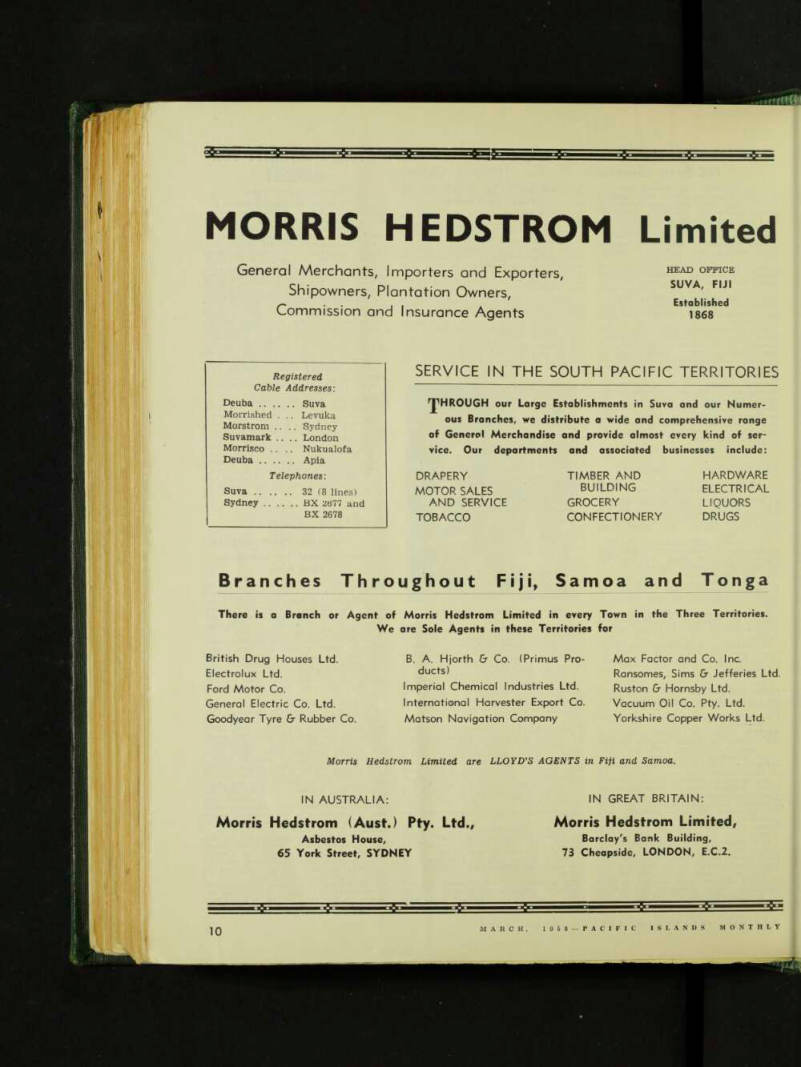
Morris Hedstrom Limited
General Merchants, Importers and Exporters,
Shipowners, Plantation Owners,
Commission and Insurance Agents
HEAD OFFICE
SUVA, FIJI
Established 1868
SERVICE IN THE SOUTH PACIFIC TERRITORIES
'J'HROUGH our Large Establishments in Suva and our Numerous Branches, we distribute a wide and comprehensive range of General Merchandise and provide almost every kind of service. Our departments and associated businesses include:
DRAPERY
MOTOR SALES
AND SERVICE
TOBACCO
TIMBER AND
BUILDING
GROCERY
CONFECTIONERY
HARDWARE
ELECTRICAL
LIQUORS
DRUGS
Branches Throughout
Fiji, Samoa and Tonga
There is a Branch or Agent of Morris Hedstrom Limited in every Town in the Three Territories.
We are Sole Agents in these Territories for
B. A. Hjorth £r Co. (Primus Products) Imperial Chemical Industries Ltd.
International Harvester Export Co.
Matson Navigation Company
British Drug Houses Ltd.
Electrolux Ltd.
Ford Motor Co.
General Electric Co. Ltd.
Goodyear Tyre £r Rubber Co.
Max Factor and Co. Inc.
Ransomes, Sims £r Jefferies Ltd.
Ruston & Hornsby Ltd.
Vacuum Oil Co. Pty. Ltd.
Yorkshire Copper Works Ltd.
Morris Hedstrom Limited are LLOYD’S AGENTS in Fiji and Samoa.
IN AUSTRALIA:
Morris Hedstrom (Aust.) Pty. Ltd Asbestos House, 65 York Street, SYDNEY •#
IN GREAT BRITAIN:
Morris Hedstrom Limited, Barclay's Bank Building, 73 Cheapside, LONDON, E.C.2.
Plain Talk About Papua-New

Guinea
Roy Kendall’s Address To Australian Senate
SOON after the Australian Parliament assembled, at the end of February, Senator Roy Kendall, of Queens land, who recently made a tour of Papua and New Guinea, placed before the Sen ate an interesting summary of conditions in the two Territories, as he found them.
This probably was regarded by the new Government as valuable information, be cause Senator Kendall was formerly a resident of New Guinea and has had long experience on which to base com parisons.
The prewar administrations of Papua and New Guinea, said Senator Kendall, were recognised throughout the world as being humane and efficient, in relation to native welfare, with a policy directed towards the steady promotion of self government. Furthermore, New Guinea then was self-supporting, and Papua cost the Australian taxpayers only about £40,000 per annum. To-day the two ter ritories were in a deplorable state—and they were costing the Australian taxpayer about £3,000,000 per annum.
The Senator said that perhaps the time had come to revise labour conditions; and the complete dislocation of govern ment caused by the war provided an op portunity of doing away with the old indenture system and substituting, for native workers, an apprenticeship system of training, extending from three to five years, according to trades. Instead, the Wardist administration allowed the old indenture system to remain—but dered it unworkable by introducing new native labour ordinances, one of which limits the period of contract to one year.
All employers know that after the native has been recruited —in itself an expensive business—the native is of little value in the first six months. Consequently the emplover gets no more than six months’ work from his labourer—and the latter is returned to his village without earn ing anything.
For four years, said the Senator, the Wardist administration had been trying to build the second story of its structure without first having laid the foundations.
Native Demonstration
ONE of the worst features of the Wardist attempt at what was called native rehabilitation was the pay ment of war damage compensation to natives who, in many cases, probably did not own half the goods they claimed for.
That money should have been put into village trusts for the betterment of the whole community, rather than for in dividuals. The method followed had been like that of giving £2O to a child of 6 years, and telling him to spend it as he wished.
A large proportion of the money had been spent with Chinese stores and traders, on unessential things. The natives had learned to seek alcohol. Al though the police had no cause against the Chinese storekeepers, the fact re mained that the natives had acquired a taste for spirits, which they were indulg ing.
“Natives who, at the end of the war, were looking forward to cleaning up the country and getting back to ‘good fella time before,’ are now sitting back wait ing for more pennies from heaven,” said the Senator,” and they are now being allowed to degenerate into supplicants, depending on Welfare State govern ment,”
Shipping Services
THE Senator dealt at length with the condition of the shipping industry in New Guinea, concerning which there has been much criticism in recent months. The Act relating to inter- Island shipping, he said, prohibits ves sels which are privately owned from carrying cargoes other than those be longing to the owner of the vessel. It was impossible financially, and economi cally ridiculous, for each plantation owner to maintain a vessel for his ex clusive use—so the Government ships have a complete monopoly. An inquiry into the operation of this monopoly had brought to light the following points: • The vessels are owned by the De partment of External Territories. • European personnel for the vessels is supplied by the Australian shipping Board. • The manning of the vessels by natives, and the maintenance, are done by private companies, on a percentage payment. • All copra produced is bought and handled by the Production Control Board. • Other cargo is supplied by private firms, but is loaded by the PCB. • The territories Directorate of Ship ping is responsible for the routing of the vessels. • The PCB obtains its native labour from the Administration, but the labour is controlled by officers of the Native Labour Department.
“The natural result of this extraordin ary system of divided control is complete chaos, and frustration of everyone con cerned, and delay in rehabilitation,” said Senator Kendall.
The small ships were in such a con dition that never more than two-thirds of the fleet were in operation—usually less —and on January 24 no less than 64,200 bags of copra were lying at plantations, etc., awaitaing shipment—their total value being £275,000. Overseas ships should have been loaded with copra at ports like Kavieng and Kieta, so as to relieve the congestion.
Timber Industry
THE policy at present being followed in the Territory in relation to timber production is of course in keeping with Socialist ideas of the late Govern ment and it has been frequently stated that the timber is to be left for pos terity” said the Senator. “It is my be lief that we are posterity.”
“It is also suggested that we should wait until the Forrestry Department can train cadets competent to survey the existing stands of timber. Everyone ap parently has forgotten that these stands were surveyed before the war by com petent private surveyors.”
The Senator said that he believed that in the Wau area there were 20 million super feet of pine; 190 million super feet in the Bulolo Valley; 250 million super feet of Kumerare alone in New Britain, plus Lope, Callypillum, Quila, Taun and Erima.
Timber was being milled by New Guinea Goldfields at Wau for the Gov ernment to reconstruct the native vil lage at Hanuabada, Port Moresby—but there was no timber for Europeans. Re cently New Guinea, which possessed
(Continued on Page 97)
these remarkable timber resources, im ported no less than 250,000 super feet of timber from New Zealand, at 149/- per 100 super feet.
The Fate Of Rabaul
THE Senator commented strongly upon the muddle over the rebuilding of Rabaul. Rabaul was completely obliterated during the war; and, ob viously, if the Administrative centre for that area was to be removed from Rabaul, owing to the earthouake menace, the time to make the decision was on the Australian re-occupation, at the end of the war. But officialdom had shown a singular reluctance to give any real guide.
The people were told, during the past four years, to build temporary structures at Rabaul —and now these structures vere falling down—and still there was no decision. The Department of Exter nal Territories said that a decision tb go to Kokopo was made in 1947: but no one in Rabaul appeared to know of this decision —and. what was more significant, there was no building or wharf construe tion work going on at Kokopo.
Residents Have No Voice
COMMENTING upon the present sys tem of Administration, the Senator pointed out that the European resi dents of the Territory have no voice whatever in the Government. Under the old system, before the war, both Terri tories had at least a Legislative Council, where the voices of the people could be heard. Legislative Councils have been promised, since the war, but have never materialised. The present system of gov ernment by Executive Council was simply a Soviet system—a dictatorship.
High Cost Of Living
THE Senator directed attention to the conditions under which Europeans official and non-official alike—were suffering. They had to pay 7/4 per lb. for tea, 5/1 for butter, 2/1 for a loaf of £56 per ton for rice. The reply that non-official people were* enjoying high prices for their primary products, overlooked the fact that those products paid an export duty while, in relation to imports, the people were treated as if they were residents of a foreign country.
The way in which permanent officials were treated was shown by the high wages and the privileges accorded to the rank and file of the Australian De partment of Works and Housing, now temporarily in the Territory. Works and Housing men were messed for 16/per week, while Administration men— who in many cases got less than half the W. and H. pay, were charged 35/per week for messing.
The Senator directed attention to the fact that the planters had been trying for years to obtain from the Production Control Board a statement of accounts— and especially the amount at the credit of the Copra Stabilisation Fund which, it was presumed, would be distributed among producers. He pointed out that the Department of Lands is still without an Ordinance covering Titles. He directed attention to the fact that patrol officers, medical assistants and agricul
tural inspectors were not now making patrols, except in isolated cases.
The Senator said that the abolition by the Wardist Administration of the native head tax had still further en hanced the natives’ idea of the “welfare state.” He said that a sick benefit or health insurance tax for natives at 20/or 30/- per head should be instituted.
The engagement has been announced of two old Territorians —Marjorie Ross of Rabaul, daughter of Mrs. Jean Hawnt, and Mr. Charles Blake also of Rabaul Mr. and Mrs. Hawnt arrived in Rabaul in 1919 and their three children were the first Australian children in the Territory.
Mr. Hawnt was lost on the Montevideo Maru. Charles Blake arrived in the Ter ritory in 1927, as a member of the Ad ministration staff but soon resigned and has since been interested in mining plantations and lately, small ships. The wedding wil take place at Rabaul Metho dist church in March. Only a few intimate friends will be present.
Advertisements & other items, pp. 15-16 (1 item)
Year Book
PACIFIC ISLANDS
1950 EDITION
To Be Published Shortly
THIS is now the world’s Standard Reference Book on the Islands of the Pacific. There have been five earlier Editions—in 1932, 1935, 1939, 1942 and 1944. The 1944 Edition, which was called the Wartime Edition, carried a great deal of material dealing with the Pacific War, and contained 384 pages and many Inset Maps.
Since the end of the Pacific War, in 1945, practically every Territory in the Pacific has been subject to farreaching changes of a political, social and commercial character.
Consequently, the 1944 Edition has been completely revised, so as to show these numerous changes.
The book has been enlarged to take care of a great deal of additional matter. There are, for example, new sections dealing with Air Transportation, the Trusteeship Territories, the South Pacific Commission, the new market background behind' the Copra Industry, and so on. There are new and improved maps.
Every Territory and Islands Group is described in detail — geography, history, administration, population, commerce, education, health, etc.
There is a complete directory of all the Christian Missions operating in the South Pacific Islands. The Index has been checked and enlarged.
There is a complete History and Chronology of the Pacific War (1941-1945).
Production has been much delayed by Australia’s economic and industrial troubles, but the new book is now scheduled for early publication.
PRICE: 21/- Australian —$2.50 Add 6d., or 6c. for Postage The Edition is limited, so please order your copy early.
Pacific Publications Pty., Ltd.
Union House, 247 George St.,
Sydney
(or P 0 Box 3408, Sydney)
Now... fly by Clipper
to ENGLAND at this m £325.0.0 £585.0.0 One Way Round Trip
LOW
EYDEII
EArE Pi vE
FARE
From Sydney. Add internal fare from other States.
Pan American’s Commonwealth Plan covers all your travel expenses ... including hotel and meal costs in U.S.A. yfn
trflu ptD
\P
• Fares to England via the U.S.A. are THE LOWEST EVER by Clipper*. What’s more, you have a low all-expense fare. You pay your low Clipper fare in pounds—and don’t need to open your purse again! Pan American’s Commonwealth Plan pays everything else! Transportation to and from the airport . . . full day’s stopover in Hawaii or the U.S. with hotel accommodations and meal costs included. All-
expense fare also includes travel on Pan America’s big new double-decked Clippers between Hawaii and California . . . New York and London. Your choice of scenic routes across the U.S.A.
Take advantage of Pan American’s Commonwealth Plan to visit England on business
or pleasure. The Flying. Clippers leave
Sydney twice a week. For reservations call your Travel Agent or . . .
Sydney Office: Mezzanine Floor , Hotel Australia. Telephone BW 4701 Melbourne Sales Office: 247 Collins Street. Telephone Cent. 4628-29 Registered Office: 368 Collins Street. Telephone MllB5
Pm Mmcm World Airways
SPEED YOUR PARCEL BY CLIPPER CARGO
FLV'/*
r O ° Sr fXPE * Trade Mark, Pan American Airways, Inc.
Pan American Airways Inc. Ltd., Incorporated in U.S.A.
Passengers By Nac To Suva
Mr. H. Turner, managing director of Turner’s & Grower’s, NZ, visiting Suva on a business trip. (LOWER): Sister Kieran, returned from 6 months’ holiday in NZ.
Mr. and Mrs. J. F. Grant, also returned from a holiday trip.
These well-known people arrived in Suva from Auckland by air on March 1-(TOP): Mr. and Mrs. D. C. McKee, returned from leave in NZ. They were for some time stationed at Tar awa, Gilbert Is. Mr. G.
N. Roberts, general manager, Tasman Em pire Airways, who went to Fiji in connection with transfer of service from NAC to TEAL.
Grants From Ng Comforts
Fund
THE New Guinea Women’s Club of Sydney has asked us to publish the following notice:— Applications for financial assistance are invited from ex-prisoners of war who enlisted from New Guinea and from the dependents of deceased prisoners-of-war who enlisted from New Guinea who are in financial need. Applicants should furnish, in writing, full particulars of place and date of enlistment, service, period and place of service as a prisoner of-war, &c., and the circumstances upon which application for relief is based. Ap plications should be made to the Secre tary, New Guinea Women’s Club, 77 King Street, Sydney not later than May 31, 1950. (This fund is distinct from the Club’s general fund for the assistance of civil internees, POWs or their dependents. It is money held by the New Guinea Com fort’s Fund at the civil evacuation of the
Territory in 1942, and later handed to the New Guinea Women’s Club of Sydney for the specific purpose of assisting New Guinea-enlisted Servicemen who became POW’s, or dependents of deceased POW’s who had enlisted in New Guinea. The money cannot be used for any other pur pose than that specified. The New Guinea Women’s Club is now anxious to wind up this fund. Applications for grants will be treated in strictest con fidence.) Professor E. Beaglehole, professor of psychology at Victoria University College, Wellington, NZ, and well-known anthro pologist, returned by air from the United States recently. He has been studying modern methods in psychology during his refresher term. He was accompanied by his wife.
Advertisements & other items, p. 17 (1 item)
Cane Knives
"UIIIKIM
s
CR£ ME
CHARMOSAN
A n.w ; M *rtO 5s VAC C eM«. .t.Q«
POWOI* .OPHP.T.O-
ADORABLY LOVELY
UNDER POWDER
iinil
Charmosan
coldcreani Cl6ua/>^
CLEANSES
AND
REFRESHES YOUR SKIN
CHARMOSAN
VANISHING AND COLD CREAMS
CANE KNIVES
Manufactured expressly for the Fiji market from true temper super steel, at lowest prices °h >0 m
ENQUIRIES ALSO INVITED
for
COPRA KNIVES, BUSH KNIVES, MACHETTES
AND AXES.
Ventura Trading Company Pty. Ltd.
P. & R. Hutchinson, Suva.
26 BRIDGE STREET, SYDNEY
Ventura Trade Agency, L»e, T.N.G
How ‘Dynamite Mac’ Missed Tahiti
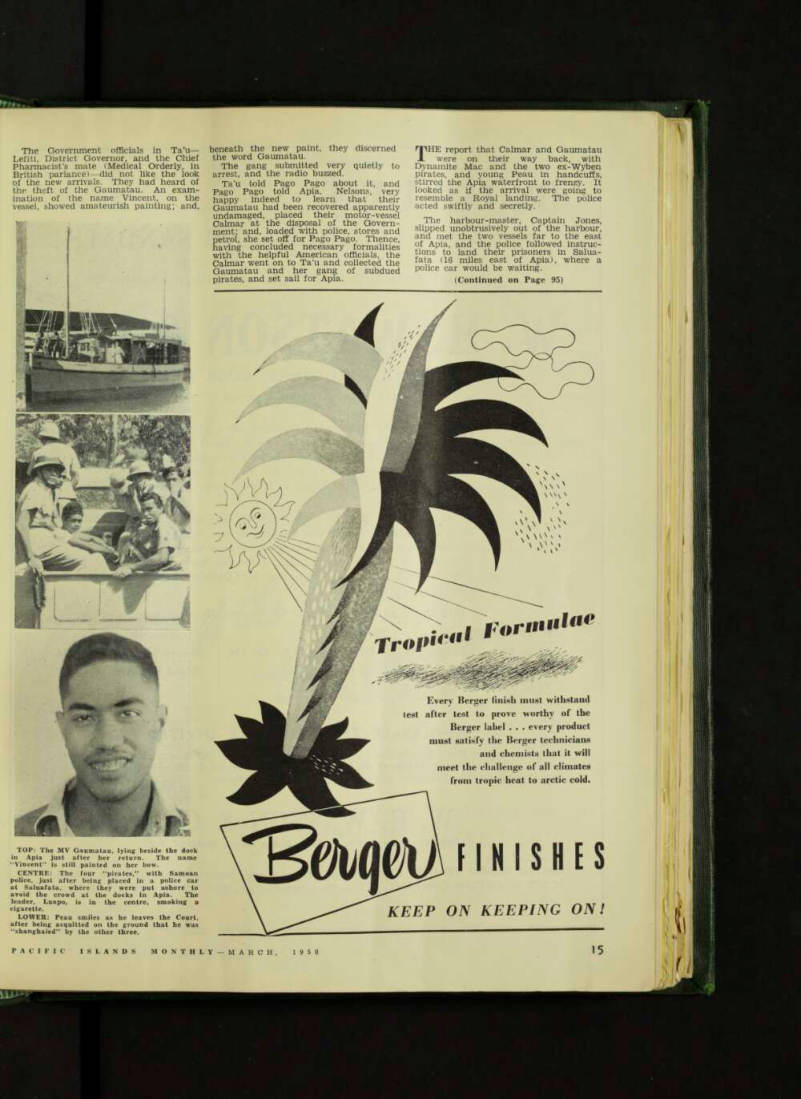
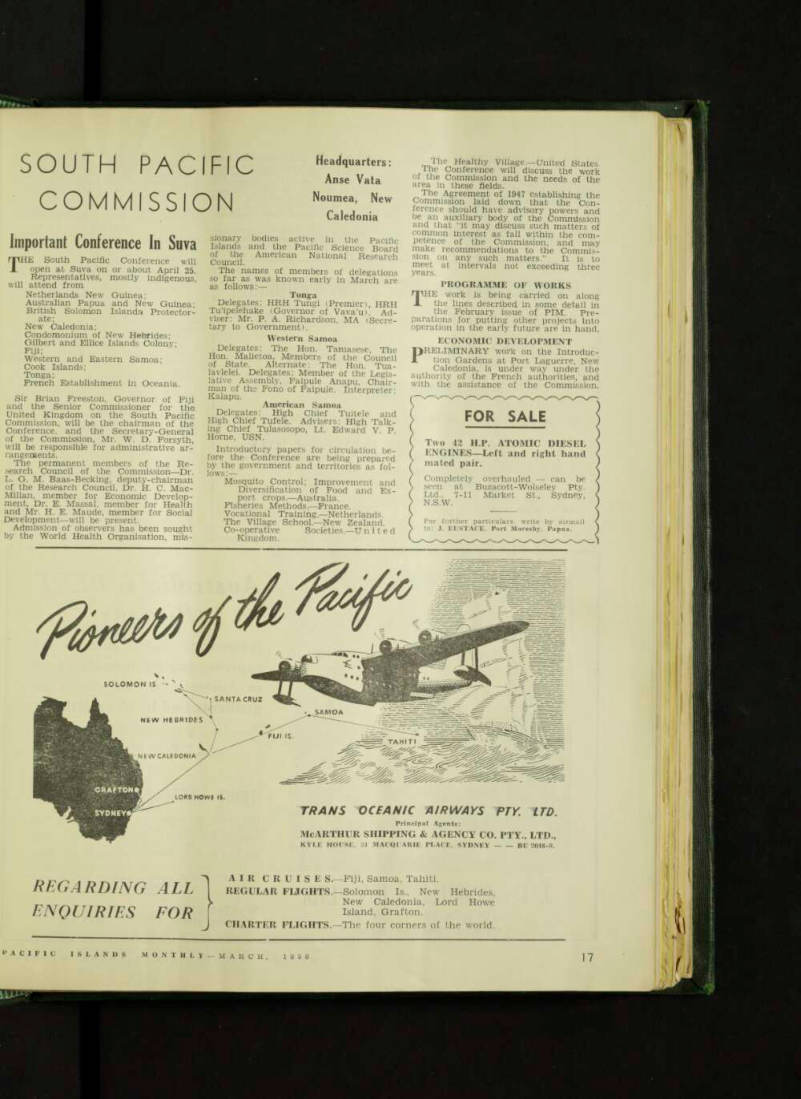
Amusing Angles of a Boat Theft In Samoa
From a Special Correspondent
IT was the evening of January 2, 1950; and the flash youths along the beach in Apia, Western Samoa, were bored.
They had enjoyed a week’s wassail, more or less, and they did not like the dismal prospect of work, once more.
“Dynamite Mac Mago” put it to his gang that they seize a ship, shake the stinking dust of Apia off their calloused heels, and head for Tahiti, land of soft colours and kindly maidens.
The gang hesitated. They liked the idea, but they feared the recklessness of “Dynamite Mac”—that was his boxing ring soubriquet. His general record did not make for confidence and comfort.
So the gang faded away—all except two—Moki (Vince) Periera, and Lolesea Lei’ataua.
Moki and Lolesea were not repelled by the plan for a bit of piracy. They were two of the bright lads who, 18 months ago, ran away with A. G. Smyth’s Wyben.
They were hot navigators. Once clear of Apia with the Wyben, they blindly followed the sunset until they met up with the Solomons. The Wyben ulti mately was sold in the Solomons, at a heavy loss to Smyths; but the gallant crew, brought back to Samoa by the police, somehow escaped the punishment they richly deserved.
Moki and Lolesea decided to go with Luapo Fa’amau —otherwise “Captain Mago,” otherwise “Dynamite Mac Mago.” Very late that night, they sneaked onto the wharf and reconnoitred O. F. Nelson & Co’s. 54 ft. motor-vessel Gaumatau, a scow type of ship with an 18 ft. beam, and worth about £6,000.
From the cabin of the Gaumatau came the gentle, rythmic snores of Peau Tusi tala, the youthful Samoan caretaker.
They crept upon Peau, and sat upon his chest, and pressed a long, sharp knife against his throat—in the best style of the Wild West pictures which Samoan youths find so exhilarating—and the terrified Peau did precisely as he was told.
They started the engine about 2 ajn., and headed out through the reef, and away into the north-east. Captain Mago assumed command. First stop, Tahiti.
They kept the engine going for about 36 hours; and naturally, they ran out of fuel. Then they carried on with a stay sail and mainsail.
They drifted around for a whole month —they do not know themselves where they were. Captain Mago said he was taking them to Tahiti.
Aboard, they found biscuits and canned meat, and these provisions, supplemented by fish which they caught, kept them going. They got water by the simple de vice of spreading, when it rained, a sail with a hole cut in its centre, and running the water through the hole into a can.
They knew that High Authority would be searching for the Gaumatau. There was paint aboard. They wiped Gaumatau off their ship’s blunt bows, and substi tuted therefor the name Vincent. (See photograph.) ON February 2 they sighted land, a long way off.
“Tahiti,” said the confident Captain Mago. His three companions shouted their joy.
Their ship drifted no nearer the distant land. So the ingenious Captain Mago mixed lubricating oil with kerosene, and somehow persuaded the engine to run on it. A few hours later, they landed on what seemed a hospitable beach.
Polynesian folk approached. “I orana ‘ce!” (the Tahitian greeting) shouted the knowledgeable Captain Mago.
The people stared. “Talofa!” (the Samoan greeting) they replied.
Captain Mago staggered slightly, and then spoke to them in Samoan, They replied in Samoan, with a slightly differ ent accent.
The voyagers discovered that they had landed in Falaesau Bay, in Ta’u, in the Manua Group of Eastern (American) Samoa, less than 200 miles from Apia.
The two disillusioned former members of the crew of the late lamented Wyben seemed inclined to take their leader apart; but there was no time. The people of Ta’u were naturally asking questions, and it was urgent that the pirate gang tell the same story. So, after consulta tion, they announced that they and their ship Vincent had been making a trip be tween Upolu and Savaii, and been blown off their course. If they could be sup plied with petrol and food, they would be on their way.
The Government officials in Ta’u — Lefiti, District Governor, and the Chief Pharmacist’s mate (Medical Orderly, in British parlance)—did not like the look of the new arrivals. They had heard of the theft of the Gaumatau. An exam ination of the name Vincent, on the vessel, showed amateurish painting; and,
beneath the new paint, they discerned the word Gaumatau.
The gang submitted very quietly to arrest, and the radio buzzed.
Ta’u told Pago Pago about it, and Pago Pago told Apia. Nelsons, very happy indeed to learn that their Gaumatau had been recovered apparently undamaged, placed their motor-vessel Calmar at the disposal of the Govern ment; and, loaded with police, stores and petrol, she set off for Pago Pago. Thence, having concluded necessary formalities with the helpful American officials, the Calmar went on to Ta’u and collected the Gaumatau and her gang of subdued pirates, and set sail for Apia.
THE report that Calmar and Gaumatau were on their way back, with Dynamite Mac and the two ex-Wyben pirates, and young Peau in handcuffs, stirred the Apia waterfront to frenzy. It looked as if the arrival were going to resemble a Royal landing. The police acted swiftly and secretly.
The harbour-master, Captain Jones, slipped unobtrusively out of the harbour, and met the two vessels far to the east of Apia, and the police followed instruc tions to land their prisoners in Salua fata (16 miles east of Apia), where a police car would be waiting.
(Continued on Page 95)
TOP: The MV Gaumatau, lying beside the dock in Apia just after her return. The name “Vincent” is still painted on her bow.
CENTRE: The four “pirates,” with Samoan police, just after being placed in a police car at Saluafata, where they were put ashore to avoid the crowd at the docks in Apia. The leader. Luapo, is in the centre, smoking a cigarette.
LOWER: Peau smiles as he leaves the Court, after being acquitted on the ground that he was “shanghaied” by the other three.
MY friend, Alf Vercoe, insists that it was pure coincidence that he was sitting on the sea-shore at Salua fata, nursing his excellent camera and a Telephoto lens, when the police came in and landed their prisoners on the beach, to be met by more police under Senior Sargeant Phillip. He says he had gone to the vicinity of Piula Methodist College to see his wife’s brother Well, if it wasn’t coincidence, Alf is psychic; because no one else in Apia seemed to even suspect anything of the police ruse to keep the glamour off Dynamite Mac. This coast is 40 miles long, and the prisoners could have been landed anywhere on a dozen beaches.
Actually, they were landed within a few hundred yards of where our news-hawk was sitting with his camera!
Anyway, it was for me a very happy coincidence. Herewith you will find the
By extraordinary luck, a professional photographer was at Saluafata when the police and “pirates” were brought ashore from the Gaumatau. He got these pictures from a distance of nearly half a mile, through a 13 cm. Telephoto lens. Top shows the party arriving on the beach. The gentleman in the centre, with his pants rolled up, is “Dynamite Mac Mago.” The lower picture shows the party marching off the beach to the waiting police cars.
excellent photographs which Mr. Vercoe secured of a quite remarkable event.
THE four adventurers were brought be fore Judge C. C. Marsack’s High Court on February 9.
Luapo—now a very much deflated Dynamite Mac—did not give any trouble.
He knew the others were going to say that they were “shanghaied” into the enterprise by him; so he pleaded guilty to the charge of theft of the boat, and was given five years’ hard labour.
The other three, pleading not guilty, were remanded to February 23. The Judge, having heard the evidence and the defence, did not waste any time over the two ex-Wyben men; each got the same sentence as Luapo. They had five weeks together on the sea in hooliganism and piracy; they now will have five years to gether, in gaol, to cherish their memories.
The Judge accepted the plea of Peau, that he was overpowered and forced to go with the other three. He does not appear to have made any frantic effort to escape from the gang of thieves; but he is only a youngster, and his character has been good, and so he was discharged, not guilty.
Nelsons are out of pocket to the extent of some meat and biscuits, a perforated sail and a badly-carboned engine; the West Samoan Government has had con siderable expense in seeking and punish ing the malefactors; and the flash youths of Apia waterfront have been shown that crime doesn’t pay.
When preaching on gambling in Bris bane recently, the Rev. J. F. McKay of the Toowong Presbyterian Church, said that a report had even come from Port Moresby where it was alleged that the natives had a “lottery craze.” A local agency in Moresby, according to Mr.
McKay, sold nearly as many tickets in Australian lotteries to natives as to Euro peans. He said that natives were indig nant when they did not win. They argued that they had paid for a prize and should get one.
The engagement has been announced of Miss Willamina Andresen, daughter of Mr. A. M. Andresen, of Mandoliana Is., Florida Group, BSI, to Mr. William (“Billy”) Barley, son of Mr. J. C. Barley, former old-time resident of the Solomons, now retired and living in Australia.
Advertisements & other items, pp. 18-20 (1 item)
Uniporn
BOOKS! BOOKS!
MALABAR FARM.
By Louis Bromfield. 15/6, post paid.
SINUHE—THE EGYPTIAN.
By Mika Waltari. 16/-, post paid.
BEDSIDE ESQUIRE.
15/6, post paid.
PRACTICAL HOME NEEDLECRAFT.
With 320 pages, 650 how-to-do-it drawings and instructive photographs. 16/6, post paid.
BOOKS.—Technical, Medical, Biography, Travel, Arts and Crafts, supplied, at lowest rates, by return mail.
Subscriptions arranged for leading American, English, French, German and all European magazines.
Write :
THE S.E. BOOK CO.
83 Pitt St., Sydney or Box 20, G.P.0., Sydney, Australia.
UNIPORN
DIESEL ENGINES
y
•MAXIMUM REL
•MINIMUM MAINTENANCE
•LONG L/FE -LOW COST
10 & 12 h.p. Available for
IMMEDIATE
~" l Iy.LJ. I
TELEGRAMS; "SUNRISE", SYDNEY
SOLE N.S.W AND PACIFIC ISLAND DISTRIBUTORS
f G. H. ROBINSON
EXPORTS & IMPORTS PTY. LTD
51 Macquarie St., Sydney.
, v, ' '* / V . / - ■sm > v\\\
N' N v X
\ \ N\ N N '
\ W
Trop 1
<•«» Forni"l" e
Every Berger finish must withstand lest after lest to prove worthy of the Berger label . . . every product must satisfy the Berger technicians and chemists that it will meet the challenge of all climates from tropic heat to arctic cold.
'S’enmJ
FINISHES
KEEP ON KEEPING ON!
BROADCAST
SHOES AND SANDALS!
Specially Made For The Islands Trade
W. H. WATSON & CO.
P.O. BOX 42, RAROTONGA, COOK ISLANDS
Cable Address: “Watson, Rarotonga.”
JJIGH prices and export restrictions are still limiting factors in retailing Shoes in the Pacific Islands. Apart from these considerations, many of the lines available from Home, Australia and New Zealand are unsuitable for the tropics, where coolness and freedom in Shoes are so necessary to comfort and health.
For these reasons, we have built, from the best materials, a range of Sandal-type Shoes and Sandals, for men, women and children, which are calculated to give the maximum degree of comfort at low cost. Already this Broad-last Footwear has found favour in many Island Territories, for COMFORT COMES
FIRST.
OUR SHOES AND SANDALS MAY BE PURCHASED FROM: —
WESTERN SAMOA:
Burns Philp (S.S.) Co. Ltd.
O. F. Nelson & Co. Ltd.
P. C. Fabricius.
TONGA:
Burns Philp (S.S.) Co. Ltd.
NIUE ISLAND:
H. T. Duane.
COOK ISLANDS:
United Island Traders Ltd.
Island Products.
WHOLESALE ENQUIRIES ARE INVITED
A sample range of Men's, Women's and Children's lines (cost £N. Z.5) will be sent on receipt of Moneyorder or other remittance. Shipment can be made immediately by sea, by air or by parcel post to any part of the Pacific. Write now for our sample range and price-list.
W. H. WATSON & CO.
Bankers: Bank of New Zealand, Queen Street, Auckland, N.Z.
Associated with: — UNITED ISLAND TRADERS LTD. —Wholesale and Retail Traders, Rarotonga, Cook Islands.
SCOTT Cr WATSON COMPANY, LTD. —Manufacturers of "Palm" brand White and khaki clothing.
Commission
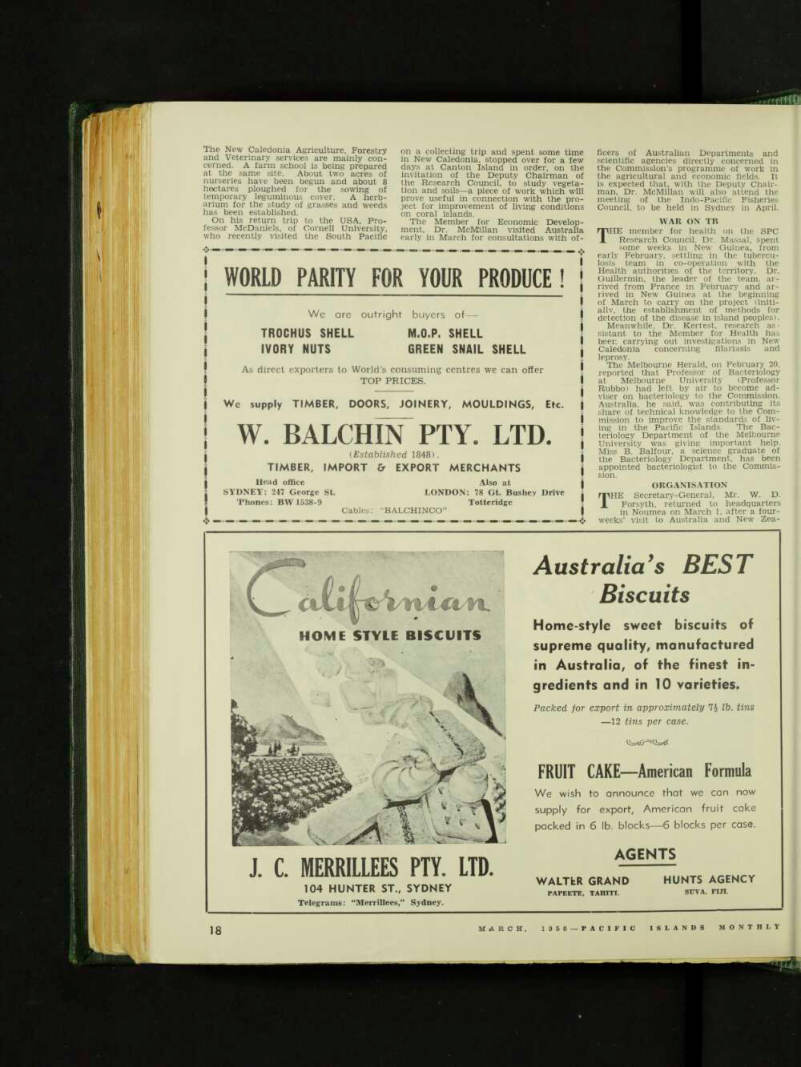
South Pacific
Important Conference In Suva
Headquarters: Anse Vata Noumea, New Caledonia
THE South Pacific Conference will open at Suva on or about April 25.
Representatives, mostly indigenous, will attend from Netherlands New Guinea; Australian Papua and New Guinea; British Solomon Islands* Protector ate; New Caledonia: Condomonium of New Hebrides; Gilbert and Ellice Islands Colony; Fiji; Western and Eastern Samoa; Cook Islands: Tonga; French Establishment in Oceania.
Sir Brian Freeston, Governor of Fiji and the Senior Commissioner for the United Kingdom on the South Pacific Commission, will be the chairman of the Conference, and the Secretary-General of the Commission, Mr. W. D. Forsyth, will be responsible for administrative ar rangements.
The permanent members of the Re search Council of the Commission—Dr.
L. G. M. Baas-Becking, deputy-chairman of the Research Council, Dr. H. C. Mac- Millan, member for Economic Develop ment, Dr. E. Massal, member for Health and Mr. H. E. Maude, member for Social Development—will be present.
Admission of observers has been sought by the World Health Organisation, mis
sionary bodies active in the Pacific Islands and the Pacific Science Board of the American National Research Council.
The names of members of delegations so far as was known early in March are as follows: Tonga Delegates: HRH Tungi (Premier), HRH Tu’ipelehake (Governor of Vava’u) Ad viser: Mr. P. A. Richardson, MA (Secre tary to Government).
Western Samoa Delegates: The Hon. Tamasese, The Hon. Malietoa, Members of the Council of State. Alternate: The Hon. Tua lavlelei. Delegates: Member of the Legis lative Assembly, Faipule Anapu, Chair man of the Fono of Faipule. Interpreter- Kalapu.
American Samoa Delegates; High Chief Tuitele and High Chief Tufele. Advisers: High Talk ing Chief Tulasosopo, Lt. Edward V. P.
Horne, USN.
Introductory papers for circulation be fore the Conference are being prepared by the government and territories as fol lows: Mosquito Control; Improvement and Diversification of Food and Ex port crops.—Australia.
Fisheries Methods.—France.
Vocational Training.—Netherlands.
The Village School.—New Zealand.
Co-operative Societies.—U nit e d Kingdom.
Ihe Healthy Village.—United States.
The Conference will discuss the work ot the Commission and the needs of the area in these fields.
The Agreement of 1947 establishing the Commission laid down that the Con ference should have advisory powers and be an auxiliary body of the Commission and that “it may discuss such matters of common interest as fall within the com petence of the Commission, and may make recommendations to the Commis sion on any such matters.” It is to meet at intervals not exceeding three years.
Programme Of Works
THE work is being carried on along the lines described in some detail in the February issue of PIM. Pre parations for putting other projects into operation in the early future are in hand.
Economic Development
PRELIMINARY work on the Introduc tion Gardens at Port Laguerre, New Caledonia, is under way under the authority of the French authorities, and with the assistance of the Commission.
The New Caledonia Agriculture, Forestry and Veterinary services are mainly con cerned. A farm school is being prepared at the same site. About two acres of nurseries have been begun and about 8 hectares ploughed for the sowing of temporary leguminous cover. A herb arium for the study of grasses and weeds has been established.
On his return trip to the USA, Pro fessor McDaniels, of Cornell University, who recently visited the South Pacific
on a collecting trip and spent some time in New Caledonia, stopped over for a few days at Canton Island in order, on the invitation of the Deputy Chairman of the Research Council, to study vegeta tion and soils—a piece of work which will prove useful in connection with the pro ject for improvement of living conditions on coral islands.
The Member for Economic Develop ment, Dr. McMillan visited Australia early in March for consultations with of
ficers of Australian Departments and scientific agencies directly concerned in the Commission’s programme of work in the agricultural and economic fields. It is expected that, with the Deputy Chair man, Dr. McMillan will also attend the meeting of the Indo-Pacific Fisheries Council, to be held in Sydney in April.
War On Tb
THE member for health on the SPC Research Council, Dr. Massal, spent some weeks in New Guinea, from early February, settling in the tubercu losis team in co-operation with the Health authorities of the territory. Dr.
Guillermin, the leader of the team, ar rived from France in February and ar rived in New Guinea at the beginning of March to carry on the project (initi allv, the establishment of methods for detection of the disease in island peoples).
Meanwhile, Dr. Kerrest, research as • sistant to the Member for Health has been carrying out investigations in New Caledonia' concerning filariasis and leprosy.
The Melbourne Herald, on February 20, reported that Professor of Bacteriology at Melbourne University (Professor Rubbo' had left by air to become ad viser on bacteriology to the Commission.
Australia, he said, was contributing its share of technical knowledge to the Com mission to improve the standards of liv ing in the Pacific Islands. The Bac teriology Department of the Melbourne University was giving important help.
Miss B. Balfour, a science graduate of the Bacteriology Department, has been appointed bacteriologist to the Commis sion.
Organisation
THE Secretary-General, Mr. W. D.
Forsyth, returned to headquarters in Noumea on March 1, after a four weeks’ visit to Australia and New Zea
land, where he conferred with the Senior Commissioners for New Zealand (Mr. C.
G. R. Mackay and Colonel F, Voelker) Australia (Mr. J. R. Halligan) and The Netherlands (Mr. J. B. D. Pennink, Netherlands Minister at Wellington, NZ).
Departmental officers in both countries directly associated with the work of the Commission discussed various aspects of the work programme, the South Pacific Conference, the possibilities of Techni cal Assistance for the region, and ad ministrative and financial matters.
The Secretary-General was granted an interview by the Australian Minister for External Affairs and External Territories, Mr. P. C. Spender, and also had oppor tunity for talks with Colonel J. K.
Murray (Administrator of Papua and New Guinea) and Mr. R. Powles, Ad ministrator of Western Samoa) as well as heads of Australian and New Zealand Departments concerned with the Com mission.
Finance
UP to the first week of March the annual Administrative Budget for 1950 had been approved by New Zealand, the United Kingdom and Aus tralia. One approval from among the three other member governments “suf ficient to confirm the Budget as adopted and referendum at the fourth session of the Commission at Noumea in October last.” Meanwhile the activities of the Commission are provided for on the basis of the 1949 Budget.
Advertisements & other items, pp. 21-22 (1 item)
Enquiries For
FOR SALE
Two 42 HP. ATOMIC DIESEL
ENGINES—Left and right hand mated pair.
Completely overhauled can be seen at Buzacott-Wolseley Pty.
Ltd., 7-11 Market St., Sydney,
N.S.W.
For further particulars, write by airmail to: J. EUSTACE, Port Moresby, Papua.
% n * x
SOLOMON IS
SANTA CRUZ
SAMOA
NEW HEBRIDES
FIJI IS.
TAHITI
CALEDONIA
LORD HOWE IS.
REGARDING ALL
ENQUIRIES FOR
I
TRANS OCEANIC AIRWAYS RTY, tTD.
Principal Agents: McArthur shipping & agency co. pty., ltd., KYLE HOUSE, 31 MACQUARIE PLACE, SYDNEY BU 2048-9.
AIR CRUISE S.—Fiji, Samoa, Tahiti.
REGULAR FLIGHTS.—SoIomon Is., New Hebrides, New Caledonia, Lord Howe
Island, Grafton.
CHARTER FLIGHTS.—The four corners of the world.
WORLD PARITY FOR YOUR PRODUCE!
We are outright buyers of—
TROCHUS SHELL M.O.P. SHELL
IVORY NUTS GREEN SNAIL SHELL
As direct exporters to World’s consuming centres we can offer
TOP PRICES.
We supply TIMBER, DOORS, JOINERY, MOULDINGS, Etc.
W. BALCHIN PTY. LTD.
(Established 1848).
TIMBER, IMPORT Cr EXPORT MERCHANTS
Head office SYDNEY: 247 George St.
Phones: BW 1538-9 Also at LONDON: 78 Gt. Bushey Drive Totte ridge Cables: “BALCHINCO”
m
HOME STYLE BISCUITS
'<2 4> ’VS.
J. C. MERRILLEES PTY. LTD.
104 HUNTER ST., SYDNEY
Telegrams: “Merrillees,” Sydney.
Australia’s BEST
Biscuits
Home-style sweet biscuits of
supreme quality, manufactured
in Australia, of the finest in-
gredients and in 10 varieties.
Packed for export in approximately 7£ lb. tins —l2 tins per case.
FRUIT CAKE —American Formula
We wish to announce that we can now supply for export, American fruit cake packed in 6 lb. blocks —6 blocks per case.
AGENTS
WALTER GRAND HUNTS AGENCY
PAPEETE, TAHITI. SUVA, FIJI.
Death Of E. G. Theodore
THE death of Mr. E. G. Theodore (Feb.
PIM) caused general regret in Fiji.
On behalf of the Government of Fiji the Acting Colonial Secretary (Mr. R. M.
Taylor) sent a telegram of sympathy to Mr. Theodore’s family. The telegram said: “The Colony owes much to his vision and energy and the news of his death has been received with deep regret by all sections of the community.”
Mr. Theodore’s connection with the goldmining industry in Fiji dates from 1933 when Mr. Pat Costello interested him in the possibilities of the Tavua field, where gold had been discovered by the late Mr. William Borthwick on November 5 1932 Mr. Costello held the first prospecting licence on the field and in April, 1943 he sold the option over the area to Mr.
Theodore who formed a small syndicate in Australia and himself brought a party of experienced miners, an assayer and a mining manager to Fiji to examine and prospect the field.
Eighteen months of strenuous work re sulted in the development of the Emperor, Loloma and Dolphin Mines and Mr.
Theodore then played a major part in organising the goldmining industry which is based on the town of Vatukoula and which has added greatly to the prosperity of Fiji in recent years.
Coconut Husking Machine
Monsieur Graziani, A New Cale
donian living at Santo, New Hebrides, is reported to have in vented a machine for de-husking coco nuts.
It is claimed that the machine worked by one man, does the work of seven natives, which is a big consideration in this age when native labour is hard to secure.
Sandy Creek Gold
ADVICE has been received from Sandy Creek Gold Sluicing, Ltd., that dur ing the six weeks ending January 31, 1950, 43 oz. of gold were recovered from 4,860 cubic yards of material treated at their Morobe leases, New Guinea.
The Rev. and Mrs. A. N. Haley, of Vic toria, will shortly be undertaking Angli can missionary work in Polynesia..
Advertisements & other items, p. 23 (1 item)
Flit
THE WORLD’S GREATEST
SELLING INSECTICIDE
id new Stwnqen. tkem Em!
FLIT
SPEEDILY KILLS
FLIES, MOSQUITOES
AND OTHER
INSECT PESTS
In addition to D.D.T., Flit also contains Pyrethrum and Thanite, making it the most effective insecticide available to Australian housewives.
When ordering, ask for FLIT, and look for the Soldier on the package.
VACUUM OIL COMPANY Pty. Ltd.
THE MOST EFFECTIVE INSECTICIDE YOU CAN BUY
Available for prompt shipment: • General Groceries and Provisions.
• Liqueurs—Wines—Spirits.
• Paints, Varnishes and Enamels. • Axes, Mattocks, Hammers and Tools. • Portable Pumping Units. • Marine Engines 3to 12 H.P. • Auto Parts and Batteries.
Price Lists airmailed on request.
R. J. CRILLEY Pty. Ltd.
WHOLESALE MERCHANTS BUYING AGENTS
123 SUSSEX STREET, SYDNEY
Cables “REJAM,” Sydney.
All classes of Australian merchandise purchased on behalf of Island clients at best wholesale rates: original Invoices provided: prompt and reliable service assured in all transactions.
Representatives Required In most Pacific Territories
Administrator

Nauru’S New
Now On Duty
ONE of the most-criticised of the Aus tralian Socialist Government’s “poli tical appointments”—that of the se lection of the South Australian Labour Party leader, Mr. Richards, to be Admin istrator of the Trust Territory of Nauru —was brought to finality on December 21, when Mr. Richards arrived in Nauru on one of the British Phosphate Com pany’s ships.
Our Canberra correspondent says there is no truth in the report that the Administrator-elect’s departure from Australia early in December was connected with the Australian general election on December 10, when the Socialists were thrown out of office and replaced by a Government pledged to wipe out political appointments of all kinds.
But it is no secret that the appoint ment is viewed with sharp disfavour by
the Menzies Government. Furthermore, it is no secret that certain high officials in Canberra recommended that one of three men, all experienced in tropical islands administration, be selected for ap pointment; and that these officials did not conceal their disgust when the Chifley Cabinet selected instead a Trades Hall personality, who —so far as is known— had never seen a Pacific island, Mr.
Richards is now in receipt of £1,500 per annum, plus £l5O per annum “entertain ment allowance,” plus a furnished resi dence.
A Nauru correspondent writes: “Our new Administrator is qualified by size; Pacific Islands natives are always im pressed by big men as leaders. We have learned with interest that he is a tee totaller (he was a prominent Rechabite in Adelaide) and a non-smoker. Mr.
Richards was married just before leaving Adelaide, and his wife has accompanied him to Nauru. We like her but we are sorry to note that she is in poor health, and is apparently feeling this equatorial climate in mid-summer.”
Nauru wishes the Adelaide Trades Hall could supply a medical officer as easily as it supplied an Administrator. The
island has been without a medical man for some time. The MO from Ocean Island has been over in Nauru, relieving; and he now has remained on there to introduce and assist the newly-appointed doctor from Australia, who is a Pole.
The Department of External Terri tories, late in 1949, sent a number of New Australians —Central European men with European medical degrees—to be medical officers in Papua and New Guinea.
Rise In Fiji Troghus
TROCHUS shell was quoted at £6O a long ton on the beach at Suva on Feb ruary 22—an increase of £lO a ton. (When Fiji’s trochus market was started about 40 years ago the exporters paid the Fijians £3 a ton.) The demand for trochus shell has been irregular since World War II when Japan and Czechoslovakia went out of the pearl button business.
The new Fiji price compares favourably with late quotations for Thursday Is, trochus, the f.o.b. price of which has been between £A6S-70.
New Guinea shell has been bringing about £A6S c.i.f. Sydney.
Advertisements & other items, p. 24 (1 item)
Kodak
feak
FILMS CAMERAS
ACCESSORIES
© are now available in full supply through any of the following Kodak Dealers:
PAPUA-NEW GUINEA
Burns Philp (New Guinea) Ltd., Port Moresby, Samarai, Lae, Madang, Rabaul.
Steamship Trading Co., Port Moresby.
G. G. Smith & Co., Port Moresby.
Mr. R. Stewart, Bulolo.
Mr. J. J. McKean, Lae.
Mr. A. K. Gibson, Port Moresby.
Mr. G. Carter, Papuan Prints, Port Moresby.
Gabriel Chow Sing Yip, Rabaul.
Robert Gillespie New Guinea Ltd., Lae, Rabaul.
Kwong Wa King (Branch), Wewak.
Kwock Cheong, F. L., Rabaul.
Sam, Leo, Rabaul.
FIJI
Burns Philp (South Sea) Co. Ltd., Suva, Levuka, Lautoka, Labasa, Ba, Sigatoka, Rotuma.
Caine, F. W., & Co., Suva.
Mouat’s Pharmacy, Suva.
Prasad’s Studios, Lautoka.
Stinson Studios, Suva.
Swann & Co., A. J., Suva.
W. R. Carpenter & Co. Ltd., Suva.
Morris, Hedstrom Ltd., Suva, Lautoka, Ba, Tavua, Vatukoula, Nausori, Sigatoka, Nandi, Labasa, Levuka, Penang, Navua.
Boots The Chemist, Suva.
C. A. Adams, Lautoka.
Fong Lee & Co., Ba.
Sharma Studios, Nadi.
Flemming’s Pharmacy, Nadi.
BRITISH SOLOMON IS. PROTECTORATE
R. C. Symes, Honiara.
TONGA
Burns Philp (South Sea) Co. Ltd., Nukualofa, Haapal, Vavau.
Jones, Mrs. E. M., Nukualofa.
Morris, Hedstrom Ltd., Nukualofa, Vavau.
A. Hettig, Nukualofa.
SAMOA
Burns Philp (South Sea) Co. Ltd., Apia, Pago Pago.
Morris, Hedstrom Ltd., Apia.
NIUE ISLAND
Burns Philp (South Sea) Co. Ltd., Niue.
COOK ISLANDS
Hopkins, S„ Rarotonga.
LORD HOWE ISLAND
Thompson, O. C.
E. P. Hines.
NORFOLK ISLAND
Burns Philp (South Sea) Co. Ltd.
R. Bell.
H. Spencer-Salt.
NEW CALEDONIA
Ventrillon Freres. Noumea.
NEW HEBRIDES
Burns Philp (South Sea) Co. Ltd., Vila.
Migrant Doctors Leave For New Guinea

fTIHESE 12 migrant doctors left Sydney A recently by air for New Guinea.
All had been Displaced Persons, had European medical degrees not recognised in Australia and had arrived in Aus
tralia about two years ago. Until selected for the Territory they were doing labour ing work or other unskilled jobs at the direction of the Australian government.
The doctors were selected personally
bv the Director of Health, Papua-New Guinea. They have completed a course at the Australian School of Pacific Ad ministration in Sydney.
The twelve doctors are: Dr. L. J. Popow Dr. T. Rubins, Dr. R. E. Rydlewski, Dr.
A. Sirko, Dr. M. M. Svirklys, Dr. L.
Gergcly, Dr. V. Zigas, Dr. L. E. Petrav skas, Dr. T. Sobol, Dr. D. R. P. Marton Dr. B. Jackeviciusb, and Dr. J. J. Saave.
Most of them are young men, and in clude four nationalities—Polish, Lithu anian, Latvian, and Ukrainian.
Advertisements & other items, p. 25 (1 item)
Enjoy a Rea! Holiday
at
“SAN ELANDA” GUEST HOUSE,
Tewantin, Queensland Island Folk will Receive a Warm Welcome. Excellent Fishing, Boating, Surfing, River Trips, Tennis, Golf. Etc., plus First-Class Accommodation and Cuisine at a Reasonable Tariff.
Tewantin, on the Coast, is 100 miles North of Brisbane.
R. P. MILLS, Proprietor
(Late of Wltn, T.N.G.) ’Phone: Tewantin 21
Distributors throughout the Territory of New Guinea for
ROOTES GROUP PRODUCTS
HUMBER, HILLMAN
and SUNBEAM-TALBOT CARS
* u rvia 'o™!*: %■ Si
COMMER and KARRIER TRUCKS
Write for full details of prices and deliveries to: —
COLYER WATSON (guinea) LTD
RABAUL
KAVIENC
Yonki Greek
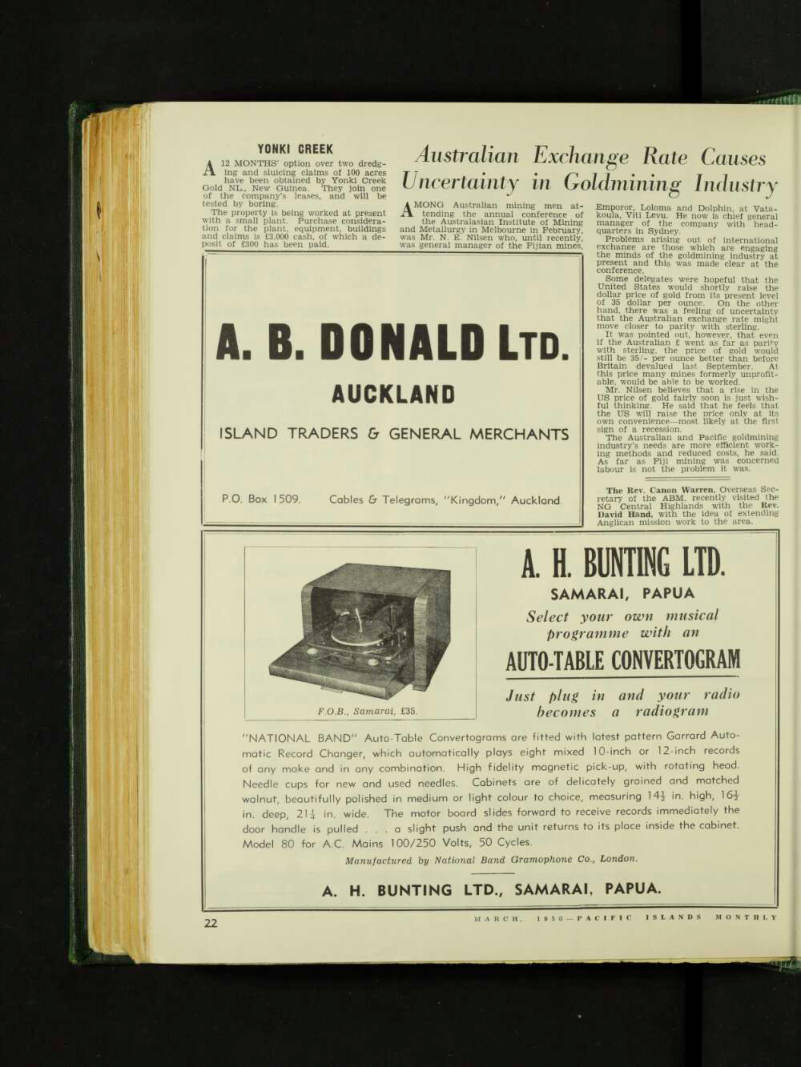
A 12 MONTHS’ option over two dredg ing and sluicing claims of 100 acres have been obtained by Yonki Creek Gold NL., New Guinea. They join one of the company’s leases, and will be tested by boring.
The property is being worked at present with a small plant. Purchase considera tion for the plant, equipment, buildings and claims is £3,000 cash, of which a de posit of £3OO has been paid.
Uncertainty in Goldmining Industry
Australian Exchange Rate Causes Uncertainty in Goldmining Industry
AMONG Australian mining men at tending the annual conference of the Australasian Institute of Mining and Metallurgy in Melbourne in February, was Mr. N. E. Nilsen who, until recently, was general manager of the Fijian mines,
Emporor, Loloma and Dolphin, at Vata koula, Viti Levu. He now is chief general manager of the company with head quarters in Sydney.
Problems arising out of international exchange are those which are engaging the minds of the goldmining industry at present and this was made clear at the conference.
Some delegates were hopeful that the United States would shortly raise the dollar price of gold from its present level of 35 dollar per ounce. On the other hand, there was a feeling of uncertainty that the Australian exchange rate might move closer to parity with sterling.
It was pointed out, however, that even if the Australian £ went as far as parity with sterling, the price of gold would still be 35/- per ounce better than before Britain devalued last September. At this price many mines formerly unprofit able, would be able to be worked.
Mr. Nilsen believes that a rise in the US price of gold fairly soon is just wish ful thinking. He said that he feels that the US will raise the price only at its own convenience—most likely at the first sign of a recession.
The Australian and Pacific goldmining industry’s needs are more efficient work ing methods and reduced costs, he said.
As far as Fiji mining was concerned labour is not the problem it was.
The Rev. Canon Warren, Overseas Sec retary of the ABM. recently visited the NG Central Highlands with the Rev.
David Hand, with the idea of extending Anglican mission work to the area.
Advertisements & other items, p. 26 (1 item)
A. B. Donald Ltd.
AUCKLAND
ISLAND TRADERS & GENERAL MERCHANTS
P.O. Box 1509. Cables & Telegrams, "Kingdom," Auckland
A. U BUNTING LTD.
SAMARAI, PAPUA
Select your own musical programme with an
AUTO-TABLE CONVERIOGRAM
Just plug in and your radio becomes a radiogram "NATIONAL BAND" Auto-Table Convertograms are fitted with latest pattern Garrard Automatic Record Changer, which automatically plays eight mixed 10-inch or 12-inch records of any make and in any combination. High fidelity magnetic pick-up, with rotating head.
Needle cups for new and used needles. Cabinets are of delicately grained and matched walnut, beautifully polished in medium or light colour to choice, measuring in. high, in. deep, 21 i in. wide. The motor board slides forward to receive records immediately the door handle is pulled ... a slight push and the unit returns to its place inside the cabinet.
Model 80 for A.C. Mains 100/250 Volts, 50 Cycles.
Manufactured hy National Band Gramophone Co., London.
A. H. BUNTING LTD., SAMARAI, PAPUA.
F. 0.8., Samarai, £35
Cocos Likes its
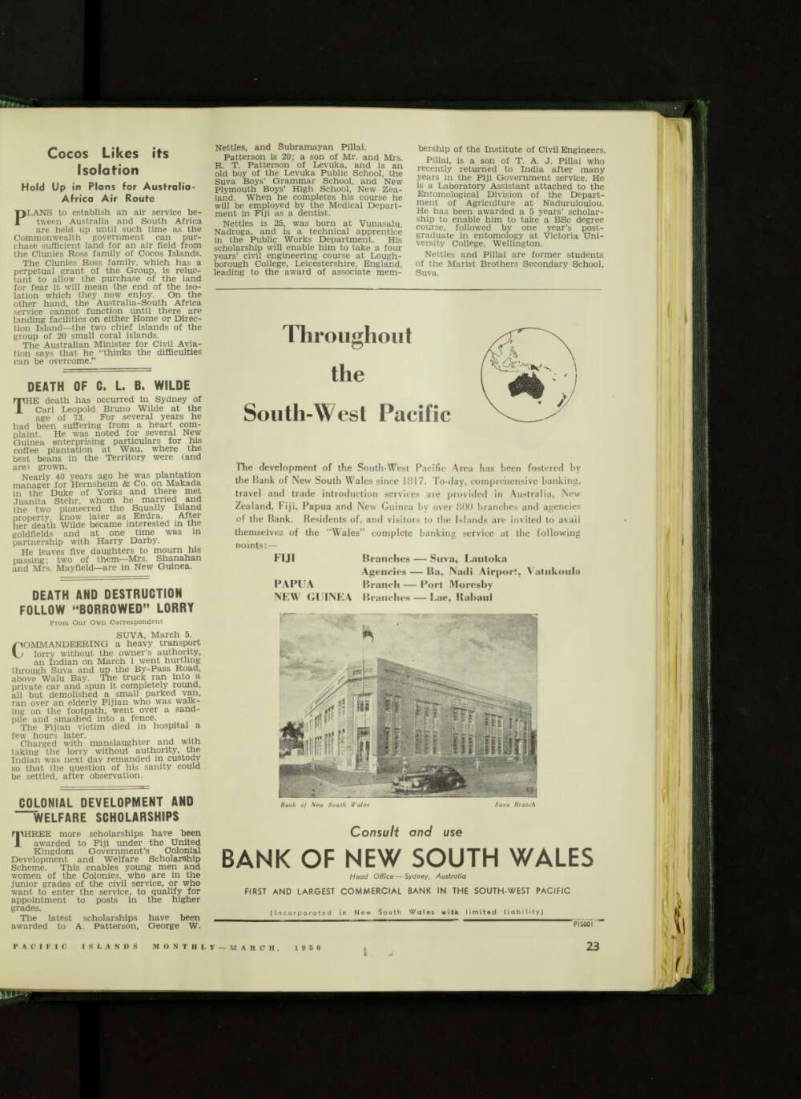
Isolation Hold Up in Plans for Australia- Africa Air Route
PLANS to establish an air service be tween Australia and South Africa are held up until such time as the Commonwealth government can pur chase sufficient land for an air field from the Clunies Ross family of Cocos Islands.
The Clunies Ross family, which has a perpetual grant of the Group, is reluc tant to allow the purchase of the land for fear it will mean the end of the iso lation which they now enjoy. On the other hand, the Australia-South Africa service cannot function until there are landing facilities on either Home or Direc tion Island —the two chief islands of the group of 20 small coral islands.
The Australian Minister for Civil Avia tion says that he “thinks the difficulties can be overcome.”
Death Of C. L. B. Wilde
THE death has occurred in Sydney of Carl Leopold Bruno Wilde at the age of 73. For several years he had been suffering from a heart com plaint. He was noted for several New Guinea enterprising particulars for his coffee plantation at Wau, where the best beans in the Territory were (and are) grown.
Nearly 40 years ago he was plantation manager for Hernsheim & Co. on Makada in the Duke of Yorks and there met Juanita Stehr, whom he married and the two pioneered the Squally Island property, know later as Emira. After her death Wilde became interested in the goldfields and at one time was in partnership with Harry Darby.
He leaves five daughters to mourn his passing; two of them —Mrs. Shanahan and Mrs. Mayfield—are in New Guinea.
Follow “Borrowed” Lorry
Death And Destruction
From Our Own Correspondent
SUVA, March 5.
COMMANDEERING a heavy transport lorry without the owner’s authority, an Indian on March 1 went hurtling through Suva and up the By-Pass Road, above Walu Bay. The truck ran into a private car and spun it completely round, all but demolished a small parked van, ran over an elderly Fijian who was walk ing on the footpath, went over a sand pile and smashed into a fence.
The Fijian victim died in hospital a few hours later.
Charged with manslaughter and with taking the lorry without authority, the Indian was next day remanded in custody so that the question of his sanity could be settled, after observation.
“Welfare Scholarships
Colonial Development And
THREE more scholarships have been awarded to Fiji under the United Kingdom Government’s Colonial Development and Welfare Scholarship Scheme. This enables young men and women of the Colonies, who are in the junior grades of the civil service, or who want to enter the service, to qualify for appointment to posts in the higher grades.
The latest scholarships have been awarded to A. Patterson, George W.
Nettles, and Subramayan Pillai.
Patterson is 20; a son of Mr. and Mrs.
R. T. Patterson of Levuka, and is an old boy of the Levuka Public School, the Suva Boys’ Grammar School, and New Plymouth Boys’ High School, New Zea land. When he completes his course he will be employed by the Medical Depart ment in Fiji as a dentist.
Nettles is 25, was born at Vunasalu, Nadroga, and is a technical apprentice in the Public Works Department. His scholarship will enable him to take a four years’ civil engineering course at Lough borough College, Leicestershire, England, leading to the award of associate mem
bership of the Institute of Civil Engineers.
Pillai, is a son of T. A. J. Pillai who recently returned to India after many years in the Fiji Government service. He is a Laboratory Assistant attached to the Entomological Division of the Depart ment of Agriculture at Naduruloulou.
He has been awarded a 5 years’ scholar ship to enable him to take a BSc degree course, followed by one year’s post graduate in entomology at Victoria Uni versity College, Wellington.
Nettles and Pillai are former students of the Marist Brothers Secondary School, Suva.
Advertisements & other items, pp. 27-28 (1 item)
Throughout
the
South-West Pacific
“a* I The development of the South-West Pacific Area has been fostered by the Bank of New South Wales since 1817. To-day, comprehensive banking, travel and trade introduction services are provided in Australia, New Zealand, Fiji, Papua and New Guinea by over 800 branches and agencies of the Bank. Residents of, and visitors to the Islands are invited to avail themselves of the “Wales” complete banking service at the following ooints: — FIJI Branches Suva, Lauloka Agencies Ba, Nadi Airport, Vatukoula PAPUA Branch Port Moresby NEW GUINEA Branches Lae, Rahaul ' * m Bank of New South Wales Suva Branch
Consult and use
BANK OF NEW SOUTH WALES
Head Office Sydney, Australia FIRST AND LARGEST COMMERCIAL BANK IN THE SOUTH-WEST PACIFIC (Incorporated in New South Wales witto limited liability)
PISOOI
■ : m
MmrM
1 Hi Price at Works: £36/ 157- Extra for 10-inch additional shelf and brackets (if required) : £2 Packing and Transport to Wharf : £lO/10/- (For cases shipped in quantities, packing is at greatly reduced rates).
The display case is securely packed in two substantial crates occupying shipping space of 32 cubic feet. Total weight, when packed, 5 cwt.
Another view of the “Brahol”
Export Counter case, showing width of counter space.
BRIEF SPECIFICATIONS
This Modem Display
Counter will Help to
Sell Goods in Your
Store!
(andit’s specially built for Export)
As smart as those in leading Australian city stores, and built by a firm that has been making fine store and office fittings for over a third of a century.
Moreover, it is specially built for export, so that it can be readily securely packed, and assembled by anyone, from simple directions, in an hour, with no tools other than a screwdriver. Retailers all over the world have To help you get an accurate picture of the “Brahol”
Special Export Glass Counter Case, here are the main specifications: Overall size is 6 feet long x 1 ft. 9 in. deep x 3 ft. 3 in. high. Made from first-class, wellseasoned Queensland Maple, hand french polished, wax finished, in natural maple colour. Glass parts are \ inch British plate glass.
The inside is lacquered ivory colour, and the recessed base is lacquered burgundy.
There is a pair of solid core sliding doors, and one glass shelf, 14 inches wide, on adjustable nickelplated brackets. learned the selling value of modern display equipment, and this "silent salesman" will soon pay for itself in increased sales.
BRAY & HOLLIDAY
PTY. LTD.
Makers of Fine Store and Office
Fittings for over a third of a century Storage space below is 11 inches high.
The plate glass front is 22 inches high.
Brahol House, 66-74 McLachlan Avenue, Rushcutter Bay, Sydney. Telephone: FA 4121 Cable and Telegraphic Address: “Brahol.”
In Suva., 45 Years Ago
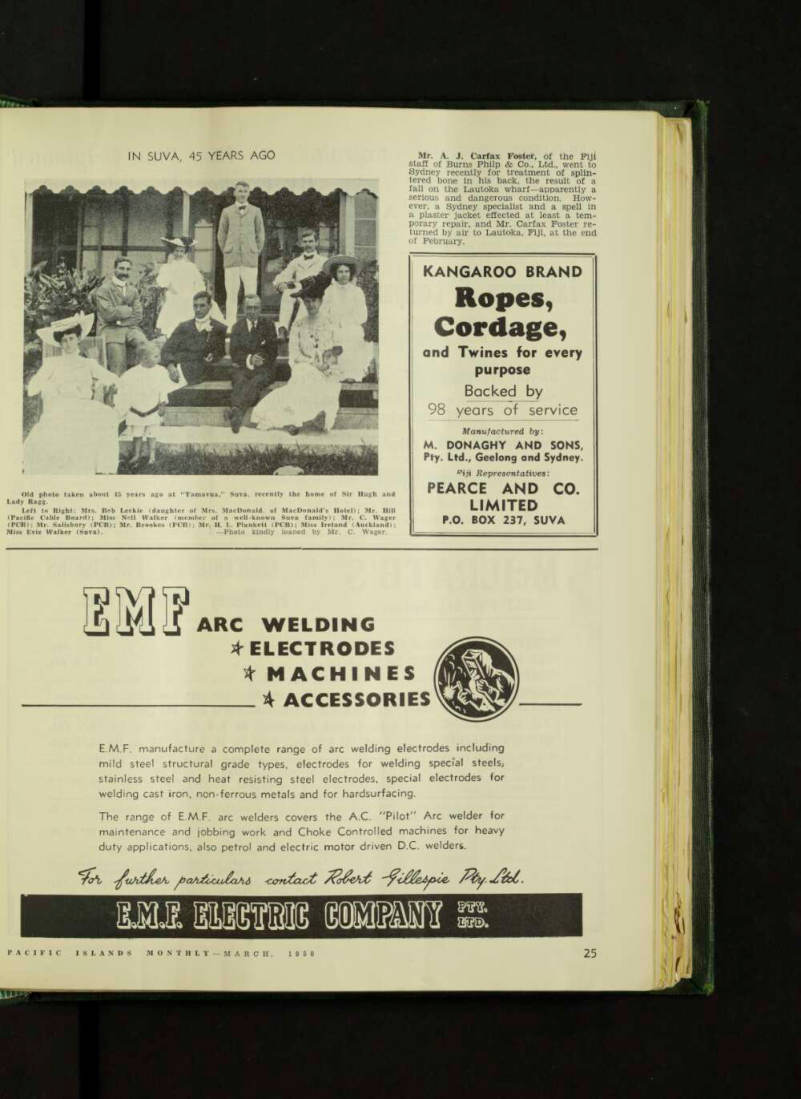
Mr. A. j. Carfax Foster, of the Fiji staff of Burns Philp & Co., Ltd., went to Sydney recently for treatment of splin tered bone in his back, the result of a fall on the Lautoka wharf—apparently a serious and dangerous condition. How ever, a Sydney specialist and a spell in a plaster jacket effected at least a tem porary repair, and Mr. Carfax Foster re turned by air to Lautoka, Fiji, at the end of February.
Old photo taken about 45 years ago at “Tamavua,” Suva, recently the home of Sir Hugh and Lady Ragg.
Left to Right: Mrs. Bob Leckie (daughter of Mrs. MacDonald, of MacDonald’s Hotel); Mr. Hill (Pacific Cable Board); Miss Nell Walker (member of a well-known Suva family); Mr. C. Wager (PCB); Mr. Salisbury (PCB); Mr. Brookes (PCB); Mr. H. L. Plunkett (PCB); Miss Ireland (Auckland); Miss Evie Walker (Suva). —Photo kindly loaned by Mr. C. Wager.
Advertisements & other items, p. 29 (1 item)
Cordage,
KANGAROO BRAND
Ropes,
and Twines for every purpose Backed by 98 years of service Manufactured by:
M. DONAGHY AND SONS,
Pty. Ltd., Geelong and Sydney.
Fiji Representatives:
PEARCE AND CO.
LIMITED
P.O. BOX 237, SUVA
mv
ARC WELDING
A ELECTRODES
A MACHINES
A ACCESSORIES
E.M.F. manufacture a complete range of arc welding electrodes including mild steel structural grade types, electrodes for welding special steelsj stainless steel and heat resisting steel electrodes, special electrodes for welding cast iron, non-ferrous metals and for hardsurfacing.
The range of E.M.F. arc welders covers the A.C. "Pilot" Arc welder for maintenance and jobbing work and Choke Controlled machines for heavy duty applications, also petrol and electric motor driven D.C. welders.
E M as®,
Bsi Planters’ Association
FURTHER efforts are being made to re vive the BSIP Planters’ Association, which has not functioned effectively since before the war.
It is hoped to hold a meeting of the Association in Honiara in March to dis cuss matters affecting planters in the Protectorate and to make subsequent re presentations to the BSIP Government.
By Former NG Pilot
Australia s Air Beef Plan Originated
A RECENT issue of Australian National Airways magazine (Air Travel) tells how Mr. I, N. Grabowsky, once a well-known Guinea Airways pilot in New Guinea, took a prominent part in the formation of Air Beef Ltd.
Air Beef is a company that has been formed to air-freight beef carcases from the Kimberleys and other parts of Aus tralia’s northern cattle country.
Mr. Grabowsky was with G’air in New Guinea in the days when they were flying anything from dredges to lamb chops in from the coast at Lae and Salamaua to the Morobe goldfields.
After his experience of air freighting in the Territory he became convinced that in air transport lay the solution to de veloping the far northern areas of Aus tralia.
He first discussed the idea of slaughter ing cattle inland and flying the carcasses to the nearest port or railhead with the Minister of the Interior in 1936. Two years later he put a detailed plan before Mr. Lyons, then Australian Prime Minister. He was promised that the scheme would be subsidised up to the hilt.
Then war came and a Labour Govern ment which was not interested, and the plans were shelved for years.
In 1946, when Mr. Grabosky was Plan ning and Development manager for ANA, he went to Perth to discuss his plans with the Western Australian Government and with Macßobertson-Miller Aviation Co. These two, with ANA are to-day in terested in Air Beef Ltd.
Last year the company went into opera tion but this was regarded as purely ex perimental. Confident now of success, Air Beef will, in 1950, proceed on a much larger scale. If 5,000 head of cattle can be slaughtered in the Kimberleys and air transported it will mean about 500,000 additional pounds of meat for export.
Advertisements & other items, p. 30 (1 item)
Mcilrath's
Tallerman & Company Pty. Limited
60 YORK STREET, SYDNEY, N.S.W.
Also Brisbane, Melbourne. Adelaide, Perth.
Buying Agents of all Australian Products ..
Sole Exporters for numerous Australian
M anufacturers
Careful and Prompt Attention to all Inquiries Send us your inquiries which will have our careful and prompt attention.
WRITE FOR DETAILED PRICE LIST
Cable Address: “FRESHET”
McILRATH'S
202 Rift St., Sydney,
for GROCERIES & PROVISIONS
at Money Saving Prices.
“SUNSHINE" FULL CREAM POWDERED MILK, 12 oz. tin 20/. doz.
FULL CREAM CONDENSED MILK, 14 oz. tin 12/6 doz.
“YOGA" TEA, Finest Ceylon & Indian, 6 lb. tin, 2/9 lb. (Plus tin, 1/101 ea.; Export levy, 3/- lb.) “CROWN” WASHING SOAP, cases of 50 x 2 lb. bars, 55/- per case ■ (Export levy, 12/6 per case.) COLD CREAM TOILET SOAP, Pink, Lemon & Green, 3 oz. cakes 30/- per gross.
“IXL” BAKED BEANS, . 4 oz. tin 5/6 doz., 8 oz. tin 9/6 doz., 16 oz. tin 15/- doz.
“IXL" SPAGHETTI IN SAUCE, 4 oz. tin 6/- doz., 8 oz. tin 10/6 doz., 16 oz. tin 16/6 doz.
“Edgell” Julienne Carrots, 16 oz. tin, 12/6 doz.
Table Margarine, 2 lb. tin, 4/6 tin, 52/6 doz.
Detailed price lists available post free on application.
Choicest Butter, 1 lb. tin, 4/3 tin, 49/6 doz.
Pure Apple Juice, 30 oz. tin, 7/6 doz.
Plain Flour, Self-Raising Flour and Australian IA Sugar is available in specially packed new 25 lb. and 35 lb. lever lid tins for Island customers.
A full range of Penfold’s, Lindeman’s, Seppelts and Hardy’s Wines now available from 3/- per 26 oz. bottle.
EVERY ORDER—large or small, has the same careful attention as if you purchased in person.
FOR YOUR CONVENIENCE—our Service Department will be pleased to procure all your general household requirements and include them with your grocery order, thereby saving extra freight and charges.
ALL SHIPMENTS, EXCLUDING DECK CARGO, ARE INSURED AGAINST PILLAGE, THEFT AND
NON-DELIVERY. ALL PRICES F. 0.8. SYDNEY.
202 PITT ST., SYDNEY, AUSTRALIA
Cable Address: “ROTUNDA,” SYDNEY
McILRATH’S PTY. LTD.
Future Of Solomon And Gilbert
Islands
Suggestion That Western Pacific High Commission Should Be Terminated
THE British High Commission for the Western Pacific has been under some criticism lately. Residents of the territories concerned seem to think that, through this delegated authority of the British Colonial Office, they are getting a raw deal. The WPHC is responsible for: — • The government of the Gilbert and Ellice Islands Colony, where there now are 33,000 good-class natives, capable of a considerable measure of self-government, and a mere sprink ling of European traders. • The government of the British Solomon Islands, where there are less than 100,000 somewhat primitive Melan esians, not yet capable of governing themselves, a very few European coco nut planters and traders, and a handful of Chinese traders. • The maintenance of the British side of the Condominium Government of the New Hebrides, where there are 40,000 somewhat primitive Melanesians, not capable of governing themselves, about 200 British and 700 French planters and traders, and a few hundred Ton kinese labourers. • The maintenance of a British Consul and Agent as an adviser in the king dom of Tonga, where there are 28,000 native Tongans, who govern themselves.
It is not a very formidable responsi bility, and the British officials —mainly Colonial Office men—do their very best with it; but everyone concerned is han dicapped because, in an economic sense, these are very poor territories, and the British Exchequer simply has no money to spare for their better administration.
Except for the New Hebrides, which produces some cocoa and coffee, the economy of the four Groups named is tied up completely with the coconut. A rather ferocious export tax on copra and a most unjustifiable income tax ensures to the G and E Colony and the Solomons some revenue from the present good market for copra; but, generally, all the administrations concerned are so poor that their official personnel seem to suf fer permanently from a sense of frustra tion and hopelessness.
The troubles of the WPHC are due generally to the war. Owing to her post war difficulties, Britain now has no funds to spare for territories like these, which, for her, have no economic value. The two most northerly territories, G and E Colony and Solomons, were invaded by Japanese, and severely battered during the war; and there has been no war damage compensa tion fund, such as the Australian Pacific territories enjoyed, to aid in their re habilitation. In New Guinea (Austra lian) there is neither copra export tax nor income tax; in G and E and Solo mons there are both.
The High Commissioner for the Wes tern Pacific is always the Governor of Fiji; and the WPHC territories do not like the arrangement because, they say, the Governorship of Fiji now is a full time job, and they therefore suffer under the delegation of authority to minor officials. But the real trouble is that no one apparently wants the string of atolls that is the G and E Colony, and the eight huge mountainous islands of the Solo mons, for purposes of colonisation and economic development. They remain the Cinderellas of the South Pacific.
EXPERIENCED observers are saying, quite brutally and frankly, that the British High Commission of the Western Pacific should be wiped out—it long has exceeded its usefulness. They suggest that it would be better for every one concerned if —
British Solomon Islands were given into the care of Australia.
Gilbert and Ellice Colony were added to the Trust Territory of Micronesia (Marshall and Caroline Islands) for which United States is responsible.
The Condominium of the New Hebrides were either wiped out, as a useless and expensive anachronism, or else the British side of the administra tion were transferred to Australia.
The connection between the British Colonial Office and Tonga were made through the Governor of Fiji.
While there may be no economic future for the long string of coral atolls
which constitute the Gilbert and Ellice Colony, it does seem possible that some thing worthwhile could be done with the Solomon Islands. They represent a very considerable land area; they have high mountains, numerous cool plateaux, and an endless variety of coastal plains—in fact, they are in almost every way com parable with the large, mountainous islands of New Guinea and the Bismarck Archipelago, which now comprise the Aus tralian Territory of Papua-New Guinea.
As the problems of administration, de velopment, communication, native wel fare, health, education, are similar in New Guinea and the Solomons, and as Australian conditions already dominate the slender economy of the Solomons, there seem to be some good reasons why the Solomons should be transferred to the Australian Department of External Territories. There may be a goldfield in the Solomons —and that would give the Group an alternative to copra.
An official of the British Colonial Office, having in 1949 visited the Solomons and seen the more or less hopeless condi tions under which the administration officials were struggling there, expressed the forthright opinion that the Solomons should be transferred to Australia. Then he visited the Territory of Papua-New Guinea, and briefly examined the condi tions there under Ward-ism; and he hastily corrected his former summary. “I cannot see that the Solomons have any thing to gain from Australian administra tion” he said.
However, the New Guinea outlook has changed a lot since December 10.
Much the same might be said in regard to the British section of the New Heb rides. This archipelago—especially some of the southern islands —is capable of de velopment and economic progress; but
most of the initiative and drive, so far, has come from the French. Australia, however, has substantial land rights in the Group—the gift of the late Sir James Burns. The future of the Solomons and the New Hebrides should be considered together.
The importance to the future defence of Australia of that arc of islands that stretches around the north-eastern part of the continent, from Timor, through New Guinea, New Britain and Bougain ville, to the Solomons and New Hebrides, was demonstrated, beyond all argument and doubt, in the Pacific War, in 1942 and 1943.
G. and E. Colony To America?
THE suggestion that the long chain of coral reefs and sand banks which constitute the Gilbert and Ellice Colony should be attached to the large group of atolls that constitute the Trus tee Territory of the Marshalls, and
handed over to United States administra tion, has something to commend it.
The G and E Colony has about the same present and potential economic value as have the Carolines and Mar shalls. Beyond the coconut, these equatorial islands are of no value, except as the home of an attractive and virile islands race.
The United States, having the re sources, has spent and is spending a large amount on the welfare of the peoples of the Mariana, Marshall and Caroline islands (taken over from the Japanese as a result of the war); and it would re quire very little more effort and money if the American organisation were ex tended over the nearby Gilbert and El lice chains.
The Gilbertese are steadily increasing in numbers. Just before the war, the British transferred some thousands of them to the unpopulated atolls of the Phoenix Islands (now part of the Gil bert and Ellice Colony); and it is re ported that plans now are afoot to trans
fer another lot of Gilbertese from the rather dry atolls of the Southern Gil berts to Christmas Island. Christmas is a very large and apparently fertile atoll far to the eastward, where there are no indigenous people.
It does appear that all these equatorial atolls, eastwards of the Solomons and northwards of the Fiji-Samoa-Cooks line, could be put in with the Caroline and Marshall islands, as one administration, with advantage to everyone concerned.
Advertisements & other items, pp. 31-34 (1 item)
Menu
TAKE YOUR PICK FROM THE
Imperial
TO P QUALITY DELICIOUS FOODS
12-oz. Hampe. 12-oz. Luncheon Pork. 12-oz. Trim. 12-oz. Camp Pie.
Pate de Foie. 12-oz. Meatreat. 16-oz. Beef Steak Pudding. 16-oz. Braised Beef Steak Stew. 16-oz. Steak & Kidney Pudding. 16-oz. Steak and Tomato. 16-oz. Sausages and Vegetables. 16-oz. Bacon Rashers. 16-oz. Irish Stew. 12-oz. Meat and Beans. 16-oz. Beef Sausages. 16-oz. Pork Sausages. 16-oz. Cambridge Sausages. 16-oz. Oxford Sausages. • 16-oz. Vienna Sausages. • 16-oz. Tomato Soup. • 16-oz. Dripping. • "OX and PALM" 16-oz. Corned Beef with Cereal. • 6-lb. Corned Beef with Cereal. •
"FLAIR"
4,8, 12 oz. Fish Cutlets. • 8-oz. Scallop Luncheon. • I l|-oz. Squab in Aspic. • 7-lb. or 16-oz. Tinned Prunes. • Also Salted Boneless Brisket Beef • in 50-lb. and 100-lb. Kegs . . .
Frozen Meats, Hams and Bacon.
IMPERIAL CANNED FOODS : ARE ' FLAVOUR-SEALED’’
Imperial goods are prepared from prime selected stock by the largest meat-processing organisation in Australia. You can be sure of top-quality when you order "Imperial.” * j good foods
RIVERSTONE
MEAT CO.
PTY. LTD.
5-7 O’Connell Street, Sydney.
Fiji Representatives: Pearce & Co. Ltd., Suva.
n i
klllii JHlwmi FROM 5
You can book in Australia by 8.0.A.C. Speedbird services from Sydney linking with any one of five other continents throughout the world.
Whatever your destination, you can enjoy without charge, expert timesaving help in planning a complete trouble-free itinerary before you leave.
You fly in comfort, without delay on one ticket all the way.
On 175,000 miles of routes to 51 countries, 8.0.A.C. always “takes good care of you”.
GREAT BRITAIN • USA • BERMUDA* CANADA • WEST INDIES • CENTRAL AND SOUTH AMERICA • MIDDLE EAST • WEST AFRICA • EAST AFRICA SOUTH AFRICA • PAKISTAN • INDIA • CEYLON • AUSTRALIA NEW ZEALAND • FAR EAST • JAPAN
8.0.A.C. TAKES GOOD CARE
YOU
FLY ’ B
All/AU Information & Bookings : Qantas Empire Airways Ltd., Sydney, Melbourne, Brisbane, Townsville, Cairns, Darwin (General Agents in Australia), or from Booking Agents in all cities.
BRITISH OVERSEAS AIRWAYS CORPORATION WITH Q.E.A., T.E.A.L. AND S.A.A.
GIOBITE
TRAVEL CASES
They're lighter, stronger, longerlasting. That's why a Globite costs less in the long run.
Made by
FORD SHERINGTON LTD.
For ALL PROCUREMENT ENQUIRIES Hongkong & Far East Merchandise
Consult: —
AUSTRALIAN INTERSTATE AGENCIES
(15 Years 7 Pacific Islands Experience) EXPORTERS OF All TRADE GOODS & CHINA PRODUCTS
CANE FURNITURE
RUBBER FOOTWEAR
VACUUM FLASKS
BROCADES
TEXTILES
PLASTIC RAINCOATS
CAMPHOR-WOOD CHESTS
FLASHLIGHTS
BASKET-WARE
CURIOS
UMBRELLAS
ENAMELWARE, BOWLS, ETC.
Direct connections with manufacturers and personal inspection
of all cargoes
QUOTATIONS AND FULL INFORMATION AIRMAILED UPON REQUEST
AUSTRALIAN INTERSTATE AGENCIES
G.P.O. BOX 2207, HONGKONG. Cable Address: "Austproduet," Hongkong.
TAHITI
To Shipmasters and Visitors When calling at Tahiti, and seeking SHIPS SUPPLIES and FRESH
PROVISIONS, see—
OSCAR G. NORDMAN
Supply Agent for Messageries Maritimes, Union S.S. Co. of N.Z., Ltd., Matson- Oceanic Line, United States Line, General S.S. Corp., Etc.
We supply General Service—lnformation about the Islands— Real Estate Service—Make Reservations—Act as Shipping Agents Wire before your arrival to
OCEANIC PAPEETE—Our
registered cable address.
OSCAR G. NORDMAN
Ship Chandler
PAPEETE. TAHITI
you ity f/te
BOVRIL
y t y
means rich meaty flavour
Try Bovril with all your soups and casserole dishes. It makes them wonderfully tasty and, in addition, makes them nourishing, too. For Bovril is the concentrated goodness of beef. Always keep Bovril in the kitchen. Use it for tasty sandwiches, and drink it daily.
BOVRIL puts BEEF into you
Agents:
BURNS, PHILP
& CO., LTD.
BE.4w
BSIP Called A “Tragic Mess”
Suva. Feb. 20
VAGUE whispers” that the situation in the British Solomon Islands Protec torate has reached such a pass that “the protectorate might conceivably be handed over to another British nation (presumably Australia)” are mentioned in a Fiji Times article by a writer with the pseudonym of “Caliban.”
Attacking the suggestion as “a humiliating admission of failure to re medy a situation which could have been remedied almost at the outset,” the writer says: “There is no proof that Aus tralia or anybody else could do better than Great Britain if only British sym pathy, tact and imaginative understand ing can be disinterred from miles of red tape fenced in with something like a Little Iron Curtain.”
After pointing out that through the years the Western Pacific High Commis sion, because of its traditional dislike of publicity, has “forfeited well-merited praise for excellent jobs it has done in some of its other territories,” the article alleges that Marching Rule is as strong in the Solomons to-day as at any time in its misguided history, and adds that an estimate of 500 Marching Rule prisoners held at Honiara indicates that Marching Rule is anything but a spent force.
Anti-British Trend DEALING with the anti-British aspects of Marching Rule, the article stresses ‘the splendid war record of the Solo mon Islanders, particularly during the Japanese occupation, and criticises the theory that the memory of American propaganda, generosity and armed might is still sufficiently potent to turn un hesitating, heroic loyalty into anti-British resentment.
“Since the war,” it continues, “it has been difficult to find a single effective attempt to restore British prestige in the right way. Wordy official platitudes spoken through an interpreter mean nothing—unless they count as a joke in the eyes of those they are meant to im press. Officialdom, sometimes well-mean ing but ineffectual —and sometimes
stupidly pompous and dictatorial —likewise helps not one whit, unless in the wrong direction. (There are one or two exceptions).”
The British administration returned after the war with taxes, talk and an almost total lack of imagination, the writer states, and quotes an unpublished decision of 1946 as support for the con tention: — “Through a flagrant example of sheer, almost unbelievable official stupidity, a proposal to send Solomon Islanders to the London Victory Parade was vetoed in the face of more enlightened opinions outside the Little Iron Curtain. The reasons for the veto were as futile as might be expected, and the fact that the Solomon Islanders had more than earned the honour of representation carried no weight in the long run. . . . Representa tion at London was denied to the British Solomon Islands Protectorate because of quibbles by officialdom.
Unlearned Lessons “'i¥/’0 RSE still, since that time not the Tf slightest effort has been made to bring the Solomons into the Empire family. Despite the lessons of the war, the post-war bureaucracy has continued grossly to under-rate the intelligence of the Solomon Islanders. . . .
“Other influences have unintentionally had a hand in creating the present muddle; the displacement of immemorial ideas and beliefs by settled government has been complicated by fantastic notions arising from ill-comprehended or totally misconstrued mission-teachings.
“Like other people who pick up odd ideas which cannot be digested without help, the Solomon Islanders are evolving a fantastic political creed. And no one can deny that they are staunchly faithful to it. . . . They deserve something better than the tragic mess into which so many of them have been allowed to get.”
Enamel Dishes?
Do You Want Two Useless
THIS post-war period will probably go down in history as the “era of valu able rubbish.” Residents of more civilised parts are used to junk mer chants who have become rich on the profits of odd pieces of galvanised iron, corroded water pipe and second-hand timber. But the disease seems now to have spread to Papua-New Guinea.
In a recent Papua and New Guinea Gazette five inches of space is used to call tenders for “eauipment lying un sheltered at Cupula Rubber Plantation.”
Of 23 items listed only two seem worth worrying about. They are “5 suspen sion shaft bracks as new,” and “1 dozen gutter brackets. Good order.”
The rest consists of things like —1 pair of platform counter scales—incomplete, 3 pulleys—rusty. Wooden roller —poor condition. Quantity home made cup hangers—poor condition and rusty. Rub ber press—poor condition. And. of course the classical item, 2 enamel dishes —useless.
The tenders and Disposals Board has one distinction —it is brutally frank about the condition of the goods it has to offer. Same cannot be said for Southern junk merchants.
Mr. and Mrs. Paul Mason, of Buka, New Guinea, arrived in Sydney at the end of 1949, intending to proceed immediately by the liner, Mooltan, to a holiday in Britain. The Mooltan’s timetable has been dislocated by a typhoid epidemic, however: and in mid-March the Masons were still waiting in Sydney with a pro bability that they would be forced to cancel their European trip.
School Of Pacific Studies
For Canberra
A SCHOOL of Pacific Studies will be part of the newly-established National University of Australia at Canberra.
Professor D. B. Copland is vice-chan cellor of the University. In New Zealand recently he gave an invitation to the University of New Zealand to interest it self in this department of the Canberra institution.
The School of Pacific Studies, he said, was an attempt to make a formal study of the Pacific as a whole and the South Pacific in particular. Work would be centred around anthropology, ethnology.
Pacific history, geography, international relations and resources.
The School would cost at least £50,000 a year to run.
High Cost Of Living
From Our Own Correspondent HONIARA, March 3.
HIGH cost of living in the Pacific, de scribed in January PIM, is nowhere more marked than in the BSIP. In spite of the present copra-prosperity and increasing production, both private in dividuals and Government officials, par ticularly those with families, are finding it difficult to maintain a reasonable standard of living and make both ends meet.
Prices of essentials are similar to those in Rabaul. The Protectorate Govern ment is very much disturbed by the present high costs and their continuing upward trend, and is trying, in consul tation with the WPHC, to find some way in which the burden of living costs may be reduced.
Advertisements & other items, pp. 35-36 (1 item)
Robert Gillespie Pty It?
1 I k \ k m cf'' 6^ All classes of merchandise purchased for Island clients throughout the South-west Pacific.
Island produce sold on Australian and overseas markets on a commission basis.
S 4» PITT ST.,SYDNEY- PHONES 8W4762- BBSS
MR. WILLIAM H. WATSON
(Established 1930).
WHOLESALE AND RETAIL TRADER
Announces the incorporation of his business as:
United Island Traders Ltd.
P.o. BOX 42, RAROTONGA, COOK ISLANDS
Cable Address: “Unitrade, Rarotonga.”
Managing Director : IV. H. WATSON. Secretary : R. J. A. INGRAM, A.R.A., N. Z.
Agents in London: Geo. H. Penney & Co. Ltd., 197 Aldersgote St., E.CI.
Associated with : W. H. WATSON Cr CO.— Manufacturers of Broad-last Footwear for the Islands Trade.
SCOTT Cr WATSON CO. LTD.— Manufacturers of "Palm" brand white and khaki clothing.
AGENTS AND DISTRIBUTORS FOR:
British Traders 7 Insurance Co. British Petroleum Company.
Whites Aviation Ltd. Ford Cars and Trucks.
B.S.A. Cycles and Motor-cycles. "Pacific Islands Monthly."
Mr. W. H. ("Willie") Watson wishes to take this opportunity of acknowledging with warm appreciation the unfailing courtesy and scrupulous trading which he has met with in 20 years of trading throughout the Pacific, and confidently expects that old and new friends will continue to look for enterprise and service to: .
United Island Traders Ltd.
Bankers: Bank of New Zealand, Queen Street, Auckland, N.Z.
News Pictures From Vanua Levu

Mr. E. J. H. Colchester Wemyss, Super intendent of Police and Prisons in the British Solomon Islands Protectorate, completed 17 years service in the Colonial Police Service on February 16, which was also his birthday. He took up duty in Honiara last year, taut was sworn in as a policeman on February 16, 1933, in Jerusalem, and during 17 years has served in Palestine, Barbados and Ja maica. During the war he was engaged on CID duty in Trinidad and St. Lucia.
Glimpses of Labasa, the sugar metropolis of Vanua Levu, Fiji. TOP LEFT: Bishop Victor Foley, Vicar Apostolic of Fiji, paid a visit to Labasa. LEFT TO RIGHT: Mr. E. Sundin, the Bishop, Mr. Gulio Massena, Miss Vera Marshall (proprietress of Grand Eastern Hotel) and Father McDonnell. TOP RIGHT: The Public Works Department closed down in Labasa owing to inability to procure staff. The District
Engineer, Mr. Ross (on the left) and Accountant, Mr. Canard (on right) say farewell to Mr. H.
B. Gibson, chairman of Town Board (centre).
LOWER: Visit of Fiji Military Band to Labasa.
The Band sergeant, Drum-Major Atanaisa, and Lieut. Hansard are shown with Mr. Gibson before the Band left in the buses for Korotari and Naleba. —Photos by H. F. Gibson.
Advertisements & other items, p. 37 (1 item)
Francis Hoover
4 Castlereagh Street, Sydney Cables: Petwer, G.P.O. Box 4623.
EXPORTERS
All classes of merchandise supplied. Careful attention given to big and small orders.
DIESEL
mm m Coventry “Victor" 7 is the finest of all Diesel Power IS MOST RELIABLE AND EFFICIENT WHEN IT'S A
COVENTRY “VICTOR” ENGINE
Ideal for all uses where low weight Diesel Power is required. The Coventry VICTOR is a sound investment. Remarkably smooth running at all speeds.
Instant starting from cold. All enclosed and dust-proof.
Model W.D.I 5/7 H.P £125.
Model W.D.2 7/9 H.P £145.
F. 0.8. Brisbane (including Packing). IMMEDIATE DELIVERY.
COMPLETE LIGHTING PLANTS
MARINE USE
Dependable Home Lighting Plants, powered by Coventry VICTOR Diesel Engines, are available. Supplied with common base plate and switch boards.
Coventry VICTOR Diesels for marine application either as main or auxiliary propulsion, or marine auxiliaries are available. These engines are ideal Power Units for craft from 16 feet to 22 feet. write to distributors : HAWLEY’S PTY. LTD. 52 BOWEN st. ( BRISBANE or to local Sales and Service Representative; C. €. EVANS, c/o Bank of N.S.W., Port Moresby.
Answer To A Correspondent
FRANK S. PARKER: We cannot “Cancel Subscription” as you re quest, because your name is not in our subscription lists. A reply to your letter, sent to the address you gave, was returned unclaimed.
We publish letters to the Editor if they deal with matters of interest to Islanders, and are not pornographic in character,
and are not camouflaged Communist propaganda. Your letter does not com ply with the third condition, and there fore has gone to the WPB.
Mr. F. G. Archibald, Mrs. R. A. Der rick and Mr. R. Munro have been ap pointed members and Miss Saraswati Devi appointed a member of the Board of Education, Fiji.
Death Of Owner Of Palmyra
THE owner of Palmyra atoll, Austra lian-born Leslie Fullard-Leo, died in Honolulu in February. He was 83.
He bought Palmyra atoll, 900 miles south of Hawaii, in 1922, but a title dis pute delayed his plans to convert it into an idyllic co-operative plantation.
The United States Government used Palmyra as an air base in wartime, but it was abandoned after Mr. Fullard-Leo’s ownership was confirmed by the United States Supreme Court in 1947. Before the war Pan American Airways used Palmyra Lagoon as a station on its route to New Zealand, which it pioneered with flying boats.
The atoll, consisting of about 50 islets, is now deserted.
QUITE apart from his island ventures he had a life packed with excite ment. It is said that as a youth he went prospecting in the wilds of Papua. In 1896 he was fighting against the revolting Matebele tribesmen in Southern Rhodesia and in 1900 went through the 215-day siege of Mafeking.
Later, he helped his commanding officer in these campaigns, Lord (then Sir) Robert Baden Powell, to found the Boy Scout movement.
Then he moved to New York, helped to build the Grand Central Railway sta tion, became a building contractor in British Colombia and went to Hawaii in 1912.
He is survived bv his wife and three sons.
Sir Hugh Ragg, one of Fiji’s leading citizens, is now in Auckland, New Zea land. recovering quite satisfactorily from a severe operation which he underwent in Auckland in February.
Advertisements & other items, p. 38 (1 item)
Akplioh
N. F. Maloney & Co.
Phone 268. PORT MORESBY Phone 268.
Cables, Radios, etc., “Malco,” Port Moresby.
CUSTOMS, SHIPPING, AND FORWARDING AGENTS.
LICENSED AUCTIONEERS AND GENERAL COMMISSION
AGENTS.
House, Land, and Estate Agents.
Chief Agents:
NEW ZEALAND INSURANCE CO. LTD.
(Incorporated in New Zealand) FIRE . . ACCIDENT . . MOTOR VEHICLE . . MARINE, ETC.
Importers and Exporters :: Manufacturers Representatives.
Australian Representatives'.
E. J. GOUGH & CO., 1 BOND STREET, SYDNEY.
ONE HORSEPOWER
PETROL ENGINES
ELECTRIC
LIGHTING PLANTS
Bring you brilliant electric light in your home, week-ender or plantation.
Low operating and initial costs. Treated for the tropics. * * Press button starting. * + * 300 watts output. + *l2 and 32 volt + models. * Weight 70 lb.
The Amplion makes the most of your petrol, runs & longer on a tankful, 8 to 10 hours to the gallon. It’s light in weight too—4o lb.
Obviously the best proposi- a tion for driving; Pumps —Compressors —Post hole borers — Lawn mowers—Saws —Shearing Machines— Crutching Machines—Spraying outfits—Concrete Mixers—Concrete Vibrators—Milking Machines.
★ 4 CYCLE AIR COOLED DESIGN
★ FULL FLOAT CARBURETTOR
★ EFFICIENT AIR CLEANER
PRICE:
$36/0/6 F. 0.8. $6O/11/6 F. 0.8.
DISTRIBUTORS THROUGHOUT
AUSTRALIA AND THE ISLANDS
aKPLIOh
(Australasia) Pty. Ltd. 36-40 Parramatta Road, Camperdown Telegrams: Amplion, Sydney Telephone: LA2828 (6 lines)
Praise For Amp’S
Products of Suva Medical School
WARM praise of Assistant Medical Practitioners, the product of the Central Medical School, Suva, Fiji, was expressed by Dr. M. Rose, who has just finished his term as Chief Medical Officer of the Gilbert and Ellice Colony, and passed through Sydney recently en route to Britain.
Dr. Rose has had extensive medical experience in the Central Pacific —he has been a medical officer in the service of New Zealand (Niue and Rarotonga), the New Zealand Army (major in the Medi cal Corps in New Caledonia for 16 months) and—during the last five years— in the service of the WPHC, in the Gil bert and Ellice Group.
“I think those Native Medical Practi tioners —now called Assistant Medical Practitioners —are marvellous,” said Dr.
Rose, to the PIM. “They impress every one. American Navy and Air medical officers who were stationed with me at Tarawa were enthusiastic concerning the work done by our AMP’s. Personally, I think that some of them, judged on the work they do, would make some of our European house physicians and surgeons ‘sit up and take notice.’
“Our senior AMP in the G and E Colony, Tutu Tekanene, is famous for his ability, both as a surgeon and physician.
When the Japs over-ran the Group, and Dr. Steenson, the CMO, was evacuated, Tutu Tekanene carried on, alone, the work of the Medical Department, and without help from the Japanese. When I arrived in the Colony in July, 1944, after the Japs had been driven out, he had somehow managed to assemble and organise a staff of helpers, and was ac tually administering the health service of the Colony. All who know him have a high respect and regard for him—he is a credit to his race and to his pro fession.
“One of our most brilliant AMP’s un fortunately died recently. He was Tea noki Bukitaua, and he had had post graduate training in hygiene, sanitation, and port health work —a most useful officer. This young Gilbertese was on tour in the Northern Gilberts when he suffered a curious accident. Something he was eating stuck in his throat, and he injured himself when trying to put it right. He became very ill, and was rushed to Ocean Island for an urgent operation, but it was too late, and he died from toxaemia —a serious loss to the medical service.
“Another of our best men is an Ellice Islander, Meauke Kuresa, whom we have sent to Fiji for post-graduate training in dentristry. He has already done excel lent service in the group, as a dentist, on both Europeans and natives. Another Ellice Islands AMP recently returned from Suva with an excellent report, after special training at Tamavua in tubercu losis work.
“The importance of training these young Polynesians and Micronesians in this way becomes apparent when we wit ness the difficulty the authorities are having in finding European medical offi cers for the work. Salaries and allow ances are now all out of proportion to the rewards in other professions and services.
“So far, only New Zealand has faced up to the new situation. New Zealand is offering, for medical officers for Islands work, £1,375 per annum salary, plus £l6O local allowance, plus £5O for each child, plus a bonus of £3OO after one year’s work, or £BOO after two years’ work, or £1,500 after three years’ work.”
Niue Island Stamps
FIRST issue of Niue Island stamps will be issued on June 1.
It was hoped to have had them on sale earlier but this has not been pos sible owing to shipping delays.
Mr. Ken McMullen, formerly a well known District Officer in New Guinea, and more recently a Rabaul director of New Guinea Co., Ltd. (the Carpenter
organisation) has taken over the manage ment of Mr. Dyson Hore-Lacy’s plantation at Talasea, New Britain. He succeeds Lieut.-Colonel Cameron, who won the DSO and Bar during the war in New Guinea, and who has now returned to Australia.
Mr. Reginald Savage, Resident Agent of Puka Puka, Northern Cook Islands, with his family, have been on leave in New Zealand for some months.
Advertisements & other items, pp. 39-40 (1 item)
Pacific Islands Trading Co.
OUR HANDS MAKE GOOD ARMS
S I L
For your Fishing and Shooting Wants Consult Us.
Lithgow .22 Cal. Repeating Rifles ... £ll 14 0? Post Lithgow .22 Cal. Single Shot 5 1 3f Extra.
RO H U 143 ELIZABETH STREET, SYDNEY.
Let us do your buying in
America . .
PACIFIC ISLANDS TRADING CO.
244 CALIFORNIA STREET, SAN FRANCISCO 11,
CALIFORNIA, U.S.A.
Direct from Factory to you. Direct
from Mills to you:
Cannon Towels Sheets Pillow Cases Cotton Blankets Sewing Threads Dress Goods Ready-made Dresses Men's Shirts Undershirts Shorts Trousers Groceries Canned Fruits Canned Vegetables Canned Milk Coffee, etc.
Refrigerators Clocks and Watches Aladdin (kerosene) Lamps—Mantles—Burners—Chimneys Hardware Glassware Paints Flashlights Batteries Plumbing Supplies Electrical Goods Gasoline Kerosene Oil WE EXPORT TO MERCHANTS IN ALL THE PACIFIC ISLANDS.
Give us a trial!
PACIFIC ISLANDS TRADING CO.
The stuff to knock the stuff in out of the
stuffiness of coughs, ’flu, etc.
is
aspaXadrene
Dramatically effective against
ASTHMAS, BRONCHITIS, CATARRH
AND HAY FEVER
Also Antrum, Sinus, Tonsilitis, etc.—these are all akin, so far as they are occasioned by inflamed capillaries of the mucous membrane.
What’s Cooking??
The Russians tell you that, by far, the finest food is Caviare.
The Marseillais makes out a case For fishy stuff called Bouillabaisse.
Americans, we understand, are keen on Chicken Maryland.
The Tyrolese, whose health is rude’el, Ring the praise of Apfel-Strudel; While Chinamen devour with zest Not only birdie, but his nest; While Swedish tissues are restored By something known as Smorgasbord.
And, in a “voce” far from “sotto,”
Italians recommend Risotto.
In every country “near enough”
They say Aspaxadrene’s “the stuff.”
That is, for Asthma and Catarrh, Hay Fever, too so “there you are.”
By reducing the inflamed capillaries.
Aspaxadrene needs no auxiliaries.
So, have an “eye to the buy ” — Aspaxadrene is the “buy word”; so buy to-day—not bye ’n bye—and have a good night’s “bye-bye” (
the family and the doctor ).
Complete outfit, 28/6 (Australian)—postage 1/6 Refill Aspaxadrene, 12/6 (Australian) —postage free.
Sole Discoverer, Proprietor and Dispenser,
A. H. CRUNDALL, ph.c, m.p.s.a., r.s.s.a.i.l.a.
BOX 58, PRAHBAN, VICTORIA, AUSTRALIA.
Plant Cocoa Now!
West African Troubles Help Pacific Planters
SOUTH PACIFIC cocoa producers just now are enjoying high prices for their product and facts and figures quoted in a recent issue of Crown Colonist, in respect of the West African industry, indicate that the ball is vir tually at the feet of Islands planters if they plant up for the future now.
The biggest producer of cocoa is still British West Africa which reached peak production in 1936-37 with 400,000 tons.
Since then production had dwindled and for one reason —the alarming spread of a cocoa tree disease called Swollen Shoot disease.
It is estimated that in 1947, of the 400 million cocoa trees in the colony, 44 million were infected with this disease and that it was spreading at the rate of 15 million trees a year. The only cure so far known is to cut the tree out and this is being done to the extent of about four million trees per year. Mean while the disease has spread to Nigeria and the French Ivory Coast.
AT the rate trees are being infected in West Africa, with consequent loss of production, it is estimated that unless extensive planting is done in some other part of the Colonial Empire now, supplies of beans a few years hence will be totally inadequate to meet demand.
Inadequate cocoa-bean supply is some thing that goes beyond mere profit or loss for the planter. It is a matter of dollars for the United Kingdom which during 1948 exported £4,500,000 worth of manufactured confectionery to hard cur rency areas.
The cocoa industry in New Guinea was
in its infancy in 1939. The war in that area, of course, did all but annihilate it.
Since the war copra has been king, but some far-sighted planters in the New Britain area have been planting-up cocoa. The natural market for New Guinea cocoa beans is Australia and this seems to be a point at which growers in New Guinea and manufacturers in Australia could get together with mutual benefit. Most New Guinea cocoa received in Australia at present is used for blend ing with Accra beans.
IN November, 1947, representatives of the Australian confectionery industry met Mr. E. J. Ward and the then Minister for Trade and Customs with a view to having the cocoa industry boosted in New Guinea. Little of a practical nature ap pears to have followed from that meet ing, however.
Although in 1949 Western Samoan cocoa beans fell temporarily to £llO per ton (for reasons that have never been adequately explained) the market has now fully recovered and beans are bring ing £2OO per ton f.o.b. Apia. New Guinea and New Hebrides beans are quoted at over £220 in Sydney; accra at £A2B3 c.i.f.
Sydney.
Fiji Anti-Tuberculosis Trust
In Action
SINCE they were appointed early in the New Year, the Trustees of Fiji’s £BO,OOO War Memorial Anti-Tubercu losis Fund have allocated funds for the purpose of X-Ray units, hospital equip ment, and material for the construction of annexes to supplement the Medical Department’s anti-tuberculosis pro gramme.
Tuberculosis annexes of 32 bed capacity are to be constructed at Lautoka and
Labasa Hospitals, and wards at Tamavua Hospital which are now vacant will be furnished.
Mr, F. H. Beckett, ANZIA, prepared free of charge the plans approved for the tuberculosis annexes.
During the past year the old Native male ward at Lautoka has been repaired and converted into a 30 bed tuberculosis annexe for which staff has already been trained. This annexe was ready tor oc cupation on February 1.
The New Caledonian students from the College de La Perouse, Noumea, and its attached Technical School, who recently visited New South Wales at the expense of their own Government, were impressed by everything they saw. They visited Mascot airport, the ABC, an ice cream factory at Redfern, the Technological Museum, a department store, the Australian Woollen Mills at Marrickville, the Forge and Engineering Corporation at Homebush, a children’s hospital at Camperdown, Sydney’s Art Gallery, Natural
History Museum and Public Library etc The student visitors, chosen for ’good school work, were: Alberte Bataille Nicole Causard, Dassie, Pierrette Lagarde Monique My, Nakamura, Raymonde Zaksas, Gustave Baudrouet, Georges Breton, Frere, Rene Mouraud, Guy de St. Quentin, Jean Savoie, Gabriel Valet and Jean Verges. All but three are New Caledonian born. They were in charge of M. Grangie, head of the Education Department, and a teacher, M. Paul Armand.
Advertisements & other items, pp. 41-42 (1 item)
A. B. Donald Limited
WIGO MAGNETOS
(made in England)
For original or replacement
equipment on engines
O' Clockwise or anti-clockwise rotation all with built-in Impulse Coupling. 4 Cyl £lO 5 0 Twin Cyl £7 17 0 Single Cyl £6 18 0 (Prices plus tax)
PRICES ON APPLICATION
.For Flange Mountings Vertical type Flywheel type Spare parts.
Trade Enquiries Invited
HARDMAN & HALL
44-48 Missenden Road, Newtown. ’Phone: LA3597.
A. B. DONALD LIMITED
RAROTONGA COOK ISLANDS
TELEGRAPHIC ADDRESS; “DONALD, RAROTONGA.”
General Merchants (Wholesale & Retail) and Shipowners Importers & Exporters Branches Throughout Cook Islands Fire, Marine & Motor Vehicles Insurance Agents for Yorkshire
Insurance Co.
Lloyd's Agents.
Agents and Distributors for : ENGLAND.—Austin Cars & Trucks, Pye Radios, Dunlop Rubber Co., Ltd., Vauxhall Cars & Trucks, R. A. Lister & Co., Ltd., Phillips' Cycles, Marples Tools.
U.S.A.—Remington Rand Corp., Radio Corp. of America, Champion Spark Plug Co., Firestone Tyres, General Steamship Corp.
NEW ZEALAND. —Vacuum Oil Co. Pty., Ltd, Petroleum Products.
AUSTRALlA.—Wunderlich, Ltd., Cement Asbestos Products.
NORWAY.—O. Mustad & Sons, Pish Hooks.
SWEDEN.—B. A. Hjorth & Co., Primus Products.
Sydney Agents : London Agents : San Francisco Agents : BURNS, PHILP & CO., LTD. BURNS, PHILP & CO., LTD. BURNS, PHILP CO. OF SAN FRANCISCO.
Head Office: — A. B. DONALD, LTD., Auckland.
Associate Houses:—
ETABLISSEMENTS DONALD TAHITI,
Papeete, Society Islands.
DOMINION FRUIT CO., Suva, Fiji Islands.
CODES: Bentley's Complete Phrase, Acme
BURNS PHILP (New Hebrides) LTD.
Registered Office; VILA, NEW HEBRIDES
Branch Office at SANTO
Exporters, Importers and General Merchants
(Retail and Wholesale) Commission, Shipping
and Customs Agents
Representatives for BURNS PHILP TRUST COMPANY LIMITED, QUEENS- LAND INSURANCE CO., LTD., and LLOYD’S OP LONDON. Agents for SOCIETE DES PETROLES SHELL DES ILES FRANCAISES DU PACIFIQUE, and numerous overseas manufacturers of all classes of merchandise.
Sydney Agents: Burns, Phllp & Co., Ltd., 7 Bridge Street.
San Francisco Agents; Burns, Philp Co. of San Francisco, Matson Building. 215 Market Street.
London Agents: Burns, Philp * Co., Ltd., 35 Crutched Friars, E.C.3
BUDGE REFRIGERATION and
ICE MAKING
EQUIPMENT
COMMERCIAL AND INDUSTRIAL
UNITS
(not domestic) Ammonia and Methyl Chloride machines of large or small capacity.
The illustration is of a small (nine 28 lb. blocks) electric, Methyl Chloride Ice making plant.
Enquirers should mention dimensions of cold room (or cabinet) and of amount of ice (if any) required per day; also if electric motor or internal combustion engine is to be included.
JAMES BUDGE PTY. LTD.
REFRIGERATION ENGINEERS
McEvoy Street 1 , Alexandria, Sydney
’5 or’
Telephones: LA 5034-5-6 Established 1890
Few Rennellese Leave
Home
From Our Own Correspondent
Honiara, Feb. 1.
FTER a recent visit to lonely Rennell Island in the British Solomon Islands, a District Commissioner re ported that the total population was now estimated at about 1,000 and the standard of health was good. The Ren nellese are Polynesians and have re mained, until recently, extraordinarily untouched by the outside world. Visits to Rennell by members of the public have been strictly controlled in the in terests of the Rennellese, who after cen turies of isolation were an easy prey to imported germs.
Comparatively few Rennellese have ever left their island homes. In the village of Kanava only 37 out of a total of 144 adult males have ever seen the world outside, and in Bagikago only 4 out of 50 have been away. Only about 25 per cent, of all adult males on the island have been away from home, and most of these only to a Mission school on Malaita. Life on the island is still fairly primitive; in 1945 stone axes were still in use.
The Rennellese now want to work out side their island. They have, however, turned down the idea, which they have had in mind over the past 12 months, of migrating permanently to some more fer tile and less remote area, with the help of the BSIP Government.
They are a striking-looking neople, tall, light-coloured, magnificently built, with straight or wavy hair. Levers tried them as labourers in the 19205, but the experi ment, like a more recent experiment with Sikaiana labour, was not a success. A few Rennellese are being trained as Govern ment hospital dressers and in the Police.
System in Fiji
Attack On Price Control System in Fiji
From Our Own Correspondent
Suva, Feb. 26
“rpHE more the price is controlled by J. the Government the less dalo (taro) appears to reach places at which it is controlled,” said Mr. H. E, Snell, managing director of Morris Hedstrom.
Ltd., when criticising aspects of Fiji’s price control system at a meeting of the Suva Chamber of Commerce recently.
The case of a Fijian dalo-seller at the Suva market who was fined £5 for over charging was quoted by Mr. Snell as an example of “some of the ironies involved.”
He pointed out that if the Fijian vendor had chosen to sell his dalo in the Suva suburbs instead of in central Suva he could have charged whatever he liked without risking prosecution. (In Suva there has been a dalo-famine for months, but this staple Fijian foodstuff is usually available in the suburbs, where the price is not controlled.) The vendor had said in the Magistrate’s Court that as soon as he appeared at the market with the dalo the crowd had rushed at him. Money had been thrust in his hand before the dalo could be weighed and the result was a police pro secution for charging 7/6 instead of the controlled price of 4/1.
Mr. Snell said he doubted if, during the ten years’ existence of price control legis lation in Fiji, there had been a single prosecution involving intentional pro fiteering.
“That there has been profiteering on a large scale is probable,” he said, “quite extensive profiteering in drapery, for example, during the time drapery was short; profiteering in a mild way on rice for practically ten years, and profiteer ing in hard liquor during the American invasion of Fiji.
“But so far as I can remember, the Price Controller has utterly failed to de tect such profiteering. All that he and his agents, the police, have been able to do has been to detect and prosecute trivialities.”
THREE years ago Mr. Snell, in the Chamber of Commerce strongly ad vocated the abolition of price control altogether. The result then was a sharp reaction by those who obviously regarded control, however inadequately it might be enforced, as a protection against possible exploitation by European and Asiatic re tailers.
This time Mr. Snell offered a compro mise; “The remedy is easy. Let us ask the Government that no prosecutions should be made by a Government de partment under the Price of Goods Ordinance unless that prosecution is ap proved by the Attorney-General.”
A motion along these lines, carried un animously by the chamber, has been sent to the Colonial Secretary.
Administrative officers in the Gilbert and Ellice Islands have been moved around. Mr. W. W. Miller has gone from the Secretariat to Canton Island, to take charge of the Phoenix Islands district. Lieut-Colonel Paul Laxton, who was at Canton Island, and who has been under medical care in New Zealand for a while, goes to Ocean Island, to relieve Mr. R. J. Keegan. Mr. Keegan is going to Britain, on long leave. Mr. McKenzie, who temporarily relieved at Canton Island, has now gone to New Zealand, where his wife has undergone a serious operation.
New Caledonia’S Fish
IN the matter of illegal fishing with Hvnnmitp New Caledonians have inno dynamite, inew oaieaomans nave long been among the worst offenders in the South Pacific, such fishing often taking place in full view of Noumea beaches and of Amedee lighthouse.
Thp odmiriistratinn is nnw taking cf-pns . to protect fishing in the island s rivers against such methods, as well as by the use of poison and artificial barrages. It is to be hoped their methods will be
efficacious, as a conservation scheme is long overdue. - If Colony was energetic enough to and release trout fry in some of lts delightful mountain streams well away from populated areas as is now being done in New Guinea, the result would probably be gratifying, provided the sporting sense of the French popula tlon could be Sufficiently aroused. If trout can live and grow in the sluggish and often ill-supplied creeks of Western Australia, surely they stand a good chance in the clear streams of New Caledonia.—P.
Advertisements & other items, pp. 43-44 (1 item)
I Pan A
FOR A DAZZLING
SPARKLING SMILF
use
I PAN A
TOOTH PASTE
At least twice a day, brush your teeth thoroughly and massage your gums gently—with IPANA. That's the way to a dazzling smile!
IPANA not only cleans and polishes your teeth to sparkling whiteness, it stimulates circulation in the gums . . . keeps them firm and healthy. IPANA guards against decay, because its deep-reachi foam sweeps away germs and food particles.
You'll like IPANA—it's refreshingly different!
Sold Everywhere v* & <? 9.
S o o mg fOR A product of Bristol-Myers
IDEAL FOR IE ISLANDS...
The Famous
fITCO Products!
ATCO—BOATIMPELLER
arc 'Zzs Si • Simple to handle • Light—easily carried Surprisingly economical It's easy starting, has smooth power and gives trouble-free performance.
ATCOSCVTHE
M 7 m Cut time and labour costs with this dependable machine. It's eight to twelve times as rapid as hand-scything. Ideal for cutting long grass, weeds, tall undergrowth, etc.
Just fill in the coupon below for illustrated booklets which will be sent post free. f?
I*^
Sili
*v J
ATCO MOTOR MOWER
There's a full range from the 12 and 14 inch models up to the 17, 20, 28 and 34 inch for big-area requirements. The ATCO is a self-contained unit and will go anywhere.
MOTOR TRACTORS PTY. LTD.
369-385 Wattle Street, Ultimo, Sydney.
Please send me Atco Booklets.
' NAME.
ADDRESS.
MOTOR TRACTORS
PTY. LIMITED
369-385 Wattle Street, Ultimo, Sydney Telegrams: “Sellmotors,” Sydney.
Planter Versus Soldier
Fiji’s Economic Condition In Relation to Defence of NZ Letter to the Editor
I CERTAINLY did not wish to give the impression I was indulging in a smear campaign against New Zealand mili tary personnel stationed in Fiji; as everybody knows, they are a highly trained and efficient body of men," and are a credit to New Zealand. I was really referring to the early stages of the war, when certain “green” troops were quart ered in and around Suva.
Most of the officers and men of this small force knew nothing of tropical con ditions and its people, with the result that much harm was done, the reper cussions of which are still being felt. The undignified behaviour of some, and the inefficiency displayed by others, were matters for much unfavourable comment at the time.
The truth of my statement that the Fijians have nothing in common with Maoris and New Zealanders should be obvious for several reasons. One is that the great majority of Fijians are not sufficiently educated, and another is that they are not a very politically-minded race. The lack of universal secondary education for both sexes should be a warning, and a sufficient indication that too much must not be expected until Fijians are given more opportunities for higher education.
Progress in all educational matters must necessarily be slow, under the cir cumstances, and the time is certainly not appropriate for military training on a scale as visualised by the Authorities, and
now being so vigorously carried out by Colonel Pleasants and his staff.
If it is really found essential to have troops to make Fiji (or is it Suva?) a worth-while outer defence bastion for New Zealand then, as the Americans de monstrated, this could be achieved in a comparatively short period.
The Navy and Air Forces should be the Colony’s first consideration in defence ex penditure, and thus greatly improved harbour facilities and the creation of up to-date aerodromes and seaplane bases are urgently required. It appears to me that the Naval and Air Forces will always play the major roles in the event of hostilities in the Pacific but, as Colonel
Pleasants has pointed out, I am no strategist, and this is outside my pro vince.
What is not outside the Colonel’s pro vince, in spite of his declarations to the contrary, are the economic conditions in this Colony to-day and, in view of his letter, it is necessary to bring further facts to his notice, as well as to the atten tion of your readers.
IF the Fiji Islands are to make any real progress, and play an important part in the near future, then the Govern ment must expedite its unreasonably long-delayed programme of public works, and must devote considerably more attention to matters relating to the primary industries. Heavy taxation will only curb development unless the sub stantial revenue received therefrom is spent wisely and in the proper directions.
The coconut planters are not agreeable to further taxation at the present time
and are, in fact, unable to afford it even with the so-called high prices and a so called stabilised market. It is fantas tically unfair to expect Fijians and Euro peans engaged in copra production to bear the brunt of extra taxation to the tune of, say, up to £lOO,OOO per annum, as an additional contribution towards, Defence expenditure.
Have the Government and the Military Authorities explored every avenue and
found no solution whereby the Indian population of this Colony could contri bute their fair share in money—and, per haps, manpower—for Defence purposes?
Is it their determination to see the im portant coconut industry crippled and brought down to the miserable levels of the local banana and rice industries?
No big-scale development work of any nature has been undertaken on coconut plantations for 30 years or more, and,
unless the industry is given a chance very soon to replant old areas, and areas damaged by the severe hurricanes of 1943 and 1948, then the Colony’s output of copra and coconut oil products will steadily decline. Replanting would be a colossal undertaking.
In other parts of the British Empire, hundreds of millions of pounds are being spent to increase food production, in pre ference to little or nothing for Defence expenditure. Already, approximately £23,000,000, we are told, has gone down the drain on England’s Peanut Plan.
Britain’s and world’s need for vegetable oils is so enormous, however, that she will continue with the Scheme, but, we learn, the unhappy English taxpayer now becomes more unhappy every time he sees a peanut. Likewise, the unhappy Fiji taxpayer becomes even more unhappy every time he sees a colonel.
I am, etc.,
J. K. S. Borron.
Mago Is., Lau, 2/1/1950.
Advertisements & other items, pp. 45-46 (1 item)
6” Receiver
Opnidked by
DAVISON
For Tropical conditions
Velvene Water Paint and Davison's Zinc Base Paints are used extensively throughout the islands and Mandated Territories on Government and Private buildings, giving full satisfaction under severe tropical conditions.
DAViSON PAINTS LTD.
BOX 24, AUBURN, N.S.W.
The new
u
6” RECEIVER
Of special interest to you in that it has: —
■ 6 volt Accumulator Operation
■ Low Current Consumption
■ Outstanding Performance and
Reliability
A wealth of practical experience in the design of shortwave receivers for tropical markets has been embodied in the Eddystone “All World Six” Receiver. It is designed to provide the remote “out-station” listener with a specialist built receiver capable of first rate performance and _... ... possessing the important feature of low Selectivity, sensitivity, quality of reproduction and performance on all wave bands, including Workmanship and quality of materials used are of the finest to battery consumption. the highest frequencies, will satisfy the most critical* ensure the highest possible degree of reliability.
The wave range of the “All World Six” Receiver is continuous from 30.6 Mc/s to 484 Kc/s (9.8 to 620 metres). The current consumption is only 2.5 amperes from a 6 volt accumulator and no H.T. battery is required. This receiver is eminently suitable for those who. lacking electric supply mains, want performance equivalent to a mains-operated receiver, allied td the utmost economy in current consumption.
Price: £39-7-6 ex works
You are invited to write for descriptive literature and the address of your nearest Distributor to the sole manufacturers.
STRATTON & CO. LTD.
EDDYSTONE WORKS, ALVECHURCH ROAD, WEST HEATH, BIRMINGHAM 31, ENGLAND
Cables: STRATNOID, BIRMINGHAM
GILLESPIE’S
The Flour
TRADE
MARK
of the Islands
- SY DN EY -
k gL R» .<*«*• «"*£
COINER
•felling loll Wholesale and Retail Merchants. Shipowners. Sawmillers.
General Engineers. Customs and Shipping Agents.
Catering for all Plantation Supplies. Buyers of Island Produce.
Plantation Owners and Managing Agents.
Agents for:— Distributing Agents in New Guinea for:— Hillman, Humber, Sunbeam-Talbot .
Chrysler and Plymouth Cars.
Commer, Karrier and Fargo Trucks.
Willys Overland Jeeps.
G.M. Marine and Industrial Engines .
Olympic Tyres and Cables.
Hygeia Dissolvenators.
Sherwin-Williams Paints.
Prefect Refrigerators.
Mullard Radios.
Aladdin Lamps.
Ewo Beer.
Snowflake Unsweetened Evaporated Milk.
Rental Soaps.
Australia-West Pacific Line.
Canton Insurance Office, Ltd.
Union Assurance Society, Ltd.
Aust. T. & G. Mutual Life Society, Ltd.
Guinea Air Traders, Ltd.
CO. ITO-
To Refine Oil In Nc
Noumea, Jan. 20.
A COMPANY to refine oil in New Cale donia is in course of formation.
Moving spirit is M. Fombelle, who arrived in the Colony last July. It is hoped the project will have better sup port and success than other industries started here by Frenchmen since the war.
A company called the Societe Man ganese, with Messrs. Louis Montagnat and Joseph Debien as directors, has been formed to exploit deposits at Taom, in the Ouaco region of New Caledonia, es timated at 20,000 tons and discovered by M. Sylvestre Leconte.
“Kama”
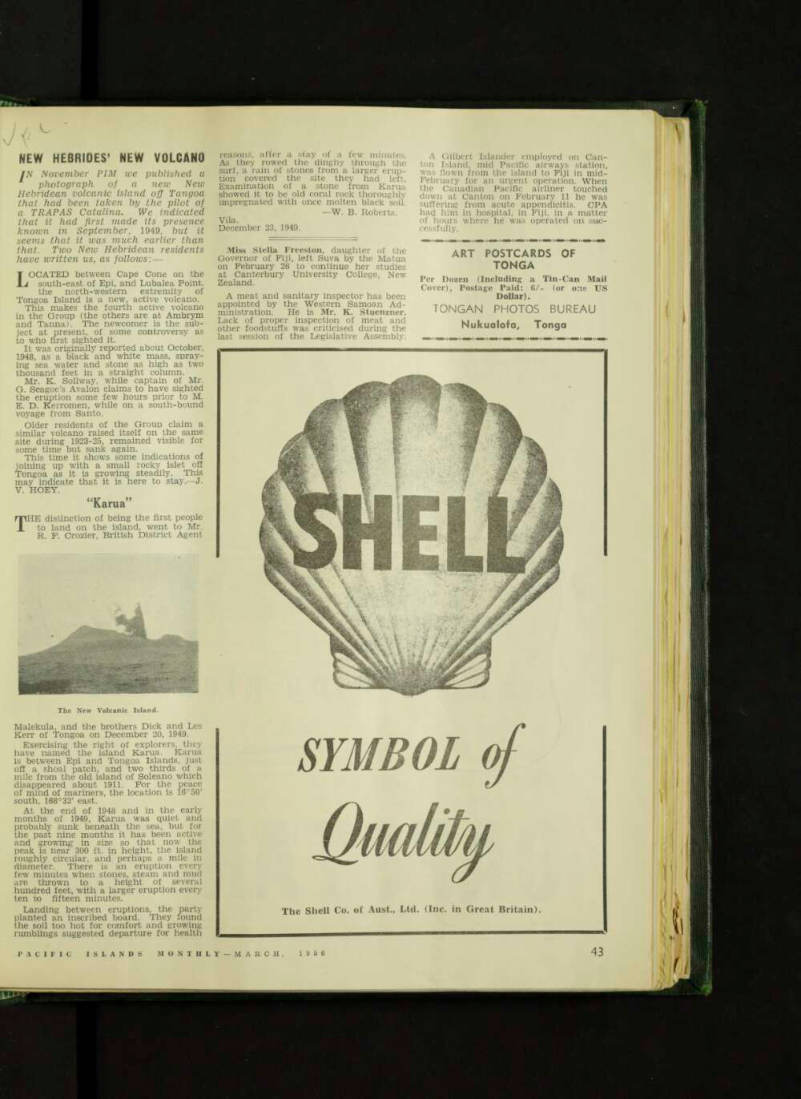
New Hebrides’ New Volcano
IN November PIM we published a photograph of a new New Hebridean volcanic island off Tangoa that had been taken by the pilot of a TRAPAS Catalina. We indicated that it had first made its presence known in September, 1949, but it seems that it was much earlier than that. Two New Hebridean residents have written us, as follows : LOCATED between Cape Cone on the south-east of Epi, and Lubalea Point, the north-western extremity of Tongoa Island is a new, active volcano.
This makes the fourth active volcano in the Group (the others are at Ambrym and Tanna). The newcomer is the sub ject at present, of some controversy as to who first sighted it.
It was originally reported about October, 1948, as a black and white mass, spray ing sea water and stone as high as two thousand feet in a straight column.
Mr. K. Soilway, while captain of Mr.
G. Seagoe’s Avalon claims to have sighted the eruption some few hours prior to M.
E. D. Kerromen, while on a south-bound voyage from Santo.
Older residents of the Group claim a similar volcano raised itself on the same site during 1923-25, remained visible for some time but sank again.
This time it shows some indications of joining up with a small rocky islet off Tongoa as it is growing steadily. This may indicate that it is here to stay.—J.
V. Hoey.
“Kama”
THE distinction of being the first people to land on the island, went to Mr.
R. F. Crozier, British District Agent
Malekula, and the brothers Dick and Les Kerr of Tongoa on December 20, 1949.
Exercising the right of explorers, they have named the island Kama. Kama is between Epi and Tongoa Islands, just off a shoal patch, and two thirds of a mile from the old island of Soleano which disappeared about 1911. For the peace of mind of mariners, the location is 16°50’ south, 168°32’ east.
At the end of 1948 and in the early months of 1949, Kama was quiet and probably sunk beneath the sea, but for the past nine months it has been active and growing' in size so that now the peak is near 300 ft. in height, the island roughly circular, and perhaps a mile in diameter. There is an eruption every few minutes when stones, steam and mud are thrown to a height of several hundred feet, with a larger eruption every ten to fifteen minutes.
Landing between eruptions, the party planted an inscribed board. They found the soil too hot for comfort and growing rumblings suggested departure for health
reasons, after a stay of a few minutes.
As they rowed the dinghy through the surf, a rain of stones from a larger erup tion covered the site they had left.
Examination of a stone from Kama showed it to be old coral rock thoroughly impregnated With once molten black soil. —W. B. Roberts.
Vila.
December 23, 1949.
Miss Stella Freeston, daughter of the Governor of Fiji, left Suva by the Matua on February 26 to continue her studies at Canterbury University College, New Zealand.
A meat and sanitary inspector has been appointed by the Western Samoan Ad ministration. He is Mr. K. Stuenzner.
Lack of proper inspection of meat and other foodstuffs was criticised during the last session of the Legislative Assembly.
A Gilbert Islander employed on Can ton Island, mid Pacific airways station, was flown from the island to Fiji in mid- February for an urgent operation. When the Canadian Pacific airliner touched down at Canton on February 11 he was suffering from acute appendicitis. CPA had him in hospital, in Fiji, in a master of hours where he was operated oh suc cessfully.
The New Volcanic Island.
Advertisements & other items, pp. 47-48 (1 item)
Symbol Of
ART POSTCARDS OF
TONGA
Per Dozen {lncluding a Tin-Can Mail Cover), Postage Paid: 6/- (or one US Dollar).
TONGAN PHOTOS BUREAU
Nukualofa, Tonga
SYMBOL of
Quatitu, The Shell Co. of Aust., Ltd. (Inc. in Great Britain).
An ornate example of historical
keys, this XVlth Century
French key features the sporting motif in its club and animal carvings. It seems to have been the key to a Duke’s country
lodge.
0 i '■* j. e ill f'2 sm A
The key
to smoking pleasure
FINE CUT
NAVY CUT
TOBACCOS
New Caledonia?
What Is Wrong With
Leading French Journalist Brutally Names the All-Powerful Nickel Company
WHEN Air France made its first flight from Paris to Noumea, in 1949, the plane brought along a well known French journalist, Michel Gor dey.
He was not pleased with what he found in New Caledonia and, on his return, he wrote for the French news paper, France Soir, an article in which he described the economic sickness of the French Pacific colony, and quite bluntly attributed that sickness to the all-powerful Nickel Company.
Publication of the article caused a stir in colonial circles, and an angry re action by certain Noumea interests. The following is a literal translation of most of the article.
THROUGHOUT my stay in New Cale donia, I listened to the same re frain: “What we need badly here is some new blood —and some new capital.”
“Metropolitan France should make an effort to aid us,” I was told everywhere.
“But you yourselves, are you prepared to make an effort to help the metropoli tans who want to work and establish themselves here?” I asked in my turn.
At this question my interlocutors looked unhappy and started to explain the dif ficulties.
“Here’s a place almost deserted, with only 20,000 whites, 30,000 native Melan esians and some 12,000 Javanese and Indo-Chinese workers —who, in any case, are anxious to return to their home lands.” a high-up metropolitan official told me.
On most of the land cattle was being raised, to the extent of 4 to 5 hectares for each head of cattle. In France the position is reversed: there we have 4 or 5 beasts for each hectare of pasture. Here the colonists suffer a lack of markets.
So their costs are too high.
However, everything seems to grow here: Wheat, pineapples, cotton, coffee, maize. But the colonies vegetate in a sort of passive misery. They prefer to go hunting, or fishing, or to speculate on the mining concessions.
In reality, nobody wants to do any serious work. But if anybody should by chance roll up his sleeves and set to, a newcomer for example, they soon do all they can to dissuade him and to make
life impossible . . .
The day following, I was told the sad story of a Parisian who came out to Noumea three years ago, to install a tan nery in the island. He had some capital, and the necessary equipment and tech nical knowledge. He had believed that the Caledonian cattle stations, which up to then had exported their skins un treated would have been anxious to see them tanned in their own country. They let him set up his tannery; but, once his capital was engaged in the venture, they brought him to bankruptcy in a matter of three months. Having lost everything, he got employment in a nickel mine, and is now with some difficulty saving enough for his fare back to France.
IT it, however, not just bad luck that explains such failures. The reason— of which they only tell you under their breath —is quite different.
The reality is that powerful local in terests, knowingly and of set purpose, pre vent all innovation, all new initiative, all introduction of outside initiative in New
Caledonia. A company which possesses a virtual monopoly both of wholesale and retail trade in New Caledonia; which exercises at the same time the function of banking and to whom everybody looks for credit; which has in this fashion grabbed a good portion of the best land; and which owns the majority of shares in most of the mining enterprises of the
island—this Company controls not only the economic life of the place but also the New Caledonian political life.
“Why ever should such people encourage Caledonians to cultivate their land, to produce butter, cheese or wheat, when they can sell them tins of Australian preserves, or Californian wine or Ameri can wheat flour?” I was asked by a small
colonist, who explained to me the wheels within wheels of the feudal set-up.
"But at least you could vote against the nominees of this company in the General Council,” I said.
"Monsieur . . . don't you believe it!
Here, everybody knows everything, in cluding everything about you—and I need credit just the same as everybody else.”
New Caledonia, in 1949, is one of the world’s few countries whose inhabitants are not called on to pay any income tax.
But extremely heavy indirect taxes swell the island’s budget. These taxes apply to the importation of machinery that local industry must buy to modernise their in stallations.
The height of absurdity is that export taxes are imposed on the export of every ton of Caledonian chrome and nickel, the only exploitable riches of the island. The result is that Caledonian ores have to be sold at a price higher than that on the world market. It is because of this that France pays three times as much for nickel from Noumea as it does for Canadian nickel.
YET the New Caledonian concerns make big profits. These profits are in Pacific francs. And the Pacific franc is valued at 5.51 frs. metropolitan.
Why? No-one can say, but the result is that the cost of living is about three times higher in Noumea than in Paris.
Here again the company which controls the economic life of the island has im posed its own point of view. As it Im ports more than it exports, it has every thing to gain by paying for its imports with an over-valued currency. The fact that with this artificial* over-valuation New Caledonian colonists are no longer able profitably to sell their coffee, their copra—and even the chrome from certain small undertakings—means nothing to this company, which has all the say in
the matter through its own general councillors.
And what of the High Commissioner who represents Prance, the Mother Country, and the interests of the metro polis?
Like his 41 predecessors he has resigned himself to the policy of not interfering too much in local affairs. Every time that any Governor uses any sort of initiative in' New Caledonia, the local bigwigs, “whose arms are long enough to reach to Paris,” see to it that he gets the sack.
The present High Commissioner, M.
Pierre Cournarie, a former African ad ministrator whose career has covered French Equatorial and West Africa, is within a few years of being pensioned off.
He received me in a big, barte-walled office. A portrait of General de Gaulle only stressed its nudity.
And what is his opinion of the pros pects of New Caledonia as a place for colonisation by young Frenchmen?
“Perhaps there might be room for a dozen specialists, hardly more,” he re plied, in a sober voice. Because of the swollen value of the Pacific franc, new comers would need such resources of capital that they would find it better to stay where they were in France itself, where the land and possibility of making a living are less costly. However, New Caledonia may be said to need new blood.
BUT I did come across a newcomer, one evening, at the Pacific Hotel. This man, an American, had come to New Caledonia with a bulldozer. He had put it to use, shifting earth and finding traces of precious metals. At once he had taken up options on the areas he had pros pected. For a few hundred thousand dollars the affair had been launched.
“But what surprises me,” he added, “is the reaction of the inhabitants. Instead of looking for minerals themselves, in stead of joining their capital together to exploit the isle’s deposits, they write to me by the hundred to propose that I should buy their declarations. They lack all energy and initiative. There is some thing decadent about this island.”
The truth is that the only profitable mine in New Caledonia, which not only makes a real do of things but is organised on modern lines, also has an American manager. Before thinking of immediate profits, he went into the question of housing the workers, took care to see that their leisure time was not wasted, and in stalled a cinema and a co-operative store.
Within three years his production had quadrupled.
“It was good business,” he told me.
“The local inhabitants seem to think that the only means to exploit a mine is to work their labourers to death. But I em ploy other methods.”
As for the future of this paradoxical island, I may perhaps mention that ac cording to rumour there is petrol and uranium in New Caledonia. There, again, the Australians and Americans will un doubtedly have to employ all their private initiative before —after a hundred years of French colonisation —we shall have a modern and reliable geological survey of the island. It’s so far away, Noumea — quite as far away from Paris as from New York.
The High Commissioner of Western Samoa, Mr. G. R. Powles, and Mrs.
Powles were in Suva for a week in February. They arrived by flying boat on February 21 and intended to go on to Apia by the NZNAC Dakota two days later. The Dakota was, however, sub jected to a series of delays. She was first prevented by bad weather from landing at Norfolk Island and when she eventually reached Nadi she was again held up by storm. She left for Tonga, Samoa and the Cook Islands on March 1.
Advertisements & other items, pp. 49-50 (1 item)
£. J. Gough S. Co.
THE
YORKSHIRE
INSURANCE
CO. LTD.
(Incorporated in England)
ALL CLASSES OF
INSURANCE
Including Fire Motor Guarantee Accident Workers Marine Island Representatives:
PORT MORESBY: E. A. James
RABAUL: G. B. Black LAE: New Guinea Industries Ltd.
MADANG: R. MacGregor SUVA: Williams & Gosling Ltd.
NOUMEA: Y. Mortensen
NORFOLK ISLAND:
A. E. Martin
€ 15 iV r Cooper Adjustable Glass Louvres are manufactured by F. W. GISSING PTY., LTD., 197 Wilson Street, Newtown, Sydney, Australia. Always insist on GENUINE
COOPER LOUVRES—
they are clearly branded.
Keep Hot Sun OUT . . .
Let Cool Breezes IN!
Cooper Adjustable Glass Louvres are the ideal way of securing maximum ventilation with minimum interference from glare. Fitted with non-actinic glass, which absorbs the sun’s heat, they are ideal for nurseries and verandahs . . and amazing though it may seem, are actually cheaper to install than ordinary windows Cheaper to instal than ANY other kind of WINQOW
ADJUSTABLE GLASS LOUVBES
r Imagine it—units of movable glass louvres (plain or figured) in metal frames, giving unobstructed light and air, yet protection from draughts and rain and all with as simple a motion as flicking on a light switch. The price is so amazingly reasonable and Father can do all the erecting, it’s so easy.
Illustrated: Typical Suburban Home. Verandah (Sydney) glassed in with Cooper Louvres.
WRITE FOR PARTICULARS TO PACIFIC ISLANDS REPRESENTATIVE
£. J. GOUGH S. CO.
SUPPLIERS OF GENERAL MERCHANDISE TO LEADING FIRMS THROUGHOUT THE PACIFIC ISLANDS.
Exporters . . . Importers . . . Manufacturers’ Representatives 1 BOND STREET, SYDNEY, AUSTRALIA. Box 3615 G.P.O. Tel. BU 2159 Bankers: Bank of N.S.W. Bank of Adelaide. Comptoir National d’Escompte de Paris.
Cable Address; “SEAFOODS.” SYDNEY.
Codes: Bentley’s, 2nd and Comp. Phrase; A.8.C., sth and 6th; Peterson, 2nd and 3rd, Banking, Acme.
Scott’s “Renown” Brand Rope,
Cordage and
Binder
Twine
Cable Address: Ropeyard, Sydney. 4,-. «
SMNNMS
of Every
Description
MANUFACTURED AT
MASCOT, N.S.W.
By
J. SCOTT
PTY. LTD.
Head Office and Store
163 CLARENCE STREET,
SYDNEY,
N.S.W.
NELSON and ROBERTSON Pty. Ltd.
Established 1895
Shipowners - Brokers and
Islands Merchants
All classes of Merchandise purchased at Best Wholesale Prices. Original Invoices supplied to Island Clients. Cocoa Beans, Copra, Rubber, Trochus Shell and All Islands Produce Sold on Commission.
Entrust your requirements to the firm with fifty-five years 1 practical experience in the Pacific Islands.
Inquiries Solicited.
Prompt attention given to all inquiries
NELSON & ROBERTSON III:
12 SPRING STREET, SYDNEY, AUSTRALIA
Telegraphic Address: IVAN, SYDNEY.
Public Servants Strike In
Noumea
MOST of the public servants in Noumea, New Caledonia, went on strike in January because they did not receive back-pay which they claimed was due to them.
A new industrial Award was accepted by the Conseil-General, and it apparently authorised back pay; but it was not dis tributed in hard cash, as was expected Thereupon the public servants ceased work. The amount involved was about 9 million francs. At the end of two days, the dispute was settled.
The closing of the Post Office, Public Works Department, Customs house, etc., caused much public inconvenience.
Mr. T. W, Alport Barker has been re elected chairman of the Fiji Publicity Board and Tourist Bureau.
Advertisements & other items, pp. 51-52 (1 item)
Batteries
THE PACIFIC ISLANDS SOCIETY
(Founded 1937) Visitors from the Pacific Islands to Sydney, or persons interested in Islands affairs, are Invited to communicate with the Honorary Secretary of the above Society which was formed to constitute a social centre for those interested in the Pacific Islands.
Hegular meetings and social gatherings, with lectures, are held at History House, 8 Young Street, Sydney, on the fourth Wednesday of each month, at 8 p.m.
Address for correspondence:—
THE PACIFIC ISLANDS SOCIETY
Box 2434, G.P.0., Sydney.
U.S.L.
BATTERIES
FOR
MOTOR CAR AND TRUCK
SOLE DISTRIBUTORS for NEW GUINEA, PAPUA
AND PACIFIC ISLANDS.
VENTURA TRADING COMPANY PTY. LTD.
26 BRIDGE STREET, SYDNEY
Cables: “VENTURA,” Sydney.
BROOMFIELDS Ltd.
Suppliers of Building Hardware General Hardware Ship Chandlery
V *> O ♦ *o ** e*o */ h / % % He «V o 'X ** % rtf' I a *3 4^ RJ *%. & & o « *&f. ,- .'f^ : /X. *» ■V- «£ % jL ‘ U ■ y pranz -'•i s.-A/y 4
EX AMD
h -X a »'*
the
services
SOUTH
B»ASiPiC
t*> New Zealand is a whole world of travel . . . but it’s a small world when you fly on the N.Z. National Airways Corporation air network that brings New Zealand’s playgrounds and wonderlands invitingly close.
NEW ZEALAND NATIONAL AIRWAYS CORPORATION.
Ne w Zealand National Airways Corporation provides a network of air services throughout the Dominion and tne South-West Pacific. General Agents in the Dominion for British Commonwealth Pacific Airlines and I fans-Australian Airlines. Booking Agents for Tasman Empire Airways, Qantas Empire Airways, the 8.0.A.C. and other overseas airlines.
Offices and Agents throughout New Zealand and the South-West Pacific.
Magazine Section
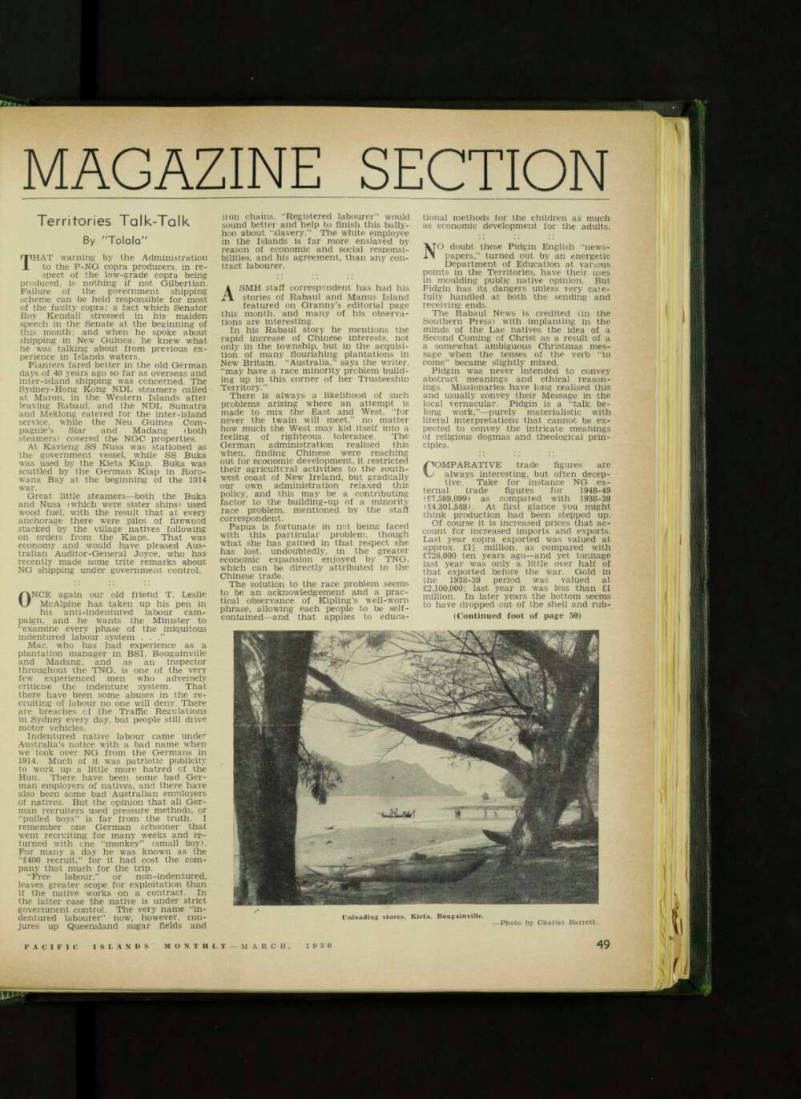
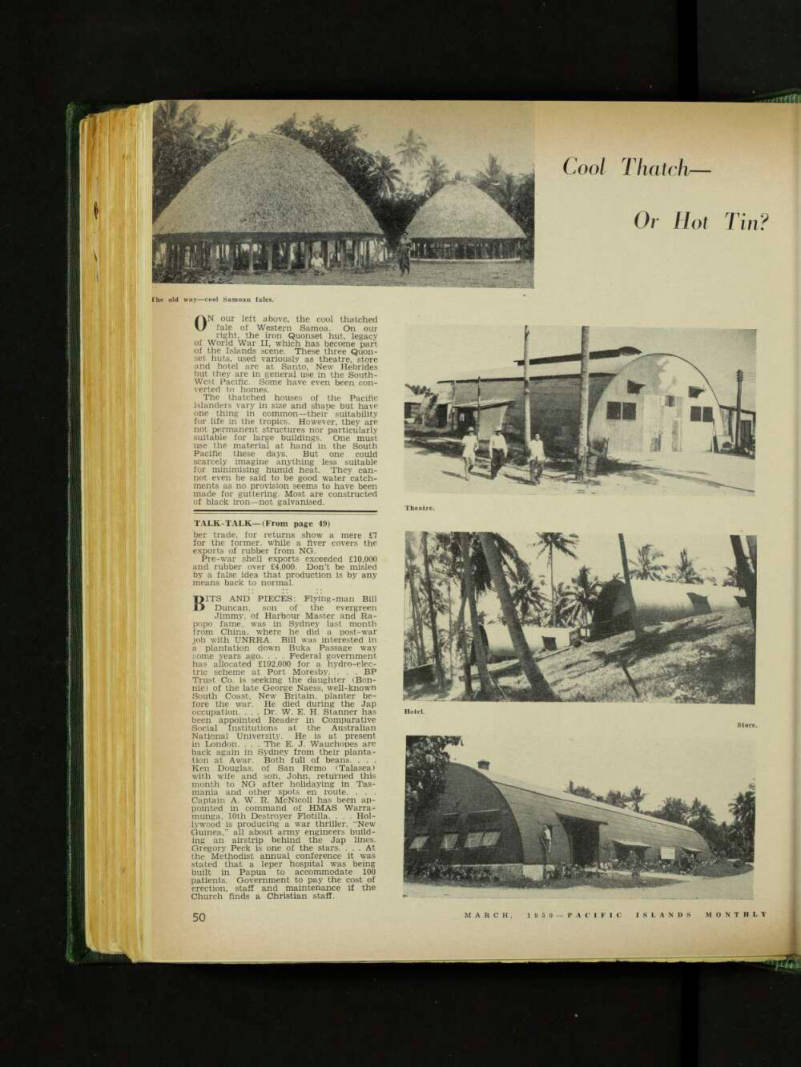
Territories Talk-Talk
By "Tolala"
warning by the Administration to the P-NG copra producers, in re spect of the low-grade copra being produced, is nothing if not Gilbertian.
Failure of the government shipping scheme can be held responsible for most of the faulty copra; a fact which Senator Roy Kendall stressed in his maiden speech in the Senate at the beginning of this month; and when he spoke about shipping in New Guinea, he knew what he was talking about from previous ex perience in Islands waters.
Planters fared better in the old German days of 40 years ago so far as overseas and inter-island shipping was concerned. The Sydney-Hong Kong NDL steamers called at Maron, in the Western Islands after leaving Rabaul, and the NDL Sumatra and Meklong catered for the inter-island service, while the Neu Guinea Com pagnie’s Siar and Madang (both steamers) covered the NGC properties.
At Kavieng SS Nusa was stationed as the government vessel, while SS Buka was used by the Kieta Kiap. Buka was scuttled by the German Kiap in Roro wana Bay at the beginning of the 1914 war.
Great little steamers—both the Buka and Nusa (which were sister ships) used wood fuel, with the result that at every anchorage there were piles of firewood stacked by the village natives following on orders from the Kiaps. That was economy and would have pleased Aus tralian Auditor-General Joyce, who has recently made some trite remarks about NG shipping under government control.
ONCE again our old friend T. Leslie McAlpine has taken up his pen in his anti-indentured labour cam paign, and he wants the Minister to “examine every phase of the iniquitous indentured labour system . .
Mac, who has had experience as a plantation manager in BSI, Bougainville and Madang, and as an inspector throughout the TNG, is one of the very few experienced men who adversely criticise the indenture system. That there have been some abuses in the re cruiting of labour no one will deny. There are breaches cf the Traffic Regulations in Sydney every day, but people still drive motor vehicles.
Indentured native labour came under Australia’s notice with a bad name when we took over NG from the Germans in 1914. Much of it was patriotic publicity to work up a little more hatred of the Hun. There have been some bad Ger man employers of natives, and there have also been some bad Australian employers of natives. But the opinion that all Ger man recruiters used pressure methods, or “pulled boys” is far from the truth. I remember one German schooner that went recruiting for many weeks and re turned with cne “monkey” (small boy).
For many a day he was known as the “£4OO recruit,” for it had cost the com pany that much for the trip.
“Free labour,” or non-indentured, leaves greater scope for exploitation than if the native works on a contract. In the latter case the native is under strict government control. The very name “in dentured labourer” now, however, con jures up Queensland sugar fields and
iron chains. “Registered labourer’’ would sound better and help to finish this ballyhoo about “slavery.” The white employee in the Islands is far more enslaved by reason of economic and social responsibilities, and his agreement, than any contract labourer. ‘ ASMH staff correspondent has had his stories of Rabaul and Manus Island featured on Granny’s editorial page this month, and many of his observations are interesting.
In his Rabaul story he mentions the rapid increase of Chinese interests, not only in the township, but in the acquisition of many flourishing plantations in New Britain. “Australia,” says the writer, “may have a race minority problem building up in this corner of her Trusteeship Territory.”
There is always a likelihood of such problems arising where an attempt is made to mix the East and West, “for never the twain will meet,” no matter how much the West may kid itself into a feeling of righteous tolerance. The German administration realised this when, finding Chinese were reaching out for economic development, it restricted their agricultural activities to the southwest coast of New Ireland, but gradually our own administration relaxed this policy, and this may be a contributing factor to the building-up of a minority race problem, mentioned by the staff correspondent with PU thls S particular
what shThaf,g“
has lost, undoubtedly, in the greater economic expansion enjoyed by TNG, ?{?lnpsp ca f? ! ,ri 1 ? dire y attnbuted t 0 the ThP snli it inn to the race nroblem seems to be an U ac^owledae^ent Pl and ei a ora™tical observance of well-worn
phrase a“| each JSopfe to ”eT
contained—and that applies to educa-
tional methods for the children as much as economic development for the adults, , '* , ** . ** , , doubt these Pidgin English news papers,” turned out by an energetic Department of Education at various points in the Territories, have their uses in moulding public native opinion. But Pidgin has its dangers unless very caie fully handled at both the sending and receiving ends, The Rabaul News is credited (in the Southern Press) with implanting in the minds of the Lae natives the idea of a Second Coming of Christ as a result of a a somewhat ambiguous Christmas mes sage when the tenses of the verb “to come” became slightly mixed.
Pidgin was never intended to convey abstract meanings and ethical reason ings. Missionaries have long realised this and usually convey their Message in the local vernacular. Pidgin is a “talk be long work,”—purely materialistic with literal interpretations that cannot be ex pected to convey the intricate meanings of religious dogmas and theological prin ciples. :: ;; ;: COMPARATIVE trade figures are ( wakaiive trade figures are always interesting, but often decep . Take for instance ex as compared with 1938~39 coo! comparedwith 1938-39 (£4,301,588). At first glance you might think production had been stepped up.
‘export
year exported was val e ten aeo—and vet tonnaee fJst vear was onlv a little over half of that exported before the war Gold °n the 1938-39 period was valued at £2,100,000; last year it was less than £1 million. In later years the bottom seems d ™PP ed ° ut ° f the shell and rub '
(Continued foot of page 50)
Unloading stores, Kieia, Bougainville. —Photo by Charles Barrett.
ber trade, for returns show a mere £7 for the former, while a fiver covers the exports of rubber from NG.
Pre-war shell exports exceeded £lO,OOO and rubber over £4,000. Don’t be misled by a false idea that production is by any means back to normal.
BITS and' PIECES: Flying-man Bill Duncan, son of the evergreen Jimmy, of Harbour Master and Ra popo fame, was in Sydney last month from China, where he did a post-war job with UNRRA. Bill was interested in a plantation down Buka Passage way some years ago. . . . Federal government has allocated £192,000 for a hydro-elec tric scheme at Port Moresby. . . . BP Trust Co. is seeking the daughter (Bon nie) of the late George Naess, well-known South Coast, New Britain, planter be fore the war. He died during the Jap occupation. . . . Dr. W. E. H. Stanner has been appointed Reader in Comparative Social Institutions at the Australian National University. He is at present in London. . . . The E. J. Wauchopes are back again in Sydney from their planta tion at Awar. Both full of beans. . . .
Ken Douglas, of San Remo (Talasea) with wife and son, John, returned this month to NG after holidaying in Tas mania and other spots en route. . . .
Captain A. W. R. McNicoll has been ap pointed in command of HMAS Warra munga, 10th Destroyer Flotilla. . . . Hol lywood is producing a war thriller, “New Guinea,” all about army engineers build ing an airstrip behind the Jap lines.
Gregory Peck is one of the stars. ... At the Methodist annual conference it was stated that a leper hospital was being built in Papua to accommodate 100 patients. Government to pay the cost of erection, staff and maintenance if the Church finds a Christian staff.
Cool Thatch —
Or Hot Tin?
ON our left above, the cool thatched fale of Western Samoa. On our right, the iron Quonset hut, legacy of World War 11, which has become part of the Islands scene. These three Quon set huts, used variously as theatre, store and hotel are at Santo, New Hebrides but they are in general use in the South- West Pacific. Some have even been con verted to homes.
The thatched houses of the Pacific islanders vary in size and shape but have one thing in common—their suitability for life in the tropics. However, they are not permanent structures nor particularly suitable for large buildings. One must use the material at hand in the South Pacific these days. But one could scarcely imagine anything less suitable for minimising humid heat. They can not even be said to be good water catch ments as no provision seems to have been made for guttering. Most are constructed of black iron—not galvanised.
The old way—cool Samoan fales.
Advertisements & other items, p. 54 (1 item)
TALK-TALK—(From page 49)
Artist Dobell Finds New Guinea
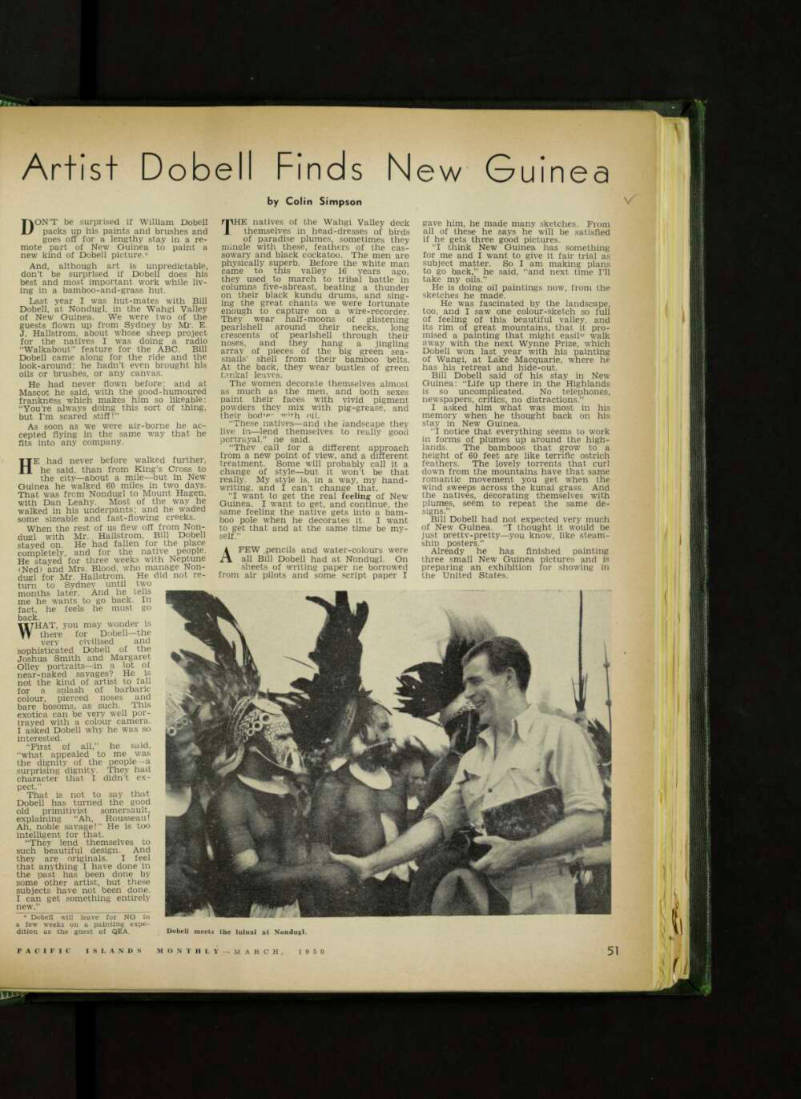
by Colin Simpson
DON’T be surprised if William Dobell packs up his paints and brushes and goes off for a lengthy stay in a re mote part of New Guinea to paint a new kind of Dobell picture.* And, although art is unpredictable, don’t be surprised if Dobell does his best and most important work while liv ing in a bamboo-and-grass hut.
Last year I was hut-mates with Bill Dobell, at Nondugl, in the Wahgi Valley of New Guinea. We were two of the guests flown up from Sydney by Mr. E.
J. Hallstrom, about whose sheep project for the natives I was doing a radio “Walkabout” feature for the ABC. Bill Dobell came along for the ride and the look-around; he hadn’t even brought his oils or brushes, or any canvas.
He had never flown before; and at Mascot he said, with the good-humoured frankness which makes him so likeable: “You’re always doing this sort of thing, but I’m scared stiff!”
As soon as we were air-borne he ac cepted flying in the same way that he fits into any company.
HE had never before walked further, he said, than from King’s Cross to the city—about a mile—but in New Guinea he walked 60 miles in two days.
That was from Nondugl to Mount Hagen, with Dan Leahy. Most of the way he walked in his underpants; and he waded some sizeable and fast-flowing creeks.
When the rest of us flew off from Non dugl with Mr. Hallstrom, Bill Dobell stayed on. He had fallen for the place completely, and for the native people.
He stayed for three weeks with Neptune (Ned) and Mrs. Blood, who manage Non dugl for Mr. Hallstrom. He did not re
turn to Sydney until two months later. And he tells me he wants to go back. In fact, he feels he must go WHAT, you may wonder is there for Dobell—the very civilised and sophisticated Dobell of the Joshua Smith and Margaret Olley nortraits —in a lot of near-naked savages? He is not the kind of artist to fall for a snlash of barbaric colour, pierced noses and bare bosoms, as such. This exotica can be very well por trayed with a colour camera.
I asked Dobell why he was so interested.
“First of all,” he said, “what appealed to me was the dignity of the people—a surprising dignity. They had character that I didn’t ex pect.”
That is not to say that Dobell has turned the good old primitivist somersault, explaining “Ah, Rousseau!
Ah, noble savage!” He is too intelligent for that.
“They lend themselves to such beautiful design. And they are originals. I feel that anything I have done in the past has been done by some other artist, but these subjects have not been done.
I can get something entirely new.”
mHE natives of the Wahgi Valley deck L themselves in head-dresses of birds of paradise plumes, sometimes they mingle with these, feathers of the cassowary and black cockatoo. The men are physically superb. Before the white man came to this valley 16 years ago, jw* to march to tribal tattle in columns five-abreast, beating a thunder on their black kundu drums, and singi n g the great chants we were fortunate enough to capture on a wire-recorder, They wear half-moons of glistening pearlshell around their necks, long crescents of pearlshell through their noses, and they hang a jingling array of pieces of the big green seasnails’ shell from their bamboo belts, At the back, they wear bustles of green tanka! leaves.
The women decorate themselves almost as much as the men, and both sexes paint their faces with vivid pigment powders they mix with pig-grease, and their bod’p- w’*h oil.
“These natives—and the landscape they llve m—lend themselves to really good portrayal,” he said.
“Thev call for a different approach from a new point of view, and a different treatment. Some will probably call it a change of style—but it won’t be that really. My style is, in a way, my handwriting, and I can’t change that.
“j wan t to get the real feeling of New Guinea. I want to get, and continue, the same feeling the native gets into a bamboo po i e W h en he decorates it. I want to get that and at the same time be myself.” ..
A FEW .pencils and water-colours were 2\ all Bill Dobell had at Nondugl. On sheets of writing paper ne borrowed from air pilots and some script paper I
gave him, he made many sketches. From all of these he says he will be satisfied if he gets three good pictures, ‘‘l think New Guinea has something for me and I want to give it fair trial as subject matter. So I am making plans to go back," he said, “and next time I’ll take my oils.”
He is doing oil paintings now, from the sketches he made.
He was fascinated by the landscape, too, and I saw one colour-sketch so full of feeling of this beautiful valley, and its rim of great mountains, that it pro mised a painting that might easih r walk away with the next Wynne Prize, which Dobell won last year with his painting of Wangi, at Lake Macquarie, where he has his retreat and hide-out.
Bill Dobell said of his stay in New Guinea: “Life up there in the Highlands is so uncomplicated. No telephones, newspapers, critics, no distractions.”
I asked him what was most in his memory when he thought back on his stay in New Guinea I notice that everything seems to work in forms of plumes up around the high lands. The bamboos that grow to a height of 60 feet are like terrific ostrich feathers. The lovely torrents that curl down from the mountains have that same romantic movement you get when the wind sweeps across the kunai grass. And the natives, decorating themselves with plumes, seem to repeat the same de signs.”
Bill Dobell had not expected very much of New Guinea. “I thought it would be just prettv-pretty—you know, like steam ship posters.”
Already he has finished painting three small New Guinea pictures and is preparing an exhibition for showing in the United States.
* Dobell will leave for NG in a few weeks on a painting expe dition as the guest of QEA,
Dobell meets the luluai at Nondugl.
Tropicalities
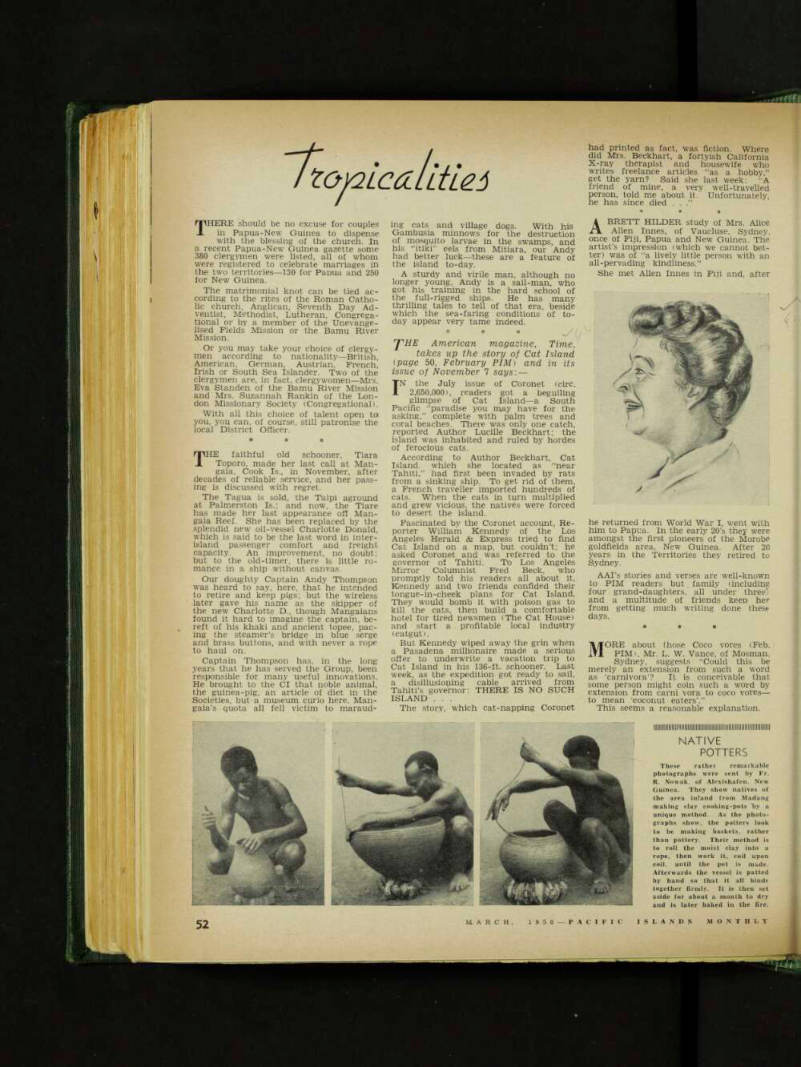
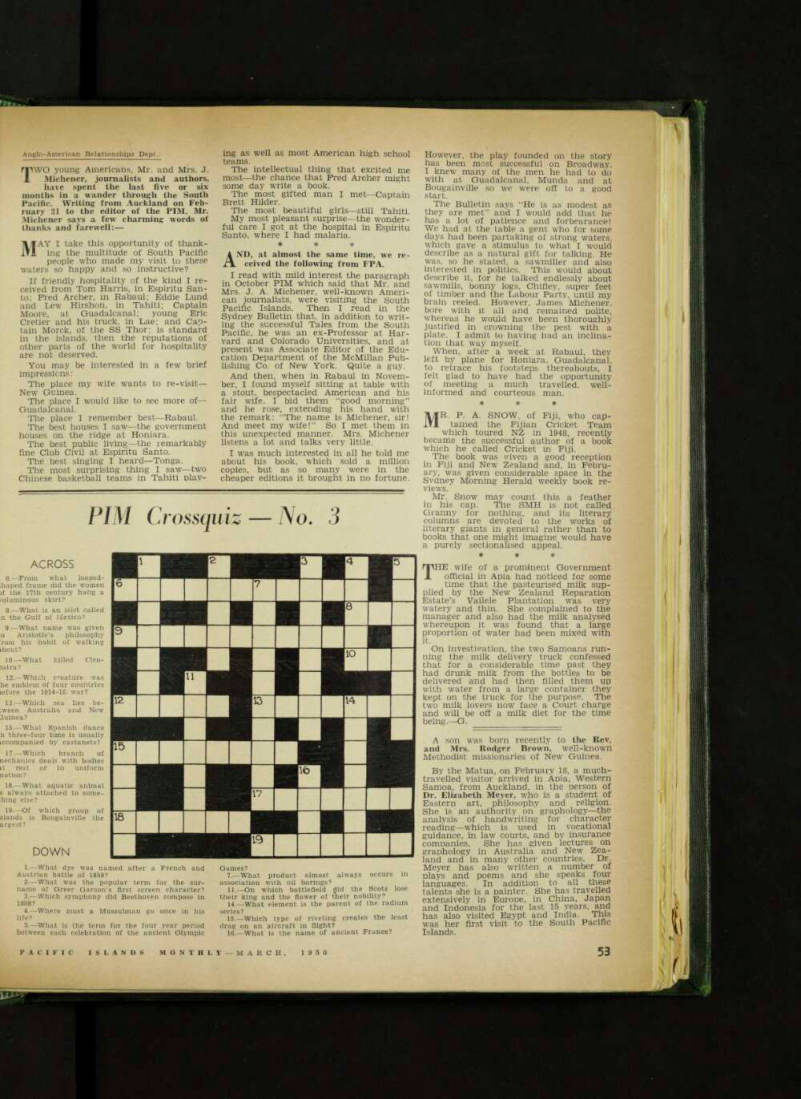
THERE should be no excuse for couples in Papua-New Guinea to dispense with the blessing of the church. In a recent Papua-New Guinea gazette some 380 clergymen were listed, all of whom were registered to celebrate marriages in the two territories—l3o for Papua and 250 for New Guinea.
The matrimonial knot can be tied ac cording to the rites of the Roman Catho lic church, Anglican, Seventh Day Ad ventist, Methodist, Lutheran, Congrega tional or by a member of the Unevange lised Fields Mission or the Bamu River Mission.
Or you may take your choice of clergy men according to nationality—British, American, German, Austrian, French, Irish or South Sea Islander. Two of the clergymen are, in fact, clergywomen—Mrs.
Eva Standen of the Bamu River Mission and Mrs. Suzannah Rankin of the Lon don Missionary Society (Congregational).
With all this choice of talent open to you, you can, of course, still patronise the local District Officer. ♦ ♦ ♦ THE faithful old schooner, Tiara Toporo, made her last call at Man gaia, Cook Is., in November, after decades of reliable service, and her pass ing is discussed with regret.
The Tagua is sold, the Taipi aground at Palmerston Is.; and now, the Tiare has made her last appearance off Man gaia Reef. She has been replaced by the splendid new oil-vessel Charlotte Donald, which is said to be the last word in inter island passenger comfort and freight capacity. An improvement, no doubt; but to the old-timer, there is little ro mance in a ship without canvas.
Our doughty Captain Andy Thompson was heard to say, here, that he intended to retire and keep pigs; but the wireless later gave his name as the skipper of the new Charlotte D.. though Mangaians found it hard to imagine the captain, be reft of his khaki and ancient topee, pac ing the steamer’s bridge in blue serge and brass buttons, and with never a rope to haul on.
Captain Thompson has, in the long years that he has served the Group, been responsible for many useful innovations.
He brought to the Cl that noble animal, the guinea-pig, an article of diet in the Societies, but a museum curio here. Man gaia’s quota all fell victim to maraud
mg cats and village dogs. With his Gambusia minnows for the destruction of mosquito larvae in the swamps, and his “itiki” eels from Mitiara, our Andy had better luck—these are a feature of the island to-day.
A sturdy and virile man, although no longer young. Andy is a sail-man, who got his training in the hard school of the full-rigged ships. He has many thrilling tales to tell of that era, beside which the sea-faring conditions of to day appear very tame indeed. * * * /
'J'HE American magazine, Time,
takes up the story of Cat Island {page 50, February PIM) and in its issue of November 7 says: IN the July issue of Coronet (circ. 2,650,000), readers got a beguiling glimpse of Cat Island—a South Pacific “paradise you may have for the asking,” complete with palm trees and coral beaches. There was only one catch, reported Author Lucille Beckhart; the island was inhabited and ruled by hordes of ferocious cats.
According to Author Beckhart, Cat Island, which she located as “near Tahiti,” had first been invaded by rats from a sinking ship. To get rid of them, a French traveller imported hundreds of cats. When the cats in turn multiplied and grew vicious, the natives were forced to desert the island.
Fascinated by the Coronet account, Re porter William Kennedy of the Los Angeles Herald & Express tried to find Cat Island on a map, but couldn’t; he asked Coronet and was referred to the governor of Tahiti. To Los Angeles Mirror Columnist Fred Beck, who promptly told his readers all about it, Kennedy and two friends confided their tongue-in-cheek plans for Cat Island.
They would bomb it with poison gas to kill the cats, then build a comfortable hotel for tired newsmen (The Cat House) and start a profitable local industry (catgut).
But Kennedy wiped away the grin when a Pasadena millionaire made a serious offer to underwrite a vacation trip to Cat Island in his 136-ft. schooner. Last week, as the expedition got ready to sail, a disillusioning cable arrived from Tahiti’s governor: THERE IS NO SUCH
Island . . .
The story, which cat-napping Coronet
had printed as fact, was fiction. Where did Mrs. Beckhart, a fortyish California X-ray therapist and housewife who writes freelance articles “as a hobby,” get the yarn? Said she last week: “A friend of mine, a very well-travelled person, told me about it. Unfortunately, he has since died ...” * * * A BRETT HILDER study of Mrs. Alice Allen Innes, of Vaucluse, Sydney, once of Fiji, Papua and New Guinea. The artist’s impression (which we cannot bet ter) was of “a lively little person with an
all-pervading kindliness.”
She met Allen Innes in Fiji and, after
he returned from World War I, went with him to Papua. In the early 20’s they were amongst the first pioneers of the Morobe goldfields area, New Guinea. After 20 years in the Territories they retired to Sydney.
AAl’s stories and verses are well-known to PIM readers but family (including four grand-daughters, all under three; and a multitude of friends keep her from getting much writing done these days. ♦ * * MORE about those Coco vores (Feb.
PIM», Mr. L. W. Vance, of Mosman.
Sydney, suggests “Could this be merely an extension from such a word as ‘carnivora’? It is conceivable that some person might coin such a word by extension from carni vora to coco vores— to mean ‘coconut eaters’.”
This seems a reasonable explanation.
Native
Potters
These rather remarkable photographs were sent by Fr.
R. Nowak, of Alexishafen, New Guinea. They show natives of the area inland from Madang making clay cooking-pots by a unique method. As the photo graphs show, the potters look to be making baskets, rather than pottery. Their method is to roll the moist clay into a rope, then work it, coil upon coil, until the pot is made.
Afterwards the vessel is patted by hand so that it all binds together firmly. It is then set aside for about a month to dry and is later baked in the fire.
Anglo-American Relationships Dept.:
TWO young Americans, Mr. and Mrs. J.
Michener, journalists and authors, have spent the last five or six months in a wander through the South Pacific. Writing from Auckland on Feb ruary 21 to the editor of the PIM, Mr.
Michener says a few charming words of thanks and farewell:— MAY I take this opportunity of thank ing the multitude of South Pacific people who made my visit to these waters so happy and so instructive?
If friendly hospitality of the kind I re ceived from Tom Harris, in Espiritu San to: Fred Archer, in Rabaul; Eddie Lund and Lew Hirshon, in Tahiti; Captain Moore, at Guadalcanal; young Eric Cretier and his truck, in Lae; and Cap tain Morck, of the SS Thor; is standard in the islands, then the reputations of other parts of the world for hospitality are not deserved.
You may be interested in a few brief impressions: The place my wife wants to re-visit— New Guinea.
The place I would like to see more of — Guadalcanal.
The place I remember best —Rabaul.
The best houses I saw —the government houses on the ridge at Honiara.
The best public living—the remarkably fine Club Civil at Espiritu Santo.
The best singing I heard—Tonga.
The most surprising thing I saw—two Chinese basketball teams in Tahiti play
ing as well as most American high school teams.
The intellectual thing that excited me most—the chance that Fred Archer might some day write a book.
The most gifted man I met—Captain Brett Hilder.
The most beautiful girls—still Tahiti.
My most pleasant surprise—the wonder ful care I got at the hospital in Espiritu Santo, where I had malaria. • ♦ ♦ AND, at almost the same time, we re ceived the following from FPA.
I read with mild interest the paragraph in October PIM which said that Mr. and Mrs. J. A. Michener, well-known Ameri can journalists, were visiting the South Pacific Islands. Then I read in the Sydney Bulletin that, in addition to writ ing the successful Tales from the South Pacific, he was an ex-Professor at Har vard and Colorado Universities, and at present was Associate Editor of the Edu cation Department of the McMillan Pub lishing Co. of New York. Quite a guy.
And then, when in Rabaul in Novem ber, I found myself sitting at table with a stout, bespectacled American and his fair wife. I bid them “good morning” and he rose, extending his hand with the remark: “The name is Michener, sir!
And meet my wife!” So I met them in this unexpected manner. Mrs. Michener listens a lot and talks very little.
I was much interested in all he told me about his book, which sold a million copies, but as so many were in the cheaper editions it brought in no fortune.
However, the play founded on the story has been most successful on Broadway.
I knew many of the men he had to do with at Guadalcanal, Munda and at Bougainville so we were off to a good start.
The Bulletin says “He is as modest as they are met” and I would add that he has a lot of patience and forbearance!
We had at the table a gent who for some days had been partaking of strong waters, which gave a stimulus to what I would describe as a natural gift for talking. He was, so he stated, a sawmiller and also interested in politics. This would about describe it, for he talked endlessly about sawmills, bonny logs, Chifley, super feet of timber and the Labour Party, until my brain reeled. However, James Michener, bore with it all and remained polite, whereas he would have been thoroughly justified in crowning the pest with a plate. I admit to having had an inclina tion that way myself.
When, after a week at Rabaul. they left by plane for Honiara, Guadalcanal, to retrace his footsteps thereabouts, I felt glad to have had the opportunity of meeting a much travelled, well informed and courteous man. ♦ * ♦ MR. P. A. SNOW, of Fiji, who cap tained the Fijian Cricket Team which toured NZ in 1948, recently became the successful author of a book which he called Cricket in Fiji.
The book was eiven a good reception in Fiji and New Zealand and, in Febru ary, was given considerable space in the Svdney Morning Herald weekly book re views.
Mr. Snow may count this a feather in his cap. The SMH is not called Granny for nothing, and its literary columns are devoted to the works of literary giants in general rather than to books that one might imagine would have a purely sectionalised appeal. ♦ ♦ ♦ THE wife of a prominent Government official in Apia had noticed for some time that the pasteurised milk sup plied by the New Zealand Reparation Estate’s Vailele Plantation was very watery and thin. She complained to the manager and also had the milk analysed whereupon it was found that a large proportion of water had been mixed with it.
On investigation, the two Samoans run ning the milk delivery truck confessed that for a considerable time past they had drunk milk from the bottles to be delivered and had then filled them up with water from a large container they kept on the truck for the purpose. The two milk lovers now face a Court charge and will be off a milk diet for the time being.—G.
A son was born recently to the Rev. and Mrs. Rodger Brown, well-known Methodist missionaries of New Guinea.
By the Matua, on February 18, a much travelled visitor arrived in Apia, Western Samoa, from Auckland, in the person of Dr. Elizabeth Meyer, who is a student of Eastern art, philosophy and religion.
She is an authority on graphology—the analysis of handwriting for character reading—which is used in vocational guidance, in law courts, and bv insurance companies. She has given lectures on graphology in Australia and New Zea land and in many other countries. Dr.
Meyer has also written a number of plays and poems and she speaks four languages. In addition to all these talents she is a painter. She has travelled extensively in Europe, in China, Japan and Indonesia for the last 15 years, and has also visited Egypt and India. This was her first visit to the South Pacific Islands.
PIM Crossquiz - No. 3
Across
6.—From what looped ihaped frame did the women )f the 17th century hang a voluminous skirt? 8. —What is an islet called n the Gulf of Mexico’ 9. —What name was given o Aristotle’s philosophy rom his habit of walking ibout? 10—What killed Cleo >atra? 12. —Which creature was he emblem of four countries >efore the 1914-18 war? 13. —Which sea lies be ;ween Australia and New Guinea? 15.—What Spanish dance n three-four time is usually iccompanied by castanets? 17. Which branch of nechanics deals with bodies it rest or in uniform notion? 18. —What aquatic animal s always attached to some hing else? 19. —Of which group of slands is Bougainville the argest?
Down
1. —What dye was named after a French and Austrian battle of 1859? 2. —What was the popular term for the sur name of Greer Garson’s first screen character? 3. —Which symphony did Beethoven compose in 1808? 4. —Where must a Mussulman go once in his life? 5. —What is the term for the four year period between each celebration of the ancient Olympic
Games? 7. —What product almost always occurs in association with oil borings? 11.—On which battlefield did the Scots lose their king and the flower of their nobility? 14. —What element is the parent of the radium series? 15. —Which type of riveting creates the least drag on an aircraft in flight? 16. what is the name of ancient France?
Norfolk
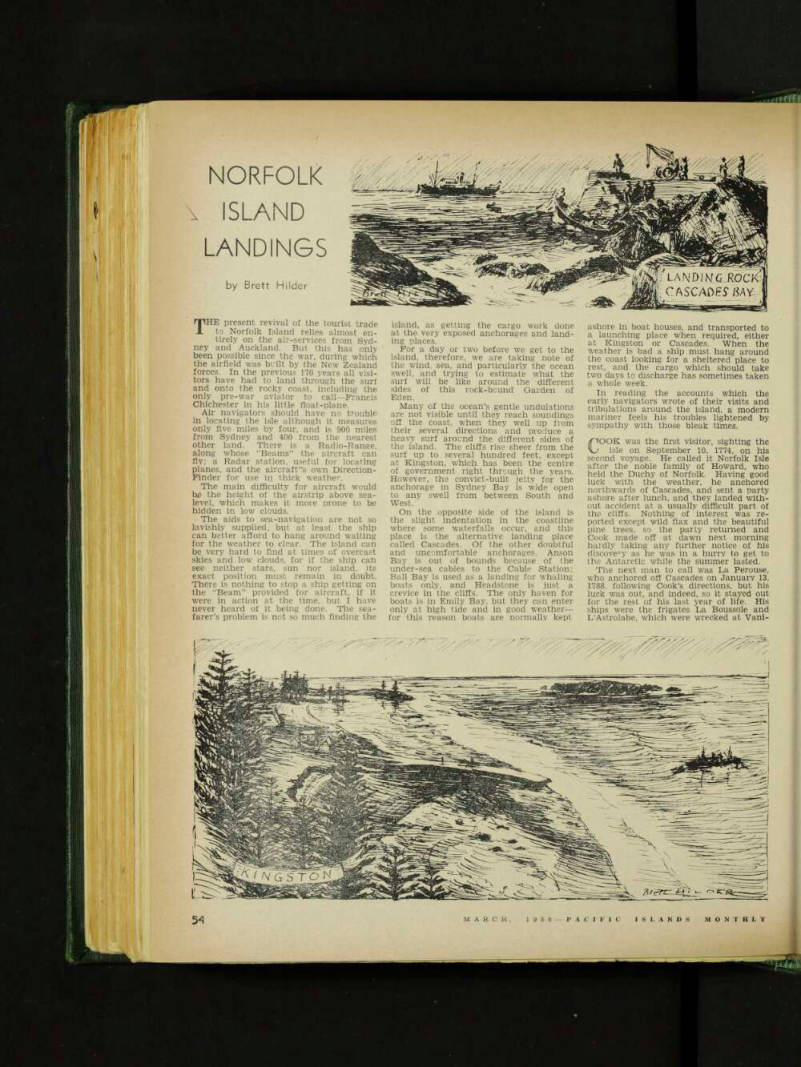
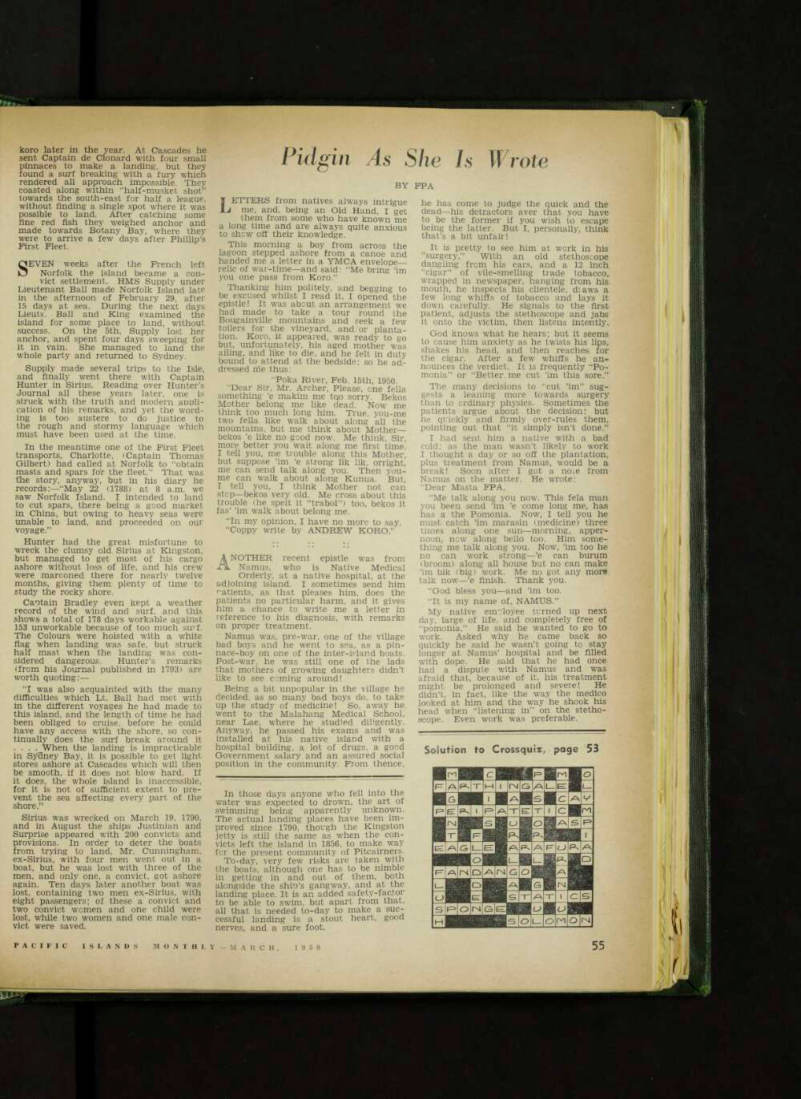
Island
Landings
by Brett Hilder
THE present revival of the tourist trade to Norfolk Island relies almost en tirely on the air-services from Syd ney and Auckland. But this has only been possible since the war, during which the airfield was built by the New Zealand forces. In the previous 170 years all visi tors have had to land through the surf and onto the rocky coast, including the only pre-war aviator to call —Francis Chichester in his little float-plane.
Air navigators should have no trouble in locating the isle although it measures only five miles by four, and is 900 miles from Sydney and 400 from the nearest other land. There is a Radio-Range, along whose “Beams” the aircraft can fly; a Radar station, useful for locating planes, and the aircraff’s own Direction- Finder for use in thick weather The main difficulty for aircraft would bje the height of the airstrip above sea level, which makes it more prone to be hidden in low clouds.
The aids to sea-navigation are not so lavishly supplied, but at least the ship can better afford to hang around waiting for the weather to clear. The island can be very hard to find at times of overcast skies and low clouds, for if the ship can see neither stars, sun nor island, its exact position must remain in doubt.
There is nothing to stop a ship getting on the “Beam” provided for aircraft, if it were in action at the time, but I have never heard of it being done. The sea farer’s problem is not so much finding the
tsland, as getting the cargo work done at the very exposed anchorages and land ing places.
For a day or two before we get to the island, therefore, we are taking note of the wind, sea, and particularly the ocean swell, and trying to estimate what the surf will be like around the different sides of this rock-bound Garden of Eden.
Many of the ocean’s gentle undulations are not visible until they reach soundings off the coast, when they well up from their several directions and produce a heavy surf around the different sides of the island. The cliffs rise sheer from the surf up to several hundred feet, except at Kingston, which has been the centre of government right through the years.
However, the convict-built jetty for the anchorage in Sydney Bay is wide open to any swell from between South and West.
On the opposite side of the island is the slight indentation in the coastline where some waterfalls occur, and this place is the alternative landing place called Cascades. Of the other doubtful and uncomfortable anchorages, Anson Bay is out of bounds because of the under-sea cables to the Cable Station; Ball Bay is used as a landing for whaling boats only, and Headstone is just a crevice in the cliffs. The only haven for boats is in Emily Bay, but they can enter only at high tide and in good weather — for this reason boats are normally kept
ashore in boat houses, and transported to a launching place when required, either at Kingston or Cascades. When the weather is bad a ship must hang around the coast looking for a sheltered place to rest, and the cargo which should take two days to discharge has sometimes taken a whole week.
In reading the accounts which the early navigators wrote of their visits and tribulations around the island, a modern mariner feels his troubles lightened by sympathy with those bleak times.
COOK was the first visitor, sighting the isle on September 10, 1774, on his second voyage. He called it Norfolk Isle after the noble family of Howard, who held the Duchy of Norfolk. Having good luck with the weather, he anchored northwards of Cascades, and sent a party ashore after lunch, and they landed with out accident at a usually difficult part of the cliffs. Nothing of interest was re ported except wild flax and the beautiful pine trees, so the party returned and Cook made off at dawn next morning hardly taking any further notice of his discovery as he was in a hurry to get to the Antarctic while the summer lasted.
The next man to call was La Perouse, who anchored off Cascades on January 13, 1788, following Cook’s directions, but his luck was out, and indeed, so it stayed out for the rest of his last year of life. His ships were the frigates La Boussole and L’Astrolabe, which were wrecked at Vani-
koro later in the year. At Cascades he sent Captain de Clonard with four small pinnaces to make a landing, but they found a surf breaking with a fury which rendered all approach impossible. They coasted along within “half-musket shot” towards the south-east for half a league, without finding a single spot where it was possible to land. After catching some fine red fish they weighed anchor and made towards Botany Bay, where they were to arrive a few days after Phillip’s First Fleet.
SEVEN weeks after the French left Norfolk the island became a con vict settlement. HMS Supply under Lieutenant Ball made Norfolk Island late in the afternoon of February 29, after 15 days at sea. During the next days Lieuts. Ball and King examined the island for some place to land, without success. On the sth, Supply lost her anchor, and spent four days sweeping for it in vain. She managed to land the whole party and returned to Sydney.
Supply made several trips to the Isle, and finally went there with Captain Hunter in Sirius. Reading over Hunter's Journal all these years later, one is struck with the truth and modern appli cation of his remarks, and yet the word ing is too austere to do justice to the rough and stormy language which must have been used at the time.
In the meantime one of the First Fleet transports, Charlotte, (Captain Thomas Gilbert) had called at Norfolk to “obtain masts and spars for the fleet.” That was the story, anyway, but in his diary he records:—“May 22 (1788) at 8 a.m. we saw Norfolk Island. I intended to land to cut spars, there being a good market in China, but owing to heavy seas were unable to land, and proceeded on our voyage.”
Hunter had the great misfortune to wreck the clumsy old Sirius at Kingston, but managed to get most of his cargo ashore without loss of life, and his crew were marooned there for nearly twelve months, giving them plenty of time to study the rocky shore.
Captain Bradley even kept a weather record of the wind and surf, and this shows a total of 178 days workable against 153 unworkable because of too much surf.
The Colours were hoisted with a white flag when landing was safe, but struck half mast when the landing was con sidered dangerous. Hunter’s remarks (from his Journal published in 1793) are worth quoting:— “I was also acquainted with the many difficulties which Lt. Ball had met with in the different voyages he had made to this island, and the length of time he had been obliged to cruise, before he could have any access with the shore, so con tinually does the surf break around it ... When the landing is impracticable in Sydney Bay, it is possible to get light stores ashore at Cascades which will then be smooth, if it does not blow hard. If it does, the whole island is inaccessible, for it is not of sufficient extent to pre vent the sea affecting every part of the shore.”
Sirius was wrecked on March 19. 1790, and in August the ships Justinian and Surprise appeared with 200 convicts and provisions. In order to deter the boats from trying to land, Mr. Cunningham, ex-Sirius, with four men went out in a boat, but he was lost with three of the men, and only one, a convict, got ashore again. Ten days later another boat was lost, containing two men ex-Sirius, with eight passengers; of these a convict and two convict women and one child were lost, while two women and one male con vict were saved.
In those days anyone who fell into the water was expected to drown, the art of swimming being apparently unknown.
The actual landing places have been im proved since 1790, though the Kingston jetty is still the same as when the con victs left the island in 1856, to make way for the present community of Pitcairners.
To-day, very few risks are taken with the boats, although one has to be nimble in getting in and out of them, both alongside the shin’s gangway, and at the landing place. It is an added safety-factor to be able to swim, but apart from that, all that is needed to-day to make a suc cessful landing is a stout heart, good nerves, and a sure foot.
Pidgin As She Is Wrote
By Fpa
LETTERS from natives always intrigue me, and, being an Old Hand, I get them from some who have known me a long time and are always quite anxious to shew off their knowledge.
This morning a boy from across the lagoon stepped ashore from a canoe and handed me a letter in a YMCA envelope relic of war-time—and said: “Me bring ’im you one pass from Koro.”
Thanking him politely, and begging to be excused whilst I read it, I opened the epistle! It was about an arrangement we had made to take a tour round the Bougainville mountains and seek a few toilers for the vineyard, and/or planta tion. Koro, it appeared, was ready to go but, unfortunately, his aged mother was ailing, and like to die, and he felt in duty bound to attend at the bedside: so he ad dressed me thus: “Poka River, Feb. 15th, 1950.
“Dear Sir, Mr. Archer, Please, one fella something ’e makim me tqo sorry. Bekos Mother belong me like dead. Now me think too much long him. True, you-me two fella like walk about along all the mountains, but me think about Mother— bekos ’e like no good now. Me think, Sir, more better you wait along me first time.
I tell you, me trouble along this Mother, but suppose ’im ’e strong lik lik, orright, me can send talk along you. Then you me can walk about along Kunua. But, I tell you, I think Mother not can stop—bekos very old. Me cross about this trouble (he spelt it “trabol”) too, bekos it fas’ ’im walk about belong me.
“In my opinion, I have no more to say.
“Coppy write by ANDREW KORO.”
ANOTHER recent epistle was from Namus, who is Native Medical Orderly, at a native hospital, at the adjoining island. I sometimes send him as that pleases him. does the patients no particular harm, and it gives him a chance to write me a letter in reference to his diagnosis, with remarks on proper treatment.
Namus was. pre-war, one of the village bad boys and he went to sea, as a pin nace-boy on one of the inter-island boats.
Post-war, he was still one of the lads that mothers of growing daughters didn’t like to see coming around!
Being a bit unpopular in the village he decided, as so many bad boys do, to take up the study of medicine! So, away he went to the Malahang Medical School, near Lae, where he studied diligently.
Anyway, he passed his exams and was installed at his native island with a hospital building, a lot of drugs, a good Government salary and an assured social position in the community. From thence,
he has come to judge the quick and the dead—his detractors aver that you have to be the former if you wish to escape being the latter. But I, personally, think that’s a bit unfair!
It is pretty to see him at work in his “surgery.” With an old stethoscope dangling from his ears, and a 12 inch “cigar” of vile-smelling trade tobacco, wrapped in newspaper, hanging from his mouth, he inspects his clientele, diaws a few long whiffs of tobacco and lays it down carefully. He signals to the first patient, adjusts the stethoscope and jabs it onto the victim, then listens intently.
God knows what he hears; but it seems to cause him anxiety as he twists his lips, shakes his head, and then reaches for the cigar. After a few whiffs he an nounces the verdict. It is frequently “Po monia” or “Better me cut ’im this sore.”
The many decisions to “cut ’im” sug gests a leaning more towards surgery than to ordinary physics. Sometimes the patients argue about the decision; but he quickly and firmly over-rules them, pointing out that “it simply isn’t done.”
I had sent him a native with a bad cold: as the man wasn’t likely to work I thought a day or so off the plantation, plus treatment from Namus, would be a break! Soon after I got a note from Namus on the matter. He wrote: “Dear Masta FPA, “Me talk along you now. This fela man you been send ’im ’e come long me, has has a the Pomonia. Now, I tell you he must catch ’im marasin (medicine) three times along one sun—morning, apper noon, now along bello too. Him some thing me talk along you. Now, ’im too he no can work strong—’e can burum (broom) along all house but no can make ’im bik (big) work. Me no got any more talk now—’e finish. Thank you.
“God bless you—and ’im too.
“It is my name of, NAMUS.”
My native employee turned up next day, large of life, and completely free of “pomonia.” He said he wanted to go to work. Asked why he came back so quickly he said he wasn’t going to stay longer at Namus’ hospital and be filled with dope. He said that he had once had a dispute with Namus and was afraid that, because of it, his treatment might be prolonged and severe! He didn’t, in fact, like the way the medico looked at him and the way he shook his head when “listening in” on the stetho scope. Even work was preferable.
Advertisements & other items, p. 59 (1 item)
Solution to Crossquiz, page 53
fashion ...

HITE waffle
pique is com bined with pink and black striped cam bric for this cool,
cotton evening
gown. The scol loped effect on the striped ruff em phasises lines of the fitted bodice and full skirt. Designed by Athena, it is worn here (to ad
vantage) by Warner
Bros, star, Alexis Smith.
Advertisements & other items, pp. 60-62 (2 items)
Matinee Queue
Burns Philp (New Guinea) Limited
General Merchants (Wholesale and Retail)
Shipping, Customs and General Agents
Head Office: PORT MORESBY, PAPUA
BRANCHES:
NEW GUINEA: Rabaul, Kokopo, Lae Gr Madang.
PAPUA: Samarai.
REPRESENTATIVES FOR:
AUSTRALIAN AGENTS;
LONDON AGENTS:
SAN FRANCISCO AGENTS;
QUEENSLAND INSURANCE CO. LTD.
LLOYD'S OF LONDON
BURNS PHILP TRUST CO. LTD
BURNS, PHILP & CO. LTD.
All States.
BURNS, PHILP & CO. LTD.
"London House", 35 Crutched Friars, E.C.3.
BURNS, PHILP CO. OF SAN FRANCISCO INC 510 Matson Building.
Distributing Agents, Territory of Papua-New Guinea for:
SHELL COMPANY OF AUSTRALIA LIMITED
Petroleum Products
GENERAL MOTORS CORPORATION
Chevrolet, Buick, Pontiac and Oldsmobile Cars Chevrolet and GMC Trucks Frigidaire Refrigerators
VAUXHALL MOTORS LIMITED
Vauxhall Cars and Bedford Trucks
R. A. LISTER Cr CO., BRISTOL
Producers of Petrol, Paraffin and Diesel Engines Pumps and Lighting plants
RUSTON HORNSBY LIMITED
Engines
CROSSLEY MARINE ENGINES
a MM Made in the Australian Branch Factory of
BLUNDELL SPENCE & CO., LTD., Hull,
B. & S. SUPER PREPARED PAINT embodies the knowledge and experience gained from nearly 140 years of Paint manufacture.
Tested and proved for tropical conditions, B. & S. PREPARED PAINT is also available in a special Lead-free series for use in volcanic and other sulphurous regions. (Specify B. & S.-Series 2301).
Ask for supplies of these and other BLUN- DELL Paints and Enamels from your local Storekeeper, or write for particulars and colour-cards to the Agent tor Pacific Islands:
KERR BROTHERS PTY. LTD.
4 YORK STREET, SYDNEY
Polynesian Society Journal
rpHE Journal of the Polynesian Society A for the last quarter of 1949 (Sep tember issue) contains a number of articles of value to those interested in Pacific culture.
Professor E. W. Gifford, of the Uni versity of Cafifornio, who spent about six months excavating in Fiji a year or so ago, writes of what he found and the significance of it. Most of the speci mens recovered from the two excava tions which he made consisted of pottery fragments ornamented in various ways.
This rules out the possibility that Poly nesians were the first settlers in these areas.
There is a description of Rarotongan string figures by C. W. Devonshire who learned them from his late wife who was of Rarotongan and Mangaian descent.
The figures are illustrated by drawings or photographs.
Tom Harrisson Again
OUR old friend Mr. Tom Harrisson makes a new appearance with an article on the Kelabits of North Central Borneo.
Mr. Harrisson, it would appear, is now Curator of Sarawak Museum and Gov ernment Ethnologist. He was regarded as somewhat of a stormy petrel in the New Hebiides in the ’3o’s when he was a member of an Oxford expedition to those parts. Australia’s A. J. Marshall was a member of the same expedition.
Both young men wrote books about their experiences. Marshall’s book (Black Musketeers) was very good. Harrisson’s odd. but interesting. Harrisson disap peared from the South Pacific scene but was heard of in the UK during the war when he was taking a mass survey of behaviour patterns among the local popu lace —or some similar task dear to the hearts of anthropologists and sociologists.
The September issue of the Journal also contains three articles on Maori culture and artifacts.
Private Enterprise”
High Costs “Will Kill Ng
Prom Our Brisbane Correspondent MRS. DORIS BOOTH, New Guinea pioneer, who recently arrived in Brisbane, claims that the formula for successful New Guinea development should be more power for local officials, and minimum control from Canberra.
Business interests, she said, hoped for great things from the Menzies Govern ment. ■ ■ * Describing post-war New Guinea, Mrs.
Booth said that private enterprise, despite restrictions, and astoundingly high costs was going ahead by leaps and bounds, but that high costs must eventually kill the efforts of private enterprise. On most goods from Australia, consumers had to pay indirectly for a high export levy, heavy freight charges, and 10 per cent import duty. She quoted one essential item—rice—the pre-war cost of which was £ll a ton. To-day, costs have risen to £69 a ton.
Mrs. Booth, who has been associated with New Guinea goldfield development since about 1921, owns the Cliffside gold mine, on the Bulolo River.
The BGD gold industry, she said, had been so rehabilitated that it was hard to realise there had been a war. Sawmills had speedily supplied timber for build ing in that area. General rehabilitation, however, was slow, and except at BGU, the main hold-up was in building.
Land Bought For Fijians
THE Native Land Trust Board has re cently purchased two islands and a freehold property of 600 acres on be half of two Fijian communities who are said to need land for agricultural pur poses.
The two islands are Vatauua and Nuku basaga, together making about 145 acres.
They were first sold before Cession but the claim of one Mary Wilson was later found to be good and Crown Grants were subsequently issued in her name. The islands will go to the people of the ad jacent island of Naqelelevu.
The leasehold is the property known as Ulubuta, also sold by the Fijians before Cession and subsequently the owner’s claim was found to be good. This land will go to the Mataqali Taliyoga of the village of Visoqo.
In ooth cases the titles will be held by the Native Land Trust Board, until such time as the peoples concerned can repay the Board for its outlay. In the meantime the land will be set aside for their use without cost.
In Fiji
Health Stamp Prizes Criticised In Fiji
From Our Own Correspondent
Suva, Jan. 30.
TWO prizes of £lO each have been offered by the Government of Fiji for designs for two Anti-TB Cam paign health stamps which, it is hoped, will parallel the enormous success of the long-established New Zealand health stamps.
Some possible contenders have dis missed the idea on the grounds that the “paltry reward” is no incentive to do a job requiring many hours of close work, designing ability and; artistic skill. It has been said that prizes of £5O would have made the effort worth while.
Japs Want to Fish in Pacific
Waters
IT is reported from Tokio that “after the peace treaty” the Japs expect to again become the world’s greatest fishing nation by extending activities to New Guinea waters, Truk and even the Indian Ocean.
Residents of New Guinea will remem ber with what suspicion they viewed the
small grey war-like Jap ships that called at New Guinea ports pre-war. Allegedly training “fishery officers,” they carried dozens of young Japs, all complete with cameras, who appeared to be more inter ested in photography than fish.
Mr. and Mrs. K. C. Douglas, of San Remo plantation, Talasea, New Guinea, who had spent some weeks’ leave in Australia, returned home early in March.
Advertisements & other items, pp. 63-64 (1 item)
A. Gregory Pty, Ltd.
IMPORTERS, EXPORTERS AND
MANUFACTURERS
Leather Saddlery and Paint Merchants ALL CLASSES OF LEATHER SUPPLIED FROM STOCK Apply direct to: A. GREGORY PTY., LTD., 107 York St, Sydney
A Comfortable Chair
And a Good Magazine
Make a Pleasant Evening!
V
AMERICAN AUTOMOBILE ... £4 13
AMERICAN BUSINESS 2 14 6
AMERICAN BUILDER (TRADE) 6 0 0
AMERICAN HOME 1 11 6
AMERICAN RIFLEMAN 2 3 0
APPAREL ARTS 296
ATLANTIC MONTHLY 2 9 6
BETTER HOMES & GARDEN . . 2 10
BUTTERICK’S PATTERN BOOK 1 5 6
CHARM 206
COLLIER’S 4 10
CORONET 179
COSMOPOLITAN 346
DOWN BEAT 259
DIESEL POWER 211 6
ESQUIRE 580
ETUDE I 16 0
ELECTRICAL MAGAZINES—
Please send for list.
PLYING 1 16 0
FORTUNE 32 6
GLAMOUR 1 16 3
GOOD HOUSEKEEPING 3 4 6
HARPER’S BAZAAR £5 8 0
HOMECRAPTSMAN 19 0
HOUSE AND GARDEN 3 4 6
INLAND PRINTER 5 8 9
IRON AND STEEL ENGINEER . . 4 16 0
JOURNAL OP THE AMERICAN
MED. ASSN 8 12 0
LADIES’ HOME JOURNAL ... 2 14 0
LIFE 39 0
LOOK 2 14 0
MADEMOISELLE 219 0
METRONOME 1 15 6
MECHANIX ILLUSTRATED ... 1 12 9
MODEL RAILROADER 2 5 6
MOTOR BOAT 1 11 6
NEW YORKER 5 1 6
NEW YORK TIMES 28 15 0
POPULAR MECHANICS 2 0 6
POPULAR PHOTOGRAPHY ... 1 16 0
RADIO NEWS 259
RED BOOK 1 12 9
RING 1 16 0
RUDDER 273
SATURDAY EVENING POST .. £4 18 0
SEVENTEEN 2 10 0
STAMPS 140
SUGAR JOURNAL 2 60
TIME 4 16 0
UNITED NATIONS’ WORLD ... 266
VOGUE 7 15 0
WOMAN’S HOME COMPANION . 1 11 6
YACHTING 30 3
SYDNEY BULLETIN 16 0
SMITH’S WEEKLY 1 6 0
MAN MAGAZINE 14 0
Women’s Magazine List on Request.
APOLLO 212 6
BAND WAGGON 16 0
COURIER 2 10 0
DAILY MAIL 19 0
ILLUSTRATED 1 1 9
LILLIPUT 17 0
LONDON OPINION 13 0
PUNCH 263
WALKABOUT 120
French Magazine List on Request.
Enquiries
Welcomed.
3,000 OF THE WORLD’S HOME, TECHNICAL AND TRADE JOURNALS.
FRANK HIBBLE & SON
175
Phone: 8L3334.
PITT STREET, SYDNEY
Cables: “FRAHIBS.”
Enquiries
Welcomed,
■i O. 4 Wfk u
BRONTE
BRAND;
Chifi Con Came Braised Steak and Onions Curried Beef Curried Mutton Steak and Onions Mutton and Peas Irish Stew Beef Steak Pudding Corned Beef Hash Corned Beef Loaf With Cereal Mutton Broth Mulligatawny Soup Tomato Soup Vegetable Soup
From
Australia’s
Finest Fat
Stock ...
From the finest fat stock and the rich-
est vegetables in Australia we produce
these high-grade canned meats and
soups. BRONTE BRAND meats,
hotmeals and soups are deliciously flavoured and are made from
ONLY meats and vegetables
of the highest quality. . . . . ★
THE COLONIAL WHOLESALE MEAT CO
PTY. LTD.
Canning Factory, State Abattoirs, Homebush Bay, Sydney.
NSW
PHONE: UM 8436
CABLE ADDRESS:
WOOLMTLL. SYDNEY.
t £ P P
Was Married
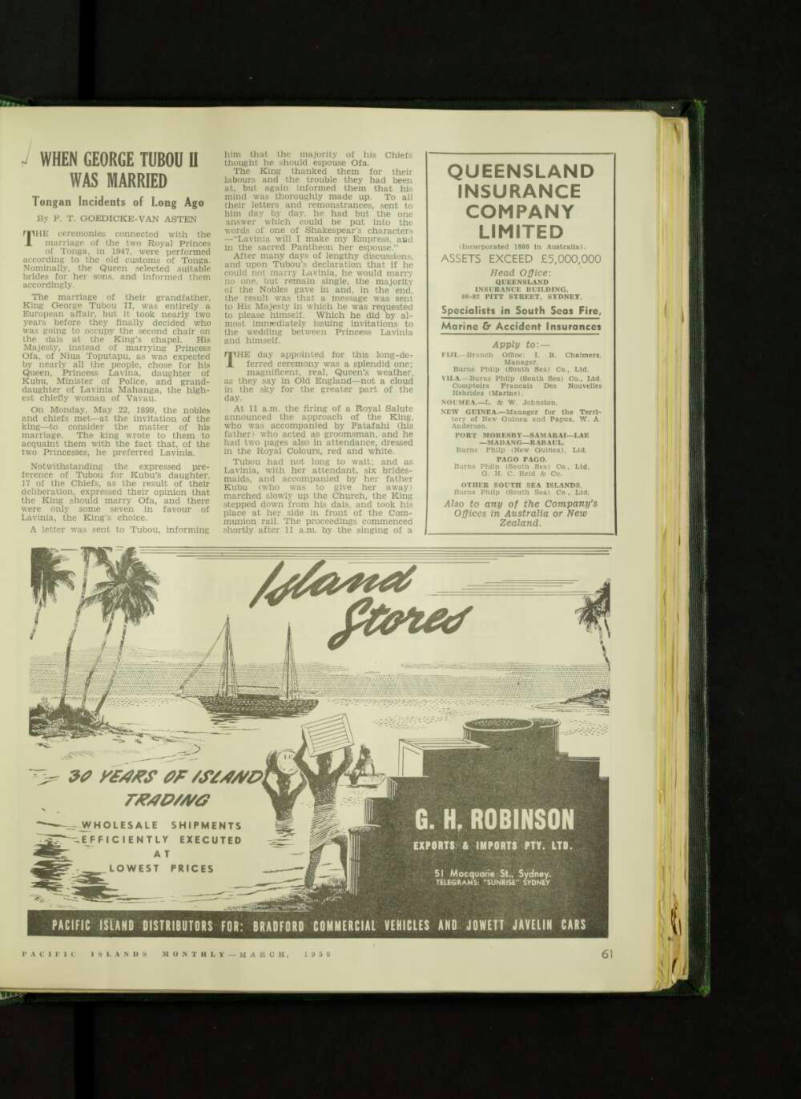
When George Tubou Ii
Tongan Incidents of Long Ago
By F. T. Goedicke-Van Asten
rpHE ceremonies connected with the J. marriage of the two Royal Princes of Tonga, in 1947, were performed according to the old customs of Tonga.
Nominally, the Queen selected suitable brides for her sons, and informed them accordingly.
The marriage of their grandfather, King George Tubou 11, was entirely a European affair, but it took nearly two years before they finally decided who was going to occupy the second chair on the dais at the King’s chapel. His Majesty, instead of marrying Princess Ofa, of Niua Toputapu, as was expected by nearly all the people, chose for his Queen, Princess Lavina, daughter of Kubu, Minister of Police, and grand daughter of Lavinia Mahanga, the high est chiefly woman of Vavau.
On Monday, May 22, 1899, the nobles and chiefs met—at the invitation of the king—to consider the matter of his marriage. The king wrote to them to acquaint them with the fact that, of the two Princesses, he preferred Lavinia.
Notwithstanding the expressed pre ference of Tubou for Kubu’s daughter, 17 of the Chiefs, as the result of their deliberation, expressed their opinion that the King should marry Ofa, and there were only some seven in favour of Lavinia, the King’s choice.
A letter was sent to Tubou, informing
him that the majority of his Chiefs thought he should espouse Ofa.
The King thanked them for their labours and the trouble they had been at, but again informed them that his mind was thoroughly made up. To all their letters and remonstrances, sent to him day by day. he had but the one answer which could be put into the words of one of Shakespear’s characters —“Lavinia will I make my Empress, and in the sacred Pantheon her espouse.”
After many days of lengthy discussions, and upon Tubou’s declaration that if he could not marry Lavinia, he would marry no one, but remain single, the majority of the Nobles gave in and, in the end, the result was that a message was sent to His Majesty in which he was requested to please himself. Which he did by al most immediately issuing invitations to the wedding between Princess Lavinia and himself. 11HE day appointed for this long-de ferred ceremony was a splendid one; magnificent, real, Queen’s weather, as they say in Old England—not a cloud in the sky for the greater part of the day.
At 11 a.m. the firing of a Royal Salute announced the approach of the King, who was accompanied by Fatafahi (his father) who acted as groomsman, and he had two pages also in attendance, dressed in the Royal Colours, red and white.
Tubou had not long to wait; and as Lavinia, with her attendant, six brides maids, and accompanied by her father Kubu (who was to give her away) marched slowly up the Church, the King stepped down from his dais, and took his place at her side in front of the Com munion rail. The proceedings commenced shortly after 11 a.m. by the singing of a
wedding hymn, and the chanting of the Lord’s Prayer. The music was the com position of His Majesty who had consider able musical ability. The “Declaration precedent to marriage” was as usual.
Service was in extenso, by the officiating minister, the Rev. J. B. Watkin, the King’s Chaplain.
Immediately after the marriage ser vice, the Royal couple ascended the dais and took their respective chairs. After
a few moments, the King stood up. The Princess Lavinia knelt on a footstool, and her principal bridesmaid unfastened her veil, and the King, placing a light, ele gant gold crown upon her head, pro claimed her to be the Queen of Tonga.
The King gave his arm to the Queen and, descending from the dais, walked into the palace, where the presentation of Europeans and Tongans took place.
The wedding cake had been made in
Auckland some two years before at a first cost of £l2O and had been lying all this time in the Customs shed, where heat and ants had made havoc of it. It was renovated—or rather, rebuilt, for it was a five decker—by Mr. A. Cowley, our local confectioner, who was an artist in this line, and who also prepared the greater part of the champagne break fast.
That was 50 years ago—but both Mr.
Cowley and I are still here to bear testi mony.
Advertisements & other items, pp. 65-66 (1 item)
G. H. Robinson
QUEENSLAND
INSURANCE
COMPANY
LIMITED
(Incorporated 1886 In Australia).
ASSETS EXCEED £5,000,000
Head Office :
QUEENSLAND
INSURANCE BUILDING,
80-82 PITT STREET, SYDNEY.
Specialists in South Seas Fire,
Marine & Accident Insurances
Apply to:
FlJl,—Branch Office: I. B. Chalmers, Manager.
Burns Philp (South Sea) Co., Ltd.
VlLA.—Burns Philp (South Sea) Co., Ltd.
Comptoirs Prancais Des Nouvelles Hebrides (Marine).
NOUMEA.—L. & W. Johnston.
NEW GUlNEA.—Manager for the Territory of New Guinea and Papua, W. A.
Anderson.
PORT MORESBY—SAMARAI—LAE
—MADANG—RABAUL.
Burns Philp (New Guinea), Ltd.
PAGO PAGO.
Burns Philp (South Sea) Co., Ltd.
G. H. C. Reid & Co.
OTHER SOUTH SEA ISLANDS.
Burns Philp (South Sea) Co., Ltd.
i4Zso to any of the Company’s
Offices in Australia or Hew
c > 30
OF/MJ/VD
rwowa
G. H. ROBINSON
W ES LY EX
EXPORTS & IMPORTS PTY. LTD.
51 Macquarie St., Sydney.
TELEGRAMS: •’SUNRISE" SYDNEY
PACIFIC ISLAND DISTRIBUTORS FOR: BRADFORD COMMERCIAL VEHICLES AND JOWETT JAVELIN CARS
AUNT
MARYS
BAKING POWDER
For the best in delicious baking results A product of TILLOCK AND GO. PTY. LTD. manufacturers of all the famous Aunt Marys Pure Foods
STEAMSHIPS TRADING COMPANY LTD.
PORT MORESBY AND SAMARAI PAPUA
Wholesale & Retail Merchants , Planters , Sawmillers,
Proprietors, Shipping, Customs and Insurance
Engineers,
Agents,
Slip
MANAGING AGENTS for;
SAWMILLERS & TRADERS LTD,
CORAL SEAS INSURANCE CO. LTD.
ACME BAKERY COMPANY.
MARIBOI RUBBER LTD.
RUBBERLANDS LTD.
KEREMA RUBBER PLANTATIONS LTD.
COCOALANDS LTD.
AGENCIES:
BANKERS & TRADERS INSURANCE CO. LTD.
VACUUM OIL CO. PTY., LTD.
DIRECTORATE OP SHIPPING—Papua-New
Guinea Division.
ROYAL PACKET NAVIGATION CO.
KOKE BAGU PTY., LTD.
TRANS OCEANIC AIRWAYS.
GUINEA AIR TRADERS.
DISTRIBUTORS IN PAPUA for:
ARMSTRONG-HOLLAND PTY., LTD.
Earth Moving and Logging Equipment.
WILLYS-OVERLAND EXPORT CORPORATION.
Jeep cars, etc.
INTERNATIONAL HARVESTER CO. OF AUST. LTD.
International Trucks, McCormick-Deering Farming Machinery, Defender Refrigerators.
SYDNEY AGENTS: NELSON & ROBERTSON PTY. LTD., 12 SPRING STREET
Levuka Urges Speed-up of Long-Awaited Jetty
Long-Awaited Jetty
From Our Own Correspondent
Suva, Jan. 30.
THE provision of a jetty on the Tailevu coast to eliminate the present system of requiring Levuka-bound passen gers to wade (through sea or mud, ac cording to the state of the tide) to launches at Lodoni, has been officially talked about since 1934.
This is pointed out by the Levuka Citizens’ Association in a brisk reminder to the Government, The Revised Development Plan provides £5,000 for a jetty or wharf, and shed, at Natovi, north of Lodoni, but wharf work at Suva and Lautoka has been given priority and the Tailevu job is not scheduled to start before 1951.
The Levuka Association maintains that the work would not take longer than two months and, claiming that Natovi is much more hazardous for launches than Lodoni, asks for the jetty to be built at the pre sent jumping-off (or wading-off) point.
Life On A Sepik Backwater

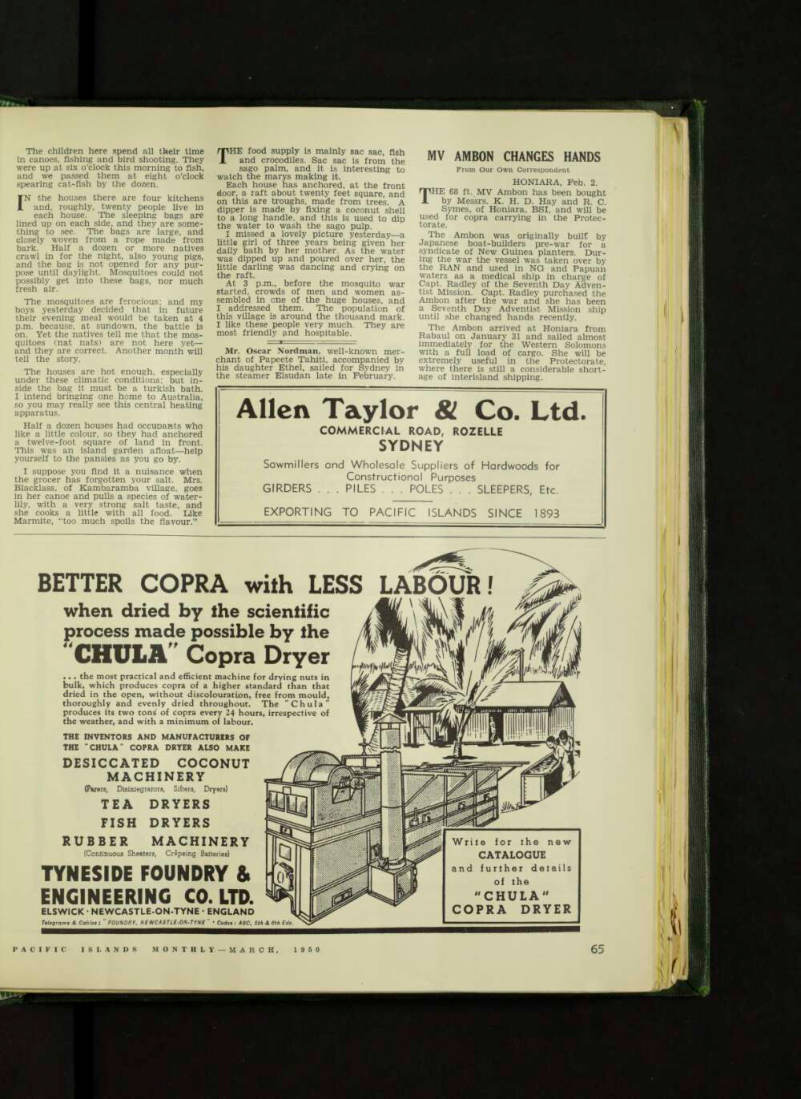
Some Notes on Water-Babies, House-Building and Mosquitoes
pROM PASTOR S. H. GANDER, who is making a Survey of the Sepik Villages, New Guinea, in the Seventh Day Adventist Mission Shiv Leleman, which is screened against mosquitoes.
IT is rather difficult for some country folk to find their way among the city streets; but they can always purchase a directory or ask a policeman.
As we move along this mighty Sepik River, with its many tributaries and barads (small channels that take a pin nace or canoe) we are glad when some friendly local offers to show us the way.
Without such a man we would pass many a channel that leads to a dozen villages.
Yesterday, we came to a mouth just sufficiently wide for the ship to enter.
Fifty yards further the water opened into a channel fifty feet wide; then it ex panded to half a mile.
Travelling for half an hour we entered the village of Kambaramba and proceeded down the main “street,” with its 110 houses.
The Sepik water is a dirty, muddy grey, but in these channels (“round waters”) it is the colour of strong tea. I think the first white folk called it “brown” water and now it is known as “round” water.
We anchored in the main thoroughfare, in four and a half fathoms of water. In five minutes we had forty canoes around us, filled with men and women.
The babies here amaze me—only two years old, but trying to paddle canoes, with twenty-five feet of water under them.
They have a child of five or six with them, but what could one of that age do in an emergency?
Wherever you go you see canoes. One mother visits another, in a canoe; there is no other way.
A lass opposite our boat decided to tidy the growth around the house. She is standing in water up to the waist, and pulling grass six feet long.
A dog in a house on the other side be came a nuisance, and the mary decided to thrash it. As she struck at him, the dog jumped into five canoes, before finishing up in the water.
Here is a bright young lass who wants to wash a loin-cloth. She comes down the steps of the house to a log and, using it as a washing board, does her best to produce a Persil finish. Then she has a bath and quenches her thirst—all in the same water, at the front doorstep.
All conveniences are on the one spot, and there the natives bathe, drink and dip for the night’s stew. They are happy and satisfied —it is beyond my under standing.
THE houses would astonish you—huge structures of massive timbers. The centre posts are of quila (like red gum), three feet in diameter, and what a length! Eighteen feet in the ground; from the surface of the water to the floor, fifteen feet; from floor to ridging, twenty seven feet. And all had to be pulled by canoes, two days’ journey!
The houses are one hundred feet long and forty feet wide. The holes for the posts have to be dug in the dry season, as for half the year the houses are sur rounded by water.
I asked what the beds under the houses were for. “Oh,” the people said, “the pigs sleep there, and a man with them. The crocodiles come and steal the pigs at night and when the pig squeals the man wakes up and spears the croc.” Good alarm clocks!
The fowls and pigs are all up on decks, and it is amusing to see the fowls jump ing from canoe to canoe and flying from
house to house. A drake, this morning, did the longest non-stop I have seen— trying to beat the jet machines.
When you first look around you are puzzled. At the rear of the houses there is long kunai grass, something like a
wheat crop, and you see heads moving here and there. Looking closer, you find the natives are in canoes paddling along in little barads.
(Continued on Page 65)
The children here spend all their time in canoes, fishing and bird shooting. They were up at six o’clock this morning to fish, and we passed them at eight o’clock spearing cat-fish by the dozen, IN the houses there are four kitchens and, roughly, twenty people live in each house. The sleeping bags are lined up on each side, and they are some thing to see. The bags are large, and closely woven from a rope made from bark. Half a dozen or more natives crawl in for the night, also young pigs, and the bag is not opened for any pur pose until daylight. Mosquitoes could not possibly get into these bags, nor much fresh air.
The mosquitoes are ferocious; and my boys yesterday decided that in future their evening meal would be taken at 4 p.m. because, at sundown, the battle is on. Yet the natives tell me that the mos quitoes (nat nats) are not here yet— and they are correct. Another month will tell the story.
The houses are hot enough, especially under these climatic conditions: but in side the bag it must be a turkish bath.
I intend bringing one home to Australia, so you may really see this central heating apparatus.
Half a dozen houses had occupants who like a little colour, so they had anchored a twelve-foot square of land in front.
This was an island garden afloat—help yourself to the pansies as you go by.
I suppose you find it a nuisance when the grocer has forgotten your salt. Mrs.
Blacklass, of Kambaramba village, goes in her canoe and pulls a species of water lily, with a very strong salt taste, and she cooks a little with all food. Like Marmite, “too much spoils the flavour.”
THE food supply is mainly sac sac, fish and crocodiles. Sac sac is from the sago palm, and it is interesting to watch the marys making it.
Each house has anchored, at the front door, a raft about twenty feet square, and on this are troughs, made from trees. A dipper is made by fixing a coconut shell to a long handle, and this is used to dip the water to wash the sago pulp.
I missed a lovely picture yesterday—a little girl of three years being given her daily bath by her mother. As the water was dipped up and poured over her, the little darling was dancing and crying on the raft.
At 3 pm., before the mosquito war started, crowds of men and women as sembled in one of the huge houses, and I addressed them. The population of this village is around the thousand mark.
I like these people very much. They are most friendly and hospitable.
Mr. Oscar Nordman, well-known mer chant of Papeete Tahiti, accompanied by his daughter Ethel, sailed for Sydney in the steamer Elsudan late in February.
Advertisements & other items, pp. 67-69 (1 item)
Kolynos
KODAK FI LMS
and all Photographic Supplies
WHOLESALE AND RETAIL
CAINE'S STUDIOS
P.O. Box 8, Suva Photographers. Est. 1904.
Write for free price lists.
CUT YOUR DENTIFRICE
BILLS IN HALF!
' ohu
HttD
oh mo« HM- f
bhosh’
VOUW
£ o r out O tun* 1 ® -P
COUC
v.OW» so %
UVStO
toot Of t\no pi^Sft
IVS
tOO'tB
KOLYNOS
DENTAL CREAM
TASTES BETTER CLEANS BETTER LASTS LONGER
There is only one
ELECTROLUX
THE MODERN KEROSENE-OPERATED REFRIGERATOR
THAT ACHIEVES THE MIRACLE OF ICE FROM HEAT
Lasting Efficiency, Silent Operation, Streamlined Beauty
w ia® lii* ■ ■ ■
Economically operated by kerosene, with a simple precision-built freezing unit that has no moving parts and is GUARANTEED FOR
FIVE (5) YEARS.
Only obtainable from :
NEW GUINEA COMPANY, LIMITED,
Rabaul, Madang, Lae, Kavieng.
J. R. CLAY & CO., LTD., Port Moresby.
W. R. CARPENTER & CO. (Sol. Is.), LTD., Tulagi
THE NORFOLK ISLAND SERVICE DEPOT,
Norfolk Island.
For New Hebrides, Gilbert and Ellice Islands Colony and New Caledonia, apply direct to:
Model LKSSI
PRICES ON APPLICATION.
Storage capacity: 5i cub. ft. (approx.); shelf area, 10 sq. ft. food shelves, six—five removable; 2 self-supporting when half drawn. Ice-making: Four trays—s lb. ice per freezing: 80 cubes. Fuel consumption: 1.8 pints kerosene per day (approx.).
Height: 4 ft. 10 in. Depth: 2 ft. Bi in.
Weight, unpacked, 406 lb. Packed, 574 lb.
W. R. CARPENTER & CO., LTD. Heod Office: 16 O'Connell St., Sydney, N. S. Woles
Allen Taylor & Co. Ltd.
COMMERCIAL ROAD, ROZELLE
SYDNEY
Sawmillers and Wholesale Suppliers of Hardwoods for Constructional Purposes GIRDERS . . . PILES . . . POLES . . . SLEEPERS, Etc.
EXPORTING TO PACIFIC ISLANDS SINCE 1893
BETTER COPRA with LESS LABOUR!
when dried by the scientific
process made possible by the
"CHULA” Copra Dryer
•.. the most practical and efficient machine for drying nuts in bulk, which produces copra of a higher standard than that dried in the open, without discolouration, free from mould, thoroughly and evenly dried throughout. The "Chula” produces its two tons of copra every 24 hours, irrespective of the weather, and with a minimum of labour.
THE INVENTORS AND MANUFACTURERS OF
THE CHULA’ COPRA DRYER ALSO MAKE
DESICCATED COCONUT
MACHINERY
(P&rers, Disintegrators, Sifters, Dryers)
TEA DRYERS
FISH DRYERS
RUBBER MACHINERY
(Continuous Sheeters, Crepeing Batteries)
TYNESIDE FOUNDRY & H
ENGINEERING CO. LTD.
ELSWICK • NEWCASTLE-ON-TYNE • ENGLAND
Telegrams & Cables : " FOUNDRY, NEWCASTLE-ON-TYNE " • Codes ; ABC, sth & 6th Eds.
I H
ski
MM m .
Write for the new
CATALOGUE
and further details of the
"CHULA 11
COPRA DRYER
Mv Ambon Changes Hands

From Our Own Correspondent
Honiara, Feb. 2.
THE 68 ft. MV Ambon has been bought by Messrs. K. H. D. Hay and R. C.
Symes, of Honiara, BSI, and will be used for copra carrying in the Protec torate.
The Ambon was originally built; by Japanese boat-builders pre-war for a syndicate of New Guinea planters. Dur ing the war the vessel was taken over by the RAN and used in NG and Papuan waters as a medical ship in charge of Capt. Radley of the Seventh Day Adven tist Mission. Capt. Radley purchased the Ambon after the war and she has been a Seventh Day Adventist Mission ship until she changed hands recently.
The Ambon arrived at Honiara from Rabaul on January 31 and sailed almost immediately for the Western Solomons with a full load of cargo. She will be extremely useful in the Protectorate, where there is still a considerable short age of interisland shipping.
Professor Thomas Mathews White, who has been appointed first Professor of Mining Engineering at the University of Queensland, has been with the Colonial Mines Service in Malaya and Fiji since 1937. There, his work included research on mineral dressing and resources. He drafted mineral legislation in Fiji, the West Pacific, and Malaya, and was asso ciated with such problems as mining health, rehabilitation, and taxation. Pro fessor White was bom in Northcote, Vic toria. He graduated Bachelor of Metal lurgical Engineering at Melbourne University in 1930.
"Frankness Wanted"
Fair Deal Urged for Fijian Education
Letter to the Editor
IN 1948, three out of every four who sat for the Qualifying Examination, from Queen Victoria School. Fiji, passed, whereas last year, 1949, only one out of every four candidates was success ful. These rather alarming facts are re vealed on the comparison of the pub lished results in the Fiji Times.
It appears that over 90 students took the examination at the end of the first year under review—a year, it will be re called, when the school came in for a fair amount of publicity at the hands of the newspapers and as a direct result of which, £lOO,OOO was quickly found to com mence building the new school at Mata vatucou and in which, also, a Principal was hurriedly found to save the face of a Government which had been dis interested for so long.
Criticism abated when Queen Victoria School was temporarily housed at Lodoni with the Intermediate School but now we are struck by this fact that, in spite of improved living and working conditions as well as a more adequate European staff, out of about 80 candidates presented last November, only 20 were successful in passing the Qualifying Examination.
There are two possible explanations.
Firstly, it may be due to internal mis management of the school by the Princi pal in an attempt to establish a purely English institution for our Fi.iian youths.
This does not appear to be the case however, and we have to look for a more serious reason: In years gone by, the number of passes in the Qualifying Exa mination was regulated by what the Government required. If it were decided that a certain number of students would pass, then the marks which the candi dates obtained were so adjusted that only the required number of passes were shown. Surely then the candidates who paid entrance money in good faith should have been warned that such a procedure was liable to operate.
THE recent Budget Debate of the Legis lative Council produced the fact that the Fijians are contributing in the vicinity of £26,000 for the education of their boys and girls. It is presumed that this amount includes the money paid by the Provinces for the maintenance of their boys at the Intermediate School at Lodoni. Have the Fijians been told though, that whereas 600 of their lads were receiving an education when the Provincial Schools were in operation, to day scarcely half that number are in attendance at Lodoni, Kadavu and Buca Levu?
The standard of education reached at Buca Levu, Vatuloa, Lodoni, Sawani, Namaka and Kadavu, 15 years ago, may not have been high but at least, over 600 boys were receiving instruction at schools away from their village environment.
The Director of Education would have us believe that all is well and that the Fijians are much better off to-day than they were under the old Provincial Schools system. We have yet to hear him make a statement to the effect that during his term of office in Fiji, he has reduced the number of boys in atten dance at the Government residential schools, excluding Queen Victoria, to half what it used to be.
By further investigation, it is found that the education of at least 100 boys must have been suddenly stopped twelve months ago when accommodation had to be found at Lodoni for Queen Victoria School. These unfortunate Fijian youths were turned out of school with no quali fications, apparently, to fit them for posi tions and yet possessing enough education to make them dissatisfied with village life and with a thirst for more education. Have we heard any mention of this fact officially?
WE hear a great deal about the Gov ernment being the champion of the rights of the Fijians but can we afford to sit back and allow injustices of the nature described here?
Our education system provides excel lent material for reports to be presented by the Director of Education to Overseas Conferences. Certainly there is a great deal of value in the system, but surely the better way would have been to build the structure on firm foundations by giving the lads who were already in the schools, the chance of completing their education instead of turning them out into the world with nothing. Such harsh treatment will not be easily forgotten and might well be a cause of future trouble with the Fijian people.
We older people have seen many changes taking place in Fiji during the last twenty years and, at times, have be come somewhat apprehensive of what the outcome will be. As responsible citizens, likely to be living here for years after the present Colonial Servants have moved on to higher posts, we should like to see a policy adopted by the Government where frankness and fidelity to the citizens of Fiji are of greater purport that prestige in the eyes of people overseas. The latter will develop naturally from the carrying into effect of the former.
I am, etc.,
Suva, Fiji, Feb. 20, 1950.
Pro-Fijian.
Mr. F. L. A. Gotz, who won the Ota huhu seat in the general election in New Zealand recently, was well known in Western Samoa, where he resided for some years. A correspondent says: “His success was in some part due to Mrs.
Gotz, who worked indefatigably to win votes for him.”
Mr. G. Milner of the London School of Oriental and African Studies, is at pre sent visiting the British Solomon Islands Protectorate. He is studying the various native languages in the Western Solomons and in particular is under taking research into the Vella Lavella language, which unlike any other language in the Group, is reported to be of Papuan origin.
Mr. John Fletcher, after 20 years’ ser vice as senior surveyor to the Joint Court in the New Hebrides, retired in September last and has now taken up his residence in Sydney. The work of the Joint Court, which has the responsibility of allotting land titles in the Condominium, has been greatly retarded by war and post-war conditions. •
Advertisements & other items, pp. 70-72 (2 items)
Heinz Green Peas
Every Branch Of
ENGINEERING and BUILDING CONSTRUCTION
MILLERS LTD.
SUVA and LAUTOKA
Sawmillers and Timber Merchants; Shipwrights and Sailmakers; Joinery and Furniture Manufacturers; Upholsterers; Plumbers; Electricians; Hardware Merchants; Motor Dealers.
AGENCIES ;
Chevrolet, Bedford, Vauxhall, Nash Motors. Firestone Tyres.
Fetters Marine and Stationary Engines. G.E.C. Radio Sets.
British Australian Lead Manufacturers Pty., Ltd., Atlas Assurance Co., Ltd.
There is no need to send to Australia or New Zealand for Repairs or Replacements. We can give you a sound Quotation and guarantee First-Class
Workmanship
HEINZ GREEN PEAS
picked when
to give you that
mst-picksd flavour
H. J. HEINZ CO. PTY. LTD.
SYDNEY
479 Bourke St., Tel.: FA 8181.
NEWCASTLE:
Carrington Chambers, 6 Watt St.
.. always
S»w Co ST
Limewashing And
LONDON-SUVA
VIA
PANAMA
For Sailings and Further Particulars Apply To: — BETHELL, GWYN & CO., BURNS PHILP (SOUTH SEA)
138 LEADENHALL ST., CO.. LTD.,
LONDON, E.C.3. SUVA.
c
The Most Extensive Manufacturers in the British Empire of
RUBBER STAMPS,
INKS, STENCILS,
Marking Devices,
ACME STAMP PADS
OFFICE S STATIONERY SUPPLIES
sesi We also Manufacture & Supply a Complete Line of
LIMEWASHING AND
SPRAYING MACHINES
for all purposes.
Let us know your requirements and we will quote by return.
WRITE FOR OUR GENERAL CATALOGUE
Limewashing Machine
EXCELSIOR SUPPLY CD. PTY. LTD.
278 Post Office Place,
MELBOURNE, VIC.
HEAD OFFIGE :
160 BROADWAY,
Formerlu known as George St., West,
SYDNEY, N.S.W.
50 Victoria Street,
WELLINGTON, N.Z.
UNION MANUFACTURING
& EXPORT CO. LTD.
G.P.O. Box 1060, Wellington, NEW ZEALAND
Cables: "UMEC", Wellington
We can arrange prompt shipment to residents
of the following Island Territories:
NEW CALEDONIA, NEW HEBRIDES, GILBERT ISLANDS,
ELLICE ISLANDS, BRITISH SOLOMON ISLANDS and
NEW GUINEA
We are also interested in buying Islands Produce of
every description, especially COCOA-BEANS,
COFFEE BEANS and VANILLA BEANS, and can
provide shipping.
MQ S'"
AVAILABLE FOR IMMEDIATE SHIPMENT
SAWN TIMBER.
PLYWOODS.
W AIjLBO ARDS.
PAINTS.
VARNISHES.
BUILDING PAPER.
ASBESTOS
SIDINGS.
FURNITURE.
ASSEMBLED &
UNASSEMBLED.
MATTRESSES.
CANDLES.
WASHING SOAP.
TOILET SOAP.
COSMETICS.
TENNIS SHOES.
LEATHER SOLES
AND HEELS.
LEATHER BELTING.
LEATHER BENDS,
ETC.
LEATHER BOOTS
AND SHOES.
SEEDS (INCLUDING
BLUE & MAPLE
PEAS).
LIVESTOCK.
FROZEN MEATS.
TINNED MEATS.
TINNED FISH.
FROZEN FISH.
BUTTER.
CHEESE.
CUSTARD POWDER
BAKING POWDER.
COFFEE ESSENCE.
POTATOES.
DRIED MILK, ETC
TINNED
VEGETABLES.
TINNED SOUPS.
ONIONS.
CORDIALS.
BEER.
RADIOS.
BUYING OR SELLING—WE CAN HELP YOU
COFFEE
New Servicemen's
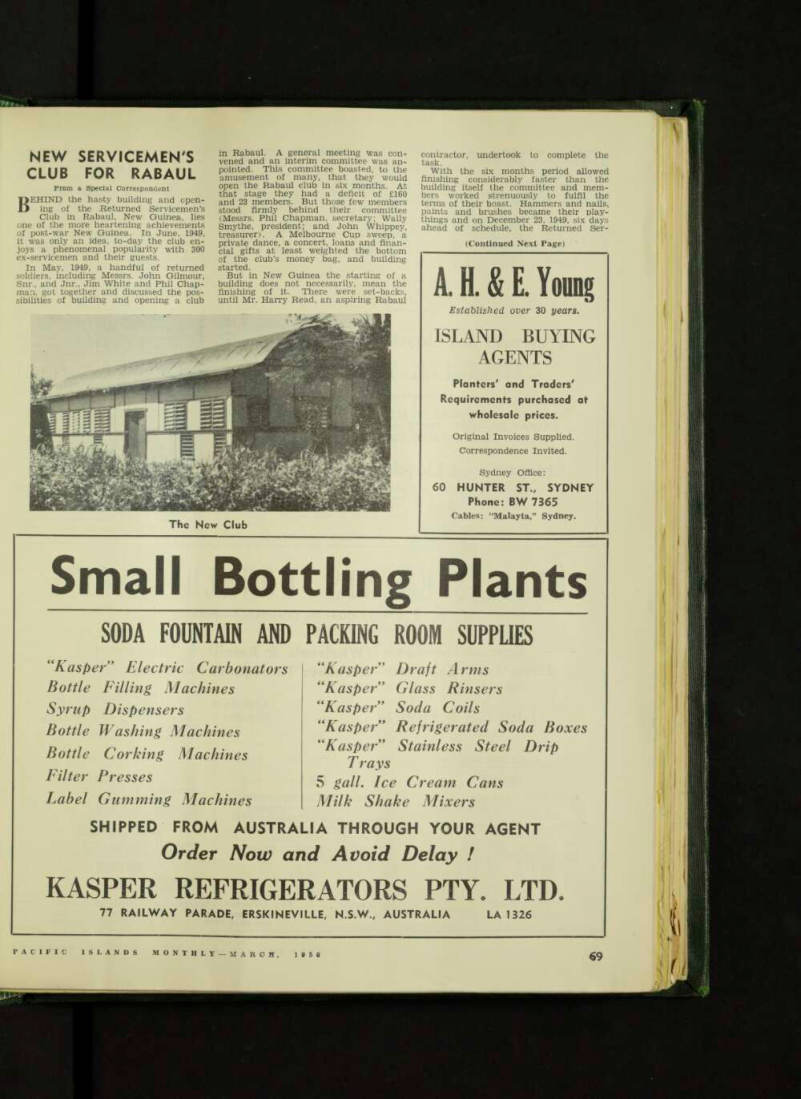
Club For Rabaul
Prom a Special Correspondent BEHIND the hasty building and open ing of the Returned Servicemen’s Club in Rabaul, New Guinea, lies one of the more heartening achievements of post-war New Guinea. In June, 1949, it was only an idea, to-day the club en joys a phenomenal popularity with 300 ex-servicemen and their guests.
In May, 1949, a handful of returned soldiers, including Messrs. John Gilmour, Snr., and Jnr., Jim White and Phil Chap man, got together and discussed the pos sibilities of building and opening a club
in Rabaul. A general meeting was con vened and an interim committee was ap pointed. This committee boasted, to the amusement of many, that they would open the Rabaul club in six months. At that stage they had a deficit of £l6O and 23 members. But those few members stood firmly behind their committee (Messrs. Phil Chapman, secretary; Wally Smythe, president; and John Whippey, treasurer). A Melbourne Cup sweep, a private dance, a concert, loans and finan cial gifts at least weighted the bottom of the club’s money bag, and building started.
But in New Guinea the starting of a building does not necessarily, mean the finishing of it. There were set-backs, until Mr. Harry Read, an aspiring Rabaul
contractor, undertook to complete the task with the six months period allowed finishing considerably faster than the building itself the committee and mem bers worked strenuously to fulfil the terms of their boast. Hammers and nails, paints and brushes became their play things and on December 23, 1949, six days ahead of schedule, the Returned Ser
(Continued Next Page)
The New Club
QPQ?iH o Scfr complete with sealed bar and liqu°r licence. hpr^hir? 6 0W th< r rt l em " bersmp. Whereas 23 saw the start of the project, 250 were on the books on da y- T* lls as now rise* l to 300.
KE tremendous success of the present Rabaul club is due, in great part, to the untiring efforts of Mr. Phil Chapman. He is locally believed to be the most spirited secretary of any subbranch m Australia, and works day and night in the interests of his members. It
is felt that under his careful guidance the club must go from one success to an other.
Trading figures of the club are interesting. For the first five weeks of its active life the bar turnover was £1,300. Now, with the first novelty giving way to steady routine, the monthly turnover is about £l,lOO.
At the last general meeting of the RSS&AILA, January 25, 1950, reference was made to the club and its activities.
As a mark of sincere appreciation of the
services rendered by the secretary, the members present unanimously supported a motion that he be recommended to the Federal Executive for life membership of the League.
AT the general meeting, the existing committee was returned unopposed, and two new members were elected.
The present committee comprises: E. V.
Smythe, president; D. Jones and H. Read, vice-presidents; P. J, Chapman, secretary; A. Barry, asst, secretary; J. Whippey, treasurer; R. Williams. assistant treasurer; Dr. Clive James, P. McKenzie, W. Dupe, M. Foley, M. Munro, M. Duff and Mrs. B. Hides.
Advertisements & other items, pp. 73-74 (1 item)
Small Bottling Plants
A. H. & E. Young
Established over 30 years .
ISLAND BUYING
AGENTS
Planters' and Traders' Requirements purchased at wholesale prices.
Original Invoices Supplied.
Correspondence Invited.
Sydney Office:
60 HUNTER ST., SYDNEY
Phone: BW 7365 Cables; “Malayta,” Sydney.
Small Bottling Plants
SODA FOUNTAIN AND PACKING ROOM SUPPLIES
“Kasper” Electric Carbonators Bottle Filling Machines Syrup Dispensers Bottle Washing Machines Bottle Corking Machines Filter Presses Label Gumming Machines “Kasper” Draft Arms “Kasper” Glass Rinsers “Kasper” Soda Coils “Kasper” Refrigerated Soda Boxes “Kasper” Stainless Steel Drip Trays 5 gall. Ice Cream Cans Milk Shake Mixers
SHIPPED FROM AUSTRALIA THROUGH YOUR AGENT
Order Now and Avoid Delay I
KASPER REFRIGERATORS PTY. LTD.
77 RAILWAY PARADE, ERSKINEVILLE, N.S.W., AUSTRALIA LA 1326
V
&H*ll
Stewarts and Lloyds (Australia) pt y . Ltd.
Manufacturers of "S&L" PIPES and FITTINGS for GAS, WATER, STEAM and other purposes.
AND Distributors of:
MILD STEEL BARS, PLATES and SECTIONS;
GALVANISED IRON; BOLTS and NUTS; ELECTRODES
and WELDING EQUIPMENT.
Stewarts and Lloyds (Australia) pt y . Ltd.
SYDNEY WAREHOUSE - ■ - Herbert Street, St. Leonards BRISBANE WAREHOUSE - Montague Road, South Brisbane MELBOURNE WAREHOUSE - - City Road, South Melbourne Telegraphic Address: "Tubes" — Sydney, Brisbane or Melbourne
ETABLISSEMENTS DONALD TAHITI
HEAD OFFICE—QUAI DU COMMERCE—PAPEETE
TELEGRAPHIC ADDRESS—“DONALD, PAPEETE"
General Merchants (Wholesale & Retail) & Shipowners
Importers & Exporters—Branches Throughout Marquesas Islands
Lloyd’s Agents
A. B. DONALD, LTD.
ASSOCIATE AUCKLAND, NEW ZEALAND.
c ' A. B. DONALD, LTD.
HOUSES: RAROTONGA. COOK ISLANDS,
DOMINION FRUIT CO.,
SUVA, FIJI ISLANDS.
Agents and Distributors for:
FRANCE:
HENNESSY COGNACS
MARIE BRIZARD & ROGER
LIQUEURS
CHARLES HEIDSIECK
CHAMPAGNES
PERRIER WATER
GRUBER BEER
U.S.A.:
GENERAL STEAMSHIP CORP.
RADIO CORP. OF AMERICA
BROWN & WILLIAMSON, LTD.
CIGARETTES: LUCKY STRIKE,
WINGS, OLD GOLD
CHAMPION SPARK PLUG CO.
RAINIER BEER
ENGLAND:
RECKITTS & COLMAN
(OVERSEAS), LTD.
PHILLIPS BICYCLES
THE BANK LINE LTD.
NEW ZEALAND:
VACUUM OIL CO. PTY., LTD.
PETROLEUM PRODUCTS
SWEDEN:
HJORTH & CIE
PRIMUS STOVES
Agents in France :
HARTH & CIE, PARIS.
A. BICKART, MARSEILLES.
Sydney Agents : London Agents :
BURNS, PHILP & CO., LTD. BURNS, PHILP A CO., LTD.
San Francisco Agents :
BURNS, PHILP CO. OF
SAN FRANCISCO.
Air Service To Vella Lavella
Suggestion
Honiara, Feb. 1.
EUROPEAN residents of the Western Solomons have for a long time felt isolated and at a disadvantage com pared with people in the Russell Islands and Guadalcanal.
Mail and cargo for the West is unloaded from ships and aircraft at Honiara and is then trans-shipped by small vessels to its destination, with some unavoidable delay.
The Methodist Mission has now sug gested to the BSIP Government that the Mission make serviceable a war-time airstrip three-quarters of a mile long at Bilua on Vella Lavella, where the Mission has its headquarters. The idea is that Qantas aircraft could call there on their normal fortnightly run from Lae to Honiara and unload Western mail and freight. , As soon as loading and unloading facilities are at Gizo, the Government Station and main port in the West, it is expected that overseas copra ships will call there. Until then, overseas vessels will have to discharge and load all cargo at Honiara and the Russells as at present.
Post-War Problems
Book Review:
and Rice Production
Report of Institute of Public Relations
ALTHOUGH the tenth conference of the Institute of Pacific Relations was held in September, 1947, papers of the conference were published only in December, 1949. As might b$ expected, the intervening two years showed some developments that were not bargained for in the earlier year, but as the 10th con ference was devoted to a consideration of reconstruction in the Far East, and as that area has continued in a state of flux, the conclusions reached then were not too wide of the mark.
Although reconstruction in the south west Pacific was included in the survey, as far as the published papers are con cerned, this area seems to have been treated as a minor affair. However, ade quate consideration was given to the problems of Southeast Asia, an area that is of vital interest to the Southwest Pacific.
Consideration of Southeast Asia, while more or less diagnosing the cause of the troubles that have intensified in Indo nesia and Malaya in the past two years, throws some light on the rice shortages that have been felt in Southeast Asia and Oceania generally.
Burma, it is stated, suffered the greatest destruction of any country in the area due to scorched-earth policies and two major campaigns which covered the whole country. Burmese cities were almost completely destroyed and the communi cations system suffered badly. In the rest of Southeast Asia there was some bombing of cities but most destruction was done to communications, particularly to railways. Junks and river boats were also targets for destruction.
One result of this destruction of com munications was the difficulty of distri buting food—mainly rice. There appeared to be no rice shortage within Burma but inadequate distribution in the north of the country at times has caused near famine. For the same reasons surplus rice production has not been properly distributed in Siam and Indo-China.
DAMAGE to irrigation works in Indo nesia had serious consequences for rice production and in Indo-China collapse of the dyke systems on the Red River caused flooding. In Burma failure to maintain dykes and drainage systems let salt water infiltrate the rice lands of the Delta.
In Indonesia the Japs ordered 50 per cent, of the rice crop to be handed over to them and this led to a sharp decline in production. Japs slaughtered great numbers of oxen and water buffalo for meat in all these rice producing countries leaving insufficient beasts to work the land.
Central Burma has been beset by bandits and these have been encouraged by Com munists for political reasons. This dis order caused cultivators to leave their
holdings.
As a result of these various forms of war damage and conditions arising out of post-war developments, exports of sur plus rice, before the war one of the sources of national income, fell away, in some instances, to nothing and non-rice growing countries of the Orient and Oceania found themselves without their chief item of diet. Chief country in this category was Malaya where rice was severely rationed after the war.
Export of rice from Southeast Asia be fore the war was between six and seven, million tons per annum; in 1946-47 it had fallen to li million tons.
As well as dealing with Southeast Asia, the report of the conference discusses problems of reconstruction in Japan, China, and Korea and devotes chapters to industrial development, international economic problems, education and tech nology.
Copies of the report are $1.35 and may be obtained from the Institute of Pacific Relations, 1 E, 54th St., New York 22, NY.
Mrs. W. R. Cahill, of Wagol plantation, Madang, New Guinea, accompanied by her sister, Miss Therese O’Brien, arrived in Brisbane recently en route to Sydney and England.
Advertisements & other items, pp. 75-76 (1 item)
F. Kopsen & Co. Pit. Ltd.
F aci J
School
LEARN TO PLAY the Hawaiian Steel Guitar or Ukulele in the modern manner. Complete postal course available. Full details free ... no obligation. Send 4d. in stamps for full particulars to
SECRETARY,
PACIFIC SCHOOL OF MUSIC
P.O. Box 487, Palmerston North, New Zealand.
CASH
REGISTERS
Made in Sweden Hugin Cash Registers are specially suitable for tropical conditions. The casing is strong bakelite and so is not affected by atmospheric changes.
The base, cash drawer and housing are of beautifully polished stainless steel. All parts which are exposed are of stainless steel or highly chromeplated steel. These are exclusive features to Hugin.
View of Electric Model with side plate down.
STOCKS ARE NOW AVAILABLE IN SYDNEY of two models of the famous Hugin Swedish cash registers. World renowned for their precision-built quality and simple efficiency. Keyboards id. to £9/19/1 li. Electric or hand operation. Provide printed receipt and detail strip, customer counter, visible indicators and every modern feature.
Hugin machines, first introduced to Australia in 1938, have worked consistently and efficiently for some of the largest stores, such as Myers (Melbourne) and Grace Bros. (Sydney).
Please write for full details setting out particulars of your business.
Hugin cash registers are available through your usual buying house or Sole Agents for Australasia and the South Pacific.
f. KOPSEN & CO. PIT. LTD.
AGENCY DEPT., 380 KENT ST., SYDNEY
Cables: “KOPSEN,” Sydney.
Executor
Trustee
Attorney
THAT
■T V r«E
Spare
your best friend
An inexperienced, overworked private executor quickly gets out of his depth. When he is remote from sound advice, the danger to the estate is greatly increased. Yet the fault really lies with the well-meaning person who made an unwise choice. Fortunately, it is a simple matter to transfer all responsibility to Burns Philp Trust Company Limited. By appointing this Company as your executor or trustee in the first place, you avoid placing a trusted friend in a most difficult position. More important still, your beneficiaries are permanently safeguarded from the hazards of inexperienced administration.
Full particulars of the Company’s many services are given in “Hands That Never Leave the Wheel.” A complimentary copy of this 20-page booklet can be obtained from any branch of Burns Philp (South Sea) Company, Burns Philp (New Guinea) Limited, or direct from the head office of this Company, James Burns Joseph Mitchell MANAGER: L S. Parker
DIRECTORS:
P. T. W. Black Eric Priestley Lee
SECRETARY: E. R. Overton, F.F.I.A.
BURNS PHILP TRUST
COMPANY LIMITED
Constituted by Special Act of the N.S.W. Parliament
Head Office: 7 BRIDGE STREET, SYDNEY
TEL. BU 5901
BOX 543, G.P.O.
BP6-50
Dollar Shortage Hits
West Samoa
Prom Our Own Correspondent DOLLAR allocations to Western Samoa importers have again been severely cut for 1950.
Allocations have been made for the following categories of goods from hard currency areas:—timber, reinforcing steel, tyres and tubes, benzine and oils, vehicles for taxi purposes and general.
Only replacements of registered taxis will be allowed and a bond to the value of the car has to be deposited to ensure that the car will not be disposed of for private purposes within four years of first regis tration.
Importations from soft currency areas will not be restricted.
It is expected that USA and Canadian goods, particularly foodstuffs, will prac tically disappear from the shelves of Apia stores and may be replaced by Australian goods.
Two lines which will be hard to re place, however, are American cigarettes and Canadian tinned fish which have always enjoyed popular favour in the Territory.
Editorial Note
WESTERN SAMOA is late in joining those countries where canned sal mon and Luckies are unknown!
American cigarettes are now a dim war time memory; canned salmon disap peared from Australasian markets in 1942 and seems unlikely to return until someone has found a way out of the dol lar maze. It gave the cynics cause for mirth, however, when last year red sal mon, canned by Red Russia, was imported into Australia and sold readily. The Commonwealth is promised more of this in 1950 —but must not import it from her sister Dominion, Canada, or from USA.
It is interesting to reflect that the present Australian generation is growing up knowing nothing of two of the com monest foods of pre-war days—salmon and rice. Although the prohibition on rice has probably prevented many nursery rice-pudding inhibitions, it has now been pushed into • the luxury class—unobtain able unless you know a Chinese sea man or have a friend with blood-pressure (and that necessary adjunct to successful living in a bureaucratic age—a Doctor’s Certificate).
There are, of course, ways and means.
Recently a group of Australians were dis cussing cream, which is also banned from the ordinary citizen’s diet.
“I get cream now, Wednesdays and Saturdays,” said Mrs. P.
“How?” asked her friends, “Oh, Mr. Jones, three doors down the street, has in ulcer. (And a Doctor’s Certificate). Mrs. Brown gets it Mondays and Thursdays and Mrs. Smith the other days.”
“What about the ulcer—when does it get it?” she was asked.
“Oh him,” was the reply, “he’s had cream.”
Australian Beach Girls In Fiji
PRIZES for two recent Australian beach girl competitions were trips to Fiji.
Miss Beverley Smith who was runner-up in the Miss Manly Mardi Gras contest won a trip to Fiji by air and in a tour of Viti Levu was the guest of Northern Hotels, Ltd., , Northern Hotels, Ltd., and the Union Steamship Co. provided accommodation for another beach girl competition win ner, Miss Maureen Duval. Her tour was organised by the Fiji Publicity Board.
Question of Court
Sentences Raised in Fiji
Prom Our Own Correspondent
Suva, Feb. 26
THERE has been recent criticism of alleged discrepancies between sen tences imposed at various courts in Fiji.
A Fijian who stole a shirt from an other Fijian has been fined £lO, and a Fijian woman who stole two dresses from other Fijian women has been gaoled for six months. For breaking into a Fijian house at Wailoku and stealing three mats, another Fijian was sentenced to six months’ hard labour. The same penalty was imposed on a youth who stole goods valued at under £9, while a young Fijian who had bought part of the goods was given nine months’ hard labour for receiving; and, finally, an Indian shop keeper who had ultimately received the transferred goods (sewing-machine needles) was sentenced to 18 months’ hard labour. (The Indian had 12 pre vious convictions).
CONTRASTING with these sentences is the case of an Indian bus-driver who, in 1947, drove his bus while helplessly drunk, smashed a motor-car, killed a woman and seriously injured a man. Charged with manslaughter, he was sentenced in the Supreme Court to two years’ gaol. With the usual reduction for good behaviour, he was released after 18 months.
At Tavua this month a Fijian was sent to gaol for two years and seven months for damaging property, assaulting the police and escaping from custody. A fine of £5 was added for being under the influence of liquor.
Although this man had 13 previous convictions, it has been pointed out that “drunks and disorderlies” at Suva fre uqently assault the police and are treated with comparative leniency.
Another aspect of magistrates’ courts which has provoked a sharp protest re cently is the frequent employment of In dians as interpreters in cases involving Fijian defendants. Although it has not been claimed that this has involved mis carriages of justice, cases are known in which Indian interpreters, through ig norance of the differences between the official language of Bau and some of the dialects, have unintentionally given wrong interpretations.
Strait Pearl-Shell
Million Dollars For Torres
IN the nine-months’ pearling season in the Torres Sfrait a haul of £500,000 worth of pearl-shell was made. This will be sold almost exclusively to the United States button trade and is ex pected to bring more than a million dollars to Australia.
Pearls (as distinct from the shell) rea lised about £lO,OOO during the period.
Highest price paid for a single pearl was £BOO for a gem won by one of Burns Philp’s native divers.
Advertisements & other items, p. 77 (1 item)
Flour
ASK FOR IT
ESTABLISHED 1868.
CLEANtR
PHONES: LA 2436
LA 4033 LA 4603
CABLE ADDRESS:
“ EXSOAP ”, SYDNEY
MFG. PTY. LTD.
14 ST. MARY STREET, CAMPBEDOWN
SYDNEY N.S.W.
\ *n. soh
Specialising For Export . . .
VARIOUS SOAPS UNDER THE REGISTERED BRAND
“WACO”
Laundering, Toilet (Eucalyptus and Carbolic Health), Sea Water, Medical (Soft and Liquid), Washing Powder, Antiseptic Grease Remover, Wool Washing, Phenyle, Disinfectant and Liquid Soap (to specification).
For all inquiries :
EXPORT SOAP MFG. PTY. LIMITED.
14 ST. MARY STREET, CAMPERDOWN, SYDNEY, N.S.W. .
New Cadet Officers For Bsi
From Our Own Correspondent
Honiara, Bsi, Feb. 22
THREE new cadet administration offi cers are expected to take up posts with the British Solomon Islands Government shortly. They are Mr. A. A.
Mackeith, who arrived in Honiara on February 20 by QANTAS; Mr. M. B.
Hamilton, who is due to arrive in March; and Mr. H. C. Wallington. All have come from the United Kingdom.
The Protectorate now has five new
cadet administrative officers either al ready on duty or expected shortly, Mr.
J. D. Field and Mr. J. F. Bartle having arrived from England last year.
A serious shortage of administrative staff has made the change-over from wartime to peacetime native administra tion very difficult, but the new arrivals will ease the situation.
Mrs. G. L. Barrow, wife of the District Agent of Tanna Island, New Hebrides, arrived in Sydney for a short holiday by the February Morinda.
Radio New Zealand Popular
In Islands
ACCORDING to reports published in New Zealand, the Government sponsored shortwave station, Radio New Zealand, has acquired a large listen ing public in the Pacific Islands during its first two years of operation (the station recently celebrated its second anniver sary) .
The programme-planners of the New Zealand Broadcasting Service claim that the shortwave broadcasts are especially designed for listeners in the Islands, and that they are assisted in their task by correspondence from many Islands, in which listeners state what programmes are, or are not wanted.
When the broadcast fare has been as sembled to the satisfaction (it is hoped) of Island listeners, the voice that puts it all together is usually that of Pat Earn shaw, Radio NZ’s only permanent an nouncer (he was the first to speak from the shortwave station, and has broadcast regularly since).
Hedstrom’S, Nadi
Second Robbery From Morris
Prom Our Own Correspondent
Suva. Feb. 6
THIEVES recently broke into the Nadi store of Morris, Hedstrom, Ltd., and stole a substantial sum (unofficially reported to be mere than £700).
In 1948 thieves removed the safe bodily, but, failing to get it open, carried it in a truck to the Nadi River and dumped it into deep water. It was re covered by the police.
This time the office was entered through the floor and the thieves made an expert job of safe-breaking.
Advertisements & other items, p. 78 (1 item)
Gordon's
Sails. Covers. Awnings
TENTS, TARPAULINS, and all classes CANVAS GOODS for industrial and home use FLAGS AND PENNANTS FOR CLUBS AND ASSOCIATIONS Send your inquiries through your agent,
/« harry” west
"SYDNEY'S SAILMAKER"
DUKE ST. (WATERFRONT) EAST BALMAIN, SYDNEY, N.S.W.
Phone: WBIIOS, W 82284.
rzet m Go m m By Appointment Gin Distillers to H.M. King George VI Tanqueray, Gordon & Co. Ltd-
&tC4rnt^a/t€t&e
Gordon's
Stands Suptema
Old And New
In The
S. W. Pacific
AS the future Government of the British Solomon Islands and the New Hebrides Condominium—and to a lesser extent the French Colony of New Caledonia—is likely to be under close review in the next year or two, a new book comes opportunely—“lsland Administration in the i South West Pacific,” by Cyril S. Beshaw, and pub lished by the Royal Institute of Inter national Affairs, Catham House, St.
James’ Square, London.
Mr. Belshaw was an Administrative of ficer in the Solomons, and has seen a good deal of the New Hebrides and New Caledonia; and he is in the position of being able to supply much valuable background information covering the history of those Territories, their economic possibilities and the way in which conditions there have been affected by wartime and postwar developments.
Mr. Belshaw obviously has spent many industrious months on research, and the material he has lined up, and carefully indexed, should be found very useful by all those concerned with the problems of Islands administration and the welfare of native races.
This is Mr. Belshaw’s conclusion: “It is quite clear . . . that these small afreas are magnificent laboratories for experiments in colonial development and social ‘engineering.’ It is a tragedy that they have, up to the present, been governed with little imagination; and that so many factors have delayed or unbalanced the few bright plans for the future that have been considered.
“Perhans the South Pacific Commis sion, and the growing political restive ness of the people themseves, will ulti mately bring administrations to the view that tolerance and legal justice are not enough; and that a forthright pro gramme, leading without delay to the es tablishment of social and economic re sponsibility is essential.”
There seem to be scores of these busy and painstaking and well-meaning writers at work, in their fearfully humour less way, upon our post-w’ar sociological problems: and, the more they make their influence felt —mainly through Socialist Governments and United Nations instru mentalities—the more are we plagued with nationalist howling by peoples who are not fitted for national responsibility.
And so we have world-wide troubles, ranging from the chaos of Southern Asia, and the humiliation of the Dutch in Indonesia, to the “Marxist Rulers” of the Solomons and the incendiaries of little Buka. it is time that a disillusioned world cancelled the license of its mischief-making Planners, and applied itself to the restoration of discipline in all those countries which understand only the rule of the Big Fist.
We do not agree with all Mr. Bel shaw’s conclusions: but we heartily com mend his book to those who, seeking a way out of our socialistic maze, want all the facts they can get, in a handy form.
Another Mercy Flight By RNZAF
In Fiji
Ssuva, Feb. 20
UPPLIES of penicillin were rushed to Lakeba, Lau Group, Fiji by RNZAF Catalina on February 17 in the latest cf the Air Force “mercy flights” in Fiji.
The package of penicillin, urgently needed for a case of meningitis, was dropped in the middle of Tubou, the main village of Lakeba.
Proni a New Zealand correspondent: Mrs. Florence Gofton Stewart, who is stili trying to re-establish her hotel business m war-torn New Guinea, is another Terntones woman who deserves Birthday Honours. She must have lived 40 years in Papua and New Guinea, and she still
seems fit and well. I well remember the day when her son Moresby was born—he was killed early in World War ll—and I also knew and esteemed his father, Harry Gofton. I was present at the marriage of J w Baldie to Mrs Stewart’s sister it seems a long time a|o.”
Advertisements & other items, pp. 79-80 (1 item)
Robert Gillespie
Wynne S. Breden Pty. Ltd.
SHIPWRIGHTS , BOAT* BUILDERS AND ENGINEERS.
"PHOENIX SHIPYARDS", NEWCASTLE, N.S.W.
Designers, Builders & Outfitters of ISLAND Vessels Work Boats, Cargo Boats and Auxiliary Craft up to 200 tons.
WHOLESALB-MfRCHANTS
MANUFACTURERS AGENTS
m '(/I a (P £ < m ccv m & ft \V v S* o* u ML e CE hJh
ROBERT GILLESPIE
NEW GUINEA LT|}
HEAD OFFICE LAE
BRANCH OFFICE RABAUL
±iw ROBERT GILLESPIE PTY.LTD. 5 Street
uiC ■ \t » a
VCER
o?s>
\\\PsX
The perfect trouble-free
LUXURY LIGHT. 300 CANDLE
POWER. MADE IN TWO SIZES,
“THE QUEEN,” 2|i" TALL AND
“THE PRINCESS,” I6J" TALL. CREAM AND POLISHED BRASS FINISH WITH SHADE TO MATCH. GIVING 12 HOURS LIGHT ON ONE FILLING: (li PINTS OF KEROSENE).
“THE LOVELY LAMP” FITTED WITH THE “HAPPY MANTLE.”
THE TILLEY LAMP COMPANY, LTD. HeNDON, ENGLAND
REPRESENTATION :
MELBOURNE: T. H. Bentley, Pty. Ltd., 123-125 William Street, Melbourne, C.l.
TASMANIA: Mr. H. V. Sellers, 108 a Charles Street, Launceston.
FIJI: Mr. K. Witherington, 2 Burns Philp Buildings, Suva.
No Decoration, Sir!
Australian Bureaucrats Have the Last Word
THERE is a new chapter to add to the remarkable history of Mr. A. J. Car fax Foster and the Australian bureaucrats.
The early wartime experiences of Mr.
Carfax Foster —who is now a resident of Lautoka, Fiji—were told, some years ago, in the PIM. He was on the reserve of officers in NSW, in 1937, when he suffered a bad accident, in camp, and was paid compensation, and discharged from the Army. War came in 1949; and it then appeared that he was still on the reserve of officers, and he was called up at once.
He was given full-time duty on the General Staff; and was recommended for promotion to major in February, 1940, and lieut.-colonel in April, 1940. Neither ap pointment came through, because the Army had now discovered that he had been “compensated” for accident. He was put before a Medical Board, and dis charged.
Mr. Carfax Foster then enlisted in the AIF as a private and passed as medically fit. He was made a sergeant six days later and served for several months. He was about to sail for Malaya (and a prison camp) with the Bth Division when the men higher up discovered his Army his tory, put him again before a Medical Board—and out he went.
Nothing daunted, Mr. Carfax Foster joined the American forces, and was em ployed for a long time on “the small boats,” wherein he had some lively ad ventures in the New Guinea area—es pecially as master of the famous little Myena. Then he got bad malaria, and
the Americans sent him back to base, to the Procurement Division, where he was an “administration executive” (a high office).
The Americans recommended that he should receive the Medal of Freedom with Gold Palm, for conspicuous service both on the small ships and in the Procure ment Division. He duly received the Southwest Pacific Area Medal and the Mercantile Marine Combat Bar; but the coveted Medal of Freedom never arrived.
Finally, he made an inquiry. He was in formed by the Americans that the Aus tralian Socialist Government had set it self resolutely against the award of such decorations to Australian civilians, and so the matter had not been proceeded with. Yet the humble civilians were al lowed to receive the less important medals.
In the view of the bureaucrats, when Mr.
Carfax Foster accepted compensation, he was no longer capable of rendering ser vice. When the war came, and every trained man was worth his weight in gold, Carfax Foster was sufficiently re covered to serve his country. The bureau crats would have none of him—better the loss of a trained man than a broken regulation. So he got in his war service with the Americans —and so effectively that they proposed to decorate him. But again the little men with the big authority stepped in—the regulations would not permit it.
Mr. Carfax Foster now regards it all as a funny story—but it is more than that.
It is a really remarkable example of red tape in its worst colours.
Mrs. E. Sprott, MBE, of the Melanesian Mission, who has given such valuable service to the Solomons for 30 years, has retired. She left for England on the Strathmore in March.
New Weather Officer For Nadi
From Our Own Correspondent
Suva. Feb. 20
MR. F. E. J. HOLLEY, who arrived in Fiji recently from the United King dom, has taken charge of the meteo rological station at Nadi Airport. Mr.
W. J. Dwyer, who has been on an inspec tion tour of the stations in Fiji, has re turned to his headquarters at Wellington, Nadi station is now fully equipped with radar and other modern devices for weather recording throughout the Pacific.
The official staff comprises six European forecasters, ten European observers and seven Fijians.
Advertisements & other items, p. 81 (1 item)
Robert Kosak
Weary, Dreary
People
Put Some GO Into Your Life
Too many men, women and girls suffer aching backs, headaches, and feel dreadfully tired— tired, always tired. The cause? Very often, anaemia or bloodlessness.
You see the symptoms in dull eyes, pallid cheeks and lips, breathlessness, vague aches, exhaustion after the slightest exertion. Young children, especially girls, suffer frequently.
If you haven’t blood normal in red corpuscles, you are not receiving sufficient energy-giving oxygen which is dispersed by the blood throughout your body every second of the day and night. Your nerves, organs and tissues are not properly nourished and you remain weary and dreary.
Get the GO which rich red blood can give you. Take the famous Dr. Williams’ Pink Pills for a few weeks. Dr. Williams’ Pink Pills are specially compounded to provide you with a normal rich blood supply. Always at your chemist or store.
IN THIS PART OF THE WORLD TOO/ W *U
TJLJb
U N f T £D
Sfc
PAC / F
js a y 7
*■* Si *r< K 15
*«SH*UN
A * tSiW «£ GtCSfW 5a susrlirA S/**•**• f Jk&tf -TsSk
jPrlwt,
> eg 3r « -.0 pjrjssf’vcH %jfe LJb %5 -i S3V a- 3- Throughout the Pacific, as with other parts of the world, ROBERT KOSAK, representing leading English, Continental and U.S.A. manufacturers, offers all the advantages of an old-established importexport service.
ISLAND PRODUCTS
SOLD ON ALL
WORLD MARKETS
ON A COMMISSION
BASIS
Inquiries invited
ROBERT KOSAK
Exporters and Manufacturers’ Representatives,
77 KING STREET, SYDNEY, AUSTRALIA
Cable Address: “ROKOSTRA,” Sydney.
Bankers: National Bank of Australasia, Ltd., Sydney.
Bank of New South Wales, Sydney.
Answer To Correspondent
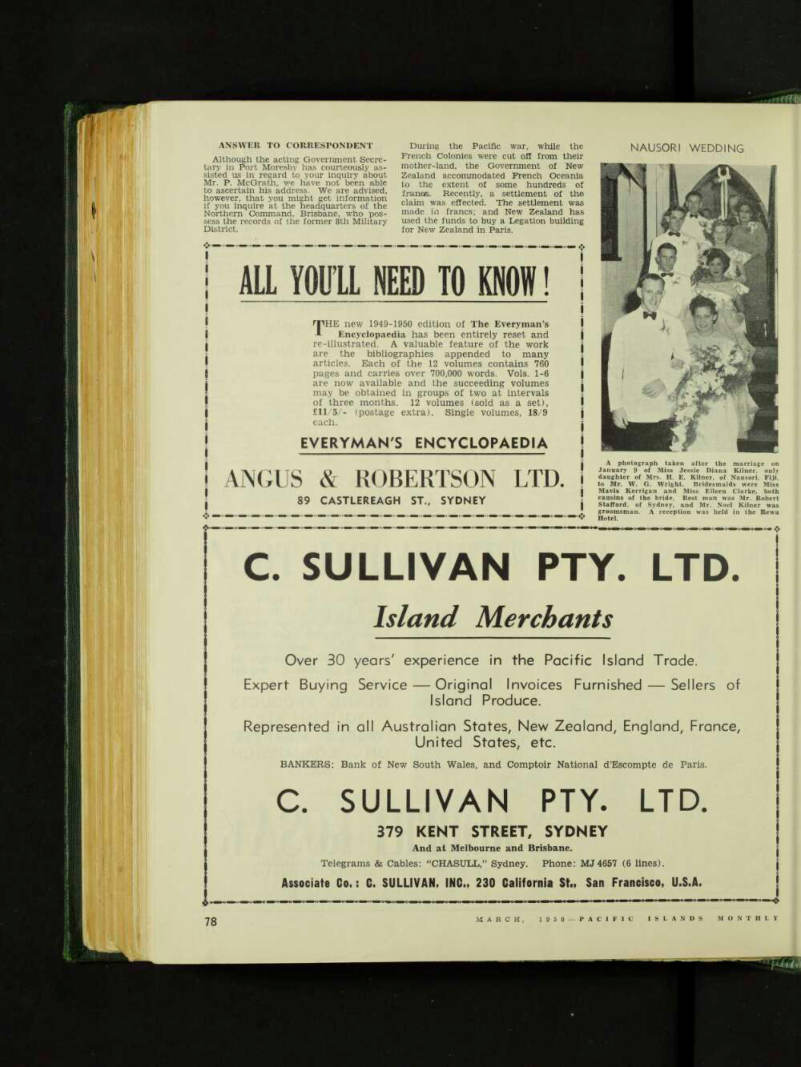
Although the acting Government Secre tary in Port Moresby has courteously as sisted us in regard to your inquiry about Mr. P. McGrath, we have not been able to ascertain his address. We are advised, however, that you might get information if you inquire at the headquarters of the Northern Command, Brisbane, who pos sess the records of the former Bth Military District.
During the Pacific war, while the French Colonies were cut off from their mother-land, the Government of New Zealand accommodated French Oceania to the extent of some hundreds of franos. Recently, a settlement of the claim was effected. The settlement was made in francs; and New Zealand has used the funds to buy a Legation building for New Zealand in Paris.
Nausori Wedding
A photograph taken after the marriage on January 9 of Miss Jessie Diana Kilner, only daughter of Mrs. H. E. Kilner, of Nausori, Fiji, to Mr. W. G. Wright. Bridesmaids were Miss Mavis Kerrigan and Miss Eileen Clarke, both causins of the bride. Best man was Mr. Robert Stafford, of Sydney, and Mr. Noel Kilner was groomsman. A reception was held in the Bewa Hotel.
Advertisements & other items, p. 82 (1 item)
All You’Ll Heed To Khow!
THE new 1949-1950 edition of The Everyman’s Encyclopaedia has been entirely reset and re-illustrated. A valuable feature of the work are the bibliographies appended to many articles. Each of the 12 volumes contains 760 pages and carries over 700,000 words. Vols. 1-6 are now available and the succeeding volumes may be obtained in groups of two at intervals of three months, 12 volumes (sold as a set), £ll/5/- (postage extra). Single volumes, 18/9 each.
EVERYMAN'S ENCYCLOPAEDIA
ANGUS & ROBERTSON LTD.
89 CASTLEREAGH ST., SYDNEY
C. SULLIVAN PTY. LTD.
Island Merchants
Over 30 years' experience in the Pacific Island Trade.
Expert Buying Service Original Invoices Furnished Sellers of Island Produce.
Represented in all Australian States, New Zealand, England, France, United States, etc.
BANKERS: Bank of New South Wales, and Comptoir National d’Escompte de Paris.
C. SULLIVAN PTY. LTD.
379 KENT STREET, SYDNEY
And at Melbourne and Brisbane.
Telegrams & Cables: “CHASULL,” Sydney. Phone: MJ4657 (6 lines).
Associate Co.; C. SULLIVAN, INC., 230 California St., San Francisco, U.S.A.
Rabaul Revisited
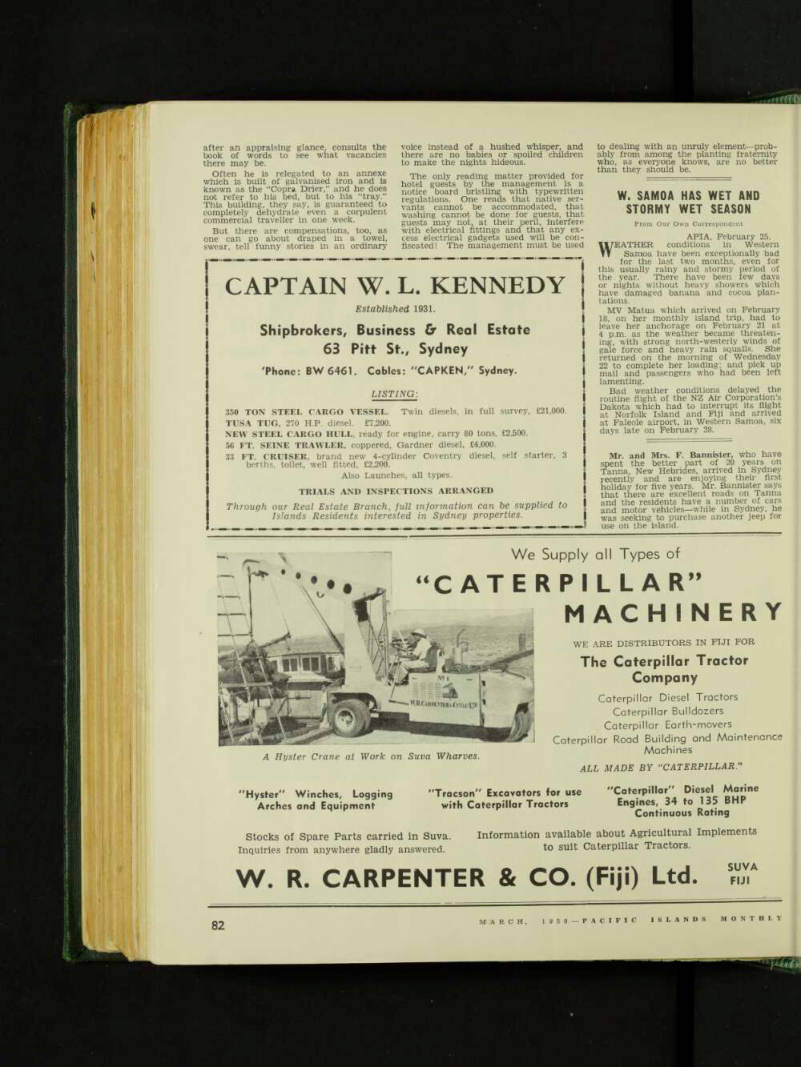
Jottings by S.A.G., who, being a dweller in Outports, regards the Metropolis with a jaundiced eye.
His opinions are his own—and not necessarily those of PIM.
LET’S go down the street and have a look round Rabaul.
Opposite the New Guinea Company a big car stops and out of it steps B. B.
Perriman and makes for the office! Our Bert is stouter than of yore but still the same smiling, dapper personality, who is always approachable. He has had a wide experience in the Pacific, including Fiji and Vancouver, and now has a man-sized job as managing director of the company.
People say he is the “Mayor of Rabaul!”
With Bert is Ken McMullen, bare headed and going grey, dressed in khaki and holding an inseparable companion— his pipe. He holds onto this when smok ing, and often answers a question by say ing: “Well, I couldn’t say—it might be and again it mightn’t be. Your guess is as good as mine.” Formerly a District Officer, and then a Colonel during the recent disturbance, Ken is now a director in the New Guinea Company and attends to the plantation side of things.
A car draws into the roadside near BP’s store, but before it stops a head is thrust through the window and a voice calls: “How are you, Mate? When did you get in? Gripes, you look fit, eh! I’m going to Africa by the Dominion Monarch in March—how about coming, too?” It’s that old-timer, Gilbert Renton, known as “Sparrow” because of his small size and alert manner and movements.
Gilbert has done much for the town— and the town has done much for him.
Now he has decided to take things more easily and is soon going off on one of his round-the-world trips. “May as well, Mate, see what I mean? No use sticking here all the time, eh?” He disappears into the store and his laugh is heard as he finds another “Mate” inside.
A jeep stops abruptly and out bustles a man of medium height, and sturdy build, with a fist) full of papers and talk ing as he comes; “Good day, young feller! How are you? Look, I’m as busy as Hell—can’t stop now! Where are you staying? Eh? Well, must get along—see you later” and he shoots into BP’s office.
This is A, H. Cresswell, who for the last 20 years or so hasn’t had a minute to spare. “Cressy” has plantations in the Bainings. As a youngster he was a machine-gunner at the storming of Mont St. Quenein, and he treats most of his problems as Mount St. Quentins and takes everything on the run! He has been many things including plantation manager and owner, gold miner at Edie Creek Across the street steps a tall, loose limbed Aussie, wearing a broad smile and calling a cheery “Good Morning.” Here we have that broth of a bhoy, Jack Keenan, now the Assistant District Officer, and a tower of strength in base ball and football teams and deservedly popular. He was one of the famous band of “Coastwatchers” during the Pacific war and collected a British DSC and a US Legion of Merit for work in the Solomons.
And here in “the best jeep in Rabaul” comes John Stokie of Notre Mai, cigar in mouth, one eye half-closed, exuding good humour and bustling energy. The car jerks to a stop and John descends and rolls towards us, smoke trailing over one shoulder, and hand extended: “Now, look” says he, “I want to see you on a matter of business; it’s about a plantation I was
thinking of leasing, now I well, hop into the jeep and we’ll go down to the Club and have a yarn.” So away we go.
John has more energy than any two ordinary men. He was fourteen months in New Britain after the Japs occupied it, and finally got away, then returned with AIB and was there for the kill.
DOWN from the cabin of a utility truck steps Frank Henderson from Keravat Experimental Station, where, as Economist-Botanist for the Ad ministration he has his headquarters.
Frank has spent many years at Keravat —and knows much of tropical agriculture.
Tall, quiet and slow-spoken, the local planters have come to appreciate his ad vice and assistance concerning planting matters.
With Frank is Ranald Maclean, a post war arrival in New Britain, who is now manager of Keravat and is vigorously carrying out the rehabilitation of the station. Brought up among coffee in Java, he came here to manage Vunalama Coffee Estate, which his late father, Major G. D. Maclean, had managed before the Japs came. After a term he joined up with the Administration, being keenly in terested in experimental work. Ranald is a keen cricketer and, generally, a man of energy and enthusiasm.
(Continued on Page 81)
Go into BP’s office and one sees Dug Ewing, delving among books and accounts and loving every minute of it. Ask Dug a question and he will draw himself up, fold his arms, and say very deliberately: “Well, now, that all depends, of course!
Now, take the case in point ”
Dug is now an Inspector for the Firm, and has a name for sound judgment and firm friendships. Always interested in navy matters, he rose to rank of Lieut.- Commander during the war and was latterly on destroyers, which is the place for fighting men.
And here comes our old friend Bobby Crookshank, a mariner of England, well known throughout the island groups in the Pacific. His very blue eyes gaze keenly from under bushy eyebrows, his head is bare and his white hair is crisp and curly. Bobby holds his pipe by the bowl, draws on it and smiles, saying: “Well, Senor, we meet again! Hm; It’s rather nice to come across old friends in this wicked city! Hm, hm! Do you think that we might, perhaps, repair hence and quaff a flowing bowl?”
So we repair to the village inn and quaff one—or maybe, two! We remember Bobby in command of various Islands ships, always smoking, always humorous and always addressing people as “Senor.”
One recollects, too, Bobby sitting on an island beach, oiling a .38 revolver about an hour before he left to pilot six American PT boats into Rabaul Harbour —this in March, 1944, when Rabaul was definitely a hot shop. Bobby gave the revolver a final rub, spun the cylinder, and bolstered the gun with the remark “It should be an interesting trip, Senor!”
The Americans loved his dry humour, his intestinal fortitude, the fact that he had been a Commander in the Royal Navy, and his record as an amateur boxer.
MORE buildings are noticed around the town of Rabaul, and others are in process of building. Scarcity of mat
erial and tradesmen has hampered rehabili tation, but it seems to be gaining momen tum at last Residents smile, unbelieving, when mention is made of the proposed move to Kokopo as they consider that merchants will not easily forego the facili ties of this deep-water port.
Another hotel is in process of erection on the site of the picture theatre of pre war days. It Is not anticipated that the place will be open until end of May. It is a badly-needed addition to the town. It is being built with local money and, so rumour says, will be floated into a com pany ere long.
The town has two taxi services, though at times they are referred to in other terms. Many of the cars are, or should be, museum pieces; and many of the native drivers are poor, but their calcu lation of the fare is keen. As there are no cards in the car to indicate the fares one wonders what visitors are charged by these native bushrangers.
It is a test of endurance to take a trip in one of the older cars with a boy who is learning to drive. One is jerked back ward by a fiercely let in clutch, propelled forward by a suddenly applied brake, whizzed round corners, missing another car or lorry by inches, and, at the end a grinning native demands what seems to be an extortionate fare which there is no means of checking.
The picture show does a thriving trade and shows pictures three nights a week.
It should be paying good dividends if one judges by the crowds that attend.
The theatre is a Qounset hut, which, on the hot Rabaul nights, causes patrons to sweat and squirm. Apart from any thing else it is hot work to follow cowboy heroes across desert and dusty plain at breakneck speed, while the dust behind a “trail herd” is choking.
The shrieks of joy which come from the coloured youths and maidens when the bad men are rounded up and shot down
are worth hearing. At the interval, and at end of the show, a rush is made to the ice cream and soft-drink department.
WHEN proceeding to Rabaul travellers are alwavs in doubt as to whether or not accommodation at the hotel will be available. On days when the steamer or plane is nearly due, the house is crowded with intending passengers and people visiting the metropolis.
The hopeful guest approaches the office and accosts a stern receptionist, who,
after an appraising glance, consults the book of words to see what vacancies there may be.
Often he is relegated to an annexe which is built of galvanised iron and is known as the “Copra Drier,” and he does not refer to his bed, but to his “tray.”
This building, they say, is guaranteed to completely dehydrate even a corpulent commercial traveller in one week.
But there are compensations, too, as one can go about draped in a towel, swear, tell funny stories in an ordinary
voice instead of a hushed whisper, and there are no babies or spoiled children to make the nights hideous.
The only reading matter provided for hotel guests by the management is a notice board bristling with typewritten regulations. One reads that native ser vants cannot be accommodated, that washing cannot be done for guests, that guests may not, at their peril, interfere with electrical fittings and that any ex cess electrical gadgets used will be con fiscated! The management must be used
to dealing with an unruly element—prob ably from among the planting fraternity who, as everyone knows, are no better than they should be.
Advertisements & other items, pp. 83-86 (2 items)
79
PACIFIC ISLANDS MONTHLV - M A R C H , 1950
I Vince
r.-*
SPECIALISING IN
PACIFIC ISLAND INSURANCES
FIRE—MOTOR VEHICLE
MARINE—HULLS AND CARGO
EMPLOYER’S LIABILITY
BONDS—In accordance with
ADMINISTRATION ORDINANCES.
COPRA INSURED FROM DRIER
TO BUYER.
AND ALL OTHER CLASSES ARRANGED
AT LOWEST CURRENT RATES.
Established Agencies throughout the Territory of Papua and New Guinea.
Managing Agents: New Guinea Company, Limited.
Island Representative: G. D. A. Kent, Rabanl Branch.
SOUTHERN PACIFIC INSURANCE
CO., LTD.
HEAD OFFICE: 60 HUNTER STREET.
WB mcwrtjpc
w/r# 00b
FOR
SUMMER
HEADACHES
HEAT
EXHAUSTION
FATIGUE
LISTLESSNESS
Enjoy Summer Fun!
PUa thrill to the call of the surf and the \W sand ! Vincent’s A.P.C give marvellous relief from Summer Headaches, Fatigue, and Nervous Depression.
Vincent’s A.P.C will lift you to bright, smiling alertness!
AN IMPORTANT
POINT TO
REMEMBER!
Prepared to the original hospital formula, genuine Vincent’s a.p.c is a proved and accepted medical prescription!
i VINCE
AT
POWDERS & TABLETS
VOU’LL ALWAYS GET
THE BEST FROM THE
PUMP!
,LUME
P 484 . and keep your engine clean, with-
MOBILOIL
Plume is the best petrol available to-day.
The finest petrol ever produced will be served from the Plume Pump as soon as world economic conditions permit. Buy Plume it's always the best petrol.
VACUUM OIL COMPANY PTY. LTD.
BERRY’S BAY
BOATYARD
(B. J. Halvorsen—Manager)
Specialists in Island vessels.
All kinds of boat-building and repairing.
New and used boats and engines for sale.
Quotations and estimates free.
BERRY’S BAY BOATYARD
John Street, North Sydney. N.S.W.
A. H. BUNTING LIMITED
SAM ARM PAPUA
SAMARA I AGENTS FOR:
Vacuum Oil Co. Pty. Ltd.
South British Insurance Co.
National Mutual Life Association
SOLE AGENTS IN PAPUA/NEW GUINEA FOR:
Polarizers (U.K.), Ltd.—Polaroid Sun Glasses.* C.S.A. Industries Eng.— Dual Freeze Refrigerators.
Webley & Scott, Ltd.—Shot Guns, Air Pistols, etc.
Le Bryan Group Products (Great Britain) Ltd.—Powermaster Electric Refrigerators.
“Getula.”—Nylon Monofilament Fish Lines. • Trade mark patented in U.S.A., Great Britain, and other countries.
REGULAR SUPPLIES OF EASTERN GOODS
WHOLESALE & RETAIL MERCHANTS IMPORTERS PLANTERS
CAPTAIN W. L. KENNEDY
Established 1931.
Shipbrokers, Business Gr Real Estate
63 Pitt St., Sydney
'Phone; BW 6461. Cables: "CAPKEN," Sydney.
LISTING :
350 TON STEEL CARGO VESSEL. Twin diesels, in full survey, £21,000.
TUSA TUG, 270 H.P. diesel. £7,200.
NEW STEEL CARGO HULL, ready for engine, carry 80 tons, £2,500. 56 FT. SEINE TRAWLER, coppered, Gardner diesel, £4,000. 33 FT. CRUISER, brand new 4-cylinder Coventry diesel, self starter, 3 berths, toilet, well fitted, £2,200.
Also Launches, all types.
TRIALS AND INSPECTIONS ARRANGED
Through our Real Estate Branch, full information can be supplied to Islands Residents interested in Sydney properties.
We Supply all Types of
“CATERPILLAR”
MACHINERY
WE ARE DISTRIBUTORS IN FIJI FOR
The Caterpillar Tractor
Company
Caterpillar Diesel Tractors Caterpillar Bulldozers Caterpillar Earth-movers Caterpillar Road Building and Maintenance Machines
ALL MADE BY “CATERPILLAR.”
«n«^, ■romiw... r A Hyster Crane at Work on Suva Wharves.
'Hyster" Winches, Logging Arches and Equipment "Tracson" Excavators for use with Caterpillar Tractors Stocks of Spare Parts carried in Suva.
Inquiries from anywhere gladly answered.
“Caterpillar" Diesel Marine Engines, 34 to 135 BHP Continuous Rating Information available about Agricultural Implements to suit Caterpillar Tractors.
W. R. CARPENTER & CO. (Fiji) Ltd.
SUVA
FIJI
W. Samoa Has Wet And
Stormy Wet Season
Prom Our Own Correspondent APIA, February 25.
WEATHER conditions in Western Samoa have been exceptionally bad for the last two months, even for this usually rainy and stormy period of the year. There have been few days or nights without heavy showers which have damaged banana and cocoa plan tations.
MV Matua which arrived on February 18, on her monthly island trip, had to leave her anchorage on February 21 at 4 p.m. as the weather became threaten ing, with strong north-westerly winds of gale force and heavy rain squalls. She returned on the morning of Wednesday 22 to complete her loading; and pick up mail and passengers who had been left lamenting.
Bad weather conditions delayed the routine flight of the NZ Air Corporation’s Dakota which had to interrupt its flight at Norfolk Island and Fiji and arrived at Faleole airport, in Western Samoa, six days late on February 28.
Mr. and Mrs. F. Bannister, who have spent the better part of 20 years on Tanna, New Hebrides, arrived in Sydney recently and are enjoying their first holiday for five years. Mr. Bannister says that there are excellent roads on Tanna and the residents have a number of cars and motor vehicles —while in Sydney, he was seeking to purchase another jeep for use on the island.
Micronesia Under American Rule
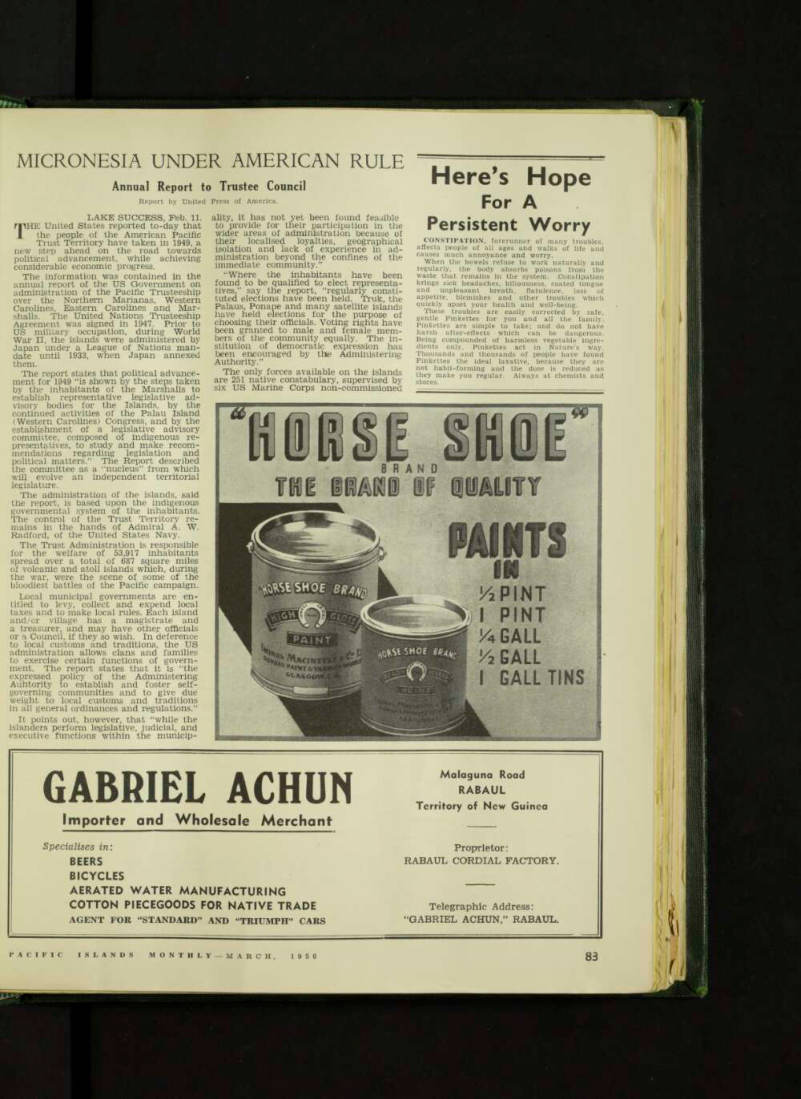
Annual Report to Trustee Council
Report by United Press of America.
Lake Success, Feb. 11.
THE United States reported to-day that the people of the American Pacific Trust Territory have taken in 1949, a new step ahead on the road towards political advancement, while achieving considerable economic progress.
The information was contained in the annual report of the US Government on administration of the Pacific Trusteeship over the Northern Marianas, Western Carolines, Eastern Carolines and Mar shalls. The United Nations Trusteeship Agreement was signed in 1947. Prior to US military occupation, during World War 11, the islands were administered by Japan under a League of Nations man date until 1933, when Japan annexed them.
The report states that political advance ment for 1949 “is shown by the steps taken by the inhabitants of the Marshalls to establish representative legislative ad visory bodies for the Islands, by the continued activities of the Palau Island (Western Carolines) Congress, and by the establishment of a legislative advisory committee, composed of indigenous re presentatives, to study and make recom mendations regarding legislation and political matters.” The Report described the committee as a “nucleus” from which will evolve an independent territorial legislature.
The administration of the islands, said the report, is based upon the indigenous governmental system of the inhabitants.
The control of the Trust Territory re mains in the hands of Admiral A. W.
Radford, of the United States Navy.
The Trust Administration is responsible for the welfare of 53,917 inhabitants spread over a total of 687 square miles of volcanic and atoll islands which, during the war, were the scene of some of the bloodiest battles of the Pacific campaign.
Local municipal governments are en titled to levy, collect and expend local taxes and to make local rules. Each island and/or village has a magistrate and a treasurer, and may have other officials or a Council, if they so wish. In deference to local customs and traditions, the US administration allows clans and families to exercise certain functions of govern ment, The report states that it is “the expressed policy of the Administering Auhtority to establish and foster self governing communities and to give due weight to local customs and traditions in all general ordinances and regulations.”
It points out, however, that “while the islanders perform legislative, judicial, and executive functions within the municip
ality, it has not yet been found feasible to provide for their participation in the wider areas of administration because of their localised loyalties, geographical isolation and lack of experience in ad ministration beyond the confines of the immediate community.”
“Where the inhabitants have been found to be qualified to elect representa tives,” say the report, “regularly consti tuted elections have been held. Truk, the Palaus, Ponape and many satellite islands have held elections for the purpose of choosing their officials. Voting rights have been granted to male and female mem bers of the community equally. The in stitution of democratic expression has been encouraged by the Administering Authority.”
The only forces available on the islands are 251 native constabulary, supervised by six US Marine Corps non-commissioned
officers. No disorder has occurred in the Territory since it became subject to US administration. 1 ECONOMICALLY, the report said, the J advancement of the islands was as sisted by cancellation of all import duties into the Territory and by opening its waters to commercial fishing. Imports of pure and cross-bred cattle to improve local beef strains and of coconut seed are now under way. A staff of agricul
turists is directing the replanting of coconut plantations in war-damaged localities, supplying seed and fertiliser to the islanders. Several experimental stations have been set up in the Territory.
Perhaps the most outstanding work in the Trust Territory has been done in the field of public health. The USS Whitbey, a medical survey ship serving as a floating clinic and laboratory, has been making a general medical survey of the population, and in 1949 it “com pleted the processing of approximately 15,000 people.” Small tubercular sana toria have beer opened and medical training programmes for the natives have been instituted at Guam. The school offers a somewhat limited standard programme of medical education.
A free public school system has been established in the Territory, and a teacher-training school has been opened on the island of Truk.
ACCORDING to the report, which was prepared by the US Navy, budgetary receipts for the 1949 fiscal year amounted to 367,951 dollars from locally derived revenues, compared with 162,537 dollars in 1948. The US allotted 1,125,000 dollars from appropriated funds as against 1,385,000 in 1948. Expenditures, on the other hand, rose from 1,307,216 dollars in 1948 to 1,455,620 dollars in 1949.
The report said that most of the ad ditional expenses went for public educa tion, medical care, public health and sanitation. It estimated local revenue for 1950 at 300,000 dollars and allotments from US funds at 795,000 dollars. The Territory had a “balance on hand” at the end of 1949 of 305,000 dollars.
Anthropological, medical, nutritional, botanical, zoologic, marine life, entomo logical and geographic research in the Territory is conducted by the Scientific Investigation of Micronesia (SIM) while the Co-ordinated Investigation of Micro
nesian Anthropology (CIMA) was set-up m 1948 to further social and scientific ad vancement of the islands.
This is the second report on its ad ministration of the Pacific Trust Terri tory that the United States has submitted to the United Nations. It is regarded as one of the fullest and most exhaustive submitted recently by any of the Ad ministering Powers since several govern ments, including Great Britain, have served notice that they will not submit political information about the Territories under their care.
Advertisements & other items, pp. 87-88 (1 item)
Gabriel Achun
Here’s Hope
For A
Persistent Worry
CONSTIPATION, forerunner of many troubles, affects people of all ages and walks of life and causes much annoyance and worry.
When the bowels refuse to work naturally and regularly, the body absorbs poisons from the waste that remains in the system. Constipation brings sick headaches, biliousness, coated tongue and unpleasant breath, flatulence, loss of appetite, blemishes and other troubles which quickly upset your health and well-being.
These troubles are easily corrected by safe, gentle Pinkettes for you and all the family.
Pinkettes are simple to take; and do not have harsh after-effects which can be dangerous.
Being compounded of harmless vegetable ingredients only. Pinkettes act in Nature’s way.
Thousands and thousands of people have found Pinkettes the ideal laxative, because they are not habit-forming and the dose is reduced as they make you regular. Always at chemists and stores.
m w pMllr
BRAN
Y Si
SHOf BRM
■ m
i r^O
k
GABRIEL ACHUN
Importer and Wholesale Merchant
Specialises in:
BEERS
BICYCLES
AERATED WATER MANUFACTURING
COTTON PIECEGOODS FOR NATIVE TRADE
AGENT FOR “STANDARD” AND “TRIUMPH” CARS
Malaguna Road
RABAUL
Territory of New Guinea Proprietor:
RABAUL CORDIAL FACTORY.
Telegraphic Address:
“GABRIEL ACHUN,” RABAUL.
WHERE THE TRADE
WINDS BLOW’
COLLECTION of fascinating tales and sketches of the South Pacific Islands by R. W. ROBSON
and JUDY TUDOR.
Well Bound and Profusely illustrated.
Price: 7/6, or 8/- post free.
From any large book store, or from Steele’s Book Store, Suva, or from—
Pacific Publications Pty. Ltd.
Union House, 247 George St., SYDNEY.
BURNS PHILP (SOUTH SEA) Go. ltd.
Registered Office: SUVA, FIJI
Code Address: “BURNSOUTH”
ISLAND TRADERS AND SHIPOWNERS
General Merchants (Wholesale and Retail)
Shipping, Customs and General Agents
Representatives for :
QUEENSLAND INSURANCE CO., LTD. BURNS PHILP TRUST CO., LTD.
Distributing Agents for :
SHELL COMPANY (P.L), LTD. FERGUSON TRACTORS
STANDARD MOTOR CAR COMPANY CROSSLEY MARINE ENGINES
BRANCHES:
FIJI—
SUVA.
LEVTTKA.
LAUTOKA.
LAB ASA.
BA.
SIGATOKA.
ROTUMA ISLAND
NORFOLK IS.— NICE IS.—
SAMOA—
APIA.
PAGO PAGO.
TONGA-
NUKUALOPA.
HAAPAI.
VAVAU.
Sydney Agents:
BURNS, PHILP & CO., LTD..
7 Bridge Street.
London Agents:
BURNS. PHILP & CO.. LTD..
35 Crutched Friars, E.C.3.
San Francisco Agents:
BURNS, PHILP CO. OP SAN FRANCISCO
Matson Building, 215 Market Street, Agencies Throughout the World.
Death of Sgt-Major Vilisi
From Our Own Correspondent
Suva, Feb. 26.
FULL military honours were accorded at the funeral on February 22 of Sergeant-Major Vilisi Nadaku, of the Fiji Police who died at Tamavua Hospital from tuberculosis.
He was only 36 and had a notable career as a policeman, as a soldier (he served in the Fiji Military Forces from 1942 to 1946, including the Solomon Islands campaign) and as a Rugby player and referee.
He was a member of Fiji’s Victory Con tingent in London in 1946.
Mr. R. A. McFarlane is a new recruit for the Coral Sea Union Mission of the Australasian Union Conference of Seventh Day Adventists. He left Sydney for Lae, New Guinea, during March. He has considerable experience in the SDA’s publishing department in various Aus tralian States, but this is his first venture into the Mission Field. Another SDA worker, Mr, R. Aveling, left Sydney this month for Suva, Fiji, to take up a new appointment with the Central Pacific Union Mission.
New Guinea's Native Delegates
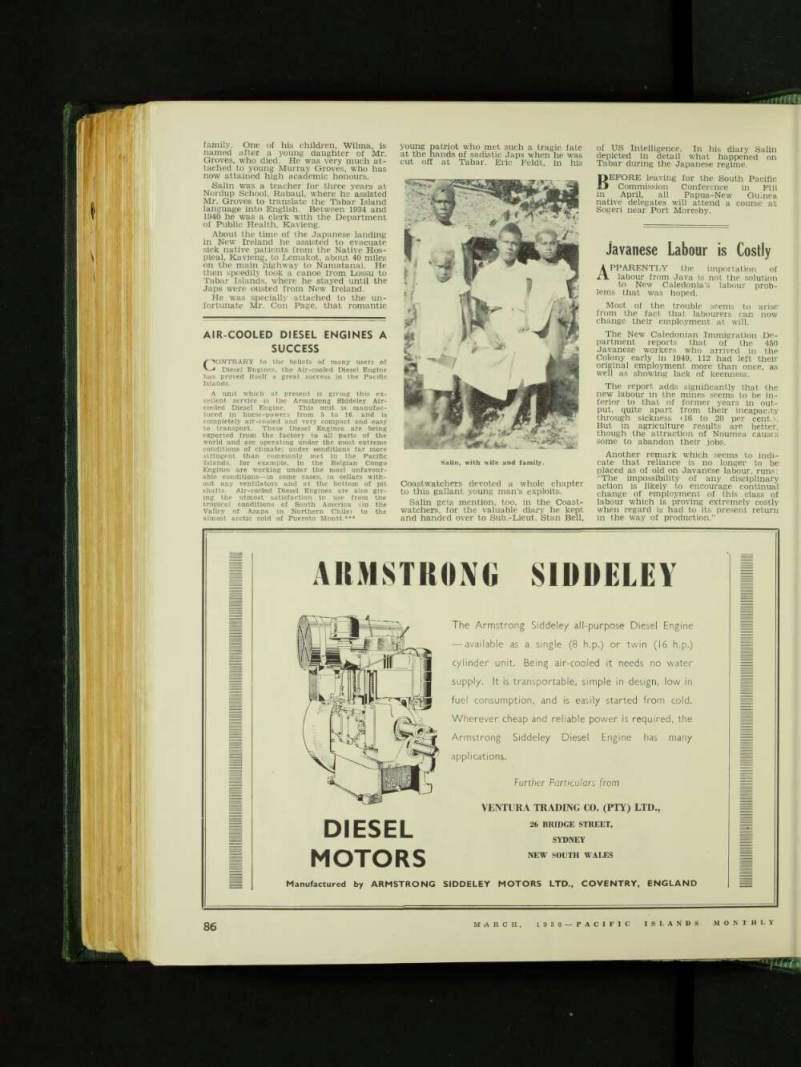
To SP Conference In Fiji
From a Special Correspondent
ALTHOUGH some full Papuans will at tend the South Pacific Conference as delegates, Aisoli Salin, is the only native-born representative from the former Mandated Territory of New Guinea. The two other delegates from New Guinea are of mixed blood—Waiau, who had a New Ireland mother and a Chinese father, and George Kasi of mixed Manus and Caroline Island descent.
Waiau is a Customs clerk; George Kasi, an Administration clerk in Rabaul. All three delegates from the New Guinea Territory attended the pre-war Malaguna School, which is a tribute to an Adminis tration venture that turned out some really first-class lads.
However, it looks as though the three may have been selected not so much for their intelligence as for their pleasing de meanor and general character, and the belief that on their return to New Guinea they will not turn revolutionary or make for the highways and byways preaching the gospel of Yali!
AISOLI SALIN was born in the tiny village of Tatau, in the remote Tabar Islands, District of New Ireland, Papua-New Guinea. He is 37.
Fitted out in tailor-made white clothes, he will look immaculate and dignified —a violent contrast to his kinsfolk, who, in their native state, prefer a small piece of cheap calico tucked around the loins.
Salin is an Educational Assistant at Ad ministration’s District School, Utu, near Kavieng, New Ireland.
As an infant he attended the Methodist Mission School in his native village, and when he was about 10 years of age the then District Officer, New Ireland (Mr. J,
Walstab), sent him to the Government School at Kokopo, near Rabaul. There Salin came under the eye of Mr. W. C.
Groves (now Director of Education,
Papua-New Guinea), who was the sole teacher.
From the Kokopo experiment came the New Guinea-famed Malaguna Native School, Rabaul, of which Mr. Groves was headmaster. Salin attended, and in the final examinations of 1926, he and a Manus boy named Lue, topped the school.
The then Director of District Services and Native Affairs (Mr. H. C. Cardew) sent them to Australia for two years further study.
Salin is devoted to Mr. Groves and his
family. One of his children, Wilma, is named after a young daughter of Mr.
Groves, who died. He was very much at tached to young Murray Groves, who has now attained high academic honours.
Salin was a teacher for three years at Nordup School, Rabaul, where he assisted Mr. Groves to translate the Tabar Island language into English. Between 1934 and 1940 he was a clerk with the Department of Public Health, Kavieng.
About the time of the Japanese landing in New Ireland he assisted to evacuate sick native patients from the Native Hos pieal, Kavieng, to Lemakot, about 40 miles on the main highway to Namatanai. He then speedily took a canoe from Lossu to Tabar Islands, where he stayed until the Japs were ousted from New Ireland.
He was specially attached to the un fortunate Mr. Con Page, that romantic
Advertisements & other items, p. 89 (2 items)
85
PACIFIC ISLANDS MONXHLY M A R C H , 1950
W. & A. Gilbey Ltd.. Melbourne. Sydney. Brisbane
For perfect cutting
under all conditions
There is a Ransomes Mower for every lawn our range covers machines for every requirement from the smooth, even surface of the putting green to the sports ground, golf course or aerodrome
The "MOON"
Mower
GANG
MOWERS
For grass such as couch, klkuyu, buffalo, etc., and grass longer than the average. 14-ln. and 18-ln. wide. 50 acres a day can easily be cut with a Ransomes Quintuple Mower drawn by a tractor and even larger outfits up to 25 ft. wide are available.
ansomes
Lawn Mowers
Write for illustrated literature and all information
MORRIS, HEDSTROM LTD.,
Suva, Lautoka, and Ba.
Made by RANSOMES, SIMS & JEFFERIES LTD., IPSWICH, ENGLAND.
N r* O r“ * N N s o • w td Pi r r v* C/J (- I Vj W. & A. GILBEY LTD.. MELBOURNE. SYDNEY. BRISBANE
Air-Cooled Diesel Engines A
Success
CONTRARY to the beliefs of many users of Diesel Engines, the Air-cooled Diesel Engine has proved itself a great success in the Pacific Islands.
A unit which at present is giving this ex cellent service is the Armstrong Slddeley Air cooled Diesel Engine. This unit is manufac tured in horse-powers from 5 to 16, and is completely air-cooled and very compact and easy to transport. These Diesel Engines are being exported from the factory to all parts of the world and are operating under the most extreme conditions of climate: under conditions far more stringent than commonly met in the Pacific Islands, for example, in the Belgian Congo Engines are working under the most unfavour able conditions —in some cases, in cellars with out any ventilators and at the bottom of pit shafts. Air-cooled Diesel Engines are also giv ing the utmost satisfaction in use from the tropical conditions of South America (in the Valley of Azapa in Northern Chile) to the almost arctic cold of Pueroto Montt.***
young patriot who met such a tragic fate at the hands of sadistic Japs when he was cut off at Tabar. Eric Feldt, in his
Coastwatchers devoted a whole chapter to this gallant young man’s exploits.
Salin gets mention, too, in the Coast watchers. for the valuable diary he kept and handed over to Sub.-Lieut. Stan Bell,
of US Intelligence. In his diary Salin depicted in detail what happened on Tataar during the Japanese regime.
BEFORE leaving for the South Pacific Commission Conference in Fiji in April, all Papua-New Guinea native delegates will attend a course at Sogeri near Port Moresby.
Salin, with wife and family.
Javanese Labour is Costly
Apparently the importation of labour from Java is not the solution to New Caledonia’s labour prob lems that was hoped.
Most of the trouble seems to arise from the fact that labourers can now change their employment at will.
The New Caledonian Immigration De partment reports that of the 450 Javanese workers who arrived in the Colony early in 1949, 112 had left their original employment more than once, as well as showing lack of keenness.
The report adds significantly that the new labour in the mines seems to be in ferior to that of former years in out put, quite apart from their incapacity through sickness (16 to 20 per cent.).
But in agriculture results are better, though the attraction of Noumea causes some to abandon their jobs.
Another remark which seems to indi cate that reliance is no longer to be placed as of old on Javanese labour, runs: “The impossibility of any disciplinary action is likely to encourage continual change of employment of this class of labour which is proving extremely costly when regard is had to its present return in the way of production.”
Advertisements & other items, p. 90 (1 item)
Armstrong Siddeley
V*-
DIESEL
MOTORS
The Armstrong Siddeley all-purpose Diesel Engine
available as a single (8 h.p.) or twin (16 h.p.) cylinder unit. Being air-cooled it needs no water supply. It is transportable, simple in design, low in fuel consumption, and is easily started from cold.
Wherever cheap and reliable power is required, the Armstrong Siddeley Diesel Engine has many applications.
Further Particulars from
VENTURA TRADING CO. (PTY) LTD.,
26 BRIDGE STREET,
SYDNEY
NEW SOUTH WALES
Manufactured by ARMSTRONG SIDDELEY MOTORS LTD., COVENTRY, ENGLAND
Sydney—N. Caledonia—
Shipping And Plane Services
Ship Services
THE following sea and air services are running to schedules in the Pacific.
Not all of the regular services which were suspended, owing to war_ condi tions. have been restored; but preparations are under way for their early reintroduction. As they become available they will be announced here.
Sydney-NZ-Fiji-Hawaii-Nth. America
THE itinerary of the Canadian-Australaslan liner “Aorangi” (17,500 tons) Is Sydney, Auckland.
Suva (FIJI), Honolulu (Hawaii), Victoria (Vancouver Island), and Vancouver (British Columbia, Canada). Time-table lor the Pacific section of her run Is;—
New Zealand —Fiji—
Samoa —Tonga
Monthly Service by MY “Matua”
Service Conducted By Unton 88 Co.,
Ltd.—Subject To Alteration Without
Notice
Auckland Apl. 18 May 18 June 20 Suva Apl. 22-23 May 22-23 June 24-25 Nukualofa Apl. 25-26 May 25-26 June 27-28 Vavau Apl. 27 May 27 June 29 Niue* May 27 Pago Pago* Apl. 27 June 29 Apia* Apl. 28-May iMay 28-31 Jn. 30-Jul. 3 Suva May 4-5 June 3-4 July 7-8 Auckland May 9 June 8 July 11 * Western Time.
Sydney—N. Caledonia—
Tahiti
LINERS of the Messageries Maritimes main tain a service at about two-monthly intervals between Sydney, Vila (New Hebrides), Noumea (New Caledonia) and Papeete (Tahiti), en route to Marseilles, via the Panama Canal; and they return by the same route.
New Caledonia—New Hebrides
THE New Caledonian Government has sub sidised and maintained me coastal snip ping services. The East Coast, the West Coast, and the Loyalty Islands, under present conditions, receive 10 round trips per annum.
The ships call at the following ports: EAST COAST.—Yate, Ounia, Thio, Nakety, Canala, Kouaoua Kua, Moneo, Ponerthouen, Tibarama. Poindlmle, Wagap, Touho, Tipindje, Hlenghene. Tao. Oubatch, Pouebo, Ealade, Pam, Arama. and return.
WEST COAST. —Pouembout, Kone, Temala, Voh. Ouaco Gomen, Koumac, Tangaiou, Tiebaghl, Nehoue, Poume, Baaba, Belep and return.
LOYALTY ISLANDS.—Mare (Tadlne), Llfou /Chepenehe) Ouvea (Fajaoue, St. Joseph) and return.
The steamer “Neo Hebridais” runs regularly between Noumea and Sydney, with occasional trips to the New Hebrides (mostly Aneltyum).
The owners are Soclete Maritime et Manlere Hagen, Noumea. Sydney agents: H. C. Sleigh. 254 George Street. Sydney.
The Messageries Maritimes motor-ship Poly nesien sails from Sydney about every six weeks to Noumea. Vila and Santo (New Hebrides) and outports, with occasional trips to the Wallis and Futuna Islands. Details from Messageries Mari times branch office, in Sydney, Noumea and Vila.
New Zealand—Cook
Is.—Niue—Samoa
THE motor vessel “Maui Pomare” owned and operated by the NZ Gov ernment, maintains a direct service between Auckland and Rarotonga (Cook
Islands), with alternative calls at Niue
and Apia (Samoa).
Sydney-Papua-
New Guinea
BURNS, PHILP LINE motor-vessels "Bulolo” and “Malaita” maintain regular services be tween Sydney and ports In Papua-New Guinea.
“Bulolo” leaves Sydney, northbound, approxi mately every six weeks; “Malaita” every seven weeks “Bulolo” calls at Brisbane. Port Moresby.
Samaral, Lae, Dregarhafen, Rabaul, Samaral.
Port Moresby. Brisbane, thence back to Sydney.
The “Malalta’s” schedule varies considerably.
She calls at Port Moresby only occasionally, but usually calls at Samaral, Lae. Madang, Manus, Rabaul. Samaral, thence direct to Syd ney—ports of call being In that order. Sometimes the order of calls is Samaral, Rabaul, Manus, Madang. Lae, Samaral. Intending passengers should check with Burns, Phllp & Co., Ltd., Sydney, or Island branches.
Sydney-Norfolk Island-
New Hebrides
The SS “Morinda,” Burns, Philp & Co., Ltd., runs at approximately three monthly intervals from Sydney to Lord Howe Island, Norfolk Island, and main ports of the New Hebrides, and re turn.
RMS "Aoranfi”
Honolulu Mar. 2 May 4 July 6 Sept. 7 Nov. 9 Suva Mar. 11 May 13 July 15 Sept. 16 Nov. 18 Auckland Mar. 14-16 May 16-18 July 18-20 Sept. 19-21 Nov. 21-23 Sydney, arr.
Mar. 20 May 22 July 24 Sept. 25 Nov. 27 Sydney, dep.
Mar. 30 June 1 Aug. 3 Oct. 5 Dec. 7 Auckland Apr. 3-4 June 5-6 Aug. 7-8 Oct. 9-10 Dec. 11-12 Suva Apr. 7 June 9 Aug. 11 Oct. 13 Dec. 15 Honolulu Apr. 14 Tune 16 Aug. 18 Oct. 20 Dec. 22 Vancouver Apr. 21-27 June 23-29 Aug. 25-31 Oct. 27-Nov. 2 Dec. 29-Jan. 4 Subject to Alterations Without Notice.
Advertisements & other items, pp. 91-96 (4 items)
Err Bros Per It
Rid Kidneys Of
Poisons And Adds
If you suffer sharp, stabbing pains, if joints are swollen, it shows your blood is poisoned through faulty kidney action. Other symptoms of Kidney Disorders are Backache, Aching Joints and Limbs, Sciatica, Neuritis, Lumbago, Sleepless Nights, Dizziness, Nervousness, Circles under Eyes, Loss of Energy and Appetite and Frequent Headaches and Colds, etc. Ordinary medicines can’t help much because you must get to the root cause of the trouble.
The Cystex treatment is specially compounded to soothe, tone and clean kidneys and bladder and remove acids and poisons from your system safely, quickly and surely, yet contains no harmful or dangerous drugs. Cystex works in three ways to end your troubles. ll) Starts killing the germs which are attacking your Kidneys, Bladder and Urinary System in two hours, yet is absolutely harmless to human tissue. (2 1 Gets rid of health-destroying, deadly poisonous acids with which your system has become saturated. (3) Strengthens and reinvigorates the kidneys, protects from the ravages of disease-attack on the delicate filter organism, and stimulates the entire system.
Praised by One-time Sufferers
Cystex is approved by one-time sufferers in 13 countries from the troubles shown above.
Mr. Reg. Thomas, Townsville, Queensland, recently wrote: “My joints were all stiff, I had leg pains, my back used to ache day and night.
My bladder was weak. I had headaches and no appetite. The first dose of Cystex helped me and before I finished three boxes my health and strength came back.”
Guaranteed to Satisfy or Money Back Get Cystex from your chemist or store to-day.
Give it a thorough test. Cystex is guaranteed to make you feel younger, stronger, better in every way, or your money back if you return the empty package.
Now in 2 sizes.
This is a
GUARANTEED
Treatment
Cystex
for Your Kidneys, Bladder, Rheumatism.
Box 3838 GPO, Cable Address, “Care” Sydney.
Sydney. Australia.
S*a 6
ISLAND MERCHANTS
ERR BROS PER It
4 YORK ST., SYDNEY
All kinds Island Produce sold on commission. All merchandise purchased at best wholesale price and original invoices supplied.
Use our 50 years’ experience as Island Merchants.
J
B^Tsd‘S?A Wdvv’Ce
AIP SERVICES
Summnrv nf Pnrifir Air summary OT racinc Air
Services
PAPUA AND NEW GUlNEA.—Regular Qantas service from Sydney. eo 3°s N er.Se LA /r-ipa U y eD b» ?SS? JSSffi to r Hmfiara Qa ßST S * er ™* also £rom Lae ' NG ' NEW regular flylng-bea. service from Sydney by Trans Oceanic Air
ways Servi * e from Noumea by French plane runs twice weekly. Qantas plane from Sydney to NH on alternate Tuesdays.
NORFOLK ISLAND.—Regular service from NZ by NZ National Airways; from Sydney by Qantas; from Fiji by NZ National Airways.
RegUl Y eekly ® ervi f 7 by Qantas and Trans Oceanic
B^TSd‘S?A WdVV’cE
land b .v NZ National Airways (to Nadi); from
ffi&M
Laucala Bay, Suva). Irregular calls from
Australia to Laucala Bay, Suva, by Trans Oceanic Airways. Regular service from Suva to Labasa by NZ National Airways
WESTERN SAMOA, COOK ISLANDS AND
TONGA.—Regular service from Fiji by NZ National Airways.
TAHlTl.—Monthly service from Noumea by TRAPAS plane via Fiji, W. Samoa. Cook Is.
DUT’CH NEW GUlNEA.—Regular weekly service fi*om Batavia by KLM.
AUSTRALIA-NEW ZEALAND. —Regular service by Tasman Empire Airways.
AUSTRALIA-NORTH AMERICA.—Regular Trans pacific services by Pan American Airways,
BCPA and CPA.
EUROPE - INDO-CHINA -N. CALEDONlA.—Fort
nightly service by Air France.
NZ National Airways
South Pacific Services
r y'HE Pacific services run by the New Zealand National Airways Corporation are aa follows:
AUCKLAND-LAUCALA BAY (SUVA): A “Sun
derland” flying-boat leaves Mechanics Bay, Auckland, at 11.30 p.m. each Monday for Laucala Bay, Suva (arrives 8.10 a.m. the follow ing day).
The aircraft departs from Laucala Bay, Suva, on the return journey at 7.30 a.m. each Wednes day, and arrives at Mechanics Bay, Auckland, at 4.15 a.m.
LAUCALA BAY (SUVA)-LABASA (VANUA
LEVU): A “Sunderland” flying-boat operates this service on a charter basis. A return trip is made between Laucala Bay and Labasa each Tuesday.
AUCKLAND-NORFOLK ISLAND-FIJI-TONGA
WESTERN SAMOA-COOK ISLANDS: A “Douglas”
airliner leaves Whenuapai, Auckland, on alter nate Tuesdays at 9 a.m. (Mar. 7, 21, Apr. 4, 18, etc.) for Norfolk Island (arr. 12.55 p.m.; dep. 2 p.m.), Nadi (arr. 8.40 p.m., dep. 5.40 a.m.
Thursday), Nausori (arr. 6.25 a.m., dej). 7.30 a.m.), Tonga (arr. 10.50 a.m., dep. 11.50 a.m.), *Faleolo, Western Samoa (arr. 4.5 p.m. Wednes day, dep. 8 a.m. Thursday), Aitutaki, Cook Islands (arr. 1.50 p.m. Thursday, dep. 2.50 p.m.), Rarotonga, Cook Is. (arr. 4.5 p.m.).
The aircraft departs from Rarotonga on the return journey at 8 a.m. on alternate Saturdays
(Mar. 11, 25, Apr. 8, 22, etc.) at 8 a.m. for Aitutaki (arr. 9.15 a.m., dep. 10 a.m.), Faleolo, W. Samoa (arr. 3.15 p.m., dep. 8 a.m. Sunday), •Tonga (arr. 10.55 a.m. Monday, dep. 11.50 a.m.), Nausori (arr. 2.40 p.m., dep. 3.40 p.m.), Nadi (arr. 4.25 p.m., dep. 5 a.m. Tuesday), Norfolk Is. (arr. 10.55 a.m., dep. 12 noon), Whenuapal, Auckland (arr. 4.50 p.m.). •Crosses International Date Line.
AUCKLAND-NORFOLK ISLAND: A “Douglas”
airliner leaves Whenuapai, Auckland, every Sun day at 8.15 a.m. for Norfolk Island (arr. 12.10 p.m.), and departs on the return flight at 1.10 p.m., arriving at Whenuapai at 6 p.m.
FARES, single (in NZ currency); Auckland to Norfolk, £l2/10/-; to Fiji, £3l; to Tonga. £3l; to Samoa, £34; to Aitutaki. £39; to Raro tonga. £39/10/-. Norfolk to FIJI, £l9. FIJI to Tonga, £B/15/-; to Samoa. £l3; to Aitutaki £29/15/-; to Rarotonga, £3l. Samoa to Raro tonga, £l7/15/-; to Aitutaki, £l6/10/-; Suva to Labasa, £4/10/-. Return fares, less 10 per cent.
BOOKING OFFICES: Wellington, Govt. Life Bldg., Customhouse Quay; Auckland. Airways rlouse, Customs St.; Dunedin, 8-10 Manse St.; Christchurch, 104 Gloucester St.; Gis borne. 74 Peel St.; Palmerston North, 107 Broadway Ave.; Hamilton, 8 Alma St.; New Plymouth, Grand Central Building, Egmont St.; Blenheim, 13 Queen St.; Hokitika, South side Airport; Norfolk Is., Burns Philp, Ltd.; Fiji, NAC at Nadi and Suva; Burns Philp, Labasa and Lautoka; Tonga, Mrs. F. P. Melhose, Fou-amotu Airfield; W. Samoa, Burns Philp (SS)!
Ltd., Apia; Cook Is., Mrs. P. McVeagh, Aitutaki! and Mr. J. D. Campbell, Rarotoga.
Sydney—Queensland—
New Guinea
QANTAS Empire Airways, Ltd., employing DCS planes, operate a regular service between Sydney. Port Moresby, Lae. Plnschhafen, Madang, Rabaul, Bulolo and Wau, and return via Brisbane, Rockhampton, Townsville and Cairns.
This service is now known as the “Bird of Paradise” Service. DC3 aircraft, carrying 19 passengers, are useo.
Planes leave Sydney on Mondays, Tuesdays, Wednesdays, Fridays and Saturdays at 9 a.m., and arrive at Lae at 1 p.m. on Tuesdays, Wed nesdays, Thursdays, Saturdays and Sundays.
The plane which leaves Sydney on Wednesday and arrives at Lae on Thursday then goes on to Rabaul. It returns on Friday. The plane, which arrives at Lae on Tuesdays, then goes on to Madang, returning to Lae the same day.
The plane, which arrives at Lae at 1 p.m. on Wednesdays, flies on to Bulolo and Wau on Wednesday afternoons, and returns to Lae.
Planes leave Lae at 5.45 a.m. on Wednesdays, Thursdays, Saturdays, Sundays and Mon days. and arrive in Sydney at 10.15 p.m., accom plishing the Lae-Sydney run in a day.
The return plane from Rabaul leaves at 1.30 p.m. on Fridays.
Bookings may be made at Qantas offices at any of the towns named. At present, berths are available only to passengers holding official per mits to visit Papua or New Guinea.
QANTAS SUBSIDIARY SERVICES IN
PAPUA-NEW GUINEA-SOLOMONS
Qantas Empire Airways run the following sub sidiary services in Papua, New Guinea, and British Solomons:— A Douglas DC3 leaves Lae, New Guinea, every Wednesday, and flies to Rabaul, and Kavieng, and returns to Lae; but every alternate Wed nesday the plane goes on from Kavieng to Manus, and returns via Kavieng to Rabaul (overnight) and returns to Lae on the Thursday morning.
Every Wednesday a plane flies from Lae to Madang and Wewak, and thence ” direct to Rabaul. It returns from Rabaul to Lae on Thursday. This service is primarily for the carriage of native labour to and from Wewak, and Europeans travelling on this service are always advised of the fact.
Every alternate Monday, a Qantas Catalina flies from Port Moresby, westward to Dam, via Yule Island, Kerema. Kikorl, Lake Kutubu and Lake Murray, remaining overnight at Kikori and returning to PM next morning.
Every alternate Wednesday, a Qantas Calalina flies from Port Moresby eastward (dep. 9 a.m.) and calls at Abau and Samarai before flying out to the Archipelagoes in the afternoon. Calls are made at Esa’ala and Losuia (where an over night stop is made), and the following day (alternate Thursdays) at Deboyne Lagoon, before returning to Port Moresby, via Samarai and Abau.
leaves Port Moresby for Rabaul. via Moewe Harhour, and Talasea (New Britain); next mornln* (Tuesday) it flies to Buka. Kieta and Buin (Bougainville) and returns to Rabaul- next morning (Wednesday) it flies to Talasea, Moewe Rabaul; 1 " an*? nex ( t qU mo 0 r t ning ay \ThS?sdly) U Tt S re° turns from Rabaul direct toVU MoS’
from to? 7 a Qantas Dou B las Ales A? baul * and continues on to (Bntl s h Solomon Islands), via Torokina; Lae th. ?nf, rni , ght H ° nlara; and returns t 0 and Rabauf 1 * 8 day (Tuesday) ’ vla Torokina Kokod!? 8 to / epairs bein & made to Bulolo and Were
CPA Sydney-Vancouver
Service
C CANADIAN Pacific Airlines, Ltd., run a trans -4 Pacific service between Sydney and Van couver. For the present there will be one northbound and one southbound trip per fort night. Stops are made at Nadi (Fiji), Canton Island, Honolulu and San Francisco. The north bound flight commences from Sydney every alter nate Tuesday.
Four-engined, pressurised “Canadair” aircraft are used; 36 passengers can be carried and a crew of 7. Flying is done in daylight. Over night accommodation is provided at hotels in Nadi and Honolulu, which is, of course, com plimentary.
Fares are (in Australian currency); Sydney- Vancouver, £289/6/- single, £520/15/- return; Piji-Vancouver, £2lO/15/- single, £379/6/- re turn; Sydney-Fiji, £54/19/- single, £9B/17/return; Sydney-Honolulu, £238/8/-; Sydney- San Francisco, £285/15/-; Fiji-Honolulu, £159/17/- single, £2BB/8/- return.
Bookings may be made at the Union Steam Ship Company of New Zealand, Limited, Sydney, or Melbourne: Union Steam Ship Co. of NZ, Ltd., Fiji; Canadian Pacific Airlines, Vancouver.
Sydney-Vancouver
BCPA Service
BRITISH Commonwealth Pacific Airlines, Ltd., operate a twice weekly trans-Paciflc service from Sydney to Vancouver, via Fiji, Canton Island, Honolulu and San Francisco; and a weekly service between Auckland and Vancouver, via the same ports.
Planes leave Sydney every Wednesday and Saturday, and Vancouver on the Southbound trip every Monday and Thursday. Every fourth trip from Sydney terminates at San Francisco instead of Vancouver.
Planes Leave Auckland every Tuesday and arrive in Vancouver the following Wednesday.
The Southbound trip to Auckland commences from Vancouver every alternate Friday. Every other Friday the service commences at San Francisco.
B.C.P.A. services make regular connections at both San Francisco and Vancouver for onward carriage, via either New York or Montreal to the United Kingdom or Europe. The through fare from Sydney to London is £325 (Aust.).
Fares are (in Australian currency;: Sydney- San Francisco, £285/15/- single and £514/6/return; Auckland-Vancouver, £266/11/- single; Auckland-Nadi (Fiji), £3B/17/-; Sydney-Nadl, £54/19/-; Sydney-Vancouver. £289/6/- single, £520/15/- return.
Douglas DC6 aircraft carrying 48 passengers (seated) or 37 passengers (in sleepers) and a crew of nine are used on the service.
Pan-American—
Trans-Pacific Service
PAN-AMERICAN World Airways clippers now provide the following services in the South Pacific, using DC4 planes, equipped with Sleep erettes: — Planes leave Sydney Monday and Friday for San Francisco, via Tontouta (New Cale donia), Nadi (Fiji), Canton Island and Hono lulu.
The return flights are made from San Francisco every Monday, Thursday, via Honolulu, Canton Island, Nadi and Tontouta; and from Seattle every Monday, via Portland, Honolulu, Canton Island, Nadi and Tontouta.
Planes leave Auckland every Wednesday, and fly via Nadi, Canton Island and Honolulu to San Francisco. They leave San Francisco for Auckland every Saturday by the same route.
Pares, in Australian currency, are:—
(Time-tables and fares subject to alteration without notice.) To convert to Fiji currency, reduce above each kilogram of excess.
Free baggage allowance is 30 kilos per person Excess baggage at 1 per cent, of single fare for figures by about 10 per cent.
Sydney-Lord Howe ls.-
Norfolk Is.
Q ANT AS, Sydney, run a Catalina once weekly from Sydney to Lord Howe Island, Pare, single, £l2. Return, £2l/12/-.
Qantas run a DC4 Skymaster alt. Thursdays (returning same day) from Sydney to Norfolk Island. Pare, £22 single; £39/12/- return. (For Norfolk Island, see also under NZ National Airways. For Lord Howe, see also under TOA.)
Sydney—New Hebrides
A QANTAS plane leaves Sydney for New Hebrides on alternate Tuesdays. It flies via Noumea and Port Vila to Santo, and returns.
£ s. d. £ s. d Single. Return.
Sydney-Seattle .. .. £285 15 0 £514 6 0 Sydney-’Prlsco .. .. 285 15 0 514 6 0 Sydney-Fijl 54 19 0 98 17 0 Sydney-Honolulu ... 238 8 0 429 0 0 Auckland-Seattle . .. 262 19 0 473 14 0 Auckland-Hf'nolulu .. 215 13 0 387 19 0 Auckland-PIjl 38 17 0 69 19 0 Auckland-San. Fran. . 22 19 0 473 14 0
Trans-Tasman Service
Sydney—Auckland
TASMAN Empire Airways, Ltd,, operate a flying-boat service between Rose Bay, Sydney, and Mechanics Bay, Auckland. Large flying-boats, capable of carrying 30 passengers, are employed. The trip is comfortable, and takes approximately 6 hours.
Flying-boats now depart Sydney and Auckland daily. They make the crossings at night, leav ing Rose Bay, Sydney, and Mechanics Bay, Auckland, about midnight. This arrangement allows passengers who wish to travel to other parts of Australia or New Zealand tq proceed on the day of arrival.
This service is supplemented by Charter Services operated by DC4 and DC6 aircraft.
Pares: £3S(A) (£2B NZ currency) single; £63(A) (£5O/8/- NZ currency) return.
Bookings may be made at Tasman Empire Airways In Auckland and at Qantas Empire Air ways, Carrington Street, Sydney.
N. Caledonia-Tahiti
TRAPAS (Soclete Prancals de Transports Aeriens du Pacific Sud-Noumea) runs a monthly service from New Caledonia to Tahiti.
Departing at 8 a.m. from Noumea, every third Thursday, the plane flies via Fiji (Nadi), Western Samoa (Faleolo), Cook Islands (Altu taki) to Papeete, where it arrives at about 11.40 a.m. two days later. One evening is spent in Nadi and one night in Aitutaki. The plane re turns by the same route In the following week.
Pare from Noumea to Papeete Is 16,000 Pacific francs single, and 28,800 return. (160 Pacific francs equal £1 Australian.) While the plane is at Papeete it runs one round trip between Papeete and Bora Bora.
New Caledonia-
New Hebrides
TRAPAS (French Air Line) operates a service between Noumea and the New Hebrides.
The plane leaves Noumea every Tuesday, and flies direct to Vila and Santo, and returns. Re turn fare for the Journey, Noumed-Santo. is approximately £42 Australian.
KLM Dutch New Guinea
Service
K.L.M. Royal Dutch Airlines run a regular weekly service from Batavia to Dutch New Guinea, via Sourabaya, Makassar and Ambon, on the following schedule: Batavia dep. Sundays at 10.30 a.m., Blak Island arr. Mondays at 4.40 p.m.; dep. Tuesdays at 6 a.m., Hollandia arr. Tuesdays at 8.10 a.m. On the return Journey the aircraft leaves Hollandia at 9 a.m. on Tuesdays: Blak Island arr. 11.10 a.m., dep.
12.15 p.m. on Tuesdays; and Batavia air. 6 p.m. on Wednesdays.
The aircraft used are C. 475, a type of DC-3, and the single fares are Batavla-Biak Island £A80; Batavia-Hollandia £A9I/15/-; and Blak Island-Hollandia £AII/15/-. Return fares, double single.
TOA Services
TRANS Oceanic Airways run the following Pacific services:— SYDNEY-LORD HOWE IS.: A regular fort nightly service with large four-engine flying
boats from Rose Bay. Pare: £ll single; £2l return. Free baggage allowance 50 lb. Excess baggage and freight rate Bd. per lb.
SYDNEY-NEW HEBRIDES: A regular monthly service with large four-engine flying-boats from Sydney, via Noumea, to Vila and Espiritu Santo (overnight stop). Fare; Sydney-Vila, £45; Sydney-Santo, £5O; Noumea-Vila, £l2/10/-, Noumea-Santo, £lB/15/-. Freight: Sydney-Vila, V- per lb.; Sydney-Santo, 2/3.
SYDNEY-SOLOMON ISLANDS: A regular
monthly service from Sydney, via New Cale donia and New Hebrides to Tulagi and Honiara,
Solomon Islands. This service is frequently ex tended to Lingatou, in the Russell Islands, and calls are sometimes made at Vanikoro, in the Santa Cruz Group. Fares; Sydney-Tulagi- Honiara, £65. Free baggage allowance, 60 lb.; excess baggage and freight, 3/6 per lb.
Sydney-Noumeo-Suva
THE following is the time-table of the Qantas flying-boat:— Sydney dep. 9 p.m. alt. Tuea.
Noumea arr. 7 a.m. alt. Wed.
Noumea dep. 8 a.m. alt. Wed.
Suva arr. 3 p.m. alt. Wed.
Suva dep. 6 a.m. alt. Frid.
Noum-a arr. 11 a.m. alt. Frid.
Noumea dep. 12 noon alt. Frid.
Sydney arr. 8 p.m. alt. Frid.
Intending passengers may book through Qantas offices in Australia. Burns, Phllp (South Seas) Company, in Suva; and T, Johnston In Noumea.
Fares; To Noumea, £35 single; £63 return.
To Suva, £52/10/- single; £B4/10/- return.
Noumea-Suva, £l7/10/- single; £3l/10/- re turn.
France-1 ndo-China-
Aust.-N. Caledonia
THE French national airways, Air France, runs a fortnightly service between Paris and New Caledonia, and return. Stops are made at Tunis (forward journey) or Marseille (return journey), Cairo, Barhein (return journey), Karachi, Calcutta, Saigon, Batavia, Darwin.
Brisbane.
DC4 Skymasters are used in the service, and Messageries Maritimes are agents in Australia.
Fare between Brisbane and Tontouta (New Caledonia) has been fixed at £A29/8/- (one way), and £AS2/18/- (return ticket). Sydney- Tontouta £A3S single; £A63 return.
Papua-NG Local
Services
MANDATED Airlines, Ltd., of Lae, New Guinea, and other private operators, run air ser vices between Lae and the New Guinea mainland centres of Wau, Bulolo, Madang, Wewak, Aitape, Mt. Hagen. Flnschhafen, Moresby. Kokoda—in fact anywhere in Papua or New Guinea where there is an air-strip. These planes carry pas sengers. malls and cargo on regular schedules or charter flights.
. H. Grove & Son
Limited
Established 1896.
AUCKLAND
Island Traders. P.O. box 490.
Telegraphic and Cable Address: “Grove”, Auckland.
Entrust Your Orders to the Firm with Fifty Years Practical Experience in the Island Trade.
Shippers of all classes of New Zealand products.
Representing English Manufacturers throughout the Cook and Society Islands, Fiji, Tonga, Samoa, Niue, New Hebrides, the Solomon Islands and New Caledonia.
In FIJI as—W. H. Grove Cr Sons (Fiji) Ltd,
OFF
0
RJ2. 18 H.P. MARINE DIESEL
Driving 21 in. x 1 siin.
Propeller at 740 RPM
DB2. 9 H.P. HEAVY DUTY
PETROL MARINE ENGINE
Driving 17-J- x 16 in.
Propeller at 700 RPM Reliable • Efficient Economical • Easy Starting I mmediate Deliveries 1 - 0 Suitable for 25-35 ft. craft.
Stuart Turner Generating Sets— l,ooo Watt, 32 Volt —Simple and Economical Write for full particulars of our complete range of engines to:
Thornycroft (Aust.) Pty., Ltd. "ITS
Cables: THORNMOTOR, Sydney.
NORTH SYDNEY TRAVEL BUREAU
Consultant: MBS. LILLIAN MILLAK, late ot New Guinea.
Let experts arrange your travels and accommodation AGENT FOR ALL LEADING AUSTRALIAN AND WORLD AIRLINES a ho ” e “n A wide extend Stlol: 'cereal estate £SSmSSI ' nVeSt ° rS aISO wIU be o”
A. R. COVENTY, R.E.A.,
Phones: XA 1780. After 56 Miller St., North Sydney Hours: XA 2342, or XL 2185.
Personal Service ensures that you
Biff OH THE BEST IHT
For more than 36 years the PERSONAL buying services of WILLIAM E.
REED, backed by an experienced staff, has ensured prompt and reliable service at lowest cost to Missions, Planters, and Traders throughout the Pacific. We operate on a WHOLESALE basis only. You receive original invoices at invoiced cost. 5 Enquiries invited for all plantation and trading products sold on a commission basis. requirements.
Island
WILLIAM E. REED
(Established 36 years).
BROKER AND AGENT,
145 a GEORGE ST, CIRCULAR QUAY, SYDNEY Cables: “WILREED,” Sydney.
Asthma Curbed Quickly
Since the discovery of Mendaco by a famous physician sufferers can get relief from Asthma. Mendaco does away with expensive injections and offensive smokes.
All you do is to take 2 tasteless tablets with meals and Mendaco starts circulating through the blood in 10 minutes. You breathe easily and freely. Your nerves relax, you get good, fresh, pure air Into your lungs, and vigour returns.
Sleep Like a Baby
Thousands of former sufferers from Asthma say that the very first dose of Mendaco brought them glorious ease and comfort, and that they slept soundly the very first night. Then their vigour returned and they felt healthier and stronger, and 5 to 10 years younger. The reason for this is that Mendaco acts in natural ways to overcome the effects of Asthma. (1) It removes the mucus or phlegm. (2) It relaxes thousands of tiny muscles in your bronchial tubes so that the air can get in and out of your lungs. (3) It promotes body vigour, and stimulates the building of rich, revitalised blood.
No Asthma for Five Years
Mendaco not only brings almost immediate results, free breathing and comfort and enables you to sleep, but also builds up the system to ward off future attacks. Mr.
J. R. writes: “I was almost dead with* Asthma. Had lost 40 lb. in weight, suf-
fered coughing every night—couldn’t sleep.
Mendaco stopped spasms first night. I have had no Asthma since in over 2 vears ”
Mrs. A. W. writes: “I had Asthma “for 25 years. After using Mendaco I can sleep all night and have not had an attack since taking it.” Mrs. G. E. C. writes: “I bless the day I first heard of Mendaco. What a godsend it is to a poor woman like me who for 35 years never knew what it w'as to have a good night’s rest. The constant fight between Asthma and sleep was wearing me down, but I feel now I want to forget my past suffering.”
Benefits Immediate
The very first dose of Mendaco goes right to work circulating through your blood and helping Nature rid you of the effects of Asthma. Try Mendaco under an iron-clad money back guarantee. You be the judge.
If you don’t feel fully satisfied after taking Mendaco just return the package and the purchase price will be refunded. Get Mendaco from your chemist to-day and see how well you sleep to-night and how much better you will feel.
RELIEVES ASTHMA
Mendaco
Now in 2 sizes.
Itching Skin Germs Killed in 3 Days
Thanks to the discovery of an American physician, it is now possible to kill and remove the true cause of most skin troubles. Your skin has nearly 50 million tiny seams and pores where invisible germs and parasites can hide, and which are the true cause of terrible Itching. Cracking, Peeling. Burning, Ringworm, Acne, Psoriasis, Blackheads. Pimples, Foot Itch and other disfiguring blemishes.
Blemishes such as these make you look and feel embarrassed, unattractive and handicapped in life, both socially and in business. You can’t get rid of these disfigurements with ordinary treatments, which give only temporary relief, because they do not kill the germs or parasites responsible for your trouble.
New Discovery Kills Cause
Former skin sufferers throughout the world are now praising Nixoderm, the discovery of a leading American skin specialist. This remarkable new preparation quickly penetrates into the pores of the skin and kills the germs and parasites responsible for your trouble in 7 minutes, stopping the itch almost instantly. At the same time, this wonderful preparation acts as a tonic and skin food, so that as the cause of your trouble is removed, your skin becomes soft, smooth and clear. This clear, healthy complexion will give you new charm and make it easy to win friends.
Praised by Doctors
Dr. T. A. Ellis, well-known physician of Toronto, Canada, recently stated: “Skin disorders caused by parasites, as many are. yield to Nixoderm. These parasites are invisible to the naked eye. They eat away the skin, forming ugly eruptions. Ordinary ointments or remedies fail completely, or give only temporary results, because they do not reach the cause of the condition. It is this value about Nixoderm in attacking parasites which impresses me most favorably, and explains in large measure the success it enjoys over many stubborn cases.”
Guaranteed Results
Get Nixoderm to-day. Put it to the test. In a few minutes you will find that the itching has stopped, and in 24 hours you can see for yourself that your skin is clearer. And it is guaranteed that, within one week. Nixoderm must make your skin soft, clear, smooth and attractive or money back on return of empty package. Get Nixoderm from your chemist or store to-day. The guarantee protects you. So don’t delay. Get Nixoderm to-day.
Nixoderm
For Skin Sores, Pimples and Itch.
Tnc Garrick motcl
Tfp:
*mim
iflliA
SUVA
FIJI
This well-known Hotel is centrally situated in Suva's main business quarter :: Modern accommodation provides comfort in all climatic conditions :: Only the best of Beers, Spirits and Wines is served Telephone: 80. VINCE COSTELLO, Proprietor.
GEORGE Kill
¥ Specialist in ladies’ and gentlemen’s wear, Eastern fancy goods, embroidered silk wear, embroidered linen table sets, carved camphorwood trunks, cane furniture, curios and general merchandise, etc.
LARGE SHIPMENT AND VARIETY ARRIVES WITH
EVERY HONG KONG BOAT
GENERAL MERCHANT & IMPORTER
Always Prompt Attention and Service.
New Chinatown, corner of Main Street, RABAUL, New Guinea.
BLAXLAND RAE PTY. LTD.
SUCCESSORS TO CHAPMAN & SHERACK.
MAKERS OF
BLAXLAND-CHAPMAN
Marine Engines • Wonder Launches
Pumps and Engineering Products
Embodying features that give safe, simple and economic operation—and employing the famous Chapman patents—there is a Blaxland-Chapman Marine Engine for most boating applications, in sizes ranging from 21 HP. to 20 HP. Enthusiastic boat owners everywhere testify the unfailing reliability of these power units, also to the Chapman Wonder Launches (in 16 ft. open, and 16 ft. and 18 ft. halfcabin models), acclaimed as examples of the most perfect small boats ever built.
Enquiries are invited :
MASTER
PUP
3 HP. BLAXLAND-
CHAPMAN Master Pup.
5/1 HP. BLAXLAND TWIN
(Model TXR). • Island residents can rely on prompt attention to their enquiries and orders for Blaxland-Chapman Marine Engines, Launches, Pumping Units and other Engineering requirements from Kerr Bros.
Pty. Ltd., Sole Pacific Distributors for Blaxland Rae Pty. Ltd. (successors to Chapman & Sherack).
KERR BROS
PTY.
LTD.
(Sole Pacific Distributors for BLAXLAND RAE PTY., LTD.)
4 YORK ST., SYDNEY, AUSTRALIA
Box 3*38, G.P.O. Cables: “CARE,” Sydney.
-¥■ A Guaranteed Sanitary System
THE HYGEIA DISSOLVENATOR
Established 1927.
No Water Supply Required
NO FLIES
NO GERMS
NO SMELLS
NO EMPTYING
AUTOMATIC
Any handy man can install.
Correspondence Invited.
HYGEIA SAN START COMPANY PTY. LTD.
26-30 BRIDGE STREET, SYDNEY, N.S.W.
Phone: BU 2521 Cables: “Berbl,” Sydney
BRITISH
DIESEL
MARINE ENGINES:
2 Distinct Power Models—P6M. 34/65 H.P. at 2,000 r.p.m., and S6M 50/100 H.P. at 2,000 r.p.m. Both are fitted with the new MRIOA hydraulicallyoperated gear-box and reduction gear and 24-volt electric system and starter.
GENERATING SETS:
25KVA—415/240 volt 3-phase diesel-operated unit.
Self-excited, eliminating belt drives and pulleys.
Screen-protected alternator, complete with switchboard, fuel tank and radiator ready for installation.
VEHICLE ENGINES:
P 6 complete with 12-inch clutch and 5-speed overdrive gear-box for road transport vehicles.
FULL RANGE OF DIESEL
SPARE PARTS:
Experts in diesel service and engine reconditioning.
LARKE, NEAVE AND CARTER LIMITED
CARSELL PARK, PARRAMATTA ROAD, CAMPERDOWN
Cable Address: Larkneve, Sydney.
89
PACIFIC ISLANDS MONTHLY M A R C H , 1950
Incendiary?
Alarming Series of Fires In New Guinea
ALTHOUGH the planters concerned have been guarded in their state ments made for publication, there seems to be no doubt that a series of fires in the Buka-Bougainville district of New Guinea is the direct result of native unrest —and, perhaps, of some thing worse.
During the past couple of months no less than 6 plantations on Buka and Bougainville have reported the destruc tion of their copra driers by fire. In nearly every case the circumstances are described as “suspicious.” The planta tions are:— Poen (owned by a Chinese) —drier lost.
Kessa —2 driers destroyed.
Karoola (owned by M. E. Babbage)— 1.
Yame (owned by F. A. Archer)—l.
Inus (managed by Paul Mason) —2.
Numa Numa (managed by Drummond Thomson) —1.
The last three fires occurred in the last fortnight of February.
Administration officials are carrying on investigations, and an official inquiry has been opened regarding the fires at Karoola, Yame, Kessa and Inus.
Before the war, the natives of Buka and some parts of Bougainville were regarded as excellent and trustworthy plantation workers. But, during the war, they were influenced both by anti-European Japanese and by certain Communist elements among the European troops which passed through; and to-day the whole of these native communities ap pear to be dissatisfied.
They accepted assurances that the plantations would be handed over to them at the end of the war. Their at titude towards Europeans generally—and planters in particular—is now sulky and non-co-operative; they refuse to work on the plantations: and their attitude to ward the Sepik and Aitape natives, who have been brought in to do the work is unfriendly.
Some planters place the blame for pre sent conditions upon the weakness of Ad ministration officials. The latter are said to have been unduly influenced by cer tain people at Port Moresby and Can berra, with the result that when natives are asked by planters to work on the plantations they sometimes reply that they have been told by the Kiap that they need not and should not work. Some sections of them insist that the planta tions belong to them and not to the Europeans.
Planters point with indignation to a particular Luluai in the district who served during the war as a Petty Officer on Japanese warships and who, since the war, has been allowed to retain his official position as Luluai, and to wear his Japanese uniform while on Government business.
Honiara Wedding
MISS M. R. Carey, of Wollstoncraft, NSW and Mr. H. M. Hill, of Lever’s Pacific Plantations, Lingatu, BSI, were married at Honiara before the Resi dent Commissioner (Mr. H. G. Gregory Smith) on February 28.
Mr. Hill has been a member of Lever’s staff since pre-war days and his bride’s brother was at Berande, one of Lever’s Guadalcanal plantations, before the war.
The bride arrived in the February Morinda, accompanied by her mother, Mrs. M. Carey, who returned to Sydney a few days later on the Morinda’s return trip.
Mr. and Mrs. Hill will live in the Russell Islands.
BSPs Big Building Programme
From Our Own Correspondent HONIARA, March 5.
BRITISH Solomon Islands Protectorate Government will let contracts amounting to at least £150,000 as part of a large - construction programme at Honiara, Guadalcanal, the capital of the Protectorate.
Buildings to be constructed include a Government Hospital, a new office for the Secretariat, a hotel, and new premises for the Government Trade Scheme.
The new buildings will replace tempor ary buildings dating from the immediate post-war period when the capital was established at Honiara. It was at first intended that the Protectorate Public Works Department should erect all build ings for the new capital, but shipping and supply difficulties, shortage of trained staff, and the time required to cope with recurrent maintenance of temporary housing, bridges, roads, electricity and water supplies, and transport, have de layed the building programme so much that the present temporary Government offices, hospital, etc., all require im mediate replacement.
Advertisements & other items, pp. 97-100 (2 items)
ciiHism
- #* Technical Training enables a man to plan and direct.
Instead of being a mere machine, responsive only to the orders of others, such a man is able to think for himself—able to direct and supervise, to plan and instruct, confident in his knowledge and ability.
The 8.1.E.T. fully realises these facts, and has published a 267-page Handbook on Technical Training, which is entitled
"ENGINEERING
OPPORTUNITIES".
Hove you received YOUR copy? If not, don't deloy — write todoy! Your future moy depend upon prompt oction.
Make
"ENGINEERING OPPORTUNITIES'
your opportunity. 8.1.E.T.
THE BRITISH INSTITUTE OF ENGINEERING TECHNOLOGY
(CENTRES THROUGHOUT THE WORLD)
Australasian Administrative Offices:
MACDONELL HOUSE, 321 PITT STREET, SYDNEY
P OST THIS
COUPON
NOW
The British Institute of Engineering I Technology.
Please forward FREE of COST your 267-page handbook “ENGI-
NEERING OPPORTUNITIES”.
NAME
ADDRESS
.j (PI501) > I Occupation AGE BT 501
The Name
CRAMMOND
is the hallmark of quality for completely sealed and tropic proofed receivers and transmitters. Any special types will be designed and built to order.
THE CRAMMOND TROPIC EAGLE
FEATURES:
Unlimited range, completely tropic-proofed, and sealed cabinet, built-in moisture absorber. Continuous short-wave coverage to 150 metres, also complete broadcast-band..
Special news for Patrol Officers and others who require
compact receiver short-wave coverage only: —-
Guaranteed for satisfactory' operation and trouble-free service in any location in the world. The Tropic “King of the Air” has won its laurel wreath as the finest tropical receiver in the world, by service in many fields.
Available for Vibrator, A.C. and Vibrator, and All Dry Ceil.
The new Crammond Portable Tropical Hawk is now undergoing field tests. Full specifications and illustration will appear in next month's issue of the "P.1.M."
Preliminary release:— Quality identical with the Tropic Eagle. Two rustless metal cabinets each 15 inches wide, 9 inches high, 9 inches deep, weight approximately 15 lb. each complete. Set is completely sealed, built-in moisture absorber. Short-wave coverage continuous from 16-150 metres. Write for particulars.
Terms may be arranged on all Crammond rec Divers. We have first-class packing and shipping facilities and you may order with confidence. When writing ask for Free Sample Copy of the Country Listeners' Club Magazine—contains practical information, also correct monthly listening times for world-wide short-wave stations.
CRAMMOND RADIO
TROP/CDL DIVISION
N» 8 QUEEN STREET . BR/SBRNE
SKIN TROUBLES
And Malaria After-Effects
Our Remedy clears up unsightly skin colour and all tropical skin diseases.
Avoid the distress of PRICKLY HEAT,
ECZEMA. CHRONIC DERMATITIS, etc.,
by a Home Treatment Course of
VIDAL’S REMEDIES. £2/10/- (includ-
ing postage). Write or call for our Great Blood Purifier and quick Healing Salve—to VIDAL’S REMEDIES, Trust Building, 155 King Street, Sydney. (G.P.O. Box 1326.) Telephone: MA 7294.
M. Emile Vidal (late of the Pacific Islands).
m 3 u are □ h &
*Masse
BATTERIES
tigers for work
It is impossible to build a better battery than the Masse. Every part of a Masse Battery is of one hundred per cent, quality . . . every stage of its manufacture is carried out in the Masse factory. When you recommend a Masse Battery to your customer, you can do so, with the utmost confidence that it wil give him more starts and longer service.
ROBERT GILLESPIE «EE. LTD.
RABAUL AND LAE
"EDDYSTONE"
‘All World Six’ Receiver
OPERATES FROM 6V ACCUMULATOR.
CONSUMPTION ONLY 2.5 AMPS.
FULL FREQUENCY COVERAGE
FROM 620 to 10 METRES, 4 BANDS.
ATTRACTIVE METAL CABINET
WITH IN-BUILT SPEAKER.
PROVISION FOR EXTERNAL
SPEAKER AND PICK-UP.
OUTSTANDING ALL WORLD
RECEPTION.
Price £52/10/-
Ex Bond F. 0.8. Melb.
WRITE FOR DESCRIPTIVE LEAFLET.
R. H. Cunningham Pty. Ltd.
62 Stanhope Street, Malvern,
Victoria.
MARINE ENGINES
HALVORSEN’S HAVE FOR IMMEDIATE DELIVERY'.
MORRIS “VEDETTE” 4 Cylinder 6/12 H.P. Petrol or Kerosene MORRIS “NAVIGATOR” 4 Cylinder 12/24 H.P. Petrol or Kerosene MORRIS “COMMODORE” 6 Cylinder 20/40 H.P. Petrol or Kerosene CHRYSLER “GROWN” 6 Cylinder 45/102 H.P. Petrol CHRYSLER “ROYAL” 8 Cylinder 55/132 H.P. Petrol “LEYLAND” DIESEL MARINE 6 Cylinder 85 H.P.
Further particulars from the distributors :
LARS HALVORSEN SONS PTV. LTD.
WATERVIEW ST., RYDE ( s £Xy°' )’ N - SlWl Telegrams: Halvorsens, Sydney. ’Phone: Hyde 705
• LARGE RANGE OF BOAT FITTINGS
• FREE EXPERT PROPELLER ADVICE
BUILDERS OF HALVORSEN BOATS
95
Dynamite Mac and His Stolen Cutter (Continued from Page 15)
PACIFIC ISLANDS MONTHLY MARCH, 1950
Product
It Was A
Of Coconut Radio
Letter to the Editor IN the article “Red Tape in French Oceania” (PIM, December, 1949) ap pears the statement: “It is a well known fact that almost all government officials have traded in the black market’.’
Please allow the undersigned to point out that they have never before been apprised of this so-called fact—a cir cumstance that appears more than curious, in so much as all of us have been American residents of Tahiti for the past 14 to 20 years.
Your anonymous contributor further informs us that; “It is widely rumoured that one fonctionnaire recenty made over 9,000 dollars in black market cur rency dealings.”
Tahiti’s rumour-factory (better known as the coconut radio) is generally con ceded to be the most active of any in the Pacific. No other word-of-mouth broadcasting has quite its vigor and abandoned fantasy. And the man is dull indeed who fails to get many a chuckle from its high flown fictions. But how we could have missed this one about a mythical official and his 9,000 dollar booty, we can’t imagine. Possibly it was never truly on the island air, but sprang fresh and full-blown from the rather badly-muddled mind of your unnamed contributor.
We are, etc.,
Lewis Hirshon. W. S. Stone.
Eddie Lund. Preston Moore.
Frank Stimson. John Farnham.
Papeete, 17/2/50.
Advertisements & other items, pp. 101-105 (2 items)
97
SENATOR KENDALL'S PLAIN TALK ON PAPUA-NEW GUINEA (Continued from Page 11)
PACIFIC ISLANDS MONTHLY - M A R C H , 1950
Building Materials
Mash Mixer illustrating the Tilting Type, with fast and loose pulley.
Chopper and Sheer for Pumpkin, Potatoes, Turnips, Carrots, Onions.
Grister and Grinder will handle corn on the cob, wheat, barley, oats. sorghum, etc. Can be supplied with Pulley or Handle or Elevator. 3*A Flame Throwers ideal for burning noxious weeds.
Forges in 4 sizes.
Sliding or Fixed Top Farmers’ Type Bench, self aligning bearings, strongly braced. will take saw up to 36 in.
Power and Hand Concrete Mixer in 2Vi and IV2 Cubic Feet sizes.
We have over 300 New Machines in stock at Penrith.
Available for Immediate Delivery.
Apply: Geo. Howell, Great Western Highway, Penrith, N.S.W.
BUILDING MATERIALS
• GYPROCK
• CANITE
• C.S.R. HARDBOARD
• PLASTER SHEETING
• FACTO BATHROOM TILES
• WIRE NAILS
• LEAD HEAD NAILS &
CLOUTS
• SCREWS STEEL OR BRASS
• NUTS & BOLTS
• WIRE NETTING, BARBED
WIRE
• GALVANISED IRON
• PLUMBING SUPPLIES
• CEMENT & PAINTS
• GLASS LOUVRES & SHEET
GLASS
• HYGEIA DISSOLVINATORS
Ventura Trading Company Pty. Ltd.
26 BRIDGE STREET, SYDNEY
Cables: “VENTURA,” Sydney. g. & R. Hutchinson, Suva. Ventura Trade Agency, Lae, T.N.G.
6 Cl
e ui
THE ONLY WAY TO TRAVEL
IN THE PACIFIC
HERE IS YOUR TRANS OCEANIC
Mooring Compt, 1 1 mm fi. • • . / / / • •• Hold. 6 Seats Navigator. / Galley Captain First Officer. Radio Op. 4 • Engineer. Workshop & Store.
Promenade Deck. * THE SAFETY OF FOUR MIGHTY ENGINES * THE COMFORT OF AN OCEAN LINER
* THE CONVENIENCE OF HARBOUR OPERATIONS
* THE COURTESY OF PRIVATE ENTERPRISE
■==_ « l: k m £Ca
illicit
PRIVATE ENTERPRISE
TRANS OCEANIC AIRWAYS RTY. ITD.
KYLE HOUSE, MACQUARIE PLACE, SYDNEY. BU 2048-9: FLYING BOAT BASE, ROSE BAY, N.S.W. FU 8911, FU 5924. * REGULAR SERVICES TO SOLOMON ISLANDS, NEW HEBRIDES, NEW CALEDONIA, LORD HOWE ISLAND, GRAFTON. * CHARTER FLIGHTS TO ANY PART OF THE WORLD BY ARRANGEMENT.
For the RIGHT TIME Rely on WESTCLOX The finest, smartest clocks in Westclox history—that’s what Westclox has in store for you! A wide range of stunning clocks for every room— spring-wound and electric alarm models—wall clocks for your kitchen and time clocks for the living room— yes, wrist and pocket watches, too— all with traditional Westclox dependability and smartness that have made Big Ben and other members of this time-keeping family famous all over the world.
“It’s a Westclox” is the finest thing you can say about a clock or watch.
Some Westclox have luminous dials that you can see in the dark.
You can buy any Westclox with confidence. Look for that trade mark on the dial of the next clock or watch you buy.
• QUALITY •
• RELIABILITY •
10 nircLii * Baby Ben—This alarm may be adjusted to loud or soft. Quiet tick. Made in two finishes— ivory and gold colour; also black with nickel trim.
BIG
BEN
Big Ben is made two ways—There’s Big Ben Loud Alarm with booming intermittent call. If you want a more gentle awakening, there’s Big Ben Chime Alarm which first calls you with soft chimes. If you ignore these chimes, there’s a loud call in reserve.
PACIFIC ISLANDS TRADING CO.
244 CALIFORNIA ST., SAN FRANCISCO, CALIF., U.S.A.
p
BEER d STOUT
Brewed and Bottled By
THOMAS & JAMES BERNARD
EDINBURGH, SCOTLAND.
LARGE 23-oz. BOTTLES
Packed in Cartons of One Dozen, Eliminating all Breakages.
Export Agents :
J. C. MERRILLEES Pty. Ltd.
104 Hunter St., Sydney, N.S.W.
Cable Address: “MERRILLEES,” Sydney.
Export
YOUR FUTURE CAREER . . .
Merchants, Accountants, Secretaries, Bankers and Business Managers ... all hold responsible positions with commensurate salaries. You too can enhance your prospects in this ever-expanding commercial field, which yields abundant returns to those with adequate qualifications. H.R.I. prepare ambitious men and women for all business positions from junior to senior executive. Tuition is practical authoritative up-to-date time saving . . . and certain in its successful results. The H.R.I. is available always to advise you write or wire for information free and without obligation.
H.R.I. tutorial service is -proved by the winning of more honours than all coaches in Australasia combined.
H.R.I. Career Training • ACCOUNTANCY • SECRETARYSHIP • COST ACCOUNTANCY
• PRACTICAL BOOKKEEPING • MARKETING SELLING
ADVERTISING • BANKING • LOCAL GOVERNMENT EXAMS.
Hemingway Robertson Institute
Founded and Owned by Hemingway & Robertson Pty. Ltd.
Consulting Accountants :: :: Professional Tutors
126 BANK HOUSE. BANK PLACE. MELBOURNE
126 BARRACK HOUSE. 16 BARRACK STREET. SYDNEY 126/815
TO MERCHANTS AND TRADERS
We have just secured sole repres 3ntation in the South Pacific for * W INVINCIBLE WHITE COTTON ATHLETIC SINGLETS. Sizes 22 to 42. Available on quantity basis. Immediate delivery.
WILLREED AGENCIES PTY LTD 145 a George St., Circular Quay, Sydney,
CABLE ADDRESS: “REEDAGE,” SYDNEY.
fine flav
MuhM"**"
fatter
TOM PIPER
LUNCHEON BEEF LOAF
Carefully prepared from the Choicest cuts of home-killed beef
TOM PIPER THE
toMSf CPE* m Export Agents for South Pacific Islands :
S. E. TATHAM & COMPANY
178 Collins Street, Melbourne, Australia.
Cables: “SET” Melbourne.
NAME OF GOODNESS!
N.P.51.
The Month In Moresby
From Our Own Correspondent
Port Moresby, March 8.
PAPUA’S slow mining progress may be judged by the fact that the largest gold mine, Cuthbert’s (Misima), will only be breaking even on expenditure by April. The company will then be pro ducing 70 tons of ore a day, half the plant’s capacity. According to the di rectors, production should improve as developmental work is extended and the full labour force is taken on.
Mandated Alluvials is making a thorough survey of the mineral possi bilities in the Port Moresby area before taking any definite steps towards resum ing production.
THE Administration is having trouble filling the position of official secre tary in the Administrator’s office.
Mr. Tom Lowney resigned from the po sition recently, after 25 years’ service in the Administration. Applications for the vacancy were to have closed on January 21, but due to the poor response the clos ing date was extended, to March 16.
Salary range is £825 to £897, with an extra £25 a year for a married person.
Duties include attending to the Admini strator’s correspondence, arranging con ferences and interviews and supervising social functions and Government House transport.
THIRTEEN migrant doctors arrived in Port Moresby from Sydney on March 2 to take up appointments with the local Department of Health. Another 21 are due here in May. Before coming to the Territory, the doctors undergo a short course at the Australian school of
Pacific Administration, in Sydney. Most, if not all, of them will work among the natives. They will greatly enlarge the Territory’s medical service, which pre viously had only 16 doctors.
THE Australasian Petroleum Company will soon be operating two new Sea Otter amphibian aircraft to help its oil search in Papua. The company has been using a Grumman Widgeon am phibian but this was found to be inade quate and the Sea Otters were ordered from England. One is due to arrive this month and the other some weeks later, HIS Honor the Administrator, Colonel J. K. Murray, and Mrs. Murray are visiting Australia. They are due back in a week or two. At Brisbane the Administrator saw officers of the Works and Housing Department and the De partment of Agriculture and Stock. In Svdnev he attended a meeting of the Australian School of Pacific Administra tion, then he went to Canberra for inter views with the new Minister for External Territories and officers of this Depart ment.
TERRITORY residents are looking for ward to the visit of the new Mini ster for External Territories, Mr.
Snender, who is expected next month.
Among the organisations preparing mat ters for submission to Mr. Spender is the Planters’ Association of Papua. The As sociation will seek the extension of the native labour contract period from one year to two, and will inquire about the proposed stabilisation of the rubber in dustry.
Housewives from the Three and Four Mile, Port Moresby, are drawing up a list of complaints to be presented to the Minister. Their main complaint is against the high cost of living, particu larly for married Administration officers.
They claim—and it seems a just claim — that married officers are being badly treated in regard to rents and rates, com pared with single officers, who pay no more than 35/- a week for accommoda tion, food, water and power.
The housewives intend to organise to fight for better conditions and* would like to form a branch of the Queensland Housewives’ Association.
THE body of a native cook off the coastal ship, Elsie B, was found floating under the main wharf at Port Moresby on February 24. There were no signs of violence and, after re ceiving a police report, the Coroner (Mr.
B. Faithorn) decided not to hold an in quest. The native disappeared from the Elsie B on the night of February 23.
Other natives saw him go to bed and the next morning he was gone. Police think he may have fallen into the sea while sick and was too weak to save him self or call for help.
PORT MORESBY’S hunger for any thing approaching “culture” was demonstrated on Wednesday, March 1, when a capacity crowd attended a special Arts Council function at the Library. The programme consisted of a one-act play, an illustrated lecture on art by Mr. A. J. Halls, and choral and solo items. Those who took part in the play-reading were Leila Steege, Mickey Fitzgerald Dawn Parsloe, Alan Spencer and Warren Steelie. The play was “The Dear Departed.” (Continued next page)
The choir presented three songs; “Greensleeves,” “Barcarolle” and “Humoresque,”
Miss Ina Gibney gave a violin solo, MJrs. Prudence Frank a piano solo and songs were presented by Miss Jean Quin lan, Mrs. Rita Smith, Mr. Harry Haines and Mr. Ernest Dale.
POSTURE of many Moresby children was bad, Dr. J. J. Refshauge told the annual meeting of the European School Parents and Citizens’ Association.
Dr. Refshauge was addressing the meet ing after the recent medical examination of local children. She emphasised the necessity for regular dental treatment for children and a balanced diet. Mr. J.
Lyons was elected President of the As sociation, Mr. R. Sinclair secretary, and Mrs. Johnson treasurer. The Committee comprises Mr. C. Maher, Mrs. Yates, Mrs.
Warren and Mrs. Woods.
IT was the Administration’s responsi bility to provide Port Moresby with a swimming pool, members of the Advisory Council said at their last meet ing. The Council, which includes five Administration representatives, unanicarried a motion by Mr. E. J.
Frame recommending that the Admini stration provide a pool.
Mr. J. Lyons said that the Government Secretary had stated that the Adminis tration was not prepared to pay any thing towards the cost of a pool. “I take exception to the Government secre tary’s attitude,” said Mr. Frame. “He says the Rabaul pool was built by public subscription but I don’t think we should be dominated by what happened in Rabaul. Before the war the pool in Moresby was built and maintained by the Government. The Council should ask the Government to assume its responsi bilities and provide the community with a swimming pool for its protection.”
The Chairman, Mr, James, said the duty of providing a pool was normally undertaken by municipal authorities. “In this Territory and town, however,” he said, “it must be undertaken by the Ad ministration, which derives the revenue normally derived by the Municipal Coun cil.” Mr. Lyons estimated that a pool built by the Government might cost £lO,OOO to £12,000. Mr. N. F. Maloney said this was not much at the Admini stration’s present spending rate. It was suggested that the Administration could recover the money spent on building a pool by charging admission.
The Advisory Council has made recom mendations to the Administration on a variety of subjects, ranging from roads to a children’s roller skating rink. The Administration’s reaction to these re commendations will decide whether the Council is to be a success or failure. Al ready some Council membes are dissatis fied with being only “advisory” and if most of their advice is ignored they are to give up in disgust.
HORNIBROOK Construction Company, which has just established itself in the Territory, expects to start work on an alternative all-weather airstrip on Fisherman’s Island, Port Moresby, in about a month for the Civil Aviation Department.
RECENT heavy rains in Moresby once again exposed the town’s bad drain age. At the 4-Mile a river of water blocked the main road and two new roads were washed away in parts.
Residents are hoping that the change now taking place in the Works and Housing set-up may result, among other things, in better roads and drainage. A Directorate of Works is being created in the Territory on the same basis as the State works organisations in Australia.
This means that the local Works and Housing Department will become an in dependent body, instead of being a branch of the Queensland Dept.
Mr. D. J. Rooney, of Works and Hous ing, Brisbane, has been appointed Di rector of Works under the new set-up.
He replaces Mr. F. Vidgen, who was known as the Commonwealth Controller of Works and Housing. Mr. Vidgen has been transferred to Queensland. Both Mr. Rooney and Mr. Vidgen are due to arrive in Moresby in a few days to make the changeover.
IF all goes well, the Territory should have a twice-weekly newspaper with in four or five months. Mr. Leslie Brodie, who is establishing the paper, expected to have it operating by Febru ary of this year, but he found that start ing a business in the Territory is not such an easy matter. The position at present, he says, is that most of his machinery is ready for shipment from Australia and work has started on the necessary buildings and houses at Kone dobu, Port Moresby The paner will be called the South Pacific Post. It will be run in conjunction with a printing business. Most people agree that the printing business will do well, but it’s doubtfull whether the Territory is ready yet for a twice-weekly paper on the am bitious scale visualised by Mr. Brodie.
A weekly would probably be a better proposition. A roneod fortnightly news paper, The Territorian produced by Mr. J. Jeffrey, has been published in Port Moresbv with considerable success since December 11 last. The Territorian’s aim is to provide a news and information ser vice until the South Pacific Post starts up.
MANDATED AIRLINES Pilot, Richard Cecil Burt, whose licence was sus pended recently for six months, had the period reduced to four months by the Appeal Board at Port Moresby last week. Members of the Board were the Deputy Crown Solicitor at Townsville (Mr. Roberts), Captain Mant, of Qantas, and Captain Humphries, of ANA. Burt’s licence had been suspended for “serious breaches of regulations.” The Board found the suspension was justified but considered it too severe. 9PA’s native session has had a lot of criticism lately. Residents say the ses sion should be broadcast at some other time, instead of from 4.30 to 6 p.m., when people want to listen to the radio after their day’s work. It’s been suggested that the session be broadcast from 2 p.m. to 3.30 but neither 9PA, nor the Education Departmemnt, which runs the session, have taken any notice of the complaints.
SIXTY members have enrolled in the Port Moresby Bowling Club and al ready there is a waiting list. The club has sent to New Zealand for infor mation about sawdust “greens.” It in tends to construct a green of this type.
PORT MORESBY Rugby League As sociation has informed the Wau Football Club that it would like to send a representative team to Wau on the King’s Birthday holiday in June.
At the annual meeting of the Paga Hill Rugby League Football Club, the following officers were elected: President.
Mr. R. Hilton; secretary, Mr. J. Buchan; treasurer, Mr. J. Haas; Delegates to As sociation. Messrs. J. Smith, C. Stewart and V. Mattingley.
]%y|lSS_ NAOMI LUCAS, of Burns Philp, iTI Ltd., and Mr. Mick Scott, of the Port Moresby Freezing Company, were married at the Ela Protestant Church, Moresby on February 21. Miss Hilda Munday was bridesmaid and Mr.
Dennis O’Connor best man. The couple spent their honeymoon at Rouna Falls.
Mr. E. L. Mqline, of the Registrar General’s Office, Port Moresby, has gone to England in the “Otranto” on nine months’ longe leave.
A son was born recently to M|r. and Mrs. Dave Foley, formerly of Moresby, and now of Sydney.
Supreme Court Registrar, Mr. J.
Gibney, has gone on leave. Mrs. Gibney has been in Australia for some months for health reasons.
Two former Moresby residents, Miss Thea Watson and Flight Lieutenant Ron Cockroft were married early February at St. Michael’s, Vaucluse. Miss Watson was formerly employed at the Director ate of Shipping Office and Flight-Lieut.
Cockroft was the RAAF officer stationed here.
After six weeks in Australia, Mr. Bill Pennv former Port Moresby RSL Club manager, returned to Moresby with Mrs.
Penny recently, Mr. and Mrs. W. Brewster, of Rubber lands Estate, are leaving the Territory.
Mr. Brewster went south by air a few weeks ago and Mrs. Brewster is going
on the current Bulolo. Others going oh the Bulolo are Mr. and Mrs. Max Roth, Mr. and Mrs. E. P. Holmes, Mr. and Mrs.
L. Large, Mr. and Mrs. T. P. Byrne, Mr. and Mrs. A. Ridge and Mr. T. Lowney.
Mr. Percy Hinds arrived from Aus tralia last weekend and returned to Kikori by Catalina last Monday.
Mr. George Bucklev. of Moresby, re turned from Australia recently with his bride.
A daughter was born to Mr. and Mrs.
John Lukin, of Eilogo Plantation, at the Moresby European Hospital recently.
Fiji Publicity Board
AS is usual at the end of every two years the Fiji Publicity Board has been re-constituted.
The members of the new Board are: Mr. T. W. Alport Barker (representing the Suva Town Council), Mr. H. M.
Scott, Mr. W G. Johnson (representing the Suva Chamber of Commerce), Mr.
D. P. Ragg (representing the Lautoka Town Board), Mr. H. B. Gibson (repre senting the Labasa Township Board), Mr. S. B. Desai (representing the Suva Indian Chamber of Commerce) and the Public Relations Officer (Mr, L. G.
Usher).
Mr. F. Ryan is secretary of the Board and the chairman will be elected by the members of the Board.
Misima’s Six Months’ Lag
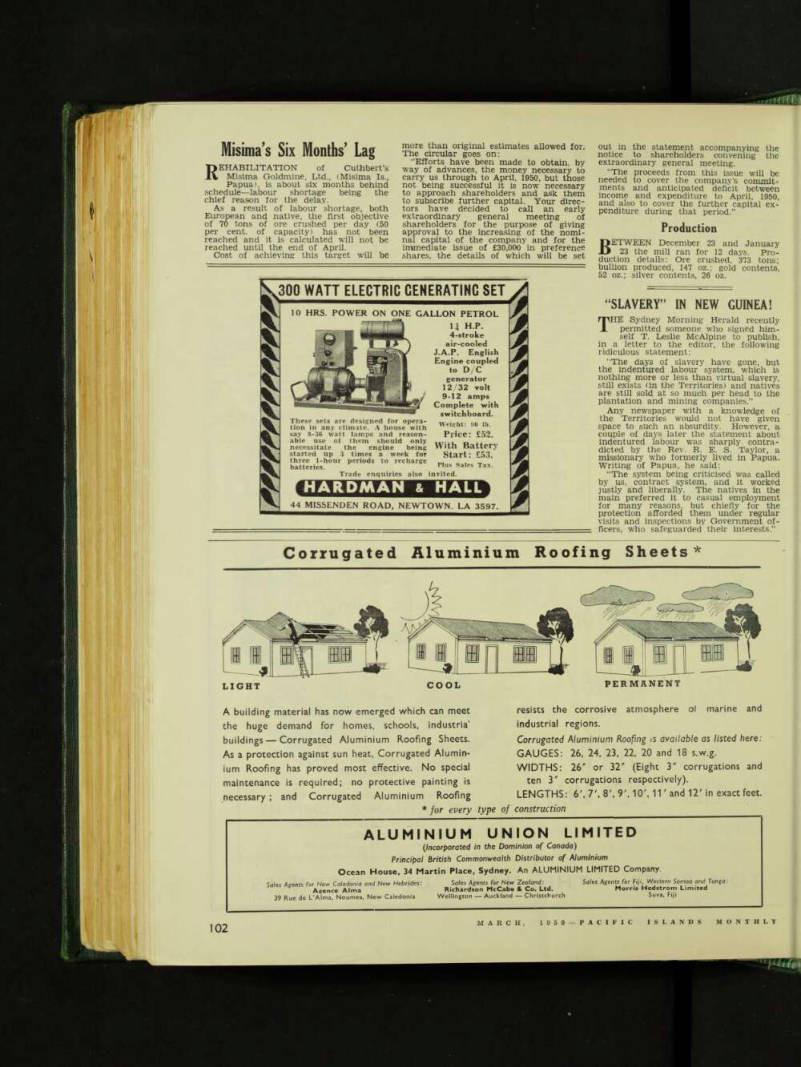
Rehabilitation of cuthbert’s Misima Goldmine, Ltd., (Misima Is., Papua), is about six months behind schedule—labour shortage being the chief reason for the delay.
As a result of labour shortage, both European and native, the first objective of 70 tons of ore crushed per day (50 per cent, of capacity) has not been reached and it is calculated will not be reached until the end of April.
Cost of achieving this target will be
more than original estimates allowed for.
The circular goes on: “Efforts have been made to obtain, by way of advances, the money necessary to carry us through to April, 1950, but those not being successful it is now necessary to approach shareholders and ask them to subscribe further capital. Your direc tors have decided to call an early extraordinary general meeting of shareholders for the purpose of giving approval to the increasing of the nomi nal capital of the company and for the immediate issue of £30,000 in preference shares, the details of which will be set
out in the statement accompanying the notice to shareholders convening the extraordinary general meeting.
“The proceeds from this issue will be needed to cover the company’s commit ments and anticipated deficit between income and expenditure to April, 1950, and also to cover the further capital ex penditure during that period.”
Production
BETWEEN December 23 and January 23 the mill ran for 12 days. Pro duction details: Ore crushed, 373 tons; bullion produced, 147 oz.; gold contents, 52 oz.; silver contents, 26 oz.
“Slavery” In New Guinea!
THE Sydney Morning Herald recently permitted someone who signed him self T. Leslie Me Alpine to publish, in a letter to the editor, the following ridiculous statement: “The days of slavery have gone, but the indentured labour system, which is nothing more or less than virtual slavery, still exists (in the Territories) and natives are still sold at so much per head to the plantation and mining companies.”
Any newspaper with a knowledge of the Territories would not have given space to such an absurdity. However, a couple of days later the statement about indentured labour was sharply contra dicted by the Rev. R. E. S. Taylor, a missionary who formerly lived in Papua.
Writing of Papua, he said: “The system being criticised was called by us, contract system, and it worked justly and liberally. The natives in the main preferred it to casual employment for many reasons, but chiefly for the protection afforded them under regular visits and inspections by Government of ficers, who safeguarded their interests.”
Advertisements & other items, p. 106 (1 item)
Corrugated Aluminium Roofing Sheets
300 WATT ELECTRIC GENERATING SET
■■ ■ ■ 11. ——— 10 HRS. POWER ON ONE GALLON PETROL These sets are designed for operation in any climate. A house with say 8-36 watt lamps and reasonable use of them should only necessitate the engine being started up 3 times a week for ii three 1-hour periods to recharge batteries.
U H.P.
4-stroke air-cooled J.A.P. English Engine coupled to D/C generator 12/32 volt 9-12 amps Complete with switchboard.
Weight: 90 lb.
Price: £52.
With Battery Start: £53.
Plus Sales Tax.
Trade enquiries also invited.
HARDMAN & HALL
44 MISSENDEN ROAD, NEWTOWN. LA 3597.
Corrugated Aluminium Roofing Sheets
•J
LIGHT
COOL
A building material has now emerged which can meet the huge demand for homes, schools, industria' buildings Corrugated Aluminium Roofing Sheets.
As a protection against sun heat, Corrugated Aluminium Roofing has proved most effective. No special maintenance is required; no protective painting is necessary ; and Corrugated Aluminium Roofing * for every type
PERMANENT
resists the corrosive atmosphere oi marine and industrial regions.
Corrugated Aluminium Roofing is available as listed here: GAUGES; 26, 24, 23, 22, 20 and 18 s.w.g.
WIDTHS: 26" or 32" (Eight 3" corrugations and ten 3" corrugations respectively).
LENGTHS: 6'. 7', B', 9', 10', 11' and 12' in exact feet. of construction
ALUMINIUM UNION LIMITED
(Incorporated in the Dominion of Canada)
Principal British Commonwealth Distributor of Aluminium Ocean House, 34 Martin Place, Sydney. An ALUMINIUM LIMITED Company.
Sales Agents for New Caledonia and New Hebrides: Sales Agents for New Zealand: Agence Alma Richardson McCabe & Co. Ltd. 39 Rue de L’Alma, Noumea, New Caledonia Wellington Auckland Christchurch Sales Agents for Fiji, Western Samoa and Tonga Morris Hedstrom Limited Suva, Fiji
Pre-Fabs For The Islands?
MR. AXEL S. HANSSON, who is Aus tralasian representative for Swedish pre-fabricated housing units, arrived in Sydney from the Central Pacific Islands in March and will return to Fiji and Tonga in April.
The possibility of obtaining these low priced wooden pre-fabricated houses has interested many people in Pacific terri tories, where the shortage of housing ac commodation is almost as acute as in Australia. However, the Swedish concern requires hard currency payments for its housing units and arranging this is proving difficult, at the moment.
It is reported that the Government of Tonga is interested in obtaining at least 20 of these attractive ready-to-erect houses.
W. Samoa’S Road Scheme
Another Section Opened
From Our Own Correspondent
Apia, Feb. 25.
A MONSTER Samoan feast on Febru ary 11, attended by 2,000 visitors from all parts of Samoa, and by European and Samoan officials marked the completion of another portion of the new Samoan road construction scheme— the Sa’anapu Hospital road section.
The Acting High Commissioner, Chief Judge C. C. Marsack, complimented the people of Salanapu on their contribution to the construction of the road and their unselfish co-operation with the Govern ment.
The traditional feast that followed the speeches included over 10,000 taros, 120 bunches of ripe bananas, 120 large fish, 250 fowl, about 100 pigs, 30 head of cattle, 15 kegs of salt beef, 12 cases of pilchards and numerous lobsters and crabs.
A collection made by the visitors to wards the village fund for hospital, school and welfare work brough liberal con tributions amounting to £7OO.
Mr. and Mrs. E. V. O'Brien of Mililat, plantation, Madang, New Guinea, spent a few days in Brisbane recently en route to Sydney, where they intend staying for 'Some months.
Queensland bom Archdeacon G. D. Hand, Bishop Coadjutor-elect of New Guinea, will be consecrated in Dogura Cathedral, Papua, on June 29. He said recently in Brisbane that the Anglican Church intended to introduce to New Guinea better methods of agricultural and animal husbandry. It was trying to get from Australia missionary agriculturists and others to help develop the natives’ own economy. He said Anglican nuns would soon be sent to New Guinea for the first time. They would be from the Sisters of the Holy Name, Melbourne, and would assist in the education of the New Guinea women and children.
Mrs. Eileen Leyer, after spending many weeks in Queensland recently returned to Madang, New Guinea. A pre-war resi dent of Port Moresby, she was evacuated to the mainland early in 1941. During her temporary residence in Brisbane, Mrs. Leyer, was a popular and active re presentative of the AMP Society, and at the latter period of her stay in the Northern Capital, was attached to the British Naval Forces at Bulimba. Asked her opinion of life in the Islands, as com pared with that in Australia, Mrs. Leyer said she “did not care if she never visited Australia again.” Madang, she though, offered as many attractions for tourists as most Australian coastal towns. She predicted a big tourist trade to the Islands if and when ample ships and ac commodation became available. Many Brisbane people had expressed to her a keen desire to visit the Territory, es pecially those who had lost relatives during the Pacific War.
New Club For Honiara
Prom Our Own Correspondent HONIARA, March 3.
THE Guadalcanal Club, Honiara, which was burned down last April, is being rebuilt on a coastal site near the proposed Honiara Golf Coifrse. First plans were for a concrete structure but this involved too much expense and de lay, and the new building will be of timber with a leaf roof.
Besides serving as a handy 19th hole, the Club will have a billiard room and dance room, and a wide verandah with an eye-catching view across the bay to Savo Island and Cape Esperance. The building should be completed in a few weeks. Nearest approach to a Club that Honiara has had over the last 10 months is the one and only hotel, the Woodford, gallantly run by Mr. K. H. D. Hay in a temporary building pending the erection of a permanent hotel. The Woodford Hotel is non-residential and run under considerable difficulties with labour and supplies. It has been the only community meeting place in Honiara, and an invalu able asset to all BSIP residents.
Anybody who has a hangover these
days generally refers to his complaint as “Hay Fever.”
Te Rapunga In Hobart
YACHTSMAN George Dibbern, well known in Rarotonga and other islands of Polynesia, arrived in Hobart, Tasmania, in ketch Te Rapunga, on March 11. He carried a crew of three and was 33 days out from New Zealand.
Considerable interest was taken in his passport, which is home-made. It has, however, been accepted in the United States and Canada as well as New Zea land and the Pacific, and Hobart officials raised no objection to it.
Dibben describes himself as a citizen of the world. In his passport he states that his long residence in many different countries places him outside nationality; he declares himself a friend of all people and promises to respect the laws of all nations.
George Dibbern has been wandering around the Pacific for 40 years but he is a German and during both World Wars was interned in New Zealand.
The full story of his wanderings in his little ship was told in PIM by William Bond in January, 1949.
Advertisements & other items, pp. 107-108 (1 item)
(Weed Agencies Ply. Ltd.
2 SMASH HITS!
FROM WILLREED AGENCIES
4 PEERLESS LOCKWOVEN
‘ SQUARE MESH FENCING
This British-made fencing is made throughout from High Tensile No. 9 gauge wire with all vertical wires in one piece to form rigid uprights which will not move out of position when pushed by cattle. Inter-sections are permanently rigid with Lockwoven non-slip knot. Peerless Lockwoven Fencing, which is fully galvanised, is manufactured in special types to suit Pig Fences, Sheep Fences, General Farm Fences and Cattle Fences. Available on indent in unlimited quantities. Straining pillars and intermediate standards are also available.
O ITALIAN MINIATURE
' SEWING MACHINES
Substantially built and beautifully finished, this miniature model has all the refinements of a full-size machine. Its reliable chain-stitch will produce perfect work and it can be used for ordinary sewing or decorative embroidery. Supplied complete with table clamp and detailed instructions. All parts replaceable. The machine is supplied packed in a carton.
Weight Zl lbs. Width in.
Length 9 in. Height 7 in.
Available on indent. Minimum order 6 machines.
(WEED AGENCIES Ply. Ltd.
145 a George Street, Circular Quay, Sydney.
Cable Address: “REEDAGE,” Sydney.
Classified Advertisements
SOUTH SEA ISLAND
WANTED TO BUY.—American writer and explorer would like to buy a small Pacific Island.
Will pay to $l,OOO (American), depending upon size and location. In replying, please quote price and give name, registry, location, size, and other pertinent information. The Island will, of course, need to be placed in escrow to assure clear title. Write to Mr. D. P. Maclure, Jr.. 129 Bucareli Drive, Parkmerced, San Francisco, California, U.S.A.
TONGA GOVERNMENT
Vacancy for Book-Keeper/Clerk
APPLICATIONS are invited for the post of Bookkeeper and Clerk to the Tonga Copra Board in their Head Office at Nukualofa, Tonga.
Quallcations as a certificated Bookkeeper and previous knowledge of the Copra Industry essential. Unmarried man preferred. Salary is in the scale £5OO plus 25 to £6OO plus 30—£660 according to age, qualifications and experience.
For further details apply: Tonga Government Agents, Messrs. Burns. Philp & Company, Limited, Bridge Street, Sydney, N.S.W., Australia.
POSITION VACANT
Typiste-Records Clerk for
“PIM”
A Senior shorthand-typiste is required by Pacific Publications Pty.
Ltd., proprietors of “Pacific Islands Monthly” and Pacific Travel Bureau, to take charge of the subscription records and carry out general office duties.
Good commencing salary and interesting work in congenial offices on 7th floor of Union House, 247 George Street, Sydney, overlooking Sydney Harbour and close to all city and suburban transport. No Saturday work.
Excellent opportunity for lady interested in the South Seas Islands.
Apply either personally or by letter to: Pacific Publications Pty. Ltd. 247 George Street, Sydney.
Telephone: BW 5037.
FOR SALE
Equipment for complete Boot-Repair Shop. Also Leather, Nails, Wax and all other Grindery necessary for Boot- Repair Work.
Apply:—
G. G. SMITH & CO. LTD.
PORT MORESBY, PAPUA.
Bp Launch New Cutter In
Apia
From Our Own Correspondent
Apia, Feb. 25.
ANEW cutter built for Messrs Burns Philp (SS) Co., Ltd., in Western Samoa, was launched on February 2 at a function attended by a gathering of representative Europeans and Samoans.
The vessel, designed fo r Messrs. Burns Philp by Mr. D. Philp, Marine Architect of Sydney, was built entirely by local shipwrights under the supervision and direction of Capt. F. J. Williams, B. P.’s marine superintendent in Apia. Credit goes to Mr. Peate, foreman shipwright, for the excellent craftsmanship shown in the vessel’s construction.
The ship has an overall length of 58 ft., a beam of 16 ft., draft of 5 ft. 4 in. and her displacement is about 48 tons. She is cutter-rigged and powered by a 90 HP Crossley engine. She is built of Australian hardwood and New Zealand Kauri and copper fastened throughout with bronze or marine brass bolts where required.
The christening ceremony was per formed by Mrs. Lily Malietoa, wife of the Hon. Fautua Tanumafili Malietoa.
Why Fiji’S Yacht Was Failure
At Auckland
From Our Own Correspondent
Suva, Feb. 20
REPORTING recently to the Suva Yacht Club on the failure of O- Vuka in the eighteen-footer world championship races at Auckland this month, were the boat’s designer, builder and skipper (Mr. A. Bentley) and her crew’s manager (Mr. R. Genge).
They said that in finish and workman ship the O-Vuka had no superior on the Waitemata, and some of Auckland’s lead ing boatbuilders gave her unstinted praise. But in sailing the O-Vuka was no match for the transom-bowed New Zealand boats, which were built as straight-out racing shells and not as racing-cum-cruising yachts. Neither could O-Vuka’s sails compare with the English-made sails of the leading New Zealand competitors.
Vegetable Supply
For Moresby
From Australia or Central Highlands
From Our Own Correspondent
Port Moresby, March 8.
PORT MORESBY’S vegetable shortage caused by the hold up on the Bulolo in Sydney in February, drew the at tention of local firms, once more, to the food-growing possibilities of the Central Highlands.
A representative of the Port Moresby Freezing Co., who visited the Highlands during the shortage, found that the natives there could supply Moresby with large quantities of vegetables. Consider able organisation is needed, however, to ensure that they bring in their vegetables to the district station at the right time and in the right quantities. When the PMF representative made his visit, he found that insufficient vegetables were available, largely because the natives did not know they could sell them.
Now that markets have been guaran teed, it is likely that they will go in for vegetable growing on a larger scale. It will be several months, however, before the supply goes anywhere near meeting the demand. The Bulolo hold up, was not really serious to Port Moresby, but showed how unwise it is for the Terri tory to continue relying on Australia for practically all its European food. One suggestion is that the Administration or private interests should establish a large vegetable farm in the Highlands.
A Polynesian Earache Cure
That Works
From Our Own Correspondent
Mangaia, Cl.
ONE of the most torturing complaints common upon this island commences with the symptoms of the common hay-fever cold, and progresses to a vio lent pain in the ear, usually on one side only, though some victims get a double dose of the pain. The cause is obscure, but the local medicine-men, who combine a genuine skill in herbal remedies with ignorant quackery in other matters, have a remedy. The poro-poro leaf, bruised and mixed with candlenut mashed in water, is used as a local application, “blue-bag” fashion, wrapped in a small piece of calico. The liquid that exudes from the little bag functions very rapidly.
Within a few hours, the pain, which may have defied aspirin, is gone, and there is no recurrence.
The properties of this simple leaf and well-known nut might usefully be in vestigated by white doctors and chemists.
Mystery Of Suva Ambulance
Service
From Our Own Correspondent SUVA, March 5.
FIJI’S new telephone directory, issued last week, tells the Suva public to telephone to police headquarters when an ambulance is needed.
It has now been discovered that, al though not one official word has been made public, the police at Suva washed their hands of the ex-police ambulance many months ago. The ambulance prac tically fell apart with age, and when that happened the CWM Hospital was left with the only available ambulance ser vice. In the meantime, of course, people have continued to badger the police for the non-existent ambulance.
Nutfall Problem
Fiji Official's BBC Talk
MR. B. E. V. Parham, Senior Agricul tural Officer of Fiji, recently repre sented the South Pacific Commission at a United Nations Conference at Lake Success on the conservation and utilisa tion of resources.
He later went on to the UK and while there spoke over the BBC on some prob lems of tropical agriculture, notably pre mature nutfall. He said: — THE great expansion of coconut plant ing through the Pacific during the past forty years has brought many problems to the scientist. Some of these we have been able to answer; but we are still busy with others. Even so, much work was incomplete when the last war started. There were several puzzling problems yet to be solved when the Japanese armies invaded the Solomon Islands, Perhaps none of these is so interesting as that of premature nutfall in that Group. Before the war planters were faced with up to 70 per cent, loss of crop due to the young nuts dropping uselessly to the ground at a very early stage of development but in 1934 the cause of the trouble had been found to be the green coreid bug. Up to the time that war came to the islands, no satisfactory means of control had been discovered. When work was resumed after the end of the Japanese occupation we found that the ground beneath the palms, which before the war had been weeded and kept free of fallen fronds, was covered with litter, creeping vines and other vegetation, but that nevertheless, the palms were bearing normal crops.
We knew before the war that the coreid bug was either destroyed or driven off by the yellow tree-ant, and that where this and was plentiful, nutfall did not occur.
Unfortunately, the yellow ant was itself attacked in a losing battle by two other kinds of ants which always made their nests at the base of palm trunks and pre vented the yellow ants from moving* up or down the palms without being de stroyed. During the war, as cultivation found an unexpected ally in the accu ceased, we now know that the yellow ant mulation of vines and fallen fronds at the base of the palms. By these the yellow ants were able to by-pass their enemies and re-establish themselves in territories from which they had been ousted.
Last year the entomologists from our department of agriculture in Fiji, Mr. B.
A. O’Connor and Dr. Leach of Cambridge, spent some time in the Solomon Islands, and they have proved that where there is a bridge of fallen fronds leaning against the trunks of the palms, the yellow ant can more than hold its own.
It is hoped that by this simple means it will soon be assisted to spread to other areas where nutfall has been most severe.
The importance of this work may be ap preciated when I sav that in the Solomon Islands alone there are 62,000 acres of plantation coconuts, not including those owned by natives. These should, with the help of the yellow ant, produce at least 30,000 tons of copra per annum.
Mr. J. F. €. Briscoe. DFC, Deputy Director of Navigational Services (Aero dromes) in the United Kinedom Ministry of Civil Aviation, was in Fiji in February to discuss civil aviation matters with the Government. Air Vice-Marshal R. P.
Willcock, C. 8., Civil Aviation Adviser to the United Kingdom High Commissioner in Australia, was expected to arrive at Nadi on February 8. He will be in Fiji for six days, during which time he will discuss aviation matters with Mr. Briscoe and with local officials.
Advertisements & other items, p. 109 (1 item)
Classified Advertisements
DEATH NOTICE
DUNNE, John Francis, late of Fiji, died in Sydney on February 1, 1950, aged 65. Loved father of Nora (Mrs. W. Eastwood), John, and Eileen, and grandfather of Shirley, Maxwell, Desmond, John, and Barry.
IN MEMORIAM
CARTER.—In memory of Florence Mary (“Mollie”), who passed on at the Homeopathic Hospital, Launceston, Tasmania, on March 15. 1949. Inserted by daughter Joan, grandson John, and Nick.
BUSINESS WANTED
WANTED TO BUY.—Any kind of business in the Pacific Islands required urgently, preferably ladies’ and/or gents’ hairdressing establishment; married accommodation required. Address replies (per airmail, if possible): Alexander, 235 Alison Road. Randwick, N.S.W. (Sydney agents may phone FX 3431.)
VESSELS FOR SALE
M.V. MELISSA.—Length. 54 ft.: beam, 13 ft.; draught, 6 ft. Pitted with Gray marine engine and ketch-rigged sails. Speed. 8 knots. Has cabin and is sheathed. Apply to Manager, Gama Plantation, Talasea, New Britain. T.N.G.
SCHOONER. —Gaff-rigged, sturdily built of choice timbers from Thursday Island lugger plan.
Dimensions: 45 ft. length. 12 ft. beam. 6 ft. draught. Copper sheathed. Apply to: “Dorchester.” c/o Box 3408, G.P.0., Sydney, N.S.W., Australia.
POSITIONS WANTED
MOTOR MECHANIC.—Young man, 27. single, four years’ experience in Papua, who understands and is used to handling natives, wishes to obtain commercial position in New Guinea as a mechanic (possessing full knowledge of petrol engines) or on a plantation. Reply by airmail to: “Mechanic,” c/o Dept. 2, Box 3408, G.P.0.. Sydney, N.S.W.
MARRIED COUPLE.—Keen young man and wife desire opening in the Islands in any capacity, both working, if necessary. Man has general experience as mechanic and fitter, diesel and petrol engines, and as fitter in machine toolmaking shop; knows Islands well. Wife experienced in bookkeeping and general clerical work.
Replies to: “Reliable,” c/o Box 3408, G.P.0., Sydney.
CLERICAL OR AVIATION—Young man of good education seeks a position in the Islands, with a preference for Papua-New Guinea: has had considerable clerical experience and can fly a plane; would make term contract. Reply to; D. J. Mahon. 56 North Mall. Leura. N.S.W., Australia.
BAKER, with considerable citv, country and New Guinea experience, seeks similar position in either Fiji. New Caledonia, or Tahiti. First-class references. Would make term contract. Please reply by airmail to: “Baker.” 83 Station Street, Tempe, Sydney. N.S.W.. Australia.
HAlRDRESSER.—Experienced ladies’ hairdresser (male) requires an immediate position in any of the Pacific Islands —the Territory of Papua-New Guinea preferred. Replies, by airmail, to: “Marcel,” 134 c High Street. Willoughby. N.S.W.
HOSTESS.—WorId travelled, educated lady seeks post, preferably in the Islands, as Hostess, or can supervise and design Island Crafts suitable for souvenir export trade. Interested in conchology. Reply, by airmail, to “Shell Craft,”
Norfolk Island.
TWO YOUNG MEN. —Very anxious to secure positions anywhere in New Guinea or the Pacific Islands: preferably in same locality, but not necessarily. Please write: B. McMahon, 92 Grey Street. South Brisbane, Queensland.
ISLANDS SOUVENIR
SOUTH SEAS SONGS!—Uplifting Poems. Cover; Feathery Palms, Tropical Flowers, Island Girl.
Ideal gift or Souvenir. One dollar (8/- Aust.), Post Free.—Dr. W. Swaan, 2574 W. Broadway, Vancouver, 8.C., Canada.
PUBLIC NOTICES
PROBATE NOTICE.—After 14 clear days from this day. application will be made to the Supreme Court, Brisbane, for a Grant of Probate of the following Will. Any person interested who desires to object to the application or to be heard upon it may file a caveat in the Registry at any time before the grant is made.
DECEASED.—Harrison Leigh Lightbody, late of Kalili Plantation, New Ireland, Territory of New Guinea, Plantation Manager.
APPLICANT.—OIive Gertrude MacLeod, of 32 Lonsdale Street, Hamilton, in the State of Victoria, Widow, the sole Executrix appointed by the Will, dated the fourteenth day of March, 1942.
SOLICITORS.—FIower & Hart, 398-400 Queen Street, Brisbane, Queensland. —Dated: February 20, 1950.
Re the Estate of LEO PETER VANDERCLAY, in the Will called NEO PETER VANDERCLAY, late of Miller’s Point, in the State of New South Wales, and Madang, New Guinea, Engineer notice is hereby given that the Public Trustee has this day elected to administer the Estate of the abovenamed deceased.
Pursuant to the Wills. Probate and Administration Act. 1898-1947. the Public Trustee Act. 1913-1942; Testator’s Family Maintenance and Guardianship of Infants Act. 1916-1938; and Trustee Act, 1925-1942, the Public Trustee, the Administrator of the Estate of the said deceased, who died on the 12th day of September, 1949, hereby gives notice that creditors and others having any claim against or to the Estate of the abovementioned deceased person, are required to send particulars of their claims to the Public Trustee at 19 O’Connell Street, Sydney, on or before the 20th day of June, 1950, at the expiration of which time the said Public Trustee will distribute the assets of the said deceased to the persons entitled, having regard only to the claims of which he then has notice.
Dated this Ist day of February, 1950. —P. J. P.
Pullen, Public Trustee.
TENDERS
ESTATE. LATHAM HAMILTON, DECEASED.—
Sealed Tenders endorsed “Tenders Sumuna and Panapau” are invited and will be received by the undersigned until 5 p.m. on April 30, 1950, for the purchase of the following:— Sumuna Plantation. — (1) Situation: On Djaul Island, New Ireland District, Territory of New Guinea. (2) Area: Approximately 250 hectares (approximately 625 acres); 150 hectares planted with coconuts and cocoa during years 1937-39 probably destroyed during Japanese occupation of the Territory.
Panapau Plantation.— (1) Situation: Near Sumuna Plantation, New Ireland District Territory of New Guinea. (2) Area: Approximately 400 hectares (1,000 acres) —only 55 hectares planted before 1940.
Sumuna and Panapau plantations originally worked as one unit. Both properties are held under agricultural lease.
General. —Above properties are overgrown with secondary growth. An assessment as under has been made by the War Damage Section and will be paid to the successful tenderer by them when satisfactory evidence is produced that the work has been completed or well advanced:—Sumuna Plantation, £5O; Panapau Plantation. £l5O.
Title.—The successful tenderer shall accept such title as the Administrator of the Estate now has, and without further investigation.
Terms.—The properties will be sold subject to the consent of the Administrator of the Territory of Papua-New Guinea. On acceptance of Tender. 25 per cent, of Tender price to be deposited, and the balance is to be paid upon the execution by the Administrator of a conveyance of the properties or such other document or instrument as the successful Tenderer may reasonably require to evidence the sale in the absence of a registerable transfer. The highest or any other Tender will not necessarily be accepted.
BURNS. PHILP TRUST COMPANY. LIMITED.
7 Bridge Street. Sydney.
Administrator of the Estate of Latham Hamilton, deceased.
Sydney, February 27, 1950.
Islands Produce
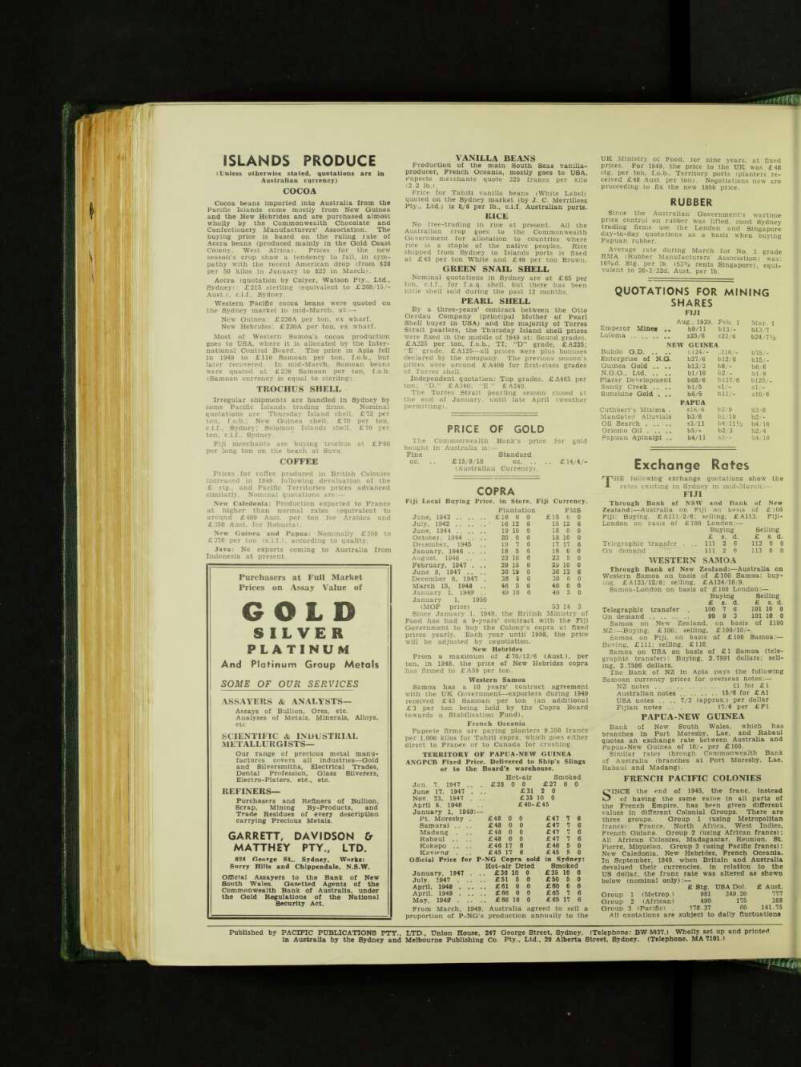
(Unless otherwise stated, quotations are in Australian currency)
Cocoa
Cocoa beans imported into Australia from the Pacific Islands come mostly from New Guinea and the New Hebrides and are purchased almost wholly by the Commonwealth Chocolate and Confectionery Manufacturers’ Association. The buying price is based on the ruling rate of Accra beans (produced mainly in the Gold Coast Colony, West Africa). Prices for the new season’s crop show a tendency to fall, in sym pathy with the recent American drop (from $2B per 50 kilos in January to $23 in March).
Accra (quotation by Colyer, Watson Pty.. Ltd., Sydney): £215 sterling (equivalent to £268/15/- Aust.), c.i.f., Sydney.
Western Pacific cocoa beans were quoted on the Sydney market in mid-March, at:— New Guinea; £23OA per ton, ex wharf.
New Hebrides; £23OA per ton, ex wharf.
Most of Western Samoa’s cocoa production goes to USA, where it is allocated by the Inter national Control Board. The price in Apia fell in 1949 to £llO Samoan per ton, f.0.b., but later recovered. In mid-March, Samoan beans were quoted at £230 Samoan per ton, f.o.b. (Samoan currency is equal to sterling).
Trochus Shell
Irregular shipments are handled in Sydney by some Pacific Islands trading firms. Nominal quotations are; Thursday Island shell, £72 per ton, f.0.b.; New Guinea shell. £7O per ton. c.i.f., Sydney: Solomon Islands shell. £7O per ton, c.i.f., Sydney.
Fiji merchants are buying trochus at £F6O per long ton on the beach at Suva.
Coffee
Prices for coffee produced in British Colonies increased in 1949, following devaluation of the £ stg., and Pacific Territories prices advanced similarly. Nominal quotations are:— New Caledonia: Production exported to France at higher than normal rates (equivalent to around £4OO Aust. per ton far Arabica and £350 Aust. for Robusta).
New Guinea and Papua: Nominally £350 to £370 per ton (c.i.f.), according to quality.
Java: No exports coming to Australia from Indonesia at present.
Vanilla Beans
Production of the main South Seas vanilla producer, French Oceania, mostly goes to USA.
Papeete merchants quote 325 francs per kilo (2.2 lb.).
Price for Tahiti vanilla beans (White Label) quoted on the Sydney market (by J. C. Merrillees Pty., Ltd.) is 8/6 per lb., c.i.f. Australian ports.
Rice
No free-trading in rice at present. All the Australian crop goes to the Commonwealth Government for allocation to countries where rice is a staple of the native peoples. Rice shipped from Sydney to Islands ports is fixed at £45 per ton White and £49 per ton Brown.
Green Snail Shell
Nominal quotations in Sydney are at £65 per ton, c.i.f., for f.a.q. shell, but there has been little shell sold during the past 12 months.
Pearl Shell
By a three-years’ contract between the Otto Gerdau Company (principal Mother of Pearl Shell buyer in USA) and the majority of Torres Strait pearlers, the Thursday Island shell prices were fixed in the middle of 1949 at: Sound grades, £A325 per ton, f.0.b., TI; “D” grade, £A225; “E” grade. £AI25 —all prices were plus bonuses declared by the company. The previous season’s prices were around £A4OO for first-class grades of Torres shell.
Independent quotation: Top grades. £A465 per ton; “D,” £ A 340; “E,” £A24O.
The Torres Strait pearling season closed at the end of January, until late April (weather permitting),
Quotations For Mining
Price Of Gold
The Commonwealth Bank’s price for gold bought in Australia is:— Fine Standard OZ. .. £ls/9/10 oz £l4/4/- (Australian Currency).
Copra
Fiji Local Buying Price, in Store, Fiji Currency.
(MOF price) .. 53 14 3 Since January 1, 1949, the British Ministry of Food has had a 9-years’ contract with the Fiji Government to buy the Colony’s copra at fixed prices yearly. Each year until 1958, the price will be adjusted by negotiation.
New Hebrides From a maximum of £7O/12/6 (Aust.), per ton, in 1948. the price of New Hebrides copra has firmed to £AS9 per ton.
Western Samoa Samoa has a 10 years’ contract agreement with the UK Government —exporters during 1949 received £45 Samoan per ton (an additional £3 per ton being held by the Copra Board towards a Stabilisation Fund).
French Oceania Papeete firms are paying planters 9.350 francs per 1.000 kilos for Tahiti copra, which goes either direct to Prance or to Canada for crushing.
Territory Of Papua-New Guinea
ANGPCB Fixed Price. Delivered to Ship’s Slings or to the Board’s warehouse.
UK Ministry of Pood, for nine years, at fixed prices. For 1949, the price to the UK was £4B stg. per ton, f.0.b., Territory ports (planters re ceived £4B Aust. per ton). Negotiations now are proceeding to fix the new 1950 price.
Rubber
Since the Australian Government’s wartime price control on rubber was lifted, most Sydney trading firms use the London and Singapore day-to-day quotations as a basis when buying Papuan rubber.
Average rate during March for No. 1 grade RMA (Rubber Manufacturers’ Association) was hed. Stg. per lb. (53% cents Singapore), equi valent to 20-3/32d. Aust. per lb.
Quotations For Mining
Shares
Fiji
Plantation
Fms
June, 1942 £16 0 0 £15 0 0 July. 1942 • 16 12 6 15 12 6 June, 1944 19 10 0 18 0 0 October, 1944 .. .. 20 0 0 18 10 0 December, 1945 19 7 6 17 17 6 January. 1946 .. .. 18 5 6 18 0 0 August. 1946 .. 23 10 6 23 5 0 February, 1947 . .. 29 15 6 29 10 0 June 9. 1947 .. .. 36 19 0 36 13 6 December 8, 1947 . 38 5 6 38 0 0 March 15, 1948 .. 46 5 6 46 0 0 January 1, 1949 . .
January 1, 1950 49 10 6 49 5 0
Hot-air Smoked Jan. 7. 1947 .. , £28 0 0 £27 0 0 June 17. 1947 . . £31 2 0 Nov. 23. 1947 . . £35 10 0 April 8. 1948 January 1, 1949:— £40- £45 Pt. Moresby . £48 0 0 £47 7 6 Samaral .. £48 0 0 £47 7 6 Madang . £48 0 0 £47 7 6 Rabaul .. £48 0 0 £47 7 6 Kokopo .. .. £46 17 6 £46 5 0 KaviPng . .. £45 17 6 £45 5 0 Official Price for P- NG Copra sold in Sydney: Hot-air Dried Smoked January, 1947 . ., £36 10 0 £35 10 0 July. 1947 ... £51 5 0 £50 5 0 April. 1948 . .. . . £61 0 0 £60 0 0 April, 1949 , ... £ 66 0 0 £65 7 6 May, 1949 , .. . £66 10 0 £65 17 6 From March, 1949, Australia agreed to sell a proportion of P-NG’s production annually to the
Aug.. 1939.
Feb. 1 Mar. 1 Emperor Mines .. b9/ll bl3/bl3/7 Loloma .. ...
S25/6 S23/6 b24/7 1 / a
New Guinea
Bulolo G.D 6124/- -110/b75/- Enterprise of N.G. b27/6 bl2/6 bl5/- Guinea Gold .. .. bl3/3 b8/b6/6 N.G.G., Ltd bl/10 b2/bl/9 Placer Development b68/6 bl37/6 bl25/- Sandy Creek .. .. bl/5 sl/sl/- Sunshine Gold . .. b6/5
Papua
bll/slO/6 Cuthbert’s Misima .
S16/6 b3/9 b3/6 Mandated Alluvials b3/8 bl/10 b2/- Oil Search S3/11 b4/liy 2 b4/10 Oriomo Oil b5/b2/3 b2/4 Papuan Apinaipl .. b4/ll so/b4/10
Exchange Rates
THE following exchange quotations show the rates existing in Sydney in mid-March:—
Fiji
Through Bank of NSW and Bank of New Zealand: —Australia on Fiji on basis of £lOO Fiji: Buying. £ All 1/2/6: selling. £AII3. Fiji- London on basis of £lOO London:—
Western Samoa
Through Bank of New Zealand: —Australia on Western Samoa on basis of £lOO Samoa: buy ing. £AI23/12/6; selling. £AI24/10/9.
Samoa-London on basis of £lOO London; —
Samoa on New Zealand, on basis of £lOO NZ:—Buying, £100; selling, £lOO/10/-.
Samoa on Fiji, on basis of £lOO Samoa: — Buying, £111: selling, £llO.
Samoa on USA on basis of £1 Samoa (tele graphic transfer): Buying, 2.7991 dollars; sell ing, 2.7586 dollars.
The Bank of NZ in Apia pays the following Samoan currency prices for overseas notes: — NZ notes £1 for £1 Australian notes 15/6 for £AI USA notes .. .. 7/3 (approx.) per dollar Fijian notes 17/6 per £FI
Papua-New Guinea
Bank of New South Wales, which has branches in Port Moresby, Lae. and Rabaul quotes an exchange rate between Australia and Papua-New Guinea of 10/- per £lOO.
Similar rates through Commonwealth Bank of Australia (branches at Port Moresby, Lae, Rabaul and Madang).
French Pacific Colonies
SINCE the end of 1945, the franc. Instead of having the same value in all parts of the French Empire, has been given different values in different Colonial Groups. There are three groups. Group 1 (using Metropolitan francs); France, North Africa, West Indies, French Guiana. Group 2 (using African francs): All African Colonies, Madagascar, Reunion. St.
Pierre, Miquelon. Group 3 (using Pacific francs): New Caledonia, New Hebrides, French Oceania.
In September, 1949. when Britain and Australia devalued their currencies, in relation to the US dollar, the franc rate was altered as shown below (nominal only):
Buying Selling £ s. d. £ s. d.
Telegraphic transfer . .. Ill 2 6 113 0 0 On demand 111 2 6 113 0 0
Buying Selling £ s. d. £ s. d.
Telegraphic transfer , 100 7 6 101 10 0 On demand 99 9 3 101 10 0
£ Stg. USA Dol. £ Aust.
Group 1 (Metrop.) 981 349.20 777 Group 2 (African) 490 175 388 Group 3 (Pacific) . 178.37 60 141.75 All quotations are subject to daily fluctuations
Advertisements & other items, pp. 110-112 (3 items)
Published by PACIFIC PUBLICATIONS PTY., LTD., Union House, 247 George Street, Sydney. (Telephone; BW 5037.) Wholly set up and printed
in Australia by the Sydney and Melbourne Publishing Co. Pty., Ltd., 29 Alberta Street. Sydney. (Telephone. MA 7101.)
Gold
Purchasers at Full Market Prices on Assay Value of
SILVER
PLATINUM
And Platinum Group Metals
SOME OF OUR SERVICES
ASSAYERS & ANALYSTS—
Assays of Bullion. Ores, etc.
Analyses of Metals, Minerals, Alloys, etc
SCIENTIFIC & INDUSTRIAL
METALLURGISTS—
Our range of precious metal manufactures covers all industries —Gold and Silversmiths, Electrical Trades, Dental Profession, Glass Silverers, Electro-Platers, etc., etc.
REFINERS—
Purchasers and Refiners of Bullion, Scrap, Mining By-Products, and Trade Residues of every description carrying Precious Metals.
GARRETT, DAVIDSON &
MATTHEY PTY., LTD.
824 George St.. Sydney, Works: Snrry Hills and Chippendale, N.S.W.
Official Assayers to the Bank of New South Wales. Gazetted Agents of the Commonwealth Bank of Australia, under the Gold Regulations of the National Security Act.
Tooth’S
1 X ood company deserves the best, and it is a thoughtful and discerning host who serves his guests sparkling K.B. Lager. -*For “K. 8.” adds enjoyment to any gathering, and it's one drink that’s appreciated by everybody, men and women alike.
G
K COO t
LAGER
M
ERCHANTS, & SHIP OWNERS
Capital ... £500,000
ESTABLISHED 1914
GENERAL MERCHANTS
AND
PROVIDORES
TRADE THROUGHOUT THE PACIFIC.
THIRTY-FIVE YEARS OF PACIFIC ISLANDS DEVELOPMENT AND SERVICE.
BUYERS AND EXPORTERS OF ALL KINDS
OF ISLAND PRODUCE, COPRA, COCOA,
M.O.P. SHELL, TROCAS SHELL, ETC.
AGENTS FOR AUSTRALIAN, EUROPEAN
AND AMERICAN MANUFACTURERS.
DISTRIBUTORS OF EVERY DESCRIPTION
OF MERCHANDISE.
Through our Sydney office, branches and agents, we distribute a wide and comprehensive range of general merchandise .
K. R. CARPENTER CO. LTD.
Head Office: 16 O'CONNELL STREET, SYDNEY, N.S.W.
Cable Address: Telephone: Postal Address: “CAMOHE.” BW 4421. G.P.0., BOX 168, Sydney.
In London: W. R. Carpenter & Co. (London), Ltd., Coronation House, 4 Lloyd s Ave., London, EC
ASSOCIATED COMPANIES THROUGHOUT THE PACIFIC :
IN NEW GUINEA:
New Guinea Company, Limited, Rabaul, Lae, Madang, Kavieng.
IN PAPUA:
J, R. Clay & Co., Ltd., Port Moresby,
IN FIJI:
W. R. Carpenter & Co. (Fiji), Ltd., Suva.