Trapicalities
pp. 55-56 · Read in the full issue
ALL sorts of incidents (not to say acci dents) attended the recent tour of the Fiji Military Forces band to Vanua Levu and some of the Fiji Group’s outer islands. But it got there just the same and did a good job for the War Memorial Anti-TB Fund for whose benefit the tour was arranged.
Travelling in the vessel Makogai, the band spent the first night at Nasau, in the island of Makogai, and then, after a short call at Nabouwalu, Vanua Levu, was stranded at Monkey Face Passage when the Makogafs engines failed and the sails were useless because of the lack of wind.
In the evening, under sail, the Makogai managed to reach an anchorage between Dreketi and Nakalou. After sunset the wind increased and rain fell in torrents.
Food supplies were running short and Staff Sergeant Atunaisa and seven men were sent ashore in a dinghy with a list of urgent needs. The party covered the five miles to Nakalou village by 11.30 p.m.
Immediately the men of the village turned out to dig root vegetables and gather breadfruit, and the Chinese storekeeper was routed out to open his shop.
At dawn the party returned to the Makogai and the vessel sailed slowly along the coast until, at noon, it was met by the Tui Taveuni, sent from Labasa by the District Commissioner.
The band transhipped and arrived at Labasa at 530 p.m. on Sunday, having missed all its engagements for Labasa’s big week-end in aid of the Fund. It made up for this by giving a concert within 21 hours of its arrival, followed by a concert at the hospital next day as well as a marching display and other per formances in the district.
At the same time, the head mechanic of the CSR Company at Labasa was sent, at the company’s expense, down the coast to repair the Makogai’s engine.
At the little centre of Naduri the band received an overwhelming welcome from a crowd which included many people who had gone to Labasa for the week-end and had returned disappointed at missing the star attraction.
When the Makogai sailed from Naduri the wharf was jammed with a crowd es timated at 500. As the little ship pulled out, the wharf collapsed, spilling 30 of the spectators into the water. The band master later reported: “Nobody was hurt
and nobody seemed to mind.”
s.
♦ ♦ * A SAMOAN recently applied to the Marist Brothers’ School, Apia, for enrolment as a pupil. The Brother in charge told the applicant that he could not be accepted as available accommoda tion at the school was already overtaxed and no new pupils could be enrolled. But the prospective pupil continued begging to be taken in.
“It is no use begging me,” said the Brother, “we cannot take you, and be sides, you are too old for the school any how.”
The Samoan thought for a moment.
“Well,” he said, “all right, but if you cannot take me, Brother, what about tak
ing my son?”-
G.
HERE’S news for every tropic housewife and those who must toil cooped up in the galleys of Island schooners: three enterprising Victorian engineers have invented a kerosene gas stove that is small, compact, fool-proof, has no wicks, requires no pumping, is silent, economical and creates no kero seney odours. It has three burners and will operate for 14 hours on one gallon of kerosene, generating 12,000 British thermal units of heat.
The stove’s designers first got the idea 26 years ago; the present stove is the re sult of trial and error and experiment since then. If it is half as good as it seems, it’s good! * ♦ * ONE of the most entertaining ways of enlivening a long bus journey in Fiji is surely to observe the rich variety of hirsute adornments adopted by the Indian male, ranging from the cute Roland and seven-a-side, to the luxurious moustaches of the older generation and the triumphant beards of the Punjabis.
In boarding a bus the Indian man in variably enters and takes his seat before the woman. One remembers an amusing incident on a recent bus journey to Nadi when a tableau of husband, wife and child, with, presumably, the man’s mother-in-law, entered the bus to the accompaniment of a volubility which Fiji residents can easily imagine.
When the bus drew up to let down the party of four, the husband paid fares for himself, his wife and his child, and one
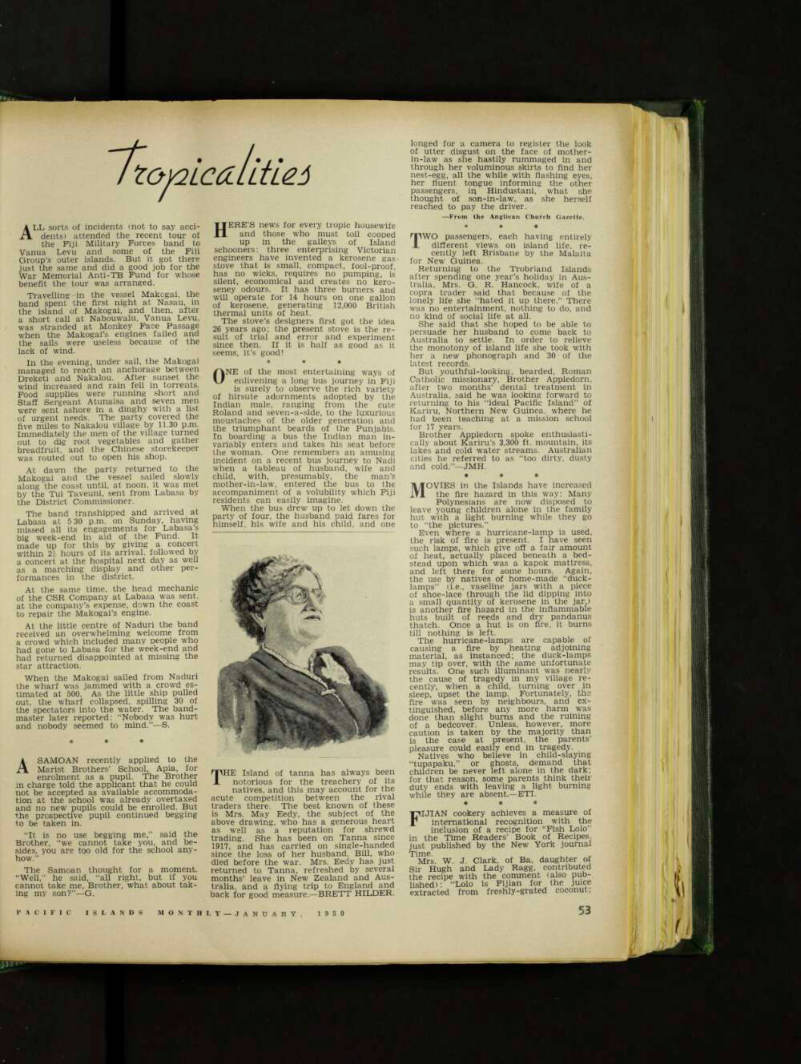
THE Island of tanna has always been notorious for the treachery of its natives, and this may account for the acute competition between the rival traders there. The best known of these is Mrs. May Eedy, the subject of the above drawing, who has a generous heart as well as a reputation for shrewd trading. She has been on Tanna since 1917, and has carried on single-handed since the loss of her husband. Bill, who died before the war. Mrs. Eedy has just returned to Tanna, refreshed by several months’ leave in New Zealand and Aus tralia, and a flying trip to England and
back for good measure.-
Brett Hilder.
longed for a camera to register the look of utter disgust on the face of mother in-law as she hastily rummaged in and through her voluminous skirts to find her nest-egg, all the while with flashing eyes, her fluent tongue informing the other passengers, ip Hindustani, what she thought of son-in-law, as she herself reached to pay the driver. —From the Anglican Church Gazette. ♦ ♦ ♦ rpwo passengers, each having entirely 1 different views on island life, re cently left Brisbane by the Malaita for New Guinea.
Returning to the Trobriand Islands after spending one year’s holiday in Aus tralia, Mrs. G. R. Hancock, wife of a copra trader said that because of the lonely life she “hated it up there.” There was no entertainment, nothing to do, and no kind of social life at all.
She said that she hoped to be able to persuade her husband to come back to Australia to settle. In order to relieve the monotony of island life she took with her a new phonograph and 30 of the latest records.
But youthful-looking, bearded, Roman Catholic missionary, Brother Appledorn, after two months’ dental treatment in Australia, said he was looking forward to returning to his “ideal Pacific Island” of Kariru, Northern New Guinea, where he had been teaching at a mission school for 17 years.
Brother Appledorn spoke enthusiasti cally about Kariru’s 3,300 ft. mountain, its lakes and cold water streams. Australian cities he referred to as “too dirty, dusty
and cold.”
Jmh.
• * • MOVIES in the Islands have increased the fire hazard in this way; Many Polynesians are now disposed to leave young children alone in the family hut with a light burning while they go to “the pictures.”
Even where a hurricane-lamp is used, the risk of fire is present. I have seen such lamps, which give off a fair amount of heat, actually placed beneath a bed stead upon which was a kapok mattress, and left there for some hours. Again, the use by natives of home-made “duck lamps” (i.e., vaseline jars with a piece of shoe-lace through the lid dipping into a small quantity of kerosene in the jar,) is another fire hazard in the inflammable huts built of reeds and dry pandanus thatch. Once a hut is on fire, it burns till nothing is left.
The hurricane-lamps are capable of causing a fire by heating adjoining material, as instanced; the duck-lamps may tip over, with the same unfortunate results. One such illuminant was nearly the cause of tragedy in my village re cently, when a child, turning over in sleep, upset the lamp. Fortunately, the fire was seen by neighbours, and ex tinguished, before any more harm was done than slight burns and the ruining of a bedcover. Unless, however, more caution is taken by the majority than is the case at present, the parents’ pleasure could easily end in tragedy.
Natives who believe in child-slaying “tupapaku,” or ghosts, demand that children be never left alone in the dark; for that reason, some parents think their duty ends with leaving a light burning
while they are absent.-
Etl
• * ♦ FIJIAN cookery achieves a measure of international recognition with the inclusion of a recipe for “Fish Lolo” in the Time Readers’ Book of Recipes, just published by the New York journal Time. . . .
Mrs. W. J. Clark, of Ba, daughter of Sir Hugh and Lady Ragg, contributed the recipe with the comment (also pub lished) : “Lolo is Fijian for the juice extracted from freshly-grated coconut;
do not mistake it for the milk of the coconut. The Fijians have delightful ways of preparing food, and this recipe is only one of many. When I tasted this first, the fish was raw, but it had been soaked in lemon juice for 12 hours and was indistinguishable from cooked fish.”
The recipe states: “Fillet and skin fish (tuna, mackerel, bonito can be used).
When you have 3 pounds of fish, cut in half-inch cubes. Cook until tender but not soft. Place in glass or earthenware bowl and cover with vinegar or lemon juice. Leave in refrigerator for at least two hours. Grate very finely the flesh of three coconuts, place in bowl, add one tablespoon water and work with hands, then squeeze through a cloth until every bit of juice is extracted. This is the ‘lolo,’ and there should be enough 1010 to cover the fish. To the 1010 add a pinch of salt, pepper, three finely-chopped hot chillis, and a large, finely-chopped onion. Chill until thick. One hour be fore serving pour off vinegar from fish.
Add fish to 1010 and return to refrigera tor until ready to serve. Serve as an entree with sliced bread and butter.”
For Americans a note is added: “Per haps fresh coconuts are scarce in the States. If so, I should imagine fresh cream could be used, but there is nothing like the real thing."
A Time circular states that the recipe, like the 229 others in the book, has been tested in an experimental kitchen in New York and pronounced “wonderful.” —s. ♦ ♦ • A CORRESPONDENT, signing himself “New Era,” criticised in December PIM certain statements by Fijian students: whereupon a North Sydney resident writes to us as follows: —“Do you think there is any likelihood that the Fijians referred to in the letter to the Editor might translate the writer’s nom de guerre as ‘a low nut’?”
It looks a tricky one; and we don’t know the answer.