Pacific
Islands
Monthly
January, 1950
Vol. XX. No. 6.
Established 1930.
[Registered at the G.P.0., Sydney, for transmission by post as a newspaper ]
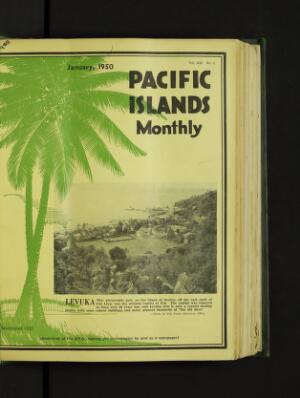
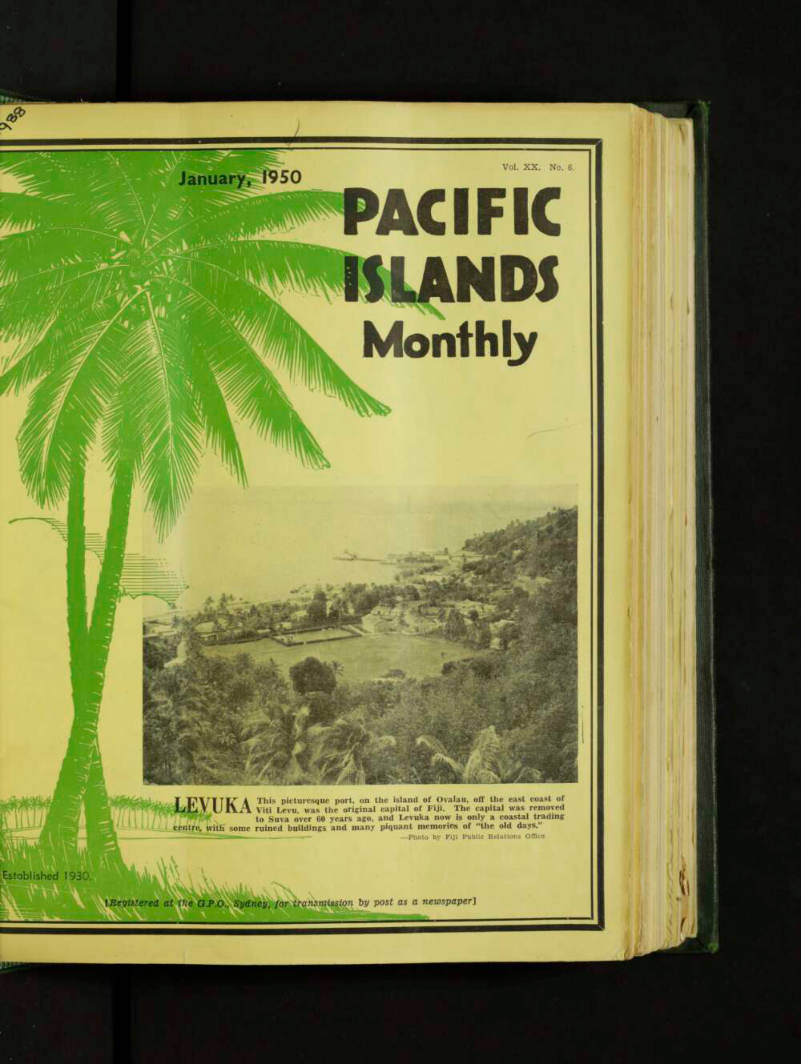
LEVUKA This picturesque port, on the island of Ovalau, off the east coast of Viti Levu, was the original capital of Fiji. The capital was removed to Suva over 60 years ago, and Levuka now is only a coastal trading centre, with some ruined buildings and many piquant memories of “the old days." —Photo by Fiji Public Relations Office
Advertisements & other items, pp. 2-4 (1 item)
q». .«•“’«»*“• *S.o V;» p;"’"'
W- \*] <V S * ,• ••• . - ~rm •,♦
wO 0* o 0^ 0* *0 a \\\* o 00 I o or rr ca 00 00 -► 4oO f oO o i O *••• 00 lK 00 lH I ..••:> o0 °
4T#Tr*
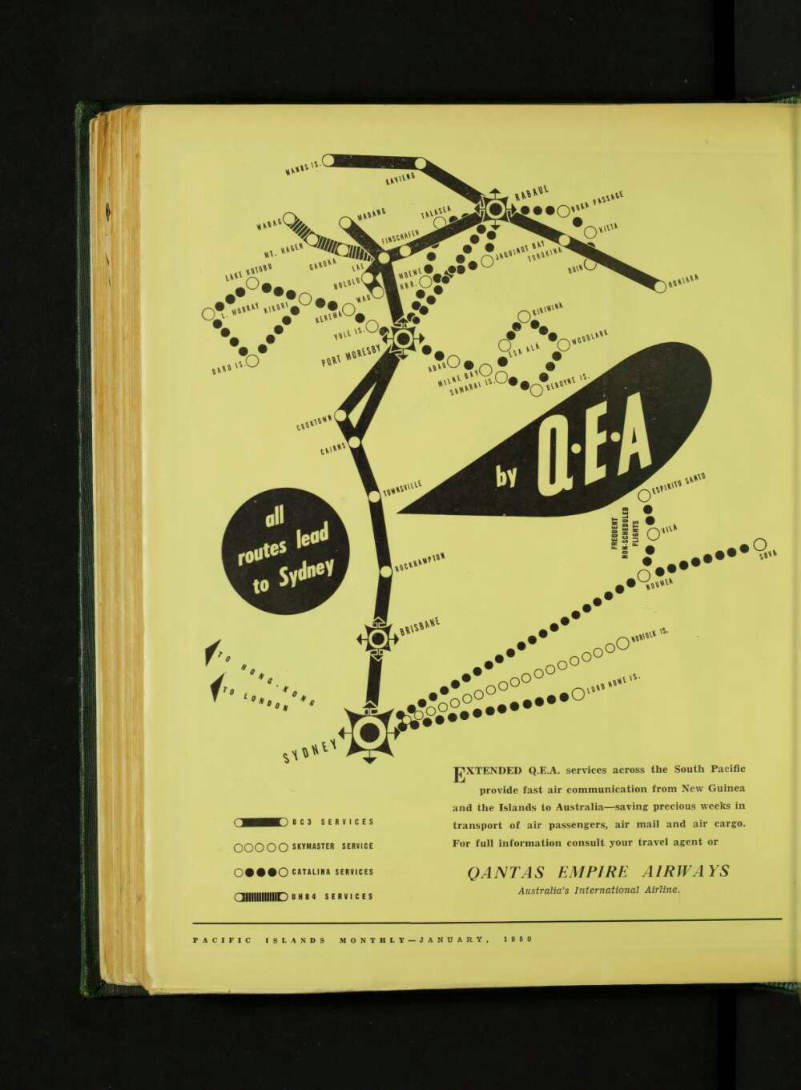
DC 3 SERVICES
00000 SKYMASTER SERVICE
o###o CATALINA SERVICES
ailllllllllllD DH 8 4 SERVICES EXTENDED Q.E.A. services across the South Pacific provide fast air communication from New Guinea and the Islands to Australia —saving precious weeks in transport of air passengers, air mail and air cargo.
For full information consult your travel agent or
QANTAS EMPIRE AIRWAYS
Australia’s International Airline.
w m m w a ?< h mmrn ii f'. 1 o r> 25 ' m 2 ■' : ':^o, W*L " "
Brazing Torches eßlow Lamps
Coleman Brazing Torches have solid-drawn heavy duty brass bodies with extra heavy brass bottoms.
All joints are mechanically sealed and securely soldered for double protection. Other features are : Sturdy bottom filler plug . . . positive shut-off fuel valve . . . removable gas tip . . . replaceable self cleaning needle . . . heavy longlife burners and heavy duty pump.
Each torch is inspected and given a pressure and burning test before leaving the factory.
PIG. I—Obtainable in two types, Petrol and Kerosene.
FIG. 2—Petrol burning only.
Fuel tank capacities of both are 1 pint and 1 quart.
FIG. 3—Coleman’s new Paraffin Blow Lamp which has valves interchangeable with European types of Lamps. The long-life burner and container are of heavy gauge brass. The container will withstand a pressure of 200 lbs. The flame is regulated through Air-release, there being no shut-off valve.
Tank capacities f, 1 and 2 pints.
Representatives for the Pacific Islands:
ROBERT GILLESPIE PTY. LTD.
540 PITT STREET, SYDNEY
PEARCE & CO. LTD
SUVA
FOR FIJI ISLANDS
A mjsm Another view of the “Brahol”
Export Counter case, showing width of counter space.
BRIEF SPECIFICATIONS
To help you get an accurate picture of the “Brahol”
Special Export Glass Counter Case, here are the main specifications: Overall size is 6 feet long x 1 ft. 9 in. deep x 3 ft. 3 in. high. Made from first-class, wellseasoned Queensland Maple, hand french polished, wax finished, in natural maple colour. Glass parts are i inch British plate glass.
The inside is lacquered ivory colour, and the recessed base is lacquered burgundy.
There is a pair of solid core sliding doors, and one glass shelf, 14 inches wide, on adjustable nickelplated brackets.
Storage space below is 11 inches high.
The plate glass front is 22 inches high.
Price at Works: £36/15/- Extra for 10-inch additional shelf and brackets (if required) : £2 Packing and Transport to Wharf : £lO/10/- (For cases shipped in quantities, packing is at greatly reduced rates).
The display case is securely packed in two substantial crates occupying shipping space of 32 cubic feet. Total weight, when packed, 5 cwt.
This Modern Display
Counter will Help to
Sell Goods in Your
Store!
( and it’s specially built for Export) As smart as those in leading Australian city stores, and built by a firm that has been making fine store and office fittings for over a third of a century.
Moreover, it is specially built for export, so that it can be readily securely packed, and assembled by anyone, from simple directions, in an hour, with no tools other than a screwdriver. Retailers all over the world have learned the selling value of modern display equipment, and this "silent salesman" will soon pay for itself in increased sales.
BRAY & HOLLIDAY
PTY. LTD.
Makers of Fine Store and Office
Fittings for over a third of a century Brahol House, 66-74 McLachlan Avenue, Rushcutter Bay, Sydney. Telephone: FA 4121 Cable and Telegraphic Address: “Brahol.”
Index to Advertisers
Achun, Gabriel . . 83 Alois Akun & Co. , 46 Aluminium Union 100 Amplion (A/asia) . 59 Angus & Robertson Ltd 19 “Aspaxadrene” . 98 Bank of NSW . . 16 Berger, Lewig & Sons (Aust.) Ltd. 27 Berry’s Bay Boat yard 81 Be thell, Gwyn & Co 89 Blaxland Rae Pty. 99 Blundell, Spence . 62 8.0.A.C. ... 20 Bovril 70 Bray & Holliday Pty., Ltd. ... 2 Breden, Wynne S. 33 Bristol-Myers Co.
Pty., Ltd. ... 39 Broomfields, Ltd. . 67 Brunton & Co., Ltd. 46 Budge, James, Ltd. 76 Bunting, A. H.
Ltd 25, 63 Bums Philp (NG) . 57 Burns Philp (NHj . 70 Burns Philp (SS) . 66 Burns Philp Trust . 95 Caine’s Studios . 61 Carpenter, W. R. & Cc,, Ltd. 64, cov. iv.
Carpenter, W. R. (Fiji), Ltd., , . 26 Carrlock Co., Ltd. 42 “Charmosan” ... 15 Classified Advertise ments 103 Colonial Meat Co. 40 Colyer Watson (NG) Ltd 22, 41 Crammond Radio . 84 “Cystex” ... 87 Dangar, Gedye & Malloch, Ltd. . . 3 Davison Paints . . 85 Degener, Otto . . 94 Donaghy, m., & Sons Pty., Ltd. . 35 Donald, A. 8., Ltd. (Auckland) ... 96 Donald, A. 8., Ltd. (Rarotonga) ... 38 Eichorn’s Remedies Pty., Ltd. ... 78
Electrolux . . . .64
E.M.F. Electric Co. 18 Etablissements Donald Tahiti . 45 Excelsior Supply Co 35 Export Soap Co*. 69 “Flit” ... 47 Ford Sherington Ltd Garrett, Davidson & Matthey Ltd. 104 Garrick Hotel . . 58 Gilbey, W. & A.
Ltd. 94 Gillespie Bros., Ltd. 67 Gillespie, Robert Pty., Ltd. ... 1, 93 Gillespie, Robert (NG), Ltd. . 74, 102 Gordon’s Gin . . 73 Gough & Co., E. J. 97 Grand Pacific Hotel 4 Gregory, A., Ltd. . 38 Grove & Sons, W.
H. Ltd 86 Halvorsen Lars Sons Pty., Ltd. . 86 Hardman & Hall 25 Heinz & Co., Ltd. . 29
Hemingway &
Robertson Ltd. . 66 Herco Pty., Ltd. . 96 Kibble, F. & son 102 Hoover Francis . . 69 International Trad ing Co. Pty., Ltd. 30 Johnson R. (Fiji) 101 Kasper Refriger ators Pty., Ltd. . 28
Kennedy. Captain . 90
Kerr Bros. Pty., Ltd. ... is,’ 99 Kodak (A/asia) Pty., Ltd. ... 24
Kolynos, Inc. ... 71 Kopsen, W. & Co. 23 Kosak, Robert . . 79 Kui, George ... 76 Kwong Chong Bros. 91 Larke Neave & Carter Ltd. . . 92 Macintyre, Thomas & Co., Ltd. ... 77 Mail Publicity Co. 22 Maloney, N. F., & Co 34 Mcllrath’s Pty., Ltd. 21 “Mendaco” ... 80 Merrillees, J. C., Pty., Ltd. ... 85 Millers, Ltd. ... 83 Morris, Hedstrom, Ltd 12 Motor Tractors Ltd. 32 Nelson & Robertson 37 “Nixoderm” ... 82 Nordman, Oscar G. 58 NZ National Air ways Corporation 48 Pacific Islands Society ... 58 Pacific Islands Trading Co. ... 33 Pacific Islands Year Book ... 13 Pacific School of Music ... 93 Pan American Air ways, Inc., Ltd. . 14 “Pinkettes” ... 37 Piper, Tom ... 31 Qantas Empire Air ways, Ltd. . cov. ii.
Old. Insurance Co .
Ltd 73 Ransomes, Sims & Jefferies ... 100 Reed, William E. . 101 Riverstone Meat Co. Pty., Ltd. . . 75 Robinson, G. H., E. & 1., Pty., Ltd. . 82 Rohu, Sll . . • • 29 “San Elanda” Guest House (Qld.) . . 18 Scott, J., Pty.. Ltd. 26 Shell Co. of Aust. . 61 Southern Cross Engine Co.. Ltd. 89 Southern Pacific Insurance Co., Ltd. ... 43 Steamships Trading Co., Ltd. . . 68. 88 Stewarts & Lloyds 74 Stratton & Co., Ltd 34 Sullivan, C., Pty., Ltd 30, 81 Swaan, Dr. Wm. . 75 Tallerman & Co. . 59 Taylor, Allen & Co. 97 Thornycroft. Ltd. . 90 Tilley Lamp Co.
Ltd. (England) . 44 Tillock & Co. Ltd. 77 Tongan Photos Bureau ... 71 Tooth & Co. . cov. iii.
Trans Oceanic Air ways Pty., Ltd. . 17 Tyneside Engineer ing Co., Ltd. ... 80 Union Mfg. & Ex port Co., Ltd. . 72 USL Batteries . . 83 Vacuum Oil Co. 36, 47 Ventura Trading Co. 42, 79, 83, 88, 99 Vincent Chem. 43 Watson, Wm. H. . 65 West, Harry ... 87 “Where the Trade Winds Blow” . . 17 Williams, Dr. . . . 65 Willreed Agencies Pty., Ltd. ... 91 Wills, W. D. & H.
O. (Aust.), Ltd. 60 Wright, E., & Co., Ltd 45 Yorkshire Insur ance Co.. Ltd. . 41 Young, A. H. & E. 47
Advertisements & other items, p. 5 (1 item)
isTen
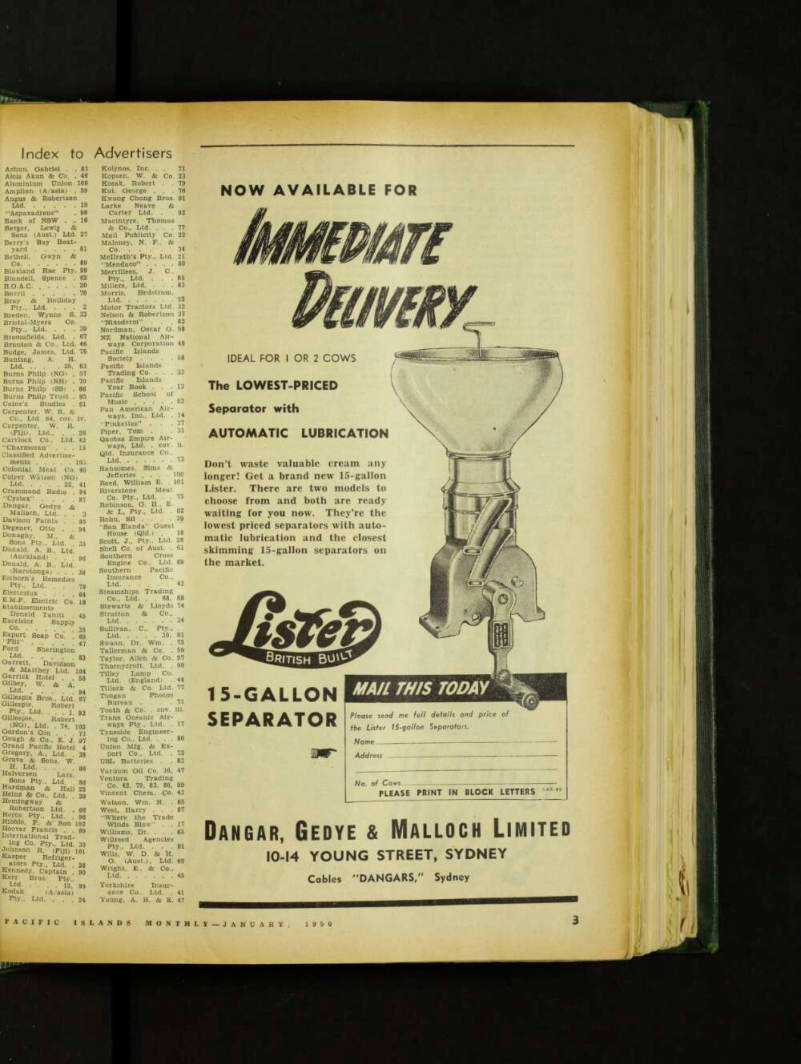
NOW AVAILABLE FOR
IDEAL FOR I OR 2 COWS
The LOWEST-PRICED
Separator with
AUTOMATIC LUBRICATION
Don’t waste valuable cream any longer! Get a brand new 15-gallon Lister. There are two models to choose from and both are ready waiting for you now. They’re the lowest priced separators with automatic lubrication and the closest skimming 15-gallon separators on the market.
isTen
British BvJ^
15-GALLON
SEPARATOR
o Please send me full details and price of the Lister 15-gallon Separators.
Name Address No. of Cows ...
PLEASE PRINT IN BLOCK LETTERS SAS 93
Dangar, Gedye & Malloch Limited
10-14 YOUNG STREET, SYDNEY
Cables "DANGARS," Sydney
In This Issue:
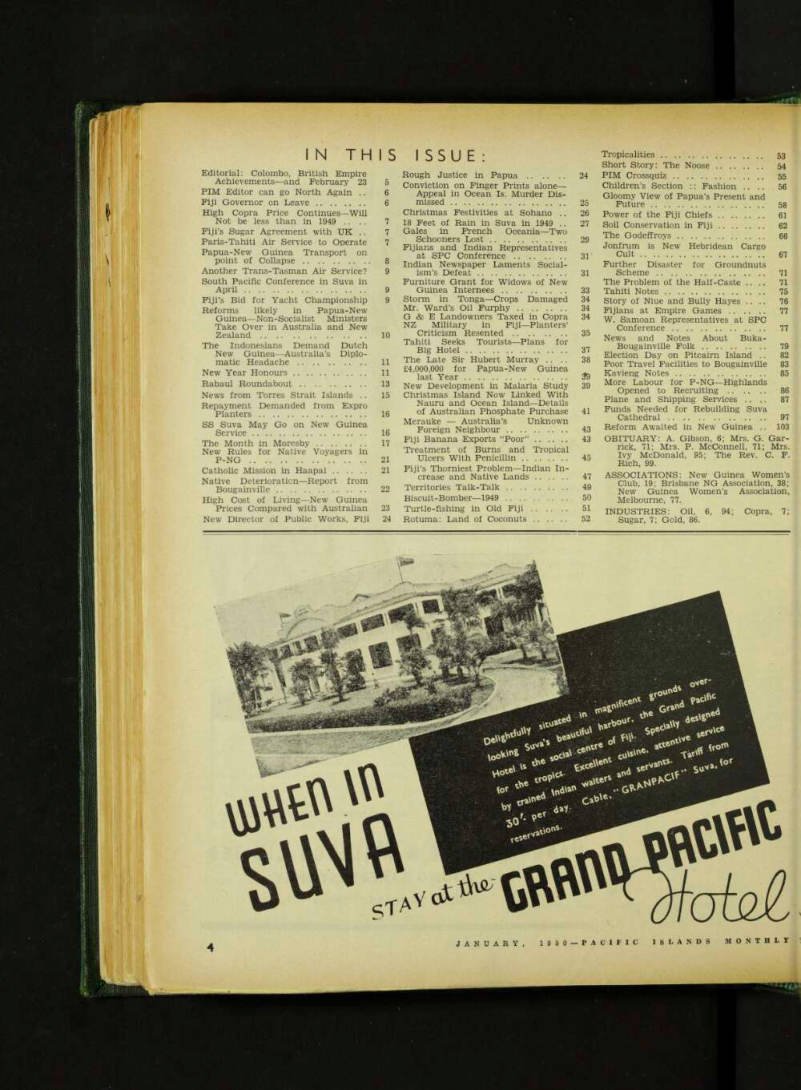
Editorial: Colombo, British Empire Achievements—and February 23 5 PIM Editor can go North Again .. 6 Fiji Governor on Leave 6 High Copra Price Continues—Will Not be less than in 1949 ... 7 Fiji’s Sugar Agreement with UK .. 7 Paris-Tahiti Air Service to Operate 7 Papua-New Guinea Transport on point of Collapse 8 Another Trans-Tasman Air Service? 9 South Pacific Conference in Suva in April 9 Fiji’s Bid for Yacht Championship 9 Reforms likely in Papua-New Guinea —Non-Socialist Ministers Take Over in Australia and New Zealand 10 The Indonesians Demand Dutch New Guinea —Australia’s Diplo matic Headache 11 New Year Honours 11 Rabaul Roundabout 13 News from Torres Strait Islands .. 15 Repayment Demanded from Expro Planters 16 SS Suva May Go on New Guinea Service 16 The Month in Moresby 17 New Rules for Native Voyagers in
P-Ng 21
Catholic Mission in Haapai 21 Native Deterioration —Report from Bougainville 22 High Cost of Living—New Guinea Prices Compared with Australian 23 New Director of Public Works, Fiji 24
Rough Justice in Papua 24 Conviction on Finger Prints alone— Appeal in Ocean Is. Murder Dis missed 25 Christmas Festivities at Sohano .. 26 18 Feet of Rain in Suva in 1949 .. 27 Gales in French Oceania—Two Schooners Lost 29 Fijians and Indian Representatives at SPC Conference 31 Indian Newspaper Laments Social ism’s Defeat 31 Furniture Grant for Widows of New Guinea Internees 33 Storm in Tonga—Crops Damaged 34 Mr. Ward’s Oil Furphy 34 G & E Landowners Taxed in Copra 34 NZ Military in Fiji—Planters’
Criticism Resented 35 Tahiti Seeks Tourists—Plans for Big Hotel 37 The Late Sir Hubert Murray ... 38 £4,000,000 for Papua-New Guinea last Year 39 New Development in Malaria Study 39 Christmas Island Now Linked With Nauru and Ocean Island —Details of Australian Phosphate Purchase 41 Merauke Australia’s Unknown Foreign Neighbour 43 Fiji Banana Exports “Poor” 43 Treatment of Burns and Tropical Ulcers With Penicillin 45 Fiji’s Thorniest Problem —Indian In crease and Native Lands 47 Territories Talk-Talk 49 Biscuit-Bomber —1949 50 Turtle-fishing in Old Fiji 51 Rotuma: Land of Coconuts 52
Tropicalities 53 Short Story: The Noose 54 PIM Crossquiz 55 Children’s Section :: Fashion ... 56 Gloomy View of Papua’s Present and Future 53 Power of the Fiji Chiefs 61 Soil Conservation in Fiji 62 The Godeffroys 66 Jonfrum is New Hebridean Cargo Cult 67 Further Disaster for Groundnuts Scheme 71 The Problem of the Half-Caste ... 71 Tahiti Notes 75 Story of Niue and Bully Hayes ... 76 Fijians at Empire Games 77 W. Samoan Representatives at SPC Conference 77 News and Notes About Buka- Bougainville Folk 79 Election Day on Pitcairn Island .. 82 Poor Travel Facilities to Bougainville 83 Kavieng Notes 85 More Labour for P-NG —Highlands Opened to Recruiting 86 Plane and Shipping Services .. .. 87 Funds Needed for Rebuilding Suva Cathedral 97 Reform Awaited in New Guinea .. 103 OBITUARY: A. Gibson, 6; Mrs. G. Gar rick, 71; Mrs. P. McConnell, 71; Mrs.
Ivy McDonald, 95; The Rev. C. F.
Rich, 99.
ASSOCIATIONS: New Guinea Women’s Club, 19; Brisbane NG Association, 38; New Guinea Women’s Association, Melbourne, 77.
INDUSTRIES: Oil, 6, 94; Copra, 7; Sugar, 7; Gold, 86.
Advertisements & other items, p. 6 (1 item)
/>
oX^ s
Pacific Islands Monthly
The Newspaper-Magazine of the South Seas
[.Registered at the G.P.0., Sydney , for transmission by post as a newspaper] Published Once Each Month and Circulated in Australia and New Zealand and in the following Pacific Territories and Islands Groups:
Australian Territory of Papua.
Trustee Territory (Australia) of New Guinea.
Australian Territory of Norfolk Island.
New Zealand Territory of Cook Islands.
Trustee Territory (NZ) of Western Samoa.
British Colony of Fiji.
British Solomon Islands Protectorate.
British Protectorate of Tongan Islands.
British Crown Colony of Gilbert and Ellice Islands.
Trustee Territory of Nauru.
British and French Condominium of New Hebrides.
French Colony of New Caledonia.
French Colony of Oceania (Tahiti, etc.), American Territory of Eastern Samoa.
American Territory of Hawaiian Islands.
Owned and Produced by Pacific Publications Pty., Ltd., Union House, 247 George Street, Sydney.
Telephone: General Office and Advertising, BW 5037.
P.O. Box 3408
Registered Address for Telegrams, Radiograms, and Cables: “Pacpub,” Sydney.
Contributions.
Articles, Stories, and Photographs dealing with Pacific Islands subjects are invited and will be paid for on publication.
Subscription Rates.
Per Annum, Pre-paid, Including Postage.
In Australia, New Zealand, Fiji New Guinea, Papua, Western Samoa, Cook Islands, Tonga, British Solo mons, Gilbert and Ellice Colony, Nauru, New Hebrides, and United Kingdom 18 0 Elsewhere $2.50 £1 1 o Single Copies 1 9
Editor and Publisher:
R. W. Robson. F.R.G.S.
Assistant Editor: JUDY TUDOR.
General Office: Union House, 247 George Street, Sydney. Telephone: BW 5037.
Business Manager: Selwyn Hughes.
Representative In London.
J. T. Wallis, Coronation House, 4 Lloyd’s Avenue, London, E.C.3, from whom may be obtained copies of Pacific Islands Monthly, Pacific Is. Year Book, advertising schedules, etc.
Representative In U.S.A.
Pacific Islands Trading Co., 244 California St., San Francisco, U.S.A,
Agents.
The following are authorised to receive sub scriptions for Pacific Islands Monthly:— Burns, Phllp & Co., Ltd., and Burns Philp (South Sea) Co., Ltd. All branches.
W. R. Carpenter & Co., Ltd. All branches.
Morris, Hedstrom, Ltd. All branches.
Steamships Trading Co., Papua. All branches.
Steele’s Central Store, Suva, Fiji.
Adams Pharmacies Pty., Lautoka, Fiji.
Cook Islands Trading Co., Rarotonga, Cook Is.
A. Vercoe, Apia, Western Samoa.
Oscar Nordman, Papeete, Tahiti.
Islands Branches and Representatives of W. H.
Grove & Sons, Ltd., Auckland, New Zealand.
Ed. Pentecost, Noumea, New Caledonia.
Societe Gubbay Kerr et Cie, Noumea, New Caledonia.
Vol. XXI. No. 6.
January, 1950
r 1/9 Per Copy.
Price 1 Prepaid, p.a.; 18/- Aust. / In USA, p.a.: $2.50.
Achievements—and February 23
Colombo , British Socialist Achievements—and February 23
ACTING with the precipitancy of political lunatics, the British Socialist Government, after taking office in July, 1945, gave independence to the politically untrained States of Burma, India, Pakistan and Ceylon, and supported the United Nations visionaries in dislodging the Dutch and creating the “United States of Indonesia.” Thus they destroyed a large section of the British and Dutch Empires, which had been responsible for maintaining peace and reason able orderliness in Asia for over 100 years.
The Colombo Conference was ar ranged by the Bloomsbury Planners to co-ordinate the policies of the English-speaking Dominions (Canada, Australia, New Zealand, South Africa) with those of their new Indian Dominions. But, meanwhile, as the British moved out of Asia, the Red Muscovites had moved in. The Com munists now have complete control of all Mongolian Asia, except Japan, and they are preparing an assault upon all the Indian States of Southern Asia, and the Mohamme dan-Arabic States of Southwest Asia.
So there was a note of urgency be hind the final arrangements for the Colombo Conference.
THE British went to Colombo ex pecting (a) the cordial co operation of fellow-Socialists from Australia and New Zealand and (b) the active goodwill of the grateful
“newly liberated” Indian States, in dealing primarily with the alarming problems of Asia.
But, before the delegates could as semble in Colombo, Australia and New Zealand had thrown their Socialists out of office. The Aus tralians and New Zealanders, like the Canadians and South Africans, re presented, at Colombo, Governments and peoples who, while deeply friendly towards their kinsfolk of the British Isles, are very critical of the Attlee-Bevin Socialist Administration.
Mr. Bevin, at Colombo, was the only Socialist Minister in sight.
And the Indians were neither clamorously grateful nor markedly co-operative. The Indian States probably will stay within the British Commonwealth so long as their ex istence is threatened by Russian Communism; but, inevitably, sooner or later, they will break away. The differences between the British and Indian countries are fundamental — racial, cultural, social, economic. The things which divide them are greater than those which unite them.
It is a pity. Ethnologically, the Aryan-Indians are closer to the Europeans than any other race. It should be easy for the Indian States, through a union with Western Euro peans, to vastly improve their stand ards of life. But the change will re quire a century or two of sympathetic co-operation; and, unfortunately, if
it is to come in time to present an effective barrier to Communism, it must be achieved within a couple of decades.
ALMOST before the Colombo dele gates had assembled, it was an nounced that the British Socialist Government, unable to find a resting place for its homing chickens—those most loudly squawking being inter national and economic in plumage— had decided upon a general election on February 23 (four months before it was necessary). As there are funda mental differences between Socialist and non-Socialist policies, especially those affecting Imperial and inter national affairs, it was not easy to carry on conversations such as those planned at Colombo.
So the Colombo Conference has been a “flop,” so far as the creation of any Asiatic barrier to Muscovite Communism is concerned. It prob ably would have been a “flop,” any way, because of the difficulty of finding any real basis pf immediate practical co-operation between the British Dominions and the Indian States. It was described, in the ab sence of the United States, as an at tempt to produce “Hamlet” without the Ghost. It probably has been worth while, however, as giving an opportunity for a most useful ex change of views and the creation of machinery for economic co-operation.
But is has done nothing to allay the justifiable fears of all communi ties in the South Pacific concerning what is happening in Asia. These new Indian States, unsupported, will not stand for any time at all against the Red flood. Support for
them can come only from close co operation between the Western De mocracies—especially Britain, the British Dominions and France—and the United States. And there is only one language which forces directing the Communist onslaught can under stand —that is the language spoken by guns and bombs. The crooning of the Bloomsbury Socialists will achieve no more in the future than it achieved between 1945 and 1950, in which period its feeble policies have let the Muscovite loose upon the northern world.
The complete wipe-out of the British Socialists on February 23 will open a new era in British history— a dangerous era, maybe, but also an opportunity for the re-establishment of British strength and British pres tige. Our losses, both material and moral, since 1945, have been appal ling. But, with British Common wealth co-operation, American sym pathy and help, and that courage and staunchness shown in 1940-45 under Churchill’s leadership, we can get ourselves out of the morass, and help greatly in restoring sanity io the world.
February 23 will be far more than a vote for a new British Government.
It quite easily may be a turning point in imperial and international affairs.
Late News
January 16.
Major h. g. gregory-smith, Commissioner of the Interior, British Guiana, has been appointed Resident Commissioner in British Solomon Islands. He will arrive in Honiara in February. He is 50; served in Kenya until 1940; served in World War II; went to Guiana in 1946. * ♦ ♦ Mr. C. E. de F. Pennefather, who re tired from the post of Adviser oh Native Affairs, Fiji, in 1943, and had served 33 years in the Pacific, died in Auckland on January 8, aged 65. • ♦ ♦ Six BGD dredges in New Guinea in December got 5,096 oz. of fine gold from 1,024,000 yards of gravel.
Cuthberts Misima Mine (Papua) in December got 467 oz. of bullion—49 oz. gold, 67 oz. silver—from 269 tons of ore, * ♦ ♦ Rabaul residents are strongly opposing Education Department’s proposal that European, Chinese and half-caste child ren shall all be taught together in new primary school.
An Anti-Socialist Atomic
Bomb
This cartoon was published in New Zealand Herald the day BEFORE the NZ general elections. New Zealanders wondered that day whether they would start a political chain reaction.
They did! Out went the NZ Socialists on November 30! On December 10 there came the Australian general elections — and out went another strongly-estab lished Socialist Government.
On February 23, we shall see the British general elections. What will Britain do?
Travel North
PIM Editor Can Again Travel North Wardism and the Permit System
NOW that Socialist control of Papua- New Guinea is gone, the editor of the Pacific Islands Monthly will be permitted to visit the Australian Terri tories again. Before War and Wardism, he usually had a look round the Terri tories every year.
Although he did a minor war job in the Gilberts in 1941, he was unable to visit Papua and New Guinea between 1940 and 1945; but, as soon as the Japs surrendered, and the war was over, he made formal application to be allowed to visit Papua-New Guinea.
To his astonishment, the Socialist Minister for Territories, Mr. Ward, re plied personally to the application. He said (see PIM, February, 1946) that he could see no good reason why Mr. Rob son should visit the Territories, and therefore the application was refused. He added that if Mr. Robson would renew his application in six months’ time, the application would be “considered.”
The PIM editor wrote the following footnote: “It is unlikely that we shall visit the Territories in 1946; but we shall visit the Territories many, many times after Minister Ward, and the quaint Socialist structure he has erected in the Territories, have been consigned to the limbo of forgotten politicians.”
Unfortunately, the Australian Socialist Government was not defeated in 1946, as we had hoped; and, as the editor was un willing to again stick his neck out for Mr. Ward’s axe, he had to wait another three years. The PlM’s assistant editor (Mrs. Tudor), disguised as a woman, has been able to get past Canberra’s guard, and visit Territories’ centres, but for years past the editor has confined his travels to Fiji and places eastward.
Now that responsible government has been restored, it is hoped that the cum bersome, bureaucratic system of Travel Permits will be wiped out, and only sufficient control retained to regulate traffic to the capacity of the accommoda tion available in Papua and New Guinea.
Mr. Alf Gibson, Of Papua,
Killed In Accident
ONE of Papua’s best-known residents, Mr, Alf Gibson, was accidentally killed on January 4, and was buried on January 5, Mr. Gibson spent most of the years be tween the wars as a member of the staff of the Government Printing Office, Port Moresby; and he was foreman there, fol lowing “Ted” Baker, in 1942, when evac uation occurred. Having completed 28 years’ service, he retired on pension; but he returned to the Territory about 1947 to carry on his photography business, which he had developed most successfully from a lifetime hobby. Mr. Gibson mar ried a New Zealand woman, but there was no family. Mrs. Gibson, to whom the sympathy of many friends will be ex tended, has been living in Sydney in re cent years.
Oil Search In Papua
Australian petroleum co. ltd., reported on January 10, as follows, on the progress of boring in Papua: HOHORO: Depth 3,585 feet. Following cementation of 13 3/8 inch casing at 2,539 feet and changeover of well-head, hole has been cleaned out to bottom and drilling is now pro ceeding.
UPOIA: Depth 3,662 feet. Fishing operations are proceeding, frozen drill pipe having been re covered from 1,240 feet to 1,770 feet.
MALALAUA Camp development is proceeding; substructure and derrick erection commenced.
WANA: Levelling of rig site has been com pleted and work on foundations commenced.
ORIOLI: River and land approaches to the rig site have been examined to decide upon an access route.
A report broadcast in Australia on January 10, that traces of oil had been found in a Papuan bore, did not come from the APC.
Fiji Governor On Leave
THE Governor of Fiji (Sir Brian Pree ston) will proceed on ieave to the United Kingdom on January 17. He expects to be back in the Colony about the beginning of April.
During his absence, the Colonial Se cretary (Mr. A. F. R. Stoddart) will act as Governor of Fiji, and Mr. G. D.
Chamberlain wil act as High Commis sioner for the Western Pacific.
Chain Reaction ?
High Copra Price To Continue
Will Not Be Less Than 1949 In Current Year
THE price of Pacific Islands copra, in 1950, is going to be as high as it was in 1949—perhaps a little higher. This happy news for planters became known about the end of December.
Towards the end of 1949, it was an nounced that the MOF (British Ministry of Food) price—fixed under the guarantee covering the period 1949-1957—f0r 1950 would be around £45 Sterling per ton, compared with £4B per ton for FMS grade in 1949. This was a reduction of over 6 per cent. Under the guarantee, the price was to be negotiated each year but was not to be more than 10 per cent, higher or lower than the previous year.
It was assumed that there would be some reduction in 1950.
But the copra producers in some British countries —Ceylon, notably—pro tested strongly against any reduction.
They reminded Britain that the devalua tion of the £, if it meant anything at all, meant that copra was now more valuable in terms of the £, because copra held its intrinsic value, as a foodstuff. In the ultimate analysis, a commodity like copra should be valued in terms of gold (or dollars, of course); and this meant that, if copra was worth £4B per ton in mid-1949, it now was worth over £6O per ton, America is such a big consumer of copra that the intrinsic value of the commodity (that is, its gold value) could not be ignored.
The British Ministry apparently ac cepted this view. It was announced at the end of December that the Sterling price of FMS copra in 1950 would not be less than the 1949 price, plus an addi tional 10/- per ton.
This makes the price for 1950, in Fiji currency, £53/14/3 per ton; and, in Aus tralian currency, about £6O per ton—a very acceptable Christmas Box, Fiji planters will, in 1950, get the equi valent of the MOF price, less handling charges. They were getting 25/- per ton more than that in 1949, but that was done in order to get rid on an accumulation of planters’ funds in the hands of the Fiji Copra Board. Those funds have now been distributed.
There has been no official announce ment regarding the 1950 price for planters in Papua-New Guinea; but that is not surprising, in view of the Governmental changes that are taking place. It is safe to say that the price will not be below 1949—and, probably, it will be higher.
Fiji was fortunate in that its Director of Agriculture, Mr. C. Harvey, was in London in December negotiating the Sugar Agreement. When he saw what was happening in relation to copra, he promptly pressed the claims of Fiji and the Western Commission territories, and got a prompt response. This is one of the few examples of a high official bar gaining strongly on behalf of producers.
As a rule, officials do not do as well as the producers themselves.
No one, as far as we know, has yet taken up the matter of the Papua-New Guinea price with MOF: but the rate, whatever it is, will be retrospective to January 1,
That “Stabilisation Fund”
PAPUA-NEW GUINEA planters and merchants should take the oppor tunity, presented by the change in Government, to press their claims for an accounting in respect of the “stabilisa tion” deduction—ranging from £5 to £7 or £8 per ton—taken from their returns by the Production Control Board, over three or four years.
No one was able to get from Socialist Minister Ward any details of this trans action —the amount of the accumulation or what was ultimately to be done with it—but it may be taken as certain that the fullest information will be supplied by the new Minister.
It is believed that the total accumula tion is now between £400,000 and £500,000.
This money belongs to the planters. There has been no need for a Stabilisation Fund since Papua-New Guinea got the benefit of the MOF nine-years’ guarantee.
The method of distributing it to planters is likely to cause some headaches. The planters who suffered the original deduc tion naturally will claim that the money is theirs. But the officials—unless they have kept very exact records of deliveries and payments over the past four years— will be inclined to get rid of the accumu lation by simply making an additional per ton payment on future deliveries, as they did in Fiji in 1949.
In any event, the matter calls for early clarification.
There will be a meeting of the Aus tralian Parliament in February or March, and it is expected that the new Minister for Territories, having had a chance to examine the whole position, will then make a statement concerning the copra market and the Papua-New Guinea copra prices and control, and the future of the Production Control Board.
Planters Should Be
Represented
AVERY good point is made, in a letter to the editor, by “Planter,” written before the new British price was an nounced:— “Planters in the British areas of the Pacific are doubtful whether the various copra boards have any real bargaining powers with the British Ministry of Food.
They would prefer a system which would ensure them open and independent re presentation at any price-fixing con ference when the dickering and ‘horse trading’ begins.
“A strong suspicion exists amongst planters that the present method of price fixing has taken control of their product away from them, and that, in many cases, their side of the bargaining is in the hands of Government representatives or nominees who have too many points of contact and Administrative connections with the gentlemen on the other side of the table.
“I suggest that an elected representa tive of the planters, from the Empire producing areas of the Pacific and Ceylon, should meet the representative of the British Ministry of Food in Sydney to wards the end of each year, during the currency of the agreement, and that they should agree upon the price for the com ing year. The one basic price (with local variations) should be agreed upon by all the representatives at the one price-fixing conference.”
Copra at £6O Stg. per Ton
Colombo, Jan. 6.
COPRA has been sold in the open mar ket since the British-Ceylonese agreement expired on December 31, and the price has risen so steeply that many millers have preferred to stop work rather than pay up to 185 rupees (£l3/7/6 sterling) a candy (500 lb.) (equal to £6O sterling or £75 Australian, per ton).
Following on that, all licences to ex port copra have been cancelled.
Paris-Tahiti
New Air France Service
From Our Own Correspondent
Papeete. Jan. 2.
IT has been officially announced that the first DC4 of Air Prance is scheduled to leave Paris for Bora Bora on January 18, 1950, and should arrive at its destination on January 28.
A Catalina plane of the TRAP AS Com pany, Noumea, will be stationed in Papeete to ferry passengers to and from Bora Bora.
In this way, the long-desired contact by air between Tahiti and the outer world will be inaugurated at Papeete, and the way made ready for the tourist traffic which is hoped for.
A special programme is being arranged in Papeete to welcome the arrival of Air France.
The Air France route will be via Aus tralia, New Caledonia and Fiji.
Fiji Sugar
Confidently Expected That New Agreement Will Give Security To Industry
Sydney. Jan. 12.
ALTHOUGH an official statement re garding a guaranteed quota and price for Fiji sugar is still awaited, enough is known of recent developments in London to give Fiji sugar interests con fidence that the future of this important industry now is secure for several years.
It is anticipated that the British Colonies will be given a quota of 1,550,000 tons per annum, which will be divided between the United Kingdom’s guaran teed market (1,100,000 tons) and Cana dian and other British markets (450,000 tons).
Fiji will supply a part of that 1,550,000 tons per annum. The proportion is not yet announced, but everyone is confident that it will be satisfactory.
Under the current agreement with the British Ministry of Food —now in opera tion, and to remain in operation until the end of 1952 —Britain takes all the sugar that the Dominions and Colonies can produce, at a guaranteed price. The new agreement is to guarantee the quantity and the price that Britain and allied markets will accept in 1953-57. The price will be fixed by periodical dis cussions, within a fixed range, and those regular conferences also will decide whether the guarantee will extend into 1958 and beyond. It is confidently ex pected that the guarantee will be so extended.
The general effect will be the stabilisa tion of a great industry that, in the past, has been subject to very embarrassing fluctuations. The guarantees covering quantity and price will enable planters generally to make long-term plans for planting.
Strike Talk Is Embarrassing
Suva. Dec. 19.
TALK of strikes on Fiji’s canefields, plus a recently-issued “call” to members of a farmers’ association to stop growing cane, could jeopardise the Colony’s sugar export industry.
A Government statement says that Fiji’s delegation to the London sugar con ference, which includes Swami Rudran anda and Mr. H. S. L. Polak. has protested that such propaganda can be extremely embarrassing, since other pro ducing countries could use such information as an indication that Fiji was unlikely to produce the quota for which it was asking.
Papua-Ng Sea Transport On Point Of Collapse
Socialist Defeat Came Just in Time
WITH the defeat of the Australian Socialist Government, it was expected that there would be an early removal of Papua-New Guinea’s muddling and inefficient “Directorate of Shipping”; and the copra-producers’ united sigh of relief, on December 11, could be heard from Kavieng to Daru The Directorate of Shipping was a Wardist dream which took this form;— • The Australian shipowners—those “greedy and ruthless exploiters —were wiped out of the Islands coastal transport which became a State monopoly. • Mr. Leighton (a friend of, and onetime political campaign director for Mr.
Ward) became “Director of Shippmg. • A fleet of small ships was created at enormous cost, with personnel enjoying pay and privileges in accordance with the Socialist utopia. • No private owner was allowed to carry cargo or passengers for profit along the coasts of Papua and New Guinea if his craft was more than 25 tons weight.
The “Directorate of Shipping” had a three years’ run, under the benign rule of Mr. Ward and his delegates; and, if reports from all over the Territory have any significance, it achieved a condition of chaos and ineptitude that almost begsj&rs description.
In the following columns, we have produced bits and pieces from various reports dealing with the shipping situation which have come in from the Territory
during the past month—written mostly before the Australian election. They speak for themselves, The defeat of the Australian Socialists came just in time to prevent a complete collapse of inter-island sea transport in New Guinea. . The latest report from Port Moresby is that Mr. Leighton, “Director of Shipping,” has gone away on leave, on the ground The f u t ure G f the shipping industry j n p a pua-New Guinea is discussed else where. No decisions have yet been taken. Even if it is decided at once to out the inefficient organisa tion an d restore shipping control to private enterprise, the present chaos and demoralisation of personnel will not be overcome for many months,
Haphazard Control
From a New Britain planter:— CIHIPPING, of course, is in its usual O chaotic state; and the mounting stores of copra in the sheds, and delay in receiving essential supplies, cause deep and profound cursing by the pro ducers. . s . . . . - When a ship arrives, its place of load ing is quite uncertain as, despite advices from Directorate of Shipping cind ship s agents, by radio, the ship often gaily goes to quite another place to load. The skippers of these comic-opera craft state that they receive no written orders from
Directorate or agents, but just a casual verbal instruction which often conflicts with radios sent out to expectant planters.
It seems to irate producers that the place at which to pick up copra is largely a matter for the skipper to decide —which is why there are suggestions of favouritism being practised. The whole position is really serious and a complete breakdown of the service is expected.
During November, a shipping list, just issued, was checked by interested people in Rabaul; and it was found that, out of 11 ships listed, only two were fit to go to sea.
The way that the native crews just walk off the ship, whenever they see fit, is a truly scandalous state of affairs, and adds to the general mess and confusion.
Half The Ships Were ‘Out’
From a correspondent in Lae:— lAM told that of a fleet of 10 or 12 small ships, supposed to be servicing New Guinea, the following were dis posed of thus in mid-December: In Rabaul harbour, “undergoing re pairs”—Raluana, Kelanoa, Kokoda, Kelaua.
Broken down at Ablingi—Maimero.
En route from Moresby, to tow Maimero —Karu.
How Planters Are Treated
From a New Britain planter:— IT is understood that shipping news— of the utmost interest to all of us— shall be broadcast at noon each day.
At least three times a week the broadcast consists of “There will be no shipping news this morning—nothing has been re ceived from the Director of Shipping.”
When we do get news, it is often unre liable and misleading.
A resident of Witu asked when a vessel could be expected, as his wife was in Rabaul and wanted to get home, and he needed stores. He was told on October 12 that the Kelanoa would be going to Witu in about 10 days. Next it was broadcast that the Kelanoa would be sailing for Madang, via Witu, early in November.
Thenceforward, from early November until mid-December, at intervals of a few days, the departure of the Kelanoa was broad cast—and cancelled. On December 11 she was still in Rabaul, undergoing repairs.
Early in December, Mr. Murray, of Langu Plantation, Witu, being in des perate need of stores, chartered Mr.
Charles Blake’s vessel, Talasea, to go to Rabaul. When she got there, the Shipping Department flatly refused to hand over Mr. Murray’s stores, although they had been in Kelanoa for a month. Messrs.
Gwilt, of Meto, Antill, of Lama, and McLean, of Ilia, were similarly treated— and some are now threatening legal ac tion.
The Maimuna was sent from Rabaul to Witu to load copra. Although all Witu planters were now in sore straits for sup plies, and cargo on the Kelanoa could have been transhipped in a few hours to the Maimuna, the indifferent Direc torate of Shipping did nothing about it.
The Malakua, en route to Madang in October, called at Witu plantations. She did not bring one bag of mail. She was supposed to pick up a full load of copra at Bali plantation. She discharged a few cases of goods, and then went on her way, not picking up any copra at all. No explanation was given.
Lack of Knowledge and Planning
From a Territories resident: — THERE has been a lamentable lack of practical knowledge shown in the equipment of the coastal ships. None of them seems to have enough boats for
(Continued on Page 100)
the efficient loading of copra. A sufficient number of properly designed boats, with some power unit to help them along, would greatly reduce loading time. But the whole system is haphazard and in efficient.
Another source of complaint is the high handed, arbitrary way in which the Direc torate and/or its agents deal with radio’d requests for goods. The planters listen for the broadcast news that ships will go to their districts. Thereupon, they radio for stores. More often than not. some of them say, they get the uncompromising answer that Bills of Lading have closed.
This may be three or four days before the little ships sail.
Copra Accumulating
From a Rabaul correspondent:— AT the end of the year, there were com plaints from various parts of the Territory of Papua-New Guinea that copra was piling up, owing to lack of coastal ships, and in some cases was de teriorating.
For example, in the Witu district, on December 12, there was an accumulation of 6,000 bags, produce of six plantations.
Burns Philp, controlling four plantations, and having plenty of finance, was not worrying; but the 3,000 bags piled up on Langu and Bali represented an increasing headache to two private planters, whose financial resources presumably are not endless. The “Director of Shipping” ad vised in December that the Maimuna would go and load copra in Witu. She can lift 660 bags!
Conditions in Buka and
Bougainville
From Our Correspondent
Sohano, Dec. 15.
DURING the visit of the Administrator (Colonel J. K. Murray) to Eastern New Guinea on December 6, the president of the Bougainville Association (Mr. F. P. Archer), and the hon, secretary (Mr. Max Babbage), had a discussion with His Honor on matters relating to District affairs and welfare. The Acting District Officer, Mr. R. Cole, was present. The following were under review:—
Shipping
The deputation pointed to lack of ships, general inefficiency in methods of handling ships; lack of co-ordination be tween Shipping Directorate, ships’ agents and ships’ officers; no written and definite instructions to master, on vessel leaving
Rabaul Residents In Festive Mood
ON Christmas Eve, for the third year in th. 6 CosrrioDolitEtri Trading Company, Rabaul, New Guinea, gave a cocktail party and buffet tea at the Cosmopolitan Hotel. The Company wished to say “Merry Christ- TeToFmem ™ S photograph Sh ° WS a Miss Dorothy Stewart, who has a gift for catering for large crowds, was hostess and had provided an amazing array of
beautiful food to which guests did such justice tiis/t they were to torgo u more formal dinner they arrived between 6.30 and 7 Tinn^wh^f 9 other and midmght depending up«what other plans they had had for the evening. aHld Rabaul custom It is a post-war development which pleases residents very much—although living in a temporary town they like to be gay on occasion.
Another Trans-Tasman
Air-service?
IT has already been hinted in New Zea land that with non-Labour govern ments now in office on both sides of the Tasman, another trans-Tasman air service may be permitted. At present, Tasman Empire Airways (owned jointly by the New Zealand, Australian and UK governments) has a monopoly of this route. This airline was taken over some years ago by the Socialist governments concerned after it had been pioneered by private enterprise.
There are three airlines now operating across the Pacific from Australia and/or New Zealand to the Pacific coast of North America (British Commonwealth Pacific Airlines, Pan American Airways and Canadian Pacific Airlines). The logical route from North America is to Fiji, New Zealand and then across the Tasman to Sydney. But the Socialist owners of TEAL were so hell-bent in keeping the Tasman route a close preserve that they would not permit the trans-Pacific air lines (even government-owned BCPA) to be logical. Instead, Auckland was made the terminal of a sort of branch line from Fiji and this made it necessary for both PAA and BCPA to run special services from this point. CPA did not enter this field.
Will the new Governments correct this anomaly? Before making any wild guesses it is as well to remember that for the year ending March 31, 1949, TEAL had lost money at the rate of £A4,000 per week.
This demanding infant is now the respon sibility of the new governments (UK has only a 20 per cent, interest) and it is unlikely that they will do anything that will put finances any further into red ink. What they should do, however, with out delay is to make a searching investi gation into the mounting losses of govern ment-owned airlines generally.
Travellers between Australia and the North Island of NZ are probably well enough served. But travellers from Aus tralia to NZ’s South Island are still left lamenting. If there is need for a new NZ-Australia air-service then first priority should go to a service between Australia and Christchurch which has the best po tential airport in the Dominion. Although New Zealand is very small in comparison with Australia, its internal transport by
road, rail or air is much more difficult owing to the fact that a large part of NZ is built in the perpendicular and because the country is neatly divided into two main parts by Cook Strait.
A few years ago Australian National Airways Pty., Ltd., offered to start a new air service between Melbourne and Christ church. The Labour governments then in office were not interested.
Ansett Wants to Run a Service IT was announced on January 12 that Ansett Airways, a large Australian air company, has applied to the governments of Australia and New Zea land to operate an air service between Melbourne and Christchurch.
The managing director of the company said that Skymasters could be secured for the service without dollar expendi ture.
It is believed that applications to run a new trans-Tasman air-service will not stop at this one and that other companies will be in the running. The manager of ANA has announced that his company applied for a similar permit two years ago.
Reorganisation of NZNAC
IT has been stated in Australia, un officially, that the New Zealand National Airways Corporation is to be re-organised as a partially privately owned airline company. This is un scrambling the eggs with a vengeance.
The NZNAC took over internal routes operated by Union Airways and Pacific regional routes pioneered by the RNZAF.
Last year the Pacific services showed a loss of £21,000.
There should be some interesting de velopments in aviation in the South Pacific in the next 12 months but while the British Commonwealth continues to have dollar problems, it is unlikely that private companies will be given too free a hand.
The Australian Department of External Territories is seeking a medical officer for Nauru Island.
The position will carry a salary of £1,200 to £1,400 taxfree.
Preference will be given to doctors with experience in tropical medicine and hos pital administration.
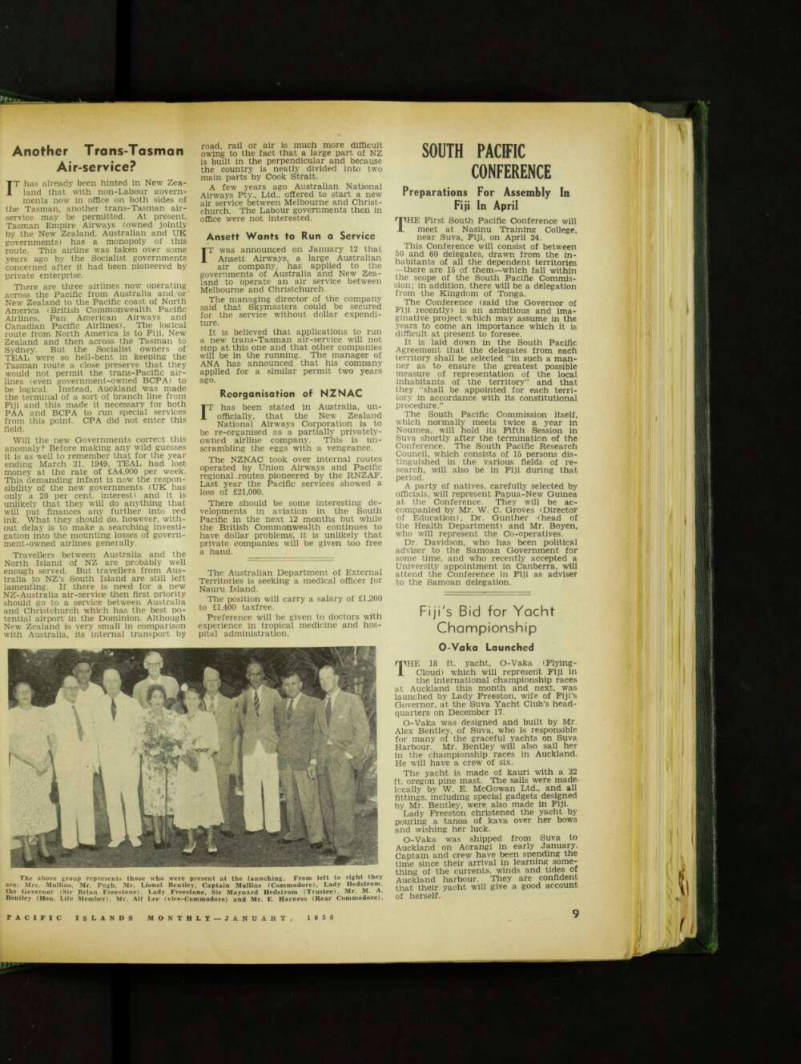
The above group represents those who were present at the launching. From left to right they are: Mrs. Mullins, Mr. Pugh, Mr. Lionel Bentley, Captain Mullins (Commodore), Lady Hedstrom. the Governor (Sir Brian Freestone), Lady Freestone, Sir Maynard Hedstrom (Trustee), Mr. M. A.
Bentley (Hon. Life Member), Mr. Alf Lee (vice-Commodore) and Mr. E. Harness (Rear Commodore).
South Pacific
Conference
Preparations For Assembly In Fiji In April
THE First South Pacific Conference will meet at Nasinu Training College, near Suva, Fiji, on April 24.
This Conference will consist of between 50 and 60 delegates, drawn from the in habitants of all the dependent territories —there are 15 of them—which fall within the scope of the South Pacific Commis sion; in addition, there will be a delegation from the Kingdom of Tonga.
The Conference (said the Governor of Fiji recently) is an ambitious and ima ginative project which may assume in the years to come an importance which it is difficult at present to foresee.
It is laid down in the South Pacific Agreement that the delegates from each territory shall be selected “in such a man ner as to ensure the greatest possible measure of representation of the local inhabitants of the territory” and that they “shall be appointed for each terri tory in accordance with its constitutional procedure.”
The South Pacific Commission itself, which normally meets twice a year in Noumea, will hold its Fifth Session in Suva shortly after the termination of the Conference. The South Pacific Research Council, which consists of 15 persons dis tinguished in the various fields of re search, will also be in Fiji during that period.
A party of natives, carefully selected by officials, will represent Papua-New Guinea at the Conference. They will be ac companied by Mr. W. C. Groves (Director of Education), Dr. Gunther (head of the Health Department) and Mr. Boyen, who will represent the Co-operatives.
Dr. Davidson, who has been political adviser to the Samoan Government for some time, and who recently accepted a University appointment in Canberra, will attend the Conference in Fiji as adviser to the Samoan delegation.
Championship
Fiji's Bid for Yacht
O-Vaka Launched
THE 18 ft. yacht, O-Vaka (Flying- Cloud) which will represent Fiji in the international championship races at Auckland this month and next, was launched by Lady Freeston, wife of Fiji’s Governor, at the Suva Yacht Club’s head quarters on December 17.
O-Vaka was designed and built by Mr.
Alex Bentley, of Suva, who is responsible for many of the graceful yachts on Suva Harbour. Mr. Bentley will also sail her in the championship races in Auckland.
He will have a crew of six.
The yacht is made of kauri with a 32 ft. oregon pine mast. The sails were made locally by W. E. McGowan Ltd., and all fittings, including special gadgets designed by Mr. Bentley, were also made in Fiji.
Lady Freeston christened the yacht by pouring a tanoa of kava over her bows and wishing her luck.
O-Vaka was shipped from Suva to Auckland on Aorangi in early January.
Captain and crew have been spending the time since their arrival in learning some thing of the currents, winds and tides of Auckland harbour. They are confident that their yacht will give a good account of herself.
Reforms Likely In Papua-New Guinea
Non-Socialist Ministers Take Over in Australia and New Zealand
A CHANGE from Socialist to non- Socialist Governments in Australia (December 10) and New Zealand (November 30), with the consequent ap pointment by both countries of new Min isters for Islands Territories, with a new policy, is a matter of considerable im portance to Islands dwellers generally.
The political land-slide will not greatly affect the islands controlled by New Zea land (Cooks and Western Samoa), where administration generally has followed cer tain well-worn paths; but in the large Territories of Papua and New Guinea, which have had a full-blooded dose of Australian Socialism, with lamentable results, there are likely to be some marked changes in both policy and ad ministration.
The new Australian Minister for Ex ternal Territories is Mr. Percy Spender, who is also Minister for External Affairs (or Foreign Minister).
Mr. Menzies’ decision to place those two portfolios in the hands of one man is a new idea, but a sound one. We have reached the stage where Australia’s “ex ternal affairs” are deeply concerned with events and developments in and around the Pacific, and especially in Asia; and the administration of Australia’s Pacific Islands naturally ties in with Pacific affairs generally.
The main objection to the new ar rangement is that External Affairs is an important portfolio, and the Minister may be so preoccupied with it that he will not have much time for External Territories— which, under present conditions demands a lot of time.
It appears, however, that Mr. Menzies has adopted the system of Parliamentary Under-Secretaries, which means that se lected younger Parliamentarians will be come first assistants to senior Ministers.
There will be an Under-Secretary for External Affairs and External Territories,
which will mean that Australian Terri tories affairs generally will be dealt with by a junior Minister, who will submit recommendations on all important things to his senior.
That might work out very well —it de pends on the calibre of the Under secretary selected for (External Terri tories. The most persistent forecast, so far, is that the job will go to Mr. Paul Hasluck, a newly elected West Australian, who was formerly a journalist and a pro minent official in the Department of Ex ternal Affairs. He should make an admirable junior Minister for the Terri tories.
There are three or four men in the Menzies Government who know a good deal about Pacific Islands affairs, and any one of whom would have made an acceptable Minister for External Terri tories —Mr. White and Mr. Anthony come readily to mind. But none is better in formed on Pacific affairs generally, and on certain aspects of Islands administra tion in particular, than Mr, Spender; and the Australian Territories are lucky that they have been given into the care of this shrewd, hard-hitting, straight-thinking Minister. He had not been a fortnight in office before he was called away to Indonesia and the Colombo Conference, where he is at this moment, and where already he has made a notable impres sion.
Before leaving Australia, Mr. Spender said he would visit Papua and New Guinea at the earliest possible moment, and he would make no fundamental change in administration until he had examined conditions on the spot.
PAPUA-NEW GUINEA literally cries aloud for reforms and alterations in several directions; but it seems un likely that anything important will be done for three or four months. Mr.
Spender is deeply involved with Australian foreign affairs; it is unlikely he will have time personally to visit the Territories between his return from Colombo and the assembling of the new Parliament on February 22; that session will last for a couple of months; and then the Minister probably will visit the Territories, and formulate recommendations for Cabinet.
But there are so many matters urgently demanding attention in the Territories that it is possible that steps will be taken to deal with them long before the Parliamentary session ends.
One suggestion is that, as soon as the Under Secretary is appointed, he will make a quick visit to the Territories be fore Parliament meets; and that he and the Administrator (Colonel J. K. Murray) will then confer in Canberra with Mr, Spender, so that the more urgent reforms may be proceeded with. Here are some matters which cannot wait very long:— • The chaotic state of coastal trans port, and the virtual breakdown of Mr. Ward’s “Directorate of Shipping.”
This is described in an article else where in this issue. • Clarification of the copra price posi tion, especially in relation to the '“stabilisation fund.’* That also is dealt with in a special article about copra. • Examination of public service condi tions in Papua-New Guinea generally, but more especially in relation to (a) the authority given to the Adminis trator to make important decisions and (b) handicaps placed upon Ad ministration personnel by the ever rising cost of living.
There are other matters clamouring; for attention, such as the conditions govern ing native labour, the proper exploitation of New Guinea’s natural resources, the handicaps that have been placed in the way of permanent housing and settle ment, the deplorable condition of the ports, and the kind of organisation re quired (including Finschhaven and Manus) to provide for defence; but they probably can await closer examination.
Mr. Ward’s policies, plus his reluctance to give any worthwhile discretionary power to his Administrator, certainly placed some strangleholds on the Terri tories. But, in the new Minister’s view, they must be removed with care and dis cretion, lest new evils be created.
IT is anticipated that Mr. Spender, to a much greater extent than has been known hitherto, will consult with ex perienced, non-official people in the Ter ritories in regard to Territories prob lems.
There are indications, also, that Mr.
Spender, at an early date, will take an active interest in the affairs of contiguous Pacific Territories, such as the Solomons, New Hebrides and Dutch New Guinea, so far as they affect Australia. The Austra lian Socialist Government did not seem to be aware that such places existed.
It is expected that interesting an nouncements relating to Pacific Islands administration and policy, will be made both by Mr. Spender and Mr. Doidge in February, soon after they return from the Colombo Conference.
THE New Zealand Minister, Mr. Doidge, arrived in Sydney by air on January 5, with advisers and staff, on his way to the Colombo Conference. Certain statements he made in New Zealand and Australia suggested that he and Mr.
Spender were thinking along the same lines in relation to the important matters to be dealt with at Colombo; and Press reports since then show that the two Ministers are working in close harmony So far as the Communist menace in Asia is concerned, New Zealand is in the same position as any of the South Pacific Islands groups—she must look to Australia to supply the main line of defence.
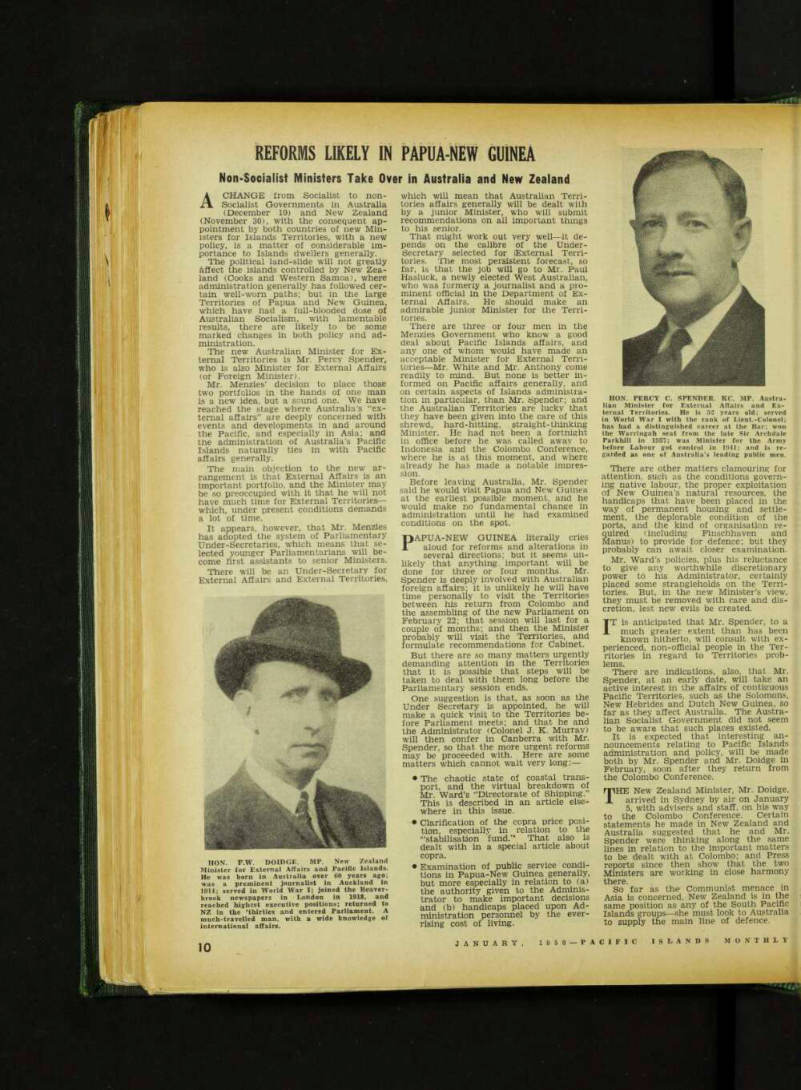
HON. P.W DOIDGE, MP. New Zealand Minister for External Affairs and Pacific Islands.
He was born in Australia over 60 years ago; was a prominent journalist in Auckland in 1914; served in World War I; Joined the Beaver brook newspapers in London in 1918, and reached highest executive positions; returned to NZ in the ’thirties and entered Parliament. A much-travelled man, with a wide knowledge of international affairs.
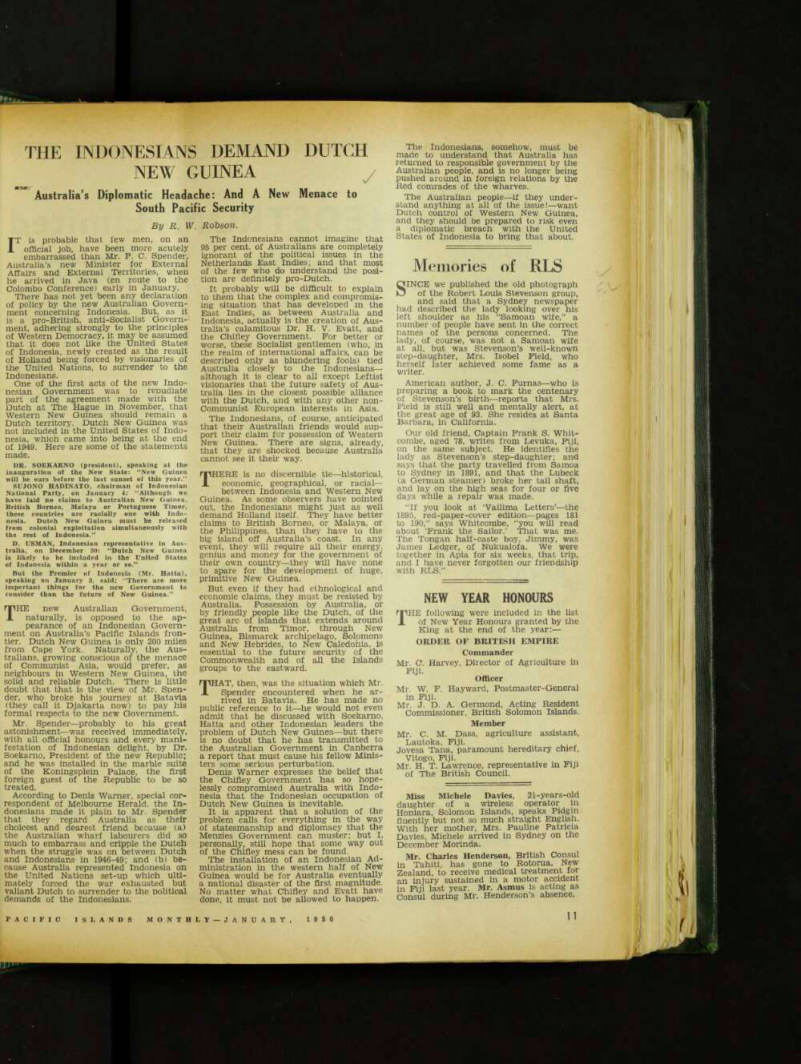
HON. PERCY C. SPENDER, KC, MP, Austra lian Minister for External Affairs and Ex ternal Territories. He is 52 years old; served in World War I with the rank of Lieut.-Colonel; has had a distinguished career at the Bar; won the Warringah seat from the late Sir Archdale Parkhill in 1937; was Minister for the Army before Labour got control in 1941; and is re garded as one of Australia’s leading public men.
New Guinea
The Indonesians Demand Dutch
Australia’s Diplomatic Headache: And A New Menace to South Pacific Security
By R. W. Robson.
IT is probable that few men, on an official job, have been more acutely embarrassed than Mr. P. C. Spender, Australia’s new Minister for External Affairs and External Territories, when he arrived in Java (en route to the Colombo Conference) early in January.
There has not yet been any declaration of policy by the new Australian Govern ment concerning Indonesia. But, as it is a pro-British, anti-Socialist Govern ment, adhering strongly to the principles of Western Democracy, it may be assumed that it does not like the United States of Indonesia, newly created as the result of Holland being forced by visionaries of the United Nations, to surrender to the Indonesians.
One of the first acts of the new Indo nesian Government was to repudiate part of the agreement made with the Dutch at The Hague in November, that Western New Guinea should remain a Dutch territory. Dutch New Guinea was not included in the United States of Indo nesia, which came into being at the end of 1949. Here are some of the statements made.
DR. SOEKARNO (president), speaking at the inauguration of the New State: “New Guinea will be ours before the last sunset of this year.’’
SUJONO HADINATO, chairman of Indonesian National Party, on January 4: “Although we have laid no claims to Australian New Guinea.
British Borneo, Malaya or Portuguese Timor, these countries are racially one with Indo nesia. Dutch New Guinea must be released from colonial exploitation simultaneously with the rest of Indonesia.”
D. USMAN, Indonesian representative in Aus tralia, on December 30: “Dutch New Guinea is likely to be included in the United States of Indonesia within a year or so.”
But the Premier of Indonesia (Mr. Hatta), speaking on January 3. said; “There are more important things for the new Government to consider than the future of New Guinea.”
THE new Australian Government, naturally, is opposed to the ap pearance of an Indonesian Govern ment on Australia’s Pacific Islands fron tier. Dutch New Guinea is only 200 miles from Cape York. Naturally, the Aus tralians, growing conscious of the menace of Communist Asia, would prefer, as neighbours in Western New Guinea, the solid and reliable Dutch. There is little doubt that that is the view of Mr. Spen der, who broke his journey at Batavia (they call it Djakarta now) to pay his formal respects to the new Government.
Mr. Spender—probably to his great astonishment—was received immediately, with all official honours and every mani festation of Indonesian delight, by Dr.
Soekarno, President of the new Republic; and he was installed in the marble suite of the Koningsplein Palace, the first foreign guest of the Republic to be so treated.
According to Denis Warner, special cor respondent of Melbourne Herald, the In donesians made it plain to Mr. Spender that they regard Australia as their choicest and dearest friend because (a) the Australian wharf labourers did so much to embarrass and cripple the Dutch when the struggle was on between Dutch and Indonesians in 1946-49; and (b) be cause Australia represented Indonesia on the United Nations set-up which ulti mately forced the war exhausted but valiant Dutch to surrender to the political demands of the Indonesians.
The Indonesians cannot imagine that 95 per cent, of Australians are completely ignorant of the political issues in the Netherlands East Indies; and that most of the few who do understand the posi tion are definitely pro-Dutch.
It probably will be difficult to explain to them that the complex and compromis ing situation that has developed in the East Indies, as between Australia and Indonesia, actually is the creation of Aus tralia’s calamitous Dr. H. V. Evatt, and the Chifley Government. For better or worse, these Socialist gentlemen (who, in the realm of international affairs, can be described only as blundering fools) tied Australia closely to the Indonesians— although it is clear to all except Leftist visionaries that the future safety of Aus tralia lies in the closest possible alliance with the Dutch, and with any other non- Communist European interests in Asia.
The Indonesians, of course, anticipated that their Australian friends would sup port their claim for possession of Western New Guinea. There are signs, already, that they are shocked because Australia cannot see it their way.
THERE is no discernible tie —historical, economic, geographical, or racial— between Indonesia and Western New Guinea. As some observers have pointed out, the Indonesians might just as well demand Holland itself. They have better claims to British Borneo, or Malaya, or the Philippines, than they have to the big island off Australia’s coast. In any event, they will require all their energy, genius and money for the government of their own country—they will have none to spare for the development of huge, primitive New Guinea.
But even if they had ethnological and economic claims, they must be resisted by Australia. Possession by Australia, or by friendly people like the Dutch, of the great arc of islands that extends around Australia from Timor, through New Guinea, Bismarck archipelago, Solomons and New Hebrides, to New Caledonia, is essential to the future security of the Commonwealth and of all the Islands groups to the eastward.
THAT, then, was the situation which Mr.
Spender encountered when he ar rived in Batavia. He has made no public reference to it—he would not even admit that he discussed with Soekarno, Hatta and other Indonesian leaders the problem of Dutch New Guinea —but there is no doubt that he has transmitted to the Australian Government in Canberra a report that must cause his fellow Minis ters some serious perturbation.
Denis Warner expresses the belief that the Chifley Government has so hope lessly compromised Australia with Indo nesia that the Indonesian occupation of Dutch New Guinea is inevitable.
It is apparent that a solution of the problem calls for everything in the way of statesmanship and diplomacy that the Menzies Government can muster; but I, personally, still hope that some way out of the Chifley mess can be found.
The installation of an Indonesian Ad ministration in the western half of New Guinea would be for Australia eventually a national disaster of the first magnitude.
No matter what Chifley and Evatt have done, it must not be allowed to happen.
The Indonesians, somehow, must be made to understand that Australia has returned to responsible government by the Australian people, and is no longer being pushed around in foreign relations by the Red comrades of the wharves.
The Australian people—if they under stand anything at all of the issue!—want Dutch control of Western New Guinea, and they should be prepared to risk even a diplomatic breach with the United States of Indonesia to bring that about.
Memories of RES
SINCE we published the old photograph of the Robert Louis Stevenson group, and said that a Sydney newspaper had described the lady looking over his left shoulder as his “Samoan wife,” a number of people have sent in the correct names of the persons concerned. The lady, of course, was not a Samoan wife at all, but was Stevenson’s well-known step-daughter, Mrs. Isobel Field, who herself later achieved some fame as a writer.
American author, J. C. Furnas—who is preparing a book to mark the centenary of Stevenson’s birth —reports that Mrs.
Field is still well and mentally alert, at the great age of 93. She resides at Santa Barbara, in California.
Our old friend, Captain Frank S. Whit combe, aged 78, writes from Levuka, Fiji, on the same subject. He identifies the lady as Stevenson’s step-daughter; and says that the party travelled from Samoa to Sydney in 1891, and that the Lubeck (a German steamer) broke her tail shaft, and lay on the high seas for four or five days while a repair was made.
“If you look at ‘Vailima Letters’ —the 1895, red-paper-cover edition —pages 181 to 190,” says Whitcombe, “you will read about ‘Frank the Sailor.’ That was me.
The Tongan half-caste boy, Jimmy, was James Ledger, of Nukualofa. We were together in Apia for six weeks, that trip, and I have never forgotten our friendship with RLS.”
New Year Honours
THE following were included in the list of New Year Honours granted by the King at the end of the year:—
Order Of British Empire
Commander Mr. C. Harvey, Director of Agriculture in Fiji.
Officer Mr. W. F. Hayward, Postmaster-General in Fiji.
Mr. J. D. A. Germond, Actmg Resident Commissioner, British Solomon Islands.
Member Mr. C. M. Dass, agriculture assistant, Lautoka, Fiji.
Jovesa Tana, paramount hereditary chief, Vitogo, Fiji.
Mr. H. T. Lawrence, representative in Fiji of The British Council.
Miss Michele Davies, 2i-years-old daughter of a wireless operator in Honiara, Solomon Islands, speaks Pidgin fluently but not so much straight English.
With her mother, Mrs. Pauline Patricia Davies, Michele arrived in Sydney on the December Morinda.
Mr. Charles Henderson, British Consul in Tahiti, has gone to Rotorua, New Zealand, to receive medical treatment for an injury sustained in a motor accident in Fiji last year. Mr. Asmus is acting as Consul during Mr, Henderson’s absence.
Advertisements & other items, p. 14 (1 item)
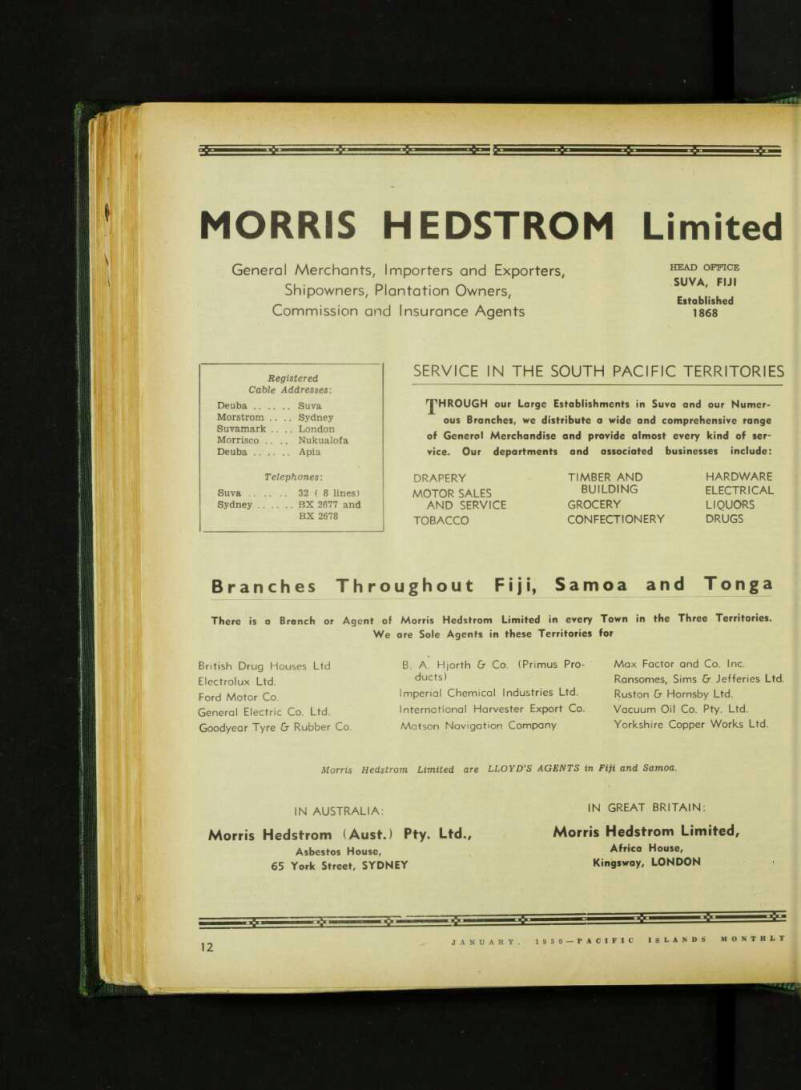
Morris Hedstrom Limited
General Merchants, Importers and Exporters,
Shipowners, Plantation Owners,
Commission and Insurance Agents
HEAD OFFICE
SUVA, FIJI
Established 1868
SERVICE IN THE SOUTH PACIFIC TERRITORIES
'J'HROUGH our Large Establishments in Suva and our Numerous Branches, we distribute a wide and comprehensive range of Generol Merchandise and provide almost every kind of service. Our departments and associated businesses include:
DRAPERY
MOTOR SALES
AND SERVICE
TOBACCO
TIMBER AND
BUILDING
GROCERY
CONFECTIONERY
HARDWARE
ELECTRICAL
LIQUORS
DRUGS
Branches Throughout Fiji, Samoa and Tojiga
There is a Branch or Agent of Morris Hedstrom Limited in every Town in the Three Territories.
We are Sole Agents in these Territories for
B. A. Hjorth £r Co. (Primus Products) Imperial Chemical Industries Ltd.
International Harvester Export Co.
Matson Navigation Company
British Drug Houses Ltd Electrolux Ltd.
Ford Motor Co.
General Electric Co. Ltd.
Goodyear Tyre £r Rubber Co.
Max Factor and Co. Inc.
Ransomes, Sims £r Jefferies Ltd.
Ruston Gr Hornsby Ltd.
Vacuum Oil Co. Pty. Ltd.
Yorkshire Copper Works Ltd.
Morris Hedstrom Limited
IN AUSTRALIA:
Morris Hedstrom (Aust.) Pty. Ltd Asbestos House, 65 York Street, SYDNEY LLOYD'S AGENTS in Fiji and Samoa.
IN GREAT BRITAIN:
Morris Hedstrom Limited,
Africa House, Kingsway, LONDON
Rabaul Roundabout

Prom Our Own Correspondent
RABAUL, December 29.
AT Namanula Hospital on December 1, a son was born to Mr. and Mrs. L.
Corbett. And on December 13, at Namanula Hospital, a daughter was born to Mr. and Mis. B. W. Ryan, of Rabaul. ♦ MRS. CHRIS NORMOYLE is back in Rabaul after three months spent in Australia. While South Mrs. Nor moyle underwent a serious operation but is well again. With her came her son, Tony, and daughter, Janet. Her elder son, Chris, Jnr., recently arrived in Port Moresby after attending the School of Pacific Administration in Sydney. He is now a cadet patrol officer.
Enthusiastic audiences filled the Administration Mess for two nights in December, when they greeted the first performances of the RSL Dramatic Club. The two plays produced were “The Man in the Bowler Hat” by A. A. Milne and “Cinderella” by a local playwrite, Mr.
Norman Adderley. Fifty-two pounds were raised and will be added to the rapidly-growing building fund for the new clubhouse. Splendid performances were given by local amateur artists, including specialty items by Mr. Gilbert Renton and Mr. Kerry Leen. Rabaul folk now look forward to another show scheduled for early New Year. It will be a variety show. * RABAUL Native Schools held their Annual Combined Sports Meeting on December 20 on the Recreation Oval.
Fifteen schools competed for a Silver Shield. Teams came from Keravat and Kokopo as well. Winner on total points was Matupi.
About 4,000 pupils attended the meeting which was opened by District Officer J. K.
McCarthy. Rain interferred with the morning events, but the skies cleared by mid-day. Music was provided by the splendid Kinagunan Native Brass Band which came from Vunapope Catholic Mis sion, Kokopo. * A SUCCESSFUL cake and ice cream stall, organised by the Church of England Ladies’ Guild, was held out side the Rabaul Cinema on December 9 from 11 a.m. to 5 p.m. and raised £36/1/6.
The C. of E. Council then decided to hold a Ball on December 27 at the Cosmopoli tan Hotel. Despite the fact that most people were tired after a hectic round of Christmas parties, a large crowd assembled and £5l/6/6 was raised. These two
amounts will be added to the building fund. The Council has received informa tion that two quonset huts at £2OO each have been reserved at Manus. When shipping is available they will be brought to Rabaul and erected as a church and vicarage. Mr. Chris Normoyle is the Council president and Miss Dorothy Stewart is secretary and treasurer. Mrs, Shanley is president, Mrs. Hides, secretary and Mrs. Whippey treasurer of the Church Ladies’ Guild. * RABAUL children turned out in force on Christmas Eve when the New Britain Club held its annual Fancy Dress Party and Christmas Tree.
It was a difficult job for the judges to decide finally which were the best costumes, but special mention was made of lan Black as “Tarzan” and Hilary Shanley as the little Hawaiian Girl. Judges were Mr. B. B. Perriman, Mrs. Una Adams and Mrs. J. Keith McCarthy. * BULOLO arrived in Rabaul early on Boxing Day with many tourists aboard and skippered by well-known Captain W. Wilding usually of the Malaita. When the ship departed th.s morning many Rabaul folk were aboard including Mr. and Mrs. Gerry Brown, Mr. and Mrs. Lindfield, Mr, and Mrs. Dixon, Mr. and Mrs. “Mick” Thomas and daughter, and Miss Kiernan, of the nurs ing staff, Madang. ♦
Island Paradise Cabaret Was The
setting for a party given by Mr. and Mrs. V. Pearson during December to celebrate Mr. Pearson’s birthday. ♦ A QUONSET HUT has been put into use as the new RSL Clubhouse. The hut has been altered considerably and with extensions and glass louvres provides a floor space of 70 ft by 20 ft. as a ren dezvous for RSL members. They held their opening night on December 23 and the house warming on Boxing Day was largely attended by husbands and wives and widows of servicemen. A picnic for the children of members was held at Nonga on December 28. * mHE New Guinea Club at Rabaul wel- X corned in the New Year with its first post-war Fancy Dress Ball. In pre war days the New Guinea Club’s Fancy Dress Ball was one of the occasions of the Christmas season.
The Club this year, returned to some thing of its former glory, was the haunt
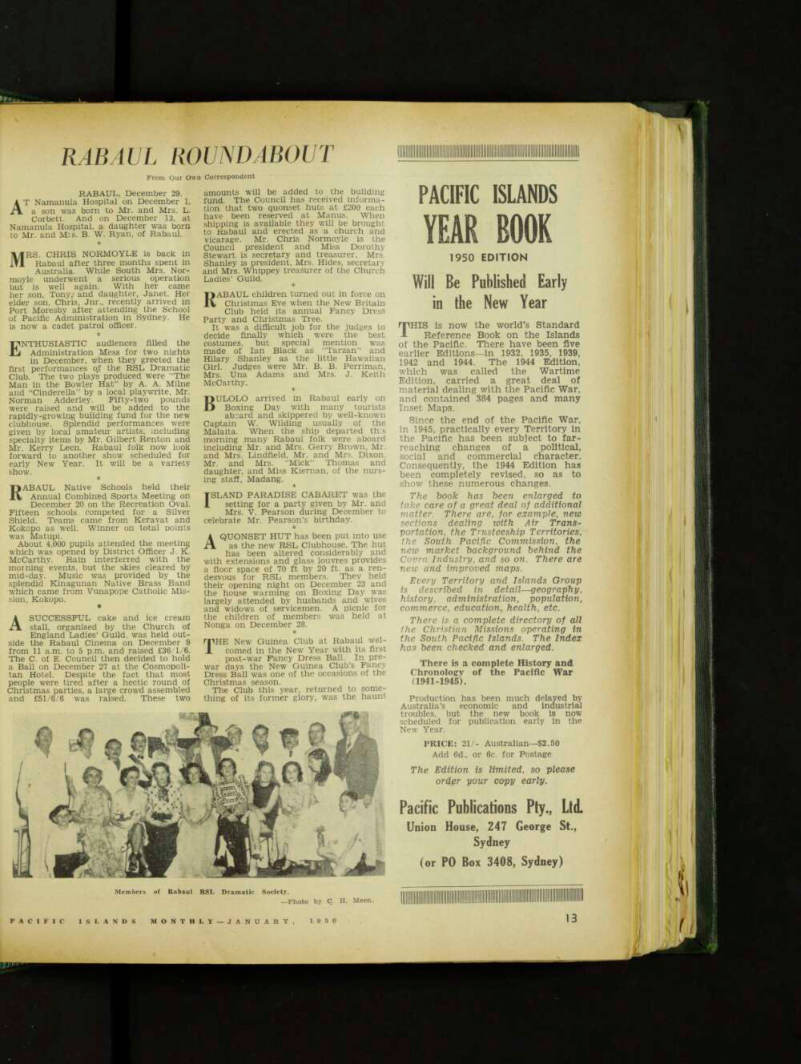
Members of Rabaul RSL Dramatic Society. —Photo by C. H. Meen.
of devils, pirates, gypsies and ladies of the East and included the Hunchback of Notre Dame.
Excellent music was provided by Mr.
Berkfeldt. In the absence of the presi dent, Mr. B. Gaskin, guests were welcomed by the acting-president, Mr. K. C. Mc- Mullen, and secretary, Mr. Galway.
The difficult task of judging the cos
tumes fell to the lot of Mrs. Rhoda Coote, Mrs. Una Adams and Mrs. J. Keith McCarthy whose final selections were Mr. and Mrs. Guy Black, best pair; most original costume, Mr. “Soldier” Williams; best dressed man, Mr. Len Palmer; best dressed lady, Mrs. Scott; and a special prize awarded to Mrs. Len Palmer as “The Hunchback of Notre Dame.”
Advertisements & other items, pp. 15-16 (1 item)
Year Book
PACIFIC ISLANDS
1950 EDITION
Will Be Published Early
in the New Year
THIS is now the world’s Standard Reference Book on the Islands of the Pacific. There have been five earlier Editions—in 1932, 1935, 1939, 1942 and 1944. The 1944 Edition, which was called the Wartime Edition, carried a great deal of material dealing with the Pacific War, and contained 384 pages and many Inset Maps.
Since the end of the Pacific War, in 1945, practically every Territory in the Pacific has been subject to farreaching changes of a political, social and commercial character.
Consequently, the 1944 Edition has been completely revised, so as to show these numerous changes.
The book has been enlarged to take care of a great deal of additional matter. There are, for example, new sections dealing with Air Transportation, the Trusteeship Territories, the South Pacific Commission, the new market background behind the Copra Industry, and so on. There are new and improved maps.
Every Territory and Islands Group is described in detail — geography, history, administration, population, commerce, education, health, etc.
There is a complete directory of all the Christian Missions operating in the South Pacific Islands. The Index has been checked and enlarged.
There is a complete History and Chronology of the Pacific War (1941-1945).
Production has been much delayed by Australia’s economic and industrial troubles, but the new book is now scheduled for publication early in the New Year.
PRICE: 21/- Australian—s2.so Add 6d., or 6c. for Postage The Edition is limited, so please ordpr your copy early.
Pacific Publications Pty., Ltd
Union House, 247 George St.,
Sydney
(or P 0 Box 3408, Sydney)
Fly Pan American to
* ife & Si IB 1111 i j§
Low fare includes travel on
luxurious new Clippers
* One ticket carries you from Australia through to Britain! You fly by comfortable Sleeperette* Clipper to Hawaii where you have stopover privileges if you wish.
From Honolulu you can fly to San Francisco or Los Angeles aboard Pan American’s new double-decked Clippers world’s largest, fastest airliners.
Another big double-decked Clipper flies you from New York to London in luxurious comfort.
For the finest in air travel to England fly Pan American, world’s most experienced airline. For reservations, call your Travel Agent or . . , SUVA: Bank of N.S.W. Bldg. (Tel. 664)
NOUMEA; Rue Jean Jaures (Tel. 85)
Pm AsfFRfCM World Airways
World's Mo si Experienced Airline SPEED YOUR PARCEL BY CLIPPER CARGO * Trade Marks, Pan American Airways, Inc.
Pan American Airways, Inc., Ltd., Incorporated in U.S.A.
Torres Strait Islands
From Our Own Correspondent
Thursday Is.. Dec 1.
WHAT effect the devaluation of the £ sterling will have on the sale of pearl shell is still a matter of con jecture. One independent buyer has already increased the price by £25 per ton, and is hopeful of a further increase unless the price in the USA drops sharply.
Apart from pearls and pearl shell, Thursday Island could be made into a tourist paradise if only the Government or some private company were long sighted enough to build first-class hotels.
Accommodation at present is at a pre mium, and hotels are reluctant to take any more guests.
THE cost of living here seems out of all proportion, and the variation in prices of various commodities is very confusing. Cigarette papers—a popular brand—at the local newsagent cost 3|d.
The same brand at two other shops is priced at sd. and 6d. respectively. Eggs may be bought at one end of the island for 3/6. Fresh supplies from Prince of Wales Island—limited supply only—are sold for 4/-, which is reasonable, but an other shop charges 7/-. Apples range in price from 4/- to 9/- per doz.
The Island Industries Board store under the control of the Department of Native Affairs, sells exclusively to the native population, and quality, range and price of commodities compare more than favourably with similar goods in large city stores on the mainland. Unfor tunately, smallgoods, fruit, etc., are not stocked, therefore the natives are forced to buy elsewhere to a certain extent; and they, as well as the white population, are forced to pay exorbitant prices for every day necessities. Exactly how high the price of fruit is on the Island may be gauged from the following facts. A carton of mixed fruit, bought retail in Cairns for 12/-, and air freighted up at a cost of 7/10, is still 50 per cent, cheaper than that bought retail on Thursday Island.
Quite a large proportion of the native population are employed indirectly by the Department of Native Affairs as ship wrights and labourers at the Island In dustries’ shipbuilding yards. These men are all members of the Australian Workers’ Union, and draw award wages, which, for shipwrights, is £B/16/- per week. Recently, it was found that the award was not being adhered to, and the Department of Native Affairs immediately rectified the error, all employees receiving back pay which in some cases meant in dividual payments of from £lO to £75.
When one understands the extent of the weekly payroll of the native population, it is easy to realise how important is the work done by the DNA to prevent ex ploitation of the islanders. Yet in the matter of high prices the Department seems powerless to act.
AT a special meeting of the Thursday Island Town Council held recently, it was decided to borrow the sum of £21,000 with subsidy for the purpose of concreting footpaths and the making of bitumen roads. It was also decided that the Council seek approval of a master
town plan to include all Thursday Island; and that the Council propose to the authorities that all islands contained in the Prince of Wales Group (20 islands in all) be included in this area of Local Government jurisdiction.
Death Of Jack Mcnulty
MR. JACK McNULTY died at the Thursday Island Hospital on Oc tober 4, aged 65. He was born on the island, his parents settling here in 1860. For many years Mr. McNulty, Snr., conducted the Federal Hotel. Jack grew up to love the Torres Strait Islands, be ing very interested in the early pioneer ing days of Thursday Island—then known as “Wyben”—and his collection of curios, souvenirs and manuscripts were much ad mired. In 1883 Mr. McNulty, Snr., deeded a large block of land to the Catholic Church and it was on this site that the Sacred Heart Church and Convent were built.
After the death of his parents, Jack McNulty, with his two sisters (Miss Margaret and Miss Katherine) carried on the management of the hotel, until the war intervened. The family then moved south, where Miss Katherine died. Jack returned, to do good work for the Army on Horn Island. After the war his sister returned, but both refrained from active business. He is survived by his sister, Margaret.
Personal
THERE is genuine regret at the de parture at the end of the year of Rev. Mr. Fisher, Church of Eng land. His sunny smile and friendly nature endeared him to people of all de nominations.
(Continued Next Page)
Mr. Walter, late manager of the Island Industries Board, has been promoted to Investigation Officer, Department of Native Affairs. Mr. Waller, together with Mrs. Waller and son Peter, have re turned after two months’ holiday on the mainland. Their eldest son is at school in Cairns.
Mr. and Mrs. Mendis were recent arrivals on the Elsanna. They were ac companied by their son, Haymen, who, at 21 months speaks two languages, Eng lish and Singhalese. They expect to stay with Mr. Mendis, Snr„ for two months.
The wedding of Miss Cook, daughter of Sergeant Cook, and Cedric Thus,
manager of the Island Industries Board shipbuilding yard, will take place shortly.
Miss Cook, who was attached to the staff of the DNA, was presented recently with a handsome crystal water set by her fellow employees.
A permanent cure for malaria which becomes effective in three days has been discovered, according to the Chicago Herald American. The newspaper says the discovery resulted from a £2 million Federal project involving experiments with 300 convicts. The drug is still unnamed and is known only as number 13272.
Advertisements & other items, pp. 17-18 (1 item)
Island Merchants
'mm p
CREME
CHARMOSAN
* new cm*' lll " M.fic 1 .»c. cm.«.
ADORABLY LOVELY
UNDER POWDER
Charmosan
coid«r?^
U6u F,,cl..n.n fl *h.^ojV«^
CLEANSES AND
REFRESHES YOUR SKIN
CHARMOSAN
VANISHING AND COLD CREAMS
Box 3838 GPO, Cable Address, “Care” Sydney.
Sydney. Australia. r tilling -mMP
ISLAND MERCHANTS
4 YORK ST., SYDNEY
All kinds Island Produce sold on commission. All merchandise purchased at best wholesale price and original invoices supplied.
Use our 50 years’ experience as Island Merchants. j
Throughout
the
South-West Pacific
MT 4 I The development of the South-West Pacific Area has been fostered by the Bank of New South Wales since 1817. To-day, comprehensive banking, travel and trade introduction services are provided in Australia, New Zealand, Fiji, Papua and New Guinea by over 800 branches and agencies of the Bank. Residents of, and visitors to the Islands are invited to avail themselves of the “Wales” complete banking service at the following points:— FIJI Branches Suva, Lautoka Agencies Ba, Nadi Airport, Vatukoula PAPUA Branch Port Moresby NEW GUINEA Branches Lae, Hahaul : - * -' - -- v - -
Ilffill
Bank of New South Wales Suva Branch
Consult and use
BANK OF NEW SOUTH WALES
Head Office Sydney, Australia FIRST AND LARGEST COMMERCIAL BANK IN THE SOUTH-WEST PACIFIC (Incorporated in New South Wales with limited liability)
PISOOI
Repayment Demanded
Xmas Present for Expro Planters in New Guinea
BY letters written in Canberra on De cember 9, the occupiers of “Expro” properties in New Guinea were in formed that, as from January 1, 1950, they would be expected to resume pay ments of principal and interest.
They are asked to pay, each quarter, in reduction of principal, £29 for every £l,OOO which they owe to the Custodian of Ex propriated Properties (the former Ger man-owned plantations); and they also must pay interest on the amount owing at the end of each quarter—3i per cent, by former soldiers, and 4 per cent, by others, “Expro Board’’ plantations were sold — mostly to ex-soldiers on liberal terms— after World War I. In the ensuing 20 years, repayment by the occupiers of the money loaned by the Australian Govern ment was interrupted a few times by de pression, and low copra prices. Finally, when Japs invaded in 1942, there was a complete moratorium. After World War 11, the Custodian allowed the mora torium to continue, for what he regarded as a reasonable period for rehabilitation.
But he has been very conscious of the high copra prices being obtained by plan ters.
All planters received liberal compensa tion from the War Damage Fund. In the case of Expro Plantations, this money went to the Custodian, and that part of it reoresenting compensation for growing trees' was credited to the individual’s ac count. Other compensation is merely “held” by the Custodian; it does not appear to be taken into account when the Custodian is calculating interest due on the account.
The new demand means that the plan ters concerned will be expected to pay off their debt at the rate of £ll6 per an num for every £l,OOO they owe.
Some planters do not take kindly to the new development. They say that their plantations have not yet recovered sufficiently to justify a demand for re payment of principal at the rate of be tween 11 and 12 per cent.
Guinea Service
Ss Suva May Run
In New
IT was reported in Sydney in January that the well-known Carpenter steamer, Suver, which is registered in Fiji, had been made available for the Papua-New Guinea service and that, for at least three or four months, she would run on a fairly regular schedule between the chief ports of Papua-New Guinea and Australia. She carries a large quantity of cargo, and can accommodate a limited number of passengers.
The American Trading Co., Ltd., of Sydney are the agents.
Got Any Old Blades?
IP any shaven reader wants his old razor blades put to a good purpose, he can send them to the Rev. J. O’Meara, c/o. 705 High Street, Thornbury, Melbourne, a missionary down on leave from New Guinea, where he finds them the most acceptable currency with which to pay the natives for food and services. Or blades could be sent direct to the Rev. F.
Parer, OFM, Warapu, via Aitape, New Guinea.
The Month In Moresby
From Our Own Correspondent
Port Moresby, Jan. 2.
MORESBY’S business centre is growing rapidly. BNG’s new store, to re place the one lost during the war, should be in full operation within a year.
Rear section of the bulk store should be open for wholesale business within four months. The new store will have two storeys and a basement, with offices on the top storey. The Port Moresby Freez ing Co. has started building a new butcher’s shop. A cafe and milk bar will be erected beside the shop and it’s planned to make it all part of the Papua Hotel. Steamships recently opened what it claims is the most modern native store in the Territory, Attractively designed and well stocked, the store sells soft drink, ice cream and freezer goods, as well as groceries, hardware and drapery goods.
Mr. and Mrs. Gordon Carter’s new photo graphic and gift shop in Cuthbertson Street opened just in time to capture the Christmas trade. ♦ AFTER three months of electricity rationing in Moresby, residents have been told that the new engine part that the Administration has been waiting for, will leave England by ship early this month. When it arrives power supplies should return to normal. Generating plants which will greatly increase the powerhouse’s capacity are on order and the first of these, a 720 HP plant, is due to leave England in February. Two 600 HP plants, ordered in August, 1947, are due to arrive from England next May.
Officials say that the fact that new plant
was ordered as far back as 1947 clears the Administration of any blame for the
present difficulties.
* THE Public Service Association has just been advised that the Public Service Ordinance, 1949, is only temporary and will be replaced by a permanent ordinance as soon as possible. Revision of the ordinance is going on now. Pre viously it was thought that the ordinance was permanent and this caused the Asso ciation some concern as some important matters were not provided for. One of the missing provisions concerned long leave and furlough, a subject now being considered by the Department of Ex ternal Territories. Indications are that the final terms of this provision will be satisfactory to both prewar Papuan and New Guinea officers and to new public servants.
Officers of the former administrations of Papua and New Guinea met in Moresby recently to discuss superannuation. A statement issued after the meeting said: “The present position is that the recent Superannuation Ordinance, 1949, has to be re-enacted as an Ordinance of the Territory of Papua and New Guinea. Re presentations are still being made to the Department of External Territories, Com monwealth Treasury and Commonwealth Actuary, regarding submissions by the Public Service Association about the rate of pension in respect of salary earned from 1945 onwards, and in respect of the conditional 25 per cent, increase in pen sions.”
Messrs, w. r. murphy and j. Reid hope to open a modern steam laundry in Moresby within a few months. They have some machinery and are expecting 1 the rest soon. The laundry will be in the former Catholic Mission boys’ school at Koki. According to the proprietors, they will do residents’ laundry at half the cost of keeping a laundry boy.
(Continued next page)
FIRST meeting of the Executive Council was held in Port Moresby on Decem ber 19. Members of the Council were appointed for six months from December 1, 1949, pending decisions on organisa tion of the public service and the per manent appointment of several depart mental heads. The Council will advise and assist the Administrator, who pre sides over its meetings. Members of the Council are:— Mr. Lonergan (Acting Government Secretary).
Mr. Jones (Acting Secretary for Plan ning and Development).
Dr. Gunther (Director of Public Health).
Mr. Chester (Acting Treasurer).
Mr. Groves (Director of Education).
Mr. Humphries (Acting Director of Native Labour), Mr. Cottrell Dormer (Director of Agri culture, Stock and Fisheries).
Mr. Holmes (Secretary for Lands, Sur veys and Mines).
Mr. McAdam (Acting Secretary for Forests).
No one here can forecast when the Legislative Council will be set up. It won’t be before July, 1950, however, as the Papua and New Guinea Act specified that the Council should not operate until a year after the Act became effective (The Act came into force in July, 1949). Much preparation will have to be made for the election of the non-Government members of the Council. * new houses for Administration . officers at Abau are ready for occupa tion. Better than the usual out station residences, they are R and A types, similar to those in Lawes Road, Port Moresby. * THE Administrator (Colonel J. K.
Murray) made this significant state ment in a special Christmas and New Year message to residents: “For the future I hope that the Australian Government will determine the design for not only development of the native people, but also for the economical development of the Territory, on which a great deal of the security of the Commonwealth and the happiness of all in this Territory depends.” ♦ A CIVIL AVIATION spokesman says that construction of an alternative all-weather airstrip for Port Moresby on Fisherman’s Island should begin early
in the New Yean The strip will take any plane in an emergency and when it is finished aircraft will no longer have to by-pass Moresby because of bad weather.
Fisherman’s Strip will be easy to approach because of the absence of surrounding hills, which, at times, make conditions difficult at Jackson’s. New radio naviga tion aids to be installed at Moresby will enable aircraft to land at Fisherman’s in almost any conditions. The strip will be 5,000 feet long compared with Jackson’s 6,438 feet and it will have a coral surface capable of taking planes with a gross weight of over 60 tons. It will cost about £40,000 in the early stages. * THE Administrator, Colonel J. K. Mur ray, and Mrs. Murray, spent Christ mas and the New Year holiday on an inspection cruise in the Laurabada around the eastern, south-eastern and northern divisions of Papua. * NEW telephone books will be issued in the Territory within a month. * A NUMBER of vehicles in Moresby are certain to be ordered off the road when registration is introduced, un less their condition improves before then.
They will be ordered off for not meeting the safety requirements provided for under registration. Before they will be regis tered, vehicles will have to pass a strict examination. They must be roadworthy and equipped with windscreen wipers, headlamps and tail-light. Left hand drive vehicles must have a mechanical or hand operated indicator. The Motor Traffic Ordinance, 1949, which provides for regis tration in Papua, among other things, is now awaiting the approval of the Ex ternal Territories Department. One of the most important provisions of the new ordinance, as far as Moresby is concerned, may be a higher speed limit. It has been recommended that the limit within
Moresby be increased from 15 mph to 25 mph. The limit will still be 15 mph when passing a school or playground. Outside Moresby the recommended limit is 40 mph, or 25 mph for heavy vehicles—those with a carrying capacity of more than two tons, including a trailer. * TRUSTEES of Moresby’s recreation area have planned a number of improve ments to the area. First on the list are new dressing sheds on Ela Beach. See saws are to be installed in the children’s playground and picnic shelters will be built. It is also hoped to erect a band rotunda. On the Recreation Ground it self, the Trustees intend to build a new pavilion and score boards. * MISTRAL (W. Connolly) won the Moresby Aquatic Club’s Fairfax Handicap with 27 points, Tradewind (A. Murray) was second with 22 points, and Kevani was third. The Lady Skip per’s Race was won by Miss Lorna James in Mistral, with Berinice (Miss D. Bald win) second and Arrow (Mrs. A. Adler) third. There will be no more races until next March. * Formation of a bowling club in Moresby has been suggested. A pub lic meeting to discuss the matter will be called soon. *
Miss Betty Christine Smith, A
nursing sister at the Moresby Euro pean Hospital, married Mr. Lance Quayle, of the Works and Housing De partment, at St. John’s Church of Eng land, Moresby, on December 19. Brides maid was Sister Pat Lumley, of the hospital, and Mr. Norman Plant was best man. Mr. Leslie Elliott gave the bride away. The reception was held at the Hotel Papua. The couple had a “round trip” honeymoon on the Bulolo. * MRS. N. ODGERS, wife of the local officer in charge of OTC, has re turned to Moresby after a year in Perth.
Senior Medical Assistant, Stan Chris tian, who has been conducting malarial surveys in the Highlands since 1946, has gone on leave.
Spending their leave in Brisbane are Mr. and Mrs. Harold Foley, of Moresby.
APC’s head accountant in the Terri tory, Mr. Len Morris, and Mrs. Morfis, flew to Melbourne by Skymaster on Xmas Eve on three months’ leave.
Mr. and Mrs. Frank Hill, of Moresby, are in Australia on leave.
Assistant Director of Agriculture, Mr, R.
E. Dwyer, and Mrs. Dwyer, returned to Moresby from leave on the December Bulolo.
A son was born to Mr. and Mrs. Frank Barber at the Moresby European Hospi tal recently.
Mr. C. J. Miller, of the co-operative sec tion, and Mrs. Miller, returned from leave on the December Bulolo.
Advertisements & other items, pp. 19-20 (1 item)
Travel
WHERE THE TRADE
WINDS BLOW'
COLLECTION of fascinating tales and sketches of the South Pacific Islands by R. W. ROBSON
and JUDY TUDOR.
I Veil Bound and Profusely illustrated.
Price: 7/6, or 8/- post free.
From any large book store, or from Steele’s Book Store, Suva, or from —
Pacific Publications Pty. Ltd.
Union House, 247 George St., SYDNEY.
TRADE
and
TRAVEL
BETWEEN AUSTRALIA AND THE ISLANDS OF THE PACIFIC IS MADE SO MUCH EASIER AND THE TIME FACTOR IS REDUCED TO A MINIMUM WITH
★ LOWER RATES
★ GREATER COMFORT
★ SUPERIOR SERVICE
TRANS OCEAN AIRWAYS TTY. LTD.
FOR FURTHER INFORMATION
CONTACT OUR PRINCIPAL AGENTS
THE MACARTHUR SHIPPING AND AGENCY CO. PTY. LTD.
31 MACQUARIE PLACE,
SYDNEY.
Day: BW 2048-9 • Night: B 0229 In the Islands our Local Agent or any accredited Travel Agent will supply particulars. /
Enjoy a Real Holiday
“SAN ELANDA” GUEST HOUSE,
Tewantin, Queensland m m Island Folk will Receive a Warm Welcome. Excellent Fishing, Boating, Surfing, River Trips, Tennis, Golf. Etc., plus First-Class Accommodation and Cuisine at a Reasonable Tariff.
Tewantin, on the Coast, is 100 miles North of Brisbane.
R. P. MILLS, Proprietor
(Late of Witu, T.N.G.) ’Phone: Tewantin 21
SI!?
ARC WELDING
* ELECTRODES
t MACHINES
* ACCESSORIES
E.M.F. manufacture a complete range of arc welding electrodes including mild steel structural grade types, electrodes for welding special steels, stainless steel and heat resisting steel electrodes, special electrodes for welding cast iron, non-ferrous metals and for hardsurfacing.
The range of E.M.F. arc welders covers the A.C. "Pilot" Arc welder for maintenance and jobbing work and Choke Controlled machines for heavy duty applications, also petrol and electric motor driven D.C. welders. i M
New Guinea Women’S Club
Of Sydney
CHILDREN’S PARTY: This function, held in the Feminist Club rooms on December 19, was a great success.
Miss Brooks was responsible for a pro gramme of dancing and singing by a group of children and Mr. N. H. Foxcroft again acted as Santa Claus. Santa also presented the president of the Club. Mrs.
Foxcroft, with a gift from the committee.
The success of the children’s party was
made possible by the generous giving of Territorians and Island firms, as fol lows: —
ADULT PARTY: About 120 people were present at the cocktail party at the Fem inist Club on December 22. As is usual
each year, this party was declared by those who attended “the best yet.”
Messrs. Foxcroft and Baldwin attended to the drinks with great efficiency.
FALL OF RABAUL: The anniversary of the fall of Rabaul to the Japanese in 1941 will be marked again this year by a gathering at the Sydney Cenotaph at 8.15 a.m. on January 23.
RECESS: The Club is now in recess and will not resume its Thursday morning meetings until February 2.
Dr. C. J. Austin, Medical Superintendent of the Fiji Leprosy Hospital, Makogai, has returned to Fiji from leave in the United Kingdom.
Mr. R. B. Ackland, Assistant Commis sioner of Inland Revenue, who paid a fly ing .visit to the United Kingdom to dis cuss taxation matters with the British Inland Revenue Authorities, returned to Fiji in early December.
Already Acknowledged £54 15 6 Mrs. Laird 0 0 Mr. H. Downing , .. i 0 0 Mrs. K. Elvy 5 0 Mrs. Pennefather 3 3 0 Lae Branch RSS&AILA 10 10 0 Mrs. L. Clark 0 0 Mrs E. Maclean , .. 1 1 0 Kokopo Sports Club , .. 10 10 0 Mrs. L. Roberts 1 1 0 Miss Wall 12 0 Mrs. Draffin 10 0 Mrs. Bellhouse 1 2 0 Mrs. Perriman . .. 1 1 0 Colyer Watson (NG) Ltd 5 5 0 Mrs. Hosking 10 0 Mrs. J. Allan 2 2 0 Mrs. Middleton 3 18 0 Total £ 100 5 6
Advertisements & other items, pp. 21-22 (1 item)
Angus £ Robertson Ltd.
Australia’s Leading Booksellers
OFFER YOU THESE SERVICES
1. BOOK SELECTION
SERVICE
We select one or more books a month for an increasing number of customers living out of touch with book shops. This is a personal service, and our choice varies according to type of book preferredfiction, detective stories, biography, political memoirs, travel, etc.
2. AUSTRALIAN BOOK
SERVICE
More and more interesting books are being issued in Australia —history, travel, fiction, etc., as well as technical books. Lists are issued regularly.
3. TECHNICAL Cr MEDICAL
BOOK SERVICE
Our technical and medical book departments are unrivalled in the Pacific area. Catalogues, lists, circulars, are issued regularly. Ask for information about our 34 technical sections and 23 medical sections in our mailing department.
4. OVERSEAS ORDER
SERVICE
Special orders are posted daily by airmail to overseas countries for books not available in Sydney, required by our customers. We can get that book you want if it is available.
5. MAGAZINE SUBSCRIP-
TION SERVICE
This department is continually expanding. Hundreds of periodicals from many countries can be ordered.
6. GENERAL MAILING
SERVICE
We record individual interests and will be glad to register your name for information about new books on any subject—education, theology, juvenile, fiction, biography and so on. Your inquiries are invited. i customer of long standing recently wrote us: “I do lousiness with nany bookshops hut none gives me the feeling of earing for my ™™hes s you do.” And another customer said: It is rarely in these days ou find a firm go to so much trouble over so small a matter.
For personal attention to your book orders, write to:
ANGUS & ROBERTSON LTD.
Booksellers : : Publishers : : Librarians.
89 CASTLEREAGH STREET, SYDNEY, N.S.W.
n V 1
n e^/j
ARGONAUT
Qf^yeeA^lA/
NOW OPERATING ON TOKYO-HONG KONG-LONDON
AND S I N G A P O R E - H O N G KONG SERVICES Proudly, 8.0.A.C. presents the first of twenty-two new 4-engined Argonaut
Speedbirds!
Here is an aircraft with passenger appeal ... an aircraft designed with you in mind ! Relax in wide, soft seats —adjustable, of course. Enjoy a new freedom of movement in either of two passenger cabins and in the smart rear lounge that seats six.
Argonaut Speedbirds, built for 8.0.A.C. by Canadair Ltd., accommodate forty passengers, cruise quietly and majestically at 298 m.p.h. on four Rolls- Royce Merlin Engines. Passenger cabins are sound-proofed and the entire aircraft is air-conditioned. Pressurised, too, for smooth over-the-weather flying where the elements are most friendly.
The superlative comfort and superior performance of these new aircraft are matched only by 8.0.A.C.’s 31 -year-old tradition of Speedbird service and experience !
8.0.A.C. TAKES GOOD CARE OF YOU
FLY BOAT
M 36 Information & Bookings : Qantas Empire Airways Ltd ., Sydney , Melbourne , Brisbane , Townsville , Cairns , Darwin (General Agents in Australia ), or from Booking Agents in all cities.
BRITISH OVERSEAS AIRWAYS CORPORATION WITH Q.E.A., T.E.A.L. AND S.A.A.
Native Voyagers
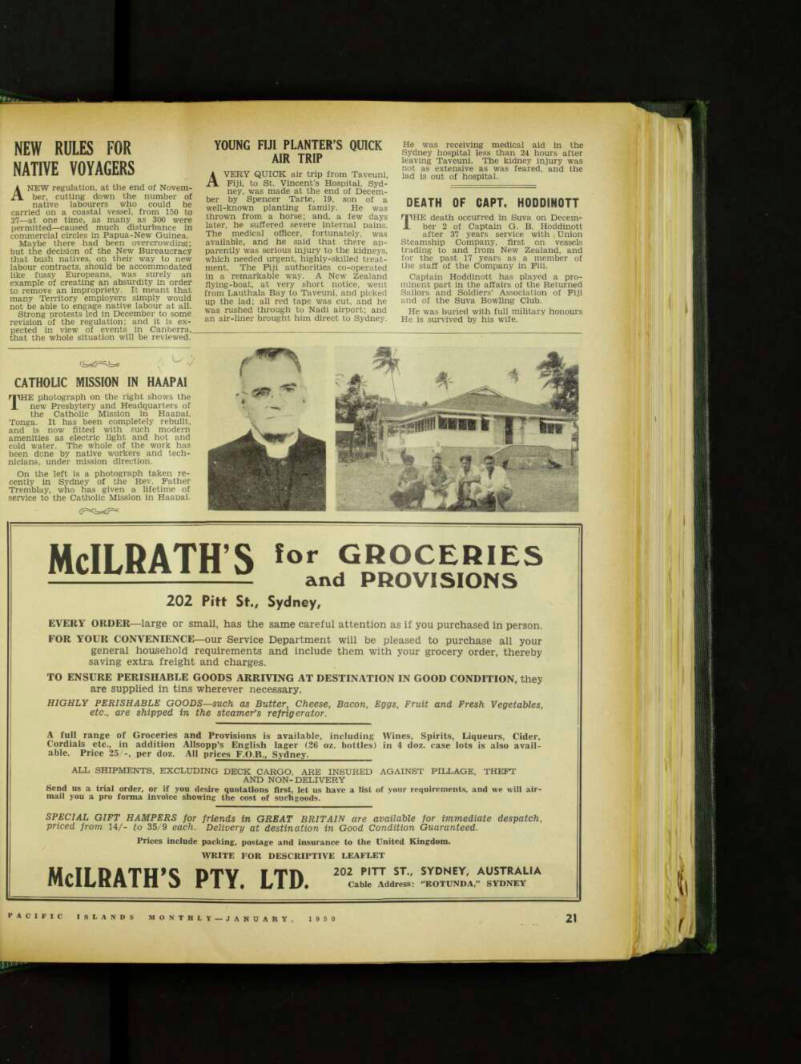
New Rules For
ANEW regulation, at the end of Novem ber, cutting down the number of native labourers who could be carried on a coastal vessel, from 150 to 37 —at one time, as many as 300 were permitted—caused much disturbance in commercial circles in Papua-New Guinea.
Maybe there had been overcrowding; but the decision of the New Bureaucracy that bush natives, on their way to new labour contracts, should be accommodated like fussy Europeans, was surely an example of creating an absurdity in order to remove an impropriety. It meant that many Territory employers simply would not be able to engage native labour at all.
Strong protests led in December to some revision of the regulation; and it is ex pected in view of events in Canberra,, that the whole situation will be reviewed.
Catholic Mission In Haapai
THE photograph on the right shows the new Presbytery and Headquarters of the Catholic Mission in Haapai, Tonga. It has been completely rebuilt, and is now fitted with such modern amenities as electric light and hot and cold water. The whole of the work has been done by native workers and tech nicians, under mission direction.
On the left is a photograph taken re cently in Sydney of the Rev. Father Tremblay, who has given a lifetime of service to the Catholic Mission in Haapai.
Young Fiji Planter’S Quick
Air Trip
AVERY QUICK air trip from Taveuni, Fiji, to St. Vincent’s Hospital, Syd ney, was made at the end of Decem ber by Spencer Tarte, 19, son of a well-known planting family. He was thrown from a horse; and, a few days later, he suffered severe internal pains.
The medical officer, fortunately, was available, and he said that there ap parently was serious injury to the kidneys, which needed urgent, highly-skilled treat ment. The Fiji authorities co-operated in a remarkable way. A New Zealand flying-boat, at very short notice, went from Lauthala Bay to Taveuni, and picked up the lad; all red tape was cut, and he was rushed through to Nadi airport; and an air-liner brought him direct to Sydney.
He was receiving medical aid in the Sydney hospital less than 24 hours after leaving Taveuni. The kidney injury was not as extensive as was feared, and the lad is out of hospital.
Death Of Cart. Hoddinott
THE death occurred in Suva on Decem ber 2 of Captain G. B. Hoddinott after 37 years service with Union Steamship Company, first on vessels trading to and from New Zealand, and for the past 17 years as a member of the staff of the Company in Fiii.
Captain Hoddinott has played a pro minent part in the affairs of the Returned Sailors and Soldiers’ Association of Fiji and of the Suva Bowling Club.
He was buried with full military honours He is survived by his wife.
Advertisements & other items, p. 23 (1 item)
McILRATH’S for groceries
mui/BH in j and PROVIS i ONS
202 Pitt St., Sydney,
EVERY ORDER—large or small, has the same careful attention as if you purchased in person.
FOR YOUR CONVENIENCE —our Service Department will be pleased to purchase all your general household requirements and include them with your grocery order, thereby saving extra freight and charges.
TO ENSURE PERISHABLE GOODS ARRIVING AT DESTINATION IN GOOD CONDITION, they are supplied in tins wherever necessary.
HIGHLY PERISHABLE GOODS—such as Butter, Cheese, Bacon, Eggs, Fruit and Fresh Vegetables, etc., are shipped in the steamer's refrigerator.
A full range of Groceries and Provisions is available, including Wines, Spirits, Liqueurs, Cider, Cordials etc., in addition Allsopp’s English lager (26 oz. bottles) in 4 doz. case lots is also available. Price 25/-, per doz. All prices F. 0.8., Sydney.
ALL SHIPMENTS, EXCLUDING DECK CARGO, ARE INSURED AGAINST PILLAGE, THEFT
AND NON-DELIVERY
Send us a trial order, or if you desire quotations first, let us have a list of your requirements, and we will airmail you a pro forma invoice showing the cost of such goods.
SPECIAL GIFT HAMPERS for friends in GREAT BRITAIN are available for immediate despatch, priced from 14/- to 35/9 each. Delivery at destination in Good Condition Guaranteed.
Prices include packing, postage and insurance to the United Kingdom.
WRITE FOR DESCRIPTIVE LEAFLET
M/>II DATH , Q DTV I 202 P,TT ST ' SYDNEY ' Australia In J rl I. JL I l/ Cable Address: “ROTUNDA,” SYDNEY
Native Deterioration
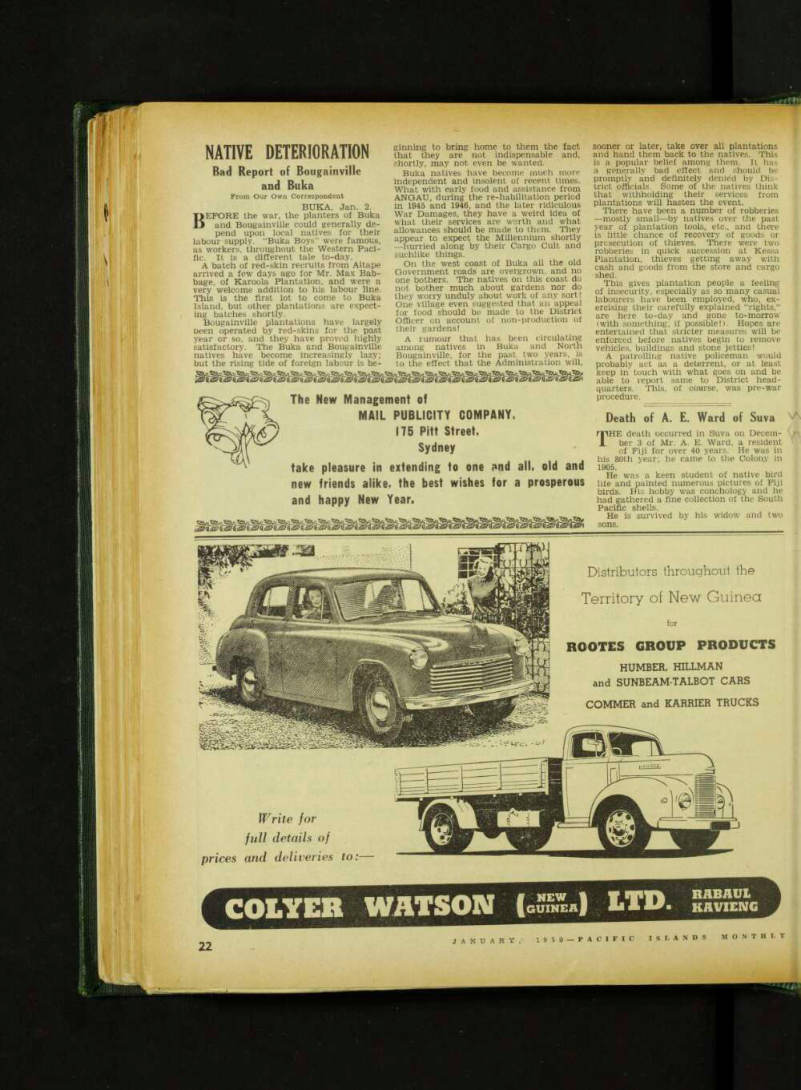
Bad Report of Bougainville and Buka
Prom Our Own Correspondent
Buka. Jan. 2.
BEFORE the war, the planters of Buka and Bougainville could generally de pend upon local natives for their labour supply. “Buka Boys” were famous, as workers, throughout the Western Paci fic. It is a different tale to-day.
A batch of red-skin recruits from Aitape arrived a few days ago for Mr. Max Bab bage, of Karoola Plantation, and were a very welcome addition to his labour line.
This is the first lot to come to Buka Island, but other plantations are expect ing batches shortly.
Bougainville plantations have largely been operated by red-skins for the past year or so, and they have proved highly satisfactory. The Buka and Bougainville natives have become increasingly lazy; but the rising tide of foreign labour is be
ginning to bring home to them the fact that they are not indispensable and, shortly, may not even be wanted.
Buka natives have become much more independent and insolent of recent times.
What with early food and assistance from ANGAU, during the re-habilitation period in 1945 and 1946, and the later ridiculous War Damages, they have a weird idea of what their services are worth and what allowances should be made to them. They appear to expect the Millennium shortly —hurried along by their Cargo Cult and suchlike things.
On the west coast of Buka all the old Government roads are overgrown, and no one bothers. The natives on this coast do not bother much about gardens nor do they worry unduly about work of any sort!
One village even suggested that an appeal for food should be made to the District Officer on account of non-production of their gardens!
A rumour that has been circulating among natives in Buka and North Bougainville, for the past two years, is to the effect that the Administration will,
sooner or later, take over all plantations and hand them back to the natives. This is a popular belief among them. It has a generally bad effect and should be promptly and definitely denied by Dis trict officials. Some of the natives think that withholding their services from plantations will hasten the event.
There have been a number of robberies —mostly small —by natives over the past year of plantation tools, etc., and there is little chance of recovery of goods or prosecution of thieves. There were two robberies in quick succession at Kessa Plantation, thieves getting away with cash and goods from the store and cargo shed.
This gives plantation people a feeling of insecurity, especially as so many casual labourers have been employed, who, ex ercising their carefully explained “rights,” are here to-day and gone to-morrow (with something, if possible!). Hopes are entertained that stricter measures will be enforced before natives begin to remove vehicles, buildings and stone jetties!
A patrolling native policeman would probably act as a deterrent, or at least keep in touch with what goes on and be able to report same to District head quarters. This, of course, was pre-war procedure.
Death of A. E. Ward of Suva
THE death occurred in Suva on Decem ber 3 of Mr. A. E. Ward, a resident of Fiji for over 40 years. He was in his 80th year; he came to the Colony in 1905.
He was a keen student of native bird life and painted numerous pictures of Fiji birds. His hobby was conchology and he had gathered a fine collection of the South Popifip cVipllq He is survived by his widow and two sons.
Advertisements & other items, p. 24 (1 item)
Colyer Watsow
k The New Management of
MAIL PUBLICITY COMPANY,
175 Pitt Street, Sydney take pleasure in extending to one and all, old and new friends alike, the best wishes for a prosperous and happy New Year.
u
HHgjBaHMWMWMIIMMI
m Write for full details of prices and deliveries to: —
COLYER WATSOW
■n •- -i- Distributors throughout the Territory of New Guinea for
ROOTES GROUP PRODUCTS
HUMBER, HILLMAN
and SUNBEAM-TALBOT CARS
COMMER and KARRIER TRUCKS
RABAUI
KAVIENG
High Cost Of
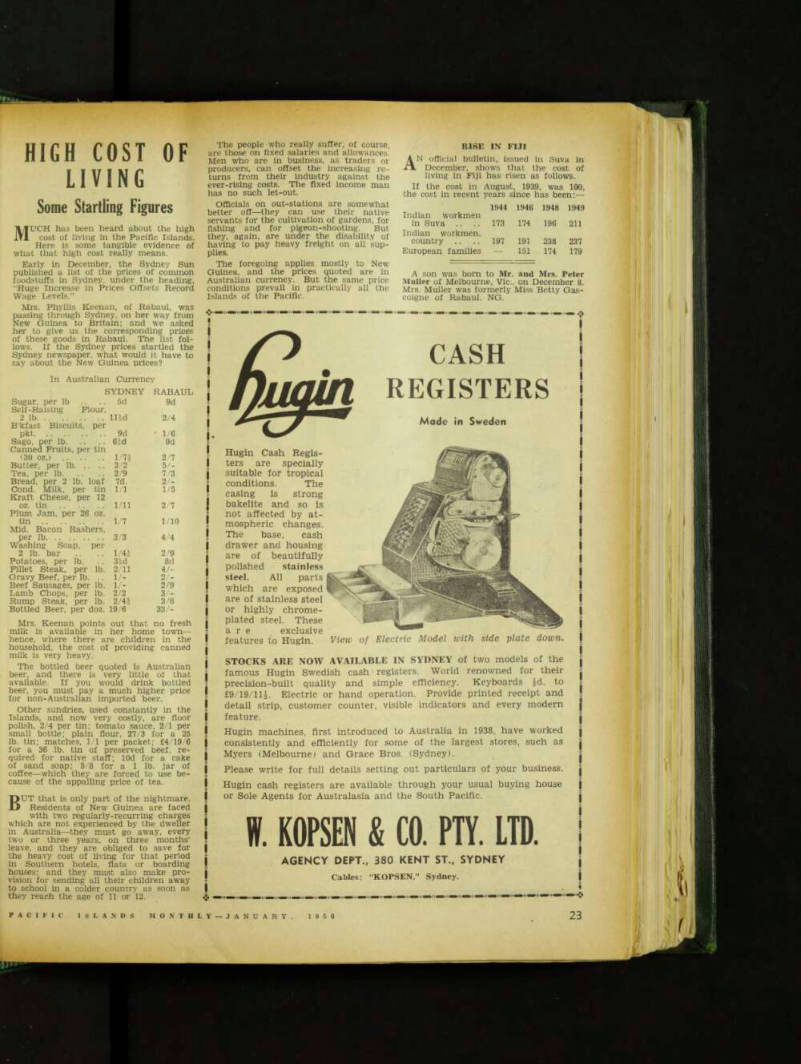
Living
Some Startling Figures
MUCH has been heard about the high cost of living in the Pacific Islands.
Here is some tangible evidence of what that high cost really means.
Early in December, the Sydney Sun published a list of the prices of common foodstuffs in Sydney, under the heading, “Huge Increase in Prices Offsets Record Wage Levels.”
Mrs. Phyllis Keenan, of Rabaul, was passing through Sydney, on her way from New Guinea to Britain; and we asked her to give us the corresponding prices of these goods in Rabaul. The list fol lows. If the Sydney prices startled the Sydney newspaper, what would it have to say about the New Guinea prices?
In Australian Currency
Mrs. Keenan points out that no fresh milk is available in her home town — hence, where there are children in the household, the cost of providing canned milk is very heavy.
The bottled beer quoted is Australian beer, and there is very little of that available. If you would drink bottled beer, you must pay a much higher price for non-Australian imported beer.
Other sundries, used constantly in the Islands, and now very costly, are floor polish, 2/4 per tin; tomato sauce, 2/1 per small bottle; plain flour, 27/3 for a 25 lb. tin; matches, 1/1 per packet; £4/19/6 for a 36 lb. tin of preserved beef, re quired for native staff; lOd for a cake of sand soap; 5/8 for a 1 lb. jar of coffee —which they are forced to use be cause of the appalling price of tea.
BUT that is only part of the nightmare.
Residents of New Guinea are faced with two regularly-recurring charges which are not experienced by the dweller in Australia—they must go away, every two or three years, on three months’ leave, and they are obliged to save for the heavy cost of living for that period in Southern hotels, flats or boarding houses; and they must also make pro vision for sending all their children away to school in a colder country as soon as they reach the age of 11 or 12.
The people who really suffer, of course, are those on fixed salaries and allowances.
Men who are in business, as traders or producers, can offset the increasing re turns from their industry against the ever-rising costs. The fixed income man has no such let-out.
Officials on out-stations are somewhat better off —they can use their native servants for the cultivation of gardens, for fishing and for pigeon-shooting. But they, again, are under the disability of having to pay heavy freight on all sup plies.
The foregoing applies mostly to New Guinea, and the prices quoted are in Australian currency. But the same price conditions prevail in practically all the Islands of the Pacific.
Sydney
Rabaui.
Sugar, per lb .. 5d 9d Self-Raising Flour, 2 lb ll£d 2/4 B’kfast Biscuits, per pkt 9d * 1/6 Sago, per lb 6id 9d Canned Fruits, per tin (30 oz.) 1/7* 2/7 Butter, per lb 2/2 5/- Tea, per lb 2/9 7/3 Bread, per 2 lb. loaf 7d. 2/- Cond. Milk, per tin 1/1 1/5 Kraft Cheese, per 12 oz. tin 1/11 2/7 Plum Jam, per 26 oz. tin 1/7 1/10 Mid. Bacon Rashers, per lb 3/3 4/4 Washing Soap, per 2 lb. bar 1/41 2/9 Potatoes, per lb. 3?.d 8d Fillet Steak, per lb. 2/11 4/- Gravy Beef, per lb. .. 1/- 2/- Beef Sausages, per lb. 1/- 2/9 Lamb Chops, per lb. 2/2 3/- Rump Steak, per lb. 2/4i 3/8 Bottled Beer, per doz. 19/6 33/-
Rise In Fiji
AN official bulletin, issued in Suva in December, shows that the cost of living in Fiji has risen as follows.
If the cost in August, 1939, was 100, the cost in recent years since has been: —
A son was born to Mr. and Mrs. Peter Muller of Melbourne, Vic., on December 8.
Mrs. Muller was formerly Miss Betty Gas coigne of Rabaul. NG.
1944 1946 1948 1949 Indian workmen in Suva .. .. 173 174 196 211 Indian workmen, country .. .. 197 191 238 237 European families — 151 174 179
Advertisements & other items, p. 25 (1 item)
Qwpa
CASH
REGISTERS
Made in Sweden Hugin Cash Registers are specially suitable for tropical conditions. The casing is strong bakelite and so is not affected by atmospheric changes.
The base, cash drawer and housing are of beautifully polished stainless steel. All parts which are exposed are of stainless steel or highly chromeplated steel. These are exclusive features to Hugin.
View of Electric Model with side plate down.
STOCKS ARE NOW AVAILABLE IN SYDNEY of two models of the famous Hugin Swedish cash registers. World renowned for their precision-built quality and simple efficiency. Keyboards id. to £9/19/IU. Electric or hand operation. Provide printed receipt and detail strip, customer counter, visible indicators and every modern feature.
Hugin machines, first introduced to Australia in 1938, have worked consistently and efficiently for some of the largest stores, such as Myers (Melbourne) and Grace Bros. (Sydney).
Please write for full details setting out particulars of your business.
Hugin cash registers are available through your usual buying house or Sole Agents for Australasia and the South Pacific.
W. KOPSEN & CO. PTV. LTD.
AGENCY DEPT., 380 KENT ST., SYDNEY
Cables: “KOPSEN,” Sydney.
Fiji

New Director of Public Works, Fiji
MR. J. P. Bruen, Deputy Director, Drainage and Irrigation Branch, Public Works Department, British Guiana, has been appointed Director of Public Works, Fiji, in succession to Mr.
J. L. Brown, who was recently transferred to Cyprus as Director of Public Works Mr. Bruen is now on leave in the United Kingdom. He will probably arrive in Fiji in April, 1950.
He graduated from the University of Ireland in 1924 as a Bachelor of Engineer ing. He was first appointed to the Colonial Service in British Guiana in January, 1930, and served in that Colony until his Fiji appointment.
Mr. J. Judd, CBE, has been appointed a member of the Suva Town Council in place of Dr. D. W. Hoodless who recently resigned in order to take up the post of temporary medical officer in the Gil bert and Ellice Islands Colony.
Rough Justice
Native Killed While in Police Custody
From Our Own Correspondent
Port Moresby, Jan. 2.
THE amazing story of how three natives stabbed another native to death while he was in police custody was told in the Court of Petty Sessions at Kerema, Papua, recently.
Later, in the Supreme Court at Moresby the murderers were sentenced to three years’ hard labour by Judge Gore. They killed Laho Hareho, of Vailala village, in revenge for the murder of a woman who was the daughter of one of them and niece of the other two. On December 5, 1949, a native policeman was taking Laho to Kerema for trial on a charge of killing the woman when her three relatives sprang out on to the track, armed with knives. According to evidence at Kerema Court, Laho fled down a hill with the men after him. The policeman, Dumaimba, reached Laho first and tried to fight off
the attackers, but they got behind him and mortally wounded Laho.
A Co-operative officer, Mr. Geoffrey Hill, who was with the policeman and his prisoner, said he shouted to the constable to shoot but no shot was fired (native police are seldom supplied with cart ridges). Hill said that after the attack the murderers passed him, still carrying their knives. He didn’t try to stop them as he was unarmed.
Major D. G. Kennedy, who has been farming in New Zealand since he retired from the Western Pacific High Commis sion Service three years ago, visited Sydney and Melbourne in January. He earned fame, and several decorations as a Coast Watcher in the Solomons in 1942- 43.
Mr. and Mrs. K. Elvy, have a son, born in Sydney on December 20. Mrs. Elvy was Miss Sheila Page, daughter of Mrs.
Page, now of Sydney, and the late H. H.
Page, Government Secretary of New Guinea who, as a prisoner of the Japanese, lost his life in the sinking of the Montevideo Maru.
Advertisements & other items, p. 26 (1 item)
Kodak
«qPjooitf |CH? >s*
FILMS CAMERAS
ACCESSORIES
are now available in full supply through any of the following Kodak Dealers:
TONGA
Burns Philp (South Sea) Co. Ltd., Nukualofa, Haapai, Vavau.
Jones, Mrs. E. M., Nukualofa.
Morris, Hedstrom Ltd., Nukualofa, Vavau.
A. Hettig, Nukualofa.
SAMOA
Burns Philp (South Sea) Co. Ltd., Apia, Pago Pago.
Morris, Hedstrom Ltd., Apia.
NIUE ISLAND
Burns Philp (South Sea) Co. Ltd., Niue.
COOK ISLANDS
Hopkins, S., Rarotonga.
LORD HOWE ISLAND
Thompson, O. C.
E. P. Hines.
NORFOLK ISLAND
Burns Philp (South Sea) Co. Ltd.
R. Bell.
H. Spencer-Salt.
NEW CALEDONIA
Ventrillon Preres, Noumea.
NEW HEBRIDES
Bums Philp (South Sea) Co. Ltd., Vila.
PAPUA-NEW GUINEA
Burns Philp (New Guinea) Ltd., Port Moresby, Samarai, Lae, Madang, Rabaul.
Steamship Trading Co., Port Moresby.
G. G. Smith & Co., Port Moresby.
Mr. R. Stewart, Bulolo.
Mr. J. J. McKean, Lae.
Mr. A. K. Gibson, Port Moresby.
Mr. G. Carter, Papuan Prints, Port Moresby.
Gabriel Chow Sing Yip, Rabaul.
Robert Gillespie New Guinea Ltd., Lae, Rabaul.
Kwong Wa King (Branch), Wewak.
Kwock Cheong, F. L., Rabaul.
Sam, Leo, Rabaul.
FIJI
Burns Philp (South Sea) Co. Ltd., Suva, Levuka, Lautoka, Labasa, Ba, Sigatoka, Rotuma.
Caine, F. W., & Co., Suva.
Mouat’s Pharmacy, Suva.
Prasad’s Studios, Lautoka.
Stinson Studios, Suva.
Swann & Co., A. J., Suva.
W. R. Carpenter & Co. Ltd., Suva.
Morris, Hedstrom Ltd., Suva, Lautoka, Ba, Tavua, Vatukoula. Nausori, Sigatoka, Nandi, Labasa, Levuka. Penang, Navua.
Boots The Chemist, Suva.
C. A. Adams, Lautoka.
Fong Lee & Co., Ba.
Sharma Studios, Nadi.
Flemming’s Pharmacy, Nadi.
BRITISH SOLOMON IS. PROTECTORATE
R. C. Symes, Honiara.
Conviction On Finger-Prints Alone
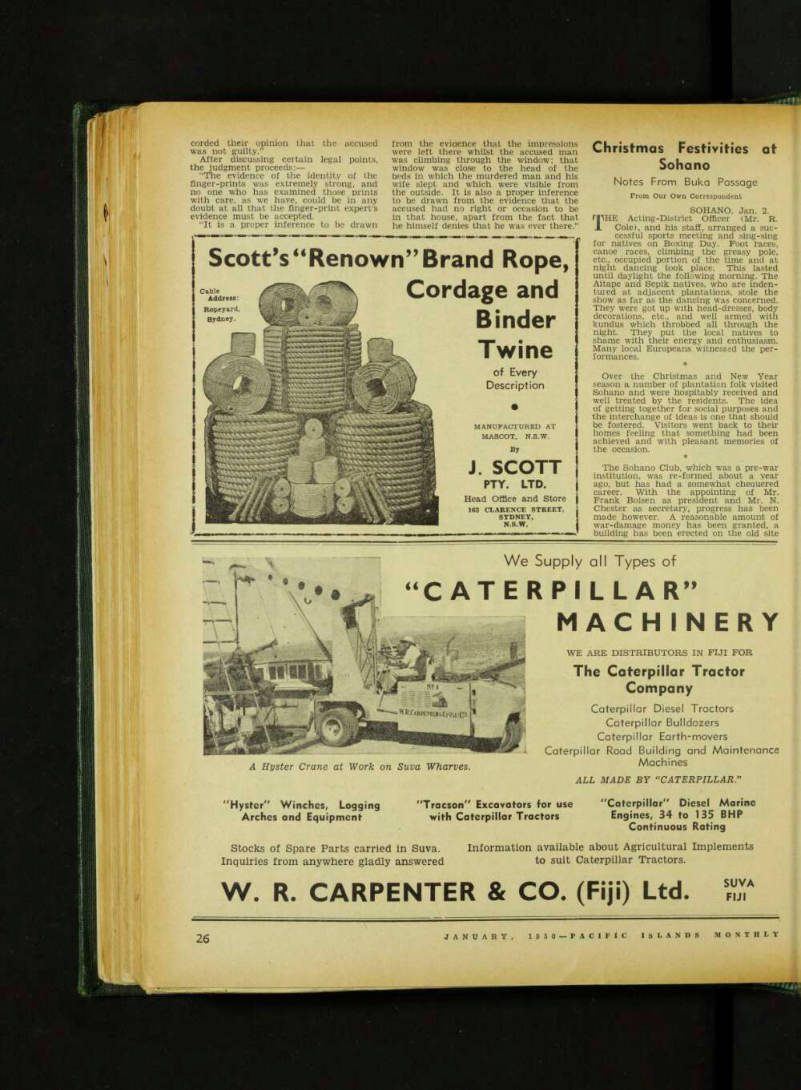
Appeal In Ocean Island Murder Is Discussed
IN dismissing the appeal of Tai Shek against the sentence of death imposed upon him for murder on Ocean Island in April last, the Fiji Court of Appeal gave an official summary of the case, and Its background, which is valuable.
Two Europeans were murdered, one night. The only evidence against the man convicted of the crime was a series of clear finger-prints. No motive for the murder ever has been disclosed.
The Appeal Court comprised the Chief Justice (Mr. J. H. Vaughan), the Puisne Judge (Mr. A. G, Carew) and the British Judge in the New Hebrides (Brigadier H.
J. M. Flaxman).
Counsel for the appellant (Mr.
H. Maurice Scott) contended, inter alia, that on the whole of the evidence there was a reasonable doubt as to whether the accused was guilty of the crime with which he was charged, that the Acting Puisne Judge (Mr. R. D. G. Higginson) had failed to give the accused the benefit of that doubt, and that there was insuffi cient evidence on which to convict of murder.
Leave to appeal to the Privy Council is now being sought.
PART of the Appeal Court judgment reads: — “In view of the nature of the ques tions raised on the appeal it is necessary briefly to set out such of the facts as are clearly established by the evidence.
“The scene of the crime was Ocean Island, which has an area of some 21 square miles and is in the hands of the British Phosphate Commissioners. The population consists of Government offi cials and the employees of the Phosphate
Commissioners, and is made up of some one hundred Europeans, 400 or more Gil bertese natives and 800 Chinese labourers.
“On the morning of April 27, 1949, the body of Mr. T. Allen, an engineer in the employment of the Commissioners, was found lying in the bedroom of his bunga low on Ocean Island. That of his wife was in the lounge, which adjoins and opens out into the bedroom. Her body was lying close to a table upon which was a telephone. Both were in their night clothes. They had been stabbed to death.
“The bedroom light was on and the telephone receiver cord had been cut. The doors and windows were open, this being in accordance with custom on Ocean Island where the climate is tropical. A knife with which the wounds could have been inflicted was found sticking in the ground sixty yards from the bungalow.
“According to the medical evidence, death had occurred between 2 a.m. and 5 a.m. There were blood-stained foot marks in the bedroom and lounge.
“A police guard was placed on the house and remained there until the in vestigations were completed.
“Special investigating officers arrived at the Island on May 8, and on May 9 they found on the wooden framework of one of the bedroom windows, which opened out on to the verandah, the impressions of a thumb and a left and right palm of a human hand. The position of these im pressions showed that the person who made them entered the bedroom of the Allen’s bungalow through this window, close to which the beds occupied by the Allens, and through which the mosquito net which hung down over both beds could be clearly seen from the outside.
“Having photographed these impres
sions, the investigating officers proceeded methodically to take the thumb and palm prints of the inhabitants of OCean Island.
“This procedure led to the arrest on May 21 of the appellant, a Chinese labourer, also employed by the Phosphate Commission, and he was in due course tried and convicted by the Supreme Court of Fiji of the murder of Mr. Allen. The trial was before a Judge sitting with five European assessors, of whom two re
corded their opinion that the accused was not guilty.”
After discussing certain legal points, the judgment proceeds:— “The evidence of the identity of the finger-prints was extremely strong, and no one who has examined those prints with care, as we have, could be in any doubt at all that the finger-print expert’s evidence must be accepted.
“It is a proper inference to be drawn
from the evidence that the impressions were left there whilst the accused man was climbing through the window: that window was close to the head of the beds in which the murdered man and his wife slept and which were visible from the outside. It is also a proper inference to be drawn from the evidence that the accused had no right or occasion to be in that house, apart from the fact that he himself denies that he was ever there.”
Advertisements & other items, pp. 27-28 (1 item)
A. H. Bunting Limited
WIGO MAGNETOS
(made in England)
For original or replacement
equipment on engines
Clockwise or anti-clockwise rotation all with built-in Impulse Coupling. (Prices plus tax)
PRICES ON APPLICATION
For Flange Mountings Vertical type Flywheel type Spare parts.
Trade Enquiries Invited
HARDMAN & HALL
44-48 Missenden Road, Newtown. ’Phone: LA3597. 4 Cyl. .. .
Twin Cyl. .
Single Cyl. £lO 5 0 £7 17 0 £6 18 0
A. H. BUNTING LIMITED
SAMARAI PAPUA
Optical discovery allows you
to see right through reflected glare
MS ★ We have been appointed Sole Agents in Papua and New Guinea for POLAROID* Day Glasses and Sunshields and enquiries are invited from Merchants and Traders. Prompt attention given to all enquiries. Many models available,
d) Polaroid
DAY GLASSES & SUNSHIELDS
in a wide range of colours. * Regd. Trade Mark Patented in U.S.A., Great Britain and other countries. ★
Scott’s “Renown” Brand Rope,
Cordage and
Binder
Twine
of Every
Description
Cable Address: Ropey a rd Sydney.
SK
MANUFACTURED AT
MASCOT, N.S.W.
J. SCOTT
PTY. LTD.
Head Office and Store
163 CLARENCE STREET,
SYDNEY,
N.S.W.
Christmas Festivities at Sohano Notes
Sohano Notes From Buka Passage
From Our Own Correspondent
Sohano, Jan. 2.
fT\HE Acting-District Officer (Mr. R. -i. Cole), and his staff, arranged a suc cessful sports meeting and sing-sing for natives on Boxing Day. Foot races, canoe races, climbing the greasy pole, etc., occupied portion of the time and at night dancing took place. This lasted until daylight the following morning. The Aitape and Sepik natives, who are inden tured at adjacent plantations, stole the show as far as the dancing was concerned.
They were got up with head-dresses, body decorations, etc., and well armed with kundus which throbbed all through the night. They put the local natives to shame with their energy and enthusiasm.
Many local Europeans witnessed the per formances. * Over the Christmas and New Year season a number of plantation folk visited Sohano and were hospitably received and well treated by the residents. The idea of getting together for social purposes and the interchange of ideas is one that should be fostered. Visitors went back to their homes feeling that something had been achieved and with pleasant memories of the occasion, * The Sohano Club, which was a pre-war institution, was re-formed about a year ago, but has had a somewhat chequered career. With the appointing of Mr.
Frank Boisen as president and Mr. N.
Chester as secretary, progress has been made however. A reasonable amount of war-damage money has been granted, a building has been erected on the old site
and some furniture has been installed— also a library is being formed. The idea is for a sports and social centre, and the facilities for visitors to the island to stay without having to depend on the hospi tality of the residents, which is always generous. The country members of the Club are anxious to see the whole affair functioning. * The European Hospital at Sohano has now been completed and is a fine build ing, with a well-equipped operating theatre, furnishings, etc. The kitchen, bathrooms and lavatories are good and an abundant water supply is assured by the tanks and large catchment area. Un fortunately, there are no Sisters to attend to patients, nor are there any quarters provided for Sisters, though it is said they may use a native material house which could easily be in better repair than it is. This matter of Sisters and accommo dation is one that requires immediate attention.
Several new buildings for the native hospital at Sohano have been erected — offices and wards —and consequent im provement in appearance is most marked.
They have an X-Ray outfit which is a great asset.
Buildings, as residences for the Medical Officer and Senior Medical Assistant, are now in course of erection at Sohano, and are a much-needed addition to the scanty accommodation provided on the island for the staff. There is still a decided ’’slum area,” comprised of native-built houses in a poor state of repair, but at last these are now being put into order pending the building of permanent houses. The sight of tarpaulins stretched across leaky roofs, the insecure flooring and so forth, is not a pleasing feature for occupants or im pressive to visitors. * THE local Administration trawler, Corn works, has been in Rabaul for some weeks for overhaul and engine re pairs, and she is likely to be another three weeks. The ailments of this lady are many but it is hoped that, after “her big operation,” she will be restored to health and return to duty. ♦ District residents are indignant at the apparently careless way that our mail matter is handled and the delay and in convenience occasioned thereby. Despite a fortnightly air service, and ships from Rabaul to Sohano, letters not infrequently take as much as a month to cover the distance. During December first-class mail matter and surface mail (newspapers, etc.) were shipped by Duali, which went to Torokina and the south of Bougainville direct, so missing Sohano, and resulting in the Christmas parcels, etc., spending the festive season in the ship’s hold. It is thought that an air mail from Australia was also on board.
Such rank and continued carelessness is inexcusable and should cease. Another act of discourtesy is the all-too-frequent habit of Rabaul-bound ships, sailing right past District Headquarters at Sohano without calling to pick up mail or in tending passengers. This is, or should be considered, a serious matter. The latest offender was the Directorate of Shipping’s Katika on December 29.
Mr. C. D. Barford, who is to succeed Mr.
B. C. Carpenter as manager of the Suva Branch of the Bank of New Zealand, ex pects to leave London for Fiji early in January. Mr. Barford was formerly manager of the Morrinsville branch of the bank and at present is on the staff of the London Branch. Mr. Carpenter, who has been in Fiji since 1947, has been transferred to New Zealand.
Advertisements & other items, p. 28 (1 item)
“Caterpillar”
a A Hyster Crane at Work on Suva Wharves.
We Supply all Types of
MACHINERY
WE ARE DISTRIBUTORS IN FIJI FOR
The Caterpillar Tractor
Company
Caterpillar Diesel Tractors Caterpillar Bulldozers Caterpillar Earth-movers Caterpillar Road Building and Maintenance Machines Hyster” Winches, Logging Arches and Equipment Tracson” Excavators for use with Caterpillar Tractors
ALL MADE BY “CATERPILLAR.”
"Caterpillar” Diesel Marine Engines, 34 to 135 BHP Continuous Rating Stocks of Spare Parts carried in Suva.
Inquiries from anywhere gladly answered Information available about Agricultural Implements to suit Caterpillar Tractors.
W. R. CARPENTER & CO. (Fiji) Ltd.
SUVA
FIJI
18 Feet of Rain
Suva Breaks Records in 1949
SUVA’S rainfall for 1949 just missed being 100 inches above normal. On a total of 271 wet days 220.54 inches fell. This was 99.68 inches above the average, and nearly 50 inches above the previous record of 170.74 inches which was established in 1921, The previous record for twelve consecu tive months was 212.13 inches. This was beaten in 1949 by over eight inches. The one record which remained intact was
that for the wettest single day. This has stood since 1906 when a fall of 26.5 inches in 24 hours was recorded. In 1949 the heaviest rainfall in one day was 14.53 inches. This occurred during May, a month in which a new record of 58.73 inches was recorded.
At Laucala Bay there were 269 wet days, only two fewer than in Suva but the total rainfall was only 179.54 inches, or 41 inches lower than Suva’s total.
When a woman driver puts her hand out, you can be sure of one thing—the window’s open.
Advertisements & other items, pp. 29-30 (1 item)
'S’enam
mmm '/
jfs!&-. y
> , '\\\ \ \ ,x\' n"
' v \ > \ N N ' \ V' '
Trop
ieal Form
Every Berger finish must withstand test after test to prove worthy of the Berger label . . . every product must satisfy the Berger technicians and chemists that it will meet the challenge of all climates from tropic heat to arctic cold.
'S’enam
FINISHES
KEEP ON KEEPING ON!
KASPER Superior SODA FOUNTAINS
‘KASPER’ SUPER SODA FOUNT AUN N° 6
SPECIALLY MADE FOR TROPICAL CONDITIONS
SODA FOUNTAIN IT feet long, J 3 inches high serving side * 29 Inchei FRAME 2 inch Angle Iron Frame, 4ELDED construction, rust-proofed FOUNTAIN TOP - l8 gauge, mirror finish, English, stainless steel.
SERVING - SIDS 20 gauge, satin finish, stainless steel.
3 J hnC'J KD
Special rust-proofed aluminium finish, wide range of colours.
Class Rinser.
Milk Shake klxer Swivel tap INSULATION Special insulation 4 ins.
Spanish cork board on bottom sides ft top, heavily pitched and sealed. 2 Arm Soda Station,-- Drip Tray ft 2 Running Viater 4 Syrup Jars Dishe Spoon Recept 6 special 10 gauge, stainless steel, mirror finish, interlocking raised hinge. Soda Fountain Lids.
Hermetically sealed Waterproof.
Surround Rabbi eh Shute tfo Syrup Storage rack ir m ce Block maker
SECTION
DIAGRAM
KEf Section Ice Cream Freesing Head extra to fountain.
Complete with 1/3 hp motor and fittings plus switch.
Ice Cream Head Refrigerator unit located here Drain Board, swivel tap a Double sinks welded into drain board Towel rail-p Sink taps Bottle storage or food storage Compartment (U cubic feet) Raised non-splash lip Chrome wheel valves for thermo-sypnoning brine.
Enables operator to e&aily regulate temperature fruit juice and soda sections Section Section Section Section Section A Double Hole for Soda ft lister Coils, plus fruit Salad Container on top of coll space.
B Double Hole for fruit Juices.
C Double Hole for Milk and/or Fruit Juices D Double Hole for serving Ice Cream S Double Hole Ice Cream nerdening section F Double Hole opening consisting of one a half hole storage space for ice blocks and/or ice cream.
Each ‘Kasper* Super Fountain fitted with Swias •Ssjiter* tnermeetstic valves.
KASPER NO. 6 TROPICAL INSULATED STAINLESS STEEL SODA FOUNTAIN
Complete with ICE CREAM MAKING MACHINE
SPECIALLY DESIGNED FOR TROPICAL CONDITIONS.
Kasper Superior Soda Fountain of all
stainless steel welded construction
surfaces.
COMPLETE FOUNTAINS, INCLUDING METAL RUST-PROOF
SURROUND, CARBONATORS AND REFRIGERATOR UNITS
SHIPPED FROM AUSTRALIA THROUGH YOUR AGENT
For beauty, for low lifetime cost, for convenience, for dependability, for profit-making power, “Kasper” Fountains stand supreme in Australia to-day. The “Kasper” Fountain is years ahead of conventional models. Every detail has been thoroughly worked out and tested in the factory and in use.
“Kasper” superior fountains are of all steel, lifetime construction with stainless steel, WELDED surfaces and chromeplated fittings. Adequate cork board insulation helps assure
lowest operating costs.
ORDER NOW AND AVOID DELAY
Kasper Refrigerators Pty. Ltd.
77 RAILWAY PARADE, ERSKINEVILLE, N.S.W., AUSTRALIA
Telephone: LA 1326
Gales In French Oceania

Two Schooners Lost
From Our Own Correspondent
Papeete, Dec. 6.
UNPRECEDENTED stormy weather in French Oceania, during November, left in its wake a number of broken ships.
Of these, the Hotu, owned by Galois and Co., a former Blue-Nose fishing boat, was driven onto the island of Vahitahi, in the Tuamotus; while the Denise, owned by John and Sam Mervin, becoming waterlogged and unmanageable, was abandoned at sea. Both vessels were well known, two-masted, trade schooners, of Papeete and both are reported a total loss.
Around-The-World Odyssey
NEWS has just been received in Tahiti regarding the world cruise of the Mexican yacht, Barca de Oro (Ship of Gold), which was in Papeete two years ago, where it was joined on its memorable voyage by young Philip Cowan, Jr., just then out of school, son of Mr. and Mrs.
Jack Cowan, of Papeete.
The Barca de Oro started from its home port, Acapulco, in July, 1947. Formerly the 56 ft., 23-year-old, two-masted schooner, Countess, with a Bermuda mainsail and auxiliary engine, her new owner, Enrique Ortega, after purchasing her for £5,000 and spending another £9OO on refitting her, re-named her Ship of Gold.
The trip was commenced with her owner, Mr. Ortega, Guillerme Heimpel, and two Mexican seamen aboard. After visiting Hawaii and the Marquesas Islands, the two seamen left the ship, and in their place Gil Daft, an American, and Philip Cowan, a British subject, were
signed on. At Mauritius, Maurice Sauzier, a fifth member of the crew joined them.
After leaving Tahiti, the ship visited the Cook Islands, Samoa. Fiji, New Caledonia, Brisbane, Timor, Bali, Batavia, the Cocos Islands and Rodriguez.
At Capetown, the Barca de Oro had a narrow shave when she was nearly run down in the night off Cape Point. “We were doing about seven knots and I think the ship must have misjudged our speed,” said Philip Cowan. “We had the wind right aft, and if we had attempted to alter course we would have gybed. The other vessel, which appeared to be a black-hulled Liberty ship, seemed to be pulling away from land, and although we had a searchlight on our sails as well as our sailing lights she cut close across our bow and gave us a bad scare.
“Then we passed over her logline—and I hope we broke it,” he concluded, grimly.
From Cape Town the Barca de Oro is heading for St. Helena, Rio de Janeiro, the Panama Canal and, finally, Acapulco.
Death Of M. Emile Laguesse
M. EMILE LAGUESSE, a well-known resident of Tahiti, died in Papeete in November after a brief illness.
M. Laguesse was bom in Paris in 1890.
At an early age he moved with his parents to Tahiti, Entering business as a young man he soon became prominent and, from 1923 until 1948, was secretary
treasurer of the Papeete Chamber of Commerce. In the latter year he was elected president of the Chamber and continued in that office until his death.
Headed by Governor Anziani, a large number of mourners followed the hearse on foot to the cemetery where an oration on the deceased was delivered by his life long friend, M. Albert Leboucher, M. Laguesse is survived by two daughters, Yvette and Janine. The former is married to M. Henri Jacquier, pharma cist, of Papeete. All three are at this time travelling abroad.
Travellers
RECENT departures by TRAPAS Air ways include:— M. Henri Gaignard, Counsellor for the Union Francaise who has been on official business in Papeete the last two months, during which a great number of entertainments were given in his honour. He arrived at the airplane sur rounded by friends, literally hidden among garlands of tropical flowers. M. Gaignard who is an MRP was, at the outbreak of the late war, an officer aboard the con verted Cap de Palmes.
IVX. Lachenal, Communist Counsellor of Union Francaise, who also has been in Papeete two months, and who arrived at the airplane alone.
Mr. William Pennington, who has been in Papeete three months studying, in the
interest of a group of Honolulu capitalists, the prospects of the tourist business. Mr, Pennington is returning home with a favourable report and expects to return to Papeete in January to inaugurate the building of a first-class modern hotel here.
The Misses Iris and Jacqueline Carlson, accompanied by M. Pedro Ezaguire, on their way to Paris where they will be guests of M. and Madame Ezaguire.
Mr. G. Blaisdell, formerly for many years Chief of the Honolulu Fire Depart ment. Mr. Blaisdell arrived in Papeete last September in the American yacht, Seaward.
Sister Superior General Mere Le tourneux, of the Soeurs de Saint Cluny, who has been in Papeete some weeks in specting the various schools of the Sisters.
During her stay a round of festivities was
given in her honour by members of the Catholic community.
Sister Gallagher who is accompanying the Mother Superior to Rarotonga to con tinue the work of inspection of the schools there.
Recent departures from Papeete for France by the steamer, Khouribga, in cluded:— Monsieur and Madame Calamy, heirs of the late Father Rougier, of Christmas Island fame, and late of Fiji.
The Rev. Father Calixte Olivier, who is making his first return to his native land after a sojourn in Tahiti of 30 years.
He expects to be back in about six months.
Monsieur and Madame Boubee, also making a first visit to Paris after 25 years. Monsieur Boubee is connected with the Department of Agriculture of Tahiti, in which capacity he has been instru mental in making many notable additions to the flora of French Oceania. He is also now owner of the extensive botanical gardens at Papeari, which he inherited from the late Harrison Smith.
Nz Governor-General Expected
NEWS has been received in Tahiti that the Governor-General of New Zea land will visit Papeete with ships of the New Zealand Navy some time in 1950 —probably May.
Mr. N. G. Cassidy, who has been ap pointed' Senior Chemist in the Fiji De partment of Agriculture, is expected to arrive in the Colony from Australia in January.
Mr. M. H. Benjamin, who has been Postmaster Suva, retired on December 31, and his place has been taken by Mr. J.
H. F. Wiley.
Advertisements & other items, pp. 31-32 (1 item)
Heinz Ss Beans
OUR HANDS MAKE GOOD ARMS
For your Fishing and Shooting Wants Consult Us.
Lithgow .22 Cal. Repeating Rifles ... £ll 14 0? Post Lithgow .22 Cal. Single Shot 5 1 3 \ Extra.
SI L RO H U 143 ELIZABETH STREET, SYDNEY.
Heinz Baked Beans are tops for taste with every man —and with the children, too. They’re oven-baked and soaked through and through in rich tomato sauce.
Buy either of the two varieties —Heinz Vegetarian Baked Beans, or Heinz Baked Beans with tender pork.
Serve Heinz Baked Beans often. They save time and work.
HEINZ SS BEANS
Livraison IMMEDIATE LINOLEUM ECOSSAIS IMPORTS
delivery immediate
(f&mwte
IMPORTED
LINOLEUM
Ideal for Island Conditions. Long Wearing.
Hessian Back. Cork based. FuU range of colours, patterned or plain. Full rolls (30 yards by 6 ft.) only supplied. Order to-day through your Trading House for delivery by first boat.
Ideal pour les pays tropicaux. D’une durabilite sans pareille, a base de liege couvert en toile de chanvre. Dessins ou unis. Rouleaux de 30 yards* par 6 pieds de large. Commandez aujourd hui chez votre Agent pour livraison par premier bateau.
TAY SIDE Linoleum distributed by.
INTERNATIONAL TRADING
PTY. LTD.
Halifax House, 26 O’Connell Street, Sydney.
Phone: BL 1543. Cables: “Mondial,” Sydney. m 4*
C. SULLIVAN PTY. LTD.
Island Merchants
Over 30 years' experience in the Pacific Island Trade.
Expert Buying Service Original Invoices Furnished Sellers of Island Produce.
Represented in all Australian States, New Zealand, England, France, United States, etc.
BANKERS: Bank of New South Wales, and Comptoir National d’Escompte de Paris.
C. SULLIVAN PTY. LTD.
379 KENT STREET, SYDNEY
And at Melbourne and Brisbane.
Telegrams & Cables: “CHASULL,” Sydney. Phone: MJ4657 (6 lines).
Associate Co.: C. SULLIVAN, INC., 230 California St., San Francisco, U.S.A.
Fijians And
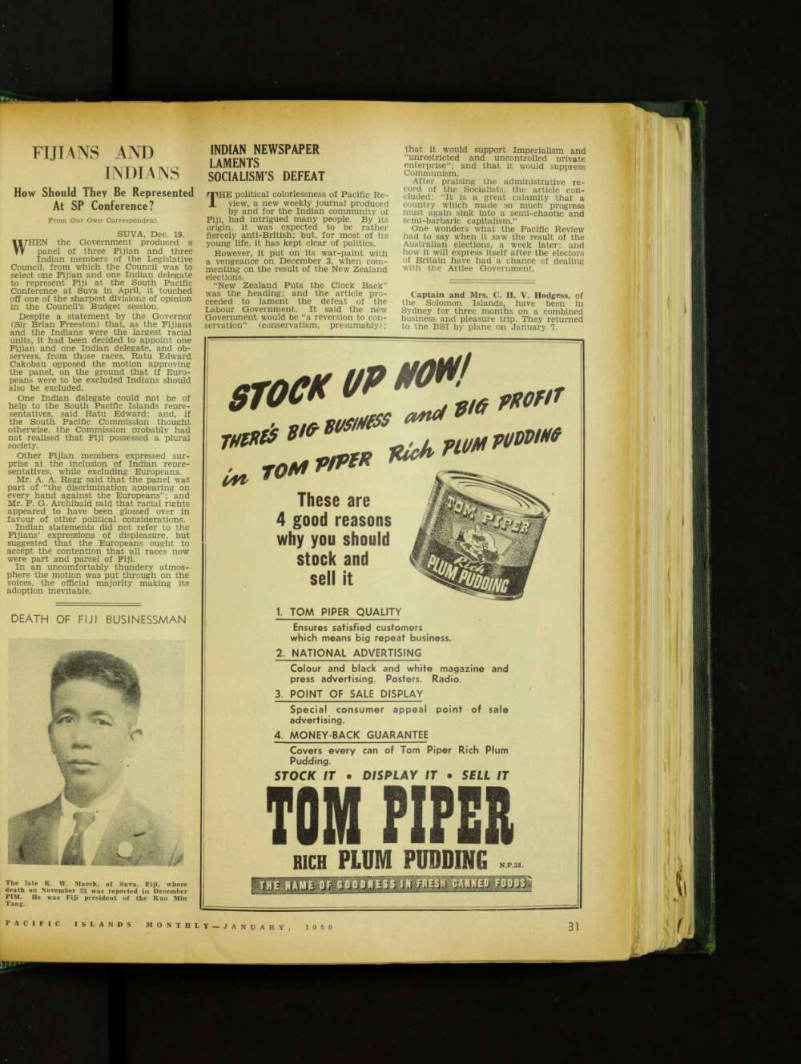
Indians
How Should They Be Represented At SP Conference?
From Our Own Correspondent
Suva, Dec. 19.
WHEN the Government produced a panel of three Fijian and three Indian members of the Legislative Council, from which the Council was to select one Fijian and one Indian delegate to represent Fiji at the South Pacific Conference at Suva in April, it touched off one of the sharpest divisions of opinion in the Council’s Budget session.
Despite a statement by the Governor (Sir Brian Freeston) that, as the Fijians and the Indians were the largest racial units, it had been decided to appoint one Fijian and one Indian delegate, and ob servers, from those races, Ratu Edward Cakobau opposed the motion approving the panel, on the ground that if Euro peans were to be excluded Indians should also be excluded.
One Indian delegate could not be of help to the South Pacific Islands repre sentatives, said Ratu Edward; and, if the South Pacific Commission thought otherwise, the Commission probably had not realised that Fiji possessed a plural society.
Other Fijian members expressed sur prise at the inclusion of Indian repre sentatives, while excluding Europeans.
Mr. A. A. Ragg said that the panel was part of “the discrimination appearing on every hand against the Europeans”; and Mr. F. G. Archibald said that racial rights appeared to have been glossed over in favour of other political considerations.
Indian statements did not refer to the Fijians’ expressions of displeasure, but suggested that the Europeans ought to accept the contention that all races now were part and parcel of Fiji.
In an uncomfortably thundery atmos phere the motion was put through on the voices, the official majority making its adoption inevitable.
Advertisements & other items, p. 33 (1 item)
Death Of Fiji Businessman
The late K. W. March, of Suva, Fiji, whose death on November 23 was reported in December PIM. He was Fiji president of the Kuo Min Tang.
Socialism’S Defeat
Indian Newspaper
Laments
THE political colorlessness of Pacific Re view, a new weekly journal produced by and for the Indian community of Fiji, had intrigued many people. By its origin, it was expected to be rather fiercely anti-British; but, for most of its young life, it has kept clear of politics.
However, it put on its war-paint with a vengeance on December 3, when com menting on the result of the New Zealand elections.
“New Zealand Puts the Clock Back” was the heading; and the article pro ceeded to lament the defeat of the Labour Government. It said the new Government would be “a reversion to con servation” (conservatism, presumably);
that it would support Imperialism and “unrestricted and uncontrolled private enterprise”; and that it would suppress Communism, After praising the administrative re cord of the Socialists, the article con cluded: “It is a great calamity that a country which made so much progress must again sink into a semi-chaotic and semi-barbaric capitalism.”
One wonders what the Pacific Review had to say when it saw the result of the Australian elections, a week later; and how it will express itself after the electors of Britain have had a chance of dealing with the Attlee Government.
Captain and Mrs. C. H. V. Hodgess, of the Solomon Islands, have been in Sydney for three months on a combined business and pleasure trip. They returned to the BSI by plane on January 7.
Advertisements & other items, pp. 33-34 (1 item)
Stock Vp **' „„„
r
These are
4 good reasons
why you should
stock and
sell it
fix.
'Jm.
1. TOM PIPER QUALITY
Ensures satisfied customers which means big repeat business.
2. NATIONAL ADVERTISING
Colour and black and white magazine and press advertising. Posters. Radio.
3. POINT OF SALE DISPLAY
Special consumer appeal point of sale advertising.
4. MONEY-BACK GUARANTEE
Covers every can of Tom Piper Rich Plum Pudding.
STOCK IT • DISPLAY IT • SELL IT
TOM
RICH PLUM PUDDING
N.P.28.
IDEAL FOR THE ISLANDS...
ATCA—BOATIMPELLER
The Famous
ATCO Products!
iii iftn?') «i .hi t;jiiTi Arc • Simple to handle • Light—easily carried Surprisingly economical It's easy starting, has smooth power and gives trouble-free performance.
ATCOSCYTHE
id , * \ jy -i. 1 M - iro ’iltin fU Vi N Cut time and labour costs with this dependable machine. It 7 s eight to twelve times as rapid as hand-scything. Ideal for cutting long grass, weeds, tall undergrowth, etc.
Just fill in the coupon below for illustrated booklets which will be sent post free. w %
ATCO MOTOR MOWER
There's a full range from the 12 and 14 inch models up to the 17, 20, 28 and 34 inch for big-area requirements. The ATCO is a self-contained unit and will go anywhere.
MOTOR TRACTORS PTY. LTD.
MOTOR TRACTORS
PTY. LIMITED
369-385 Wattle Street, Ultimo, Sydney Telegrams: “Sellmotors,” Sydney.
Furniture Grant for Widows of New Guinea Internees
New Guinea Internees
THE day before his government met its Waterloo at the December 10 elec tions, Mr. Chifley informed Mr.
Sydney Smith, secretary of the Austra lian Prisoners of War Relatives’ Associa tion (NSW Branch) that New Guinea widows of civilian internees were eligible for £75 furniture allowance. There were, of course, certain conditions attached thereto.
Although the Chifley government is now no more there is no reason to believe that the new government will go into reverse on this question.
Mr. Chifley’s statement, contained in a letter, was the outcome of representations made by Mr. Smith on behalf of his Association in a letter to the then Prime Minister in August. Mr. Smith had been informed by the Repatriation Commission that the regulation relating to the furni ture grant to certain war widows of Aus tralian servicemen did not apply to New Guinea women who had lost their hus bands who were civilian internees of the Japanese.
Mr. Smith pointed out that the govern ment recognised these widows for the purpose of War Widows Pensions, which had been granted to them as from Janu ary 17, 1946, and said that it was fair to assume that as their bread-winners had given their lives for King and country they should be entitled to the same rights as widows of members of the Australian Forces. He quoted the case of a New Guinea widow who had been separated from her children for
eight years and who only recently had been successful in getting a house where they could all live together. The Prisoners of War Relatives Association had made inquiries on her behalf regarding the furniture grant and had been informed by the Repatriation Commission that the regulation did not apply in her case.
Mr. Chifley’s reply (dated December 9, 1949) was as follows: Dear Mr. Smith, I have your letter of November 9, 1949.
The Government has approved the ex tension of the furniture grant of £75 provided for under the Australian Sol diers’ Repatriation Act to married, blinded and totally and permanently incapacitated persons, and widows with children under 16 years under the New Guinea Civilian War Pension Scheme. Furniture grants
to these persons are to be made on the conditions laid down in the regulations under the Australian Soldiers’ Repatria tion Act but for this purpose the Govern ment has decided that a widow with children under the age of 16 years at January 17, 1946, will be regarded as a “widow with children” provided:— (1) the child or children are still living with the mother; (2) the need for furniture still exists; and (3) application for assistance is made within twelve months of the time of commencement of the new benefit.
Yours sincerely,
J. B. Chifley
Prime Minister.
Koro Island, Fiji, recently reported the discovery of a live American bomb, an aerial 50-pounder. It is believed that it was dropped during combined opera tions which were staged at Koro in July. 1942, in preparation for the US Marines’ first landing at Guadalcanal.
Advertisements & other items, p. 35 (1 item)
Pacific Islands Trading Co.
Wynne S. Breden Pty. Ltd.
SHIPWRIGHTS, BOAT BUILDERS AND ENGINEERS.
"PHOENIX SHIPYARDS", NEWCASTLE, N.S.W.
Designers, Builders & Outfitters of ISLAND Vessels Work Boats, Cargo Boats and Auxiliary Craft up to 200 tons.
For the RIGHT TIME Rely on WESTCLOX The finest, smartest clocks in Westclox history—that’s what Westclox has in store for you! A wide range of stunning clocks for every room— spring-wound and electric alarm models—wall clocks for your kitchen and time clocks for the living room— yes, wrist and pocket watches, too— all with traditional Westclox dependability and smartness that have made Big Ben and other members of this time-keeping family famous all over the world.
“It’s a Westclox” is the finest thing you can say about a clock or watch.
Some Westclox have luminous dials that you can see in the dark.
• QUALITY •
• • RELIABILITY •
10 You can buy any Westclox with confidence. Look for that trade mark on the dial of the next clock or watch you buy.
Baby Ben—This alarm may be adjusted to loud or soft. Quiet tick. Made in two finishes — ivory and gold colour; also black with nickel trim.
CHIME ALARM
BIG
BEN
Big Ben is made two ways—There’s Big Ben Loud Alarm with booming intermittent call. If you want a more gentle awakening, there’s Big Ben Chime Alarm which first calls you with soft chimes. If you ignore these chimes, there’s a loud calf in reserve.
PACIFIC ISLANDS TRADING CO.
244 CALIFORNIA ST., SAN FRANCISCO, CALIF., U.S.A.
Storm In Tonga
Produce Crops Damaged
Nukualofa, Dec. 30.
THE Tongan archipelago had a nasty little blow on December 19 and a good deal of damage was done.
The SDA Mission lost its useful launch,
Endeavour, hear VaVau —quite a bad thing for both the Mission and the Group. (See article elsewhere.) I am afraid the storm will make a serious reduction in our copra production, and indications are that there will be no banana crop for at least 12 months.
A quartet is where all four think the other three can’t sing.
Mr. Ward’S Recent Oil
Furphy
WE published in the December PIM a statement by the then Australian Minister for Territories (Mr. Ward) to the effect that an excellent oil pros pect in New Guinea had been killed by big oil interests. Although Mr. Ward did not say so it was evident that he was making a reflection upon certain of the big com panies that are now carrying out boring operations in Papua.
The Sydney Bulletin, of December 21, deals with the story mercilessly. It says that this “Furphy” has been broadcast at intervals for many decades —ever since the search for oil commenced.
Mr. Ward produced no document of any tangible evidence to support his story—it was put into circulation simply to allow the Socialist member for East Sydney to “have a go” at the hated dollar interests.
The Bulletin pertinently asks whether the APC, which is spending enormous sums on the hiring of experts, and on boring operations in Papua, would de liberately overlook a prospect such as Mr. Ward described.
Landowners Taxed In Copra
THE Resident Commissioner of the Gilbert and Ellice Islands, Mr. W. J.
Peel, has notified by proclamation that the following taxes have been im posed on landowners in the Colony for the calendar year 1950; — Gilbert Islands .. 483 tons of copra Ellice Islands ... 74 tons of copra Phoenix Islands .. 12 tons of copra
Advertisements & other items, p. 36 (1 item)
He “All World 6” Receiver
N. F. Maloney & Co.
Phone 268. PORT MORESBY Phone 268.
Cables, Radios, etc., “Malco,” Port Moresby.
CUSTOMS, SHIPPING, AND FORWARDING AGENTS.
LICENSED AUCTIONEERS AND GENERAL COMMISSION
AGENTS.
House, Land, and Estate Agents. 1 Chief Agents:
NEW ZEALAND INSURANCE CO. LTD.
(Incorporated in New Zealand) FIRE . . ACCIDENT . . MOTOR VEHICLE . . MARINE, ETC.
Importers and Exporters :: Manufacturers Representatives.
Australian Representatives'.
E. J. GOUGH & CO., 1 BOND STREET, SYDNEY.
The new
HE “ALL WORLD 6” RECEIVER
Of special interest to you in that it has : —
■ 6 volt Accumulator Operation
■ Low Current Consumption
■ Outstanding Performance and
Reliability
A wealth of practical experience in the design of shortwave receivers for tropical markets has been embodied in the Eddystone “All World Six” Receiver. It is designed to provide the remote “out-station” listener with a specialist built receiver capable of first rate performance and possessing the important feature of low battery consumption. Selectivity, sensitivity, quality of reproduction and performance on all wave bands, including the highest frequencies, will satisfy the most critical. Workmanship and quality of materials used are of the finest to Th^wav^rar^e °Six” Receiver is continuous from 30.6 Mc/s to 484 Kc/s (9.8 to 620 metres). The current consumption is only 2.5 amperes from a 6 volt accumulator and no H.T. battery is required. This receiver is eminently suitable for those who, lacking electric supply mains, want performance equivalent to a mams-operated receiver, allied to the utmost economy in current consumption.
Price: £37-10-0 ex works
You are invited to write for descriptive literature and the address of your nearest Distributoi to the sole manufacturers.
STRATTON & CO. LTD.
EDDYSTONE WORKS, ALVECHURCH ROAD, WEST HEATH, BIRMINGHAM 31, ENGLAND
Cables: STRATNOID, BIRMINGHAM
Nz Military In Fiji
Planter’s Criticism Is Resented
Letter to the Editor I HAVE just seen, in the November issue of your magazine, the article giving the opinions of Mr. James S. K. B.
Borron on taxation in Fiji. With part of that letter I am vitally concerned, and I would request space to bring to Mr.
Borron’s notice a few facts and to refute a gratuitous insult to a country for which Fiji has much to thank.
In the statement appears the sentence: “The upkeep of local military forces stationed in Viti Levu only is unnecessary and is a pure waste of money and man power.”
It is unnecessary to go into a discus sion of strategy with Mr. Borron. It should be sufficiently clear that the de cision was not taken in Fiji, but by ser vice chiefs and politicians who are a little more informed of world affairs than a plantation-owner on the island of Mago in the Lau Group.
It may also be of interest to him to know that the people who made those decisions were not in any way concerned with hostile Indians or any other Indians.
They were concerned with British Com monwealth defence and how a Colony which expects to benefit from that defence may play a part.
It is very comforting to sit down and say that one’s best effort is to produce food, and to leave someone else to put up with the discomforts and dangers of the battle-front. The despised New Zea land could also have taken that viewpoint in the last war, as she is a food-producing country; but it is perhaps as well that she didn’t. When no less a person than Winston Churchill gives praise for New Zealand’s part I think the readers of PIM will be sufficiently intelligent to give the views of Mr. Borron their relevant im portance.
One can’t help thinking that his views on New Zealanders are coloured by the fact that his house in Suva was occupied by them during the war. Perhaps if he could take time for a few minutes to study some of the history of the war, he would find that these “undignified and inefficient personnel” were not so re garded by most of the rest of the world outside Mago.
With his remarks about the Fijians be ing great fighters and a great race, I entirely agree. But, once again, let me point out that the units of Fiji Military Forces, which fought so well in the Solo mons, were mainly commanded by New Zealand officers. That hardly fits in with his statement that the Fijians and New Zealanders have nothing in common.
Mr. Borron has made certain state ments about training. I desire to chal lenge him to produce any evidence of “ditch-digging, barbed-wire entangle ments, route marches and flag-waving reminiscent of Boer War days.” Parades— yes—Cession Day and Remembrance Day.
Perhaps if he could spare a few moments of his valuable time when he next comes to Suva he might be able to see some of the training for himself.
The rest of the statement is outside my province, but I cannot refrain from re minding the readers of PIM that if it had not been for the Royal New Zealand Air Force stationed at Laucala Bay, relief measures in the Lau Group after the hurricane, which so nearly ruined Mr, Borron apparently, would not have been possible so quickly. It is poor thanks to the crews and ground staff to read that it is hoped New Zealand will send “more dignified and efficient personnel.” One
hopes that Mr. Borron never has cause to request assistance in urgent sickness such as the RNZAF has several times carried out. It may be difficult to find a crew who would be prepared to assist him after his remarks about New Zea landers in Fiji.
Incidentally, as a matter of figures, to quadruple the Police as he suggests will cost at least another £200,000. Defence expenditure, if ignored, will only save £lOO,OOO, leaving a further £lOO,OOO to be found by taxation.
I am, etc.,
C. A. Pleasants,
Colonel.
Commander, Fiji Military Forces.
Suva, 13/12/49.
Editorial Note: As Mr. Borron lives in an isolated place, and cannot immediately defend himself, it perhaps is fair to say here that his article, as published, was a summary of a much longer manuscript.
We believe that we correctly reported Mr.
Borron’s statements; but it is possible that, in the condensation, some qualify ing phrases were lost.
The death occurred in Suva on Decem ber 1 of Mr. Charles Maberley, who has for just over a year been Marine Superin tendent for South Sea Marine Products Ltd.
Advertisements & other items, pp. 37-38 (2 items)
35
PACIFIC- ISLANDS MONTHLY JANUARY, 1950
Ropes,
kangaroo brand
Cordage,
and Twines for every purpose Backed by 86 years of service Manufactured by:
M. DONAGHY AND SONS,
Pty. Ltd., Geelong and Sydney.
Fiji Representatives :
PEARCE AND CO.
LIMITED
P.O. BOX 237, SUVA
The Most Extensive Manufacturers in the British Empire of
RUBBER STAMPS,
INKS, STENCILS,
Marking Devices,
ACME STAMP PADS
OFFICE 8 STATIONERY SUPPLIES
U We also Manufacture & Supply a Complete Line of
LIMEWASHING AND
SPRAYING MACHINES
for all purposes.
Let us know your requirements and we will quote by return.
WRITE FOR OUR GENERAL CATALOGUE
Limewashing Machine
EXCELSIOR SUPPLY CD. PTY. LTD.
278 Post Office Place,
MELBOURNE, VIC.
HEAD OFFICE :
160 BROADWAY,
Former I u known as George St., West,
SYDNEY, N.S.W.
50 Victoria Street,
WELLINGTON, N.Z.
Grime
does
not
y* m mm m*. mm* »* <« w V-. ■ c W ‘7 s^=- >.• a /
VACUUM
OUflUir PRODUCT
Keep
your
ine Clean
with
Eng
A clean engine gives perfect lubrication, improved performance, longer engine life, quicker starting and complete protection at all speeds and temperatures.
VACUUM OIL COMPANY PTY. LTD.
MOBILOIL
M 492
Tahiti Seeks Tourists
Plans For a Big Hotel
Papeete. Nov. 30.
TAHITI has entered the field as a com petitor for tourist business and is going after it in a big way.
M. Anziani, the new Governor of French Oceania, is heartily committed to the project, while Honolulu capitalists are already investigating Tahiti as an outlet for the investment of capital in de luxe hotels and other tourist enterprises.
When questioned recently regarding the purpose of his presence in Papeete, in the interest of the Earl Thacker company of Honolulu, Mr. William Pennington said: “Subject to confirmation by Hawaii principals, the site for the contemplated hotel, to be constructed with American capital, is already decided upon.
“Alexander Taran, long resident of Tahiti, and I, have inspected all available hotel sites around Papeete. Situated in the most salubrious and popular district of the island, the location decided on is within easy distance of town. The erec tion of a first-class hotel with excel lent appointments, which Tahiti at present does not possess, is contemplated.
“The main building will probably be a permanent two-storey structure of 100 rooms, designed by Honolulu architects.
It will be surrounded by colourful Tahiti type bungalows, set in a landscaped tropi cal garden. Attention will be given to the amusement and recreation of guests. Be sides tennis courts and a Roman swim ming pool, yachting and deep-sea fishing will be featured.”
Mr. Pennington continued. “I am greatly impressed with the whole tourist situation here. Tahiti has all the pos
sibilities of development that Hawaii had at the commencement of its campaign for visitors. They are now awaiting develop ment.”
“We are now studying the investment situation as it will apply to the recently enacted law permitting American capital to enter Tahiti, to possess property here and withdraw holdings and profits in American dollars,” said Alexander Taran.
“We have found his Excellency Governor Anziani most co-operative with our plans. He is not only willing but anxious to assist us. Paris travel agents are already featuring the Tahiti tourist trade.
“One feature of our project will be par ticularly attractive to foreign investors.
Tahiti imposes no realty, capital or per sonal property tax. It may be said to be tax free.”
Governor Anziani has stated that he is desirous of not only one properly equipped hotel to be erected in Tahiti, but several. In order to provide ade quate transportation for tourists, Air France and Pan American are committed to the establishment and maintenance, by January of 1950, of a pool of planes at Bora Bora airstrip. The Noumea In vestment Company, of which Trapas is a subsidiary, will then devote its attention to ferrying tourists from Bora Bora to Papeete.
Indications all point to the fact that Tahiti is on the eve of a great develop ment which, in these days of accelerated means of construction and transporta tion, will be a question, not of years, but of a few months.
Christmas Island, in the Gilbert and Ellice Colony, is no longer a first port of entry for overseas vessels, but Funafuti, in the Ellice Group, has become a first port of entry.
Fifteen tons of drilling equipment and general cargo were lost when the 20-ton APC barge, Guria, capsized off Hisiu Papua, on December 6. The Guria over turned after heavy seas drowned one engine, causing her to swing beam-on to the waves. Two accompanying barges, the Gadia and Goura, rescued the oc cupants, Mr. B. Browne and three natives All three vessels were taking equipment and general cargo to Malalaua. The Guria was washed on to the beach, but has been righted now. Her cargo is on the sea bottom two or three miles off shore. It’s stated officially that the lost equipment can be replaced locally.
Advertisements & other items, p. 39 (1 item)
Nelson & Robertson Rs
The Twinkle in
Your Eye
COMES FROM ACTIVE
DIGESTION
Good normal digestive and liver activity means good, normal health and fitness. If you are becoming gloomy and feel tired out, the cause may be a congested state of your intestinal tract. So many people are troubled with constipation, which, through the retention of waste in the digestive system, causes sick headache, biliousness, pimply skin, unpleasant breath, irritability, slackness and dull eyes.
Regain your bright and attractive appearance by banishing constipation with Plnkettes. Tiny, oerfectly harmless, gentle yet effective, these famous laxative and liver pills painlessly exercise and strengthen the bowels, keep the food tract clean and active, stir the liver, and thus banish sick headache, bilious attacks, pimples, unpleasant breath and gloom. All chemists and stores sell Pinkettes, the perfect laxative and liver pills.
NELSON and ROBERTSON Pfy. Ltd.
Established 1895
Shipowners - Brokers and
Islands Merchants
All classes merchandise purchased at Best Wholesale Prices. Original Invoices supplied to Island Clients. Cocoa Beans, Copra, Rubber, Trochus Shell and All Islands' Produce Sold on Commission.
Entrust your requirements to the firm with fifty years' practical experience in the Pacific Islands.
Inquiries Solicited.
Prompt attention given to all inquiries
NELSON & ROBERTSON RS
12 SPRING STREET, SYDNEY, AUSTRALIA
Telegraphic Address: IVAN, SYDNEY.
Party
Brisbane NG Assn. Christmas Party
THE ladies of the Brisbane New Guinea Association held a re-union Christ mas Party at the Lyceum Club Rooms in December. About 30 members were present.
Many friendships were renewed and re miniscences exchanged of the happy pre war days spent in the Islands.
Miss A. Jamieson, Dudley Street,
Sherwood, is still the Hon. Secretary of the Association, to whom all intending members should apply.
MRS. STAN McCOSKER, formerly of Matala Plantation, Rabaul, New Guinea, entertained 20 children at a Christmas Party in her home at New Farm, Brisbane, in December.
The greatest asset a woman can have is a man’s imagination.
The Late Sir Hubert Murray
Letter to the Editor ITAKE strong exception to the state ment in Osmar White’s article on Papua-New Guinea Administration (from Melbourne Herald, and published in September PIM) that “the late Sir Hubert Murray . . . was an old-time anthropologist who thought even mission school-teachers who educated their scholars to the third standard were a pack of interfering, disruptive busy bodies.”
On what authority does Mr. White base this assertion that Murray was an an thropologist? To be sympathetically dis posed towards a branch of science and its practitioners, as the late Sir Hubert undoubtedly was, does not make a man an anthropologist. Never at any time did he, with all his great intellectual gifts, set himself up as one.
The latter part of the same sentence is also palpably untrue and demonstrably false. “H.E.’s” opinion of the value of missions and mission education is well known to those who knew the man or who have taken, the trouble to discover what he left on record on those subjects in his published writings. That particu lar sentence in Mr. White’s article is unworthy of the writer of that very read able book “Green Armour.”
I am, etc.,
Evan R. Gill.
Liverpool, Eng. 10/12/49. (Editorial Note: We agree entirely. Sir Hubert Murray was not an anthropolo gist, and he was a warm admirer and supporter of the work done among the natives by the missionaries.)
Advertisements & other items, p. 40 (1 item)
A. B. Donald Limited
A. GREGORY PTY, LTD.
IMPORTERS, EXPORTERS AND
MANUFACTURERS
Leather Saddlery and Paint Merchants ALL CLASSES OF LEATHER SUPPLIED FROM STOCK Apply direct to: A. GREGORY PTY., LTD., 107 York St., Sydney
A. B. DONALD LIMITED
RAROTONGA COOK ISLANDS
TELEGRAPHIC ADDRESS: “DONALD, RAROTONGA.”
General Merchants (Wholesale Cr Retail) and Shipowners Importers & Exporters Branches Throughout Cook Islands Fire, Marine & Motor Vehicles Insurance Agents for Yorkshire
Insurance Co.
Lloyd's Agents.
Agents and Distributors for : ENGLAND.—Austin Cars & Trucks, Pye Radios, Dunlop Rubber Co., Ltd., Vauxhall Cars & Trucks, R. A. Lister & Co., Ltd., Phillips' Cycles, Marples Tools.
U.S.A.—Remington Rand Corp., Radio Corp. of America, Champion Spark Plug Co., Firestone Tyres, General Steamship Corp.
NEW ZEALAND.—Vacuum Oil Co. Pty., Ltd* Petroleum Products.
AUSTRALlA.—Wunderlich, Ltd., Cement Asbestos Products.
NORWAY.—O. Mustad & Sons, Fish Hooks.
SWEDEN.—B. A. HJorth & Co., Primus Products.
Head Office:— A. B. DONALD, LTD., Auckland.
Associate Houses: — ETABLISSEMENTS DONALD, Tahiti, Papeete, Society Islands.
DOMINION FRUIT CO., Suva, Fiji Islands.
CODES: Bentley's Complete Phrase, Acme Sydney Agents :
BURNS, PHILP & CO., LTD.
London Agents :
BURNS, PHILP & CO„ LTD.
San Francisco Agents :
BURNS, PHILP CO. OF SAN FRANCISCO.
£4,000,000 Per Annum
Expenditure in Papua-New Guinea
A SUMMARY of the finances of the Territory of Papua-New Guinea, for the year ended June 30 last, was published in the official Gazette in De cember.
It is disclosed that, during the year, the Territory had available for its purposes the sum of £4,720,000, the sources of which were: £ Surplus from 1948 period .. 290,000 From local taxes 1,234,000 Grant from Australia .. .. 3,196,000 Most of the local taxation came from Customs, which raised no less than £914,000, which was just on a quarter million more than in 1948. Next best revenue producers were Mines, £59,000 and Post Office, £51,000. Owing to the way in which the figures are presented, it is not possible to know the amount of gold royalty received —presumably, it is included in Customs.
The Territory spent just over £4,000,000 in 1948-9, and carried forward a surplus of £709,000. It is impossible to tell, from this summary, just where the money went. £1,478,000 was dispersed through “Mis cellaneous Services,” and £628,000 through “Additions, new works, etc.” District Services got £638,000, Police £191,000, Public Health £131,000, Education £147,000, and Public Works £153,000.
It may be noted that, while this Terri tory is spending at the rate of £4,000,000 per annum, its own revenues do not ex ceed £1,250,000. The balance is provided by the reluctant Australian taxpayer. As more than £2,000,000 is accounted for in the mysterious items of “Miscellaneous Services” and “New Works, etc.,” and if we presume that that expenditure is not essential, it may be found that, if Aus tralia gets tired of subsidising the Terri tory, most of the Departments can carry on most of their operations on the Terri tory’s own revenues.
Much will depend upon the view taken by the new Australian Government.
Messrs. Menzies and Fadden are anxious to reduce taxation, and they are certain to cast a calculating eye upon those very generous gifts to Papua-New Guinea.
New Development In
Malaria Study
BY “planting” malaria germs in chicken egg cultures and keeping a constant microscopic watch over the germs as they develop to maturity, scientists in the United States are learning some of the secrets of the life-cycle of the malaria parasite. The knowledge gained from these studies, it is hoped, will give doctors weapons to fight malaria in its earliest stages.
The parasites being studied are the type that cause malaria in birds. They are not the same as those that infect human beings. The life cycles of both types of parasite, however, are believed to follow the same pattern.
Lack of knowledge of how the parasite develops in the body during the seven day period between infection from an anopheles mosquito, and appearance of the parasites in red blood cells has long been a major obstacle to effective early treatment of the disease. During this seven-day period the parasite apparently vanishes in the body. When it reappears, it is full grown and already firmly estab lished in the red blood cells. The victim is already in the “chills and fever” stage of the disease.
The technique for isolating the malarial
parasites and growing them in chicken embryo cultures was developed by scien tists of the University of Tennessee, work ing for the US Office of Naval Research.
The High Commissioner of Western Samoa, Mr. G. R. Powles, and Mrs. Powles, with an official party of leading officials of the Western Samoan Government, left Apia on November 26 by plane for Pago Pago, American Samoa, for a short official visit at the invitation of the American Government of the neighbouring Terri tory.
Steamships Trading Company of
Papua has opened what it claims is the most modern native store in the Terri tory. Situated in Douglas Street, Port Moresby, next to G. G. Smith’s trade store, it is attractively designed and well stocked. It will sell ice cream and soft drinks and freezer goods such as saus ages, as well as groceries, hardware and drapery goods.
Mr. and Mrs. E. T. Fulton, of Makura pau Plantation, New Britain, have estab lished a second home at Frankston. Vic toria.
Advertisements & other items, pp. 41-42 (1 item)
I Pan A
TAKE THIS
MOST IMPORTAMT STEP
TO KEEP TEETH SPARKLING WHITE
use
I PAN A
TOOTH PASTE
Doctors and dentists all agree that gum troubles are the cause of most tooth extractions. That's one important reason why you should always use IPANA— the tooth paste that keeps both teeth and gums clean and healthy.
IPANA gives lasting radiance to your smile because it protects as well as cleans your teeth to sparkling whiteness.
Sold Everywhere X A * A. <o Si o o A,
fOf
A OO SPA rKLE
To you*
SMILE
A PRODUCT OF
BRISTOL-MYERS
8M32-49
55 f . m I 3ts * I s I
BRONTE BRAND:
Chili Con Came Braised Steak and Onions Curried Beef Curried Mutton Steak and Onions Mutton and Peas Irish Stew Beef Steak Pudding Corned Beef Hash Corned Beef Loaf With Cereal Mutton Broth Mulligatawny Soup Tomato Soup Vegetable Soup
From
Australia’s
Finest Fat
Stock ...
From the finest fat stock and the rich-
est vegetables in Australia we produce
these high-grade canned meats and
soups. BRONTE BRAND meats,
hotmeals and soups are deliciously
flavoured and are made from
ONLY meats and vegetables
of the highest quality. . . .
BM ★
THE COLONIAL WHOLESALE MEAT CO.
PTY. LTD.
Canning Factory, State Abattoirs, Homebush Bay, Sydney.
N.S.W.
PHONE: UM 8436.
CABLE ADDRESS:
WOOLMILL. SYDNEY.
Christmas Is. Now Linked With Nauru and Ocean Is
Ocean Is.
Details of Phosphate Purchase by Australia and New Zealand
DETAILS of the new arrangement, under which Australia and New Zealand will control the collection and distribution of phosphatic rock from Christmas Island, in the Indian Ocean, were given in the Australian Senate on October 27, when the Christmas Island Agreement Bill was passed.
The Governments of Australia and New Zealand have bought, for a sum of nearly £3,000,000 Sterling (over £3,600,000 Aus tralian) all rights to the phosphatic deposits on Christmas Island, as from January 1, 1949; and the new industry will be more or less controlled and operated by the British Phosphate Com mission, which collects and distributes the Nauru and Ocean Island phosphate.
In the course of a speech, the then Aus tralian Minister for Supply and Develop ment (Senator Armstrong) said that efforts had been made from time to time, since 1926, to acquire these rights from Christmas Island Phosphate Co.
Ltd., a private company incorporated in England. He proceeded: C CHRISTMAS Island, about 1,400 miles j north-west of Premantle, is an administrative dependency of the Colony of Singapore. It contains deposits of high-grade phosphate estimated at from 25,000,000 to 30,000,000 tons. Those de posits have been worked for more than 50 years by the Christmas Island Phos phate Co. Limited under a 99 years’ lease of the whole island, which was
granted to the company from Ist January, 1891.
Pre-war output of phosphate by the Co. was approximately 150,000 tons a year, most of which was sold to Japan. Since the war, supplies of this phosphate have been obtained for Australia and New Zealand to supplement supplies from Nauru and Ocean Island. Phosphate requirements of Australia and New Zea land are approximately 1,250,000 tons a year, expected to increase to 1,500,000 tons by 1951-52. Nauru, with a total deposits of 75,000,000 tons, and Ocean Island, with a total deposit of 12,000,000 tons, can supply approximately 1,300,000 tons a year. The Christmas Island de posits should supply the balance of requirements.
Under the agreement with the Christ mas Island Phosphate Co., the two gov ernments have jointly purchased the whole of the rights of the company in the undertaking at Christmas Island as at 31st December, 1948, including the un expired portion of the company’s lease which, at that date, had still 41 years to run. An amount of £2,750,000 sterling was paid by the two governments as joint purchasers in consideration for the sale. This price was subject to adjust ments in respect of capital expenditure incurred by the Co. after June 30, 1948, and also in respect of certain stock ad justments, which have since been effected with the company, involving a further sum of £142,695 sterling, bringing the
total purchase price up to £2,892,695 sterling.
Following the conclusion of the sale, consultations have taken place between the Australian and New Zealand Gov ernments as to future conduct of the undertaking at Christmas Island and agreement has been arrived at. The
purchase price and any additional moneys required for the working of the under taking will be provided by the two governments in equal shares. It is es timated that Australia’s contribution will be £1,500,000 sterling.
A SEPARATE commission, to manage and control the undertaking on behalf of the two governments, will con sist of three commissioners, of whom one is to be appointed by the Australian
Government, one by the New Zealand Government and one by the two gov ernments jointly. The British Phosphate Commissioners representing the Govern ments of the United Kingdom, Australia and New Zealand attend to the supply of phosphate for Australia and New Zealand and work the deposits on Nauru and Ocean Islands; but as the United Kingdom Government is not joined in the agreement for the purchase of Christmas Island deposits it will be necessary to establish a separate corn
mission to control this Christmas Island undertaking.
However, in view of the close connection between the working of the Christmas Island phosphate deposits and the act ivities of the British Phosphate Com missioners in regard to Nauru and Ocean Islands deposits, it is proposed to utilize the services of the British Phosphate Commissioners as managing agents of the Christmas Island undertaking and there by avoid unnecessary duplication of existing facilities and services. In anti cipation of the agreement to give effect to this arrangement, the British Phosphate Commissioners assumed con trol as managing agents of the under taking at Christmas Island from the Ist January, 1949.
Phosphate from Christmas Island will be disposed of in Australia and New Zealand in conjunction with phosphate supplied by the British Phosphate com missioners from Nauru and Ocean Islands, under agreements that will ensure, so far as practicable, the lowest possible cost.
In practice the Christmas Island phos phate will be delivered to the nearest fertilizer works in Australia, principally in Western Australia, thus releasing a corresponding tonnage of phosphate from Nauru and Ocean Islands for delivery to New Zealand.
The supply of ground phosphate from Christmas Island to Malaya previously arranged by the Christmas Island com pany will continue in accordance with the obligation taken over from the company, but the agreement provides that phosphate is not otherwise to be supplied to other countries outside Aust ralia and New Zealand except with the unanimous approval of the commissioners.
In common with the British Phosphate Commissioners the activities of the Christmas Island Phosphate Commission will be conducted on a non-profit basis, but any surplus funds which may be ac
cumulated as the result of the activities of the commission are to be shared equally between the two governments.
The addition of these Christmas Island deposits to the present holdings at Nauru and Ocean Islands, pursuant to the provisions of this bill, will ensure con tinuity of supplies of high-grade phos phate for Australian and New Zealand needs for many years to come.
The pre-war production of superphos phate at Christmas Island was 150,000 tons a year. That production has already been increased to 200,000 tons a year, and it is estimated that it will be increased to 250,000 tons by 1950. It is hoped that the deposits at Christmas Island will yield a maximum of 400,000 tons a year, and it is expected to achieve that target during the financial year 1951-52.
Advertisements & other items, pp. 43-44 (1 item)
Insurance
THE
YORKSHIRE
CO. LTD.
(Incorporated in England)
ALL CLASSES OF
INSURANCE
Including
Fire Motor Guarantee Accident Workers Marine Island Representatives:
PORT MORESBY: E. A. James
RABAUL: G. B. Black LAE: New Guinea Industries Ltd.
MADANG: R. MacGregor SUVA: Williams & Gosling Ltd.
NOUMEA: Y. Mortensen
NORFOLK ISLAND:
A. E. Martin
A 7, •K 2 /y x Wholesale and Retail Merchants. Shipowners. Sawmillers.
General Engineers. Customs and Shipping Agents.
Catering for all Plantation Supplies. Buyers of Island Produce.
Plantation Owners and Managing Agents.
Agents for:— Australia-West Pacific Line.
China Navigation Co.
Canton Insurance Office, Ltd.
Union Assurance Society, Ltd.
Aust. T. & G. Mutual Life Society, Ltd.
Guinea Air Traders, Ltd. ** co . tn>.
CQUYE*.*^ and , CohurcV
Distributing Agents in New Guinea for;— Hillman, Humber, Sunbeam-Talbot , Chrysler and Plymouth Cars.
Commer, Karrier and Fargo Trucks.
Willys Overland Jeeps.
G.M. Marine and Industrial Engines, Olympic Tyres and Cables.
Hygeia Dissolvenators.
Sherwin-Williams Paints.
Prefect Refrigerators.
Mullard Radios.
Aladdin Lamps.
Ewo Beer.
Snowflake Unsweetened Evaporated Milk.
SOLVE YOUR POWER PROBLEMS
WITH AN
ARMSTRONG SHEET
Aircooled Diesel Engine, 5/6, 7/8, 12/16 H.P.
DESIGNED FOR
Power Generating e All Plant Operation
FEATURES:
• COLD STARTING
• PRESSURE LUBRICATION
• FUEL ECONOMY
• COMPACT
• LOW WEIGHT
• BUILT TO OPERATE IN ANY
CLIMATE
IMMEDIATE DELIVERY
Sole Pacific Agents :
VENTURA TRADING COMPANY PTY. LTD.
26 BRIDGE STREET, SYDNEY.
CABLES, “VENTURA,” SYDNEY.
Represented by P. & E. HUTCHINSON, Sava. VENTURA TRADE AGENCY, Lae, T.N.G
Telegram; "CARRLOCK" P.O. Box 2140, Hong Kong
CARRLOCK CO. LTD.
2nd Floor, Queen's Bldg., Chafer Road, HONG KONG
General Merchants ;; Commission Agents
Exporters and Shippers of All Kinds of Merchandise To the Pacific Islands
Representatives of Leading Manufacturers
in HONG KONG
INQUIRIES INVITED
Merauke
Australia’s Unknown Foreign Neighbour
ALTHOUGH Merauke is the nearest non-British town to Australia, probably not one Australian in one hundred thousand knows what and where Merauke is.
It is the chief town of the south-eastern part of Dutch New Guinea, and it is only a few hundred miles north-west of Cape York. It has been known to tropical wanderers for a hundred years, mainly as a centre for Bird-of-paradise shooters and shell-fishers, but otherwise it is just a sleepy little trading town on the New Guinea coast.
Recently, two Australians, Captain George Wyeth and young Stan Little, took a 26 ft. motor launch from the Queensland coast to Merauke: and Mr.
Little, back in Sydney, gave some in teresting impressions of the little Dutch port.
“We went through Torres Strait to Thursday Island,” he said, “and then, from TI, we headed straight across to the New Guinea coast. We simply followed the coast north-west to Merauke.
“Merauke is on a river, about a mile from the mouth. It is a sheltered port, but the country around is low-lying and mostly covered with tropical jupgle There are many native villages, and a number of coconut plantations, along the coast.
“There are not more than a score of Dutchmen in Merauke. There are half a dozen stores, run by Chinese, and a large community of Indonesians. There must be a considerable native popula tion —there seem to be always natives on the move through the town.
“There is no hotel accommodation in the place—the traveller has to be privately lodged. We lived on the launch. The Chinese stores sell liquor.
“A Dutch cargo vessel comes in once a month. We were told that a fortnightly plane service, connecting with Java, was to start in December.
“The Sacred Heart of Jesus Mission has a big establishment there, with hospital, schools, and so forth.
“We went up quickly, with the south east trade wind behind us; taut it was a different story when two Dutchmen brought us back in the same launch. We had to beat into it all the way. We were three days coming round from Merauke to Daru, in Western Papua, where we picked up the Qantas Catalina to Port Moresby.”
Mr. A. F. S. Ohman, a veterinary officer of the Queensland Agricultural Depart ment, has accepted an appointment as director of veterinary services, Fiji. Mr.
Ohlman left for his new post by the Sonoma on December 20.
Fiji Export Bananas
Said To Be Poor
From Our Own Correspondent
Suva, Dec. 3.
MR. PERCY McCONNELL, who, while visiting Auckland, conducted a vio lent protest campaign in the local press about the quality of the Fiji bananas shipped to New Zealand, has thereby electrified the buyers in Fiji and inspired a detailed statement from the Fiji Agriculture Department.
It is, he claims, wrong and unfair to attempt to put the blame on to the Fijian growers, who “have never been checked and, as far as I can see, have never been given a plan to help them and to insist that better quality fruit is picked, packed and shipped.”
Pleading the case of the New Zealand consumer, Mr. McConnell demands that no immature fruit be picked; that all fruit should be carefully handled, and that the licensed buyers to-day should “ask the old-timers about the bananas that were shipped from Fiji to Sydney 50 years ago.”
Mr. McConnell returned to Suva in the Aorangi to-day. He said that very few Auckland shops display bananas from Fiji “because they are small and ripen black.”
Advertisements & other items, pp. 45-46 (2 items)
43
Y JANUARY, 1950
PACIFIC ISLANDS MONTHL
Vince
m
SPECIALISING IN
PACIFIC ISLAND INSURANCES
FIRE—MOTOR VEHICLE
MARINE—HULLS AND CARGO
EMPLOYER’S LIABILITY
BONDS —In accordance with
ADMINISTRATION ORDINANCES.
COPRA INSURED FROM DRIER
TO BUYER.
AND ALL OTHER CLASSES ARRANGED
AT LOWEST CURRENT RATES.
Established Agencies throughout the Territory of Papua and New Guinea Managing Agents: New Guinea Company, Limited.
Island Representative: G. D. A. Kent, Babaul Branch.
SOUTHERN PACIFIC INSURANCE
CO., LTD.
HEAD OFFICE: 60 HUNTER STREET,
SYDNEY.
me maw's we
w/m
£O/ove/j/ce
FOR
SUMMER
HEADACHES
HEAT
EXHAUSTION
FATIGUE
LISTLESSNESS
Enjoy Summer Fun!
thrill to the call of the surf and the sand! Vincent’s A.P.C give marvellous relief from Summer Headaches, Fatigue, and Nervous Depression.
Vincent’s A.P.C will lift you to bright, smiling alertness! r 4
AN IMPORTANT
PO/NT TO
REMEMBER!
Prepared to the original hospital formula, genuine Vincent’s a.p.c is a proved and accepted medical prescription! smiling alerl
VINCE
JIB
fOR
sakSIE
POWDERS
F NT’S 1
& TABLETS
HIM
v e
its
a
its
Rtso
o
OSENE'
KER
burns
oRD
The perfect trouble-free
LUXURY LIGHT. 300 CANDLE
POWER. MADE IN TWO SIZES,
“THE QUEEN,” 2li" TALL AND
“THE PRINCESS,” I6i" TALL. CREAM AND POLISHED BRASS FINISH WITH SHADE TO MATCH, GIVING 12 HOURS LIGHT ON ONE FILLING: (l| PINTS OF KEROSENE).
“THE LOVELY LAMP” FITTED WITH THE “HAPPY MANTLE.”
THE TILLEY LAMP COMPANY, LTD. HeNDON, ENGLAND
REPRESENTATION :
MELBOURNE: T. H Bentley, Pty. Ltd., 123-125 William Street, Melbourne, C.l TASMANIA: Mr. H. V. Sellars, 108 a Charles Street, Launceston.
FIJI: Mr. K. Witherington, 2 Burns Philp Buildings, Suva.
Treatment of Burns and Tropical
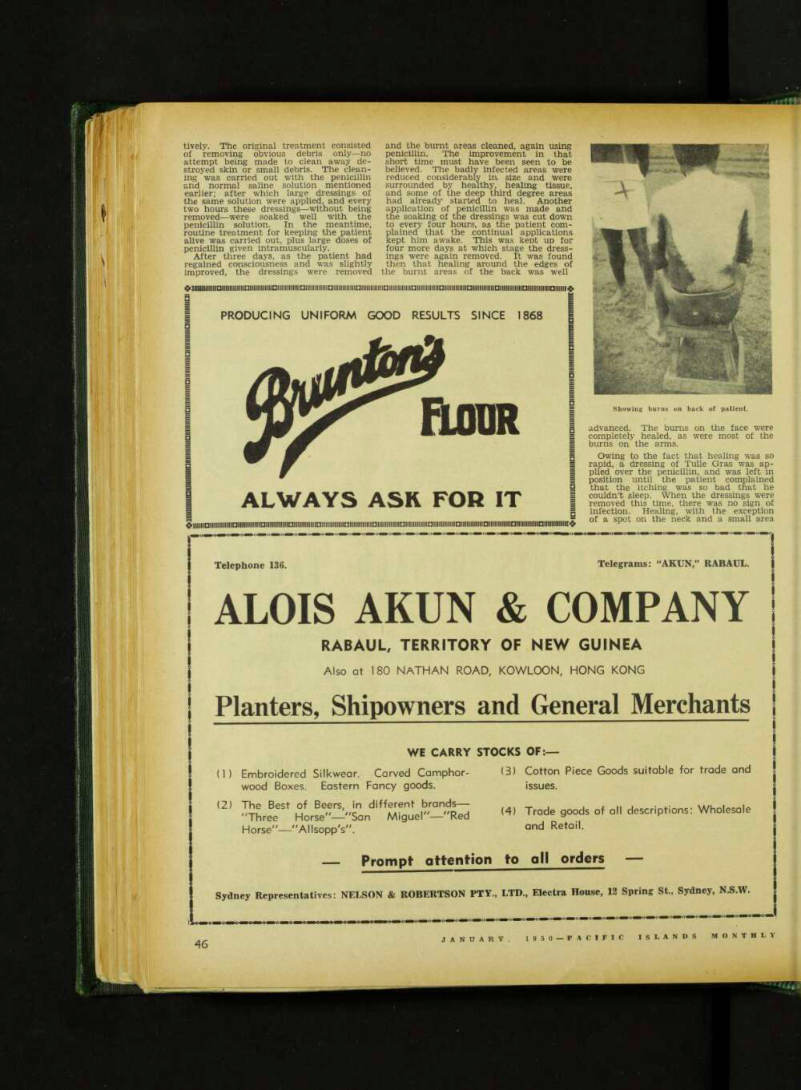
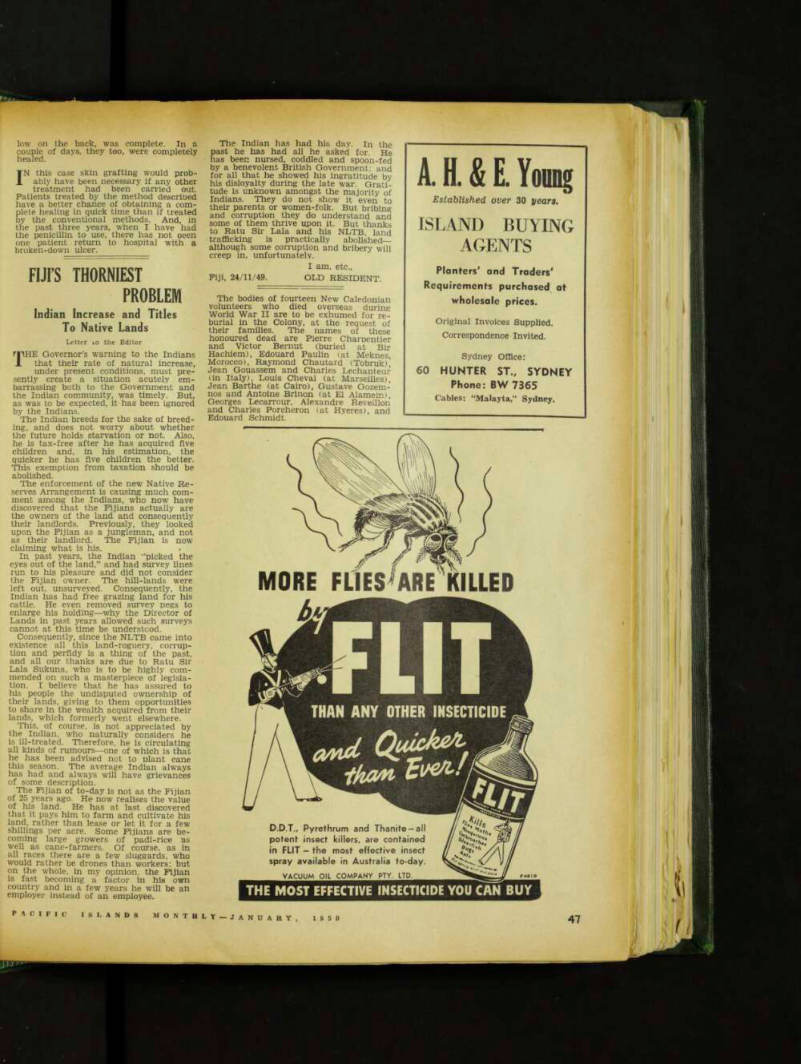
Ulcers With Penicillin
By Daika
SINCE reading in a 1946 copy of PIM where “JDW” reported his ex periences with the use of penicillin in the treatment of tropical ulcers by skin grafting, others have found that by using similar methods to those he de scribed, the results have been equally successful.
It was found also that, if a large, acute tropical ulcer was treated with a solution of penicillin in sterile normal saline (0.9 per cent.) it would, in most cases, heal without extensive scarring in a shorter time than if the accepted method of treatment were used, and this does away with the necessity of skin grafting at all (which was often the only way such tropical ulcers could be healed without fear of their breaking down and recur ring periodically).
I would like to state that I am not a medical officer, but that my experience has been gained by close contact with large numbers of natives over a number of years, in both Territories of Papua- New Guinea as a member of ANGAU, the Administration and the missions.
The treatments used were as follows: For a large and chronic tropical ulcer it was found that after cleaning, a solu tion of penicillin in normal saline well soaked into a dressing and applied daily for one week would stop active infection, and often, in that time the lesion would be completely healed.
If a skin graft were necessary, the best method was found to be a thorough
irrigation of the ulcer with the penicillin solution, then the skin graft applied, and a wet dressing of penicillin firmly bound into position. This was left in place for five days, and it was invariably found, on removal, that an excellent percentage of the grafts had taken.
This was always followed with a fur ther application of the penicillin solution under a firm strapping of adhesive bandage (elastoplast) which was left in position for a further five days. Usually in that time, healing would be complete, or at least so far advanced that one more application of the solution would com plete the treatment.
IN treating native patients suffering (from extensive burns—usually caused by children falling into the fire, or a house burning down around a family— it was found that most patients suffered from infection of the burnt areas either before coming into hospital, or shortly after admission.
One such case (photo next page), a casualty from a house fire, suffering from second and third degree burns of the back, face, and arms was admitted to hospital a week after the accident in an unconscious state. During that pre vious week, two days were spent lying in his village while others who had died in the fire were buried; and five days were taken up while the patient was carried to the hospital. No treatment, other than wrapping him in banana leaves, was given him, so the state of his burns on admission to hospital, can be imagined.
As the patient was in such a bad state, the burnt areas were treated conserva
tively. The original treatment consisted of removing obvious debris only—no attempt being made to clean away de stroyed skin or small debris. The clean ing was carried out with the penicillin and normal saline solution mentioned earlier; after which large dressings of the same solution were applied, and every two hours these dressings—without being removed —were soaked well with the penicillin solution. In the meantime, routine treatment for keeping the patient alive was carried out, plus large doses of penicillin given intramuscularly.
After three days, as the patient had regained consciousness and was slightly improved, the dressings were removed
and the burnt areas cleaned, again using penicillin. The improvement in that short time must have been seen to be believed. The badly infected areas were reduced considerably in. size and were surrounded by healthy, healing tissue, and some of the deep third degree areas had already started to heal. Another application of penicillin was made and the soaking of the dressings was cut down to every four hours, as the patient com plained that the continual applications kept him awake. This was kept up for four more days at which stage the dress ings were again removed. It was found then that healing around the edges of the burnt areas of the back was well
advanced. The bums on the face were completely healed, as were most of the burns on the arms.
Owing to the fact that healing was so rapid, a dressing of Tulle Gras was ap plied over the penicillin, and was left in position until the patient complained that the itching was so bad that he couldn’t sleep. When the dressings were removed this time, there was no sign of infection. Healing, with the exception of a spot on the neck and a small area
Showing burns on back of patient.
low on the back, was complete. In a couple of days, they too, were completely healed.
IN this case skin grafting would prob ably have been necessary if any other treatment had been carried out.
Patients treated by the method described have a better chance of obtaining a com plete healing in quick time than if treated by the conventional methods. And, in the past three years, when I have had the penicillin to use, there has not oeen one patient return to hospital with a broken-down ulcer.
Advertisements & other items, pp. 47-48 (1 item)
Etablissements Donald Tahiti
Woven Wire for all Industry
COPRA DRYING TRAYS, FLOORS, Etc.
FRUIT DRYING TRAYS, MINING SCREENS.
Heavy Mosquito Gauze in Phosphor Bronze and other Metals Impervious to Salt Sea Air.
WIRE DOOR MATS AND GENERAL WIRE WORKS
E. WRIGHT & CO. LTD.
Office and Works: 148-162 Cleveland Street, Sydney, N.S.W.
Telegraphic Address: "Wrlghtmake," Chippendale.
ETABLISSEMENTS DONALD TAHITI
HEAD OFFICE—QUAI DU COMMERCE—PAPEETE
TELEGRAPHIC ADDRESS—“DONALD, PAPEETE”
General Merchant's (Wholesale & Retail) & Shipowners
Importers & Exporters—Branches Throughout Marquesas Islands
Lloyd’s Agents
ASSOCIATE
HOUSES:
A. B. DONALD, LTD.
AUCKLAND, NEW ZEALAND.
A. B. DONALD, LTD.
RAROTONGA, COOK ISLANDS
DOMINION FRUIT CO..
SUVA, FIJI ISLANDS.
Agents and Distributors for :
FRANCE:
HENNESSY COGNACS
MARIE BRIZARD & ROGER
LIQUEURS
CHARLES HEIDSIECK
CHAMPAGNES
PERRIER WATER
GRUBER BEER
U.S.A.:
GENERAL STEAMSHIP CORP.
RADIO CORP. OF AMERICA
BROWN & WILLIAMSON, LTD.
CIGARETTES: LUCKY STRIKE,
WINGS. OLD GOLD
CHAMPION SPARK PLUG CO.
RAINIER BEER
ENGLAND:
RECKITTS & COLMAN
(OVERSEAS), LTD.
PHILLIPS BICYCLES
THE BANK LINE LTD.
NEW ZEALAND:
VACUUM OIL CO. PTY., LTD.
PETROLEUM PRODUCTS
SWEDEN:
HJORTH & CIE
PRIMUS STOVES
Sydney Agents :
BURNS, PHILP & CO., LTD.
London Agents : San Francisco Agents : Agents in France : BURNS, PHILP & CO., LTD. BURNS, PHILP CO. OF HARTH & CIE, PARIS.
SAN FRANCISCO. A. BICKART, MARSEILLES.
PRODUCING UNIFORM GOOD RESULTS SINCE 1868
ALWAYS ASK FOR IT
Telephone 136.
Telegrams: “AKUN,” RABAUL.
ALOIS AKUN & COMPANY
RABAUL, TERRITORY OF NEW GUINEA
Also at 180 NATHAN ROAD, KOWLOON, HONG KONG
Planters, Shipowners and General Merchants
WE CARRY STOCKS OF:—
(1) Embroidered Silkwear. Carved Camphorwood Boxes. Eastern Fancy goods. (2) The Best of Beers, in different brands — “Three Horse"—"San Miguel"—"Red Horse"—"Allsopp's".
Prompt attention
(3) Cotton Piece Goods suitable for trade and issues. (4) Trade goods of all descriptions: Wholesale and Retail.
to all orders
Sydney Representatives: NELSON & ROBERTSON PTY., LTD., Electra House, 12 Spring: St., Sydney, N.S.W,
Problem
Fiji’S Thorniest
Indian Increase and Titles To Native Lands
Letter io the Editor THE Governor’s warning to the Indians that their rate of natural increase, under present conditions, must pre sently create a situation acutely em barrassing both to the Government and the Indian community, was timely. But, as was to be expected, it has been ignored by the Indians.
The Indian breeds for the sake of breed ing, and does not worry about whether the future holds starvation or not. Also, he is tax-free after he has acquired five children and, in his estimation, the quicker he has five children the better.
This exemption from taxation should be abolished.
The enforcement of the new Native Re serves Arrangement is causing much com ment among the Indians, who now have discovered that the Fijians actually are the owners of the land and consequently their landlords. Previously, they looked upon the Fijian as a jungleman, and not as their landlord. The Fijian is now claiming what is his.
In past years, the Indian “picked the eyes out of the land,” and had survey lines run to his pleasure and did not consider the Fijian owner. The hill-lands were left out, unsurveyed. Consequently, the Indian has had free grazing land for his cattle. He even removed survey pegs to enlarge his holding—why the Director of Lands in past years allowed such surveys cannot at this time be understood.
Consequently, since the NLTB came into existence all this land-roguery, corrup tion and perfidy is a thing of the past, and all our thanks are due to Ratu Sir Lala Sukuna, who is to be highly com mended on such a masterpiece of legisla tion. I believe that he has assured to his people the undisputed ownership of their lands, giving to them opportunities to share in the wealth acquired from their lands, which formerly went elsewhere.
This, of course, is not appreciated by the Indian, who naturally considers he is ill-treated. Therefore, he is circulating all kinds of rumours—one of which is that he has been advised not to plant cane this season. The average Indian always has had and always will have grievances of some description.
The Fijian of to-day is not as the Fijian of 25 years ago. He now realises the value of his land. He has at last discovered that it pays him to farm and cultivate his land, rather than lease or let it for a few shillings per acre. Some Fijians are be coming large growers of padi-rice as well as cane-farmers. Of course, as in all races there are a few sluggards, who would rather be drones than workers: but on the whole, in my opinion, the Fijian is fast becoming a factor in his own country and in a few years he will be an employer instead of an employee.
The Indian has had his day. In the past he has had all he asked for. He has been nursed, coddled and spoon-fed by a benevolent British Government; and for all that he showed his ingratitude by his disloyalty during the late war. Grati tude is unknown amongst the majority of Indians. They do not show it even to their parents or women-folk. But bribing and corruption they do understand and some of them thrive upon it. But thanks to Ratu Sir Lala and his NLTB, land trafficking is practically abolished— although some corruption and bribery will creep in, unfortunately.
I am, etc.,
Fiji, 24/11/49.
Old Resident.
The bodies of fourteen New Caledonian volunteers who died overseas during World War II are to be exhumed for re burial in the Colony, at the request of their families. The names of these honoured dead are Pierre Charpentier and Victor Bernut (buried at Bir Hachiem), Edouard Paulin (at Meknes, Morocco), Raymond Chautard (Tobruk), Jean Gouassem and Charles Lechanteur (in Italy), Louis Cheval (at Marseilles), Jean Barthe (at Cairo), Gustave Gozem nos and Antoine Brinon (at El Alamein), Georges Lecarrour, Alexandre Reveillon and Charles Porcheron (at Hyeres), and Edouard Schmidt.
Advertisements & other items, pp. 49-50 (1 item)
A. H. & E Young
Established over 30 years .
ISLAND BUYING
AGENTS
Planters' and Traders' Requirements purchased at wholesale prices.
Original Invoices Supplied.
Correspondence Invited.
Sydney Office:
60 HUNTER ST., SYDNEY
Phone: BW 7365 Cables; “Malayta,” Sydney.
* . l 11
THAN ANY OTHER INSECTICIDE
ih/m
D.D.T., Pyrethrum and Thanite-all potent insect killers, are contained in FLIT - the most effective insect spray available in Australia to-day.
VACUUM OIL COMPANY PTY. LTD.
4/7/ F 4610 THE MOST EFFECTIVE INSECTICIDE YOU CAN BUY
o /, 9f S\y I «* i o x ** * HP- *x I a vS*® fW /£ S? 4 O N* P ' % '(A 2* tA» P /»• v A m * :> 3/ »\ / -t ¥J, ««?
A vfl* X X I'*
the
services
SOUTH
Nit
PACIFIC
New Zealand is a whole world of travel . . . but it’s a small world when you fly on the N.Z. National Airways Corporation air network that brings New Zealand’s playgrounds and wonderlands invitingly close.
NEW ZEALAND NATIONAL AIRWAYS CORPORATION.
New Zealand National Airways Corporation provides a network of air services throughout the the South-West Pacific. General Agents in the Dominion for British Commonwealth Pacific Airlines ana Trans-Australian Airlines. Booking Agents for Tasman Empire Airways, Qantas Empire Airways, me c.u. . • and other overseas airlines.
Offices and Agents throughout New Zealand and the South-West Pacific.
Magazine Section
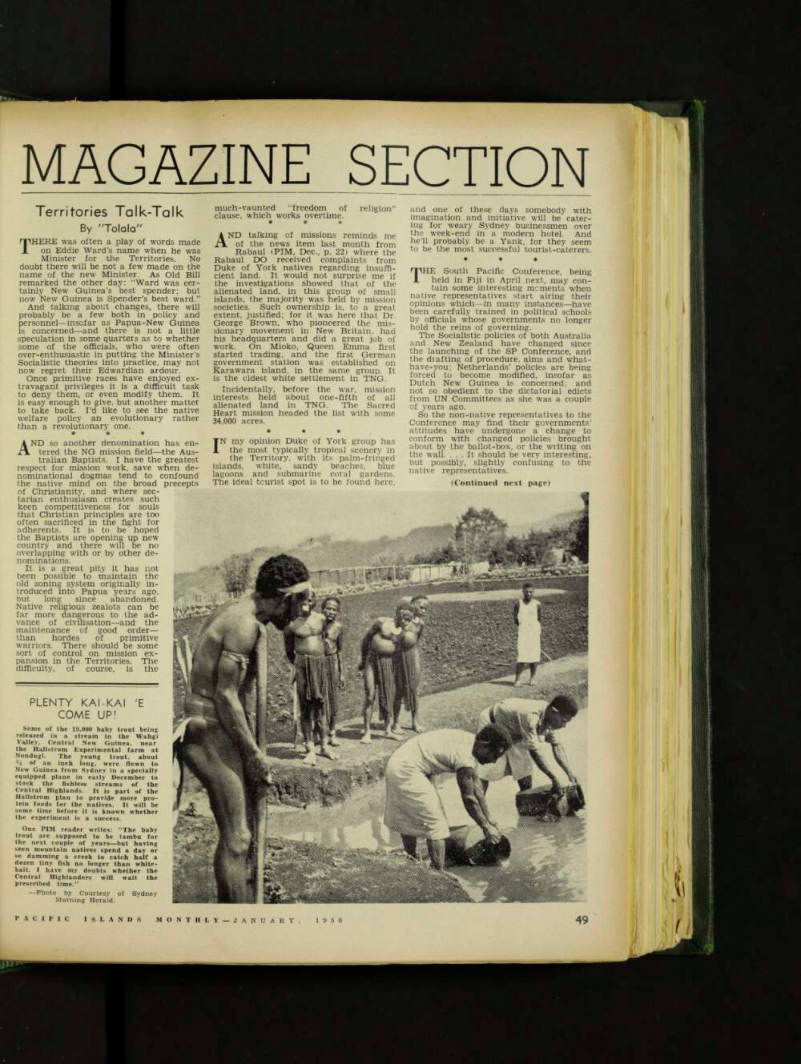
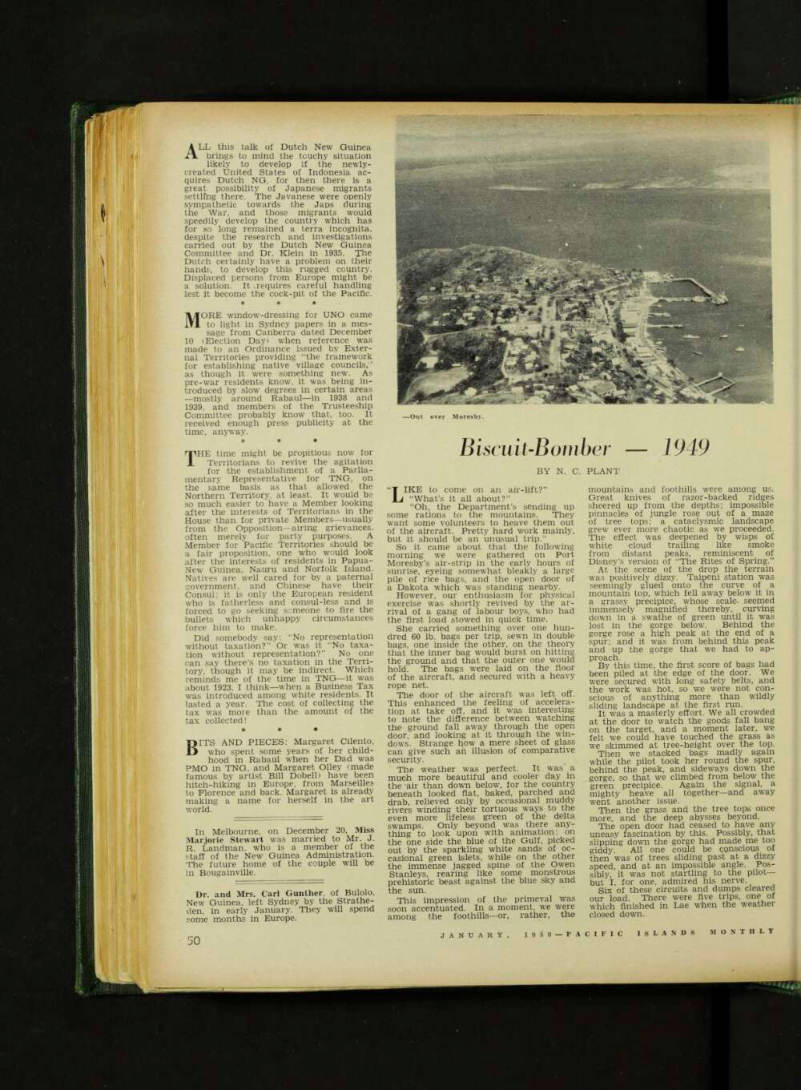
Territoriesp Talk-Talk
By "Tolala"
THERE was often a play of words made on Eddie Ward’s name when he was Minister for the Territories. No doubt there will be not a few made on the name of the new Minister. As Old Bill remarked the other day: ‘‘Ward was cer tainly New Guinea’s best spender; but now New Guinea is Spender’s best ward.”
And talking about changes, there will probably be a few both in policy and personnel—insofar as Papua-New Guinea is concerned—and there is not a little speculation in some quarters as to whether some of the officials, who were often over-enthusiastic in putting the Minister’s Socialistic theories into practice, may not now regret their Edwardian ardour.
Once primitive races have enjoyed ex travaErant nrivilesres it is a difficult task I ripfv hfm nTpvfn Lriifv thl Tt Is ea!v y enourti’ to eive anothS matte? is easy enougn to give, out anotner matter welfare policy an 6
than revolutionary oSe y
man a revolutionary one.
A N ? S< h denomi “ A tered the NG mission field—the Aus trahan Baptists. I have the greatest respect for mission work, save when de nominational dogmas tend to confound the native mind on the broad precepts
of Christianity, and where sec tarian enthusiasm creates such keen competitiveness for souls that Christian principles are too often sacrificed in the fight for adherents. It is to be hoped the Baptists are opening up new country and there will be no overlapping with or by other de nominations.
It is a great pity it has not been possible to maintain the old zoning system originally in troduced into Papua years ago, but long since abandoned.
Native religious zealots can be far more dangerous to the ad vance of civilisation—and the maintenance of good order — than hordes of primitive warriors. There should be some sort of control on mission ex pansion in the Territories. The difficulty, of course, is the
much-vaunted “freedom of religion”
Clause, which works overtime. * A ND talking of missions reminds me 0 f the news item last month from Rabaul (PIM, Dec., p. 22) where the Rabaul DO received ’complaints from Duke of York natives regarding insuffident land. It would not surprise me If the investigations showed that of the alienated land, in this group of small islands, the majority was held by mission societies. Such ownership is, to a great extent, justified; for it was here that Dr.
George Brown, who pioneered the missionary movement in New Britain, had his headquarters and did a great job of work. On Mioko, Queen Emma first started trading, and the first German government station was established on Karawara island, in the same group. It is the oldest white settlement in TNG.
T . , ~. , , Incidentally, before the war. mission interests held about one-fifth of all alienated land in TNG. The Sacred mission headed the list with some 34 ’ 000 acres ’ * T N t “ y °P“°tvpfcanv tropical SSSttta A the most tropical m the Ten tory .withi its; palm-fringed islands, wnite, sanay beacnes, blue lagoons and submarine coral gardens.
The ideal tourist spot is to be found here,
and one of these days somebody with imagination and initiative will be cater ing for wear y Sydney businessmen over L he week-end * n a modern hotel. And he ’ n P robabl y be a Yank, for they seem 136 tbe most successful tourist-caterers. * • • rrunr cinnth Pa.ifir K -
Tl. piJ?, ,° ' bemg
A f l . ln * IJI * n A P nl next - ma Y con
r?cn?ePts Yi? en
i helr
iPfp ances ~J ia ve ICal s l chools hniri^b^rpin?* nf 6 ffnSprn?^ entS n ° longer *. ,• „ i iv? 11 01 iu n j s - lla f,P d i Z^ a nged since an ds policies_ a o re f being , SSISIL, m ? c r l « m lPr ar a I Dutch New Guinea is concerned, and not so obedient to the dictator ial edicts from UN Committees as she was a couple of vears aeo So the non-native representatives to the Conference may find their governments’ attitudes have undergone a change to
“to SMtSS?. J?uS^W5
th wal f lt shou]d be verv interesting, b t possibly sllghtly confusing to the nativ r rpnrpspntativps Ilciuve lepresemawves.
(Continued next page)
Plenty Kai-Kai 'E
Come Up!
Some of the 19,000 baby trout being released in a stream in the Wahgi Valley, Central New Guinea, near the Hallstrom Experimental farm at Nondugl. The young trout, about ¾ of an inch long, were flown to New Guinea from Sydney in a specially equipped plane in early December to stock the fishless streams of the Central Highlands. It is part of the Hallstrom plan to provide more pro tein foods for the natives. It will be some time before it is known whether the experiment is a success.
One PIM reader writes: “The baby trout are supposed to be tambu for the next couple of years—but having seen mountain natives spend a day or so damming a creek to catch half a dozen tiny fish no longer than white bait, I have my doubts whether the Central Highlanders will wait the prescribed time.” —Photo by Courtesy of Sydney Morning Herald.
ALL this talk of Dutch New Guinea brings to mind the touchy situation likely to develop if the newly created United States of Indonesia ac quires Dutch NG. for then there is a great possibility of Japanese migrants settling there. The Javanese were openly sympathetic towards the Japs during the War, and those migrants would speedily develop the country which has for so long remained a terra incognita, despite the research and investigations carried out by the Dutch New Guinea Committee and Dr. Klein in 1935. The Dutch certainly have a problem on their hands, to develop this rugged country.
Displaced persons from Europe might be a solution. It requires careful handling lest it become the cock-pit of the Pacific. ♦ ♦ * MORE window-dressing for UNO came to light in Sydney papers in a mes sage from Canberra dated December 10 (Election Day) when reference was made to an Ordinance issued by Exter nal Territories providing “the framework for establishing native village councils, ’ as though it were something new. As pre-war residents know, it was being in troduced by slow degrees in certain areas —mostly around Rabaul —in 1938 and 1939, and members of the Trusteeship Committee probably know that, too. It received enough press publicity at the time, anyway. ♦ * * rpHE time might be propitious now for JL Territorians to revive the agitation for the establishment of a Parlia mentary Representative for TNG, on the same basis as that allowed the Northern Territory, at least. It would be so much easier to have a Member looking after the interests of Territorians in the House than for private Members—usually from the Opposition—airing grievances, often merely for party purposes. A Member for Pacific Territories should be a fair proposition, one who would look after the interests of residents in Papua- New Guinea, Nauru and Norfolk Island.
Natives are well cared for by a paternal government, and Chinese have their Consul; it is only the European resident who is fatherless and consul-less and is forced to go seeking someone to fire the bullets which unhappy circumstances force him to make.
Did somebody say; "No representation without taxation?" Or was it “No taxa tion without representation?" No one can say there’s no taxation in the Terri tory, though it may be indirect. Which reminds me of the time in TNG —it was about 1923, I think—when a Business Tax was introduced among white residents. It lasted a year. The cost of collecting the tax was more than the amount of the tax collected! ♦ ♦ * BITS AND PIECES: Margaret Cilento, who spent some years of her child hood in Rabaul when her Dad was PMO in TNG, and Margaret Olley (made famous by artist Bill Dobell) have been hitch-hiking in Europe, from Marseilles to Florence and back. Margaret is already making a name for herself in the art world.
In Melbourne, on December 20, Miss Marjorie Stewart was married to Mr. J.
R. Landman, who is a member of the staff of the New Guinea Administration.
The future home of the couple will be in Bougainville.
Dr. and Mrs. Carl Gunther, of Bulolo, New Guinea, left Sydney by the Strathe den, in early January. They will spend some months in Europe.
Biscuit-Bomber 1949
By N. C. Plant
“T IKE to come on an air-lift?” 1 a “What’s it all about?”
“Oh, the Department’s sending up some rations to the mountains. They want some volunteers to heave them out of the aircraft. Pretty hard work mainly, but it should be an unusual trip.”
So it came about that the following morning we were gathered on Port Moresby’s air-strip in the early hours of sunrise, eyeing somewhat bleakly a large pile of rice bags, and the open door of a Dakota which was standing nearby.
However, our enthusiasm for physical exercise was shortly revived by the arrival of a gang of labour boys, who had the first load stowed in quick time.
She carried something over one hundred 60 lb. bags per trip, sewn in double bags, one inside the other, on the theory that the inner bag would burst on hitting h h o ld gr °The Ces h wlre h la?d te o r n o the W floOT rone 1 net rCraft ’ seCUred with a h6aVy lope lieu.
The door of the aircraft was left off.
This enhanced the feeling of acceleration at take ofS, and it was interesting to note the difference between watching the ground fall away through the open door, and looking at it through the windows. Strange how a mere sheet of glass can give such an illusion of comparative security.
The weather was perfect. It was a much more beautiful and cooler day in the'air than down below, for the country beneath looked flat, baked, parched and drab, relieved only by occasional muddy rivers winding their tortuous ways to the even more lifeless green of the delta swamps. Only beyond was there anything to look upon with animation; on the one side the blue of the Gulf, picked out by the sparkling white sands of occasional green islets, while on the other the immense jagged spine of the Owen Stanleys, rearing like some monstrous prehistoric beast against the blue sky and the sun.
This impression of the primeval was soon accentuated. In a moment, we were among the foothills—or, rather, the
mountains and foothills were among us.
Great knives of razor-backed ridges sheered up from the depths: impossible pinnacles of jungle rose out of a maze of tree tops; a cataclysmic landscape grew ever more chaotic as we proceeded, The effect was deepened by wisps of white cloud trailing like smoke from distant peaks, reminiscent of Disney’s version of “The Rites of Spring, At the scene of the drop the terrain was positively dizzy. Taipem station was seemingly glued onto the curve of a mountain top, which fell away below it in a grassy precipice whose scale seemed immensely magnified thereby, curving down in a swathe of green until it was lQ st ln the |9 r e be !° w v .P 1 ® gorge rose a high peak at the end of a spi i r ’ 11 ?!: n ?v,i t i an( * up the gorge that we had to ap P Bythls time, the first score of bags had were secm-ecf whh *ong °safety belts, ami the wor k was hot, so we were not con scious 0 f anything more than wildly sliding landscape at the first run.
It as a mas terly effort. We all crowded door wa tch the goods fall bang on target, and a moment later, we felt we could have touched the grass as we skimmed at tree-height over the top.
Then we stac k e d bags madly again while the pilot took her round the spur, behind the peak, and sideways down the gorge, so that we climbed from below the green precipice. Again the signal, a mighty heave all together—and away wen t another issue.
Then the grass and the tree tops once mo re, and the deep abysses beyond, The open door had ceased to have any uneasy fascination by this. Possibly, that slipping down the gorge had made me too giddy. All one could be conscious of t hen was of trees sliding past at a dizzy spe ed, and at an impossible angle. Pos sibly, it was not startling to the pilot— but j f or o ne, admired his nerve, Six of these circuits and dumps cleared our load. There were five trips, one of which finished m Lae when the weather closed down.
—Out over Moresby.
Old Fiji
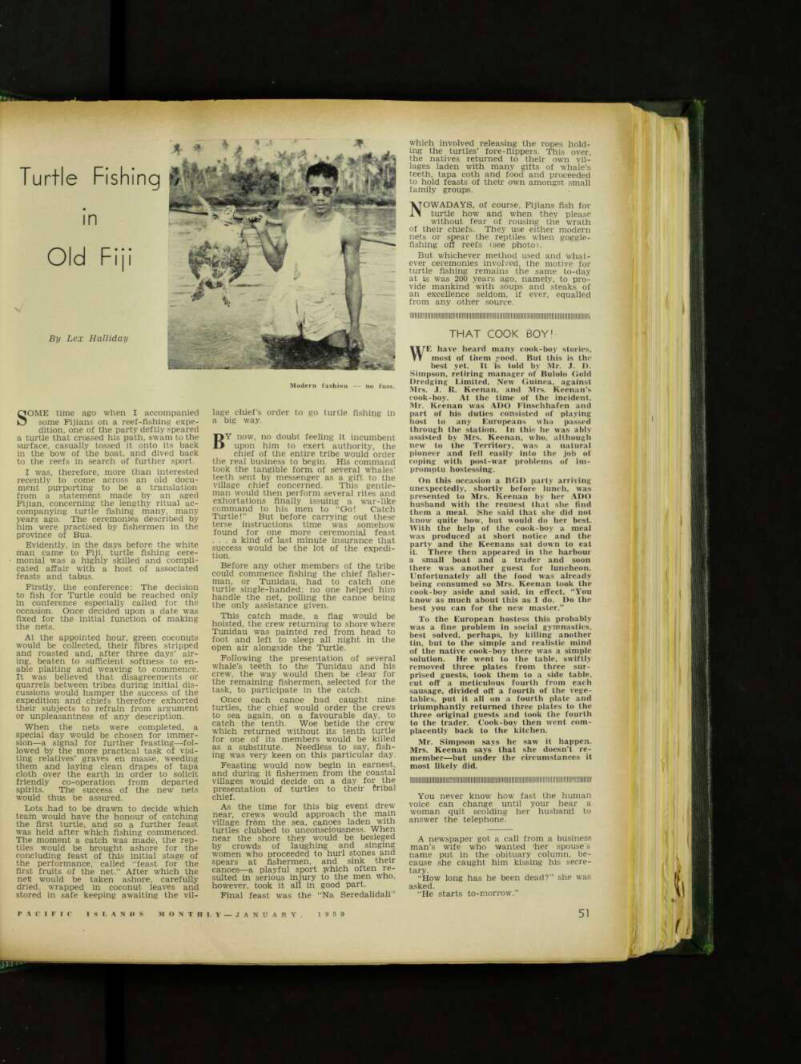
Turtle Fishing in Old Fiji
By Lex Holliday
SOME time ago when I accompanied some Fijians on a reef-fishing expe dition, one of the party deftly speared a turtle that crossed his path, swam to the surface, casually tossed it onto its back in the bow of the boat, and dived back to the reefs in search of further sport.
I was, therefore, more than interested recently to come across an old docu ment purporting to be a translation from a statement made by an aged Fijian, concerning the lengthy ritual ac companying turtle fishing many, many years ago. The ceremonies described by him were practised by fishermen in the province of Bua.
Evidently, in the days before the white man came to Fiji, turtle fishing cere monial was a highly skilled and compli cated affair with a host of associated feasts and tabus.
Firstly, the conference: The decision to fish for Turtle could be reached only in conference especially called for the occasion. Once decided upon a date was fixed for the initial function of making the nets.
At the appointed hour, green coconuts would be collected, their fibres stripped and roasted and, after three days’ air ing, beaten to sufficient softness to en able plaiting and weaving to commence.
It was believed that disagreements or quarrels between tribes during initial dis cussions would hamper the success of the expedition and chiefs therefore exhorted their subjects to refrain from argument or unpleasantness of any description.
When the nets were completed, a special day would be chosen for immer sion—a signal for further feasting—fol lowed by the more practical task of visi ting relatives’ graves en masse, weeding them and laying clean drapes of tapa cloth over the earth in order to solicit friendly co-operation from departed spirits. The success of the new nets would thus be assured.
Lots had to be drawn to decide which team would have the honour of catching the first turtle, and so a further feast was held after which fishing commenced.
The moment a catch was made, the rep tiles would be brought ashore for the concluding feast of this initial stage of the performance, called “feast for the first fruits of the net.” After which the nelj would be taken ashore, carefully dried, wrapped in coconut leaves and stored in safe keeping awaiting the vil
lage chief’s order to go turtle fishing in a big way.
BY now, no doubt feeling it incumbent upon him to exert authority, the chief of the entire tribe would order the real business to begin. His command took the tangible form of several whales’ teeth sent by messenger as a gift to the village chief concerned. This gentle man would then perform several rites and exhortations finally issuing a war-like command to his men to “Go! Catch Turtle!” But before carrying out these terse instructions time was somehow found for one more ceremonial feast . . . a kind of last minute insurance that success would be the lot of the expedi tion.
Before any other members of the tribe could commence fishing the chief fisher man, or Tunidau, had to catch one turtle single-handed: no one helped him handle the net, polling the canoe being the only assistance given.
This catch made, a flag would be hoisted, the crew returning to shore where Tunidau was painted red from head to foot and left to sleep all night in the open air alongside the Turtle.
Following the presentation of several whale’s teeth to the Tunidau and his crew, the way would then be clear for the remaining fishermen, selected for the task, to participate in the catch.
Once each canoe had caught nine turtles, the chief would order the crews to sea again, on a favourable day, to catch the tenth. Woe betide the crew which returned without its tenth turtle for one of its members would be killed as a substitute. Needless to say, fish ing was very keen on this particular day.
Feasting would now begin in earnest, and during it fishermen from the coastal villages would decide on a day for the presentation of turtles to their tribal chief.
As the time for this big event drew near, crews would approach the main village from the sea, canoes laden with turtles clubbed to unconsciousness. When near the shore they would be besieged by crowds of laughing and singing women who proceeded to hurl stones and spears at fishermen, and sink their canoes—a playful sport often re sulted in serious injury to the men who, however, took it all in good part.
Final feast was the “Na Seredalidali”
which involved releasing the ropes hold ing the turtles’ fore-flippers. This over, the natives returned to their own vil lages laden with many gifts of whale’s teeth, tapa coth and food and proceeded to hold feasts of their own amongst small family groups.
NOWADAYS, of course, Fijians fish for turtle how and when they please without fear of rousing the wrath of their chiefs. They use either modern nets or spear the reptiles when goggle fishing off reefs (see photo).
But whichever method used and what ever ceremonies involved, the motive for turtle fishing remains the same to-day at is was 200 years ago, namely, to pro vide mankind with soups and steaks of an excellence seldom, if ever, equalled from any other source.
You never know how fast the human voice can change until your hear a woman quit scolding her husband to answer the telephone.
A newspaper got a call from a business man’s wife who wanted 'her spouses name put in the obituary column, be cause she caught him kissing his secre tary.
“How long has he been dead?” she was as ked “He starts to-morrow.”
Modern fashion no fuss.
That Cook Boy!
WE have heard many cook-boy stories, most of them good. But this is the best yet. It is told by Mr. J. D.
Simpson, retiring manager of Bulolo Gold Dredging Limited, New Guinea, against Mrs. J. R. Keenan, and Mrs. Keenan’s cook-boy. At the time of the incident, Mr. Keenan was ADO Finschhafen and part of his duties consisted of playing host to any Europeans who passed through the station. In this he was ably assisted by Mrs. Keenan, who, although new to the Territory, was a natural pioneer and fell easily into the job of coping with post-war problems of im
promptu hostessing.
On this occasion a BGD party arriving unexpectedly, shortly before lunch, was presented to Mrs. Keenan by her ADO husband with the request that she find them a meal. (She said that she did not know quite how, but would do her best.
With the help of the cook-boy a meal was produced at short notice and the party and the Keenans sat down to eat it. There then appeared in the harbour a small boat and a trader and soon there was another guest for luncheon.
Unfortunately all the food was already being consumed so Mrs. Keenan took the cook-boy aside and said, in effect, “You know as much about this as I do. Do the best you can for the new master.”
To the European hostess this probably was a fine problem in social gymnastics, best solved, perhaps, by killing another tin, but to the simple and realistic mind of the native cook-boy there was a simple solution. He went to the table, swiftly removed three plates from three sur prised guests, took them to a side table, cut off a meticulous fourth from each sausage, divided off a fourth of the vege tables, put it all on a fourth plate and triumphantly returned three plates to the three original guests and took the fourth to the trader. Cook-boy then went com placently back to the kitchen.
Mr. Simpson says he saw it happen.
Mrs. Keenan says that she doesn’t re member—but under the circumstances it most likely did.
Coconuts
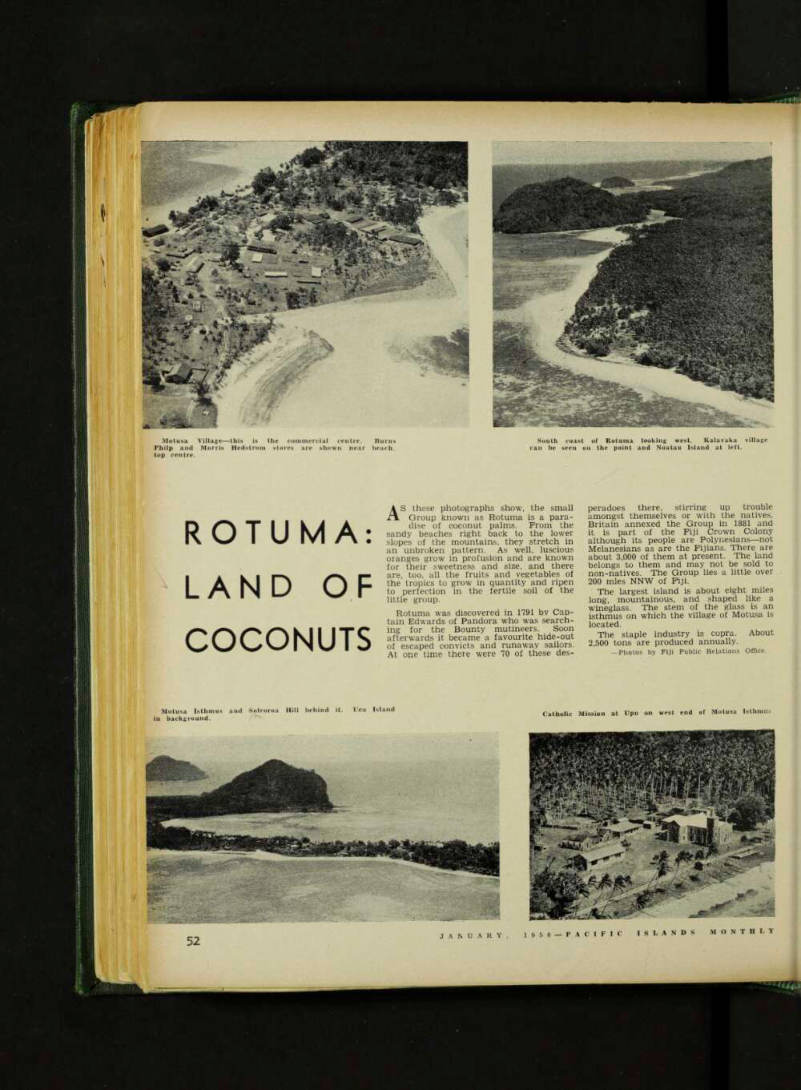
Rotuma:
Land Of
AS these photographs show, the small Group known as Rotuma is a para dise of coconut palms. From the sandy beaches right back to the lower slopes of the mountains, they stretch in an unbroken pattern. As well, luscious oranges grow in profusion and are known for their sweetness and size, and there are, too. all the fruits and vegetables of the tropics to grow in quantity and ripen to perfection in the fertile soil of the little group.
Rotuma was discovered in 1791 bv Cap tain Edwards of Pandora who was search ing for the Bounty mutineers. Soon afterwards it became a favourite hide-out of escaped convicts and runaway sailors.
At one time there were 70 of these des
peradoes there, stirring up trouble amongst themselves or with the natives.
Britain annexed the Group in 1881 and it is part of the Fiji Crown Colony although its people are Polynesians—not Melanesians as are the Fijians. There are about 3,000 of them at present. The land belongs to them and may not be sold to non-natives. The Group lies a little over 200 mles NNW of Fiji.
The largest island is about eight miles long, mountainous, and shaped like a wineglass. The stem of the glass is an isthmus on which the village of Motusa is located.
The staple industry is copra. About 2,500 tons are produced annually. —Photos by Fiji Public Relations Office.
Motusa Village—this is the commercial centre. Burns Philp and Morris Hedstrom stores are shown near beach, top centre.
South coast of Rotuma looking west. Kalavaka village can be seen on the point and Noatau Island at left.
Motusa Isthmus and Solroroa Hill behind it. Uea Island in background.
Catholic Mission at Upu on west end of Motusa Isthmus
Trapicalities
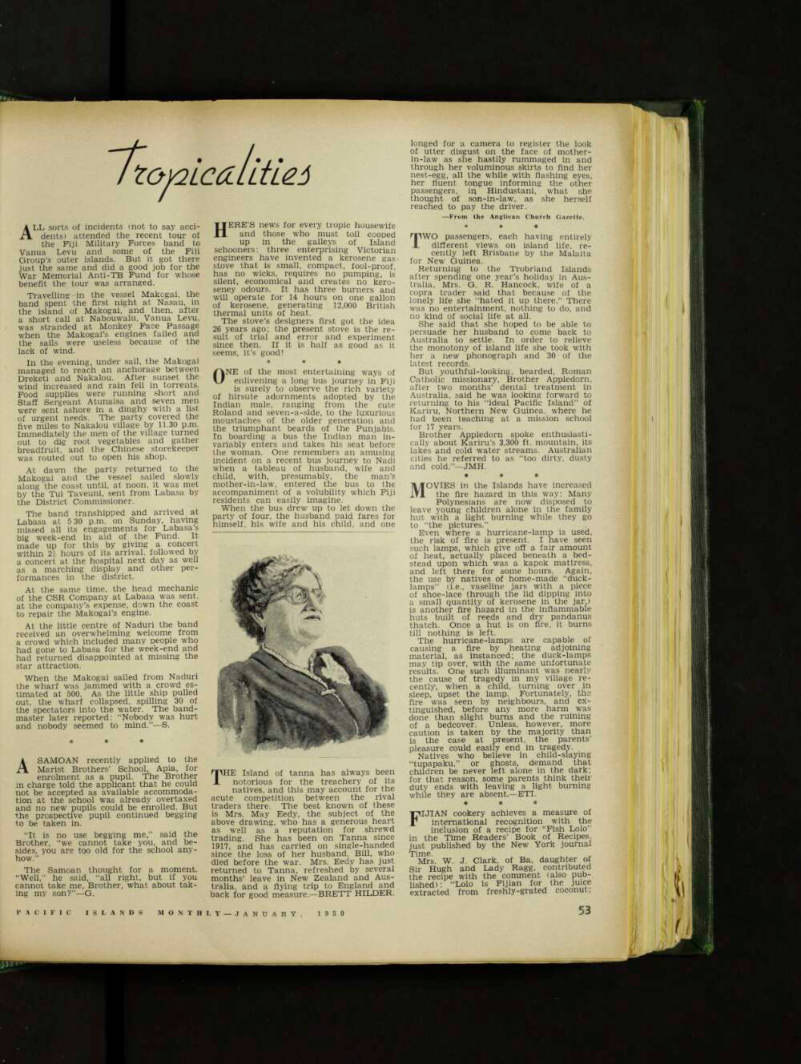
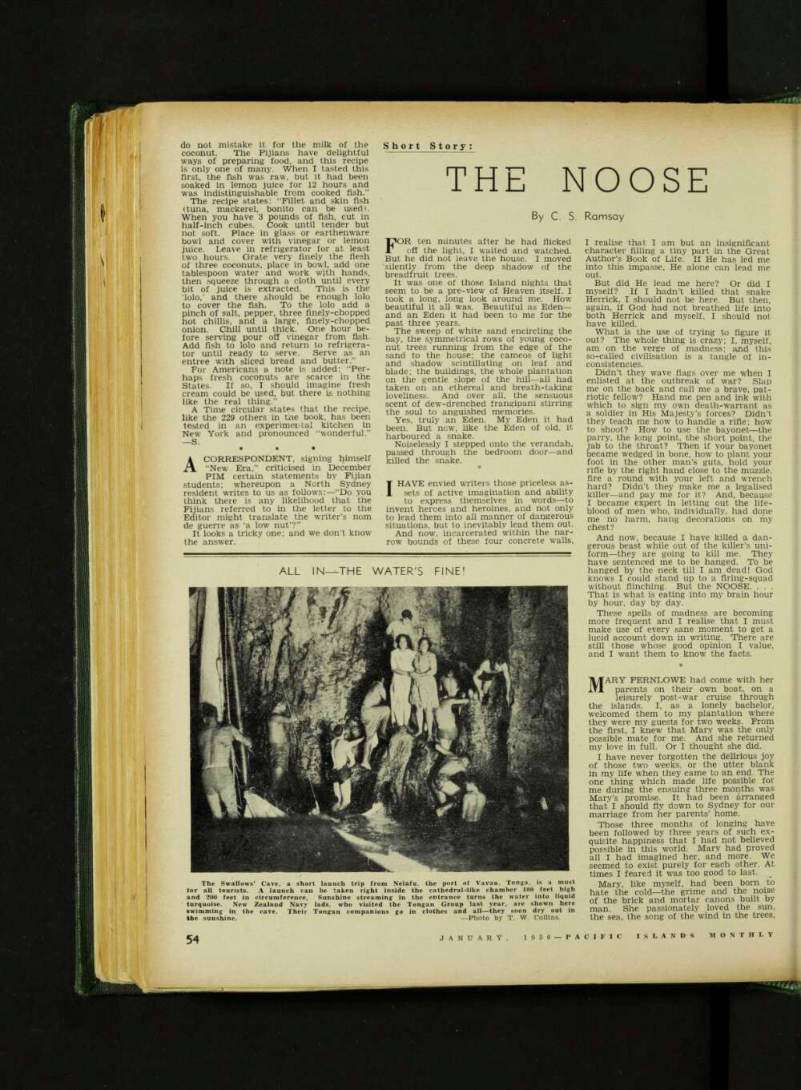
ALL sorts of incidents (not to say acci dents) attended the recent tour of the Fiji Military Forces band to Vanua Levu and some of the Fiji Group’s outer islands. But it got there just the same and did a good job for the War Memorial Anti-TB Fund for whose benefit the tour was arranged.
Travelling in the vessel Makogai, the band spent the first night at Nasau, in the island of Makogai, and then, after a short call at Nabouwalu, Vanua Levu, was stranded at Monkey Face Passage when the Makogafs engines failed and the sails were useless because of the lack of wind.
In the evening, under sail, the Makogai managed to reach an anchorage between Dreketi and Nakalou. After sunset the wind increased and rain fell in torrents.
Food supplies were running short and Staff Sergeant Atunaisa and seven men were sent ashore in a dinghy with a list of urgent needs. The party covered the five miles to Nakalou village by 11.30 p.m.
Immediately the men of the village turned out to dig root vegetables and gather breadfruit, and the Chinese storekeeper was routed out to open his shop.
At dawn the party returned to the Makogai and the vessel sailed slowly along the coast until, at noon, it was met by the Tui Taveuni, sent from Labasa by the District Commissioner.
The band transhipped and arrived at Labasa at 530 p.m. on Sunday, having missed all its engagements for Labasa’s big week-end in aid of the Fund. It made up for this by giving a concert within 21 hours of its arrival, followed by a concert at the hospital next day as well as a marching display and other per formances in the district.
At the same time, the head mechanic of the CSR Company at Labasa was sent, at the company’s expense, down the coast to repair the Makogai’s engine.
At the little centre of Naduri the band received an overwhelming welcome from a crowd which included many people who had gone to Labasa for the week-end and had returned disappointed at missing the star attraction.
When the Makogai sailed from Naduri the wharf was jammed with a crowd es timated at 500. As the little ship pulled out, the wharf collapsed, spilling 30 of the spectators into the water. The band master later reported: “Nobody was hurt
and nobody seemed to mind.”
s.
♦ ♦ * A SAMOAN recently applied to the Marist Brothers’ School, Apia, for enrolment as a pupil. The Brother in charge told the applicant that he could not be accepted as available accommoda tion at the school was already overtaxed and no new pupils could be enrolled. But the prospective pupil continued begging to be taken in.
“It is no use begging me,” said the Brother, “we cannot take you, and be sides, you are too old for the school any how.”
The Samoan thought for a moment.
“Well,” he said, “all right, but if you cannot take me, Brother, what about tak
ing my son?”-
G.
HERE’S news for every tropic housewife and those who must toil cooped up in the galleys of Island schooners: three enterprising Victorian engineers have invented a kerosene gas stove that is small, compact, fool-proof, has no wicks, requires no pumping, is silent, economical and creates no kero seney odours. It has three burners and will operate for 14 hours on one gallon of kerosene, generating 12,000 British thermal units of heat.
The stove’s designers first got the idea 26 years ago; the present stove is the re sult of trial and error and experiment since then. If it is half as good as it seems, it’s good! * ♦ * ONE of the most entertaining ways of enlivening a long bus journey in Fiji is surely to observe the rich variety of hirsute adornments adopted by the Indian male, ranging from the cute Roland and seven-a-side, to the luxurious moustaches of the older generation and the triumphant beards of the Punjabis.
In boarding a bus the Indian man in variably enters and takes his seat before the woman. One remembers an amusing incident on a recent bus journey to Nadi when a tableau of husband, wife and child, with, presumably, the man’s mother-in-law, entered the bus to the accompaniment of a volubility which Fiji residents can easily imagine.
When the bus drew up to let down the party of four, the husband paid fares for himself, his wife and his child, and one
THE Island of tanna has always been notorious for the treachery of its natives, and this may account for the acute competition between the rival traders there. The best known of these is Mrs. May Eedy, the subject of the above drawing, who has a generous heart as well as a reputation for shrewd trading. She has been on Tanna since 1917, and has carried on single-handed since the loss of her husband. Bill, who died before the war. Mrs. Eedy has just returned to Tanna, refreshed by several months’ leave in New Zealand and Aus tralia, and a flying trip to England and
back for good measure.-
Brett Hilder.
longed for a camera to register the look of utter disgust on the face of mother in-law as she hastily rummaged in and through her voluminous skirts to find her nest-egg, all the while with flashing eyes, her fluent tongue informing the other passengers, ip Hindustani, what she thought of son-in-law, as she herself reached to pay the driver. —From the Anglican Church Gazette. ♦ ♦ ♦ rpwo passengers, each having entirely 1 different views on island life, re cently left Brisbane by the Malaita for New Guinea.
Returning to the Trobriand Islands after spending one year’s holiday in Aus tralia, Mrs. G. R. Hancock, wife of a copra trader said that because of the lonely life she “hated it up there.” There was no entertainment, nothing to do, and no kind of social life at all.
She said that she hoped to be able to persuade her husband to come back to Australia to settle. In order to relieve the monotony of island life she took with her a new phonograph and 30 of the latest records.
But youthful-looking, bearded, Roman Catholic missionary, Brother Appledorn, after two months’ dental treatment in Australia, said he was looking forward to returning to his “ideal Pacific Island” of Kariru, Northern New Guinea, where he had been teaching at a mission school for 17 years.
Brother Appledorn spoke enthusiasti cally about Kariru’s 3,300 ft. mountain, its lakes and cold water streams. Australian cities he referred to as “too dirty, dusty
and cold.”
Jmh.
• * • MOVIES in the Islands have increased the fire hazard in this way; Many Polynesians are now disposed to leave young children alone in the family hut with a light burning while they go to “the pictures.”
Even where a hurricane-lamp is used, the risk of fire is present. I have seen such lamps, which give off a fair amount of heat, actually placed beneath a bed stead upon which was a kapok mattress, and left there for some hours. Again, the use by natives of home-made “duck lamps” (i.e., vaseline jars with a piece of shoe-lace through the lid dipping into a small quantity of kerosene in the jar,) is another fire hazard in the inflammable huts built of reeds and dry pandanus thatch. Once a hut is on fire, it burns till nothing is left.
The hurricane-lamps are capable of causing a fire by heating adjoining material, as instanced; the duck-lamps may tip over, with the same unfortunate results. One such illuminant was nearly the cause of tragedy in my village re cently, when a child, turning over in sleep, upset the lamp. Fortunately, the fire was seen by neighbours, and ex tinguished, before any more harm was done than slight burns and the ruining of a bedcover. Unless, however, more caution is taken by the majority than is the case at present, the parents’ pleasure could easily end in tragedy.
Natives who believe in child-slaying “tupapaku,” or ghosts, demand that children be never left alone in the dark; for that reason, some parents think their duty ends with leaving a light burning
while they are absent.-
Etl
• * ♦ FIJIAN cookery achieves a measure of international recognition with the inclusion of a recipe for “Fish Lolo” in the Time Readers’ Book of Recipes, just published by the New York journal Time. . . .
Mrs. W. J. Clark, of Ba, daughter of Sir Hugh and Lady Ragg, contributed the recipe with the comment (also pub lished) : “Lolo is Fijian for the juice extracted from freshly-grated coconut;
do not mistake it for the milk of the coconut. The Fijians have delightful ways of preparing food, and this recipe is only one of many. When I tasted this first, the fish was raw, but it had been soaked in lemon juice for 12 hours and was indistinguishable from cooked fish.”
The recipe states: “Fillet and skin fish (tuna, mackerel, bonito can be used).
When you have 3 pounds of fish, cut in half-inch cubes. Cook until tender but not soft. Place in glass or earthenware bowl and cover with vinegar or lemon juice. Leave in refrigerator for at least two hours. Grate very finely the flesh of three coconuts, place in bowl, add one tablespoon water and work with hands, then squeeze through a cloth until every bit of juice is extracted. This is the ‘lolo,’ and there should be enough 1010 to cover the fish. To the 1010 add a pinch of salt, pepper, three finely-chopped hot chillis, and a large, finely-chopped onion. Chill until thick. One hour be fore serving pour off vinegar from fish.
Add fish to 1010 and return to refrigera tor until ready to serve. Serve as an entree with sliced bread and butter.”
For Americans a note is added: “Per haps fresh coconuts are scarce in the States. If so, I should imagine fresh cream could be used, but there is nothing like the real thing."
A Time circular states that the recipe, like the 229 others in the book, has been tested in an experimental kitchen in New York and pronounced “wonderful.” —s. ♦ ♦ • A CORRESPONDENT, signing himself “New Era,” criticised in December PIM certain statements by Fijian students: whereupon a North Sydney resident writes to us as follows: —“Do you think there is any likelihood that the Fijians referred to in the letter to the Editor might translate the writer’s nom de guerre as ‘a low nut’?”
It looks a tricky one; and we don’t know the answer.
All In—The Water's Fine!
The Swallows’ Cave, a short launch trip from Neiafu, the port of Vavau, Tonga, is a must for all tourists. A launch can be taken right inside the cathedral-like chamber 100 feet high and 200 feet in circumference. Sunshine streaming in the entrance turns the water into liquid turquoise. New Zealand Navy lads, who visited the Tongan Group last year, are shown here swimming in the cave. Their Tongan companions go in clothes and all—they soon dry out in the sunshine. —Photo by T. W. Collins.
The Noose
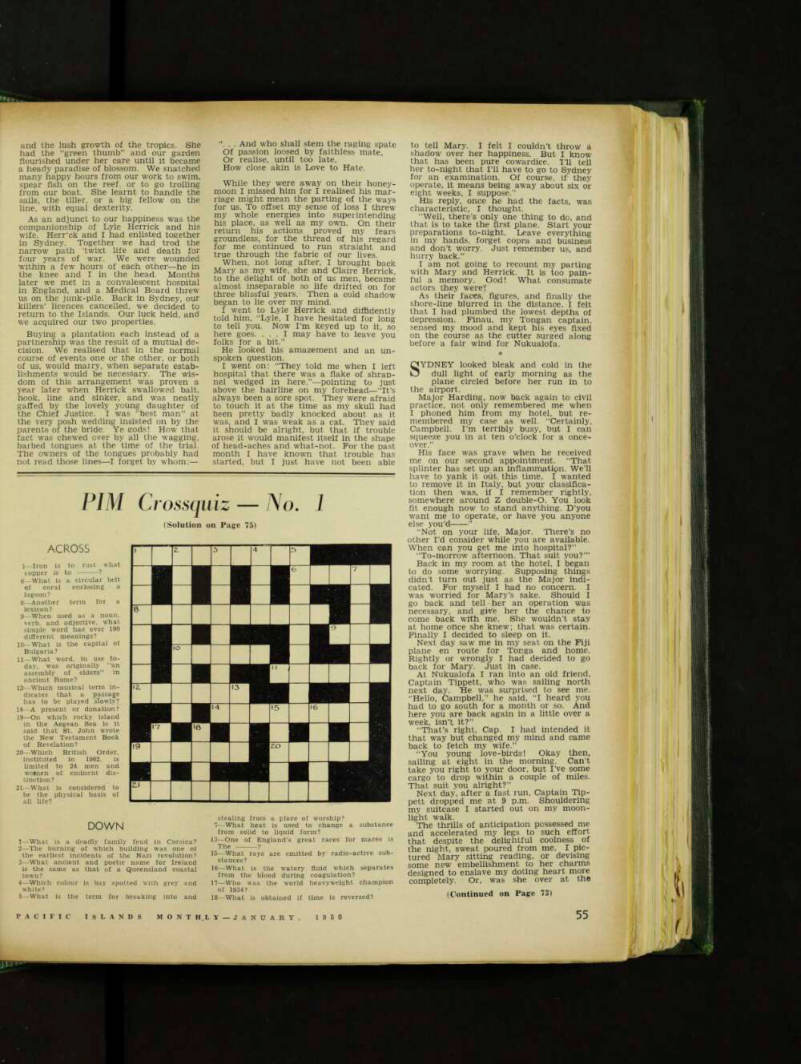
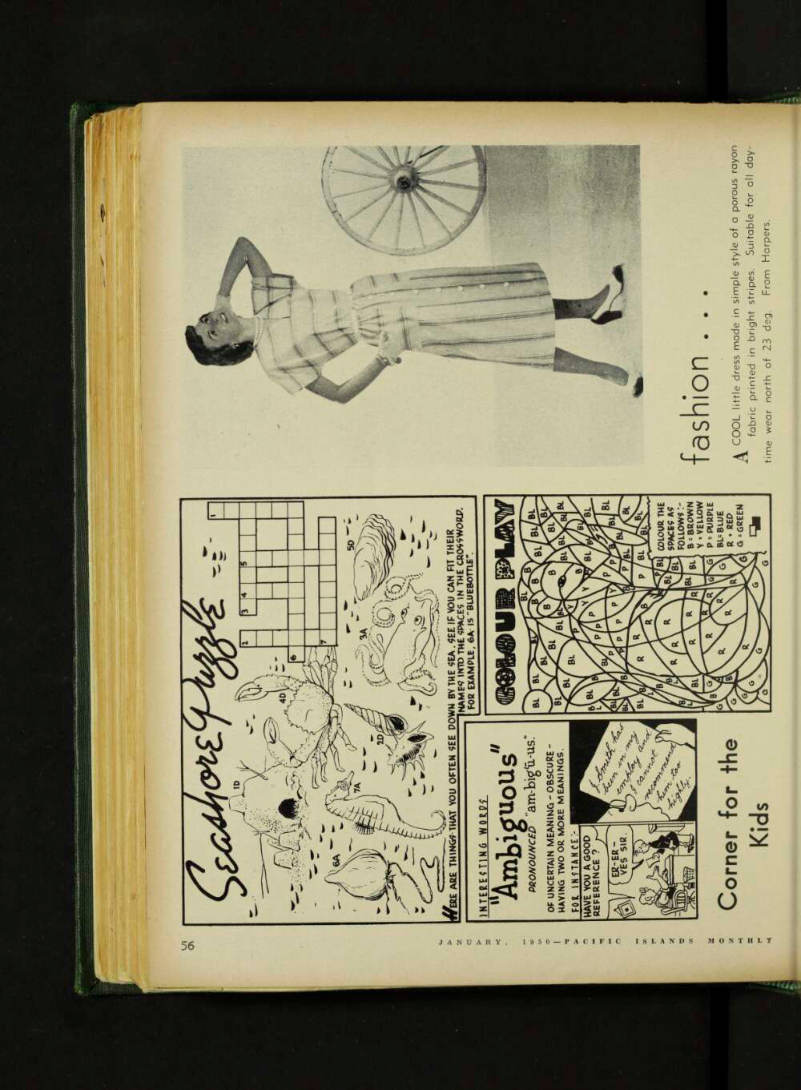
Short Story:
By C. S. Ramsay
FOR ten minutes after he had flicked off the light, I waited and watched.
But he did not leave the house. I moved silently from the deep shadow of the breadfruit trees.
It was one of those Island nights that seem to be a pre-view of Heaven itself. I took a long, long look around me. How beautiful it all was. Beautiful as Eden— and an Eden it had been to me for the past three years.
The sweep of white sand encircling the bay, the symmetrical rows of young coco nut trees running from the edge of the sand to the house; the cameos of light and shadow scintillating on leaf and blade; the buildings, the whole plantation on the gentle slope of the hill—all had taken on an ethereal and breath-taking loveliness. And over all, the sensuous scent of dew-drenched frangipani stirring the soul to anguished memories.
Yes, truly an Eden. My Eden it had been. But now, like the Eden of old, it harboured a snake.
Noiselessly I stepped onto the verandah, passed through the bedroom door —and killed the snake. * IHAVE envied writers those priceless as sets of active imagination and ability to express themselves in words —to invent heroes and heroines, and not only to lead them into all manner of dangerous situations, but to inevitably lead them out.
And now, incarcerated within the nar row bounds of these four concrete walls,
I realise that I am but an insignificant character filling a tiny part in the Great Author’s Book of Life. If He has led me into this impasse, He alone can lead me out.
But did He lead me here? Or did I myself? If I hadn’t killed that snake Herrick, I should not be here. But then, again, if God had not breathed life into both Herrick and myself, I should not have killed.
What is the use of trying to figure it out? The whole thing is crazy; I, myself, am on the verge of madness; and this so-called civilisation is a tangle of in consistencies.
Didn’t they wave flags over me when I enlisted at the outbreak of war? Slap me on the back and call me a brave, pat riotic fellow? Hand me pen and ink with which to sign my own death-warrant as a soldier in His Majesty’s forces? Didn’t they teach me how to handle a rifle; how to shoot? How to use the bayonet—the parry, the long point, the short point, the jab to the throat? Then if your bayonet became wedged in bone, how to plant your foot in the other man’s guts, hold your rifle by the right hand close to the muzzle, fire a round with your left and wrench hard? Didn’t they make me a legalised killer—and pay me for it? And, because I became expert in letting out the life blood of men who, individually, had done me no harm, hang decorations on my chest?
And now, because I have killed a dan gerous beast while out of the killer’s uni form —they are going to kill me. They have sentenced me to be hanged. To be hanged by the neck till I am dead! God knows I could stand up to a firing-squad without flinching. But the NOOSE. . . .
That is what is eating into my brain hour by hour, day by day.
These spells of madness are becoming more frequent and I realise that I must make use of every sane moment to get a lucid account dowp in writing. There are still those whose good opinion I value, and I want them to know the facts. * MARY FERNLOWE had come with her parents on their own boat, on a leisurely post-war cruise through the islands. I, as a lonely bachelor, welcomed them to my plantation where they were my guests for two weeks. From the first, I knew that Mary was the only possible mate for me. And she returned my love in full. Or I thought she did.
I have never forgotten the delirious joy of those two weeks, or the utter blank in my life when they came to an end. The one thing which made life possible for me during the ensuing three months was Mary’s promise. It had been arranged that I should fly down to Sydney for our marriage from her parents’ home.
Those three months of longing have been followed by three years of such ex quisite happiness that I had not believed possible in this world. Mary had proved all I had imagined her, and more. We seemed to exist purely for each other. At times I feared it was too good to last. Mary, like myself, had been born to hate the cold—the grime and the noise of the brick and mortar canons built by man. She passionately loved the sun, the sea, the song of the wind in the trees,
and the lush growth of the tropics. She had the “green thumb” and our garden flourished under her care until it became a heady paradise of blossom. We snatched many happy hours from our work to swim, spear fish on the reef or to go trolling from our boat. She learnt to handle the sails, the tiller, or a big fellow on the line, with equal dexterity.
As an adjunct to our happiness was the companionship of Lyle Herrick and his wife. Herfck and I had enlisted together in Sydney. Together we had trod the narrow path ’twixt life and death for four years of war. We were wounded within a few hours of each other—he in the knee and I in the head. Months later we met in a convalescent hospital in England, and a Medical Board threw us on the junk-pile. Back in Sydney, our killers’ licences cancelled, we decided to return to the Islands. Our luck held, and we acquired our two properties.
Buying a plantation each instead of a partnership was the result of a mutual de cision. We realised that in the normal course of events one or the other, or both of us, would marry, when separate estab lishments would be necessary. The wis dom of this arrangement was proven a year later when Herrick swallowed bait, hook, line and sinker, and was neatly gaffed by the lovely young daughter of the Chief Justice. I was "best man” at the very posh wedding insisted on by the parents of the bride. Ye gods! How that fact was chewed over by all the wagging, barbed tongues at the time of the trial.
The owners of the tongues probably had not read those lines —I forget by whom:—
"... And who shall stem the raging spate Of passion loosed by faithless mate, Or realise, until too late, How close akin is Love to Hate.
While they were away on their honey moon I missed him for I realised his mar riage might mean the parting of the ways for us. To offset my sense of loss I threw my whole energies into superintending his place, as well as my own. On their return his actions proved my fears groundless, for the thread of his regard for me continued to run straight and true through the fabric of our lives.
When, not long after, I brought back Mary as my wife, she and Claire Herrick, to the delight of both of us men, became almost inseparable so life drifted on for three blissful years. Then a cold shadow began to lie over my mind.
I went to Lyle Herrick and diffidently told him, "Lyle, I have hesitated for long to tell you. Now I’m keyed up to it, so here goes. ... I may have to leave you folks for a bit.”
He looked his amazement and an un spoken question.
I went on; "They told me when I left hospital that there was a flake of shrap nel wedged in here,” —pointing to just above the hairline on my forehead—"lt’s always been a sore spot. They were afraid to touch it at the time as my skull had been pretty badly knocked about as it was, and I was weak as a cat. They said it should be alright, but that if trouble arose it would manifest itself in the shape of head-aches and what-not. For the past month I have known that trouble has started, but I just have not been able
to tell Mary. 1 felt I couldn’t throw a shadow over her happiness. But I know that has been pure cowardice. I’ll tell her to-night that I’ll have to go to Sydney for an examination. Of course, if they operate, it means being away about six or eight weeks, I suppose.”
His reply, once he had the facts, was characteristic, I thought.
"Well, there’s only one thing to do, and that is to take the first plane. Start your preparations to-night. Leave everything in my hands, forget copra and business and don’t worry. Just remember us, and
hurry back.”
I am not going to recount my parting with Mary and Herrick. It is too pain ful a memory. God! What consumate actors they were!
As their faces, figures, and finally the shore-line blurred in the distance. I felt that I had plumbed the lowest depths of depression. Finau, my Tongan captain, sensed my mood and kept his eyes fixed on the course as the cutter surged along before a fair wind for Nukualofa. * SYDNEY looked bleak and cold in the dull light of early morning as the plane circled before her run in to the airport.
Major Harding, now back again to civil practice, not only remembered me when I phoned him from my hotel, but re membered my case as well. "Certainly, Campbell. I’m terribly busy, but I can squeeze you in at ten o’clock for a once over.”
His face was grave when he received me on our second appointment. "That splinter has set up an inflammation. We’ll have to yank it out this time. I wanted to remove it in Italy, but your classifica tion then was, if I remember rightly, somewhere around Z double-O. You look fit enough now to stand anything. D’you want me to operate, or have you anyone else you’d ”
"Not on your life, Major. There’s no other I’d consider while you are available.
When can you get me into hospital?”
"To-morrow afternoon. That suit you?”’
Back in my room at the hotel, I began to do some worrying. Supposing things didn’t turn out just as the Major indi cated. For myself I had no concern. I was worried for Mary’s sake. Should I go back and tell her an operation was necessary, and give her the chance to come back with me. She wouldn’t stay at home once she knew; that was certain.
Finally I decided to sleep on it.
Next day saw me in my seat on the Fiji plane en route for Tonga and home.
Rightly or wrongly I had decided to go back for Mary. Just in case.
At Nukualofa I ran into an old friend, Captain Tippett, who was sailing north next day. He was surprised to see me.
“Hello, Campbell,” he said, "I heard you had to go south for a month or so. And here you are back again in a little over a week, isn’t it?”
"That’s right, Cap. I had intended it that way but changed my mind and came back to fetch my wife.”
"You young love-birds! Okay then, sailing at eight in the morning. Can t take you right to your door, but I’ve some cargo to drop within a couple of miles.
That suit you alright?”
Next day, after a fast run, Captain Tip pett dropped me at 9 p.m. Shouldering my suitcase I started out on my moon light walk.
The thrills of anticipation possessed me and accelerated my legs to such effort that despite the delightful coolness of the night, sweat poured from me. I pic tured Mary sitting reading, or devising some new embellishment to her charms designed to enslave my doting heart more completely. Or, was she over at the
(Continued on Page 73)
Herricks’. I could only hope she was at home, and strode the faster.
At last the well-remembered boundary, and then the house and—yes, a light burning on the vine-enclosed verandah we used as sitting-room.
I moved silently over the dewy grass toward the house. Gently parting the thick-growing creeper, I peered through There are times in the lives of few of us when some catastrophic happening en gulfs us, wrenches our puny anchors from their insecure hold in the shifting sands of happiness, and crashes our souls and the very fabric of our existence down to the lowest depths of hell.
Such a thing happened that night to me My brain at first refused to credit the evidence of sight. Mary was standing near the table, close in the arms of Lyle Herrick!
Eve and the snake!
Then she raised her head, put her arms around his neck and said: “Lyle, I’ve loved you from the first.”
Disengaging her arms, he stepped across to the switch —that lightning-plant had been a Christmas gift to her —and, with an evil smile, he flicked off the light.
Swiftly I stepped back to the deep shadows lest they see me outlined against the moonlight.
I had to think. Think what course to take —what punishment I would inflict.
From the moment that I knew their treachery I had no further thought for myself or the future. Only one passionate desire obsessed me—to kill! Kill them both.
A low murmur of voices reached me once, then silence.
My head was throbbing with almost unbearable pain, as though a saw were biting through bone to the brain. It was difficult to think. Suddenly I saw that I could punish her the more by killing only him. Let her live out her days reaping the harvest of her rotten, treacherous heart.
It was astonishingly easy. I had always been a stronger man than he, and I had, too, the advantage of surprise. I re member I laughed at the way their eyes popped as I snapped on the light in the bed-room.
The I reached for him. Took him by the throat and strangled him. Strangled him while Mary screamed and screamed * AND now, to-morrow morning, I too am to die. I wonder how the Great Author will round off my little part in His Book.
My fellow-men are going to carry out the sentence passed by their little puppet judge. I can recall every feature of his face —every pompous mannerism as he said —“You shall be hanged by the neck until you are dead.”
Of course, I hadn’t a chance from the first. My plea of the “unwritten law” was ridiculed and refuted as soon as I had put it forward. Every well-known factor of our intimate friendship with the Her ricks gave it the lie. All our friends and acquaintances, even our boys knew that Herrick’s and my regard for each other had been equalled only by Mary’s love for me. And though Mary could not be called to testify against me, she flatly denied my revelation of her adultery. Without a witness, what could I do?
I am glad they have granted my re quest for the light. Otherwise I could
not have finished this. The buzz-saw has been rasping into my skull to such a degree that at times I have thought I would be able to cheat the hangman after all.
Well, there’s but little more to add and time is short. My narrow, barred window looks less black than it was. Ah. the light has just gone out and day is here In Its place. Not long now. Another hour or so. An hour ol life, then an eternity of sleep.
Strange how much more reconciled I feel about things at this moment. The pain in my head has entirely gone. Gone too is all rancour against Mary. She, her wrong to me, I myself, the fools who dragged me here, the gallows, and even that piece of twisted hemp waiting to swing me to eternity, all are nothing.
There Is movement going on outside.
One atom bomb released from the bay of a plane, and hundreds of thousands
perish. Yet all this preparation and paraphernalia to send me off, alone!
Well, this is it! They are “granting the condemned man his last request” and waiting till I write these, my last words on earth —The iron door is open. Across the sunlight at the end of the grey, stone passage lies a long, black shadow. The shadow of the gallows and —the noose! * DRUGGED senses fought for claiity of thought as my eyes opened to white clad figures around me. With tre mendous effort I forced words to my lips; “The —the gallows —the noose—where—”
Then the answer, in Major Harding’s voice: “Gallows? No gallows around here, my lad. The anaesthetic set you dream ing. It often does, especially in an opera tion like yours. You’re OK now. Be home in no time. Here’s a present for you.”
He held up his hand for me to see Black against a piece of cotton-wool lay a fragment of shrapnel. ‘And then I re membered coming only yesterday straight from the hotel to the hospital—and I thanked God as I have never thanked Him before.
Recounting this and what I dreamed I had written, has helped to pass an im patient convalescence.
But I swear I’ll never show it to Mary!
Mrs. Joan Hay, previously of Kavieng, New Guinea, who has been staying with her brother, Mr. Neville Holland, in Rabaul, has gone on to Wau, where she is the guest of Mr. and Mrs. W. Seale.
Mr. P. Costello, of Suva, has been ap pointed a director of Emperor Mines Ltd., filling the vacancy caused by the retire ment of Sir Maynard Hedstrom.
FIM Crossquiz No. 1
(Solution on Page 75)
Across
I—lron is to rust what copper is to ? 6—what is a circular belt of coral enclosing a lagoon? 8— Another term for a lexicon? 9 When used as a noun, verb, and adjective, what simple word has over 100 different meanings? 10 — What is the capital of Bulgaria? 11 — What word, in use to day, was originally "an assembly of elders” in ancient Rome? 12— Which musical term in dicates that a passage has to be played 'slowly? 14—A present or donation? 19— On which rocky island in the Aegean Sea is it said that St. John wrote the New Testament Book of Revelation? 20 — Which British Order, instituted in 1902, is limited to 24 men and women of eminent dis tinction? 21— What is considered to be the physical basis of all life?
Down
1— What is a deadly family feud in Corsica? 2 The burning of which building was one of the earliest incidents of the Nazi revolution? 3 What ancient and poetic name for Ireland is the same as that of a Queensland coastal town? 4 Which colour is bay spotted with grey and white? 5 What is the term for breaking into and
stealing from a place of worship? 7 —What heat is used to change a substance from solid to liquid form? 13—One of England’s great races for mares is The ? 15— What rays are emitted by radio-active sub stances? 16 — What is the watery fluid which separates from the blood during coagulation? 17 — Who was the world heavyweight champion of 1934? 18 — What is obtained if time is reversed?
fashion ...
COOL little dress made in simple style of a porous rayon fabric printed in bright stripes. Suitable for all day time wear north of 23 deg. From Harpers.
Five plane loads of timber were brought from Lae to Port Moresby by the De partment of Works and Housing recently.
The planes were chartered by the Ad ministration for other work and would have come across empty if the timber had not been put aboard. A total of 6,000 super feet of pine and joinery tim bers, used in furniture making, was carried.
A new butcher’s shop, cafe and milk bar will be built by the Port Moresby Freezing Company. Work has started on the butcher’s shop. The company’s offices will be above the shop and next door will be the cafe and milk bar.
Advertisements & other items, pp. 59-60 (1 item)
Burns Philp (New Guinea) Limited
General Merchants (Wholesale and Retail)
Shipping, Customs and General Agents
Head Office: PORT MORESBY, PAPUA
BRANCHES:
NEW GUINEA: Rabaul, Kokopo, Lae & Madang.
PAPUA: Sama rai.
QUEENSLAND INSURANCE CO. LTD.
LLOYD S OF LONDON
BURNS PHILP TRUST CO. LTD.
BURNS, PHILP & CO. LTD.
All States.
BURNS, PHILP Cr CO. LTD.
"London House", 35 Crutched Friars, E.C.3.
BURNS, PHILP CO. OF SAN FRANCISCO INC. 510 Matson Building.
Distributing Agents, Territory of Papua-New Guinea for:
SHELL COMPANY OF AUSTRALIA LIMITED
Petroleum Products
GENERAL MOTORS CORPORATION
Chevrolet, Buick, Pontiac and Oidsmobile Cars Chevrolet and GMC Trucks Frigidaire Refrigerators
VAUXHALL MOTORS LIMITED
Vauxhall Cars and Bedford Trucks
R. A. LISTER & CO., BRISTOL
Producers of Petrol, Paraffin and Diesel Engines Pumps and Lighting plants
RUSTON HORNSBY LIMITED
Engines
CROSSLEY MARINE ENGINES
REPRESENTATIVES FOR
AUSTRALIAN AGENTS
LONDON AGENTS:
SAN FRANCISCO AGENTS:
THE PACIFIC ISLANDS SOCIETY
(Founded 1937) Visitors from the Pacific Islands to Sydney, or persons interested in Islands affairs, are invited to communicate with the Honorary Secretary of the above Society which was formed to constitute a social centre for those interested in the Pacific Islands.
Regular meetings and social gatherings, with lectures, are held at History House. 8 Young Street, Sydney, on the fourth Wednesday of each month, at 8 p.m.
Address for correspondence:—
THE PACIFIC ISLANDS SOCIETY
Box 2434, G.P.0., Sydney.
TAHITI
To Shipmasters and Visitors When calling at Tahiti, and seeking SHIPS SUPPLIES and FRESH
PROVISIONS, see—
OSCAR G. NORDMAN
Supply Agent for Messageries Maritimes, Union S.S. Co. of N.Z., Ltd., Matson Oceanic Line, United States Line, General S.S. Corp., Etc.
We supply General Service—lnformation about the Islands— Real Estate Service—Make Reservations—Act as Shipping Agents Wire before your arrival to
OCEANIC PAPEETE—Our
registered cable address.
OSCAR G. NORDMAN
Ship Chandler
PAPEETE. TAHITI
The Garrick Notel
JL
SUVA
li » m
FIJ
nil
This well-known Hotel is centrally situated in Suva's main business quarter :: Modern accommodation provides comfort in all climatic conditions :: Only the best of Beers, Spirits and Wines is served Telephone: 80. VINCE COSTELLO, Proprietor.
Of Papua’S
Gloomy View
Present And Future
By D. H. Osborne, Op
Rossel Island
IT was 50 years on May 1, 1949, since I first landed in Samarai, Eastern Papua.
I remained in the country until August, 1915, when I went to Townsville and joined the first AIF. I returned to the Territory in December, 1918, and re mained here until February, 1942, when the Jap invasion forced a four years’ ab sence.
I have travelled over much of Papua and the adjacent islands to the east and south-east. 1 have dealt with all kinds of natives. Some, in the early days, shot spears and arrows at me. Some, more recently, type letters for me. I regard Papua as a poor country—the land is mostly mountains or swamps.
The native population is fast decreas ing. Where there were big villages 30 years ago there is only jungle to-day. The decrease has been so marked in the eas tern part of Papua that there now is not sufficient labour to maintain the land that has been cultivated.
Heavy and frequent rain causes severe erosion; a heavy shower will take away a couple of inches of broken-up soil.
Transport is a big problem. Roads are difficult to build, and repairs are ex pensive.
Most of the land is unsuitable for stock.
Their sharp hooves cut up the surface soil; rain washes it away, in a few years; and the land becomes useless. Cattle pastured there become weedy—milk is poor and meat is tough and tasteless. I have tried to sell full-grown bullocks to the natives at £1 per head. They would not buy.
They would eat the meat when I killed a beast, but they buy tinned meat in pre ference to fresh meat.
A lot of the country is covered with dense jungle but there is very little mar ketable timber in it. Transport is almost impossible.
There is nothing in the Territory to en courage new settlers. All this hot-air bubble that is passing over the land now passed over in 1910, when the late Mr.
Staniforth Smith, the BNG Company and the late Mr. “Hoppy” Clarke were going strong. The Kwato Mission to-day has a rice “bubble”: but for the last ten years they have not produced any rice.
ANY crop that will grow in Papua will grow in Queensland, north of Bowen, and living conditions and transport are better there. The advantage that we here had over Queensland was that we could get native labour. But native labour has gone for a time —if not for all time.
Our present Administrator, speaking on the air recently, said there are a million people in Papua-New Guinea, and the population will be double in the next 20 years. The population has been decreas ing, to my knowledge, for the last 47 years. I am afraid it is continuing to decrease. I cannot suggest a remedy. The late Dr. Bellamy gave one reason—that idleness and over-indulgence in sex caused a small birth-rate. The Govern ment and the Missions encourage idleness among the natives.
This country is dying on its feet. There is a vast difference between the “progress” of to-day, and of fifty years ago. Most of the people are newcomers—town dwellers, or they are in the Government Stations.
In Moresby, a native said to me: “You have been a long time in Papua. You
are not like the Europeans who come to Moresby to-day.”
The idea that natives are fond of the Government and the missionaries is non sense. I have been asked by natives: “What do the Government and the Mis sions do for natives?” I try and explain the good they do. But natives are human beings—we are all human beings—and a human being takes all it can get and looks for more, regardless of colour or nationality.
THIS Territory is overloaded with drones, and still more are coming.
I have read many Mission reports —such as “taking civilisation to the natives of the New Guinea highlands” (your July issue). They do not want “civilisation.” The majority of natives be gin to decline at the age of 30. Their span of life is from 40 to 45 years. Odd ones live to 70 —not many. A number of both sexes die at about 20.
My experience is that the most dirty and slovenly natives in the village are those who have been trained by missionaries, or whites. After a certain age, a native’s brain becomes stagnant—he cannot or will not learn.
Natives are not as free to-day as they were twenty years ago. A native is liable to be imprisoned for one month for not sending his child to a Mission school within a radius of one mile from his home. The Missions do not stick to the mile, and take them from farther away.
A Labour Senator, in July PIM, praises the native police. Many of these police are rogues—they rob the native men and seduce the young women. Some mission native teachers consistently rob the school kids. Few white officers will lis ten to complaints against the Police.
There are far too many in the force.
These “native councillors” are another lot of drones on the inhabitants of the villages.
I have no personal complaint—His Honour the Administrator and all his staff have been very kind and helpful to my son and to me since our return to the Territory. But I am not happy about the conditions here, and I have tried frankly to tell you why.
The Less Gloomy Side of the
Editorial Note The Less Gloomy Side of the Picture
OUR contributor maybe is unduly pessi mistic. He lays too much emphasis on the decrease in native popula tion.
Every Central Pacific race, without ex
ception, decreased rapidly in numbers in the two or three generations immediately following its impact with Europeans; and every one, without exception, recovered, and is now showing a steady and satis factory natural increase. This applies to all the Polynesian and Micronesian races —the Maoris (New Zealand), Cook Islanders, Fijians, Samoans, Tongans, Gil bertese, Nauruans.
It does not yet apply to the Mela nesians, simply because the New Hebrides, Solomons, Bismarck Islands and New Guinea races—especially the latter—have been a comparatively short time under European influence, and have not yet turned the corner. Mr. Osborne’s coastal Papuans have had only 30 or 40 years of “Europeanisation.” In another 30 or 40 years they probably will be making, in a racial sense, a good recovery.
It is true that Papua offers very poor prospects for most of the industries familiar to Islanders. But Mr. Osborne overlooks oil. If oil is found in Papua in marketable quantities—and all the signs and portents are in its favour—Papua, from being a veritable Cinderella, will be come one of the Pacific’s richest Terri tories.
Advertisements & other items, pp. 61-62 (1 item)
Amplioh
Tallennan & Company Pty. Limited
60 YORK STREET, SYDNEY, N.S.W.
Also Brisbane, Melbourne, Adelaide, Perth.
Buying Agents of all Australian Products ..
Sole Exporters for numerous Australian
Manufacturers
Careful and Prompt Attention to all Inquiries Send us your inquiries which will have our careful and prompt attention.
WRITE FOR DETAILED PRICE LIST
Cable Address: “FRESHET”
aMPLIOh
ELECTRIC
LIGHTING PLANTS
Bring you brilliant electric light in your home, week-ender or plantation.
Low operating and initial costs.
Treated for the
ONE HORSEPOWER
PETROL ENGINES
tropics.
Press button starting. * 300 watts output. + M 12 and 32 volt models. * Weight 70 lb. \ hole borers— The Amplion makes the most of your petrol, runs longer on a tankful, 8 to 10 hours to the gallon. It’s light in weight too—4o lb.
Obviously the best proposition for driving: Pumps—Compressors—Post Lawn mowers—Saws—Shearing Machines— Crutching Machines—Spraying outfits—Concrete Mixers—Concrete Vibrators —Milking Machines.
★ 4 CYCLE AIR COOLED DESIGN
★ FULL FLOAT CARBURETTOR
★ EFFICIENT AIR CLEANER
Special Islands
PRICE'.
£6O/11/6 F. 0.8.
PRICE :
£36/0/6
FOB.
DISTRIBUTORS THROUGHOUT
AUSTRALIA AND THE ISLANDS
aKPLIOh
(Australasia) Pty. Ltd. 36-40 Parramatta Road, Camperdown.
Telegrams: Amplion, Sydney Telephone: LA2828 (6 lines)
An ornate example of historical
keys, this XVlth Century
French key features the sporting motif in its club and animal carvings. It seems to have been the key to a Duke’s country
lodge.
v -li'
The key
to smoking pleasure
~2J / fi m l
CAPSTAN
FINE CUT
NAVY CUT
TOBACCOS
or 1657./.48
Chiefs
Power Of The Fiji
Letter to the Editor AN insight into native enterprise and its sidelights may be gained to-day by a visit to the districts where, offi cially, the natives are handling their own commercial affairs.
Ostensibly, the natives are doing re markably well; but, on closer observation, it is found that the only ones profiting from the scheme are the chiefs, who have discovered in it an ideal method of ex ploiting their people—not legally, but with impunity, as no reports of embezzlement are made.
The reaction of the people to the chiefs’ monopolies could well be under stood by following the affairs of a certain outside copra-buyer. This buyer, a native and representing a certain firm, went to a certain village at the invitation of a few desperate members of the village. The village was on the verge of starvation, as a result of the district house-building campaign, wherein all able-bodied men are compelled to build houses in a certain village—where they build a little, and feast and frolic a lot at the expense of the villagers.
The village in question had just been the victim of such an ordeal and the de pletion of the food crop and the chief’s village store was the result.
The interested firm had already made arrangements to replenish a private store in the village and offered to buy any copra available. The chief’s store, by the way, was supplied through the Govern ment, hence the lack of supplies. How ever, on the arrival of the copra-buyer, the chief called the village council to gether and told them he would buy their copra at a certain price (much below the copra buyer’s price) and not to sell to the outsider. There was a surplus of over £lOO in the village store’s fund, and not until the people sought outside help could he think of parting with any of it. Of course, they knew he would always take their copra; but, like all human beings, they liked being paid for what was theirs.
Naturally his wishes were acceded to in the council, irrespective of their indi vidual feelings. The village parson, and another strong-minded man of the vil lage, sold their copra according to their discretion but the rest sought the copra
buyer in the night, so it would not be known. Until 3 a.m., the buyer was creep ing around dark corners in the village with copra owners, to indulge in the clan destine practice of buying copra in modern Fiji.
Many of the sellers asserted that their fear was not only of the chief, but that they had heard that a certain man. a few villages away, had been recently served with a summons for selling his . copra outside the village, and they were afraid.
Their need of food was so great that they were taking the risk —but, please, would the copra-buyer say nothing about their action!
This incident occurred five days ago and is typical of what is happening in “controlled” Fijian areas. The Fijians have no conception of democracy, or of their rights as British subjects, and the present native policy is playing them right into the hands of autocratic chief control, as bad, or worse, than before Cession.
The deplorable part is that the whole
scheme is sponsored by the Government, which proudly imagines it is all accord ing to the will of the people. It is a de velopment that is not good for the Fijian people.
I am, etc.,
North-West.
Fiji, 27/10/49.
Mrs. G. Whittaker, of Lae, New Guinea, was visiting relatives in Cairns (Q.), in January.
Advertisements & other items, pp. 63-64 (1 item)
Shell
KODAK FILMS
and all Photographic Supplies
WHOLESALE AND RETAIL
CAINE'S STUDIOS
P.O. Box 8, Suva Photographers. Est. 1904.
Write for free price lists.
No. 6 in SHELL’S “ Australian Artists ” Series Ut THE REFUELLING OF A FLYING DOCTOR PLANE with a scene interpreted by Douglas Annand Out beyond Broken Hill, in the hot sand deserts where the Flying Doctor service has a base, Douglas Annand, well-known Australian artist, found an interesting aspect of Shell service.
Here, where aviation gasoline, motor spirit, and lubricadng oils are the very life blood of the scattered communities, Douglas Annand found Shell providing an efficient service to all who needed it.
Shell has never limited its activities to the metropolitan areas where distribution is easy. Shell pioneering has helped open up the continent by improving communications and thus reducing isolation.
Shell will continue to lead in providing an adequate petroleum service for those “outback.”
The above scene in full colour by Douglas Annand will be published as occasion offers by Shell.
You can be sure of
SHELL
SHELL
The Shell Company of Australia Ltd. (Inc. in Great Britain) G497J
Made in the Australian Branch Factory of
BLUNDELL SPENCE & CO., LTD., Hull,
B. & S. SUPER PREPARED PAINT embodies the knowledge and experience gained from nearly 140 years of Paint manufacture.
Tested and proved for tropical conditions, B. & S. PREPARED PAINT is also available in a special Lead-free series for use in volcanic and other sulphurous regions. (Specify B. £r S.-Series 2301).
Ask for supplies of these and other BLUN- DELL Paints and Enamels from your local Storekeeper, or write for particulars and colour-cards to the Agent for Pacific Islands :
KERR BROTHERS PTY. LTD.
4 YORK STREET, SYDNEY
In Fiji
Soil Conservation In Fiji
The following is a condensation of an article by Mr. C. Harvey, Director
of Agriculture, Fiji, which appeared in
October issue of Corona.
THE two principal islands of Fiji possess distinct climatic zones. The rain fall averages around 120 inches in the wet zone, with the heaviest falls be tween October and May, and in the dry zone around 75 inches, with a well marked dry season from June to October during which heavy storms occur. The interiors of both islands, approximately five-sevenths of the total area, are rugged and in the wet zone largely forest covered; in the dry zone extensive areas of reeds and grass occur some of which are suit able for rough grazing.
The most widely used agricultural soils are those of the broad flood plains of the larger rivers—meadow alluvial soils of medium to high potential fertility but usually of impending drainage, support ing sugar cane, dairying and rice; the sandy coastal soils, usually under coco nuts; red and brown earths and lateric red earths overlying marls and tuffs which provide second and third class cane land and also support a wide range of culti vated crops such as maize, peanuts, pine apples, tobacco, pulses and vegetables as well as a livestock population (cattle, goats and horses) which may be hedvy in areas of close settlement.
The general picture on the principal islands is that the alluvial flats and un dulating to hilly lands lying below the central ranges, particularly in the dry zone, are cultivated by industrious Indian farmers, usually on holdings of from ten to twenty acres in size, while the sandy, coastal lands and narrower valleys of the wet zone districts and of the interior support a largely Fijian population en gaged variously in subsistence agriculture and the production of copra, bananas and surplus food crops—mainly taro (Colo casia) yams, cassava and sweet potatoes.
Plantation agriculture is mainly confined to the coastal coconut lands of the second and smaller islands but dairy farming is carried on to a limited extent on the mam islands. The production of sugar cane, though on a peasant farm unit basis, is highly organised by the purchasing and milling company and this industry occu pies much of the best arable land.
ATTENTION was first given to the danger of soil erosion in 1938 when a recon naissance survey was undertaken.
This disclosed that while there was no widespread erosion it was locally severe in districts where closely settled immi grant farming populations had become established. Moreover it was apparent that £ the dry and . intermediate rain fall zones the indiscriminate burning of reeds and grasses was quite ineffectively controlled and that this, combined with overstocking in limited areas with both cattle and goats, was responsible for ero sion as well as accelerating the destruc tion of dry zone forest and the replacement of grasses by noxious weeds.
The desirability of controlling the an nual burning of reeds and grass was recognised by Government as early as 1927 when an ordinance was passed whicn imposes heavy penalties for the indis criminate firing of grass. A Native Affairs Board Regulation similarly pro vides for the punishment of Fijian offen ders. In practice this legislation is ineffective: two communities are involved,
Indian (and European) stock owners who wish to induce a growth of young grass and Fijian villagers (who are not, gen erally, large livestock owners) who find their search for wild yams greatly facili tated by a good burn. It is easy for one community to blame the other, apart from the great difficulty of proving the offence in court.
Apart from coconut planting, which is the largest single source of Fijian income, Fijian agriculture is generally confined to the planting of root crops and bananas on pockets of land along the main river sys tems and the less important cultivation of rice and other field crops on the smaller river flats. Although much steeply sloping land is cleared for food gardens, and there is undoubtedly some loss of surface soil therefrom, severe erosion is not in evidence because the Fijian does not practise clean weeding, allows cut grass and weeds to lie as a mulch between the growing crop plants and, for the most part, does not disturb the soil between planting hills. The gardens are rested for five years or more between crops and. since the rainfall is such that weed growth is rapid at all seasons of the year, the system is not harmful so long as the pressure of population remains relatively slight.
Where departure is made from the tra ditional system of wet zone cultivation, as by immigrant communities, the balance is disturbed and severe erosion may follow.
Chinese market gardeners and Indian cultivators farming relatively small hold ings close to towns and settlements culti vate the land almost continuouslv and are unable to afford long resting periods.
Vertical drains are dug to dispose of excess water, clean weeding is practised and no manuring is undertaken; under these conditions soil structure is rapidly lost and soil wash is heavy.
Cane Lands Erosion

rpHE most extensive soil deterioration X has, however, taken place in the dry zone where the principal Indian farm ing settlements are centred around the cane lands. The Colonial Sugar Refining Com pany Limited has, for many years, followed an enlightened policy of insist ing on the maintenance of soil fertility through the compulsory inclusion of a green manure crop in the rotation and the application of coral sand, super phosphate and potash to the cane. On the poorer red tuff soils applications of mill mud, rice hulls and coral sand have raised the fertility level over a relatively shbrt period. The principal cane lands are alluvial flats and gently undulating slopes but even on the latter the main tenance of a high level of fertility, coupled with the nature of the crop, has limited soil wash to a minimum.
On the periphery of the cane settle ments, the foothills and small valleys are closely settled by Indian farmers who plant both swamp and hill rice and a
variety of other crops. These farms, which are worked as family holdings varying in size but averaging about fif teen acres, are intensively cultivated and the use of the plough is universal. Man uring is not practised, though livestock are kept, and no attempt is made either to maintain fertility or to prevent soil wash. All of these farmers keep work ing bullocks and one or two milch cows and many keep goats also; these and the livestock of the cane farmers within the settlement, where there is little grazing land other than field headlands and the roadside, are depastured on the hills within and around the fringe of the settle ments. In the dry season these hills pre sent a sorry picture: red gashes show up where the vegetal cover has disappeared entirely, but over most of the hills the cover has degenerated and shrubby weeds and coarse unpalatable grasses are be coming dominant. An accessory factor giving rise to gullying is the common use of the gazeta, a rough bullock sledge hewn
(Continued on Page 65)
from a tree fork, which is used for the transport of produce to the road.
IT is in these areas that the principal effort is being made to establish con trol and to arrest the further de gradation of the land.
After the 1938 survey the first steps were taken to prepare for a campaign but at this stage the war intervened and for the period of its duration the re sources of the Department of Agriculture had to be diverted to the increased pro duction of food crops. Since that time the effort has been increased and. in addition to the conventional methods of control of movement of surplus water on farming land, particular attention is being given to the selection and trial of pasture grasses, fodder crops and legumes, since it is fundamental that in the closely settled areas the livestock population pressure on rough grazing areas must be relieved by the supplementary use of fod der crops as well as by increasing the carrying capacity of pastures with better grasses and rotational grazing.
Efforts to raise the fertility of arable lands by the conservation and use of farmyard manure have met with much less encouraging response. All Indian farmers keep livestock but these are not housed at any time; demonstration stock sheds for the conservation of manure have evoked little interest and it is evi dent that some means of returning fer tility to the land which entails less expenditure of labour must be devised.
Demonstrations of contour lay-out have been established in a number of districts.
In the earlier demonstrations it was ne cessary for Government to undertake the complete work of throwing up the bunds, but the idea has caught on well with Indian farmers and in one district, where erosion is most in evidence, there is a waiting list of farmers who only require the contour lines to be staked out, after
which the farmer himself ploughs out and consolidates the bunds and digs whatever drains are necessary. Outfalls from the drains lead to natural water courses wherever possible but shallow, grassed outlets have also been constructed. Simple furrow lines the contour have also been put in on some grazing areas to observe the effect on the re-establishment of grasses.
This work has hitherto been undertaken by the extension staff as part of their normal duties. In 1948 Legislative Coun cil approved the appointment of a Soil Conservation Officer and an Assistant to gether with the provision of grading and terracing equipment; it is expected that with these facilities the work will be pushed ahead more rapidly.
It is found in practice that the form of land tenure is a dominating factor in de termining the attitude of the farmer to the adoption of soil conservation practice.
Roughly 400,000 acres of the Colony’s agricultural land is held under fee simple and another 400,000 acres under lease from the Native Lands Trust Board (prin cipally) and the Crown. Farming in the closely settled areas is for the most part undertaken by Indian tenant farmers; where these farmers hold annual or other short term tenancies from private land lords the type of farming practised is exploitation of the worst kind, and in the absence of provision for compensa tion for improvements or dilapidations no better can be expected. ‘The Native Lands Trust Board and the Crown, as landlords, have a forward policy in en couraging tenants by the grant of thirty year leases with renewals to be decided fifteen years in advance of the expiry of the lease and with provision for compen sation for improvements if the lease is not renewed.
There is no legislation providing for the conservation of soil and water resources
so that there is at present no means of prompting the conscience of short-sighted or irresponsible landlords; without such legislation the full implementation of a soil conservation policy is impracticable.
Dr. William Armstrong, superintendent of Tanna Presbyterian hospital, New Hebrides, is in Victoria on furlough. Sister Nancy Parkinson, also of the New Hebrides, has arrived in Melbourne on furlough.
Advertisements & other items, pp. 65-66 (1 item)
A. H. Bunting Limited
Soa^l,
GIOBITE
TRAVEL CASES
They're lighter, stronger, longerlasting. That's why a Globite costs less in the long run.
Made by
FORD SHERINGTON LTD.
A. H. BUNTING LIMITED
SAMARAI PAPUA
SAMARA I AGENTS FOR;
Vacuum Oil Co. Pfry., Ltd.
South British Insurance Co.
National Mutual Life Association
SOLE AGENTS IN PAPUA/NEW GUINEA FOR:
Polarizers (U.K.), Ltd.—Polaroid Sun Glasses.* C.S.A. Industries Eng.— Dual Freeze Refrigerators.
Webley & Scott, Ltd—Shot Guns, Air Pistols, etc.
Lc Bryan Group Products (Great Britain) Ltd. —Powermaster Electric Refrigerators.
“Getula.”—Nylon Monofilament Fish Lines. * Trade mark patented in U.S.A., Great Britain, and other countries.
REGULAR SUPPLIES OF EASTERN GOODS
WHOLESALE & RETAIL MERCHANTS IMPORTERS PLANTERS
There is only one
ELECTROLUX
THE MODERN KEROSENE-OPERATED REFRIGERATOR
THAT ACHIEVES THE MIRACLE OF ICE FROM HEAT
Lasting Efficiency, Silent Operation, Streamlined Beauty
II 3 □ m
Economically operated by kerosene, with a simple precision-built freezing unit that has no moving parts and is GUARANTEED FOR
FIVE (5) YEARS.
Only obtainable from:
NEW GUINEA COMPANY, LIMITED,
Rabaul, Madang, Lae, Kavieng.
J. R. CLAY & CO., LTD., Port Moresby.
W. R. CARPENTER & CO. (Sol. Is.), LTD., Tulagi.
THE NORFOLK ISLAND SERVICE DEPOT,
Norfolk Island.
For New Hebrides, Gilbert and Ellice Islands Colony and New Caledonia, apply direct to:
Model LKSSI
PRICES ON APPLICATION.
Storage capacity: 5i cub. ft. (approx.); shelf area, 10 sq. ft. food shelves, six—five removable; 2 self-supporting when half drawn. Ice-making: Four trays —5 lb. ice per freezing: 80 cubes. Fuel consumption: 1.8 pints kerosene per day (approx.).
Height: 4 ft. 10 in. Depth: 2 ft. 3i in.
Weight, unpacked, 406 lb. Packed, 574 lb.
W. R. CARPENTER & CO., LTD. Head Office: 16 O'Connell Sf., Sydney, N. S. Wales
Cannot Sleep
If You
Feel Fit For Nothing.
You may be anaemic or bloodless, for this ailment plays havoc with your health and nervous energy. You feel terribly nervy; suffer headaches and dizzy spells, have poor appetite, cannot sleep at night —losing those precious hours of rest and recovery, essential for your health and fitness.
Many people have recovered' from these miseries by taking Dr. Williams’ Pink Pills, which have reinvigorated, strength ened their systems and banished the vague pains and weariness. Dr. WUllams’ Pink Pills always help to enrich and increase the blood supply, giving beneficial help to the nerves, tissues and organs of the body. With enriched blood you cannot help feeling happier, sleeping better, be coming reinvigorated.
Stop anaemia making you a suffering invalid without delay. Take Dr. Williams' Pink Pills and soon notice the difference in your eyes, skin, nerves and general health. At all chemists and stores.
In a school in one of the poorer dis tricts of a big city, a questionnaire was sent home with a new pupil, requesting information regarding the home environ ment, number of brothers and sisters, father’s occupation and so on.
The nqxt day the child returned with a scrap of paper on which was the fol lowing : “We have 18 children. My husband can also do plumbing and carpentry work.”
Advertisements & other items, pp. 67-68 (1 item)
William H. Watson
ESTABLISHED 1930
RAROTONGA, COOK ISLANDS
Wholesale and Retail Trader
LICENSED STAMP DEALER
Agent For:—
BRITISH TRADERS' INSURANCE CO.
CORONA & L. C. SMITH TYPEWRITERS
KAISER & FRAZER MOTOR CARS
B.S.A. CYCLES AND MOTOR CYCLES
AMERICAN LEAD PENCIL CO.
WHITES AVIATION LTD.
Manufacturers of: FOOTWEAR, ALL CLASSES SUITABLE FOR NATIVE TRADING . . . M.O.P. PRODUCTS, INCLUDING ROUND EAR-RING BLANKS AND BUTTON BLANKS Exporter of: “Rarotonga” Hula-Skirts.
Sea-Shell Necklaces.
M.O.P. Jewellery.
Island Produce.
Cable Address: “Watson” Rarotonga Wholesale and Retail Inquiries Invited.
Prepared to Consider Agencies for all Class of Goods.
Bankers: Importer of: Textiles.
General Hardware.
Fancy Goods.
General Merchandise.
Bank of New Zealand, Auckland.
The Key ta Earning . .
Sometimes men think that a general education or an elementary knowledge of business is enough to get ahead. But experience soon teaches that thorough, specialised training is just as necessary for success in business as it is in the professions of Law, Medicine or Dentistry. If you are interested in the many opportunities in the Business World ... if you seek responsibility, success and economic security, commence training now —in some specialised business subject. H.R.I. is available always to help and advise ambitious men and women. Write or wire for particulars and career information.
H.R.I. tutorial service is proved by the winning of more honours than all coaches in Australasia combined.
H.R.I. Career Training • ACCOUNTANCY • SECRETARYSHIP • COST ACCOUNTANCY
• PRACTICAL BOOKKEEPING • MARKETING SELLING
ADVERTISING • BANKING • LOCAL GOVERNMENT EXAMS.
Hemingway Robertson Institute
Founded and Owned by Hemingway & Robertson Pty. Ltd.
Consulting Accountants :: Professional Tutors
126 BANK HOUSE, BANK PLACE, MELBOURNE.
126 BARRACK HOUSE, 16 BARRACK STREET, SYDNEY.
BURNS PHILP (SOUTH SEA) Go. Ltd.
Registered Office: SUVA, FIJI
Code Address: “BURNSOUTH”
ISLAND TRADERS AND SHIPOWNERS
General Merchants (Wholesale and Retail)
Shipping, Customs and General Agents
Representatives for :
QUEENSLAND INSURANCE CO., LTD. BURNS PHILP TRUST CO., LTD,
Distributing Agents for :
SHELL COMPANY (P. 1.), LTD. FERGUSON TRACTORS STANDARD MOTOR CAR COMPANY CROSSLEY MARINE ENGINES
BRANCHES:
FIJI-
LEVTJKA,
LADTOKA.
LAB ASA.
BA.
SIG ATOKA.
ROTUMA ISLAND.
SAMOA—
APIA.
PAGO PAGO.
TONGA—
NUKUALOFA.
HAAPAI.
VAVAU.
NORFOLK IS.—
NTUE IS.—
Sydney Agents:
BURNS, PHILP & CO., LTD.,
7 Bridge Street.
London Agents:
BURNS, PHILP & CO., LTD.,
35 Crutched Friars, E.C.3.
San Francisco Agents:
BURNS, PHILP CO. OP SAN FRANCISCO,
Matson Building, 215 Market Street, Agencies Throughout the World.
The Godeffroys
(Articles in the PIM in November, 1948, March, 1949, and September, 1949, described the impetus given by Johann Cesar Godeffroy, head of the great Godeffroy firm, of Hamburg, to German commercial penetration and colonisa tion in the South Pacific Islands. The following letter to the editor was written after the publication of Mr.
Gurau’s article on page 76 of the September issue.) AUSTRALIA also comes into the pic ture of the many activities of the house of Godeffroy. From 1863 to 1872, during the period when Johan Cesar Godeffroy was at the head of the firm, Frau Amalie Dietrich worked for them in Australia and other places.
“She did pioneering work in Queens land of great value to natural science, collecting and preparing, in the most ex pert manner, for dispatch to Europe, specimens of plants and animals, many of them unknown to scientists until that time. She also took a keen interest in the native population of Australia. Whilst in this country, she endured untold hard ships and sometimes faced great danger with undaunted courage and perse verance.” (Quoted from the Foreword to Australische Briefe).
Those specimens were for the private museum of Herr Cesar Godeffroy, in Hamburg. On her return voyage to Europe she visited Tonga.
A vivid description of her life and work in Australia is given in her letters to her daughter, Charitas, in Germany.
Some of these letters were edited and published (in German) by Associate Professor Augustin Lodewychx, of the University of Melbourne, under the title, “Australische Briefe von Amalie Dietrich.”
They make very interesting and enter taining reading.
I am, etc.,
(Miss) B. W. Milne.
42, The Avenue, Parkville, Victoria.
A diplomat is one who can tell you to go to hell so tactfully that you look forward to the trip.
“Jonfrum” Is New Hebridean
“Cargo Cult”
Interesting History of this Native Movement On the Island of Tanna
IN the past 12 or 18 months we have had in the Pacific Islands Monthly several references to the “Jonfrum” native movement of Tanna, New Heb rides. The following is based on a trans lation by H. E. L. Friday of an article in a French publication by the Rev. Father Patrick O’Reilly of Tanna, and sets out what appears to be a clear and unbiassed account of the movement.
Jonfrum is obviously closely related to the many other native movements in other places that have come into being spontaneously after a certain amount of contact with Europeans. In New Guinea and Papua they are generally known as Cargo Cult; but similar manifestations have occurred in Africa and other native countries. .They may take slightly dif ferent forms but all are based on a funda mental envy of European goods—those highly exciting things like calico and electric torches and bicycles—even cars and aeroplanes and refrigerators—that come in European ships and go into Euro pean stores, and the like of which were unknown to the native in pre-European times. Knowing nothing of the countries from whence they come; of their origin or manufacture, sooner or later from among the natives will arise a “prophet” who will propound the theory that these goods are really treasure from benevolent ancestors, sent to the natives but inter cepted by the wily Europeans and diverted to their stores. The remedy is obvious: Get rid of the white men and the “cargo” will naturally keep coming to its rightful owners—that is, the natives.
This form of native madness is well known to anthropologists who have re corded outbreaks from most native countries at some time or other. The Jon frum movement, which appears to be the first of its kind in the New Hebrides, has been longer developing as it seems to have manifested itself only in 1940.
Since the war there have been out breaks of Cargo Cult in Papua and New Guinea and in the Solomons—although as far as the latter territory is concerned this movement should not be confused with the Marching Rule movement which was a direct result of Marxist doctrine peddled by misguided American troops during the war.
The various forms of cargo cult are a spontaneous native reaction to European domination —and by European we mean every section of that community—mis sionary, planter, trader and governmental official. As Father O’Reilly says at the conclusion of his article, the only cure for it is sane education.
As well as adding to our knowledge of this primitive psychological kink, the fol lowing article gives us an interesting glimpse of events in the New Hebrides in 1940-43 which hitherto have not been re corded.
The article will be published in two parts.
Part I
IN the latest issue of the Paris review, Le Monde Non-Chretien, to reach Sydney Father Patrick O’Reilly, writing from Tanna, New Hebrides, gives a categorical account of the anti-white, Jonfrum native movement on that Island.
A footnote draws attention to a similar movement on the isle of Santo where, since 1945, a native named Tieka (Jack) has preached the rejection of white ways,
including schooling, and a return to sexual promiscuity. (The Santo move ment was discussed in the December, 1948, issue of the Journal of the Polynesian Society by J. G, Miller under the heading, “Naked Cult in Central West Santo.”) Father O’Reilly traces the Tanna move ment back to 1940. He describes Tanna
as a fertile and well-watered isle whose Melanesian population (good cultivators, independent, difficult and unpopular with other islanders) has increased from 5,712 in 1941 to 6,620 in 1947. Tanna men are avaricious, and hoard most of the money they get from copra, in tin boxes which they bury. Their reputation as sorcerers and poisoners is well known, and they still remember the brutalities of former labour recruiters (from Fiji and Queens land, the writer says, by accident or de sign ignoring that most early recruitment from this isle was for New Caledonia).
Picture on Tanna in 1940, the British local Resident, a man of 65, small and jovial James M. Nicol, a man “of sur prising activity,” there since 1916, know ing the natives intimately and loved even by those whom he had at times given
brief terms of imprisonment. He has as his assistant Mr. Eady, trader, planter and government radio operator keeping touch with Vila. They are at Lenakel, on the East coast, but elsewhere are traders Wilkinson and Bannister with their wives, on good terms with the natives. There are also the missionaries—at Lenakel Dr.
Armstrong and his wife at the head of the long-established Presbyterian Mis sion; the Seventh Day Adventists, Mr. and Mrs. Miller, at Port Resolution; and, sometimes at Lowanatum and sometimes at Imaki, on the East coast, the Rev. Pere Martin, of the small Catholic Mission, established only since 1934. Besides schools, Dr. Armstrong has organised the hospital at Lenakel where he has the as sistance of his wife and sometimes Euro pean or Australian nurses.
It was in the early part of 1940 that a “one fellow something” rumour began to circulate. There were goings and comings at Green Point, and meetings from which whites and womenfolk were excluded. A mysterious little man with bleached hair, a high pitched voice and clad in a coat with shining buttons was prophesying that all was to be changed on Tanna—the isle would become flat: the mountains would fall and block the rivers.
Tanna would be joined with Erromanga and Aneityum. The whites would go. The natives would all get back their youth and there would be no more sickness.
They would have all their wants fulfilled, and there would be no need to work, so it was useless to cultivate their gardens, plant trees or rear pigs. Jonfrum would give them all the money they wanted. But to achieve this the missions, the Govern ment and their agents and the police would have to go; European money would have to be suppressed; all natives from other islands would be sent home; and a return be made t© ancient customs—kava drinking, dances and polygamy.
FOR almost a year Resident Nicol did not take the movement seriously, though reporting into the Vila authori ties. A rush on the Lenakel stores in April, 1940, did not alarm him. It was only in May, 1941, that he was forced to recognise the gravity of the movement.
Jonfrum then ordered his followers to bring all their money and buy all the goods they could, because presently their money would be no use, since there would be neither money nor stores to go to.
Local traders were astonished when in a day or two the natives came along with over £lOO, some of it in gold sovereigns, for many years unknown in island trade.
On Sunday, May 11, no natives at tended Dr. Armstrong’s morning service, for Nako, the most influential West coast chief had given the order that the mission was to be abandoned. The schools were likewise deserted, while cows and pigs were killed, kava drunk and in the villages round Green Point dancing went on all through the night.
On May 19, Nicol went to Green Point and found nobody but a few women and children in the villages. He had no police at his disposal, so asked a tiny force to be sent from Vila, and 20 French and English militia boys under Captain Marinacce arrived on the Germaine on May 30. With the support of Chief Kaukari of Whitesand, he then acted rapidly, surprising and arresting the lead ing natives concerned in the movement, who were brought in, handcuffed, to Lenakel. They came in followed by men, women and children from their villages, some of whom menaced the force, crying, “Hold firm for Jonfrum!” There was danger of a fight, but, says Father O’Reilly, the captain of the Germaine, Father Martin, and M. Henin (a New Caledonian Frenchman) helped to calm the mob, who were fortunately unarmed.
After the Court had been in session for
some days Mr. Nicol finally succeeded in identifying Jonfrum. He proved to be a painted native in his thirties, named Manehevi, who refused to say where he had got his gold-buttoned coat. Though illiterate, he had pretended to consult a big book, and Mr. Nicol had him tied to a tree and exposed as an impostor for a day. Five of the chiefs signed a state ment that they had finished with Jon frum, and as a sign of good faith they agreed to pay a fine of £lOO. Manehivi
and nine other natives—Kamti, Kuinil lamaga, Nokves, Kahu, Ncklam, Manuig, Nampas, Nikiau and Nakounaha —were sent to Vila where Jonfrum (or Manehivi) was sentenced to three years’ internment and five years’ banishment from Tanna and the rest to a year’s imprisonment.
(To be continued in February)
Before leaving for England at the end of December, Mr. C. I. Campbell, of Raua
Plantation, Bougainville, New Guinea, paid a visit to Canberra to interview the new Minister for External Territories, Mr.
P. C. Spender, and to put before him the views of the Planters’ Association of New Guinea and the Bougainville Associa tion, in regard to shipping, supplies and matters concerned with employment of natives, Mr. Max Babbage, secretary of the Bougainville Association, has also gone to Sydney and will also interview the Minister about Territories matters.
Advertisements & other items, pp. 69-72 (1 item)
Broomfields Ltd.
GILLESPIE’S
The Flour
TRADE
MARK
of the Islands
- SYDNEY -
BROOMFIELDS Ltd.
Suppliers of
Building Hardware
Ship Chandlery, Paint Materials
M
WRITE DIRECT TO:
Broomfields Ltd., 152 Sussex Street, Sydney
HEAVY MACHINERY AND EQUIPMENT
FOR THE ISLANDS TERRITORIES
Steamships Trading Company Ltd.
AUTOMOTIVE and MACHINERY DEPARTMENT
Distributors in Papua and New Guinea for —
MOT 0 R C A RS
ROOTES, LTD.—Hillman Minx—Humber Hawk— Humber Snipe and Sunbeam-Talbot Cars.
WIL LYS - OVER LA N D—U ni versa 1 J eeps—J eepste rs —Jeep Station Waggons.
Papua only.
ROAD TRANSPORT
INTERNATIONAL HEAVY DUTY MOTOR
TRUCKS —15 cwt. to 8 tons Gross Carrying Capacity. Utility Bodies—Platform Bodies — Tippers—Semi-Trailers—Low Loaders, Etc.
AGRICULTURAL MACHINERY
McCORMICK-DEERING FARM TRACTORS, all
sizes, Wheel and Crawler Types.
FARM MACHINERY to suit every Purpose— Ploughs Harrows -- Cultivators Planters Harvesters Grass-Mowers Hay Rakes & Power Pressers—Chaff Cutters—Feed Grinders —Hammer Mills, Etc.
RICE-MILLING MACHlNERY—Hullers—Pearlers Polishers Threshers & Dressers Seed Graders —Aspirators—also Complete Mills from 100 to 3,000 lb. capacity rice per hour.
EARTH-MOVING EJUI PME N T
Bullgraders Dozers Excavators Front End Loaders—Road Graders —Road-Rippers—Waggon Scoops—Quarry Dumpers—Bitumen Sprayers, Etc.
TIMBER LOGGING AND
Ml LUNG EQUIPMENT
Diesel Logging Tractors—Timber Trucks—Timber J inkers—Log Haulers—Tractor Logging Winches —Truck Mounted Loading & Front End Pull Winches —Wire Rope, Etc.
SAW-MILLING MACHINERY Circular Saw
Benches —Circular Rack Saws Gr Log Mills up to 31" depth of cut.
INDUSTRIAL EQUIPMENT
DIESEL STATIONARY ENGINES—from 5 h.p.
upward, all purposes.
DIESEL MARINE ENGINES—from 5 h.p. upward W/Reverse & Reducing Gears.
OUTBOARD MOTORS— 2\ to 22 h.p.
MOBILE CRANES—Wharf Gr Material Handling, 1 to 5 tons Capacity.
PUMPS & PUMPING PLANTS—Agriculture- Mining and General Purpose Pumps.
ELECTRIC GENERATING SETS—sizes to suit every purpose—A.C.-D.C. current.
ELECTRIC MOTORS—GENERATORS—FractionaI
sizes upwards—A.C. and D.C. current.
GANG & POWER GRASS MOWERS—Municipal,
Golf Course and Airfield use.
REFRIGERATORS
ELECTRIC COMPRESSOR and KEROSENE
OPERATED Food Storage Capacity. Models 4 to 7 Cubic Feet.
AUTOMOTIVE EQUIPMENT
STORAGE BATTERIES—for every purpose—Car —Truck—Radio—Marine —Lighting sets.
TY RES & TUB ES—Ca rs—Trucks—Tractors— Industrial Equipment.
HYDRAULIC LIFTING JACKS —i ton to 10 ton capacity.
GENERAL CAR AND TRUCK ACCESSORIES—
Electrical & Hydraulic Replacements—Clutch Linings, Brake Linings, Etc.
Adequate stocks of spare parts are available for all vehicles and machinery at our
SERVICE PARTS DEPOT
PORT MORESBY
Postal Address : Port Moresby, Papua
Telephone : Moresby, 476
Cable Address: “Steamships,” Port Moresby
FRANCIS HOOVER
4 Castlereagh Street, Sydney Cables: Petwer, G.P.0., Box 4623.
ISLAND TRADERS
All classes of merchandise supplied. Careful attention given to big and small orders.
.v*a 3
CUANIR
PHONES: LA 2436
LA 4033 LA 4603
CABLE ADDRESS:
“ EXSOAP ”, SYDNEY
sol
WJOOfMiMJ
MFG. PTY. LTD.
14 ST. MARY STREET, CAMPERDOWN
SYDNEY N.S.W.
• n
Specialising For Export . . .
VARIOUS SOAPS UNDER THE REGISTERED BRAND
(i mmr a
WACO
Laundering, Toilet (Eucalyptus and Carbolic Health), Sea Water, Medical (Soft and Liquid), Washing Powder, Antiseptic Grease Remover, Wool Washing, Phenyle, Disinfectant and Liquid Soap (to specification).
For all inquiries :
EXPORT SOAP MFG. PTY. LIMITED.
14 ST. MARY STREET, CAMPERDOWN, SYDNEY, N.S.W.
BURNS PHILP (New Hebrides) LTD.
Registered Office; VILA, NEW HEBRIDES
Branch Office at SANTO
Exporters, importers and General Merchants
(Retail and Wholesale) Commission, Shipping
and Customs Agents
Representatives for BURNS PHILP TRUST COMPANY LIMITED, QUEENS- LAND INSURANCE CO., LTD., and LLOYD’S OF LONDON. Agents for SOCIETE DES PETROLES SHELL DES ILES FRANC AISES DU PACIFIQUE, and numerous overseas manufacturers of all classes of merchandise.
Sydney Agents: Burns, Phllp * Ce., Ltd., 7 Bridge Street.
San Francisco Agents: Burns, Philp Co. of San Francisco, Matson Building, 215 Market Street.
London Agents: Burns, Philp A Co., Ltd., 35 Crutched Friars, E.C.3
Ground-Nut Scheme
Further Disaster For African
THE economic disaster which has be fallen the British Socialists’ plan to grow ground-nuts in Africa —on which nearly £30,000,000 has already been spent—has now been added to by Nature.
The ghastly losses already incurred are the result of the muddling and inefficiency which are typical of almost any Socialist enterprise. But now, on top of this, comes one of the worst droughts ever known in Africa’s history. Water is so scarce that there is not enough for the railway en gines. Special trains have had to be put on to carry famine relief to the 600 Euro peans and the 5,500 Africans who are en gaged on the ground-nut scheme at Urambo. Added to this, there has been an acute shortage of petrol, which has caused widespread disorganisation.
This is a summary of reports from East Africa, published in the London papers at the end of December.
Fire On Gsr Go’S Rona
Prom Our Own Correspondent
Suva, Dec. 28.
EARLY in the afternoon of Christmas Day, fire was discovered in coal in a bunker on the CSR Co’s ship, Rona, which was at Suva wharf.
Thereafter, for two days, there was little rest for Suva Fire Brigade, Police, or officers and crew of the ship.
Holes cut in steel bulkheads and the application of water-fog failed to deal with the situation completely and, finally, coal was unloaded from the top of the pile into a barge. When the seat of the fire was reached the Fire Brigade was able to deal with it.
Advertisements & other items, p. 72 (1 item)
Bovril Sandwiches
\1 ttsft
OHE 0?BOVR«-
A 85.3 rtrr
are simply made
for enjoyment
Bovril sandwiches are so delicious everyone wants more, and so economical you can afford to keep passing them round. The thinner you spread Bovril the better it tastes. And Bovril sandwiches are so sustaining.
bovril
puts beef into them
4gents: BURNS, PHILP & CO., LTD.
The Problem
Of The
Half-Castes
Letter to the Editor WE have read, in your October PIM, an article entitled “Tragic Problem of Half-Castes.”
We, the half-castes of this part of the Territory, do not think the Administra tion has made any blundering step in trying to bring the half-castes closer to European status.
This is the first time for many years that something good or reasonable has been done or tried to be done towards the half-caste population. We also cannot understand why the word “tragic” is used in the headline. We are not a dangerous community, but good law abiding citizens.
We have read in books and papers of the name, Freedom—the symbol of Aus tralia everywhere, yet it doesn’t apply to the half-caste population. It is just a name, and no more, to us.
We are not to be blamed for coming into this world. It is the European who is to be blamed for all this. Therefore, it is fair to do the utmost for the half castes, instead of criticising about them.
Many of us have tried, and are still trying, to advance nearer to the Euro pean status, but have been knocked back by those words, “you cannot do this” or “you cannot do that.” We understand in other parts of the world, and also in Aus tralia, half-castes have nearly the same rights as any European.
As for the criticism regarding the per mission given to half-castes to travel on the European bus, we only know of two girls, working at the Native Hospital as nurses. Those are the only two we know of. If they did not go on the bus, they would have to walk four miles to get to the Hospital. Therefore we are sure the Administrator is doing his duty, not for one only but for all colours, as the two Territories come under his jurisdiction.
We are, etc.,
Port Moresby
Half-Castes.
Dengue and Typhoid in Suva
From Our Own Correspondent
. Suva, Dec. 19.
DENGUE FEVER is threatening to as sume epidemic proportions in the Suva area. The Health Department, m collaboration with the Suva Town Council, has launched an all-out cam paign to clean up mosquito breeding places throughout the Suva Peninsula.
There have also been a few cases of a form of typhoid which starts with symp toms very similar to those of a type of gastric influenza. At least one of the typhoid cases has been fatal. Up to the time of death there was nothing to in dicate that the patient was not suffer ing from gastric influenza, and the true nature of the illness was discovered only when a post-mortem examination was made.
A f ew cases of typhoid occurred earlier this year, when warnings were issued a £ a £L st , eatin § of mussels and similar shellfish gathered anywhere near the town area.
More disturbing has been an official statement that Suva’s water supply, par ticularly after heavy rain, sometimes gives alarming results in tests.
Death Of Two Well-Known
Fiji Women
TWO women, well known in Fiji for many years, died in December. They were Mrs. Godfrey Garrick, whose death occurred suddenly in Sydney; and Mrs. Percy McConnell, who has been ill for many months in Suva.
Mr. and Mrs. McConnell came to live in Suva in 1948 after more than 40 years of residence on Taveuni. Mrs. McCon nell’s generosity and kindness through the years won her a large circle of friends.
Mr. E. V. Crisp, managing director of Steamships Trading Co., Ltd., Papua, was a visitor to Sydney and Melbourne during December.
Advertisements & other items, pp. 73-76 (3 items)
Kolynos
ART POSTCARDS OF
TONGA
Per Dozen (Including a Tin-Can Mail Cover), Postage Paid: 6/- (or one US Dollar).
TONGAN PHOTOS BUREAU
Nukualofa, Tonga
CUT YOUR DENTIFRICE
BILLS IN HALF!
MOO
OH
\HGH
AH HW-f
bros"'
MOOR
£ O r 5 i/* Vs JL out o
OOUO
\ ou« so PS *L«i. «* <S»-" T 3 loot Of loots ItfVNO plXSft 100^0 ooo\u^ N
KOLYNOS
DENTAL CREAM
TASTES BETTER CLEANS BETTER LASTS LONGER
’ ; 5 JS it ft
UNION MANUFACTURING
& EXPORT CO. LTD.
G.P.O. Box 1060, Wellington, NEW ZEALAND
Cobles: "UMEC", Wellington
We con arrange prompt shipment to residents
of the following Island Territories:
NEW CALEDONIA, NEW HEBRIDES, GILBERT ISLANDS,
ELLICE ISLANDS, BRITISH SOLOMON ISLANDS and
NEW GUINEA
We are also interested in buying Islands Produce of
every description, especially COCOA-BEANS,
COFFEE BEANS and VANILLA BEANS, and can
provide shipping.
m
AVAILABLE FOR IMMEDIATE SHIPMENT
SAWN TIMBER.
PLYWOODS.
W AIjLBO ARDS.
PAINTS.
VARNISHES.
BUILDING PAPER.
ASBESTOS
SIDINGS.
FURNITURE.
ASSEMBLED &
UNASSEMBLED.
MATTRESSES.
CANDLES.
WASHING SOAP.
TOILET SOAP.
COSMETICS.
TENNIS SHOES.
LEATHER SOLES
AND HEELS.
LEATHER BELTING.
LEATHER BENDS,
ETC.
LEATHER BOOTS
AND SHOES.
SEEDS (INCLUDING
BLUE & MAPLE
PEAS).
LIVESTOCK.
FROZEN MEATS.
TINNED MEATS.
TINNED FISH.
FROZEN FISH.
BUTTER.
CHEESE.
CUSTARD POWDER.
BAKING POWDER.
COFFEE ESSENCE.
POTATOES.
DRIED MILK, ETC.
TINNED
VEGETABLES.
TINNED SOUPS.
ONIONS.
CORDIALS.
BEER.
RADIOS.
BUYING OR SELLING —WE CAN HELP YOU COFFtt J.A r
QUEENSLAND
INSURANCE
COMPANY
LIMITED
(Incorporated 1886 In Australia).
ASSETS EXCEED £5,000,000
Head Office :
QUEENSLAND
INSURANCE BUILDING,
80-82 PITT STREET, SYDNEY.
Specialists in South Sega Fire,
Marine tr Accident Insurances
Apply to: — FlJl.—Branch Office: I. B. Chalmers, Manager.
Burns Philp (South Sea) Co., Ltd.
VILA. —Burns Philp (South Sea) Co., Ltd.
Comptolrs Prancais Des Nouvelles Hebrides (Marine).
NOUMEA.—L. & W. Johnston.
NEW GUlNEA.—Manager for the Territory of New Guinea and Papua, W. A.
Anderson.
PORT MORESBY—SAMARAI—LAE
—MADANG—RABAUL.
Burns Philp (New Guinea), Ltd.
PAGO PAGO.
Burns Philp (South Sea) Co., Ltd.
G. H. C. Reid & Co.
OTHER SOUTH SEA ISLANDS.
Burns Philp (South Sea) Co., Ltd.
Also to any of the Company*s
Offices in Australia or New Zealand.
Si By Appointment Gin Distillers to H.M. King George VI Tanqueray, Gordon & Co. Ltd.
&tcirm^ei/La&e
Gordon's
StandsSupk&ms,
V D Stewarts and Lloyds (Australia) pt y . Ltd.
Manufacturers of "S&L" PIPES and FITTINGS for GAS, WATER, STEAM and other purposes.
AND Distributors of;
MILD STEEL BARS, PLATES and SECTIONS;
GALVANISED IRON; BOLTS and NUTS; ELECTRODES
and WELDING EQUIPMENT.
Stewarts and Lloyds (Australia) pt y . Ltd.
SYDNEY WAREHOUSE • - - Herbert Street, St. Leonards BRISBANE WAREHOUSE - Montague Road, South Brisbane MELBOURNE WAREHOUSE - - City Road, South Melbourne Telegraphic Address: "Tubes" — Sydney, Brisbane or Melbourne
ENJOY YOUR
MOTORING
GET A
*Masse
BATTERY
“ They’re Tigers for mO (5 There's no better battery made than Masse. Sturdy plates and husky case make for long life. Supercol Separators ensure a super-activity of acid on every part of the plates, giving a constant output of current far beyond the allotted span. That's why Masse stands up to hard work and the heaviest drains made upon it in starting and lighting.
ROBERT CUESPIE <SL
LAE and RABAUL
72
JANUARY. 1950-P A C I F I C ISLANDS MONTHLY
73
PACIFIC ISLANDS MONTHLY JANUARY, 1950
THE NOOSE
(Continued from page 55)
Tahiti Notes
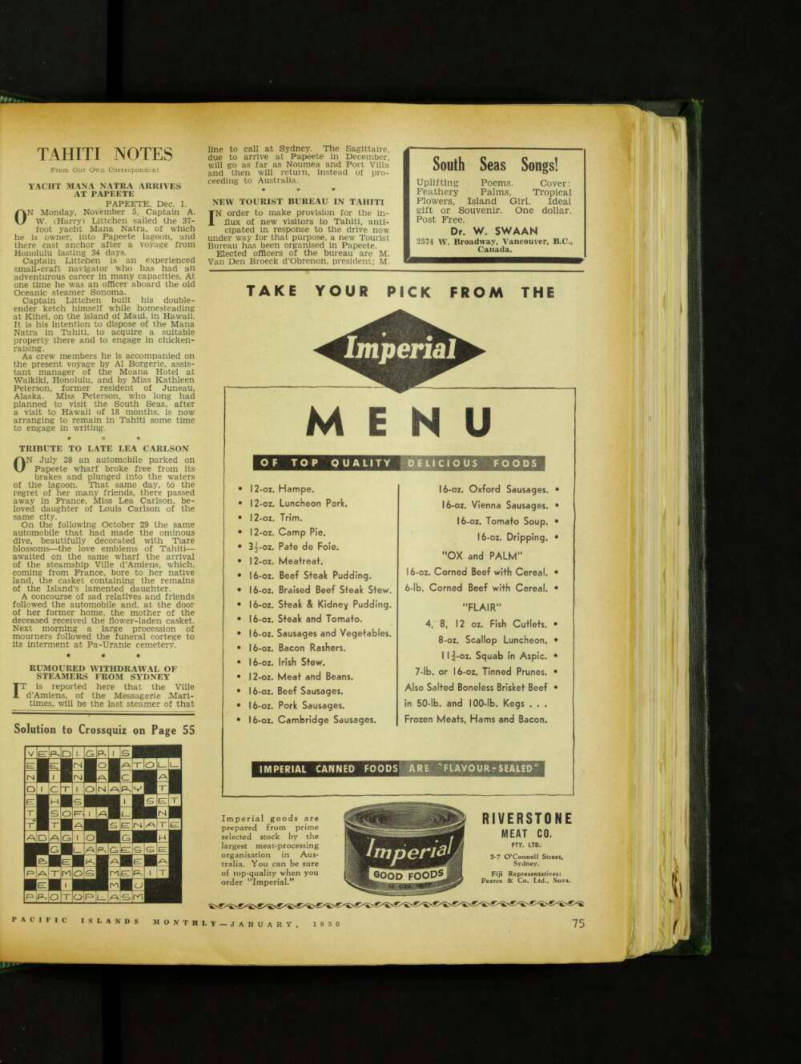
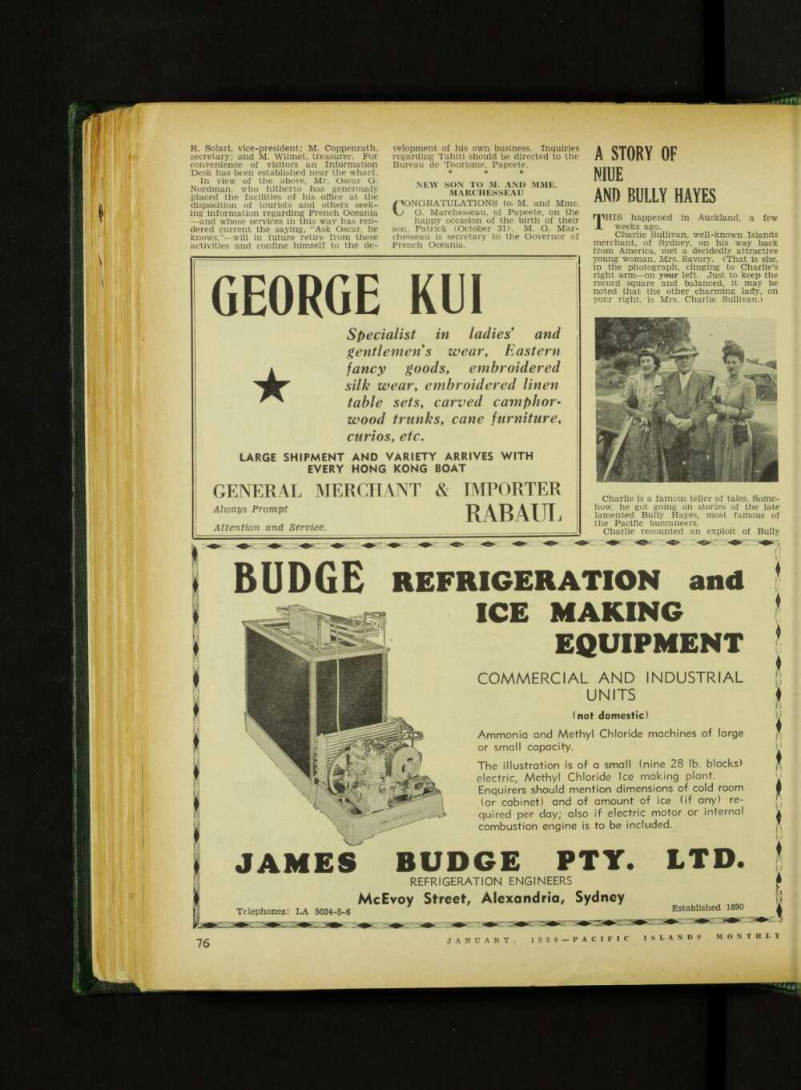
From Our Own Correspondent
Yacht Mana Natra Arrives
At Papeete
Papeete, Dec. 1.
ON Monday, November 5, Captain A.
W. (Harry) Littchen sailed the 37foot yacht Mana Natra, of which he is owner, into Papeete lagoon, and there cast anchor after a voyage from Honolulu lasting 34 days.
Captain Littchen is an experienced small-craft navigator who has had an adventurous career in many capacities. At one time he was an officer aboard the old Oceanic steamer Sonoma.
Captain Littchen built his double ender ketch himself while homesteading at Kihei, on the island of Maui, in Hawaii.
It is his intention to dispose of the Mana Natra in Tahiti, to acquire a suitable property there and to engage in chicken raising.
As crew members he is accompanied on the present voyage by A 1 Borgerie, assis tant manager of the Moana Hotel at Waikiki, Honolulu, and by Miss Kathleen Peterson, former resident of Juneau, Alaska. Miss Peterson, who long had planned to visit the South Seas, after a visit to Hawaii of 18 months, is now arranging to remain in Tahiti some time to engage in writing. ♦ * *
Tribute To Late Lea Carlson
ON July 28 an automobile parked on Papeete wharf broke free from its brakes and plunged into the waters of the lagoon. That same day, to the regret of her many friends, there passed away in France, Miss Lea Carlson, be loved daughter of Louis Carlson of the same city.
On the following October 29 the same automobile that had made the ominous dive, beautifully decorated with Tiare blossoms —the love emblems of Tahiti — awaited on the same wharf the arrival of the steamship Ville d’Amiens, which, coming from France, bore to her native land, the casket containing the remains of the Island’s lamented daughter.
A concourse of sad relatives and friends followed the automobile and, at the door of her former home, the mother of the deceased received the flower-laden casket.
Next morning a large procession of mourners followed the funeral cortege to its interment at Pa-Uranie cemetery. • ♦ •
Rumoured Withdrawal Of
Steamers From Sydney
IT is reported here that the Ville d’Amiens, of the Messagerie Mari times, will be the last steamer of that
line to call at Sydney. The Sagittaire, due to arrive at Papeete in December, will go as far as Noumea and Port Villa and then will return, instead of pro ceeding to Australia. » * »
New Tourist Bureau In Tahiti
IN order to make provision for the in flux of new visitors to Tahiti, anti cipated in response to the drive now under way for that purpose, a new Tourist Bureau has been organised in Papeete.
Elected officers of the bureau are M.
Van Den Broeck d’Obrenon, president; M.
R. Solari, vice-president; M. Coppenrath, secretary; and M. Wilmet, treasurer. For convenience of visitors an Information Desk has been established near the wharf.
In view of the above, Mr. Oscar G.
Nordman, who hitherto has generously placed the facilities of his office at the disposition of tourists and others seek ing information regarding French Oceania —and whose services in this way has ren dered current the saying, “Ask Oscar, he knows,’’—will in future retire from these activities and confine himself to the de
velopment of his own business. Inquiries regarding Tahiti should be directed to the Bureau de Tourisme, Papeete. * * *
New Son To M. And Mme.
Marchesseau
Congratulations To. M. And Mme.
G. Marchesseau, of Papeete, on the happy occasion of the birth of their son, Patrick (October 31). M. G. Mar chesseau is secretary to the Governor of French Oceania.
Advertisements & other items, pp. 77-78 (2 items)
Solution to Crossquiz on Page 55
Menu
South Seas Songs!
Uplifting Poems. Cover: Feathery Palms, Tropical Flowers, Island Girl. Ideal gift or Souvenir. One dollar.
Post Free.
Dr. W. SWAAN
2574 W. Broadway, Vancouver, 8.C., Canada.
TAKE YOUR PICK FROM THE
MENU
OF TOP QUALITY DELICIOUS FOODS
12-oz. Hampe. 12-oz. Luncheon Pork. 12-oz. Trim. 12-oz. Camp Pie.
Pate de Foie. 12-oz. Meatreat. 16-oz. Beef Steak Pudding. 16-oz. Braised Beef Steak Stew. 16-oz. Steak & Kidney Pudding. 16-oz. Steak and Tomato. 16-oz. Sausages and Vegetables. 16-oz. Bacon Rashers. 16-oz. Irish Stew. 12-oz. Meat and Beans. 16-oz. Beef Sausages. 16-oz. Pork Sausages. 16-oz. Cambridge Sausages. 16-oz. Oxford Sausages. • 16-oz. Vienna Sausages. • 16-oz. Tomato Soup. • 16-oz. Dripping. • "OX and PALM" 16-oz. Corned Beef with Cereal. • 6-lb. Corned Beef with Cereal. •
"FLAIR"
4,8, 12 oz. Fish Cutlets. • 8-oz. Scallop Luncheon. • I l|-oz. Squab in Aspic. • 7-lb. or 16-oz. Tinned Prunes. • Also Salted Boneless Brisket Beef • in 50-lb. and 100-lb. Kegs . . .
Frozen Meats, Hams and Bacon.
IMPERIAL CANNED FOODS ARE 'FLAVOUR-S Efi LED"
Imperial goods are prepared from prime selected stock by the largest meat-processing organisation in Australia. You can be sure of top-quality when you order ‘'lmperial.” food 5
GOOD
RIVERSTONE
MEAT CO.
PTY. LTD.
5-7 O’Connell Street, Sydney.
Fiji Representatives: Pearce & Co. Ltd., Suva.
GEORGE Kill
★ Specialist in ladies’ and gentlemen s wear. Eastern fancy goods, embroidered silk wear, embroidered linen table sets, carved ■ wood trunks, cane furniture, curios, etc.
LARGE SHIPMENT AND VARIETY ARRIVES WITH
EVERY HONG KONG BOAT
GENERAL MERCHANT & IMPORTER
Always Prompt Attention and Service.
RABAUL
BUDGE
REFRIGERATION and
ICE MAKING
EQUIPMENT
COMMERCIAL AND INDUSTRIAL
UNITS
(not domestic) Ammonia and Methyl Chloride machines of large or small capacity.
The illustration is of a small (nine 28 lb. blocks) electric, Methyl Chloride Ice making plant.
Enquirers should mention dimensions of cold room (or cabinet) and of amount of ice (if any) required per day; also if electric motor or internal combustion engine is to be included.
JAMES BUDGE PTY. LTD.
REFRIGERATION ENGINEERS
McEvoy Street, Alexandria, Sydney
. 0 Telephones: LA 5034-5-6 Established 1890
A Story Of
Niue
And Bully Hayes
THIS happened in Auckland, a few weeks ago.
Charlie Sullivan, well-known Islands merchant, of Sydney, on his way back from America, met a decidedly attractive young woman, Mrs. Savory, (That is she, in the photograph, clinging to Charlie’s right arm—on your left. Just to keep the record square and balanced, it may be noted that the other charming lady, on your right, •is Mrs. Charlie Sullivan.)
Charlie is a famous teller of tales. Some how, he got going on stories of the late lamented Bully Hayes, most famous of the Pacific buccaneers.
Charlie recounted an exploit of Bully
when he sailed into Niue, nearly 100 years ago, and persuaded old Captain Head to sell him his copra. When the copra was all loaded and the anchor hove short, Bully and his merry men seized Head, and threw him overboard. As his boat’s crew picked up the blaspheming trader, the barquentine Leonora sailed away, while the jovial and bearded Hayes blew kisses coyly to his victim, from the rail.
A year or so later, Hayes brought his ship back to Niue, and assured Captain Head that the theft had lain heavy upon his conscience. He had decided to come back and pay for the copra. “I don’t suppose you’ll ever trade with me again,” said the penitent Bully.
Head said it was a dirty trick—but he’d forget it—Hayes’s money was as good as that of anyone else, he supposed.
They drank amiably together, it transpired that Head had another lot of copra awaiting shipment. Yes, he’d sell it to Hayes, bo they made a deal.
History repeated itself. When the ship was ready to depart, they again threw Head overboard, and sailed away. Head never forgave Hayes.
“Yes, that was typical of Hayes,” said Mrs. Savory. “But that wasn’t how the story ended. He didn’t throw Captain Head overboard a second time.”
“Why, how do you know?” asked Charlie.
“Oh, Captain Head was my great grandfather,” replied the lady.
Charlie, back in Sydney, is still wonder ing why he selected that particular person to tell that particular story to.
Fijians At Empire Games
THE four athletes, who are to represent Fiji at the British Empire Games in Auckland in February left Suva in early January.
They are Orisi Dawai and Manasa Nukuvou, who will compete in the 100 yards and 220 yards races; Mataika Tuicakau, who will take part in the shot put and discus events; and Luke Tuna buna, javelin-thrower.
Recent performances of each of these athletes compare favourably with those put up in the athletic meeting held on August 1, 1949, between Great Britain and France and are in every case better than the New Zealand standard required for the British Empire Games.
Mr. H, M. McMillan, who has been training the four men, will go with them to Auckland as manager-coach.
It is expected that the cost of sending the athletics team to the Empire Games, and the yacht and crew to represent Fiji in the 18 ft. international race on Auck land harbour, will be about £l,OOO. The Government of Fiji has promised a grant of up to £5OO, to meet half the cost of the trip.
W. Samoan Representatives
For Spg Conference
From Our Own Correspondent THE people and Government of Western Samoa will be represented at the South Pacific Conference at Suva in April, 1950, by four delegates. They are the two members of the Council of State (the Hon. Tupua Tamasese and the Hon.
Malietoa Tanumafili ID Tualaulelei, a member of the Legislative Assembly, and Anapu, the speaker of the Fono of Faipule.
Mr. D. H. Osborne, of Samarai, Eastern Papua, is in Brisbane at present, but expects to return to his home in Feb ruary.
New Guinea Women’S
Association, Melbourne
THE New Guinea Women’s Association, Melbourne, held a Christmas party on December 10, at the Caris Club Rooms, Collins Street. About 80 members and their friends were there to partake of a delightful afternoon tea served at 3.45 p.m., and cocktails and savouries later in the afternoon. Many Territorians, some from other States and several down on leave from the Territory, renewed old friendships and exchanged news.
The party took the form of “Bring a Gift, Buy a Gift,” and the opportunity table was so well patronised that the As-
Sociation was able to add another £26 to the Scholarship Fund.
The president, Mrs. H. A. Gregory, welcomed the guests assisted by the treasurer, Mrs. G, Walker and secretary, Miss Valda Youlden. Mrs. Holland and Mrs. Youlden were in charge of the gift table.
ANOTHER two children will benefit by the Scholarship Fund in 1950, making four who are now being as sisted in their education.
A service will be held at the Shrine of Remembrance, Melbourne, in conjunction with the 2/22nd Batalion on January 22, 1950, to commemorate those men who gave their lives in the defence of the Territory.
Advertisements & other items, pp. 79-80 (1 item)
Marys
AUNT
BAKING POWDER
For the best in delicious baking results A product of TILLOCK AND GO. PTY. LTD. manufacturers of all the famous Aunt Mary's Pure Foods
4#
BRAN
Over Half A Century Of Healing!
An Australian Success Story
AUGUST EICHORN (pronounced I-Corn), born at Tumut, N.S.W., was the son of a German scientist who came to Australia during the Gold Rush in the eighteen-fifties.
A natural method of healing, by stimulating the curative powers of the blood-stream, as taught by his father, appealed to the logical mind of August Eichorn and, when quite a young man, he started the experiments that led him to discover the herbal extractive that was to make him an almost legendary figure throughout southern New South Wales.
Eichorn was in his late twenties when he perfected “Eichorn’s Remedy” and set out to prove, by practical demonstration, its efficacy in the prevention and treatment of septic conditions in wounds, inflammation, reptile bites, mosquito, sandfly and all insect bites, boils, carbuncles, abscesses, bleeding gums and a host of everyday ailments and injuries. : // • we? f,
August Eichorn
188 5 t 0 th e turn of the century and after saw i uuv August Eichorn riding from homestead, to mining camp, to township, in southern New South Wales with his instruments and materials for “Eichorn’s Remedy” and Eichom’s Ointment” in his saddle-bags.
At a period w r hen injuries were frequent and doctors few. Eichom’s treatment had to be simple and effective.
It proved to be just that and he earned the practical gratitude of thousands whose limbs and lives he saved. 1Q 1 A and onwards, saw Eichorn proving the Efficacy 1y 1 v of his remedies by giving public demonstrations In which he permitted venomous snakes and spiders, even the dreaded Death Adder, to bite him.
A quotation from the "Sydney Mail" of June. 1919, reads:—"So certain is his cure and such is the faith the people of Adelong district have in it that almost any youngster will coolly handle a deadly reptile if August Eichorn is with them."
Eichorn continued these demonstrations and, up to the time of his death, at the grand old age of 87, had allowed himself to be bitten over three hundred times. 1922* Now mi ddle age. August Eichorn decided MmMm% to assure continued production of ‘Eichorn’s Remedy” and ‘Eichorn’s Ointment” after his life ended.
Selecting trusted associates, he formed Eichorn’s Remedies Pty. Ltd. in Sydney. This company remained under his supervision until his death, in 1944, and continues production of “Eichorn’s Remedy” and “Eichorn’s Ointment” to his original formula® and processes.
TOHAY* Thousands of testimonials attest remark- I v/L/AV I . a bie cures effected with “Eichorn’s Remedy,” “Eichorn’s Ointment,” or both.
MR. WM. HERRING, Grazier, of Gundagai, writes:—“l had septic blood-poisoning of the foot. After four months of unsuccessful effort at cure it was decided to amputate my leg. A friend advised me to see Mr. Eichorn. After two months of his treatment my foot was cured and has never troubled me since.”
MRS. E. WATERWORTH, of 66 Ivy Rd., Cricklewood, London writes: —“I resided in Australia for two years, and always had a bottle of ‘Eichorn’s’ handy. I would never be without it now. It was the only treatment that cured me of Septic Poisoning of the gums.”
“Eichoms Remedy” and “Eichorn’s Ointment” are now sold everywhere at a price within the reach of all. Each day sees these wonderful specifics being added to the family medicine chest in thousands of homes all over the world.
For safety sake “Eichorn’s Remedy” and “Eichorn’s Ointment” should be in YOUR home NOW.
BIGHORN’S
REFUSE
(PRONOUNCED l-CORNS) IS OBTAINABLE
ALL CHEMISTS AND STORES
SUBSTITUTES—DEMAND THE GENUINE
AT
EICHORN’S
HEALTH
and
FIRST-AID BOOK
FREE AND POST FREE
A LIMITED NUMBER of these valuable books, giving August Eichorn’s Health Hints and First-aii Rules will be sent FREE AND POST FREE to “Pacific Island Monthly” readers . . . The edition is limited . . . Apply NOW . . . Fill in and post this coupon to:
EICHORN’S REMEDIES PTY. LTD,
11c Castlereagh St., Sydney, N.S.W.
KILLS PAIN —CLEANSES —HEALS —SAVES LIFE
Bottles:
\ V6.1'66i4'6
EICHORNS
OINTMENT
TOUR NAME (PRINT PLEASE)
PENETRATES-SOOTHES-rHEALS
ADDRESS
STATE
V
JARS: I'6
Notes and News About Buka
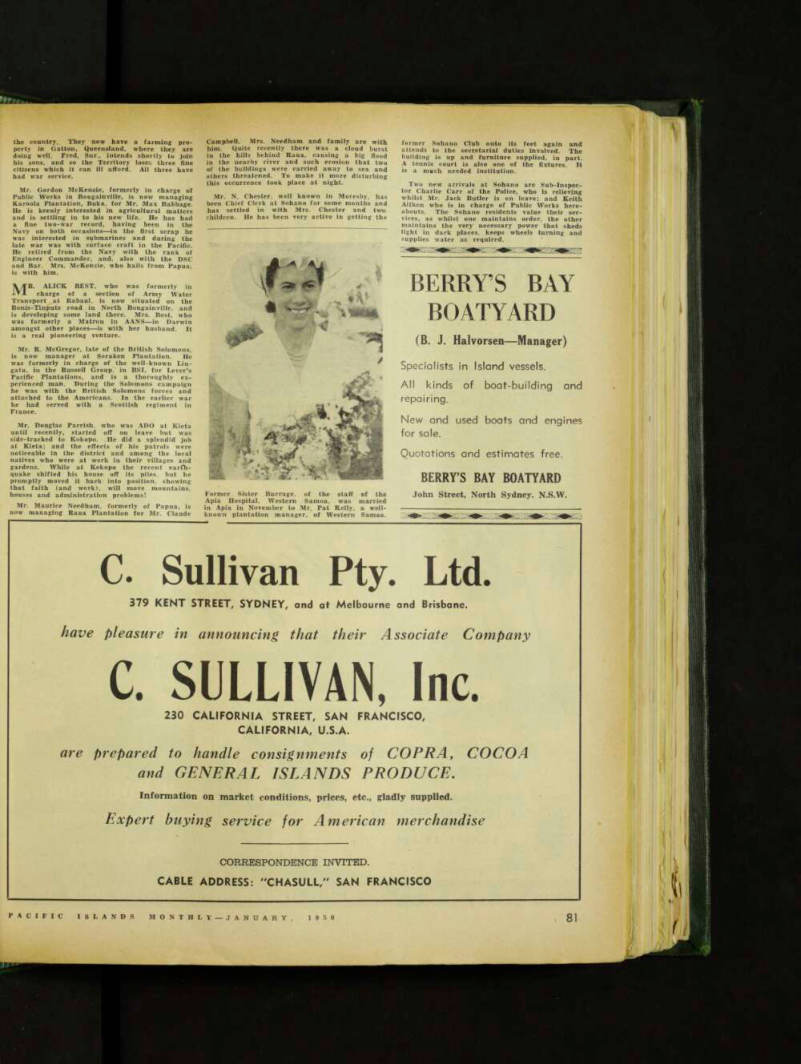
and Bougainville Folk
From Our Own Correspondent
Buka Passage, Dec. 29.
THE Administrator (Colonel J. K.
Murray), paid a visit to Sohano on December 6 and 7, arriving by Cata lina at 7.30 a.m. With him were Dr.
Gunther, Director of Health and Dr. May, Assistant Director of Health. During his stay His Honor met the various Adminis tration officials and some residents of the district. It was his intention and the medical represent!ves’ to visit the Tas man and Mortlock Groups in the Cata lina, but weather conditions prevented landings being made and the plane re turned to Sohano in the afternoon, and took off for Rabaul at about 4 p.m. on the same day. The whole visit to Sohano was a pleasant affair and gave general satisfaction.
Our District Officer, Mr. Raleigh Farlow, is now on leave and we understand that he proposes to visit Norfolk Island where he was Commandant for a time during the recent war. Mrs. Farlow and the girls preceded him to Australia. Rumour says that he will be stationed in another area when he returns to New Guinea.
Mrs. Alma Good is carrying on at Kessa, in North Buka, despite the isolated posi tion, lack of shipping, and other in conveniences that are part of the daily life of the outports resident. One must pay tribute to the grit of our Territory womenfolk, who accept all these things as part of the daily round. Thanks to Mrs. Good’s energy and knowledge of local conditions the plantation is producing its share of copra.
Father Albert Lebel, that man of energy and resource, conducted the Christmas Service, and later rejoicings, at the Tea rouki Mission in a manner characteristic of him. Whatever he tackles he does “with his might.” The Mission now has some fine buildings on it, strongly con structed houses of native material and some Quonsett huts. They grew under the Father’s capable supervision—and often under his own hands. One recalls the work he did among the Coast Watching fraternity—even refusing evacuation by submarine—in order to continue his medical assistance to them. At the time the Japs were very keen to lay hands on him, but he managed to keep one jump ahead as he did his rounds! Father Lebel also did a term as Chaplain on various US warships.
IVjEWS of the death of Skipper Ernie Vider, in Sydney, came as a shock to our com munity. He went away on sick leave some months ago but everyone was hoping for his speedy return to health. He was an old time islander with experience in several Groups, and he had handled Administration vessels for a number of years. He was, like so many Ter ritorians a “two war” man.
The Rev. Gordon Cornwell has taken over the Methodist Mission activities in Buka. His pre decessor, the Rev. Clarrie Luxton, went to New Zealand to try to recover his health. Mr.
Cornwell is a man of parts, who served with the NZ Engineers, then joined the Navy and was on MTBs in the English Channel where he got badly shot up. After recovery, nothing daunted, he became an Engineer Test Pilot in an aeroplane works. He can be classed as a imiseula-r Christian. Mrs. Cornwell, also a New Zealander, is with him.
Mr. Max Babbage of Karoola Plantation, Buka, has not let any grass grow under his feet during the last year. In addition to pro ducing from his coconut area, he has planted about 30,000 cocoa trees which are doing well.
In addition he acts as Hon, Secretary f®r Bougainville Branch of the Planters’ Associa tion, and also for the recently formed Bougain ville Association. He goes to Sydney in January on leave.
We are to lose our popular Education Officer,
Mr. Frank Boisen, who has done good work dur ing his stay among us. He has opened up new schools and kept a watchful eye on those al ready operating. Recently he went to Rabaul to get his Military Cross from the Governor General. He goes to Rabaul shortly for duty.
He and Mrs. Boisen will be missed.
Mr. Paul Mason, and Mrs. Mason, of Inus, are off to England in the New Year. Mrs.
Mason, who was a Sydney journalist prior to her marriage, has been acting as Bougainville correspondent for the ABC and has helped to put our district on the map. All concerned will wish these popular people, and excellent citizens, a thoroughly enjoyable time whilst on tour.
Mr. Alf Long, of Bonis Plantation, in Buka Passage, has done a good job. He now has
fine Ceylon Driers elected, good copra shed and a stone jetty, alongside which the inter island ships can lie. No matter what comes or goes he proceeds on his way, as seems to be the idea with the old timers. Mrs, Long enjoys the place and is happy with her splendidly situated house and her books.
Mr. Bob Cole, who did fine work in Buin area for the Administration, has now been ap pointed Acting District Officer for Bougainville.
This is a happy arrangement and the whole district is pleased. There is very much to be done in the area in the way of straightening up villages, re-opening roads, and general patrol ling.
During a recent visit, the Administrator pre sented the Military Cross to Mr. Bob Stuart of Tenekau Plantation, Bougainville, who won the
decoration in Bougainville while serving with the AIB. There was a gathering of local resi dents at the ceremony and, afterwards Stuart received hearty congratulations.
Mr. Claude Campbell went South in December with the intention of proceeding to England on a holiday and health trip. Mrs. Campbell, and daughter (Mrs. Nari Forster), accompany him. During his re-habilitation of Raua Plan tation there were many trials and set-backs, but the state of Raua is a testimonial to Camp bell’s efforts. He has been a keen worker for the Planters’ Association and Bougainville As sociation, and before sailing went especially to Canberra to lay before the new Minister for External Territories our various disabilities.
A new member of the District Services at Sohano is Mr. Colin McLean, who takes over the duties of ADO for Buka and North Bougainville. .He was brought up in the Terri tory and joined the Administration as a youngster. He is conversant with the things that matter. Mrs. McLean, senior, is staying with him at Sohano.
One of the district’s greatest assets is our medico, Dr, Ken Pike, who is one of the well known Brisbane family of that name. He was here previously and residents appreciate his skill, genial ways and desire to help everybody needing his attention. A trip at any time, to anywhere, in order to help sick folk is part of Dr. Ken’s creed. In the native hospital he has made some fine cures and the natives say, in praise of his skill: “Dokitor belong me fella savvy too much—this Dokitor ’e No. 1 true.”
Mr. Ernie Wilkinson with Mrs. Wilkinson and son John have now returned from southern leave and look very fit. Wilkinson has re sumed his duties as Senior Medical Assistant.
Mr. Freddie Cattell, who was holding the fort during Medical-Assistant Wilkinson’s ab sence, went on to Talasea where he will com plete his term and then go South. He opened the first Native Hospital in Buka in 1928 and had Mrs. Cattell and his young family with him on Sohano when it was mostly bush. His name as a Medical Assistant is a byword throughout New Guinea as he served in most districts. His two sons, Fred and Jack, were brought up in the Territory but after a period back here, after the war ended, they decided that conditions were against them and left
the country. They now have a farming pro perty in Gatton, Queensland, where they are doing well. Fred, Snr., intends shortly to join his sons, and so the Territory loses three fine citizens which it can ill afford. All three have had war service.
Mr. Gordon McKenzie, formerly in charge of Public Works in Bougainville, is now managing Karoola Plantation, Buka, for Mr. Max Babbage.
He is keenly interested in agricultural matters and is settling in to his new life. He has had a fine two-war record, having been in the Navy on both occasions—in the first scrap he was interested in submarines and during the late war was with surface craft in the Pacific.
He retired from the Navy with the rank of Engineer Commander, and, also with the DSC and Bar. Mrs. McKenzie, who hails from Papua, is with him.
MR. ALICK BEST, who was formerly in charge of a section of Army Water Transport at Rabaul, is now situated on the Bonis-Tinputz road in North Bougainville, and is developing some land there. Mrs. Best, who was formerly a Matron in AANS—in Darwin amongst other places—is with her husband. It is a real pioneering venture.
Mr. R. McGregor, late of the British Solomons, is now manager at Soraken Plantation. He was formerly in charge of the well-known Lin gatu, in the Russell Group, in BSI, for Lever’s Pacific Plantations, and is a thoroughly ex perienced man. During the Solomons campaign he was with the British Solomons forces and attached to the Americans. In the earlier war he had served with a Scottish regiment in France.
Mr, Douglas Parrish, who was ADO at Kieta until recently, started off on leave but was side-tracked to Kokopo. He did a splendid job at Kieta; and the effects of his patrols were noticeable in the district and among the local natives who were at work in their villages and gardens. While at Kokopo the recent earth quake shifted his house off its piles, but he promptly moved it back into position, showing that faith (and work), will move mountains, houses and administration problems!
Mr. Maurice Needham, formerly of Papua, is now managing Raua Plantation for Mr. Claude
Campbell. Mrs. Needham and family are with him. Quite recently there was a cloud burst in the hills behind Raua, causing a big flood in the nearby river and such erosion that two of the buildings were carried away to sea and others threatened. To make it more disturbing this occurrence took place at night.
Mr. N. Chester, well known in Moresby, has been Chief Clerk at Sohano for some months and has settled in with Mrs. Chester and tw(o children. He has been very active in getting the
Former Sister Burrage, of the staff of the Apia Hospital, Western Samoa, was married in Apia in November to Mr. Pat Kelly, a well known plantation manager, of Western Samoa.
former Sohano Club onto its feet again and attends to the secretarial duties involved. The building is up and furniture supplied, in part.
A tennis court is also one of the fixtures. It is a much needed institution.
Two new arrivals at Sohano are Sub-Inspec tor Charlie Carr of the Police, who is relieving whilst Mr. Jack Butler is on leave; and Keith Aitken who is in charge of Public Works here abouts. The Sohano residents value their ser vices, as whilst one maintains order, the other maintains the very necessary power that sheds light in dark places, keeps wheels turning and supplies water as required.
Mrs. Iris Hunt, well-known and popular wife of Mr. Harvey Hunt, of Suva, pro ceeded to New Zealand in November on her travel agency business. While there, she became seriously ill, and was still in hospital in Auckland in December. How ever, she is improving, and hopes to re turn to Suva in February.
Nine-years-old Nesauiu Rachel, a Tanna girl (New Hebrides) arrived in Sydney on the December Morinda with Dr. William Armstrong and his wife, of the Presby terian Mission. They rescued Rachel soon after her birth when her father at tempted to bury her alive with her mother who had died.
Advertisements & other items, pp. 81-84 (2 items)
Robert Kosak
LIGHTING PLANTS
32 VOLT AND 110 VOLT PLANTS, COMPLETE WITH
BATTERIES
VENTURA TRADING COMPANY PTY. LTD.
26 BRIDGE ST., SYDNEY, N.S.W.
Cables: “Ventura,” Sydney.
P. & R. HUTCHINSON, Suva. VENTURA TRADE AGENCY, Lae. T.N.G.
IN THIS PART OF THE WORLD TOO/ ■Mf united ■vr / irirp^ . - -k >k Hr Jter> E3F « & VSt %«s *
Jl/H£
J 5 A Jy /
/ 7 / >%Fjx a 435 ijTf übshhi' X- * ctf£o*iif*a **•«* S 3 •3«5»i u*«m* -feJ'
ftas
V —.(* «5E*» V'at ?W *£y« TX* 1 C* . TOfc*. >• s<** «sF^ * fAJit IK «««rr i Throughout the Pacific, as with other parts of the world, ROBERT KOSAK, representing leading English, Continental and U.S.A. manufacturers, offers all the advantages of an old-established importexport service.
ISLAND PRODUCTS
SOLD ON ALL
WORLD MARKETS
ON A COMMISSION
BASIS
Inquiries invited
ROBERT KOSAK
Exporters and Manufacturers’ Representatives,
77 KING STREET, SYDNEY, AUSTRALIA
Cable Address: “ROKOSTRA,” Sydney.
Bankers: National Bank of Australasia, Ltd., Sydney.
Bank of New South Wales, Sydney.
Asthma, Bronchitis Coughing, Curbed in 3 Minutes
Do you have attacks of Asthma or Bronchitis so bad that you can’t sleep? Do you feel weak, unable to work, and have to be careful not to take cold and can’t eat certain foods?
No matter how long you have suffered or what you have tried, there is new hope for you In a doctor’s prescription called Mendaco.
No dopes, no smokes, no injections, no atomizer.
All you do is take two tasteless tablets at meals and in 3 minutes Mendaco starts working through your blood, aiding nature to remove phlegm, promote free easy breathing and bring sound sleep the first night, so that you soon feel years younger and stronger.
No Asthma in 2 Years
Mendaco not only brings almost immediate comfort and free breathing but builds up the system to ward off future attacks. For Instance, J. Richards, Hamilton, Ont., Canada, had lost 40 lbs., suffered coughing every night, couldn’t sleep. Mendaco stopped Asthma
spasms first night and he has had none since In over two years.
Money Back Guarantee
The very first dose of Mendaco goes right to work circulating through your blood and helping nature relieve you of the effects of Asthma. Try Mendaco under an iron-clad money back guarantee. You be the judge. If you don’t feel fully satisfied alter taking Mendaco Just return the empty package and the full purchase price will be refunded. Get Mendaco from your chemist to-day and see how well you sleep to-night and how much better you feel to-morrow. The guarantee protects
you - RELIEVES ASTHMA
Mendaco
Now in 2 sizes . . . 6/- and 12/-
. . . the most practical and efficient machine for drying nuts in bulk, which produces copra of a higher standard than that dried in the open, without discolouration, free from mould, thoroughly and evenly dried throughout. The Chula produces its two tons' of copra every 24 hours, irrespective or the weather, and with a minimum of labour.
THE INVENTORS AND MANUFACTURERS OF
THE CHULA COPRA DRYER ALSO MAKE
DESICCATED COCONUT
MACHINERY
(Parers, Disintegrators, Sillers, Dryers)
TEA DRYERS
FISH DRYERS
RUBBER MACHINERY
(Continuous Sheeters, Crepeing Batteries)
TYNESIDE FOUNDRY &
ENGINEERING CO. LTD.
ELSWICK • NEWCASTLE-ON-TYNE • ENGLAND
Telegrams & Cables : " FOUNDRY. NEWCASTLE-ON-TYNE '
BETTER COPRA with LESS LABOUR !
when dried by Ihe scientific
process made possible by the
CHULA' Copra Dryer
A A "A B CA i p 7 Write for the new
CATALOGUE
and further details of the
"CHULA"
COPRA DRYER
BERRY’S BAY
BOATYARD
(B. J. Halvorsen—Manager)
Specialists in Island vessels.
All kinds of boat-building and repairing.
New and used boats and engines for sale.
Quotations and estimates free.
BERRY'S BAY BOATYARD
John Street, North Sydney. N.S.W.
C. Sullivan Pty. Ltd.
379 KENT STREET, SYDNEY, and at Melbourne and Brisbane. have pleasure in announcing that their Associate Company
C. SULLIVAN, Inc.
230 CALIFORNIA STREET, SAN FRANCISCO,
CALIFORNIA, U.S.A.
are prepared to handle consignments of COPRA, COCOA
and GENERAL ISLANDS
Information on market conditions, prices, etc., gladly supplied.
Expert buying service for American merchandise
CORRESPONDENCE INVITED.
CABLE ADDRESS: "CHASULL," SAN FRANCISCO
Itching Skin Germs Killed in 3 Days
Thanks to the discovery of an American physician, it Is now possible to kill and remove the true cause of most skin troubles. Your skin has nearly 50 million tiny seams and pores where invisible germs and parasites can hide, and which are the true cause of terrible Itching, Cracking, Peeling, Burning, Ringworm.
Acne, Psoriasis, Blackheads, Pimples, Foot Itch and other disfiguring blemishes.
Blemishes such as these make you look and feel embarrassed, unattractive and handicapped in life, both socially and In business. You can’t get rid of these disfigurements with ordinary treatments, which give only temporary relief, because they do not kill the germs or parasites responsible for your trouble. .
New Discovery Kills Cause
Former skin sufferers throughout the world are now praising Nlxoderm, the discovery of a leading American skin specialist. This remarkable new preparation quickly penetrates into the pores of the skin and kills the germs and parasites responsible for your trouble in 7 minutes, stopping the itch almost instantly. At the same time, this wonderful preparation acts as a tonic and skin food, so that as the cause of your trouble is removed, your skin becomes soft, smooth and clear. This clear, healthy complexion will give you new charm and make it easy to win friends.
Praised by Doctors
Dr. T. A. Ellis, well-known physician of Toronto, Canada, recently stated: ‘‘Skin disorders caused by parasites, as many are, yiel** to Nixoderm. These parasites are invisible to the naked eye. They eat s.way the skin, forming ugly eruptions. Ordinary ointments or remedies fall completely, or give only temporary results because they do not reach the cause of the condition. It is this value about Nixoderm in attacking parasites which Impresses me most favorably, and explains In large measure the success it enjoys over many stubborn cases.”
Guaranteed Results
Get Nixoderm to-day. Put It to the test. In a few minutes you will find that the itching has stopped, and in 24 hours you can see for yourself that your skin Is clearer. And it is guaranteed that, within one week, Nixoderm must make your skin soft, clear, smooth and attractive or money back on return of empty package. Get Nixoderm from your chemist or store to-day. The guarantee protects you. So don’t delay. Get Nixoderm to-day.
Nixoderm u-**/-
For Skin Sores, Pimples and Itch.
80
JANUARY, 1950 PACIFIC ISLANDS MONTH.!
Election Day on Pitcairn Island
Pitcairn Island
L IF R„ is much simpler when only 200 -odd folk live on an isolated island in mid-Pacific. Mrs. Myrtle Ward, Seventh Day Adventist Mis sionary on Pitcairn Island, tells us something of election day there when Islanders got going at 5 a.m. to re cord their votes and finished up the whole business, without fuss, by 10 a.m.
Apparently, voting is not compul sory, as only about 80 people recorded their votes.
PITCAIRN ISLAND has a new Chief Magistrate for 1950—Mr. Warren C, Christian, who took up his duties on New Year’s Day.
He is the son of the late Mr. Edgar R.
Christian, who, between 1923 and 1940, was our Chief Magistrate and held other positions in the Island Government. He died while still in office. Warren Chris tian’s mother —now also dead —was well known as a writer usually under the name of Ada M. Christian.
The retiring officer is Mr. Parkin Chris tian, an uncle of the new Chief Magis trate. It is likely that Mr. Parkin Christian will be returning shortly to Australia, where his son resides.
NOMINATIONS having been received on December 14," the voting was timed for 5 a.m. on December 21.
Notwithstanding the heavy rain and the muddy roads, the people turned out and the voting was carried through briskly.
Pitcairn Islanders may vote when they reach the age of eighteen. When the
voting for the Chief Magistrate was finished, results were announced from the verandah of the tiny Post Office. For the three candidates the figures were, 44, 19 and 6. There are always several informal votes.
From the waiting company in the pub lic square shouts of acclamation mingle with banter. The defeated candidates join in the general pleasantry.
But soon more papers are obtained from the Government Secretary. This time the vote is for the election of two Assessors.
Then follows quickly the voting for Chairman of the Internal Committee. In each case results are announced imme diately.
Electors and others do not wait about long once voting is over, for preparations for Christmas are afoot. The voting, counting and the announcing of results were all over by about 10 a.m., when the weather cleared wonderfully and all were soon at their gardens, curios or house work.
As with other countries where new Government officials are taking up their duties, we are all hoping that 1950 will be a very Happy New Year,
Advertisements & other items, p. 84 (1 item)
G. H. Robinson
2<? W/tXS 0
TWP/A/&
-WHOLESALE SHIPMENTS
EXECUTED
AT
LOWEST PRICES
% O Huh*, ii
G. H. ROBINSON
EXPORTS & IMPORTS PTY. LTD.
51 Macquarie St., Sydney.
TELEGRAMS: "SUNRISE" SYDNEY
PACIFIC ISLAND DISTRIBUTORS FOR: BRADFORD COMMERCIAL VEHICLES AND JOWETT JAVELIN CARS
Poor Travel Facilities To
Bougainville
Prom Our Own Correspondent
Sohano (Ng), Dec. 19.
BUKA and Bougainville are served by a fortnightly Catalina service, calling at Sohano, Inus, Kieta and Buin, and return to Rabaul over the same route.
There is a Douglas machine which, en route to Honiara (British Solomons) calls at Torokina, on Bougainville west coast; but Torokina is merely the remains of an Army dump, and is remote from other centres, so this call does no good to average residents, especially as no mail comes that way by air.
Residents consider that the district is due for a more frequent service as we are about the most isolated community in the Territory. If no other Catalina can be found to increase the service, then the Buka ’drome, just opposite Sohano, should be put into order and the Douglas routed that way. The delay in re-condi tioning the Buka ’drome seems to be the fault of Civil Aviation—which body should stick a pin in itself! Those whose opinion is sound say that not a great deal of work is required.
Fares on the Catalina have recently been raised by 50 per cent.—£6/15/- from Sohano to Rabaul, as against a former £4/10/ —which residents resent.
Kavieng has had, until recently at least, four services per week, and the fare still appears to be £4/10/-. On this run there is no difference made between European
fares and native fares, whereas, on other runs, there is a marked difference.
As a good many Aitape recruits come this way we are at a double disadvantage
since the restrictions put on number of natives allowed to travel on ships at sea.
Now we get it two ways—higher fares and less facilities for native recruits to travel.
Advertisements & other items, pp. 85-86 (1 item)
Batteries
Every Branch Of
ENGINEERING and BUILDING CONSTRUCTION
MILLERS LTD.
SUVA and LAUTOKA
Sawmillers and Timber Merchants; Shipwrights and Sailmakers; Joinery and Furniture Manufacturers; Upholsterers; Plumbers; Electricians; Hardware Merchants; Motor Dealers.
AOENOIEB:
Chevrolet, Bedford, Vauxhall, Nash Motors. Firestone Tyres.
Fetters Marine and Stationary Engines. G.E.C. Radio Sets.
British Australian Lead Manufacturers Pty., Ltd., Atlas Assurance Co., Ltd.
There is no need to send to Australia or New Zealand for Repairs or Replacements. We can give you a sound Quotation and guarantee First-Class Workmanship
U.S.L.
BATTERIES
FOR
MOTOR CAR AND TRUCK
SOLE DISTRIBUTORS for NEW GUINEA, PAPUA
AND PACIFIC ISLANDS.
VENTURA TRADING COMPANY PTY. LTD.
26 BRIDGE STREET, SYDNEY
Cables: “VENTURA,” Sydney.
GABRIEL ACHUN
Importer and Wholesale Merchant
Malaguna Road
RABAUL
Territory of New Guinea Specialises in:
BEERS
BICYCLES
AERATED WATER MANUFACTURING
COTTON PIECEGOODS FOR NATIVE TRADE
AGENT FOR “STANDARD” AND “TRIUMPH” CARS
Proprietor:
RABAUL CORDIAL FACTORY.
Telegraphic Address:
“GABRIEL ACHUN,” RABAUL.
CRAMMOND
“King of the
TROPICAL RECEIVERS
Continue to maintain their reputation as being the only sets in the world especially designed and built to stand up to tropical conditions and provide a lifetime of satisfactory service to their owners.
THE
TROPIC EAGLE
FEATURES:—
Completely sealed and infra red ray tropic proofed models for vibrator, A.C., 1.4 all dry cell.
Also a vibrator and all electric model.
FEATURES:—
Continuous coverage from 16-150 on Short Waves full Broadcast coverage. Mechanical band spread. Completely sealed rustlesjs cabinet. Built in moisture absorber.
THE SET WITHOUT A SINGLE DISAPPOINTMENT. THE ONLY COMPLETELY TROPIC-PROOFED RANGE OF RECEIVERS IN THE WORLD TO-DAY.
HERE'S THE PROOF
Mr. R.S.
P.O. Rabaul.
Dear Sirs, Again I can only say as I have said before, Crammond Tropic Eagle receivers are the right radio sets for this part of the world. 40 other models to choose from including vibrator and all electric gramo-combinations. Quotations will be gladly furnished for any type of transmitter you require. As evidence of our faith in our products, Crammond receivers carry a 12 month unconditional guarantee.
Write for particulars of the Country Listeners Club and monthly magazine. All your radio problems answered in non-technical language. Subscription 15/- per year. A complimentary copy of the Club Magazine will be sent on request.
CRAMMOND RADIO
TROPfCDL DIVISION
HO 8 QUEEN STREET . BRISBRHE
Kavieng Notes
Kavieng, Ng, Jan. 2.
HIGHLIGHTS of our very happy Christ mas were the well-organised native aquatic sports and field events, the big “sing-sing,” a “Shipwreck Party” at the residence of the District Officer (Mr.
I. F. G. Downs), a Cocktail Party (also at the Downs’), sports at Utu District School, a gay gathering at “House Pig,” a sumptuous Christmas Dinner of turkey, ham and pork provided by Mr. and Mrs.
Schultze, and a host of parties for the kiddies. * A daughter was born to Mr. and Mrs.
Noel Collins at Kavieng Hospital on Christmas Day. This couple are popular in the locality, where Mr. Collins is the hard-working manager for Colyer Watson (New Guinea), Ltd. ♦ Mrs. Soo Tong, 68, died recently. She was the wife of Kavieng’s oldest Chinese resident, Soo Tong, who first came to New Guinea in 1904 and has resided locally since 1912. ♦ Mrs. H. L. Schultze flew South just after Christmas. She was accompanied by her two young daughters, Dorothea and Carol, who will enter the Presby terian Ladies’ College, Goulburn. * Mr. and Mrs. Jack Goad are spending a couple of months here. Mr. Goad is well-known among the old residents—he lived here before the war. * Mr. Robert Cheong, under 10-stone boxing champion of Thornburgh College, Charters Towers, Queensland, is spending his Christmas vacation with his parents, Mr. and Mrs. Cheong Fatt, of Kavieng.
You can now get an excellent meal at
old Tsang Tsang's; but we are wondering which will be up first—his “pub,” or the Kavieng Club (1949). Accommodation for visitors is sadly needed at Kavieng and one or the other would be welcome.
Wedding At Wewak
THE wedding of Miss Nan Walker and Mr. Tom Briggs took place at We wak, New Guinea, on December 2.
The Reverend Mr. Finger officiated.
Miss W. Watson was Matron of Honour, and Mr. Tom Cooper was best man. The bride was given away by Mr. W. Watson.
More than 150 guests attended the wed ding, and later, the breakfast, which was held at the Wewak Club.
The bride and groom left Wewak on the following day, bound for Australia, calling at Dunk Island on the way.
The Fiji Commissioner of Police, Mr. I.
E. Lucchinelli, is at present in New Zea land on vacation leave.
Fijians Welcomed Warmly In
Tahiti
From Our Own Correspondent
Papeete, Jan. 3.
rpHE arrival of the Carpenter motor ship, X Lakemba, late in December, to pick up 2,000 tons of copra for Vancouver, became an important social and sporting event.
The Lakemba’s erew of Fijians were welcomed delightedly by the Tahitians— especially by some of our local belles.
Sportsmen quickly promoted a boxing contest on December 21 between Fredo Salmon, described as “the champion of French Oceania,” and Camaibua, “cham pion des Isles Fidji.” There was a large assembly, and the ring was decorated by French and British flags.
Fredo gave a good showing for seven rounds, after which he gracefully accepted a knock-out from Camaibua.
The Lakemba continued her voyage on January 1, A very good time was had by all.
Advertisements & other items, p. 87 (1 item)
Biscuits..
OpnldhedL
For Tropical conditions
Velvene Water Paint and Davison's Zinc Base Paints are used extensively throughout the islands and Mandated Territories on Government and Private buildings, giving full satisfaction under severe tropical conditions.
DAVISON PAINTS LTD.
BOX 24, AUBURN, N.S.W.
I I f
HOME STYLE BISCUITS
-•; : 1 - « »i 4 8 V,
J. C. MERRILLEES PTY. LTD.
104 HUNTER ST., SYDNEY
Telegrams: “Merrillees,” Sydney.
BISCUITS..
Home-style sweet biscuits of supreme quality, manufactured in Australia, of the finest ingredients and in 10 varieties.
Packed for export in approximately lb. tins —l2 tins per case.
FRUIT CAKE —American Formula
We wish to announce that we can now supply for export, American fruit cake packed in 6 lb. blocks —6 blocks per case.
AGENTS
WALTER GRAND HUNTS AGENCY
PAPEETE, TAHITI. SUVA, FIJI.
Sandy Creek Gold Sluicing Ltd.
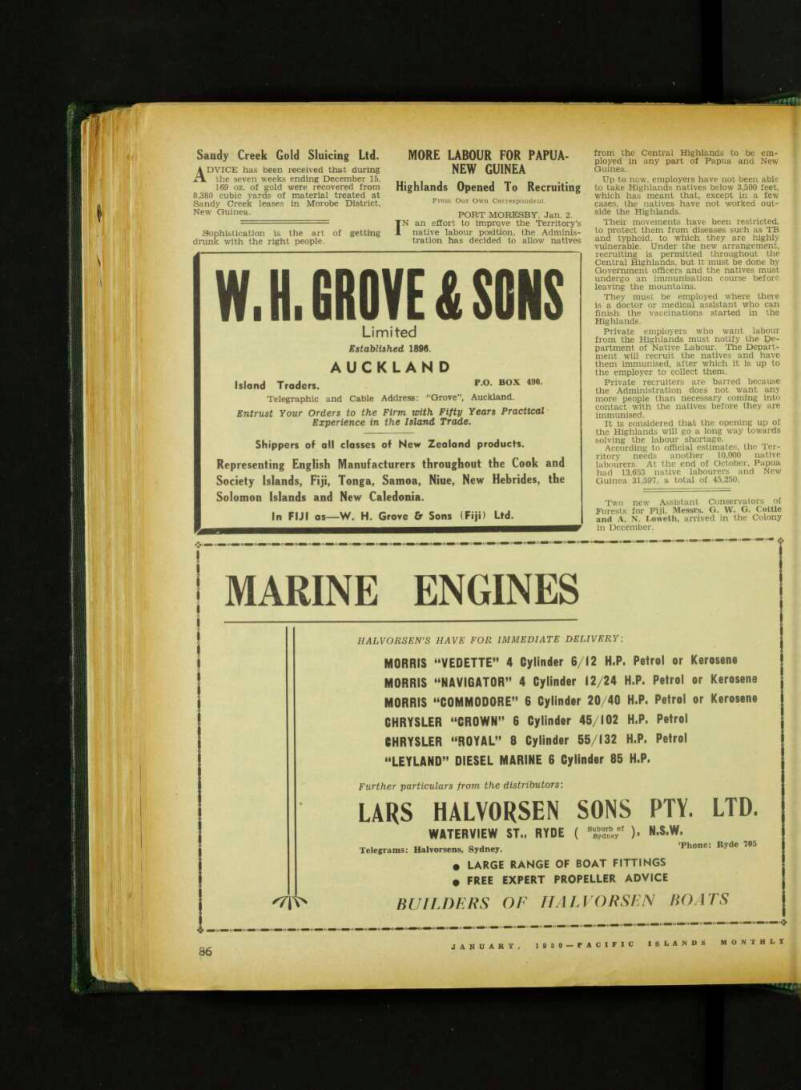
ADVICE has been received that during the seven weeks ending December 15, 169 oz. of gold were recovered from 8,380 cubic yards of material treated at Sandy Creek leases in Morobe District, New Guinea.
Sophistication is the art of getting drunk with the right people.
Highlands Opened To Recruiting
More Labour For Papua
New Guinea
From Our Own Correspondent
Port Moresby. Jan. 2.
IN an effort to improve the Territory’s native labour position, the Adminis tration has decided to allow natives
from the Central Highlands to be em ployed in any part of Papua and New Guinea.
Up to now, employers have not been able to take Highlands natives below 3,500 feet, which has meant that, except in a few cases, the natives have not worked out side the Highlands.
Their movements have been restricted, to protect them from diseases such as TB and typhoid, to which they are highly vulnerable. Under the new arrangement, recruiting is permitted throughout the Central Highlands, but it must be done by Government officers and the natives must undergo an immunisation course before leaving the mountains.
They must be employed where there is a doctor or medical assistant who can finish the vaccinations started in the Highlands.
Private employers who want labour from the Highlands must notify the de partment of Native Labour. The Depart ment will recruit the natives and have them immunised, after which it is up to the employer to collect them.
Private recruiters are barred because the Administration does not want any more people than necessary coming into contact with the natives before they are immunised.
It is considered that the opening up of the Highlands will go a long way towards solving the labour shortage.
According to official estimates, the Ter ritory needs another 10,000 native labourers. At the end of October, Papua had 13,653 native labourers and New Guinea 31,597, a total of 45,250.
Two new Assistant Conservators of Forests for Fiji, Messrs. G. W. G. Cottle and A. N. Loweth, arrived in the Colony in December.
Advertisements & other items, p. 88 (1 item)
W. H. Grove & Sons
Limited
Established 1896.
AUCKLAND
Island Traders. PO BOX 490 ‘ Telegraphic and Cable Address: “Grove", Auckland.
Entrust Your Orders to the Firm with Fifty Years Practical Experience in the Island Trade.
Shippers of all classes of New Zealand products.
Representing English Manufacturers throughout the Cook and Society Islands, Fiji, Tonga, Samoa, Niue, New Hebrides, the Solomon Islands and New Caledonia.
In FIJI as—W. H. Grove Cr Sons (Fiji) Ltd.
MARINE ENGINES
HALVORSEN’S HAVE FOR IMMEDIATE DELIVERY:
MORRIS “VEDETTE” 4 Cylinder 6/12 H.P. Petrol or Kerosene MORRIS “NAVIGATOR” 4 Cylinder 12/24 H.P. Petrol or Kerosene MORRIS “COMMODORE” 6 Cylinder 20/40 H.P. Petrol or Kerosene CHRYSLER “CROWN” 6 Cylinder 45/102 H.P. Petrol CHRYSLER “ROYAL” 8 Cylinder 55/132 H.P. Petrol “LEYLAND” DIESEL MARINE 6 Cylinder 85 H.P.
Further particulars from the distributors :
LARS HALVORSEN SONS PTY. LTD.
WATERVIEW ST., RYDE ( Sydney ) 9 NeSiWe Telegrams: Halvorsens, Sydney. ’Phone: Ryde 705
LARGE RANGE OF BOAT FITTINGS
• FREE EXPERT PROPELLER ADVICE
BUILDERS OF HALVORSEN BOATS
Sydney-Papua-
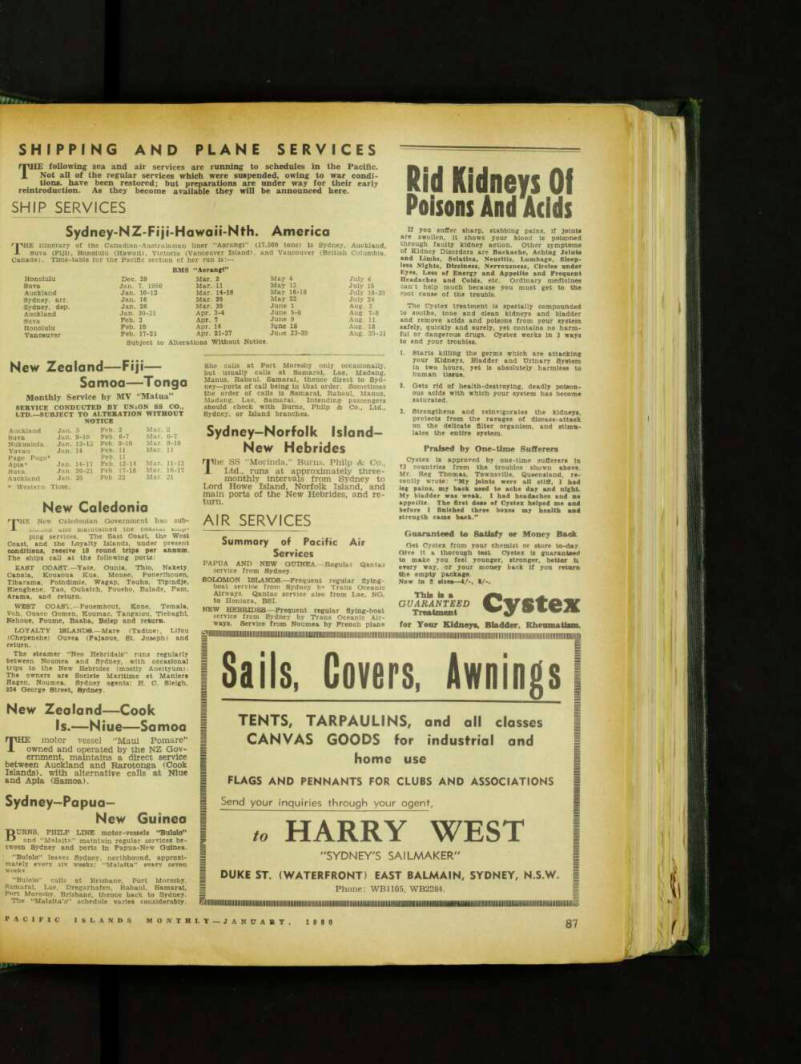
Shipping And Plane Services
Ship Services
fTiHE following sea and air services are running to schedules in the Pacific.
X Not all of the regular services which were suspended, owing to war condi tions. have been restored; but preparations are under way for their early reintroduction. As they become available they will be announced here.
Sydney-NZ-Fiji-Hawaii-Nth. America
'T'HE itinerary of the Canadian-Australasian liner “Aorangi” (17,500 tons) is Sydney, Auckland, A Suva (FIJI), Honolulu (Hawaii), Victoria (Vancouver Island), and Vancouver (British Columbia, Canada). Time-table for the Pacific section of her run Is:—
New Zealand—Fiji—
Samoa —Tonga
Monthly Service by MY “Matua”
Service Conducted By Union Ss Co.,
Ltd.—Subject To Alteration Without
Notice
New Caledonia
THE New Caledonian Government has sub aiu.ocd ana maintained tne coastal snip ping services. The East Coast, the West Coast, and the Loyalty Islands, under present conditions, receive 10 round trips per annum.
The ships call at the following ports: EAST COAST.—Yate, Ounla, Thio, Nakety.
Canala, Kouaoua Kua, Moneo, Ponerlhoucn, Tibarama, Poindlmie, Wagap, Touho, Tlpindje, Hienghene, Tao, Oubatch, Pouebo, Balade, Pam, Arama, and return.
WEST COAST.—Pouembout, Kone, Temala, Voh. Ouaco Gomen, Koumac, Tangaiou, Tlebaghl, Nehoue, Poume, Baaba, Belep and return.
LOYALTY ISLANDS.—Mare (Tadine), Llfou (Chepenehe) Ouvea (Fajaoue, St. Joseph) and return.
The steamer “Neo Hebrldais” runs regularly between Noumea and Sydney, with occasional trips to the New Hebrides (mostly Aneityum).
The owners are Soclete Maritime et Manlere Hagen, Noumea, Sydney agents; H. C. Sleigh, 254 George Street, Sydney.
New Zeoland—Cook
Is.—Niue—Samoa
THE motor vessel “Maui Pomare” owned and operated by the NZ Gov ernment, maintains a direct service between Auckland and Rarotonga (Cook Islands), with alternative calls at Niue and Apia (Samoa).
Sydney-Papua-
New Guinea
rtURNS, PHILP LINE motor-vessels "Bulolo”
AA and “Malaita” maintain regular services be tween Sydney and ports In Papua-New Guinea.
“Bulolo” leaves Sydney, northbound, approxi mately every six weeks; “Malaita” every seven weeks “Bulolo” calls at Brisbane, Port Moresby, Samarai, Lae, Dregarhafen, Rabaul, Samaral.
Port Moresby. Brisbane, thence back to Sydney.
The “Malaita's” schedule varies considerably.
She calls at Port Moresby only occasionally, but usually calls at Samara!, Lae, Madang.
Manus, Rabaul, Samaral, thence direct to Syd ney—ports of call being in that order. Sometimes the order of calls is Samaral, Rabaul, Manus, Madang. Lae, Samarai. Intending passengers should check with Burns, Philp & Co., Ltd., Sydney, or Island branches.
Sydney-Norfolk Island-
New Hebrides
Tlhe SS “Morinda,” Burns, Philp & Co., Ltd., runs at approximately three monthly intervals from Sydney to Lord Howe Island, Norfolk Island, and main ports of the New Hebrides, and re turn.
Honolulu Dec. 29 RMS “Aorsmrl”
Mar. 2 May 4 July 6 Suva Jan. 7, 1950 Mar. 11 May 13 July 15 Auckland Jan. 10-12 Mar. 14-16 May 16-18 July 18-20 Sydney, arr.
Jan. 16 Mar. 20 May 22 July 24 Sydney, dep.
Jan. 26 Mar. 30 June 1 Aug. 3 Auckland Jan. 30-31 Apr. 3-4 June 5-6 Aug. 7-8 Suva Feb. 3 Apr. 7 June 9 Aug. 11 Honolulu Feb. 10 Apr. 14 Tune 16 Aug. 18 Vanceuver Feb. 17-23 Apr. 21-27 June 23-29 Aug. 25-31 Subject to Alterations Without Notice.
Auckland Jan. 5 Feb. 2 Mar. 2 Suva Jan. 9-10 Feb. 6-7 Mar. 6-7 Nukualofa Jan. 12-13 Feb. 9-10 Mar. 9-10 Vavau Jan. 14 Feb. 11 Mar. 11 Pago Pago* Feb. 11 Apia* Jan. 14-17 Feb. 12-14 Mar. 11-13 Suva. Jan. 20-21 Feb. 17-18 Mar. 16-17 Auckland Jan. 25 Feb. 22 Mar. 21 * Western Time.
Air Services
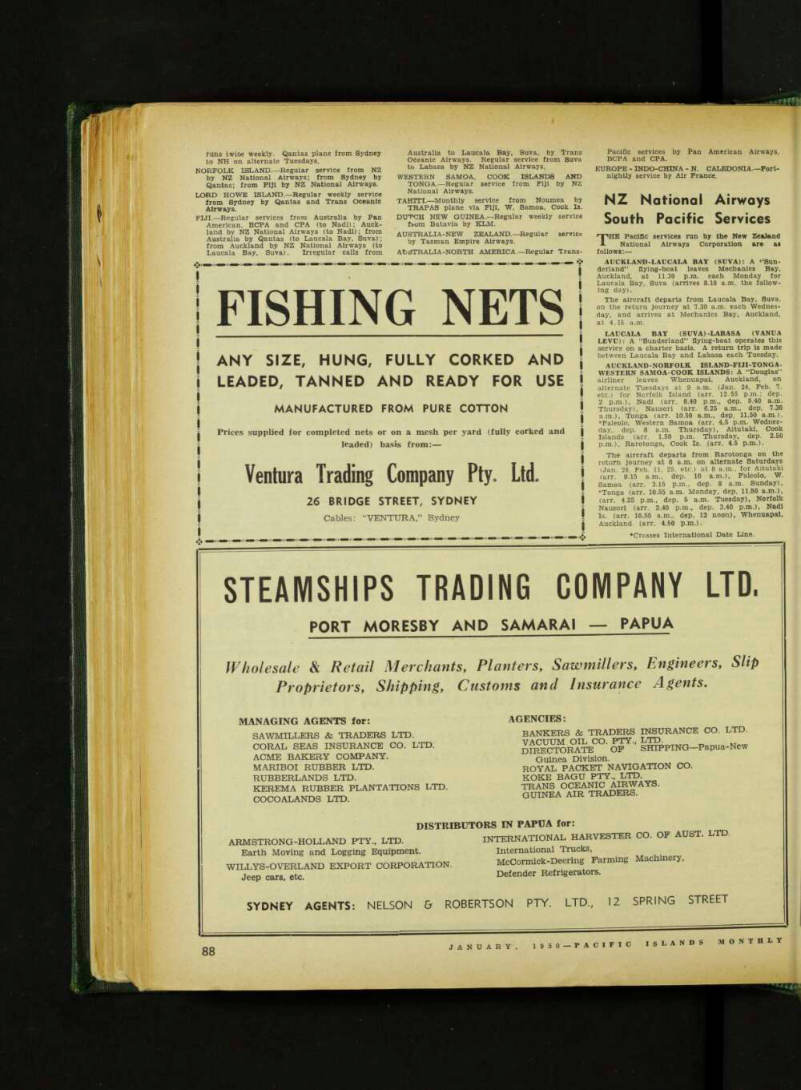
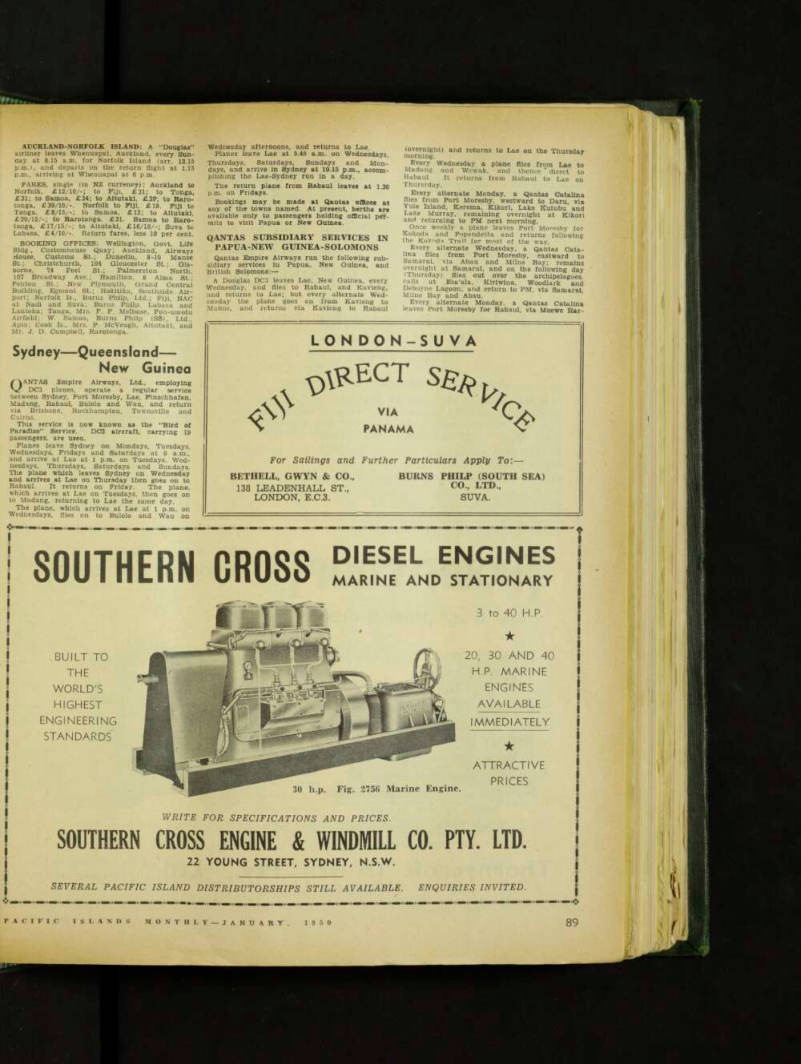
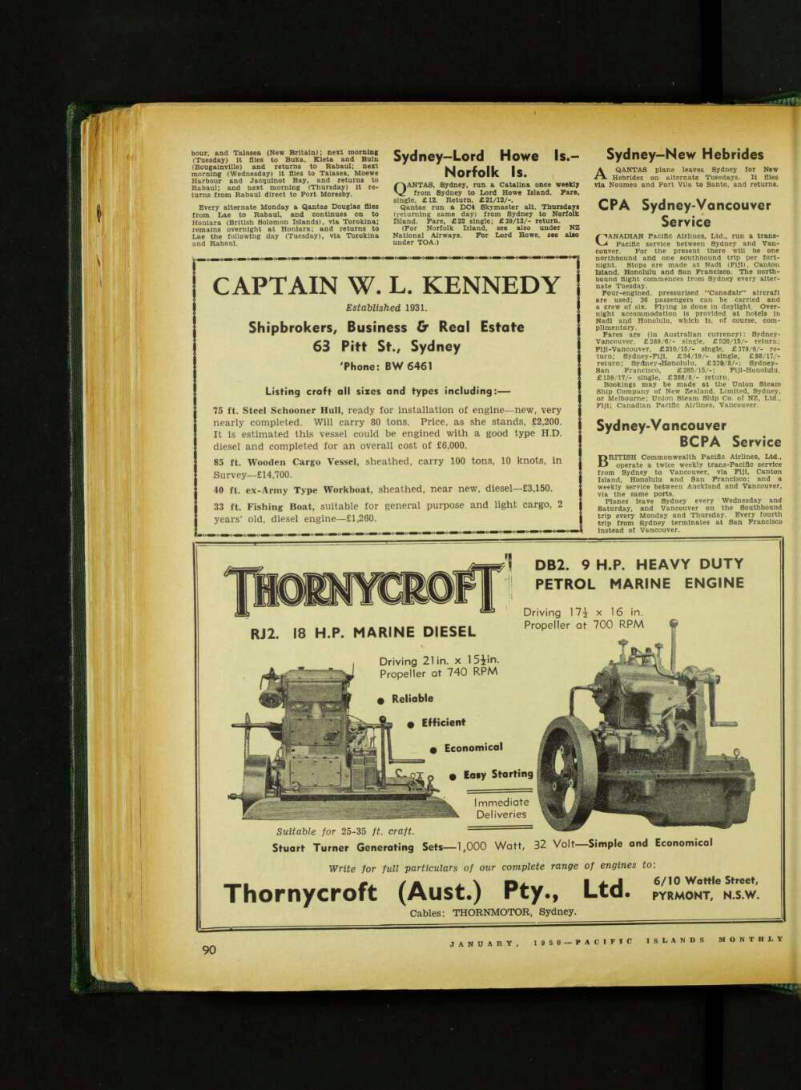
Summary of Pacific Air
Services
PAPUA AND NEW GUINEA. Regular Qantas service from Sydney.
SOLOMON ISLANDS.—Frequent regular flying boat service from Sydney Trans Oceanic Airways. Qantas service also from Lae. NG, to Honiara, BSI.
NEW HEBRlDES.—Frequent regular flying-boat service from Sydney by Trans Oceanic Air ways. Service from Noumea by French plane
fUhS twice weekly. Qantas plane from Sydney to NH on alternate Tuesdays.
NORFOLK ISLAND. —Regular service from NZ by NZ National Airways; from Sydney by Qantas; from Fiji by NZ National Airways.
LORD HOWE ISLAND.—Regular weekly service from Sydney by Qantas and Trans Oceanic Airways.
FIJI. —Regular services from Australia by Pan American, BCPA and CPA (to Nadi); Auck land by NZ National Airways (to Nadi); from Australia by Qantas (to Laucala Bay, Suva); from Auckland by NZ National Airways (to Laucala Bay, Suva). Irregular calls from
Australia to Laucala Bay, Suva, by Trans Oceanic Airways. Regular service from Suva to Labasa by NZ National Airways.
Western Samoa, Cook Islands And
TONGA. —Regular service from Fiji by NZ National Airways.
TAHlTl.—Monthly service from Noumea by TRAPAS plane via Fiji, W. Samoa, Cook Is.
DUTCH NEW GUlNEA—Regular weekly service fi-om Batavia by KLM.
AUSTRALIA-NEW ZEALAND.—ReguIar service by Tasman Empire Airways.
AUSTRALIA-NORTH AMERICA.—Regular Trans-
Pacific services by Pan American Airways,
Bcpa And Cpa.
Europe - Indo-China -N. Caledonla.—Fort
nightly service by Air France.
NZ National Airways
South Pacific Services
THE Pacific services run by the New Zealand National Airways Corporation are as follows: —
Auckland-Laucala Bat (Suva); A “Sun
derland” flying-boat leaves Mechanics Bay, Auckland, at 11.30 p.m. each Monday for Laucala Bay, Suva (arrives 8.10 a.m. the follow ing day).
The aircraft departs from Laucala Bay, Suva, on the return journey at 7.30 a.m. each Wednes day, and arrives at Mechanics Bay, Auckland, at 4.15 a.m.
Laucala Bay (Suva) -Labasa (Vanua
LEVU): A “Sunderland” flying-boat operates this service on a charter basis. A return trip is made between Laucala Bay and Labasa each Tuesday.
Auckland-Norfolk Island-Fiji-Tonga
Western Samoa-Cook Islands: A “Douglas”
airliner leaves Whenuapai, Auckland, on alternate Tuesdays at 9 a.m. (Jan. 24, Feb. 7, etc.) for Norfolk Island (arr. 12.55 p.m.; dep. 2 p.m.), Nadi (arr. 8.40 p.m., dep. 5.40 a.m.
Thursday), Nausori (arr. 6.25 a.m., dep. 7.30 a.m.), Tonga (arr. 10.50 a.m., dep. 11.50 a.m.), *Faleolo, Western Samoa (arr. 4.5 p.m. Wednes day, dep. 8 a.m. Thursday), Aitutaki, Cook Islands (arr. 1.50 p.m. Thursday, dep. 2.50 p.m.), Rarotonga, Cook Is. (arr. 4.5 p.m.).
The aircraft departs from Rarotonga on the return journey at 8 a.m. on alternate Saturdays (Jan. 28, Feb. 11. 25. etc.) at 8 a.m., for Aitutaki (arr. 9.15 a.m., dep. 10 a.m.), Faleolo, W.
Samoa (arr. 3.15 p.m., dep. 8 a.m. Sunday), ♦Tonga (arr. 10.55 a.m. Monday, dep. 11.50 a.m.), (arr. 4.25 p.m., dep. 5 a.m. Tuesday), Norfolk Nausori (arr. 2.40 p.m., dep. 3.40 p.m.), Nadi Is. (arr. 10.55 a.m., dep. 12 noon), Whenuapai, Auckland (arr. 4.50 p.m.). •Crosses International Date Line.
Auckland-Norfolk Island: A “Douglas”
airliner leaves Whenuapai, Auckland, every Sun day at 8.15 am. for Norfolk Island (arr. 12.15 p.m.), and departs on the return flight at 1.15 p.m., arriving at Whenuapai at 6 p.m.
FARES, single (in NZ currency); Auckland to Norfolk, £l2/10/-; to Fiji, £3l; to Tonga, £3l; to Samoa, £34; to Aitutaki, £39; to Raro tonga, £39/10/-. Norfolk to FIJI, £l9. Fiji to Tonga, £B/15/-; to Samoa, £l3; to Aitutaki, £29/15/-; to Rarotonga, £3l. Samoa to Raro tonga, £l7/15/-; to Aitutaki, £l6/10/-; Suva to Labasa, £4/10/-. Return fares, less 10 per cent.
BOOKING OFFICES: Wellington, Govt. Life Bldg., Customhouse Quay; Auckland, Airways House, Customs St.; Dunedin, 8-10 Manse St.; Christchurch, 104 Gloucester St.; Gis borne, 74 Peel St.; Palmerston North, 107 Broadway Ave.; Hamilton, 8 Alma St.; Fenton St.; New Plymouth, Grand Central Building, Egmont St.; Hokitika, Southside Air port; Norfolk Is., Burns Philp, Ltd.; Fiji, NAC at Nadi and Suva; Burns Philp, Labasa and Lautoka; Tonga, Mrs. F. P. Melhose, Fou-amotu Airfield; W. Samoa, Burns Philp (SS), Ltd., Apia; Cook Is., Mrs. P. McVeagh, Aitutaki, and Mr. J. D. Campbell, Rarotonga.
Sydney—Queensland—
New Guinea
QANTAS Empire Airways, Ltd., employing DC3 planes, operate a regular service between Sydney, Port Moresby, Lae, Pinschhafen, Madang, Rabaul, Bulolo and Wau, and return via Brisbane, Rockhampton, Townsville and Cairns.
This service is now known as the “Bird of Paradise” Service. DC3 aircraft, carrying 19 passengers, are useo.
Planes leave Sydney on Mondays, Tuesdays, Wednesdays, Fridays and Saturdays at 9 a.m., and arrive at Lae at 1 p.m. on Tuesdays, Wed nesdays, Thursdays, Saturdays and Sundays.
The plane which leaves Sydney on Wednesday and arrives at Lae on Thursday then goes on to Rabaul. It returns on Friday. The plane, which arrives at Lae on Tuesdays, then goes on to Madang, returning to Lae the same day.
The plane, which arrives at Lae at 1 p.m. on Wednesdays, flies on to Bulolo and Wau on
Wednesday afternoons, and returns to Lae.
Planes leave Lae at 5.45 a.m. on Wednesdays, Thursdays, Saturdays, Sundays and Mon days, and arrive in Sydney at 10.15 p.m., accom plishing the Lae-Sydney run in a day.
The return plane from Rabaul leaves at 1.30 p.m. on Fridays.
Bookings may be made at Qantas offices at any of the towns named. At present, berths are available only to passengers holding official per mits to visit Papua or New Guinea.
Qantas Subsidiary Services In
Papua-New Guinea-Solomons
Qantas Empire Airways run the following sub sidiary services In Papua, New Guinea, and British Solomons: — A Douglas DCS leaves Lae, New Guinea, every Wednesday, and flies to Rabaul, and Kavieng, and returns to Lae; but every alternate Wed nesday the plane goes on from Kavieng to Manus, and returns via Kavieng to Rabaul
(overnight) and returns to Lae on the Thursday morning.
Every Wednesday a plane flies from Lae to Madang and Wewak, and thence * direct to Rabaul. It returns from Rabaul to Lae on Thursrday.
Every alternate Monday, a Qantas Catalina flies from Port Moresby, westward to Daru, via Yule Island, Kerema, Kikorl, Lake Kutubu and Lake Murray, remaining overnight at Kikori and returning to PM next morning.
Once weekly a plane leaves Port Moresby for Kokoda and Popendetta and returns following the Kokoda Trail for most of the way.
Every alternate Wednesday, a Qantas Cata lina flies from Port Moresby, eastward to Samarai. via Abau and Milne Bay; remains overnight at Samarai. and on the following day (Thursday) flies out over the archipelagoes, calls at Esa’ala, Kiriwlna, Woodlark and Deboyne Lagoon, and return to PM, via Samarai Milne Bay and Abau.
Every alternate Monday, a Qantas Catalina leaves Port Moresby for Rabaul. via Moewe Har
hour, and Talasea (New Britain); next morning (Tuesday) it flies to Buka, Kieta and Buin (Bougainville) and returns to Rabaul; next morning (Wednesday) it flies to Talasea, Moewe Harbour and Jacqulnot Bay, and returns to Rabaul; and next morning (Thursday) it re turns from Rabaul direct to Port Moresby.
Every alternate Monday a Qantas Douglas flies from Lae to Rabaul, and continues on to Honiara (British Solomon Islands), via Torokina; remains overnight at Honiara; and returns to Lae the following day (Tuesday), via Torokina and Rabaul.
Sydney-Lord Howe ls.-
Norfolk Is.
Q ANT AS, Sydney, run a Catalina once weekly from Sydney to Lord Howe Island. Fare, single, £l2. Return, £2l/12/-.
Qantas run a DC4 Skymaster alt. Thursdays (returning same day) from Sydney to Norfolk Island. Pare, £22 single; £39/12/- return. (For Norfolk Island, see also under NZ National Airways. For Lord Howe, see also under TOA.)
Sydney-New Hebrides
AQANTAS plane leaves Sydney for New Hebrides on alternate Tuesdays. It flies via Noumea and Port Vila to Santo, and returns.
CPA Sydney-Vancouver
Service
CANADIAN Pacific Airlines, Ltd., run a trans pacific service between Sydney and Van couver. For the present there will be one northbound and one southbound trip per fort night. Stops are made at Nadi (Fiji), Canton Island, Honolulu and San Francisco, The north bound flight commences from Sydney every alter nate Tuesday.
Four-engined, pressurised “Canadalr” aircraft are used; 36 passengers can be carried and a crew of six. Flying is done in daylight. Over night accommodation is provided at hotels in Nadi and Honolulu, which is, of course, com plimentary.
Fares are (in Australian currency); Sydney- Vancouver, £289/6/- single, £520/15/- return; Piji-Vancouver, £2lO/15/- single, £379/6/- re turn; Sydney-Fiji, £54/19/- single, £9B/17/return; Sydney-i Honolulu, £238/8/-: Sydney- San Francisco, £285/15/-; Fiji-Honolulu, £159/17/- single, £2BB/8/- return.
Bookings may be made at the Union Steam Ship Company of New Zealand, Limited, Sydney, or Melbourne: Union Steam Ship Co. of NZ, Ltd., Fiji; Canadian Pacific Airlines, Vancouver.
Sydney-Vancouver
BCPA Service
BRITISH Commonwealth Pacific Airlines, Ltd., operate a twice weekly trans-Paciflc service from Sydney to Vancouver, via Fiji, Canton Island, Honolulu and San Francisco; and a weekly service between Auckland and Vancouver, via the same ports.
Planes leave Sydney every Wednesday and Saturday, and Vancouver on the Southbound trip every Monday and Thursday. Every fourth trip from Sydney terminates at San Francisco Instead of Vancouver.
Planes leave Auckland every Tuesday and arrive in Vancouver the following Wednesday.
The Southbound trip to Auckland commences from Vancouver every alternate Friday. Every other Friday the service commences at San Francisco.
B.C.P.A. services make regular connections at both San Francisco and Vancouver for onward carriage, via either New York or Montreal to the United Kingdom or Europe. The through fare from Sydney to London is £325 (Aust.).
Pares are (in Australian currency): Sydney- San Francisco, £285/15/- single and £514/6/return; Auckland-Vancouver, £266/11/- single: Auckland-Nadi (Fiji), £3B/17/-; Sydney-Nadi, £54/19/-; Sydney-Vancouver, £289/6/- single, £520/15/- return.
Douglas DC6 aircraft carrying 48 passengers (seated) or 37 passengers (in sleepers) and a crew of nine are used on the service.
Pan-American—
Trans-Pacific Service
PAN-AMERICAN World Airways clippers now provide the followlne services in the South Pacific, using DC4 planes, equipped with Sleep erettes:— Planes leave Sydney Monday and Friday for San Francisco, via Tontouta (New Cale donia), Nadi (Fiji), Canton Island and Hono lulu.
The return flights are made from San Francisco every Monday, Thursday, via Honolulu, Canton Island, Nadi and Tontouta; and from Seattle every Monday, via Portland, Honolulu, Canton Island, Nadi and Tontouta.
Planes leave Auckland every Wednesday, and fly via Nadi, Canton Island and Honolulu to San Francisco. They leave San Francisco for Auckland every Saturday by the same route Pares, in Australian currency, are;—
(Time-tables and fares subject to alteration without notice.) To convert to Fiji currency, reduce above each kilogram of excess.
Free baggage allowance is 30 kilos per person.
Excess baggage at 1 per cent, of single fare for figures by about 10 per cent.
Trans-Tasman Service
Sydney—Auckland
'T'ASMAN Empire Airways, Ltd., operate a A flying-boat service between Rose Bay Sydney, and Mechanics Bay. Auckland. Large flying-boats, capable of carrying 30 passengers, are employed. The trip is comfortable, and takes approximately 8 hours.
Flying-boats now depart Sydney and Auckland dally.
This service will be supplemented by Charter Services operated by DC4 and DC6 aircraft.
Pares: £35 (A) (£2B NZ currency) single: £63 (A) (£5O/8/- NZ currency) return.
Bookings may be made at Tasman Empire Airways in Auckland and at Qantas Empire Air ways. Carrington Street, Sydney
N. Caledonia-Tahiti
TRAPAs (Soclete Prancals de Transports Aeriens du Pacific Sud-Noumea) runs a monthly service from New Caledonia to Tahiti.
Departing at 8 a.m. from Noumea, every third Thursday, the plane files via Fiji (Nadi) Western Samoa (Paleolo), Cook Islands (Altu takl) to Papeete, where it arrives at about 11.40
a.m. two days later. One evening is spent in Nadi and one night in Altutakl. The plane re turns by the same route In the following week.
Pare from Noumea to Papeete is 16.000 Pacific francs single, and 28,800 return. (160 Pacific francs equal £1 Australian.) While the plane is at Papeete it runs one round trip between Papeete and Bora Bora.
(Continued on Page 93)
£ s. d. £ s. d . Single. Return.
Sydney-Seattle ... £285 15 0 £514 6 0 Sydney-’Frlsco ... 285 15 0 514 6 0 Sydney-Piji 54 19 0 98 17 0 Sydney-Honolulu ... 238 8 0 429 0 0 Auckland-Seattle ... 262 19 o 473 14 o Auckland-Honolulu .. 215 13 0 387 19 o Auckland-PIJi 38 17 0 69 19 0 Auckland-San. Fran. . 22 19 0 473 14 o
New Caledonia-
New Hebrides
TRAPAS (French Air Line) operates a service between Noumea and the New Hebrides.
The plane leaves Noumea every Tuesday, and ing under cultivation.
Sydney-Noumea—Suva
THE following is the time-table of the Qantas flying-boat;— Sydney dep. 9 p.m. alt. Tues.
Noumea arr. 7 a.m. alt. Wed.
Noumea dep. 8 a.m. alt. Wed.
Suva arr. 3 p.m. alt. Wed, Suva dep. 6 a.m. alt. Frid.
Noum-a arr. 11 a.m. alt. Frid.
Noumea dep. 12 noon alt. Frid.
Sydney arr. 8 p.m. alt. Frid.
Intending passengers may book through Qan*.»s offices in Australia. Burns, Phllp (South Seas) Company, in Suva; and T. Johnston in Noumea.
Fares: To Noumea, £35 single; £63 return.
To Suva, £52/10/- single; £94/10/- return.
Noumea-Suva, £l7/10/- single; £3l/10/- re turn. flies direct to Vila and Santo, and returns. Re turn fare for the journey, Noumea-Santo, is approximately £42 Australian.
KLM Dutch New Guinea
Service
K.L.M. Royal Dutch Airlines run a regular weekly service from Batavia to Dutch New Guinea, via Sourabaya, Makassar and Ambon, on the following schedule: Batavia dep. Sundays at 10.30 a.m., Biak Island arr. Mondays at 4.40 p.m.; dep. Tuesdays at 6 a.m., Hollandia arr. Tuesdays at 8.10 a.m. On the return journey the aircraft leaves Hollandia at 9 a.m. on Tuesdays: Biak Island arr. 11.10 a.m.. dep. 12.15 p.m. on Tuesdays; and Batavia arr. 6 p.m. on Wednesdays.
The aircraft used are C. 475, a type of DC-3, and the single fares are Batavla-Biak Island £A80; Batavia-Hollandia £A9I/15/-; and Biak Island-Hollandia £AII/15/-. Return fares, double single.
TOA Services
TRANS Oceanic Airways run the following Pacific services:— SYDNEY-JLORD HOWE IS.: A regular fort nightly service with large four-engine flying boats from Rose Bay. Pare: £ll single; £2l return. Free baggage allowance 50 lb. Excess baggage and freight rate Bd. pfcr lb.
SYDNEY-NEW HEBRIDES; A regular monthly service with large four-engine flying-boats from Sydney, via Noumea (overnight stop), to Vila and Espiritu Santo. Pare: Sydney-Vila, £45- Sydney-Santo, £5O; Noumea-Vila, £l2/10/-’
Noumea-Santo, £lB/15/-. Freight: Sydney-Vila’ 2/- per lb.; Sydney-Santo, 2/3.
Sydney-Solomon Islands: A Regular
monthly service from Sydney, via New Cale donia and New Hebrides to Tulagi, Solomon Islands. This service is frequently extended to Lingatou, in the Russell Islands, and calls are sometimes made at Vanikoro, in the Santa Cruz Group. Fares: Sydney-Tulagl, £65. Free bag gage allowance, 60 lb.; excess baggage and freight, 3/- per lb.
France-Indo-China-
N. Caledonia
THE French national airways, Air France, runs a fortnightly service between Paris and New Caledonia, and return. Stops are made at Tunis, Cairo, Basra (forward journey) or Darhein (return journey), Karachi, Calcutta, Saigon, Batavia, Darwin, Brisbane.
DC4 Skymasters are used in the service.
Fare between Brisbane and Tontouta (New Caledonia) has been fixed at £A29/8/- (one way), and £AS2/18/- (return ticket). Sydney - Tontouta £A3S single; £A63 return.
Advertisements & other items, pp. 89-94 (3 items)
cxsfvh
Rid Kidneys Of
Poisons And Adds
If you suffer sharp, stabbing pains, if Joints are swollen, It shows your blood is poisoned through faulty kidney action. Other symptoms of Kidney Disorders are Backache, Aching Joints and Limbs, Sciatica, Neuritis, Lumbago, Sleepless Nights, Dizziness, Nervousness, Circles under Eyes, Loss of Energy and Appetite and Frequent Headaches and Colds, etc. Ordinary medicines can’t help much because you must get to the root cause of the trouble.
The Cystex treatment is specially compounded to soothe, tone and clean kidneys and bladder and remove acids and poisons from your system safely, quickly and surely, yet contains no harmful or dangerous drugs. Cystex works In 3 ways to end your troubles. 1. Starts killing the germs which are attacking your Kidneys, Bladder and Urinary System In two hours, yet Is absolutely harmless to human tissue. 2. Gets rid of health-destroying, deadly poisonous acids with which your system has become saturated. 3. Strengthens and reinvigorates the kidneys, protects from the ravages of disease-attack on the delicate filter organism, and stimulates the entire system.
Praised by One-time Sufferers Cystex is approved by one-time sufferers in 73 countries from the troubles shown above.
Mr. Reg Thomas, Townsville, Queensland, recently wrote: “My Joints were all stiff, I had leg pains, my back used to ache day and night.
My bladder was weak. I had headaches and no appetite. The first dose of Cystex helped me and before I finished three boxes my health and strength came baek.”
Guaranteed to Satisfy or Money Baek Get Cystex from your chemist or store to-day.
Give it a thorough test. Cystex is guaranteed to make you feel younger, stronger, better ii every way, or your money back If you return the empty package.
Now in 2 sizes—4/-, •/-. for Your Kidneys, Bladder, Rheumatism, This is a
GUARANTEED
Treatment
Cystex
cxsfvh
FISHING NETS
ANY SIZE, HUNG, FULLY CORKED AND
LEADED, TANNED AND READY FOR USE
MANUFACTURED FROM PURE COTTON
Prices supplied for completed nets or on a mesh per yard (fully corked and leaded) basis from:—
Ventura Trading Company Pty. Ltd.
26 BRIDGE STREET, SYDNEY
Cables: “VENTURA,” Sydney
STEAMSHIPS TRADING COMPANY LTD.
PORT MORESBY AND SAMARAI PAPUA
Wholesale & Retail Merchants, Planters, Sawmillers, Engineers, Slip
Proprietors, Shipping, Customs and Insurance Agents.
MANAGING AGENTS for:
SAWMILLERS & TRADERS LTD.
CORAL SEAS INSURANCE CO. LTD.
ACME BAKERY COMPANY.
MARIBOI RUBBER LTD.
RUBBERLANDS LTD.
KEREMA RUBBER PLANTATIONS LTD.
COCOALANDS LTD.
AGENCIES:
BANKERS & TRADERS INSURANCE CO. LTD.
VACUUM OIL CO. PTY., LTD.
DIRECTORATE OP SHIPPING-Papua-New
Guinea Division.
ROYAL PACKET NAVIGATION CO.
KOKE BAGU PTY., LTD.
TRANS OCEANIC AIRWAYS.
GUINEA AIR TRADERS.
DISTRIBUTORS IN PAPUA for:
ARMSTRONG-HOLLAND PTY., LTD. INTERNATIONAL HARVESTER CO. OF AUST. LTD.
Earth Moving and Logging Equipment. International Trucks, WILLYS-OVERLAND EXPORT CORPORATION. McCormick-Deering Farming Mac me y, Jeep cars, etc. Defender Refrigerators.
SYDNEY AGENTS: NELSON b ROBERTSON PTY. LTD., 12 SPRING STREET
LONDON-SUVA
VIA
PANAMA
For Sailings and Further Particulars Apply To: — BETHELL, GWYN & CO., BURNS PHILP (SOUTH SEA) 138 LEADENHALL ST. f CO ’ LTD »
LONDON, E.C.3. SUVA.
hi c
SOUTHERN
pnnqq DIESEL ENGINES
UnUOO MARINE and stationary
BUILT TO
THE
WORLD'S
HIGHEST
ENGINEERING
STANDARDS
JMt
* I
& jnTN..
. sar ■ : tff 30 h.p. Fig. 2756 Marine Engine. 3 to 40 H.P. ★
20, 30 AND 40
H.P. MARINE
ENGINES
AVAILABLE
IMMEDIATELY
ATTRACTIVE
PRICES
WRITE FOR SPECIFICATIONS AND PRICES.
SOUTHERN CROSS ENGINE & WINDMILL CO. PIY. LTD.
22 YOUNG STREET, SYDNEY, N.S.W.
SEVERAL PACIFIC ISLAND DISTRIBUTORSHIPS STILL AVAILABLE. ENQUIRIES INVITED.
CAPTAIN W. L. KENNEDY
Established 1931.
Shipbrokers, Business & Real Estate
63 Pitt St., Sydney
'Phone: BW 6461 Listing craft all sizes and types including:— 75 ft. Steel Schooner Hull, ready for installation of engine—new, very nearly completed. Will carry 80 tons. Price, as she stands, £2,200.
It is estimated this vessel could be engined with a good type H.D. diesel and completed for an overall cost of £6,000. 85 ft. Wooden Cargo Vessel, sheathed, carry 100 tons, 10 knots, in Survey— £l4,7oo. 40 ft. ex-Army Type Workboat, sheathed, near new, diesel— £3,lso. 33 ft. Fishing Boat, suitable for general purpose and light cargo, 2 years’ old, diesel engine— £l,26o.
0
18 H.P. MARINE DIESEL
DB2. 9 H.P. HEAVY DUTY
PETROL MARINE ENGINE
Driving x 16 in.
Propeller at 700 RPM RJ2 %■ Driving 21 in. x 1 siin.
Propeller at 740 RPM Reliable Efficient • Economical • Easy Starting m Immediate Deliveries Suitable for 25-35 ft. craft.
Stuart Turner Generating Sets— l,ooo Watt, 32 Volt— Simple and Economical Write for full particulars of our complete range of engines to:
Thornycroft (Aust.) Pty., Ltd. pyrmont, n.s.w
Cables: THORNMOTOR, Sydney.
WILLREED AGENCIES PIT. LTD.
145 a George St., Circular Quay, Sydney. Cables; “REEDAGE.”
An organisation formed to act os Australian and
overseas manufacturers' representatives.
distributors of
40-ft. TRADE BOATS
fllfvere^to^yoT^esUnaUon l f ° r Is ‘ and COnditions ' quipped and
B.T.H. SOUND-FILM PROJECTORS. ROAMER AUTO-BIKE.
AGENTS FOR PLYPAC BOAT ASSEMBLY KITS
8 ft., 12 ft. and 16 ft. boat assembly kits.
GENERAL MERCHANDISE
We have associates in the United Kingdom, France Germanv wnii products:— d Japan ’ En( 3 uiries and indent orders invited for the’ following • Nails. • Chains • Wire Netting • Barbed Wire, • Corrugated Iron • Wood Working Machinery • Diesel Engines (Stationary and Marine) • Crawler Tractors 9 Copra Driers • Desiccated Coconut Machinery • Machinery for processing and Baling Coconut Fibre • Pelton Hydraulic Turbines • Prefabricated Houses. • Perfumes • Building Boards • Milk Pasteurising Plant • Electrical Equipment • Fish Hooks • Cotton Prints • Blankets • Copra Sacks • Watches
NATIVE TRADE GOODS OF ALL DESCRIPTION.
Our representative is at present in Europe and will give personal
attention to all enquiries.
KWONG CHONG BROTHERS
General MeixlmMs and Planters
Have now re-established their business on their original pre-war site/ and are carrying stocks of Trading and Plantation requirements. All enquiries welcomed and service assured.
Sydney Representatives: NE K a \!? BE !^l O " PT I- LTD ’ KWONG CHONG BROTHERS Blectra House, 12 Spring Street,
Sydney, NSW. KEMARERE STREET, RABAUL
BRITISH
*S m
DIESELS
MARINE ENGINES
P6M 34/65 h.p, at 2,000 r.p.m.
S6M 50/100 h.p. at 2,000 r.p.m.
Both models feature the new MRIOA Hydraulically-operated Gear Box and Reduction Gear with 24 volt Electrical System and starter.
More British Perkin's Diesel Engines were supplied to the British Fighting Services 1939-1945 than those of any other Diesel Manufacturer.
GENERATING SETS
The Perkins 25 K.V.A. —415/240 volt 3 phase Diesel Operated Generating Set, self excited, eliminates belt drives and pulleys. Screen protected alternator complete with switchboard. Fuel tank and radiator and mounted ready for installation to standard supply board.
VEHICLE ENGINES
PERKINS P 6 Vehicle Engines complete with 12 inch Clutch and 5 speed overdrive gear box for replacement of worn out petrol units.
THERE IS A BRITISH PERKINS FOR EVERY PURPOSE. DELIVERY IS IMMEDIATE All enquiries direct to the Sydney Distributors
LARKE NEAVE & CARTER LTD.
CARSELL PARK, PARRAMATTA RD., CAMPERDOWN, SYDNEY, N.S.W.
Cable Address: Larkneve, Sydney.
91
PACIFIC ISLANDS MONTH LT-JANUARY. 1950
92
JANUARY, 1950 PACIFIC ISLANDS MONTH I. Y
Papua-NG Local
Services
A/TANDATED Airlines, Ltd., of Lae, New Guinea, XVJ - and other private operators, run air ser vices between Lae and the New Guinea mainland centres of Wau, Bulolo, Madang, Wewak, Altape Mt. Hagen, Pinschhafen, Moresby, Kokoda—in fact anywhere in Papua or New Guinea where there is an air-strip. These planes carry pas sengers, mails and cargo on regular schedules or charter flights.
Christmas
Fiji Had Fine Weather For Christmas
AFTER one of the wettest years on record, the entire Fijian Group cele brated Christmas Day and Boxing Day in bright sunshine tempered by cool breezes.
Sign on an unoccupied garage: “We Undersold Everyone.”
Advertisements & other items, p. 95 (1 item)
Robert Gillespie Pit It?
/2c/ ?
srh
"0 1 Us lc LEARN TO PLAY the Hawaiian Steel Guitar or Ukulele in the modern manner. Complete postal course available. Full details free ... no obligation. Send 4d. in stamps for full particulars to
SECRETARY.
PACIFIC SCHOOL OF MUSIC
P.O. Box 487, Palmerston North, New Zealand.
r>*. % m t r All classes of merchandise purchased for island clients throughout the South-west Pacific.
Island produce sold on Australian and overseas markets on a commission basis.
ROBERT GILLESPIE PIT IT?
54a PITT ST.,SYDNEY- PHONES-8W4762* BISOS
Cable fddregs-: ‘‘ROBi&JlLt.^ydne? l '
*• I. . • ’
New Method of Unloading Oil
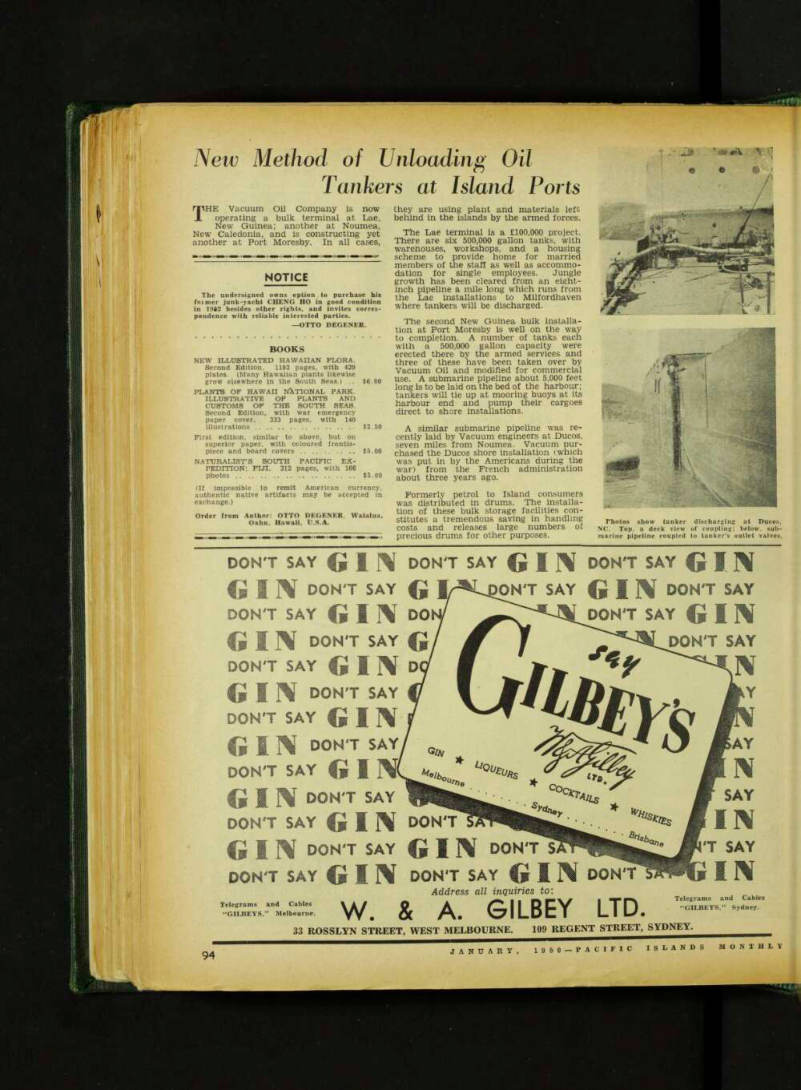
Tankers at Island Ports
THE Vacuum Oil Company is now operating a bulk terminal at Lae, New Guinea; another at Noumea, New Caledonia, and is constructing yet another at Port Moresby. In all cases,
they are using plant and materials left behind in the islands by the armed forces.
The Lae terminal is a £lOO,OOO project.
There are six 500,000 gallon tanks, with warehouses, workshops, and a housing scheme to provide home for married members of the staff as well as accommo dation for single employees. Jungle growth has been cleared from an eight inch pipeline a mile long which runs from the Lae installations to Milfordhaven where tankers will be discharged.
The second New Guinea bulk installa tion at Port Moresby is well on the way to completion. A number of tanks each with a 500,000 gallon capacity were erected there by the armed services and three of these have been taken over by Vacuum Oil and modified for commercial use. A submarine pipeline about 5,000 feet long is to be laid on the bed of the harbour; tankers will tie up at mooring buoys at its harbour end and pump their cargoes direct to shore installations.
A similar submarine pipeline was re cently laid by Vacuum engineers at Ducos, seven miles from Noumea. Vacuum pur chased the Ducos shore installation (which was put in by the Americans during the war) from the French administration about three years ago.
Formerly petrol to Island consumers was distributed in drums. The installa tion of these bulk storage facilities con stitutes a tremendous saving in handling costs and releases large numbers of precious drums for other purposes.
Photos show tanker discharging at Ducos, NC. Top, a deck view of coupling: below, sub marine pipeline coupled to tanker’s outlet valves.
Advertisements & other items, p. 96 (1 item)
T Say G I N
NOTICE
The undersigned owns option to purchase his foimer junk-yacht CHENG HO in good condition in 1952 besides other rights, and invites correspondence with reliable interested parties.
—OTTO DEGENER.
BOOKS
NEW ILLUSTRATED HAWAIIAN FLORA.
Second Edition. 1192 pages, with 429 plates. (Many Hawaiian plants likewise grow elsewhere in the South Seas.) .. $6.00
PLANTS OP HAWAII NATIONAL PARK.
ILLUSTRATIVE OF PLANTS AND
CUSTOMS OP THE SOUTH SEAS.
Second Edition, with war emergency paper cover. 333 pages, with 140 illustrations $2.50 First edition, similar to above, but on superior paper, with coloured frontispiece and board covers $5.00
NATURALIST’S SOUTH PACIFIC EX-
PEDITION: FIJI. 312 pages, with 166 photos $5.00 (If impossible to remit American currency, authentic native artifacts may be accepted in exchange.) Order from Author: OTTO DEGENER, Waialua, Oahu, Hawaii, tI.S.A.
DON'T SAY G § M DON'T SAY |J
fill! DON'T SAY G 1
DON'T SAY G I M DO
IM DON'T SAY G
T SAY G I N D
DON'T SAY GIY
gON'T SAY GIN DON'T SAY
DON'T SAY G I M
DON'T SAY
J^j -
GIN DON'T SAY
s AY 5/Az N u.
In iJk. 4. -Or>.
SAY
A.
IN bo.
SAY
IN
T SAY G I N
GIN DON'T SAY
DON'T SAY GIN!
GIN DON'T SAY
DON'T SAY G 1 ]\ T DON'T G I M DON'T SAY GIN DON'T 1!
DON'T SAY G I M DON'T SAY G I M DON'T* Address all inquiries to:
W. & A. GILBEY LTD.
33 ROSSLYN STREET, WEST MELBOURNE.
Telegrams and Cables “GILBEYS,” Melbourne.
Telegrams and Cables “GILBEYS,” Sydney.
109 REGENT STREET, SYDNEY.
Death of Mrs. Ivy
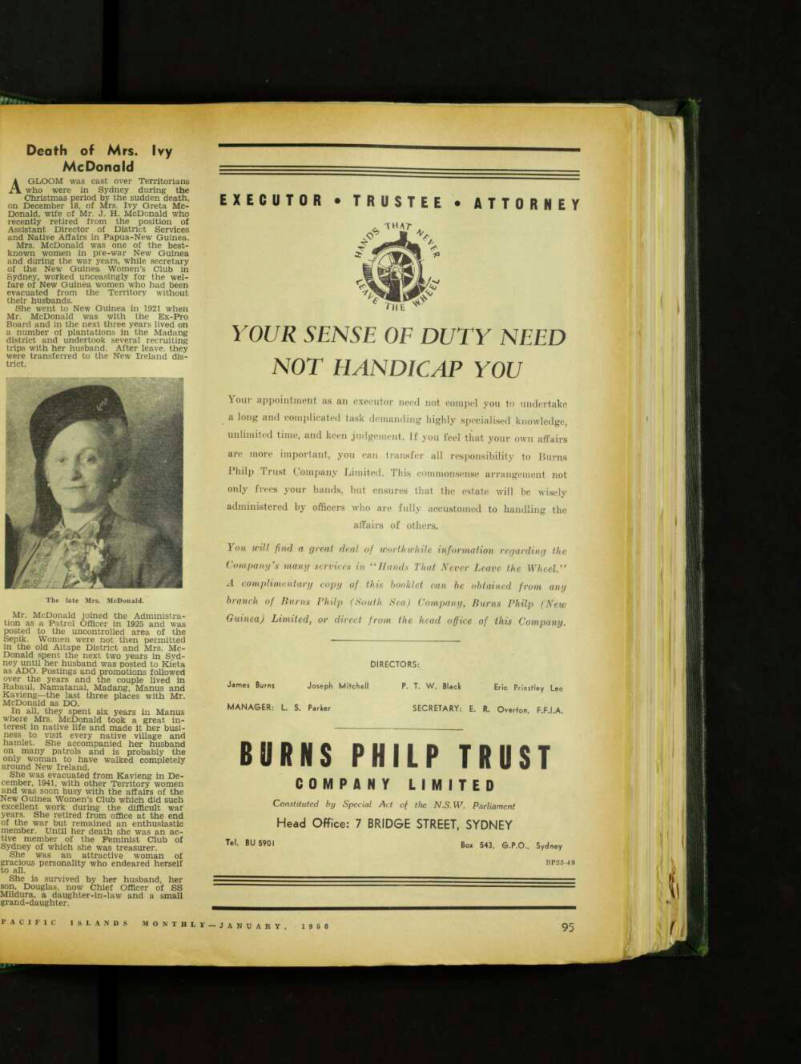
McDonald
A GLOOM was cast over Territorians who were in Sydney during the Christmas period by the sudden death, on December 18, of Mrs. Ivy Greta Mc- Donald, wife of Mr. J. H. McDonald who recently retired from the position of Assistant Director of District Services and Native Affairs in Papua-New Guinea.
Mrs. McDonald was one of the best known women in pre-war New Guinea and during the war years, while secretary of the New Guinea Women’s Club in Sydney, worked unceasingly for the wel fare of New Guinea women who had been evacuated from the Territory without their husbands.
She went to New Guinea in 1921 when Mr. McDonald was with the Ex-Pro Board and in the next three years lived on a number of plantations in the Madang district and undertook several recruiting trips with her husband. After leave, they were transferred to the New Ireland dis trict.
Mr, McDonald joined the Administra tion as a Patrol Officer in 1925 and was posted to the uncontrolled area of the Sepik. Women were not then permitted in the old Aitape District and Mrs. Mc- Donald spent the next two years in Syd ney until her husband was posted to Kieta as ADO. Postings and promotions followed over the years and the couple lived in Rabaul, Namatanai, Madang, Manus and Kavieng—the last three places with Mr.
McDonald as DO.
In all, they spent six years in Manus where Mrs. McDonald took a great in terest in native life and made it her busi ness to visit every native village and hamlet. She accompanied her husband on many patrols and is probably the only woman to have walked completely around New Ireland.
She was evacuated from Kavieng in De cember, 1941, with other Territory women and was soon busy with the affairs of the New Guinea Women’s Club which did such excellent work during the difficult war years. She retired from office at the end of the war but remained an enthusiastic member. Until her death she was an ac tive member of the Feminist Club of Sydney of which she was treasurer.
She was an attractive woman of gracious personality who endeared herself to all.
She is survived by her husband, her son, Douglas, now Chief Officer of SS Mildura, a daughter-in-law and a small grand-daughter.
The late Mrs. McDonald.
Advertisements & other items, p. 97 (1 item)
Burns Philp Trust
EXECUTOR • TRUSTEE • ATTORNEY
YOUR SENSE OF DUTY NEED
NOT HANDICAP YOU
Your appointment as an executor need not compel you to undertake a long and complicated task demanding highly specialised knowledge, unlimited time, and keen judgement. If you feel that your own affairs are more important, you can transfer all responsibility to Burns Philp Trust Company Limited. This commonsense arrangement not only frees your hands, but ensures that the estate will be wisely administered by officers who are fully accustomed to handling the You will find a great deal of worthwhile information regarding the Company’s many services in “Hands That Never Leave the Wheel.”
A complimentary copy of this booklet can be obtained from any branch of Burns Philp (South Sea) Company, Burns Philp (New Guinea) Limited, or direct from the head office of this Company.
BURNS PHILP TRUST
'THAT'
affairs of others.
DIRECTORS:
James Burns Joseph Mitchell P. I. W. Black Eric Priestley Lee MANAGER: L. S. Parker
SECRETARY: E. R. Overton, F.F.I.A.
COMPANY LIMITED
Constituted by Special Act of the N.S.W. Parliament
Head Office: 7 BRIDGE STREET, SYDNEY
Tel. BU 5901 Box 543, G.P.0., Sydney 8P23-49
thf Cook' IZnds KoAucers
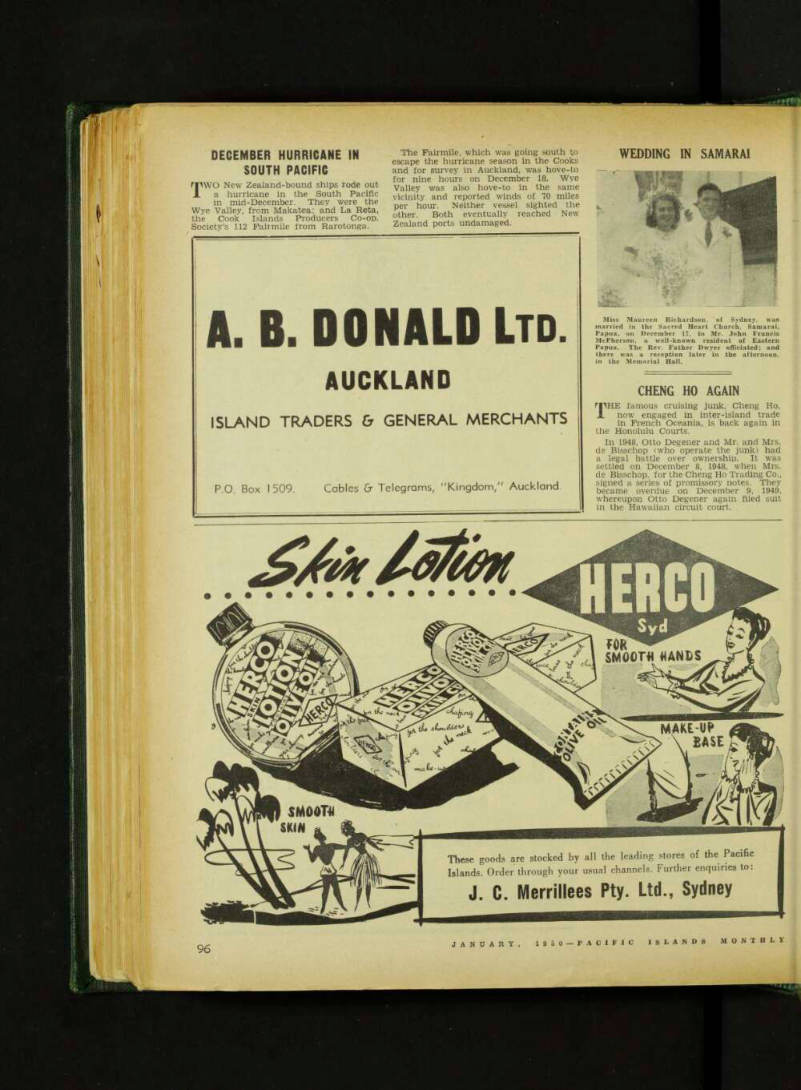
December Hurricane In
South Pacific
TWO New Zealand-bound ships rode out a hurricane in the South Pacific Deco1 Tv 1 /r >e i r 'f They /> 81 ’ 0^^ 0
thf Cook' IZnds KoAucers
Society’s 112 Fairmile from Rarotonga.
The Fair mile, which was going south to escape the hurricane season in the Cooks and for survey in Auckland, was hove-to for nine hours on December 18. Wye Valley was also hove-to in the same vicinity and reported winds of 70 miles per hour. Neither vessel sighted the other. Both eventually reached New Zealand ports undamaged.
Wedding In Samarai
Miss Maureen Richardson, of Sydney, was married in the Sacred Heart Church, Samarai, Papua, on December 17, to Mr. John Francis McPherson, a well-known resident of Eastern Papua. The Rev. Father Dwyer officiated; and there was a reception later in the afternoon, in the Memorial Hall.
Cheng Ho Again
rpHE famous cruising junk, Cheng Ho, X now engaged in inter-island trade in French Oceania, is back again in the Honolulu Courts.
In 1948, Otto Degener and Mr. and Mrs. de Bisschop (who operate the junk) had a legal battle over ownership. It was settled on December 8, 1948, when Mrs. de Bisschop, for the Cheng Ho Trading Co., signed a series of promissory notes. They became overdue on December 9, 1949. whereupon Otto Degener again filed suit in the Hawaiian circuit court.
Advertisements & other items, p. 98 (1 item)
A. B. Donald Ltd.
AUCKLAND
ISLAND TRADERS & GENERAL MERCHANTS
P.O. Box 1509. Cables & Telegrams, "Kingdom," Auckland
m
SMOOTH WANES
at k y \*r ’S>< IL y V & <S^
MAKE-UP
\ BASE
iL IP * 5v A y£ .v s> £S o '< s £
SKIN
SMOOTH
These goods are stocked by all the leading stores of the Pacific Islands. Order through your usual channels. Further enquiries to:
J. C. Merrillees Pty. Ltd., Sydney
Funds Are Needed For This Proposed Suva Cathedral
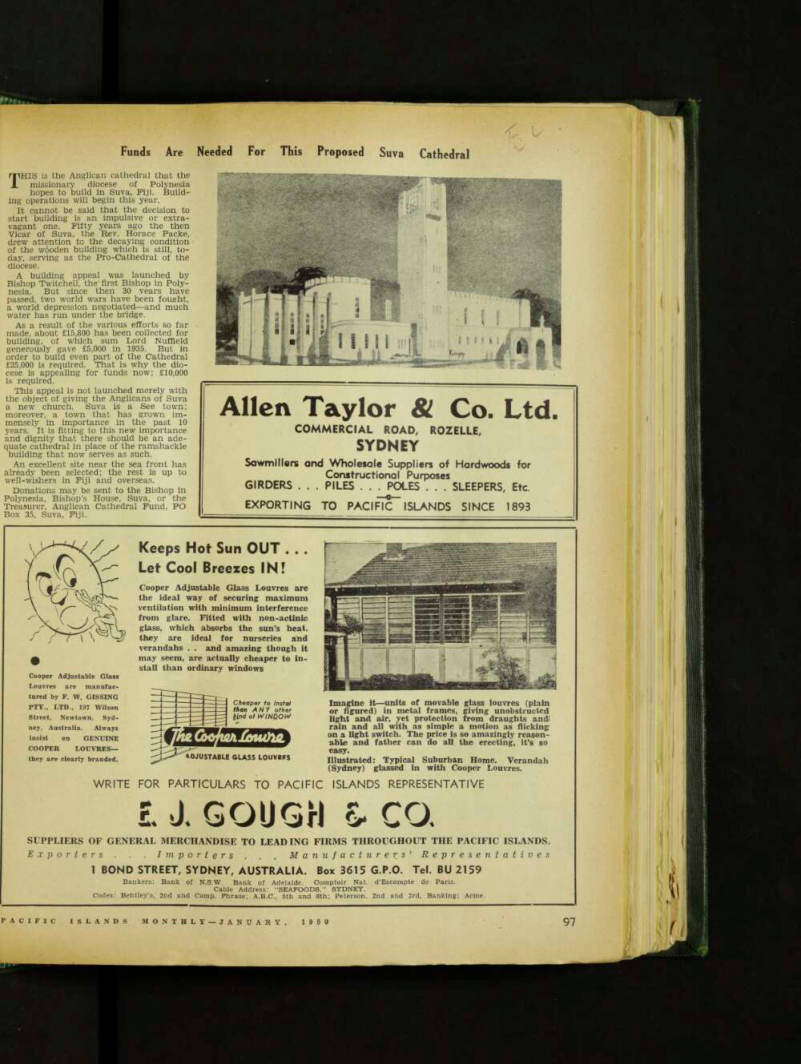
THIS is the Anglican cathedral that the missionary diocese of Polynesia hopes to build in Suva, Fiji. Build ing operations will begin this year.
It cannot be said that the decision to start building is an impulsive or extra vagant one. Fifty years ago the then Vicar of Suva, the Rev. Horace Packe, drew attention to the decaying condition of the wooden building which is still, to day, serving as the Pro-Cathedral of the diocese.
A building appeal was launched by Bishop Twitched, the first Bishop in Poly nesia. But since then 30 years have passed, two world wars have been fought, a world depression negotiated—and much water has run under the bridge.
As a result of the various efforts so far made, about £15,800 has been collected for building, of which sum Lord Nuffield generously gave £5,000 in 1935. But in order to build even part of the Cathedral £25,000 is required. That is why the dio cese is appealing for funds now; £lO,OOO is required.
This appeal is not launched merely with the object of giving the Anglicans of Suva a new church. Suva is a See town; moreover, a town that has grown im mensely in importance in the past 10 years. It is fitting to this new importance and dignity that there should be an ade quate cathedral in place of the ramshackle building that now serves as such.
An excellent site near the sea front has already been selected; the rest is up to well-wishers in Fiji and overseas.
Donations may be sent to the Bishop in Polynesia, Bishop’s House, Suva, or the Treasurer, Anglican Cathedral Fund, PO Box 35, Suva, Fiji.
Advertisements & other items, pp. 99-100 (1 item)
£. J. Gougri S. Co.
Allen Taylor 8i Co. Ltd.
COMMERCIAL ROAD, ROZELLE,
SYDNEY
Sawmillers and Wholesale Suppliers of Hardwoods for Constructional Purposes GIRDERS . . . PILES . . . POLES . . . SLEEPERS, Etc.
EXPORTING TO PACIFIC - ISLANDS SINCE 1893
/ 0 r <V r Cooper Adjustable Glass Louvres are manufactured by F. W. GISSING PTY., LTD., 197 Wilson Street, Newtown, Sydney, Australia. Always Insist on GENUINE
COOPER LOUVRES—
they are clearly branded.
WRITE
Keeps Hof Sun OUT . . .
Lef Cool Breezes IN!
Cooper Adjustable Glass Louvres are the ideal way of securing maximum ventilation with minimum interference from glare. Fitted with non-actinic glass, which absorbs the sun’s heat, they are ideal for nurseries and verandahs . . and amazing though it may seem, are actually cheaper to install than ordinary windows Cheaper to Instal than ANY other llpd of WINQOW
ADJUSTABLE GLASS LOUVBES
■ * ■ RHi SS BB£ * Imagine it—units of movable glass louvres (plain or figured) in metal frames, giving unobstructed light and air, yet protection from draughts andrain and all with as simple a motion as flicking on a light switch. The price is so amazingly reasonable and father can do all the erecting, it’s so easy.
Illustrated; Typical Suburban Home. Verandah (Sydney) glassed in with Cooper Louvres.
FOR PARTICULARS TO PACIFIC ISLANDS REPRESENTATIVE
£. J. GOUGrI S. CO.
SUPPLIERS OF GENERAL MERCHANDISE TO LEAD ING FIRMS THROUGHOUT THE PACIFIC ISLANDS.
Exporters . . . Importers . . . Manufacturers' Representatives 1 BOND STREET, SYDNEY, AUSTRALIA. Box 3615 G.P.O. Tel. BU 2159 Bankers: Bank of N.S.W. Bank of Adelaide. Comptoir Nat. d’Escompte de Paris.
Cable Address: “SEAFOODS,” SYDNEY.
Codes: Bentley’s, 2nd and Comp. Phrase; A.8.C., sth and 6th; Peterson, 2nd and 3rd, Banking: Acme.
AN AUSTRALIAN ELEVEN
/: W 0 Wi BIRDS OF A FEATHER' 1 may be truthfully applied to Asthmas, Bronchitis, Hay Fever, Catarrh, Antrum, Sinus, etc., as they are all akin—being occasioned by expanded capillaries of the mucous membrane.
aspaXadrene
(The Answer to the Asthmatic's Prayers) , Relieves in 5 seconds (not 5 years) because It “Touches the Spot.” • Absolutely harmless-same oray-same liquid-babies and adults. •No dleting-eat anythlng-especially what you are not suposed to. • Sleep on anything—live anywhere—sea. plain, valley or mountain air. • Cause uration—family history, etc.—immaterial. • Takes the strain off the heart—by easing the breathing > May be used in conjunction with your doctor’s allergy injections or any other medicine you like. ontains 0.5 per cent. Adrenalin and guaranteed Iree from Atropine. Ephedrine. Cocaine. Morphine, Pituitary. Papavarlne or any other Opium drug—so is absolutely harmless.
Complete outfit, 28/6 (Australian) —postage 1/6 Refill Aspaxadrene, 12/6 (Australian) —postage free.
Sole Discoverer, Proprietor and Dispenser,
A. H. CRUNDALL, Qualified Chemist
BOX 58, PRAHRAN, VICTORIA, AUSTRALIA.
■h. sites’A,"S!afla w,,h ’ n ’ B “
Death Of Rev. C. F. Rich
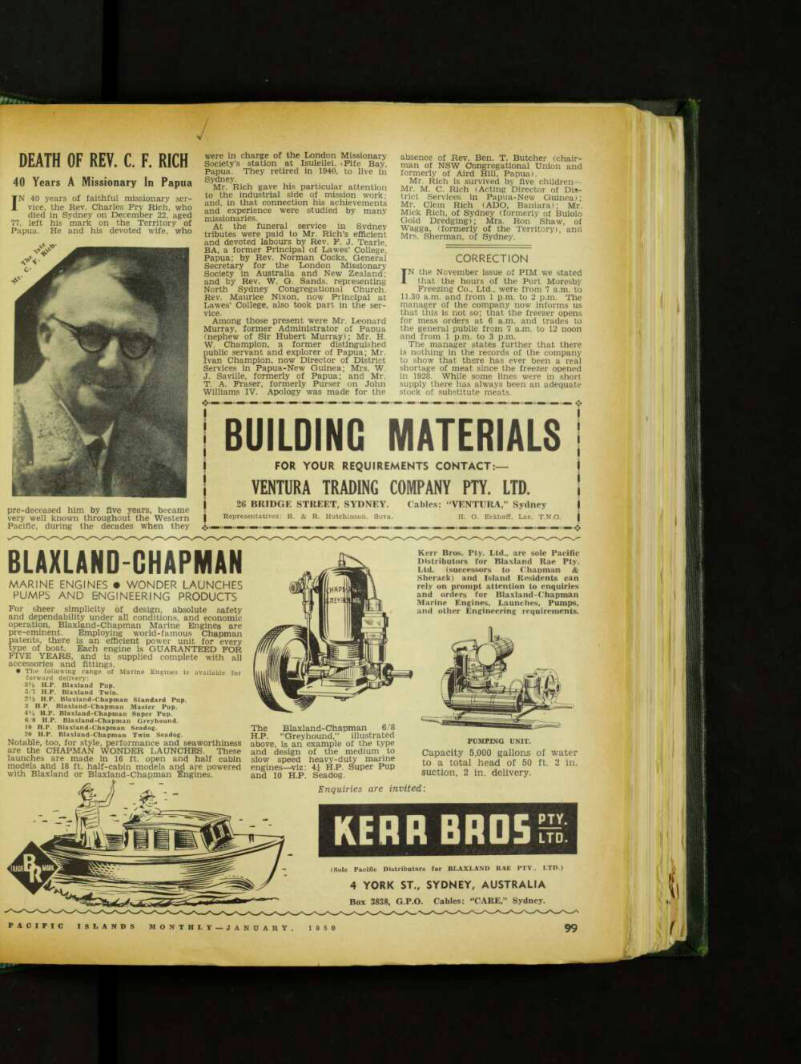
40 Years A Missionary In Papua
IN 40 years of faithful missionary ser vice, the Rev. Charles Fry Rich, who died in Sydney on December 22, aged 77, left his mark on the Territory of Papua. He and his devoted wife, who
pre-deceased him by five years, became very well known throughout the Western Pacific, during the decades when they
were in charge of the London Missionary Society’s station at Isuleilei, .Fife Bay, Papua. They retired in 1940, to live in Sydney.
Mr. Rich gave his particular attention to the industrial side of mission work; and, in that connection his achievements and experience were studied by many missionaries.
At the funeral service in Sydney tributes were paid to Mr. Rich’s efficient and devoted labours by Rev. F. J. Tearle, BA, a former Principal of Lawes’ College, Papua; by Rev. Norman Cocks, General Secretary for the London Missionary Society in Australia and New Zealand: and by Rev. W. G. Sands, representing North Sydney Congregational Church.
Rev. Maurice Nixon, now Principal at Lawes’ College, also took part in the ser vice.
Among those present were Mr. Leonard Murray, former Administrator of Papua (nephew of Sir Hubert Murray); Mr. H.
W. Champion, a former distinguished public servant and explorer of Papua; Mr.
Ivan Champion, now Director of District Services in Papua-New Guinea; Mrs. W.
J. Saville, formerly of Papua; and Mr.
T. A. Fraser, formerly Purser on John Williams IV. Apology was made for the
absence of Rev. Ben. T. Butcher (chair man of NSW Congregational Union and formerly of Aird Hill, Papua).
Mr. Rich is survived by five children— Mr. M. C. Rich (Acting Director of Dis trict Services in Papua-New Guinea); Mr. Clem Rich (ADO, Baniara); Mr.
Mick Rich, of Sydney (formerly of Bulolo Gold Dredging); Mrs. Ron Shaw, of Wagga, (formerly of the Territory), and Mrs. Sherman, of Sydney.
Correction
IN the November issue of PIM we stated that the hours of the Port Moresby Freezing Co., Ltd., were from 7 a.m, to 11.30 a.m. and from 1 p.m. to 2 p.m. The manager of the company now informs us that this is not so; that the freezer opens for mess orders at 6 a.m. and trades to the general public from 7 a.m, to 12 noon and from 1 p.m. to 3 p.m.
The manager states further that there is nothing in the records of the company to show that there has ever been a real shortage of meat since the freezer opened in 1928. While some lines were in short supply there has always been an adequate stock of substitute meats.
Advertisements & other items, pp. 101-102 (2 items)
Building Materials
FOR YOUR REQUIREMENTS CONTACT:—
VENTURA TRADING COMPANY PTY. LTD.
26 BRIDGE STREET, SYDNEY. Cables: “VENTURA,” Sydney Representatives: R. & R. Hutchinson, Suva. H. G. Eekhoff, Lae, T.N.G.
BLAXLAND-GHAPMAN
MARINE ENGINES • WONDER LAUNCHES
PUMPS AND ENGINEERING PRODUCTS
For sheer simplicity of design, absolute safety and dependability under all conditions, and economic operation, Blaxland-Chapman Marine Engines are pre-eminent. Employing world-famous Chapman patents, there is an efficient power unit for every type of boat. Each engine is GUARANTEED FOR FIVE YEARS, and is supplied complete with all accessories and fittings. • The following range of Marine Engines is available for forward delivery: 3Vz H.P. Blaxland Pup. 5/7 H.P. Blaxland Twin. 2V2 H.P. Blaxland-Chapman Standard Pup. 3 H.P. Blaxland-Chapman Master Pup. 4*4 H.P. Blaxland-Chapman Super Pup. 6/8 H.P. Blaxland-Chapman Greyhound. 10 H.P. Blaxland-Chapman Seadog. 20 H.P. Blaxland-Chapman Twin Seadog.
Notable, too, for style, performance and seaworthiness are the CHAPMAN WONDER LAUNCHES. These launches are made in 16 ft. open and half cabin models and 18 ft. half-cabin models and are powered with Blaxland or Blaxland-Chapman Engines. t - &J.-M
MAPI'
REY
Kerr Bros. Pty. Ltd., are sole Pacific Distributors for Blaxland Rae Pty.
Ltd. (successors to Chapman & Sherack) and Island Residents can rely on prompt attention to enquiries and orders for Blaxland-Chapman Marine Engines, Launches, Pumps, and other Engineering requirements.
The Blaxland-Chapman 6/8 H.P. “Greyhound,” illustrated above, is an example of the type and design of the medium to slow speed heavy-duty marine engines—viz: H.P. Super Pup and 10 H.P. Seadog.
P
PUMPING UNIT.
Capacity 5,000 gallons of water
to a total head of 50 ft. 2 in.
suction, 2 in. delivery.
Enquiries are invited :
KERR BROS
(Sole Pacific Distributors for BLAXLAND RAE PTY., LTD.)
4 YORK ST., SYDNEY, AUSTRALIA
Box 3838, G.P.O. Cables: “CARE,” Sydney.
PLOUGHS for EVERY PLANTER
There is a Ransomes Plough for every planter. For nearly 150 years Ransomes have been leaders in plough design, and to-day they offer a range for animal and tractor draught covering all possible requirements. Whether a light steel plough or a tractor disc plough weighing more than 3 tons is required, there is a Ransomes model which will give complete satisfaction.
Ransomes
THE
"CUB"
PLOUGH
Write lor Illustrated catalogues and all information. Ask also for particulars of our lawn mowers, aerodrome equipment, etc
MORRIS, HEDSTROM LTD.
Suva, Lautoka and 80.
Made by: RANSOMES, SIMS & JEFFERIES LTD., IPSWICH, ENG.
Corrugated Aluminium Roofing Sheets I i ffl
I II
m
LIGHT
COOL
PERMANENT
resists the corrosive atmosphere of marine and industrial regions.
Corrugated Aluminium Roofing is available as listed here: GAUGES: 26, 24, 23, 22, 20 and 18 s.w.g.
WIDTHS: 26" or 32" (Eight 3" corrugations and ten 3" corrugations respectively).
LENGTHS: 6', 7', B', 9', 10', 11' and 12' in exact feet.
A building material has now emerged which can meet the huge demand for homes, schools, industrial buildings Corrugated Aluminium Roofing Sheets.
As a protection against sun heat, Corrugated Aluminium Roofing has proved most effective. No special maintenance is required; .no protective painting is necessary ; and Corrugated Aluminium Roofing
* for every type of construction
ALUMINIUM UNION LIMITED
(Incorporated in the Dominion of Canada)
Principal British Commonwealth Distributor of Aluminium
Ocean House, 34 Martin Place. Sydney. An ALUMINIUM LIMITED Company.
Sales Agents for New Zealand Richardson McCabe & Co. Ltd.
Wellington Auckland Christchurch Sales Agents, New Caledonia, its Dependencies and New Hebrides. Age nee Alma, 39 Rue de L’Alma, Noumea, New Caledonia Sales Agents for Fiji, Western Samoa and Tonga: Morris Hedstrom Limited Suva, Fiji
100
JANUARY, 1950-PACIFIC ISLANDS MONTHLY
P-NG SEA TRANSPORT
COLLAPSE
(Continued from Page 8)
port, regarding ports of loading; lack of sufficient life-saving apparatus
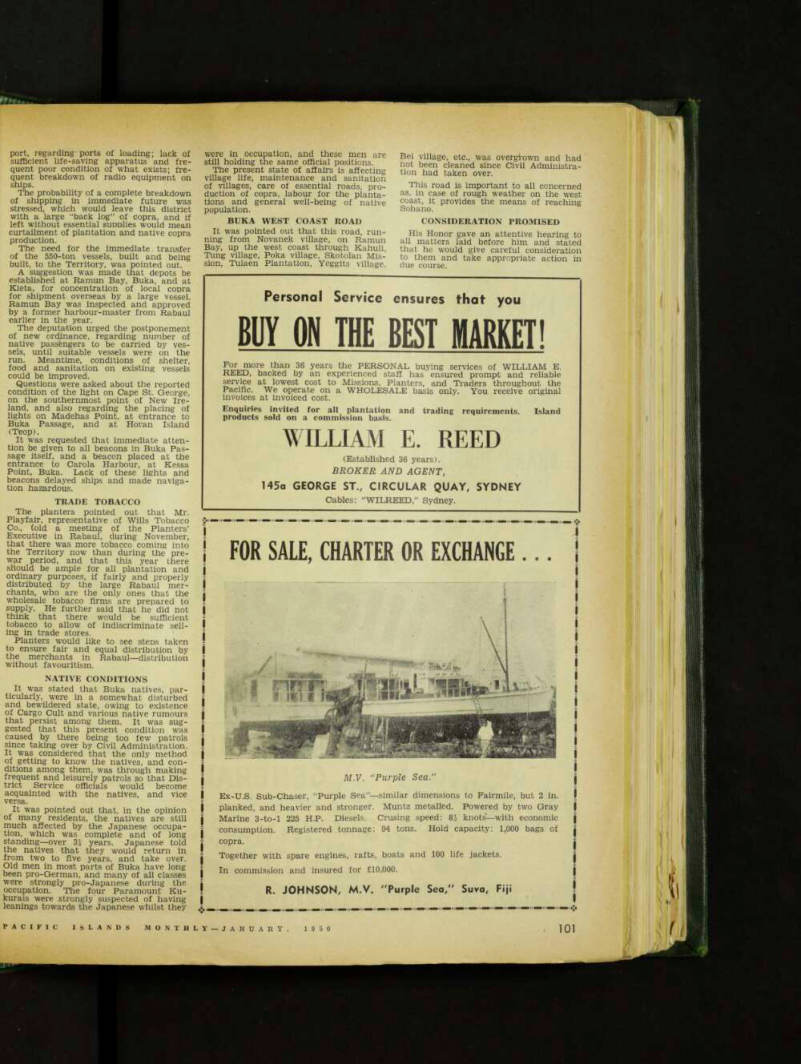
sufficient life-saving apparatus and fre quent poor condition of what exists; fre quent breakdown of radio equipment on ships.
The probability of a complete breakdown of shipping in Immediate future was stressed, which would leave this district with a large “back log” of copra, and if left without essential supplies would mean curtailment of plantation and native copra production.
The need for the immediate transfer of the 550-ton vessels, built and being built, to the Territory, was pointed out.
A suggestion was made that depots be established at Ramun Bay, Buka, and at Kieta, for concentration of local copra for shipment overseas by a large vessel.
Ramun Bay was inspected and approved by a former harbour-master from Rabaul earlier in the year.
The deputation urged the postponement of new ordinance, regarding number of native passengers to be carried by ves sels, until suitable vessels were on the run. Meantime, conditions of shelter, food and sanitation on existing vessels could be improved.
Questions were asked about the reported condition of the light on Cape St. George, on the southernmost point of New Ire land, and also regarding the placing of lights on Madehas Point, at entrance to Buka Passage, and at Horan Island (Teop).
It was requested that immediate atten tion be given to all beacons in Buka Pas sage itself, and a beacon placed at the entrance to Carola Harbour, at Kessa Point, Buka. Lack of these lights and beacons delayed ships and made naviga tion hazardous.
Trade Tobacco
The planters pointed out that Mr, Playfair, representative of Wills Tobacco Co., fold a meeting of the Planters’
Executive in Rabaul, during November, that there was more tobacco coming into the Territory now than during the pre war period, and that this year there should be ample for all plantation and ordinary purposes, if fairly and properly distributed by the large Rabaul mer chants, who are the only ones that the wholesale tobacco firms are prepared to supply. He further said that he did not think that there would be sufficient tobacco to allow of indiscriminate sell ing in trade stores.
Planters would like to see steps taken to ensure fair and equal distribution by the merchants in Rabaul—distribution without favouritism.
Native Conditions
It was stated that Buka natives, par ticularly, were in a somewhat disturbed and bewildered state, owing to existence of Cargo Cult and various native rumours that persist among them. It was sug gested that this present condition was caused by there being too few patrols since taking over by Civil Administration.
It was considered that the only method of getting to know the natives, and con ditions among them, was through making frequent and leisurely patrols so that Dis trict Service officials would become acquainted with the natives, and vice versa.
It was pointed out that, in the opinion of many residents, the natives are still much affected by the Japanese occupa tion, which was complete and of long standing—over 31 years. Japanese told the natives that they would return in from two to five years, and take over.
Old men in most parts of Buka have long been pro-German, and many of all classes were strongly pro-Japanese during the occupation. The four Paramount Ku kurais were strongly suspected of having leanings towards the Japanese whilst they
were in occupation, and these men are still holding the same official positions.
The present state of affairs is affecting village life, maintenance and sanitation of villages, care of essential roads, pro duction of copra, labour for the planta tions and general well-being of native population.
Buka West Coast Road
It was pointed out that this road, run ning from Novanek village, on Ramun Bay, up the west coast through Kahuli, Tung village, Poka village, Skotolan Mis sion, Tulaen Plantation, Yeggits village,
Bei village, etc., was overgrown and had not been cleaned since Civil Administra tion had taken over.
This road is important to all concerned as, in case of rough weather on the west coast, it provides the means of reaching Sohano.
Consideration Promised
His Honor gave an attentive hearing to all matters laid before him and stated that he would give careful consideration to them and take appropriate action in due course.
Advertisements & other items, p. 103 (1 item)
Buy Oh The Best Mabket!
Personal Service ensures that you
For more than 36 years the PERSONAL buying services of WILLIAM E.
REED, backed by an experienced staff has ensured prompt and reliable service at lowest cost to Missions, Planters, and Traders throughout the Pacific. We operate on a WHOLESALE basis only. You receive original invoices at invoiced cost.
Enquiries invited for all plantation and trading requirements. Island products sold on a commission basis.
WILLIAM E. REED
(Established 36 years).
BROKER AND AGENT,
145 a GEORGE ST., CIRCULAR QUAY, SYDNEY Cables: “WILREED,” Sydney.
FOR SALE, CHARTER OR EXCHANGE...
Ex-U.S. Sub-Chaser, “Purple Sea”—similar dimensions to Fairmile, but 2 in. planked, and heavier and stronger. Muntz metalled. Powered by two Gray Marine 3-to-l 225 H.P. Diesels. Crusing speed: 8i knots—with economic consumption. Registered tonnage: 94 tons. Hold capacity: 1,000 bags of copra.
Together with spare engines, rafts, boats and 100 life jackets.
In commission and insured for £lO,OOO.
M.V. “Purple Sear R. JOHNSON, M.V. "Purple Sea," Suva, Fiji
No Change At
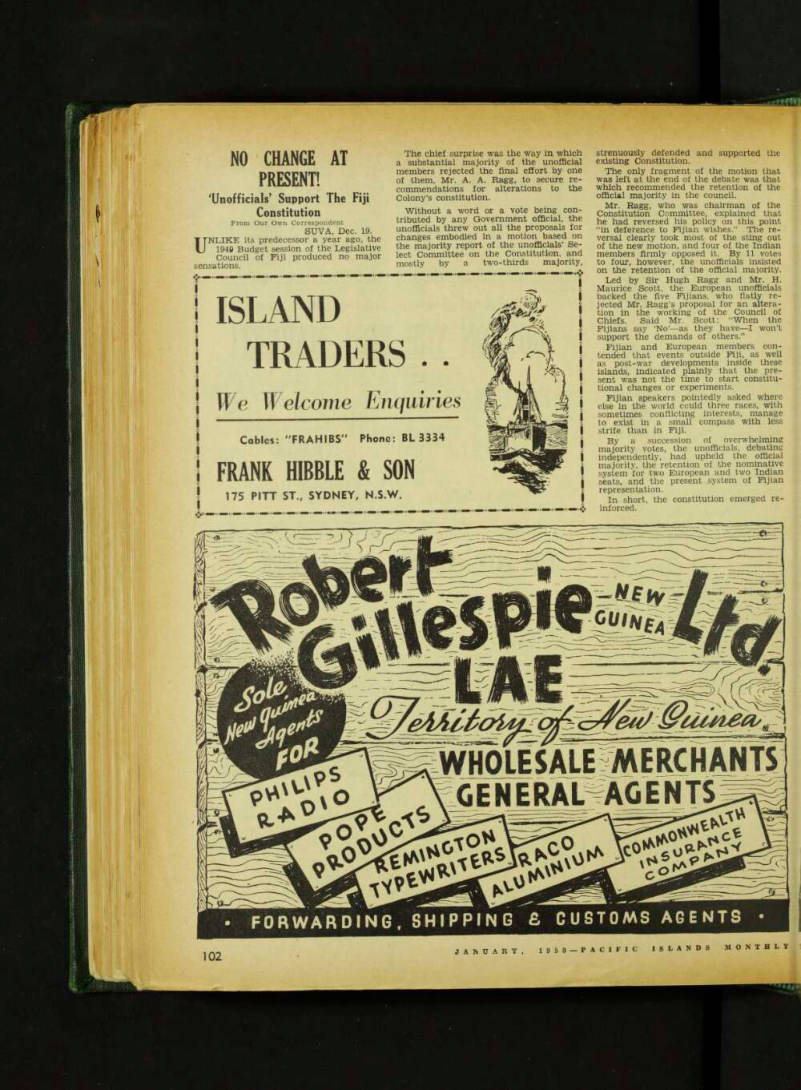
Present!
‘Unofficials’ Support The Fiji Constitution
From Our Own Correspondent
Suva, Dec. 19.
UNLIKE its predecessor a year ago, the 1949 Budget session of the Legislative Council of Fiji produced no major sensations.
The chief surprise was the way in which a substantial majority of the unofficial members rejected the final effort by one of them, Mr. A. A. Ragg, to secure re commendations for alterations to the Colony’s constitution.
Without a word or a vote being con tributed by any Government official, the unofficials threw out all the proposals for changes embodied in a motion based on the majority report of the unofficials’ Se lect Committee on the Constitution, and mostly by a two-thirds majority,
strenuously defended and supported the existing Constitution.
The only fragment of the motion that was left at the end of the debate was that which recommended the retention of the official majority in the council.
Mr. Ragg, who was chairman of the Constitution Committee, explained that he had reversed his policy on this point “in deference to Fijian wishes.” The re versal clearly took most of the sting out of the new motion, and four of the Indian members firmly opposed it. By 11 votes to four, however, the unofficials insisted on the retention of the official majority.
Led by Sir Hugh Ragg and Mr. H.
Maurice Scott, the European unofficials backed the five Fijians, who flatly re jected Mr. Ragg’s proposal for an altera tion in the working of the Council of Chiefs. Said Mr. Scott: “When the Fijians say ‘No’—as they have —I won’t support the demands of others.”
Fijian and European members con tended that events outside Fiji, as well as post-war developments inside these islands, indicated plainly that the pre sent was not the time to start constitu tional changes or experiments.
Fijian speakers pointedly asked where else in the world could three races, with sometimes conflicting interests, manage to exist in a small compass with less strife than in Fiji.
By a succession of overwhelming majority votes, the unofficials, debating independently, had upheld the official majority, the retention of the nominative system for two European and two Indian seats, and the present system of Fijian representation.
In short, the constitution emerged re inforced.
Advertisements & other items, p. 104 (1 item)
Wholesale Merchant!
ISLAND
TRADERS . .
We Welcome Enquiries
Cables: "FRAHIBS" Phone; BL 3334
FRANK HIBBLE & SON
175 PITT ST. ( SYDNEY, N.S.W.
ttMiy 3t .v.#: 'uubeos p*"> \9S %* O'
WHOLESALE MERCHANT!
GENERAL AGENTS
V)tA FORWARDING . BHIPPIN G fi C U STOMS AG E NTS •
Reform Awaited
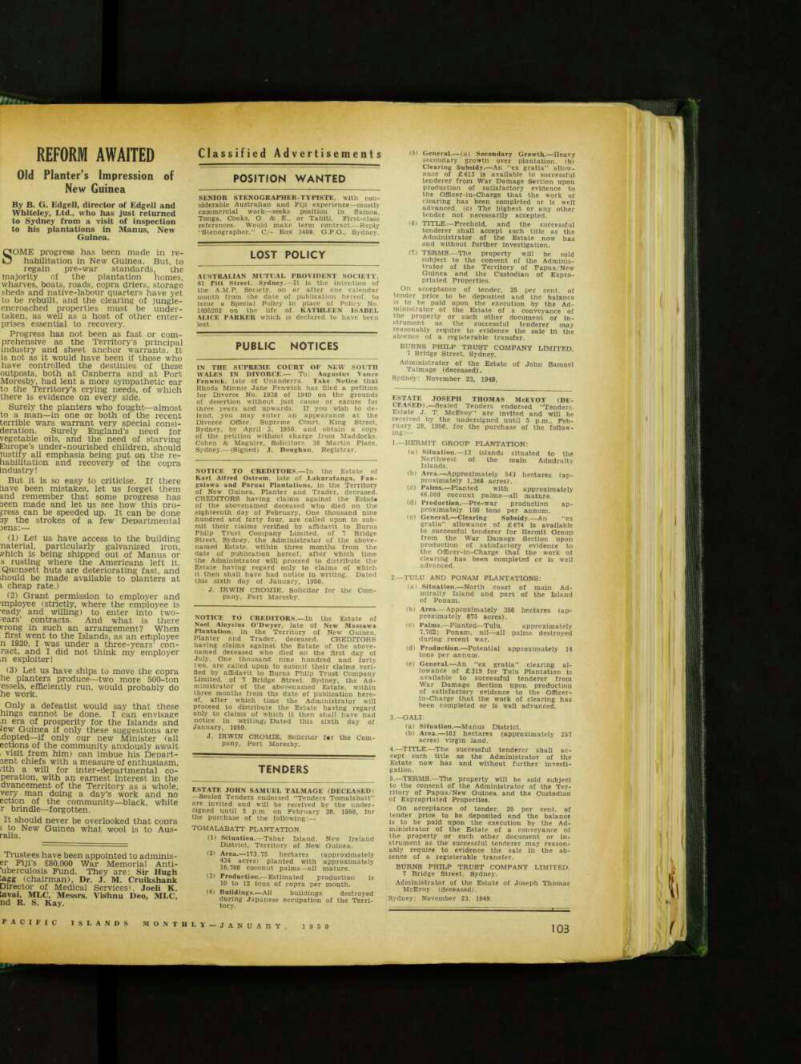
Old Planters Impression of New Guinea
By B. G. Edgell, director of Edgell and Whiteley, Ltd., who has just returned to Sydney from a visit of inspection to his plantations in Manus, New Guinea.
SOME progress has been made in re habilitation in New Guinea. But, to regain pre-war standards, the majority of the plantation homes, wharves, boats, roads, copra driers, storage sheds and native-labour quarters have yet to be rebuilt, and the clearing of jungle encroached properties must be under taken, as well as a host of other enter prises essential to recovery.
Progress has not been as fast or com prehensive as the Territory’s principal industry and sheet anchor warrants. It is not as it would have been if those who have controlled the destinies of these outposts, both at Canberra and at Port Moresby, had lent a more sympathetic ear to the Territory’s crying needs, of which there is evidence on every side.
Surely the planters who fought—almost to a man—in one or both of the recent terrible wars warrant very special consi deration. Surely England’s need for vegetable oils, and the need of starving Europe’s under-nourished children, should justify all emphasis being put on the re habilitation and recovery of the copra industry!
But it is so easy to criticise. If there iiave been mistakes, let us forget them and remember that some progress has seen made and let us see how this pro gress can be speeded up. It can be done ay the strokes of a few Departmental Dens: — (1) Let us have access to the building naterial, particularly galvanised iron, vhich is being shipped out of Manus or s rusting where the Americans left it.
Quonsett huts are deteriorating fast, and should be made available to planters at i cheap rate.) (2) Grant permission to employer and ■mployee (strictly, where the employee is •eady and willing) to enter into two ;ears’ contracts. And what is there vrong in such an arrangement? When first went to the Islands, as an employee n 1920, I was under a three-years’ con ract, and I did not think my employer in exploiter! (3) Let us have ships to move the copra he planters produce—two more 500-ton essels, efficiently run, would probably do he work.
Only a defeatist would say that these hings cannot be done. I can envisage -n era of prosperity for the Islands and Jew Guinea if only these suggestions are dopted—if only our new Minister (all ections of the community anxiously await - visit from him) can imbue his Depart ment chiefs with a measure of enthusiasm, nth a will for inter-departmental co peration, with an earnest interest in the dvancement of the Territory as a whole, very man doing a day’s work and no ection of the community—black, white
r brindle—forgotten.
It should never be overlooked that copra > to New Guinea what wool is to Aus ralia.
Trustees have been appointed to adminis er Fiji’s £BO,OOO War Memorial Anti ‘uberculosis Fund. They are: Sir Hugh -agg (chairman), Dr. J. M. Cmikshank Director of Medical Services). Joeli K. lavai, MLC, Messrs. Vishnu Deo, MLC, nd R. S. Kay.
Advertisements & other items, p. 105 (2 items)
103
pacific islands MONTHLY- J A N U A R Y , 1950
Classified Advertisements
POSITION WANTED
SENIOR STENOGRAPHER-TYPISTE, with con-
siderable Australian and Fiji experience—mostly commercial work —seeks position in Samoa.
Tonga, Cooks, G. & E., or Tahiti. First-class references. Would make term contract. —Reply “Stenographer,” C/- Box 3408, G.P.0., Sydney.
LOST POLICY
AUSTRALIAN MUTUAL PROVIDENT SOCIETY.
87 Pitt Street, Sydney.—lt is the intention of the A.M.P. Society, on or after one calendar month from the date of publication hereof, to issue a Special Policy in place of Policy No. 1095202 on the life of KATHLEEN ISABEL ALICE PARKER which is declared to have been lost.
PUBLIC NOTICES
IN THE SUPREME COURT OF NEW SOUTH WALES IN DIVORCE.— To: Augustus Vance Fenwick, late of Unanderra. Take Notice that Rhoda Minnie Jane Fenwick has filed a petition for Divorce No. 1938 of 1949 on the grounds of desertion without just cause or excuse foi three years and upwards. If you wish to defend, you may enter an appearance at the Divorce Office. Supreme Court, King Street, Sydney, by April 3, 1950, and obtain a copy of the petition without charge from Maddocks, Cohen & Maguire, Solicitors. 38 Martin Place, Sydney.— (Signed) J. Doughan, Registrar.
NOTICE TO CREDITORS—In the Estate of Karl Alfred Ostrom, late of Lakurafanga, Faugaiowa and Paruai Plantations, in the Territory of New Guinea, Planter and Trader, deceased.
CREDITORS having claims against the Estata of the abovenamed deceased who died on the eighteenth day of February, One thousand nine hundred and forty four, are called upon to submit their claims verified by affidavit to Burns Philp Trust Company Limited, of 7 Bridge Street, Sydney, the Administrator of the abovenamed Estate, within three months from the date of publication hereof, after which time the Administrator will proceed to distribute the Estate having regard only to claims of which it then shall have had notice in writing. Dated this sixth day of January, 1950.
J. IRWIN CROMIE, Solicitor for the Company, Port Moresby.
NOTICE TO CREDITORS—In the Estate of Noel Aloysius O’Dwyer, late of New Massawa Plantation, in the Territory of New Guinea.
Planter and Trader, deceased. CREDITORS having claims against the Estate of the abovenamed deceased who died on the first day of July, One thousand nine hundred and forty two, are called upon to submit their claims verified by affidavit to Burns Philp Trust Company Limited, of 7 Bridge Street, Sydney, the Administrator of the abovenamed Estate, within three months from the date of publication hereof, after which time the Administrator will proceed to distribute the Estate having regard only to claims of which it then shall have had notice in wtritingj Dated this sixth day of January, 1950.
J. IRWIN CROMIE, Solicitor f#r the Company, Port Moresby.
TENDERS
ESTATE JOHN SAMUEL TALMAGE (DECEASED)
—Sealed Tenders endorsed “Tenders Tomalabatt” are invited and will be received by the undersigned until 5 p.m. on February 28, 1950, for the purchase of the following;—
TOMALABATT PLANTATION.
(1) Situation.—Tabar Island, New Ireland District, Territory of New Guinea. (2) Area.—173.75 hectares (approximately 434 acres) planted with approximately 16,700 coconut palms—all mature. (3) Production.—Estimated production is 10 to 12 tons of copra per month. (4) Buildings.—All buildings destroyed during Japanese occupation of the Territory.
(5j General.— (a) Secondary Growth.—Heavy secondary growth over plantation, (b) Clearing Subsidy.—An “ex gratia” allowance of £413 is available to successful tenderer from War Damage Section upon production of satisfactory evidence to the Officer-in-Charge that the work of clearing has been completed or is well advanced, (c) The highest or any other tender not necessarily accepted. (6) TlTLE.—Freehold, and the successful tenderer shall accept such title as the Administrator of the Estate now has and without further investigation. (7) TERMS—The property will be sold subject to the consent of the Administrator of the Territory of Papua/New Guinea and the Custodian of Expropriated Properties.
On acceptance of tender, 25 per cent, of tender price to be deposited and the balance is to be paid upon the execution by the Administrator of the Estate of a conveyance of the property or such other document or instrument as the successful tenderer may reasonably require to evidence the sale In the absence of a registerable transfer.
BURNS PHILP TRUST COMPANY LIMITED.
7 Bridge Street, Sydney.
Administrator of the Estate of John Samuel Talmage (deceased).
Sydne'y: November 23, 1949.
ESTATE JOSEPH THOMAS McEVOY (DE-
CEASED).—SeaIed Tenders endorsed “Tenders.
Estate J. T. McEvoy” are invited and will be received by the undersigned until 5 p.m., February 28, 1950, for the purchase of the following:—
1. HERMIT GROUP PLANTATION:
(a) Situation.—l 3 islands situated to the Northwest of the main Admiralty Islands. (b) Area.—Approximately 543 hectares (approximately 1,368 acres). (c) Palms.—Planted with approximately 46,000 coconut palms—all mature. (d) Production.—Pre-war production approximately 100 tons per annum. (e) General.—Clearing Subsidy.—An “ex gratia” allowance of £674 is available to successful tenderer for Hermit Group from the War Damage Section upon production of satisfactory evidence to the Officer-in-Charge that the work of clearing has been completed or is well advanced.
2. TULU AND PONAM PLANTATIONS:
(a) Situation.—North coast of main Admiralty Island and part of the Island of Ponam. (b) Area.—Approximately 350 hectares (approximately 875 acres). (c) Palms. —Planted—Tulu, approximately 7,762; Ponam, nil —all palms destroyed during recent war. (d) Production.—Potential approximately 14 tons per annum. (e) General.—An “ex gratia” clearing allowance of £315 for Tulu Plantation is available to successful tenderer from War Damage Section upon production of satisfactory evidence to the Officerin-Charge that the work of clearing has been completed or is well advanced.
3. —GALI;
(a) Situation.—Manus District.
(b) Area.—lo 3 hectares (approximately 257
acres) virgin land. 4—TITLE. —The successful tenderer shall accept such title as the Administrator of the Estate now has and without further investigation.
S.—TERMS.—The property will be sold subject to the consent of the Administrator of the Territory of Papua/New Guinea and the Custodian of Expropriated Properties.
On acceptance of tender. 25 per cent, of tender price to be deposited and the balance is to be paid upon the execution by the Administrator of the Estate of a conveyance of the property or such other document or instrument as the successful tenderer may reasonably require to evidence the sale in the absence of a registerable transfer.
BURNS PHILP TRUST COMPANY LIMITED,
7 Bridge Street, Sydney.
Administrator of the Estate of Joseph Thomas McEvoy (deceased).
Sydney; November 23, 1949.
Islands Produce
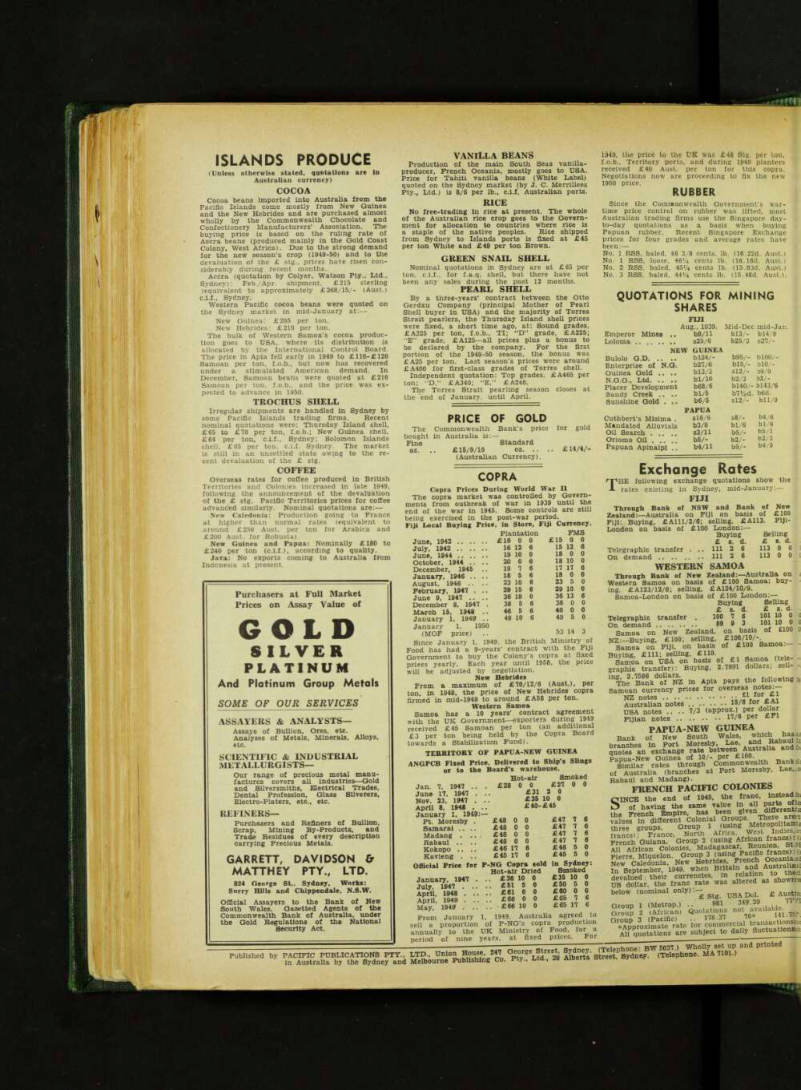
(Unless otherwise stated, quotations are in Australian currency)
Cocoa
Cocoa beans imported into Australia from the Pacific Islands come mostly from New Guinea and the New Hebrides and are purchased almost wholly by the Commonwealth Chocolate and Confectionery Manufacturers’ Association. The buying price is based on the ruling rate of Accra beans (produced mainly in the Gold Coast Colony, West Africa). Due to the strong demand for the new season’s crop (1949-50) and to the devaluation of the £ stg., prices have risen con siderably during recent months.
Accra (quotation by Colyer, Watson Pty., Ltd., Sydney): Feb./Apr, shipment, £215 sterling (equivalent to approximately £268/15/- (Aust.) c.i.f., Sydney.
Western Pacific cocoa beans were quoted on the Sydney market in mid-January at: — New Guinea: £205 per ton.
New Hebrides: £2lO per ton.
The bulk of Western Samoa’s cocoa produc tion goes to USA, where its distribution is allocated by the International Control Board.
The price in Apia fell early in 1949 to £llO-£l2O Samoan per ton, f.0.b., but now has recovered under a stimulated American demand. In December, Samoan beans were quoted at £2lO Samoan per ton, f.0.b., and the price was ex pected to advance in 1950.
Trochus Shell
Irregular shipments are handled in Sydney by some Pacific Islands trading firms. Recent nominal quotations were: Thursday Island shell, £65 to £7O per ton, f.0.b.; New Guinea shell, £64 per ton, c.i.f., Sydney: Solomon Islands shell, £65 per ton. c.i.f. Sydney. The market is still in an unsettled state owing to the re cent devaluation of the £ stg.
Coffee
Overseas rates for coffee produced in British Territories and Colonies increased in late 1949, following the announcement of the devaluation of the £ stg. Pacific Territories prices for coffee advanced similarly. Nominal quotations are:— New Caledonia: Production going to France at higher than normal rates (equivalent to around £250 Aust. per ton for Arabica and £2OO Aust. for Robusta).
New Guinea and Papua: Nominally £lBO to £240 per ton (c.i.f.), according to quality.
Java: No exports coming to Australia from Indonesia at present.
Vanilla Beans
Production of the main South Seas vahilla producer, French Oceania, mostly goes to USA.
Price for Tahiti vanilla beans (White Label) quoted on the Sydney market (by J. C. Merrillees Pty,, Ltd.) is 8/6 per lb., c.i.f. Australian ports.
Rice
No free-trading in rice at present. The whole of the Australian rice crop goes to the Govern ment for allocation to countries where rice is a staple of the native peoples. Rice shipped from Sydney to Islands ports is fixed at £45 per ton White and £49 per ton Brown.
Green Snail Shell
Nominal quotations in Sydney are at £65 per ton, c.i.f., for f.a.q. shell, but there have not been any sales during the past 12 months.
Pearl Shell
By a three-years’ contract between the Otto Gerdau Company (principal Mother of Pearl Shell buyer in USA) and the majority of Torres Strait pearlers, the Thursday Island shell prices were fixed, a short time ago, at: Sound grades, £A325 per ton, f.0.b., TI; “D” grade, £A225; “E” grade, £Al2s—all prices plus a bonus to be declared by the company. For the first portion of the 1949-50 season, the bonus was £ A 25 per ton. Last season’s prices were around £ A4OO for first-class grades of Torres shell.
Independent quotation: Top grades. £A465 per ton; “D.” £ A 340; “E,” £A24O.
The Torres Strait pearling season closes at the end of January, until April.
Copra
Price Of Gold
The Commonwealth Bank’s price for gold bought in Australia is;— Fine Standard oz. .. £ls/9/10 oz £l4/4/- (Australian Currency).
Copra Prices During World War II The copra market was controlled by Govern ments from outbreak of war in 1939 until the end of the war in 1945. Some controls are still being exercised in the post-war period.
Fiji Local Buying Price, in Store, Fiji Currency.
Since January 1, 1949, the British Ministry of Food has had a 9-years’ contract with the Fiji Government to buy the Colony’s copra at fixed prices yearly. Each year until 1958, the price will be adjusted by negotiation.
New Hebrides From a maximum of £70/12/6 (Aust,), per ton, in 1948, the price of New Hebrides copra firmed in mid-1949 to around £A58 per ton.
Western Samoa Samoa has a 10 years’ contract agreement with the UK Government —exporters during 1949 received £45 Samoan per ton (an additional £3 per ton being held by the Copra Board towards a Stabilisation Fund).
Territory Of Papua-New Guinea
ANGPCB Fixed Price, Delivered to Ship’s Slings or to the Board’s warehouse.
From January 1, 1949. Australia agreed to sell a proportion of P-NG’s copra production annually to the UK Ministry of Food, for a period of nine years, at fixed prices. For
1949, the price to the UK was £4B Stg. pgr ton, f.0.b., Territory ports, and during 1949 planters received £4O Aust. per ton for this copra.
Negotiations now are proceeding to fix the new 1950 price.
Rubber
Since the Commonwealth Government’s war time price control on rubber was lifted, most Australian trading firms use the Singapore day to-day quotations as a basis when buying Papuan rubber. Recent Singapore Exchange prices for four grades and average rates have been:— No. 1 RSS, baled, 46 3/8 cents, lb. (16.22 d. Aust.) No. 1 RSS, loose, 46Vi cents lb. (16.18 d. Aust.) No. 2 RSS, baled, 45(4 cents lb. (15.83 d. Aust.) No. 3 RSS, baled, 44(4 cents lb. (15.48 d. Aust.).
Quotations For Mining
Shares
June, 1942 Plantation £16 0 0 £15
Fms
0 0 July, 1942 16 12 6 15 12 6 June, 1944 19 10 0 18 0 0 October, 1944 .. .. 20 0 0 18 10 0 December, 1945 .. 19 7 6 17 17 6 January, 1946 .. .. 18 5 6 18 0 0 August, 1946 .. 23 10 6 23 5 0 February, 1947 . .. 29 15 6 29 10 0 June 9, 1947 .. 36 19 0 36 13 6 December 8, 1947 . 38 5 6 38 0 0 March 16, 1948 .. 46 5 6 46 0 0 January 1, 1949 .. 49 10 6 49 5 0 January 1, 1950 (MOF price) 53 14 3
Hot-air Smoked Jan. 7, 1947 .. . £28 0 0 £27 0 0 June 17, 1947 . £31 2 0 Nov, 23, 1947 . £35 10 0 April 8. 1948 . £40- £45 January 1, 1949 — Pt. Moresby . £48 0 0 £47 7 6 Samarai .. .. £48 0 0 £47 7 6 Madang . .. £48 0 0 £47 7 6 Rabaul .. £48 0 0 £47 7 6 Kokopo .. .. £46 17 6 £46 5 0 Kavieng . .. £45 17 6 £45 5 0 Official Price for P-NG Copra sold in Sydney; Hot-air Dried Smoked January, 1947 . .. £36 10 0 £35 10 0 July, 1947 . .. .. £51 5 0 £50 5 0 April, 1948 . .. .. £61 0 0 £60 0 0 April, 1949 . .. .. £66 0 0 £65 7 6 May, 1949 . . . £66 10 0 £65 17 6
Fiji
Aug., 1939.
Mid-Dec. mid-Jan Emperor Mines .. b9/ll bl3/bl4/9 Loloma S25/6 b25/3 s27/-
New Guinea
Bulolo G.D bl24/b95/blOO/- Enterprise of N.Q. b27/6 bl5/blO/- Guinea Gold .. .. bl3/3 sl2/b9/9 N.G.G., Ltd bl/10 b2/3 b2/- Placer Development b68/6 bl40/b143/6 Sandy Creek .. .. bl/5 b7y 2 d. b6d.
Sunshine Gold . .. b6/5 sl2/bll/9
Papua
Cuthbert’s Misima .
S16/6 s8/b4/6 Mandated Alluvials b3/8 bl/6 bl/6 Oil Search S3/11 b5/b5/l Oriomo Oil b5/b2/b2/3 Papuan Apinalpl .. b4/H b5/b4/9
Exchange Rates
THE following exchange quotations show the rates existing in Sydney, mid-January;—
Fiji
Through Bank of NSW and Bank of New Zealand:— Australia on Fiji on basis of £100 Fiji: Buying, £Alll/2/6; selling, £A113. Flji- London on basis of £100 London: —
Western Samoa
Through Bank of New Zealand:—Australia on Western Samoa on basis of £100 Samoa: buy ing, £ A123/12/6; selling, £A124/10/9.
Samoa-London on basis of £100 London: —
Samoa on New Zealand, on basis of £100 NZ-Buying. £100; selling. £100/10/-.
Samoa on Fiji, on basis of £100 Samoa:- Buying, £111; selling, £110.
Samoa on USA on basis of £1 Samoa (tele graphic transfer): Buying, 2.7991 dollars, sell in The Bank d of a NZ in Apia pays the following Samoan currency prices for overseas notes: NZ notes 1 " ] p Australian notes 15/ 6 for .’r 1 A l; USA notes .. .. 7/3 (approx, per dollar Fijian notes I 7 / 6 P er £F1
Papua-New Guinea
Bank of New South Wales, w £ ic *L branches in Port Moresby, Lae. Md Mij quotes an exchange rate *> etw ! e “ Austraha and Papua-New Guinea of 10/- per £100.
Similar rates through Commonwealth Bank of Australia (branches at Port Moresby, Lae, Rabaul and Madang).
French Pacific Colonies
SINCE the end of 1945, the franc, in ® te ®_^ ( of having the same value in all parte of ; the French Empire, has been given different, values in different Colonial Groups. There are three groups. Group 1 (using Metropolitan francs) France, North Africa, West Indies.
French Guiana. Group 2 (using Afri^ n fjJ nc |V All African Colonies, Madagascar. Reunion, St, Pierre Miquelon. Group 3 (using Pacific francs) .
New Caledonia, New Hebrides, French Oce In September, 1949, when B1 n tai^g n Au t f devalued their currencies, in relation to ww US dollar, the franc rate was altered as shown below (nominal only) ugA Dol . £ Austd
Soup 2 |(Atrman) Quotations available.
rate for commercial Alf quotations are subject to daily fluctuations
Buying Selling £ s. d. £ 8. d.
Telegraphic transfer . .. Ill 2 6 113 0 0 On demand .. Ill 2 6 113 0 0
Buying SeUing £ s. d. £ s. d.
Telegraphic transfer .
On demand 100 7 6 99 9 3 101 10 0 101 10 0
Advertisements & other items, pp. 106-108 (4 items)
Published by PACIFIC PUBLICATIONS PTY.. LTD., Union House, 247 Geor S e stJe^Sydne^(Telephone. MA 7101.)
in Australia by the Sydney and Melbourne Publishing Co. Ply., Ltd., w Aioena owe
Gold
Purchasers at Full Market Prices on Assay Value of
SILVER
PLATINUM
And Platinum Group Metals
SOME OF OUR SERVICES
ASSAYERS & ANALYSTS—
Assays of Bullion, Ores, etc.
Analyses of Metals, Minerals, Alloys, etc.
SCIENTIFIC & INDUSTRIAL
METALLURGISTS—
Our range of precious metal manufactures covers all industries —Gold and Silversmiths, Electrical Trades, Dental Profession, Glass Sllverers, Electro-Platers, etc., etc.
REFINERS—
Purchasers and Refiners of Bullion, Scrap, Mining By-Products, and Trade Residues of every description carrying Precious Metals.
GARRETT, DAVIDSON
MATTHEY PTY., LTD.
824 George St., Sydney. Works: Sorry Hills and Chippendale, N.S.W.
Official Assayers to the Bank of New South Wales. Gazetted Agents of the Commonwealth Bank of Australia, under the Gold Regulations of the National Security Act.
Tooth’S
m I
PHJ C
JL ood company deserves the best, and it is a thoughtful and discerning host who serves his guests sparkling K.B. Lager. For “K. 8.” adds enjoyment to any gathering, and it’s one drink that’s appreciated by everybody, men and women alike.
TOOTH’S
LAGER
*VO *IT
K8.35.FF
MERCHANTS. Qc SHIP OWNERS
Capital £500,000
ESTABLISHED 1914
GENERAL MERCHANTS
AND
PROYIDORES
TRADE THROUGHOUT THE PACIFIC.
THIRTY-FIVE YEARS OF PACIFIC ISLANDS DEVELOPMENT AND SERVICE.
BUYERS AND EXPORTERS OF ALL KINDS
OF ISLAND PRODUCE, COPRA, COCOA,
M.O.P. SHELL, TROCAS SHELL, ETC.
AGENTS FOR AUSTRALIAN, EUROPEAN
AND AMERICAN MANUFACTURERS.
DISTRIBUTORS OF EVERY DESCRIPTION
OF MERCHANDISE.
Through our Sydney office, branches and agents, we distribute a wide and comprehensive range of general merchandise.
*. R. CARPENTER & CO. LTD.
Head Office: 16 O'CONNELL STREET, SYDNEY, N.S.W.
Cable Address:
“CAMOHE.”
Telephone: BW 4421.
Postal Address: G.P.0., BOX 168, Sydney.
In London: W. R. Carpenter & Co. (London), Ltd., Coronation House, 4 Lloyd's Ave., London, EC
ASSOCIATED COMPANIES THROUGHOUT THE PACIFIC:
IN NEW GUINEA:
New Guinea Company, Limited, Rabaul, Lae, Madang, Kavieng.
IN PAPUA:
J. R. Clay & Co., Ltd., Port Moresby.
IN FIJI:
W. R. Carpenter & Co. (Fiji), Ltd., Suva.