Pacific
Islands
Monthly
December, 1949
Vol. XX. No. 5.
Established 1980.
{Registered at the G.P.0., Sydney, for tranmm&nbypostas a newspaper ] - ———
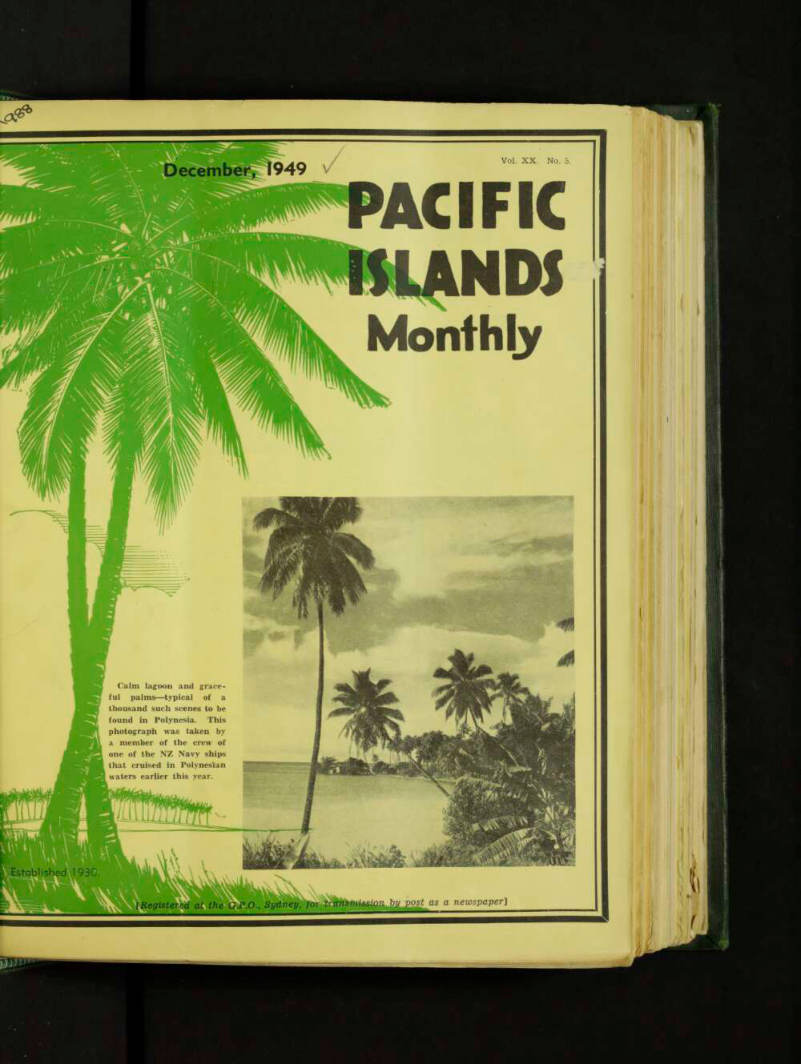
Calm lagoon and grace ful palms—typical of a thousand such scenes to be found in Polynesia. This photograph was taken by a member of the crew of one of the NZ Navy ships that cruised in Polynesian waters earlier this year.
Advertisements & other items, pp. 2-4 (1 item)
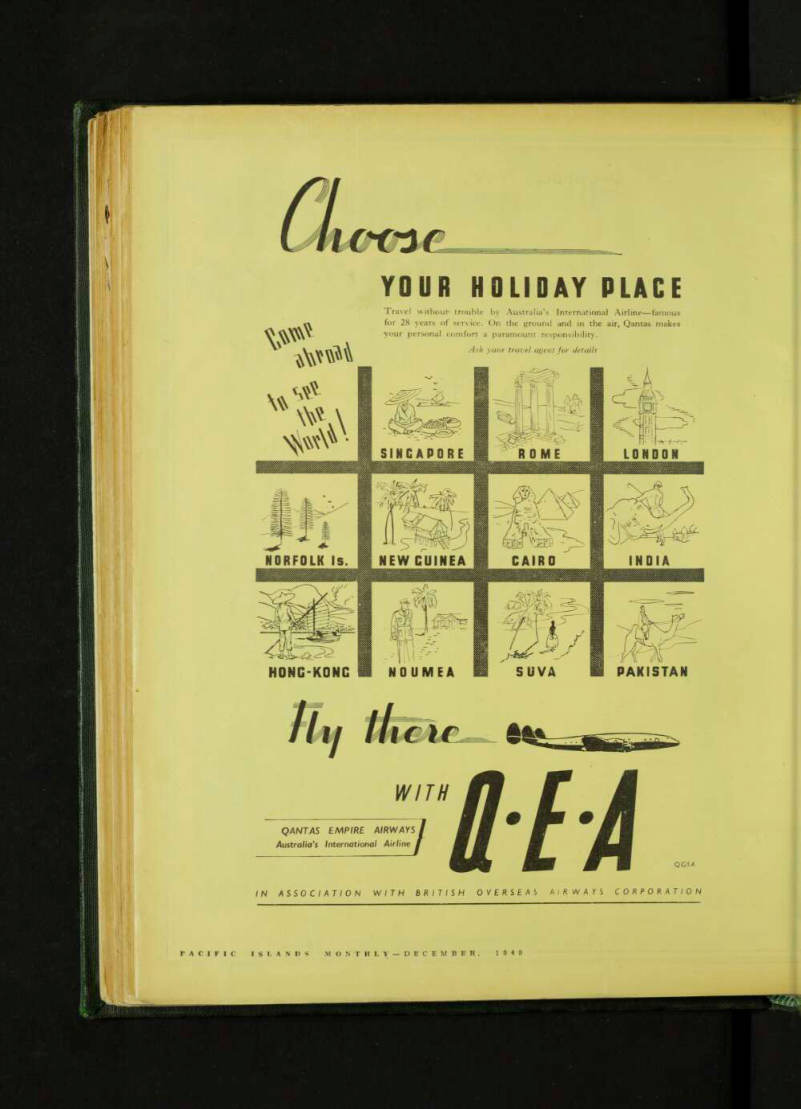
Your Holiday Place
Travel without- trouble by Australia’s International Airline—famous for 28 years of service. On the ground and in the air, Qantas makes your personal comfort a paramount responsibility.
Ask yaur travel agent for details \w
LONDON
SI M t- 'fi 02 5^
NORFOLK Is.
EW
GUINEA
CAIR
INDIA
J ■in ■"Erin /
UVA
M
HONGKONG
PAKISTAN
QANTAS EMPIRE AIRWAYS
Australia's International Airline
WITH
QGSA
IN ASSOCIATION WITH BRITISH OVERSEAS AIRWAYS CORPORATION
CM
VOU
■ w i ■
I# W'Mfi
iMftf
O m J 4 M
DEPEND ON
SljW
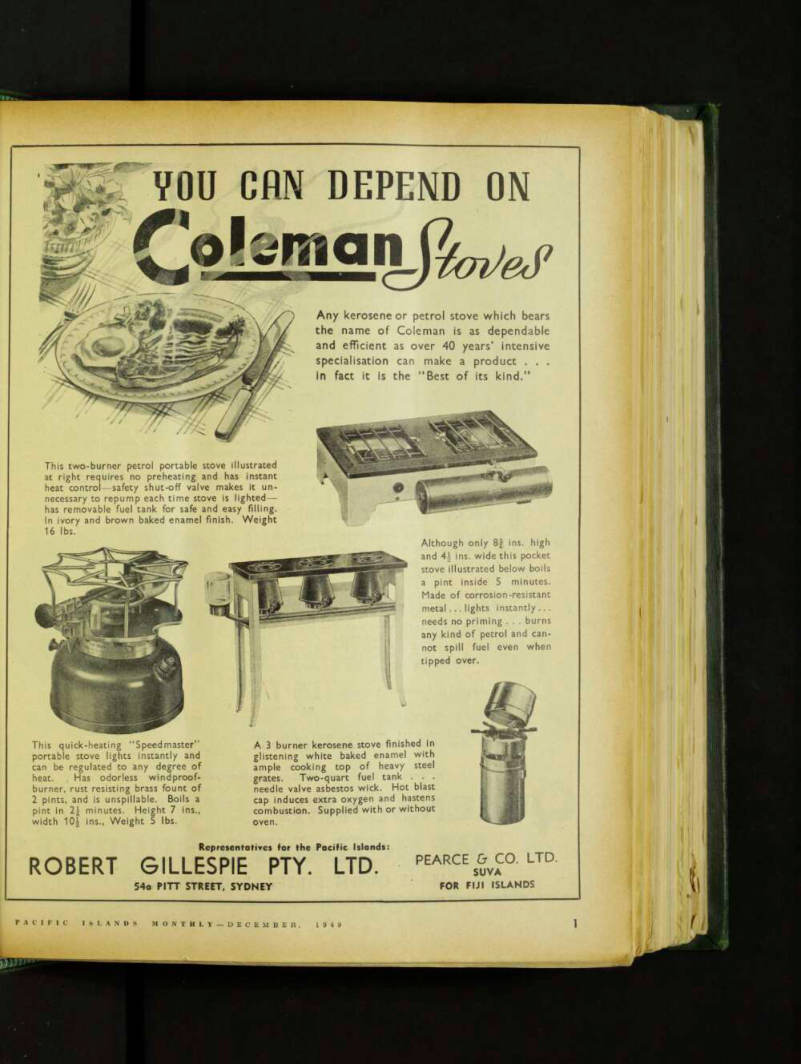
Any kerosene or petrol stove which bears the name of Coleman is as dependable and efficient as over 40 years’ intensive specialisation can make a product . . .
In fact it is the “Best of its kind.’* This two-burner petrol portable stove illustrated at right requires no preheating and has instant heat control—safety shut-off valve makes it unnecessary to repump each time stove is lighted— has removable fuel tank for safe and easy filling.
In ivory and brown baked enamel finish. Weight 16 lbs. *
i|F I
Although only 8| ins. high and ins. wide this pocket stove illustrated below boils a pint inside 5 minutes.
Made of corrosion-resistant
metal... lights instantly ...
needs no priming . . . burns any kind of petrol and cannot spill fuel even when
tipped over.
This quick-heating “Speedmaster portable stove lights instantly and can be regulated to any degree of heat. Has odorless windproofburner, rust resisting brass fount of 2 pints, and is unspillable. Boils a pint in 2J minutes. Height 7 ins., width 10£ ins., Weight 5 lbs.
A 3 burner kerosene stove finished in glistening white baked enamel with ample cooking top of heavy steel grates. Two-quart fuel tank . . . needle valve asbestos wick. Hot blast cap induces extra oxygen and hastens combustion. Supplied with or without oven.
Representatives for the Pacific Islands:
ROBERT GILLESPIE PTY. LTD
540 PITT STREET, SYDNEY
PEARCE & CO. LTD
SUVA
FOR FIJI ISLANDS
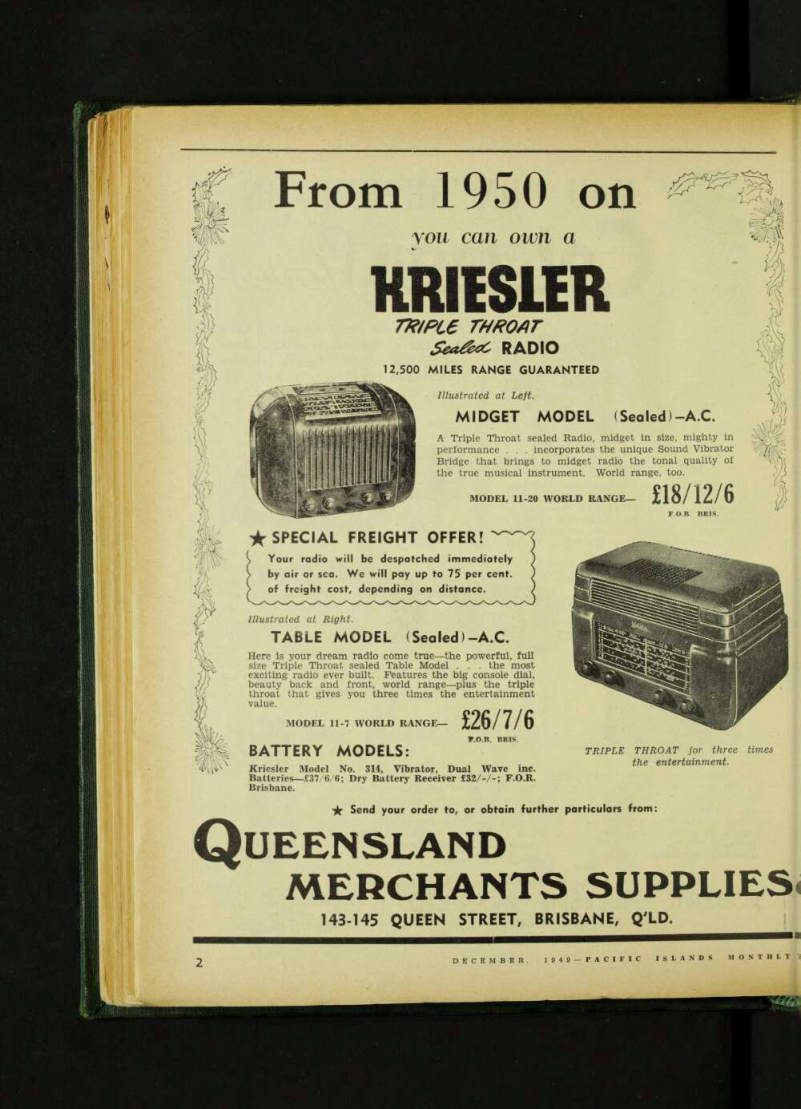
From 1950 on
you can own a
KRIISLER
TK/PCe TH
Sea£*C RADIO
12,500 MILES RANGE GUARANTEED
Illustrated at Left.
MIDGET MODEL
(Sealed )-A.C
A Triple Throat sealed Radio, midget in size, mighty in performance . . . incorporates the unique Sound Vibrator Bridge that brings to midget radio the tonal quality of the true musical instrument. World range, too.
MODEL 11-20 WORLD RANGE—
£IB/12/6
F. 0.8. BRIS.
* SPECIAL FREIGHT OFFER!
Your radio will be despatched immediately by air or sea. We will pay up to 75 per cent, of freight cost, depending on distance.
Illustrated at Right.
TABLE MODEL
(Sealed )-A.C.
Here is your dream radio come true—the powerful, full size Triple Throat sealed Table Model . . . the most exciting radio ever built. Features the big console dial, beauty back and front, world range—plus the triple throat that gives you three times the entertainment value.
MODEL 11-7 WORLD RANGE—
£26/7/6
BATTERY MODELS:
F. 0.8. BRIS.
Kriesler Model No. 314, Vibrator, Dual Wave inc.
Batteries—£37/6/6; Dry Battery Receiver £32/-/-; F.O.R.
Brisbane.
TRIPLE THROAT for three times the entertainment.
Send your order to, or obtain further particulars from:
Queensland
MERCHANTS SUPPLIES
143-145 QUEEN STREET, BRISBANE, Q'LD.
index to Advertisers
Achun, Gabriel . . 91 Alois Akun & Co. ...73 Aluminium Union 34 Amplion (A/sia) . 37 “Aspaxadrene” . 88 Australian Inter state Agencies, 30, 59 Baker, W. Jno.
Pty., Ltd. ... 45 Bank of NSW . . 23 Bethell, Gwyn & Co 78 Blaxland Rae Pty. 103 Blundell, Spence . 58 Bovril 85 Breden, Wynne S. 25 Broomfields, Ltd. . 42 Brown, Thomas & Sons, Ltd. ... 33 Brunton & Co., Ltd. 89 Budge, James, Ltd. 65 Bunting, A. H.
Ltd 84 Burns Philp (NG) . 57 Burns Philp (NH) . 34 Burns Philp (SS) 29 Burns Philp Trust . 95 Caine’s Studios 31 Carpenter, W. R. & Co., Ltd. 44, cov. iv.
Carpenter, W. R. (Fiji), Ltd., . . 47 Carrlock Co., Ltd. 62 “Charmosan” 24 Classified Advertise ments 103 Colonial Meat Co. 32 Colyer Watson (NG) Ltd. ... 16, 71 Crammond Radio . 96 Cunningham. R. H. & Co 22 “Cystex” ... 77 Dangar, Gedye & Malloch, Ltd. . . 3 Davison Paints, Ltd. 65 Donaghy, M., & Sons Pty., Ltd. . 37 Donald, A. 8.. Ltd. (Auckland) ... 67 Donald, A. 8., Ltd., (Rarotonga) ... 61 Dunlop Rubber, Ltd 94 Electrolux ... 44 Etablissements Donald (Tahiti) 69 Export Soap Mfg.
Co .83 “Flit” . . . . ; 17 Ford Sherington Ltd 73 Garrett, Davidson & Matthey Pty., Ltd 104 Garrick Hotel . . 46 Gilbey, W. & A.
Ltd 60 Gillespie Bros.. Ltd. 62 Gillespie, Robert Pty., Ltd. . . .1, 86 Gillespie, Robert (NG), Ltd. . 35, 97 Gordon’s Gin ... 82 Gough & Co., E. J. 24 Grand Pacific Hotel 4 Gregory, A., Pty., Ltd 66 Grove & Sons, W.
H., Ltd 77 Halvorsen Lars, Sons Pty., Ltd. . 78 Hardman & Hall 16 Heinz & Co. Pty., Ltd 21 Hemingway & Robertson Ltd. . . 74 Herco Pty., Ltd. . 38 Hoover, Francis . . 93 Horlicks Pty., Ltd. 63 International Trad ing Co. Pty.. Ltd. 86 Johnson, J. Stanley Pty. Ltd 100 Kasper Refriger tors Pty.. Ltd., 36, 90 Kennedy, Captain . 30 Kerr Bros. Pty., Ltd 79, 103 Kolynos, Inc. ... 31 Kopsen, W. & Co. 75 Kosak, Robert . . 74
Kraft Walker Cheese Co. Pty., Ltd 98 Kui, George ... 87 Kwong Chong Bros. 79 Maclntyre, Thomas & Co., Ltd. ... 70 Mail Publicity Co. (Books) . . . . 18, 61 Maloney, N. F., & Co 38 Mcllrath’s Pty., Ltd. 93 “Mendaco” ... 67 Merrillees, J. C., Pty., Ltd. . . 18, 98 Millers, Ltd. ... 42 Morris, Hedstrom, Ltd 12 Motor Tractors Pty., Ltd . 28 Nelson & Robertson 26 “Nixoderm” ... 87 Nordman, Oscar G. 46 NZ National Air ways Corporation 48 Pacific Islands Society 35 Pacific Islands Trading Co. ... 25 Pacific School of Music ... 75 Pan American Air ways. Inc., Ltd. . 14 “Pinkettes” . .29' Qantas Empire Air ways, Ltd. . cov. ii.
Qld. Insurance Co., Ltd 41 Qld. Merchants Supplies ... 2, 102 Reed, William E. . 101 Riverstone Meat Co. Pty., Ltd. . 27 Robinson, G. H., E. & 1., Pty., Ltd. . 15 Rohu, Sil . . . .24 Scott, J., Pty., Ltd. 94 Shell Co. of Aust., Ltd 45 Sherwin - Williams Co. (Aust.) Pty., Ltd 19 Southern Pacific In surance Co.. Ltd. 83 Spartan Paints, Pty., Ltd 68 Steamships Trading Co., Ltd. . . 43. 64 Stewarts & Lloyds 47 Stratton & Co., Ltd 89 Sullivan, C., Pty., Ltd 22, 66 Swaan, Dr. Wm. . 42 Swallow & Ariell Ltd 102 Tallerman & Co. . 43 Taylor, Allen, & Co. 46 Thornycroft, Ltd. . 81 Tilley Lamp Co,, Ltd. (England) . 72 Tillock & Co., Ltd. 90 Tongan Photos Bureau ... 67 Tooth & Co. . cov. iii.
Trans Oceanic Air ways Pty., Ltd. . 20 Tyneside Engineer ing Co., Ltd. . , 41 Union Mfg. & Ex port Co., Ltd. . , 80 USL Batteries . . 82 Vacuum Oil Co., 17,40 Ventura Trading Co. Pty.. Ltd. 17, 26, 82, 99 Vincent Chem. Co. 39 Watson, Victor, Ltd. 92 Watson, Wm. H. . 59 West, Harry ... 71
Williams., Dr. . . 79
Willreed Agencies Pty., Ltd. ... 91 Wills, W. D. & H.
O. (Aust.), Ltd. . 76 Wright, E„ & Co., Ltd 33 Wright & Co. . . 101 Wunderlich Ltd. . 70 Yorkshire Insur ance Co., Ltd. . 69 Young, A. H., & E. 39
Advertisements & other items, p. 5 (1 item)
“Hargan’S”
Let ONE Man—
—do the work of Two!
*r :
fSjgj3
(832 . . . with a
“HARGAN’S”
(Patented) Mobile Saw Outfit
Suitable for farm and station use, because of the many jobs it can perform, the “Hargan’s”
Mobile Power Saw is the ideal type of docking saw. It’s economical for the cutting of mine props, caps and sleepers, and is invaluable to timber cutters.
The high driving power is provided by a British-built engine, which also makes it economical to operate. The “Hargan’s” will take up to a 38-inch saw, and the twin V-belt drive transmits the power to the saw flexibly yet positively.
• HARD SERVICE.
• TROUBLE - FREE
OPERATION.
• EASILY HANDLED
BY ONE MAN.
SOLE AGENTS :
DANGAR, GEDYE & MALLOCH LTD.
10 YOUNG STREET, SYDNEY
Telephone 8U5095. Code Address “DANGAES. 1
In This Issue:
Editorial; “Goodbye to Socialism— and All That” 5 Copra Outlook—UK Offer to Fiji for 1950 7 New Guinea Gets Cars from China 7 Effect of NZ Election on W. Samoa 7 Migrant Doctors for Papua-New Guinea 8 Trout for New Guinea 9 Qantas Extend Air Services in NG 9 No Japs Wanted in South Pacific— Impertinent Mass-Migration Plan 9 W. Samoa Against British Preferen tial Tariff 10 Fiji Police Arrest Indian Speedsters 10 Fiji Land-Agitation discredited by Governor 11 Snaring Generals and the NG War 11 Giant Snails Invade New Ireland .. 11 South Pacific Commission —Substantial Progress in One Year 13 Copra Sacks May Be Scarcer and Dearer Next Year 16 Patrol Now Examining Central Western Region of New Guinea .. 16 Pacific Franc-Devaluation Causes Irritation in French Colonies ... 17 Overwhelming Response to Fiji’s TB Fund 19 Death of Edward Farrell—Timber Lease Case 21 NZ and France Have Air Agreement 21 Rabaul Roundabout 22 Nauru’s Sulky Communities 23 Tai Shek’s Appeal Case on December 15 24 Red Tape in French Oceania —Discouragement of Casual Travellers 25
Fiji Doesn’t Need Export Tax Now 29 Australian-Samoan Trade Good Chance Missed 30 Millions for Fiji—Development and Social Services 31 All Quiet on Fiji’s Industrial Front — Governor’s Review 33 Fiji Representatives at Empire Games 34 Dutch Leaving Indonesia 35 Possible Pay Rise for Fiji Public Ser vants 35 Morris Hedstrom Scholarship Award, 1950 38 Tahiti Wants Tourist Traffic 39 Solomon Islanders at Youth Con ference 39 Tongan Traditions Observed at Im portant Nukualofa Wedding .. .. 41 Newsletter from NG Highlands ... 42 Western Papua Notes 43 What Works and Housing Dept. Has Done in Samarai 45 Devaluation Means Dear Flour and Petroleum Products for Fiji .. .. 46 Last Americans Leaving BSI .. .. 46 Are Pacific Candlenuts Unsaleable? 47 Vila-Noumea Radio-telephone .. .. 47 Talk-Talk 49 Highland Skyways and Highland Lassies 50 Pago Pago Disillusioned These Hope ful Pilgrims 51 Come in to Kutubu 52 Tropicalities 53 Lets Explore New Holland 54
Of Falling Leaves, and Trees and Other Things 54 Where Dead Ships Lie 56 Modern Fijian Examined by Old Resident 58 Population of Motouriki, Fiji, Will Be Mass-Educated Next Year .. 61 Baptists Enter the Mission Field in NG Highlands 63 W. Samoa Legislative Assembly Keenly Debates Territory Affailrs 66 Gentle Art of Dentistry—NG High lands Style 73 Rising Cost of Fiji Health Service .. 74 Liquor Laws Fiji Government Abandons Thorny “Equality” Bill 75 Plane and Shipping Timetables ... 77 New Set-up for W. Samoa Public Service 83 Big BGD Dredge Sinks 87 The Month in Moresby 89 Taking Movies to Dreketi 93 New Ireland Notes 95 Rabaul Weddings and Travellers .. 97 Cutter Lost on Reef in Fiji 98 New Cabaret - Restaurant for Rabaul 99 Norfolk Is. Notes 102 Commercial, Markets, etc 104 OBITUARY: Edward Farrell, 21; Sister Marie Jean Baptiste, 23; Capt.
W. H. Luff, 38; E. C. Vider, 50; D. H.
Ward, 65; H. E. Nicholson, 71; H. B.
Harricks, 75; K. W. March, 83; William J. Hettig, 85.
INDUSTRIES; Oil, 6; Cocoa, 7; Copra, 7, 21; Gold, 6, 24; Pearling, 78.
ORGANISATIONS: NG Memorial Schol arship Fund, 7; New Guinea Women’s Club, Sydney, 8.
Advertisements & other items, p. 6 (1 item)
BflS*
r: n Wi
TA v s
Pacific Islands monthly
The Newspaper-Magazine of the South Seas
ißegistered at the G.P.0., Sydney, for transmission "by post as a newspaper 1 Published Once Each Month and Circulated in Australia and New Zealand and in the following Pacific Territories and Islands Groups:
Australian Territory of Papua.
Trustee Territory (Australia) of New Guinea.
Australian Territory of Norfolk Island.
New Zealand Territory of Cook Islands.
Trustee Territory (NZ) of Western Samoa.
British Colony of Fiji.
British Solomon Islands Protectorate.
British Protectorate of Tongan Islands.
British Crown Colony of Gilbert and Ellice Islands.
Trustee Territory of Nauru.
British and French Condominium of New Hebrides.
French Colony of New Caledonia.
French Colony of Oceania (Tahiti, etc.), American Territory of Eastern Samoa, American Territory of Hawaiian Islands.
Owned and Produced by Pacific Publications Pty., Ltd., Union House, 247 George Street, Sydney.
Telephone: General Office and Advertising, BW 5037.
P.O. Box 3408
Registered Address for Telegrams, Radiograms, and Cables: “Pacpub,” Sydney.
Contributions.
Articles, Stories, and Photographs dealing with Pacific Islands subjects are invited and will be paid for on publication.
Subscription Rates.
Per Annum, Pre-paid, Including Postage.
In Australia, New Zealand, Fiji New Guinea, Papua, Western Samoa, Cook Islands, Tonga, British Solo mons, Gilbert and Ellice Colony, Nauru, New Hebrides, and United Kingdom 18 0 Elsewhere $2 50 £llO Single Copies 19
Editor and Publisher:
R. W. Robson, P.R.G.S.
Assistant Editor: JUDY TUDOR.
General Office: Union House, 247 George Street, Sydney, Telephone: BW 5037.
Business Manager: Selwyn Hughes.
Representative In London.
J. T. Wallis, Coronation House, 4 Lloyd’s Avenue, London, E.C.3, from whom may be obtained copies of Pacific Islands Monthly, Pacific Is. Year Book, advertising schedules, etc
Representative In U.S.A.
Pacific Islands Trading Co., 244 California St., San Francisco, U.S.A,
Agents.
The following are authorised to receive sub scriptions for Pacific Islands Monthly:— Burns, Phllp & Co., Ltd., and Burns Philp (South Sea) Co., Ltd. All branches.
W. R. Carpenter & Co., Ltd. All branches.
Morris, Hedstrom, Ltd. All branches.
Steamships Trading Co., Papua. All branches.
Steele’s Central Store, Suva, Fiji.
C. A. Adams, Lautoka, Fiji.
Cook Islands Trading Co., Rarotonga, Cook Is.
Oscar Nordman, Papeete, Tahiti.
Islands Branches and Representatives of W. H.
Grove & Sons, Ltd., Auckland, New Zealand.
Ed. Pentecost, Noumea, New Caledonia.
Societe Gubbay Kerr et Cie, Noumea, New Caledonia.
Vol. XX. No. 5.
December, 1949
r 1/9 Per Copy.
Price \ Prepaid, p.a.; 18/- Aust, ( In USA, p.a.: $2.50.
Goodbye to Socialism—and All That!
THE defeat of the Socialist Governments of New Zealand (November 30) and Australia (on December 10) is an event of moment in the history of the British Empire and of international relationships, because it is an almost certain indication of the defeat of the British Socialist Government early in the coming year.
The Socialist administration of the British Empire has done enormous, almost in calculable, harm to the Empire, and to the world generally; but it is not too late to undo some of that harm, and to intro duce a new note into international affairs.
When World War II ended, the vic torious Anglo-American partnership was completely in command. Their duty was clear. The cataclysmic events of 1939- 45 had thrown upon them an obligation to police the world, restore order to the nations and save humanity from the tor tures of an economic collapse. Instead of that, the British Empire—except Canada, of course—virtually deserted the United States, and went high-tailing off in a mad and giddy chase after “Socialism in our time.”
While the British countries have been learning, the hard way, that Socialism is not practicable—especially in a post-war period—the Americans have been left to carry the responsibility for world orderli ness; with the result that the Muscovite plot against Western civilisation has been carried to a point that many observers find terrifying. If there is to be a World War 111 (Western Democracy against Eastern Totalitarianism), blame for the disaster will be placed squarely upon the
British Socialists and their New Planner camp-followers. The Anglo-American partnership of 1945, had it continued, would have put the Moscow Communists very firmly into their proper place, and kept them there.
The Australian and New Zealand voters have pointed the way for the British. A British anti-Red Government will —(a) destroy the forces that have been con niving at the disintegration of the British Empire; (b) establish a British Commonwealth understanding that will enable the British Empire to speak with one authoritative voice in international affairs; (c) seek a much closer relation ship with the United States; (d) chal lenge the evil power of Moscow: (e) re store the pride of the British people in their flag, their ancient institutions, and their destiny.
THE British people do not take kindly to Socialism. Their character, their history and their natural viewpoint are opposed entirely to the subversion of the individual to the State.
The swing towards Totalitarianism in the three principal British countries, at the end of World War 11, was an amazing development. These nations, which had sacrificed so much and performed so gal lantly in the fight for personal freedom, surrendered themselves in an extra ordinary fashion to the dictatorship of Leftist visionaries. No one who knew British history expected the Red regime to last.
It perhaps was a desirable thing, in
this epoch of swift change, that the British should learn the fallacies of Socialist doctrine, and discover that Com munism is merely the logical develop ment of Socialism; but it was unfortunate for the world that they should have chosen the immediate post-war period for the great experiment.
If the Australian and New Zealand elec tion results mean anything, they mean that the British Empire is finished with Socialism for at least a generation; and this, in turn, will put new hope into the hearts of the millions of solid British people throughout the world, who have been literally sick with shame at what they have seen happening in the Empire during the last five years.
BUT we must realise that there was more in the Great Socialist Experi ment than mere post-war irresponsible ness. If it meant anything, it meant that the masses of common men were in revolt against the Money Power which virtually had taken control of the world’s affairs in the ’twenties and ’thirties, and which led to World War 11.
If we have any statesmanship left in the Empire, we should accept the fact that unrestricted Money Power (or Indivi dualism, or Private Enterprise) may be just as great a menace to our personal liberty and national security as is the Red Muscovite.
Effect In Pacific Islands
IN the Pacific Islands, the end of British Socialism is of importance, and will be generally welcomed. No communities have suffered more under the controls and regulations of rampant bureaucracy than the vote-less and voice-less people
of the biggest South Pacific Territories.
They have had to look on helplessly while well-meaning but generally impractical New Planners have marched complacently around their islands, introducing new un tried principles, deifying the natives and placing obstruction and frustration in the way of anything resembling large-scale private enterprise.
In Papua-New Guinea, for example, Socialism has — • Set up the Production Control Board, to buy the planters’ produce, and protect them from “the piracies and robberies” of the Big Firms—but which actually takes more from the planters, in the way of special charges on their copra, than they ever lost to the Big Firms. • Introduced a new contract system for native labour, so as to “save the natives from slavery”—but which actually has achieved nothing good for the natives, and has so heavily increased the cost of labour to the white employer that only the main tenance of high rates for copra, gold, etc., will allow him to carry on. • Established a monopoly for State owned coastal ships—and thereby has ac complished nothing except a general lowering of service efficiency and a marked increase in transport costs. • Created a vast, new organisation for the development of the Territories and the welfare of the natives—so that the Aus tralian taxpayers must now find nearly £4,000,000 per annum for the Territories, which under the bad old days of private enterprise were about self-supporting.
And so forth, ad nauseam. From Daru eastward to Rarotonga, and from Norfolk Island northward to the equator, there is scarcely one word to be heard in favour of the Socialist-inspired administration of the tropical islands; but there are thousands of frustrated and irritated resi dents who will cheer the announcement of Socialist defeats, because they expect that the re-establishment of middle-class governments in the British countries will mean the re-establishment of better living, trading and transport conditions in the Pacific Islands generally.
IT would be foolish to suggest that the end of Socialism means that all those plans for native welfare and advancement are to be abandoned. There has been no indication of any such change in policy.
On the contrary, it may be taken as cer tain that the new Governments will carry on with all enterprises designed to assist the native to higher standards of life.
But it is equally certain that those plans generally will be revised, so that they may be tied more closely to realities, where necessary.
R. W. Robson and Judy Tudor, 247 George St., Sydney, are responsible for Australian elec tion comments.
Search For Oil In
Papua
Residents Upset By Shortening
of Staff
From Our Own Correspondent
Moresby, Dec. 6.
RESIDENTS are concerned about re ports that the management of the Australasian Petroleum Co. —the giant organisation that is conducting a search for oil in Papua—is putting off staff by the dozen.
It is stated that the Oroi rig is closing down, after boring to a depth of 5,516 feet. Some people regard this as a sign of a general narrowing of APC’s opera tions.
A few weeks ago, high officials of the Anglo-Iranian Oil Co. and Standard Vacuum Oil Co. were in Papua, looking over the field of search operations; and it was reported at the time that they favoured a policy of concentrating the search at certain points that seemed to offer the best prospects of success. What the local residents call the APC’s “austerity campaign” began about that time.
Story That Good Oil Prospect
Was ‘Killed’
MEANWHILE, in Sydney, on December 7, Mr. E. J. Ward (Australian Minis ter for Territories) said he had strong evidence that a huge oil combine had deliberately frustrated development of an oil find in New Guinea.
“The operations occurred in territory where Australian oil-search companies are not functioning. A foremost topograph ical surveyor and oil technologist, em ployed by the combine, discovered oil bearing country which, from a 2,000 ft. shaft, was productive of oil,” said Mr.
Ward.
“However, he was instructed not to bore deeper than 500 ft.—a depth which the oil combine executives knew would be unproductive of oil in this area. The expert was told by the company to seal the shaft-hole and move expensive equipment on the site to another site
which was the crater of an extinct vol cano.
“He bitterly protested to his employers, pointing out that, first, if he were allowed to proceed he would produce huge quan tities of oil for them, and, secondly, it was a waste of time drilling in the crater. He drilled fruitlessly in the crater and pro tested again to the company, which then summarily dismissed him.”
Mr. Ward said that this man who had had many years’ experience in the oil fields of America, Persia and Burma, is now dead, but letters, written prior to his death, are in existence, protesting against the treatment he had received from the company and the manner in which his efforts to obtain oil had been deliberately frustrated. These letters describe the exact area where the original shaft was sunk.
The Search Will Go On
A SYDNEY authority said on December 8 that there was no suggestion what ever of the abandonment of the oil search in Papua. One great problem there was insufficiency of transport. By reducing the rigs (boring installations) from five to three, the Cos. found it could make better and more economical use of transport. Another factor was that de valuation had automatically made nearly all supplies. 25 per cent, more costly. The most important recent development was the recent decision to increase the issued capital of the Cos. from five to ten million pounds.
Mr. E. J. Thomsett For Rabaul
MR. E. J. THOMSETT, who will be re membered as a Director and Sec retary of W. R. Carpenter & Co. (Fiji) Ltd., has now accepted an appointment to the Board of Directors of the New Guinea Company Limited, Rabaul.
Recently, he has been associated with W. R. Carpenter & Co. Ltd. Sydney, who entertained him at a farewell luncheon held in his honour at the Wentworth Hotel, Sydney, on November 21.
Mr. Thomsett departed from Sydney by Qantas aircraft on November 30 for Rabaul.
Mrs. Thomsett and their youngest daughter are to follow early in the new year.
We Try Again!
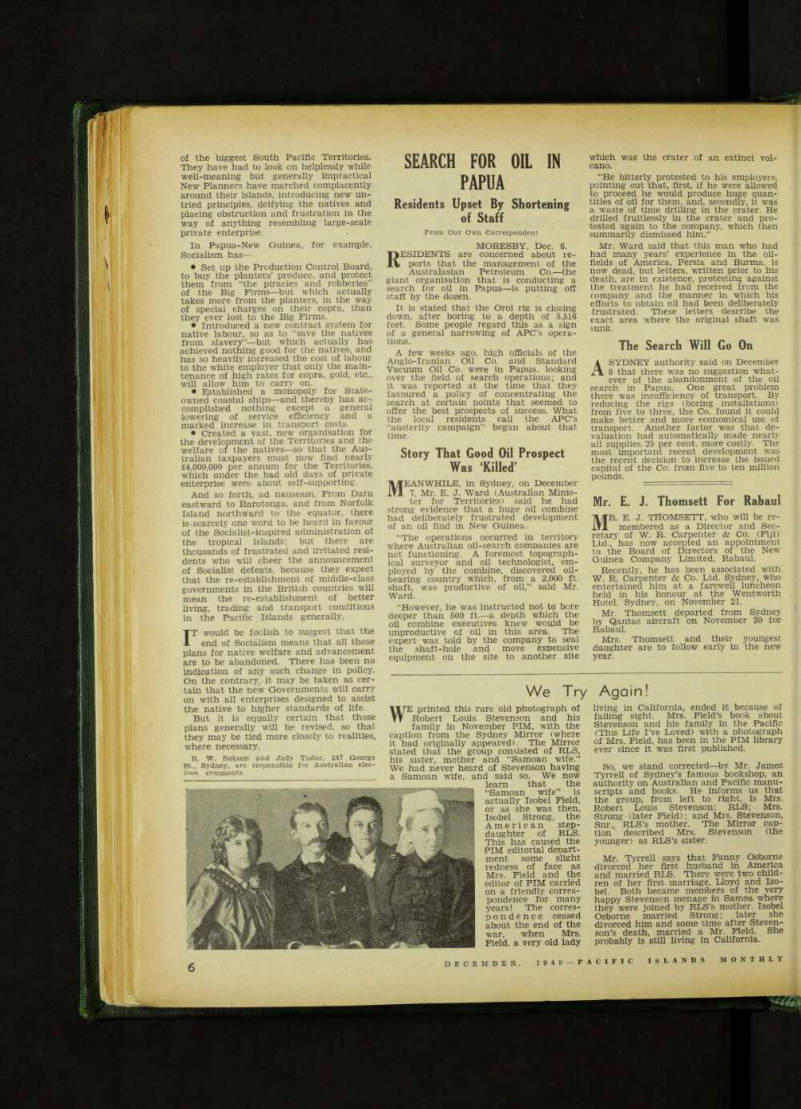
I¥7E printed this rare old photograph of TT Robert Louis Stevenson and his family in November PIM, with the caption from the Sydney Mirror (where it had originally appeared). The Mirror stated that the group consisted of RLS, his sister, mother and “Samoan wife.”
We had never heard of Stevenson having a Samoan wife, and said so. We now
learn that the “Samoan wife” is actually Isobel Field, or as she was then, Isobel Strong, the American step daughter of RLS.
This has caused the PIM editorial depart ment some slight redness of face as Mrs. Field and the editor of PIM carried on a friendly corres pondence for many years! The corres pondence ceased about the end of the war, when Mrs.
Field, a very old lady
living in California, ended it because of failing sight. Mrs. Field’s book about Stevenson and his family in the Pacific (This Life I’ve Loved) with a photograph of Mrs. Field, has been in the PIM library ever since it was first published.
So, we stand corrected—by Mr. James Tyrrell of Sydney’s famous bookshop, an authority on Australian and Pacific manu scripts and books. He informs us that the group, from left to right, is Mrs.
Robert Louis Stevenson; RLS; Mrs.
Strong (later Field); and Mrs. Stevenson, Snr., RLS’s mother. The Mirror cap tion described Mrs. Stevenson (the younger) as RLS’s sister.
Mr. Tyrrell says that Fanny Osborne divorced her first husband in America and married RLS. There were two child ren of her first marriage, Lloyd and Iso bel. Both became members of the very happy Stevenson menage in Samoa where they were joined by RLS’s mother. Isobel Osborne married Strong; later she divorced him and some time after Steven son’s death, married a Mr. Field. She probably is still living in California.
Copra Outlook
General Fall of Ten Per Cent Likely in Coming Year
THE free market price of first class copra has been varying between £6O and £7O stg. per ton cif, European ports.
Philippines copra, during the past three months, has ranged between 170 and 185 US dollars, per ton, cif., European ports.
Indications are that there is a slight easing in the world price of copra, and it is expected that the 1950 guaranteed price of the British Ministry of Food—which regulates the market now in all British and Australian Pacific Territories— will be down about 10 per cent, on the 1949 figure, which was around £4B Stg. per ton, on wharf, Island port,—equal to £54 Fijian, and £6O Australian. With local Governmental deductions, this has worked out at about £49 per ton Fijian, and £4B per ton Australian in the pockets of producers.
As there is a change of Government in Australia, Papua-New Guinea copra producers should make a strong appeal to Canberra to forego some of the heavy and, as yet, unjustified deductions made by Canberra from the British-guaranteed price—deductions equal to at least £l2 Australian per ton. Papua-New Guinea planters in 1950 should get another £4 or £5 per ton from the Australian Govern mental authority, and this would suffice to take care of the expected reduction of 10 per cent, in the British-guaranteed price.
PLANTERS also should make a de termined effort to obtain something official from Canberra about the so-called Stabilisation Fund. There must now be a huge sum there —some estimates ex ceed £500,000 —and it belongs to the planters, who have contributed to it at the rate of from £5 to £8 per ton.
Socialist Minister Ward has stubbornly refused to give any information to the planters about what is actually their own money; but a non-Socialist Minister will not be actuated by hatred of private enterprise and profit, and will give reasonable information about the Fund.
There has been no need of a Stabilisation Fund since Britain gave the 9-years’ guarantee, at the end of 1948.
Some planters expect that the Stabili sation Fund will be distributed among planters, in proportion to their tonnage contribution to the Production Control Board. Others favour the idea that, if and when copra prices fall below a designated figure, the fund should be used
to give producers a bonus of so much per ton of copra supplied. But whatever system is favoured, it is only fair and just that there should be some indication
of policy.
Mr. Ward’s system, of simply grabbing so much per ton from the planters, and hiding it away, without any indication of plan or purpose, is completely typical of Socialism, where the State is the ruthless dictator, and the individual does not matter.
There are indications that the Papua- New Guinea Production Control Board is being prepared for winding-up. Accord ing to Mr. Ward, that was to have taken place a year ago. But, after December 10, the removal of that particular limb of bureaucracy may be somewhat hastened.
Copra
Uk Offer For 1950
Fiji and Ceylon Negotiations
THE British Ministry of Food has offered £45 sterling for Fiji copra during 1950. This represents a reduction on the present price (£4Bstg.) of 6.2 per cent.
Under the Copra Purchasing Agreement the price has to be negotiated annually and must not be more than 10 per cent, higher or lower than the price paid the previous year.
The UK Ministry of Food has copra agreements with Papua-New Guinea, Cey lon, Western Samoa, some WPHC terri tories as well as Fiji. The price fixed for one territory will naturally affect the purchasing price in any of the others.
The Fiji Copra Board, which announced the UK offer on November 16, made this statement: — The chairman of the Fiji Copra Board, Mr. C, Harvey (Fiji Director of Agriculture), is in London in connec tion with the Sugar Conference and will take the opportunity during this visit of inquiring into the state of the copra market and of opening up discussions with the British Ministry of Food on the new price offer. No decision, of course, will be reached until the Fiji Board has had an opportunity of con sidering Mr. Harvey’s report.
It is understood that negotiations for the 1950 prices are now taking place between the British Ministry of Food and Ceylon and it is considered that the outcome of these discussions will reflect more clearly the present trend in world copra prices and assist the Board in its deliberations.
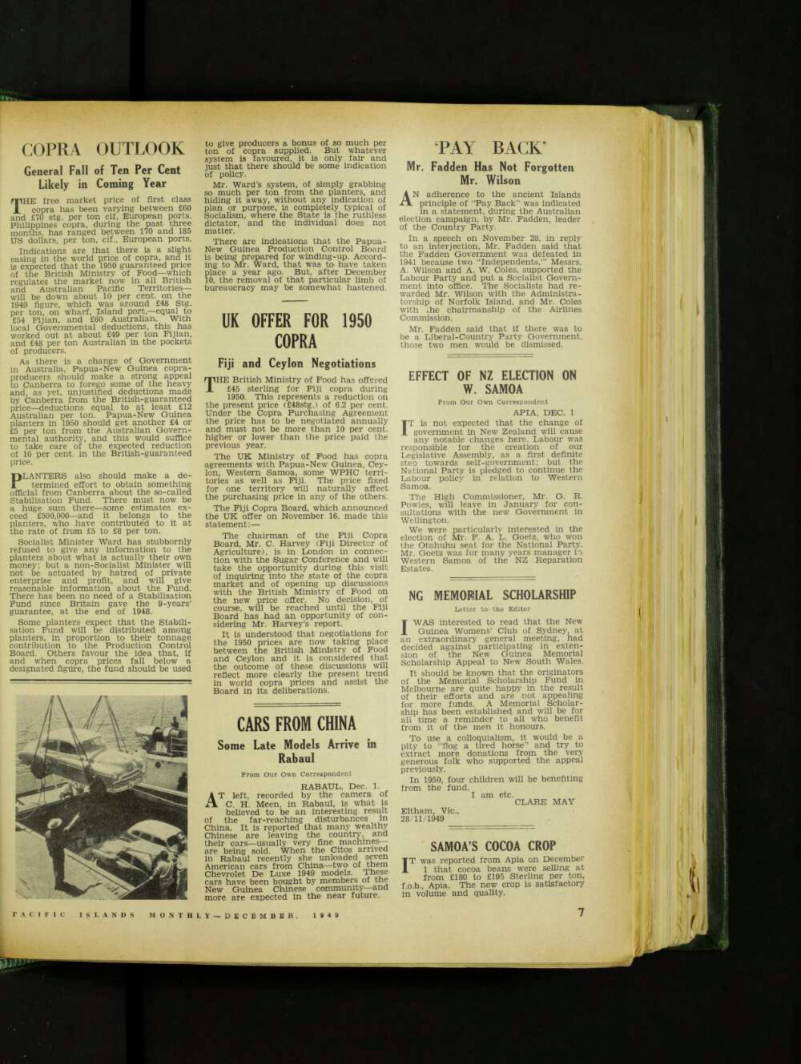
Cars From China
Some Late Models Arrive in Rabaul
From Our Own Correspondent
Rabaul. Dee. 1.
AT left, recorded by the camera of C. H. Meen, in Rabaul, is what is believed to be an interesting result of the far-reaching disturbances in China. It is reported that many wealthy Chinese are leaving the country, and their cars—usually very fine machines— are being sold. When the Citos arrived in Rabaul recently she unloaded seven American cars from China —two of them Chevrolet De Luxe 1949 models. These cars have been bought by members of the New Guinea Chinese community—and more are expected in the near future.
‘Pay Back’
Mr. Fadden Has Not Forgotten Mr. Wilson
AN adherence to the ancient Islands principle of “Pay Back” was indicated in a statement, during the Australian election campaign, by Mr. Fadden, leader of the Country Party.
In a speech on November 28, in reply to an interjection, Mr. Fadden said that the Fadden Government was defeated in 1941 because two “Independents,”’ Messrs.
A. Wilson and A. W. Coles, supported the Labour Party and put a Socialist Govern ment into office. The Socialists had re warded Mr. Wilson with the Administra torship of Norfolk Island, and Mr, Coles with ohe chairmanship of the Airlines Commission.
Mr. Fadden said that if there was to be a Liberal-Country Party Government, those two men would be dismissed.
Effect Of Nz Election On
W. Samoa
From Our Own Correspondent
Apia, Dec. 1
IT is not expected that the change of government in New Zealand will cause any notable changes here. Labour was responsible for the creation of our Legislative Assembly, as a first definite steo towards self-government; but the National Party is pledged to continue the Labour policy in relation to Western Samoa.
The High Commissioner, Mr. G. R.
Powles, will leave in January for con sultations with the new Government in Wellington.
We were particularly interested in the election of Mr. F. A. L. Goetz, who won the Otahuhu seat for the National Party.
Mr. Goetz was for many years manager in Western Samoa of the NZ Reparation Estates.
Ng Memorial Scholarship
Letter to the Editor I WAS interested to read that the New Guinea Womens’ Club of Sydney, at an extraordinary general meeting, had decided against participating in exten sion of the New Guinea Memorial Scholarship Appeal to New South Wales.
It should be known that the originators of the Memorial Scholarship Fund in Melbourne are quite hanpy in the result of their efforts and are not appealing for more funds. A Memorial Scholar ship has been established and will be for all time a reminder to all who benefit from it of the men it honours.
To use a colloquialism, it would be a pity to “flog a tired horse” and try to extract more donations from the very generous folk who supported the appeal
previously.
In 1950, four children will be benefiting from the fund.
I am etc.
Clare May
Eltham, Vic., 28/11/1949
Samoa’S Cocoa Crop
IT was reported from Apia on December 1 that cocoa beans were selling at from £lBO to £195 Sterling per ton, f.0.b., Apia. The new crop is satisfactory in volume and quality.
Papua-New Guinea
Migrant Doctors For
40 Men to Reinforce the
Medical Services
SEVEN “New Australians” (European migrants) who hold European medical degrees, which are not re cognised as yet in Australia, are either on their way to Papua and New Guinea, as officially-appointed medical officers, or they soon will be. They will be followed at an early date by others, until about 40 will be employed in the Australian Terri tories as medical officers.
Behind this arrangement there is evi dence of the bitter war that has been going on between the Australian Socialist Government, which has tried to nationalise medicine in Australia, and the British Medical Association doctors, who have resisted the plan successfully, and refused all co-operation. It was an im portant issue in the Australian general election, on December 10.
Details of the plan, and an indication of the background, were given in a state ment made in the Australian Parliament on October 27 by Minister Calwell (Immi gration). The following is the official (Hansard) report: “Mr. Edmonds: Has the attention of the Minister for Immigration been drawn to the reported shortage of medical staff in Papua-New Guinea? If so. will the Minister state whether any steps have been taken to alleviate that shortage by the appointment of suitably qualified per sons from among the new Australians who are being brought to this country.
“Mr. Calwell: I am aware of the needs of the medical services in Papua-New Guinea. The question relates to a subject which has been referred to on both sides of the House for some time past, which is, the necessity to use the services of new Australians to the greatest possible, de gree in conformity with their attainments, aptitudes and qualifications.
“But in order that persons with medical degrees from European universities, who are nationals of countries with which Australia has no reciprocal agreement for the recognition of such degrees, may prac tise, it is necessary that they should be come registered under State laws. There is no disposition on the part of some State authorities to grant such recogni tion, but this Parliament has power un der the Australian Constitution to regis ter such medical practitioners in terri tories of the Commonwealth such as Papua-New Guinea, the Australian Capi tal Territory, the Northern Territory, and Norfolk Island.
“The Department of Immigration has received requests from the Department .of External Territories for the services of a number of doctors. Dr. Gunther, who is chief of the medical services in Panua- New Guinea, has been in consultation with officers of my department about this matter.
“I think that about 40 doctors amongst the new Australians have been examined, and some have already been selected by Dr Gunther. Those who have had medi cal experience in Europe and who have satisfied Dr. Gunther’s requirements are to go td Papua-New Guinea as soon as possible. They number six and will be registered as medical practitioners in Papua-New Guinea and will attend to the needs of the natives of the territory.
The Minister for External Territories has been most anxious that the health of the natives should not suffer.
“The Government has tried in England.
Australia and in fact everywhere, to get
doctors to go to Papua-New Guinea, but has met with no success.
“It is hoped that ultimately all of the 40 individuals who I have mentioned will be appointed to practise in New Guinea.
I believe that such appointments will have some influence upon the attitude of the British Medical Association and the State medical boards on the question of afford ing recognition to university degrees in medicine and other branches of science held by these new Australians.
“The men who are to be appointed are all single men and will attend an orienta tion course at the Australian School of Pacific Administration, at Mosman, Syd ney, prior to proceeding to the Territory.
They will be registered for medical prac tice in the territory of Papua-New Guinea when they arrive in that territory.”
It was officially announced on Decem ber 3 that seven “migrant doctors” had been appointed; that practice in the ter ritory would not automatically guarantee them the right of private practice in Aus tralia; and that some of them intended to save most of their income to return to the mainland and attend a university to qualify for admittance to medical prac tice in the Commonwealth.
Two Years’ Indenture?
Letter to the Editor I'IHE arrival of 15 medical practitioners from Europe, to be followed later by a further 15, is announced by the Department of Public Health.
Will these gentlemen be under a two years’ indenture, as is the case with thousands of European migrants in Aus tralia?
If so, full particulars should be gazetted concerning their ration scale, hours of work, etc.; and an official explanation given as to why two years’ indenture is too long for a Papuan, but not for a European.
The matter should be taken up at once by the Rev. Dr. Burton, Professor Elkin, and similar critics of indenture.
I am, etc.,
G. T. Gemmell.
Mariboi Estate, Papua.
New Guinea Women’S Club
Sydney
FURTHER donations towards the cost of the Children’s Party were received by the New Guinea Women’s Club of Sydney in November-December.
The children’s party will be held on De cember 19 and adults’ party on December 22 at 6.30 p.m.
Mr. E. J. W. Browne, son of Mr. and Mrs. Cyril Browne, of Suva, Fiji, was killed in a motor cycle accident in Nov ember, in Auckland, NZ?, He joined the Royal New Zealand Air Force last year and at the time of his death was a machinist at the Hobsonville base. He was 20.
Previously acknowledged £26 3 6 Mrs. C. Helton 2 2 0 Mr. A. J. Gaskin 2 2 0 Cosmopolitan Trading Co., Rabaul 3 3 0 Mrs. W. Vallentine 1 1 0 Miss D. Stewart 1 1 0 Mrs. U. Adams 3 18 0 A. W. Anderson Pty.. Ltd 1 1 0 Robert Gillespie 5 5 0 Lady McNicoll (2nd don.) .. 1 1 0 Mr. & Mrs, Wauchope 2 2 0 Mrs. Parry 6 0 Mrs. Hopkins in 0 Mrs. D. Booth 5 0 0 Total £54 15 6
Fiji’S Gold Mines
Big Profits—And Very Big Taxes
IN the year ended June 30 last, the Em peror and Loloma gold-mines, in the Tavua district of Fiji, won just on £1,000,000 worth of gold, thus maintaining most satisfactorily Fiji’s third big in dustry—the other two, of course, being sugar and copra production.
The following table shows what ,the mines actually accomplished:—
Ever since the courage and enterprise of a Melbourne group, headed by John Wren and E. G. Theodore, established this rich industry on an ore that had been sneered at by most of the experts, the Companies have had a raw deal from tax-hungry governments—especially in the post-war, or Socialist, era.
In Australia, the profits of Australian gold-mines are free of income tax —as they should be, considering the enterprise needed to find gold, the risks taken, and the way in which the producers are mulcted in royalties, and so forth. But in Fiji the mines get no such concession —they are heavily taxed. Yet in recent years, the companies could not transfer their profits (already taxed) from Fiji to Australia, because Australia simply classi fied them as “oversea companies,” and insisted that their dividends were subject to a fearful slug. So the Directors, for years, wisely kept their profits, undivided, in Fiji.
Some of those profits were ear-marked for a scientific search for gold in Guadal canal, in the Solomons, where there are encouraging prospects. But when the new British Socialist set-up announced that, in the event of gold being found in the Solomons, the State would participate heavily in the returns, the directors simply closed down their Solomons enterprise, and cut their losses.
Now comes the third set-back. The Fiji Government already imposes an income tax on the companies, equal to 6/3 in the £; and the new system of calculating royalty rates imposed on the gold ex ported means that the gold-mines will be paying out in direct taxation no less than 50 per cent, of their gross income.
It is described in Australia as “a ludi crous situation, and it means that the gold industry, despite the comparative richness of the field, will be forced out of the Colony.”
The Emperor and Loloma Companies have been very good for Fiji, in an econo mic and social sense. They employ large numbers of Fijian and half-caste people, and they have taken pride in organising and establishing model villages and amenities for both those communities.
“The Fiji Government tries to tax us as if we were South African mining com panies,” said a manager to a PIM visitor, not long ago. “I bet they never saw model workmen’s villages like these around any African mine.”
The* accounts show that the company expect that, in this financial year, Loloma will pay £48,255 and Emperor £37,406 in taxation, to the Fiji Government.
Because of shortage of European miners and lack of ore, the crushing mill at the Cuthbert mine on Misima Island. Papua, ran only ten days in the period ended November 23. 250 tons were crushed, for 43 oz. of gold and 41 of silver.
Gold Won Profit Oz. Value (£F) £ (A) Emperor, 1948 55,417 588,494 56,>637 1949 59,241 574,255 76.202 Loloma, 1948 29,042 88.839 1949 29,781? 128.083
Trout For N. Guinea
“Operation Flying Fish”
ANEW experiment in air transportation was made at the end of Novem ber by Qantas Empire Airways, who flew 20,000 live trout to New Guinea. The aircraft, chartered by Mr, E. J. Hallstrom, took the fish to his Experimental Station at Nondugl, in the Highlands of New Guinea.
In order to keep the fish alive during the flight Qantas equipped a DC3 air freighter with special equipment driven by electric motors. A series of four special pumps provided continuous aeration of water, both in the air and on the ground.
The fish were carried in 18 five-gallon tanks, to which the air was supplied by special nylon hoses, each pump supplying nine cans with approximately four cubic feet of air per hour. Special diffusers in each can broke up the air supply to emit a fine stream of bubbles.
As an added precaution special air cy linders were carried to allow instant re placement of air should a pump failure occur. A control panel was installed in the aircraft to show warning lights in case of electric supply failure.
The fish arrived at Mascot, Sydney, from the Central Acclimatisation Society Hatcheries at Oberon at 9 p.m., and the aircraft departed at 9.30 p.m. on a non stop flight to Townsville. A supply of ice was available at Townsville for use should the water rise above the danger point of 70 degrees.
Well-known philanthropist E. J. Hall strom, who has already successfully de monstrated the transport of sheep by air, hopes that in a few years’ time the trout will add tourist value to the Highlands of New Guinea. Mr. Hallstrom’s son and a fisheries expert were in constant at tendance on the consignment. The fish were liberated in the mountain streams at Nondugl less than 24 hours after leaving Sydney.
Qantas Extend Ng Service
Qantas Empire Airways Have Ex
tended their internal air services in New Guinea to link Wewak, on the north-east mainland coast, direct with Rabaul.
Before the war Wewak, which had some importance as the port for the Sepik gold fields and the oil search that was being undertaken in the district, was on the main route of Burns Philp’s Sydney-New Guinea service. Although two BP ships have been back on the run for over two years, Wewak is no longer a port of call.
Communication with the rest of the Terri tory is maintained by small aircraft owned by private companies, and the small Government-owned inter-island ships which call at irregular intervals.
The new air service which will be operated by DCS aircraft should be of much benefit to local residents as well as to recruiters from New Britain. The We wak-Aitape hinterland is still one of the most fruitful fields of plantation labour, although it is not unusual these days for recruits to have to wait three months on the beach before transport to Rabaul can be arranged by ship.
The new QEA service leaves Lae every Wednesday morning. It calls at Madang and Wewak and then flies on to Rabaul.
It returns to Lae, direct, each Thursday.
Kokoda Trail Route
IN November Qantas opened another Papuan service from Port to Kokoda and Popendetta and return.
The route closely follows the Kokoda trail.
Impertinent Flan for Mass Migration
No Japs Are Wanted Here
Impertinent Flan for Mass Migration to South Pacific Lands
RICHARD HUGHES, who is a special correspondent in Tokio for the Syd ney Sun and Melbourne Herald, says that Japan hopes, with United Nation’s blessing, to be able to move five million of its people into the “empty Pacific lands” in the first five years after any peace treaty is signed.
Much has been said in the past 12 months of the Japanese leaders’ aspira tions in respect of Pacific migration. In the past, however, the common Japanese man or woman has shown a notorious re luctance to migrate. Before the war there were more avenues of migration open to them than there are now—the .Asian mainland, the Marianas, Carolines and Marshalls, etc. The great majority of Japanese preferred to stay on the over crowded homeland. As mentioned in the following article there is, even to-day, immediate room for six million Japs in their own largely unsettled northern-most island of Hokkaido.
It is an undeniable fact that the popu lation of Japan has increased by about 10 million in as many years and the re sults of this have yet to be seen. There are two schools of thought as far as “population pressure” are concerned. It has not yet been proved, however, that over-population alone will turn a naturally stay-at-home race into a pioneering, migrating one.
There may be approval of Jap leaders’ migration plans from some Asiatic rep resentatives of UN, But there are signs of returning political sanity in the Wes tern Democracies and in five years from now we can confidently expect that the starry-eyed theorists who have been in the ascendancy since the war will no longer represent us at UN.
Despite General MacArthur’s apparent change of heart, recently-arranged British Empire trade pacts with Japan and other indications that we are now expected to forgive our bestial enemy of four short years ago, there is not a European in the South Pacific, whatever his political beliefs, who will countenance Jap migra tion in this direction. If South America wants them, as has been indicated, let them go there. They are not wanted here.
Hughes’ article follows for the infor mation of readers.
Migrant Plan for Millions
JAPAN hopes, with United Nations ap proval, to move five million migrants into empty South Pacific lands in the first five years after any peace treaty is signed.
In addition, her leaders propose boldly to use Japan’s ever soaring birth-rate as an economic weapon on the world’s markets.
These aims are thinly masked in the long-awaited report submitted by the Japanese Population Council to Prime Minister Yoshida recently.
Following five months’ deliberation, the council of hand-picked experts has at last presented a series of recommenda tions for “absorbing” Japan’s bursting population, which was 66 million in 1930- 34, 72 million at the end of the war. 80 million at the end of last year, and will be 105 million in 20 years.
After perfunctorily endorsing birth con trol, the council suggests that other courses open to Japan are:— Recovery of Japan’s international trade.
Promotion of secondary or urban in dustries.
Training of “industrious and peaceful migrants.”
The areas which Japan has specifically marked down for migration are: Borneo, New Guinea (beginning with Dutch New Guinea), the Celebes, Halmahera and Ceram.
Let Them Go to Hokkaido
JAPAN’S leaders ignore the fact that there is immediate room for six million pioneers in Hokkaido, the beautiful but cold and unsettled northern most island of the Japanese homeland.
They recognise that birth control is a strange alien idea in Japan, and that any central government could easily stifle public interest in its widespread adoption.
And, anyway, they don’t want to check Japan’s population growth.
That is the central point on which all Japanese parties, from Prime Minister Yoshida’s conservatives and reactionaries to Sanzo Nosaka’s Communists, are in firm nationalistic agreement.
Members of the Japanese Population Council believe, further, that in any United Nations’ discussion on migration they could first count on the help of Asiatic nations like China, India and In donesia.
Then they could also count on trad itionally friendly South American countries like Brazil and Argentina, which have already declared willingness to wel come “Industrious and peaceful Japanese migrants.”
“Dutch New Guinea, populated now by 200,000 natives, could support at least 20 million Japanese,” says a private appen dix to the Population Council’s report.
“Japanese pioneers who successfully operated cotton and hemp concessions on the north coast of Dutch New Guinea know that untapped natural resources could yield rich supplies of high-grade lumber, resin and processed forestry pro ducts.”
Japan’s irrepressible birth rate conse quently becomes at once a challenge to White Australia fears of an Asiatic popu lation spill-over into the south and a threat to Western high-wage tariffs against Japanese sweat-rag trade com petition.
of Fiji
Promotion for P. D. Macdonald of Fiji
MR. P. D. MACDONALD, who held the post of Assistant Colonial Secretary, Fiji, has been appointed Colonial Secretary, Leeward Islands.
Mr. Macdonald, who is at present on leave in the United Kingdom, served in the Gilbert and Ellice Islands Colony as an Administrative Officer from 1932 un til 1940, when he was appointed an Assistant Secretary, Western Pacific High Commission. .
In 1942, he was seconded to Trinidad as Assistant Colonial Secretary, and in 1946 was transferred to Fiji.
The report of Mr. E. B. Rice, Director of Dairying, Queensland, on the Dairy Industry in Fiii, with particular reference to the costs of production of butterfat has been published as a Council Paper Copies are available at the Government Press, Suva. The price is 47-
Samoa Against British Preferential Tariff
Desire To Revert to Pre-1914 System
BEFORE the Western Samoa adminis tration was taken over by Germany in 1900, there was an ad valorem duty on all goods entering the country, to help pay government costs. Germany maintained the old system—an ad valorem duty on all goods, irrespective of country of origin—but increased the duty to 10 per cent, in 1901 and to 12 per cent, in 1909. Many goods came in free, and some—like liquor, tobacco and fire-arms —were specially taxed.
The New Zealand military administra tion followed the same system from 1914, until 1920, when the Mandate Govern ment functioned. Thenceforward, all goods with an origin in British countries were given a preference of 7i> per cent, over other goods. When World War II came, the rates of duty had climbed up to 17i per cent, on British goods and 25 per cent, on others, plus a heavy sur charge In mid-1949, the new Legislative As sembly of Western Samoa set up a Select Committee — “(a) To consider, in view of the statements and discussions at the Fourth Session of the United Nations Trusteeship Council, whether the existing British Preferential Tariff should be maintained or, if not, what principle in this respect should be adopted in determining rates of customs duties in future; “(b) To take evidence, on oath or otherwise in the discretion of the Select Committee, from, and ascertain the opinions of, representatives of the various sections of the community upon the existing Preferential Tariff and upon any desirable modifications thereto.’’
This Committee now has reported, and its conclusions are thus summarised: — 1. That the existing British tariff pre ference should be abolished: 2. That a new tariff should be drawn up providing for — (a) specific duties on certain lines of low value on which it is de sired to impose a high rate of duty (e.g., cigarettes, tobacco, petrol); (b) a general rate of ad valorem duty to be imposed on all goods not otherwise provided for, re gardless of their country of origin: (c) a lower rate of ad valorem duty to be imposed on certain speci fied staple lines, regardless of their country of origin. (d) a free list. 3. That there should be a single con solidated rate of duty in place of the present basic duty plus sur charge ; 4. That the Government should con sider the advisability of valuing all goods for the assessment of Cus toms due in terms of Samoan cur rency; 5. That the Government should con sider undertaking a thorough sur vey of the economic resources of the Territory, with special reference to the possibility of expanding existing industries and establishing new ones.
In its deliberations upon the form of tariff best suited to the needs of Western Samoa, the Committee has kept in mind two main principles:— 1. That any proposals which it might make should be designed so as to allow the Government to obtain the same amount of revenue, in proportion to import trade, as at present; 2. That the price of staple lines, prin cipally foodstuffs, should be kept as low as possible.
Editorial Note
AS Western Samoa is a New Zealand Trusteeship, the New Zealand Government probably will have to be consulted before any such far-reaching changes are made.
The newly-elected NZ Parliament is sharply critical of the Leftist influences which, since 1945, have been seeking the disintegration of the British Empire; and, if the Trusteeship Council’s tendency to interference in Samoan affairs is regarded as coming in that category, the Select Committee’s report will get short thrift in Wellington.
However, Trusteeship territories like Western Samoa have been given a new status since 1945, which seems to place them partly outside Imperial controls; and New Zealand probably will accept that viewpoint, and permit the implemen tation of the Report. NZ businessmen will not like it, however. The Western Samoa administration has cost NZ a lot of money, in special grants and subsidies—why, therefore, should New Zealand not get the benefit of trade with Western Samoa?
The trade figures (1947 are the last available) are worth quoting:—
British imports Into Samoa New Zealand £289,892 Australia 133,396 United Kingdom .. .. 120,671 Canada 98,701 Fiji 23,338 Other countries .. .. 18,093 Total British imports .. £684,091 Foreign Imports Into Samoa United States £224,890 Iran 7,379 Other countries .. .. 7,413 Total foreign imports .. £239,682 “The most important reasons why Samoa trades with these five British countries and the United States,” says the report, “are not difficult to find. They are the countries with which the Territory has reasonably good shipping connections.
All but the United Kingdom are within, or upon the borders of the Pacific; and the United Kingdom, owing to the scale of its trade with Pacific countries, operates regular and frequent trans-Pacific freight services. Samoa trades with these countries not so much because they pro duce what she needs —for other countries do that as well —as because they have means of sending their goods to Samoa with at least fair regularity and without unduly expensive trans-shipment.”
C. Sullivan Ltd. Extends To
America
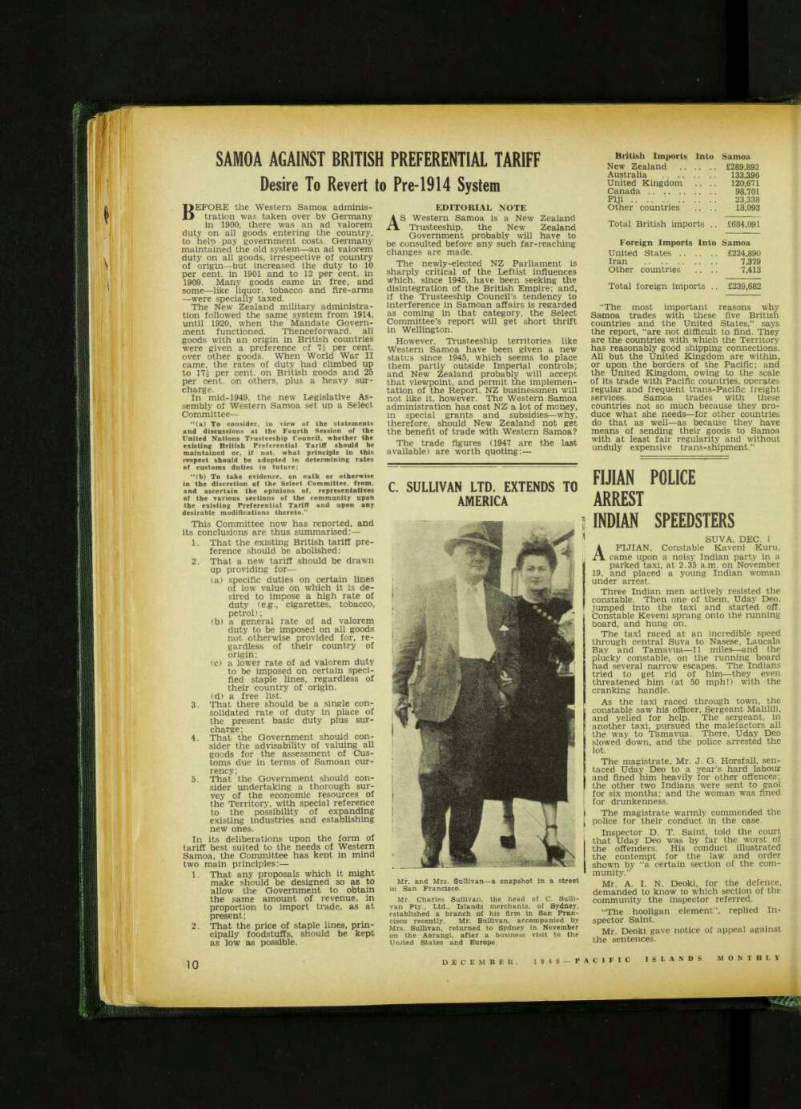
Mr. and Mrs. Sullivan —a snapshot in a street in San Francisco.
Mr. Charles Sullivan, the head of C. Sulli van Pty., Ltd., Islands merchants, of Sydney, established a branch of his firm in San Fran cisco recently. Mr. Sullivan, accompanied by Mrs. Sullivan, returned to Sydney in November on the Aorangi, after a business visit to the United States and Europe.
Indian Speedsters
Fijian Police
Arrest
Suva, Dec. 1
A FIJIAN, Constable Kaveni Kuru, came upon a noisy Indian party in a parked taxi, at 2.35 a.m. on November 19, and placed a young Indian woman under arrest.
Three Indian men actively resisted the constable. Then one of them, Uday Deo, jumped into the taxi and started off.
Constable Keveni sprang onto the running board, and hung on.
The taxi raced at an incredible speed through central Suva to Nasese, Laucala Bay and Tamavua—ll miles—and the plucky constable, on the running board had several narrow escapes. The Indians tried to get rid of him —they even threatened him (at 50 mph!) with the cranking handle.
As the taxi raced through town, the constable saw his officer, Sergeant Malilili, and yelled for help. The sergeant, in another taxi, pursued the malefactors all the way to Tamavua. There, Uday Deo slowed down, and the police arrested the lot.
The magistrate, Mr. J. G. Horsfall, sen taced Uday Deo to a year’s hard labour and fined him heavily for other offences; the other two Indians were sent to gaol for six months; and the woman was fined for drunkenness.
The magistrate warmly commended the police for their conduct in the case.
Inspector D. T. Saint, told the court that Uday Deo was by far the worst of the offenders. His conduct illustrated the contempt for the law and order shown by “a certain section of the com munity.”
Mr. A. I. N. Deoki, for the defence, demanded to know to which section of the community the inspector referred.
“The hooligan element”, replied In spector Saint.
Mr. Deoki gave notice of appeal against the sentences.
By Governor
Fiji Land-Agitation Firmly Discredited
Indian Community Again Warned of Over-Population Peril From Our Own Correspondent
Suva, Nov. 25.
11HE Fijian land reserves situation, cur rently the subject of unrestrained Indian political agitation, was handled with characteristic directness by the Governor (Sir Brian Freeston) in his opening address at the Budget session of the Legislative Council to-day.
“Let us hear no more of the irrespon sible talk, which I should like to believe is based on nothing worse than misunder standing and stupidity—but which, if all that reaches my ears is true, has led to apprehensions of wholesale evictions, plots to get the Indian farmers off the land, and the creation in the next year or two of a large class of landless paupers,” the Governor demanded.
“Such talk, and the encouragement of such fantastic fears is, to say the least of it, unutterably foolish, and I rely on the good sense of our Indian fellow-sub jects in this Colony to treat these rumours and their originators with the contempt which they deserve.”
Number of Indian Lessees THE Governor said that in the two pro vinces, Ba and Lautoka, where the boundaries of the Fijian reserves have now been finally established, there are 2,643 Indian canegrowers.
“Out of this number only 32 occupy native leases which will expire and will not be renewed on December 31 next year,” said Sir Brian. “Of these 32 who will be required to vacate their present holdings in 13 months’ time, all but one have already had their position and pros pects carefully examined by the Western District Resettlement Committee.
“Of the 31 cases examined, the com mittee found that only five required as sistance towards resettlement, the re mainder having already provided them selves with other land on which to main tain themselves and their families when they leave their present holdings.
“In the remainder of the sugar-belt there are, I believe, 2,298 Indian cane growers. In this area the boundaries of the Fijian reserves have not yet been published; on the information available, however, it is expected that 41 native leases will expire without prospect of re newal on December 31, 1950.
“Of these 41 cases the committee has so far examined 33 and has found that out of these 33, 23 are already, provided for and only ten are in need of assist ance.”
To sum up, said the Governor, out of a total of nearly 5,000 Indian canefarmers in the Western District, the number in need of assistance towards resettlement was only 15—or 20 if allowance were made for the few cases which the com mittee had not yet had time to examine.
Dealing with the more distant future, the Governor said: “On the particulars available to me I can say that after 1950 there will be possibly another 100 native leases which will not be renewed on ter mination. Some of these, however, still have many years to run, and the displace ments involved will be spread over the next 50 years.
Apprehension Discounted “AS regards the rest of the Colony, no XX exact figures are yet available; we shall know more about this aspect of the problem in 12 months’ time. But there is no reason to apprehend that the difficulties will be on a much greater scale than in the Western District, or that they will be incapable of solution on the lines which I have indicated.”
After pointing out that, given goodwill on all sides, the transitional period could be passed with a minimum of hardship to those immediately affected, who were very few, the Governor said that, when complete, the operation of the system would give greater security of tenure to non-Fijians in respect of lands outside the Fijian reserves.
At this point the Governor recalled his pronouncement to the Legislative Council that their overwhelming rate of increase threatened to bring about a catastrophe in which Fiji would be unable to support its overcrowded population. He said : “The case which I have laid before you rests on the basis of the non-native popu lation of Fiji as it exists to-day.
“As regards the consequences of an un restricted increase in their numbers, I have nothing to add to, and nothing to subtract from, the remarks which I ad dressed to you from this chair in opening the August session of Council.”
'Rine'!
Snarling Generals And The New Guinea War
ANEW book on the Southwest Pacific War, by the American Air Force Gen eral Kenny, setting out some bitter home-truths about the ghastly muddling of Australian and American brass-hats, has caused a stir in Australia’s ageing military circles.
From the book, and from “letters to the editor” since the book was reviewed, it is clear that some Australian leaders hated other Australian leaders with a vicious and deadly hatred, in those critical months in Papua and New Guinea.
Two other things that come out clearly are a general admiration for General Douglas MacArthur, and the high quality displayed by those battle-hardened Seventh and Ninth Australian Divisions, when they got into the mud and stench of jungle warfare.
But we cannot follow the war through these readable pages—it is much too complicated. Better re-tell one of Kenney’s best stories.
Kenney kept the Americans and Aus tralians as far apart as possible.
To illustrate the handicap of too-close co-operation, he says an Australian weather officer once was explaining to an American crew that there might be rain clouds on the way to the bombing target.
“What are ‘rine-clouds’?” asked one American pilot.
His co-pilot remarked: “He said ‘rime clouds’—clouds that have rime-ice.”
The Americans worried about this, were preparing to get de-icing equipment fitted to the aircraft until it was explained that, in the Australian accent, “ram” be came “rine.”
Miss Eleanor Rivett, MA, formerly Prin cipal of the Women’s Christian College at Madras, has been appointed Woman Secretary of the London Missionary Society,Australia and New Zealand Com mittee. Miss Rivett succeeds Miss Kath leen Scott, who resigned some time ago on her marriage to the Rev. James Kay of New Zealand.
Loathsome!
Jap-Snail Invasion of New Ireland
From Our Own Correspondent
Kavieng, Dec. 1.
POLICE and Customs officials here seem powerless to check the invasion of a loathsome snail that is causing more peril than a large Communistic migration from the Dutch border. The demoralising effect on the local natives is apparent, and only by combined effort of the plan ters can this pernicious element in our midst be kept in its place.
Of a nomadic disposition, with a stan dard of living even lower than the native himself, this “camp follower” was first brought to New Ireland by the Japanese troops to satisfy their protein needs, and, as may be expected, it does its dirty work mostly at night.
A true hermophrodite, the giant snail, Achatina Fulica, is breeding far and wide.
Every individual is an egg producer, and a single snail could, in five years, pro duce 11 billion offspring, weighing 11 bil lion pounds. Up to 300 eggs are laid in a single hatch.
But ducks like “him,” and the future of New Ireland may lie in large-scale poultry breeding for the export market!
Achatina has a really high protein value and, if the worst comes to the worst, and we’re ever cut off again in this charming neck of the Pacific, we should not be stuck for “kai,” what with the abundance of snails, frogs, fish and coco nuts. But I do wish the goats wouldn’t eat the hibiscus, for hibiscus leaves also have definite food value!
You can see these horrible snails squashed along every yard of Bulomin ski’s famed highway, which also scin tilates with the fragments of millions of smashed snail-shells.
More Delay Ik Rose Bay
Flying-Boat Case
SYDNEY, December 7.
THE managing-director of Trans Oceanic Airways, Mr. Bryan Wills Monkton, who was brought before the Central Court here, on October 12, on a charge of malicious damage to a Catalina flying boat at Rose Bay, and remanded to De cember 7, was further remanded to-day to February 7. Application for remand was made by the Police Prosecutor on the grounds that a Crown witness, whose name he refused to divulge, would not be available until then.
The charge against Monkton arose out of an incident on the night of August 27, when a Qantas flying-boat, lying at Rose Bay, Sydney, was destroyed by fire fol lowing a mysterious explosion. Investi gation showed that a crude time-bomb had been used.
When Monkton appeared before the Central Court to-day he was accompanied by his solicitor, Mr. E. Murray Robson, MLA. Mr. Robson asked for the name of the Crown Witness in view of his client’s six years of service in the RAAF and the respect in which he was held in aviation circles in Australia. He said that it was thought that the witness in question was a former employee of TOA who was dis charged in circumstances amounting al most to dishonesty and that it was felt that he would not return to the jurisdic tion of the Court. His request was refused.
Mr. Robson said that Mr. J. W. Shand, KC, had been retained for the defence.
Advertisements & other items, p. 14 (1 item)
Morris Hedstrom Limited
General Merchants, Importers and Exporters,
Shipowners, Plantation Owners,
Commission and Insurance Agents
HEAD OFFICE
SUVA, FIJI
Established 1868
SERVICE IN THE SOUTH PACIFIC TERRITORIES
THROUGH our Large Establishments in Suva and our Numerous Branches, we distribute a wide and comprehensive range of General Merchandise and provide almost every kind of service. Our departments and associated businesses include:
DRAPERY
MOTOR SALES
AND SERVICE
TOBACCO
TIMBER AND
BUILDING
GROCERY
CONFECTIONERY
HARDWARE
ELECTRICAL
LIQUORS
DRUGS
Branches Throughout Fiji, Samoa and Tonga
There is a Branch or Agent of Morris Hedstrom Limited in every Town in the Three Territories.
We are Sole Agents in these Territories for
British Drug Houses Ltd.
Electrolux Ltd.
Ford Motor Co.
General Electric Co. Ltd.
Goodyear Tyre Cr Rubber Co.
B. A. Hjorth Gr Co. (Primus Products) Imperial Chemical Industries Ltd.
International Harvester Export Co.
Matson Navigation Company
Max Factor and Co. Inc.
Ransomes, Sims Gr Jefferies Ltd.
Ruston & Hornsby Ltd.
Vacuum Oil Co. Pty. Ltd.
Yorkshire Copper Works Ltd.
Morris Hedstrom Limited
IN AUSTRALIA:
Morris Hedstrom (Aust.) Pty. Ltd Asbestos House, 65 York Street, SYDNEY LLOYD'S AGENTS in Fiji and Samoa.
IN GREAT BRITAIN:
Morris Hedstrom Limited, Africa House, Kingsway, LONDON
South Pacific
Commission
Substantial Progress In One Year
Organisation Based on Noumea
IN the twelve months since the Commis sion inaugurated its permanent organisation and chose Noumea as its permanent seat, important progress has been made.
The Research Council held its first meeting in May, 1949, and laid the ground-plan of the work programme in its 28 Projects.
The Commission adopted these pro jects, authorised immediate expenditure for 1949 and, at the recent session, made budgetary provision for carrying them on in 1950.
The Secretariat was transferred in March from the temporary headquarters at Mosman, NSW, and established at the Pentagon Building at Anse Vata, Noumea.
The Commission has now decided that the Pentagon Building will serve as per manent headquarters and has agreed on the main lines of a financial agreement with the French authorities in respect of the expenses of reconstructing the building.
The French authorities have drawn un a plan for the permanent housing of members of the Commission staff.
All six of the Principal Officers (the Secretary-General, the Deputy Chairman of the Research Council, the Deputy-
Headquarters: Anse Vata Noumea, New Caledonia
Secretary-General and the Members of the Research Council for Health, Econo mic Development and Social Development) have been appointed since November 1, 1948, and appointments have been made to some of the senior posts in the Secre tariat —other posts so far being held on a temporary basis.
The international character of the staff has been preserved. Those so far ap pointed for one year or longer comprise three Australians, three Frenchmen, three Netherlanders, one New Zealander, one Englishman and one American.
The clerical and typing staff is drawn mainly from Australia, New Caledonia and New Zealand, The phase in which organisation neces sarily occupied the main attention is pass ing; many of the Projects have been launched; and arrangements for putting the others into operation are in hand.
The adoption of the first budget for a full operational year (the 1950 Budget considered at the recent Session) will be a landmark, and the holding of the first South Pacific Conference at Nasinu, Fiji, in April next, will complete a full cycle of the meetings of the Commission and its auxiliary bodies.
Introduction of New Plants
TWO of the Commission’s economic de velopment projects will be carried out in New Caledonia.
Arrangements have been in hand for some time to develop gardens for the in troduction of economic plants and the
study of these plants, in order to find varieties suitable for cultivation in South Pacific Islands (Project E/l).
A suitable tract of land in the Port La Guerre area has been selected, on which the New Caledonia Government proposes to establish a farm school, a model farm and a reafforestation project. Introduction gardens will form part of this work, and the ways in which the Commission and its research officers will assist have been agreed upon.
Similar work will be carried out at Nanduruloulou in Pitt under the same Project, An area suitable for the pilot-land-usesurvey, provided for in Pro.iect E/4, has New b Ca?edonto 6n in" the 6 „, e „'' Thesnrvev will he made bv j°S
“expSTK! M 153
surveyor) selected by the Commission.
Council D Tr ty ßaa^c a king exp£tT?S
Istms
convinced The
fortw? <S™ev Chairman of the The findings will be imnortant in con-
nection with afforestatSn^Mature dl
ve'oSment and a hy“S re“ 6 d6 ‘ Final details and formal arrangement*
between the cISSnSSi and thl nTw
Caledonia administration are now being wlrked out b c A ji r nVQ i ooii on lorai isianus MEANWHILE, the deputy chairman has Uf a ?vL SOme inter ® stin .f investigations i O -ei t IS pl £ c . ess °? on coral islands; this work has been done on the Isle aux Canards, off Anse Vata Bay, near Noumea.
One result, so far, has been the isolation of representatives of anew group of nitrogen-fixing bacteria which may be of great importance in the formation of soil from coral sand.
Initial steps have been taken for the preparation of a handbook of weeds of the South Pacific area.
Field work as a preliminary to experiments designed to establish methods for controlling the Guave has been begun by the Deputy Chairman and Dr. Me- Daniels; the Institut Francais d’Oceanie is being consulted also.
Tiikurnilnsi'B War on I ÜberculOSlS for the Commission’s I tuberculosis team to start work in been
toeffiflk Mw l
Sin of the French Coloni?! Medical nfcian radi ° BraPher Project 1 H/3°win e b e ea to dj*f ferent antigens and methods used in tuberculin tests in various racial and age S roups in the South Pacific area * and to compare the radiographic appearances in tne World Health Organisation classification of Tuberculosis, and to examine the possibility of producing simple techniques in radiography suitable under field ?onditions.”
The team will move on to other territories after it has made its investigations in New Guinea.
Plans for Better Food
HTHE Member for Health is seeking a 1 nutritionist to make studies of dietary requirements of indigenous
peoples of the South Pacific and also to work out suitable menus and demonstrate methods of preparation of foods Tbi* wnrk . fpvnipct* tt 9 „ r4 ii begS in the Melanesian aria needs are most urgent nrnhahiv in Jhp Mew Hebrides and y n tn ew ±leDrmes ana Solomons, NAfnMo Fvnorimonf in noiaoie experiment in FIJI rpHE Research Council Member for I Social Develonment Mr H f Mande has given considerable HrrTe and Xught in g rec?n“ weeks to the pioneer experiment in Community De velopment on Moturiki islet in Fiji This is the subject of an article on Pages 61 and 62, where the plan is ex-
P Cussed ’
Pacific-Wide Interest
The progress of this experimental at
«srt°s!
offers a possible solution to some of their own problems. Whether it succeeds or &, ll6> how l ever - will depend primarily on the people of Moturiki themselves, on SSSMShe" ‘ W ° rk Wffl cessarny aevoive.
Mr. Maude has pointed out that a unique opportunity for achieving a measure of social and economic develoo ment is being offered to them: one can but hope that, with wise leadership, they will take full advantage of it. --- France has warmly thanked the Austra lian Government for its friendly gesture i n cancelling the debt of £7OO 000 for arm- Sg and French Pacific fl^s during World War 11.
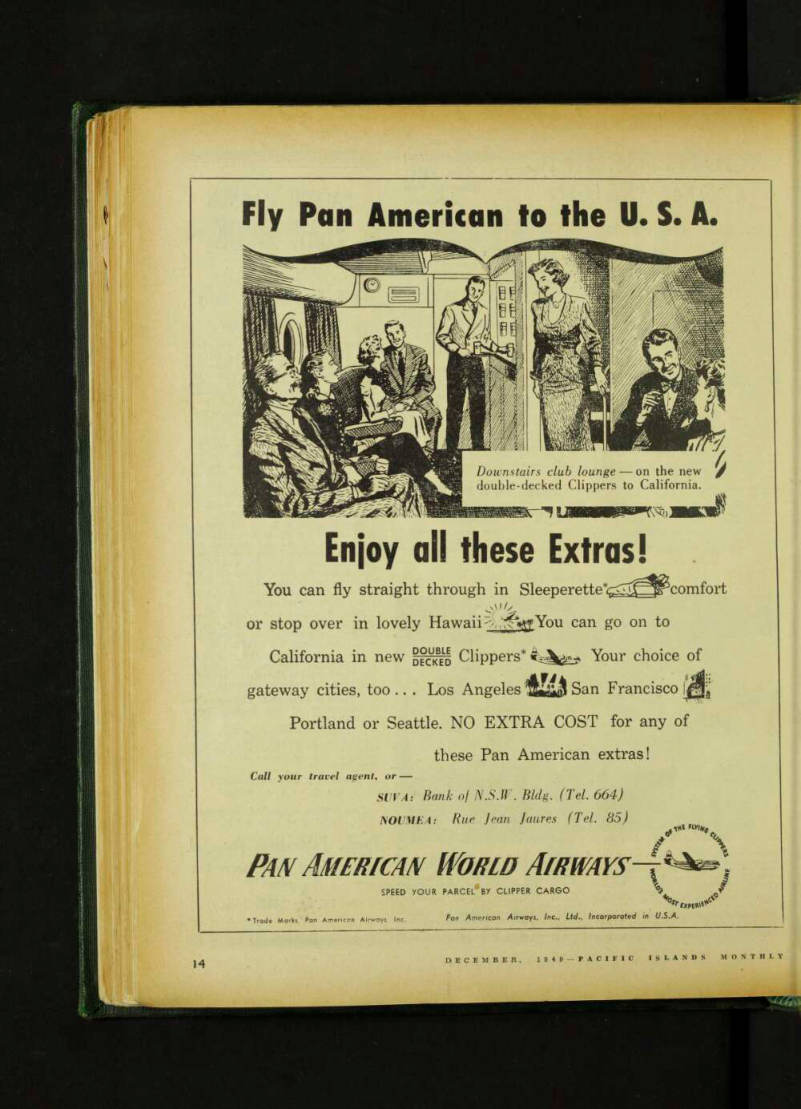
Fiji Police Officers 45 Years Ago
This interesting old photograph shows the Fiji Constabulary in the making. The organ isation which now has a fine record, was brought into being about 1906 by legislation that was based on the constitution of the Royal Irish Constahulery. .Before that, Fiji was policed by officers—mostly old Army men —who bad only local responsibility.
This group of officers of the new police force was taken in the year in which King Edward Vll died, hence the black arm-bands.
Back row: Sub-Inspector Ratu Ephereni, Sub-
Inspector McDermott, Sub-Inspector C. A.
Swinbourne, Sub- Inspector Stanlake, Sub- Inspector Wager, Sub-Inspector Ratu Inoke.
Front) row: Sub-Inspector Pennefather, Inspector Francis (now Sir Brook Francis), the late Hon. Ismay McOwan (Inspector General), Sub-Inspector Barnett, Sub-Inspector Scott-Young.
Some of these men became well known in later years. Messrs. Swinbourne and Wager, both retired, are residents of Sydney. We are endebted to Mr. Wager for the loan of this valuable old print.
Advertisements & other items, pp. 15-17 (1 item)
Year Book
PACIFIC ISLANDS
1950 EDITION
Will Be Published Early
in the New Year
THIS is now the world’s Standard Reference Book on the Islands of the Pacific. There have been five earlier Editions—in 1932, 1935, 1939, 1942 and 1944. The 1944 Edition, which was called the Wartime Edition, carried a great deal of material dealing with the Pacific War, and contained 384 pages and many Inset Maps.
Since the end of the Pacific War, in 1945, practically every Territory in the Pacific has been subject to farreaching changes of a political, social and commercial character.
Consequently, the 1944 Edition has been completely revised, so as to show these numerous changes.
The hook has been enlarged to take care of a great deal of additional matter. There are, for example, new sections dealing with Air Transportation, the Trusteeship Territories, the South Pacific Commission, the new market background behind the Copra Industry, and so on. There are new and improved maps.
Every Territory and Islands Group is described in detail — geography, history, administration, population, commerce, education, health, etc.
There is a complete directory of all the Christian Missions operating in the South Pacific Islands. The Index has been checked and enlarged.
There is a complete History and Chronology of the Pacific War (1941-1945).
Production has been much delayed by Australia’s economic and industrial troubles, but the new book is now scheduled for publication early in the New Year.
PRICE: 21/- Australian—s2.so Add 6d., or 6c. for Postage The Edition is limited, so please your copy early.
Pacific Publications Ply., Ltd
Union House, 247 George St.,
Sydney
(or P 0 Box 3408, Sydney)
Fly Pan American to the U. S. A.
V /£ & n NQ) Downstairs club lounge —on the new / double-decked Clippers to California.
Enjoy all these Extras!
You can fly straight through in or stop over in lovely Hawaii ,•< You can go on to California in new pf c u K g E p Clippers* Your choice of gateway cities, too .. . Los Angeles San Francisco Portland or Seattle. NO EXTRA COST for any of these Pan American extras!
Call your travel agent , or SUVA: Bank of N.S.W. Bldg. (Tel. 664) NOUMEA : Rue Jean Jaures (Tel. 85)
Pm American World
SPEED YOUR PARCEL BV CLIPPER CARGO
•Trade Marks, Pan American Airways Inc.
Pan American Airways, Inc., Lid., Incorporated in U.S.A.
I
'i>'
W /M*S O /Slf/VOi
r*fp//va
—-WHOLESALE SHIPMENTS
EXECUTED
A T
PRICES
% ''/' //«//!« |t, (»
G. H. ROBINSON
EXPORTS & IMPORTS PTY. LTD.
5i Macquarie St., Sydney.
TELEGRAMS: "SUNRISE" SYDNEY
PACIFIC ISLAND DISTRIBUTORS FOR: BRADFORD COMMERCIAL VEHICLES AND JOWETT JAVELIN CARS
Copra Sacks May Be Scarcer and Dearer

Next Year
A TARIFF war between India and Pakistan may result in a steep in crease in the cost of copra sacks (and a sharp decline in their production) next year.
India does most of the jute processing; Pakistan grows the fibre. Recently, India
began raising the duty on raw jute with the result that Pakistan stopped sending it across the border. Sacks in India jumped from the equivalent of 27/6 per dozen to about 42/- per dozen (Austra lian) ; the Calcutta jute market closed down and sales are limited now to black market dealings. India is reported to be increasing her own production of raw jute but it will take three years before she is self-sufficient.
There has been a shortage of bags and sacks since the end of the war but the position has eased slightly in the last two years. The bumper Australian wheat harvest of two years ago found Australia unprepared as far as sacks were con cerned. Copra producing territories, de pendent upon Australia for copra sacks, consequently went short also. A better than-average wheat crop is again being harvested in Australia at the present time.
It is reported that there are ample sup plies of jute and hessian available in the Commonwealth to cope with it but after that the outlook is grim. Australia has a quota of 100,000 tons of jute a year but the demand of sacks is growing all the time.
Although the cultivation of other fibre producing plants (sisal, ramie, etc.) has been boosted in tropical and sub-tropical territories from time to time, nothing seems to have displaced jute as a material for sacks. At present two young service men in Sydney are engaged in cultivating acres of canna lilies, which are known to most amateur gardeners. It is said that the fibres of the roots can be used as a substitute for jute and similar commercial fibres.
Western Region
Unknown N. Guinea
Patrol Now Examining Central- Western Region
Pt. Moresby, Dec. 6.
PENETRATION of the huge, well populated and generally unknown region that lies near the centre of New Guinea, south-eastwards of the point in the mountains where the boundaries of Australian New Guinea, Dutch New Guinea and Papua meet, is now being un dertaken by a small party in charge of Mr.
Allan Timperley (Assistant District Officer at Mount Hagen) and Patrol Officer Corrigan, They are making the first direct patrol from Mount Hagen. (New Guinea Central Highlands) to Lake Kutubu (near the western end of Papua).
Mr. Ivan Champion and the late Mr.
Jack Hides, two of the most distinguished members of the late Sir Hubert Murray’s Administration, were the first men to enter and report upon this interesting country.
Several different branches of a superior type of native live in the broad valleys and high, fertile plateaus that lie in this interior, protected by almost impassable chains of mountains and a rather terri fying “limestone barrier.”
Mr. Hides, in the ‘thirties, left the Administration service and took a small expedition into this country, via the Fly and the Strickland, in search of gold.
They got out, after suffering great priva tions; but Lyall, Hides’s companion, died at Daru, and Hides died not long after wards, in Sydney.
Although it has been examined fre nuently from the air, the whole region, embracing the headwaters of the Fly, Strickland, Sepik and Purari rivers, is still partly unmapped and unknown.
Advertisements & other items, p. 18 (1 item)
(guutca) LTD.
WICO MAGNETOS
(made in England)
For original or replacement
equipment on engines
Clockwise or anti-clockwise rotation all with built-in Impulse Coupling. (Prices plus tax)
PRICES ON APPLICATION
For Flange Mountings Vertical type Flywheel type Spare parts.
Trade Enquiries Invited
HARDMAN & HALL
44-48 Missenden Road, Newtown. ’Phone: LA 3597. 4 Cyl. .. .
Twin Cyl. .
Single Cyl. £lO 5 0 £7 17 0 £6 18 0
m sj Write for full details of prices and deliveries to : —
• COLYEB WATSON
,v r Distributors throughout the Territory of New Guinea for
ROOTES GROUP PRODUCTS
HUMBER, HILLMAN
and SUNBEAM-TALBOT CARS
COMMER and KAHRIER TRUCKS
mw% . m 1A
(guutca) LTD.
RABAUL
KAVIENC J
Pacific Franc

Devaluation Causes Irritation In French Colonies
rpHERE has been much perturbation in L French-Pacific commercial and financial circles sine the £ Stg. was devalued in mid-September.
Prance was not consulted by Britain before the drastic step was taken; and, as the franc is an important factor in Western European economy, and closely linked with Sterling, France was acutely embarrassed, and the French Government collapsed.
Before Sterling was de-valued, the Paci fic franc was quoted at 159 to the Aus tralian £. Probably, if the Australian £ had not also been de-valued. the Pacific franc would not have altered; but when the Australian £ followed Sterling to the new level, the French in New Caledonia and French Oceania did not know what to do.
Finally, they decided to follow the £ only half-way. At the end of November, they were quoting the Pacific franc at 141.75 to the Australian £, as compared with 159 (equal to 70 francs to the US dollar). This represented a de valuation of rather more than 12i per cent., whereas the British and Australian £, in relation to the Dollar, had gone down nearly 30 per cent.
This meant that Australian exporters, in relation to the markets of New Cale donia and Tahiti, were given a sharp advantage over French exporters, French merchants generally are finding the situa tion difficult. The French authorities are trying to keep all possible French trade in French channels; but the natural ten dency is to buy in the cheapest market— Australia.
The New Caledonian General Council is supporting a vigorous protest by the Noumea Chamber of Commerce against the devaluation of the Pacific franc. The Governor-General has been asked to inform the French Government of the protest and of the alarm of the local population at this blow to their economic welfare. A serious view is taken of the interruption of French trade with the New Hebrides. French trade there, it is alleged, has been paralysed in favour of the British as a result of devaluation.
The other side of the picture is seen already in the nickel and chrome industry of New Caledonia. As a result of the new rates a large increase in exports of nickel matte and chrome ore is expected in 1950.
New Caledonia, in 1950, is increasing postages on ordinary letters by 50 per cent, (from 2 to 3 francs—one franc is
worth about one and two-thirds Austra lian pennies) and telegraphic charges by 300 per cent.
In November, New Caledonia held 1,100,000 US dollars, £225,000 Sterling, and £280,000 Australian —described as “a favourable situation.”
Owing to the higher cost of Australian flour, the price of bread in Noumea has gone from 11.20 to 11.65 francs per loaf.
Mr. Bill Murrain, American circum navigator, paid a visit to Sydney in November. He arrived in Port Moresby at the end of October in his stainless steel 30-ft. yacht, Seven Seas 11, after spending over two years in a leisurely crossing of the Pacific, and visiting many Territories.
He left his interesting craft in Port Moresby, and flew South for a brief spell of city life.
Mr. Harry Edmunds has been promoted to the post of Assistant Postmaster- General, Fiji. He joined the Posts and Telegraphs Department in 1921 as a telephone operator. He later became a postal clerk and on various occasions has acted as Postmaster at Levuka, Lautoka and Suva. He was appointed Assistant Accountant in June. 1946, and Accoun tant in July. 1948.
Advertisements & other items, pp. 19-20 (1 item)
Season’s Greetings
FLIT MEANS DEATH TO
MOSQUITOES
FLIT is again available everywhere to help you wage war against insect pests.
FLIT contains D.D.T., in addition to Pyrethrum and Thanite, making it the most effective insecticide available.
VACUUM OIL COMPANY PTY. LTD.
THE MOST EFFECTIVE INSECTICIDE YOU CAN BUY Kills Moth* MoiquHoe* (ockroarh** ‘'lverTnh Bugs Ant* tL
We Extend
TO OUR PACIFIC ISLANDS FRIENDS :
Season’s Greetings
VENTURA TRADING COMPANY PTY. LTD.
2 6 BRIDGE STREET,
SYDNEY.
BOOK LOVERS!
Hutchinson’s UNIVERSAL BOOK CLUB offers an easy way to build a well-chosen Home Library.
Each month a Committee, with the co-operation of leading English and American publishers, selects for the members of the UNIVERSAL BOOK CLUB an outstanding contemporary novel by a famous author.
The subscription is £2/2/- for 12 books a year delivered monthly or £l/1/- for 6 months. This is the only charge and includes postage.
Join now and receive your first book by return mail .
Membership in other Book Clubs may also be arranged.
MAIL PUBLICITY COMPANY
175 Pitt Street.
Sydney, N.S.W.
HV Royal Flight Now Fiji Governor’s Yacht
The 56-ft. twin “Gardner”-Diesel, twin screw, motor-vessel, Royal Flight, owned by Group-Captain and Mrs. Garnet Malley, of Sydney, has recently been purchased by the Fiji Government. She will hence forth be the Govenment yacht, conveying the Governor to outlying Islands, and will undertake much of the work done up to date by the “Adi Beti.”
With exception of two months, when they loaned their Royal Flight to the J. Arthur Rank Company for the purpose of filming the Blue Lagoon in Fiji waters, Group-Captain and Mrs. Malley have for the past three years been cruising around the Pacific Islands in this yacht.
They are at present at their plantation at Vanua M’Balavu, in the Lau Exploring Group, Fiji Islands.
Islanders Do Well From Pearling
Activities
DURING 12 months activities, a fleet of 31 pearling vessels operated by Torres Strait Islanders, earned £67,547.
The boats won 162 tons of mother-of pearl, worth £53,142, and 228 tons of trochus shell, worth £14,405.
The biggest money was earned by Tanu date by the “Adi Beti.”
Most of the male population of the Torres Strait Islands work in the pearl ing industry. Some own their luggers and others work for pearling companies. For year ended June 30 the islanders’ savings bank accounts increased by £lO,OOO over the previous year’s figure.
Price of pearl shell has dropped, how ever, from over £7OO per ton in 1946 to between £3OO-£4OO, and trochus shell from £l6O to £72. Some believe that the pre sent market is not stable and prices may drop even further.
Advertisements & other items, p. 20 (1 item)
Biscuits...
HOME STYLE BISCUITS
■ 1
J. C. MERRILLEES PTY. LTD.
104 HUNTER ST., SYDNEY
Telegrams: “Merrillees,” Sydney.
BISCUITS...
Home-style sweet biscuits of supreme quality, manufactured in Australia, of the finest ingredients and in 7 varieties.
Packed -for export in lb. cartons or tins —l 2 cartons or tins per case.
AGENTS
WALTER GRAND HUNTS AGENCY
PAPEETE, TAHITI.
SUVA, FIJI.
We extend to all our Clients and Friends
0 CHRISTMAS and NEW
YEAR GREETINGS.
Overwhelming Result of Fijis
Anti-TBAppeal
From Our Own Correspondent
Suva, Nov. 14.
ALL estimates of the success of Fiji’s War Memorial Anti-TB Appeal have gone overboard, and it now appears that the fund will close, for 1949, some where near £60,000, or approximately 50 per cent, over the target set on August 16.
This figure does not include the Govern ment’s donation of £20,000.
The astonishing result of the appeal has been due to the reaction of the “small people’’—Fijans. Europeans, Indians, Chinese, Polynesians and others alike.
Apart from the generous support of a few big commercial organisations, cf which the CSR Company, the Associated Goldmines (£3,000), and W. R. Carpenter and Co. (Fiji) Ltd., are by far the most outstanding, the response of the wealthiest sections of the community has done little to help achieve the total.
At times there have been flickers of criticism of the appeal, mostly from those who express distrust of anything of the kind in which the Government has a hand, but there has been an emphatic demonstration of public impatience with unconstructive quibbling—sc emphatic that the 1949 Appeal will go down as the first movement of any sort that has over ridden all the racial, religious and other sectional barriers that commonly divide Fiji into suspicious and sometimes bitterly opposed factions.
The central committee of the appeal organisation admits that in the early days £35,000 was regarded as a likely figure.
Administration cf Fund A BILL will be introduced at the Budget session of the Legislative Council (which was opened on November 25) providing for the establishment and ad ministration of the War Memorial Anti- Tuberculosis Fund.
Five trustees will be appointed by the Governor to see that “the purpose for which the fund shall be used and applied shall be the prevention and control of tuberculosis in the Colony and the treat ment and welfare of persons suffering from tuberculosis in the Colony.”
Some of the uses the fund —or
what remains after deduction of the capital expenditure of £30,000 —will be the erection and extension of wards and hos pitals for the treatment of tubercular patients; the erection of staff quarters, clinics, laboratories and other buildings; the equipment and furnishing of the new
wards and hospitals; the travelling ex penses of tubercular patients to and from hospitals or clinics; the supply of com forts to TB patients; the after-care of discharged patients.
Whatever portion of the fund is not re quired for immediate needs may be in vested in England or Fiji.
Mrs. Phyllis Keenan, wife of ADO J.
R. Keenan of Rabaul, arrived in Syd ney late in November on MV Bulolo.
Early in January she will leave for the United Kingdom. She will be joined there by her husband later in 1950.
2,000 Miles In 26 Ft. Launch
North Queensland newspapers in November gave prominence to the voyage of 2,000 miles of a 26 ft. launch, made under the direction of Cap tain G. Wyeth.
Captain Wyeth, who is a member of the firm of Capricorn Charters, of Gladstone, had for crew an apprentice named Stan Little, and was charged with the respon sibility of delivering the boat, which was constructed at Eallina, NSW, at Merauke, Dutch New Guinea. He successfully ac complished his mission.
Throughout the voyage the only calls made into ports were for fuel. The journey was completed mainly in day light; at nights the boat was anchored in the lee of the islands. Fortunately, the entire trip was accompanied by fine weather. The launch is powered with a 16 h.p. diesel engine, and had three tons of stores as ballast.
This is the second lengthy voyage made by George Wyeth. Last year he took the 50 ft. ketch, Capriccn, from Sydney to Honiara, British Solomon Islands. Organ isation for construction and delivery of this vessel was in the hands of William E.
Reed, Sydney.
Advertisements & other items, pp. 21-22 (1 item)
Sherwin-Williams Paints
ms m m m sm m O, WP Years of experience in the manufacture of paints and finishes of a consistent high standard have resulted in a spirit of responsibility among the members of the Sherwin-Williams organisation. This assumes tangible form in the manner by which a great tradition continues to be transformed into high-grade products . . . paints for all climates and conditions.
DISTRIBUTORS THROUGHOUT NEW GUINEA
COLYER WATSON (NEW GUINEA) PTY. LTD.
(/t'.sa i nitty (A
THE ONLY WAY TO TRAVEL
IN THE PACIFIC
HERE IS YOUR TRANS OCEANIC
Mooring Compt, ★ / .in 1 mi nr i / oda rut
7i rJ /IWwlVw
« 0 4 • Cartaln. Navigator.
O I n First Officer. Radio Op Engineer. Workshop & Store. 9 C& [ * Hold. e Seats. © Galley.
Promenade Deck. * THE SAFETY OF FOUR MIGHTY ENGINES if THE COMFORT OF AN OCEAN LINER
★ THE CONVENIENCE OF HARBOUR OPERATIONS
if THE COURTESY OF PRIVATE ENTERPRISE
m V',
PRIVATE ENTERPRISE
”TRANS i OCEANIC AIRWAYS PTY. ITD
KYLE HOUSE, MACQUARIE PLACE, SYDNEY. BU 2048-9: FLYING BOAT BASE, ROSE BAY, N.S.W. FU 8911, FU5924. * REGULAR SERVICES TO SOLOMON ISLANDS, NEW HEBRIDES, NEW CALEDONIA, LORD HOWE ISLAND, GRAFTON. * CHARTER FLIGHTS TO ANY PART OF THE WORLD BY ARRANGEMENT.
Death Of Farrell
Arch-Villain of New Guinea Timber Case
THE death occurred in November of Ed ward Farrell, the arch-villain of the New Guinea Timber inquiries which absorbed over a year of the time of Aus tralian Teiritories Minister Ward.
The “syndicate” which claimed it had a timber concession, and bush-ranged the Queensland timber company, Hancock and Gore Ltd., to the tune of £50,000, originally comprised Farrell, Jock Garden, Jock’s son, Harcourt, and Ray Parer.
Jock was put into gaol for conspiracy and allied offences; Harcourt Garden and Ray Parer were tried and acquitted: but Farrell escaped prosecution on the ground of serious ill-health. Judge Ligertwood, who eventually, as a Royal Commissioner, cleared up the whole unsavoury mess, said that Farrell was the chief conspirator.
Farrell was engaged in some sort of activity in and around the New Guinea goldfields before the war, and he knew that a New Guinea timber concession would be extremely valuable. It was he who conceived the idea of using Parer to get a concession through Jock Garden (the Minister’s intimate associate and confidant), and he who carried on the extraordinary negotiations with Hancock and Gore.
Although Farrell escaped prosecution on health grounds in 1948-49, he was quite able to give evidence at the Ligertwood inquiry, and there was a howl a few months ago when, following the Judge’s report, the Federal and State Labour Governments refused to take action against him. However, it is now apparent that he was close to death’s door; and the
Reaper has now gathered him in. He ruined a couple of lives and at least one
political reputation.
Jock Garden probably will be out of gaol soon. The only net results of the notorious Timber Lease case are, there fore that Jock Garden was branded criminal and sent to gaol; Farrell was branded arch-rogue, and is dead; and the Queensland timber company is the loser of £50,000. It does not appear that any one ever tried seriously to find out what became of that £50,000.
Meanwhile, it is now proposed that the New Guinea timber-bearing country in question shall be worked by the Australian Government and Bulolo Gold Dredging- Ltd., in co-operation—BGD presumably to provide the operating organisation. Up to date, it has been the proud boast of Minister Ward that any timber-getting concessions given in New Guinea would be obtained only by public tender.
BSI Plantation Co. Shows Profit
Solomon Islands Rubber Plan
TATIONS LTD., a Brisbane-owned, 40-year-old company which produces copra on Ysabel, in the Solomons, and which was out of production during the war years, made a net profit of £1,609 last year (July 31). It thus was able to wipe out an accumulated loss of £1.534 in its trading account, and go forward with a credit balance of £75. Indications are that, under the guaranteed price, it will continue to make profits for two or three years. It has an issued capital of £77,000; and there are accumulated arrears of some £1,400 on its £17,000 of preference shares. It balances its accounts by show ing “War Damage” at £3.795 —but notes that no war damage now is payable in respect of the Solomons.
Agreement
Nz And France Have Air
THE New Zealand and French Govern ments, on November 15, came to an interim agreement in respect of air craft landing rights in the territories in the South Pacific under their respective control. A more formal agreement is ex pected to follow, later.
By the interim agreement, the NZ Government grants to a French airline traffic rights in certain NZ Pacific Terri tories while the French Government has undertaken to grant similar rights in French territories to an airline to be de signated by the NZ Government.
In practice, this agreement is at pre sent one-sided as the only airline affected by it is the French TRAPAS service which runs monthly between Noumea, New Cale donia, and Tahiti with calls at airports in Fiji, Western Samoa and Cook Islands— the two last named being NZ-controlled Territories. This service has been operat ing for a year or so. The new agreement merely regularises it and will probably permit now, of the TRAPAS plane picking up and setting down passengers, mails or cargo at Western Samoa and Cook Islands airports.
There is no New Zealand air service which at present uses airports in French Pacific possessions. However, the agree ment provides for the NZ Government to designate an operator to use such facilities if and when NZ’s air network is extended to include French possessions in the Paci fic.
Dr. H. S. Evans, who has been on holiday in the United Kingdom, has re turned to Fiji, accompanied by his wife.
Dr. Evans is to be posted to Rotuma as a combined Medical and District Officer.
Mr L. C. Grant, OBE, who has been ap pointed Chief Engineer, Posts and Tele graphs Department on agreement for three years, has arrived in Fiji, He served in India from 1925 until last year. He will replace Mr. R. C. Farquhar as Chief En gineer. Mr. Farquhar, who has been filling the post for some years as a re employed pensioner will go to the United Kingdom on retirement leave next year.
Miss Maureen Mclvor has joined the Australian Broadcasting Commission’s staff at Port Moresby, Papua.
Advertisements & other items, p. 23 (1 item)
holiday, too!
Give mother
t. «• * X ★ Heinz Perfect Soups ★ Heinz Baked Beans ★ Heinz Spaghetti ★ Heinz Green Peas ★ Heinz 57 Sauce
Save work. Save lime
Save money
and eat well!
Make Heinz famous ready-toserve foods your holiday standby—just heat and eat!
Let mother have a real rest from cooking meals. Heinz will satisfy those hungry appetites every day.
1 HEW?
PURE
FOOD
products i
HEINZ
37 Varieties
World Famous for Quality and Flavour!
Rabaul Roundabout
From Our Own Correspondent
Rabaul, Nov. 25.
THE New Guinea Administration is en couraging the establishment of native-owned cocoa plantations in the Rabaul district. Mr. Overstone of the Department of Agriculture has al ready inspected five blocks of land owned by the people of villages situated at Kabaira Bay, and has found it suitable for cocoa planting. The blocks, which will total more than sixty acres, are with in easy road access of one another and when production stage is reached the vil lages will share in the construction of common fermentation vats and driers.
Clearing will start immediately and plant ing will commence early in the New Year. * DURING a recent visit to the Duke of York Islands, District Officer J.
K. McCarthy, of Rabaul, attended the village council of the Group. The council stated that native lands were scarce, owing to large areas having been alienated during German times, and de spite the existence of native reserves, land was now insufficient for food require ments, if full economical development was to be carried out. The matter is being investigated by officials of the Department of District Services and Native Affairs. * MR. K. C. DOUGLAS, of San Remo Plantation, Talasea District de parted for Australia recently, where he will join his wife and son in Tasmania.
He will place his son at that famous old school in Hobart, ‘Hutchins,” where he was also a pupil. Mr. Douglas is well
known to most Territorians as a most able planter and owner of San Remo. * RECENT visitors to Rabaul during November were Mr. W. R. Humphries, Director of Native Labour, who also paid a visit to Sohano; Mr. W. C. Groves, Director of Education and Mrs. Groves who had an extensive tour, visiting New Ireland and its outlying islands, also Bougainville. Mr. Blair, Tea Expert from Assam, had a short stay in Rabaul during his tour of the Territories. Mr. Moore, of the South-Pacific Commission accom panied by Mr. Cox, inspected and dis cussed Visual Education. Judge E. Big nold, on Supreme Court Circuit, accom panied by Mr. S. Johnson, Crown Law Officer and Mrs. W. Watkins. Dr. John Gunther, Director Public Health, who also visited Sohano, Talasea and Kandrian.
Mr. Trigg, motor and marine expert from the Department of Works and Housing, came on general inspection of all trans port. * MANY people have left Rabaul during the month aboard BP’s two ships, Malaita and Bulolo. It was the last trip of both ships to Australia before Christmas. Among their recent passen gers were District Officer R. M. Farlow: District Officer J. Read and Mrs. Read: Mr. and Mrs. Keith Chambers, and two children; Mr. and Mrs. Ralph and five children; Mr. and Mrs. Geoffrey Bliss, who came from Madang to join the Bulolo; Mrs. Jack Allan, Mrs. Ormond and her daughter, Mrs. J. D. Reid and two child ren.
THE Church of England Ladies’ Guild, ably led V>y Mrs. Shanley as presi dent and Mrs. Hides as secretary, benefited financially this month by two well-organised evening entertainments— a card party held at the Cosmopolitan Hotel made £l2/-/- and the Gilbert and Sullivan Opera, “Princess Ida,” played on a miniature stage with tiny carved figures representing the actors, operated and loaned by Mr. Len Palmer, netted the sum of £6/13/6.
Advertisements & other items, p. 24 (1 item)
C. Sullivan, Inc.
THE “SCOPE”
6-Second Soldering Iron
• New in principle. • Melts solder in 6 seconds. • 150 watt iron performance. • 4-volt accumulator or transformer operation.
Price, 43/6. Trans. 30/-.
R. H. CUNNINGHAM AND CO.
62 Stanhope Street, Malvern, Victoria.
C. Sullivan Pty. Ltd.
379 KENT STREET, SYDNEY, and at Melbourne and Brisbane. have pleasure in announcing that their Associate
C. SULLIVAN, Inc.
230 CALIFORNIA STREET, SAN FRANCISCO,
CALIFORNIA, U.S.A.
are prepared to handle consignments of COPRA, COCOA
and GENERAL ISLANDS PRODUCE.
Information on market conditions, prices, etc., gladly supplied.
Expert buying service for American merchandise
CORRESPONDENCE INVITED.
CABLE ADDRESS: "CHASULL," SAN FRANCISCO
Nauru’S Sulky
Communities
Time Has Come for a New Outlook
(Contributed) THE 1,500 Chinese labourers employed by the British Phosphate Commis sion on Nauru are well-housed, well fed and well-paid; but they are not well disciplined, and they are “a pain in the neck” to the Australian Administration (which governs Nauru on behalf of the joint Trustees, Britain, Australia and New Zealand).
Before the war, there were about the same number of Chinese, 1,500, here but there was no political or industrial trouble of any kind on Nauru (or, to give it its older name, Pleasant Island). The Chinese, mostly from Hongkong, sought the Nauru labour contract eagerly—the clean, safe life and comparatively good food were very attractive, in comparison with conditions in China. Many of them, repatriated in accordance with their con tract, came back to Nauru again and again.
To-day, there are only Chinese workers on Nauru, and they appear to have been affected by Communist agitators. They are often sulky, aggressive, dissatisfied and unwilling to give a fair day’s toil. Their attitude is generally anti-European.
The problem of maintaining order in the Territory defeated the late Adminis trator, and it is by no means solved. Can berra has appointed a Labour politician from South Australia who does not appear to have had one hour’s practical ex perience of tropical administration, to be the new Governor; but that does not seem the ideal solution.
THERE is trouble also on the native side.
There were some 1,700 native Nauruans there in 1939, but the Japs exterminated some hundreds of them in 1942-45. However, they have made a quick recovery, and they now number nearly 1,500. Before the war, they were a happy, contented community—probably, because they get regular royalties on all phosphate mined, one of the richest native communities in the Pacific.
But their temper has changed. They seem discontented and querulous, and full of grievances. Their grievances seem petty, and mostly imaginary. There are agita tors among them, who encourage them to complain to the Trusteeship Council —to the great embarrassment of the Australian Socialist Government.
There is only one way to restore peace and harmony on Nauru—and that is by firm discipline, based on strict justice. The Chinese and native communities, on this isolated island, if given any encourage ment, will exaggerate their grievances— and, if they have none to exaggerate, they will imagine some. The spectacle of Aus tralian politicians grovelling before them, and urging them to be good little boys, has been a nauseating one during 1949 — and it has achieved nothing. A clear-cut policy, based on justice, and strong police action, are what is needed on Nauru.
A “delegation” from the Trusteeship Council of the United Nations is expected to visit Nauru at an early date. If Can berra is following its policy of recent times —“the Chinese and the natives are always right”—then the idealists and New Planners of UNO probably will just about take Nauru apart.
Miss Elsie Smith, matron of the Metho dist Orphanage, Fiji, who has been on furlough in Melbourne, left on December 2 to return to Fiji, where she has com pleted 21 years’ service.
A regulation to establish a Government Savings Bank in BSI came into force on October 27. Deposits of up to a total of £l,OOO may be deposited at £2 per cent, interest per annum. Deposits in excess of £l,OOO will not be interest-bearing.
On his return from France Father Gag naire, of the Marist Mission, formerly of Poya on the New Caledonian mainland, has been sent to Ouvea, where he will be assisted by Father Regent. Sister Marie- Jean-Baptiste, of the Ouvea mission re cently died. She had been with the mis sion on this island since February, 1890.
Advertisements & other items, pp. 25-26 (1 item)
Trade
To promote
The Bank of New South Wales offers these services:— • Introductions to importers and exporters in oversea countries. • Credit information about residents of those countries, with whom you may wish to trade. • Facilities for making payments abroad and for receiving payments from overseas. • Arrangements for business visits overseas.
Consult any branch of the
BANK OF
NEW SOUTH WALES
FIRST AND LARGEST COMMERCIAL BANK IN THE SOUTH-WEST PACIFIC
HEAD OFFICE: SYDNEY. AUSTRALIA
ISLANDS BRANCES
FIJI: Suva, Lautoka (Agencies at Ba, Nadi Airport, Vatukoula) PAPUA: Port Moresby. NEW GUINEA: Lae, Rabaul, (Incorporated in New South Wales with limited liability) P 14901
"Uiituimnii s
CREME
CHARMOSAN
% * >l*
ADORABLY LOVELY
UNDER POWDER
.iiiiiiinSS
■mihiiiihiim
Charmosan
co|dcPeam
c2 — H l for dut*. «»C
CLEANSES AND
REFRESHES YOUR SKIN
CHARMOSAN
VANISHING AND COLD CREAMS
OUR HANDS MAKE GOOD ARMS
S I l.
For your Fishing and Shooting Wants Consult Us.
Litngow .22 Cal, Repeating Rifles ... £ll 14 Of Post Lithgow ,22 Cal. Single Shot 5 1 3 I Extra.
rO h u 143 ELIZABETH
STREET, SYDNEY.
t J. GOUGH S. CO.
Bond Street, Sydney, Australia Tel. BU 2195. Box 3615 G.P.O.
SUPPLIERS OF GENERAL MERCHANDISE TO LEADING FIRMS THROUGHOUT THE
PACIFIC ISLANDS
Exporters ... Importers Manufacturers' Representatives Bankers: Bank of N.S.W. Bank of Adelaide. Comptolr Nat. d’Escompte de Paris.
Cable Address: "SEAFOODS.” SYDNEY.
Codes: Bentley’s. 2nd and Comp. Phrase; A. 8.0., sth and 6th; Peterson. 2nd and 3rd; Banking; Acme.
Difficulties of Small
Gold Cos.
In Papua-New Guinea
Sandy Creek and Enterprise Report
Losses
REPORTS from two New Guinea goldmining companies indicate the crushing difficulties of rehabilita tion, high labour and material costs that have confronted the smaller companies in Papua-New Guinea since the end of the war. After these balance-sheets were made up, however, gold (because of the devaluation of sterling and the Austra lian £ against the dollar), increased from approximately £10 Australian per ounce to £15 Australian. This should boost all gold-mining companies’ profits in the Ter ritory in the current year—if the rot has not gone too far.
Sandy Creek Gold Sluicing
Sandy Creek Gold Sluicing Ltd.,
which operates in the Morobe gold field, New Guinea, has again met considerable ill fortune. The result of it is that for the year ending March 31, 1949, a loss of £4,455 was sustained. In the pre vious year the company showed a profit of £988.
During the period under review 1,192 ounces of gold were recovered from the company’s properties which realised £10,266 or 2/4 per cubic yard. Cost of working averaged 2/9 per cubic yard.
The Sandy Creek property yielded poor results at the latter end of the financial year and torrential rain in February, 1949, broke the race supplying water to the workings. As repairs would have been costly it was decided to abandon opera tions on this property. Revaluation of this property necessitated the writing off of £60,000. t .
The Watut property could not be worked satisfactorily as pre-war water pipes then in use, would not stand the head of water necessary to work the richest, but very deep, ground. Operations had to be confined to ground sluicing of terrace deposits. ... . , Although floods had contributed to losses of the Company early in 1949, drought conditions later took toll. In a report issued in mid-November, on pro
gress made after the close of the financial year, it was stated that from July to Sep tember the water supply to the Watut property was so inadequate that it was de cided to suspend all operations and renew the steel pipes that form the pressure column from the race to the workings:.
Work was resumed during October and for that month 48 ounces of gold were recovered from 3,816 cubic yards of gravel treated.
Enterprise of NG Also Takes Loss
ENTERPRISE of New Guinea Gold and Petroleum Development NL for the year ending August 31, reports a de ficit of £5,744. Loss for 1947-48 was £3,391.
Tai Shek's Appeal Case
on December 15 First of its Kind in Fiji
From Our Own Correspondent
Suva, Nov. 27.
THE first sitting of Fiji’s new Court of Appeal will be opened in Suva on December 15. The Court will com prise the Chief Justice, the Puisne Judge and the British Judge in the New Heb rides.
The first appeal set down for hearing is that against the death sentence imposed on Tai Shek at the conclusion of his trial in the Supreme Court, Suva, on Sep tember 26. Tai Shek was found guilty of the murder of T. W. Allen, a British Phosphate Commission engineer, and his wife, at Ocean Island on April 26. Three of the assessors at the trial gave an opinion of “guilty” to his Honor, Mr. R.
C. G. D. Higginson and the remaining two said “not guilty.” Mr. Gordon Bryce ap peared for the Crown and Mr. H. Maurice Scott for the defence.
Automatic Telephones
Proposed For Suva
Suva. Nov. 21.
SUVA’S antiquated manual telephone exchange, as every user of the sys tem is well aware, is all but falling apart with age.
The Development Revision Report states that nearly 200 potential sub scribers are waiting for connections and applications are constantly being added, but not another connection can be made.
“Expert advice has been obtained, and assurances have been given that an auto matic system will function satisfactorily in Suva’s damp tropical climate,” the reports states. An allocation of £122.000 for the provision of an automatic system with individual meters has been made.
Annual rental of £4 would be charged and Id. for each call. This, it is estimated, would return a revenue of about £17,300 a year.
Discouragement of Casual Travellers
Red Tape In French Oceania
(Contributed)
AN article entitled “Travellers and Currency in New Caledonia” prompts me to write about similar conditions in French Oceania.
Visitors to the fabled island of Tahiti— now a paradise for French officials—are confronted with endless red tape, in place of the traditional hospitality.
When a foreigner arrives he is forced to declare all his currency. That money must either be deposited in the local bank, or converted into francs by the bank, which takes its percentage.
Certain amounts have been fixed as to what a tourist is expected to spend per person per month. For example, an American is obliged to spend 200 dollars per month. Close supervision is kept on all tourists and if they do not spend the fixed amount they are told in no uncer tain terms to leave the colony.
Recently, some tourists were informed in very insulting language that the only reason they were tolerated in Tahiti was because of the need for foreign exchange; and, if they did not spend the prescribed amount, they had no business staying on.
This may be a surprise to those who saw the recent article in PIM which stated that our newest Governor was anxious to encourage the tourist business.
Before the war, if one wished to visit Tahiti, all that was necessary was a round-trip ticket and a visa from the nearest French consul, obtainable in a matter of minutes. Now, a prospective
visitor must pay the consul the fee for a cable to Tahiti and the necessary an swer from the Governor, authorising him to obtain the visa before the consul may issue the visa. Then, one is allowed to buy a round-trip ticket to Tahiti. As stated above all money must be declared on arrival and a close check is maintained on the visitor, as though he were a dan gerous criminal.
If one wants to visit the outer islands— for example, Bora Bora—a letter to the Governor is necessary. Before permis sion is granted the official in charge of such matters carefully consults the bank and, if the visitor is not guilty of the crime of trying to live economically, and has spent his 200 dollars per month, he is allowed to make the visit. If the un suspecting tourist has not spent his quota
of 200 dollars per month, he receives a severe tongue-lashing and is asked to leave the colony, A wonderful French way of developing the tourist trade!
When the tourist leaves, he is made to account for all the money he originally declared and a check is made with the bank to be sure that no discrepancies exist. Then, after a careful search of his luggage, the departing traveller is allowed to go aboard the vessel and de part.
Such an attitude, and way of treating tourists, cannot possibly encourage more to come nor to bring in many dollars. On the other hand, it is a well-known fact that almost all the government officials have traded in the black market. It is widely rumoured that one fonctionnaire recently made over 9,000 dollars in black market currency dealings. Small wonder the colony’s finances are not very stable!
All colonies in the Pacific, interested in developing a tourist trade, would do well, by way of contrast, to look at Bermuda and Nassau, in the Atlantic Ocean. Those two places have the minimum of restric tions and red tape. No passports, no
visas, ho deposits, no cables to governors.
The only requirement is a round-trip ticket. The result is that each prospers, and neither is short on dollars.
Please excuse me for wishing to remain anonymous; my reasons are most ob vious. I live in Tahiti because I like the Polynesians and not the bureaucratic French officials, who systematically drain all the fat off the land.
Advertisements & other items, p. 27 (1 item)
Pacific Islands Trading Co.
Wynne S. Breden Pty. Ltd.
SHIPWRIGHTS, BOAT BUILDERS AND ENGINEERS.
"PHOENIX SHIPYARDS", NEWCASTLE, N.S.W.
Designers, Builders & Outfitters of ISLAND Vessels Work Boats, Cargo Boats and Auxiliary Craft up to 200 tons.
For the RIGHT TIME Rely on WESTCLOX The finest, smartest clocks in Westclox history—that’s what Westclox has in store for you! A wide range of stunning clocks for every room— spring-wound and electric alarm models—wall clocks for your kitchen and time clocks for the living roomyes, wrist and pocket watches, too— all with traditional Westclox dependability and smartness that have made Big Ben and other members of this time-keeping family famous all over the world.
“It’s a Westclox” is the finest thing you can say about a clock or watch.
Some Westclox have luminous dials that you can see in the dark.
You can buy any Westclox with confidence. Look for that trade mark on the dial of the next clock or watch you buy.
• QUALITY •
• •RELIABILITY •
10 Baby Ben —His alarm may be adjusted to loud or soft. Quiet tick. Made in two finishes— ivory and gold colour; also black with nickel trim.
BIG
BEN
Big Ben is made two ways—There’s Big Ben Loud Alarm with booming intermittent call. If you want a more gentle awakening, there’s Big Ben Chime Alarm which first calls you with soft chimes. If you ignore these chimes, there’s a loud calf in reserve.
PACIFIC ISLANDS TRADING CO.
244 CALIFORNIA ST., SAN FRANCISCO, CALIF., U.S.A.
The Other Side of the Picture
Picture
AFTER "the above article was in type, we had the pleasure of a call, at the PIM offices, from Mr. Anthony Bam bridge, a leading business and public man of Tahiti, who was spending a brief holi
day in Sydney with Mrs. and Miss Bam bridge.
It soon was apparent that Mr. Barn bridge is not only an admirer of the Governor, M. Anziani, and acquainted with the latter’s policy of encouraging the tourist traffic: he also is au fait with the exchange problem in French Oceania.
The Government, says Mr. Bambridge, applies the exchange regulations strictly in order to protect both the tourists and the Tahitians themselves. There are two classes of people whom the Government does not want in Tahiti —the black marketeer in currency, and the beach comber class. The former is a new pest, which has developed since the war. The latter was an old pest, before the war, and the French authorities want to keep him out, now.
The Chinese traders of Tahiti will very willingly give, for United States dollars, far more than the official rate (about 70 Pacific francs to the dollar); and, natur ally, the travellers are happy to part with their dollars on those terms. But, if that kind of trading is not checked, it is inevitable that the cost of goods and service in Tahiti will rise against the holders of dollars.
People from America also arrive from time to time with cars or boats, which eventually they desire to sell. Here, again, there is a chance of black market eering—certain classes in Tahiti are eager to pay, in francs, far more than the French authorities say is the fair value of those things. To guard against infla tion, all such transactions must be very carefully policed.
That is why such firm controls over ex change are clamped on, as described by our contributor.
The insistence that visitors shall spend a certain minimum sum per month is
based on the French authorities’ deter mination to keep out the beachcombing class. In past times, large numbers of Europeans, with slender resources—or with no resources at all—attracted by the charm and ease of life in Tahiti, settled themselves in the country. But a large proportion of them accepted no obliga tion to work —they took fullest advantage of native hospitality, and literally lived on the natives. That created a state of affairs that, socially and economically, was undesirable.
The official view is that if a person does not spend 200 dollars per month on living expenses (normally, about £4O) he is of no use to the Territory, which does not seek permanent new settlers of Euro pean origin. Bona fide tourists and new residents with an assured income are economically useful, and are welcome.
Mr. Bambridge has many interests in Tahiti, but he is chiefly concerned with the theatre business. He has practically a monopoly of the cinema theatres and halls throughout French Oceania. He is a handsome, middle-aged man of charm ing personality, and one of the outstand ing figures of Tahiti.
Advertisements & other items, p. 28 (1 item)
Nelson & Robertson
SOLVE YOUR POWER PROBLEMS
WITH AN
ARMSTRONG SIDDELEY
Aircooled Diesel Engine, 5/6, 7/8, 12/16 H.P
DESIGNED FOR
Power Generating © All Plant Operation
FEATURES:
• COLD STARTING
• PRESSURE LUBRICATION
• FUEL ECONOMY
• COMPACT
• LOW WEIGHT
• BUILT TO OPERATE IN ANY
CLIMATE
IMMEDIATE DELIVERY
Sole Pacific Agents :
VENTURA TRADING COMPANY PTV. LTD.
26 BRIDGE STREET, SYDNEY.
CABLES, “VENTURA,” SYDNEY.
Represented by P. &R. HUTCHINSON, Sava. VENTURA TRADE AGENCY, Lae, T.N.G
NELSON and ROBERTSON Pty. Ltd
Established 1895
Shipowners - Brokers and
Islands Merchants
All classes merchandise purchased at Best Wholesale Prices. Original Invoices supplied to Island Clients. Cocoa Beans, Copra, Rubber, Trochus Shell and All Islands' Produce Sold on Commission.
Entrust your requirements to the firm with fifty years' practical experience in the Pacific Islands.
NELSON & ROBERTSON
PTY.
LTD.
12 SPRING STREET, SYDNEY, AUSTRALIA
Telegraphic Address: IVAN, SYDNEY.
A Plea For The ‘Little People’
EDITORIAL NOTE.—Mr. Bambridge has given what appears to be a complete answer to the charge that the control of exchange by the French administration is not necessary.
But there is one class that is ignored by officialdom. If the number of inquiries received at the PIM offices is any criterion, there are in the world many thousands of modest people, with slender resources, who are desperately anxious to find, among the Pacific Islands, some pleasant place where they may escape the horrors of “modem civilisation.”
They want a place where they may be far off the tracks of snarling industrialists
and screeching politicians; where the climate is equable and where there are few tropical diseases; where people are friendly and happy, and a livelihood may be taken from a fertile soil with a mini mum of effort. French Oceania conforms to those specifications, and therefore that is the archipelago to which most of these inquirers would go.
But few of them have an income equal to 1,200 dollars a year—most of them have only a limited capital—enough perhaps to take them to Tahiti and establish them in some sort of a home. After that, they
would fend for themselves. However, the Government of French Oceania is not friendly to that kind of immigration. It acknowledges that the majority of such people probably would become admirable citizens—but the system would open the doors, once again, to a choice selection of the world’s loafers, who could be as much of a nuisance in the future as they were before World War 11.
It is a pity. Tahiti became world famous as a lovely, sub-tropical refuge for the “little people”; and there is a general wish that it should be so again.
In Suva Squall
Miranda Battered To Death
THIS recent photograph shows all that remains of Miranda, a yacht which once held Australian championships.
Some 15 years ago she was taken to Fiji, where she became one of the fastest boats in the Suva Yacht Club. She survived quite a number of mishaps, but recently
she became involved in an accident which placed her beyond repair. Early one morning a sudden squall endangered all the Club’s boats and the Miranda dragged her moorings and was thrown onto the breakwater in front of the new Clubhouse.
There, in spite of all efforts, and the help of a gang of 15 prisoners, rushed from the nearby compound, she was pounded to pieces. She now lies inside the prison compound, and is a total loss. Mr.
Robert Hutchinson, who supplied the photograph, says he thinks she was built in Sydney by Lars Halvorsen.
Mrs. C. Ryder, accompanied by her two children, returned to Rabaul recently by the Malaita after spending seven months holiday in Sydney.
Advertisements & other items, pp. 29-30 (1 item)
Menu
TAKE YOUR PICK FROM THE
OF TOP QUALITY DELICIOUS FOODS
12-oz. Hampe. 12-oz. Luncheon Pork. 12-oz. Trim. 12-oz. Camp Pie.
Pate de Foie. 12-oz. Meatreat. 16-oz. Beef Steak Pudding. 16-oz. Braised Beef Steak Stew. 16-oz. Steak & Kidney Pudding. 16-oz. Steak and Tomato. 16-oz. Sausages and Vegetables. 16-oz. Bacon Rashers. 16-oz. Irish Stew. 12-oz. Meat and Beans. 16-oz. Beef Sairsages. 16-oz. Pork Sausages. 16-oz. Cambridge Sausages. 16-oz. Oxford Sausages. • 16-oz. Vienna Sausages. • 16-oz. Tomato Soup. • 16-oz. Dripping. • "OX and PALM" 16-oz. Corned Beef with Cereal. • 6-lb. Corned Beef with Cereal. •
"FLAIR"
4, 8, 12 oz. Fish Cutlets. • 8-oz. Scallop Luncheon. • I l|-oz. Squab in Aspic. • 7-lb. or 16-oz. Tinned Prunes. • Also Salted Boneless Brisket Beef • in 50-lb. and 100-lb. Kegs . . .
Frozen Meats, Hams and Bacon.
IMPERIAL CANNED , ’'FLAVOUR - SEALED"
Imperial goods are prepared from prime selected stock by the largest meat-processing organisation in Australia. You can be sure of top-quality when you order ''Imperial.” * > am t • good food 5
RIVERSTONE
MEAT CO.
PTY. LTD.
5-7 O’Connell Street.
Sydney.
Fiji Representatives: Pearce & Co. Ltd., Suva.
IDEAL FOR THE ISLANDS...
The Famous
ATCO Products!
ATCO-BOATIMPELLER
■fZ
MHSfi/,
• Simple to handle • Light—easily carried Surprisingly economical It's easy starting, has smooth power and gives trouble-free performance.
ATCOSCYTHE
m iro 7/#//7 Cut time and labour costs with this dependable machine. It's eight to twelve times as rapid as hand-scything. Ideal for cutting long grass, weeds, tall undergrowth, etc.
Just fill in the coupon below for illustrated booklets which will be sent post free. m ii m : I}
ATCO MOTOR MOWER
There's a full range from the 12 and 14 inch models up to the 17, 20, 28 and 34 inch for big-area requirements. The ATCO is a self-contained unit and will go anywhere.
MOTOR TRACTORS PTY. LTD. MATAD THT? A 369-385 Wattle Street, Ultimo, Sydney. ITX W X Ufi X XVijLVy X VXXVkJ Please send me Atco Booklets. ■
► name I PTY. LIMITED
ADDRESS I 369-385 Wattle Street, Ultimo, Sydney Telegrams: “Sellmotors,” Sydney.
Now Need
Fiji Does Not
More Export Tax
From Our Own Correspondent
Suva, Nov. 25.
DESPITE the ringing of alarm bells at intervals since the publication of the correspondence between the Gover nor of Fiji and the Secretary of State for the Colonies on the subject of the pro posed copra tax and the raising, at least temporarily, of the sugar export tax, neither levy will be brought up again at the present Budget session of the Legis lative Council.
The Governor (Sir Brian Freeston), in his opening address, at the Legislative Council, said: “At this time last year the honourable unofficial members of this council declared their conversion, with remarkable unan imity, to the economic doctrine that all export taxes are radically vicious.”
The Government, he continued, re mained firmly of the opinion that taxes on exported commodities, for which the price received by the producer showed a substantial margin over his costs of pro duction, were a fair, proper and conveni ent means of raising revenue.
Referring -to the published correspon dence between himself and the Secretary of State, Sir Brian said: “I venture to ex press the hope that the study which they have no doubt given to the facts and arguments in support of the true faith set out in Council Paper No. 21 of 1949, will have reconverted them from this moment ary lapse into economic heresy.”
“Be that as it may,” the Governor con tinued, “I wish to make it clear beyond
any possibility of ambiguity that, if and when the time should come for looking for fresh sources of revenue, nothing that has been said or done in the last 12 months will deter me or my successors in office from regarding export taxes on prosperous commodities as a wholly legitimate source of such additional revenue.”
The Governor repeated his statement, made during previous debates on the sub ject, that the Government had no inten tion of increasing taxes merely for the sake of taxation.
At the present time, he said, the Gov ernment’s fiscal requirements for 1950 seemed likely to be fully covered without the need for new taxation. “I do not propose to introduce a copra export tax, even at nominal rates, at this session,” he added, “or to move for the reimposition of an export tax on sugar.”
There was, however, an additional fac tor. The revised Development Plan en visaged the borrowing on the external market for the developmental purposes of something over £1,000,000.
“We see no necessity for any such bor rowing in 1950, but in 1951, or at any rate in 1952, we shall probably wish to place, in London or perhaps in Wellington or Sydney, the first instalment of a De velopment Loan,” said the Governor, and quoted the repeated London injunction that the British Government’s support for external borrowing by Fiji would depend on its being satisfied that local resources were being fully utilised.
Such an attitude was eminently reason able in the interests of both the lender and the borrower, and if these oossible circumstances arose, and if the Govern ment found that copra, or sugar, or both, could stand an export tax without detri ment, it would have no hesitation what ever in imposing it, the Governor con cluded.
WITH revenue at a little over £3,101,000 and expenditure at £2,922,000, the Financial Secretary has budgeted for a surplus of just over £179,000.
The Government subsidy on imported flour, reintroduced after the rise in price which followed the September devaluation of currencies, is estimated at £150,000. (This will keep the price in Fiji down to a pound.) To prevent a rise in the price of petrol and petroleum products a resolution has been moved in the council to reduce the duty on petrol by sd. a gallon and on kerosene by 4d. a gallon. These reduc tions will cost £70,000 a year.
The plural of spouse is spice.
Your Eye
The Twinkle in Your Eye
Comes From Active
Digestion
Good normal digestive and liver activity means good, normal health and fitness. If you are becoming gloomy and feel tired out, the cause may be a congested state of your Intes tinal tract. So many people are troubled with constipation, which, through the retention of waste In the digestive system, causes sick head ache, biliousness, pimply skin, unpleasant breath, irritability, slackness and dull eyes.
Regain your bright and attractive appearance by banishing constipation with Plnkettes. Tiny, perfectly harmless, gentle yet effective, these famous laxative and liver pills painlessly exercise and strengthen the bowels, keep the food tract clean and active, stir the liver, and thus banish sick headache, bilious attacks, pimples, un pleasant breath and gloom. All chemists and stores sell Pinkettes, the perfect laxative and liver pills.
Advertisements & other items, p. 31 (1 item)
Burns Philp (South Sea) Go. Ltd.
Registered Office: SUVA, FIJI
Code Address: "BURNSOUTH”
ISLAND TRADERS AND SHIPOWNERS
General Merchants (Wholesale and Retail)
Shipping, Customs and General Agents
7? inv* QUEENSLAND INSURANCE CO., LTD. BURNS PHILP TRUST CO., LTD.
Distributing Agents for :
SHELL COMPANY (P.L), LTD. FERGUSON TRACTORS
STANDARD MOTOR CAR COMPANY CROSSLEY MARINE ENGINES
BRANCHES:
FIJI—
SAMOA—
SUVA.
LEVXJKA.
LAUTOKA.
LAB ASA.
BA.
SIGATOKA.
ROTUMA ISLAND.
NORFOLK IS.—
APIA.
PAGO PAGO.
TONGA-
NUKUALOPA,
HAAPAI.
VAVAU.
NIUE IS.—
Sydney Agents:
BURNS. PHILP & CO.. LTD.,
7 Bridge Street.
London Agents:
BURNS, PHILP & CO., LTD.,
35 Crutched Friars, E.C.3.
San Francisco Agents;
BURNS, PHILP CO. OP SAN FRANCISCO
Matson Building, 215 Market Street, Agencies Throughout the World.
Australian-Samoan
Trade
A Good Chance Is Being Missed
From Our Own Correspondent
Apia. Dec. 1.
THE devaluation of the £ Sterling has had a marked effect in Western Samoa, where—probably because
most of Western Samoa’s cocoa is sold in the American market —there always has been a large importation of American goods.
All purchases for which dollars are re quired are now sharply restricted and, while the present situation lasts, Western Samoa must turn elsewhere for the goods which customarily have been brought in from the United States.
There has been some move here to in sist that the tariff should be adjusted to
give American goods the same duties as are enjoyed by British goods—but under present conditions little is expected to come of that.
Australian manufacturers and exporters should note that they have an excellent opportunity at present of capturing prac tically the whole of the Western Samoan market. The depreciation of the Austra lian £, in relation to both the British and New Zealand £, and the ban on the use of American dollars, means that Austra lian goods can be landed in Western Samoa at rates with which British and other goods simply cannot compete. Fur thermore, Australian goods in this country have a good reputation in regard to quality.
Australia’s greatest present disability in this connection is the lack of a direct shipping service between Australia and Western Samoa. This, combined with the apparent reluctance of Australian ex porters to send commercial travellers here with samples, means that many dis tributors in Western Samoa who would like to try out the Australian lines are forced to buy British and New Zealand goods. Why do not Australian exporters combine, to exploit these markets?
Australia imports a lot of cocoa—it is strange that Australia does not buy the excellent product of the Samoan cocoa plantations. This would help Samoan- Australian trade considerably.
It seems that there is need of some vigorous agency to publicise and straighten out these things.
In the Western Pacific High Commission Gazette of October, and under the Native Status Ordinance, 1941, three men of the Gilbert and Ellice Islands Colony were declared non-native. They are Robert Leonard Sutherland, George John Brech tefeld, and John Armstrong Murdock.
Advertisements & other items, p. 32 (1 item)
Australian Interstate Agencies
CAPTAIN W. L. KENNEDY
Established 1931.
Shipbrokers, Business & Real Estate
63 Pitt St., Sydney
'Phone: BW 6461
LISTING FOR SALE:
Diesel Cargo Vessels, Tugs, Seine Trawlers, Army Work-boats, Deep Sea Fishing and Trap Boats, Island Ketches, Cruisers, Auxiliaries, Speed Craft, 16 and 18 ft. Half-Cabin Runabouts, and other good Craft of all types.
Agent for several known makes of Diesel Engines.
AT.I. INQUIRIES PROMPTLY ATTENDED TO
Through our Real Estate Department, we can supply information on Land, Homes, and Businesses in the State of New South Wales.
For ALL PROCUREMENT ENQUIRIES Hongkong & Far East Merchandise
Consult: —
AUSTRALIAN INTERSTATE AGENCIES
(15 Years 7 Pacific Islands Experience) EXPORTERS OF ALL TRADE GOODS & CHINA PRODUCTS
CANE FURNITURE
RUBBER FOOTWEAR
VACUUM FLASKS
BROCADES
TEXTILES
PLASTIC RAINCOATS
CAMPHOR-WOOD CHESTS
FLASHLIGHTS
BASKET-WARE
CURIOS
UMBRELLAS
ENAMELWARE, BOWLS, ETC.
Direct connections with manufacturers and personal inspection
of all cargoes
QUOTATIONS AND FULL INFORMATION AIRMAILED UPON REQUEST
AUSTRALIAN INTERSTATE AGENCIES
G.P.O. BOX 2207, HONGKONG. Cable Address: "Austproduct," Hongkong.
Millions For Fiji
Plans For Development and Social Services
From Our Own Correspondent
Suva, Nov. 21.
FIJI’S post-war Ten-Year Plan, which came partly unstuck when the Sec retary of State for the Colonies asked for more emphasis on productive de velopment and less on purely welfare schemes, has been put together again by the Development Revision Committee, ap pointed last year.
The committee, of which the Governor (Sir Brian Freeston) is chairman, has drawn up a plan involving the expenditure of £4,250,000 between 1949 and 1958, ap proximately as follows: — Economic development £1,500,000 Communications extensions and general £1,500,000 Social services £1,000,000 In reserve £200,000 The £4,250,000 is made up of the £1,000,000 (sterling) allotted to Fiji by Great Britain under the Colonial Develop ment and Welfare Act, plus £85,000 which, it is hoped, will come by way of grants from the Colonial Development and Wel fare Funds for research and survey needs, plus £2,000,000 which, the committee re commends, should be raised by local or overseas loans.
In addition, the committee proposes that for the next nine years, £50,000 should be provided each year from public revenue for development works and that £636,690 be appropriated from surplus balances for development.
If this year’s working should show a surplus the greater part of it will be added to the appropriation, and borrowing reduced accordingly.
The proposals allocate £1,531,942, or 36.05 per cent., to schemes relating to production and to the development of natural resources.
The largest item is £566,000, as contri bution to the Navua River hydro-electric scheme, followed by £445,000 for feeder roads and £150,000 for agricultural and in dustrial credit.
Sums of £50,000 for aerial survey, as a preliminary to land development, and of £26,700, for forestry development, are pro vided.
Social Services
SOCIAL services account for £1,077,507, or 25.35 per cent. This comprises:— £245,942 for the Suva Medical Centre; £200,000 for the Suva water supply; £lOO,OOO for Queen Victoria School (this grant was approved by the Secretary of State last February, after disclosures of the state of neglect into which this famous all-Fijian school had been per mitted to fall had produced a storm of public indignation); £BO,OOO for industrial housing; £59,500 for seven Indian central schools; £58,000 for an educational building pool.
The report states: “We cannot agree that expenditure on social services, as they are called, must necessarily be regarded as uneconomic. A country cannot be econ omically healthy if its people are physic ally unfit. It cannot achieve maximum output if its workers are unable to contri bute sustained and energetic work because of ill health or recurring sickness. Simi larly a country cannot progress if its in habitants are illiterate and unskilled.”
Suva Point Airport
OF the proposed expenditure of £1,500,000 under the heading “Communications and General,” the largest item is £340,000, as Fiji’s contribution to the in ternational airport at Suva Point.
The report makes it clear that the com mittee allocated this sum “with consider able diffidence.”
However, it states, the allocation re presents only one-sixth of the total cost of an irremovable asset, which will always be useful for regional and local services.
“Whatever the ultimate verdict of pos terity,” the report adds, “we are convinced at this stage that Fiji stands to lose nothing and may gain much from an in ternational airport. It is at all events worth taking a chance.”
Lautoka’s new electricity plant, installed by the Fiji PWD Department, is now in full operation. Extensions outside the
town will be completed next year. Mr. N.
G. Turley is electrical foreman in charge.
Advertisements & other items, pp. 33-34 (1 item)
Kolynos
KODAK FILMS
and all Photographic Supplies
WHOLESALE AND RETAIL
CAINE'S STUDIOS
P.O. Box 8, Suva Photographers. Est. 1904.
Write for free price lists.
YOU SAVE MONEY WHEN
YOU USE KOLYNOS
YOU
NEED
ONLY
HALF
AN
INCH
ON h 0 *
YOUR
A O v
BRUSH
❖ * c> o n V V \ % fc s a & $ / so
CONCENTRATED\
ONE TUBE LASTS
AS LONG AS TWO
TUBES OF ORDINARY
V TOOTH PASTE J
& & & I i?
V v *
KOLYNOS
DENTAL CREAM
TASTES BETTER CLEANS BETTER LASTS LONGER
7a •as m
From
Australia’s
Finest Fat
Stock ..
BRONTE BRAND:
• Chili Con Came • Braised Steak and Onions • Curried Beef • Curried Mutton • Steak and Onions • Mutton and Peas • Irish Stew • Beef Steak Pudding • Corned Beef Hash • Corned Beef Loaf With Cereal • Mutton Broth • Mulligatawny Soup • Tomato Soup • Vegetable Soup From the finest fat stock and the rich-
est vegetables in Australia we produce
these high-grade canned meats and
soups. BRONTE BRAND meats,
hotmeals and soups are deliciously
flavoured and are made from
ONLY meats and vegetables
of the highest quality. . . . ★
THE COLONIAL WHOLESALE MEAT CO.
PTY. LTD.
Canning Factory, State Abattoirs, Homebush Bay, Sydney.
N.S.W.
CABLE ADDRESS;
PHONE: UM 8436. WOOLMILL. SYDNEY.
a & p m ?.***
All Quiet on Fiji’s Industrial Front
Governor Reviews Position
Suva, Nov. 25.
NO major upheavals, no startling changes and no memorable events had been recorded in Fiji in the last year, said the Governor (Sir Brian Free ston) when opening the Budget Session of the Legislative Council to-day.
“Thanks to the good sense and the goodwill of all concerned, we have not been vexed with the stupidities of indus trial strife,” he said, and added that there were encouraging signs that the various races in Fiji were finding that they had more and more in common.
Fiji was fortunate to be able to record that the year had brought her undisturbed peace, prosperity and a mild measure of progress. Although the Colony’s total turnover in external trade up to the end of October was, at more than £11,500,000, nearly £500,000 less than the figure for the first ten months of 1948, it still re presented nearly £5O a head of the popu lation per annum, and the decline was partly accounted for by the fall in copra exports as a result of the devastating December hurricane.
MATERIAL progress had been retarded by the continuing shortages of man power, machinery and materials, and by the fact that final approval of the De velopment Plan was still awaited. Never theless, without waiting for this approval, spending on new works was going on at the rate of about £150,000 per annum.
“If anyone asks what we have to show for that expenditure,” said Sir Brian, “I would suggest a personal visit of inspec tion to the Walu Bay reclamation, to the
Agricultural Station at Koronivia, or to the beginnings of the new Queen Victoria School at Ngoma Point.”
In the course of his address the Gov ernor announced that he intended to make a brief visit to London early in 1950, and that one of the objects of his journey will be to persuade the powers-that-be in Lon don that Fiji’s Development Plan is the best that can be devised, and to secure final approval for it.
Referring to the report of the Select Committee on Constitutional Reform, which was tabled at the August session of the Legislative Council and will be de bated during the present session, the Gov ernor said; “When, and not until, I am in possession of the views of the unofficial members as a body I shall be able to forward those
views to the Secretary of State together with my own comments,” he said, and ex pressed a hope that certain constitutional matters not touched upon in the report would be raised, particularly the questions of admitting women to the voters’ roll and of altering the property qualifications now required from electors and candidates.
Council Extension?
THE Governor pointed out that under the law the present Legislative Council would be dissolved in the latter part of 1950 and a general election would follow.
“The inconvenience of holding a general election at a time when the constitution is in the melting-pot—when constituencies are being rearranged, new voters’ lists prepared and so forth, is so manifest and obvious that it may be considered desir able to invite the Secretary of State’s approval for prolonging the life of this present Council for one year. This is ad vanced merely as a suggestion, and I shall be much interested to learn how it commends itself to my unofficial friends.”
Advertisements & other items, p. 35 (1 item)
Thomas Brown & Sons Ltd.
Woven Wire for all industry
COPRA DRYING TRAYS, FLOORS, Etc.
FRUIT DRYING TRAYS, MINING SCREENS.
Heavy Mosquito Gauze in Phosphor Bronze and other Metals Impervious to Salt Sea Air.
WIRE DOOR MATS AND GENERAL WIRE WORKS
E. WRIGHT & CO. LTD.
Office and Works: 148-152 Cleveland Street, Sydney, N.S.W.
Telegraphic Address: “Wrlghtmake," Chippendale.
THOMAS BROWN & Sons Ltd.
Merchants, Manufacturers and Distillers Wines and Spirits, Foodstuffs, Drapery, Clothing, Textiles, Stationery, Hardware, and Fancy Goods.
Our Manufactures include :
TOPS FOODSTUFFS, ESQUIRE SHIRTS AND CLOTHING,
BEENLEIGH POT STILL RUM, DUNCAN'S GIN, MARTIN'S
AUSTRALIAN WHISKY, GRAND ESTATE BRANDY, ETC.
Special attention given to Island inquiries
EAGLE STREET, BRISBANE
Fiji Representatives At
Empire Games
PUR Fijian athletes, Mataika Tuica kau, Orisi Dewa, Manasa Nukuvou and Luke Tunabuna, are at present in training in preparation for the British Empire Games which are to be held at Auckland next February. They are being trained by Mr. H. M. McMillan of Nasinu Training College, who is to go to New Zealand as manager-coach. The perfor mances of the four men are being watched
and a decision will be made later as to which of them are to represent Fiji at the Games.
The Fiji Bowling Association intends to send representatives to the Games.- A Selection Committee met in late November to choose the members of the team.
Mrs. M. H. Jewell, of Lolorua Rubber Plantation, Kanosia, Papua, returned to the Territory by air in mid-December after a visit to Sydney.
South African Yacht On
World Cruise
From a Special Correspondent
Vila, Nov. 1.
ON . the morning of October 15, a strange vessel was seen lying in Vila Harbour. We tried to read her flag.
Some averred she was Dutch; others said Belgian.
But it was the South African flag, and the vessel was the yacht Cariad I. She is 140 ft. long, and graceful and shapely as an albatross. Below her flush deck, the saloon, lounge and sleeping accommoda tion are spacious, and even luxurious, so that her personnel of eight travel in real comfort.
Mr. A. Flitton, of Capetown, is the owner and the captain is Mr. T.
Orzechowski, of Poland, an efficient and likeable young navigator, who speaks English with fluency and an engaging accent. The chief of the galley is Joe, a glistening, smiling, S. African negro, who holds down his important position to everyone’s satisfaction. There are two young Englishmen, recently from Eng land; and the other three are South African-born Britishers.
The Cariad I is on a leisurely world cruise, and already has visited the Galapagos, Tahiti. Samoa. Tonga, and Fiji. Soon she will be leaving the New Hebrides for Lord Howe island, and then Sydney, where she will remain until after the hurricane season.
Cuthbert’s Misima Goldmine, Eastern Papua, reports: The clean-up figures for period ended October 23 (delayed until November owing to late arrival of sul phuric acid) are—Ore crushed. 283 tons, producing 409 oz. of bullion, with gold contents of 51 oz. and silver content of 41 oz.
Advertisements & other items, p. 36 (1 item)
BURNS PHILP (New Hebrides) LTD,
Registered Office: VILA, NEW HEBRIDES
Branch Office at SANTO
Exporters, Importers and General Merchants
(Retail and Wholesale) Commission, Shipping
and Customs Agents
Representatives for BURNS PHILP TRUST COMPANY LIMITED, QUEENS- LAND INSURANCE CO., LTD., and LLOYD’S OF LONDON. Agents for SOCIETE DES PETROLES SHELL DES ILES FRANC AISES DU PACIFIQUE, and numerous overseas manufacturers of all classes of merchandise.
Sydney Agents: Burns, Philp & Co., Ltd., 7 Bridge Street.
San Francisco Agents: Burns, Philp Co. of San Francisco, Matson Building, 215 Market Street.
London Agents; Burns, Philp 8t Co., Ltd., 35 Crutched Friars, E.C.3.
Corrugated Aluminium Roofing Sheets*
a
COOL
LIGHT
ALL
PERMANENT
A building material has now emerged which can meet the huge demand for homes, schools, industria
buildings Corrugated Aluminium Roofing Sheets.
As a protection against sun heat, Corrugated Aluminium Roofing has proved most effective. No special maintenance is required; no protective painting is necessary ; and Corrugated Aluminium Roofing * for every type of resists the corrosive atmosphere of marine and industrial regions.
Corrugated Aluminium Roofing is available as listed here: GAUGES: 26, 24, 23. 22, 20 and 18 s.w.g.
WIDTHS; 26" or 32" (Eight 3" corrugations and ten 3" corrugations respectively).
LENGTHS: 6', 7', B', 9'. 10', 11' and 12' in exact feet. construction
ALUMINIUM UNION LIMITED
( Incorporated in the Dominion of Canada ) Principal British Commonwealth Distributor of Aluminium Ocean House. 34 Martin Place, Sydney. An ALUMINIUM LIMITED Company.
Sales Agents for New Zealand Richardson McCabe & Co. Ltd.
Wellington Auckland Christchurch Sales Agents for Fiji, Western Samoa and Tonga: Morris Hedstrom Limited Suva, Fiji
Dutch Leaving
Indonesia
40,000 For Western New Guinea
AVERY interesting migration of Dutch people from Java, has commenced, since the formation of “the Repub lic of the United States of Indonesia” was announced.
The Dutchmen —most desirable settlers —are seeking a new home; and it looks as if New Zealand will benefit. The Dutch might have been expected to move next door, into Australia: but they have not forgotten how Australia, guided and directed by its wharf labourers assisted the Indonesians against the Dutch, in 1946-49.
Further to AAP- Reuter reports from Batavia, advising the departure of two Skymasters, carrying Dutch ex-Service men migrating to New Zealand, it can be stated that another group of 100 Dutch migrants will probably be following in December or January.
The impression the first group of new settlers made, on arrival in Auckland, was so good that the New Zealand authorities immediately made application for a further batch of ex-soldiers.
Many thousands of Dutch soldiers in Indonesia will be demobilised within the coming six months, and a great number who realise the difficulties of making an existence in their already over-populated homeland are anxious to migrate to the South Pacific.
Some months ago, the Australian Press publicised plans then in preparation for the migration of a great number of Dutch ex-Servicemen to Australia, but nothing more has been heard of it. Probably the wharf labourers did not approve.
Move Into New Guinea
THE first plane carrying migrants from Indonesia to Dutch New Guinea was to leave Java about the middle of December, It is expected that before the end of 1949, 8,000 new settlers will arrive in Dutch New Guinea. Many others will follow during the first half of 1950, and present estimates are that a total number of 40,000 will then be reached.
The first arrivals will commence build ing houses and camps. They will settle in Sorrong, Manokwari and Hollandia, close to the border of Australian New Guinea.
IT was announced on November 29 that the Australian Waterside Workers’
Federation had graciously consented to discuss with other waterside unions a proposal that, as the Indonesians now have gained their independence, the ban upon working Dutch shipping in Austra lian ports should be lifted.
On December 3, a conference of 17 Aus tralian Unions decided to lift the Ban, at the request of the Waterside Workers’
Federation.
Meanwhile, Australia’s Dr. Evatt, nominally in charge of Australia’s foreign policy—and who. by permitting the waterside ban on Dutch ships, has clearly accepted his instructions from the Com munist-led waterside union—was fighting hard to retain his own seat of Barton in Sydney suburbs. The “wharfies’ ban” was being used against him; but, up to date, he had not been induced to say one word in defence of Australia’s attitude on the Dutch-Indonesian prob lem.
The waterside workers imposed the ban in September, 1945. Originally it applied to the export of war weapons to Indonesia.
In July, 1947, it was extended to all car goes. It is estimated that it has cost Australia £6O million worth of trade.
Servants Mooted
Pay Rise For Fiji Civil
From Our Own Correspondent
Suva, Nov. 25.
11HE Governor of Fiji (Sir Brian Free ston) at the opening of the present session of the Legislative Council emphasised the grave difficulty with which the Fiji Government is faced in maintaining and replenishing its profes sional services—a difficulty due largely to the meagre level of remuneration which prevails in Fiji compared with other parts of the Colonial Empire.
He said that a Salaries Commissioner
was being sent to the Colony by the Sec retary of State for the Colonies and would arrive about March to investigate the position.
It was likely that Fiji thereafter would have to find more money for at least some categories of its civil servants.
Advertisements & other items, pp. 37-38 (1 item)
Robert Gillespie
THE PACIFIC ISLANDS SOCIETY
(Founded 1937) Visitors from the Pacific Islands to Sydney, nr persons interested in Islands affairs, are invited to communicate with the Honorary Secretary of the above Society which was formed to constitute a social centre for those interested in the Pacific Islands.
Regular meetings and social gatherings, with lectures, are held at History House, 8 Young Street, Sydney, on the fourth Wednesday of each month, at 8 p.m.
Address for correspondence:—
THE PACIFIC ISLANDS SOCIETY
Box 2434, G.P.0., Sydney.
WUOLESALEfIktRCHANTS
MANUFACTURERS AGENTS
V * % / f m
CVS
E <2 S? 2 s* vv 6.
CE V
ROBERT GILLESPIE
NEW GUINEA LTD
HEAD OFFICE LAE
BRANCH OFFICE RABAUL
±tv ROBERT GILLESPIE PTY.LTD. 5
KASPER Superior SODA FOUNTAINS
‘IKASJPJTJR' SUPER SODA FO DINT AII IN IN 0 6
SPECIALLY MADE FOR TROPICAL CONDITIONS
SODA FOUNTAIN 19 feet long, 33 inches high serving side k 29 inches side.
FRAME 2 inch Angle Iron Frame, 4KLDED construction, rust-proofed FOUNTAIN TOP •18 gauge, mirror finish, English, stainless steel.
SERVING' SIDS 20 gauge, satin finish, stainless steel.
SURROUND Special rust-proofed aluminium finish, wide range of colours.
Glass Rinser Milk Shake Mixer Swivel tap INSULATION Special insulation 4 ins Spanish cork board on bottom sides & top, heavily pitched and sealed. 2 Arm Soda Stationr * Drip Trey k 2 Running Viater 4 Syrup Jars Disher Vat Spoon Receptac Ice Cream Freezing Head extra to fountain.
Complete with 1/3 hp motor and fittings plus switch. ice Cream Head
6 special l 3 gauge,
stainless steel, mirror finish, interlocking raised hinge. Soda Fountain Lids.
Hermetically sealed Waterproof.
Surround Raised non-splash lip Towel rail-p Sink taps
Storage rack^
Rubbish Shute ✓? tfo Syrup & Ice Block maker m
KEY
Refrigerator unit located here Drain Board, swivel tap k Double sinks welded into drain board Bottle storage or food storage compartment (1J cubic feet)
SECTION DIAGRAM
Section plus Fruit Salad Chrome wheel valves lor thermo-sypnoning brine.
Enables operator to easily regulate temperature iruit juice end soda sections.
Section Section Section Section Double Hole for Soda a later Coils, Container on top of coil space.
Double Hole lor Fruit Juices.
Double Hole for Milk and/or Fruit Juices Double Hole for serving Ice Cream Double Hole Ice Cream hardening section Double Hole opening coneisting of one * half hole storage space for ice blocks and/or ice cream.
Each •Kasper* Super Fountain fitted with Swiss •Sspter* tnermeetatic valves.
KASPER NO. 6 TROPICAL INSULATED STAINLESS STEEL SODA FOUNTAIN
Complete with ICE CREAM MAKING MACHINE
SPECIALLY DESIGNED FOR TROPICAL CONDITIONS .
Kasper Superior Soda Fountain of all
stainless steel welded construction
surfaces.
COMPLETE FOUNTAINS, INCLUDING METAL RUST PROOF
SURROUND, CARBONATORS AND REFRIGERATOR UNITS
SHIPPED FROM AUSTRALIA THROUGH YOUR AGENT
For beauty, for low lifetime cost, for convenience, for dependability, for profit-making power, “Kasper” Fountains stand supreme in Australia to-day. The “Kasper” Fountain is years ahead of conventional models. Every detail has been thoroughly worked out and tested in the factory and in use.
“Kasper” superior fountains are of all steel, lifetime construction with stainless steel, WELDED surfaces and chromeplated fittings. Adequate cork board insulation helps assure
lowest operating costs.
ORDER NOW AND AVOID DELAY
Kasper Refrigerators Pty. Ltd.
77 RAILWAY PARADE, ERSKINEVILLE, N.S.W., AUSTRALIA
Telephone: LA 1326
Maclaren-King Ii
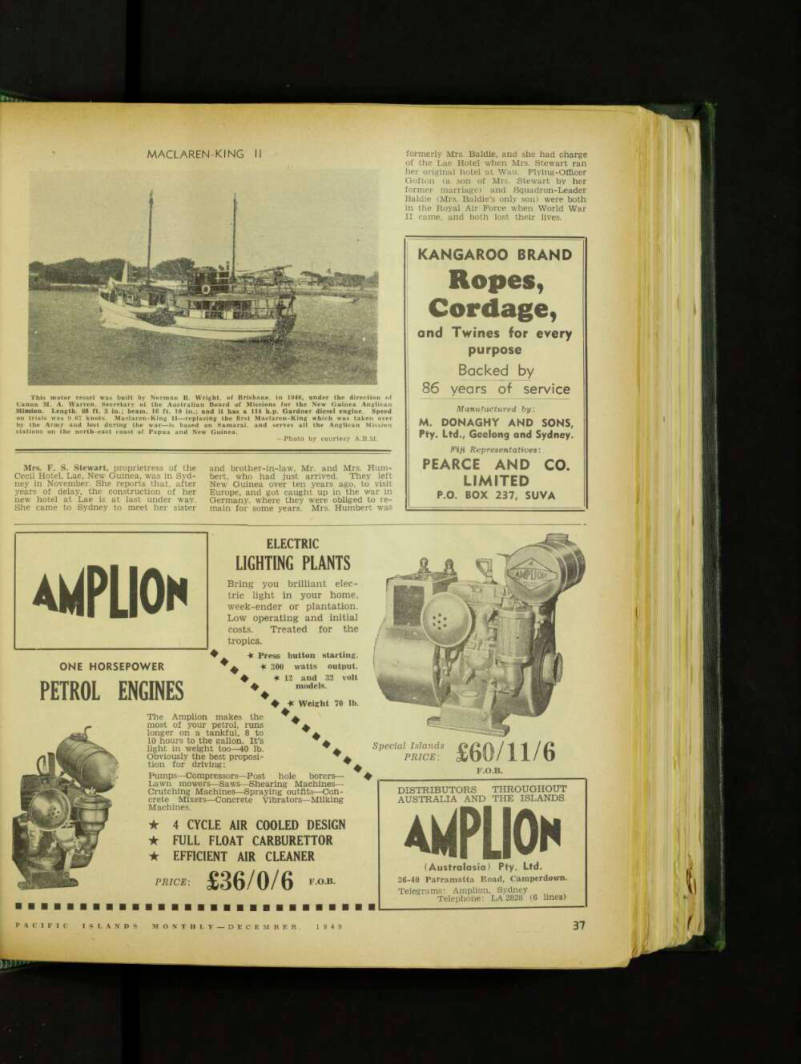
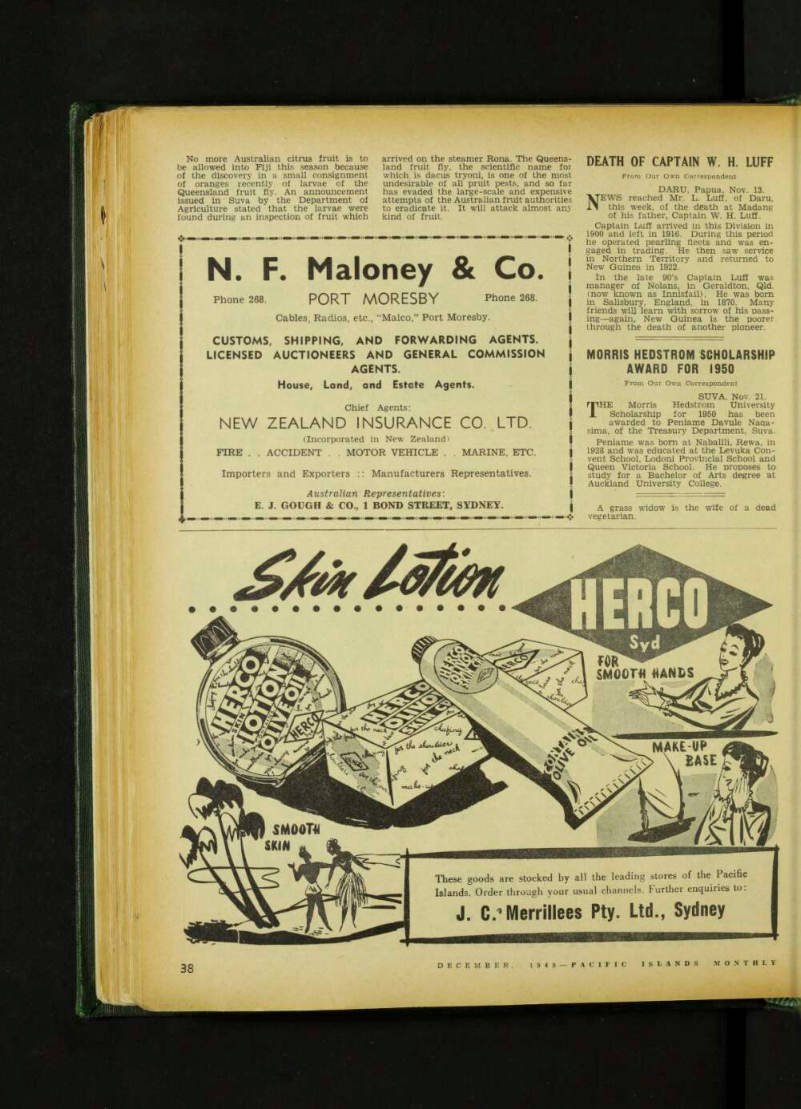
Mrs. F. S. Stewart, proprietress of the Cecil Hotel, Lae, New Guinea, was in Syd ney in November. She reports that, after years of delay, the construction of her new hotel at Lae is at last under way.
She came to Sydney to meet her sister
and brother-in-law, Mr. and Mrs. Hum bert, who had just arrived. They left New Guinea over ten years ago, to visit Europe, and got caught up in the war in Germany, where they were obliged to re main for some years. Mrs. Humbert was
formerly Mrs. Baldie, and she had charge of the Lae Hotel when Mrs. Stewart ran her original hotel at Wau. Flying-Officer Gofton (a son of Mrs. Stewart by her former marriage) and Squadron-Leader Baldie (Mrs. Baldie’s only son) were both in the Royal Air Force when World War II came, and both lost their lives.
This motor vessel was built by Norman R. Wright, of Brisbane, in 1948, under the direction of Canon M. A. Warren, Secretary of the Australian Board of Missions for the New Guinea Anglican Mission. Length, 68 ft. 3 in.; beam, 16 ft. 10 in.; and it has a 114 h.p. Gardner diesel engine. Speed on trials was 9.67 knots. Maclaren-King ll—replacing the first Maclaren-King which was taken over by the Army and lost during the war—is based on Samarai, and serves all the Anglican Mission stations on the north-east coast of Papua and New Guinea. by courtesy A.B.M.
No more Australian citrus fruit is to be allowed into Fiji this season because of the discovery in a small consignment of oranges recently of larvae of the Queensland fruit fly. An announcement issued in Suva by the Department of Agriculture stated that the larvae were found during an inspection of fruit which
arrived on the steamer Rona. The Queens land fruit fly, the scientific name for which, is dacus tryoni, is one of the most undesirable of all pruit pests, and so far has evaded the large-scale and expensive attempts of the Australian fruit authorities to eradicate it. It will attack almost any kind of fruit.
Advertisements & other items, pp. 39-40 (1 item)
a^PLIOh
KANGAROO BRAND
Ropes,
Cordage,
and Twines for every purpose Backed by 86 years of service Manufactured by:
M. DONAGHY AND SONS,
Pty. Ltd., Geelong and Sydney.
Fiji Representatives:
PEARCE AND CO.
LIMITED
P.O. BOX 237, SUVA
ONE HORSEPOWER
PETROL ENGINES
The Amplion makes the most of your petrol, runs longer on a tankful, 8 to 10 hours to the gallon. It’s light in weight too —40 lb.
Obviously the best proposition for driving:
ELECTRIC
LIGHTING PLANTS
Bring you brilliant electric light in your home, week-ender or plantation.
Low operating and initial costs. Treated for the tropics. * Press button starting. * Q * 300 watts output. + 12 and 32 volt models. * Weight 70 lb. \ hole borers— mi m Special Islands
PRICE :
£6O/11/6 Pumps—Compressors—Post Lawn mowers—Saws —Shearing Machines— Crutching Machines—Spraying outfits —Concrete Mixers —Concrete Vibrators —Milking Machines.
★ 4 CYCLE AIR COOLED DESIGN
★ FULL FLOAT CARBURETTOR
★ EFFICIENT AIR CLEANER
F. 0.8.
PRICE:
£36/0/6 F. 0.8.
DISTRIBUTORS THROUGHOUT
AUSTRALIA AND THE ISLANDS
a^PLIOh
(Australasia) Pty. Ltd. 36-40 Parramatta Road, Camperdown.
Telegrams: Amplion, Sydney Telephone: LA2828 (6 lines)
N. F. Maloney & Co.
Phone 268, PORT MORESBY phone 268 - Cables, Radios, etc., “Malco,” Port Moresby.
CUSTOMS, SHIPPING, AND FORWARDING AGENTS,
LICENSED AUCTIONEERS AND GENERAL COMMISSION
AGENTS.
House, Land, and Estate Agents.
Chief Agents:
NEW ZEALAND INSURANCE CO. LTD.
(Incorporated in New Zealand) FIRE . . ACCIDENT . . MOTOR VEHICLE . . MARINE, ETC.
Importers and Exporters :: Manufacturers Representatives.
Australian Representatives : E. J. GOUGH & CO., 1 BOND STREET, SYDNEY.
* • • • 'J*
SMOOTH MANCS
c » 5C 0 J > PH UL>£ iS V * > v o^
MAKE-UP
\ BASE
*% 5v tor* .v A K S 3 O s I
SMOOTH
SKIM
These goods are stocked by all the leading stores of the Pacific Islands. Order through your usual channels. Further enquiries to.
J. C.’Merrillees Pty. Ltd., Sydney
Death Of Captain W. H. Luff
From Our Own Correspondent DARU, Papua. Nov. 13.
NEWS reached Mr. L. Luff, of Daru, this week, of the death at Madang of his father, Captain W. H. Luff.
Captain Luff arrived in this Division in 1900 and left in 1916. During this period he operated pearling fleets and was en gaged in trading. He then saw service in Northern Territory and returned to New Guinea in 1922.
In the late 90’s Captain Luff was manager of Nolans, in Geraldton, Qld. (now known as Innisfail). He was bom in Salisbury, England, in 1870. Many friends will learn with sorrow of his pass ing—again, New Guinea is the poorer through the death of another pioneer.
Morris Hedstrom Scholarship
Award For 1950
Prom Our Own Correspondent
Suva, Nov. 21.
THE Morris Hedstrom University Scholarship for 1950 has been awarded to Peniame Davule Naqa sima, of the Treasury Department, Suva.
Peniame was bom at Nabalili, Rewa, in 1928 and was educated at the Levuka Con vent School, Lodoni Provincial School and Queen Victoria School. He proposes to study for a Bachelor of Arts degree at Auckland University College.
A grass widow is the wife of a dead vegetarian.
Tahiti Wants Tourist
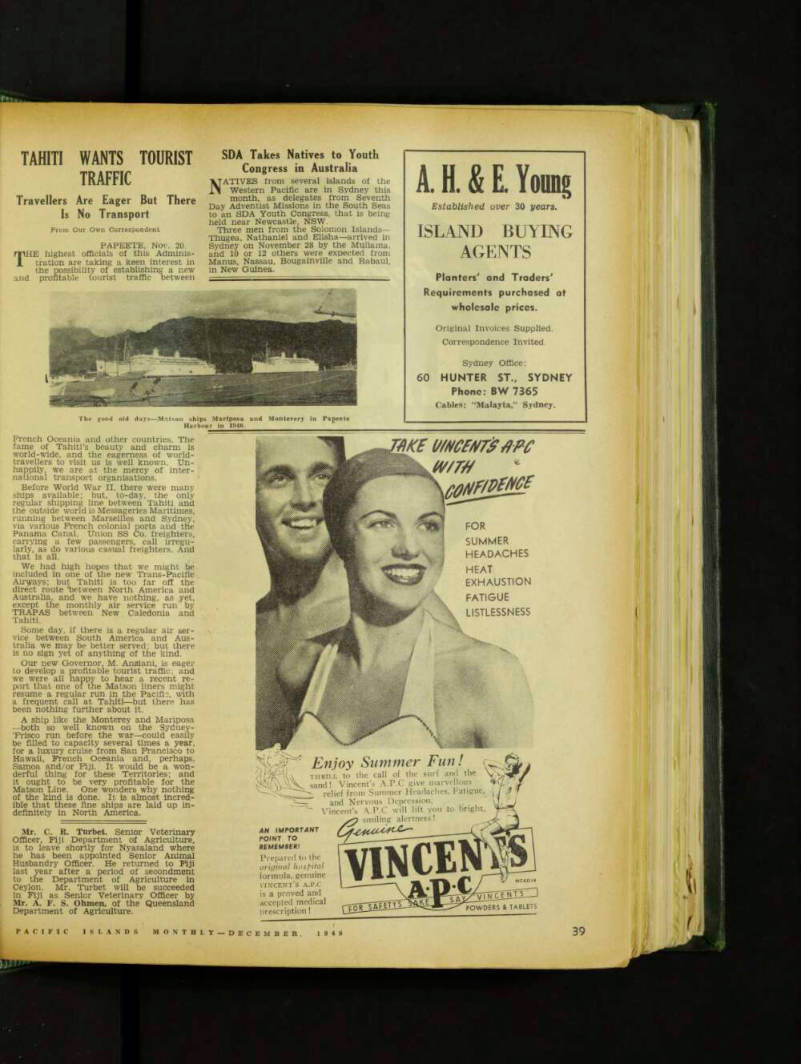
Traffic
Travellers Are Eager But There Is No Transport
From Our Own Correspondent
Papeete, Nov. 20.
THE highest officials of this Adminis tration are taking a keen interest in the possibility of establishing a new and profitable tourist traffic between
French Oceania and other countries. The fame of Tahiti’s beauty and charm is world-wide, and the eagerness of world travellers to visit us is well known. Un happily, we are at the mercy of inter national transport organisations.
Before World War 11, there were many ships available; but, to-day, the only regular shipping line between Tahiti and the outside world is Messageries Maritimes, running between Marseilles and Sydney, via various French colonial ports and the Panama Canal. Union SS Co. freighters, carrying a few passengers, call irregu larly, as do various casual freighters. And that is all.
We had high hopes that we might be included in one of the new Trans-Pacific Airways; but Tahiti is too far off the direct route between North America and Australia, and we have nothing, as yet, except the monthly air service run by TRAPAS between New Caledonia and Tahiti.
Some day, if there is a regular air ser vice between South America and Aus tralia we may be better served: but there is no sign yet of anything of the kind.
Our new Governor, M. Anziani, is eager to develop a profitable tourist traffic: and we were all happy to hear a recent re port that one of tne Matson liners might resume a regular run in the Pacific, with a frequent call at Tahiti—but there has been nothing further about it.
A ship like the Monterey and Mariposa —both so well known on the Sydney ’Frisco run before the war—could easily be filled to capacity several times a year, for a luxury cruise from San Francisco to Hawaii, French Oceania and, perhaps, Samoa and/or Fiji. It would be a won derful thing for these Territories; and it ought to be very profitable for the Matson Line, One wonders why nothing of the kind is done. It is almost incred ible that these fine ships are laid up in definitely in North America.
Mr. C. R. Turbet. Senior Veterinary Officer, Fiji Department of Agriculture, is to leave shortly for Nyasaland where he has been appointed Senior Animal Husbandry Officer. He returned to Fiji last year after a period of secondment to the Department of Agriculture in Ceylon. Mr. Turbet will be succeeded in Fiji as Senior Veterinary Officer by Mr. A. F. S. Oilmen, of the Queensland Department of Agriculture,
The good old days—Matson ships Mariposa and Monterery in Papeete Harbour in 1940.
Congress in Australia
SDA Takes Natives to Youth Congress in Australia
NATIVES from several islands of the Western Pacific are in Sydney this month, as delegates from Seventh Day Adventist Missions in the South Seas to an SDA Youth Congress, that is being held near Newcastle, NSW.
Three men from the Solomon Islands— Thugea, Nathaniel and Elisha —arrived in Sydney on November 28 by the Muliarna, and 10 or 12 others were expected from Manus, Nassau, Bougainville and Rabaul, in New Guinea.
Advertisements & other items, pp. 41-42 (1 item)
A. H. & E. Young
Established over 30 years.
ISLAND BUYING
AGENTS
Planters' and Traders' Requirements purchased at wholesale prices.
Original Invoices Supplied.
Correspondence Invited.
Sydney Office:
60 HUNTER ST., SYDNEY
Phone: BW 7365 Cables: “Malayta,” Sydney.
mb mcEHrt&pc
M//T#
C OOOE E
FOR
SUMMER
HEADACHES
HEAT
EXHAUSTION
FATIGUE
LISTLESSNESS
Enjoy Summer Fun!
thrill to the call of the surf and the sand! Vincent’s A.P.C give marvellous relief from Summer Headaches. Fatigue, and Nervous Depression.
Vincent’s A.P.C will lift you to bright, smiling alertness!
AN IMPORTANT
POINT TO
REMEMBER!
Prepared to the original hospital formula, genuine Vincent’s a.p.c is a proved and accepted medical prescription!
& TABLETS
/ns/sf
LAUREL
/te ft fa//nest
KEROSENE
you can
Laurel is the purest and best kerosene you can buy for your kerosene refrigerator. Laurel burns with a dean, steady flame with a minimum of smoke, smell or wick-char.
Don't ask for "just'' kerosene.
Always specify LAUREL.
Try this ICE CREA.AI Recipe £ cup Condensed Milk, \ cup Water, U cups Beaten Cream, 1| teaspoons Vanilla.
Mix condensed milk with water. Add vanilla and set in refrigerator to chill. When cold add cream and when partially frozen remove and beat thoroughly. Return to refrigerator and freeze until hard.
VACUUM OIL COMPANY PTY. LTD. (Inc. in Aush)
Important Nukualofa Wedding
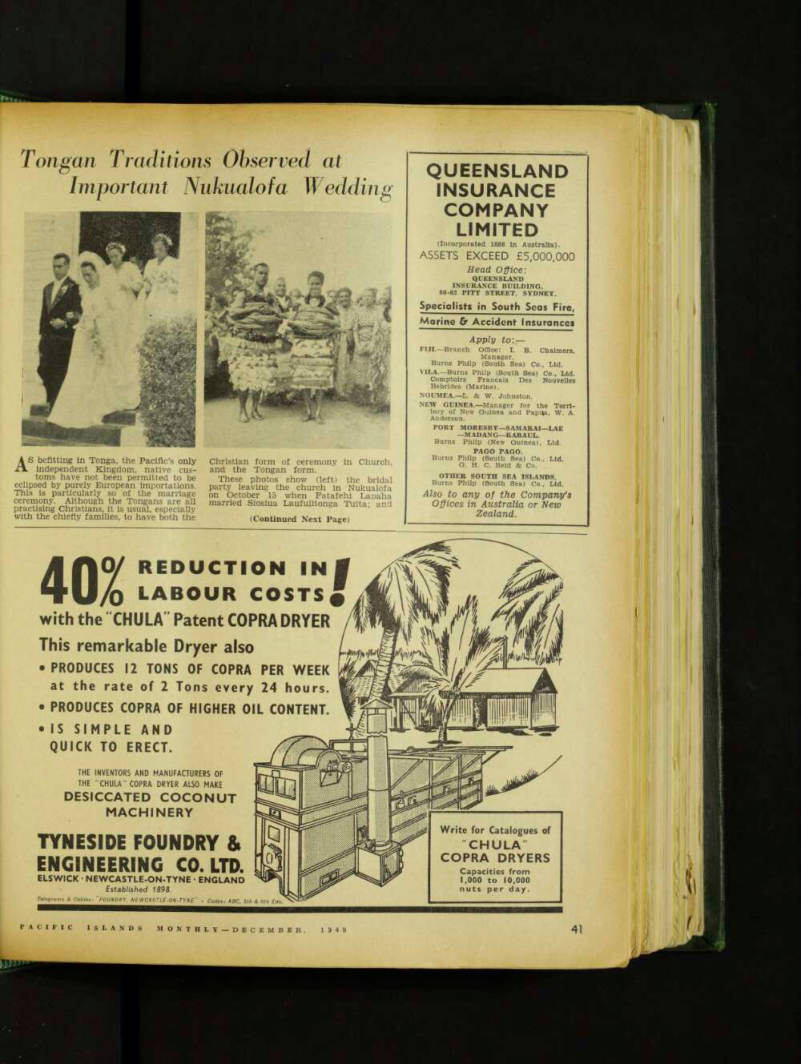
Tongan Traditions Observed Important Nukualofa Wedding
AS befitting in Tonga, the Pacific’s only independent Kingdom, native cus toms have not been permitted to be eclipsed by purely European importations.
This is particularly so of the marriage ceremony. Although the Tongans are all practising Christians, it is usual, especially with the chiefly families, to have both the
Christian form of ceremony in Church, and the Tongan form.
These photos show (left) the bridal party leaving the church in Nukualofa on October 15 when Fatafehi Lapaha married Siosiua Laufulitonga Tuita; and
(Continued Next Page)
(right) the young couple at the Tongan marriage ceremonial a few days later.
Fatafehi Lapaha is daughter of Queen Salote’s ADC, Vilai Tupou and his wife; her brother is the present holder of the Vaea title. Siosiua Laufulitonga Tuita is second cousin of Queen Salote and the
eldest son of Tuita, a noble of high rank.
The wedding took place at the Royal Chapel, Nukualofa, and was attended by Queen Salote, Crown Price Tungi, Prin cess Mata’aho, HBM’s Agent and Consul and Mrs. Windrum, Tongan nobles and almost all the European community. The Rev. McKay of the Free Methodist Church performed the ceremony. Afterwards 500 guests were entertained in tne Govern ment College Hall where huge tables were laden with wine and Hght refreshments of all kinds, including a five-tiered wedding cake specially imported from Auckland.
A ball followed in the evening which was thoroughly enjoyed by all who attended.
The ceremonies in the Tongan fashion, including feasting and dancing, took place a couole of days afterwards and were at tended by both Europeans and Tongans, including the Royal family. Guests came also from neighbouring islands.
Advertisements & other items, pp. 43-44 (1 item)
AkwipK
QUEENSLAND
INSURANCE
COMPANY
LIMITED
(Incorporated 1886 In Australia).
ASSETS EXCEED £5,000,000
Head Office:
QUEENSLAND
INSURANCE BUILDING,
80-82 PITT STREET, SYDNEY.
Speciolists in South Seos Fire,
Morine Zr Accident Insuronces
Apply to:—
FlJl.—Branch Office: I. B. Chalmers, Manager.
Burns Philp (South Sea) Co., Ltd.
VlLA.—Burns Philp (South Sea) Co., Ltd.
Comptoirs Francais Des Nouvelles Hebrides (Marine), NOUMEA.—L. & W. Johnston.
NEW GUlNEA.—Manager for the Territory of New Guinea and Papua, W. A.
Anderson.
PORT MORESBY—SAMARAI—LAE
—MADANG—RABAUL.
Burns Philp (New Guinea), Ltd.
PAGO PAGO.
Burns Philp (South Sea) Co., Ltd.
G. H. C. Reid & Co.
OTHER SOUTH SEA ISLANDS.
Burns Philp (South Sea) Co., Ltd.
Also to any of the Company’s
Offices in Australia or New Zealand.
Mil o / reduction ini
LABOUR COSTS
with the CHULA Patent COPRA DRYER
This remarkable Dryer also
• PRODUCES 12 TONS OF COPRA PER WEEK at the rate of 2 Tons every 24 hours. • PRODUCES COPRA OF HIGHER OIL CONTENT.
• IS SIMPLE AND
QUICK TO ERECT.
THE INVENTORS AND MANUFACTURERS OF
THE ■CHULA" COPRA DRYER ALSO MAKE
DESICCATED COCONUT
MACHINERY
TYNESIDE FOUNDRY &
ENGINEERING CO. LTD.
ELSWICK • NEWCASTLE-ON-TYNE • ENGLAND
Established 1898.
Telegrams & Cables: "FOUNDRY, NEWCASTLE-ON-TYNE" . Codes: ABC, sth & 6th Eds. m 3 VP
AkwipK
'c^- Wnte for Catalogues of
CHULA
COPRA DRYERS
Capacities from 1,000 to 10,000 nuts per day.
Songs of the South Seas!
Inspirations. Cheer. Uplift.
Cover: Feathery Palms, Tropical Flowers, Native Girl. Ideal Gift or Souvenir. 5/-. Post free.
Order from ;
Dr. Wm. SWAAN
2574 W. Broadway, Vancouver, B.C.
Every Branch Of
ENGINEERING and BUILDING CONSTRUCTION
MILLERS LTD.
SUVA and LAUTOKA
Sawmillers and Timber Merchants; Shipwrights and Sailmakers; Joinery and Furniture Manufacturers; Upholsterers; Plumbers; Electricians; Hardware Merchants; Motor Dealers.
AGENCIES:
Chevrolet, Bedford, Vauxhall, Nash Motors. Firestone Tyres.
Fetters Marine and Stationary Engines. G.E.C. Radio Sets.
British Australian Lead Manufacturers Pty., Ltd., Atlas Assurance Co., Ltd.
There is no need to send to Australia or New Zealand for Repairs or Replacements. We can give you a sound Quotation and guarantee First-Class Workmanship
BROOHFIELDS Ltd.
Suppliers of
Building Hardware
General Hardware
Ship Chandlery
Paint Materials
WRITE DIRECT TO
Broomfields Ltd.
152 SUSSEX STREET, SYDNEY
Sole Agents : P. H. MUNTZ & CO.’s 3-CROWN BRAND METAL
PEACOCK
SHEATHING.
BUCHANS’ ENGLISH READY-
[ED PAINTS.
m m s 11
Newsletter from
the N.G. Highl'ds
From a Special Correspondent
November 14.
RECENT arrivals in the Central High lands of New Guinea, are old-time missionaries (Lutheran M ssion) Mr. and Mrs. Hannerman. They have been in America for some months where Mrs.
Hannerman underwent a serious opera tion. They are now at their previous station—Kerowagi. They are accompanied by their daughter, Caroline. * Departed during the month for Wewak, Dr. J. Akerman, previously District Medi cal Officer for the Central Highlands District who has left to relieve Dr. Mac- Inerney. Gorokaites will miss the “Doc.” as will all European residents of the High lands District, where during his stay, he proved himself to be a popular and effi cient Medical Officer. The well-known hospitality of the doctor and his wife will also be missed. * Medical Assistant Keyes, late of Manus is now in charge of the Native Hospital at Kundiawa (Chimbu Sub-District). He is accompanied by his wife. * Kerowagi (also in the Chimbu Sub- District) is to get a new native hospital.
The hospital buildings are well under way, and the establishment should be com pleted early in the new year. This will fill a great need as the population war rants a hospital. Natives in the area are looking forward to having it there. Pre viously patients from this area had to be carried to Kup, a distance of 10 miles, for treatment or hospitalisation. * Mr. M. C. W. Rich, the new Director of District Services, of Port Moresby, accom panied by the District Officer of the Cen tral Highlands, Mr. George Greathead, visited most stations in the Highlands re cently.
Mr E. J. Hallstrom, accompanied by a party which included the Administrator (Col. J. K. Murray) visited Nondugl dur ing the month. Owing to landing restric tions, the chartered DCS could not land on the Nondugl strip, so the party was landed at Kerowagi and ferried from there by Dragon Rapides. A member of the party was overheard to say that Non dugl was the “Wahgi Wonderland.” We agree with him. Our last visit there showed improvements carried out on all sides. This is due in no small measure to the capable management of Mr. N. B.
Blood The development of this Experi mental Station is well worth watching. * Natives of the Banz area weie staggered a while back by the large numbers of aircraft and masters that visited their airstrip in the Hagen sub-District. Some of them wanted to know if there was another war on. Maybe so —but happily, not the type of war they thought. It was only a large party looking for a suitable spot to construct an airfield, and if that does not constitute the commencement of a paper-war between departments and Canberra. I don’t know what does.
Mrs. Gordon Harris, who arriyed in Australia several ago to inquire concerning her interests in Djaul Island, New Gufnea (where, before the war her husband operated a plantation) has gone to Port Moresby, as a member of the temporary staff of the Production Control Board.
Advertisements & other items, p. 44 (1 item)
42
DECEMBER, 1949-PACIFIO ISLANDS MONTHLY
Western Papua Notes
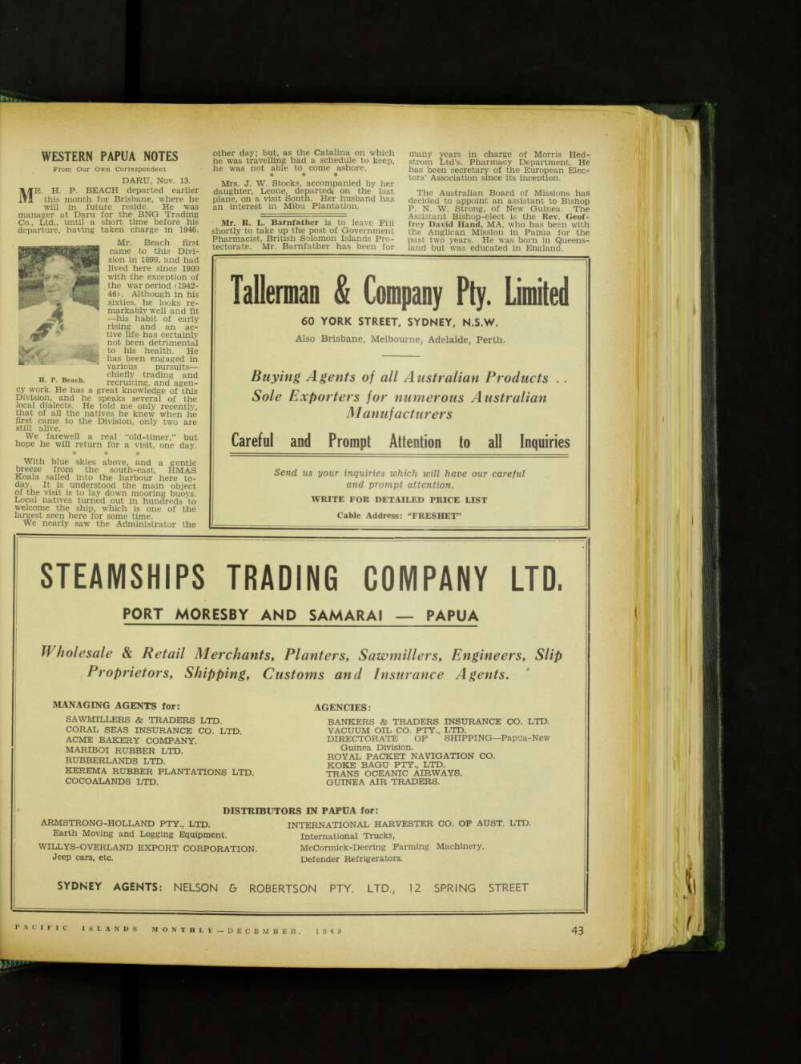
From Our Own Correspondent
Daru, Nov. 13.
MR. H. P. BEACH departed earlier this month for Brisbane, where he will in future reside. He was manager at Daru for the BNG Trading Co., Ltd., until a short time before his departure, having taken charge in 1946.
Mr. Beach first came to this Divi sion in 1899, and had lived here since 1900 with the exception of the war period (1942- 46). Although in his sixties, he looks re markably well and fit —his habit of early rising and an ac tive life has certainly not been detrimental to his health. He has been engaged in various pursuits—
chiefly trading and h. V. Beach. recruiting, and agen cy work. He has a great knowledge of this Division, and he speaks several of the local dialects. He told me only recently, that of all the natives he knew when he first came to the Division, only two are still alive.
We farewell a real “old-timer.” but hope he will return for a visit, one day. * * * With blue skies above, and a gentle breeze from the south-east, HMAS Koala sailed into the harbour here to day. It is understood the main object of the visit is to lay down mooring buoys.
Local natives turned out in hundreds to welcome the ship, which is one of the largest seen here for some time.
We nearly saw the Administrator the
other day; but, as the Catalina on which he was travelling had a schedule to keep, he was not able to come ashore. * ♦ * Mrs. J. W. Stocks, accompanied by her daughter, Leone, departeds on the last plane, on a visit South. Her husband has an interest in Mibu Plantation.
Mr. R. L. Barnfather is to leave Fiji shortly to take up the post of Government Pharmacist, British Solomon Islands Pro tectorate. Mr. Barnfather has been for
many years in charge of Morris Hed strom Ltd’s. Pharmacy Department. He has been secretary of the European Elec tors’ Association since its inception.
The Australian Board of Missions has decided to appoint an assistant to Bishop P. N. W. Strong, of New Guinea. The Assistant Bishop-elect is the Rev. Geof frey David Hand, MA, who has been with the Anglican Mission in Papua for the past two years. He was born in Queens land but was educated in England.
Advertisements & other items, pp. 45-46 (1 item)
Tallerman & Company Pty. Limited
60 YORK STREET, SYDNEY, N.S.W.
Also Brisbane, Melbourne, Adelaide, Perth.
Buying Agents of all Australian Products ..
Sole Exporters for numerous Australian
M anufacturers
Careful and Prompt Attention to ail Inquiries Send us your inquiries which will have our careful and prompt attention.
WRITE FOR DETAILED PRICE LIST
Cable Address: “FRESHET”
STEAMSHIPS TRADING COMPANY LTD.
PORT MORESBY AND SAMARAI PAPUA
Wholesale & Retail Merchants, Planters, Sawmillers, Engineers, Slip
Proprietors, Shipping, Customs and Insurance Agents.
MANAGING AGENTS for:
SAWMILLERS & TRADERS LTD.
CORAL SEAS INSURANCE CO. LTD.
ACME BAKERY COMPANY.
MARIBOI RUBBER LTD.
RUBBERLANDS LTD.
KEREMA RUBBER PLANTATIONS LTD.
COCOALANDS LTD.
AGENCIES:
BANKERS & TRADERS INSURANCE CO. LTD.
VACUUM OIL CO. PTY., LTD.
DIRECTORATE OF SHIPPING—Papua-New
Guinea Division.
ROYAL PACKET NAVIGATION CO.
KOKE BAGU PTY., LTD.
TRANS OCEANIC AIRWAYS.
GUINEA AIR TRADERS.
DISTRIBUTORS IN PAPUA for:
ARMSTRONG-HOLLAND PTY., LTD. INTERNATIONAL HARVESTER CO. OF AUST. LTD.
Earth Moving and Logging Equipment. International Trucks, WILLYS-OVERLAND EXPORT CORPORATION. McCormick-Deering Farming Machinery, Jeep cars, etc. Defender Refrigerators.
SYDNEY AGENTS: NELSON & ROBERTSON PTY. LTD,, 12 SPRING STREET
There is only one
ELECTROLUX
THE MODERN KEROSENE-OPERATED REFRIGERATOR
THAT ACHIEVES THE MIRACLE OF ICE FROM HEAT
Lasting Efficiency, Silent Operation, Streamlined Beauty
a m .
' - ■ n
Economically operated by kerosene, with a simple precision-built freezing unit that has no moving parts and is GUARANTEED FOR
FIVE (5) YEARS.
Only obtainable from :
NEW GUINEA COMPANY, LIMITED,
Rabaul, Madang, Lae, Kavieng.
J. R. CLAY & CO., LTD., Port Moresby.
W. R. CARPENTER & CO. (Sol. Is.), LTD., Tulagi.
THE NORFOLK ISLAND SERVICE DEPOT,
Norfolk Island.
For New Hebrides, Gilbert and Ellice Islands Colony and New Caledonia, apply direct to:
Model LKSSI
PRICES ON APPLICATION.
Storage capacity: 5i cub. ft. (approx.); shelf area, 10 sq. ft. food shelves, six—five removable; 2 self-supporting when half drawn. Ice-making: Four trays —5 lb. ice per freezing: 80 cubes. Fuel consumption: 1.8 pints kerosene per day (approx.).
Height: 4 ft. 10 in. Depth: 2 ft. in.
Weight, unpacked, 406 lb. Packed, 574 lb.
W. R. CARPENTER & CO., LTD. Head Office: 16 O'Connell St., Sydney, N. S. Wales
Public Works At Samarai
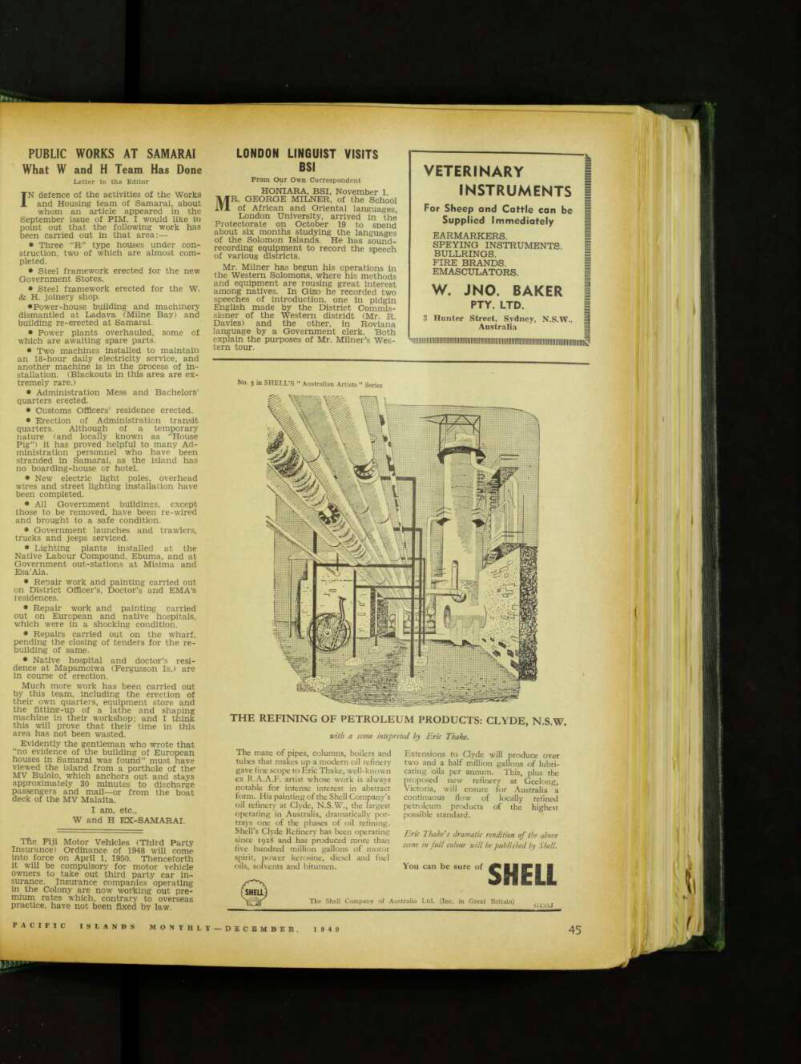
What W and H Team Has Done
Letter to the Editor IN defence of the activities of the Works and Housing team of Samarai, about whom an article appeared in the September issue of PIM, I would like to point out that the following work has been carried out in that area:— • Three “R” type houses under con struction, two of which are almost com pleted. • Steel framework erected for the new Government Stores. • Steel framework erected for the W. & H. joinery shop. • Power-house building and machinery dismantled at Ladava (Milne Bay) and building re-erected at Samarai. • Power plants overhauled, some of which are awaiting spare parts. • Two machines installed to maintain an 18-hour daily electricity service, and another machine is in the process of in stallation. (Blackouts in this area are ex tremely rare.) • Administration Mess and Bachelors’ quarters erected. • Customs Officers’ residence erected. • Erection of Administration transit quarters. Although of a temporary nature (and locally known as “House Pig”) it has proved helpful to many Ad ministration personnel who have been stranded in Samarai, as the island has no boarding-house or hotel. • New electric light poles, overhead wires and street lighting installation have been completed. • All Government buildings, except those to be removed, have been re-wired and brought to a safe condition. • Government launches and trawlers, trucks and jeeps serviced. • Lighting plants installed at the Native Labour Compound, Ebuma, and at Government out-stations at Misima and Esa’Ala. • Repair work and painting carried out on District Officer’s, Doctor’s and EMA’s residences. • Repair work and painting carried out on European and native hospitals, which were in a shocking condition. • Repairs carried out on the wharf, pending the closing of tenders for the re building of same. • Native hospital and doctor’s resi dence at Mapamoiwa (Fergusson Is.) are in course of erection.
Much more work has been carried out by this team, including the erection of their own quarters, equipment store and the fitting-up of a lathe and shaping machine in their workshop; and I think this will prove that their time in this area has not been wasted.
Evidently the gentleman who wrote that “no evidence of the building of European houses in Samarai was found” must have viewed the island from a porthole of the* MV Bulolo, which anchors out and stays approximately 30 minutes to discharge passengers and mail—or from the boat deck of the MV Malaita.
I am, etc.,
W And H Ex-Samarai.
The Fiji Motor Vehicles (Third Party Insurance) Ordinance of 1948 will come into force on April 1, 1950. Thenceforth it will be compulsory for motor vehicle owners to take out third party car in surance. Insurance companies operating in the Colony are now working out pre mium rates which, contrary to overseas practice, have not been fixed by law.
London Linguist Visits
Bsi
Prom Our Own Correspondent HONIARA, BSI, November 1.
MR. GEORGE MILNER, of the School of African and Oriental languages, London University, arrived in the Protectorate on October 19 to spend about six months studying the languages of the Solomon Islands. He has sound recording equipment to record the speech of various districts.
Mr. Milner has begun his operations in the Western Solomons, where his methods and equipment are rousing great interest among natives. In Gizo he recorded two speeches of introduction, one in pidgin English made by the District Commis sioner of the Western distridt (Mr. R.
Davies) and the other, in Rovlana language by a Government clerk. Both explain the purposes of Mr. Milner’s Wes tern tour.
Advertisements & other items, pp. 47-48 (1 item)
Shell
VETERINARY
INSTRUMENTS
For Sheep and Cattle can be
Supplied Immediately
EARMARKERS.
SPEYING INSTRUMENTS
BULLRINGS.
FIRE BRANDS.
EMASCULATORS.
W. JNO. BAKER
PTY. LTD.
3 Hunter Street, Sydney, N.S.W., Australia
No. 5 in SHELL’S " Australian Artists ” Series i as m W; S' fa 1 iU « 1 Xisr THE REFINING OF PETROLEUM PRODUCTS: CLYDE, N.S.W. with a scene intepreted by Eric Thake.
The maze of pipes, columns, boilers and tubes that makes up a modern oil refinery gave fine scope to Eric Thake, well-known ex R.A.A.F. artist whose work is always notable for intense interest in abstract form. His painting of the Shell Company’s oil refinery at Clyde, N.S.W., the largest operating in Australia, dramatically portrays one of the phases of oil refining.
Shell’s Clyde Refinery has been operating since 1928 and has produced more than five hundred million gallons of motor spirit, power kerosine, diesel and fuel oils, solvents and bitumen.
Extensions to Clyde will produce over two and a half million gallons of lubricating oils per annum. This, plus the proposed new refinery at Geelong, Victoria, will ensure for Australia a continuous flow of locally refined petroleum products of the highest possible standard.
Eric Thake's dramatic rendition of the above scene in full colour will be published by Shell.
SHELL
SHELL
The Shell Company of Australia Ltd. (Inc. in Great Britain)
G4DBJ
Allen Taylor & Co. Ltd.
COMMERCIAL ROAD, ROZELLE,
SYDNEY
Sawmillers and Wholesale Suppliers of Hardwoods for Constructional Purposes GIRDERS ... PILES .. . POLES . . . SLEEPERS, Etc.
EXPORTING TO PACIFIC - ISLANDS SINCE 1893
TAHITI
To Shipmasters and Visitors When calling at Tahiti, and seeking SHIPS SUPPLIES and FRESH
PROVISIONS, see—
OSCAR G. NORDMAN
Supply Agent for Messageries Mari times, Union S.S. Co. of N.Z., Ltd., Matson Oceanic Line, United States Line, General S.S. Corp., Etc.
We supply General Service —Information about the Islands Real Estate Service—Make Reservations —Act as Shipping Agents Wire before your arrival to
OCEANIC PAPEETE—Our
registered cable address.
OSCAR G. NORDMAN
Ship Chandler
PAPEETE. TAHITI
Tnc Oarrick Motel
tciefi
A**. ISL
SUVA
'"'.Vjinr
F J & « This well-known Hotel is centrally situated in Suva s main busi ness quarter :: Modern accommodation provides comfort in all climatic conditions :: Only the best of Beers, Spirits and Wines is served Telephone: 80.
VINCE COSTELLO,
Pronrietor.
Flour for Fiji
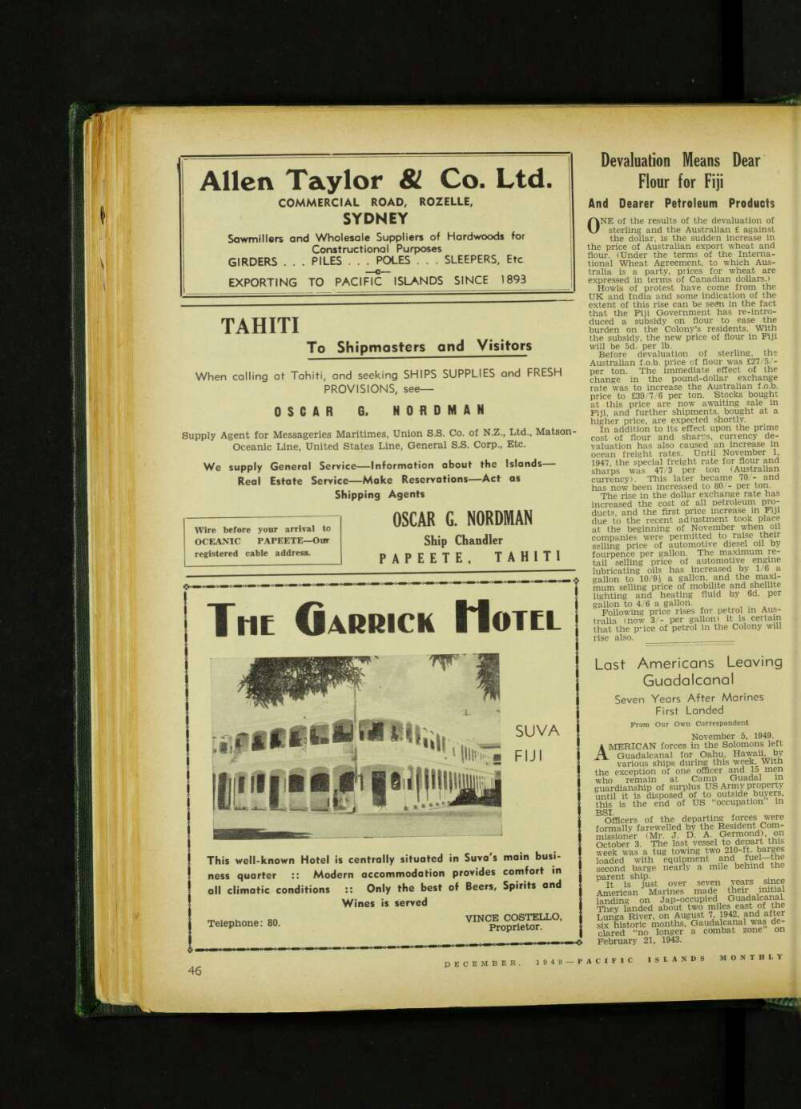
Devaluation Means Dear Flour for Fiji And Dearer Petroleum Products
ONE of the results of the devaluation of sterling and the Australian £ against the dollar, is the sudden increase in the price of Australian export wheat and flour. (Under the terms of the Interna tional Wheat Agreement, to which Aus tralia is a party, prices for wheat are expressed in terms of Canadian dollars.) Howls of protest have come from the UK and India and some indication of the extent of this rise can be seen in the fact that the Fiji Government has re-intro duced a subsidy on flour to ease the burden on the Colony’s residents. With the subsidy, the new price of flour in Fiji will be sd. per lb.
Before devaluation of sterling, the Australian f.o.b. price of flour was £27/5/per ton. The immediate effect of the change in the pound-dollar exchange rate was to increase the Australian f.o.b. price to £39/7/6 per ton. Stocks bought at this price are now awaiting sale in Fiji, and further shipments, bought at a higher price, are expected shortly.
In addition to its effect upon the prime cost of flour and sharps, currency de valuation has also caused an increase in ocean freight rates. Until November 1, 1947, the special freight rate for flour and sharps was 47/3 per ton (Australian currency). This later became 70/- and has now been increased to 80/- per ton.
The rise in the dollar exchange rate has increased the cost of all petroleum pro ducts, and the first price increase m Fiji due to the recent adiustment took place at the beginning of November when oil companies were permitted to raise their selling price of automotive diesel oil by fourpence per gallon. The maximum re tail selling price of automotive engine lubricating oils has increased by 1/6 a gallon to 10/9J a gallon, and the maxi mum selling price of mobilite and shellite lighting and heating fluid by 6d. per gallon to 4/6 a gallon. .
Following price rises for petrol in Aus tralia (now 3/- per gallon) it is certain that the pnce of petrol in the Colony will rise also.
Guadalcanal
Last Americans Leaving Guadalcanal Seven Years After Marines First Landed
From Our Own Correspondent November 5, 1949.
AMERICAN forces in the Solomons left , Guadalcanal for Oahu, Hawaii, by various ships during this week. With the exception of one officer and 15 men who remain at Camp Guadal in guardianship of surplus US Army property until it is disposed of to outside buyers, this is the end of US “occupation’ in
Bsi
Officers of the departing forces were formally farewelled by the Resident Com missioner (Mr. J. D. A. Germond), on October 3. The last vessel to depart this week was a tug towing two 210-ft. harges loaded with equipment and fuel—the second barge nearly a mile behind the oyer seven ye^ rg s ince American Marines made their initial landing on Jap-occupied Guadalcanal.
Thev landed about two miles east of the Lunga River, on August 7, 1942, and after six historic months, Gaudalcanal was de clared “no longer a combat zone on February 21, 1943.
Are Pacific Candlenuts
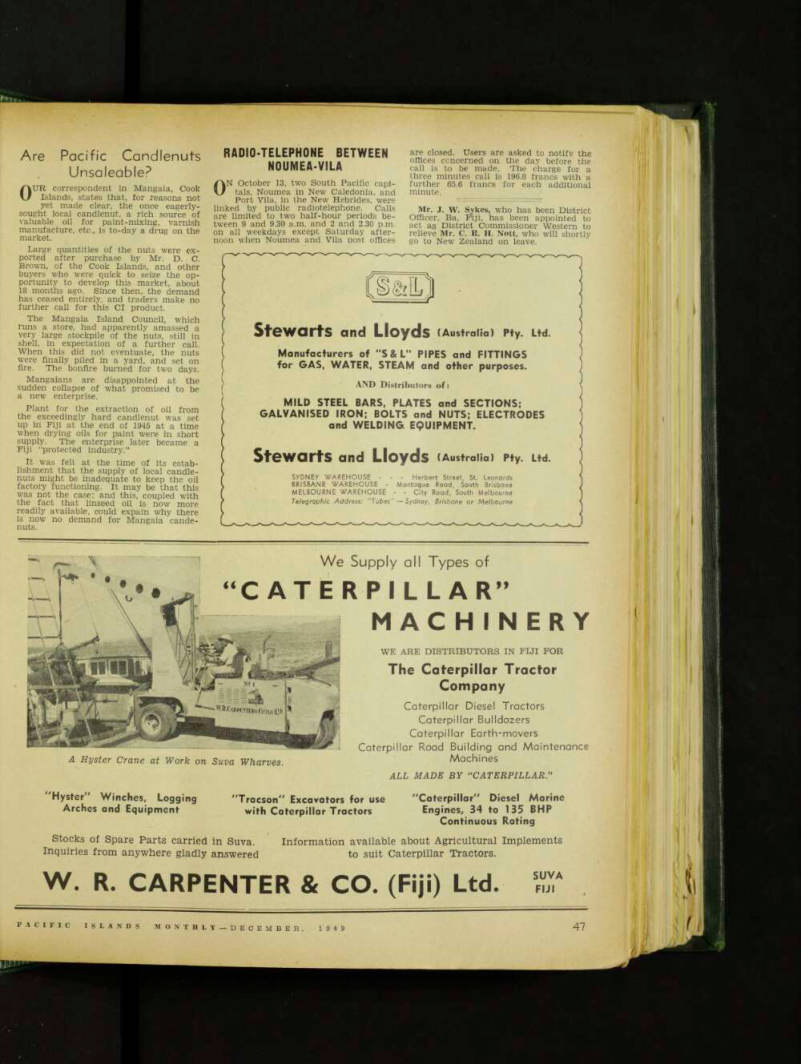
Unsaleable?
OUR correspondent in Mangaia, Cook Islands, states that, for reasons not yet made clear, the once eagerly sought local candlenut, a rich source of valuable oil for paint-mixing, varnish manufacture, etc., is to-day a drug on the market.
Large quantities of the nuts were ex ported after purchase by Mr. D. C.
Brown, of the Cook Islands, and other buyers who were quick to seize the op portunity to develop this market, about 18 months ago. Since then, the demand has ceased entirely, and traders make no further call for this Cl product.
The Mangaia Island Council, which runs a store, had apparently amassed a very large stockpile of the nuts, still in shell, in expectation of a further call.
When this did not eventuate, the nuts were finally piled in a yard, and set on fire. The bonfire burned for two days.
Mangaians are disappointed at the sudden collapse of what promised to be a new enterprise.
Plant for the extraction of oil from the exceedingly hard candlenut was set up in Fiji at the end of 1945 at a time when drying oils for paint were in short supply. The enterprise later became a Fiji “protected industry.”
It was felt at the time of its estab lishment that the supply of local candle nuts might be inadequate to keep the oil factory functioning. It may be that this was not the case; and this, coupled with the fact that linseed oil is now more readily available, could expain why there is now no demand for Mangaia cande nuts.
Radio-Telephone Between
Noumea-Vila
ON October 13, two South Pacific capi tals, Noumea in New Caledonia, and Port Vila, in the New Hebrides, were linked by public radiotelephone. Calls are limited to two half-hour periods be tween 9 and 9.30 a.m. and 2 and 2.30 p.m. on all weekdays except Saturday after noon when Noumea and Vila post offices
are closed. Users are asked to notify the offices concerned on the day before the call is to be made. The charge for a three minutes call is 196.8 francs with a further 65.6 francs for each additional minute.
Mr. J. w. Sykes, who has been District Officer, Ba, Fiji, has been appointed to act as District Commissioner Western to relieve Mr. C. R. H. Nott, who will shortly go to New Zealand on leave.
Advertisements & other items, pp. 49-50 (1 item)
Machinery
ry V &IL
Stewarts and Lloyds (Australia) Pty. Ltd.
Manufacturers of "S&L" PIPES and FITTINGS for GAS, WATER, STEAM and other purposes.
AND Distributors of:
MILD STEEL BARS, PLATES and SECTIONS;
GALVANISED IRON; BOLTS and NUTS; ELECTRODES
and WELDING EQUIPMENT.
Stewarts and Lloyds (Australia) pt y . Ltd.
SYDNEY WAREHOUSE - - - Herbert Street, St. Leonards BRISBANE WAREHOUSE - Montague Road, South Brisbane MELBOURNE WAREHOUSE • - City Road, South Melbourne Telegraphic Address: "Tubes ' — Sydney, Brisbane or Melbourne
h* 5
We Supply all Types of
“CATERPILLAR”
MACHINERY
A Hyster Crane at Work on Suva Wharves.
WE ARE DISTRIBUTORS IN FIJI FOR
The Caterpillar Tractor
Company
Caterpillar Diesel Tractors Caterpillar Bulldozers Caterpillar Earth-movers Caterpillar Road Building and Maintenance Machines
ALL MADE BY “CATERPILLAR.”
Hyster" Winches, Logging Arches and Equipment Tracson" Excavators for use with Caterpillar Tractors Caterpillar" Diesel Marine Engines, 34 to 135 BMP Continuous Rating Stocks of Spare Parts carried in Suva. Information available about Agricultural Implements Inquiries from anywhere gladly answered to suit Caterpillar Tractors.
W. R. CARPENTER & CO. (Fiji) Ltd.
SUVA
FIJI
*o<,* *** ... •*».„^*%hA o .AW n X (*► I a *3 Wof /£ ft & £ *** * *r /*m m 9* A 7#' * > w v' fb* n / •ws M» A *S ■nr pfOL* /> 23
the
services s
SOUTH
iNJLt
PACIFIC
New Zealand is a whole world of travel . . . but it’s a small world when you fly on the N.Z. National Airways Corporation air network that brings New Zealand’s playgrounds and wonderlands invitingly close.
NEW ZEALAND NATIONAL AIRWAYS CORPORATION.
New Zealand National Airways Corporation provides a network of air services throughout the Dominion and the South-West Pacific. General Agents in the Dominion for British Commonwealth Pacific Airlines ami Trans-Australian Airlines. Booking Agents for Tasman Empire Airways, Qantas Empire Airways, me .u. . and other overseas airlines.
Offices and Agents throughout New Zealand and the South-West Pacific.
Magazine Section
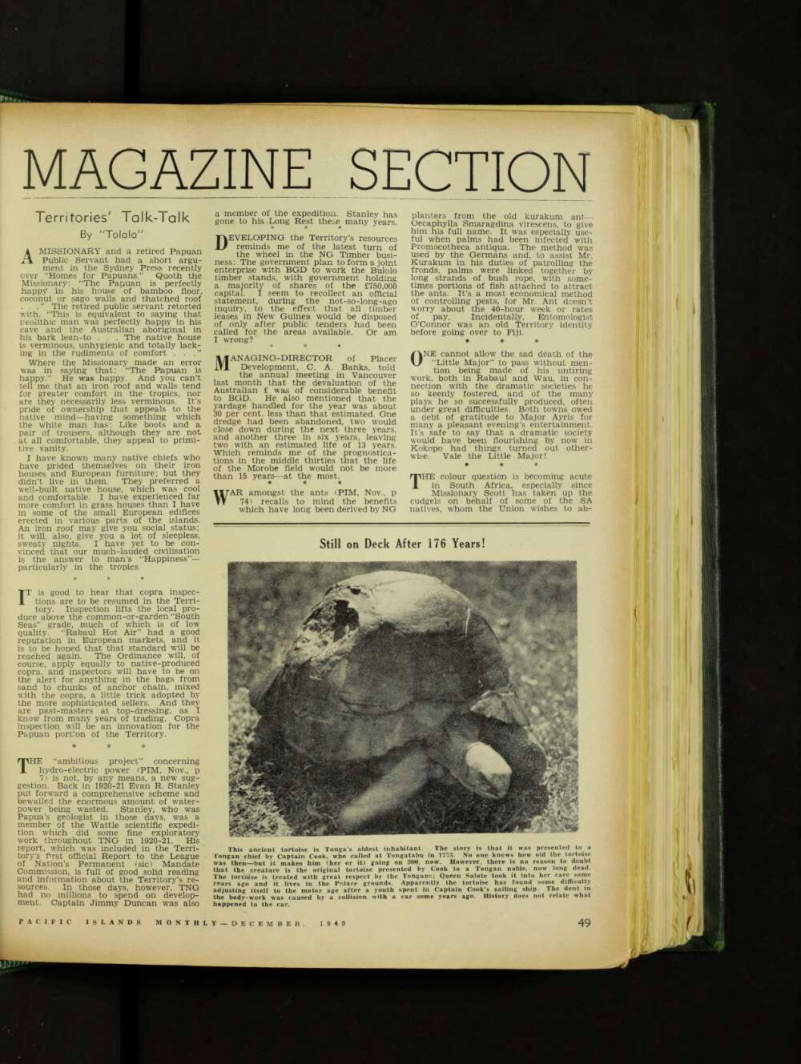
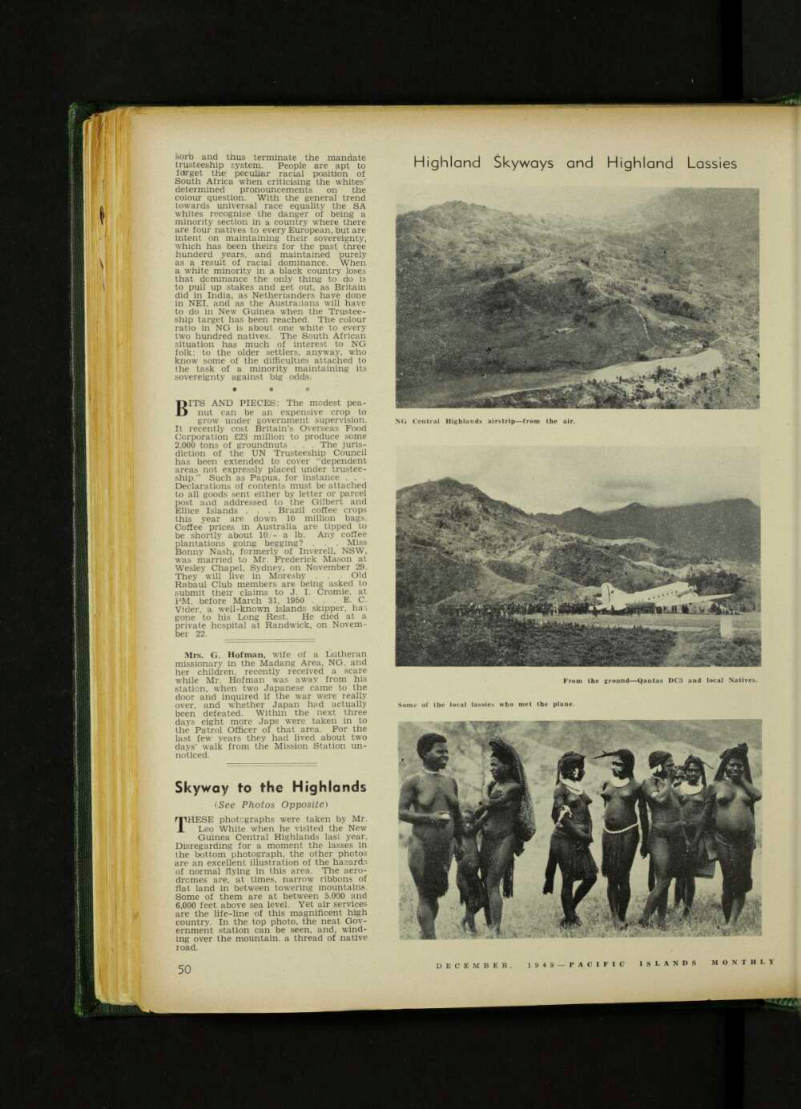
Territories ' Talk-Talk
By "Tolala"
AMISSIONARY and a retired Papuan Public Servant had a short argu ment in the Sydney Press recently over “Homes for Papuans.” Quoth the Missionary: “The Papuan is perfectly happy* in his house of bamboo floor, coconut or sago walls and thatched roof ...” The retired public servant retorted with, “This is equivalent to saying that neolithic man was perfectly happy in his cave and the Australian aboriginal in his bark lean-to . . . The native house is verminous, unhygienic and totally lack ing in the rudiments of comfort . . .”
Where the Missionary made an error was in saying that: “The Papuan is happy.” He was happy. And you can’t tell me that an iron roof and walls tend for greater comfort in the tropics, nor are they necessarily less verminous. It’s pride of ownership that appeals to the native mind —having something which the white man has: Like boots and a pair of trousers, although they are not at all comfortable, they appeal to primi tive vanity.
I have known many native chiefs who have prided themselves on their iron houses and European furniture; but they didn’t live in them. They preferred a well-built native house, which was cool and comfortable. I have experienced far more comfort in grass houses than I have in some of the small European edifices erected in various parts of the islands.
An iron roof may give you social status; it will, also, give you a lot of sleepless, sweaty nights. I have yet to be con vinced that our much-lauded civilisation is the answer to man’s “Happiness”— particularly in the tropics. * * * IT is good to hear that copra inspec tions are to be resumed in the Terri tory. Inspection lifts the local pro duce above the common-or-garden “South Seas” grade, much of which is of low quality. “Rabaul Hot Air” had a good reputation in European markets, and it is to be hoped that that standard will be reached again. The Ordinance will, of course, apply equally to native-produced copra, and inspectors will have to be on the alert for anything in the bags from sand to chunks of anchor chain, mixed with the copra, a little trick adopted by the more sophisticated sellers. And they are past-masters at top-dressing, as I know from many years of trading. Copra inspection will be an innovation for the Papuan portion of the Territory. ♦ * « THE “ambitious project” concerning hydro-electric power (PIM, Nov., p 7) is not, by any means, a new sug gestion. Back in 1920-21 Evan R. Stanley put forward a comprehensive scheme and bewailed the enormous amount of water power being wasted. Stanley, who was Papua’s geologist in those days, was a member of the Wattle scientific expedi tion which did some fine exploratory work throughout TNG in 1920-21. His report, which was included in the Terri tory’s first official Report to the League of Nation’s Permanent (sic) Mandate Commission, is full of good solid reading and information about the Territory’s re sources. In those days, however, TNG had no millions to spend on develop ment. Captain Jimmy Duncan was also
a member of the expedition. Stanley has gone to his Long Rest many years.
DEVELOPING the Territory’s resources reminds me of the latest turn of the wheel in the NG Timber busi ness: The government plan to form a joint enterprise with BGD to work the Bulolo timber stands, with government holding a majority of shares of the £750,000 capital. I seem to recollect an official statement, during the not-so-long-ago inquiry, to the effect that all timber leases in New Guinea would be disposed of only after public tenders had been called for the areas available. Or am I wrong? * * ♦ Managing-director of Placer Development, C. A. Banks, told the annual meeting in Vancouver last month that the devaluation of the Australian £ was of considerable benefit to BGD. He also mentioned that the yardage handled for the year was about 30 per cent, less than that estimated. One dredge had been abandoned, two would close down during the next three years, and another three in six years, leaving two with an estimated life of 13 years.
Which reminds me of the prognostica tions in the middle thirties that the life of the Morobe field would not be more than 15 years—at the most. ♦ ♦ ♦ WAR amongst the ants (PIM, Nov., p 74) recalls to mind the benefits which have long been derived by NG
planters from the old kurakum ant— Oecaphylla Smaragdina virescens, to give him his full name. It was especially use ful when palms had been infected with Promocotheca antiqua. The method was used by the Germans and, to assist Mr.
Kurakum in his duties of patrolling the fronds, palms were linked together by long strands of bush rope, with some times portions of fish attached to attract the ants. It’s a most economical method of controlling pests, for Mr. Ant doesn’t worry about the 40-hour week or rates of pay. Incidentally, Entomologist O’Connor was an old Territory identity before going over to Fiji. ♦ ♦ ♦ ONE cannot allow the sad death of the “Little Major’’ to pass without men tion being made of his untiring work, both in Rabaul and Wau, in con nection with the dramatic societies he so keenly fostered, and of the many plays he so successfully produced, often under great difficulties. Both towns owed a debt of gratitude to Major Ayris for many a pleasant evening’s entertainment.
It’s safe to say that a dramatic society would have been flourishing by now in Kokopo had things turned out other wise. Vale the Little Major! ♦ ♦ * THE colour question is becoming acute in South Africa, especially since Missionary Scott has taken up the cudgels on behalf of some of the SA natives, whom the Union wishes to ab
feorb and thus terminate the mandate trusteeship system. People are apt. to foirget the peculiar racial position of South Africa when criticising the whites’ determined pronouncements on the colour question. With the general trend towards universal race equality the SA whites recognise the danger of being a minority section in a country where there are four natives to every European, but are intent on maintaining their sovereignty, which has been theirs for the past three hunderd years, and maintained purely as a result of racial dominance. When a white minority in a black country loses that dominance the only thing to do is to pull up stakes and get out, as Britain did in India, as Netherlanders have done in NEI, and as the Australians will have to do in New Guinea when the Trustee ship target has been reached. The colour ratio in NG is about one white to every two hundred natives. The South African situation has much of interest to NG folk; to the older settlers, anyway, who know some of the difficulties attached to the task of a minority maintaining its sovereignty against big odds. * ♦ * BITS AND PIECES; The modest pea nut can be an expensive crop to grow under government supervision.
It recently cost Britain’s Overseas Food Corporation £23 million to produce some 2,000 tons of groundnuts . . . The juris diction of the UN Trusteeship Council has been extended to cover “dependent areas not expressly placed under trustee ship.’’ Such as Papua, for instance . . .
Declarations of contents must be attached to all goods sent either by letter or parcel post and addressed to the Gilbert and Ellice Islands . . . Brazil coffee crops this year are down 10 million bags.
Coffee prices in Australia are tipped to be shortly about 10 - a lb. Any coffee plantations going begging? . . . Miss Bonny Nash, formerly of Inverell, NSW, was married to Mr. Frederick Mason at Wesley Chapel, Sydney, on November 29.
They will live in Moresby . . . Old Rabaul Club members are being asked to submit their claims to J. I. Cromie, at PM, before March 31, 1950 . . . E. C.
Vider, a well-known islands skipper, has gone to his Long Rest. He died at a private hospital at Randwick, on Novem ber 22.
Mrs. G. Hofman, wife of a Lutheran missionary in the Madang Area, NG, and her children, recently received a scare while Mr. Hofman was away from his station, when two Japanese came to the door and inquired if the war were really over, and whether Japan had actually been defeated. Within the next three days eight more Japs were taken in to the Patrol Officer of that area. For the last few years they had lived about two days’ walk from the Mission Station un noticed.
Still on Deck After 176 Years!
This ancient tortoise is Tonga’s oldest inhabitant. The story is that it was presented to a Tongan chief by Captain Cook, who called at Tongatabu in 1773. No one knows how old the tortoise was then—but it makes him (her or it) going on 200, now. However, there is no reason to doubt that the creature is the original tortoise presented by Cook to a Tongan noble, now long dead.
The tortoise is treated with great respect by the Tongans; Queen Salote took it into her care some years ago and it lives in the Palace grounds. Apparently the tortoise has found some difficulty adjusting itself to the motor age after a youth spent in Captain Cook’s sailing ship. The dent in the body-work was caused by a collision with a car some years ago. History does not relate what happened to the car.
Skyway to the Highlands
(See Photos Opposite) THESE photographs were taken by Mr.
Leo White when he visited the New Guinea Central Highlands last year.
Disregarding for a moment the lasses in the bottom photograph, the other photos are an excellent illustration of the hazards of normal flying in this area. The aero dromes are, at times, narrow ribbons of flat land in between towering mountains, Some of them are at between 5.000 and 6,000 feet above sea level. Yet air services are the life-line of this magnificent high country. In the top photo, the neat Gov ernment station can be seen, and, wind ing over the mountain, a thread of native road.
Advertisements & other items, p. 52 (1 item)
Highland Skyways and Highland Lassies
NG Central Highlands airstrip—from the air.
From the ground—Qantas DCS and local Natives.
Some of the local lassies who met the plane.
Pago Pago Disillusioned These
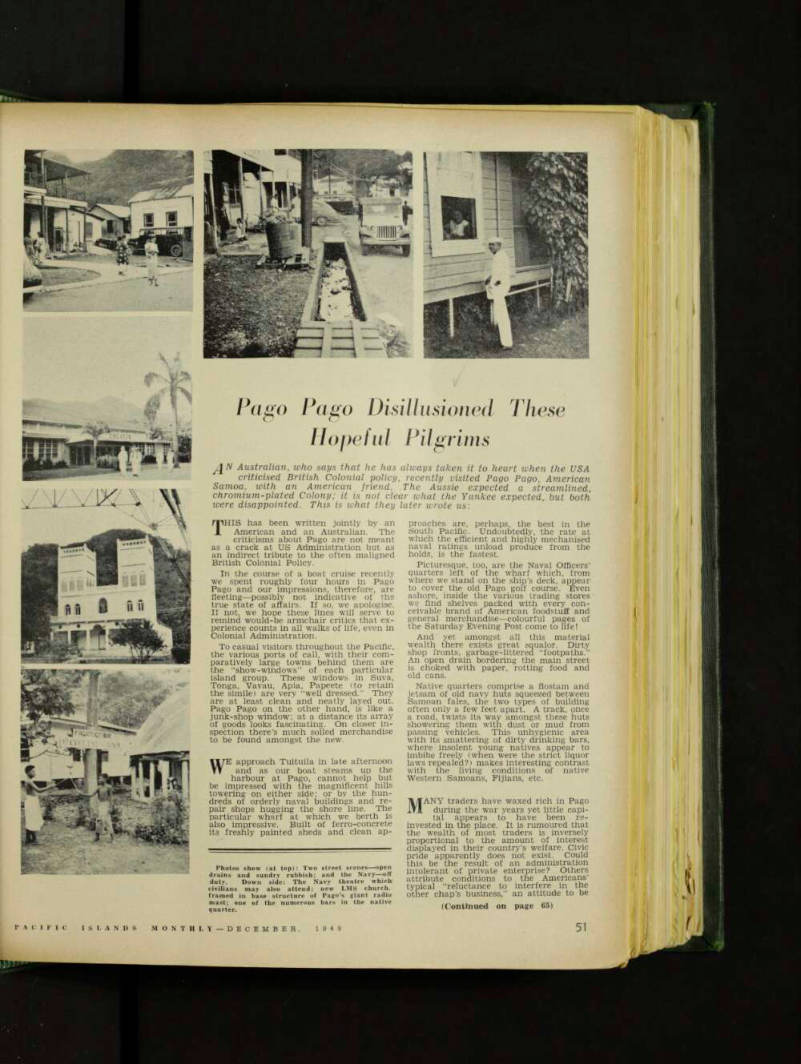
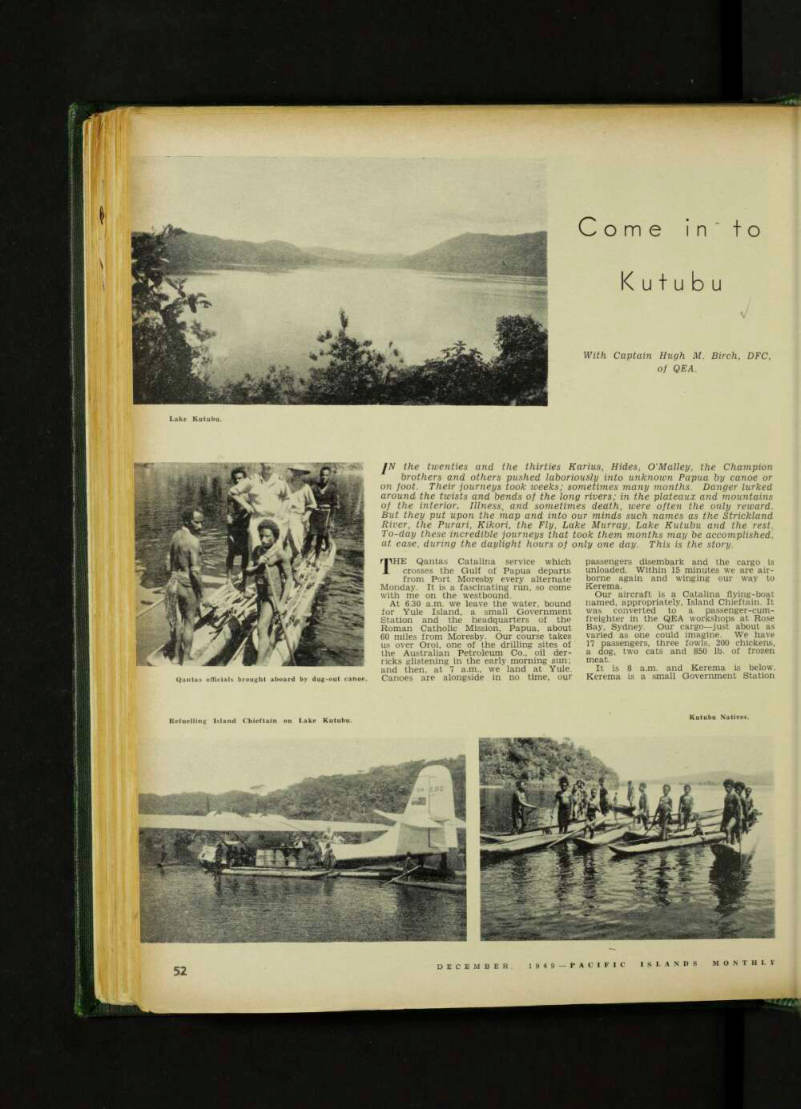
Hopeful Pilgrims
Australian, who says that he has always taken it to heart when the USA criticised British Colonial policy, recently visited Pago Pago, American Samoa . with an American friend. The Aussie expected a streamlined, chromium-plated Colony; it is not clear what the Yankee expected, but both were disappointed. This is what they later wrote us:
THIS has been written jointly by an American and an Australian. The criticisms about Pago are not meant as a crack at US Administration but as an indirect tribute to the often maligned British Colonial Policy.
In the course of a boat cruise recently we spent roughly four hours in Pago Pago and our impressions, therefore, are fleeting—possibly not indicative of the true state of affairs. If so, we apologise.
If not, we hope these lines will serve to remind would-be armchair critics that ex perience counts in all walks of life, even in Colonial Administration.
To casual visitors throughout the Pacific, the various ports of call, with their com paratively large towns behind them are the “show-windows” of each particular island group. These windows in Suva, Tonga, Vavau, Apia, Papeete (to retain the simile) are very “well dressed.” They are at least clean and neatly layed out.
Pago Pago on the other hand, is like a junk-shop window; at a distance its array of goods looks fascinating. On closer in spection there’s much soiled merchandise to be found amongst the new.
WE approach Tuituila in late afternoon and as our boat steams up the harbour at Pago, cannot help but be impressed with the magnificent hills towering on either side; or by the hun dreds of orderly naval buildings and re pair shops hugging the shore line. The particular wharf at which we berth is also impressive. Built of ferro-concrete its freshly painted sheds and clean ap
proaches are, perhaps, the best in the South Pacific. Undoubtedly, the rate at which the efficient and highly mechanised naval ratings unload produce from the holds, is the fastest.
Picturesque, too, are the Naval Officers’ quarters left of the wharf which, from where we stand on the ship’s deck, appear to cover the old Pago golf course. Even ashore, inside the various trading stores we find shelves packed with every con ceivable brand of American foodstuff and general merchandise-colourful pages of the Saturday Evening Post come to life!
And yet amongst all this material wealth there exists great squalor. Dirty shop fronts, garbage-littered “footpaths.”
An open drain bordering the main street is choked with paper, rotting food and old cans.
Native quarters comprise a flostam and jetsam of old navy huts squeezed between Samoan fales, the two types of building often only a few feet apart. A track, once a road, twists its way amongst these huts showering them with dust or mud from passing vehicles. This unhygienic area with its smattering of dirty drinking bars, where insolent young natives appear to imbibe freely (when were the strict liquor laws repealed?) makes interesting contrast with the living conditions of native Western Samoans, Fijians, etc, MANY traders have waxed rich in Pago during the war years yet little capi tal appears to have been re invested in the place. It is rumoured that the wealth of most traders is inversely proportional to the amount of interest displayed in their country’s welfare. Civic pride apparently does not exist. Could this be the result of an administration intolerant of private enterprise? Others attribute conditions to the Americans’ typical “reluctance to interfere in the other chap’s business,” an attitude to be
(Continued on page 65)
Photos show (at top): Two street scenes —open drains and sundry rubbish; and the Navy—off duty. Down side: The Navy theatre which civilians may also attend: new LMS church, framed in base structure of Pago’s giant radio mast; one of the numerous bars in the native quarter.
admired when dealing with people of equal social development, but harmful when applied to natives who have access, but are unadjusted, to European stand ards.
Under these conditions you can’t give natives a large measure of self-govern ment overnight. You must prepare them for it over a period of generations. With out constant correction and education the native will throw an empty food can out the back door of his hut. He knows little and cares less about unclean gutters bringing him sickness. Unless disciplined he will eat the white man’s tinned food, live in his abandoned houses without the knowledge nor inclination to pay attention to elementary principles of hygiene. Just how high is the incidence of TB and Venereal Disease in Pago’s native quarter?
With naval buildings well maintained but the native and civilian areas in such sorry condition, the immediate query springs to mind—“ls US Naval Adminis tration sufficiently interested or experi enced to cope effectively with such a set-up . . . from the point of view of native welfare?” For this, apart from military proficiency, is the point of view under discussion.
Before attempting an answer, let us take a brief look at the administrative set-up:— (1) The governor of Eastern Samoa is a naval officer appointed by the President. (2) All laws are made by the governor and are subject to the approval of the Navy Department. (3) Natives have a considerable amount of self government, enact ing laws concerning counties and villages, retaining as far as pos
sible their old forms of govern ment.
Perhaps the root of the trouble is con stitutional, and native interests would be better served by an administration inde pendent of the Navy and answering to some authoritative body similar to the Western Pacific High Commission in Suva.
With Tuituila’s natural wealth it seems odd too, that a healthy private enterprise has not been fully encouraged? No doubt by now the US has already discussed future improvements of native wel fare with other nations of the South Pacific Commission in Noumea.
Meanwhile, perhaps some local resident can, through the columns of this journal, enlighten us further as to the true con ditions existing in Pago to-day.
During deputation work in Tasmania, the Rev, Kolmio Saukuru, Fijiian Metho dist Missionary to Australian Aborigines, was given a civic reception in Hobart and Launceston.
Advertisements & other items, p. 53 (1 item)
51
ACIFIC ISLANDS MONTHLY DECEMBER. 1949
Kutubu
Come in to Kutubu
With Captain Hugh M. Birch, DFC, of QEA.
JN the twenties and the thirties Karius, Hides, O'Malley, the Champion brothers and others pushed laboriously into unknown Papua by canoe or on foot. Their journeys took weeks; sometimes many months. Danger lurked around the twists and bends of the long rivers; in the plateaux and mountains of the interior. Illness, and sometimes death, were often the only reward.
But they put upon the map and into our minds such names as the Strickland River, the Purari, Kikori, the Fly, Lake Murray, Lake Kutubu and the rest.
To-day these incredible journeys that took them months may be accomplished, at ease, during the daylight hours of only one day. This is the story.
rpHE Qantas Catalina service which i. crosses the Gulf of Papua departs from Port Moresby every alternate Monday. It is a fascinating run, so come with me on the westbound.
At 6.30 a.m. we leave the water, bound for Yule Island, a small Government Station and the headquarters of the Roman Catholic Mission, Papua, about 60 miles from Moresby. Our course takes us over Oroi, one of the drilling sites of the Australian Petroleum Co., oil der ricks glistening in the early morning sun; and then, at 7 a.m., we land at Yule.
Canoes are alongside in no time, our
passengers disembark and the cargo is unloaded. Within 15 minutes we are air borne again and winging our way to Kerema.
Our aircraft is a Catalina flying-boat named, appropriately, Island Chieftain. It was converted to a passenger-cum freighter in the QEA workshops at Rose Bay, Sydney. Our cargo—just about as varied as one could imagine. We have 17 passengers, three fowls, 200 chickens, a dog, two cats and 850 lb. of frozen meat.
It is 8 a.m. and Kerema is below.
Kerema is a small Government Station
Lake Kutubu.
Qantas officials brought aboard by dug-out canoe.
Kutubu Natives.
Refuelling Island Chieftain on Lake Kutubu.
on Freshwater Bay; it is a centre for copra, cocoa and rubber plantations. Here we are met by the Assistant District Officer, in a whale boat. He signs for the mail, two more passengers disem bark and again we are on our way.
Off to the north, towering peaks of the Owen Stanleys are still clear in the morning air. Later they will disappear, shrouded in the cumulus clouds so familiar to all New Guinea pilots.
We now near the top of the mighty Gulf and our course takes us over the winding rivers and flats of the Delta country. This, a crocodile infested swampy area, described on the map as “a tortuous maze of navigable rivers and streams,” is not much good for any thing. Few live here except the hardy river natives whose sole means of trans port is the dug-out canoe.
It is on one of the many Delta streams that we find our next port of call— Kikori on the Kikori River. It is about 20 miles upstream, and one of the wet test places in the world. It has an average rainfall of nearly 300 inches, most of it falling between April and September. Ten inches in one day is not an abnormal fall.
Through the misty rain we can see the river winding below—a swiftly flow ing stream with many logs floating down stream. We circle the Station and come down on to the river. Kikori is the District Headquarters for the Delta Division of Papua and the natives of this area were well known, not so long ago, for their cannibalistic tendencies.
Those days have now passed and it would be difficult to find a more peaceful spot.
Here we take on 4,000 lb. of cargo for Lake Kutubu, 90 miles inland and to the north-west in the direction of the Central Highlands. We leave Kikori and commence the long climb over the ranges levelling out at 7,000 ft. On our left is the Great Papuan Plateau, a series of limestone ridges and valleys, varying in height from 2,000 to 4 000 feet. From this Plateau rises Mt. Bosari—a volcano, 9.500 ft. high, its peak wreathed in clouds.
Now below are Beaver’s Falls, a mag nificent torrent falling vertically for over 300 feet. This is the Mubi River which has its source not far from our desti nation. Lake Kutubu, 2,600 ft. above sea level is of volcanic origin and very deep. It is nearly 11 miles long and varies in width from U to 2 miles.
Through a hole in the clouds we can see it ahead, deep blue and so calm that the clouds are reflected on its sur face. We gradually descend onto its waters and are soon surrounded by the local tribesmen—fierce looking warriors each with a bone piercing his nose. This base was opened up by the Qantas Cata lina onlv a few months ago. Our journey from Kikori by the Island Chieftain has taken 45 minutes—to walk it the record is 56 days.
In charge of the Government Post here are a young Assistant District Officer and a Patrol Officer whose duty it is to bring these native people under control, learn their customs and strange language the surrounding country.
Kutubu is a beautiful place surrounded by mountains covered with jungle right to the waters edge.
WE still have 460 miles to go before our night stop, so as soon as the cargo is unloaded we are off once more, our next call Lake Murray, in the great Fly River valley. We cross the nmestone plateau again, passing Mount Bosari and Lake Campbell, a small vol canic lake named after Group-Captain Stuart Campbell, a pioneer aviator in
these parts and more recently leader of an Australian expedition to the Antarc tic.
Then gradually the plateau drops away to flat and swampy river country. We cross the Strickland River and soon we see Lake Murray, which is a 7 most an inland sea, nearly 30 miles long. We are now only 12 miles from the Dutch New Guinea Border and one of the duties of the lonely Patrol Officer stationed here is to patrol that Border. His is a solitary life with no other white men for at least 100 miles. His pleasure at seeing us can be imagined. He has a yarn for half an hour, receives h’s mail and stores, and then we are gone. Without an air service to this Lake, the only link with civilisation is a boat trip of over 500 miles down the Lake and then into the Strickland River and thence down the Flv to Daru. About a month is the usual time for this voyage. We take U hours.
Daru is a flat, damn and rather de pressing place with little to recommend it. Once it was a haven for pearling luggers from Thursday Island, but few come here now. We do not tarry long: it is the end of our Western run. but Kikori is where we usually spend the night, so off we go with half a dozen passengers to Kikori.
It is 5 p.m. when we touch down again on those muddv swirling waters after eight hundred miles of flying since 6.30 a.m. with seven stops. The Captain and his crew are glad to get ashore for the first time in nearly 11 hours. Night falls quickly on Kikori: dinner is waiting: we give bur hosts the latest news from Moresey—it is time for bed.
To-morrow we depart for Moresby via Wana, another oil drilling centre, Kerema and Yule Island. Our cargo— a parcel of mummified hands for a museum in Sydney, two stretcher cases, 500 live crabs and a dozen passengers.
Trapicalities
(CALLING all Anthropologists: At a re j cent meeting of the Western Samoa Legislative Assembly it was decided that the 170 Chinese now remaining in the Territory should be permitted to re main as free citizens. It was recom mended also, that the ban on marriage between these men and Samoan women be lifted. As a corollary to this last piece of belated generosity it was decided that offspring of de facto marriages be tween Chinese and Samoans (and there have been plenty) should not be regarded as illegitimate (illegitimacy was “some thing belong Mission,” anyhow); and that the said offspring should now have the option of declaring themselves of either Samoan status, or EUROPEAN status!
“Samoan status” and “European status” are accepted Samoan terminology but now that the Territory is so hell-bent for independence why don’t they go the whole hog and make it Samoan status or Foreign status—as that is obviously what they mean. Even if it is just for the record, it would be interesting to know by what processes of deduction it is con cluded that a full blooded Chinese father and a 100 per cent. Samoan mother can produce a European chiId—ANTHROP. * * * SIDELIGHT on Suva’s climate: Early in October, after months of tropical downpours, the big 75th Cession Day
parade planned at Suva was curtailed and a Sydney newsreel unit which wanted to film the occasion was warned to stay at home. Prom that day—almost from the hour —of this decision, the weather started to improve, and Suva celebrated Cession in a blaze of sunshine plus perfect, moonlit nights, before and after. What was more, the good weather lasted for most of October and for War Memorial Appeal and Remembrance Days on November 5 and 6. And then the Suva Cricket Association fixed November 12 for the opening of its season. And the cricket clubs announced their opening teams. And the cricket grounds were allotted. Then it rained five solid inches in a lump.—S. * ♦ ♦ IT is not easy, these days, to get to Pit cairn Island, but it is even harder to get away once vou are there.
Eighteen months ago when a school teacher was sent to Pitcairn from New Zealand, the WPHC sent along also, a pre-fabricated school, a dwelling and three Indian carpenters to erect them.
The carpenters finished the job about six months ago but no ship was available to take them off. Ships were radioed but all were too busy to call for the men until after five months of idleness and homesickness for Suva, the master of the new Burns Philp ship Braeside offered to assist. Braeside (5,600 tons) was on her maiden voyage from the UK to Aus tralia via Panama. She reached Sydney
THIS is a Bret* Hilder drawing of Mr.
George Purdy, who first went to the New Hebrides with his parents in 1907, and since has spent about half his life there, with the exception of the war years, which he spent very actively in the RAAF.
He and his wife have now given the Hebrides away and have plunged into mass cultivation of carnations at Mount Tambourine, near Brisbane, Qld.
in November and the three carpenters later went on to Fiji by air.
Braeside will go onto the Sydney- Singapore run. * * * A RECENT incident has recalled to my mind the par in PIM, during the war, about the maidens of the Society Is. who, not “having the English,” took tubes of American shaving-cream for tooth paste.
A Cook Island lad recently took a sudden fancy to own a toothbrush and related amenity although our folks do not, save in the case of such VIPs as teachers, etc., habitually use tooth brushes; they never did. As there are few luxuries at this end of Oceania, it is not strictly essential, anyway—people’s teeth seldom decay in any serious degree. The lad under consideration had a sudden rush of civilisation to the head, possibly caused by seeing someone do it in a movie, and he purchased a brush, plus a tube of something, the label of which he could not read, although it looked right enough.
Next morning the youth was back at the store, demanding a refund —where the tube was concerned, that is. The brush had worked quite well. He complained that the toothpaste had “tasted bad.” He suggested that there was a plot afoot to liquidate simple Islanders putting their faith in white men’s chemical factories.
The storekeeper thereupon suggested personal examination of the offending item. The boy went and got it. On viewing the allegedly-defective tube of “toothpaste,” the trader burst into hearty laughter.
The dental preservative, nicely put-up in a yellow tube, was rubber solution for bicycle tyres.—E.G. * * * WHEN this advertisement appeared in a London newspaper a few weeks ago, the sensational newspapers gave tongue wildly: “Permanent secretary-assistant re quired, any nationality, scientific and general filing, typing, isolated tropical island until 1953, languages and bio logical degree an advantage, personal distinction and charming personality essential. Write Box No. —”
“Secretary-assistant”—“tropical island”
—“charming personality essential” . . .
the imaginative fog-bound reporters never stopped, until they ran down the author of it. He was Dr. H. S. Evans, formerly Deouty Director of Health Ser vices in Fiji, and now, being retired, a mild and elderly scholar, intensely in terested in native languages and customs.
He was on a visit to London; and, hav ing agreed to go temnorarilv as medical officer on Rotuma. he decided to applv himself there to the writing of certain books which he planned long ago, and to take a secretary with him.
When the reporters found him, he was immersed in applications from scores of ladies who apparently were attracted by the general idea of a life on isolated Rotuma. He tried to be very serious obout the proposed job; but that “charm ing personality” line had struck a note that he could not escape, and so the pressmen let themselves go. This, for example: “When Dr. Evans and his unnamed secretary are not working, they can stroll along palm-fringed beaches and watch the native girls dive off their boats to spear fish underwater.”
The newspapers said that the secretary has been chosen, but her name is being kept secret for the present. She and Dr. Evans were to sail from London for Fiji in October. * ♦ * AT the age of 17, Antony Hooper, of Suva, is 6 ft. 41 in. in height. His father, Superintendent B. F. Hooper,
of the Fiji Police, tops him by 4 in., but the gap is believed to be narrowing.
Hooper pere, in 1917, became the first Fiji-born student at the New Plymouth Boys’ High School, one of New Zealand’s leading secondary schools, which has since had more boys from Fiji than any other school in the Dominion. This year son Antony is in his last year at New Plymouth. Next year he will go to Auck land University College with a remark able school record behind him.
He is head of his House; head of all boarders (270 boys) and head of the school (700 boys). At the age of 15 he gained the School Leaving Certificate and at 16 passed the University Entrance. He is vice-captain of the Rugby First XV.
In 1947 he won the junior swimming championship and this year was second in the senior. As a member of the surf life-saving team he won a Surf Medallion.
In last year’s athletics he won the dis cus event with a record-breaking throw of 108 ft. 61 in. and this year broke his own record with what a New Plymouth newspaper called “a prodigious throw of 128 ft. 8 in.” This year he also estab lished a putting-the-shot record with 43 ft.
He has been a senior NCO in the High School Cadet Battalion for two years and this year is leader of the school church choir. Last year, to round things off, he won the school senior reading prize.—S.
Let’S Go Explore New
Holland
By P. O'Rell
A TIME comes for the more adven turous, when they leave the peace and security of established life in New Guinea and evince a desire to ex plore that Territory—originally, New Holland—which lies south of 10 deg.
Quiet, home-loving citizens from places like Gcilala, Telefomin or Wabag are suddenly smitten with the pioneer urge and, in spite of their initial experiences in the semi-controlled areas around Moresby or Rabaul, press on southward over the seas to face the unknown —some never to return, others to re-appear as greatly changed people.
The more daring have been known to defer their journey until after the Sum mer solstice, when the cold season has already set in and conditions are incle ment. Brave men, indeed, these, who well know that fate is against them and that in the words of the old prophecy, “Many are called, but ‘A—tchoo’ are frozen.”
Most explorers, in addition to a fluency in Pidgin, Motu or Blanche Bay dialect, are also conversant with English, which is reputed to be the lingua franca of these Southern regions. However, this idea is erroneous, as the actual tongue spoken is, as it were, a distinct patois or cousin germain and in many cases, bears little resemblance to English. A practical in stance is noted immediately on arrival with that simple word “customs.” The sense in which it is used by the indigenes is an extremely left-handed one and is apt, for the first few hours at least, to cause a certain amount of inconvenience.
However, after the visitor has got over the initial searching interest shown in him by the inhabitants, he has to settle down to a serious study of colloquialisms and phrases. Owing to the co-operation of the natives this is somewhat simplified and, if he makes contact with the right section of the community, such abstruse
phrases as “on the black’’ and “key money” will assume a lucid and definite significance.
Owing to the nature of the climate the usual “sac-sac,” “pungal,” “kunai” and “sisalkraft” dwellings are absent, and are replaced by structures of stone, ce ment and brick. A close study of these buildings is rarely possible.
Travelle:s, on seeing the words “guest house,” are prone to the belief that these will provide that opportunity; but, once again, the sense attached to the phrase is a purely local one, and entry is quali fied by stringent conditions.
It is hard to determine the exact nature of the structure owing to the jealous guard which is placed on them. In cer tain ways they resemble a “haus tambu.”
One wanderer, being of the opinion that a certain password was necessary, in response to “I have a flat to let.” re plied, “I’ll buy the furniture” and was welcomed. Whilst he was apparently on the blink of success, he was further ques tioned and was informed that his reply, without further qualifications, meant nothing. It would appear that in addi tion to a certain ritual, the possession of a “bank account” —something strange to Islands dwellers —was necessary.
Native tobacco also appears to be tam bu to strangers and, indeed, to the majority of groups in the native com munity. Observation shows that a fur tive trade in the substance is carried on.
The product would appear to be regarded very highly. In the majority of cases, the recipient has first to undergo a cere monial purification which involves the removal of portion of the hair from the head and face.
IN an endeavour to assess the relative occupations of the various indigenes, it is perturbing to find that they have little respect for the truth. On a poll of some five thousand units, in which the individual was asked who he worked for, the answer—in all but ten cases —was, “Working for Chif, mate.” The observers report that in over four thousand cases this answer was followed by a peculiar and rather ironic laugh.
The local equivalent of bearers and car riers are known as “takkisis.” Again, the normal order is reversed and. where it is our habit to move from point to point by the shortest track, it is inevitable that the visitor will notice these vehicles tak ing the longest possible route. “Takkisi” drivers are obviously men of standing in the community, for nothing is tambu to them and, if approached in the proper manner, they can be relied on to produce any item which is prohibited to the general populace. It is fair to point out, however, that such articles as salt and gold-lipped shell have no trade value.
“Luluais” and “Tul-tuls” do not appear to exist as such; but dignitaries known as “the books” or “the licensee” appear to be held in some regard, and are usually mentioned in a tone of veneration, es pecially in conjunction with such phrases as “two to one bar one” or “time, gentle men, please.”
AS I type, a rather friendly looking in digene has just entered and uttered another of their cryptic sayings—“ Care for a grog, sport?”
Excuse me—l had better do some more research.
Of Falling Leaves , Trees
and Other Things
By Judy Tudor
RECENTLY, when visiting a friend in a farming district north of Sydney, we found him cutting a huge tree. Would I like to stay and see it fall?
No, I would not—falling trees being something that I could not abide. 1 removed myself about quarter of a mile away and contemplated nature while the deed was done. When at last it crashed to the ground, it was followed by the customary split second of dead silence, and this, in turn, by screams and yells out of which I could distinguish only. “Come quickly—come quickly!” Then the sound of feet pounding down the track.
A big, hot palpitating lump (my heart, I suspect) came up and was stuck in my throat; my legs seemed to be made of cotton wool. Visions of gory corpses swam before me. Who was it—one of the kids? Or one of the men? .Or just the Beagle-hound pup?
I tottered off in the direction of the pounding feet and met them at the bend of the road. “W-what is it?”
I asked.
“Come quick, before they recover,”
I was told, they’re stunned. A nest of baby possums. The cutest things you've ever seen. Glider possums . .”
Possums, forsooth! I could have bitten the hand that grabbed me and pulled me up the bush track.
Falling trees have not been my lot of recent years, but it took me two days to recover from that one. While the fit was upon me I dug up my old New Guinea diary and, at a certain spot that describes a new camp we had made on the Ulahau River {in land, north-west of Wewak), read: ONE thing I have discovered since being here (New Guinea) is that I have a morbid fear of falling trees. I can’t understand this as I was brought up on a saw-mill in the New Zealand bush. (Query; Maybe mother was, in in the pre natal sense, “frightened” by a falling tree?). But there it is.
The site for the new house I selected myself. Centuries before it must have been part of a river bed; later, no doubt, a r ]Y e £ flat; k ut now is a terrace, 30 or 40 feet above the present level of the stream, about a quarter of an acre in ex tent and quite level. When we saw it first it was covered with tall timber and the usual tangled undergrowth of sap lings, vines and creepers. The boys cleaned out the small stuff and made a leaf shelter to sleep under and shifted the tent-sail and our belongings up from below. I wasn’t particularly happy about this arrangement but I was assured that the trees could be felled in such a way as not to interfere with the camp. Any how, it is the wet season and I had to choose between being flooded out on the river bank and the menace -of falling trees.
As axe-men, the local gentry leave a
lot to be desired although they are madly happy if given any sort of chopping in strument. Three or four or even more of them will attack a huge tree, whittling away with their fool little axes like wood-peckers. Because their antics fill me with foreboding I have taken par ticular notice of their technique and I’m sure that they have no idea of where a tree is going to fall until it actually be gins to topple, then they get themselves out of the way with the agility of moun tain goats.
Usually when they are clearing I re move myself at least half a mile away but when the time came to clear the larger timber on our flat I had fever and I was in bed in the improvised bedroom with what they called a “big fella sick.”
The sick was big enough, but not so big as to make me oblivious of all else, i spent a miserable day under a pile of trade-blankets while trees crashed all around me and the men made frequent calculations to prove that they would all miss me by at least a yard. They did.
But after the days work was over and the boys were standing waiting for their rice issue there was an ominous creaking from above, a scatter of bare feet and rice tins and a shriek of “Look out Masta! Diwai ’i like bruk now!”
I didn’t wait. Some sort of reflex action caused me to leap straight out of bed and I covered the first twenty feet in two hops and a jump. But fever, quinine and athletics don’t mix and an ant-bed was right in my path. I stretched my whole length in it, which naturally infuriated the ants who came out in thousands. This variety don’t bite; they are known to the boys as being of the “stink-finish” variety—in other words, they smell. But I was beyond caring about that. I lay there, on my tummy, thinking: “This is the end,” and waiting for the broken tree to crash into the middle of my back.
Nothing happened. I took a quick look over my shoulder; the whole matter of the broken diwai had straightened itself out. It was no tree; merely a limb that was cracked and ready to fall off. I crept back to my bed under the tent-sail, dusting off a few stray stink-finishers and hoping that my little excursion had gone unnoticed. Next morning my fever had left me and I took myself from that locality until everyone had finished with it. ★ RUT that is not the last word the diary has to say on the subject of falling trees. Many months later
this entry appears :
ONE of the teams working in the river has now come right up to just below the house. At that point there was a huge tree that overhung the flat.
Ground had been worked all around it and gold had been taken from its very roots. We watched it day by day, wondering what an extra large flood would do to it and, finally, it was decided that it would be best to get rid of it once and for all and be sure. The usual cal culation had shown that, with care, it could be grubbed out and the whole line of boys swinging, at the critical moment, on the vines and canes that grew from it,
could pull it to fall up the creek and miss the flat (and the house) altogether. No one asked my opinion but I gave it, freely. In my estimation the tree could fall no where else but right across the house. I was advised not to act like a silly old woman—it was well known that I had a kink where falling trees were concerned and no reliance whatever could be placed on my notions. The tree must —and would —come down.
OK, if that’s how it is, said I to myself, this time I stay right in the confounded house, and if the tree falls on me and kills me, then it serves them right.
Grubbing operations started next morning and continued most of the day.
It was a long process. True to my promise I stayed in the house. I sat in front of my typewriter and tried to write.
And occasionally I would go out to the end of the flat and look at that tree. As the day wore on, I went back to the type writer after these inspections with more and more reluctance and about 3.30 took my last look at the tree. It would go any time now, I was told. It would just miss the point of the terrace.
I could see that it would go anytime— the boys were already manning the many kunda vines that trailed from it. They looked like silly little ants; and the tree was huge, with great, spreading branches.
I went slowly back to the house. Would I? Wouldn’t I? Was it worth risking a broken neck, or worse, just to prove
That Woman Is Sometimes Right?
Yells from the creek told me the tree was “talking.”
“No,” my lesser-self replied emphatic ally—better to be wrong than a cold, clammy corpse. I grabbed the lid of my typewriter, shoved it on, took the dog by the scruff of the neck and carrying both in my arms beat it —out across the terrace through the pumpkin patch to our primitive black-smith snop which was well out of the way of all possible danger.
Whoops and yodels were coming con tinuously from the river now, as the top most leaves of the giant tree began to tremble. Then the tree gave a lurch and began to fall, slowly at first then with a mightly swoosh. The huge head of branches turned in mid-air—and down she came—crash! Horror and an in verted sort of satisfaction filled me— there it was, precisely where I said it would land, right across the centre of the house in which I had been sitting a few minutes before.
The cook-boy and I reached the scene of the disaster simultaneously. There was dead silence from the river below. The tree and its branches, stuck out far be yond the ruined house, still trembled with the impact. The air was full of pieces of thatching and bits of paper that I had left on what had once been a table, and dust from smashed wood sifted down over everything. The cook-boy and I looked at each other in silence. There was no need for words. We waded in through the mess and dug among the ruins. We retrieved a blue enamel meat safe and a petrol lantern, both battered beyond repair. Silently we placed them outside what had once been a doorway.
Then Tulawai, the cook-boy found his voice: “The ” he wailed, shaking his fist in the direction of the river, “Al’gether something ’e buggerup finish!”
People passing the Brisbane City Con gregational Church during one day in November, were surprised to see three black figures performing a war dance on the church’s steps. They were Papuan natives in port as members of a ship’s crew. The dance was given in apprecia tion of afternoon tea served by the Women’s Auxiliary of the London Missionary Society, and depicted in mime, Australian soldiers fighting the Japanese.
Where Dead Ships Lie
By Geoffrey Shepherd
SHOWN on Pacific maps, between New Caledonia and Queensland’s Great Barrier, there are two insignificant looking specks, lying close together. These are Elizabeth and Middleton Reefs, at first glance just two of the Pacific’s many reefs —but what a history they have!
Like coral necklaces rising from the sea, they break from the Pacific in a welter of foam. With a reputation of being marine graveyards, veritable Goodwins of the Pacific, they are avoided like plague spots by all shipping to-day, for theirs is a grim history.
Since 1800 they have taken toll of at least 20 vessels which were driven by ill winds and currents onto their coral ram parts. These fangs of the sea had no verdure-covered shores peopled with friendly natives waiting to succour casta ways.
I have seen Middleton Reef and some of the wrecks which, even in death, still cling to it. It was only a fleeting glimpse that I had, from a liner which was taking an observation, but as a picture of utter desolation and starkness, its chill memory remains with me yet.
ELIZABETH REEF was named after the first victim it snared, in 1831. It has a somewhat less villainous record than Middleton. It is about four miles in diameter and was visited, in 1936, by a small scientific party in the yacht, Wan derer. Middleton Reef was also visited on that occasion—one of the rare times when humans have voluntarily landed on these coral necklaces of death.
Middleton is 30 miles to the north of Elizabeth and is the slightly larger. Its first recorded victim was snared in 1806, although there is evidence that many un identified vessels finished their careers there at an even earlier period.
Middleton has 12 recorded wrecks: Eli zabeth eight; but loss of life has been far more severe on Middleton, a heavy toll being taken of the crews of the barques, Ramsay (1852), Mary Lawson (1866) and Errol (1909). With others Fate was less relentless—some crews were picked up by passing vessels as the reefs lie in the zone of early China-bound clippers and some reached the shores of Lord Howe Island, 120 miles south from Middleton. In this latter category were the crews from the Naiad (1855) which piled up on Elizabeth, and the Annasona and Maelgwyn, both wrecked in 1907.
Earlier this year, when on Lord Howe Island, I heard from a resident the strange story of the series of queer co incidences that dogged the sister ships, Annasona and Maelgwyn. Both sailed from the Mersey, Liverpool, during the same month in 1906. They were bound for different destinations but both en countered the same Pacific storm and both became wrecks—the Annasona piling up on Middleton Reef and the Maelgwyn being abandoned as a derelict off Lord Howe Island.
Crews of both vessels took to the boats and safely reached Lord Howe’s shores within a week of each other. It seemed, somehow, that the mystical hand of Fate had intervened, for the strangest feature in these links was that the derelict Maelgwyn, after being abandoned, was caught by currents and driven up onto Middleton Reef where she became re united, in death, with her sister ship.
Middleton reef’s worst disaster was the loss of the Errol, a Nor wegian barque bound for Newcastle from Peru. She carried 22 people, includ
ing Mrs. Andreason, the wife of the skipper, and their four young children.
The vessel struck the northern fringes of the reef in bad weather, at midnight on June 18, 1909. Heavy seas soon breached her and in the confusion of the disaster the first mate and three sailors were washed overboard and drowned.
Daylight revealed a cheerless scene. The Errol was a hopeless wreck. Only her fore and aft sections remained awash and on these the 18 survivors clung.
There was tinned food in the galley— but the galley lay shattered at the bottom of the lagoon which was alive with sharks.
There was no rush of volunteers to dive for it. Then a young Australian seaman named Lawrence, with reckless disregard of the perils lurking below, went down and managed to secure a meagre supply of tinned food.
Days of despair slowly passed. On the fourth day Captain Andreason and his second mate were caught in under currents and drowned when trying to make a raft from floating timber in the lagoon. His wife was not spared the hor ror of later seeing his body devoured by sharks.
With the captain dead, discipline slackened among the remnants of the thirst and hunger-crazed crew. Ominous glances were cast at the children, but the faithful Lawrence appears to have taken the family as his charge and warded off attempts of violence by the more des perate.
Men weakened and slipped off the wreck into the seas below. The few sur vivors were now desperate. At last five of them completed a raft and put off for the Annasona, leaving Lawrence behind on the shattered Errol with his charges.
The Annasona had been wrecked two years previously, but had been flung high upon the reef, about four miles away, and appeared to be in a well-preserved con dition. The raft reached the wreck but
hot before it had capsized, drowning one of the five. The Annasona proved to be a bare hulk, securer than the Errol cer tainly, but without supplies.
A week after the disaster a steamer bound for the islands from Sydney passed close in by the reef but failed to observe the addition of the new wreck, or the frantic efforts the castaways were making to attract attention. The steamer un heeding continued on, finally disappearing over the horizon.
Meanwhile, back on the Errol, tragedy had again struck. One morning Law rence awoke to find the bodies of the woman and her children floating on the lagoon. The demented heart-broken woman had at last carried out her promise to rejoin her husband. On that battered hulk of tragedy Lawrence was left to himself and his bitter thoughts.
On the twenty-sixth day of their ordeal —ten days without water—another steamer approached the reef, sighted the wreck and this time deliverance was at hand. Those who survived were picked up in the last stages of exhaustion. They were only five, but it is satisfying to know that the devoted Lawrence was among them. The curtain was at last rung down on the drama of the Errol.
To-day on Elizabeth Reef there are no visible remains of its wrecks. Time, tides and tempests have dislodged them from this reef’s grip and the dead ships lie in waters fathoms deep.
But on Middleton a few ribs from the shattered Errol protrude. And despite the bombing by the RAAF, which used it for war-time target practice, the old Anna sona still clings there, her bow pointing defiantly upwards as if challenging the heavens to dislodge her.
With the passing of the era of sail and the fact that the reefs are chartered and given a wide berth, it is many years since the seas brought them their grim tribute. The last victim Eliza beth claimed was the barque, Askoy in 1911, but Middleton Reef, almost as if aghast at the catastrophe it brought to the ill-fated Errol, has made no more claims on shipping.
These six youngsters, representing Fijian, Indian and European communities of Fiji were standard bearers at the 75th Anniversary of Cession celebrations on October 10.
Photo by Public Relations Office, Fiji.
Advertisements & other items, pp. 58-60 (2 items)
56
DECEMBER, 1949 PACIFIC ISLANDS MONTHLI
Burns Philp (New Guinea) Limited
General Merchants (Wholesale and Retail)
Shipping, Customs and General Agents
Head Office; PORT MORESBY, PAPUA
BRANCHES:
NEW GUINEA: Rabaul, Kokopo, Lae & Madang.
PAPUA: Samarai.
REPRESENTATIVES FOR:
AUSTRALIAN AGENTS:
LONDON AGENTS:
QUEENSLAND INSURANCE CO. LTD.
LLOYD'S OF LONDON
BURNS PHILP TRUST CO. LTD.
BURNS, PHILP Cr CO. LTD.
All States.
BURNS, PHILP & CO. LTD.
"London House", 35 Crutched Friars, E.C.3.
SAN FRANCISCO AGENTS:
BURNS, PHILP CO. OF SAN FRANCISCO INC. 510 Matson Building.
Distributing Agents, Territory of Papua-New Guinea for;
SHELL COMPANY OF AUSTRALIA LIMITED
Petroleum Products
GENERAL MOTORS CORPORATION
Chevrolet, Buick, Pontiac and Oldsmobile Cars Chevrolet and GMC Trucks Frigidaire Refrigerators
VAUXHALL MOTORS LIMITED
Vauxhall Cars and Bedford Trucks
R. A. LISTER a CO., BRISTOL
Producers of Petrol, Paraffin and Diesel Engines Pumps and Lighting plants
RUSTON HORNSBY LIMITED
Engines
CROSSLEY MARINE ENGINES
W; Made in the Australian Branch Factory of
BLUNDELL SPENCE & CO., LTD., Hull,
B. & S. SUPER PREPARED PAINT embodies the knowledge and experience gained from nearly 140 years of Paint manufacture.
Tested and proved for tropical conditions, B. Gr S. PREPARED PAINT is also available in a special Lead-free series for use in volcanic and other sulphurous regions. (Specify B. & S.-Series 2301).
Ask for supplies of these and other BLUN- DELL Paints and Enamels from your local Storekeeper, or write for particulars and colour-cards to the Agent lor Pacific Islands :
KERR BROTHERS PTY. LTD.
4 YORK STREET, SYDNEY
Modern Fijian
Examined
By Old Resident
(A Letter to the Editor) AS an old resident I should like to com ment upon Mr. Price’s letter, pub lished in June PIM, wherein he de fended Indian workmen in Fiji, and was rather critical of Fijians. It was rather bluntly put; but, rather than chide him for indiscretion, I should like to con gratulate him on having the courage to sign his name to what was obviously an honest expression of his views about Fijians generally.
His letter prompted two Fijians, attend ing Auckland University, suddenly to remember what a noble race they rep resented. They greatly deprecate that all Fijians, including .themselves, should be classed with the “unfortunate speci mens who attracted Mr. Price.” No doubt Mr. Price had not met educated “speci mens” like them. I have had the pleasure of knowing many, so I take it upon myself to speak for Mr. Price.
Like most natives of their type, your correspondents have only the sketchiest idea of Fijian communal life and history and have their whole conception of them selves and their people embodied in Rous seau’s theory, as a result of their sojourn in New Zealand, where they have learned that they are Nature’s gentlemen, or children of nature, or both; and if, as a race, they have any faults they were en tirely due to the advent of the white man with his “vices and diseases.” Such is the outlook of our Anglo-Saxon idealists to-day, and this is instilled into these unfortunates who come to be “edu cated.”
That the Fijians are a proud race is news to me. I know much of their vanity; but racial pride is a new term for them and, in their own language, it had to be coined for them—like the words “grati tude” and “love,” which qualities were never known, and hence had no place in their vocabulary.
With the usual “Fijian educated” com plex, they refer to “colour” and “full blooded Fijian,” showing the usual prejudice of their type to the race that is educating them. Their prejudice at present is probably in the embryo stage, and will come to full maturity when they return to Fiji and find that the local Europeans, unlike those in New Zealand, maintain the racial barriers.
The suggestion that the book written by Helen D. Cato should be accepted as the truth about the Fijians is a trifle humorous. I should rather suggest “His tory of Fiji” by R. A. Derrick, who did know a little. When your correspondents suggest there are no “rogues, vagabonds and other personalities” among the Fijians, I can only imagine they mean criminals and, if this is so, a perusal of the Fiji papers over the last year would be enlightening.
IFEEL, in writing this letter, I am at tempting to be a kindergarten teacher; the position would be comical if it were not tragic. Your correspondents are two of many natives who are train ing in the outside world to be something they can never be; that is, reasonable substitutes for Europeans. As parasites on their community, grabbers of public funds, autocrats and general oppressors they will probably be quite successful as so many of their kind are.
The old Fijian, between whom and the Whiteman there was always genuine af
fection, has passed on, to the detriment of Fiji. He would work, not because he “worshipped a man whose skin hap pened to be white,” but because he loved work for work’s sake, as all honest men do. He respected the white man for what the white man was—not just white in skin, but something your two correspon dents will probably never understand—and the white man respected the Fijian for what he knew the Fijian to be.
We now live in another era and. though the conditions are the work of my own race, I can only say, what an appalling result of their efforts! With their usual good intentions, they are making a race of worthless beings out of a hitherto likeable people. Education will do every thing (they argue)—and here are two of the results.
With very little knowledge of their own race, and far less of the race that has nurtured them, they are supposed to be fitted to lead their own people into a better way of living. The first noticeable result of their higher education will be a considerable increase in the alcohol consumed in the Suva hotels, and a greater number of bad debts on the Chinese storekeepers’ books.
That is now tne Government hopes to fight the Indian problem: by backing a horse that has already lost. The Indian does at least justify his existence. The modern Fijian does not —or, rather, the modern Fijian is as the Native Adminis tration would have him be.
I am, etc.,
Fiji, 22/10/49.
New Era.
Ravuama Vunivalu, who has been studying co-operative methods in the United Kingdom, Europe and Ceylon, has returned to Fiji.
Opening New South Coast
Road, W. Samoa
From Our Own Correspondent APIA, November, 18.
A LARGE feast, in true Samoan style, was given on November 12 at Poutasi, Falealili district, by the Faipule of the district, Te’o and the people of Fale alili, to celebrate the opening of an im portant stretch of the new road between Siumu and Poutasi which connects Apia
direct with the South Coast of Upolu.
The High Commissioner, Government officials, European and Samoan repre sentatives and a large gathering* of Samoans, estimated at about 7,000, at tended the monster function.
The High Commissioner complimented the district on the valuable work it had done on the road, which would be of great benefit to them. A collection, taken for the establishment of a district hospi tal in Falealili, realised over £l,OOO.
Advertisements & other items, pp. 61-62 (1 item)
William H. Watson
HAMMOND ORGANS
and
SOLOVOX Piano Attachments
(FULLY TROPICALISED)
Available for speedy shipment from
Hongkong
ALL ENQUIRIES WILL RECEIVE IMMEDIATE ATTENTION
AUSTRALIAN INTERSTATE AGENCIES
Importers and Exporters of Overseas and Hongkong Manufactured Products.
G.P.O. BOX 2207, HONGKONG. Cables: “Austproduct,” Hongkong.
ESTABLISHED 1930
WILLIAM H. WATSON
RAROTONGA, COOK ISLANDS
Wholesale and Retail Trader
LICENSED STAMP DEALER
Agent For:—
BRITISH TRADERS 7 INSURANCE CO.
CORONA 6* L C. SMITH TYPEWRITERS
KAISER & FRAZER MOTOR CARS
B.S.A. CYCLES AND MOTOR CYCLES
AMERICAN LEAD PENCIL CO.
WHITES AVIATION LTD.
Manufacturers of: FOOTWEAR, ALL CLASSES SUITABLE FOR NATIVE TRADING . . . MO P. PRODUCTS, INCLUDING ROUND EAR-RING BLANKS AND BUTTON BLANKS Exporter of: “Rarotonga” Hula-Skirts.
Sea-Shell Necklaces.
M.O.P. Jewellery.
Island Produce.
Cable Address: “Watson” Rarotonga Wholesale and Retail Inquiries Invited.
Prepared to Consider Agencies for all Class of Goods.
Bankers: Importer of: Textiles.
General Hardware.
Fancy Goods.
General Merchandise.
Bank of New Zealand, Auckland.
DON'T SAY GIN
(JIM DON'T SAY
DON'T SAY GIN
GIN DON'T SAT
DON'T SAY G I N
GIN DON'T SAY
DON'T SAY G I M
C‘ IM DON'T SAY
DON'T SAY G I
G I M DON'T SAY
DON'T SAY GIN
G I M DON'T SAY
DON'T SAY CIM
DON'T SAY GIN
GIN DON'T SAY
DON'T SAY GIN
GIN DON'T SAY
DON'T SAY GIN
GIN DON'T SAY
DON'T SAY G I M
G IM DON'T SAY
DON'T SAY GIN
GIN DON'T SAY
DON'T SAY GIN
GIN DON'T SAY
DON'T SAY G I N
DON'T SAY G 1
G say
DON'T SAY G I N
GIN DON'T SAY
DON'T SAY GIN
DON'T SAY
M Y
DON
m D S Gift Ll ou iTo °Ur n e Cq c IS s ychi ey
SKIP
I
DON"
Gin DON'T S
DON'T SAY G I M
DON'T SAY G I M
G SAY
DO G D AY M
SAY
IM
'T SAY
DON'T 3XP mi I M
DON'T SAY G I M
GIM DON'T SAY
DON'T SAY G I M
DON'T SAY
M Y S AT Qcv * N
VQU
WHs A# Ifo *
SAY
AlLs S y<^ * IN S *t£.
Br ish ar, e
DON'T
GIN DON'T
DON'T SAY GIN DON'T
'T SAY
JIN
Telegrams and Cables: "GILBETS,” Melbourne Address aU inquiries to:
W. & A. GILBEY LTD.
33 EOSSLYN STREET, WEST MELBOURNE.
Telegrams and Cables: “GILBETS.” Sydney.
109 REGENT STREET. SYDNEY.
Population of Moturiki , Fiji , Will
Be “Mass Educated” Next Year
announced by the South Pacific Commission in November, the small island of Moturiki, off the west coast of Ovalau, in Fiji, has been selected as the site for an experiment in community development. The ex periment will be conducted by ifCe Government of Fiji as part of a SPC project, and just what it means is described in the following article prepared by the Public Relations Office, Suva. It is scheduled to begin in January.
By way of explanation it is stated that community development schemes have been carried out in other British colonial territories under the name of “Mass Education” and they are “designed to promote better living in the whole of the community that is participating.”
The idea of being mass observed, or mass educated, or even of being promoted to better living en masse, will fill many readers with horror.
Others, conditioned to such post-war experiments, will view the project with an open mind. Nothing is said in the PRO statement as to how the 500 Fijian inhabitants of Moturiki feel about it, but as Fijians invariably co operate 100 per cent, wth all Govern ment-sponsored schemes, their good
will must be taken for granted. If the scheme is carried out in its
entirety they will benefit materially.
MOTURIKI has been chosen for the project in Fiji for a number of reasons. As a small island, five miles in length and two miles wide, it offers a finite field for experiment and recording. It contains a small tikina of just over 500 persons, grouped in 10 vil lages. These villages may be dealt with independently, but the island might also be considered as a single community. The island is capable of agricultural economy.
A reasonably accessible market for pro duce is available at Levuka.
The exact lines along which develop ment will take place on Moturiki have not yet been decided but among the pro posals which have been suggested are the re-building of houses and of the District School on the island, the development of copra production and the introduction of pineapples, the formation of co-operatives for farming and marketing, the introduc tion of small livestock, improvements to the island’s water supply and to latrines, health education, improved nutrition, the development of local crafts, a literacy campaign, and the construction of a jetty to facilitate the marketing of pro duce.
The project will be planned and its progress assisted by an Advisory Group led by the Director of Education, who is also an Associate Member of the South Pacific Research Council. Others in the Advisory Group will be the Director of
Medical Services, the Director of Agri culture, the District Commissioner Southern (in whose district Moturiki lies), the .Registrar of Co-operative Societies and Ratu Edward Cakobau, rep resenting the Fijian Affairs Board.
The project will be carried out by a Fijian community team, which will probably consist of a leader and co-opera tive adviser, a woman instructor for home crafts and handicrafts, a senior assistant nurse for maternity and infant welfare
work, an assistant Mosquito Inspector for work on hygiene and public health, a Field Assistant from the Department of Agriculture and a carpenter and house builder. The health workers will be un der the general supervision of an Assis tant Medical Practitioner, who will visit Moturiki from time to time.
When the team has been selected it will begin the project by making a com prehensive preliminary survey of Moturiki, with the assistance of specialist officers
from Government Departments where necessary. The survey will cover such things as land tenure, land utilisation, housing and hygiene and the occupations and incomes of the adults on the island.
There will be a survey of the intelligence, practical ability and attainment of the school children. A comprehensive set of photographs of the island will be taken.
It is expected that the preliminary sur vey will take about six weeks and the team will then go to Nasinu Training College for training in work on the pro ject. Using the results of the preliminary survey, the team will consider what can be attempted at Moturiki and how it can best be done. They will work out methods of co-operation between individual mem bers of the team and they will consider the incentives by which the co-operation of the people of Moturiki can best be en listed. Methods of recording and cost ing the project will be worked out.
During the training period, arrange ments will be put in hand for building quarters of native type construction on Moturiki for the team and observers.
When the project ends there will be a re-survey along the lines of the pre liminary survey, so that the progress which has resulted from the project can be measured. Further surveys will be carried out later from time to time as the agricultural and medical schemes mature.
It is expected that during the project opportunities will be found for selecting leaders for further community develop ment schemes among the Fijian people.
Throughout the course of the project facilities will be afforded for visits bv ob servers both from other parts of Fiji and from the territories embraced by the South Pacific Commission.
Salaries of workers on the project will be paid by the Government of Fiji and all other expenses involved will be met by the South Pacific Commission.
Advertisements & other items, pp. 63-64 (1 item)
A. B. Donald Limited
OVERSEAS MAGAZINES
Direct to You from the Publishers.
American:
CHARM 40/6
COLLIERS WEEKLY 817-
CORONET 27/9
ESQUIRE 1087-
HARPER’S BAZAAR 108/9
LADIES’ HOME JOURNAL 547-
LIFE 697-
LOOK 54/-
POPULAR MECHANICS 40/6
READERS’ DIGEST 12/-
SATURDAY EVENING POST 99/-
SCIENTIFIC AMERICAN 77/6
TIME 967-
VOGUE 155/3
YACHTING 60/3
English:
APOLLO 52/6
COURIER 50/6
PICTURE POST 27/6
PUNCH 46/3
TATLER 122/-
TIMES WEEKLY 38/-
Rates are for one year and include all charges. Many other overseas periodicals available on all subjects.
ALL ORDERS AIR-MAILED TO
PUBLISHERS.
MAIL PUBLICITY CO., 175 PITT
STREET, SYDNEY, N.S.W.
A. B. DONALD LIMITED
RAROTONGA COOK ISLANDS
TELEGRAPHIC ADDRESS: “DONALD, RAROTONGA.”
General Merchants (Wholesale & Retail) and Shipowners Importers & Exporters Branches Throughout Cook Islands Fire, Marine & Motor Vehicles Insurance Agents for Yorkshire
Insurance Co.
Lloyd’s Agents.
Agents and Distributors for : ENGLAND.—Austin Cars & Trucks, Pye Radios, Dunlop Rubber Co., Ltd., Vauxhall Cars & Trucks, R. A. Lister & Co., Ltd., Phillips' Cycles, Marples Tools.
U.S.A.—Remington Rand Corp., Radio Corp. of America, Champion Spark Plug Co., Firestone Tyres, General Steamship Corp.
NEW ZEALAND.—Vacuum Oil Co. Pty., Ltd* Petroleum Products.
AUSTRALlA.—Wunderlich, Ltd., Cement Asbestos Products.
NORWAY.—O. Mustad & Sons, Fish Hooks.
SWEDEN.—B. A. Hjorth & Co., Primus Products.
Sydney Agents : London Agents : San Francisco Agents : BURNS, PHILP & CO., LTD. BURNS, PHILP & CO., LTD. BURNS, PHILP CO. OF SAN FRANCISCO.
Head Office: — A. B. DONALD, LTD., Auckland.
Associate Houses:— ETABLISSEMENTS DONALD, Tahiti, Papeete, Society Islands.
DOMINION FRUIT CO., Suva, Fiji Islands.
CODES: Bentley's Complete Phrase, Acme
GILLESPIE’S
The Flour
TRADE
MARK
of the Islands
- SY DN EY -
Telegram: "CARRLOCK" P.O. Box 2140, Hong Kong
CARRLOCK CO. LTD.
2nd Floor, Queen's Bldg., Chafer Road, HONG KONG
General Merchants :: Commission Agents
Exporters and Shippers of All Kinds of Merchandise To the Pacific Islands Representatives of Leading Manufacturers
in HONG KONG
INQUIRIES INVITED
Baptists Enter Mission
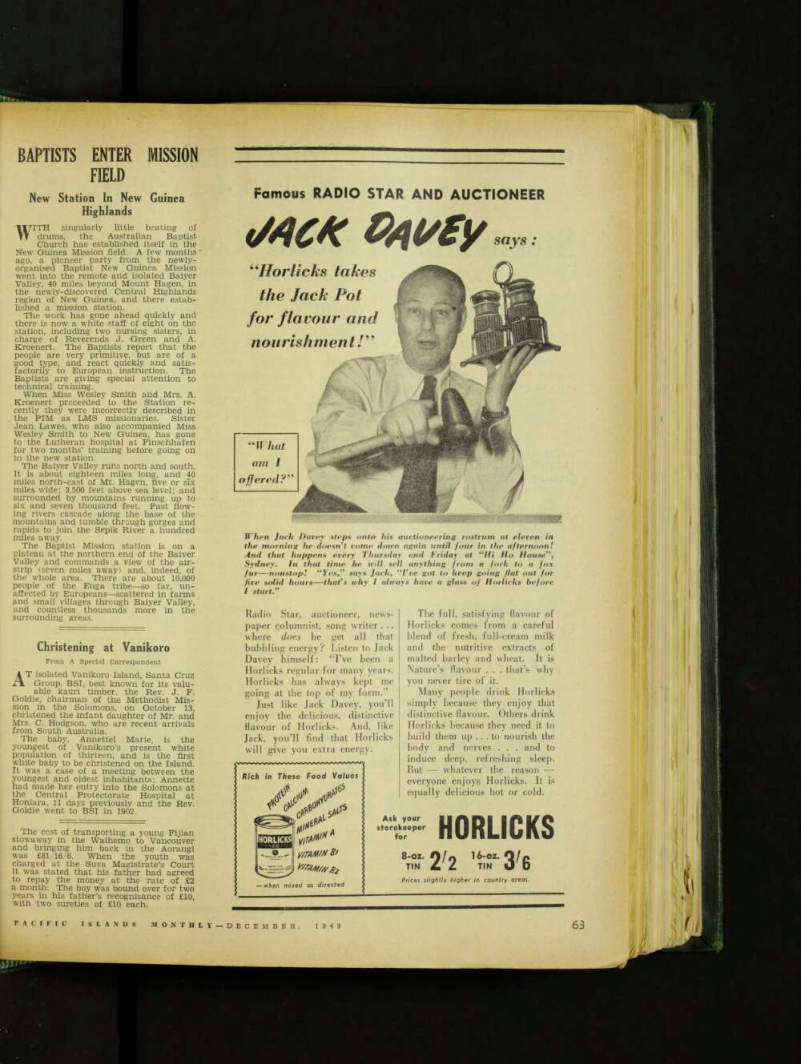
Field
New Station In New Guinea Highlands
WITH singularly little beating of drums, the Australian Baptist Church has established itself in the New Guinea Mission field. A few months ago, a pioneer party from the newly organised Baptist New Guinea Mission went into the remote and isolated Baiyer Valley, 40 miles beyond Mount Hagen, in the newly-discovered Central Highlands region of New Guinea, and there estab lished a mission station.
The work has gone ahead quickly and there is now a white staff of eight on the station, including two nursing sisters, in charge of Reverends J. Green and A.
Kroenert. The Baptists report that the people are very primitive, but are of a good type, and react quickly and satis factorily to European instruction. The Baptists are giving special attention to technical training.
When Miss Wesley Smith and Mrs. A.
Kroenert proceeded to the Station re cently they were incorrectly described in the PIM as LMS missionaries. Sister Jean Lawes, who also accompanied Miss Wesley Smith to New Guinea, has gone to the Lutheran hospital at Finschhafen for two months’ training before going on to the new station.
The Baiyer Valley runs north and south.
It is about eighteen miles long, and 40 miles north-east of Mt. Hagen, five or six miles wide; 3,500 feet above sea level; and surrounded by mountains running up to six and seven thousand feet. Fast flow ing rivers cascade along the base of the mountains and tumble through gorges and rapids to join the Sepik River a hundred miles away.
The Baptist Mission station is on a plateau at the northern end of the Baiyer Valley and commands a view of the air strip (seven miles away) and, indeed, of the whole area. There are about 10,000 people of the Enga tribe—so far, un affected by Europeans—scattered in farms and small villages through Baiyer Valley, and countless thousands more in the surrounding areas.
Christening at Vanikoro
From A Special Correspondent AT isolated Vanikoro Island, Santa Cruz Group, ESI, best known for its valu able kauri timber, the Rev. J. F.
Goldie, chairman of the Methodist Mis sion in the Solomons, on October 13, christened the infant daughter of Mr. and Mrs. C. Hodgson, who are recent arrivals from South Australia.
The baby, Annettel Marie, is the youngest of Vanikoro’s present white population of thirteen, and is the first white baby to be christened on the Island.
It was a case of a meeting between the youngest and oldest inhabitants; Annette had made her entry into the Solomons at the Central Protectorate Hospital at Honiara, 11 days previously and the Rev.
Goldie went to ESI in 1902.
The cost of transporting a young Fijian stowaway in the Waihemo to Vancouver and bringing him back in the Aorangi was £Bl/16/6. When the youth was charged at the Suva Magistrate’s Court it was stated that his father had agreed to repay the money at the rate of £2 a month. The boy was bound over for two years in his father’s recognisance of £lO, with two sureties of £lO each.
Advertisements & other items, pp. 65-66 (1 item)
</ACK t>A!/£y
Famous RADIO STAR AND AUCTIONEER
says :
“Hor licks takes
the Jack Pot
for flavour and
nourishment!”
“What am I offered?”
W'hen Jack Davey steps onto his auctioneering rostrum at eleven in the morning he doesn’t come down again until four in the afternoon!
And that happens every Thursday and Friday at “Hi Ho House”, Sydney. In that time he trill sell anything from a fork to a fox fur — nonstop! “Yes,” says Jack , “I’ve got to keep going flat out for five solid hours — that’s why I always have a glass of Horlicks before I start.”
Radio Star, auctioneer, newspaper columnist, song writer . .. where does he get all that bubbling energy? Listen to Jack Davey himself: “I’ve been a Horlicks regular for many years.
Horlicks has always kept me going at the top of my form.”
Just like Jack Davey, you’ll enjoy the delicious, distinctive flavour of Horlicks. And, like Jack, you’ll find that Horlicks will give you extra energy.
The full, satisfying flavour of Horlicks comes from a careful blend of fresh, full-cream milk and the nutritive extracts of malted barley and wheat. It is Nature’s flavour . . . that’s why you never tire of it.
Many people drink Horlicks simply because they enjoy that distinctive flavour. Others drink Horlicks because they need it to build them up ... to nourish the body and nerves . . . and to induce deep, refreshing sleep.
But whatever the reason everyone enjoys Horlicks. It is equally delicious hot or cold.
Rich in These Food Values if# *0 iA^ >■**
VITAMIHSI
when mixed as directed
t" HORLICKS
8-oz. 0/ 0 16-oz.
TIN L L TIN g b
Prices slightly higher in country areas.
HEAVY MACHINERY AND EQUIPMENT
FOR THE ISLANDS TERRITORIES
Steamships Trading Company Ltd.
AUTOMOTIVE and MACHINERY DEPARTMENT
Distributors in Papua and New Guinea for —
MOTOR CARS
ROOTES, LTD.—Hillman Minx—Humber Hawk— Humber Snipe and Sunbeam-Talbot Cars.
WILLYS-OVERLAND —Universal Jeeps—Jeepsters —Jeep Station Waggons.
Papua only.
ROAD TRANS PORT
INTERNATIONAL HEAVY DUTY MOTOR
TRUCKS —15 cwt. to 8 tons Gross Carrying Capacity. Utility Bodies—Platform Bodies — Tippers—Semi-Trailers—Low Loaders, Etc.
AGRICULTURAL MA CHINER Y
McCORMICK-DEERING FARM TRACTORS, all
sizes, Wheel and Crawler Types.
FARM MACHINERY to suit every Purpose— Ploughs Harrows Cultivators Planters Harvesters Grass-Mowers Hay Rakes & Power Pressers —Chaff Cutters —Feed Grinders —Hammer Mills, Etc.
RICE-MILLING MACHINERY —Hullers—Pearlers Polishers Threshers & Dressers Seed Graders —Aspirators—also Complete Mills from 100 to 3,000 lb. capacity rice per hour.
EARTH-MOVING EQUIPMENT
Bullgraders Dozers Excavators Front End Loaders —Road Graders —Road-Rippers—Waggon Scoops—Quarry Dumpers—Bitumen Sprayers, Etc.
TIMBER LOGGING AND
MILLING EQUIPMENT
Diesel Logging Tractors —Timber Trucks—Timber Jinkers—Log Haulers—Tractor Logging Winches —Truck Mounted Loading & Front End Pull Winches—Wire Rope, Etc.
SAW-MILLING MACHINERY Circular Saw
Benches—Circular Rack Saws Gr Log Mills up to 31" depth of cut.
INDUSTRIAL EQUIPMENT
DIESEL STATIONARY ENGINES —from 5 h.p.
upward, all purposes.
DIESEL MARINE ENGINES—from 5 h.p. upward W/Reverse £r Reducing Gears.
OUTBOARD MOTORS—2i to 22 h.p.
MOBILE CRANES—Wharf & Material Handling, 1 to 5 tons Capacity.
PUMPS & PUMPING PLANTS—Agriculture- Mining and General Purpose Pumps.
ELECTRIC GENERATING SETS —sizes to suit every purpose —A.C.-D.C. current.
ELECTRIC MOTORS—GENERATORS—FractionaI
sizes upwards—A.C. and D.C. current.
GANG & POWER GRASS MOWERS—Municipal,
Golf Course and Airfield use.
REFRIGERATORS
ELECTRIC COMPRESSOR and KEROSENE
OPERATED Food Storage Capacity. Models 4 to 7 Cubic Feet.
AUTOMOTIVE EQUIPMENT
STORAGE BATTERIES —for every purpose—Car —Truck—Radio —Marine—Lighting sets.
TYRES £r TUBES —Cars—Trucks —Tractors — Industrial Equipment.
HYDRAULIC LIFTING JACKS—i ton to 10 ton capacity.
GENERAL CAR AND TRUCK ACCESSORIES—
Electrical & Hydraulic Replacements—Clutch Linings, Brake Linings, Etc.
Adequate stocks of spare parts are available tor all vehicles and machinery at our
SERVICE PARTS DEPOT
PORT MORESBY
Postal Address: Port Moresby, Papua
Telephone : Moresby, 476
Cable Address: “Steamships,” Port Moresby
Death Of Mr. D. H. Ward
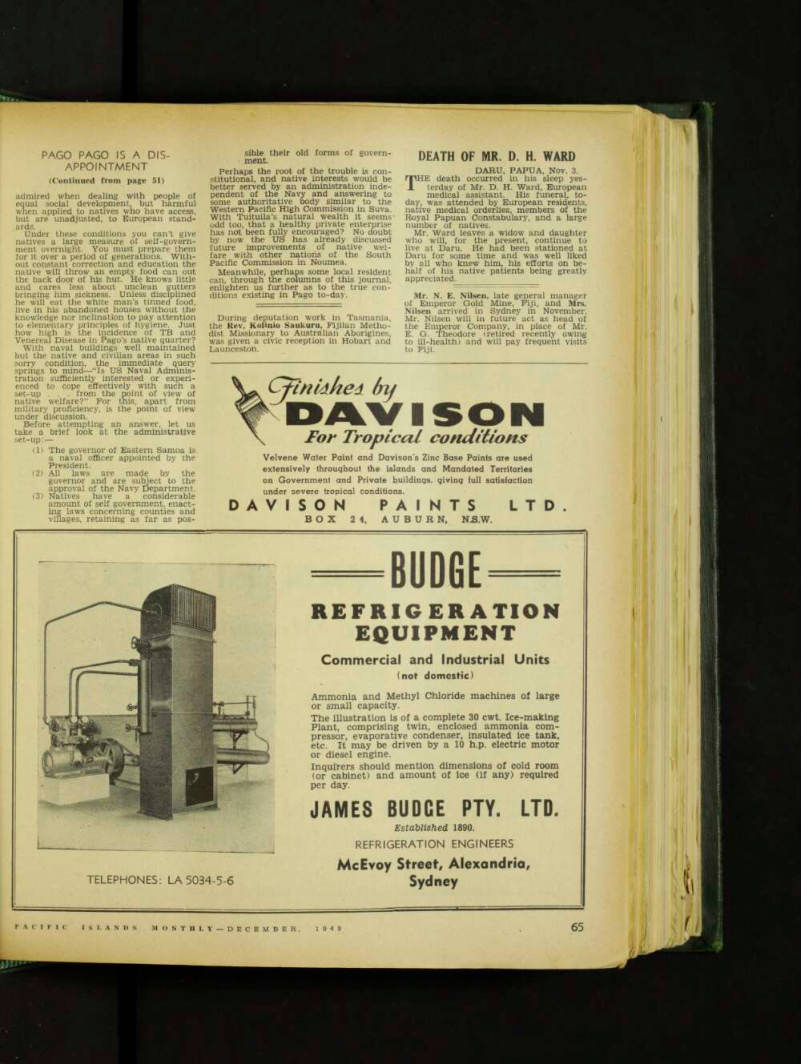
Daru, Papua, Nov. 3.
rpHE death occurred in his sleep yes- JL terday of Mr. D. H. Ward, European medical assistant. His funeral, to day, was attended by European residents, native medical orderlies, members of the Royal Papuan Constabulary, and a large number of natives.
Mr. Ward leaves a widow and daughter who will, for the present, continue to live at Daru. He had been stationed at Daru for some time and was well liked by all who knew him, his efforts on be half of his native patients being greatly appreciated.
Mr. N. E. Nilsen, late geperal manager of Emperor Gold Mine, Fiji, and Mrs.
Nilsen arrived in Sydney in November.
Mr. Nilsen will in future act as head of the Emperor Company, in place of Mr, E. G. Theodore (retired recently owing to ill-health) and will pay frequent visits to Fiji.
Mr. J. N. Clifford, an Australian service man who has had his sight restored by surgery, will leave Sydney soon to spend a long holiday in Fiji. Japanese ill treatment, while he was a prisoner on the Burma Road, caused the complete loss of his sight, about 1944. He was persuaded, six months ago,, to go to England for a specialist operation. When, five weeks after the operation, the bandages were removed, he could see again. The specialist had straightened a twisted nerve.
Advertisements & other items, p. 67 (2 items)
65
PACIFIC ISLANDS MONTHLY DECEMBER, 1949
PAGO PAGO IS A DIS
APPOINTMENT
(Continued from page 51)
Budge
Cpnldhed
For Tropical conditions
Velvene Water Paint and Davison's Zinc Base Paints are used extensively throughout the islands and Mandated Territories on Government and Private buildings, giving full satisfaction under severe tropical conditions.
DAVISON PAINTS
BOX 24. AUBURN. NB.W.
LTD
TELEPHONES: LA 5034-5-6
BUDGE
REFRIGERATION
EQUIPMENT
Commercial and Industrial Units (not domestic) Ammonia and Methyl Chloride machines of large or small capacity.
The illustration is of a complete 30 cwt. Ice-making Plant, comprising twin, enclosed ammonia compressor, evaporative condenser, insulated ice tank, etc. It may be driven by a 10 h.p. electric motor or diesel engine.
Inquirers should mention dimensions of cold room (or cabinet) and amount of ice (if any) required per day.
JAMES BUDGE PTY. LTD.
Established 1890.
REFRIGERATION ENGINEERS
McEvoy Street, Alexandria,
Sydney
W. Samoa Legislative Assembly
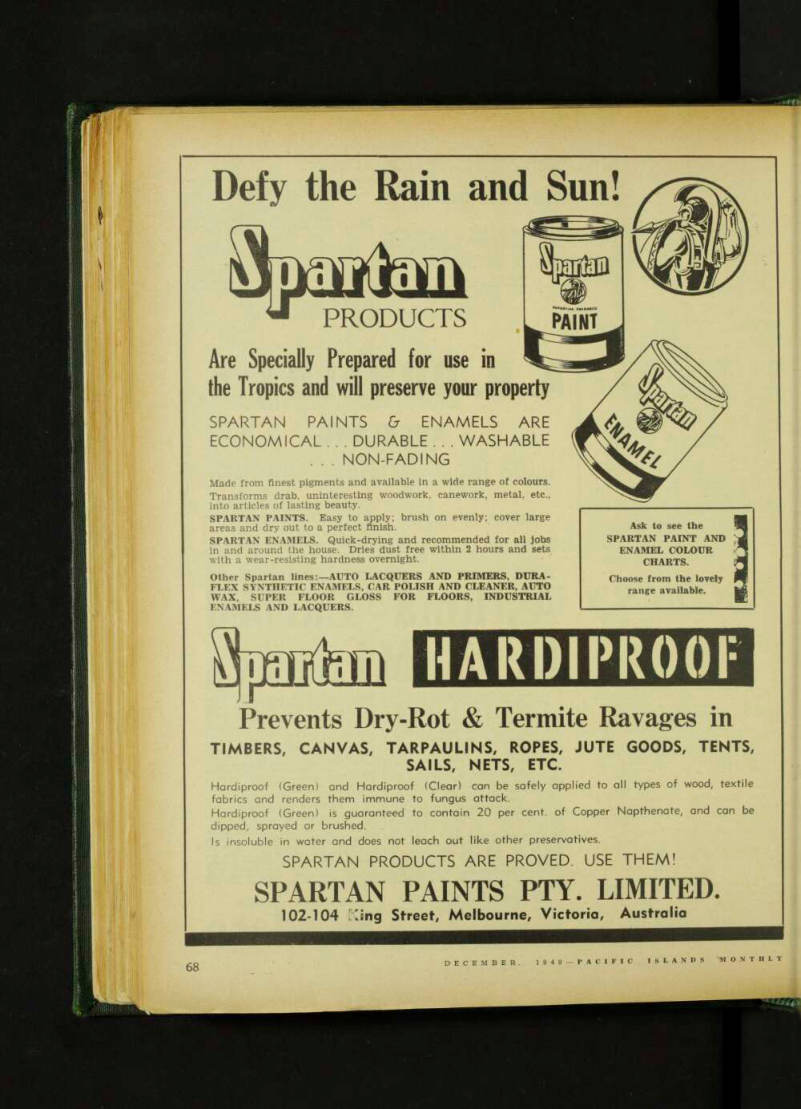
Keenly Debates Territory Affairs
Prom Our Own Correspondent
APIA, November 18.
THE Legislative Assembly of Western Samoa met on October 26 for its third session for 1949 at the Fono
House at Mulinu’u, the traditional seat of the Samoan Government. The Sup plementary Estimates for the current financial year and other important busi ness were discussed. The session ended on November 11. The debates were car ried on in English and Samoan and for the first time broadcast, in full, by Apia Broadcasting Station, 2AP. The public took a great interest in this innovation and welcomed the opportunity to listen to the proceedings which previously had been open to only a few of the favoured.
Status of Chinese A REPORT presented to the Assembly by the High Commissioner on the status of Chinese inhabitants of Western Samoa was vigorously debated.
Certain requests had been made by the Chinese Consul in Suva, Fiji, on behalf of the Chinese inhabitants of the Territory and the Government desired to elucidate public feeling before making a decision.
There are 173 Chinese in the Territory, 83 of whom are old men over 60. and 90 younger men working on plantations. It was contended that there are no legal powers to restrict Chinese in their choice of work and employment and that the Chinese will automatically become free citizens of the Territory in the next four years. The existing prohibition of mar riage between Chinese- and Samoan women had also to be considered, as in the opinion of the New Zealand Govern ment this prohibition is now not war ranted. The offspring of these unions
which cannot be legalised are, of course, illegitimate in law.
During the debate the opinion was ad vanced that the present difficulty was due to the laxity of the former Governments in not carrying out the repatriation of Chinese labourers after the expiration of their three-year contracts. Samoan and European members agreed, however, that the small remaining number of full blooded Chinese should be allowed to be come free settlers. It was also agreed that the descendents of unions of Chinese and Samoan women, should of their own choice, be allowed to take the status either of Samoans or Europeans and enjoy the full rights of their new status and that their illegitimacy should be no bar to citizenship, as the conception of illegi timacy was, in any case, unknown to Samoan custom until the arrival of the missionaries. The immediate lifting of the prohibition of legal marriage between Chinese and Samoans was also recom mended unanimously by members. Any further immigration of Chinese into the Territory, including re-entry of Chinese formerly repatriated was, however, strongly opposed by Samoan members.
Finances THE financial position of the Territory was disclosed when the Supplemen tary Estimates for the current finan cial year were submitted to the Assembly.
Estimated receipts in the Main Estimates were £421,600 and transferred from Re serves £118,150. In the Supplementary Estimates, the estimated revenue is in creased by £23,985 (mainly Store Tax, copra export duty and building tax). Ad ditional expenditure asked for in the Supplementary Estimates amounts to £8,405, leaving at the end of the financial year, an estimated credit balance of £19,415 which will be returned to Reserves.
In addition to this there is still the General Reserve Fund of £500,000.
In the debate that followed, several members criticised the Government finan cial policy and expressed apprehension of the future. Stricter economy was ad vocated and the hope expressed that the appointment cf a new Public Service Commission shortly would lead to more economical working of the various De partments and greater efficiency. The newly-established Agricultural Depart ment should be of assistance in a drive for increased production, which in turn should provide more revenue for the Government.
During the debate on the Education De partment vote, the construction of ex pensive school buildings at the present time was severely criticised by members Plans and specifications had, in the opinion of members, not been prepared with sufficient care and in some cases es timates were greatly exceeded. Though the necessity of a good and thorough edu cation was generally acknowledged, some members considered that the present ex penditure on education strained the financial resources of the country to the utmost.
In the matter of health services it was suggested that free medical services should be provided for all inhabitants and instead of the present payments for services, a medical levy should be introduced.
An incrase in remuneration from £52 to £7B per annum was granted to the members of the Fono of Faipule, the Samoan Parliament, owing to the increase in the cost of living.
In a debate on Government vehicles for the island of Savai’i, a Savai’i represen tative strongly urged the claims of the Savai’i people for more consideration by the Government, as Savai’i was contri buting a large share of the Government revenue through the large quantities of cocoa and copra produced on the island.
The Public Works Department vote was criticised and the Government accused of exceeding by £1,600 the vote on a building bought for housing a new teacher from New Zealand and using this large building for one teacher instead of for several as was recommended by the Assembly.
In discussing the vote for the improve ment of reef passages, particularly in Savai’i, Government, European and Samoan members stressed the need for this work and recommended more expen
(Continued on page 69)
diture for these urgently required im provements.
Empire Preference A REPORT tabled by a Select Commit tee of the Assembly making certain recommendations regarding abolition of the existing Preferential Customs Tariff on British goods, and modification of certain tariff rates, caused a lengthy and interesting discussion. Reduction of duty on staple lines, mainly foodstuffs was also recommended by the Committee in order to lower the cost of living for the people.
Recommendations for the expansion of existing industries and introduction of new industries in the Territory were also made and a protective tariff was sug gested, to stimulate and assist.
The report was received by the As sembly and referred to the Government for consideration and action.
Meat Inspection A REPLY to a question by a member re garding the present system of meat inspection in the Territory evoked the answer from the Chief Medical Officer that there was no regular meat inspec tion at all, because of shortage of staff in the Health Department. The CMO admitted also that practically all herds of cattle in the Territory were infected with Tuberculosis. He minimised the danger by stating that meat from young cattle who are less diseased does not en danger human health, especially if well cooked. At present only samples of meat are occasionally taken from carcases. In the debate that followed, this situation was condemned by members who strongly requested that regular meat inspection be resumed immediately to safeguard meat consumers, particularly as TB is steadily spreading among the inhabitants of the Territory. Inspection of herds and eli mination of diseased beasts was also re commended.
UK Copra Contract INFORMATION was given regarding the present copra contract with the British Ministry of Food, which has just been received in Apia. The contract price in Samoan currency is £4B of which £45 is paid to exporters and £3 is retained by the Copra Board towards the Stabilisa tion Fund.
A motion to increase remunerations of members of the Legislative Assembly was approved of, although European members voted against it. European members ac knowledged, however, that Samoan mem bers, coming to Apia from faraway districts, had more expenses and had, in accordance with Samoan custom, great obligations of entertainment, travelling expenses, etc.
Radio LACK of co-operation of villagers in the broadcasting scheme and neglect of receiving sets in the villages causing considerable cost and trouble to the Government was described in a report by the Superintendent of Radio submitted to the Assembly. This led to a lengthy de bate in which the lack of interest of vil lagers was attributed to the monotonous programmes provided and various sug gestions for improvement of broadcasting services were made. Some difficulty was also experienced in placing the receiving sets in a suitable house in the villages so that they could be made available at all times to listeners and particularly to schoolchildren for educational broadcasts during the day. It was resolved that a special commission of inquiry visit out side districts and get into touch with vil lagers in order to effect improvements and attract interest in the programmes offered by Station 2AP.
Village Councils PROBABLY the most important sub ject before the Assembly was a motion by the secretary of Native
Affairs to investigate an increase in the powers of the Samoan village councils ( Ali’i and Faipule) and also the possibility of establishing a town government in the Apia area. This motion was widely de bated. It was generally agreed that the powers of the Ali’i and Faipule (chiefs and orators) in the villages should be
increased and that present laws restrict ing their powers should be amended to bring them into line with the new set-up of Government. The second part of the motion, the possibility of town govern ment in Apia and its investigation by a proposed Commission of Inquiry, found strong opposition amongst the Samoan members who remember something of the old municipality of Apia 50 years ago, which was a foreign area in which the
Samoans had no say whatever. Reference to the town government in Apia was de leted from the motion and it was agreed that the Commission of Inquiry consider only the question of local government in the villages and districts.
Revaluation of Currency AMOTION to investigate the advisa bility of establishing an independent •Samoan £ as apart from the New
Zealand £, was, after lengthy discussion, referred to a Select Committee of the Assembly for further action. It was pointed out that New Zealand conditions, economic and political, were totally dif ferent from those in Samoa and that the present dependence of the Samoan currency on the New Zealand currency may in future lead to serious economic disadvantages for Samoa.
On conclusion of the business before the Assembly the High Commissioner commented that the session had been a difficult one, but although lengthy and somewhat tiring had been interesting and informative. The debates had been par ticularly useful to the Government and official members.
Visit of USA Congressional Party to Assembly A PLEASING interlude during the session occurred on November 8 when a party of members of the US Congress, who are on an official visit to American Samoa, flew over to Apia from Pago Pago and paid a courtesy visit to the Legislative Assembly then in ses sion at Mulinu’u. Speeches expressing the pleasure and goodwill and the spirit of co-operation and friendship existing between the two Governments and the people of American and Western Samoa were exchanged by the High Commis sioner and the Speaker of the Congres sional party.
Advertisements & other items, pp. 68-72 (2 items)
66
, n „*ri p T f ISLANDS MONTHLY DECEMBER. 1949 PACIFIC 1 » L A
A. Gregory Pty, Ltd.
IMPORTERS, EXPORTERS AND
MANUFACTURERS
Leather Saddlery and Paint
J
Merchants
ALL CLASSES OF LEATHER SUPPLIED FROM STOCK Apply direct to: A. GREGORY PTY., LTD., 107 York St., Sydney
C. SULLIVAN PTY. LTD.
Island Merchants
Over 30 years' experience in the Pacific Island Trade.
Expert Buying Service Original Invoices Furnished Sellers of Island Produce.
Represented in all Australian States, New Zealand, England, France, United States, etc.
BANKERS: Bank of New South Wales, Comptoir National d’Escompte de Paiis, Bank of New Zealand.
C. SULLIVAN PTY. LTD.
379 KENT STREET, SYDNEY
And at Melbourne and Brisbane.
Telegrams & Cables: "CHASULL,” Sydney. Phone: MJ4657 (6 lines).
Associate Co.: C. SULLIVAN, INC., 230 California St., San Francisco, U.S.A.
ART POSTCARDS OF
TONGA
Per Dozen (Including a Tin-Can Mail Cover), Postage Paid: 6/- (or one US Dollar).
TONGAN PHOTOS BUREAU
Nukualofa, Tonga
A. B. DONALD Ltd.
AUCKLAND
ISLAND TRADERS & GENERAL MERCHANTS
P.O. Box 1509. Cables & Telegrams, "Kingdom," Auckland
Asthma Curbed In 3 Minutes
Since the discovery of Mendaco by a famous physician sufferers can get relief from Asthma. Mendaco does away with expensive injections and offensive smokes.
All you do is to take 2 tasteless tablets with meals and Mendaco starts circulating through the blood In 10 minutes. You breathe easily and freely. Your nerves relax, you get good, fresh, pure air Into your lungs, and vigour returns.
Sleep Like a Baby
Thousands of former sufferers from Asthma say that the very first dose of Mendaco brought them glorious ease and comfort, and that they slept soundly the very first night. Then their vigour returned and they felt healthier and stronger, and 5 to 10 years younger. The reason for this is that Mendaco acts in natural ways to overcome the effects of Asthma. (1) It removes the mucus or phlegm; (2) It relaxes thousands of tiny muscles in your bronchial tubes so that the air can get In and out of your lungs; (3) It promotes body vigour, and stimulates the building of rich, revitalised blood.
No Asthma for Five Years
Mendaco not only brings almost Immediate results, free breathing and comfort and enables you to sleep, but also builds up the system to ward off future attacks. Mr.
J. R. writes: “I was almost dead with Asthma. Dad lost 40 lbs. in weight, snf-
fered coughing every night—couldn’t sleep, Mendaco stopped spasms first night. I have had no Asthma since in over 2 years.”
Mrs. A. W. writes: “I had Asthma for 25 years. After using Mendaco I can sleep all night and have not had an attack since taking it.” Mrs. G. E. C. writes: “I bless the day I first heard of Mendaco. What a godsend it is to a poor woman like me who for 35 years never knew what it was to have a good night’s rest. The constant fight between Asthma and sleep was wearing me down, but I feel now I want to forget my past suffering.”
Benefits Immediate
The very first dose of Mendaco goes right to work circulating through your blood and helping nature rid you of the effects of Asthma. Try Mendaco under an iron-clad money back guarantee. You be the judge.
If you don’t feel fully satisfied after taking Mendaco Just return the package and the purchase price will be refunded. Get Mendaco from your chemist to-day and see how well you sleep to-night and how much better you will feel.
RELIEVES ASTHMA
Mendaco
Now in 2 sizes 6/- and 12/-
Defy the Rain and Sun!
PRODUCTS
Are Specially Prepared for use in
the Tropics and will preserve your property
SPARTAN PAINTS & ENAMELS ARE
ECONOMICAI DURABLE . . . WASHABLE
. . . NON-FADING
Made from finest pigments and available in a wide range of colours.
Transforms drab, uninteresting woodwork, canework, metal, etc., into articles of lasting beauty.
SPARTAN PAINTS. Easy to apply; brush on evenly; cover large areas and dry out to a perfect finish.
SPARTAN ENAMELS. Quick-drying and recommended for all jobs in and around the house. Dries dust free within 2 hours and sets with a wear-resisting hardness overnight.
Other Spartan lines:—AUTO LACQUERS AND PRIMERS, DURA- FLEX SYNTHETIC ENAMELS, CAR POLISH AND CLEANER, AUTO WAX, SUPER FLOOR GLOSS FOR FLOORS, INDUSTRIAL
ENAMELS AND LACQUERS.
A
PAINT
A * Ask to see the
SPARTAN PAINT AND
ENAMEL COLOUR
CHARTS.
Choose from the lovely range available.
Prevents Dry-Rot & Termite Ravages in
TIMBERS, CANVAS, TARPAULINS, ROPES, JUTE GOODS, TENTS,
SAILS, NETS, ETC.
Hardiproof (Green) and Hardiproof (Clear) can be safely applied to all types of wood, textile fabrics and renders them immune to fungus attack.
Hardiproof (Green) is guaranteed to contain 20 per cent, of Copper Napthenate, and can be dipped, sprayed or brushed.
Is insoluble in water and does not leach out like other preservatives.
SPARTAN PRODUCTS ARE PROVED. USE THEM!
SPARTAN PAINTS PTY. LIMITED.
102-104 [ling Street, Melbourne, Victoria, Australia
THE
YORKSHIRE
INSURANG
CO. LTD.
(Incorporated in England)
ALL CLASSES OF
INSURANCE
Including
Fire Motor Guarantee Accident Workers Marine Island Representatives:
PORT MORESBY: E. A. James
RABAUL: G. B. Black LAE: New Guinea Industries Ltd.
MADANG: R. MacGregor SUVA: Williams & Gosling Ltd.
NOUMEA: Y. Mortensen
NORFOLK ISLAND:
A. E. Martin
tTABLISSEMENTS DONALD TAHITI
HEAD OFFICE—QUAI DU COMMERCE—PAPEETE
TELEGRAPHIC ADDRESS—“DONALD, PAPEETE"
General Merchants (Wholesale & Retail) & Shipowners
Importers & Exporters—Branches Throughout Marquesas Islands
Lloyd’s Agents
ASSOCIATE
HOUSES:
A. B. DONALD, LTD.
AUCKLAND, NEW ZEALAND.
A. B. DONALD, LTD.
RAROTONGA, COOK ISLANDS.
DOMINION FRUIT CO.,
SUVA, FIJI ISLANDS.
Agents and Distributors for:
FRANCE:
HENNESSY COGNACS
MARIE BRIZARD & ROGER
LIQUEURS
CHARLES HEIDSIECK
CHAMPAGNES
PERRIER WATER
GRUBER BEER
U.S.A.:
GENERAL STEAMSHIP CORP.
RADIO CORP. OF AMERICA
BROWN & WILLIAMSON, LTD.
CIGARETTES: LUCKY STRIKE,
WINGS, OLD GOLD
CHAMPION SPARK PLUG CO.
RAINIER BEER
ENGLAND:
RECKITTS & COLMAN
(OVERSEAS), LTD.
PHILLIPS BICYCLES
THE BANK LINE LTD.
NEW ZEALAND:
VACUUM OIL CO. PTY., LTD.
PETROLEUM PRODUCTS
SWEDEN:
HJORTH & CIE
PRIMUS STOVES
Sydney Agents :
BURNS, PHTLP A CO., LTD.
London Agents : San Francisco Agents : Agents in France : BURNS, PHILP A CO., LTD. BURNS, PHILP CO. OF HARTH & CIE, PARIS.
SAN FRANCISCO. A. BICKART. MARSEILLES.
The Perfect Sink Unit
Available to a new streamlined design in Stainless Steel with a lustrous "Wunderbnte" finish.
Sizes 4', 4 6", 5' and 6' long by I 6 wide.
Ask your local Hardware Merchant, 'phone MX 241 I or write to Wunderlich Limited, Box 474, G.P.0., Sydney, for prices and leaflet.
MiOMIW
COMBINATION SINK & DRAINER
9
BRAND
Samoan Eagerness For
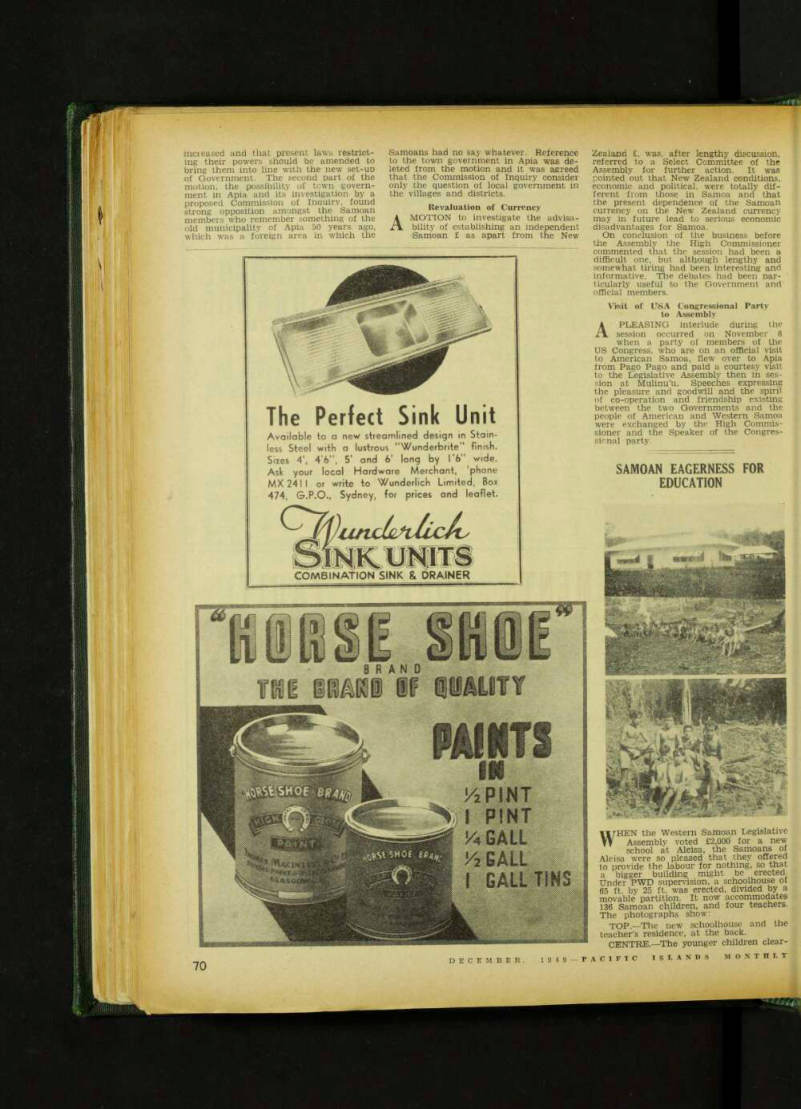
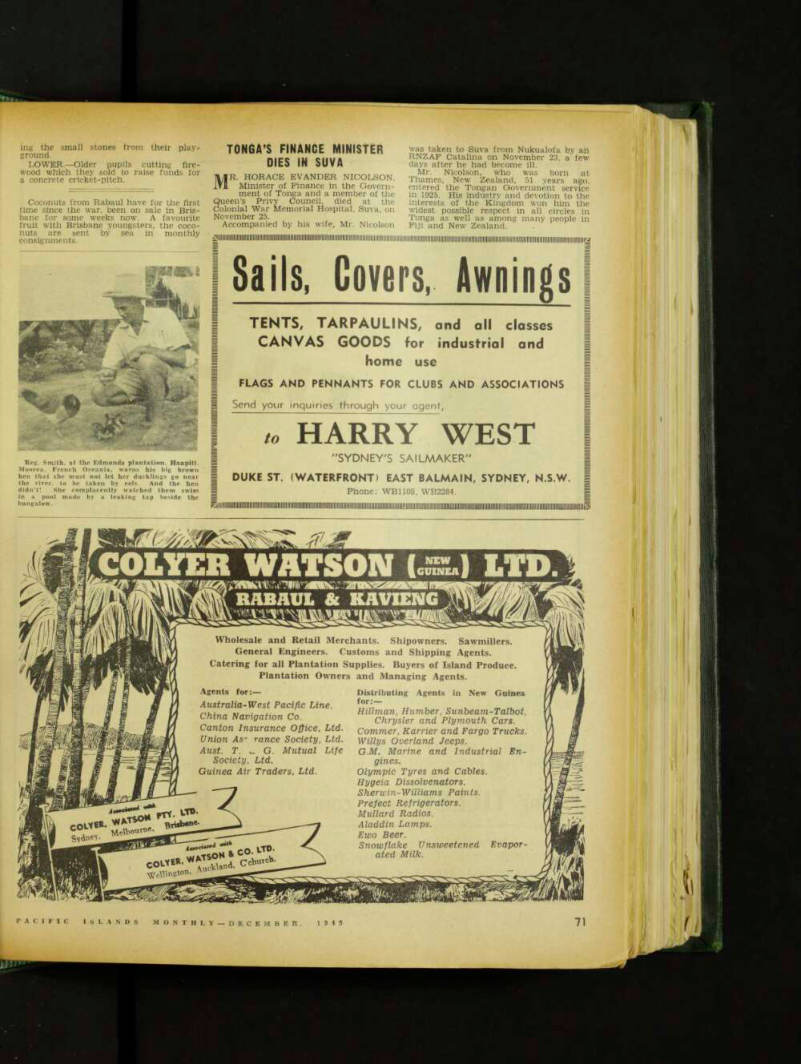
Education
WHEN the Western Samoan Legislative Assembly voted £2,000 for a new school at Aleisa, the Samoans of Aleisa were so pleased that they offered to provide the labour for nothing, so that a bigger building might be erected.
Under PWD supervision, a schoolhouse oi 65 ft. by 25 ft. was erected, divided by a movable partition. It now accommodates 136 Samoan children, and four teachers.
The photographs show: TOP. —The new schoolhouse and the teacher’s residence, at the back.
CENTRE.—The younger children clear
mg the small stones from their play ground.
LOWER. —Older pupils cutting fire wood which they sold to raise funds for a concrete cricket-pitch.
Coconuts from Rabaul have for the first time since the war, been on sale in Bris bane for some weeks now. A favourite fruit with Brisbane youngsters, the coco nuts are sent by sea in monthly consignments.
Reg. Smith, at the Edmonds plantation. Haapitl, Moorea, French Oceania, warns his big brown hen that she must not let her ducklings go near the river, to be taken by eels. And the hen didn’t! She complacently watched them swim in a pool made by a leaking tap beside the bungalow.
Advertisements & other items, p. 72 (1 item)
70
DECEMBER, 1949 PACIFTC ISLANDS MONTHLY
Tonga's Finance Minister
Dies In Suva
Mr. Horace Evander Nicolson,
Minister of Finance in the Govern ment of Tonga and a member of the Queen’s Privy Council, died at the Colonial War Memorial Hospital, Suva, on November 25.
Accompanied by his wife, Mr. Nicolson
was taken to Suva from Nukualofa by art RNZAF Catalina on November 23, a few days after he had become ill.
Mr. Nicolson, who was born at Thames, New Zealand, 51 years ago, entered the Tongan Government service in 1925. His industry and devotion to the interests of the Kingdom won him the widest possible respect in all circles in Tonga as well as among many people in Fiji and New Zealand.
Advertisements & other items, pp. 73-74 (1 item)
poijok
GOLYER WATSON |cS>| LTD
RABAUL & KAVILNCjmMSm*-
Wholesale and Retail Merchants. Shipowners. Sawmillers.
General Engineers. Customs and Shipping Agents.
Catering for all Plantation Supplies. Buyers of Island Produce.
Plantation Owners and Managing Agents. v* Agents for:— Australia-West Pacific Line.
China Navigation Co.
Canton Insurance Office, Ltd.
Union As° ranee Society, Ltd.
Aust. T. v~ G. Mutual Life Society, Ltd.
Guinea Air Traders, Ltd.
CO. tTO
COLYEtt. **^ nd , CcVmteh-
Distributing Agents in New Guinea for:— Hillman, Humber, Sunbeam-Talbot , Chrysler and Plymouth Cars.
Commer, Harrier and Fargo Trucks.
Willys Overland Jeeps.
G.M. Marine and Industrial Engines.
Olympic Tyres and Cables.
Hygeia Dissolvenators.
Sherwin-Williams Paints.
Prefect Refrigerators.
Mullard Radios.
Aladdin Lamps.
Ewo Beer.
Snowflake Unsweetened Evaporated Milk.
to
e a«V
its
a o
m-tk
* =*> r; ra
os^ E!
VCfc*
u o ?s>
BU^ S
+ J
«THE GUARDSMAN
STORM LANTERN X 246
500 Candle Power If you think of night work— you must THINK OF TILLEY. THERE IS A LAMP FOR EVERY JOB, FROM THE 300 CANDLE POWER
“GUARDSMAN” STORM LANTERN. AS ILLU-
STRATED, TO THE 5,000 CANDLE POWER
PORTABLE FLOODLIGHT. EVERY TILLEY OUTDOOR LAMP IS ENTIRELY STORM PROOF AND WILL OPERATE IN THE WORST WEATHER CONDITIONS WITH COMPLETE RELIABILITY. MANUFACTURED TO THE HIGHEST ENGIN- EERING STANDARDS FROM THE FINEST MATERIALS. TILLEY PRODUCTS ARE THE FINEST YOU CAN BUY. THE LAMP WITH THE “ HAPPY MANTLES. ”
THE TILLEY LAMP COMPANY, LTD. HeNDON, ENGLAND
REPRESENTATION;
MELBOURNE: T. H. Bentley, Pty. Ltd., 123-125 William Street. Melbourne. Cl TASMANIA: Mr. H. V. Sellars, 108 a Charles Street, Launceston.
FIJI; Mr. K. Witherington, 2 Burns Philp Buildings, Suva.
Guinea Highlands Style
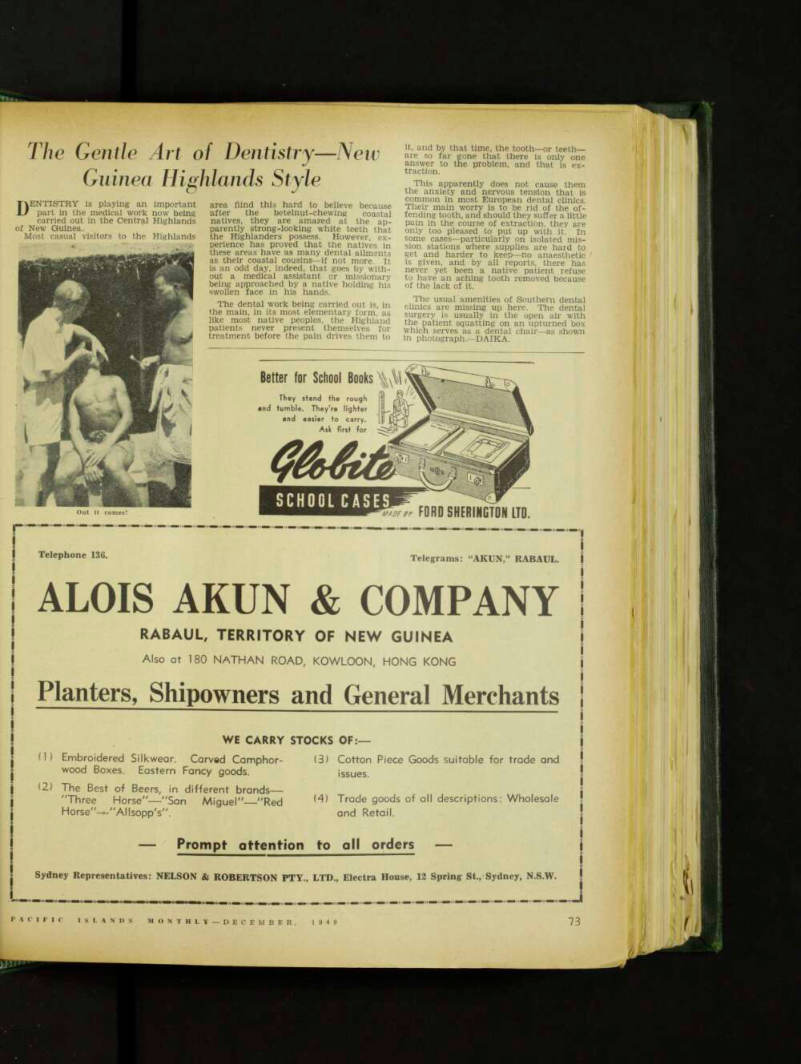
The Gentle Art of Dentistry—New Guinea Highlands Style
DENTISTRY is playing an important part in the medical work now being carried out in the Central Highlands of New Guinea.
Most casual visitors to the Highlands
area hind this hard to believe because after the betelnut-chewing coastal natives, they are amazed at the ap parently strong-looking white teeth that the Highlanders possess. However, ex perience has proved that the natives in these areas have as many dental ailments as their coastal cousins—if not more. It is an odd day, indeed, that goes by with out a medical assistant or missionary being approached by a native holding his swollen face in his hands.
The dental work being carried out is, in the main, in its most elementary form, as like most native peoples, the Highland patients never present themselves for treatment before the pain drives them to
it, and by that time, the tooth—or teeth— are so far gone that there is only one answer to the problem, and that is ex traction.
This apparently does not cause them the anxiety and nervous tension that is common in most European dental clinics.
Their main worry is to be rid of the of fending tooth, and should they suffer a little pain in the course of extraction, they are only too pleased to put up with it. In some cases—particularly on isolated mis sion stations where supplies are hard to get and harder to keep—no anaesthetic is given, and by all reports, there has never yet been a native patient refuse to have an aching tooth removed because of the lack of it.
The usual amenities of Southern dental clinics are missing up here. The dental surgery is usually in the open air with the patient squatting on an upturned box which serves as a dental chair—as shown
in photograph.—DAlKA.
Advertisements & other items, p. 75 (1 item)
Alois Akun & Company
Better for School Books
They stand the rough and tumble. They're lighter and easier to carry.
Ask first for
SCHOOL CASES
'Mapf gr
FORD SHERINGTON LTD.
Telephone 136. Telegrams: “AKUN,” RABAUL.
ALOIS AKUN & COMPANY
RABAUL, TERRITORY OF NEW GUINEA
Also at 180 NATHAN ROAD, KOWLOON, HONG KONG
Planters, Shipowners and General Merchants
WE CARRY STOCKS OF:—
(1) Embroidered Silkwear. Carved Camphor- (3) Cotton Piece Goods suitable for trade and wood Boxes. Eastern Fancy goods. issues. (2) The Best of Beers, in different brands — "Three Horse"—"San Miguel" "Red Trade goods of all descriptions: Wholesale Horse // -t-"Allsopp / s". and Retail.
Proropt attention to all orders Sydney Representatives: NELSON & ROBERTSON PTY., LTD., Electra House, 12 Spring St., Sydney, N.S.W.
Rising Cost of Fiji
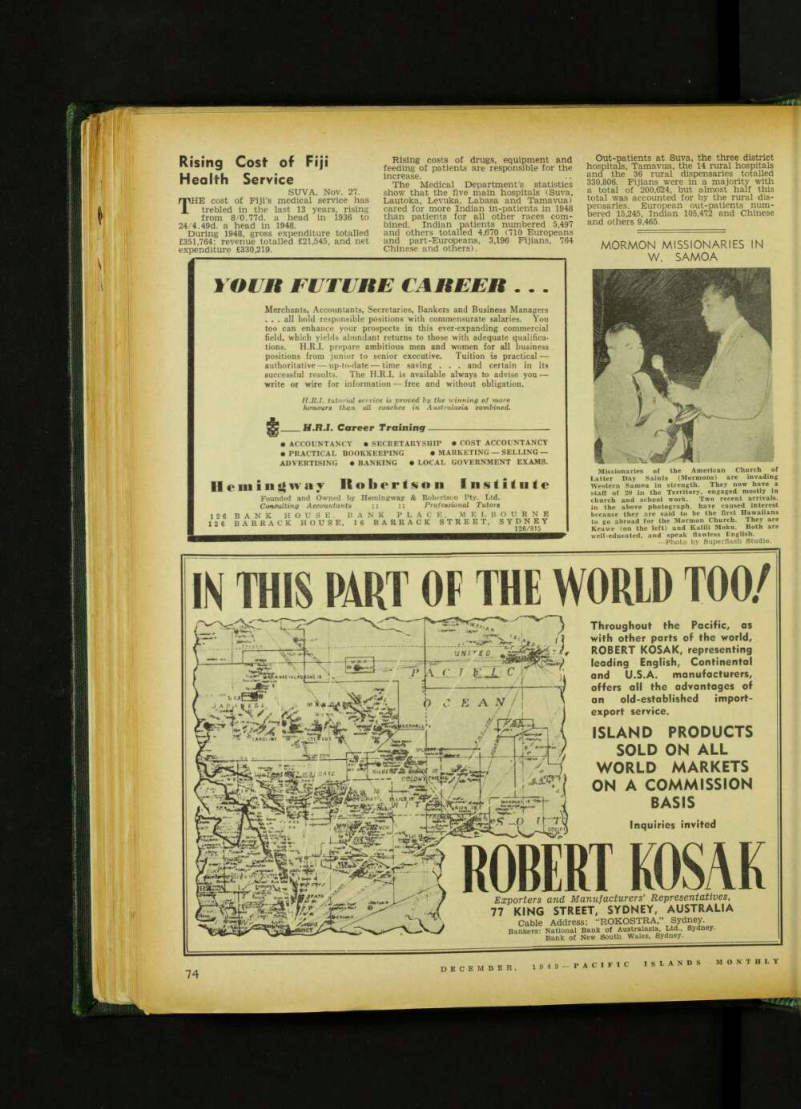
Health Service
Suva, Nov. 27.
rE cost of Fiji’s medical service has trebled in the last 13 years, rising from 8/0.77d. a head in 1936 to 24/4.49d. a head in 1948.
During 1948, gross expenditure totalled £351,764; revenue totalled £21,545, and net expenditure £330,219.
Rising costs of drugs, equipment and feeding of patients are responsible for the increase.
The Medical Department’s statistics show that the five main hospitals (Suva, Lautoka, Levuka, Labasa and Tamavua) cared for more Indian in-patients in 1948 than patients for all other races com bined. Indian patients numbered 5,497 and others totalled 4,670 (710 Europeans and part-Europeans, 3,196 Fijians, 764 Chinese and others).
Out-patients at Suva, the three district hospitals, Tamavua, the 14 rural hospitals and the 36 rural dispensaries totalled 330,806. Fijians were in a majority with a total of 200,624, but almost half this total was accounted for by the rural dis pensaries. European out-patients num bered 15,245, Indian 105,472 and Chinese and others 9,465.
Mormon Missionaries In
W. Samoa
Missionaries of the American Church of Latter Day Saints (Mormons) are invading Western Samoa in strength. They now have a staff of 20 in the Territory, engaged mostly in church and school work. Two recent arrivals, in the above photograph, have caused interest because they are said to be the first Hawaiians to go abroad for the Mormon Church. They are Keawe (on the left) and Kalili Moku. Both are well-educated, and speak flawless English. —Photo by Superflash Studio.
Advertisements & other items, p. 76 (1 item)
Robert Kosak
YOUR FUTURE CAREER . . .
Merchants, Accountants, Secretaries, Bankers and Business Managers ... all hold responsible positions with commensurate salaries. You too can enhance your prospects in this ever-expanding commercial field, which yields abundant returns to those with adequate qualifications. H.R.I. prepare ambitious men and women for all business positions from junior to senior executive. Tuition is practical authoritative up-to-date time saving . . . and certain in its successful results. The H.R.I. is available always to advise you write or wire for information free and without obligation.
H.R.I. tutorial service is proved by the winning of more honours than all coaches in Australasia combined.
H.R.I. Career Training • ACCOUNTANCY • SECRETARYSHIP • COST ACCOUNTANCY
• PRACTICAL BOOKKEEPING • MARKETING SELLING
ADVERTISING • BANKING • LOCAL GOVERNMENT EXAMS.
II emingway Robertson Institute
Founded and Owned by Hemingway & Robertson Pty. Ltd.
Consulting Accountants :: :; Professional Tutors 12 6 12 6
BANK HOUSE.
BARRACK HOUSE.
BANK PLACE. MELBOURNE
16 BARRACK STREET. SYDNEY
126/815
IN THIS PART OF THE WORLD TOO/ i n§N p a c / p;.i. c y'/ £ A *>-<W X ✓ •• o-?V, ft
\£?Sh —% SESSi’
p' *** «u*£lltt& »Lj?2 s** bF^ > > ■ f AROI t*< t 3 I f iuw? syj**-***.) vein* ■sa *rr %Bfe IJ^ «K’
I , J*xm SS* rtterf*** S*e&*£ Throughout the Pacific, as with other parts of the world, ROBERT KOSAK, representing leading English, Continental and U.S.A. manufacturers, offers all the advantages of an old-established importexport service.
ISLAND PRODUCTS
SOLD ON ALL
WORLD MARKETS
ON A COMMISSION
BASIS
Inquiries invited
ROBERT KOSAK
Exporters and Manufacturers' Representatives,
77 KING STREET, SYDNEY, AUSTRALIA
Cable Address: “ROKOSTRA," Sydney.
Bankers: National Bank of Australasia, Ltd., Sydney. •Rant nf fsipw South Wales, Sydney.
Liquor Law Equality
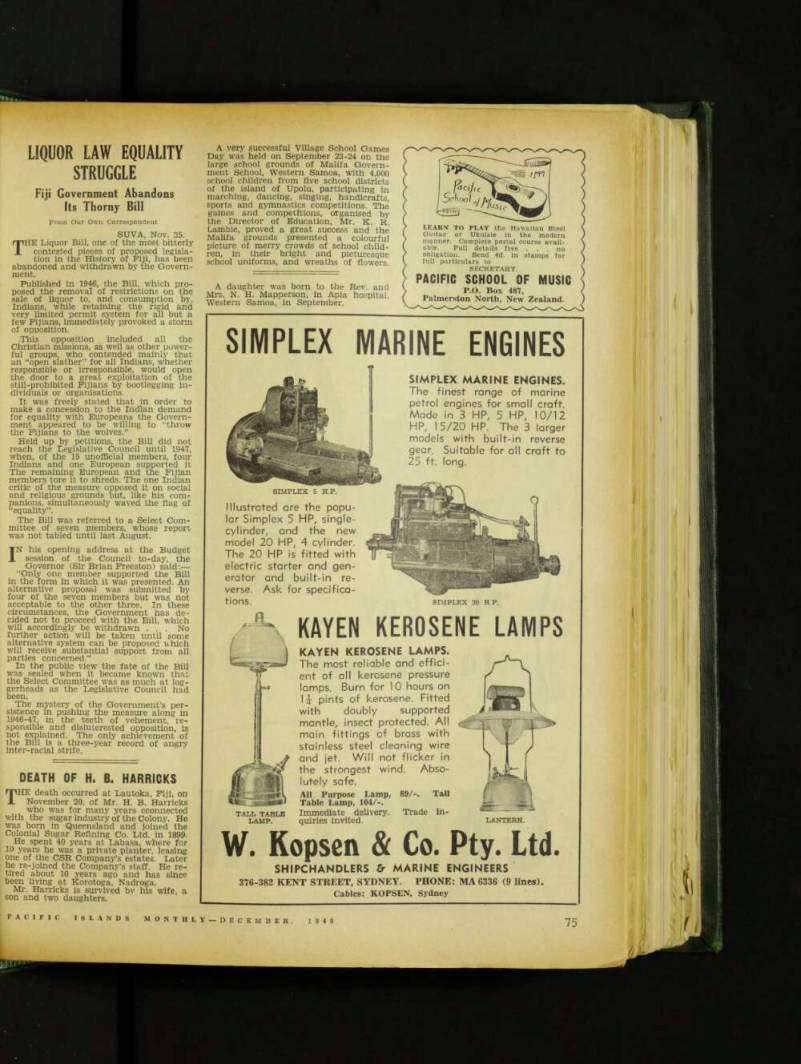
Struggle
Fiji Government Abandons Its Thorny Bill
From Our Own Correspondent
Suva, Nov. 25.
THE Liquor Bill, one of the most bitterly contested pieces of proposed legisla tion in the History of Fiji, has been abandoned and withdrawn by the Govern ment.
Published in 1946, the Bill, which pro posed the removal of restrictions on the sale of liquor to, and consumption by, Indians, while retaining the rigid and very limited permit system for all but a few Fijians, immediately provoked a storm of opposition. .This opposition included all the Christian missions, as well as other power ful groups, who contended mainly that an “open slather” for all Indians, whether responsible or irresponsible, would open the door to a great exploitation of the still-prohibited Fijians by bootlegging in dividuals or organisations.
It was freely stated that in order to make a concession to the Indian demand for equality with Europeans the Govern ment appeared to be willing to “throw the Fijians to the wolves.”
Held up by petitions, the Bill did not reach the Legislative Council until 1947, when, of the 15 unofficial members, four Indians and one European supported it The remaining European and the Fijian members tore it to shreds. The one Indian critic of the measure opposed it on social and religious grounds but, like his com panions, simultaneously waved the flag of “equality”.
The Bill was referred to a Select Com mittee of seven members, whose report was not tabled until last August.
IN his opening address at the Budget session of the Council to-day, the Governor (Sir Brian Freeston) said:— “Only one member supported the Bill in the form in which it was presented. An alternative proposal was submitted by four of the seven members but was not acceptable to the other three. In these circumstances, the Government has de cided not to proceed with the Bill, which will accordingly be withdrawn ... No further action will be taken until some alternative system can be proposed vhich will receive substantial support from all parties concerned.”
In the public view the fate of the Bill was sealed when it became known that the Select Committee was as much at log gerheads as the Legislative Council had been.
The mystery of the Government’s per sistence in pushing the measure along in 1946-47, in the teeth of vehement, re sponsible and disinterested opposition, is not explained. The only achievement of the Bill is a three-year record of angry inter-racial strife.
Death Of H. B. Harricks
THE death occurred at Lautoka, Fiji, on November 20, of Mr. H. B. Harricks who was for many years cconnected with the sugar industry of the Colony. He was born in Queensland and joined the Colonial Sugar Refining Co. Ltd. in 1899.
He spent 40 years at Labasa, where for 10 years he was a private planter, leasing one of the CSR Company’s estates. Later he re-joined the Company’s staff. He re tired about 10 years ago and has since been living at Korotoga, Nadroga.
Mr. Harricks is survived by his wife, a son and two daughters.
A very successful Village School Games Day was held on September 23-24 on the large school grounds of Malifa Govern ment School, Western Samoa, with 4,000 school children from five school districts of the island of Upolu, participating in marching, dancing, singing, handicrafts, sports and gymnastics competitions. The games and competitions, organised by the Director of Education, Mr. K. R.
Lambie, proved a great success and the Malifa grounds presented a colourful picture of merry crowds of school child ren, in their bright and picturesque school uniforms, and wreaths of flowers.
A daughter was born to the Rev. and Mrs. N. H. Mapperson, in Apia hospital, Western Samoa, in September.
Advertisements & other items, pp. 77-78 (1 item)
Simplex Marine Engines
/ff?
?aci)
% "00/ LEARN TO PLAY the Hawaiian Steel Guitar or Ukulele in the modern manner. Complete postal course available. Full details free ... no obligation. Send 4d. in stamps for full particulars to
SECRETARY,
PACIFIC SCHOOL OF MUSIC
P.O. Box 487, Palmerston North, New Zealand.
SIMPLEX MARINE ENGINES
tm
SIMPLEX MARINE ENGINES.
The finest range of marine petrol engines for small craft.
Made in 3 HP, 5 HP, 10/12 HP, 15/20 HP. The 3 larger models with built-in reverse gear. Suitable for all craft to 25 ft. long.
SIMPLEX 5 H.P.
Illustrated are the popular Simplex 5 HP, singlecylinder, and the new model 20 HP, 4 cylinder.
The 20 HP is fitted with electric starter and generator and built-in reverse. Ask for specifications. r
SIMPLEX 20 H.P.
-J
KAYEN KEROSENE LAMPS
TALL TABLE
LAMP.
KAYEN KEROSENE LAMPS.
The most reliable and efficient of all kerosene pressure lamps. Burn for 10 hours on 1 i pints of kerosene. Fitted with doubly supported mantle, insect protected. All main fittings of brass with stainless steel cleaning wire and jet. Will not flicker in the strongest wind. Absolutely safe.
All Purpose Lamp, 89/-. Tall Table Lamp, 104/-.
Immediate delivery. Trade inquiries invited.
LANTERN.
W. Kopsen & Co. Pty. Ltd.
SHIPCHANDLERS & MARINE ENGINEERS
376-382 KENT STREET, SYDNEY. PHONE: MA 6336 (9 lines).
Cables: KOPSEN, Sydney
An ornate example of historical
keys, this XVlth Century
French key features the sporting motif in its club and animal ♦ carvings. It seems to have been the key to a Duke’s country
lodge.
A 4 * 1 £4 ~£r m* > s . ■ m A Th e
sure
a e to s
CAPSTAN
FINE CUT
NAVY CUT
TOBACCOS
or 1657./.48 ■
Sydney-NZ-Fiji-Hawaii-Nth. America
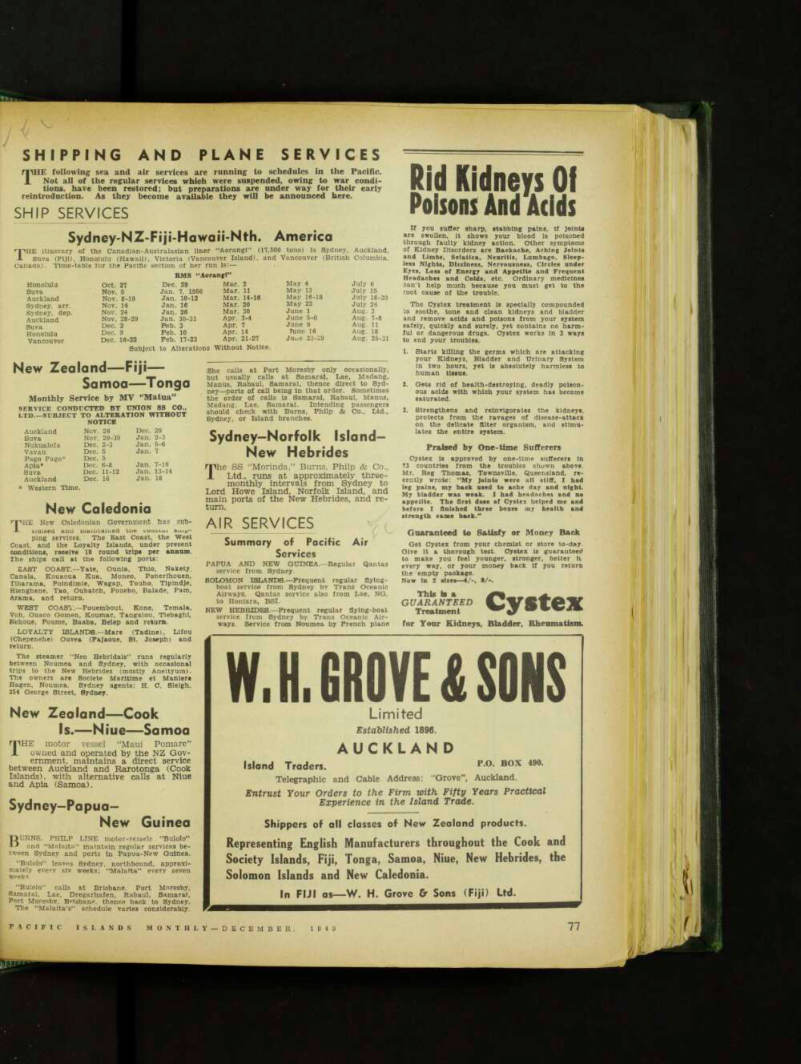
Shipping And Plane Services
Ship Services
rE following sea and air services are running to schedules in the Pacific.
Not all of the regular services which were suspended, owing to war condi tions. have been restored; but preparations are under way for their early reintroduction. As they become available they will be announced here.
Sydney-NZ-Fiji-Hawaii-Nth. America
THE itinerary of the Canadian-Australaslan liner "Aorangi” (17,500 tons) Is Sydney, Auckland.
Suva (Fiji), Honolulu (Hawaii), Victoria (Vancouver Island), and Vancouver (British Columbia, Canada). Time-table lor the Pacific section of her run is:—
New Zealand —Fiji—
Samoa —Tonga
Monthly Service by MV “Matua”
Service Conducted By Union 8S Co.,
Ltd.—Subject To Alteration Without
Notice
New Caledonia
THE New Caledonian Government has sub sumed ana maintained lac oomux baip ping services. The East Coast, the West Coast, and the Loyalty Islands, under present condition*, receive 10 round trip* per annum.
The ships call at the following ports: EAST COAST.—Yate, Ounia, Thio, Nakety.
Canala, Kouaoua Kua, Moneo, Ponerthouen, Tibarama, Polndlmle, Wagap, Touho, Tlplndje, Hienghene, Tao, Oubatch, Pouebo, Balade, Pam, Arama, and return.
WEST COAST.— Pouembout, Kone, Temala, Voh, Ouaco Gomen, Koumac, Tangaiou. Tiebaghl, Nehoue, Poume, Baaba, Belep and return.
LOYALTY ISLANDS.—Mare (Tadine), Llfou (Chepenehe) Ouvea (Fajaoue, St. Joseph) and return.
The steamer “Neo Hebrldals” runs regularly between Noumea and Sydney, with occasional trips to the New Hebrides (mostly Aneltyum).
The owners are Societe Maritime et Manlere Hagen, Noumea. Sydney agents: H. C. Sleigh, 254 George Street, Sydney.
New Zealand—Cook
Is.—Niue—Samoa
THE motor vessel “Maui Pomare” owned and operated by the NZ Gov ernment, maintains a direct service between Auckland and Rarotonga (Cook Islands), with alternative calls at Niue and Apia (Samoa).
Sydney-Papua-
New Guinea
T>URNS, PHILP LINE motor-vessels "Bulolo” and “Malaita.” maintain regular services be tween Sydney and ports in Papua-New Guinea.
“Bulolo” leaves Sydney, northbound, approxi mately every six weeks; “Malaita” every seven weeks.
“Bulolo” calls at Brisbane. Port Moresby, Samarai, Lae, Dregarhafen, Rabaul, Samaral, Port Moresby. Brisbane. thence back to Sydney.
The “Malaita’s” schedule varies considerably.
She calls at Port Moresby only occasionally, but usually calls at Samaral, Lae, Madang, Manus, Rabaul, Samaral, thence direct to Syd ney—ports of call being In that order. Sometimes the order of calls is Samaral, Rabaul, Manus, Madang, Lae, Samarai. Intending passengers should check with Burns, Phllp & Co., Ltd., Sydney, or Island branches.
Sydney-Norfolk Island-
New Hebrides
The SS “Morinda,” Burns, Philp & Co., Ltd., runs at approximately three monthly intervals from Sydney to Lord Howe Island, Norfolk Island, and main ports of the New Hebrides, and re turn.
RMS “Aoranri”
Honolulu Oct. 27 Dec. 29 Mar. 2 May 4 July 6 Suva Nov. 5 Jan. 7. 1950 Mar. 11 May 13 July 15 Auckland Nov. 8-10 Jan. 10-12 Mar. 14-16 May 16-18 July 18-20 Sydney, arr. Nov. 14 Jan. 16 Mar. 20 May 22 July 24 Sydney, dep. Nov. 24 Jan. 26 Mar. 30 June 1 Aug. 3 Auckland Nov. 28-29 Jan. 30-31 Apr. 3-4 June 5-6 Aug. 7-8 Suva Dec. 2 Peb. 3 Apr. 7 June 9 Aug. 11 Honolulu Dec. 9 Feb. 10 Apr. 14 Tune 16 Aug. 18 Vancouver Dec. 16-22 Feb. 17-23 Apr. 21-27 June 23-29 Aug. 25-31 Subject to Alterations Without Notice.
Auckland Nov. 26 Dec. 29 Suva Nov. 29-30 Jan. 2-3 Nukualofa Dec. 2-3 Jan. 5-6 Vavau Dec. 5 Jan. 7 Pago Pago* Dec. 5 Apia* Dec. 6-8 Jan. 7-10 Suva Dec. 11-12 Jan. 13-14 Auckland Dec. 16 Jan. 18 * Western Time.
Air Services
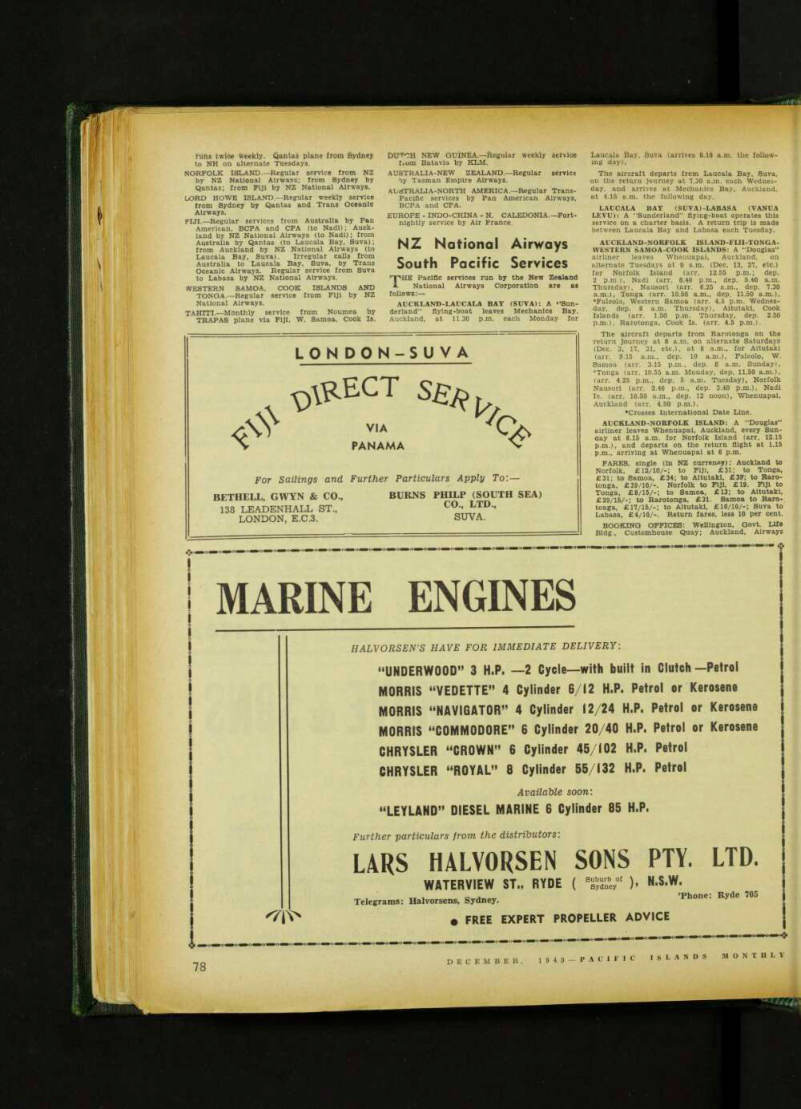
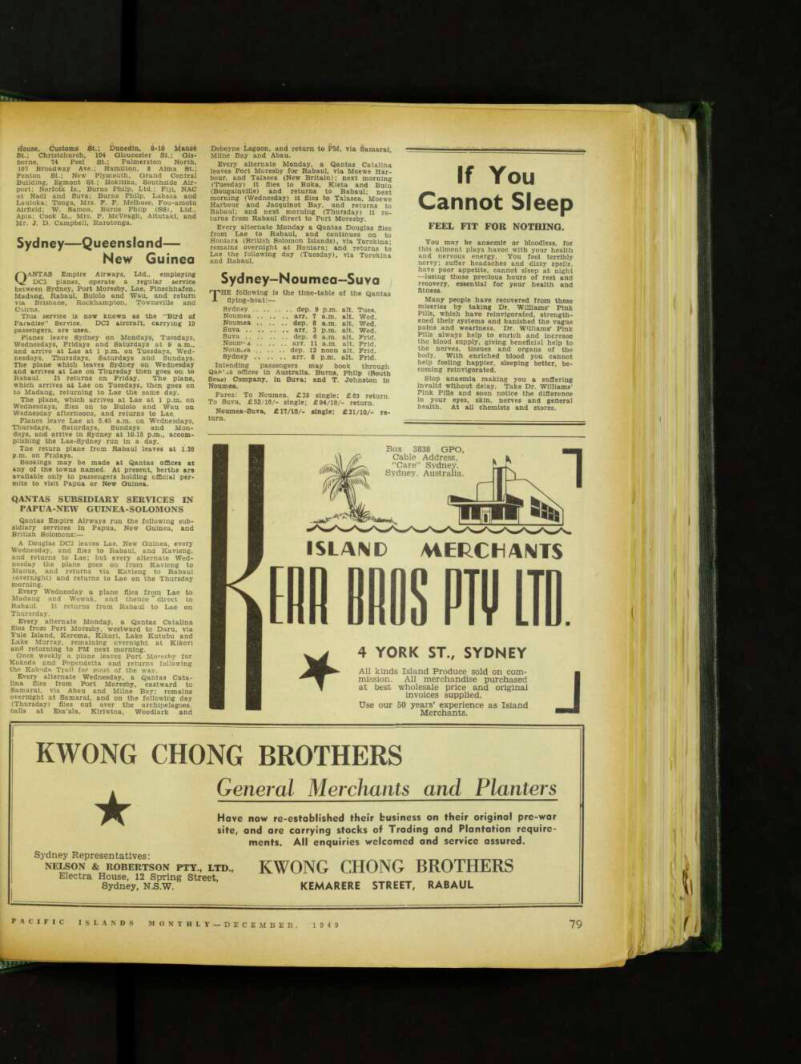
Summary of Pacific Air
Services
PAPUA AND NEW GUlNEA.—Regular Qantaa service from Sydney.
SOLOMON ISLANDS.—Frequent regular flying boat service from Sydney by Trans Oceanic Airways. Qantas service also from Lae, NG, to Honiara, BSI.
NEW HEBRlDES.—Frequent regular flying-boat service from Sydney by Trans Oceanic Air ways. Service from Noumea by French plane
riihs twice weekly. Qantas plane from Sydney to NH on alternate Tuesdays.
NORFOLK ISLAND.—Regular service from NZ by NZ National Airways; from Sydney by Qantas; from Fiji by NZ National Airways.
LORD HOWE ISLAND—Regular weekly service from Sydney by Qantas and Trans Oceanic Airways.
FIJI. —Regular services from Australia by Pan American, BCPA and CPA (to Nadi); Auck land by NZ National Airways (to Nadi); from Australia by Qantas (to Laucaia Bay, Suva); from Auckland by NZ National Airways (to Laucaia Bay, Suva). Irregular calls from Australia to Laucaia Bay, Suva, by Trans Oceanic Airways. Regular service from Suva to Labasa by NZ National Airways.
Western Samoa, Cook Islands And
TONGA. —Regular service from Fiji by NZ National Airways.
TAHlTl.—Monthly service from Noumea by TRAPAS plane via Fiji, W. Samoa, Cook Is.
DU't'CS NEW GUlNEA.—Regular weekly service ii-om Batavia by KLM.
AUSTRALIA-NEW ZEALAND.—ReguIar service by Tasman Empire Airways.
AUSTRALIA-NORTH AMERICA.—Regular Trans pacific services by Pan American Airways,
Bcpa And Cpa.
Europe - Indo-China -N. Caledonla.—Fort
nightly service by Air France.
NZ National Airways
South Pacific Services
r T'HE Pacific services run by the New Zealand 1. National Airways Corporation are as follows:
Auckland-Laucala Bay (Suva): A “Sun
derland” flying-boat leaves Mechanics Bay.
Auckland, at 11.30 p.m. each Monday for
Laucaia Say, Suva (arrives 8.16 a.m. the follow ing day).
The aircraft departs from Laucaia Bay, Suva, on the return journey at 7.30 a.m. each Wednes day, and arrives at Mechanics Bay, Auckland, at 4.15 a.m. the following day.
Laucala Bat (Suva)-Labasa (Vanda
LEVU): A “Sunderland” flying-boat operates this service on a charter basis. A return trip is made between Laucaia Bay and Labasa each Tuesday.
Auckland-Norfolk Island-Fiji-Tonga
Western Samoa-Cook Islands: A “Douglas”
airliner leaves Whenuapai, Auckland, on alternate Tuesdays at 9 a.m. (Dec. 13, 27, etc.) for Norfolk Island (arr. 12.55 p.m.; dep. 2 p.m.), Nadi (arr. 8.40 p.m., dep. 5.40 a.m.
Thursday), Nausori (arr. 6.25 a.m., dep. 7.30 a.m.), Tonga (arr. 10.50 a.m., dep. 11.50 a.m.), *Faleolo, Western Samoa (arr. 4.5 p.m. Wednes day, dep. 8 a.m. Thursday), Aitutaki, Cook Islands (arr. 1.50 p.m. Thursday, dep. 2.50 p.m.), Rarotonga, Cook Is. (arr. 4.5 p.m.).
The aircraft departs from Rarotonga on the return journey at 8 a.m. on alternate Saturdays (Dec. 3, 17, 31, etc.), at 8 a.m., for Aitutaki (arr. 9.15 a.m., dep. 10 a.m.), Faleolo, W.
Samoa (arr. 3.15 p.m., dep. 8 a.m. Sunday), ♦Tonga (arr. 10.55 a.m. Monday, dep. 11.50 a.m.), (arr. 4.25 p.m., dep. 5 a.m. Tuesday), Norfolk Nausori (arr. 2.40 p.m., dep. 3.40 p.m.), Nadi Is. (arr. 10.55 a.m., dep. 12 noon), Whenuapai, Auckland (arr. 4.50 p.m.). •Crosses International Date Line.
Auckland-Norfolk Island: A “Douglas”
airliner leaves Whenuapai, Auckland, every Sun day at 8.15 a.m. for Norfolk Island (arr. 12.15 p.m.), and departs on the return flight at 1.15 p.m., arriving at Whenuapai at 6 p.m.
FARES, single (in NZ currency): Auckland to Norfolk, £l2/10/-; to Fiji, £3l; to Tonga, £3l; to Samoa, £34; to Aitutaki, £39; to Raro tonga. £39/10/-. Norfolk to Fiji. £l9. Fiji to Tonga, £B/15/-; to Samoa, £l3; to Aitutaki, £29/15/-; to Rarotonga, £3l. Samoa to Raro tonga, £l7/15/-; to Aitutaki, £l6/10/-; Suva to Labasa, £4/10/-. Return fares, less 10 per cent.
BOOKING OFFICES: Wellington, Govt. Life Bldg., Customhouse Quay; Auckland, Airways
House, Customs St.; Dunedin, 8-10 Manse St.; Christchurch, 104 Gloucester St.; Gis borne, 74 Peel St.; Palmerston North, 107 Broadway Ave.; Hamilton, 8 Alma St.; Fenton St.; New Plymouth, Grand Central Building, Egmont St.; Hokitika, Southside Air port; Norfolk Is., Burns Philp, Ltd.; Fiji, NAC at Nadi and Suva; Burns Philp, Labasa and Lautoka; Tonga, Mrs. F. F. Melhose, Fou-amotu Airfield; W. Samoa, Burns Philp (SS), Ltd., Apia; Cook Is., Mrs. P. McVeagh, Aitutaki, and Mr. J. D. Campbell, Rarotonga.
Sydney—Queensland—
New Guinea
QANTAS Empire Airways, Ltd., employing DCS planes, operate a regular service between Sydney, Port Moresby, Lae, Finschhafen, Madang, Rabaul, Bulolo and Wau, and return via Brisbane, Rockhampton, Townsville and Cairns.
This service is now known as the “Bird of Paradise” Service. DCS aircraft, carrying 19 passengers, are useo.
Planes leave Sydney on Mondays, Tuesdays, Wednesdays, Fridays and Saturdays at 9 a.m., and arrive at Lae at 1 p.m. on Tuesdays, Wed nesdays, Thursdays, Saturdays and Sundays.
The plane which leaves Sydney on Wednesday and arrives at Lae on Thursday then goes on to Rabaul. It returns on Friday. The plane, which arrives at Lae on Tuesdays, then goes on to Madang, returning to Lae the same day.
The plane, which arrives at Lae at 1 p.m. on Wednesdays, flies on to Bulolo and Wau on Wednesday afternoons, and returns to Lae.
Planes leave Lae at 5.45 a.m. on Wednesdays, Thursdays, Saturdays, Sundays and Mon days, and arrive in Sydney at 10.15 p.m., accom plishing the Lae-Sydney run in a day.
The return plane from Rabaul leaves at 1.30 p.m. on Fridays.
Bookings may be made at Qantas offices at any of the towns named. At present, berths are available only to passengers holding official per mits to visit Papua or New Guinea.
Qantas Subsidiary Services In
Papua-New Guinea-Solomons
Qantas Empire Airways run the following sub sidiary services in Papua, New Guinea, and British Solomons:— A Douglas DC3 leaves Lae, New Guinea, every Wednesday, and flies to Rabaul, and Kavieng, and returns to Lae; but every alternate Wed nesday the plane goes on from Kavieng to Manus, and returns via Kavieng to Rabaul (overnight) and returns to Lae on the Thursday morning.
Every Wednesday a plane flies from Lae to Madang and Wewak, and thence * direct to Rabaul. It returns from Rabaul to Lae on Thursrday.
Every alternate Monday, a Qantas Catalina flies from Port Moresby, westward to Daru, via Yule Island, Kerema, Kikori, Lake Kutubu and Lake Murray, remaining overnight at Kikori and returning to PM next morning.
Once weekly a plane leaves Port Moresby for Kokoda and Popendetta and returns following the Kokoda Trail for most of the way.
Every alternate Wednesday, a Qantas Cata lina flies from Port Moresby, eastward to Samarai, via Abau and Milne Bay; remains overnight at Samarai, and on the following day (Thursday) flies out over the archipelagoes, calls at Esa’ala, Kirlwlna, Woodlark and
Deboyne Lagoon, and return to PM, via Samaral, Milne Bay and Abau.
Every alternate Monday, a Qantas Catalina leaves Port Moresby for Rabaul, via Moewe Har bour, and Talasea (New Britain); next morning (Tuesday) it flies to Buka, Kieta and Buin (Bougainville) and returns to Rabaul; next morning (Wednesday) it flies to Talasea, Moewe Harbour and Jacquinot Bay, and returns to Rabaul; and next morning (Thursday) it re turns from Rabaul direct to Port Moresby.
Every alternate Monday a Qantas Douglas flies from Lae to Rabaul, and continues on to Honiara (British Solomon Islands), via Torokina; remains overnight at Honiara; and returns to Lae the following day (Tuesday), via Torokina and Rabaul.
Sydney-Noumea-Suvo
THE following is the time-table of the Qantas flying-boat:— Sydney dep. 9 p.m. alt. Tues.
Noumea arr. 7 a.m. alt. Wed.
Noumea dep. 8 a.m. alt. Wed.
Suva arr. 3 p.m. alt. Wed.
Suva dep. 6 a.m. alt. Frid.
Noumea arr. 11 a.m. alt. Prid.
Noumea dep. 12 noon alt. Frid.
Sydney arr. 8 p.m, alt. Frid.
Intending passengers may book through offices in Australia. Burns, Phllp (South Seas) Company, in Suva; and T, Johnston in Noumea.
Fares: To Noumea. £35 single; £63 return.
To Suva, £52/10/- single; £94/10/- return.
Noumea-Suva, £l7/10/- single; £3l/10/- re turn.
Sydney-Lord Howe ls.-
Norfolk Is.
QANTAS, Sydney, run a Catalina once weekly from Sydney to Lord Howe Island. Fare, single, £l2. Return, £2l/12/-.
Qantas run a DC4 Skymaster alt. Thursdays (returning same day) from Sydney to Norfolk Island. Pare, £22 single; £39/12/- return. (For Norfolk Island, see also under NZ National Airways. For Lord Howe, see also under TOA.)
Sydney-New Hebrides
A QANTAS plane leaves Sydney for New Hebrides on alternate Tuesdays. It flies via Noumea and Port Vila to Santo, and returns.
CPA Sydney-Vancouver
Service
CANADIAN Pacific Airlines, Ltd., run a trans- Paciflc service between Sydney and Van couver. For the present there will be one northbound and one southbound trip per fort night. Stops are made at Nadi (Fiji), Canton Island, Honolulu and San Francisco. The north bound flight commences from Sydney every alter nate Tuesday.
Four-engined, pressurised “Canadalr” aircraft are used; 36 passengers can be carried and a crew of six. Plying is done in daylight. Over night accommodation is provided at hotels In Nadi and Honolulu, which Is, of course, com plimentary.
Fares are (in Australian currency): Sydney- Vancouver, £289/6/- single, £520/15/- return; Fiji-Vancouver, £2lO/15/- single, £379/6/- re turn; Sydney-Fiji, £54/19/- single, £9B/17/return; Sydney-Honolulu, £238/8/-; Sydney- San Francisco, £285/15/-; Flji-Honolulu, £159/17/- single. £2BB/8/- return.
Bookings may be made at the Union Steam Ship Company of New Zealand, Limited, Sydney, or Melbourne; Union Steam Ship Co. of NZ, Ltd., Fiji; Canadian Pacific Airlines, Vancouver.
Sydney-Vancouver
BCPA Service
BRITISH Commonwealth Pacific Airlines, Ltd., operate a twice weekly trans-Paciflc service from Sydney to Vancouver, via Fiji, Canton Island, Honolulu and San Francisco; and a weekly service between Auckland and Vancouver, via the same ports.
Planes leave Sydney every Wednesday and Saturday, and Vancouver on the Southbound trip every Monday and Thursday. Every fourth trip from Sydney terminates at San Francisco instead of Vancouver, Planes Leave Auckland every Tuesday and arrive in Vancouver the following Wednesday, The Southbound trip to Auckland commences from Vancouver every alternate Friday. Every other Friday the service commences at San Francisco.
B.C.P.A. services make regular connections at both San Francisco and Vancouver for onward carriage, via either New York or Montreal to the United Kingdom or Europe. The through fare from Sydney to London Is £325 (Aust.).
Fares are (in Australian currency): Sydney- San Francisco, £285/15/- single and £514/6/return; Auckland-Vancouver, £266/11/- single; Auckland-Nadi (FIJI), £3B/17/-; Sydney-Nadl £54/19/-; Sydney-Vancouver, £289/6/- single’ £520/15/- return.
Douglas DC6 aircraft carrying 48 passengers (seated) or 37 passengers (in sleepers) and a crew of nine are used on the service.
Pan-American—
Trans-Pacific Service
DAN-AMERICAN World Airways clippers now A provide the following services in the South Pacific, using DC4 planes, equipped with Sleep erettes:— Planes leave Sydney Monday and Friday for San Francisco, via Tontouta (New Cale donia), Nadi (Fiji), Canton Island and Hono lulu, The return flights are made from San Francisco every Monday, Thursday, via Honolulu. Canton
Island, Nadi and Tontouta; and from Seattle every Monday, via Portland, Honolulu, Canton Island, Nadi and Tontouta.
Planes leave Auckland every Wednesday, and fly via Nadi, Canton Island and Honolulu to San Francisco. They leave San Francisco for Auckland every Saturday by the same route.
Fares, in Australian currency, are;—
(Time-tables and fares subject to alteration without notice.) To convert to Fiji currency, reduce above each kilogram of excess.
Free baggage allowance Is 30 kilos per person.
Excess baggage at 1 per cent, of single fare for figures by about 10 per cent.
Trans-Tasman Service
Sydney—Auckland
npASMAN Empire Airways, Ltd., operatr. a ■A flying-boat service between Rose Bay, Sydney, and Mechanics Bay, Auckland. Large flying-boats, capable of carrying 30 passengers, are employed. The trip is comfortable, and takes approximately 8 hours.
Flying-boats now depart Sydney and Auckland dally.
This service will be supplemented by Charter Services operated by DC4 and DC6 aircraft.
Fares: £35 (A) (£2B NZ currency) single; £63 (A) (£5O/8/- NZ currency) return.
Bookings may be made at Tasman Empire Airways in Auckland and at Qantas Empire Air ways. Carrington Street, Sydney.
New Caledonia-
New Hebrides
r pRAPAS (French Air Line) operates a service A between Noumea and the New Hebrides.
The plane leaves Noumea every Tuesday, and
£ s. d. £ s. d . Single. Return.
Sydney-Seattle .. .. £285 15 0 £514 6 0 Sydney-’Prlsco ... 285 15 0 514 6 0 Sydney-Plji 54 19 0 98 17 0 Sydney-Honolulu ... 238 8 0 429 0 0 Auckland-Seattle ... 262 19 0 473 14 o Auckland-Honolulu .. 215 13 0 387 19 0 Auckland-Piji 38 17 0 69 Iff o Auckland-San. Fran. . 22 19 0 473 14 o
flies direct to Vila and Santo, and returns. Re turn fare for the journey, Noumea-Santo, is approximately £42 Australian.
N. Coledonio-Tahiti
TRAPAS (Societe Francais de Transports Aeriens du Pacific Sud-Noumea) runs a monthly service from New Caledonia to Tahiti.
Departing at 8 a.m. from Noumea, every third Thursday, the plane flies via Fiji (Nadi), Western Samoa (Faleolo), Cook Islands (Aitu taki) to Papeete, where it arrives at about 11.40 a.m. two days later. One evening is spent in Nadi and one night in Aitutaki. The plane re turns by the same route in the following week.
Fare from Noumea to Papeete is 16,000 Pacific francs single, and 28,800 return. (160 Pacific francs equal £1 Australian.) While the plane is at Papeete it runs one round trip between Papeete and Bora Bora.
KLM Dutch New Guinea
Service
K.L.M. Royal Dutch Airlines run a regular weekly service from Batavia to Dutch New Guinea, via Sourabaya, Makassar and Ambon, on the following schedule; Batavia dep. Sundays at 10,30 a.m., Biak Island arr. Mondays at 4.40 p.m.; dep. Tuesdays at 6 a.m., Hollandia
arr. Tuesdays at B.ID a.m. On the return journey the aircraft leaves Hollandia at 9 a.m. bn Tuesdays: Biak Island arr. 11.10 a.m.. dep. 12.15 p.m. on Tuesdays; and Batavia arr. 6 p.m. on Wednesdays.
The aircraft used are C. 475, a type of DC-3, and the single fares are Batavia-Biak Island £A80; Batavia-Hollandia £A9I/15/-; and Biak Island-Hollandia £AII/15/-. Return fares, double single.
TOA Services
TRANS Oceanic Airways run the following Pacific services:— SYDNEY-LORD HOWE IS.: A regular fort nightly service with large four-engine flying boats from Rose Bay. Pare: £ll single; £2l return. Free baggage allowance 50 lb. Excess baggage and freight rate Bd. p£r lb.
SYDNEY-NEW HEBRIDES: A regular monthly service with large four-engine flying-boats from Sydney, via Noumea (overnight stop), to Vila and Espiritu Santo. Fare: Sydney-Vlla, £45; Sydney-Santo, £5O; Noumea-Vila, £l2/10/-, Noumea-Santo, £lB/15/-. Freight: Sydney-Vila, 2/- per lb.; Sydney-Santo, 2/3.
Sydney-Solomon Islands: A Regular
monthly service from Sydney, via New Cale donia and New Hebrides to Tulagi, Solomon Islands. This service is frequently extended to Lingatou, in the Russell Islands, and calls are sometimes made at Vanikoro, in the Santa Cruz Group. Fares: Sydney-Tulagi, £65. Free bag gage allowance, 60 lb.; excess baggage and freight, 3/- per lb,
France-Indo-China-
N. Caledonia
THE French national airways, Air France, runs a fortnightly service between Paris and New Caledonia, and return. Stops are made at Tunis. Cairo, Basra (forward journey) or Darhein (return journey), Karachi, Calcutta, Saigon, Batavia, Darwin, Brisbane.
DC4 Skymasters are used in the service.
Fare between Brisbane and Tontouta (New Caledonia) has been fixed at £A29/8/- (one way), and £AS2/18/- (return ticket).
Advertisements & other items, pp. 79-84 (1 item)
W. H. Grove & Sons
Rid Kidneys Of
Poisons And Adds
If you suffer sharp, stabbing pains, if Joint* are swollen, it shows your blood Is poisoned through faulty kidney action. Other symptoms of Kidney Disorders are Backache, Aching Joints and Limbs, Sciatica, Neuritis, Lumbago, Sleepless Nights, Dizziness, Nervousness, Circles under Eyes, Loss of Energy and Appetite and Frequent Headaches and Colds, etc. Ordinary medicines can’t help much because you must get to the root cause of the trouble.
The Cystex treatment is specially compounded to soothe, tone and clean kidneys and bladder and remove acids and poisons from your system safely, quickly and surely, yet contains no harmful or dangerous drugs. Cystex works in 3 ways to end your troubles. 1. Starts killing the germs which are attacking your Kidneys, Bladder and Urinary System in two hours, yet is absolutely harmless to human tissue. 2. Gets rid of health-destroying, deadly poisonous acids with which your system has become saturated. 3. Strengthens and reinvigorates the kidneys, protects from the ravages of disease-attack on the delicate filter organism, and stimulates the entire system.
Praised by One-time Sufferers Cystex is approved by one-time sufferers in 73 countries from the troubles shown above.
Mr. Reg Thomas, Townsville, Queensland, recently wrote: “My Joints were all stiff, I had leg pains, my back nsed to ache day and night.
My bladder was weak. 1 had headaches and no appetite. The first dose of Cystex helped me and before I finished three boxes my health and strength came back/* Guaranteed to Satisfy or Money Back Get Cystex from your chemist or store to-day.
Give it a thorough test. Cystex is guaranteed to make you feel younger, stronger, better li every way, or your money back if you return the empty package.
Now in 2 sizes—4/-, t/-.
GUARANTEED
Treatment for Your Kidneys, Bladder, Rheumatism.
W. H. GROVE & SONS
Limited
Established 1896.
AUCKLAN D
Island Traders. PO - BOX 49 °* Telegraphic and Cable Address: “Grove”, Auckland.
Entrust Your Orders to the Firm with Fifty Years Practical Experience in the Island Trade.
Shippers of all classes of New Zealand products.
Representing English Manufacturers throughout the Cook and Society Islands, Fiji, Tonga, Samoa, Niue, New Hebrides, the Solomon Islands and New Caledonia.
In FIJI as—W. H. Grove Cr Sons (Fiji) Ltd.
LONDON-SUVA
ECT
\Y V|A
C
PANAMA
For Sailings and Further Particulars Apply To: —
BETHELL, GWYN & CO.,
138 LEADENHALL ST.,
LONDON, E.C.3.
BURNS PHILP (SOUTH SEA)
CO., LTD.,
SUVA.
MARINE ENGINES
HALVORSEN’S HAVE FOR IMMEDIATE DELIVERY :
“UNDERWOOD” 3 H.P. —2 Cycle—with built in Clutch —Petrol MORRIS “VEDETTE” 4 Cylinder 6/12 H.P. Petrol or Kerosene MORRIS “NAVIGATOR” 4 Cylinder 12/24 H.P. Petrol or Kerosene MORRIS “COMMODORE” 6 Cylinder 20/40 H.P. Petrol or Kerosene CHRYSLER “CROWN” 6 Cylinder 45/102 H.P. Petrol CHRYSLER “ROYAL” 8 Cylinder 55/132 H.P. Petrol Available soon : “LEYLAND” DIESEL MARINE 6 Cylinder 85 H.P.
Further particulars from the distributors :
LARS HALVORSEN SONS PTY. LTD.
WATERVIEW ST., RYDE ( Sydney )’ NeSeWe Telegrams; Halvorsens, Sydney. Phone. Hyde
• FREE EXPERT PROPELLER ADVICE
If You
Cannot Sleep
FEEL FIT FOR NOTHING.
You may be anaemic or bloodless, for this ailment plays havoc with your health and nervous energy. You feel terribly nervy; suffer headaches and dizzy spells, have poor appetite, cannot sleep at night —losing those precious hours of rest and recovery, essential for your health and fitness.
Many people have recovered from these miseries by taking Dr. Williams’ Pink Pills, which have relnvigorated, strengthened their systems and banished the vague pains and weariness. Dr. Williams’ Pink Pills always help to enrich and increase the blood supply, giving beneficial help to the nerves, tissues and organs of the body. With enriched blood you cannot help feeling happier, sleeping better, becoming relnvigorated.
Stop anaemia making you a suffering Invalid without delay. Take Dr. Williams’
Pink Pills and soon notice the difference in your eyes, skin, nerves and general health. At all chemists and stores.
Box 3838 GPO, Cable Address, “Care” Sydney.
Sydney. Australia
ISLAND MERCHANTS
4 YORK ST., SYDNEY
All kinds Island Produce sold on commission. All merchandise purchased at best wholesale price and original invoices supplied.
Use our 50 years’ experience as Island Merchants.
J
KWONG CHONG BROTHERS
General Merchants and Planters
Hove now re-established their business on their original pre-war site, and are carrying stocks of Trading and Plantation requirements. All enquiries welcomed and service assured.
Sydney Representatives:
NELSON & ROBERTSON PTY., LTD,
Electra House, 12 Spring Street, Sydney, N.S.W.
KWONG CHONG BROTHERS
KEMARERE STREET, RABAUL
'Hi
UNION MANUFACTURING
& EXPORT CO. LTD.
G.P.O. Box 1060, Wellington, NEW ZEALAND
Cobles: "UMEC", Wellington
We con arrange prompt shipment to residents
of the following Island Territories:
NEW CALEDONIA, NEW HEBRIDES, GILBERT ISLANDS,
ELLICE ISLANDS, BRITISH SOLOMON ISLANDS and
NEW GUINEA
We are also interested in buying Islands Produce of
every description, especially COCO-BEANS, COFFEE
BEANS and VANILLA BEANS, and can provide
shipping.
A JE
AVAILABLE FOR IMMEDIATE SHIPMENT
SAWN TIMBER.
PLYWOODS.
WAIjLBOARDS.
PAINTS.
VARNISHES.
BUILDING PAPER.
ASBESTOS
SIDINGS.
FURNITURE.
ASSEMBLED &
UNASSEMBLED.
MATTRESSES.
CANDLES.
WASHING SOAP.
TOILET SOAP.
COSMETICS.
TENNIS SHOES.
LEATHER SOLES
AND HEELS.
LEATHER BELTING.
LEATHER BENDS?
ETC.
LEATHER BOOTS
AND SHOES.
SEEDS (INCLUDING
BLUE & MAPLE
PEAS).
LIVESTOCK.
FROZEN MEATS.
TINNED MEATS.
TINNED FISH.
FROZEN FISH.
BUTTER.
CHEESE.
CUSTARD POWDER.
BAKING POWDER.
COFFEE ESSENCE.
POTATOES.
DRIED MILK, ETC.
TINNED
VEGETABLES.
TINNED SOUPS.
ONIONS.
CORDIALS.
BEER.
RADIOS.
BUYING OR SELLING —WE CAN HELP YOU ri
Above: 90 HP RNR6 type with 2/1 or 3/1 reduction, and patent single lever control. ★ Stern gear made to order After sales service and spares facilities always available
THORNYCROFT (Aust.) Pty. Ltd.
6-10 WATTLE ST., PYRMONT, N.S.W.
A DIRECT BRANCH OF THE MANUFACTURERS.
MARINE ENGINES
PETROL OR DIESEL
9 to 130 HP Reliable—efficient and economical for all types of vessels
FULL PARTICULARS ON REQUEST.
5 m 65 HP RTR6 type, 2/1 reduction.
U.S.L.
BATTERIES
FOR
MOTOR CAR AND TRUCK
SOLE DISTRIBUTORS for NEW GUINEA , PAPUA
AND PACIFIC ISLANDS.
VENTURA TRADING COMPANY PTY. LTD.
26 BRIDGE STREET, SYDNEY
Cables; “VENTURA,” Sydney.
m n sa iM 6$ "r By Appointment Gin Distillers to H.M. King George VI Tanqueray, Gordon & Co. Lid.
Gordon's
Stcrttds Suftetf iA
Popua-NG Local
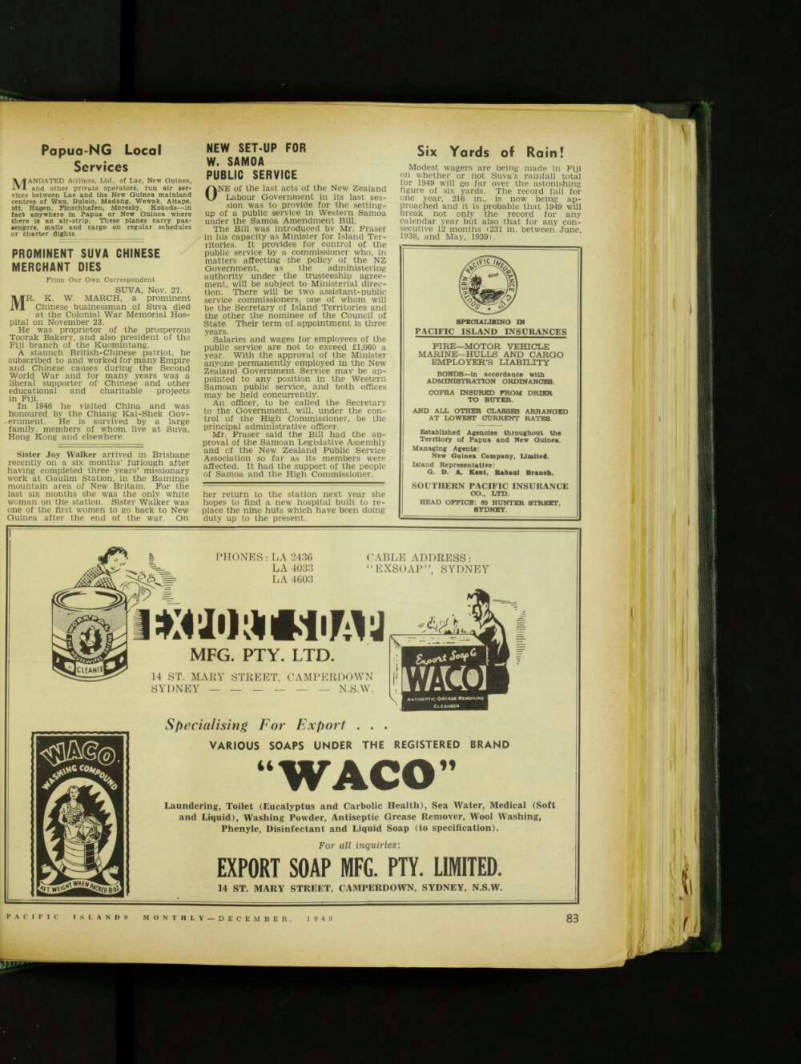
Services
MANDATED Airlines, Ltd., of Lae, New Guinea, and other private operators, run air ser vices between Lae and the New Guinea mainland centres of Wau, Bulolo, Madang, Wewak, Altape, Mt. Hagen, Flnschhafen, Moresby. Kokoda—in fact anywhere in Papua or New Guinea where there is an air-strip. These planes carry pas sengers, mails and cargo on regular schedules or charter flights.
Prominent Suva Chinese
Merchant Dies
From Our Own Correspondent
Suva, Nov. 27.
MR. K. W. MARCH, a prominent Chinese businessman of Suva died at the Colonial War Memorial Hos pital on November 23.
He was proprietor of the prosperous Toorak Bakery, and also president of the Fiji branch of the Kuomintang.
A staunch British-Chinese patriot, he subscribed to and worked for many Empire and Chinese causes during the Second World War and for many years was a liberal supporter of Chinese and other educational and charitable projects in Fiji.
In 1946 he visited China and was honoured by the Chiang Kai-Shek Gov ernment. He is survived by a large family, members of whom live at Suva, Hong Kong and elsewhere.
Sister Joy Walker arrived in Brisbane recently on a six months’ furlough after having completed three years’ missionary work at Gaulim Station, in the Bainings mountain area of New Britain. For the last six months she was the only white woman on the station. Sister Walker was one of the first women to go back to New Guinea after the end of the war. On
her return to the station next year she hopes to find a new hospital built to re place the nine huts which have been doing duty up to the present.
New Set-Up For
W. Samoa
Public Service
ONE of the last acts of the New Zealand Labour Government in its last ses sion was to provide for the setting up of a public service in Western Samoa under the Samoa Amendment Bill.
The Bill was introduced bv Mr. Fraser in his capacity as Minister for Island Ter ritories. It provides for control of the public service by a commissioner who, in matters affecting the policy of the NZ Government, as the administering authority under the trusteeship agree ment, will be subject to Ministerial direc tion. There will be two assistant-public service commissioners, one of whom will be the Secretary of Island Territories and the other the nominee of the Council of State. Their term of appointment is three years.
Salaries and wages for employees of the public service are not to exceed £1,060 a year. With the approval of the Minister anyone permanently employed in the New Zealand Government Service may be ap pointed to any position in the Western Samoan public service, and both offices may be held concurrently.
An officer, to be called the Secretary to the Government, will, under the con trol of the High Comrrjissioner, be the principal administrative officer.
Mr. Fraser said the Bill had the ap proval of the Samoan Legislative Assembly and of the New Zealand Public Service Association so far as its members were affected. It had the support of the people of Samoa and the High Commissioner.
Six Yards of Rain!
Modest wagers are being made in Fiji on whether or not Suva’s rainfall total for 1949 will go far over the astonishing figure of six yards. The record fall for one year, 216 in., is now being ap proached and it is probable that 1949 will break not only the record for any calendar year but also that for any con secutive 12 months (231 in. between June, 1938, and May, 1939).
Advertisements & other items, pp. 85-86 (1 item)
Waco
SPECIALISING IN
PACIFIC ISLAND INSURANCES
FIRE—MOTOR VEHICLE
MARINE—HULLS AND CARGO
EMPLOYER’S LIABILITY
BONDS—In accordance with
ADMINISTRATION ORDINANCES.
COPRA INSURED FROM DRIER
TO BUYER.
AND ALL OTHER CLASSES ARRANGED
AT LOWEST CURRENT RATES.
Established Agencies throughout the Territory of Papua and New Guinea.
Managing Agents; New Guinea Company, Limited.
Island Representative: G. D. A. Kent, Babaul Braneh.
SOUTHERN PACIFIC INSURANCE
CO., LTD.
HEAD OFFICE: 60 HUNTER STREET.
SYDNEY.
PHONES: LA 2436
LA 4033 LA 4603
CABLE ADDRESS:
“EXSOAP”, SYDNEY
MFC. PTY. LTD.
CIfANIR
*n. gol
14 ST. MARY STREET, CAMPERDOWN
SYDNEY N.S.W.
Specialising For Export . . .
VARIOUS SOAPS UNDER THE REGISTERED BRAND
44
WACO
Laundering, Toilet (Eucalyptus and Carbolic Health), Sea Water, Medical (Soft and Liquid), Washing Powder, Antiseptic Grease Remover, Wool Washing, Phenyle, Disinfectant and Liquid Soap (to specification).
For all inquiries :
EXPORT SOAP MFC. PTY. LIMITED.
14 ST. MARY STREET, CAMPERDOWN, SYDNEY, N.S.W.
A. H. BUNTING LIMITED
SAMARAI PAPUA
Presents the NEW
C.S.A. ENGLISH DUAL FREEZE
■ : 'li
SAMARAI AGENTS FOR:
Vacuum Oil Co. Pty., Ltd.
South British Insurance Co.
National Mutual Life Association
MORE THAN A REFRIGERATOR—A FREEZER AS
WELL—FRESH VEGETABLES, FRUIT, MEAT AT
ANY TIME—AND SO SMALL A COST
DIMENSIONS; Overall 42 in. wide. 21 in. deep. 36 in. high.
REFRIGERATOR CAPACITY: 4 CUBIC FEET.
ZERO DEEP FREEZE STORAGE SPACE; U CUBIC FEET.
ALL ALUMINIUM CABINET.
STAINLESS STEEL TOP.
RUSTLESS.
240 VOLT A.C. 50 CYCLES.
ALSO AVAILABLE—IIO VOLT A.C.—SLIGHTLY EXTRA.
PRICE: £152/10 6. F. 0.8., SAMARAI.
SOLE AGENTS IN PAPUA/NEW GUINEA FOR
Polarizers (U.K.), Ltd.— Polaroid* Sun Glasses.
C.S.A. Industries Eng.—Dual Freeze Refrigerators.
Webley & Scott, Ltd.-Shot Guns, Air Pistols, etc.
Le Bryan Group Products (Great Britain) Ltd.— Powermaster Electric Refrigerators.
“Getula.”— Nylon Monofilament Fish Lines. • Trade mark patented in U.S.A., Great Britain, and other countries
REGULAR SUPPLIES OF EASTERN GOODS
A. H. BUNTING LIMITED - SAMARAI
WHOLESALE & RETAIL MERCHANTS IMPORTERS PLANTERS
William J. Hettig, Pioneer,
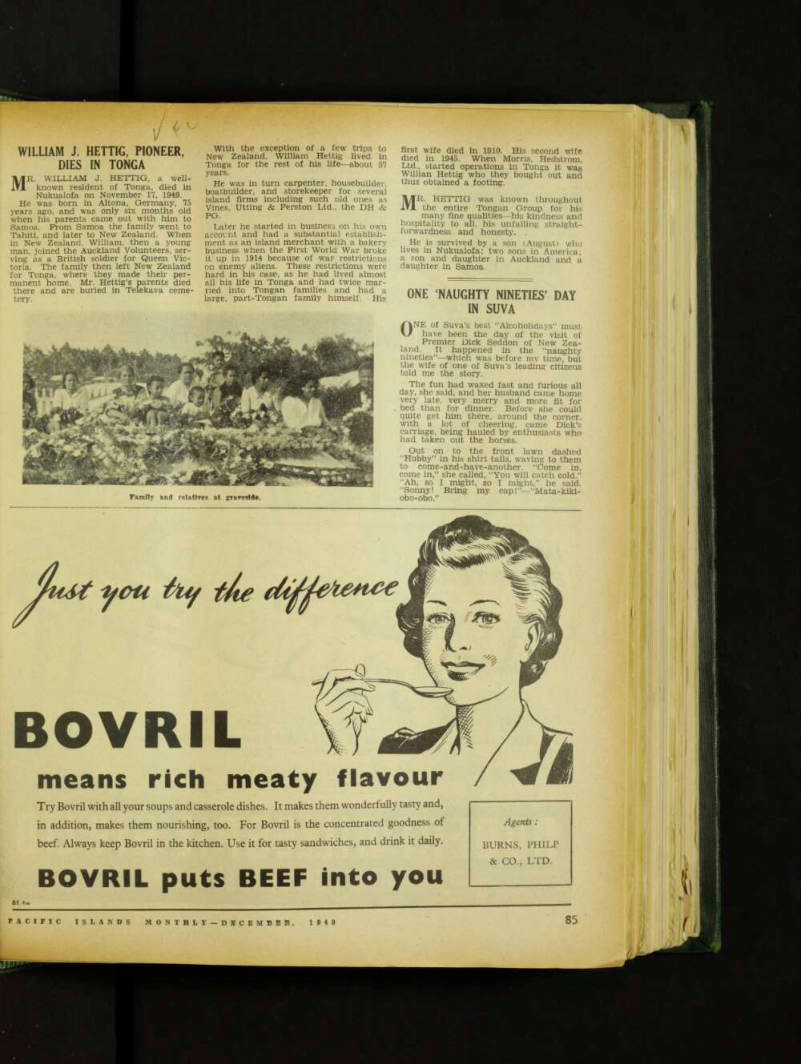
Dies In Tonga
Mr. William J. Hettig, A Well
known resident of Tonga, died in Nukualofa on November 17, 1949.
He was born in Altona, Germany, 75 years ago, and was only six months old when his parents came out with him to Samoa. Prom Samoa the family went to Tahiti, and later to New Zealand. When in New Zealand, William, then a young man, joined the Auckland Volunteers, ser ving as a British soldier for Queen Vic toria. The family then left New Zealand for Tonga, where they made their per manent home. Mr. Hettig’s parents died there and are buried in Telekava ceme tery.
With the exception of a few trips to New Zealand, William Hettig lived in Tonga for the rest of his life—about 57 years.
He was in turn carpenter, housebuilder, boatbuilder, and storekeeper for several island firms including such old ones as Vines, Utting & Perston Ltd., the DH & PG.
Later he started in business on his own account and had a substantial establish ment as an island merchant with a bakery business when the First World War broke it up in 1914 because of war restrictions on enemy aliens. These restrictions were hard in his case, as he had lived almost all his life in Tonga and had twice mar ried into Tongan families and had a large, part-Tongan family himself. His
first wife died in 1910. His second wife died in 1945. When Morris, Hedstrom, Ltd., started operations in Tonga it was Willian Hettig who they bought out and thus obtained a footing.
MR. HETTIG was known throughout the entire Tongan Group for his many fine qualities—his kindness and hospitality to all, his unfailing straight forwardness and honesty.
He is survived by a son (August) who lives in Nukualofa; two sons in America; a son and daughter in Auckland and a daughter in Samoa.
Family ant! relatives at graveside.
One Naughty Nineties’ Day
In Suva
ONE of Suva’s best “Alcoholidays” must have been the day of the visit of Premier Dick Seddon of New Zea land. It happened in the “naughty nineties”—which was before my time, but the wife of one of Suva’s leading citizens told me the story.
The fun had waxed fast and furious all day, she said, and her husband came home very late, very merry and more fit for bed than for dinner. Before she could quite get him there, around the corner, with a lot of cheering, came Dick’s carriage, being hauled by enthusiasts who had taken out the horses.
Out on to the front lawn dashed “Hubby” in his shirt tails, waving to them to come-and-have-another. “Come in, come in,” she called, “You will catch cold.”
“Ah, so I might, so I might,” he said.
“Sonny! Bring my cap!”—“Mata-kiki obo-obo.”
The Rev. Dr. G. Hemming, who was formerly on the staff of the Colonial War Memorial Hospital, Suva, Fiji, has re turned to Fiji to take up private prac tice in partnership with Dr. W. Paley.
After leaving the Colonial War Memorial Hospital, Dr. Hemming went to the Solo mon Islands where he was in charge of the Hospital of the Epiphany, on the Island of Malaita.
Advertisements & other items, p. 87 (1 item)
Bovril
you tu/ t/ie
means rich meaty flavour
y.y Try Bovril with all your soups and casserole dishes. It makes them wonderfully tasty and, in addition, makes them nourishing, too. For Bovril is the concentrated goodness of beef. Always keep Bovril in the kitchen. Use it for tasty sandwiches, and drink it daily.
BOVRIL puts BEEF into you
BE,4w Agents:
BURNS, PHILP
& CO., LTD.
Retires From Rabaul
The Rev. Mo Pui Sam
THE Rev. Mo Pui Sam who left Hong Kong in 1940 to become pastor to the Chinese Methodist Community in Rabaul, NG, has now taken up work per manently with the Presbyterian Church in Sydney.
The Methodist Mission Review says of him:— “In China he had graduated not only from a Theological College but also from a Teachers’ Training College, and he came to us with fine credentials as a youth leader, Scout Master and ambulance worker. He had been in the work at Rabaul only 18 months at the time of the Japanese invasion. During the war years he was with the rest of the Rabaul Chinese community in special camps under supervision. Not only was he a source of much help to his people because of his medical knowledge, but also for the ministeries of comfort and encourage ment which he brought to them.
“In 1948 he was granted furlough for 12 months to return to Hong Kong, but while waiting in Sydney he received a cablegram to say that his wife had died two months previously. He sought per mission to remain in Australia and over tures were made to us from the Presby terian Church to allow him to carry on their work in Sydney during part of his furlough. To this we willingly agreed.”
Fiji Bowlers For Empire
Games
THE Fiji Bowling Association has se lected the team which is to repre sent Fiji at the British Empire Games in Auckland next February.
The singles representative will be L.
F. Garnett of Suva. The pairs team will be J. E. Poulton and L. G. Browne, both of Ba.
The team for the rinks will be N. S.
Chalmers of Ba, H. B. Gibson of Labasa and P. Costello and Sir Hugh Ragg of Suva. , E. H. Mcllwain of Nauson and D. B.
Costello of Suva have been selected as emergencies.
Advertisements & other items, p. 88 (1 item)
Robert Gillespie Pivltd
Livraison IMMEDIATE LINOLEUM ECOSSAIS IMPORTE
delivery immediate
Lfe
IMPORTED
LINOLEUM
Ideal for Island Conditions. Long Wearing.
Hessian Back. Cork based. Full range of colours, patterned or plain. Full rolls (30 yards by 6 ft.) only supplied. Order to-day through your Trading House for delivery by first boat.
Ideal pour les pays tropicaux. D’une durabilite sans pareille, a base de liege convert en toile de chanvre. Dessins ou unis. Rouleaux de 30 yards par 6 pieds de large. Commandez aujourd hui chez votre Agent pour livraison par premier bateau.
TAYSIDE Linoleum distributed by:
INTERNATIONAL TRADING
PTY. LTD.
Halifax House, 26 O’Connell Street, Sydney.
Phone: BL 1548. Cables: “Mondial,’ Sydney. & a
IMPORTERS
EXPORTERS
» t r ALL CLASSES OF MERCHANDISE PURCHASED FOR ISLAND CLIENTS
THROUGHOUT THE SOUTH-WEST PACIFIC.
ISLAND PRODUCE SOLD ON AUSTRALIAN AND OVERSEAS MARKETS
ON COMMISSION BASIS.
1.,1 J/IIA
ROBERT GILLESPIE PIVLTD
BANKERS BANK OF NSW 0177C7 CU [1 NF V NSW ROBERG.LL COMPTOIR NATIONAL !/|U 111 I U I - UIUIHT PHONES BW 4782-B 1305
DESCOMPTE DE PARIS
CABLE ADDRESS:
•ROBERGILL"
PHONES BW 4782-B 1305
Big Dredge Sinks
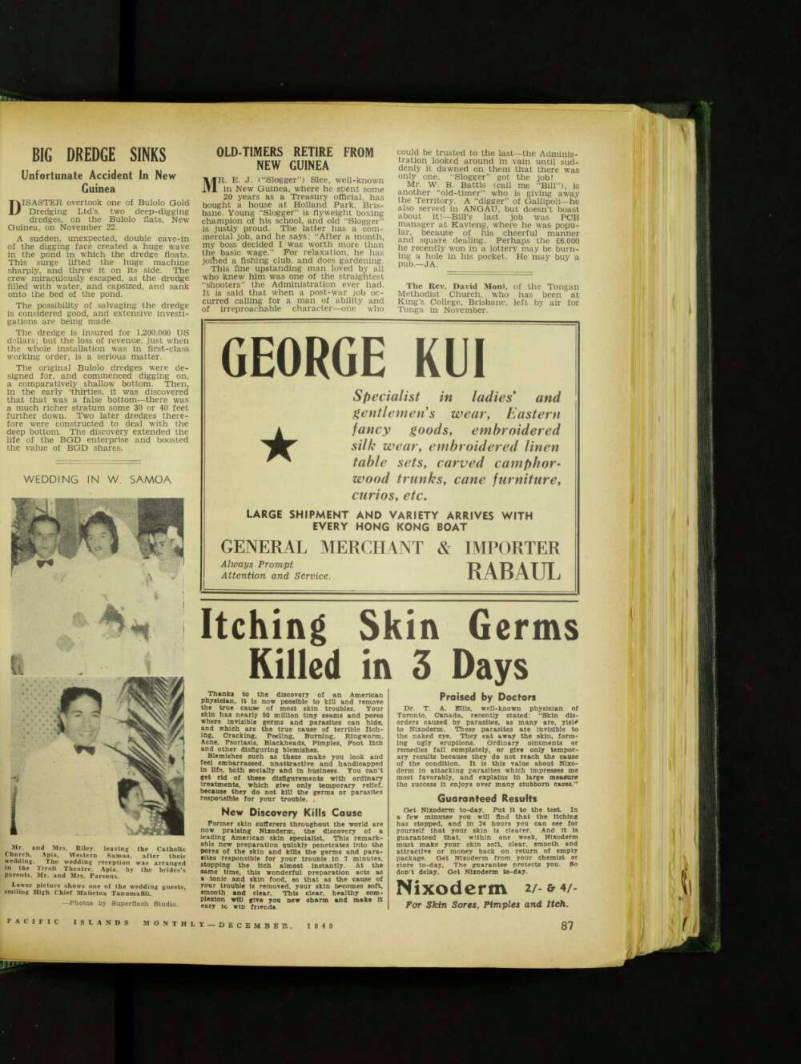
Unfortunate Accident In New Guinea
DISASTER overtook one of Bulolo Gold Dredging Ltd’s, two deep-digging dredges, on the Bulolo flats, New Guinea, on November 22.
A sudden, unexpected, double cave-in of the digging face created a huge wave in the pond in which the dredge floats.
This surge lifted the huge machine sharply, and threw it on its side. The crew miraculously escaped, as the dredge filled with water, and capsized, and sank onto the bed of the pond.
The possibility of salvaging the dredge is considered good, and extensive investi gations are being made.
The dredge is insured for 1,200,000 US dollars; but the loss of revenue, just when the whole installation was in first-class working order, is a serious matter.
The original Bulolo dredges were de signed for, and commenced digging on, a comparatively shallow bottom. Then, in the early ’thirties, it was discovered that that was a false bottom—there was a much richer stratum some 30 or 40 feet further down. Two later dredges there fore were constructed to deal with the deep bottom. The discovery extended the life of the BGD enterprise and boosted the value of BGD shares.
Wedding In W. Samoa
Mr. and Mrs. Riley, leaving the Catholic Church, Apia, Western Samoa, after their wedding. The wedding reception was arranged in the Tivoli Theatre, Apia, by the brides’s parents, Mr. and Mrs. Parsons.
Lower picture shows one of the wedding guests, smiling High Chief Malietoa Tanumafili.
Photos by Superflash Studio.
Old-Timers Retire From
New Guinea
MR. E. J. (“Slogger”) Slee, well-known in New Guinea, where he spent some 20 years as a Treasury official, has bought a house at Holland Park, Bris bane. Young “Slogger” is flyweight boxing champion of his school, and old “Slogger” is justly proud. The latter has a com mercial job, and he says: “After a month, my boss decided I was worth more than the basic wage.” For relaxation, he has joihed a fishing club, and does gardening.
This fine upstanding man loved by all who knew him was one of the straightest “shooters” the Administration ever had.
It is said that when a post-war job oc curred calling for a man of ability and of irreproachable character —one who
could be trusted to the last—the Adminis tration looked around in vain until sud denly it dawned on them that there was only one. “Slogger” got the job!
Mr. W. B. Battis (call me “Bill”), is another “old-timer” who is giving away the Territory. A “digger” of Gallipoli—he also served in ANGAU, but doesn’t boast about it!—Bill’s last job was PCB manager at Kavieng, where he was popu lar, because of his cheerful manner and square dealing. Perhaps the £6,000 he recently won in a lottery may be burn ing a hole in his pocket. He may buy a
pub.-
JA.
The Rev. David Moni, of the Tongan Methodist Church, who has been at King’s College, Brisbane, left by air for Tonga in November.
Advertisements & other items, pp. 89-90 (2 items)
87
PACIFIC ISLANDS MONTHLY-D E C E M B E R , 1949
George Kui
★ Specialist in ladies' and gentlemen s wear. Eastern fancy goods, embroidered silk wear, embroidered linen table sets, carved camphorwood trunks, cane furniture, curios, etc.
LARGE SHIPMENT AND VARIETY ARRIVES WITH
EVERY HONG KONG BOAT
GENERAL MERCHANT & IMPORTER
Always Prompt Attention and Service.
RABAUL
Itching Skin Germs Killed in 3 Days
Thanks to the discovery of an American physician, It Is now possible to kill and remove the true cause of most skin troubles. Your skin has nearly 50 million tiny seams and pores where invisible germs and parasites can hide, and which are the true cause of terrible Itching, Cracking, Peeling, Burning, Ringworm, Acne, Psoriasis, Blackheads, Pimples, Foot Itcb and other disfiguring blemishes.
Blemishes such as these make you look and feel embarrassed, unattractive and handicapped in life, both socially and in business. You can’t get rid of these disfigurements with ordinary treatments, which give only temporary relief, because they do not kill the germs or parasites responsible for your trouble. .
New Discovery Kills Cause
Former skin sufferers throughout the world are now praising Nlxoderm, the discovery of a leading American skin specialist. This remarkable new preparation quickly penetrates into the pores of the skin and kills the germs and parasites responsible for your trouble In 7 minutes, stopping the itch almost Instantly. At the same time, this wonderful preparation acts as a tonic and skin food, so that as the cause of your trouble is removed, your skin becomes soft, smooth and clear. This clear, healthy complexion will give you new charm and make It easy to win fnenda.
Praised by Doctors
Dr. T. A. Ellis, well-known physician of Toronto, Canada, recently stated; "Skin disorders caused by parasites, as many are, ylel* to Nixoderm. These parasites are Invisible to the naked eye. They eat away the skin, forming ugly eruptions. Ordinary ointments or remedies fall completely, or give only temporary results because they do not reach the cause of the condition. It Is this value about Nixoderm In attacking parasites which Impresses me most favorably, and explains In large measure the success It enjoys over many stubborn cases."
Guaranteed Results
Get Nixoderm to-day. Put It to the test. In a few minutes you will find that the Itching has stopped, and In 24 hours you can see for yourself that your skin Is clearer. And It Is guaranteed that, within one week, Nixoderm must make your skin soft, clear, smooth and attractive or money back on return of empty package. Get Nixoderm from your chemist or store to-day. The guarantee protects you. So don’t delay. Get Nixoderm to-day.
Nixoderm v- & 4/-
For Skin Sores, Pimples and Itch.
CHEIRON
I
The answer to the Asthmatic’s Prayer—the
Asthmatic’s “Bis
The Sire of Pharmacy. ultra modern magic—dramatically effective against expanded capillaries of the mucous membrane which occasion mm Simplicity itself.
ASTHMAS, BRONCHITIS, HAY FEVER, ANTRUM, ETC.
(actually, testimonials have been received on its efficacy in the above, and also Malaria, Sinus, Croup, Whooping Cough, War Gas, Pneumonia, and Pleurisy)—that is, most complaints of the respiratory tract that it can reach. Not a "cure-all"—it simply reduces the inflamed capillaries that exist in those ills. • Relieves in 5 seconds (not. 5 years) because it “Touches the Spot.” • Absolutely harmless—same spray—same liquid—babies and adults. •No dieting—eat anything—especially what you are not supposed to. • Sleep on anything—live anywhere—sea, plain, valley or mountain air. • Causeduration—family history, etc.—immaterial. • Takes the strain off the heart—by easing the breathing • May be used in conjunction with your doctor’s allergy injection or any other medicine you like.
Contains .5 per cent. Adrenalin and guaranteed free from Atropine, Ephedrine, Cocaine, Morphine, Pituitary, Papaverine or any other Opium drug—so is absolutely harmless.
Look! Both hands!!
ITALIAN—La cura per inalazione “Aspaxadrene” e adesso adoperata in tutto il mondo.
SPANISH.—EI trato respiratorio—“Aspaxadrene” —es empleado ahora de todos los pueblos del mundo.
CHINESE: *..£ >tA. < % if *J. f’J H FRENCH.—L’aspiratoire “Aspaxadrene” se trouve maintenant partout.
GERMAN.— Die Behandlung durch Einatmung von “Aspaxadrene” wird jetzt in der ganzen.
YIDDISH.— anim p-n«D{>KßDt<„ iin
URDU OR HINDU
aspaxadreitc treatment; ( hay fever ) cat Testimonials have noiv been received from all over the world, excepting Russia and Tibet; there is a monthly issue (full names and addresses) — it’s yours “for the asking.”
So buy to-day—not bye 'n bye
Complete outfit, 28/6 (Australian)—postage 1/6
Refill Aspaxadrene, 12/6 (Australian) —postage free.
Sole Discoverer, Proprietor and Dispenser,
A. H. CRUNDALL, Qualified Chemist
BOX 58, PRAHRAN, VICTORIA, AUSTRALIA.
SOLD ALL OVER THE WORLD
Man with a Theory
The Month In Moresby
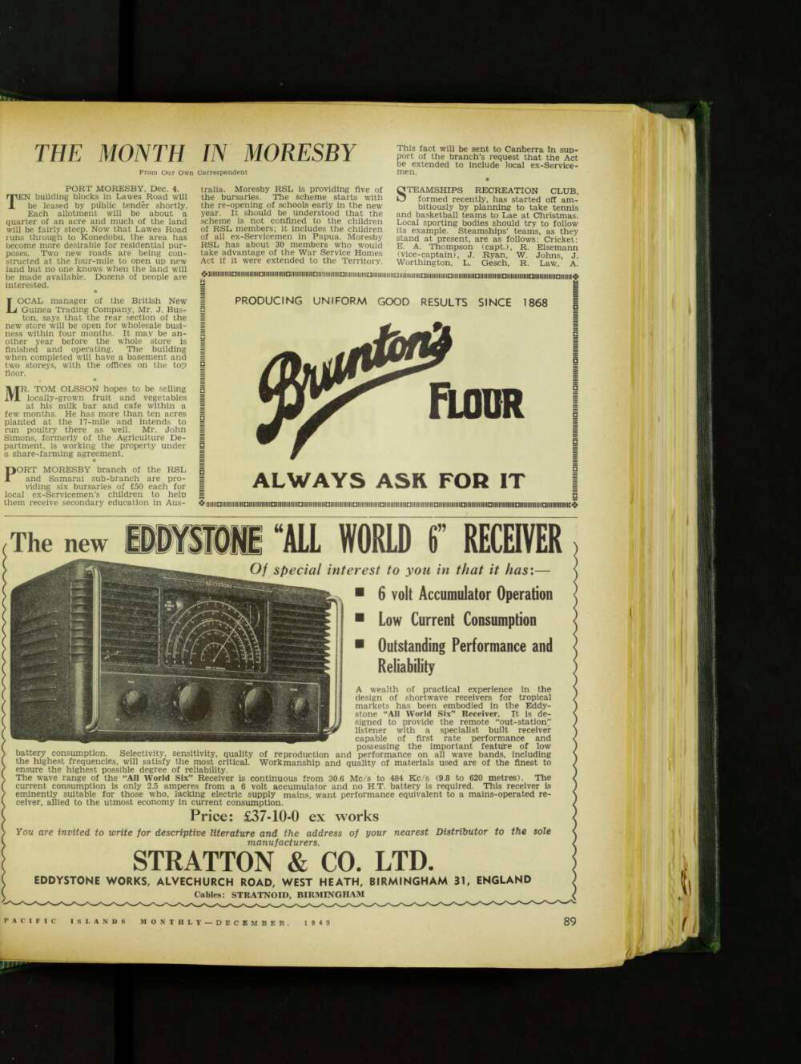
From Our Own Correspondent
Port Moresby, Dec. 4.
TEN building blocks in Lawes Road will be leased by public tender shortly.
Each allotment will be about a quarter of an acre and much of the land will be fairly steep. Now that Lawes Road runs through to Konedobu, the area has become more desirable for residential pur poses. Two new roads are being con structed at the four-mile to open up new land but no one knows when the land will be made available. Dozens of people are interested. * LOCAL manager of the British New Guinea Trading Company, Mr. J. Bus ton, says that the rear section of the new store will be open for wholesale busi ness within four months. It may be an other year before the whole store is finished and operating. The building when completed will have a basement and two storeys, with the offices on the top floor. . * MR. TOM OLSSON hopes to be selling locally-grown fruit and vegetables at his milk bar and cafe within a few months. He has more than ten acres planted at the 17-mile and intends to run poultry there as well. Mr. John Simons, formerly of the Agriculture De partment, is working the property under a share-farming agreement. * PORT MORESBY branch of the RSL and Samarai sub-branch are pro viding six bursaries of £5O each for local ex-Servicemen’s children to help them receive secondary education in Aus
tralia. Moresby RSL is providing five of the bursaries. The scheme starts with the re-opening of schools early in the new year. It should be understood that the scheme is not confined to the children of RSL members; it includes the children of all ex-Servicemen in Papua. Moresby RSL has about 30 members who would take advantage of the War Service Homes Act if it were extended to the Territory.
This fact will be sent to Canberra In sup port of the branch’s request that the Act be extended to include local ex-Service men. * Steamships recreation club, formed recently, has started off am bitiously by planning to take tennis and basketball teams to Lae at Christmas.
Local sporting bodies should try to follow its example. Steamships’ teams, as they stand at present, are as follows: Cricket: E. A. Thompson (capt.), R. Eisemann (vice-captain), J. Ryan, W. Johns, J.
Worthington, L. Gesch, R. Law, A.
Browne, C. J. Wood, A. Jobling, W. Flick, J. Codings, J. Baldwin, J. McNamara, V.
Boles and K. Byrne. Basketball; Miss M Drewe (captain'), Mrs. B. Maple (vice captain), Mrs. B. Hawks, Mrs. M. Eise mann, Mrs. A. Boles, Miss P. Geddes, Miss D. Holt. Miss D. Baldwin and Miss J.
Hart. * ROUNA guesthouse has quickly become popular under its new management.
There is a big demand for morning
and afternoon teas and, lately, every se cond newly-married couple has gone there for their honeymoon More recreational facilities are all that is needed. The pro prietors would be wise to go ahead with their plan to build a tennis court. * LOCAL baseballers are making a habit of beating the crews of Pioneer ships which bring equipment here from America for APC. A Moresby team defeated a Pioneer Star team some
months ago and on November 26 a local side beat a team from the Pioneer Isle by 13 to 12, with an innings to spare.
Cricket is making a slow start this season.
There have been no competition games so far, as the committee is having trouble getting enough teams. Sailing is the only sport flourishing here at present but the season ends in a couple of weeks. * PATROL Officer B. R. Heagney was found not guilty in the Supreme Court at Daru on a manslaughter charge arising from the death of a male native. Judge Gore fined Heagney £5 for assault. The native concerned died of a ruptured spleen and it was alleged that a few days before Heagney had hit him with a stick. * QANTAS’ weekly Dragon services to Popendetta will be of benefit to the Kokoda-Buna Tourist Company, which is building a tourist hotel at Pop endetta. The hotel should have been almost ready now but because of lack of materials it is not expected to be finished before March or April. More than 100 inquiries about accommodation have been received, many of them from Australia. * NOVEMBER was a popular month for weddings in Moresby. On the 9th, Joy Mowby, formerly of the Gov ernment Secretary’s Department, married Mr. Ken Kitchen, of APC, at the LMS mission. Miss Jane Daly attended the bride and Mr. Ted Olding was best man.
The couple did the round trip to New Guinea on the Bulolo—a popular type of honeymoon—and are now waiting to go to Malalaua. On the 12th, Miss Zeta Flanagan, of Auckland, New Zealand, married Mr. Alf. Bunting, of OTC, also from Auckland, at the Catholic Church.
Miss Flanagan arrived on the November Bulolo. Miss Dorothy Willett was brides
maid and Mr. Stan Jory best man. The reception was at the Papua Hotel and the couple spent a ten-day honeymoon at Rouna Falls. Miss Ruth Malkin, who ar rived here from England in July, 1947, married Mr. Mervyn Mogridge, of Burns Philp, at the Ela Protestant Church on the 19th. The bride’s sister, Mrs. Joyce Sutherland-Ross, was matron-of-honour and Mr. Vince Sanders was best man. Re ception was at the Papua Hotel. Mr. and Mrs. Mogridge spent a week at Rouna Falls. A cousin of the bridegioom, the Rev. Les Allen, who was in Moresby for the LMS conference, performed the mar riage ceremony. Also on November 19, Miss Betty Bayliss and Mr. Carl Mayoh were married at the Catholic Church, Moresby. Mrs. Shirley Gilmore was matron-of-honour and Mr. Kevin O’Mara was best man. The reception was held at the women’s hostel, Paga Hill. Mr. and Mrs. Mayoh also chose Rouna for their honeymoon. * A CONFERENCE of senior education officers will be held at Sogeri in January. Twenty-five officers are expected to attend the conference, which will be the first of its kind. * AMONG those who left Moresby on the November south-bound Bulolo were Mr. and Mrs. W. L. Barrett, Dr. M.
Granger, Mrs. D. Julian, Mr. and Mrs. W.
L. Leydin, Mr. and Mrs. P. Bosgard, Miss E. Baker, Mr. and Mrs. J, Butler, Mr. and Mrs. W. Albert, Mr. J, Lee, Mr. and Mrs.
W. Edmondson, Mrs. W. Charlesworth, Mr. and Mrs. R. Wren, Mr. and Mrs. L, Ar mit, Mr. L. Sims, Mr. M. Enfante, Mr. and Mrs. O. J. Leighton, Mrs. S. Stubbs, Mr. and Mrs. F. Vidgen, Mrs. E. Chester, Mr. and Mrs. M. Lang, Mr. L. Drewe and Mrs.
S. Crowley. ♦ MR. ALLAN CHAMPION, acting DO at Higaturu, arrived in Moresby a few days ago and entered the European Hospital. * Murray heights tennis club is trying to arrange a teams competi tion which, if it comes to anything, should boost local interest in tennis.
Moresby Tennis Club, which controls the three main courts in town, is reported t« be apathetic about the idea. This club collects fairly high fees, yet its courts, nets and other equipment are in a bad state. * A RECENT accident on the Rouna Road in which Mr. Arthur Foley, of Subi tana plantation, suffered a fractured skull, has reminded residents that this road is dangerous. The edge of the road collapsed under the weight of Mr. Foley’s truck, which fell many feet. To widen
the road in dangerous spots would be ex pensive but any expenditure is justified if it saves lives. Upper Port Road also has an extremely dangerous spot which should be improved immediately. Vehicles have about two feet to spare, with a fatal drop on one side.
MISS THEA WATSON, of the Direc torate of Shipping, Moresby, re cently returned to her home in Sydney. Miss Connie Dinsmore flew to Sydney on November 27 on two months’ sick leave. Mr. M. J. McKnoulty, of the Forestry Department, Moresby, went to
Townsville by Qantas on December 2 on leave. ♦ THE Territory’s medical service will ex pand considerably next year when between 30 and 40 migrant doctors arrive to take up appointments with the Health Department. Selected by Dr.
Gunther while he was in Australia on leave recently, the doctors include Hun
garians, Czechs, Poles, Austrians, Ger mans and Balts. There will probably be two or three women among them. Al though many have high qualifications, the migrants can’t obtain registration in Australia. The offer of employment in Papua-New Guinea as registered doctors attracted more than 60 applicants for the 40 positions available. Native medical work will occupy most of the new doctors.
Advertisements & other items, pp. 91-94 (1 item)
The New Uddy^Osil 4 All World 6 Receiver
PRODUCING UNIFORM GOOD RESULTS SINCE 1868
ALWAYS ASK FOR IT
The new UDDY^OSIl 4 ALL WORLD 6 RECEIVER Of special interest to you in that it has: —
■ 6 volt Accumulator Operation
■ Low Current Consumption
■ Outstanding Performance and
Reliability
A wealth of practical experience in the design of shortwave receivers for tropical markets has been embodied in the Eddystone “All World Six” Receiver. It is designed to provide the remote “out-station” listener with a specialist built receiver capable of first rate performance and possessing the important feature of low battery consumption. Selectivity, sensitivity, quality of reproduction and performance on all wave bands, including the highest frequencies, will satisfy the most critical. Workmanship and quality of materials used are of the finest to ensure the highest possible degree of reliability.
The wave range of the “All World Six” Receiver is continuous from 30.6 Mc/s to 484 Kc/s (9.8 to 620 metres). The current consumption is only 2.5 amperes from a 6 volt accumulator and no H.T. battery is required. This receiver is eminently suitable for those who, lacking electric supply mains, want performance equivalent to a mains-operated receiver, allied to the utmost economy in current consumption.
Price: £37-10-0 ex works
You are invited to write for descriptive literature and the address of your nearest Distributor to the sole manufacturers.
STRATTON & CO. LTD.
EDDYSTONE WORKS, ALVECHURCH ROAD, WEST HEATH, BIRMINGHAM 31, ENGLAND
Cables: STRATNOID, BIRMINGHAM
AUNT
MARYS
BAKING POWDER
For the best in delicious baking, results A product of TILLOGK AND GO. PTY. LTD. manufacturers of all the famous Aunt Mary s Pure Foods
KASPER
e © pt
ICE CREAM DISPENSING
& HARDENING CABINETS
Available Now!
Specially insulated for Tropical Conditions with genuine Spanish Corkboard.
Cabinet top of 18-gauge, mirror finish, stainless steel.
Cabinet sides of 20-gauge, satin finish, stainless steel.
Frame 2 in. angle iron, welded construction, rustproofed.
Cabinet 19 contains 4 Double Holes with a capacity for 40 gallons of ice cream; Ice Block Maker and Ice Cream Making Head (capacity 15 gallons per hour).
All cabinets are self-contained and complete with refrigerator unit and electric motors. Every “Kasper’’
Cabinet fitted with stainless steel, hinged lids, hermetically sealed, and cork insulated.
Cabinets available with storage capacity from 20 to c 100 gallons. Custom built to your specifications. (When ordering, please specify type of power avail - able.)
KASPER means QUALITY BUILT, SCIENTIFICALLY
ENGINEERED and DEPENDABLE in OPERATION.
Kasper Cabinet No. 19.
KASPER REFRIGERATORS PTY. LTD.
ORDER NOW AND AVOID DELAY !\
77 RAILWAY PARADE, ERSKINEVILLE, N.S.W.
AUSTRALIA.
Phone: LA 1326.
ARE YOUR REOUIREHENTS
HERE?
40-ft. TRADE BOATS
Especially designed and built for Island conditions. Fully equipped and delivered to your destination.
B.T.H. PROJECTORS
16 m.m. Sound-Film Projectors embodying features unique in current British and American sound film projectors. Independent power supply equipment available if desired. Films on loan or purchase basis can be supplied by sea or air.
ROBINGRAFT PRESSURE JETS
A Kerosene Pressure Jet Thermal Unit—quick, clean and portable—using only lighting kerosene, with many uses for dairies, hospitals, homes, guest houses, hotels, shops, etc.
RAMBLER AUTO BIKE
A British-made 9B c.c. lightweight motor cycle with petrol consumption up to 150 m.p.g. Automatic lubrication, immensely strong. Tyre size 26 in, by 2 in. Tyres and replacement parts available.
SAN MIGUEL PALE PILSENER
A delightful high quality bottled beer brewed in Hong Kong and famous throughout the East. Available in 100-lot cases—4 dozen to the case.
SWIFTSHOT CAMERA
An attractive box-type camera, very low in cost and beautifully constructed.
Available in a wide range of colours.
Note :— Our representative is at present visiting U.K. and the Continent and is able to carry out special commissions. Please advise us.
WILLREED AGENCIES PTV. LTD.
145 a George St., Circular Quay, Sydney. Cables: “REEDAGE.”
GABRIEL ACHUN
Importer and Wholesale Merchant
Specialises in:
BEERS
BICYCLES
AERATED WATER MANUFACTURING
COTTON PIECEGOODS FOR NATIVE TRADE
AGENT FOR “STANDARD” AND “TRIUMPH” CARS
Malaguna Road
RABAUL
Territory of New Guinea Proprietor:
RABAUL CORDIAL FACTORY.
Telegraphic Address:
“GABRIEL ACHUN,” RABAUL.
X=RAY and
Electro - Medical Equipment
is supplied and serviced from 20 centres throughout Australia and New 'Zealand .
Located at each centre are fully trained Service Technicians who are at your call for routine maintenance service and operative advice .
The efficiency of Wat Vic X-ray and Electro-Medical Equipment is amply demonstrated by the satisfactory performance of the many Wat Vic installations now operating throughout New Guinea, Papua and the Pacific Islands . Periodical visits are made to these centres by our Service Technicians.
We also supply SCIENTIFIC and SURGICAL APPARATUS of a precision and finish you’ll appreciate .
Wats omVictor.
]l n fvh a nr e a>
WATSON HOUSE, BLIGH STREET, SYDNEY
TOWNSVILLE BRISBANE NEWCASTLE, WAGGA, ORANGE, BALLARAT, MELBOURNE, LAUNCESTON, HOBART,
TOWNSVILLE, BRISBANE. NtWC AUCKLAND, CHRISTCHURCH, DUNEDIN
Taking Movies To Dreketi
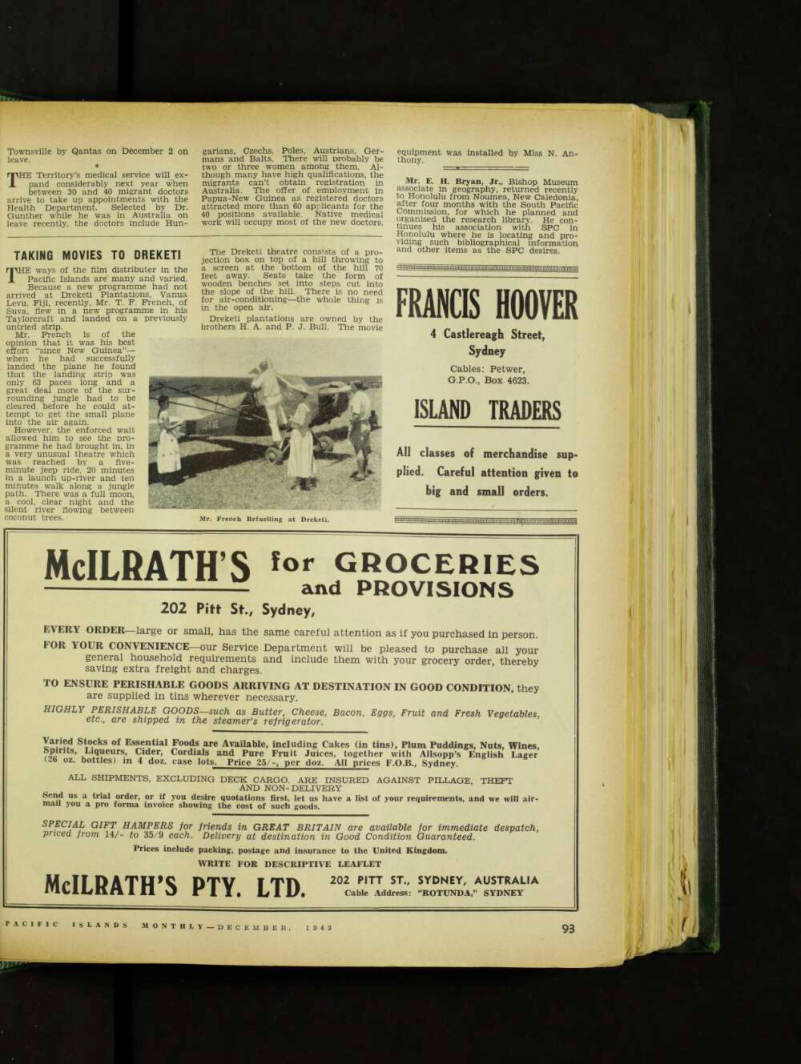
THE ways of the film distributer in the Pacific Islands are many and varied.
Because a new programme had not arrived at Dreketi Plantations, Vanua Levu, Fiji, recently, Mr. T. F. French, of Suva, flew in a new programme in his Taylorcraft and landed on a previously untried strip.
Mr. French is of the opinion that it was his best effort “since New Guinea” — when he had successfully landed the plane he found that the landing strip was only 63 paces long and a great deal more of the sur rounding jungle had to be cleared before he could at tempt to get the small plane into the air again.
However, the enforced wait allowed him to see the pro gramme he had brought in, in a very unusual theatre which was reached by a five minute jeep ride, 20 minutes in a launch up-river and ten minutes walk along a jungle path. There was a full moon, a cool, clear night and the silent river flowing between coconut trees.
The Dreketi theatre consists of a pro jection box on top of a hill throwing to a screen at the bottom of the hill 70 feet away. Seats take the form of wooden benches set into steps cut into the slope of the hill. There is no need for air-conditioning—the whole thing is in the open air.
Dreketi plantations are owned by the brothers H. A. and P. J. Bull. The movie
equipment was installed by Miss N. An thony.
Mr. E. H. Bryan, Jr., Bishop Museum associate in geography, returned recently to Honolulu from Noumea, New Caledonia, after four months with the South Pacific Commission, for which he planned and organised the research library. He con tinues his association with SPC in Honolulu where he is locating and pro viding such bibliographical information and other items as the SPC desires.
Mr. French Refuelling at Dreketi.
For health reasons. Sir Maynard Hed strom is not seeking re-election to the Board of Directors of Emperor Mines Ltd., and Loloma (Fiji) Gold Mines, NL. The other directors of the two companies are Messrs. E. G. Theodore, P. F. Cody, Wal lace H. Smith, John Wren, T. R. Victor, and E. G. Banks.
Advertisements & other items, pp. 95-96 (1 item)
Francis Hoove
4 Castlereagh Street, Sydney Cables: Petwer, G.P.0., Box 4623.
ISLAND TRADERS
All classes of merchandise supplied. Careful attention given to big and small orders.
McILRATH’S for groceries
- and PROVISIONS
202 Pitt St., Sydney,
EVERY ORDER—large or small, has the same careful attention as if you purchased in person.
FOR YOUR CONVENIENCE—our Service Department will be pleased to purchase all your general household requirements and include them with your grocery order thereby saving extra freight and charges.
TO ENSURE PERISHABLE GOODS ARRIVING AT DESTINATION IN GOOD CONDITION, they are supplied in tins wherever necessary.
HIGHLY PERISHABLE GOODS—such as Butter, Cheese, etc., are shipped in the steamer’s refrigerator.
Bacon, Eggs, Fruit and Fresh Vegetables, Stocks of Essential Foods are Available, including Cakes (in tins), Plum Puddings, Nuts, Wines, hpints, Liqueurs, Cider, Cordials and Pure Fruit Juices, together with Allsopp’s English Lager ub oz. bottles) in 4 doz. case lots. Price 25/-, per doz. All prices F. 0.8., Sydney.
ALL SHIPMENTS, EXCLUDING DECK CARGO, ARE INSURED AGAINST PILLAGE, THEFT
AND NON-DELIVERY
Send us a trial order, or if you desire quotations first, let us have a list of your requirements, and we will airmail you a pro forma invoice showing the cost of such goods.
SPECIAL GIFT HAMPERS for friends in GREAT BRITAIN are available for immediate despatch, priced from 14/- to 35/9 each. Delivery at destination in Good Condition Guaranteed.
Prices include packing, postage and insurance to the United Kingdom.
WRITE FOR DESCRIPTIVE LEAFLET
MrTf DTV ITb 202 pitt st., Sydney, Australia in J r 1 I, LI I/, Cable Address; "ROTUNDA,” SYDNEY
Scott’s “Renown” Brand Rope,
Cordage and
Binder
Twine
of Every Description Cable Address: Ropeyard Sydney. 222 1 s
MANUFACTURED AT
MASCOT, N.S.W.
J. SCOTT
PTY. LTD.
Head Office and Store
163 CLARENCE STREET,
SYDNEY,
N.S.W.
The New Maxply Tennis Racket.
I The New Heavy Duty Tennis Ball.
Popular Choice
Dunlop is the popular choice of the champion as well os the man who plays merely "for the fun of it".
Wherever you rate on the sports ladder, you'll get more enjoyment from your game when you use Dunlop tennis rackets, tennis balls, golf balls and sports shoes.
Dunlop is first by popular choice.
DUNLOP
FOR ALL SPORTING EQUIPMENT
"Badminton" Sport Shoes. f/j y a, v im f) S j $ <&: * \ V. ti\ 1 > • ,yW 63' f. ( iti rn \ * * * * * ? f m Dunlop Bowls DO 9257
Popular Do And Wife
Leave Kavieng
From a Special Correspondent MR. and Mrs. W. J. Read went south on leave by the November (Malaita, after a long spell in New Ireland, where Mr. Read has been District Officer.
The popular couple will tour New Zealand.
As a Navy Lieutenant during the war our District Officer was one of the most famous of Commander Eric Feldt’s Coast watchers. It was Read and Lieutenant Paul Mason who watched Jap planes fly over their hide-outs in Bougainville and by tele-radio were able to advise the US defenders of Guadalcanal long before they arrived, that “Japs were headed south.”
The US Airforce and Marines had thus ample time to prepare for the raiders and this factor was largely responsible for their being able to hold out in the Solo mons in the stickiest days of the war.
Farewell social and sporting functions were held to celebrate the Reads’ de , parture. They were guests of honour at ’ an informal evening organised by the New Ireland District Sports Association held at the residence of Mr. and Mrs. lan F.
G. Downs, Kavieng, on October 22. All Kavieng turned up, and planters travelled for miles by vehicle and jeep to attend the happy gathering. Mrs. Read had been the enthusiastic and energetic honorary secretary of NIDSA since its post-war rejuvenation. A tennis tournament was held over the week-end. The prizes were donated by Mrs. Read, who played a strenuous game herself and very nearly succeeded in winning the prize. Best in dividual player was Mr. D. C. West, and outstanding among the women players was Mrs. J. H. L. McGuigan.
Chinese residents, who outnumber the Europeans at Kavieng, and form an im portant, indispensable and prosperous section of the community, farewelled the Reads with a special Chinese dinner held at the Kuomintang (Chinese Nationalist Party) Club House on October 23. The hall was decorated for the occasion and everyone juggled with chop sticks and thoroughly enjoyed the lavish repast.
New Ireland Notes
Kavieng Dec. 1
KAVIENG Club (1949) has purchased the pre-war site of the Bank of NSW and the ground is being cleared for the new building. Who knows, we may be sitting around the “Round Table” within a few months! Tom Render is the energetic secretary, and as it took him an hour to read all the correspondence etc., at the last annual meeting, it looks as though he’s done a mighty big job.
No wonder Errol Flynn admired a Kavieng “meri”—they can wear a semi transparent “Mother Hubbard” with the same grace and sex-appeal as the Hanuabadan sways her grass skirt. Meet ’em anywhere on a bush track in New Guinea and the meris scurry off into the scrub in sheer fright. But not the New Ireland belles; they say “Good day, Master” as they pass you on the road and give a suitable smile.
Most of the war damage money paid to natives here found its way into the coffers of a dozen Chinese trade stores.
Some of these Chinese are wealthy; but most of them are generous.
Many natives, too, are economically independent. They have their own coco nut groves and small sun-driers, and it takes little effort to produce a bag of copra, which they can sell for £3. Several have trucks of their own and many now have copra-buying licences.
I’ve always said that New Guinea's destiny is tied up with “black ivory” from Aitape or the Sepik, or the immigration of a few thousand coolies from the East.
It looks as though industry would be at a standstill throughout the Territory were it not for the good old Aitapes and Sepiks helping us out of our dilemma.
These fine, upstanding lads are slashing boilers, give little trouble, and don’t run to the “kiap” with every trivial com plaint. Yes, we have to thank these ‘boys” very much for our post-war re habilitation.
Mr. and Mrs. H. L. Schultze and their ;wo charming little daughters, Dorothea md Carol, are now comfortably settled n at “Lebrechtshof,” where many a lappy party took place before and since ;he war.
Gone South: The Misses Stanfield, Mr. •V. J. (Bill) Grose.
“Beeps” have been going to start here or a long time. Their presence, together vith a big freezer, would be greatly ap preciated, as fresh meat flown in from vabaul spasmodically is an expensive tern. Probably the big firm will establish tself at Kavieng once the wharf has >een re-built. I hear a start is being nade to rebuild the wharf very soon. It ui 1 welcom ?> for then we shall be ible to get ships direct from overseas, nus considerably reducing the cost of ivmg which is exceptionally high here, t will also save double-handling of copra.
The new native hospital, built for the department of Public Health by a firm t Chinese contractors, vies with any nmg the Administration had in New jumea before the war. The newly ecupied District Office is also a ommendable permanent structure; while he European and Asiatic Hospitals, mien should be completed within a few /eeks, will also be worthy and well leeded acquisitions to the District. The •regress and prosperity of the District of rreland is due not only to the “guts” i the pre-war residents who came back nd started off scratch, but also to a wise nd long-sighted policy pursued by administration officers of vision and understanding.
Advertisements & other items, pp. 97-98 (2 items)
95
ACIFIC ISLANDS MONTHLY DECEMBER, 1949
Bums Philp Trust
timt a ¥ m Vhe
Executor - Trustee
Attorney
FIND OUT YOUR
OBLIGATIONS FIRST
Before you agree to act as an executor or trustee, you should be quite clear regarding the extent of your obligations. The same precaution will prevent you from appointing an unsuitable executor. All essential facts regarding the administration of estates are given in the new edition of "Hands That Never Leave The Wheel”. This informative booklet explains why the fulltime services of the capable directors and experienced officers of Burns Philp Trust Company Limited should be at your disposal.
A complimentary copy of this 20-page booklet can be obtained from any branch of Burns Philp (South Sea) Company , Burns Philp (New Guinea) Limited, or direct from the head office of this Company,
DIRECTORS:
James Burns Joseph Mitchell P. T, W. Black Eric Priestley Lee MANAGER: I. S. Parker
SECRETARY: E. R. Overton. F.F.I.A.
Bums Philp Trust
COMPANY LIMITED
Constituted by Special Act of the N.S.W. Parliament
Head Office: 7 BRIDGE STREET, SYDNEY
TELEPHONE: BU 5901
BOX 543, G.P.0., SYDNEY
BP2O-49
CRAMMOND
TROPICAL RECEIVERS
Are truly Kings of the Air
Pray, do not pass over this advertisement with the remark, "Just another mass produced set. Probably no better than others." Years of research and development by notable radio engineers, many of whom have spent long periods in the tropics, have been devoted to bringing Crammond receivers to their present state of perfection. Every instrument is individually precision built by skilled radio engineers.
THE
FEATURES:—
Completely sealed and infra red ray tropic proofed models for vibrator, A.C., 1.4 all dry cell.
Also a vibrator and all electric model.
CRAMMOND IRK EAGLE
m
FEATURES:—
Continuous coverage from 16-150 on Short Waves full Broadcast coverage. Mechanical band spread. Completely sealed rustless cabinet. Built in moisture absorber.
THE ONLY COMPLETELY TROPIC PROOFED RANGE
OF RECEIVERS IN THE WORLD TO-DAY
40 other models to choose from including vibrator and all electric gramo-combinations. Quotations will be gladly furnished for any type of transmitter you require. As evidence of our faith in our products, Terms available anywhere.
Crammonds take this opportunity to wish you all a Very Happy Xmas and Prosperous New Year.
Write for particulars of the Country Listeners Club and monthly magazine. All your radio problems answered in non-technical language. Subscription 15/- per year.
CRAMMOND RADIO
TROPICBL DIVISION
HO 8 QUEEN STREET ,
Rabaul —Weddings and Travellers
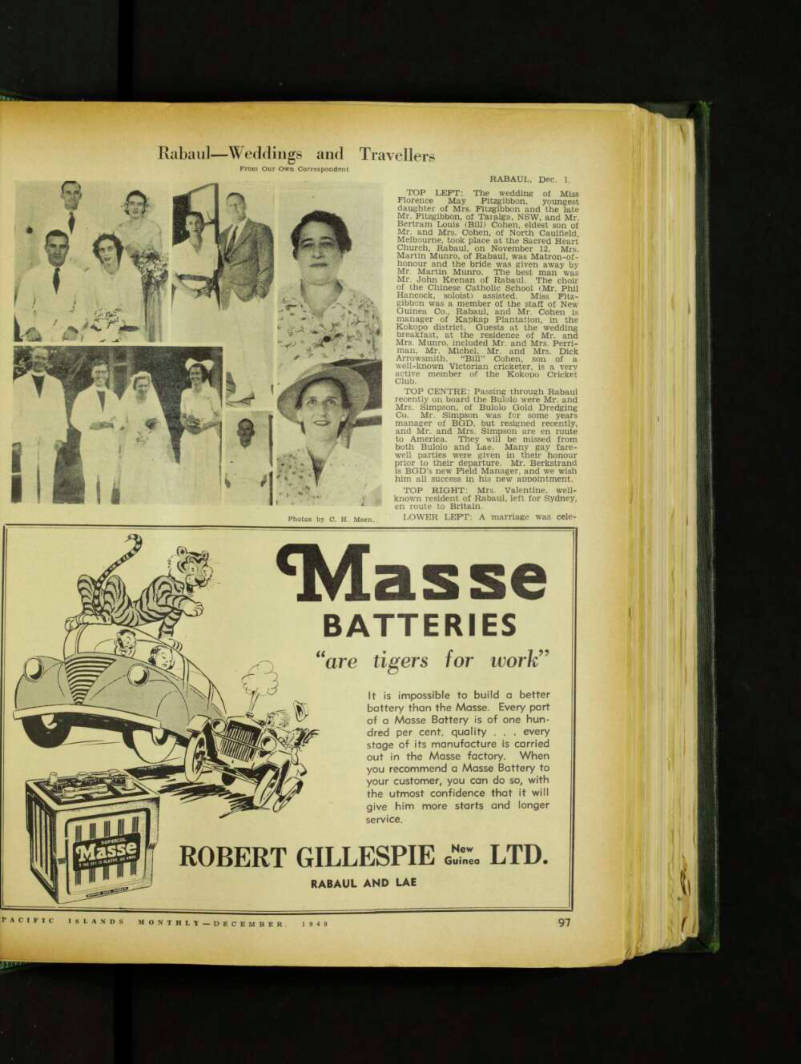
From Our Own Correspondent
Rabaul, Dec. 1.
TOP LEFT; The wedding of Miss Florence May Fitzgibbon, youngest daughter of Mrs. Fitzgibbon and the late Mr. Fitzgibbon, of Taralga, NSW, and Mr.
Bertram Louis (Bill) Cohen, eldest son of Mr. and Mrs. Cohen, of North Caulfield, Melbourne, took place at the Sacred Heart Church, Rabaul, on November 12. Mrs.
Martin Munro, of Rabaul, was Matron-of honour and the bride was given away by Mr. Martin Munro. The best man was Mr. John Keenan of Rabaul. The choir of the Chinese Catholic School (Mr. Phil Hancock, soloist) assisted. Miss Fitz gibbon was a member of the staff of New Guinea Co., Rabaul, and Mr. Cohen is manager of Kapkap Plantation, in the Kokopo district. Guests at the wedding breakfast, at the residence of Mr. and Mrs. Munro, included Mr. and Mrs. Perri man, Mr. Michel, Mr. and Mrs. Dick Arrowsmith. “Bill” Cohen, son of a well-known Victorian cricketer, is a very active member of the Kokopo Cricket Club.
TOP CENTRE: Passing through Rabaul recently on board the Bulolo were Mr. and Mrs. Simpson, of Bulolo Gold Dredging Co. Mr. Simpson was for some years manager of BGD. but resigned recently, and Mr. and Mrs. Simpson are en route to America. They will be missed from both Bulolo and Lae. Many gay fare well parties were given in their honour prior to their departure. Mr. Berkstrand is BGD’s new Field Manager, and we wish him all success in his new anpointment.
TOP RIGHT: Mrs. Valentine, well known resident of Rabaul, left for Sydney, en route to Britain.
LOWER LEFT; A marriage was cele
Photos by C. H. Meen.
brated on November 19 at the nicturesque little Methodist Church at Rabaul. The bride was Miss S. Grey; the bridegroom Rev W Matron of Honour? Mrs.
G Young; and best-man, Rev. G. Young. , , , LOWER CENTRE: The well-known and highly-esteemed Mr. “Bert” Gaskin, partowner of Rabaul’s Cosmopolitan Hotel, left for South recently. He intends leaving shortly on a trip to England.
LOWER RIGHT; Mrs. J. R. Keenan, wife of Rabaul’s ADO, departed for Aus-
tralia, per Bulolo, where she will join her parents and leave on a tour of England in January. They do not expect to be back in the Territory until November, 1950. Whilst on the Continent. Mrs.
Keenan and her parents will visit her sister, who is living in Holland. Mrs.
Keenan will be missed from Rabaul by all who knew her as a charming, capable and clever girl, who always gave a help ing hand and a word of cheer when needed. Prior to her departure she was acting-secretary for the New Britain
Womens’ Club and also the correspondent for 9PA and PIM. We all wish her a happy trip and safe return.
Advertisements & other items, p. 99 (1 item)
TMasse
€ □ c r
BATTERIES
“are tigers for work
99 It is impossible to build a better battery than the Masse. Every part of a Masse Battery is of one hundred per cent, quality . . . every stage of its manufacture is carried out in the Masse factory. When you recommend a Masse Battery to your customer, you can do so, with the utmost confidence that it will give him more starts and longer service.
ROBERT GILLESPIE JSS. LTD.
RABAUL AND LAE
Cutter Lost on Reef in Fiji
Suva, Dec. 1.
THE auxiliary cutter, Island Queen Lailai, owned by Burns, Philp (South Sea) Co. Ltd., Levuka, sank within 15 minutes of striking the Horseshoe Reef, Nairai (80 miles north-east of Suva) early on November 23. Eleven members of the crew and two passengers got clear in the ship’s boat.
At midnight, the captain judged he was near Koro light, but heavy rain was fall ing. At 2.30 a.m., they found they were almost upon Horseshoe Reef. Unable to turn in time, the Island Queen Lailai struck with both sails up and the engine running. , There was a heavy sea and the lifeboat was nartly filled with water when the 13 people were picked up by Mr. Jack Mor ris, in his cutter, Fetumoana, at 4.30 a.m.
The Island Queen Lailai. whose masts and after-housing can be seen below water, was carrying 400 tons of copra, with s:me timber and empty oil-drums. Gil bertese divers have gone to investigate.
The 42 ft. motor ketch, Waihape, in charge of owner-skipper Johnny Wray, arrived in Auckland on November 16, after a five-months’ cruise in the Tonga archi pelago. Johnny Wray is an Auckland yachtsman who has sailed his own little ships oVer thousands of miles of the South Pacific. He built the Waihape himself m 1948, and went off to the Islands in her last June, alone. He was nearly lost in a severe gale off the Kermadecs, but es caped with some damage and loss of gear.
He brought back with him a young Ton gan, Charles Hansen, who helped him to work the ketch.
Advertisements & other items, p. 100 (2 items)
98
DECEMBER, 1949 PACIFIC ISLANDS MONTHLIi
J. C. Merr1Llees Pty.
a A_.L
104 HUNTER ST., SYDNEY
ORANGE. LEMON,
CITRUS COCKTAIL,
FRUIT CUP, PINE-
APPLE, PASSION
FRUIT, AND ETC.
Also all Milk Bar Requirements, Syrups, and
ICE CREAM MIX
Agents :—
WALTER GRAND,
PAPEETE, TAHITI.
HUNTS AGENCY,
SUVA, FIJI.
Telegrams;
'MERRILLEES,”
Sydney
Look for KRAFT
and find QUALITY
The unchanging quality of Kraft foods is a byword wherever fine foods find appreciation. In their constant vigilance over quality, Kraft experts have achieved even more than just that, for hand in hand with Kraft quality goes flavour perfection and food value of a very high order.
Wherever you see the name “Kraft”, buy confidently, and remember, “Red Feather” foods are made by Kraft too. No finer foods can be found.
Export Division.
Kraft Walker Cheese Co. Pty. Ltd.,
Riverside Ave., South Melbourne,
AUSTRALIA,
tfVEGEMlTlt*
ili
KRAFT
V // CS Three famous Kraft Foods now available
in full supply everywhere.
VEGEMITE — the delicious, healthful yeast extract. One of the richest known sources of the important Vitamin B complex. Strongly recommended in all areas where fresh vegetables are scarce. A little does a power of good.
KRAFT CHEDDAR CHEESE — a
creamy-smooth, choice processed cheddar.
Rich in Vitamins A, B and D, calcium, phosphorus, and other nutrients of milk.
Always fresh whether in the attractive blue can or in its hygienic foil wrapping. Not too sharp —not too mild —just too good for words.
BONOX — pre-digested beef in its tastiest and most assimilable form. A valuable food for its high content of niacin (the anti-pellagric factor), and a powerful digestive stimulant. Dissolve in hot water for an appetising drink, or use as a spread or a flavouring for cooked dishes. Eat it and drink it for a lift!
New Cabaret-Restaurant In Rahaul
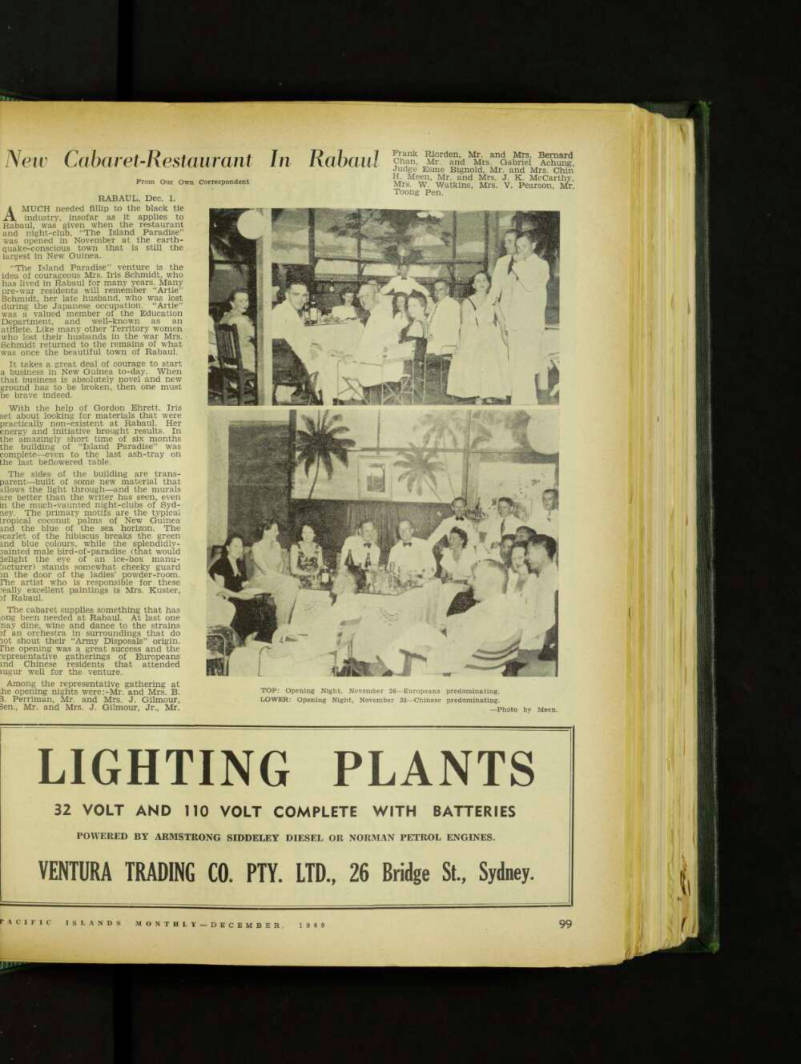
From Our Own Correspondent
Rabaul, Dec. 1.
A MUCH needed fillip to the black tie industry, insofar as it applies to Rabaul, was given when the restaurant and night-club, “The Island Paradise” was opened in November at the earth quake-conscious town that is still the largest in New Guinea.
“The Island Paradise” venture is the idea of courageous Mrs, Iris Schmidt, who has lived in Rabaul for many years. Many pre-war residents will remember “Artie”
Schmidt, her late husband, who was lost during the Japanese occupation. “Artie” was a valued member of the Education Department, and well-known as an athlete. Like many other Territory women who lost their husbands in the war Mrs.
Schmidt returned to the remains of what was once the beautiful town of Rabaul.
It takes a great deal of courage to start a business in New Guinea to-day. When that business is absolutely novel and new ground has to be broken, then one must be brave indeed.
With the help of Gordon Ehrett. Iris set about looking for materials that were practically non-existent at Rabaul. Her energy and initiative brought results. In the amazingly short time of six months the building of “Island Paradise” was complete—even to the last ash-tray on the last beflowered table.
The sides of the building are trans parent—built of some new material that allows the light through—and the murals are better than the writer has seen, even in the much-vaunted night-clubs of Syd ney. The primary motifs are the typical tropical coconut palms of New Guinea and the blue of the sea horizon. The scarlet of the hibiscus breaks the green and blue colours, while the splendidly aainted male bird-of-paradise (that would ielight the eye of an ice-box manu facturer) stands somewhat cheeky guard an the door of the ladies’ powder-room, rhe artist who is responsible for these really excellent paintings is Mrs. Kuster, af Rabaul.
The cabaret supplies something that has rang been needed at Rabaul. At last one nay dine, wine and dance to the strains af an orchestra in surroundings that do lot shout their “Army Disposals” origin, rhe opening was a great success and the ’epresentative gatherings of Europeans md Chinese residents that attended mgur well for the venture.
Among the representative gathering at ;he opening nights were;-Mr, and Mrs. B. 3. Perriman, Mr. and Mrs. J. Gilmour, 3en., Mr. and Mrs. J. Gilmour, Jr., Mr.
Frank Riorden, Mr. and Mrs. Bernard Chan, Mr. and Mrs. Gabriel Achung, Judge Esme Bignold, Mr. and Mrs. Chin H. Meen, Mr. and Mrs. J. K. McCarthy, Mrs, W. Watkins, Mrs. V. Pearson, Mr.
Toong Pen.
TOP: Opening Night, November 26 —Europeans predominating.
LOWER: Opening Night, November 28 —Chinese predominating. —Photo by Meen.
Advertisements & other items, pp. 101-102 (2 items)
99
ACIFIC ISLANDS MONTHLY DECEMBER, 1949
Lighting Plants
32 VOLT AND 110 VOLT COMPLETE WITH BATTERIES POWERED BY ARMSTRONG SIDDELEY DIESEL OR NORMAN PETROL ENGINES.
VENTURA TRADING CO. PTY. LTD., 26 Bridge St., Sydney.
r'ssz
IP
“Make Mine Music”
FROM
AUSTRALIA’S FINEST MUSIC HOUSE
Yes, everybody wants music in some form, whether it be a record., an instrument or sheet music. Ex-
press your Christmas thought in music.
MOUTH ORGANS
and
RECORDS
We have large stocks of Australian and English records of all labels. Write to us for particulars about new releases— Columbia, and “Tempo.” Have your name placed* on our mailing list. m *#• Vi !U £ \W toJ*9i*ViC V The always popular. More so with these strong quality instruments with full note range.
Hohner 20-reed Echo Vamper .. 12/6 Auto-Valve Harp, 40-reed .. .. 36/6 Chromonica, 40-reed 47/6 Super-Chromonica, 48-reed .. .. 65/- (AU Plus Postage).
PORTABLE
GRAMOPHONES
You can choose from a comprehensive range at J. Stanley Johnston. Such famous makes as Continental. H.M.V., Odeon and Columbia are available.
Fitted with English motors with a case covered in waterproof leatherette these gramophones are reliable and have a beautiful tone. Priced from £lO/10/-.
BANJO MANDOLINS
Model 7S —Walnut veneered back and rim (lOVa”). walnut neck, 12 brackets, cutaway vellum bezel, covered tailpiece.
Complete with case .. .. £UA7/6.
Melody Major—Stained walnut neck, rim, and resonator with sunsplash effect, 10y 2 ” rim, 16 brackets. Tone ring under vellum.
Complete with case .. .. £l2/10/-.
GUITARS
Illustrated are the world famous CREMONA Quitars, renowned for their perfect finish and flawless tone.
Super Dominator, Concert Grand Model, finished in Birds Eye Maple, Blond, Mohogany. Rosewood £69/15/9.
Imperial Special Model, Large Spanish round-hole model.
Price .. . £4O/13/6.
Apex Professional Model, swelled back and top—F holes; adjustable bridge and tailpiece. Price ££9/5/-.
Standard Models in Spanish or Hawaiian. Price .. .. £B/T7/6.
Trade Enquiries Invited
BANJO MANDOLINS
Model XXS—Ebonised back and rim (71/4”) stained rosewood neck, 6 brackets, covered tailpiece.
Complete with case .. .. £6/15/-.
Model XS —Stained walnut neck and I back rim (8”) 8 brackets, covered i tailpiece.
Complete with case £7/10/-. .
Model 16S —Ebonised back and rim (10”) rosewood finished neck, 8 8 brackets, covered tailpiece.
Complete with case .. .. £9/19/6..
NYLON STRINGS
CREMONA “SUPERSONIC” Nylon n
strings for Violin, Guitar and Ukulele.. 9 The ideal string for Tropical Climates..a NYLON strings have superseded allil other types of strings throughout)!
America and the Continent.
For smoothness, clarity, harmoniCDt pizzicato response fflus
use CREMONA NYLON STRINGS.
Ukulele 5/6 per set..) Guitar, Ist, 2/6 ea.; 2nd, 3/- ea.;;. 3rd, 3/6 ea.
Violin E, 2/- ea.; A. 2/6 ea.; D, 8/- ea..!
FREIGHT EXTRA ON
ALL PRICES.
437-439
THE HOUSE FOR BETTER MUSIC
GEORGE STREET, SYDNEY,
AUSTRALIA#
Sullen Natives
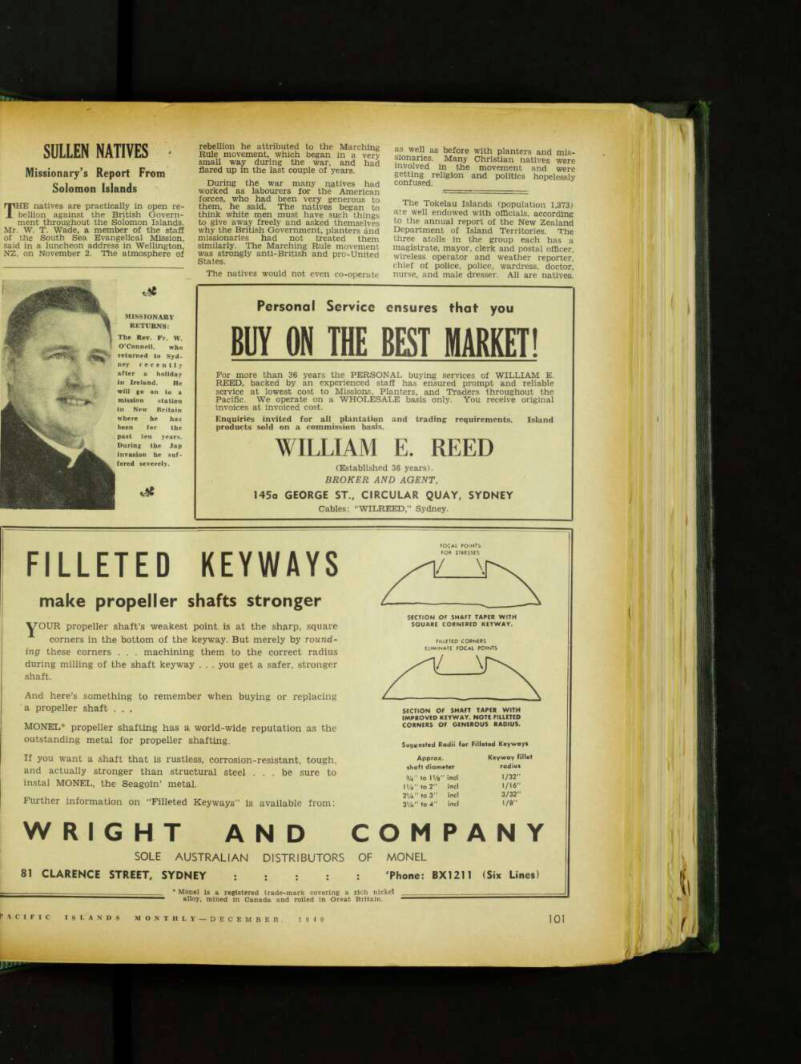
Missionary’s Report From Solomon Islands
THE natives are practically in open re bellion against the British Govern ment throughout the Solomon Islands.
Mr. W. T. Wade, a member of the staff of the South Sea Evangelical Mission, said in a luncheon address in Wellington, NZ, on November 2. The atmosphere of
rebellion he attributed to the Marching Rule movement, which began in a very small way during the war, and had flared up in the last couple of years.
During the war many natives had worked as labourers for the American forces, who had been very generous to them, he said. The natives began to think white men must have such things to give away freely and asked themselves why the British Government, planters and missionaries had not treated them similarly. The Marching Rule movement was strongly anti-British and pro-United States.
The natives would not even co-operate
as well as before with planters and mis sionaries. Many Christian natives were involved in the movement and were getting religion and politics hopelessly confused.
The Tokelau Islands (population 1,373) are well endowed with officials, according to the annual report of the New Zealand Department of Island Territories. The three atolls in the group each has a magistrate, mayor, clerk and postal officer, wireless operator and weather reporter, chief of police, police, wardress, doctor, nurse, and male dresser. All are natives.
Missionary
Returns:
The Rev. Fr, W.
O’Connell, who returned to Syd ney recently after a holiday in Ireland. He will go on to a mission station in New Britain where he has been for the past ten years.
During the Jap invasion he suf fered severely.
Advertisements & other items, pp. 103-104 (2 items)
101
ACIFIC ISLANDS MONTHLY DECEMBER 1949
Buy (Hi The Best Market!
Personal Service ensures that you
For more than 36 years the PERSONAL buying services of WILLIAM E.
REED, backed by an experienced staff has ensured prompt and reliable service at lowest cost to Missions, Planters, and Traders throughout the Pacific. We operate on a WHOLESALE basis only. You receive original invoices at invoiced cost.
Enquiries invited for all plantation and trading requirements. Island products sold on a commission basis.
WILLIAM E. REED
(Established 36 years).
BROKER AND AGENT,
145 a GEORGE ST., CIRCULAR QUAY, SYDNEY Cables: “WILREED,” Sydney.
FOCAL POINTS
FILLETED KEYWAYS "
make propeller shafts stronger L .
Y° ur propeller shaft’s weakest point is at the sharp, square corners in the bottom of the key way. But merely by rounding these corners . . . machining them to the correct radius during milling of the shaft keyway . . . you get a safer, stronger shaft.
And here’s something to remember when buying or replacing ' a propeller shaft . . .
MONEL* propeller shafting has a world-wide reputation as the
outstanding metal for propeller shafting.
If you want a shaft that is rustless, corrosion-resistant, tough, and actually stronger than structural steel ... be sure to instal MONEL, the Seagoin’ metal.
Further information on “Filleted Keyways” is available from;
SECTION OF SHAFT TAPER WITH
SQUARE CORNERED KEYWAY.
filleted corners eliminate focal points
SECTION OF SHAFT TAPER WITH
IMPROVED KEYWAY. NOTE FILLETED
CORNERS OF GENEROUS RADIUS.
Suggested Radii for Filleted Keyways Approx, shaft diameter 3/t" to I Vs'' incl I'A" to 2" incl 2V4” to 3" incl 3V4" to 4” incl Keyway fillet radius 1/32" 1/16" 3/32" 1/8"
WRIGHT AND COMPANY
SOLE AUSTRALIAN DISTRIBUTORS OF MONEL
81 CLARENCE STREET, SYDNEY : : : : : 'Phone: BXI2II (Six Lines) * Monel is a registered trade-mark covering a rich nickel alloy, mined in Canada and rolled in Great Britain.
Outstanding Offer . . .
.22 LITHGOW RIFLE
REPEATERS £lO/17/6 each
SINGLE SHOTS £5/-/- each
(POSTAGE EXTRA)
Also Available ...
MEN’S LIP WRIST WATCHES ... 17 Jewels, non-magnetic, shock-proof, water proof, luminous hands and figures .. .. £l2/12/-.
JUNGHANS BOUDOIR CLOCKS. 4 jewels, 1-day alarm with watch movement, size 2 in x 1 7/8 in JUNGHANS TRAVELLER’S CLOCK (wallet type) 4 jewels, alarm, size 3 1/8 in. x 3% in £6/6/ -
(PRICES QUOTED INCLUDE FREIGHT)
Send your order to-day to . . .
QUEENSLAND MERCHANTS SUPPLIES
143-145 QUEEN ST., BRISBANE, QLD.
% m l .
limited
■ 'K ‘
Bakers of the best biscuits
S/9620
Norfolk Island Notes
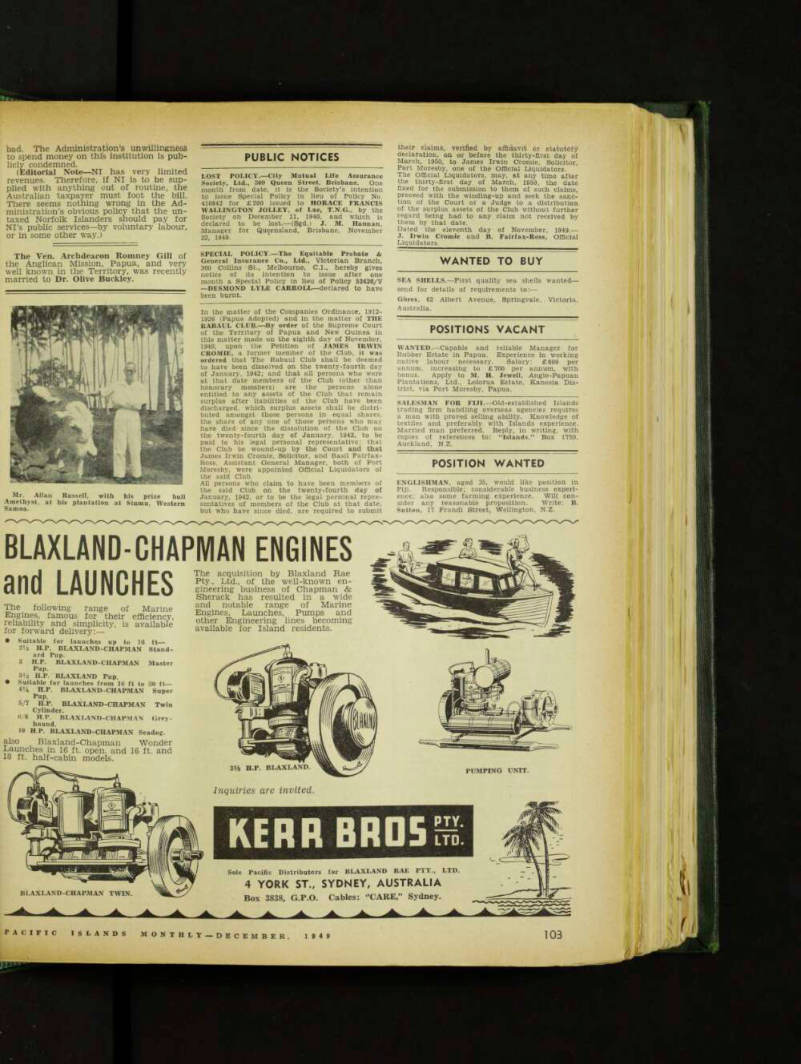
By Vernon Wheatley
NEAR FATALITY: The Whaling Com pany’s new chaser uses an electrified harpoon —the whale is electrocuted instead of killed by an explosive head — ■ and Captain Hansen had just fired and missed. As he was hauling in the line, , the mechanic accidentally flipped the ; energising switch. Fortunately, Captain j Hansen had momentarily relinquished his ; grip on the line and and thus narrowly T escaped certain death. As it was, a fair ' sized hole was blown in the side of the ; vesseL-and this was speedily repaired 1 upon return to base.
In spite of many obstacles the Company * has given a lead as to what to expect next J season. Now that many difficulties have j been ironed out, the Company, given i merely the elements of luck, should get d at least a whale a week.
BOUQUET: At long last the Adminis- tration has made a serious attempt to c transform the cattle tracks humorously \ termed roads into at least a semblance of I real roads. The Department of Works a and Housing is performing the task, as a the Administration does not possess suit- able plant or equipment. In the past, the Administration has been unable to o pay good wages and thus could not at- tract labour.
LUXURY: Poor Phyliss has been dis-charged, sacked or what-have-you..i Phyllys or Phyllis—it’s all one to me—wasa, an ancient Chev., sans everything, buti still filled with the determination there at all costs. She was a grand pldb l a( jy—her canvas top lashed with wires and old bootlaces, her doors flapping inn the wind of her own velocity, heri; mechanical roar unstifled by either muf-fler or exhaust pipe, and her windshieldb screen opaque with a perpetual mist. Shee bore her name proudly—painted inex pertly on the bonnet —but the Anglicann minister found the going too tough. The9j old lady was sold and her place is takem by a sleek young wench of this years' vintage. An interest-free loan, plus as few raffles and functions, enabled thoi change to be made.
WHISPER: If anybody with enterprises —plus a bit of capital, of course—likess to ship a few small boats to Vila, he willb find a ready sale for them at almost any: price he cares to ask.
ANGUISH: A visitor was heard to com-o ment somewhat bitterly: “I don’t know about Norfolk being called ‘The Madeira*! of the Pacific’—it should be called thee ‘Bahamas of the Pacific.’ ” The Bahamasj as you know, is a millionaires’ playgroundb We are inclined to agree. With tinn freight skipping up £1 every time a boae calls, cement at 25/- a bag, and increases, in prices all along the line, the brassed!) off housewife is wondering when anm how it will all end. We could tell her. .
SHIPPING; Since the Holmburn haa. indicated that she will call regularly her©*! there has been a sort of rush from NS> First the Monique, and, later in Decembers the Rosalie. BP’s are the agents for thrt latter vessels.
Hospital Handicaps: An Ovens
worked doctor and matron do a wondens fully good job at the NI Hospital, under adverse conditions. The Admimstratiooj offers only 25/- per week ° r 5/ - P er j for Probationer Nurses, and of there are not enough apphcants. Voluffii tary workers are appealed for, and mapjj
public-spirited women respond; but■ J®
Administration will not provide transooio for them. If the matron wants an artic.oj for the hospital, she bas tomakea public appeal. There is no X : Ray Piant. one requiring that service, must take till
pfane to Auckland or Sydney Samtarj
conditions around the hospital are veie
bad. The Administration’s unwillingness to spend money on this institution is pub licly condemned. (Editorial Note—Nl has very limited revenues. Therefore, if NI is to be sup plied with anything out of routine, the Australian taxpayer must foot the bill.
There seems nothing wrong in the Ad ministration’s obvious policy that the un taxed Norfolk Islanders should pay for Nl’s public services—by voluntary labour, or in some other way.) The Ven. Archdeacon Romney Gill of the Anglican Mission, Papua, and very well known in the Territory, was recently married to Dr. Olive Buckley.
Mr. Allan Russell, with his prize bull Amethyst, at his plantation at Siumu, Western Samoa.
Advertisements & other items, pp. 104-105 (2 items)
102
DECEMBER, X 9 4 9 -PACIF.C ISLANDS MONTHLY
Kerr Bros
their claims, verified by affidavit or statutory declaration, on or before the thirty-first day of March, 1950, to James Irwin Cromie, Solicitor, Port Moresby, one of the Official Liquidators.
The Official Liquidators, may, at any time after the thirty-first day of March, 1950, the date fixed for the submission to them of such claims, proceed with the winding-up and seek the sanction of the Court or a Judge to a distribution of the surplus assets of the Club without further regard being had to any claim not received by them by that date.
Dated the eleventh day of November, 1949.
J. Irwin Cromie and B. Fairfax-Ross, Official Liquidators.
WANTED TO BUY
SEA SHELLS. —First quality sea shells wanted— send for details of requirements to: — Gbres, 62 Albert Avenue, Springvale, Victoria, Australia.
POSITIONS VACANT
WANTED. —Capable and reliable Manager for Rubber Estate in Papua. Experience in working native labour necessary. Salary: £6OO per annum, increasing to £7OO per annum, with bonus. Apply to M. H. Jewell, Anglo-Papuan Plantations, Ltd., Lolorua Estate, Kanosia District, via Port Moresby, Papua.
SALESMAN FOR FIJI. —Old-established Islands trading firm handling overseas agencies requires a man with proved selling ability. Knowledge of textiles and preferably with Islands experience.
Married man preferred. Reply, in writing, with copies of references to: “Islands,” Box 1759, Auckland, N.Z.
POSITION WANTED
ENGLISHMAN, aged 35. would like position in Fiji. Responsible: considerable business experience; also some farming experience. Will consider any reasonable proposition. Write: B.
Sutton, 17 Frandi Street, Wellington, N.Z.
PUBLIC NOTICES
LOST POLICY.—City Mutual Life Assurance Society, Ltd., 309 Queen Street, Brisbane. One month from date, it is the Society’s intention to issue Special Policy in lieu of Policy No. 410842 for £2OO issued to HORACE FRANCIS WALLINGTON JOLLEY, of Lae, T.N.G., by the Society on December 11, 1940, and which is declared to be lost. — (Sgd.) J. M. Hannan, Manager for Queensland, Brisbane, November 22, 1949.
SPECIAL POLICY. —The Equitable Probate & General Insurance Co., Ltd., Victorian Branch, 360 Collins St., Melbourne, C. 1., hereby gives notice of its intention to issue after one month a Special Policy in lieu of Policy 52426/V —DESMOND LYLE CARROLL—declared to have been burnt.
In the matter of the Companies Ordinance, 1912- 1926 (Papua Adopted) and in the matter of THE RABAUL CLUB.—By order of the Supreme Court of the Territory of Papua and New Guinea in this matter made on the eighth day of November, 1949’, upon the Petition of JAMES IRWIN CROMIE, a former member of the Club, it was ordered that The Rabaul Club shall be deemed to have been dissolved on the twenty-fourth day of January, 1942; and that all persons who were at that date members of the Club (other than honorary members) are the persons alone entitled to any assets of the Club that remain surplus after liabilities of the Club have been discharged, which surplus assets shall be distributed amongst those persons in equal shares, the share of any one of those persons who may have died since the dissolution of the Club on the twenty-fourth day of January, 1942, to be paid to his legal personal representative; that the Club be wound-up by the Court and that James Irwin Cromie, Solicitor, and Basil Fairfax- Ross, Assistant General Manager, both of Port Moresby, were appointed Official Liquidators of the said Club.
All persons who claim to have been members of the said Club on the twenty-fourth day of January, 1942, or to be the legal personal representatives of members of the Club at that date, but who have since died, are required to submit
BLAXLAND-CHAPMAN ENGINES
and LAUNCHES
The following range of Marine Engines, famous for their efficiency, reliability and simplicity, is available for forward delivery:— • Suitable for launches up to 16 ft —
3*4 H.P. BLAXLAND-CHAPMAN Stand-
ard Pup.
3 H.P. BLAXLAND-CHAPMAN Master
Pup.
31/2 H.P. BLAXLAND Pup.
• Suitable for launches from 16 ft to 30 ft—
-4*4 H.P. BLAXLAND-CHAPMAN Super
Pup.
5/7 H.P. BLAXLAND-CHAPMAN Twin
Cylinder.
6/8 H.P. BLAXLAND-CHAPMAN Grey-
hound.
10 H.P. BLAXLAND-CHAPMAN Seadog.
also Blaxland-Chapman Wonder Launches in 16 ft. open, and 16 ft. and 18 ft. half-cabin models.
The acquisition by Blaxland Rae Pty., Ltd., of the well-known engineering business of Chapman & Sherack has resulted in a wide and notable range of Marine Engines, Launches, Pumps and other Engineering lines becoming available for Island residents.
ili
3H.P. BLAXLAND
Inquiries are invited.
PUMPING UNIT.
KERR BROS
PTY.
LTD.
BLAXLAND-CHAPMAN TWIN
Sole Pacific Distributors for BLAXLAND BAE PTY., LTD.
4 YORK ST., SYDNEY, AUSTRALIA
Box 3838, G.P.O. Cables: “CARE,” Sydney.
Islands Produce
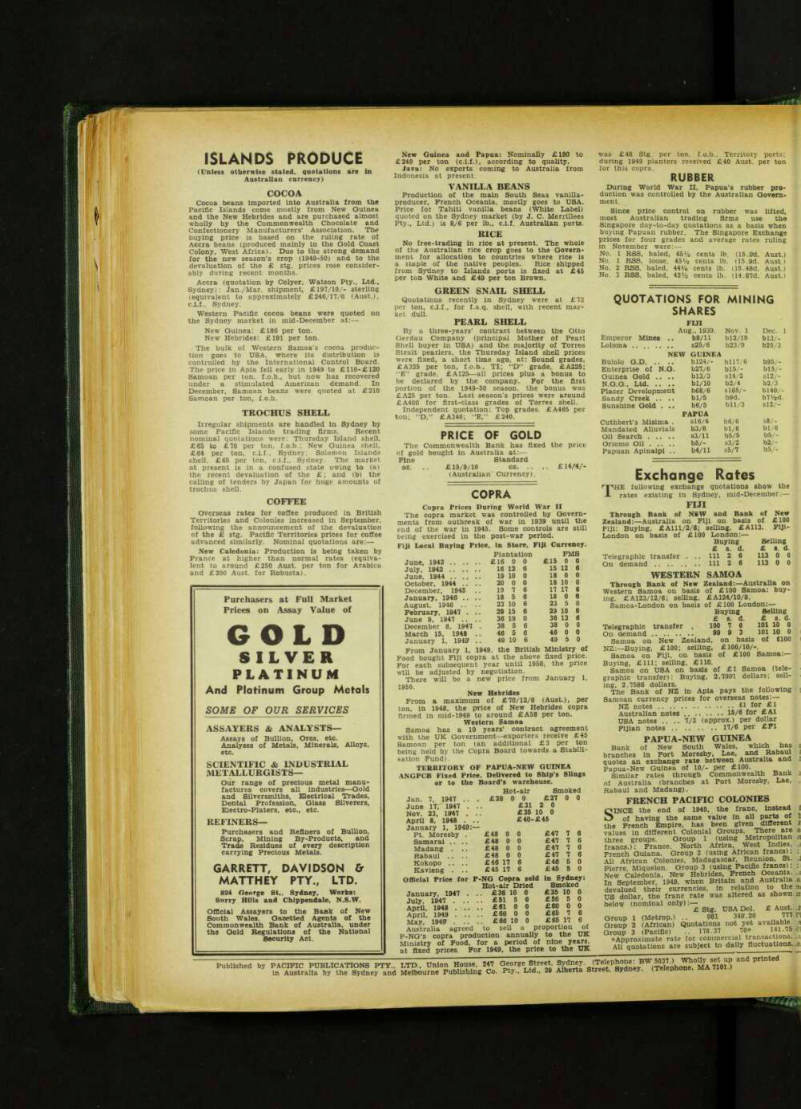
(Unless otherwise stated, quotations are in Australian currency)
Cocoa
Cocoa beans imported into Australia from the Pacific Islands come mostly from New Guinea and the New Hebrides and are purchased almost wholly by the Commonwealth Chocolate and Confectionery Manufacturers’ Association. The buying price is based on the ruling rate of Accra beans (produced mainly in the Gold Coast Colony, West Africa). Due to the strong demand for the new season’s crop (1949-50) and to the devaluation of the £ stg. prices rose consider ably during recent months.
Accra (quotation by Colyer, Watson Pty., Ltd., Sydney): Jan./Mar. shipment, £197/10/- sterling (equivalent to approximately £246/17/6 (Aust.), c.i.f., Sydney.
Western Pacific cocoa beans were quoted on the Sydney market in mid-December at;— New Guinea: £lB6 per ton.
New Hebrides; £l9l per ton.
The bulk of Western Samoa's cocoa produc tion goes to USA, where its distribution is controlled by the International Control Board.
The price in Apia fell early in 1949 to £llO-£l2O Samoan per ton. f.0.b., but now has recovered under a stimulated American demand. In December, Samoan beans were quoted at £2lO Samoan per ton, f.o.b.
Trochus Shell
Irregular shipments are handled in Sydney by some Pacific Islands trading firms. Recent nominal quotations were: Thursday Island shell, £65 to £7O per ton, f.0.b.; New Guinea shell, £64 per ton, c.i.f., Sydney; Solorhon Islands shell. £65 per ton, c.i.f., Sydney. The market at present is in a confused state owing to (a) the recent devaluation of the £; and (b) the calling of tenders by Japan for huge amounts of trochus shell.
Coffee
Overseas rates for coffee produced in British Territories and Colonies increased in September, following the announcement of the devaluation of the £ stg. Pacific Territories prices for coffee advanced similarly. Nominal quotations are:— New Caledonia: Production is being taken by France at higher than normal rates (equiva lent to around £250 Aust. per ton for Arabica and £2OO Aust. for Robusta).
New Guinea and Papua: Nominally £lBO to £240 per ton (c.i.f.), according to quality.
Java: No exports coming to Australia from Indonesia at present.
Vanilla Beans
Production of the main South Seas vanilla producer, French Oceania, mostly goes to USA.
Price for Tahiti vanilla beans (White Label) quoted on the Sydney market (by J. C. Merrillees Pty., Ltd.) is 8/6 per lb., c.i.f. Australian ports.
Rice
No free-trading in rice at present. The whole of the Australian rice crop goes to the Govern ment for allocation to countries where rice is a staple of the native peoples. Rice shipped from Sydney to Islands ports is fixed at £45 per ton White and £49 per ton Brown.
Green Snail Shell
Quotations recently in Sydney were at £72 per ton, c.i.f., for f.a.q. shell, with recent mar ket dull.
Pearl Shell
By a three-years’ contract between the Otto Gerdau Company (principal Mother of Pearl Shell buyer in USA) and the majority of Torres Strait pearlers, the Thursday Island shell prices were fixed, a short time ago, at: Sound grades, £A325 per ton, f.0.b., TI; “D” grade, £A225; “E” grade, £AI25 —all prices plus a bonus to be declared by the company. For the first portion of the 1949-50 season, the bonus was £A2S per ton. Last season’s prices were around £A4OO for first-class grades of Torres shell.
Independent quotation; Top grades. £A465 per ton; “D,” £A34O; “E,” £240.
Quotations For Mining
Price Of Gold
The Commonwealth Bank has fixed the price of gold bought in Australia at:— Pine Standard oz. .. £15/9/10 oz £14/4/- (Australian Currency).
Copra
Copra Prices During World War II The copra market was controlled by Govern ments from outbreak of war in 1939 until the end of the war in 1945. Some controls are still being exercised in the post-war period.
Fiji Local Baying Price, in Store, Fiji Currency.
From January 1, 1949, the British Ministry of Food bought Fiji copra at the above fixed price.
For each subsequent year until 1958, the price will be adjusted by negotiation.
There will be a new price from January 1, 1950.
New Hebrides From a maximum of £7O/12/6 (Aust.), per ton, in 1948, the price of New Hebrides copra firmed in mid-1949 to around £ASB per ton.
Western Samoa Samoa has a 10 years’ contract agreement with the UK Government —exporters receive £45 Samoan per ton (an additional £3 per ton being held by the Copra Board towards a Stabili sation Fund).
Territory Of Papua-New Guinea
ANGPCB Fixed Price. Delivered to Ship’s Slings or to the Board’s warehouse.
Australia agreed to sell a proportion, of P-NG’s copra production annually to the UK Ministry of Pood, for a period of nine years, at fixed prices. For 1949, the price to the UK
was £4B Stg. per ton, f.0.b., Territory ports; during 1949 planters received £4O Aust. per ton for this copra.
Rubber
During World War 11, Papua’s rubber pro duction was controlled by the Australian Govern ment.
Since price control on rubber was lifted, most Australian trading firms use the Singapore day-to-day quotations as a basis when buying Papuan rubber. The Singapore Exchange prices for four grades and average rates ruling in November were;— No. 1 RSS, baled, 45Vj2 cents lb. (15.9 and. Aust.) No. 1 RSS, loose, 45 Vz cents lb. (15.9 and. Aust.) No. 2 RSS, baled, 44V4 cents lb. (15.48 and. Aust.) No. 3 RSS, baled, 42V2 cents lb. (14.87 and. Aust.)
Quotations For Mining
Shares
June, 1942 Plantation £16 0 0 £15
Pms
0 0 July, 1942 16 12 6 15 12 6 June, 1944 19 10 0 18 0 0 October, 1944 .. .. 20 0 0 18 10 0 December, 1945 .. 19 7 6 17 17 6 January, 1946 .. .. 18 5 6 18 0 0 August, 1946 .. 23 10 6 23 5 0 February, 1947 . .. 29 15 6 29 10 0 June 9, 1947 .. 36 19 0 36 13 6 December 8, 1947 . 38 5 6 38 0 0 March 15, 1948 .. 46 5 6 46 0 0 January 1, 1949 .. 49 10 6 49 5 0
Hot-air Smoked Jan. 7, 1947 .. . £28 0 0 £27 0 0 June 17, 1947 . £31 2 0 Nov. 23, 1947 . £35 10 0 April 8. 1948 . £40- £45 January 1. 1949:— Pt. Moresby . £48 0 0 £47 7 6 Samarai .. £48 0 0 £47 7 6 Madang . .. £48 0 0 £47 7 6 Rabaul .. £48 0 0 £47 7 6 Kokopo .. £46 17 6 £46 5 0 Kavieng . .. £45 17 6 £45 5 0 Official Price for P-NG Copra sold in Sydney: Hot-air Dried Smoked January, 1947 . .. £36 10 0 £35 10 0 July. 1947 . .. .. £51 5 0 £50 5 0 April, 1948 . .. .. £61 0 0 £60 0 0 April, 1949 . .. .. £66 0 0 £65 7 6 May. 1949 . .. .. £66 10 0 £65 17 6
Fiji
Aug., 1939.
Nov. 1 Dec. 1 Emperor Mines .. b9/H bl2/10 bl3/- Loloma s25/6 b23/9 b25/3
New Guinea
Bulolo G.D bl24/bll7/6 b95/- Enterprise of N.Q. b27/6 bl5/bl5/- Guinea Gold •. .. bl3/3 S14/2 sl2/- N.G.G., Ltd bl/10 b2/4 b2/3 Placer Development b68/6 sl65/bl40/- Sandy Creek .. .. bl/5 b9d. b7y 2 d.
Sunshine Gold . .. b6/5 bll/3 sl2/-
Papua
Cuthbert’s Misima .
S16/6 b6/6 s8/- Mandated Alluvials b3/8 bl/6 bl/6 Oil Search S3/11 b5/5 b5/- Oriomo Oil b5/s3/2 b2/- Papuan Apinaipi .. b4/ll s5/7 b5/-
Exchange Rates
THE following exchange quotations show the rates existing in Sydney, mid-December: —
Fiji
Through Bank of NSW and Bank of New Zealand: —Australia on Fiji on basis of £lOO Fiji: Buying. £Alll/2/6; selling, £AII3. Plji- London on basis of £lOO London: —
Western Samoa
Through Bank of New Zealand:—Australia on Western Samoa on basis of £lOO Samoa: buy ing, £ A123/12/6; selling, £AI24/10/9.
Samoa-London on basis of £lOO London: —
Samoa on New Zealand, on basis of £lOO NZ:—Buying, £100; selling, £lOO/10/-.
Samoa on Fiji, on basis of £lOO Samoa:— Buying, £111; selling, £llO.
Samoa on USA on basis of £1 Samoa (tele graphic transfer); Buying, 2.7991 dollars; sell ing, 2.7586 dollars.
The Bank of NZ in Apia pays the following Samoan currency prices for overseas notes: — NZ notes £1 for Australian notes 15/6 for £AI USA notes .. .. 7/3 (approx.) per dollar Fijian notes 17/6 per £PI
Papua-New Guinea
Bank of New South Wales, which has branches in Port Moresby, Lae, and RabaiU quotes an exchange rate between Australia and Papua-New Guinea of 10/- per £lOO.
Similar rates through Commonwealth Bank of Australia (branches at Port Moresby, Lae, Rabaul and Madang).
French Pacific Colonies
SINCE the end of 1945, the franc, instead of having the same value in all parts of the French Empire, has been given different values in different Colonial Groups. There are three groups. Group 1 (using Metropolitan francs.): France, North Africa, West Indies, French Guiana. Group 2 (using African francs): All African Colonies, Madagascar, Reunion, St.
Pierre, Miquelon. Group 3 (using Pacific francs).
New Caledonia. New Hebrides, French Oceania.
In September, 1949, when Britain and Australia devalued their currencies, in relation to the US dollar, the franc rate was altered as shown below (nominal only): .„ , . . £ Stg, USA Dol. £ Aust.
Group 1 (Metrop.) .. 981 349.20 777 Group 2 (African) Quotations not yet available.
Group 3 (Pacific) .. 178.37 70* 141 - 75 *Approximate rate for commercial transactions.
All quotations are subject to daily fluctuations.
Buying Selling £ s. d. £ s. d.
Telegraphic transfer . .. Ill 2 6 113 0 0 On demand .. Ill 2 6 113 0 0
Buying Selling £ s. d. £ s. d.
Telegraphic transfer . 100 7 6 101 10 0 On demand 99 9 3 101 10 0
Advertisements & other items, pp. 106-108 (3 items)
Published by PACIFIC PUBLICATIONS PTY., LTD., Union House, 247 George Street, Sydney."cTeJe;P^one^^ W ( Tde^«^°MA S nOU PTinted
in Australia by the Sydney and Melbourne Publishing Co. Pty.. Ltd.. 29 Alberta Street. Sydney. (Teiepnone. ma
Gold
Purchasers at Full Market Prices on Assay Value of
SILVER
PLATINUM
And Platinum Group Metals
SOME OF OUR SERVICES
ASSAYERS & ANALYSTS—
Assays of Bullion, Ores, etc.
Analyses of Metals, Minerals, Alloys, etc.
SCIENTIFIC & INDUSTRIAL
METALLURGISTS—
Our range of precious metal manufactures covers all industries —Gold and Silversmiths, Electrical Trades, Dental Profession, Glass Sllverers, Electro-Platers, etc., etc.
REFINERS—
Purchasers and Refiners of Bullion, Scrap, Mining By-Products, and Trade Residues of every description carrying Precious Metals.
GARRETT, DAVIDSON &
MATTHEY PTY., LTD.
824 George St., Sydney. Works; Snrry Hills and Chippendale, N.S.W.
Official Assayers to the Bank of New South Wales. Gazetted Agents of the Commonwealth Bank of Australia, under the Gold Regulations of the National Security Act.
Tooths
Si 1 V r 1 7 % i ood company deserves the best, and it is a thoughtful and discerning host who serves his guests sparkling K.B. Lager. For “K. 8.” adds enjoyment to any gathering, and it’s one drink that’s appreciated by everybody, men and women alike.
LAGER
K 8.35. FF
Capital ... £500,000
ESTABLISHED 1914
GENERAL MERCHANTS
AND
PROYIDORES
TRADE THROUGHOUT THE PACIFIC.
THIRTY-FIVE YEARS OF PACIFIC ISLANDS DEVELOPMENT AND SERVICE.
BUYERS AND EXPORTERS OF ALL KINDS
OF ISLAND PRODUCE, COPRA, COCOA,
M.O.P. SHELL, TROCAS SHELL, ETC.
AGENTS FOR AUSTRALIAN, EUROPEAN
AND AMERICAN MANUFACTURERS.
DISTRIBUTORS OF EVERY DESCRIPTION
OF MERCHANDISE.
Through our Sydney office, branches and agents, we distribute a wide and comprehensive range of general merchandise.
f. R. CARPENTER S CO. LTD.
Head Office: 16 O'CONNELL STREET, SYDNEY, N.S.W.
Cable Address:
“CAMOHE.”
Telephone: BW 4421.
Postal Address: G.P.O., BOX 168, Sydney.
In London: W. R. Carpenter & Co. (London), Ltd., Coronation House, 4 Lloyd's Ave., London, EC
ASSOCIATED COMPANIES THROUGHOUT THE PACIFIC :
IN NEW GUINEA:
New Guinea Company. Limited, Rabaul, Lae, Madang, Kavieng.
IN PAPUA:
J. R. Clay & Co., Ltd., Port Moresby.
IN FIJI:
W. R. Carpenter & Co. (Fiji), Ltd., Suva.