New Guinea
p. 13 · Read in the full issue
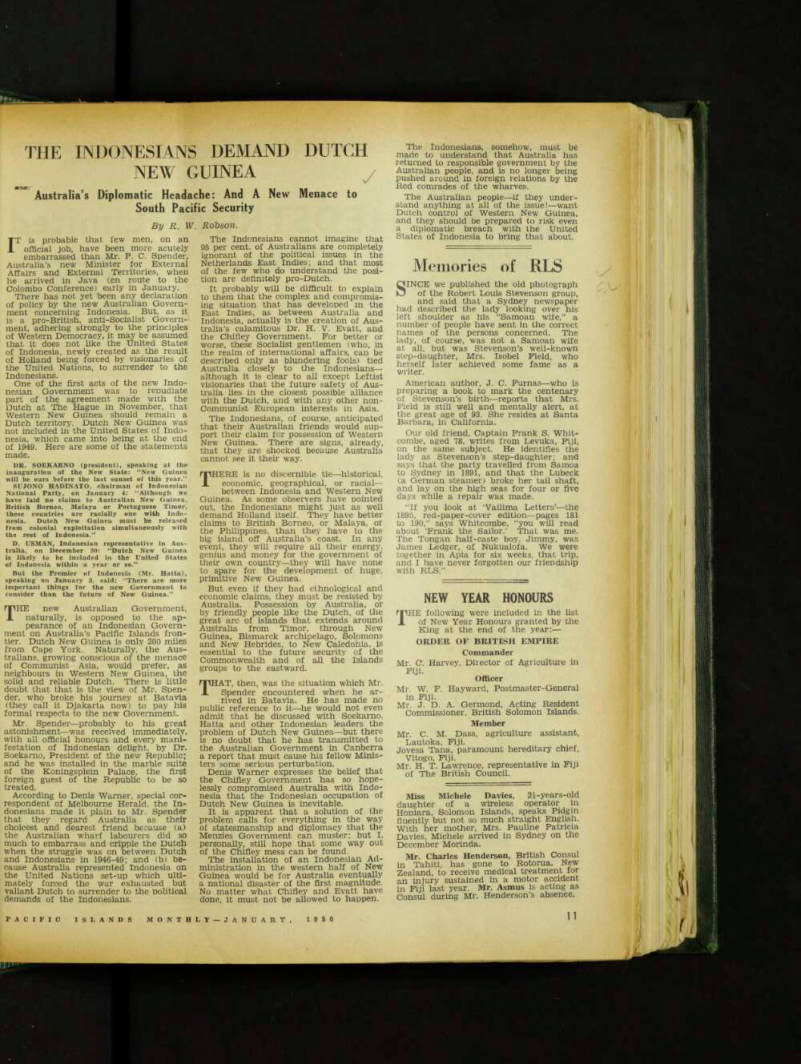
The Indonesians Demand Dutch
Australia’s Diplomatic Headache: And A New Menace to South Pacific Security
By R. W. Robson.
IT is probable that few men, on an official job, have been more acutely embarrassed than Mr. P. C. Spender, Australia’s new Minister for External Affairs and External Territories, when he arrived in Java (en route to the Colombo Conference) early in January.
There has not yet been any declaration of policy by the new Australian Govern ment concerning Indonesia. But, as it is a pro-British, anti-Socialist Govern ment, adhering strongly to the principles of Western Democracy, it may be assumed that it does not like the United States of Indonesia, newly created as the result of Holland being forced by visionaries of the United Nations, to surrender to the Indonesians.
One of the first acts of the new Indo nesian Government was to repudiate part of the agreement made with the Dutch at The Hague in November, that Western New Guinea should remain a Dutch territory. Dutch New Guinea was not included in the United States of Indo nesia, which came into being at the end of 1949. Here are some of the statements made.
DR. SOEKARNO (president), speaking at the inauguration of the New State: “New Guinea will be ours before the last sunset of this year.’’
SUJONO HADINATO, chairman of Indonesian National Party, on January 4: “Although we have laid no claims to Australian New Guinea.
British Borneo, Malaya or Portuguese Timor, these countries are racially one with Indo nesia. Dutch New Guinea must be released from colonial exploitation simultaneously with the rest of Indonesia.”
D. USMAN, Indonesian representative in Aus tralia, on December 30: “Dutch New Guinea is likely to be included in the United States of Indonesia within a year or so.”
But the Premier of Indonesia (Mr. Hatta), speaking on January 3. said; “There are more important things for the new Government to consider than the future of New Guinea.”
THE new Australian Government, naturally, is opposed to the ap pearance of an Indonesian Govern ment on Australia’s Pacific Islands fron tier. Dutch New Guinea is only 200 miles from Cape York. Naturally, the Aus tralians, growing conscious of the menace of Communist Asia, would prefer, as neighbours in Western New Guinea, the solid and reliable Dutch. There is little doubt that that is the view of Mr. Spen der, who broke his journey at Batavia (they call it Djakarta now) to pay his formal respects to the new Government.
Mr. Spender—probably to his great astonishment—was received immediately, with all official honours and every mani festation of Indonesian delight, by Dr.
Soekarno, President of the new Republic; and he was installed in the marble suite of the Koningsplein Palace, the first foreign guest of the Republic to be so treated.
According to Denis Warner, special cor respondent of Melbourne Herald, the In donesians made it plain to Mr. Spender that they regard Australia as their choicest and dearest friend because (a) the Australian wharf labourers did so much to embarrass and cripple the Dutch when the struggle was on between Dutch and Indonesians in 1946-49; and (b) be cause Australia represented Indonesia on the United Nations set-up which ulti mately forced the war exhausted but valiant Dutch to surrender to the political demands of the Indonesians.
The Indonesians cannot imagine that 95 per cent, of Australians are completely ignorant of the political issues in the Netherlands East Indies; and that most of the few who do understand the posi tion are definitely pro-Dutch.
It probably will be difficult to explain to them that the complex and compromis ing situation that has developed in the East Indies, as between Australia and Indonesia, actually is the creation of Aus tralia’s calamitous Dr. H. V. Evatt, and the Chifley Government. For better or worse, these Socialist gentlemen (who, in the realm of international affairs, can be described only as blundering fools) tied Australia closely to the Indonesians— although it is clear to all except Leftist visionaries that the future safety of Aus tralia lies in the closest possible alliance with the Dutch, and with any other non- Communist European interests in Asia.
The Indonesians, of course, anticipated that their Australian friends would sup port their claim for possession of Western New Guinea. There are signs, already, that they are shocked because Australia cannot see it their way.
THERE is no discernible tie —historical, economic, geographical, or racial— between Indonesia and Western New Guinea. As some observers have pointed out, the Indonesians might just as well demand Holland itself. They have better claims to British Borneo, or Malaya, or the Philippines, than they have to the big island off Australia’s coast. In any event, they will require all their energy, genius and money for the government of their own country—they will have none to spare for the development of huge, primitive New Guinea.
But even if they had ethnological and economic claims, they must be resisted by Australia. Possession by Australia, or by friendly people like the Dutch, of the great arc of islands that extends around Australia from Timor, through New Guinea, Bismarck archipelago, Solomons and New Hebrides, to New Caledonia, is essential to the future security of the Commonwealth and of all the Islands groups to the eastward.
THAT, then, was the situation which Mr.
Spender encountered when he ar rived in Batavia. He has made no public reference to it—he would not even admit that he discussed with Soekarno, Hatta and other Indonesian leaders the problem of Dutch New Guinea —but there is no doubt that he has transmitted to the Australian Government in Canberra a report that must cause his fellow Minis ters some serious perturbation.
Denis Warner expresses the belief that the Chifley Government has so hope lessly compromised Australia with Indo nesia that the Indonesian occupation of Dutch New Guinea is inevitable.
It is apparent that a solution of the problem calls for everything in the way of statesmanship and diplomacy that the Menzies Government can muster; but I, personally, still hope that some way out of the Chifley mess can be found.
The installation of an Indonesian Ad ministration in the western half of New Guinea would be for Australia eventually a national disaster of the first magnitude.
No matter what Chifley and Evatt have done, it must not be allowed to happen.
The Indonesians, somehow, must be made to understand that Australia has returned to responsible government by the Australian people, and is no longer being pushed around in foreign relations by the Red comrades of the wharves.
The Australian people—if they under stand anything at all of the issue!—want Dutch control of Western New Guinea, and they should be prepared to risk even a diplomatic breach with the United States of Indonesia to bring that about.