Reforms Likely In Papua-New Guinea
p. 12 · Read in the full issue
Non-Socialist Ministers Take Over in Australia and New Zealand
A CHANGE from Socialist to non- Socialist Governments in Australia (December 10) and New Zealand (November 30), with the consequent ap pointment by both countries of new Min isters for Islands Territories, with a new policy, is a matter of considerable im portance to Islands dwellers generally.
The political land-slide will not greatly affect the islands controlled by New Zea land (Cooks and Western Samoa), where administration generally has followed cer tain well-worn paths; but in the large Territories of Papua and New Guinea, which have had a full-blooded dose of Australian Socialism, with lamentable results, there are likely to be some marked changes in both policy and ad ministration.
The new Australian Minister for Ex ternal Territories is Mr. Percy Spender, who is also Minister for External Affairs (or Foreign Minister).
Mr. Menzies’ decision to place those two portfolios in the hands of one man is a new idea, but a sound one. We have reached the stage where Australia’s “ex ternal affairs” are deeply concerned with events and developments in and around the Pacific, and especially in Asia; and the administration of Australia’s Pacific Islands naturally ties in with Pacific affairs generally.
The main objection to the new ar rangement is that External Affairs is an important portfolio, and the Minister may be so preoccupied with it that he will not have much time for External Territories— which, under present conditions demands a lot of time.
It appears, however, that Mr. Menzies has adopted the system of Parliamentary Under-Secretaries, which means that se lected younger Parliamentarians will be come first assistants to senior Ministers.
There will be an Under-Secretary for External Affairs and External Territories,
which will mean that Australian Terri tories affairs generally will be dealt with by a junior Minister, who will submit recommendations on all important things to his senior.
That might work out very well —it de pends on the calibre of the Under secretary selected for (External Terri tories. The most persistent forecast, so far, is that the job will go to Mr. Paul Hasluck, a newly elected West Australian, who was formerly a journalist and a pro minent official in the Department of Ex ternal Affairs. He should make an admirable junior Minister for the Terri tories.
There are three or four men in the Menzies Government who know a good deal about Pacific Islands affairs, and any one of whom would have made an acceptable Minister for External Terri tories —Mr. White and Mr. Anthony come readily to mind. But none is better in formed on Pacific affairs generally, and on certain aspects of Islands administra tion in particular, than Mr, Spender; and the Australian Territories are lucky that they have been given into the care of this shrewd, hard-hitting, straight-thinking Minister. He had not been a fortnight in office before he was called away to Indonesia and the Colombo Conference, where he is at this moment, and where already he has made a notable impres sion.
Before leaving Australia, Mr. Spender said he would visit Papua and New Guinea at the earliest possible moment, and he would make no fundamental change in administration until he had examined conditions on the spot.
PAPUA-NEW GUINEA literally cries aloud for reforms and alterations in several directions; but it seems un likely that anything important will be done for three or four months. Mr.
Spender is deeply involved with Australian foreign affairs; it is unlikely he will have time personally to visit the Territories between his return from Colombo and the assembling of the new Parliament on February 22; that session will last for a couple of months; and then the Minister probably will visit the Territories, and formulate recommendations for Cabinet.
But there are so many matters urgently demanding attention in the Territories that it is possible that steps will be taken to deal with them long before the Parliamentary session ends.
One suggestion is that, as soon as the Under Secretary is appointed, he will make a quick visit to the Territories be fore Parliament meets; and that he and the Administrator (Colonel J. K. Murray) will then confer in Canberra with Mr, Spender, so that the more urgent reforms may be proceeded with. Here are some matters which cannot wait very long:— • The chaotic state of coastal trans port, and the virtual breakdown of Mr. Ward’s “Directorate of Shipping.”
This is described in an article else where in this issue. • Clarification of the copra price posi tion, especially in relation to the '“stabilisation fund.’* That also is dealt with in a special article about copra. • Examination of public service condi tions in Papua-New Guinea generally, but more especially in relation to (a) the authority given to the Adminis trator to make important decisions and (b) handicaps placed upon Ad ministration personnel by the ever rising cost of living.
There are other matters clamouring; for attention, such as the conditions govern ing native labour, the proper exploitation of New Guinea’s natural resources, the handicaps that have been placed in the way of permanent housing and settle ment, the deplorable condition of the ports, and the kind of organisation re quired (including Finschhaven and Manus) to provide for defence; but they probably can await closer examination.
Mr. Ward’s policies, plus his reluctance to give any worthwhile discretionary power to his Administrator, certainly placed some strangleholds on the Terri tories. But, in the new Minister’s view, they must be removed with care and dis cretion, lest new evils be created.
IT is anticipated that Mr. Spender, to a much greater extent than has been known hitherto, will consult with ex perienced, non-official people in the Ter ritories in regard to Territories prob lems.
There are indications, also, that Mr.
Spender, at an early date, will take an active interest in the affairs of contiguous Pacific Territories, such as the Solomons, New Hebrides and Dutch New Guinea, so far as they affect Australia. The Austra lian Socialist Government did not seem to be aware that such places existed.
It is expected that interesting an nouncements relating to Pacific Islands administration and policy, will be made both by Mr. Spender and Mr. Doidge in February, soon after they return from the Colombo Conference.
THE New Zealand Minister, Mr. Doidge, arrived in Sydney by air on January 5, with advisers and staff, on his way to the Colombo Conference. Certain statements he made in New Zealand and Australia suggested that he and Mr.
Spender were thinking along the same lines in relation to the important matters to be dealt with at Colombo; and Press reports since then show that the two Ministers are working in close harmony So far as the Communist menace in Asia is concerned, New Zealand is in the same position as any of the South Pacific Islands groups—she must look to Australia to supply the main line of defence.
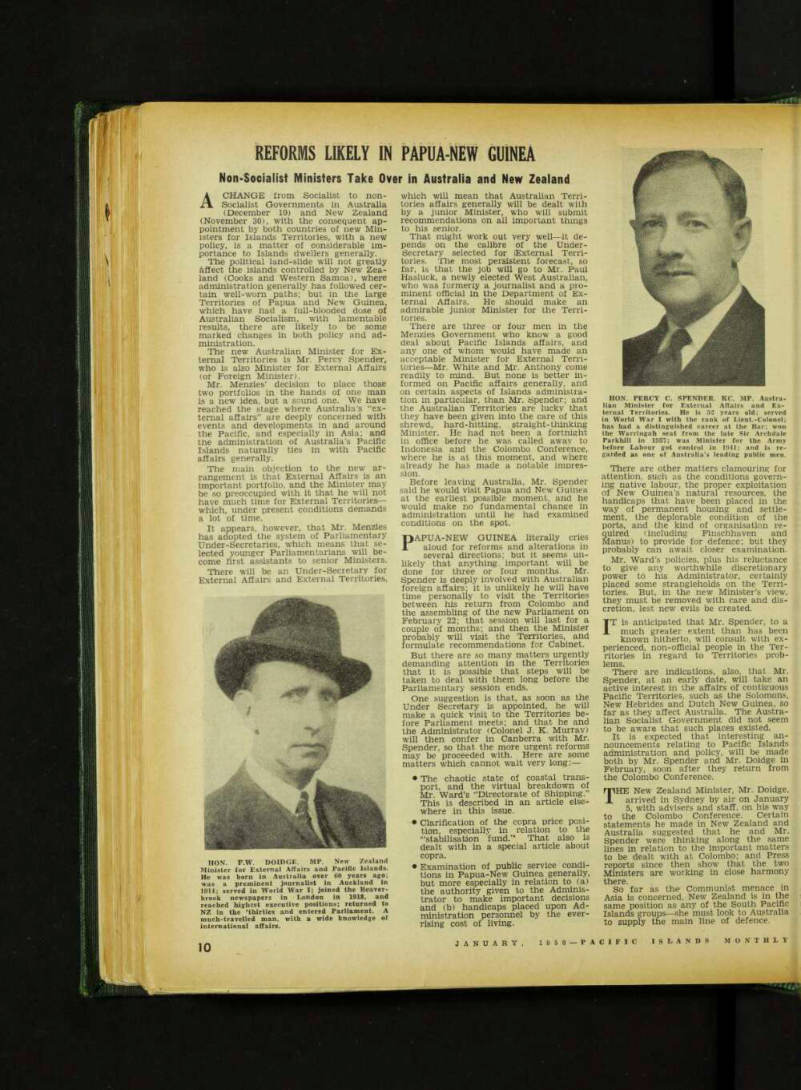
HON. P.W DOIDGE, MP. New Zealand Minister for External Affairs and Pacific Islands.
He was born in Australia over 60 years ago; was a prominent journalist in Auckland in 1914; served in World War I; Joined the Beaver brook newspapers in London in 1918, and reached highest executive positions; returned to NZ in the ’thirties and entered Parliament. A much-travelled man, with a wide knowledge of international affairs.
HON. PERCY C. SPENDER, KC, MP, Austra lian Minister for External Affairs and Ex ternal Territories. He is 52 years old; served in World War I with the rank of Lieut.-Colonel; has had a distinguished career at the Bar; won the Warringah seat from the late Sir Archdale Parkhill in 1937; was Minister for the Army before Labour got control in 1941; and is re garded as one of Australia’s leading public men.