Trapicalities
pp. 55-56 · Read in the full issue
(CALLING all Anthropologists: At a re j cent meeting of the Western Samoa Legislative Assembly it was decided that the 170 Chinese now remaining in the Territory should be permitted to re main as free citizens. It was recom mended also, that the ban on marriage between these men and Samoan women be lifted. As a corollary to this last piece of belated generosity it was decided that offspring of de facto marriages be tween Chinese and Samoans (and there have been plenty) should not be regarded as illegitimate (illegitimacy was “some thing belong Mission,” anyhow); and that the said offspring should now have the option of declaring themselves of either Samoan status, or EUROPEAN status!
“Samoan status” and “European status” are accepted Samoan terminology but now that the Territory is so hell-bent for independence why don’t they go the whole hog and make it Samoan status or Foreign status—as that is obviously what they mean. Even if it is just for the record, it would be interesting to know by what processes of deduction it is con cluded that a full blooded Chinese father and a 100 per cent. Samoan mother can produce a European chiId—ANTHROP. * * * SIDELIGHT on Suva’s climate: Early in October, after months of tropical downpours, the big 75th Cession Day
parade planned at Suva was curtailed and a Sydney newsreel unit which wanted to film the occasion was warned to stay at home. Prom that day—almost from the hour —of this decision, the weather started to improve, and Suva celebrated Cession in a blaze of sunshine plus perfect, moonlit nights, before and after. What was more, the good weather lasted for most of October and for War Memorial Appeal and Remembrance Days on November 5 and 6. And then the Suva Cricket Association fixed November 12 for the opening of its season. And the cricket clubs announced their opening teams. And the cricket grounds were allotted. Then it rained five solid inches in a lump.—S. * ♦ ♦ IT is not easy, these days, to get to Pit cairn Island, but it is even harder to get away once vou are there.
Eighteen months ago when a school teacher was sent to Pitcairn from New Zealand, the WPHC sent along also, a pre-fabricated school, a dwelling and three Indian carpenters to erect them.
The carpenters finished the job about six months ago but no ship was available to take them off. Ships were radioed but all were too busy to call for the men until after five months of idleness and homesickness for Suva, the master of the new Burns Philp ship Braeside offered to assist. Braeside (5,600 tons) was on her maiden voyage from the UK to Aus tralia via Panama. She reached Sydney
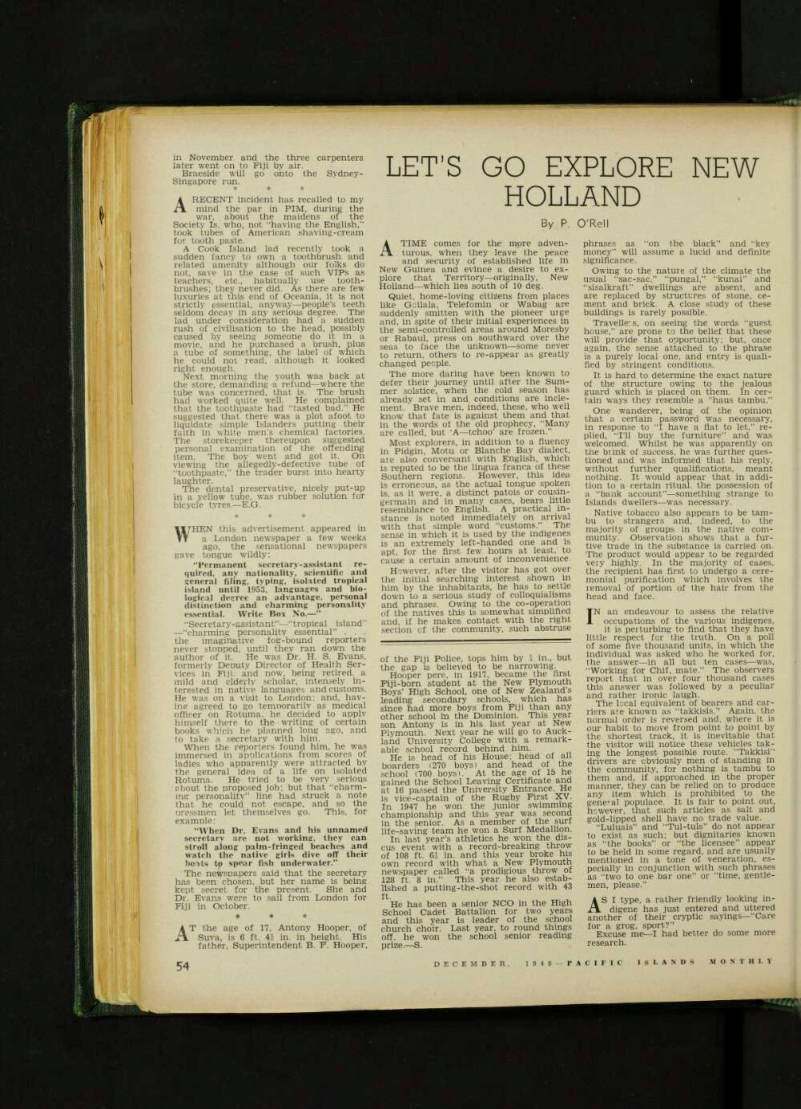
THIS is a Bret* Hilder drawing of Mr.
George Purdy, who first went to the New Hebrides with his parents in 1907, and since has spent about half his life there, with the exception of the war years, which he spent very actively in the RAAF.
He and his wife have now given the Hebrides away and have plunged into mass cultivation of carnations at Mount Tambourine, near Brisbane, Qld.
in November and the three carpenters later went on to Fiji by air.
Braeside will go onto the Sydney- Singapore run. * * * A RECENT incident has recalled to my mind the par in PIM, during the war, about the maidens of the Society Is. who, not “having the English,” took tubes of American shaving-cream for tooth paste.
A Cook Island lad recently took a sudden fancy to own a toothbrush and related amenity although our folks do not, save in the case of such VIPs as teachers, etc., habitually use tooth brushes; they never did. As there are few luxuries at this end of Oceania, it is not strictly essential, anyway—people’s teeth seldom decay in any serious degree. The lad under consideration had a sudden rush of civilisation to the head, possibly caused by seeing someone do it in a movie, and he purchased a brush, plus a tube of something, the label of which he could not read, although it looked right enough.
Next morning the youth was back at the store, demanding a refund —where the tube was concerned, that is. The brush had worked quite well. He complained that the toothpaste had “tasted bad.” He suggested that there was a plot afoot to liquidate simple Islanders putting their faith in white men’s chemical factories.
The storekeeper thereupon suggested personal examination of the offending item. The boy went and got it. On viewing the allegedly-defective tube of “toothpaste,” the trader burst into hearty laughter.
The dental preservative, nicely put-up in a yellow tube, was rubber solution for bicycle tyres.—E.G. * * * WHEN this advertisement appeared in a London newspaper a few weeks ago, the sensational newspapers gave tongue wildly: “Permanent secretary-assistant re quired, any nationality, scientific and general filing, typing, isolated tropical island until 1953, languages and bio logical degree an advantage, personal distinction and charming personality essential. Write Box No. —”
“Secretary-assistant”—“tropical island”
—“charming personality essential” . . .
the imaginative fog-bound reporters never stopped, until they ran down the author of it. He was Dr. H. S. Evans, formerly Deouty Director of Health Ser vices in Fiji, and now, being retired, a mild and elderly scholar, intensely in terested in native languages and customs.
He was on a visit to London; and, hav ing agreed to go temnorarilv as medical officer on Rotuma. he decided to applv himself there to the writing of certain books which he planned long ago, and to take a secretary with him.
When the reporters found him, he was immersed in applications from scores of ladies who apparently were attracted by the general idea of a life on isolated Rotuma. He tried to be very serious obout the proposed job; but that “charm ing personality” line had struck a note that he could not escape, and so the pressmen let themselves go. This, for example: “When Dr. Evans and his unnamed secretary are not working, they can stroll along palm-fringed beaches and watch the native girls dive off their boats to spear fish underwater.”
The newspapers said that the secretary has been chosen, but her name is being kept secret for the present. She and Dr. Evans were to sail from London for Fiji in October. * ♦ * AT the age of 17, Antony Hooper, of Suva, is 6 ft. 41 in. in height. His father, Superintendent B. F. Hooper,
of the Fiji Police, tops him by 4 in., but the gap is believed to be narrowing.
Hooper pere, in 1917, became the first Fiji-born student at the New Plymouth Boys’ High School, one of New Zealand’s leading secondary schools, which has since had more boys from Fiji than any other school in the Dominion. This year son Antony is in his last year at New Plymouth. Next year he will go to Auck land University College with a remark able school record behind him.
He is head of his House; head of all boarders (270 boys) and head of the school (700 boys). At the age of 15 he gained the School Leaving Certificate and at 16 passed the University Entrance. He is vice-captain of the Rugby First XV.
In 1947 he won the junior swimming championship and this year was second in the senior. As a member of the surf life-saving team he won a Surf Medallion.
In last year’s athletics he won the dis cus event with a record-breaking throw of 108 ft. 61 in. and this year broke his own record with what a New Plymouth newspaper called “a prodigious throw of 128 ft. 8 in.” This year he also estab lished a putting-the-shot record with 43 ft.
He has been a senior NCO in the High School Cadet Battalion for two years and this year is leader of the school church choir. Last year, to round things off, he won the school senior reading prize.—S.