Despite Sliding Cocoa Prices
p. 62 · Read in the full issue
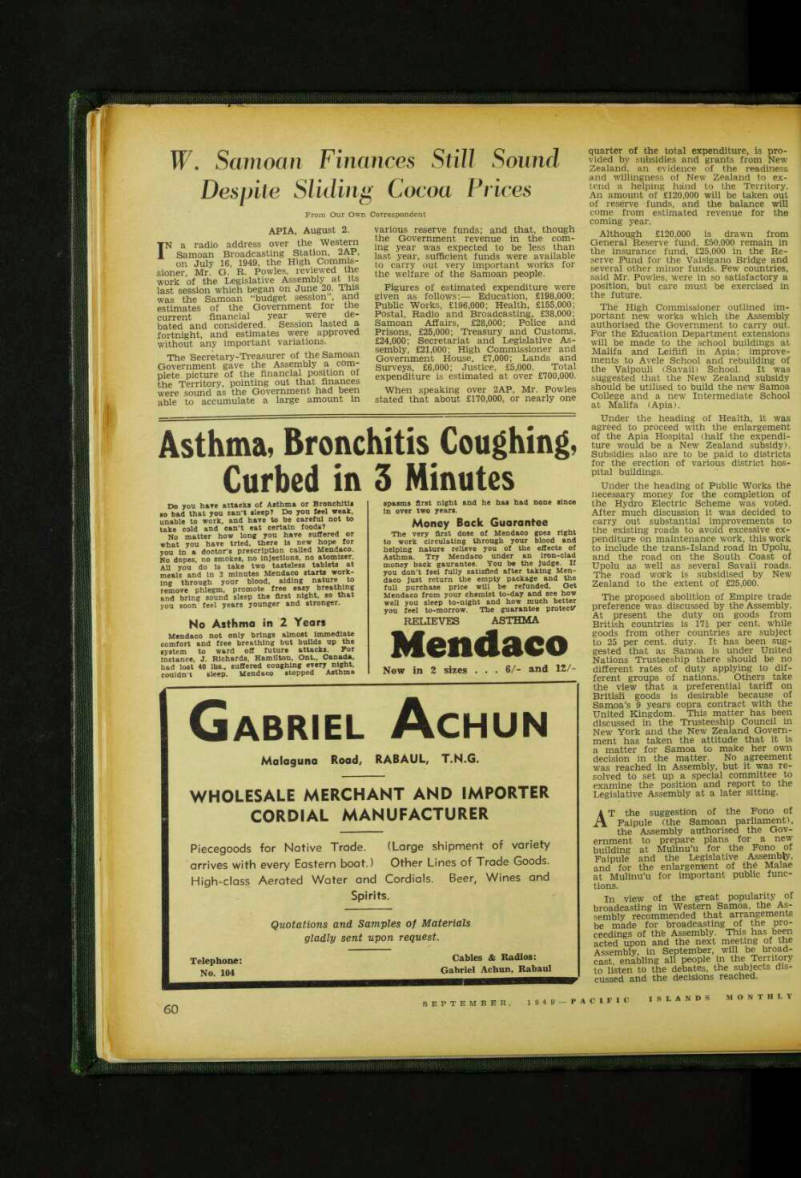
W. Samoan Finances Still Sound Despite Sliding Cocoa Prices
From Our Own Correspondent
APIA, August 2.
IN a radio address over the Western Samoan Broadcasting Station, 2AP, on July 16, 1949, the High Commis sioner, Mr. G. R. Powles, reviewed the work of the Legislative Assembly at its last session which began on June 20. This was the Samoan “budget session , and estimates of the Government for the current financial year were de bated and considered. Session lasted a fortnight, and estimates were approved without any important variations.
The Secretary-Treasurer of the Samoan Government gave the Assembly a com plete picture of the financial position of the Territory, pointing out that finances were sound as the Government had been able to accumulate a large amount in
various reserve funds; and that, though the Government revenue in the com ing year was expected to be less than last year, sufficient funds were available to carry out very important works for the welfare of the Samoan people.
Figures of estimated expenditure were given as follows; Education, £198,000; Public Works, £196,000; Health, £155,000; Postal, Radio and Broadcasting, £38,000; Samoan Affairs, £28,000; Police and Prisons, £25,000; Treasury and Customs, £24,000; Secretariat and Legislative As sembly, £21,000; High Commissioner and Government House, £7,000; Lands and Surveys, £6,000; Justice, £5,000. Total expenditure is estimated at over £700,000.
When speaking over 2AP, Mr. Powles stated that about £170,000, or nearly one
quarter of the total expenditure, is pro vided by subsidies and grants from New Zealand, an evidence of the readiness and willingness of New Zealand to ex tend a helping hand to the Territory.
An amount of £120,000 will be taken out of reserve funds, and the balance will come from estimated revenue for the coming year.
Although £120,000 is drawn from General Reserve fund, £50,000 remain in the insurance fund, £25,000 in the Re serve Fund for the Vaisigano Bridge and several other minor funds. Few countries, said Mr. Powles, were in so satisfactory a position, but care must be exercised in the future.
The High Commissioner outlined im portant new works which the Assembly authorised the Government to carry out.
For the Education Department extensions will be made to the school buildings at Malifa and Leifiifi in Apia; improve ments to Avele School and rebuilding of the Vaipouli (Savaii) School. It was suggested that the New Zealand subsidy should be utilised to build the new Samoa College and a new Intermediate School at Malifa (Apia).
Under the heading of Health, it was agreed to proceed with the enlargement of the Apia Hospital (half the expendi ture would be a New Zealand subsidy).
Subsidies also are to be paid to districts for the erection of various district hos pital buildings.
Under the heading of Public Works the necessary money for the completion of the Hydro Electric Scheme was voted.
After much discussion it was decided to carry out substantial improvements to the existing roads to avoid excessive ex penditure on maintenance work, this work to include the trans-island road in Upolu, and the road on the South Coast of Upolu as well as several Savaii roads.
The road wotrk is subsidised by New Zealand to the extent of £25,000.
The proposed abolition of Empire trade preference was discussed by the Assembly.
At present the duty on goods from British countries is 17§ per cent, while goods from other countries are subject to 25 per cent. duty. It has been sug gested that as Samoa is under United Nations Trusteeship there should be no different rates of duty applying to dif ferent groups of nations.' Others take the view that a preferential tariff on British goods is desirable because of Samoa’s 9 years copra contract with the United Kingdom. This matter has been discussed in the Trusteeship Council in New York and the New Zealand Govern ment has taken the attitude that it is a matter for Samoa to make her own decision in the matter. No agreement was reached in Assembly, but it was re solved to set up a special committee to examine the position and report to the Legislative Assembly at a later sitting.
AT the suggestion of the Fono of Faipule (the Samoan parliament), the Assembly authorised the Gov ernment to prepare plans for a new building at Mulinu’u for the Fono of Faipule and the Legislative Assembly, and for the enlargement of the Malae at Mulinu’u for important public func tions.
In view of the great popularity of broadcasting in Western Samoa, the As sembly recommended that arrangements be made for broadcasting of the pro ceedings of th'e Assembly. This has been acted upon and the next meeting of the Assembly, in September, will be broad cast, enabling all people in the Territory to listen to the debates, the subjects dis cussed and the decisions reached.