Growing Hold Of Indians On Fiji’S Economic Life
p. 61 · Read in the full issue
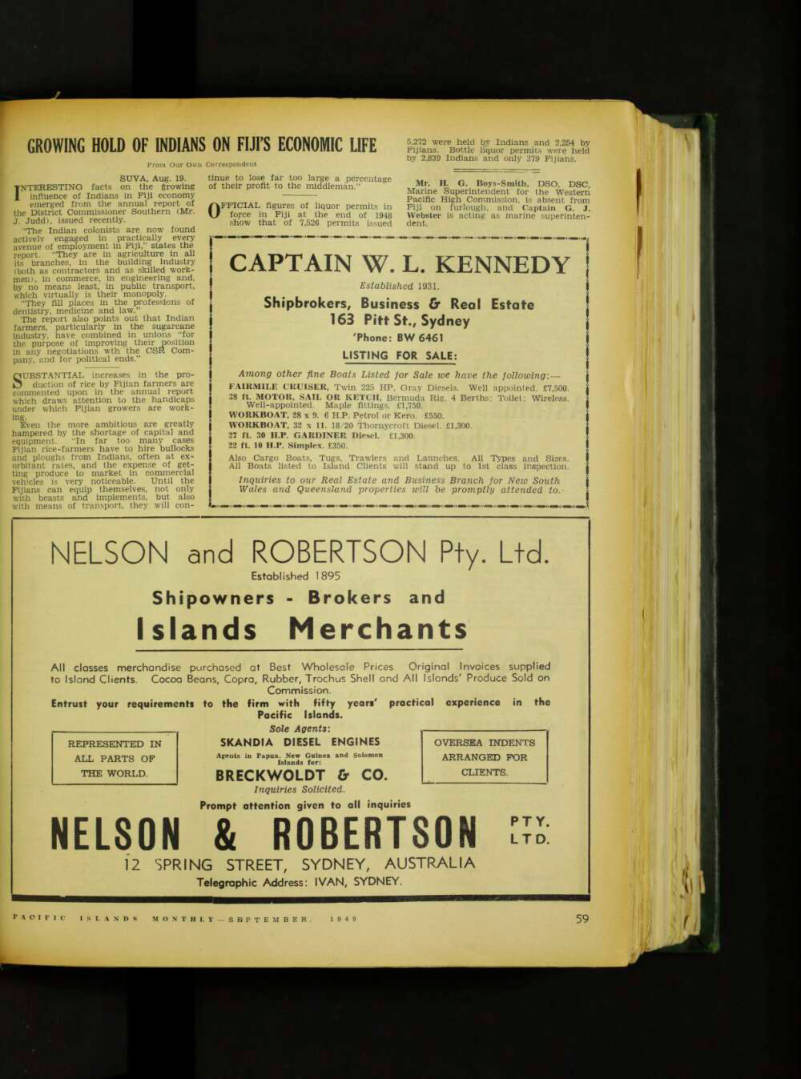
From Our Own Correspondent
Suva, Aug. 19.
INTERESTING facts on the growing influence of Indians in Fiji economy emerged from the annual report of the District Commissioner Southern (Mr.
J. Judd), issued recently.
“The Indian colonists are now found actively engaged in practically every avenue of employment in Fiji,” states the report. “They are in agriculture in all its branches, in the building industry (both as contractors and as skilled work men), in commerce, in engineering and, by no means least, in public transport, which virtually is their monopoly.
“They fill places in the professions of dentistry, medicine and law.”
The report also points out that Indian farmers, particularly in the sugarcane industry, have combined in unions “for the purpose of improving their position in any negotiations wth the CSR Com pany, and for political ends.”
SUBSTANTIAL increases in the pro duction of rice by Fijian farmers are commented upon in the annual report which draws attention to the handicaps under which Fijian growers are work ing.
Even the more ambitious are greatly hampered by the shortage of capital and equipment. “In far too many cases Fijian rice-farmers have to hire bullocks and ploughs from Indians, often at ex orbitant rates, and the expense of get ting produce to market in commercial vehicles is very noticeable. Until the Fijians can equip themselves, not only with beasts and implements, but also with means of transport, they will con
tinue to lose far too large a percentage of their profit to the middleman.”
OFFICIAL figures of liquor permits in foj-ce in Fiji at the end of 1948 show that of 7,526 permits issued
5,272 were held b# Indians and 2,254 by Fijians. Bottle liquor permits were held by 2,839 Indians and only 379 Fijians.
Mr. H. G. Boys-Smith, DSO, DSC, Marine Superintendent for the Western Pacific High Commission, is absent from Fiji on furlough, and Captain G. J.
Webster is acting as marine superinten dent.