Lonely island of pirates' gold
pp. 53-54 · Read in the full issue
A FEW months ago, the first post- World War II seeker after Cocos Island’s lost treasure returned to his base m America —without the treasure. It would be hard to tell just where he comes in the list of disappointed seekers after the pirate’s gold of Cocos —but the num ber who have tried, and failed, must now run into three figures.
Sailors, English noblemen, admirals, journalists, philanthropic maiden-ladies, widows, convicts, plain adventurers —ah have been represented in the hunt. They dug for the treasure with picks and shovels, blasted for it with dynamite, used “scientific instruments” in an at tempt to divine it. Legend has it that some of the earlier seekers came away with sundry gold pieces. One gentleman (nameless) is supposed to have found, and got off with, £12,000 worth of coin. Others nave sworn that they have sighted it — only to be thwarted by some unfortunate circumstance. However, there still seems to be a belief in the hearts of some that Cocos retains, somewhere, millions of dollars worth of specie, bullion, gold plate and other treasures —an amount as high as 60 million dollars is sometimes mentioned, for when calculating such an elusive El Dorado, why quibble over a mere million or two? lsland (another of those islands J which should not be confused with one of similar name in the Indian Ocean) is a small speck in the Pacific Ocean about 400 miles south-west of Panama. In more modern times it was claimed by the Central American repub lic of Costa Rica, which presumably still is nominal owner of the enigmatical island. No one seems to know who was the first voyager to set foot there, al though it must have been at least sighted by the early Spanish navigators in those waters even before it first appeared on a map by Nicholas Deliens in 1541. Cocos is surrounded by tricky currents and often veiled in mists and sudden rainstorms which, possibly, may explain why some of the earliest voyagers apparently passed it without knowing that it was there.
The island itself is about miles across and 16 square miles in extent. It might be supposed then, that it would be no great task, in this modern age, to literally take it to pieces, yard by yard, and thus lay bare its secret (if any), once and for all. But about four-fifths of the island is built in the perpendicular, it is thickly covered with vegetation, has in numerable watercourses and one of its peaks is almost three thousand feet high.
In addition, the rainfall appears to oe phenomenal. The views of those early visitors to the island who left records, seem, in fact, to be largely coloured by the weather. If they chanced upon it in its comparatively fine periods, they were loud in their praise of its beauty, its silver streams, its birds’ eggs, the fish that abound in its waters, and the bounti ful supply of coconuts. If they called there on its more frequent, sodden days, they, likewise, took upon themselves a mood of depression and disapproval and left a record in keeping.
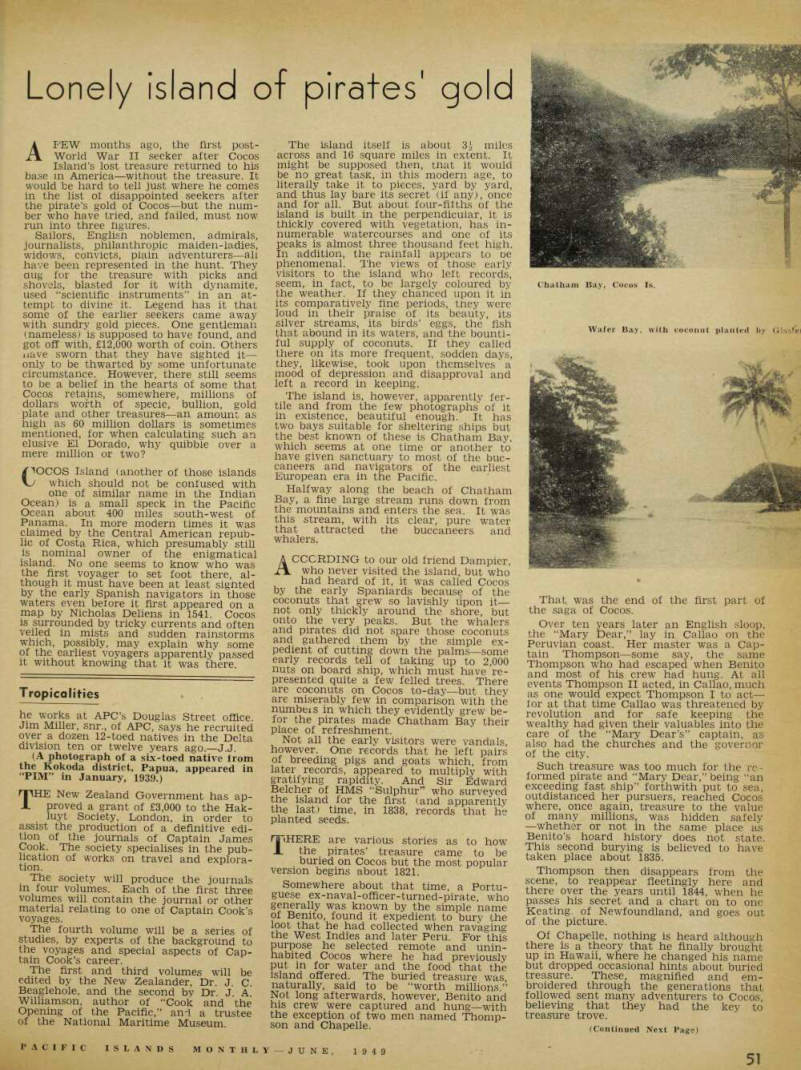
The island is, however, apparently fer tile and from the few photographs of it in existence, beautiful enough. It has two bays suitable for sheltering ships but the best known of these is Chatham Bay, which seems at one time or another to have given sanctuary to most of the buc caneers and navigators of the earliest European era in the Pacific.
Halfway along the beach of Chatham Bay, a fine large stream runs down from the mountains and enters the sea. it was this stream, with its clear, pure water that attracted the buccaneers and whalers.
ACCORDING to our old friend Dampier, who never visited the island, but who had heard of it, it was called Cocos by the early Spaniards because of the coconuts that grew so lavishly upon it— not only thickly around the shore, but onto the very peaks. But the whalers and pirates did not spare those coconuts and gathered them by the simple ex pedient of cutting down the palms—some early records tell of taking up to 2,000 nuts on board ship, which must have re presented quite a few felled trees. There are coconuts on Cocos to-day—but they are miserably few in comparison with the numbeis in which they evidently grew be for the pirates made Chatham Bay their place of refreshment.
Not all the early visitors were vandals, however. One records that he left pairs of breeding pigs and goats which, from later records, appeared to multiply with gratifying rapidity. And Sir Edward Belcher of HMS “Sulphur" who surveyed the island for the first (and apparently the last) time, in 1838, records that he planted seeds.
TiHERE are various stories as to how the pirates’ treasure came to be buried on Cocos but the most popular version begins about 1821.
Somewhere about that time, a Portu guese ex-naval-officer-turned-pirate, who generally was known by the simple name of Benito, found it expedient to bury the loot that he had collected when ravaging the West Indies and later Peru. For this purpose he selected remote and unin habited Cocos where he had previously put in for water and the food that the island offered. The buried treasure was, naturally, said to be “worth millions.’’
Not long afterwards, however, Benito and his crew were captured and hung—with the exception of two men named Thomp son and Chapelle.
That was the end of the first part of the saga of Cocos.
Over ten years later an English sloop, the “Mary Dear,” lay in Callao on the Peruvian coast. Her master was a Cap tain Thompson—some say, the same Thompson who had escaped when Benito and most of his crew had hung. At all events Thompson II acted, in Callao, much as one would expect Thompson I to act— for at that time Callao was threatened by revolution and for safe keeping the wealthy had given their valuables into the care of the “Mary Dear’s” captain, as also had the churches and the governor of the city.
Such treasure was too much for the re formed pirate and “Mary Dear,” being “an exceeding fast ship” forthwith put to sea, outdistanced her pursuers, reached Cocos where, once again, treasure to the value of many millions, was hidden safely —whether or not in the same place as Benito’s hoard history does not state.
This second burying is believed to have taken place about 1835.
Thompson then disappears from the scene, to reappear fleetingly here and there over the years until 1844, when he passes his secret and a chart on to one Keating, of Newfoundland, and goes out of the picture.
Of Chapelle, nothing is heard although there is a theory that he finally brought up in Hawaii, where he changed his name but dropped occasional hints about buried treasure. These, magnified and em broidered through the generations that followed sent many adventurers to Cocos, believing that they had the key to treasure trove. (Continued Next Pag?e)
Chatham Bay, Cocos Is.
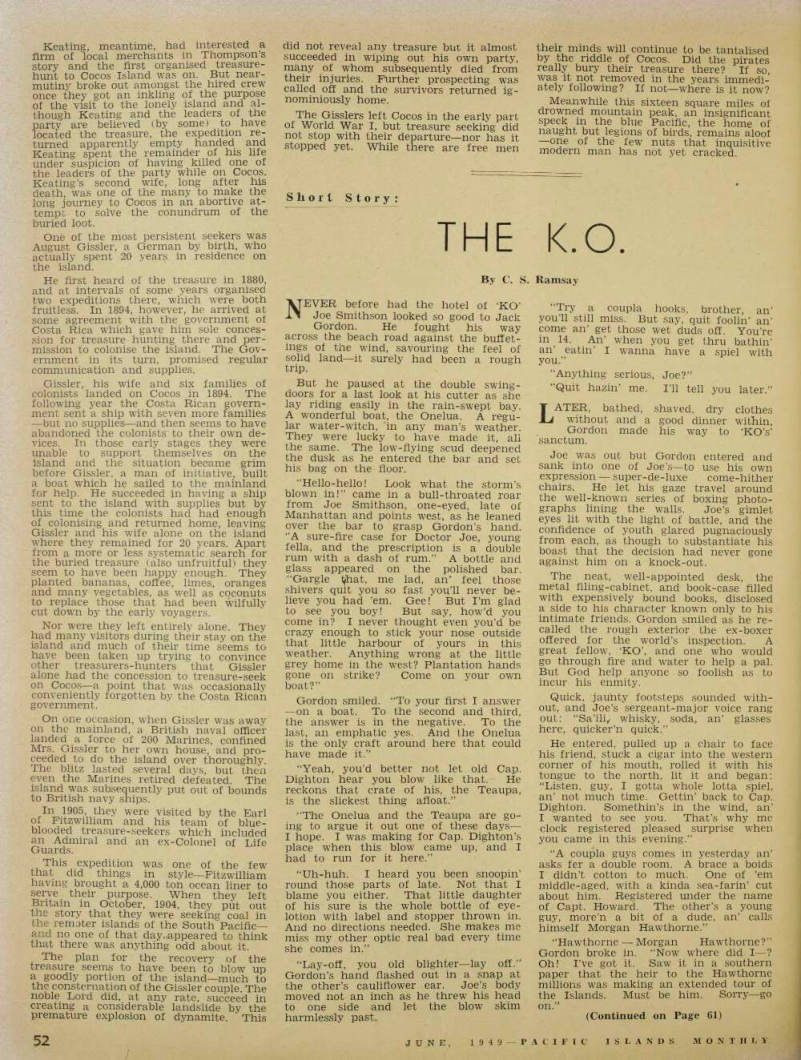
Wafer Bay, with coconut planted by (Gissley [?]
Keating, meantime, had interested a firm of local merchants in Thompson’s story and the first organised treasure hunt to Cocos Island was on. But near mutiny broke out amongst the hired crew once they got an inkling of the purpose of the visit to the lonely island and al though Keating and the leaders of the party are believed (by some) to have located the treasure, the expedition re turned apparently empty handed and Keating spent the remainder of his life under suspicion of having killed one of the leaders of the party while on Cocos.
Keating’s second wife, long after his death, was one of the many to make the long journey to Cocos in an abortive at tempt to solve the conundrum of the buried loot.
One of the most persistent seekers was August Gissler, a German by birth, who actually spent 20 years in residence on the island.
He first heard of the treasure in 1880, and at intervals of some years organised two expeditions there, which were both fruitless. In 1894, however, he arrived at some agreement with the government of Costa Rica which gave him sole conces sion for treasure hunting there and per mission to colonise the island. The Gov ernment in its turn, promised regular communication and supplies.
Gissler, his wife and six families of colonists landed on Cocos in 1894. The following year the Costa Rican govern ment sent a ship with seven more families —but no supplies—and then seems to have abandoned the colonists to their own de vices. In those early stages they were unable to support themselves on the island and the situation became grim before Gissler, a man of initiative, built a boat which he sailed to the mainland for help. He succeeded in having a ship sent to the island with supplies but by this time the colonists had had enough of colonising and returned home, leaving Gissler and his wife alone on the island where they remained for 20 years. Apart from a more or less systematic search for the buried treasure (also unfruitful) they seem to have been happy enough. They planted bananas, coffee, limes, oranges and many vegetables, as well as coconuts to replace those that had been wilfully cut down by the early voyagers.
Nor were they left entirely alone. They had many visitors during their stay on the island and much of their time seems to have been taken up trying to convince other treasurers-hunters that Gissler alone had the concession to treasure-seek on Cocos —a point that was occasionally conveniently forgotten by the Costa Rican government.
On one occasion, when Gissler was away on the mainland, a British naval officer landed a force of 200 Marines, confined Mrs. Gissler to her own house, and pro ceeded to do the island over thoroughly.
The blitz lasted several days, but then even the Marines retired defeated. The island was subsequently put out of bounds to British navy ships.
In 1905, they were visited by the Earl of Fitzwilliam and his team of blue blooded treasure-seekers which included an Admiral and an ex-Colonel of Life Guards.
This expedition was one of the few that did things in style—Fitzwilliam having brought a 4,000 ton ocean liner to serve their purpose. When they left Britain in October, 1904, they put out the story that they were seeking coal in the remoter islands of the South Pacific— and no one of that day,.appeared to think that there was anything odd about it.
The plan for the recovery of the treasure seems to have been to blow up a goodly portion of the island—much to the consternation of the Gissler couple The noble Lord did, at any rate, succeed in creating a considerable landslide by the premature explosion of dynamite. This
did not reveal any treasure bur it almost succeeded in wiping out his own party, many of whom subsequently died from their injuries. Further prospecting was called off and the survivors returned ig nominiously home.
The Gisslers left Cocos in the early part of World War I, but treasure seeking did not stop with their departure—nor has it stopped yet. While there are free men
their minds will continue to be tantalised by the riddle of Cocos. Did the pirates really bury their treasure there? If so, was it not removed in the years immedi ately following? If not—where is it now?
Meanwhile this sixteen square miles of drowned mountain peak, an insignificant speck in the blue Pacific, the home of naught but legions of birds, remains aloof —one of the few nuts that inquisitive modern man has not yet cracked.