Tropicalities
pp. 52-53 · Read in the full issue
WHEN the new Methodist Mission ship “Cicely II” arrived in Suva in May, one of the most interested of its crew was Mr. Burnell R. Young.
He is a direct descendant of Edward Young, one of the two last survivors of the Bounty mutineers at Pitcairn Island, and his first call in Suva was at the Fiji Museum, where the rudder of the Bounty is now preserved. The rudder was found on the floor of Bounty Bay, Pitcairn Island, by Mr. Parkin Christian and was “roped” by Mr. Burnell Young himself.
In an interview, Mr. Young was asked whether anything was left of the Bounty at Bounty Bay, where the ship was burned by the mutineers in 1789. He said that there was no trace.
When he was reminded that in 1933, an Australian film, “In the Wake of the Bounty” (Errol Flynn, in his first screen role, played Fletcher Christian), sug gested that the keel and fragments of the ribs of a ship, apparently quite
clearly visible below the water, were part of the Bounty, Mr. Young smiled broadly.
He agreed that the film sequence men tioned was effective, but said that the fragment shown was part of a sailing ship wrecked half a mile from the place where HMS “Bounty” sank after burn ing.
Mr. Young went to New Zealand from Pitcairn before the war. His wife and family are there and he will return to the Dominion after the delivery of the “Cicely 11" in the Solomons.
The ketch is skippered by Mr. Carl Johnson and the other members of the crew are Messrs. Morris, Palmer and Frank Gresham (engineer). .
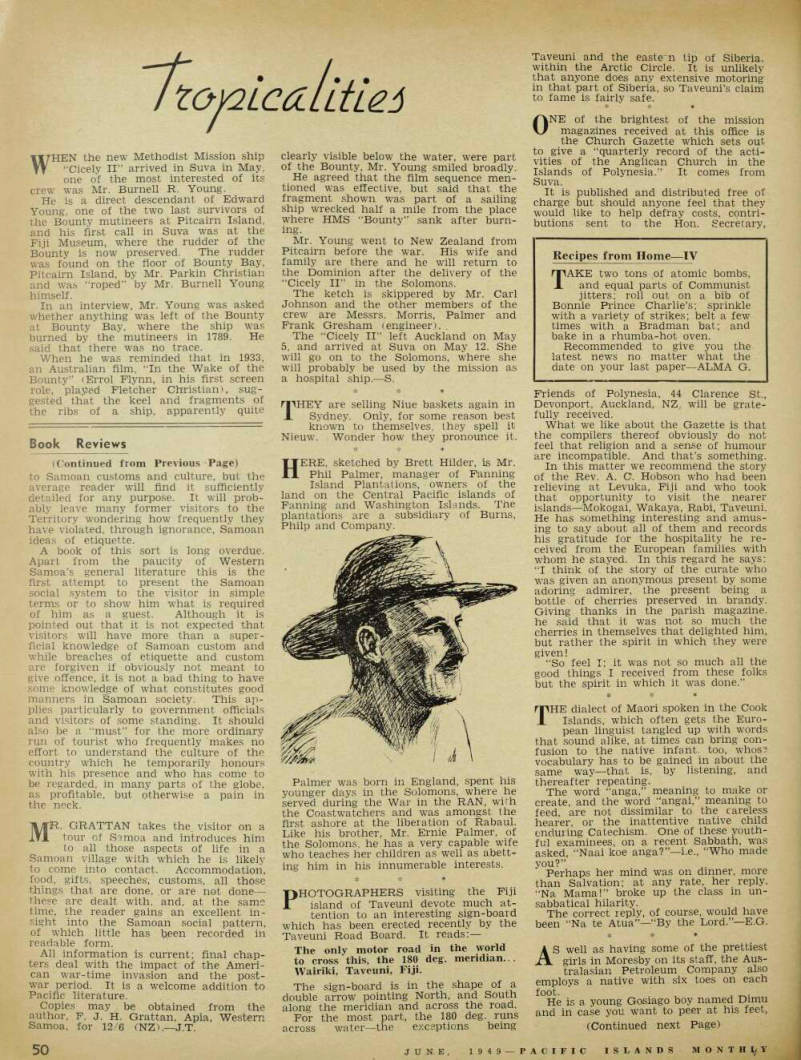
The “Cicely II" left Auckland on May 5, and arrived at Suva on May 12. She will go on to the Solomons, where she will probably be used by the mission as a hospital ship.—S. * * * THEY are selling Niue baskets, again in Sydney. Only, for some reason best known to themselves, they spell it Nieuw. Wonder how they pronounce it. * $ * HERE, sketched by Brett Hilder, is Mr.
Phil Palmer, manager of Fanning Island Plantations, owners of the land on the Central Pacific islands of Fanning and Washington Islands. The plantations are a subsidiary of Burns, Philp and Company.
Palmer was born in England, spent his younger days in the Solomons, where he served during the War in the RAN, with the Coastwatchers and was amongst the first ashore at the liberation of Rabaul.
Like his brother, Mr. Ernie Palmer, of the Solomons, he has a very capable wife who teaches her children as well as abett ing him in his innumerable interests. * * * Photographers visiting the Fiji island of Taveuni devote much at tention to an interesting sign-board which has been erected recently by the Taveuni Road Board. It reads: — The only motor road in the world to cross this, the 180 deg. meridian.
Wairiki, Taveuni, Fiji.
The sign-board is in the shape of a double arrow pointing North, and South along the meridian and across the road.
For the most part, the 180 deg. runs across water—the exceptions being
Taveuni and the eastern tip of Siberia, within the Arctic Circle. It is unlikely that anyone does any extensive motoring in that part of Siberia, so Taveuni’s claim to fame is fairly safe. * * * ONE of the brightest of the mission magazines received at this office is the Church Gazette which sets out to give a “quarterly record of the acti vities of the Anglican Church in the Islands of Polynesia.” It comes from Suva.
It is published and distributed free of charge but should anyone feel that they would like to help defray costs, contri butions sent to the Hon. Secretary,
Friends of Polynesia, 44 Clarence St., Devonport, Auckland, NZ, will be grate fully received.
What we like about the Gazette is that the compilers thereof obviously do not feel that religion and a sense of humour are incompatible. And that’s something.
In this matter we recommend the story of the Rev. A. C. Hobson who had been relieving at Levuka, Fiji and who took that opportunity to visit the nearer islands —Mokogai, Wakaya, Rabi, Taveuni.
He has something interesting and amus ing to say about all of them and records his gratitude for the hospitality he re ceived from the European families with whom he stayed. In this regard he says: “I think of the story of the curate who was given an anonymous present by some adoring admirer, the present being a bottle of cherries preserved in brandy.
Giving thanks in the parish magazine, he said that it was not so much the cherries in themselves that delighted him, but rather the spirit in which they were given!
“So feel I; it was not so much all the good things I received from these folks but the spirit in which it was done.’’ * * * THE dialect of Maori spoken in the Cook Islands, which often gets the Euro pean linguist tangled up with words that sound alike, at times can bring con fusion to the native infant, too, whos3 vocabulary has to be gained in about the same way—that is, by listening, and thereafter repeating.
The word “anga,” meaning to make or create, and the word “angai,” meaning to feed, are not dissimilar to the careless hearer, or the inattentive native child enduring Catechism. One of these youth ful examinees, on a recent Sabbath, was asked, “Naai koe anga?”—i.e., “Who made you?”
Perhaps her mind was on dinner, more than Salvation; at any rate, her reply, “Na Mama!” broke up the class in un sabbatical hilarity.
The correct reply, of course, would have been “Na te Atua”—“By the Lord.”—E.G. * * * AS well as having some of the prettiest girls in Moresby on its staff, the Aus tralasian Petroleum Company also employs a native with six toes on each foot. , . _.
He is a young Gosiago boy named Dimu and in case you want to peer at his feet, (Continued next Page)
he works at APC’s Douglas Street office.
Jim Miller, snr., of APC, says he recruited over a dozen 12-toed natives in the Delta division ten or twelve years ago.—J.J. (A photograph of a six-toed native from the Kokoda district, Papua, appeared in “PIM” in January, 1939.) THE New Zealand Government has ap proved a grant of £3,000 to the Hak luyt Society, London, in order to assist the production of a definitive edi tion of the journals of Captain James Cook. The society specialises in the pub lication of works on travel and explora tion.
The society will produce the journals m four volumes. Each of the first three volumes will contain the journal or other material relating to one of Captain Cook’s voyages.
The fourth volume will be a series of studies, by experts of the background to the voyages and special aspects of Cap tain Cook’s career.
The first and third volumes will be edited by the New Zealander, Dr. J. C.
Beaglehole, and the second by Dr. J A Williamson, author of “Cook and the Opening of the Pacific,” and a trustee of the National Maritime Museum.