The Navy Shows The Flag
pp. 50-51 · Read in the full issue
(Fart I—ln Fiji)
WORLD WAR II was past and already partly forgotten. Three blasts on the shrill-toned siren rent the quiet of a sunny afternoon early in July. The last wire had been slipped and one of New Zealand’s modern cruisers slid astern in to the tideway of Auckland harbour. His Majesty’s New Zealand cruiser “Belldna” was setting forth on a two months’ cruise amongst the islands of the South Pacific.
What, some may ask, is the purpose of such a cruise? The answers are; To promote friendship between the peoples of our Commonwealth: To render as sistance of any sort, where it may' be required; To brighten the days of those who lead lonely lives in far places by breaking the monotony for a spell; And to show the native populations the ships, and the crews, which defend their free dom. “Showing the flag” gives isolated societies a similar sense of security to that engendered in a suburban dweller by the sight of the solitary policeman on his beat at dead of night.
RAOUL (or Sunday) Island in the Kermadec Group was our first port of call, a day and a half’s voyage from Auckland. This island, named after a French sailing master, was discovered,
on a Sunday, by the French Admiral d’Entrecasteaux. It was annexed to Great Britain in 1866 and to New Zealand in 1887, together with the re maining three islands of the group Raoul is still actively volcanic, bleak and mountainous from the sea, but with an inland plain which will grow oranges and support sheep.
Our mission was to land stores for the use of the men at the meteorological
By Starshell
station there. This was achieved by transferring the stores to the motor vessel “Ranui”, recently arrived from Auckland, in the lee of the island. This, unfortunately, was on the western side and out of reach of the settlement. We, therefore, did not have the opportunity of landing or of meeting the men who. by their solitary work, contribute so much to the safety of our air and ship ping routes.
Many of our keener fishermen were busy soon after anchoring and succeeded in pulling several weird and wonderful looking fish from the blue-tinted waters before their activities were cut short by the sailing of the ship.
On the evening we left Raoul Island we made our first beer issue. Normally the sailor is “dry” onboard except for the daily tot of rum which he may have if he is over 20. The popularity of rum has waned markedly in recent years, however, and many now prefer the threepence “in lieu”. In most of the islands on the cruise programme, beer is practically unobtainable and quite re cently the Naval Board approved the carrying of beer for consumption at sea and in the remoter ports and anchorages amongst the islands. A very popular move, though the quantity is limited by the amount of stowage space available.
Still, 10,000 quart bottles was not to be sneezed at.
Our embryo matelots have, so far, been smiled on by Mother Nature who has been gentle and moderate with her weather. We anticipate that such kind ness will continue. Is not the Navy much envied, and sometimes reviled, for the practice of chasing the fine climate?
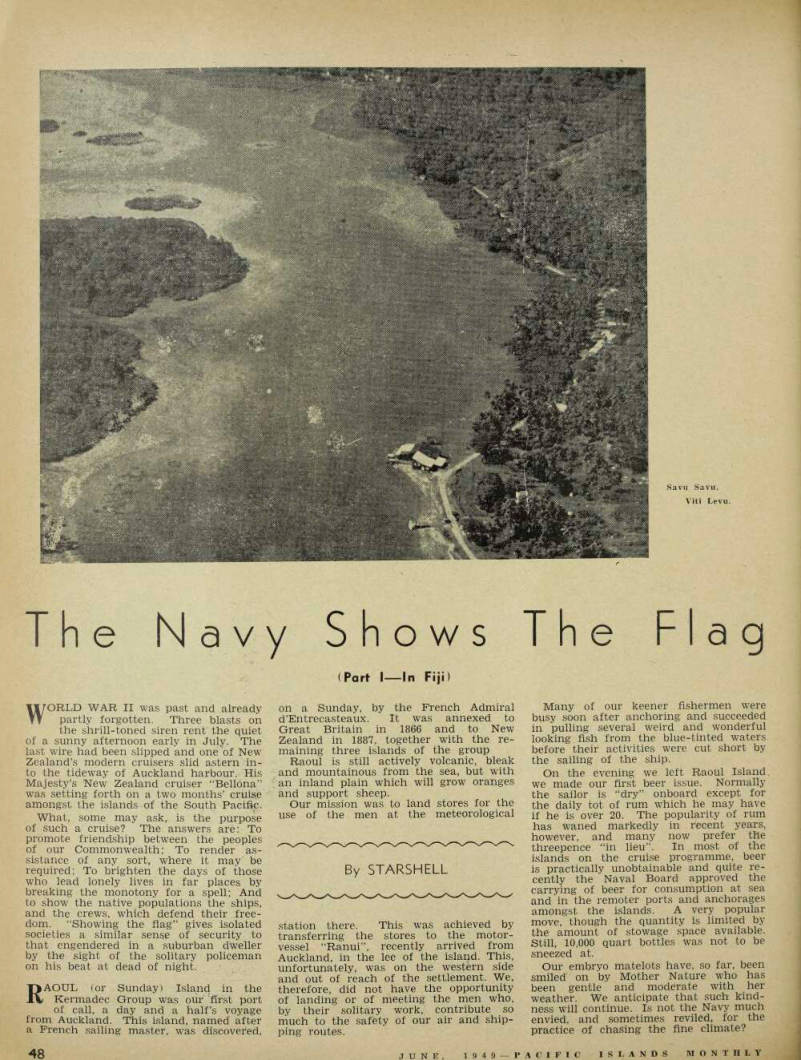
Savu Savu, Viti Levu.
Life is seldom dull in a ship, but the discovery of a case of mumps brought with it a spate of rumour and counter rumour, also some amateur predictions of future movements, until we were given permission to land our “mump” at Suva.
After a night at anchor in this harbour, where we landed the sick but partook of no other activity, except the inevitable fishing, we continued our voy age to Savu Savu in the Fijian Island of Vanua Levu.
We hear that the natives of these islands are very prone to European dis eases and that the results are far more serious in their case than in ours. So, for a while, the shadow of restricted leave hung threateningly over us. This was, fortunately, dissipated by the medical authorities who were able to make arrangements satisfactory to all— or so we earnestly hope; for to sow the mumpling seed on this almost virgin native soil is the very antithesis of our desire.
Early in the dog watches on Sunday, July 12, we negotiated the barrier reef and came to anchor off a small creek called Na Kama. Here there are two jetties, used mainly for the export of copra, but which are suitable for the ship’s boats.
The bay of Savu Savu is an extensive anchorage almost completely surrounded by jungle clad mountains. A really tropi cal Scapa Flow capable of sheltering a vast fleet. It gave us a sensation of emptiness.
Our arrival proved to be something of an event. The last warship, of any size, to pay a visit “came between the wars”.
As for the year—my guess is as good as yours.
The morning after our arrival I turned out very early to catch the splendour of a tropical dawn, but instead caught the Commander’s eye and found myself sprawling along a lower boom to gain a whaler which had to be pulled inshore for a pre-prandial swim. An absolute spate of boat pulling has broken out as prelude to an inter-part competition.
Rugger and Soccer matches against the local teams provided a ding-dong struggle in which the honours were, more or less, evenly shared. Maybe the “most easterly hotel in the world” was a spiritual factor on the side of the home team. This attraction (179 deg. 20 min. East) did not lie undiscovered for long by the sailors but proved to be completely de void of beer. There was a copious supply of other juices.
A few hardy souls accepted invitations to hunt the wild pig which is reputed to inhabit the hilly jungle slopes of Vanua Levu. Various stout, and heavily armed, expeditions sallied forth to comb the dense tropical undergrowth from dawn till dusk, but encountered only cattle (heavily protected both by law and Fijian guides), and some very tame back-yard pigs which were mercifully spared. These protagonists of the hunt returned thinner and wiser men; the only bag being one or two inoffensive jungle birds—mistaken for wild pigeon— which were literally blasted to pieces by the might of their ordnance!
Shortly after our arrival, the Captain, accompanied by a number of Officers and Chief and Petty Officers, was afforded the honour of a Fijian welcome at the nearby village of Yaroi. The ritual was interesting and imnressive and included the presentation of a Tambua (whale’s tooth) and the making and ceremonial drinking of kava, served from a large bowl. In return for their hospitality, the villagers were asked on board as guests given a fireworks and small-arms display and presented with a New Zealand en sign, a number of ship’s cap ribbons and
some bread, all of which were received with acclamation.
Later in the day. our last at Savu Savu, a native party complete with band appeared on board and entertained us all with songs and dances. The native girls are anything but shy and it was not long before they had seized partners, festooned them with flowers, and had them gyrating round the quarterdeck in an uproarious whirlgig. This impromptu dance, which involved all ranks and rat ings from the Captain to the youngest trainee, is the first we have had onboard.
We hope it is an augury for the future.
So ended our visit to this pleasant spot where the Fijians parted from us with many expressions of goodwill and hopes for the ship’s speedy return. (Continued in July)