Private Enterprise Did This . . .
p. 49 · Read in the full issue
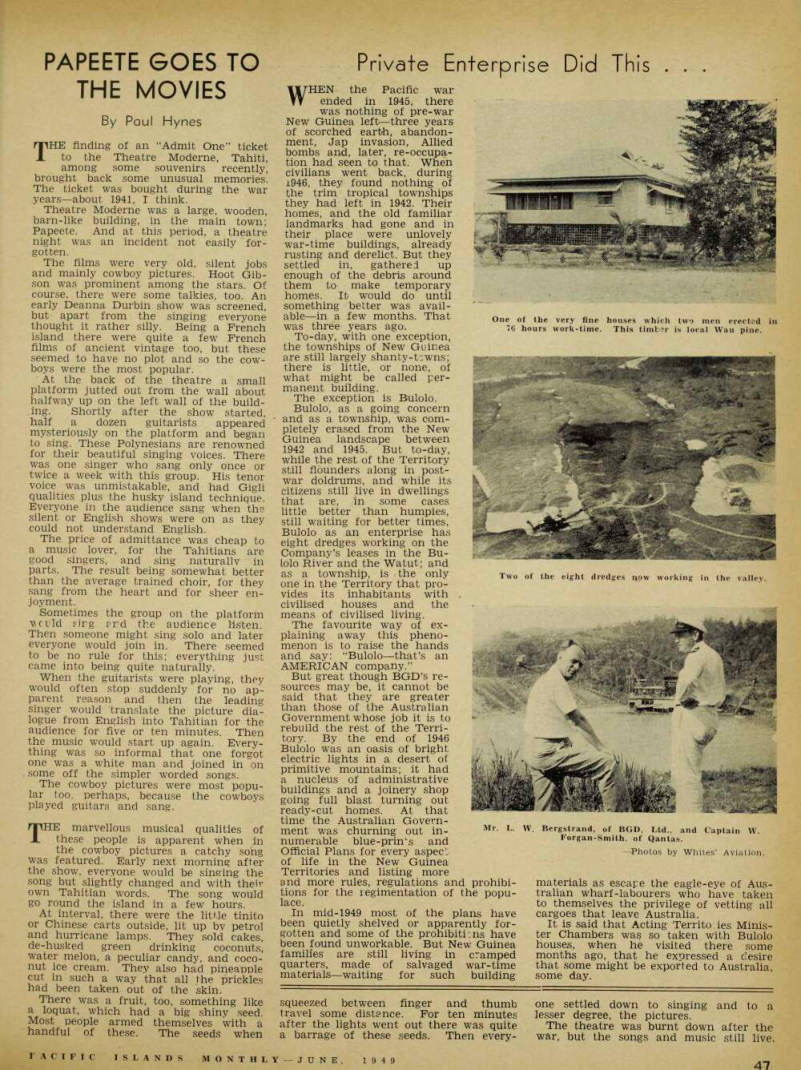
WHEN the Pacific war ended in 1945, there was nothing of pre-war New Guinea left—three years of scorched earth, abandon ment, Jap invasion, Allied bombs and, later, re-occupa tion had seen to that. When civilians went back, during i 946, they found nothing of the trim tropical townships they had left in 1942. Their homes, and the old familiar landmarks had gone and in their place were unlovely war-time buildings, already rusting and derelict. But they settled in, gathered up enough of the debris around them to make temporary homes. It would do until something better was avail able —in a few months. That was three years ago.
To-day, with one exception, the townships of New Guinea are still largely shanty-tcwns; there is little, or none, of what might be called per manent building.
The exception is Bulolo.
Bulolo, as a going concern and as a township, was com pletely erased from the New Guinea landscape between 1942 and 1945. But to-day, while the rest of the Territory still flounders along in post war doldrums, and while its citizens still live in dwellings that are, in some cases little better than humpies, still waiting for better times, Bulolo as an enterprise has eight dredges working on the Company’s leases in the Bu lolo River and the Watut; and as a township, is the only one in the Territory that pro vides its inhabitants with civilised houses and the means of civilised living.
The favourite way of ex plaining away this pheno menon is to raise the hands and say: “Bulolo —that’s an AMERICAN company.’’
But great though BGD’s re sources may be, it cannot be said that they are greater than those of the Australian Government whose job it is to rebuild the rest of the Terri tory. By the end of 1946 Bulolo was an oasis of bright electric lights in a desert of primitive mountains; it had a nucleus of administrative buildings and a joinery shop going full blast turning out ready-cut homes. At that time the Australian Govern ment was churning out in numerable blue-prhTs and Official Plans for every aspect of life in the New Guinea Territories and listing more
and more rules, regulations and prohibi tions for the regimentation of the popu lace.
In mid-1949 most of the plans have been quietly shelved or apparently for gotten and some of the prohibitions have been found unworkable. But New Guinea families are still living in cramped quarters, made of salvaged war-time materials —waiting for such building
materials as escape the eagle-eye of Aus tralian wharf-labourers who have taken to themselves the privilege of vetting all cargoes that leave Australia.
It is said that Acting Territo.ies Minis ter Chambers was so taken with Bulolo houses, when he visited there some months ago, that he expressed a desire that some might be exported to Australia, some day.
One of the very fine houses which two men erected in 76 hours work-time. This timber is local Wau pine.
Two of the eight dredges now working in the valley.
Mr. L. W. Bergstrand, of BGD, Ltd., and Captain W.
Forgan-Smith, of Qantas.
Photos by Whites’ Aviation.