and Still Unspoiled
pp. 46-47 · Read in the full issue
Wallis Is. ( French) Is Pleasant and Still Unspoiled
By Harold J. Pollock
IN the present-day world of ultra rapid transport it seems fantastic that there still could be an island as yet untouched bv the ever lengthening tentacles of European civilisation, an island populated by 5,000 natives who have no money, wear no clothes except the utilitarian pareu or loin cloth, speak no tongue but their own who do not need to labour (their bounteous island supplies all their wants), who regard a comb as a priceless possession and a papalangi (white man) almost as a wonder seen for the first time. vpi curb a nresent-dav naradise still
exists - "and if ?oTare interes[?dlearch
man for a tinv dot approximately 300 miles west of Samoa and vnn’ii cpp an island marked Uvea or Wallis, a French-administered atoll with about 30 miles of coast line, and visited twice rvear Carg ° St6amer ° n ‘ y ° nC6 ° r twice a year.
As the anchor-chain clanked through the hawse pipe and the little steamer came to rest in the beautiful bay at Mata Uta, the main village of Wallis. my eyes drank in the fabulous picturesqueness of the idyllic scene, the mTaJav le to m]stv h fnfin?tv S hIUS stretch ' mg away to misty infinity.
Their brown, naked backs shining in the sunlight like bronze, hundreds of husky natives came swarming out from the shore in huge outrigger canoes. The paddles flashed silver at each quick, powerful stroke and soon canoes were three or four deep, all around the ship, the occupants shouting full, deep-throated cries to friends and acquaintances from nearby Futuna Island.
Full-bodied fafines (girls) dogpaddled in a sea so blue that it reminded me of wash-day. and so transparent that, although the ship was anchored in seven fathoms of water, the pretty coral garden on the sea bottom could be plainly seen.
Slender branches of seaweed waved gently from the coral.
With large, upturned, laughing brown eyes, the tafines hurled jokes m their pleasing native tongue at the passengers assembled along the rail. My mind speeded back to the stories I had read of Captain Cook and his descriptions 9f South Sea Island landfalls; and so closeiy did they resemble the pageant now before my eyes, that I realised how little this tiny outpost had changed from the days of the great navigator, Soon, steam winches were fussily work ing the cranes which in turn =were lifting the products of the serious-minded white man into the waiting canoes, .1 stepped into one of .the trim out riggers and was soon racing toward the gleaming yellow sand of the beach, my crew of four Uveans whooping with de fight at their good o^sminne papalangi passenger. Hundreds of smiling Sancfof tropical flowers mled my nostrils. Sweetsmelling gar iands 0 f flowers (leis) were shyly placed aroU nd my neck, and invitations to eat heaped upon me. “Heremai kai kai flare.” rioON I was strolling along the grass trQrVr hv bread-fruit trees,’ immense mangoes and waving coconut palms. Fully 50 healthy looking, brown-skinned children formed an escort and plied me with questions in their native tongue, not a word of which I understood. Very quick to see my dilem ma, with frantic gestures they soon made their meaning clear. A dozen freshly picked coconuts were next proffered; and as the coconut water, cool and sweet as ice-cream, palliated my parched throat, I began to imagine I was living in a modern Eden, Everywhere along the track B re w de licious oranges, corn-yellow paw P Q a^n tall bending banana-palms heavily laden with huge bunches of fruit, umbrageous mango trees, showering their golden pink fruit on the ground with a prodigal hand, When I evinced the slightest desire tor
an orange, the children, with sticks and stones, would bring down dozens of the sweet fruit. When I remonstrated at such wastefulness, they, laughed loudly at my unnecessary concern, for they pointed with chubby fingers at the hun dreds of oranges still weighing down the boughs.
We came to a patch of earth where pineapples had been roughly planted, and my eyes fastened on huge pines, a foot high, and weighing 10 pounds and more.
I quickly sank my teeth into one of these smooth-skinned mammoths, and the sweet juice literally poured from it. Never have I tasted better pineapples.
“Heremai” (come here) the children ordered with peremptory abruptness; and I was next shown rows and rows of fine, sweet corn, growing profusely, apparently without any cultivation apart from the initial planting.
It was soon manifest that almost any thing would grow in this natural garden, for the soil is black, rich and loamy.
Almost every day a gentle shower of warm rain sprinkles the island, the fall seldom lasting more than an hour or so. The sun-drenched soil quickly absorbs the moisture, and after such a sun-shower the earth seems vibrant with life. Some times it would rain at dusk, and at such times my inner vision conjured up pic tures of suburban householders watering their tiny plots with hose and spray. In prolific Wallis hoses are never used—nor, indeed, needed.
FOR a week I continued my joyous ex ploration of the fascinating island.
Sometimes I would swim in the cool lake of the now extinct volcano, La Lo Lo, the native word for Hades. Legend has it that the lake has no bottom. Fact is, during the war, American marines sounded to a depth of 600 metres and found no bottom, and the lake has a tide of about one foot, synchronised with that of the ocean.
At other times I lazed and watched the fafines beating out the tappa cloth, a lost art of the Polynesian in nearly all the islands of the Pacific. Bark is stripped from a certain sapling tree. It is then dried in the sun, soaked in water, and beaten out into thin strips with a heavy tappa mallet. Finally, the strips are beaten together and the fabric is carefully painted in geometrical designs with the juice of selected plants. Domin ant colours are black, brown, and yellow, and some of the designs are arrestingly beautiful. A tappa which costs perhaps 80 francs in Uvea can be sold in Tahiti for 800 francs (the equivalent of £5) for the Tahitian has sadly lost the art of the tappa-beaters, and avidly buys any pieces that happen to come to Tahiti from Uvea.
House building is another island art, full of interest and ingenuity. The up rights are made from stout posts, and the centre ridge-pole is cunningly braced from within. The framework is composed of sapling trees and is tied together with sennit (native rope). The roofs are of pandanus leaves doubled over a piece of bamboo, and set on the frames, much the same as set on tiles. A pretty design is formed on the inside from the neatly tied rows of pandanus leaves, and the roof is absolutely watertight. A well-made roof lasts from five to seven years. On the hottest day, the inside of a flare (house) is cool and fresh, for the sides are open and the leaves insulate the sun’s heat.
An iron-roofed house in the tropics seems, in comparison, stuffy and hot. When a storm comes, mats are lowered on the weather side, and all is still snug and dry within. White pebbles are sprinkled on the floor, and. by raking them over, the house is made fresh and neat. The natives sleep on mats on the floor, and the whole family sleeps placidly m the one-roomed flare. One night I slept soundly on a mat in a flare, more soundly
(Continued foot Col. 1, opposite)
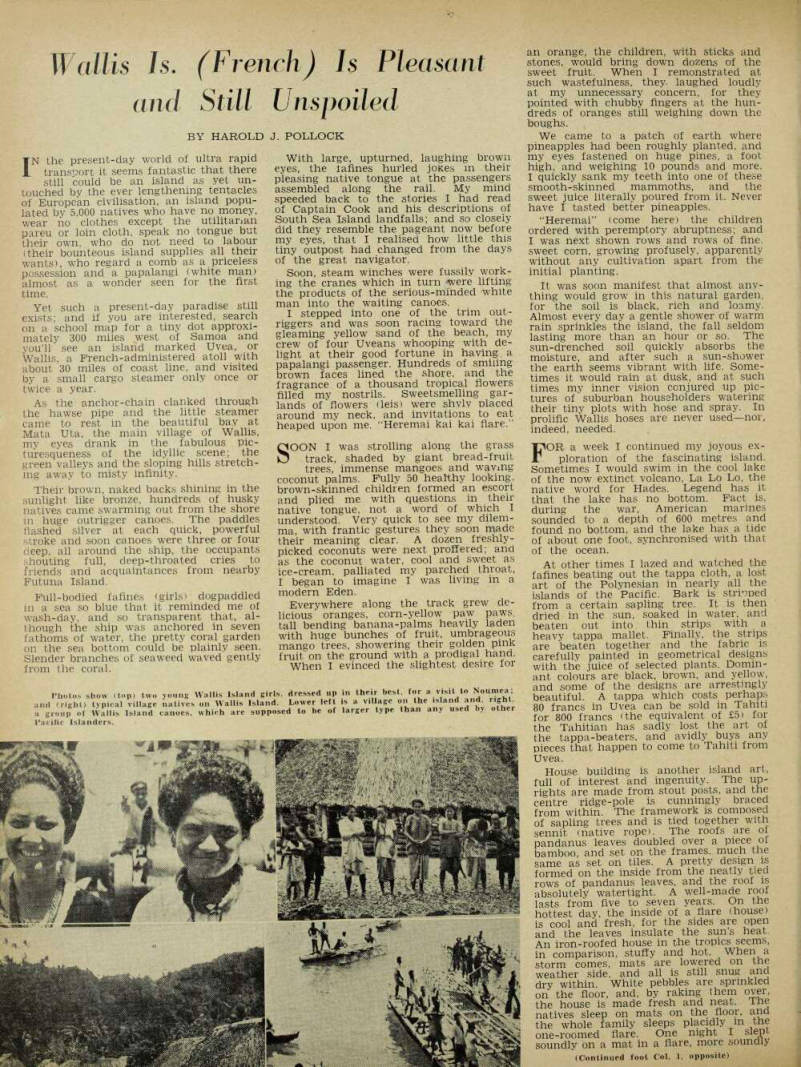
Photos show (top) two young Wallis Island girls, dressed up in their best, for and (right) typical village natives on Wallis Island. Lower left is a village on the island and right a group of Wallis island canoes, which are supposed to be of larger type than any used by other Pacific Islanders.
perhaps than I would have on a feather bed in a Queensland iron-roofed house, for there are no, or few, mosquitoes in Uvea.
One day is much the same as another in Wallis, and they slip by without worry, without hurry, and without an angry word. Sometimes, as the hush of even ing gently fell over Uvea, I would sit on the beach and listen to the gentle lap lap of the waters on the shore of the blue lagoon. The sweet scents of the lovely Tiare Tahiti gardenia and the Frangi pani mingled with the pungent smell of the cooking fires, and of the damp earth.
The merry laughter of the natives swim ming in the lagoon would float away in the still air. The flafes of the Uveans fishing on the reef reminded me of a street of electric lights. A feeling of content would steal over me, as I dreamed on for an hour or so, and then slowly paddled out to the ship, swinging to her anchor chain.
So, Mr. Beachcomber, Mr. Tired Busi nessman, Mr. Naturist, if you are search ing for your Utopia, don’t worry about the much-publicised islands like Tahiti, Fiji, and Samoa, for I know you will be disap pointed. If there is a spot on this planet more like Eden than Uvea —well, that’s the place I’m heading for on my next holiday.