At The Club
pp. 45-52 · Read in the full issue
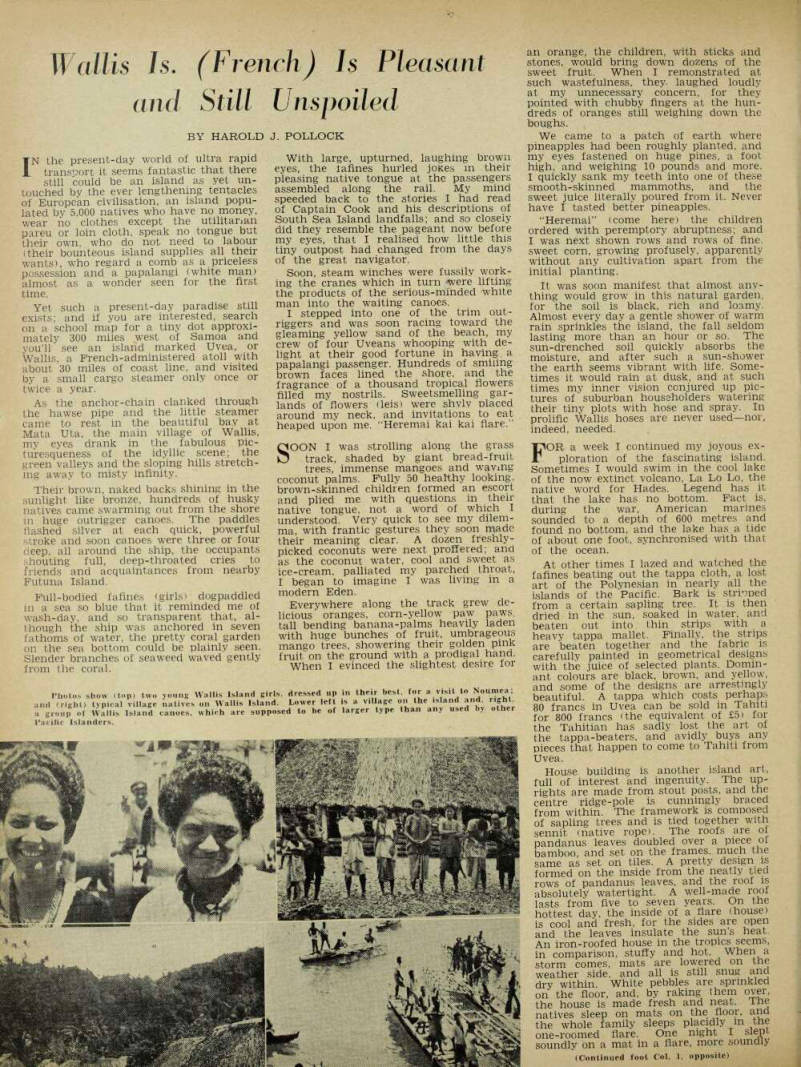
i( Oh to the club, the scene of savage joys, The school of coarse goodfellowship and noise.” 11HE man who penned that couplet in the 18th century had never heard of the New Hebrides; but it describes the “gamel” on Tomman Island, off the southern coast of Malekula to a tee, Joy is only relative, and good fellowship a matter of good fellows, whether they wear a “nambas” or a neck-tie. One hoped for the best and observed the de cencies of a guest, while avoiding the sprawling loops of carefully preserved liana vine, lying coiled about the sing sing drums.
As a club-house, the amenities were of the simplest. There was a roof of ragged palm thatch, relieved by Paisley-patterned crotons: the phallic stones to which pigs are tethered during the noisy delibera tions of what might be called committee meetings; and, of course, the lianas, which, to the untouched natives of the New Hebrides, represent nature’s umbili cal cord —that link with the Unknown that is the source of life itself. For all that, this little clearing in the bush was essentially a male retreat, to which women never come.
It must be confessed, however, that what the poet terms savage joy was not much in evidence just then. The members of this al fresco club were a reserved and rather sullen lot, whom conscience pricked, perhaps, into a state of mind con cerned more with the purpose of the British Agent’s visit, than with doing the carefree honours of the place.
It was not for them to know that we had merely dropped in during the course of a launch patrol around the shores of Malekula, that had as its object some business with the Big Nambas, further north. A trip inland to meet these people on their own ground was a major operation: but, as there is always a com ing and going between the mainland and surrounding islands, it is often poss ble to gain the latest information in the course of casual conversation.
ALINE drawn through a map of the New Hebrides touching the lower parts of Santo and Ambrym, may be taken as roughly dividing the social cus toms of the group. To the northward, for instance, women have some standing in the community, whereas in the south they have little or none. In what may be nothing more than a matter of degree,
By Basil Hall
it is a point of difference matched only by that peculiar form of loin ornament, lffl e ca ; t ir b u a p S on sizel gives P rise name of Big and Little Nambas, by which the Malekulans are generally known. on Tomman Island-as, indeed, in any part of Malekula except the nortn-wesc section—the people wear the small “nam bas,” and are not far from the days when the repulsive habit of binding tne heads of infants led to the elongated skull formation that is still a common sight, in the hills behind Port Sandwich women affect the kind of grass skirts that have a very “new look" when com pared with the minute coverings in vogue elsewhere. K vogue are who aS the bfg noTse Thev a re B n independent people, supporting their claim to isolation With regrettably modern methods of jungle warfare in which fire arms of the Tower muskrt viTrirtv Slav a n all too consnicnnnW V play A conspicuous part.
Amongst the old timers who had come know them in the hard wav was tne man who .had taken me to Tomman Island. This was C, G. M. Adams, who, as British Agent for Malekula, shared re sponsibility with his French colleague for H lO . peac f anc * good order of the place, r* 5? ost People would admit that the , e Ewan Corlette, of Bushmans Bay, knew I P, uc h about the natives of the New Hebrides as anyone, and it was to Or. S. M. Lambert <“A Doctor - n Ear . adlse ) had recommended me while
ln FIJI
- combined forty years’ ex perience of the group with a sound edu cation, and was much sought after by scientific bodies abroad as an authority upon the numerous dialects and inter locking customs that make Malekula the curiosity it is. He had no love for the Big Nambas (who had murdered his son) but he remained one of the few Europeans who had walked into their principal village of Amok, where the population is believed to number four hundred people In letters, before me now, he recalls these things, and refers again to the evening saunters we made together down the beach to what might well have been an other club. This was Adams’ comfortable veranda, where F. J. Fleming and “Rob bie” joined us to hear the wireless news, Man is a sociable creature and, whether white or brown, takes joy in the seclusion of his own particular club. In the “m’bure” of Fiji, in the “long houses” of
the Fly river area, or even in the Savage Club of Melbourne—where there is a lengthy waiting list—entry is a matter of some deliberation, and the newcomer would do well to watch his step. Good fellowship is as necessary in one place as the other; but, in the New Hebrides, a man must couple the usual qualifications with a herd of pigs. To him the fullness of the earth is represented by a multipli city of those long-snouted, slab-sided porkers, whose value increases as their tusks expand.
Even in portions of the group where women claim to have some standing, they never aspire to the dignity of the pig.
Females are suffered as necessary for the continuation of their respective kind; but the Big Nambas, who are still canni bals on occasion, and none too particular as to diet at the best of times, seldom eat anything of the softer sex. Women can be no more than the Marthas of these sylvan glades, whose mission it is to nurse piglet or piccaninny to an age when the males of both species begin to play their part in the tribal sing-sing ceremonies.
So far as the pig is concerned, his con tribution to the scheme of things com mences with the knocking out of the in cisor teeth, upon which the tusks of the lower jaw normally grind and sharpen.
Remove this obstruction, and there is nothing to prevent a pig’s teeth growing in a full circle, to enter the animal’s Up and then the jaw bone about the age of seven years. As values go, the pig may then be worth £7, and hand-feeding on yam mush and bananas becomes neces sary, if the tusk is to begin the second circle that is so much prized. At this stage, the pig has become a public charac ter, and is a source of pride to all con cerned. Should a price be mentioned, it might be as high as £3o—if there were any sellers.
BY the same well-defined steps, the boy and the growing pig follow their ap pointed paths.
The ritual concerning these things is undeviating; for, by the time the pig has become a £7 investment, a seven-years old boy has reached the painful period of
(Continued on Page 48)
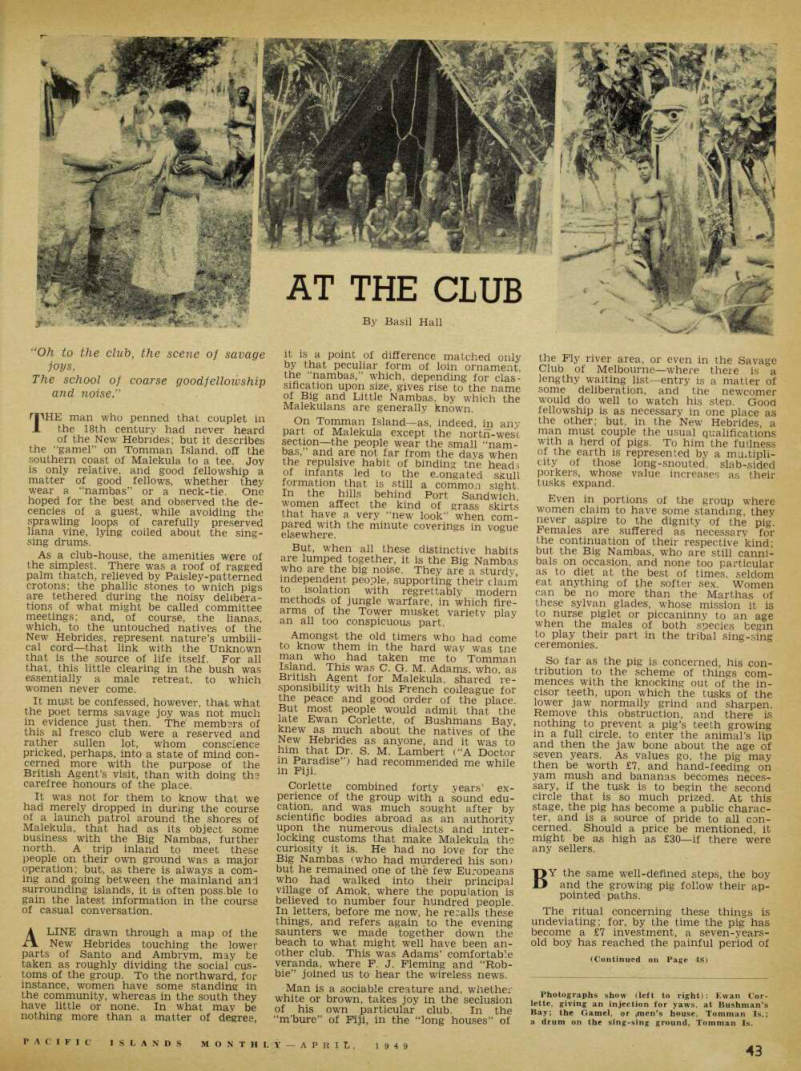
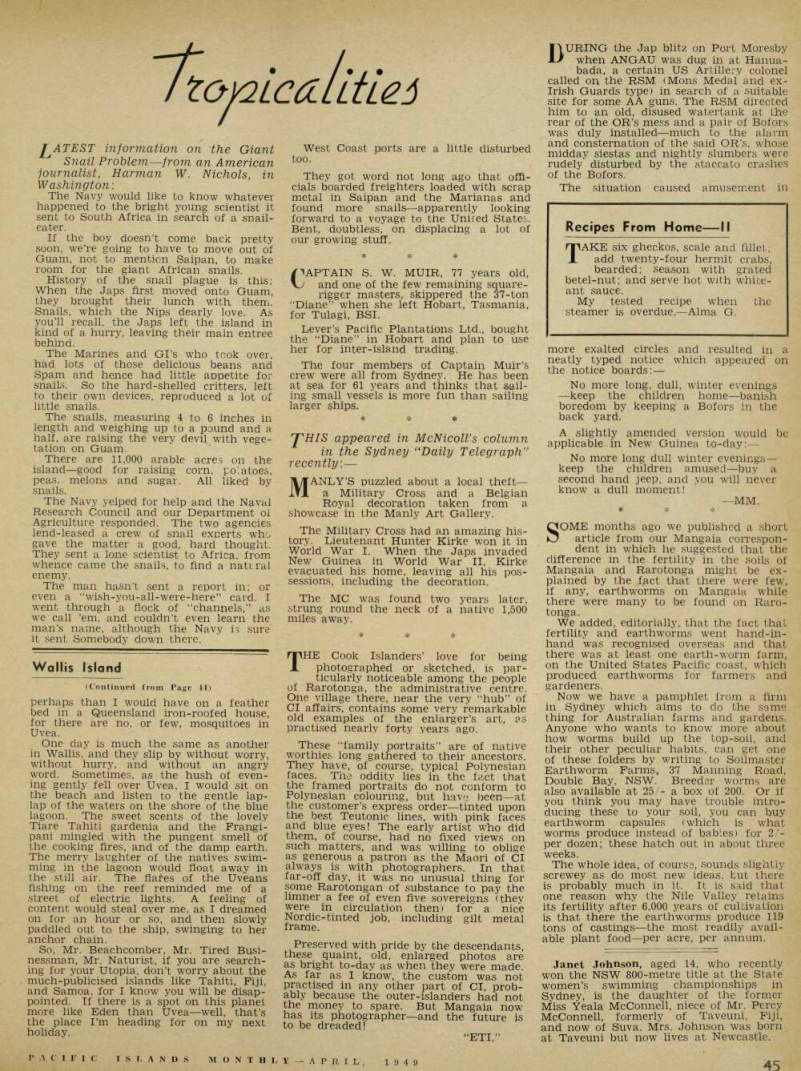
Photographs show (left to right): Ewan Cor lette, giving an injection for yaws, at Bushman’s Bay; the Gamel, or house, Tomman Is.; a drum on the sing-sing ground, Tomman Is.
initiation, and is free of his mother’s care and guidance. Now he may wear the "nambas” and is approaching that grand moment when he joins forces with his father’s pigs; the one to enter the men’s "gamel,” the other to become no more than the memory of a good deed in a naughty world.
For the first of a young man’s sing sings the whole family must prepare a good twelve months before, since upon a bumper yam harvest do they depend to feed their guests. Very often a whole year’s food supply is poured out in one glorious spree, leaving the kind of debt that hangs like a dark cloud in the back ground of a native’s life. Hard economic facts like this are the things that go to swell a British planter’s labour line, and the recruiter follows close upon the sing sing hang-over.
In a world of clubs and pubs—the two being synonymous in Malekula where the big Nambas brew a form of kava —a boy prepares for his first sing-sing, by tying his pigs with the traditional wild cane bands before those ancestral drums (“tame”) that dominate the dancing ground. Pop-eyed with excitement, he follows his prancing elders through all the intricacies of a complicated dance; dazzled by the light of torches, deafened by chanting, hand-clapping and the thud of drums, he has reached manhood as he falls exhausted long before the night is done. His is now the right of member ship that carries with it a fire of his own in the “gamel,” and the chance to laugh
with “coarse good fellowship” at those same moss-hung stories that are a feature of any smoking room.
But he knows better than to believe that he has seen the last of pigs. If an en gaging young woman catches his eye, her parents will expect him to say it with pigs. He must have more pigs for his wife to rear, for, as a family man, it is up to him to work his way from the most junior to more senior places in the club life of the “gamel,” and, once more, a sing-sing is the necessary procedure. This time, he will tie his offering to stakes cut
from the Dragon’s Blood tree and. with each succeeding grade, to those of the coral tree (Nen-Rar), the cycus palm; to stakes of teak, and to slabs of stone wnoie height increases with advancement. One can compress the ladder of life into a dozen lines; but multiply the years in terms of pig currency, and it becomes apparent that only the rich man really scales the social peaks.
Pig money or what passes for the same elsewhere —well, you know the answer! I have a feeling, too, that Wil liam Cowper’s lines describe most clubs— or should we scornfully reject the word "noise?”
Monsieur Girault, Administrator of Colonies Ist Class, has arrived at Papeete, Tahiti, as Secretary-General of French Oceania. Another arrival is M. Vaissiere, a French educationist, who is to organise technical instruction in Tahiti.
Like New Caledonian students, who get an allowance of 12,000 metropolitan francs when attending French universities, Tahitian students are now to receive al lowances amounting to 13,000 francs monthly at Paris or Marseilles, and 12,000 at other French universities.