We went Recruiting in the Gilberts
pp. 46-60 · Read in the full issue
STORY BY BRETT HILDER—PHOTOGRAPHY BY 'MULIAMA CAMERA CLUB
r pHE three Line atolls belonging to Britain are Washington . Fanning and Christmas. Although they vary greatly in development, area and rainfall, their copra production is very similar, having an upper limit of 1,000 tons a year. This ivould require about 100 labourers on each island, while at present there are only about 80. About half of these natives are married, having a wife and two children on the average; these men are all recruits from the Gilberts, as
there are no indigenous natives at all in the Line Islands. The necessary
recruiting trips take place every 18
months, and this year, as in 1947, the work was done by the <( Muliama,”
temporarily diverted from her regular
run to the Solomons.
WE entered the Gilberts at Tarawa on October 30, landed some cargo and made all arrangements with the Government for the legality of the re cruiting. We set out with the veteran recruiter and boat-builder William Reiher. and a Government officer, Mr. Turbott.
We made Tabiteuea on November 3, where we hoped to recruit all the natives we wanted for the first voyage, as none of them were away at Ocean Island as usual. The last crowd of Gilbertese had gone on strike at Ocean, and had to be repatriated.
There was quite a carnival air and bustle about the village on our arrival, as this was also the day for the monthly council meeting or “Bure”, to which all the villages elect a representative called a “Kabure”. These, in turn, elect a Chief Kabure for the atoll, and the council governs the island under the strong hand of the Chief Magistrate who acts for the Crown, and who is assisted by a Scribe of the Court. All these native chiefs wear white shirts above their blue lava-lavas, while the two chief dignitaries also wear neat black ties and official belts of office.
The Bure was held in the Town Hall, the Kabures squatting around the centre, and with the men of the villages behind.
The open walls were lined with a changing mural of women and children.
The only furniture was the Government dinner-table and its chairs, borrowed for the occasion, for the seating of the Europeans. These consisted of the Government officer, the recruiter, the visiting American anthropologist, Dr.
Luomala, and two or three of the ship’s officers.
The proceedings were all in Gilbertese, except when the Interpreter was em ployed to act, and the first business was the issue of a new ordinance to the Kabures on Native Government, called the New Constitution.
The recruiting then started by long readings of the terms of the agreement, and the Labour Ordinance which governs recruiting, labour, and repatriation. Then followed long debates on each point, with many rhetorical questions dear to the heart and pride of the Gilbertese.
When the rate of pay began to receive the same detailed examination as the budget in the House of Commons, one man tried to get the meeting to demand the same pay and conditions that they had failed to get by striking at Ocean Island. When honour had been satisfied by argument, he was hissed down, and he later melted away without offering for recruitment. We were able to get the done before the luncheon adjournment, and carry on with actual recruiting at 2 p.m.
We first called for 54 single men for Washington Island, and these were ob tained, village by village supplying its quota. As each man gave his name it was written on a slip of paper, for him
to get a medical ‘ pass”. The Interpreter was also the NMP, and he set up his brass-plate in an adjacent hut. Here he checked the recruits for leprosy, heart trouble, TB and VD, not without some good-natured raillery from the holiday crowd.
Upon being found fit they returned to sign on the dotted line of the contract, where the recruiter and the Government had previously affixed their signatures.
I was surprised at their general ability to write, but found out later that few can write much more than their name. Only one man was unable to sign, and in his shame crouched down below the table, trembling with the public disgrace of not having gone to school. The pen was forced into his hand and a cross achieved by force, when he scurried away amid the noise of general derision.
SOME of the youths were well under age, and these were rejected by the Government, but made numerous attempts to enlist, each time wearing a different lava-lava. Others of the “single” men were denounced by their wives or sweethearts, and shamed into retreat; some others, due to face their trial at the police-court the next day, were also denounced, and rejected, amidst howls of delight from the audience.
The 26 married men required for Wash ington could have been got ten times over. Each village had to be given a strict quota, and the only difference in their recruitment was that they had to declare the number of their children, of which they were only allowed to take two. The two permissable dependants, in addition to a wife, may include any adopted children, or even aunts and grandparents. Some of the so-called children included girls of marriageable age, and some of the youths who had failed to make the grade as recruits.
These dependants were not medically examined, nor could they be checked or tallied in any way.
The old-time recruiting consisted only in picking up young men who left home with nothing but a sleeping mat, as free as a swaggie. But nowadays the married men take most of their house hold gear in large sea-chests which they or their ancestors bought during their terms of recruitment. These camphor wood chests are not available now, so they have to bring the old ones into use.
Some of the chests looked of very fine make, and may have come from some of the numerous ships wrecked on the Gilberts, and Line atolls.
Recruiting is only permitted during the daylight—no doubt for the safety of the natives and their women against the vicious Blackbirders —so we had to get the last man signed on before sundown, and this? added some urgency to the problem which arose when we called for single men for Fanning Island.
For some reason there were no single men offering for recruitment for Fanning, which is normally preferred to Washing ton, as the work is much less arduous.
It is the wish of the Government that only married men be recruited, in order to maintain family life, and for the greater production of brown babies. But I suspect, in this case, that it was rather a matter of local economy. For Tabiteuea contains nearly 4,000 souls, for which there
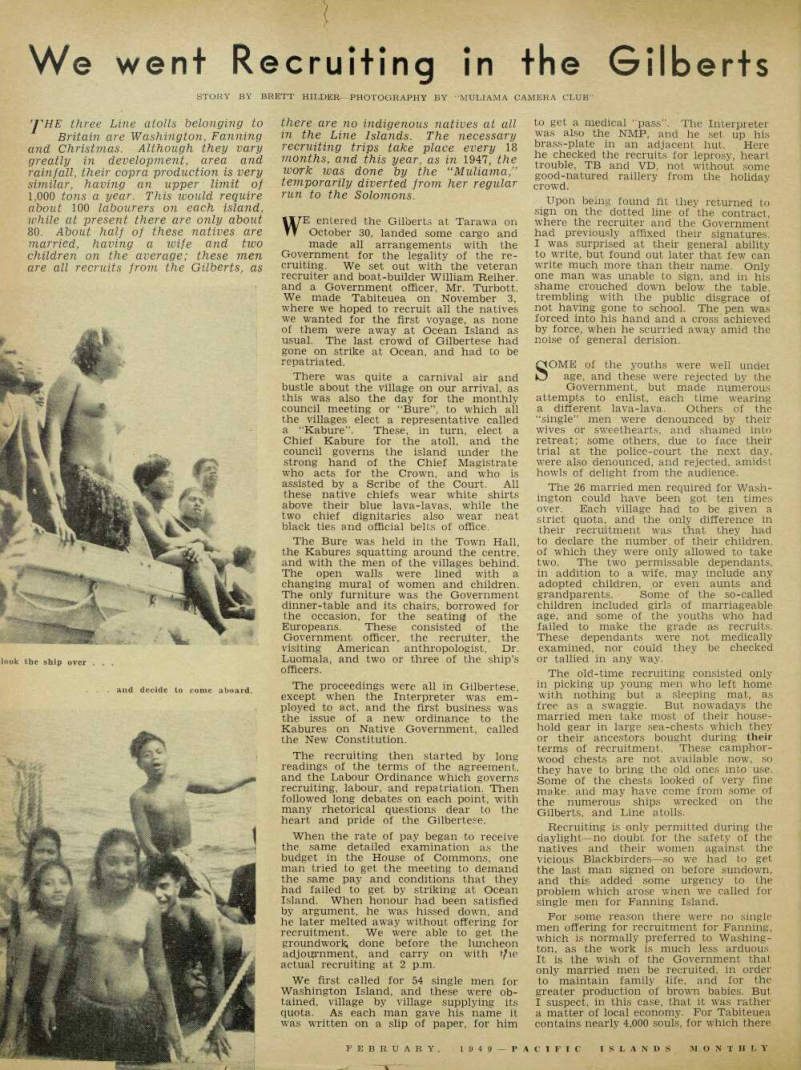
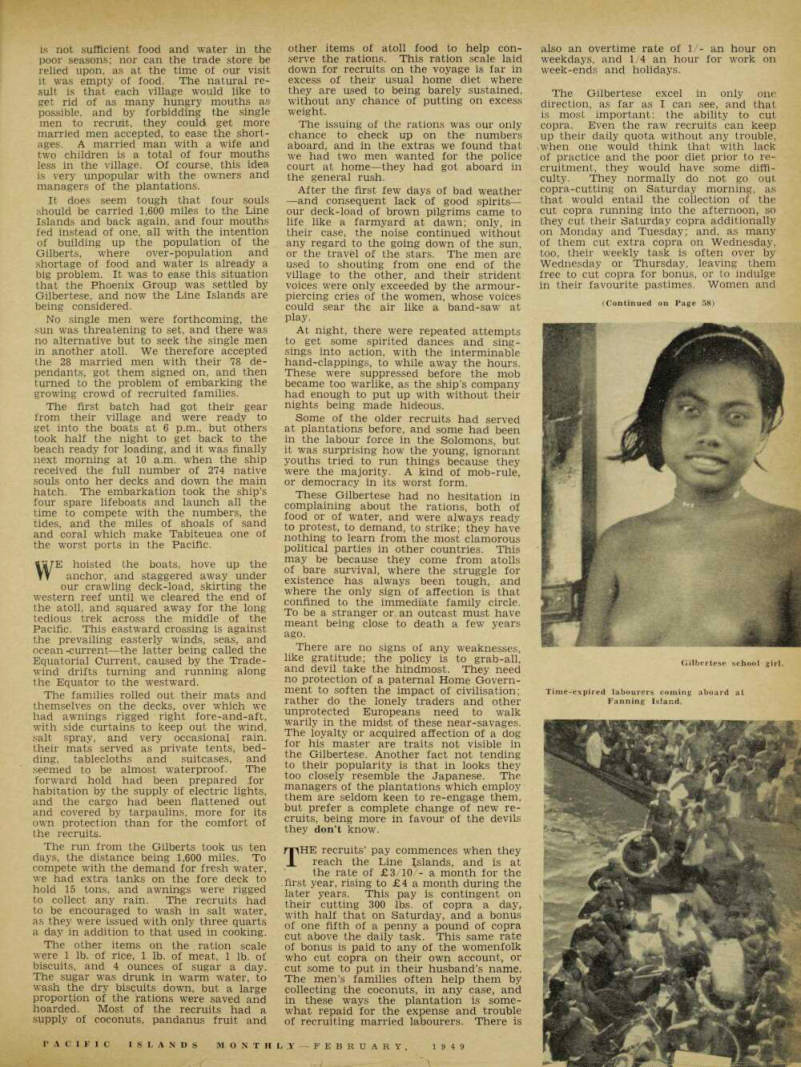
look the ship over . . .
and decide to come aboard.
is not sufficient food and water in the poor seasons; nor can the trade store be relied upon, as at the time of our visit it was empty of food. The natural re sult is that each village would like to get rid of as many hungry mouths as possible, and by forbidding the single men to recruit, they could get more married men accepted, to ease the short ages. A married man with a wife and two children is a total of four mouths less in the village. Of course, this idea is very unpopular with the owners and managers of the plantations.
It does seem tough that four souls should be carried 1,600 miles to the Line Islands and back again, and four mouths fed instead of one, all with the intention of building up the population of the Gilberts, where over-population and shortage of food and water is already a big problem. It was to ease this situation that the Phoenix Group was settled by Gilbertese, and now the Line Islands are being considered.
No single men were forthcoming, the sun was threatening to set, and there was no alternative but to seek the single men in another atoll. We therefore accepted the 28 married men with their 78 de pendants, got them signed on, and then turned to the problem of embarking the growing crowd of recruited families.
The first batch had got their gear from their village and were ready to get into the boats at 6 p.m., but others took half the night to get back to the beach ready for loading, and it was finally next morning at 10 a.m. when the ship received the full number of 274 native souls onto her decks and down the main hatch. The embarkation took the ship’s four spare lifeboats and launch all the time to compete with the numbers, the tides, and the miles of shoals of sand and coral which make Tabiteuea one of the worst ports in the Pacific.
WE hoisted the boats, hove up the anchor, and staggered away under our crawling deck-load, skirting the western reef until we cleared the end of the atoll, and squared away for the long tedious trek across the middle of the Pacific. This eastward crossing is against the prevailing easterly winds, seas, and ocean-current—the latter being called the Equatorial Current, caused by the Trade wind drifts turning and running along the Equator to the westward.
The families rolled out their mats and themselves on the decks, over which we had awnings rigged right fore-and-aft, with side curtains to keep out the wind, salt spray, and very occasional rain, their mats served as private tents, bed ding, tablecloths and suitcases, and seemed to be almost waterproof. The forward hold had been prepared for habitation by the supply of electric lights, and the cargo had been flattened out and covered by tarpaulins, more for its own protection than for the comfort of the recruits.
The run from the Gilberts took us ten days, the distance being 1,600 miles. To compete with the demand for fresh water, we had extra tanks on the fore deck to hold 15 tons, and awnings were rigged to collect any rain. The recruits had to be encouraged to wash in salt water, as they were issued with only three quarts a day in addition to that used in cooking.
The other items on the ration scale were 1 lb. of rice, 1 lb. of meat, 1 lb. of biscuits, and 4 ounces of sugar a day.
The sugar was drunk in warm water, to wash the dry biscuits down, but a large proportion of the rations were saved and hoarded. Most of the recruits had a supply of coconuts, pandanus fruit and
other items of atoll food to help con serve the rations. This ration scale laid down for recruits on the voyage is far in excess of their usual home diet where they are used to being barely sustained, without any chance of putting on excess weight.
The issuing of the rations was our only chance to check up on the numbers aboard, and in the extras we found that we had two men wanted for the police court at home —they had got aboard in the general rush.
After the first few days of bad weather —and consequent lack of good spirits— our deck-load of brown pilgrims came to life like a farmyard at dawn; only, in their case, the noise continued without any regard to the going down of the sun, or the travel of the stars. The men are used to shouting from one end of the village to the other, and their strident voices were only exceeded by the armour piercing cries of the women, whose voices could sear the air like a band-saw at play.
At night, there were repeated attempts to get some spirited dances and sing sings into action, with the interminable hand-clappings, to while away the hours.
These were suppressed before the mob became too warlike, as the ship’s company had enough to put up with without their nights being made hideous.
Some of the older recruits had served at plantations before, and some had been in the labour force in the Solomons, but it was surprising how the young, ignorant youths tried to run things because they were the majority. A kind of mob-rule, or democracy in its worst form.
These Gilbertese had no hesitation in complaining about the rations, both of food or of water, and were always ready to protest, to demand, to strike; they have nothing to learn from the most clamorous political parties in other countries. This may be because they come from atolls of bare survival, where the struggle for existence has always been tough, and where the only sign of affection is that confined to the immediate family circle.
To be a stranger or. an outcast must have meant being close to death a few years ago.
There are no signs of any weaknesses, like gratitude; the policy is to grab-all, and devil take the hindmost. They need no protection of a paternal Home Govern ment to soften the impact of civilisation; rather do the lonely traders and other unprotected Europeans need to walk warily in the midst of these near-savages.
The loyalty or acquired affection of a dog for his master are traits not visible in the Gilbertese. Another fact not tending to their popularity is that in looks they too closely resemble the Japanese, The managers of the plantations which employ them are seldom keen to re-engage them, but prefer a complete change of new re cruits, being more in favour of the devils they don’t know.
THE recruits’ pay commences when they reach the Line Islands, and is at the rate of £3/10 - a month for the first year, rising to £4 a month during the later years. This pay is contingent on their cutting 300 lbs. of copra a day, with half that on Saturday, and a bonus of one fifth of a penny a pound of copra cut above the daily task. This same rate of bonus is paid to any of the womenfolk who cut copra on their own account, or cut some to put in their husband’s name.
The men’s families often help them by collecting the coconuts, in any case, and in these ways the plantation is some what repaid for the expense and trouble of recruiting married labourers. There is
also an overtime rate of 1/- an hour on weekdays, and 14 an hour for work on week-ends and holidays.
The Gilbertese excel in only one direction, as far as I can see, and that is most important: the ability to cut copra. Even the raw recruits can keep up their daily quota without any trouble, when one would think that with lack of practice and the poor diet prior to re cruitment, they would have some diffi culty. They normally do not go out copra-cutting on Saturday morning, as that would entail the collection of the cut copra running into the afternoon, so they cut their Saturday copra additionally on Monday and Tuesday; and, as many of them cut extra copra on Wednesday, too, their weekly task is often over by Wednesday or Thursday, leaving them free to cut copra for bonus, or to indulge in their favourite pastimes. Women and
(Continued on Page 58)
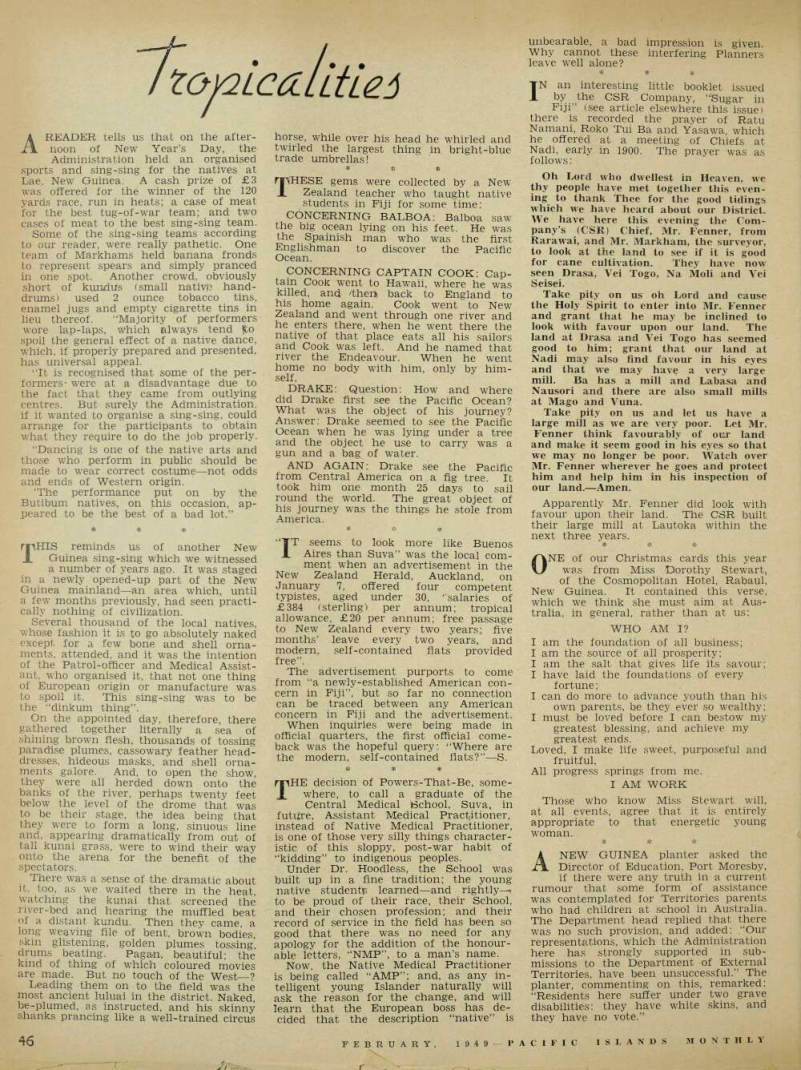
Gilbertese school girl.
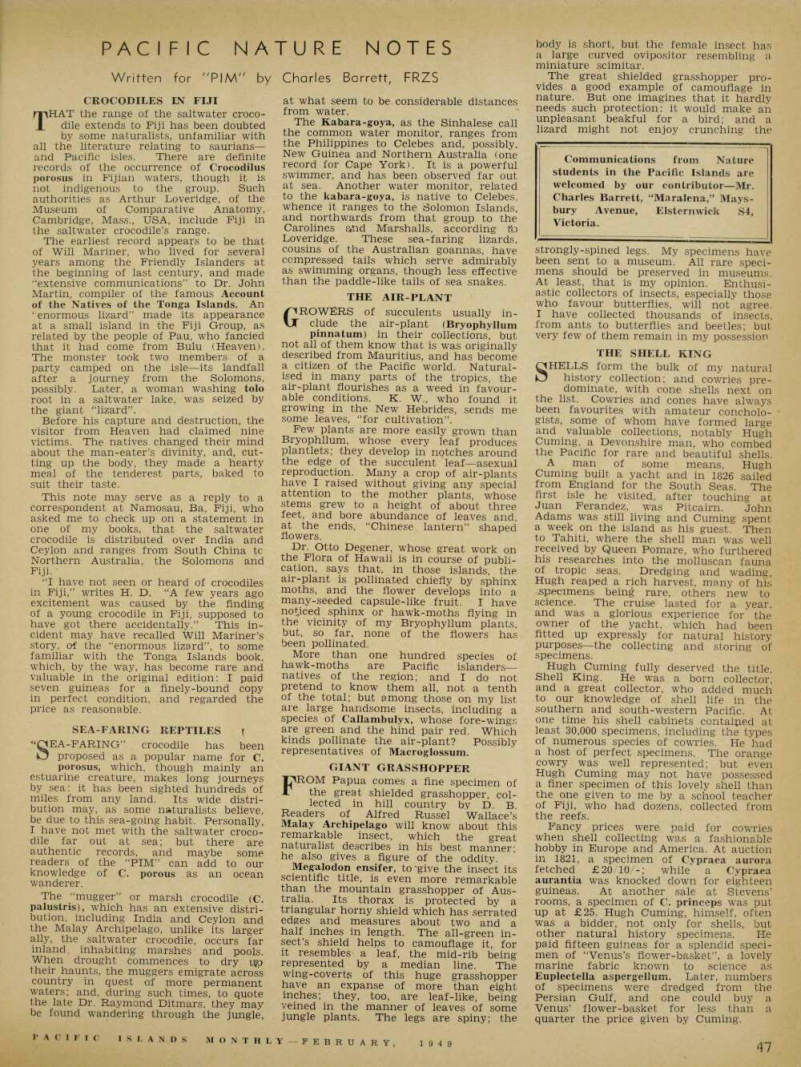
Time-expired labourers coming aboard at Fanning Island.
illicit gambling seem to be among these occupations. A .
Most of the recruits save a lot of their rations on the plantations, and buy
further supplies with their pay, as well as trade-goods like sewing-machines and bicycles. When the time comes for their repatriation they have nearly a ton of personal gear apiece—bags and drums of flour, rice and sugar, boxes full of biscuits, and miles of calicoes. They have lived off the land to a great extent, on native foods grown by themselves or inherited
from the previous recruits.
All the coconuts they eat are charged at the rate of one penny each, which is roughly their value as copra, and there is no check at all on the number they consume. After their experience of living on a well-run plantation, having plenty of food and also some money to buy trade goods, they should not curse the workings of private enterprise and the Big Firms. They have also seen a large island run efficiently, without the continuous arguments, debates and lack of co-operation which is usual on their own democratic islands.
ON our first trip we renewed the labour force of Washington and half that of Fanning, and on the second trip we brought replacements for the other half of Fanning and all the new recruits required for Christmas Island. There was a very marked change in the recruits during their period of indenture. After their time is over they are much quieter, reasonable, docile and peaceful. They seem to be aware of the fact that the whole ship doesn’t belong to them, as did their own island, and that there are other people in the world besides them selves and their own little wants and habits. I believe that they are much better citizens for their short and materially profitable experience of work ing for a commercial concern.
On our first return voyage we were notified that a leper had gone from one plantation, and was suspected of being aboard. This turned out to be true, the Tabiteueans having smuggled him aboard ujiseen, and kept him hidden among themselves in a life-boat, surrounded, as usual, by plenty of mats.
They had no fear of the disease, nor did the leper have any worries; and he is now safely on his way to Makogai, Fiji. An other addition* to our family was the birth of a daughter to the wife of a recruit, Tu kiara, and although I suggested that the girl be named Muliama, they may not have taken it seriously. v We finally discharged the last of our repatriates at Tarawa on January 7 of this year, and made our farewells to the Gilberts the same day, getting out of the lagoon just before dusk.
No more till next time!