The Marquis provided
pp. 45-59 · Read in the full issue
the mill-stone
By Judy Tudor
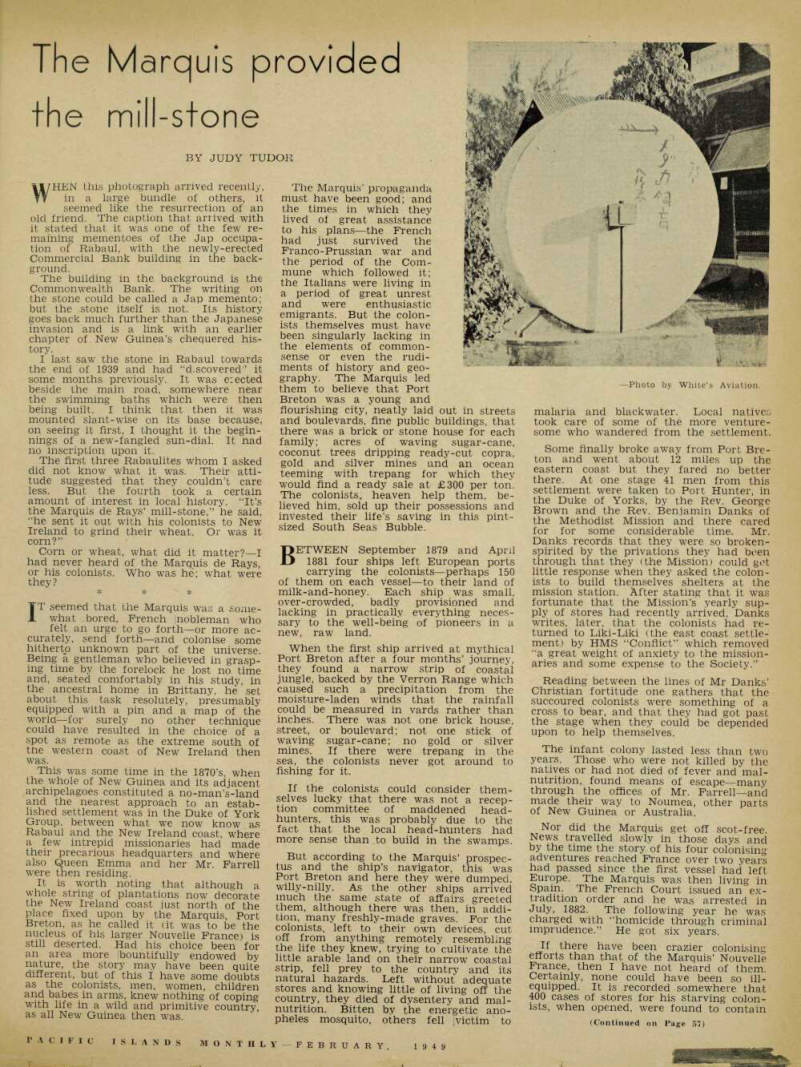
WHEN this photograph arrived recently, in a large bundle of others, it seemed like the resurrection of an old friend. The caption that arrived with it stated that it was one of the few re maining mementoes of the Jap occupa tion of Rabaul, with the newly-erected Commercial Bank building in the back ground.
The building in the background is the Commonwealth Bank. The writing on the stone could be called a Jap memento; but the stone itself is not. Its history goes back much further than the Japanese invasion and is a link with an earlier chapter of New Guinea’s chequered his tory.
I last saw the stone in Rabaul towards the end of 1939 and had “d.scovered” it some months previously. It was erected beside the main road, somewhere near the swimming baths which were then being built. I think that then it was mounted slant-wise on its base because, on seeing it first, I thought it the begin nings of a new-fangled sun-dial. It nad no inscription upon it.
The first three Rabaulites whom I asked did not know what it was. Their atti tude suggested that they couldn’t care less. But the fourth took a certain amount of interest in local history. “It’s the Marquis de Rays’ mill-stone,” he said, “he sent it out with his colonists to New Ireland to grind their wheat. Or was it corn?”
Corn or wheat, what did it matter?—l had never heard of the Marquis de Rays, or his colonists. Who was he; what were they? * * ♦ IT seemed that the Marquis was a some what bored, French Inobleman who felt an urge to go forth—or more ac curately, send forth—and colonise some hitherto unknown part of the universe.
Being a gentleman who believed in grasp ing time by the forelock he lost no time and, seated comfortably in his study, in the ancestral home in Brittany, he set about this task resolutely, presumably equipped with a pin and a map of the world—for surely no other technique could have resulted in the choice of a spot as remote as the extreme south of the western coast of New Ireland then was.
This was some time in the 1870’s, when the whole of New Guinea and its adjacent archipelagoes constituted a no-man’s-land and the nearest approach to an estab lished settlement was in the Duke of York Group, between what we now know as Rabaul and the New Ireland coast, where a few intrepid missionaries had made their precarious headquarters and where also Queen Emma and her Mr. Farrell were then residing.
It is worth noting that although a whole string of plantations now decorate the New Ireland coast just north of the place fixed upon by the Marquis, Port Breton, as he called it (it was to be the nucleus of his larger Nouvelle France) is still deserted. Had his choice been for an area more 'bountifully endowed by nature, the story may have been quite different, but of this I have some doubts as the colonists, men, women, children and babes in arms, knew nothing of coping with life in a wild and primitive country, as all New Guinea then was.
The Marquis’ propaganda must have been good: and the times in which they lived of great assistance to his plans—the French had just survived the Franco-Prussian war and the period of the Com mune which followed it; the Italians were living in a period of great unrest and were enthusiastic emigrants. But the colon ists themselves must have been singularly lacking in the elements of common sense or even the rudi ments of history and geo graphy. The Marquis led them to believe that Port Breton was a young and
flourishing city, neatly laid out in streets and boulevards, fine public buildings, that there was a brick or stone house for each family; acres of waving sugar-cane, coconut trees dripping ready-cut copra, gold and silver mines and an ocean teeming with trepang for which they would find a ready sale at £3OO per ton.
The colonists, heaven help them, be lieved him, sold up their possessions and invested their life’s saving in this pint sized South Seas Bubble.
BETWEEN September 1879 and April 1881 four ships left European ports carrying the colonists —perhaps 150 of them on each vessel—to their land of milk-and-honey. Each ship was small, over-crowded, badly provisioned and lacking in practically everything neces sary to the well-being of pioneers in a new, raw land.
When the first ship arrived at mythical Port Breton after a four months’ journey, they found a narrow strip of coastal jungle, backed by the Verron Range which caused such a precipitation from the moisture-laden winds that the rainfall could be measured in yards rather than inches. There was not one brick house, street, or boulevard; not one stick of waving sugar-cane; no gold or silver mines. If there were trepang in the sea, the colonists never got around to fishing for it.
If the colonists could consider them selves lucky that there was not a recep tion committee of maddened head hunters, this was probably due to the fact that the local head-hunters had more sense than to build in the swamps.
But according to the Marquis’ prospec tus and the ship’s navigator, this was P<prt Breton and here they were dumped, willy-nilly. As the other ships arrived much the same state of affairs greeted them, although there was then, in addi tion, many freshly-made graves. For the colonists, left to their own devices, cut off from anything remotely resembling the life they knew, trying to cultivate the little arable land on their narrow coastal strip, fell prey to the country and its natural hazards. Left without adequate stores and knowing little of living off the country, they died of dysentery and mal nutrition. Bitten by the energetic ano pheles mosquito, others fell [victim to
malaria and blackwater. Local natives took care of some of the more venture some who wandered from the settlement.
Some finally broke away from Port Bre ton and went about 12 miles up the eastern coast but they fared no better there. At one stage 41 men from this settlement were taken to Port Hunter, in the Duke of Yorks, by the Rev. George Brown and the Rev. Benjamin Danks of the Methodist Mission and there cared for for some considerable time. Mr.
Danks records that they were so broken spirited by the privations they had been through that they (the Mission) could get little response when they asked the colon ists to build themselves shelters at the mission station. After stating that it was fortunate that the Mission’s yearly sup ply of stores had recently arrived, Danks writes, later, that the colonists had re turned to Liki-Liki (the east coast settle ment) by HMS “Conflict” which removed “a great weight of anxiety to the mission aries and some expense to the Society.”
Reading between the lines of Mr Danks’
Christian fortitude one gathers that the succoured colonists were something of a cross to bear, and that they had got past the stage when they could be depended upon to help themselves.
The infant colony lasted less than two years. Those who were not killed by the natives or had not died of fever and mal nutrition, found means of escape—many through the offices of Mr. Farrell—and made their way to Noumea, other parts of New Guinea or Australia.
Nor did the Marquis get off scot-free.
News travelled slowly in those days and by the time the story of his four colonising adventures reached Prance over two years had passed since the first vessel had left Europe. The Marquis was then living in Spain. The French Court issued an ex tradition order and he was arrested in July, 1882. The following year he was charged with “homicide through criminal imprudence.” He got six years.
If there have been crazier colonising efforts than that of the Marquis’ Nouvelle France, then I have not heard of them.
Certainly, none could have been so ill equipped. It is recorded somewhere that 400 cases of stores for his starving colon ists, when opened, were found to contain
(Continued on Page 57)
Photo by White’s Aviation.
2,000 dog-collars, a Punch and Judy show and thousands of satin slippers. Possibly it was at this time also, that the Marquis opened his heart and sent them the mill stone. ♦ ♦ * IDO not know which of Rabaul’s history minded citizens was instrumental in having the old relic brought across from Port Breton but Commander C. J.
R. Webb, then harbour-master at Rabaul, performed the actual task. I believe, some time between 1937 and 1938. The job was difficult but he accomplished it by tow ing the stone on a raft behind a govern ment schooner.
It seems [strange, indeed, that when the rest of Rabaul was completely erased from the map by Allied bombing, be tween 1942 and 1945, this old link with another murky incident in New Guinea’s past, should survive. It seemed so im probable that I consulted Mr. Gordon Thomas who was one of the handful who lived through the occupation of Rabaul.
He replied—Yes, the old mill-stone was lying about somewhere after Rabaul had been done-over, and that he remembered seeing it when he came into the town again. By then the Jap characters had been written upon it and it was suggested that they meant “Nippon above all!”
However, Mr, Thomas seems to doubt this and, in view of the arrow thereon, it seems more probable that the characters merely mean “This way to the canteen’’— or the Jap equivalent.
Mr. Thomas says that the only “me men to erected by the Japs was a wooden pillar about 18 feet high, commemorating their victory in Rabaul in January, 1942.
Among the prisoners who were later sent away to their death in the ill-fated “Mon teyideo Maru,” but who then were im prisoned in the town, there was much talk
of pulling it down when Rabaul was again in Allied hands. But Mr. Harold Page, New Guinea Government Secretary, said; “No, let’s keep it there. We’ll put a post script to the thing commemorating our return to Rabaul.”
But the wooden pillar proved as un substantial as the Japanese hold on New Britain, After the Jap surrender in 1945 it was found that several years of Allied bombing had left nothing of it.
A publican’s license for premises at Wau, New Guinea, to be known as the Kaindi Hotel, has been granted to Mr.
Joseph Michael Bourke.