High Chief’S
p. 50 · Read in the full issue
Stick
Comes Home
IN 1941 when Fiji’s RAF contingent was preparing to depart from the Colony for training in Rhodesia. Ratu Sir Lala Sukuna, presented them with a walking stick.
This was no ordinary walking stick however, but had belonged to Ma’afu, the high chief who went from Tonga to Lau over 100 years ago, and whose skill m war and influence on the native life of the time made him an outstanding figure in the Colony’s early history.
Ratu Sir Lala is one of his descendants.
When Sir Lala presented the stick he asked the contingent to take it with them wherever they went, and when the war ended, to bring it back to him.
The stick was placed in charge of the youngest member of the contingent,Mr Don Aidney, DFC, and travelled with the first draft to Rhodesia, where the men began their training. After the training period, the group was split up, some members of the contingent going to bombers, others to fighters, and others being given training duties. The stick, left in charge of Mr. J. Haney, was later taken to England and eventually returned to Fiji.
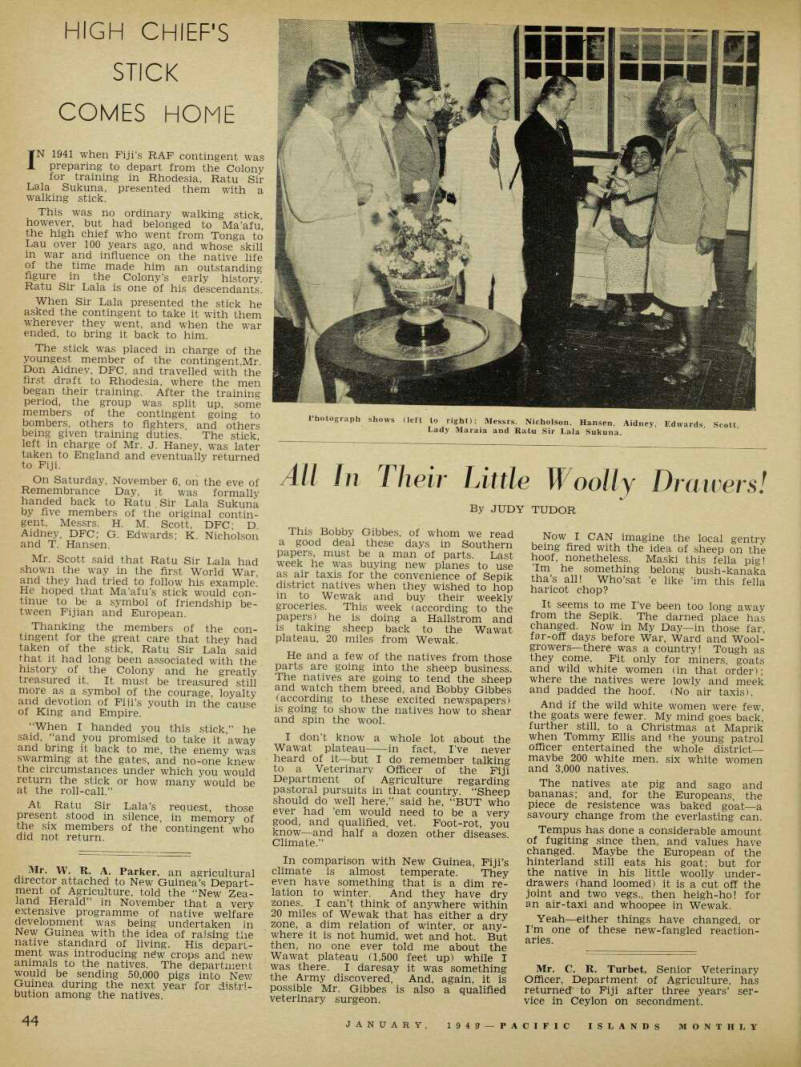
On Saturday, November 6, on the eve of Remembrance Day, it was formally handed back to Ratu Sir Lala Sukuna by five members of the original contin gent, Messrs. H. M. Scott, DFC • D Aidney, DFC; G. Edwards: K. Nicholson and T. Hansen.
Mr. Scott said that Ratu Sir Lala had shown the way in the first World War, and they had tried to follow his example.
He hoped that Ma’afu’s stick would con tinue to be a symbol of friendship be tween Fijian and European.
Thanking the members of the con tingent for the great care that they had taken of the stick, Ratu Sir Lala said that it had long been associated with the history of the Colony and he greatly treasured it. It must be treasured still more as a symbol of the courage, loyalty and devotion of Fiji’s youth in the cause of King and Empire.
“When I handed you this stick ” he said, “and you promised to take it away and bring it back to me, the enemy was swarming at the gates, and no-one knew the circumstances under which you would return the stick or how many would be at the roll-call.”
At Ratu Sir Lala’s request, those present stood in silence, in memory of the six members of the contingent who did not return.
Mr. W. R. A. Parker, an agricultural director attached to New Guinea’s Depart ment of Agriculture, told the “New Zea land Herald” in November that a very extensive programme of native welfare development was being undertaken in New Guinea with the idea of raising the native standard of living. His depart ment was introducing n£w crops and new animals to the natives. The department would be sending 50,000 pigs into New Guinea during the next year for distri bution among the natives.
Photograph shows (left to right): Messrs. Nicholson. Hansen. Aidney, Edwards, Scott Lady Maraia and Ratu Sir Lala Sukuna.