Abemama, Land of Moonlight
p. 49 · Read in the full issue
by G. A. Maxwell
ON May 27, 1892, Commander H. M.
Davis, of HMS Royalist, went ashore at Abemama, and proclaimed the Gilbert Islands a British possession in the name of Queen Victoria. Why he should choose Abemama is hard to say, because it is just another atoll, such as you might see by the dozen, scattered throughout the Pacific. In those days, however, it was the seat of the Gilbertese King, so possibly that justified his decision.
Abemama is remote, and it is lonely.
The white population numbers one Government official, and a few mission aries, while the native population totals eight hundred. Ships come at long and irregular intervals bringing mail and cargo. Great is the excitement as they sail through the entrance, past Biki, and drop anchor in the lagoon; but they are soon gone, and Abemama seems more lonely, and more remote than ever.
It may be due to this sense of isolation that Abemama has earned the reputation of being a lazy island. The natives here do little in the way of handiwork. They will weave their own sleeping-mats and blinds, build their own canoes, and make their rope from coconut fibre, but you can procure little in the way of curios, such as other islands have to offer.
Yet when it comes to cutting copra, I do not think you would call them lazy.
Prices are high just now, and from morn ing till night, you will see men, women and children alike wielding their copra knives, as if there is a race to be won.
The quality of their copra, however, is poor—due a good deal to their method of cutting the coconut into pieces and allowing the fats to escape.
If Abemama is a lazy island, then it is also a peaceful island. The young natives will make any excuse at all to travel to the islands where life is more bright and gay; but the older ones remain. It is quiet here, they say—no fights. For that reason, the jail (they have a jail) is rarely occupied. Other offences, such as drinking sour toddy, or riding their bicycles at night without a light, is punished by the payment of a small “find”.
Nor did they enjoy the war years. It seems strange that Abemama, lying so quietly beyond the grasping fingertips of
civilization, should have known the tortures of war. The scars are still there, should you wish to see them. They knew the cruelty of the Japanese, and the mis guided generosity of the Americans; but they remember the Americans and their kindness, far more than they do the Japanese.
There are six villages on Abemama, 3 lying north and 3 south, and although I frequented the north more I liked the south better. The atmosphere there was always hushed, and very peaceful, the villages cleaner, and I liked the passages of water you meet running through the island from the ocean into the lagoon.
All these passages, except the third one, swept straight through: but one passage stopped half-way, turned and- wandered for some way down the centre of the island before it finally let itself out into the lagoon.
I liked the crude little native bridge which allowed you to pass across half way down, and I liked the way William Reiher, the half-German boatbuilder and pilot, had built his house out over the water. As you cross the bridge you come upon the Catholic Mission station, with its gleaming white church and rows of dormitories for native students. They call this area “Tebanga”, which means, “Holy Place”.
If you take the road that leads on down from Tebanga, you come to Manuku, and another passage, the loveliest of them all.
Here the water is as clear as crystal, and as blue as sapphires. For fishermen it would be an ideal spot, but for the fish it is just a good place to be, because as you cross this passage, you come to the most southern tip of the island, and, like ■‘Biki”, which guards the lagoon entrance, no one lives here.
I think I liked this spot best of all. The palms almost touched overhead, making the road an avenue which led to the very end. It was always cool here, and the dark shadows on either side suggested mystery, and. the past. It is one of the few places on earth where time has no meaning. Nothing changes, no one comes or goes, there is nothing to rise and fall — a place where you could call the future the past.
FOR nine months I lived on Abemama, and not one day out of those nine months did I not yearn to be gone; to put the sight of the place behind me forever. At sunset I would wander along the shore of the lagoon, longing for the day when I would sail past Biki into the ocean beyond.
It was not until three months had passed that I realized the lagoon was so beautiful. It was the colours which forced themselves upon me, reflections from the sun and sky. I cannot say which was the most beautiful that flame along the horizon, the- silver grey, the delicate apple green, the pale yellow, the misty blue, shell pink, amber. Desperately I tried to make my decision, but they merged, folded, and drifted away and I was glad I could not decide. After that, the lagoon was no longer a place to nurse my longing and discontent.
Sometimes I would walk on the ocean side of the island and listen to the surf beating on the reef, the everlasting roll and roar of the waves, until I thought it was the only sound that ever was. It was on this side, and not far from where I lived that you came to Foo Bay, so named after Robert Louis Stevenson’s Chinese servant, and where he is said to have walked in the evenings playing his flute. Like the lagoon, I was slow to find the beauty. Not until the peace and quietness had absorbed my fret did I realize that there was anything really worth going there for; but, as I said, that is where the treachery lies.
It was not until a couple of nights be fore I left, however, that I knew that all the things ever written about the moon light, were perfectly true. I had seen the beauty of this island in many ways and aspects, but this night, sitting on my step, I thought there could never have been anything quite so perfect before or since.
My trunks were packed and ready. The 60 ft. “Maureen” was waiting, white and innocent in the lagoon, and Abemama had come to say goodbye. I went to bed early that night, for the next day I was going to see my friends for the last time.
I found Agnes reading on her verandah and/ as I hopped off my cycle, she laid aside her book and bade me sit down.
One frail little hand clasped the bowl of her pipe, and for a while we talked. Her voice was lovely.
“Agnes”, I said. “What does Abemama mean in English?”
"Abemama?” she said, “It means the Land of Moonlight.”
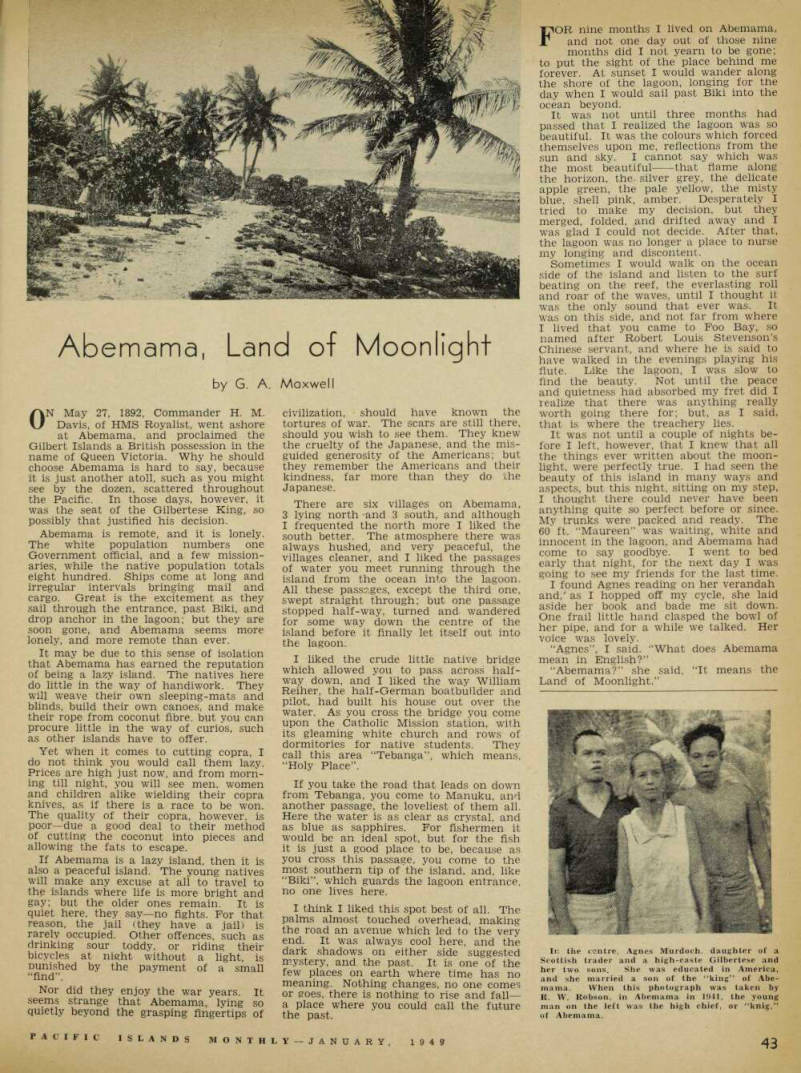
In the centre, Agnes Murdoch, daughter of a Scottish trader and a high-caste Gilbertese and her two sons. She was educated in America, and she married a son of the “king” of Abe mama. When this photograph was taken by R. W. Robson, in Abemama in 1941, the young man on the left was the high chief, or “knig,” of Abemama.