Tropicalities
pp. 52-53 · Read in the full issue
DAWES, Melbourne journa
list, has something to say about Mr. Ward’s desire that New Guinea natives call a saw a saw. He says
that he’ll find that easy—most of
them do now, anyway.
Dawes also recollects a certain New Guinea Administrator who reigned about 20 years before Ward, who also
banned Pidgin :
The servants of Government House an nounced “Dinner is served, sir,” and, with tray poised, purred, “Cocktails, Scotch or s’erry?”—and out in the kitchen the house-cook scratched a calf thoughtfully with a grubby toe and remarked, “Gov’ment he long-long too much.” (H s Honor’s off his nut.) I happened to overhear the Old Man, when a certain VIP from Canberra was being dined. “No, no, you idiot, NOT the decanter—the BLACK LABEL!” he roared.
Privately I opined that the “Scotch” in the decanter might have been of a charac ter even H.H. couldn’t have done justice to in standard English.
Josef (who answered to Tovaruruai in private life, but was Mission Josef) ap pealed to me tearfully at the French win dows.
“Master, what name this black table?
Guv’ment he got one feller table now he stop. Now me no savvy along Dick Anter —now whatname master this Dick Anter?” * * * THIS little Letter-to-the-Editor, appar ently from a thwarted Australian rice-eater, appeared recently in an Australian newspaper: It is reported that most of the rice grown here is sent to natives in the British Pacific area until they are able to grow the stuff for themselves. (The war has been over a long time now. When will they be able to grow their own? —G. L. Hobson, Narrabeen.
The writer must be an optimist or else has not heard of Mr. Ward, who really did not write that cheerful erstwhile popular ditty . . “I’ve got a white man working for me . . .” long sung round New York’s Harlem.
These days the same little ditty could be sung with much deeper and sadder emotion by our ex-Servicemen struggling to cope with conditions in New Guinea.
Pre-war the Government spent much time and money training natives to scratch their rich river flats and rain drenched valleys to grow their own rice but these days we ship it from Australia to give the native more leisure.
Sappho Suds
BECAUSE the Qantas planes linking the Dutch East Indies with Australia are booked out weeks in advance, mem bers of the New Caledonian-New Hebri dean mission, which has been in Indo nesia endeavouring to arrange a supply of Javanese labour for French planters and mining interests, are having great difficulty in obtaining passages to Sydney, whence they can without difficulty book to Noumea. The French Ambassador in Canberra recently had to intervene to enable the Noumea lawyer, M. Elie Solie, to get a place on the plane from Soura baya to Sydney. The other members of the mission have had to make other ar rangements.
QIGN of the times: When a European was bewailing the fact that he had omitted to change his library books and had nothing to read, a Fijian friend immediately promised to remedy the deficiency. The result was awaited with a certain degree of curiosity.
It was: (1) “Green Dolphin Country,” by Elizabeth Goudge; (2) “A Surfeit of Lam preys,” by Ngaio Marsh; (3) “See Here, Private Hargrove,” by Marion Hargrove.
Each was handed over with an adequate summary of the contents, (1) and (2) being recommended, but (3) dismissed as “too much American.”
The interesting point was not that books of the kind had been acquired and read by a Fijian who had had little more than a primary school education—supple mented by a great deal of wartime travel but that it was obvious that the contrast ing techniques of writers like Misses Goudge and Marsh were appreciated.
This sort of thing is unusual, but it is steadily becoming less so. * * * 4 NOTHER sign of the times: A note from a Fijian to a European: “Dear Mr. , Here is the 15/- lOU. I am sorry I cannot give it to you personally, but I thank you for the help. You realise, sir, how damned ruinous yet unavoidable Fijian ‘what’s yours is mine’ is when a mataqali or domestic kerekere starts. I would like to have a talk with you about it some time.”
There is a slightly ominous note about the last sentence, but it must be pointed out that the 15/- was lent to tide over a blackout in kerosene when a flood of country relatives descended without warn ing on a small-salary family in Suva.
Kerekere, which worked admirably in the old days, can be a shameful imposition in these times of outrageous living costs, particularly for Fijian town-dwellers. —S. ♦ * * WHEN the wooden wall of a wartime temporary-permanent public lava tory near the Suva Town Hall unex pectedly flopped flat one busy Saturday afternoon, creating the utmost confusion inside and near-hysterics outside in Vic toria Parade, an Australian who helped to push the wall up again muttered: “Where but in Suva could this happen?”
Something of the sort might have been said also on a recent afternoon when a strapping young Fijian, radiating bon homie to the world in general—he was outside a Victoria Parade hotel—stopped all the traffic for conversational purposes.
The traffic, on the whole, responded well.
Among those stopped happened to be a European police inspector. After a good deal of handshaking and an exchange of pleasantries, the inspector suggested that the succession of traffic holdups was not altogether wise. The happy young man agreed to keep to the footpath and the inspector drove on. But he looked hack at a turning and saw that a truck had been stopped right on a corner.
The insnector was at this point of his evidence in Court next day when the de fendant (drunk and disorderly charge) announced that he pleaded guilty.
“Why didn’t you plead guilty in the first place?” the Magistrate wanted to know. “Oh,” said the defendant with a cheerful glance at the inspector, “I just wanted to hear what he had to say!” (Fined £3).
MR. DAN POWER, who left New Guinea last July (in disgust, he said, at so much Ward-ism) is now an Estate Supervisor in African Housing Estates, East African Railways and Harbours, with headquarters in Nairobi, Kenya. He se cured a first-class job, with an excellent furnished bungalow, within a few days of arrival in Nairobi, and he is about to be married to an Australian lass whom he met on the ship en route to Capetown.
He writes: “In Capetown, I was amazed at the evidence everywhere of great pros perity-pity Australia could not get a few lessons here—or at least let some of these lessons be applied to New Guinea , . .
I liked Durban so much that, before going on North to Mombasa, I decided I would return and get myself a job there—signs of prosperity and progress everywhere . .
I did not like the Indian situation here in Kenya, and was at first disinclined to remain here on that account—But now I have a new job, a new house, a new car: I shall have a new wife within a month and, within three months, I shall have a new language—because it is a condition of my appointment that I learn Swahili . .
Nice healthy climate here —very much like Wau.” * * * A NOTE from a member of the SDA Mission, newly arrived in New Guinea’s Highlands, and concerning native salt-makers: We took time to look over the salt fac tories en route to Omalikaukau, These are situated on the bank of a yawning chasm through which the Wahgi flows.
The fact that these natives can make good quality salt from water containing a high proportion of hydrogen sulphate
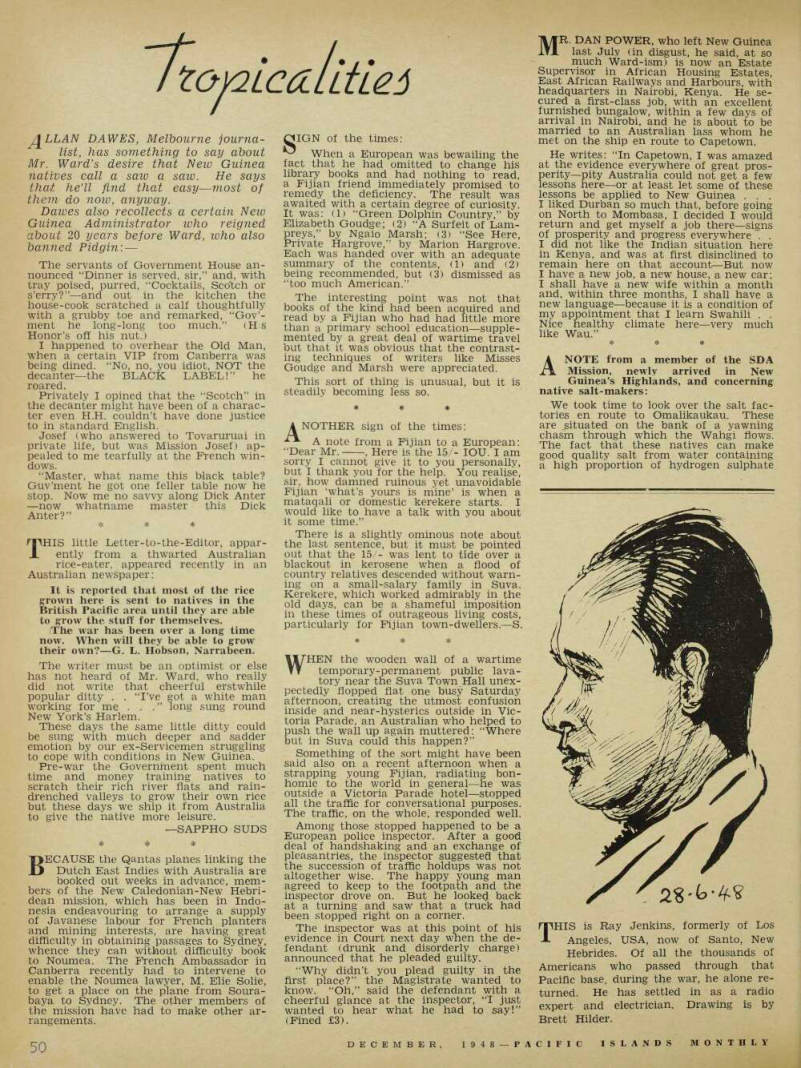
THIS is Ray Jenkins, formerly of Los Angeles, USA, now of Santo, New Hebrides. Of all the thousands of Americans who passed through that Pacific base, during the war, he alone re turned. He has settled in as a radio expert and electrician. Drawing is by Brett Hilder.
is interesting and until seen, almost in credible.
The water is obtained from a very small spring flowing out from a wall of rock and about this are grouped a lot of grass huts spread over an area of about three quarters of an acre. The water is run onto bundles of grass for three or four days; the grass is then put in the sun, dried, and eventually burned. It smoulders away very gradually until only a very fine grey ash remains. This is gathered up and laboriously carried up the canyon walls to the respective villages, where the final process is carried out.
In the hut through which we were shown it was very dark, the roof being only about four feet above ground; there were no windows. The ashes were poured into a funnel, the bottom of which is stuffed with dried grass. Onto the ashes water is poured for a specified period until the salt is considered to be completely washed from them. The salt water is then poured into a clay pan from the bamboos in which it was caught and a slow fire maintained under the pan until only the salt residue remains. We tasted the salt which is of good quality—a little grey in colour but much stronger than the salt we use. I understand these natives have become wealthy by selling the salt to other tribes. * ♦ ♦ THE arrival in Port Moresby of a skilled boot-maker, with a commission to measure the feet of the native Papuan policemen, has been regarded with interest and tolerant amusement by old Territorians. It is another instance of the intense pre-occupation of the Admin istration with native welfare; but the old hands doubt whether much will be achieved by extending the welfare move ment to the feet of the policemen, and putting the Force into boots.
It is recalled that when coastal carriers first got up into the Bulolo-Edie Creek region, the fresh water—to which they, being “soda-water” natives were quite un accustomed—played havoc with their feet. The humane employers—Mr. Ward doubtless will be astonished that humane employers were present in New Guinea as far back as 1926—decided to put their carriers into boots; and this operation was duly performed at Salamaua.
The line, very proud of its new boots, started off happily across the flats towards the foothills: but within an hour 90 per cent, of the boys had their boots hanging round their necks and were using their feet in climbing. As 90 per cent, of Papua and New Guinea is more or less standing on edge it is not expected that much success will attend any attempt to put into boots natives who are accustomed to using their toes on the steep hill-sides. * * ♦ HONIARA (BSD had a treasure hunt in November. The idea was to un earth a secret hoard of weapons and equipment reputed, to have been laid down during the war for possible guerilla tactics if the Japs had pulled off a suc cessful comeback.
Among the big underground “igloos” in the old American ammo dumn in the foothills was spotted a mound of promis ing shape, unmarked by ventilator or doorway. The hopeful treasure-hunters converged on this, one blistering morning, and urged a somewhat languid pick-and shovel gang into action.
Spectators, animated by varying de grees of optimism and scepticism, and discussing the likelihood of revolvers, binoculars, ammunition, an odd jeep or two (or perhaps just C-rations and Scotch), comprised four British, and a party of seven Americans, including a Lieut.-Colonel, a naval commander, a medico captain, a chaplain, and a roving reporter from the “New York Times” who
leapt about and took photographs, and a
disillusioned-looking dog.
After three hours of fruitless manual labour, a bulldozer came clanking to the rescue and carried on, while the cynical inquired just how many guerilla parties were likely to have been equipped for bulldozing tactics.
When the treasure-hunters finally gave up hope, spoils for the day were several tons of limestone, a few old clamshells and two violent attacks of hayfever from the Kunai grass.—R.M. * * V \lfE have received from Messrs. Bowler, ▼ f Bannerman & Howells, Solicitors of Gore, New Zealand (who are en devouring to finalise the estate of Mr.
Dick Roche, who disappeared in Dutch New Guinea many years ago) an inquiry for the addresses of Mr. H. Cobb, Mrs. C.
R. Sheldon (formerly of Darwin) and Mrs.
H. Vidgen (formerly of Thursday Island).
Those three are believed to be the next of-kin of the late Mr. H. Cholmondeley Jardine of Dobo, Aroe Islands. Anyone who can supply information is invited to write to the solicitors named.
The Resident Commissioner of the Solomon Islands (Colonel O. C. Noel) left Honiara on October 17 by Trans oceanic aircraft to join the “Orontes” in Sydney, for six months’ leave in Eng land. During Col. Noel’s absence from the Protectorate, the post of Acting Resident Commissioner is held by Mr.
J. D. A. Germond, Divisional Adminis trative officer, who came to the Pro tectorate at the end of last year from Basutoland.