Industry In The S. Pacific?
pp. 50-51 · Read in the full issue
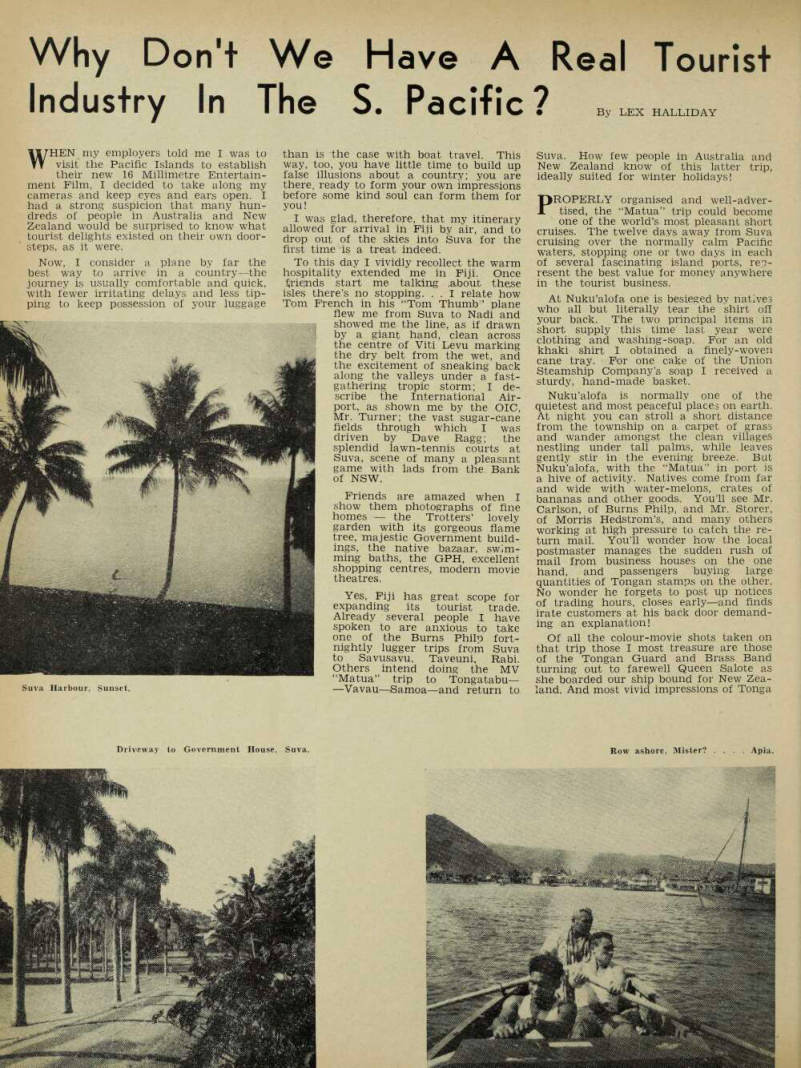
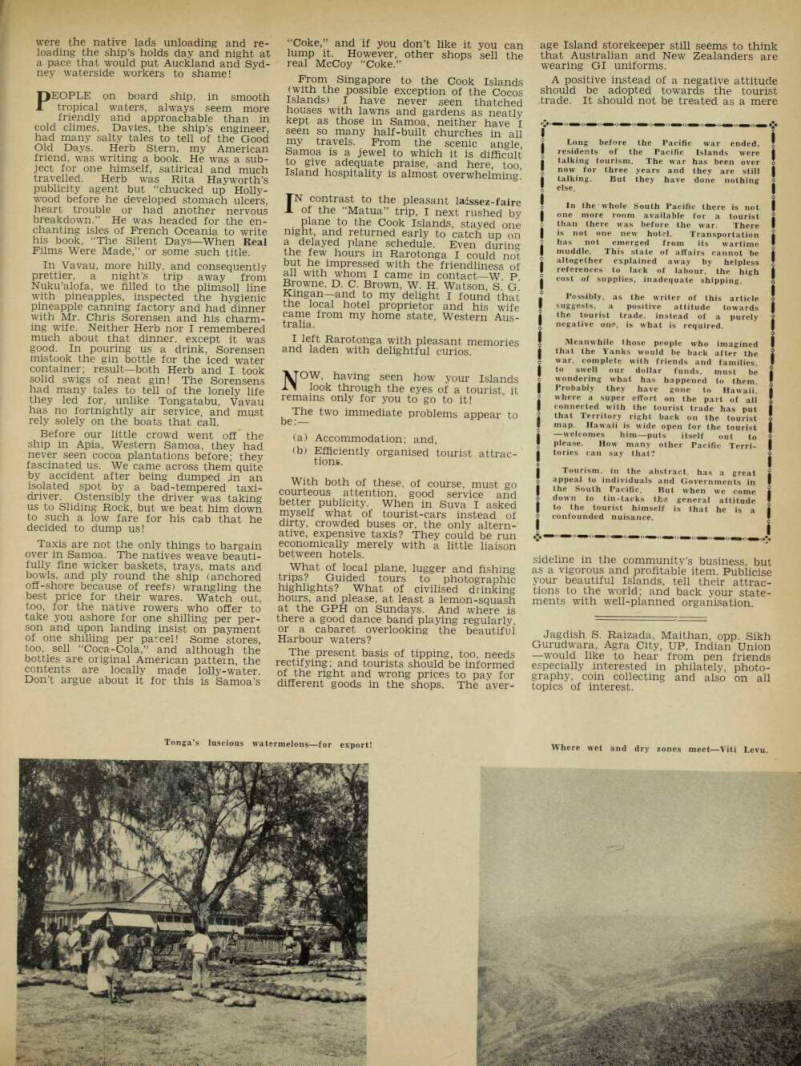
Why Don't We Have A Real Tourist
By Lex Halliday
WHEN my employers told me I was to visit the Pacific Islands to establish their new 16 Millimetre Entertain ment Film, I decided to take along my cameras and keep eyes and ears open. I had a strong suspicion that many hun dreds of people in Australia and New Zealand would be surprised to know what tourist delights existed on their own door steps, as it were.
Now, I consider a plane by far the best way to arrive in a country—the journey is usually comfortable and quick, with fewer irritating delays and less tip ping to keep possession of your luggage
than is the case with boat travel. This way, too, you have little time to build up false illusions about a country; you are there, ready to form your own impressions before some kind soul can form them for you!
I was glad, therefore, that my itinerary allowed for arrival in Fiji by air, and to drop out of the skies into Suva for the first time is a treat indeed.
To this day I vividly recollect the warm hospitality extended me in Fiji. Once triqnds start me talking .about the,se isles there’s no stopping. . , I relate how Tom French in his “Tom Thumb” plane
flew me from Suva to Nadi and showed me the line, as if drawn by a giant hand, clean across the centre of Viti Levu marking the dry belt from the wet, and the excitement of sneaking back along the valleys under a fast gathering tropic storm; I de scribe the International Air port, as shown me by the QIC, Mr. Turner; the vast sugar-cane fields through which I was driven by Dave Ragg; the splendid lawn-tennis courts at Suva, scene of many a pleasant game with lads from the Bank of NSW.
Friends are amazed when I show them photographs of fine homes the Trotters’ lovely garden with its gorgeous flame tree, majestic Government build ings, the native bazaar, swim ming baths, the GPH, excellent shopping centres, modern movie theatres.
Yes, Fiji has great scope for expanding its tourist trade.
Already several people I have spoken to are anxious to take one of the Burns Philo fort nightly lugger trips from Suva to Savusavu, Taveuni, Rabi.
Others intend doing the MV “Matua” trip to Tongatabu— —Vavau—Samoa—and return to
Suva. How few people in Australia and New Zealand know of this latter trip, ideally suited for winter holidays!
PROPERLY organised and well-adver tised, the “Matua” trip could become one of the world’s most pleasant short cruises. The twelve days away from Suva cruising over the normally calm Pacific waters, stopping one or two days in each of several fascinating island ports, rep resent the best value for money anywhere in the tourist business.
At Nuku’alofa one is besieged by natives who all but literally tear the shirt off your back. The two principal items in short supply this time last year were clothing and washing-soap. For an old khaki shirt I obtained a finely-woven cane tray. For one cake of the Union Steamship Company’s soap I received a sturdy, hand-made basket.
Nuku’alofa is normally one of the quietest and most peaceful places on earth.
At night you can stroll a short distance from the township on a carpet of grass and wander amongst the clean villages nestling under tall palms, while leaves gently stir in the evening breeze. But Nuku’alofa, with the “Matua” in port is a hive of activity. Natives come from far and wide with water-melons, crates of bananas and other goods. You’ll see Mr.
Carlson, of Burns Philp, and Mr. Storer, of Morris Hedstrom’s, and many others working at high pressure to catch the re turn mail. You’ll wonder how the local postmaster manages the sudden rush of mail from business houses on the one hand, and passengers buying large quantities of Tongan stamps on the other.
No wonder he forgets to post up notices of trading hours, closes early—and finds irate customers at his back door demand ing an explanation!
Of all the colour-movie shots taken on that trip those I most treasure are those of the Tongan Guard and Brass Band turning out to farewell Queen Salote as she boarded our ship bound for New Zea land. And most vivid impressions of Tonga
Suva Harbour, Sunset.
Driveway to Government House, Suva.
Row ashore, Mister? ... Apia.
were the native lads unloading and re loading the ship’s holds day and night at a pace that would put Auckland and Syd ney waterside workers to shame!
PEOPLE on board ship, in smooth tropical waters, always seem more friendly and approachable than in cold climes. Davies, the ship’s engineer, had many salty tales to tell of the Good Old Days. Herb Stern, my American friend, was writing a book. He was a sub ject for one himself, satirical and much travelled. Herb was Rita Hayworth’s publicity agent but “chucked up Holly wood before he developed stomach ulcers, heart trouble or had another nervous breakdown.” He was headed for the en chanting isles of French Oceania to write his book, “The Silent Days—When Real Films Were Made,” or some such title.
In Vavau, more hilly, and consequently prettier, a night’s trip away from Nukualofa, we filled to the plimsoll line with pineapples, inspected the hygienic pineapple canning factory and had dinner with Mr. Chris Sorensen and his charm ing wife. Neither Herb nor I remembered much about that dinner, except it was good. In pouring us a drink, Sorensen mistook the gin bottle for the iced water container; result—both Herb and I took solid swigs of neat gin! The Sorensens had many tales to tell of the lonely life they led for, unlike Tongatabu, Vavau has no fortnightly air service, and must rely solely on the boats that call.
Before our little crowd went off the ship in Apia, Western Samoa, they had never seen cocoa plantations before; they fascinated us. We came across them quite by accident after being dumped in an isolated spot by a bad-tempered taxi driver. Ostensibly the driver was taking us to Sliding Rock, but we beat him down to such a low fare for his cab that he decided to dump us!
Taxis are not the only things to bargain over in Samoa. The natives weave beauti fully fine wicker baskets, trays, mats and bowls, and ply round the ship (anchored off-shore because of reefs) wrangling the best price for their wares. Watch out, too, for the native rowers who offer to take you ashore for one shilling per per son and upon landing insist on payment of one shilling per parcel! Some stores, too, sell “Coca-Cola,” and although the bottles are original American pattern, the contents are locally made lolly-water.
Don’t argue about it for this is Samoa’s
“Coke,” and if you don’t like it you can lump it. However, other shops sell the real McCoy “Coke.”
From Singapore to the Cook Islands (with the possible exception of the Cocos Islands) I have never seen thatched houses with lawns and gardens as neatly kept as those in Samoa, neither have I seen so many half-built churches in all my travels. From the scenic angle Samoa is a jewel to which it is difficult to give adequate praise, and here, too, Island hospitality is almost overwhelming.
IN contrast to the pleasant laissez-faire of the “Matua” trip, I next rushed by plane to the Cook Islands, stayed one night, and returned early to catch up on a delayed plane schedule. Even during the few hours in Rarotonga I could not but he impressed with the friendliness of all with whom I came in contact—W P Browne, D. C. Brown, W. H. Watson, S.’ G Kingan—and to my delight I found that the local hotel proprietor and his wife came from my home state, Western Aus tralia.
I left Rarotonga with pleasant memories and laden with delightful curios.
NOW, having seen how your Islands look through the eyes of a tourist, it remains only for you to go to it! be The two imm ediate problems appear to (a) Accommodation; and. (b) Efficiently organised tourist attrac tions.
With both of these, of course, must go courteous attention, good service and better publicity. When in Suva I asked myself what of tourist-cars instead of dirty, crowded buses or, the only altern ative, expensive taxis? They could be run economically merely with a little liaison between hotels.
What of local plane, lugger and fishing trips? Guided tours to photographic highlights? What of civilised drinking hours, and please, at least a lemon-squash at the GPH on Sundays. And where is there a good dance band playing regularly, or a cabaret overlooking the beautiful Harbour waters?
The present basis of tipping, too, needs rectifying: and tourists should be informed of the right and wrong prices to pay for different goods in the shops. The aver-
age Island storekeeper still seems to think that Australian and New Zealanders are wearing GI uniforms.
A positive instead of a negative attitude should be adopted towards the tourist trade. It should not be treated as a mere
Long before the Pacific war ended, residents of the Pacific Islands were talking tourism. The war has been over now for three years and they are still talking. But they have done nothing else.
In the whole South Pacific there is not one more room available for a tourist than there was before the war. There is not one new hotel. Transportation has not emerged from its wartime muddle. This state of affairs cannot be altogether explained away by helpless references to lack of labour, the high cost of supplies, inadequate shipping.
Possibly, as the writer of this article suggests, a positive attitude towards the tourist trade, instead of a purely negative one, is what is required.
Meanwhile those people who imagined that the Yanks would be back after the war. complete with friends and families, to swell our dollar funds, must be wondering what has happened to them.
Probably they have gone to Hawaii! where a super effort on the part of all connected with the tourist trade has put that Territory right back on the tourist map. Hawaii is wide open for the tourist —welcomes him—puts itself out to please. How many other Pacific Terri tories can say that?
Tourism, in the abstract, has a great appeal to individuals and Governments in the South Pacific. But when we come down to tin-tacks the general attitude to the tourist himself is that he is a confounded nuisance.
sideline in the community’s business, but as a vigorous and profitable item. Publicise your beautiful Islands, tell their attrac tions to the world; and back your state ments with well-planned organisation.
Jagdish S. Raizada, Maithan, opp. Sikh Gurudwara, Agra City, UP, Indian Union —would like to hear from pen friends especially interested in philately, photo graphy, coin collecting and also on all topics of interest.
Tonga’s luscious watermelons—for export!
Where wet and dry zones meet—Viti Levu.