Tropicalities
pp. 47-48 · Read in the full issue
THERE are some residents of the Cook Islands who can recall the time when molasses was the universal tea sweetener, white sugar (or brown) then be ing unknown. The old-time molasses, imported from the United States, was ten times sweeter than modern substitutes, and about the colour and consistency of coal-tar.
Moreover, it was cheap, it kept in definitely, and was entirely fool-proof.
All these desirable attributes do not apply to white sugar, which looks so very much like trade salt.
At a recent local church tea-fight, the chef-in-charge made the shocking faux pas of sugaring the stew and salting the tea that, after a good satisfying after noon of prayer and hymns, was to re store the bodily tissues. To put it mildly, he was unpopular. Neither item could be served without apology and even that didn’t help much, for although you can put salt where sugar ought to be, you can’t take it out again. This couldn’t have happened in 1880!—G. ♦ ♦ ♦ DOES anyone remember a tale of the Solomon Islands (by Beatrice Grim shaw, perhaps—l forget now, as I read it nearly 30 years ago) of the two rival traders, who, not unlike their counterparts here in the Cooks, were always trying to steal a march on each other with something new?
But, unlike Cl, that was rough territory, with natives of a war-like type, “manners none and customs nasty,” as the gentle man said.
Trader A had a bright idea; he im ported a number of gramophones, then a rarity in the South Seas, and sold them to certain tribal chiefs for goodly piles of copra equal to about fifty times the value, retaining, however, the winding handles. At full-moon the chiefs came to the trader, who ceremonially wound-up the machines for half an hour to let “the Great God Phoney” do his stuff, and entertain Brown Brother, who was. at that stage of BSI history, fairly naive. This went on for a long time, and Trader A. grew rich.
Then, at the beginnings of radio broad casting in the white man’s world, along came Trader B, who had heard of A’s orosperity, and figured to get it away from him—with the newly-developed radio! B. brought along a set by way of sample.
The natives were tickled to death, and treated B. who was not afraid to enter
“doubtful” territory, as generously as they’d done A.
But B made a slight error; he forgot to bring any spare batteries. So the Brown Brothers were rather annoyed when their dearly-bought set conked out. and the magic voices and music were heard no more. They sent for B. and demanded results, “or else.”
Trader B, realising that he was up against it, twiddled the knobs frantically, in the hope that at least something would be heard for long enough to give him time to get away in his lugger. But the battery was far gone. Turning every thing on the set, B managed to catch, for a few seconds, a broadcast about pre serving fruit. The chiefs had already told him that if the set didn’t revive they would cut poor B’s ears off. Twiddling away, he brought in for a few fleeting words the instructive broadcast cited, then the battery failed utterly. The last words B heard, uttered in a “prissy,” school-marm voice, were. “Slice with a sharp knife, and then hang up to dry,,.”! —“Tukapa Koko.” ♦ ♦ ♦ MR. WARD, Australian Territories Min ister, doesn’t like Pidgin, according to the Melbourne “Herald.”
Particularly he dislikes the classical Pidgin term for a saw: This-fella-you push-im-’e-go-you-pull’im-e’-come.
To Mr. Ward the jargon doesn’t make sense and he wants all New Guinea natives to speak “proper English” as soon as it can be arranged.
It all depends, of course, on what Mr.
Ward means by proper English. If he means Parliamentary English, as spoken by Australian MP’s and Senators, he should leave well alone and let his natives struggle along with Pidgin for a few more generations.
If further disillusion were possible in respect of their politicians, then the Aus tralian listening public got it when the ABC began Parliamentary broadcasts.
Most listeners probably would think it a vast improvement if Honourable Mem bers (and Senators) gave up murdering “proper” English, and began conducting proceedings in Pidgin. * ♦ ♦ THE New Caledonian Education Depart ment is inviting French families to state whether they are prepared to provide accommodation for Australian and New Zealand students wishing to visit that country during their holidays. An exchange system on the lines encouraged between Prance and Britain is suggested.
It is pointed out in Noumea that a knowledge of English is not only culturally desirable but a necessity for Caledonians from a commercial, tourist and general information point of view.
It may also be pointed out that Aus tralians probably are the worst linguists among the Western nations—not one in ten thousand can even read French, let alone speak that or any other language beyond their own. That is partly the result of indifference, partly due to Aus tralia’s comparative isolation. ♦ * ♦ CANON WARREN, whose photograph was in the June issue of the “PIM” as being the only Australian clergy man to hold a master’s navigational ticket, has a companion in the ranks of
Australian clergy-mariners. Canon John Done, formerly senior priest of the Torres Strait Mission, lately retired from a parish in the Diocese of Goulburn, and now living in retirement at Wilton. NSW, obtained his master’s ticket in March, 1926, after passing the necessary exam inations of the Marine Board of Queens land.
When the first “Maclaren King” visited Thursday Island from New Guinea, Canon Done piloted her through the difficult Torres Strait passages, and navigated other vessels from time to time. Signed on as master of the ketch “Herald,” he used to be a familiar figure at Thursday Island and up and down the North Queensland coast, sometimes straying far afield, right across the Gulf of Car pentaria. He still retains his certificate of discharge—“ Conduct, v.g.”
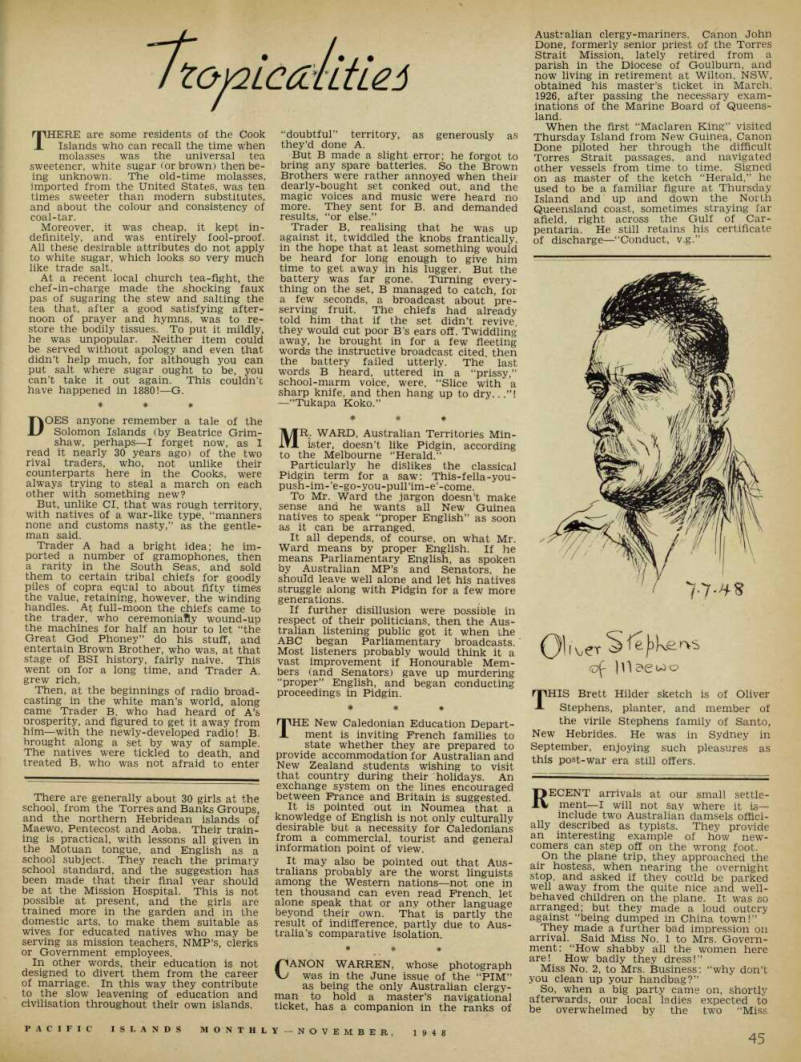
THIS Brett Hilder sketch is of Oliver Stephens, planter, and member of the virile Stephens family of Santo, New Hebrides. He was in Sydney in September, enjoying such pleasures as this post-war era still offers.
RECENT arrivals at our small settle ment—l will not say where it is— include two Australian damsels offici ally described as typists. They provide an interesting example of how new comers can step off on the wrong foot.
On the plane trip, they approached the air hostess, when nearing the overnight stop, and asked if they could be parked well away from the quite nice and well behaved children on the plane. It was so arranged; but they made a loud outcry against “being dumped in China town!”
They made a further bad impression on arrival. Said Miss No. 1 to Mrs. Govern ment: “How shabby all the women here are! How badly they dress!”
Miss No. 2, to Mrs. Business: “why don’t you clean up your handbag?”
So, when a big party came on, shortly afterwards, our local ladies expected to be overwhelmed by the two “Miss
Snooties” in Dior creations. But they did their best, and made quite a brave show in attractive and reasonably modern evening frocks.. The dreaded “Snooties,” however, made a faux pas— they arrived in street length frocks, look ing very much out of place. The local ladies now are feeling better—CYNIC
De-Trop.
FIJI’S Commissioner of Police, Mr. I. E.
Lucchinelli, has evolved an effective technique in making personal dashes after erring motorists. A few months age he chased a driver across the heart of Suva and subsequently obtained a con viction of the quarry for speeding.
On October 8, he made another dash after an Indian driver who was later fined £7/10/- for driving while his efficiency was impaired by drink. Swerv ing wildly to avoid pedestrians during the chase, the Indian ended up across a footpath near the Lilac Theatre when the Commissioner caught up.—S. • • • THE cautious paragraph about the former RCS “Viti’s” odd propellers (September “PIM”) seems to have been almost too cautious. At least, no one has been able to deny the report; and, since the original publication, the “Fiji Times” has stated that it has acquired further proof of the accuracy of the state ments made —that the “Viti” travelled around the Pacific for years with odd pro pellers. There was a scurry-round in various quarters to find grounds for a denial —but the denial has failed to materialise. The “Fiji Times” remarked that at least it was tactful of the new owners of the ship to send back the coat of-arms instead of the propellers, which might have been a trifle obstrusive in the Suva Yacht Club’s new clubhouse!
Mr. H. G. Eekhoff, of Lae, New Guinea, has been appointed Diocesian Represen tative on the General Synod of the Angli can Church in Lae. A church hall will shortly be built on the hill (Namanula), and a Church will follow later.
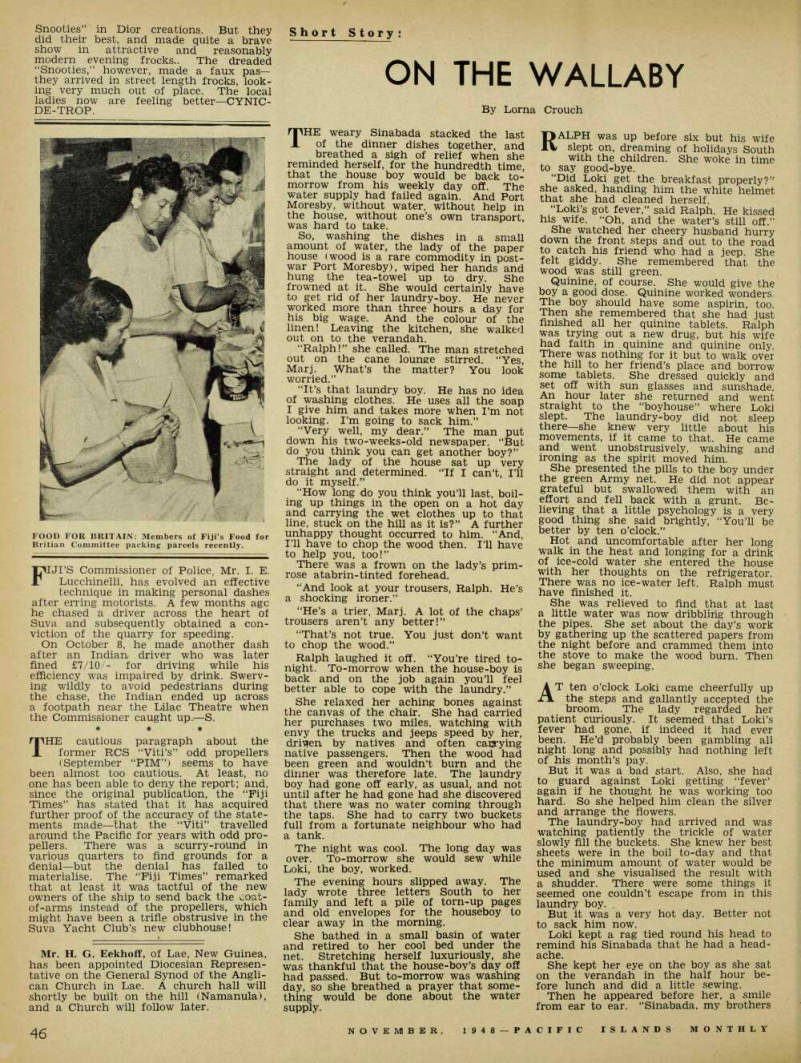
FOOD FOR BRITAIN: Members of Fiji’s Food for Britian Committee packing parcels recently.