Torgil,
pp. 46-47 · Read in the full issue
valley of the Virgins
By Hebridean
OUT of the waters of the New Hebrides, rises a long, smooth curve of misty blue; this is the elusive island of Aoba, whose outline has been described as that of a whale; or like a huge wave about to break.
The name is pronounced Oba, which is the older spelling. The natives call it Omba, which I suspect is derived from the Malay word, “ombak,” a wave or breaker.
The island was first seen by Bougain ville, and called by him the Isle of Lepers, as he said the natives were peeling from a skin disease.
This was a libel, for the inhabitants are cleaner and healthier than those of the surrounding islands, and even have the unusual habit of bathing dally in the surf, which breaks on their rocky coast line. (They may have had grilli, a ring worm type of skin disease). Other traits of Polynesian admixture in their make up have made their young women the favourite source of wives among the old time traders who had cut themselves off from civilisation.
The island rises to a dome-shaped sum mit about 4,000 feet high, in whose hollows lie two crater-lakes, and a vent which often smokes. But the only haven for visiting craft lies near the eastern end of the island, the harbour of Lolowai.
Here we find the local headouarters of the Melanesian Mission, with an Arch deacon who comes under the Bishop of Melanesia in the Solomons. A mile or so west of Lolowai is the native boys’ High School, under Father Rowley, where pro mising pupils can reach the Intermediate standard. From there they can go on
to the Solomons and attain the Leaving standard.
In the eastern corner of Lolowai is the Mission Hospital, and here we take the
steep path which leads up and over the ridge which divides the outside world from the valley of Torgil.
Torgil forms the eastern extremity of
Aoba, and so is well pro tected from intrusion. The visitor sees first a series of gardens, spread out from the houses of the Mission school for native girls. But we are soon disturbed by violent barking, and then comes the bounding entry of a great, black watch-dog of most blood-thirsty temper. He guards the valley by day and night, reminding me forcibly of the ever-watchful Cerberus with the three heads and tails, while on the nocturnal side of his pedigree can be seen the terrible Hound of the Baskervilles.
The schoolgirls rejoice in a simple uniform, appar
ently consisting of nothing but a lava lava, which does not extend above the waist, and so hides none of those en dearing young charms.
The attractiveness of the girls compared with their sisters billowing in the Mother Hubbards, favoured by the other denom inational missions, has led to the school at Torgil being popularly known as the Valley of the Virgins. Torgil has some thing in common with the mythical Tibetan valley of Shangri-la, for the Tibetans turn down their furry clothes to the waist during the warm hours of sunlight, and by their evening fires.
THE school arrived at Torgil in 1937 from Vureas in the Banks Group.
The first teacher was Miss Muir, under the capable guidance of that de lightful personality, Mother Margaret, who was one of the first Sisters of the Com munity of the Cross, beginning her career in India and also serving in the Solomons.
The sisters run the school, the latest arrival being Sister Dolovia, whose name is not derived from the Via dolorosa, but from a word of the Nglea dialect meaning “beloved”; she was previously Mrs.
Marjorie Gresham.
There is also Sister Veronica, well known for her watercolours. The Sisters wear flowing robes of white and blue, keeping close to nature by going bare footed in their everyday life in their tropic Garden of Eden.
(See opposite)
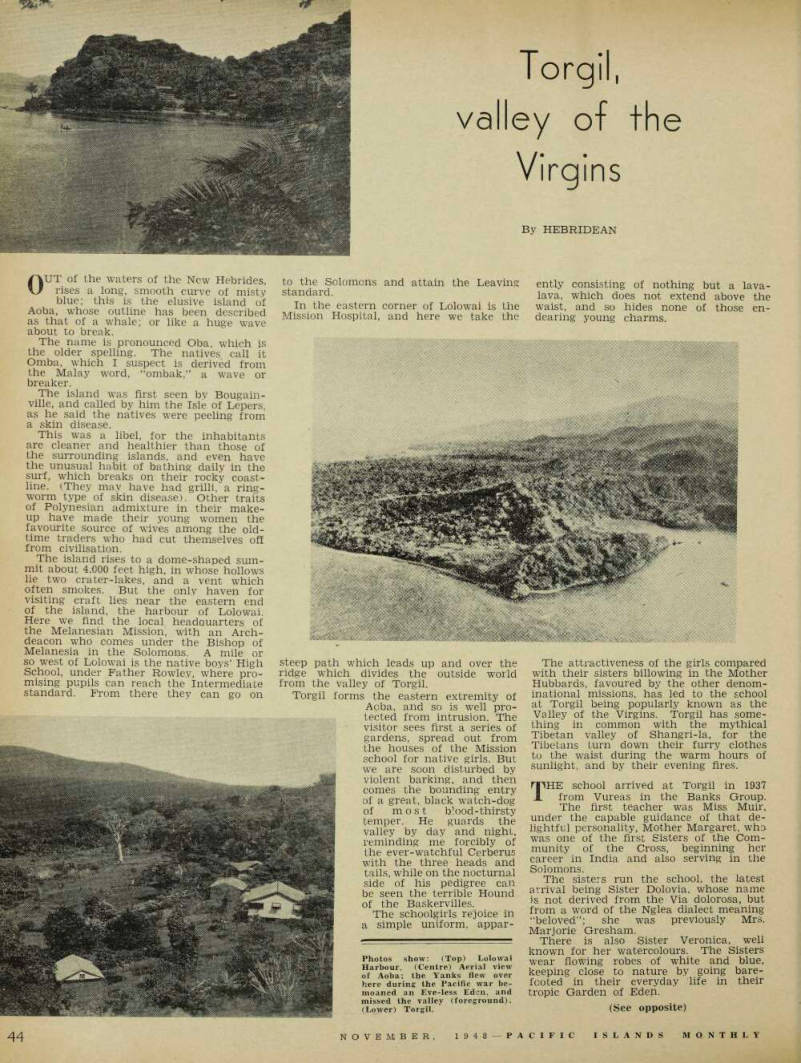
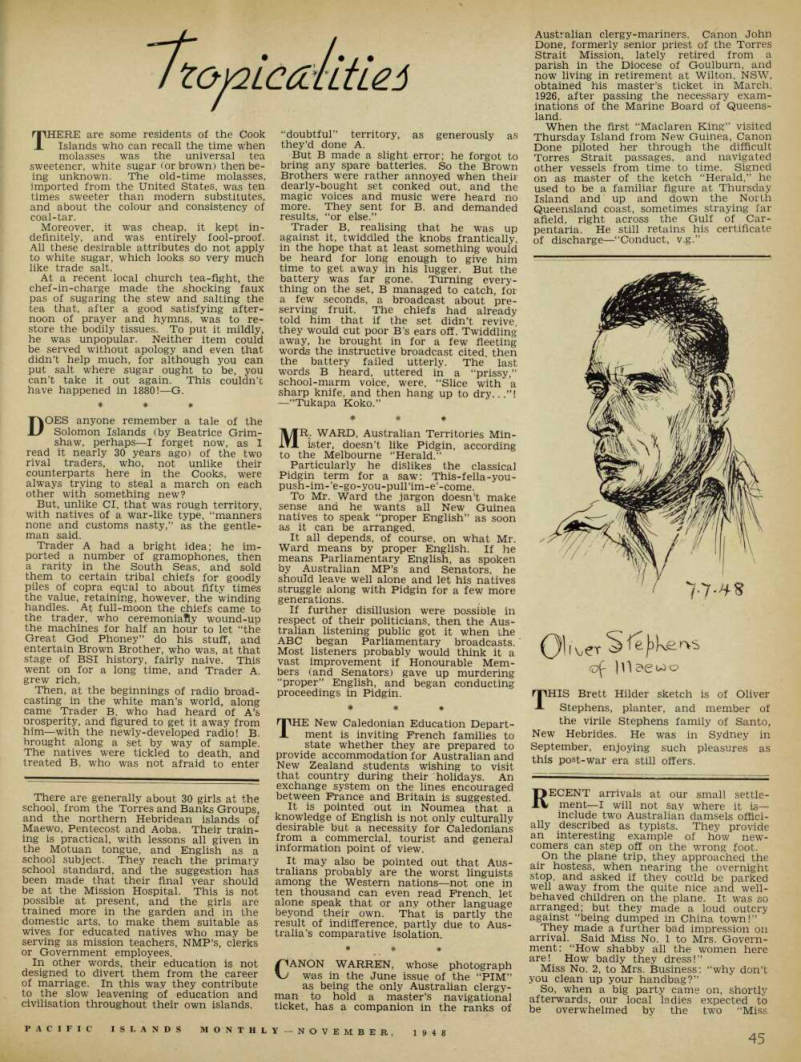
Photos show: (Top) Lolowai Harbour. (Centre) Aerial view of Aoba; the Yanks flew over here during the Pacific war be moaned an Eve-less Eden, and missed the valley (foreground). (Lower) Torgil.
There are generally about 30 girls at the school, from the Torres and Banks Groups, and the northern Hebridean islands of Maewo, Pentecost and Aoba. Their train ing is practical, with lessons all given in the Motuan tongue, and English as a school subject. They reach the primary school standard, and the suggestion has been made that their final year should be at the Mission Hospital. This is not possible at present, and the girls are trained more in the garden and in the domestic arts, to make them suitable as wives for educated natives who may be serving as mission teachers, NMP’s, clerks or Government employees.
In other words, their education is not designed to divert them from the career of marriage. In this way they contribute to the slow leavening of education and civilisation throughout their own islands.