Tale of a Little Ship
p. 42 · Read in the full issue
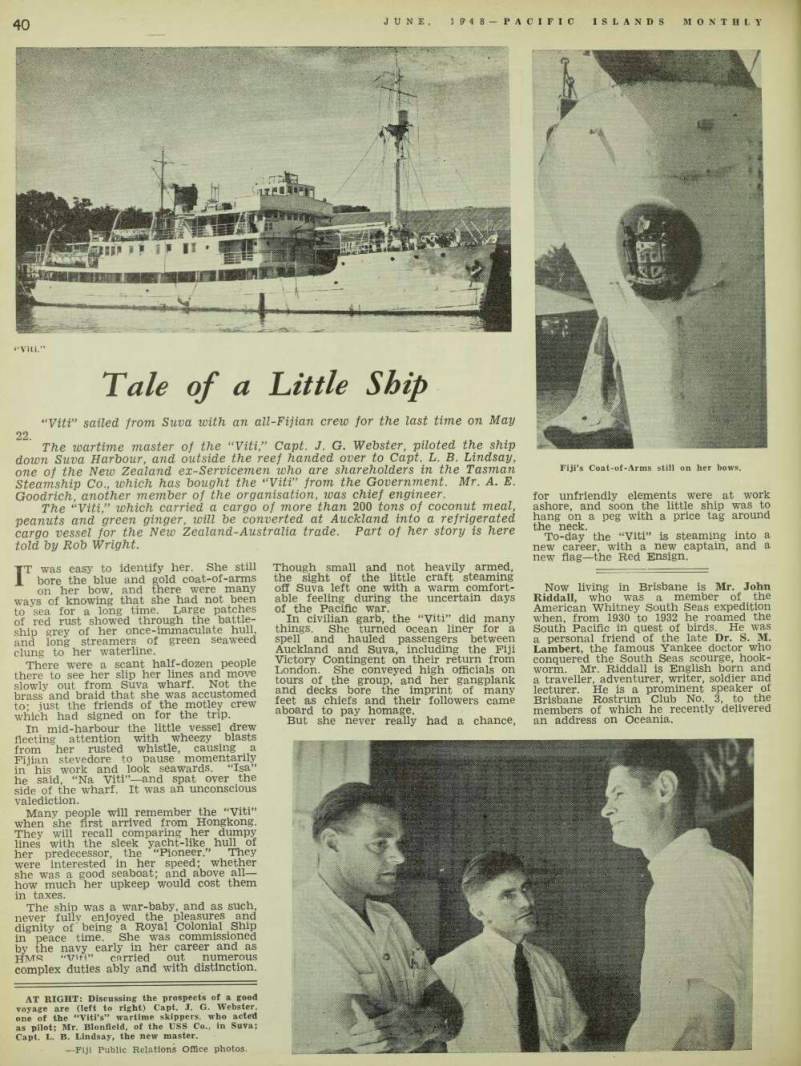
“Viti” sailed -from Suva with an all-Fijian crew for the last time on May 22 The wartime master of the “Viti” Capt. J. G. Webster, piloted the ship down Suva Harbour, and outside the reef handed over to Capt. L. B. Lindsay, one of the Neiv Zealand ex-Servicemen ivho are shareholders in the Tasman Steamship Co., which has bought the “Viti” from the Government. Mr. A. E.
Goodrich, another member of the organisation, was chief engineer.
The “Viti,” which carried a cargo of more than 200 tons of coconut meal, peanuts and green ginger, will be converted at Auckland into a refrigerated cargo vessel for the Hew Zealand-Australia trade. Part of her story is here told by Rob Wright.
IT was easy to identify her. She still bore the blue and gold coat-of-arms on her bow, and there were many ways of knowing that she had not been to sea for a long time. Large patches of red rust showed through the battle ship grey of her once-immaculate hull, and long streamers of green seaweed clung to her waterline.
There were a scant half-dozen people there to see her slip her lines and move slowly out from Suva wharf. Not the brass and braid that she was accustomed to; just the friends of the motley crew which had signed on for the trip.
In mid-harbour the little vessel drew fleeting attention with wheezy blasts from her rusted whistle, causing a Fijian stevedore to Pause momentarily in his work and look seawards. “Isa” he said, “Na Viti”—and spat over the side of the wharf. It was an unconscious valediction.
Many people will remember the “Viti” when she first arrived from Hongkong.
They will recall comparing her dumpy lines with the sleek yacht-like hull of her predecessor, the “Pioneer.” They were interested in her speed; whether she was a good seaboat; and above all— how much her upkeep would cost them in taxes.
The ship was a war-baby, and as such, never fullv enjoyed the pleasures and dignity of being a Royal Colonial Ship in peace time. She was commissioned by the navy early in her career and as HM« “Viti” carried out numerous complex duties ably and with distinction.
Though small and not heavily armed, the sight of the little craft steaming off Suva left one with a warm comfort able feeling during the uncertain days of the Pacific war.
In civilian garb, the “Viti” did many things. She turned ocean liner for a spell and hauled passengers between Auckland and Suva, including the Fiji Victory Contingent on their return from London. She conveyed high officials on tours of the group, and her gangplank and decks bore the imprint of many feet as chiefs and their followers came aboard to pay homage.
But she never really had a chance,
for unfriendly elements were at work ashore, and soon the little ship was to hang on a peg with a price tag around the neck To-day’ the “Viti” is steaming into a new career, with a new captain, and a new flag—the Red Ensign.
Now living in Brisbane is Mr. John Riddall, who was a member of the American Whitney South Seas expedition when, from 1930 to 1932 he roamed the South Pacific in quest of birds. He was a personal friend of the late Dr. S. M.
Lambert, the famous Yankee doctor who conquered the South Seas scourge, hook worm. Mr. Riddall is English born and a traveller, adventurer, writer, soldier and lecturer. He is a prominent speaker of Brisbane Rostrum Club No. 3, to the members of which he recently delivered an address on Oceania.
"viti."
AT RIGHT: Discussing the prospects of a good voyage are (left to right) Capt. J. G. Webster, one of the “Viti’s” wartime skippers, who acted as pilot; Mr. Blonfleld, of the USS Co., in Suva; Capt, L. B. Lindsay, the new master. —Fiji Public Relations Office photos.
Fiji’s Coat-of-Arms still on her bows.