The Stephens Family of Urelapa
p. 41 · Read in the full issue
Urelapa
THIS is the story (not yet finished) of Thomas Carefield Stephens, of Hampshire, England: and of his charming Tongan wife, Sela Tubou. Here is one of those delightful romances of the South Seas, in which imaginative writers revel. But there is this difference: Every word of this story is true.
The occasion of its telling is the golden wedding of Mr. and Mrs. Stephens.
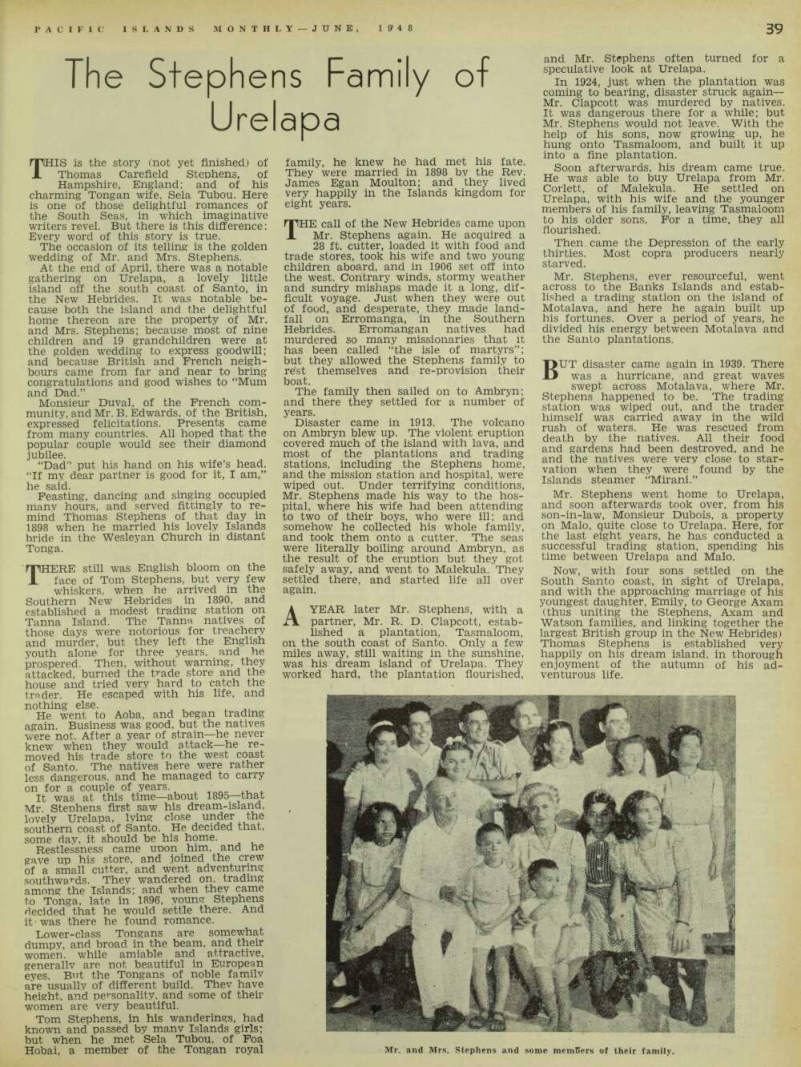
At the end of April, there was a notable gathering on Urelapa, a lovely little island off the south coast of Santo, in the New Hebrides. It was notable be cause both the island and the delightful home thereon are the property of Mr. and Mrs. Stephens; because most of nine children and 19 grandchildren were at the golden wedding to express goodwill; and because British and French neigh bours came from far and near to bring congratulations and good wishes to “Mum and Dad.”
Monsieur Duval, of the French com munity, and Mr. B. Edwards, of the British, expressed felicitations. Presents came from many countries. All hoped that the popular couple would see their diamond jubilee.
“Dad” put his hand on his wife’s head.
“If my dear partner is good for it, I am,” he said.
Feasting, dancing and singing occupied many hours, and served fittingly to re mind Thomas Stephens of that day in 1898 when he married his lovely Islands bride in the Wesleyan Church in distant Tonga.
THERE still was English bloom on the face of Tom Stephens, but very few whiskers, when he arrived in the Southern New Hebrides in 1890, and established a modest trading station on Tanna Island. The Tanna natives of those days were notorious for treachery and murder, but they left the English youth alone for three years, and he prospered. Then, without warning, they attacked, burned the Uade store and the house and tried very hard to catch the trader. He escaped with his life, and nothing else. .
He went to Aoba, and began trading again. Business was good, but the natives were not. After a year of strain—he never knew when they would attack —he re moved his trade store to the west coast of Santo. The natives here were rather less dangerous, and he managed to carry on for a couple of years.
It was at this time—about 1895—that Mr. Stephens first saw his dream-island, lovely Urelapa, lying close under the southern coast of Santo. He decided that, some day, it should be his home.
Restlessness came upon him, and he gave up his store, and joined the crew of a small cutter, and went adventuring southwards. They wandered on, trading among the Islands; and when they came to Tonga, late in 1896, young Stephens decided that he would settle there. And it • was there he found romance.
Lower-class Tongans are somewhat dumpy, and broad in the beam, and their women, while amiable and attractive, generally are not beautiful in European eyes. But the Tongans of noble family are usually of different build. Thev have height, and personality, and some of their women are very beautiful.
Tom Stephens, in his wanderings, had known and passed by many Islands girls; but when he met Sela Tubou, of Foa Hobai, a member of the Tongan royal
family, he knew he had met his fate.
They were married in 1898 by the Rev.
James Egan Moulton; and they lived very happily in the Islands kingdom for eight years.
THE call of the New Hebrides came upon Mr. Stephens again. He acquired a 28 ft. cutter, loaded it with food and trade stores, took his wife and two young children aboard, and in 1906 set off into the west. Contrary winds, stormy weather and sundry mishaps made it a long, dif ficult voyage. Just when they were out of food, and desperate, they made land fall on Erromanga, in the Southern Hebrides. Erromangan natives had murdered so many missionaries that it has been called “the isle of martyrs”; but they allowed the Stephens family to re'st themselves and re-provision their boat.
The family then sailed on to Ambryn; and there they settled for a number of years.
Disaster came in 1913. The volcano on Ambryn blew up. The violent eruption covered much of the island with lava, and most of the plantations and trading stations, including the Stephens home, and the mission station and hospital, were wiped out. Under terrifying conditions, Mr. Stephens made his way to the hos pital, where his wife had been attending to two of their boys, who were ill; and somehow he collected his whole family, and took them onto a cutter. The seas were literally boiling around Ambryn, as the result of the eruption but they got safely away, and went to Malekula. They settled there, and started life all over again.
A YEAR later Mr. Stephens, with a partner, Mr. R. D. Clapcott, estab lished a plantation, Tasmaloom, on the south coast of Santo. Only a few miles away, still waiting in the sunshine, was his dream island of Urelapa. They worked hard, the plantation flourished,
and Mr. Stephens often turned for a speculative look at Urelapa.
In 1924, just when the plantation was coming to bearing, disaster struck again— Mr. Clapcott was murdered by natives.
It was dangerous there for a while; taut Mr. Stephens would not leave. With the help of his sons, now growing up, he hung onto Tasmaloom, and built it up into a fine plantation.
Soon afterwards, his dream came true.
He was able to buy Urelapa from Mr.
Corlett, of Malekula. He settled on Urelapa, with his wife and the younger members of his family, leaving Tasmaloom to his older sons. For a time, they all flourished.
Then came the Depression of the early thirties. Most copra producers nearly starved.
Mr. Stephens, ever resourceful, went across to the Banks Islands and estab lished a trading station on the island of Motalava, and here he again built up his fortunes. Over a period of years, he divided his energy between Motalava and the Santo plantations.
BUT disaster came again in 1939. There was a hurricane, and great waves swept across Motalava, where Mr.
Stephens happened to be. The trading station was wiped out. and the trader himself was carried away in the wild rush of waters. He was rescued from death by the natives. All their food and gardens had been destroyed, and he and the natives were very close to star vation when they were found by the Islands steamer “Mirani.”
Mr. Stephens went home to Urelapa, and soon afterwards took over, from his son-in-law, Monsieur Dubois, a property on Malo, quite close to Urelapa. Here, for the last eight years, he has conducted a successful trading station, spending his time between Urelapa and Malo.
Now, with four sons settled on the South Santo coast, in sight of Urelapa, and with the approaching marriage of his youngest daughter, Emily, to George Axam (thus uniting the Stephens, Axam and Watson families, and linking together the largest British group in the New Hebrides) Thomas Stephens is established very happily on his dream island, in thorough enjoyment of the autumn of his ad venturous life.
Mr and Mrs. Stephens and some members of their family.