The Craig
pp. 46-47 · Read in the full issue
Twins
By Len Usher
in Levuka —in its heyday a con l genial home for men of unconven tional ways—the exploits of the Craigs became almost legendary.
There were originally three brothers, but it is of the twins, Willie and Milton, that the most hilarious tales are told.
The brothers arrived in Fiji in the 1890's and, after enlivening and entertain ing Levuka for a good many years, Willie and Milton settled at Lodoni. on the Tailevu coast, where they became dairy farmers. They persuaded Ratu Kadavu levu to give the name of London to a village adjoining their land and in the village, called by the Fijians, Lodoni. they duly marked out Piccadilly Circus, Leicester Square and the Strand.
The eldest brother, Leonard, died about thirty years ago. Willie’s death occurred in 1930 and that of Milton in October of this year. He was 84. The end of the brothers’ “London” came when the people of Lodoni village agreed last year to move elsewhere to allow room for the neigh bouring Provincial School Eastern to grow into the much larger Ratu Kadavulevu Intermediate School for Fijian boys.
Willie periodically wrote topical verse, which the old “Polynesian Gazette” printed over the pen name of Roger Barns. A long narrative poem. “The Hunting of the Bottle,” was published in pamphlet form, and now. in its original edition, is sought after by collectors of literary Fijiana. It was reprinted not long ago by the “The Fiji Times and Herald.” It tells of a happening in old Levuka which was typical of what was likely to occur when the Craigs gave their minds to dealing with a situation which in their view deserved some at tention. 11HE head of the police in the town de . termined that he would suppress a suspected illicit trade in liquor. Act ing on information surreptitiously re ceived, he posted constables one night, in hiding, outside a certain dwelling.
In time, the virgil was rewarded by the sight of a Fijian emerging furtively from the gate, clutching what was very obvi ously a bottle. The police closed in, and the suspect took to his heels. An epic chase followed, as the fleet-footed quarry led his pursuers along street after street, up and down the long flights of steps which characterise Levuka, over one piece of difficult country after another, until the officers of the law had come close to exhaustion point.
Then, at last, the suspect was over hauled and was triumphantly locked up for the night. The bottle was carefully impounded, to appear next morning as Exhibit A in a courtroom where a con fident police officer told the magistrate of the happenings of the night before and firmly demanded conviction and a heavy penalty as an example to other would-be lawbreakers.
Then came a suggestion of doubt.
Counsel for the defence admitted that a
bottle had been carried in the previous night’s chase and that this same bottle was the one now produced in Court. But —what was in the bottle? The police had assumed that it was alcoholic liquor, but what proof had they?
A fine point; and the magistrate agreed that it must be cleared up.
The cork was drawn and the contents of the bottle sniffed. The smell was not that of any familiar alcoholic drink.
Eventually, to dispose of the matter finally, the magistrate ordered that the liquor should be tasted.
The unfortunate official victim of the order put the bottle to his lips, took a mouthful of the contents, spat it out hastily, and in explosive and positive terms removed all doubt as to the guilt of the man in the dock. The liquid might have been of interest to a student of physiology but it was certainly not potable and it was not—except possibly in remote origin—alcoholic.
AN elaborately contrived plan. such as this for the discomfiture of the forces of virtue and authority was the sort of thing that gave the Craig brothers, and Willie in particular, huge delight.
They came of a family reputed to be very wealthy, and certain of their con nections were said to have held high municipal office in the Midlands. The boys had attended good public schools; and Milton had continued his education on the Continent. Respectability and the formal conventions, however, they re garded as wholly superfluous and unim portant.
The arrival of remittances from the family was a quarterly signal for appropri ate celebrations. Usually, both twins par ticipated; but if one happened to be away from Levuka the other disposed of the joint remittance on his own. There were never any recriminations. The two men had that perfect understanding common between twins; and, anyhow, money was only money.
A HOST of stories grew up about Willie and Milton and it is sometimes hard now to separate the true from the apocryphal and exaggerated.
In recent years, Milton denied one of the tales most frequently told about him.
It was the story of his having used his authority as a Justice of the Peace to try, while awaiting the arrival of a magis trate, a young Fijian accused of highly improper behaviour, Milton, after a cross examination worthy of Thorne Smith in his most ribald mood, was said to have awarded sentence on a novel legal prin ciple in which elements of distance and time were combined in diverting fashion Editorial discretion makes it impossible to nrint details in a journal designed for family reading.
Although Milton was sometimes re
luctant to acknowledge his own share in past escapades, he could usually be per suaded to recall samples of Willie’s do ings. It was Milton who told me of what happened when a well-known Suva firm sent Willie a series of increasingly firm letters about his outstanding indebted ness.
For a time, Willie treated the letters with silent scorn; but at last he was moved to reply. His letter (somewhat amended) ran: “Gentlemen,—Recent medical research has shown one of the most prolific causes of malignant disease in certain parts of the body to be the application of paper on which there is writing in ink. Will you please render your accounts in pencil in future?”
WILLIE once decided that he would open a hairdressing saloon in Levuka. To someone who objected that he knew nothing of the barber’s trade, Willie replied, simply; “Well, I can learn, can’t I?”
The venture had been in existence for only a few days when Willie was persuaded—not unwillingly—to help to celebrate the arrival in Levuka of a planter friend. In due course, Willie transferred to his companion his new found enthusiasm for hairdressing; and, after a solemn visit of inspection to the Craig saloon, where the planter was par ticularly impressed with shelves piled high with cigar boxes, a deal was arranged and the business changed hands for £5O, Some days later, the celebrations having tapered off, the new owner went to in spect his purchase. With increasing in dignation, he examined the cigar boxes which had made such a brave show on the initial visit. All were empty except one, which contained a small quanity of locally-grown tobacco. He went in search of Willie, who listened calmly to his protests and agreed that the stock was perhaps not what it had seemed.
“Then what was the £5O for?” asked the indignant purchaser.
“Oh,” said Willie, explaining all, “that was for the good-will.”
ALTHOUGH I talked to Milton many times, I find it impossible to repro duce his conversation adequately. In a steady stream witticism followed wittic ism, and Milton’s eyes twinkled re peatedly as some fresh absurdity occurred to his gay and agile mind. His charm was irresistible, and in another age lace and ruffles would have become him fittingly.
The courtliness with which he made visitors welcome at Lodoni helped one to overcome a certain surprise at the minia ture menagerie which seemed perpetually to share his house.
“Sit in this chair,” Milton would say.
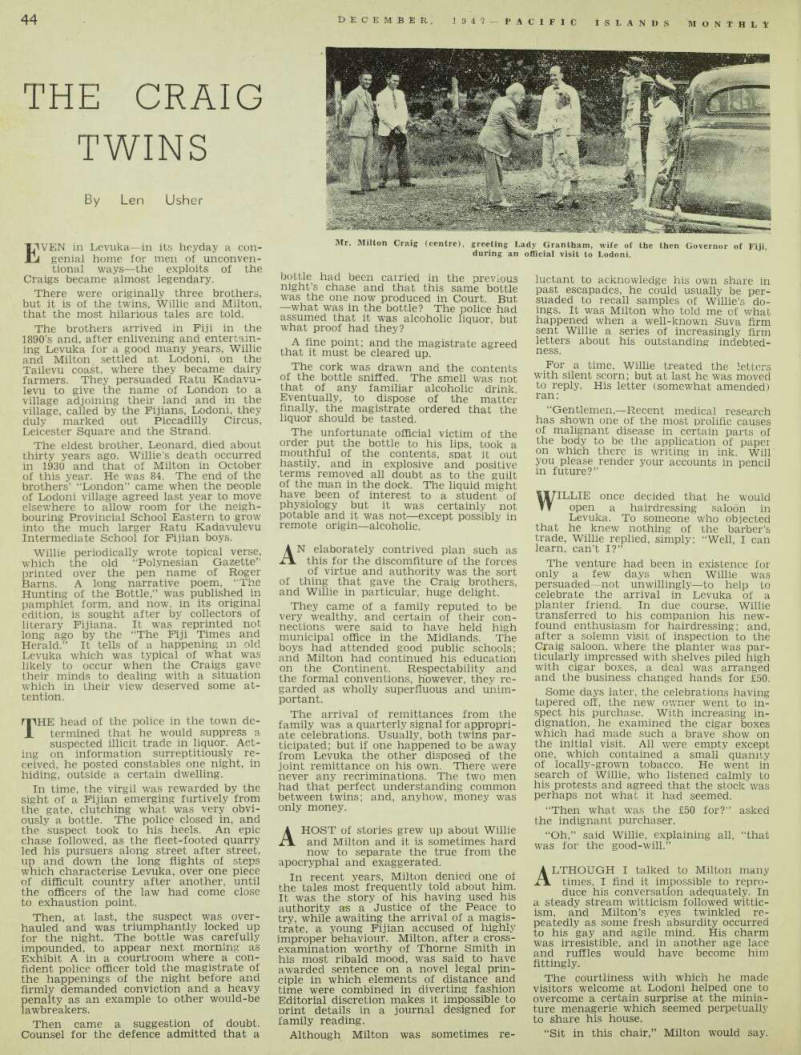
Mr. Milton Craig (centre), greeting Lady Grantham, wife of the then Governor of Fiji, during an official visit to Lodoni.
“This is the one we usually keep for the Governor.” And as he spoke he would tip the chair smartly forward and an in dignant dog would fall to the floor. Unless the visitor seated himself smartly the dog would beat him to the place which, through long-established custom, he had come to regard as his own.
With a wealth of detailed illustration, Milton once explained to me how con venient it was for the hens to lay their eggs in the house, where they were readily available for domestic use.
At a meal, I started back in some sur prise when Milton’s tame owl swooped across the table in its passage from one kitchen rafter to another. Milton’s flow of conversation was only momentarily in terrupted as he commented, “A most useful bird, that We keep it especially.
Every house in Fiji should have one.
The flapping of the wings drives away mosquitoes.”
BECAUSE Milton appeared to fit in with their preconceived ideas of what a beachcomber should be, visiting authors and journalists from time to time, in recent years, wrote of him as if he were an English aristocrat who had become derelict under the malign influence of the South Seas Their writings nearly always eventu ally got back to Milton, and they hurt him greatly. He was distressed that people who had accepted his hospitality should go away and write of him in such unkindly fashion and, by his standards, it was wholly false to describe him as derelict. In his life in Fiji, lived with gusto for half a century, he found satis faction and fun, and these, in his view, far outweighed the possible material ad vantages of a more conventional exist ence.