Magazine Section
p. 45 · Read in the full issue
Territories ' Talk-Talk
By "Tolala"
TOM GRIFFITHS another old New Guinea Administrator gone to his last rest—will long be kindly re membered by older residents of the Terri tory for his great understanding of non official problems, and his disregard for red-tape procedure. Although one of Australia’s oldest and most distinguished soldiers, he made no use of his military status when he stepped into civil life as Administrator of Nauru (1921-27) and New Guinea (1932-34). Despite the blitz years in New Britain, there still stands at Bitapaka the Memorial to those Aus tralians who fell in the 1914 landing in German New Guinea, which he was in strumental in erecting, and which he un veiled a few days before he departed from the Territory in September, 1934. * * * SOME candid comment on New Guinea conditions is made by a missionary executive in “The Methodist” (offi cial organ of the denomination) of Octo ber 25; . Native people have a new out look. In some places they have been left dazed and bewildered. In others they have shown an astonishing capacity to turn the situation to their advantage. A native owning four motor lorries, two copra driers and a restaurant was given six months for drinking. He offered £lOO to have the sentence reduced to three months, but did not get the sympathetic ear of the magistrate . . . There is no longer the old pride in the village garden.
There has been developed a taste for tinned food and bread . . . Missionaries who might be regarded as the least likely to be without domestic helo find it hard, sometimes impossible, to get help in the house . . . There are vast plantations . . . . where only half-a-dozen boys (sic), sometimes less, have been prepared to accept work and always at wages far In excess of those laid down in the Labour Ordinance . . . The Administration has been so thoroughly co-operative and sym pathetic to missionary activity that mis sionaries are loath to criticise officialdom, but there is a serious weakness in the present relation of planter (or mission ary) and the brown men. Natives are signed on, but contracts are not honoured ... It is surprising nothing has been done to impress upon the people that it is dishonourable to break any contract, much more a written one . . . Terri torians are marvellously hospitable, even to a missionary executive whose organisa tion is credited with the present native policy!”
Statements such as these from such a source can scarcely be ignored by offi cialdom, or brushed off with the terse remark thev “do not approximate to the truth.” * * * THE same writer does, incidentally, make one slip: In referring to road and sea travelling, which he says is “difficult as Administration’s fleet of boats has not yet materialised.” he refers to the Bulomihski Road in New Ireland “built at pistol point most of the way from Kavieng to Nakanai.” He adds “the journey along the road is an exciting adventure.”
It certainly would be —considering the quantity of Pacific Ocean between Kavieng and Nakanai. Obviously a typo graphical as well as geographical error, and intended for Namatanai.
MORE caustic comment: A. D. Mickle, the Australian author who recently made the round trip to New Guinea, remarks that “Never had the prestige of the white man been so low.
Natives openly referred to them as ‘white kanakas.’ And the present policy of ‘New Guinea for the Fuzzy-Wuzzies’ was much the same as handing schools over to children.”
One might suggest that the Adminis tration, which bans the word “boy” as applied to natives, might take the same action to prevent whites being called kanakas. • ♦ • THAT arrogant article; Canberra’s attempt to discredit “Blue” Allan’s statements concerning the NG food situation had its humorous angle.
Chifley, in his usual unemotional mono tone, referred to “a Colonel Allan.” Later, a Sydney daily quoted “Blue” as men tioning Mr. Melrose, “a Government Sec retary.”
The Territory has had many Gov. Secs., but there has been onlv one “Blue”
Allan. * * * DURING the debate in the House on the same question the Prime
Minister said a ship was on its way to Rabaul with food. He was quite right but he forgot to say the vessel was being de viated for the purpose of landing stores for military personnel only. * * * MESSAGES from Hong kong relative to the massarce of Euro peans at Kavieng by the Japs recently hit the head lines of Sydney papers and opened again many a broken heart. The date "March, 1942” is mentioned in the report from Hong kong; but Gordon Thomas —whose MS on Rabaul dur ing the Jap occupation I have seen mentions meeting a Nip journalist in Raoaul, just returned from Kavieng, about September. 1942, who brought word of European civilians being well at that time. The Topal youth was amongst them. So the tragedy must have occurred much later than March, 1942.
Many of the other Kavi eng residents perished in the Montevideo Maru.
Most effective booby traps, installed by our re tiring commando troops when the Japs landed at Kavieng, were said to be responsible for much of the harsh treatment meted out to prisoners there. (Later reports state that the murder was carried out in March, 1944.) * * * OLD New Guinea Ger mans who were de ported from Australia to Europe last month in cluded Oscar Rundnagel
and Macco. Otto Soltwedel was ordered to join the ship and then was given a “reprieve” for six months. He has not experienced a European winter for 3b years, and had no enthusiasm about the idea of returning to Germany. ♦ * ♦ ACCORDING to Canberra reports Cabinet has approved a draft bill to provide a merger of the adminis trations of Papua and New Guinea.
Separatists maintain this doesn’t mean a thing, or at any rate not necessarily the union of the two territories, as most legislation concerning the Territories is changed half-a-dozen times before any one measure becomes effective.
It took Canberra a long, long time to select a capital site for TNG, before the war but there wasn’t any vacillation over the Shipping Bill, if I remember rightly. * * • BITS AND PIECES: Padre James Ben son, who narrowly escaped being put to the Jap sword at Gona in 1942, and remained a nrisoner during the Jap occupation, has been appointed a Canon of the Diocese of New Guinea. He leaves early next year to attend a conference in London . . . The APC bore at Kariava (Papua) is down 10,152 ft., deepest drilling in Australia or its territories.
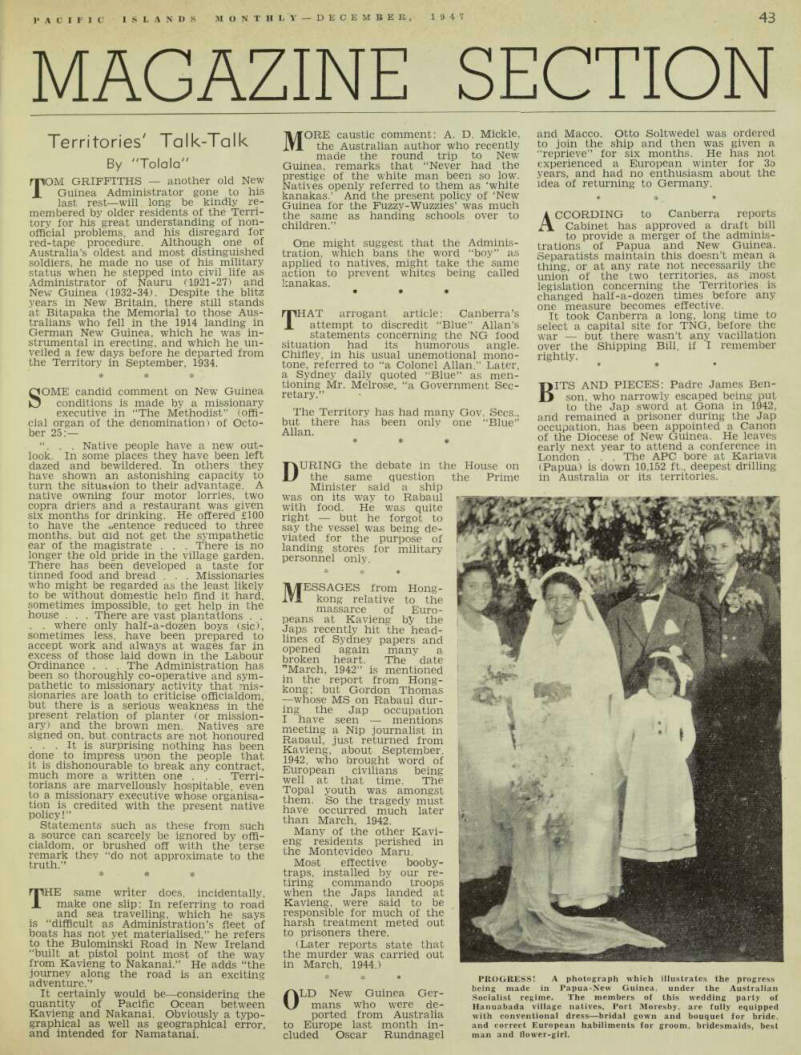
PROGRESS! A photograph which illustrates the progress being made in Papua-New Guinea, under the Australian Socialist regime. The members of this wedding party of Hanuabada village natives, Port Moresby, are fully equipped with conventional dress —bridal gown and bouquet for bride, and correct European habiliments for groom, bridesmaids, best man and flower-girl.