Mission
pp. 84-85 · Read in the full issue
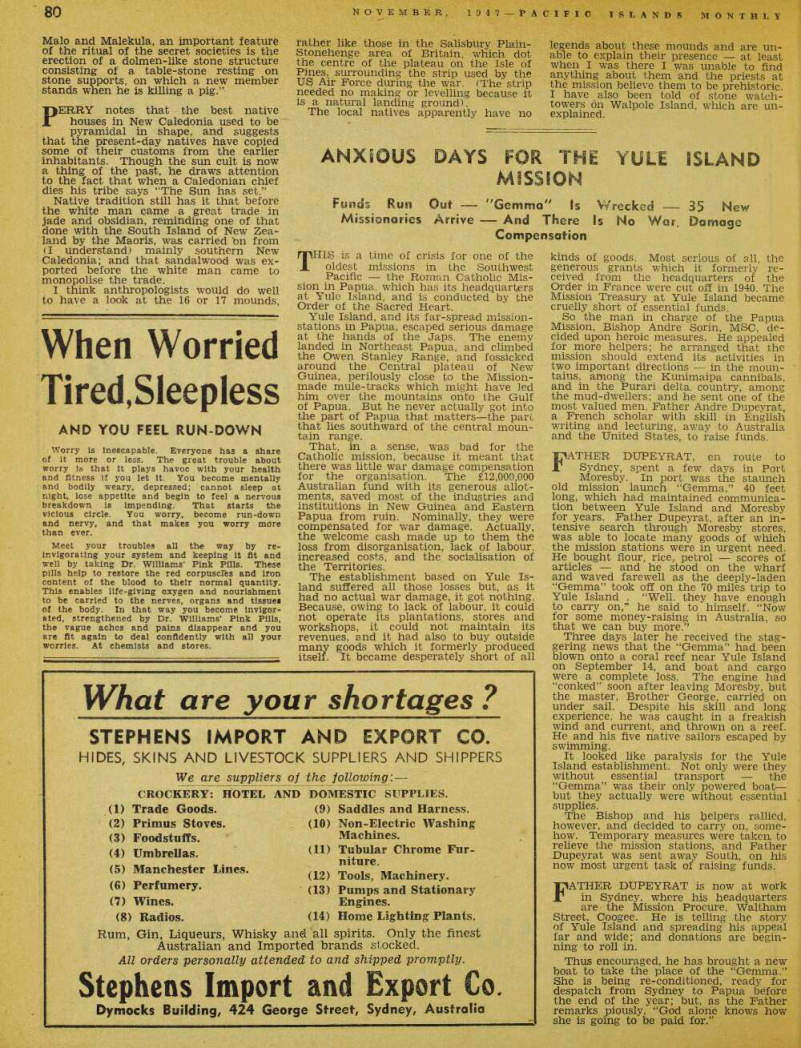
Anxious Days For The Yuli Island
Funds Run Out - "Gemma" Is Wrecked —35 New Missionaries Arrive And There Is No War. Damage Compensation
THIS is a time of crisis for one of the oldest missions in the Southwest Pacific the Roman Catholic Mis sion in Papua, which has its headquarters at Yule Island, and is conducted by the Order of the Sacred Heart.
Yule Island, and its far-spread mission stations in Papua, escaped serious damage at the hands of the Japs. The enemy landed in Northeast Papua, and climbed the Owen Stanley Range, and fossicked around the Central plateau of New Guinea, perilously close to the Mission made mule-tracks which might have led him over the mountains onto the Gulf of Papua. But he never actually got into the part of Papua that matters —the part that lies southward of the central moun tain range.
That, in a sense, was bad for the Catholic mission, because it meant that there was little war damage compensation for the organisation. The £12,000,000 Australian fund with its generous allot ments, saved most of the industries and institutions in New Guinea and Eastern Papua from ruin. Nominally, they were compensated for war damage. Actually, the welcome cash made up to them the loss from disorganisation, lack of labour, increased costs, and the socialisation of the Territories.
The establishment based on Yule Is land suffered all those losses but, as it had no actual war damage, it got nothing.
Because, owing to lack of labour, it could not operate its plantations, stores and workshops, it could not maintain its revenues, and it had also to buy outside many goods which it formerly produced itself. It became desperately short of all
kinds of goods. Most serious of all, the generous grants which it formerly re ceived from the headquarters of the Order in France were cut off in 1940. The Mission Treasury at Yule Island became cruelly short of essential funds.
So the man in charge of the Papua Mission, Bishop Andre Sorin, MSC, de cided upon heroic measures. He appealed for more helpers; he arranged that the mission should extend its activities in two important directions in the moun tains, among the Kunimaipa cannibals, and in the Purari delta, country, among the mud-dwellers; and he sent one of the most valued men, Father Andre Dupeyrat, a French scholar with skill in English writing and lecturing, away to Australia and the United States, to raise funds.
FATHER DUPEYRAT, en route to Sydney, spent a few days in Port Moresby. In port was the staunch old mission launch “Gemma,” 40 feet tong, which had maintained communica tion between Yule Island and Moresby for years. Father Dupeyrat, after an in tensive search through Moresby stores, was able to locate many goods of which the mission stations were in urgent need.
He bought flour, rice, petrol scores of articles and he stood on the wharf and waved farewell as the deeply-laden “Gemma” took off on the 70 miles trip to Yule Island . “Well, they have enough to carry on,” he said to himself. “Now for some money-raising in Australia, so that we can buy more.”
Three days later he received the stag gering news that the “Gemma” had been blown onto a coral reef near Yule Island on September 14, and boat and cargo were a complete loss. The engine had “conked” soon after leaving Moresby, but the master, Brother George, carried on under sail. Despite his skill and long experience, he was caught in a freakish wind and current, and thrown on a reef.
He and his five native sailors escaped by swimming.
It looked like paralysis for the Yule Island establishment. Not only were they without essential transport the “Gemma” was their only powered boat— but they actually were without essential supplies.
The Bishop and his helpers rallied, however, and decided to carry on, some how. Temporary measures were taken to relieve the mission stations, and Father Dupeyrat was sent away South, on his now most urgent task of raising funds.
FATHER DUPEYRAT is now at work in Sydney, where his headquarters are the Mission Procure, Waltham Street, Coogee. He is telling the story of Yule Island and spreading his appeal far and wide; and donations are begin ning to roll in.
Thus encouraged, he has brought a new boat to take the place of the “Gemma.”
She is being re-conditioned, ready for despatch from Sydney to Papua before the end of the year; but, as the Father remarks piously, “God alone knows how she is going to be paid for.”
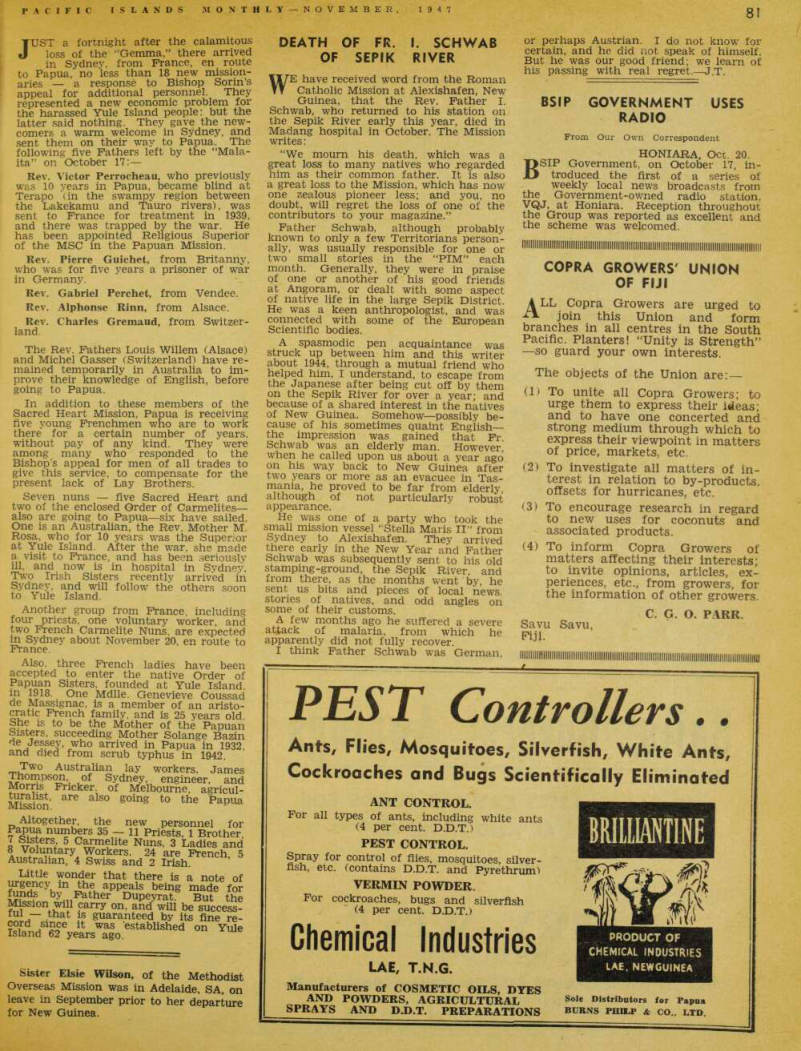
JUST a fortnight after the calamitous loss of the “Gemma,” there arrived in Sydnev, from France, en route to Papua, no less than 18 new mission aries a response to Bishop Sorin’s appeal for additional personnel. They represented a new economic problem for the harassed Yule Island people: but the latter said nothing. They gave the new comers a warm welcome in Sydney, and sent them on their way to Papua. The following five Fathers left by the “Mala ita” on October 17:— Rev. Victor Perrocheau, who previously was 10 years in Papua, became blind at Terapo (in the swampy region between the Lakekamu and Tauro rivers). was sent to France for treatment in 1939, and there was trapped by the war. He has been appointed Religious Superior of the MSC in the Papuan Mission.
Rev. Pierre Guichet, from Britanny, who was for five years a prisoner of war in Germany.
Rev. Gabriel Perchet, from Vendee.
Rev. Alphonse Rinn, from Alsace.
Rev. Charles Gremaud, from Switzer land.
The Rev. Fathers Louis Willem (Alsace) and Michel Gasser (Switzerland) have re mained temporarily in Australia to im prove their knowledge of English, before going to Papua.
In addition to these members of the Sacred Heart Mission, Papua is receiving five young Frenchmen who are to work there for a certain number of years, without pay of any kind. They were among many who responded to the Bishop's appeal for men of all trades to give this service, to compensate for the present lack of Lay Brothers.
Seven nuns five Sacred Heart and two of the enclosed Order of Carmelites— also are going to Papua—six have sailed.
One is an Australian, the Rev. Mother M.
Rosa, who for 10 years was the Superior at Yule Island. After the war, she made a visit to France, and has been seriously ill, and now is in hospital in Sydney.
Two Irish Sisters recently arrived in Sydney, and will follow the others soon to Yule Island.
Another group from Prance, including four priests, one voluntary worker, and two French Carmelite Nuns, are expected in Sydney about November 20, en route to Prance.
Also, three French ladies have been accepted to enter the native Order of Papuan Sisters, founded at Yule Island, in 1918. One Mdlle. Genevieve Coussad de Massignac, is a member of an aristo cratic French family, and is 25 years old She is to be the Mother of the Papuan Sisters, succeeding Mother Solange Bazin de Jessey who arrived in Papua in 1932, and died from scrub typhus in 1942.
Two Australian lay workers, James Thompson, of Sydney, engineer, and Morns Fncker, of Melbourne, agriculare alS ° going to the Papua Altogether, the new personnel for Papua numbers 35 11 Priests, 1 Brother. « 5 Carmelite Nuns, 3 Ladies and 8 Voluntary Workers. 24 are French, 5 Australian, 4 Swiss and 2 Irish.
Little wonder that there is a note of S Cy h. m^ app ?f ls made for funds by Father Dupeyrat. But the Mission wdl carry on. and will be success tul J h at is guaranteed by its fine rex Sl ?o e was established on Yule Island 62 years ago.
Sister Elsie Wilson, of the Methodist Overseas Mission was in Adelaide, SA, on leave in September prior to her departure for New Guinea.