The Rock Carvings
pp. 82-84 · Read in the full issue

Of New Caledonia
Evidence of a Pre-Melanesian Colonisation
By H. E. L. Friday
LITTLE is known of the prehistoric race that inhabited New Caledonia before the arrival of the Papuan type Melanesian natives, who Captain Cook found there.
Archaeologists and anthropologists con sider that the original inhabitants were related to that archaic civilisation deriv ing from Ancient Egypt, whose customs were carried to India and later across the Pacific to America, largely by Phoeni cian voyagers.
This archaic civilisation apparently in dulged in terraced irrigation on a large scale, the construction of pyramids and dolmens, the use of pearl shell and pottery, sandalwood and jade and obsi dian instruments and ornaments, and the mining of gold. , , . „ ..
Inscriptions on rocks, including the swastika cross, are found on numbers of Pacific islands, including some in the French Colony and are traced back by pre-historians to the people whom W. J.
Perry, in his book of that title published by Methuen in 1923, calls, “Children of the Sun.” , ... .
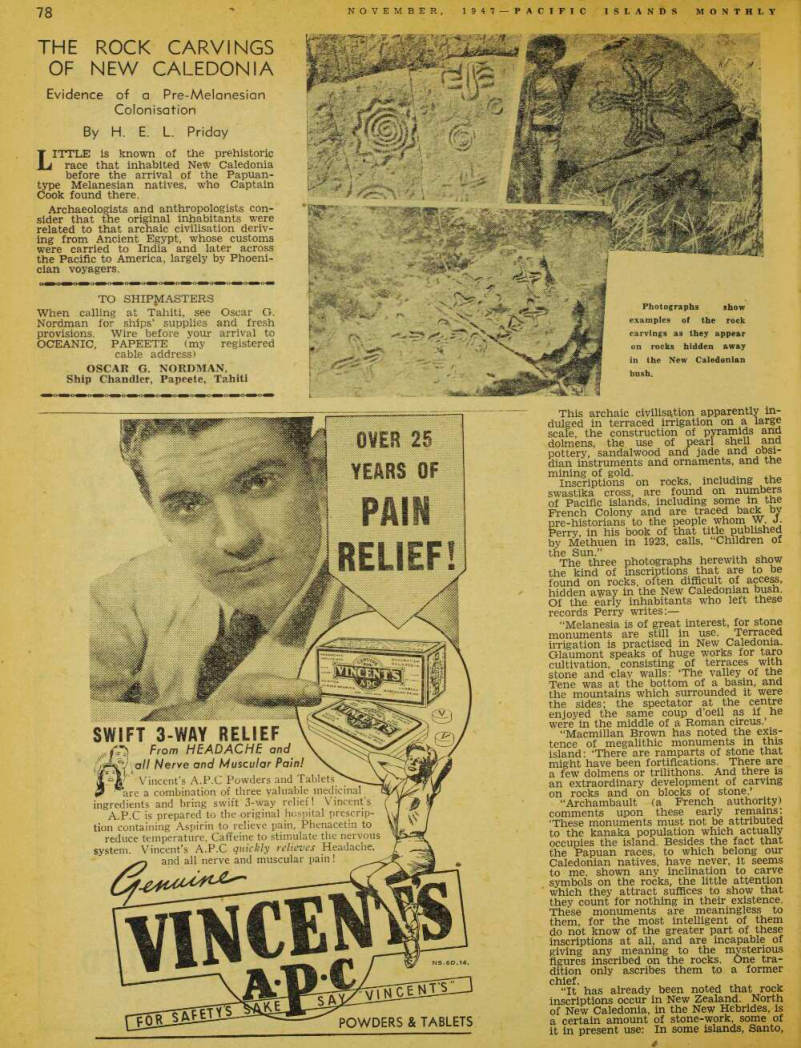
The three photographs herewith show the kind of inscriptions that are to be found on rocks, often difficult of access, hidden in the New Caledonian bush.
Of the early inhabitants who left these records Perry writes;— “Melanesia is of great interest, for stone monuments are still in use. Terraced irrigation is practised in New Caledonia.
Glaumont speaks of huge works for taro cultivation, consisting of terraces with stone and clay walls; ‘The valley of the Tene was at the bottom of a basin, and the mountains which surrounded it were the sides; the spectator at the centre enjoyed the same coup d’oeil as if he were in the middle of a Roman circus.’
“Macmillan Brown has noted the exis tence of megalithic monuments in this island: ‘There are ramparts of stone that might have been fortifications. There are a few dolmens or trilithons. And there is an extraordinary development of carving on rocks and on blocks of stone.’
“Archambault (a French authority) comments upon these early remains; ‘These monuments must not be attributed to the kanaka population which actually occupies the island. Besides the fact that the Papuan races, to which belong our Caledonian natives, have never, it seems to me. shown any inclination to carve symbols on the rocks, the little attention which they attract suffices to show that they count for nothing in their existence.
These monuments are meaningless to them, for the most intelligent of them do not know of the greater part of these inscriptions at all, and are incapable of giving any meaning to the mysterious figures inscribed on the rocks. One tra dition only ascribes them to a former chief. .
“It has already been noted that rock inscriptions occur in New Zealand. North of New Caledonia, in the New Hebrides, is a certain amount of stone-work, some of it in present use: In some islands, Santo,
Photographs show examples of the rock carvings as they appear on rocks hidden away in the New Caledonian bush.
Malo and Malekula, an important feature of the ritual of the secret societies is the erection of a dolmen-like stone structure consisting of a table-stone resting on stone supports, on which a new member stands when he is killing a pig.”
PERRY notes that the best native houses in New Caledonia used to be pyramidal in shape, and suggests that the present-day natives have copied some of their customs from the earlier inhabitants. Though the sun cult is now a thing of the past, he draws attention to the fact that when a Caledonian chief dies his tribe says “The Sun has set.”
Native tradition still has it that before the white man came a great trade in jade and obsidian, reminding one of that done with the South Island of New Zea land by the Maoris, was carried bn from (I understand) mainly southern New Caledonia; and that sandalwood was ex ported before the white man came to monopolise the trade.
I think anthropologists would do well to have a look at the 16 or 17 mounds,
legends about these mounds and are un able to explain theirpresence - It lea^t when I was there I was liable to find anything about oriests at the mission believe them to be D?ehlstlrkt I have also been told of stone watch towers on Walpole Island, which are un explained
rather like those in the Salisbury Plain- Stonehenge area of Britain, which dot the centre of the plateau on the isle of pines, surrounding the strip used by the US Air Force during the war. (The strip needed no making or levelling because it 18la ?. din S ground) The local natives apparently have no