Lutheran Missionary
p. 40 · Read in the full issue
Doctor Returns To Ng
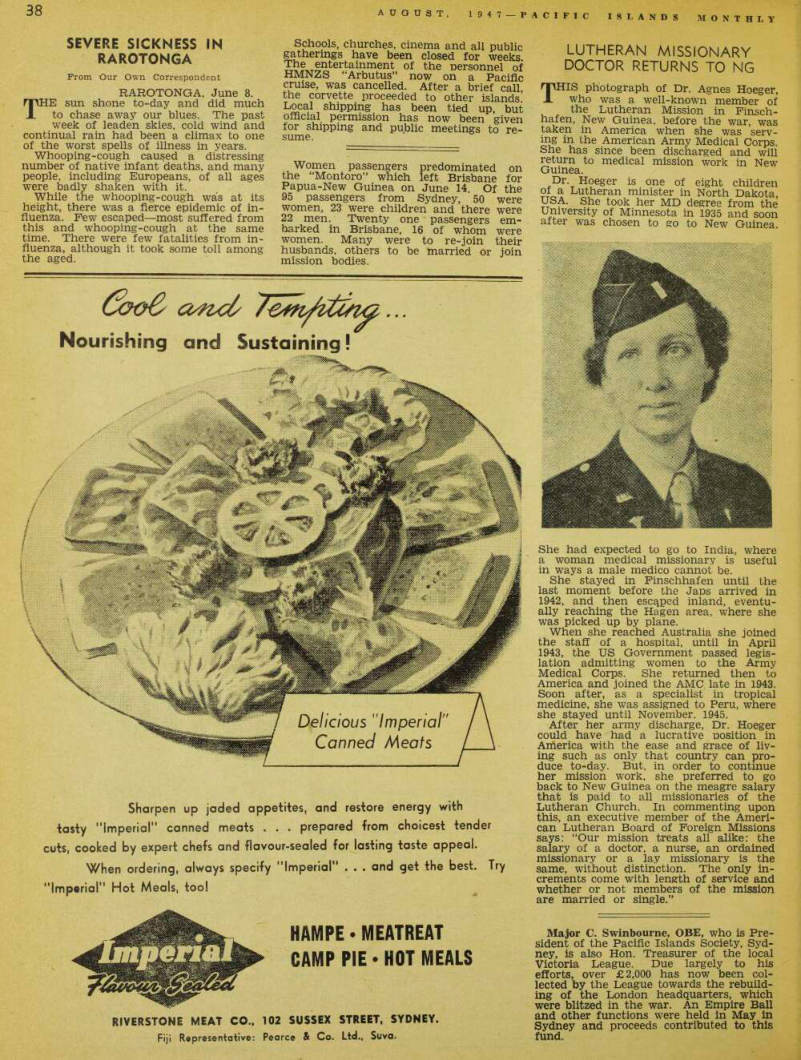
THIS photograph of Dr. Agnes Hoeger, who was a well-known member of the Lutheran Mission in Firusch hafen, New Guinea, before the war, was taken in America when she was serv ing in the American Army Medical Corps.
She has since been discharged and will return to medical mission work in New Guinea.
Dr Hoeger is one of eight children of a Lutheran minister in North Dakota, USA. She took her MD degree from the University of Minnesota in 1935 and soon after was chosen to go to New Guinea.
She had expected to go to India, where a woman medical missionary is useful in ways a male medico cannot be.
She stayed in Finschhafen until the last moment before the Japs arrived in 1942, and then escaped inland, eventu ally reaching the Hagen area, where she was picked up by plane.
When she reached Australia she joined the staff of a hospital, until in April 1943, the US Government passed legis lation admitting women to the Army Medical Corps. She returned then to America and joined the AMC late in 1943.
Soon after, as a specialist in tropical medicine, she was assigned to Peru, where she stayed until November. 1945.
After her army discharge, Dr. Hoeger could have had a lucrative position in America with the ease and grace of liv ing such as only that country can pro duce to-day. But, in order to continue her mission work, she preferred to go back to New Guinea on the meagre salary that is paid to all missionaries of the Lutheran Church. In commenting upon this, an executive member of the Ameri can Lutheran Board of Foreign Missions says: “Our mission treats all alike: the salary of a doctor, a nurse, an ordained missionary or a lay missionary is the same, without distinction. The only in crements come with length of service and whether or not members of the mission are married or single.”
Major C. Swinbourne, OBE, who is Pre sident of the Pacific Islands Society, Syd ney, is also Hon. Treasurer of the local Victoria League. Due largely to his efforts, over £2,000 has now been col lected by the League towards the rebuild ing of the London headquarters, which were blitzed in the war. An Empire Ball and other functions were held in May in Sydney and proceeds contributed to this fund.