The Late Mr. Bolton of Tabiti
p. 45 · Read in the full issue
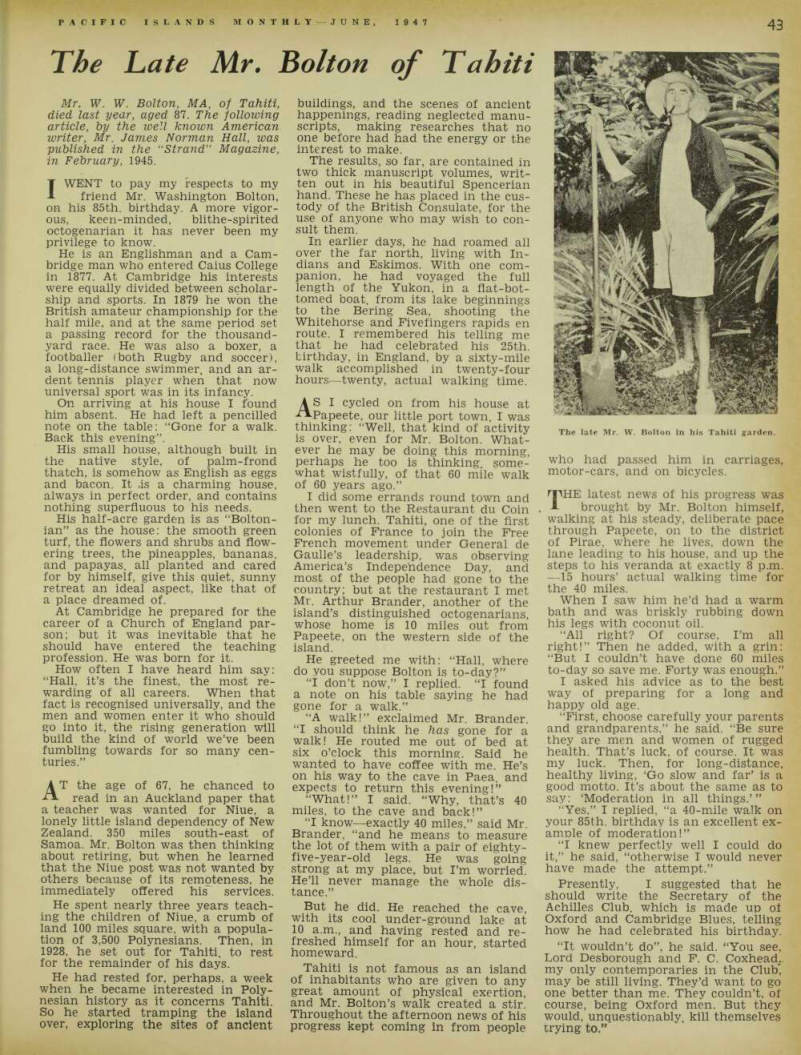
Mr. W. W. Bolton, MA, of Tahiti, died last year, aged 87. The following article, by the well known American writer, Mr. James Norman Hall, was published in the “ Strand ” Magazine, in February, 1945.
I WENT to pay my respects to my friend Mr. Washington Bolton, on his 85th. birthday. A more vigor ous, keen-minded, blithe-spirited octogenarian it has never been my privilege to know.
He is an Englishman and a Cam bridge man who entered Caius College in 1877. At Cambridge his interests were equally divided between scholar ship and sports. In 1879 he won the British amateur championship for the half mile, and at the same period set a passing record for the thousand yard race. He was also a boxer, a footballer (both Rugby and soccer), a long-distance swimmer, and an ar dent tennis player when that now universal sport was in its infancy.
On arriving at his house I found him absent. He had left a pencilled note on the table; “Gone for a walk.
Back this evening”.
His small house, although built in the native style, of palm-frond thatch, is somehow as English as eggs and bacon. It .is a charming house, always in perfect order, and contains nothing superfluous to his needs.
His half-acre garden is as “Bolton ian” as the house: the smooth green turf, the flowers and shrubs and flow ering trees, the pineapples, bananas, and papayas, all planted and cared for by himself, give this quiet, sunny retreat an ideal aspect, like that of a place dreamed of.
At Cambridge he prepared for the career of a Church of England par son; but it was inevitable that he should have entered the teaching profession. He was born for it.
How often I have heard him say: “Hall, it’s the finest, the most re warding of all careers. When that fact is recognised universally, and the men and women enter it who should go into it, the rising generation will build the kind of world we’ve been fumbling towards for so many cen turies.”
AT the age of 67, he chanced to read in an Auckland paper that a teacher was wanted for Niue, a lonely little island dependency of New Zealand. 350 miles south-east of Samoa. Mr. Bolton was then thinking about retiring, but when he learned that the Niue post was not wanted by others because of its remoteness, he immediately offered his services.
He spent nearly three years teach ing the children of Niue, a crumb of land 100 miles square, with a popula tion of 3,500 Polynesians. Then, in 1928, he set out for Tahiti, to rest for the remainder of his days.
He had rested for, perhaps, a week when he became interested in Poly nesian history as it concerns Tahiti.
So he started tramping the island over, exploring the sites of ancient
buildings, and the scenes of ancient happenings, reading neglected manu scripts, making researches that no one before had had the energy or the interest to make.
The results, so far, are contained in two thick manuscript volumes, writ ten out in his beautiful Spencerian hand. These he has placed in the cus tody of the British Consulate, for the use of anyone who may wish to con sult them.
In earlier days, he had roamed all over the far north, living with In dians and Eskimos. With one com panion, he had voyaged the full length of the Yukon, in a flat-bot tomed boat, from its lake beginnings to the Bering Sea, shooting the Whitehorse and Fivefingers rapids en route. I remembered his telling me that he had celebrated his 25th. birthday, in England, by a sixty-mile walk accomplished in twenty-four hours—twenty, actual walking time.
AS I cycled on from his house at Papeete, our little port town, I was thinking: “Well, that kind of activity is over, even for Mr. Bolton. What ever he may be doing this morning, perhaps he too is thinking some what wistfully, of that 60 mile walk of 60 years ago.”
I did some errands round town and then went to the Restaurant du Coin for my lunch. Tahiti, one of the first colonies of France to join the Free French movement under General de Gaulle’s leadership, was observing America’s Independence Day, and most of the people had gone to the country; but at the restaurant I met Mr. Arthur Brander, another of the island’s distinguished octogenarians, whose home is 10 miles out from Papeete, on the western side of the island.
He greeted me with: “Hall, where do you suppose Bolton is to-day?”
“I don’t now,” I replied. “I found a note on his table saying he had gone for a walk.”
“A walk!” exclaimed Mr. Brander.
“I should think he has gone for a walk! He routed me out of bed at six o’clock this morning. Said he wanted to have coffee with me. He’s on his way to the cave in Paea. and expects to return this evening!”
“What!” I said. “Why, that’s 40 miles, to the cave and back!”
“I know—exactly 40 miles,” said Mr.
Brander, “and he means to measure the lot of them with a pair of eighty five-year-old legs. He was going strong at my place, but I’m worried.
He’ll never manage the whole dis tance.”
But he did. He reached the cave, with its cool under-ground lake at 10 a.m., and having rested and re freshed himself for an hour, started homeward.
Tahiti is not famous as an island of inhabitants who are given to any great amount of physical exertion, and Mr. Bolton’s walk created a stir.
Throughout the afternoon news of his progress kept coming in from people
who had passed him in carriages, motor-cars, and on bicycles.
THE latest news of his progress was brought by Mr. Bolton himself, walking at his steady, deliberate pace through Papeete, on to the district of Pirae, where he lives, down the lane leading to his house, and up the steps to his veranda at exactly 8 p.m. —l5 hours’ actual walking time for the 40 miles.
When I saw him he’d had a warm bath and was briskly rubbing down his legs with coconut oil.
“All right? Of course, I’m all right!” Then he added, with a grin: “But I couldn’t have done 60 miles to-day so save me. Forty was enough.”
I asked his advice as to the best way of preparing for a long and happy old age.
“First, choose carefully your parents and grandparents,” he said. “Be sure they are men and women of rugged health. That’s luck, of course. It was my luck. Then, for long-distance, healthy living, ‘Go slow and far’ is a good motto. It’s about the same as to say: ‘Moderation in all things.’”
“Yes,” I replied, “a 40-mile walk on your 85th. birthday is an excellent ex ample of moderation!”
“I knew perfectly well I could do it,” he said, “otherwise I would never have made the attempt.”
Presently, I suggested that he should write the Secretary of the Achilles Club, which is made up of Oxford and Cambridge Blues, telling how he had celebrated his birthday.
“It wouldn’t do”, he said. “You see, Lord Desborough and F. C. Coxhead.,, my only contemporaries in the Club' may be still living. They’d want to go one better than me. They couldn’t, of course, being Oxford men. But they would, unquestionably, kill themselves frying to.”
The late Mr. W. Bolton in his Tahiti garden.