South Pacific Gold
pp. 42-44 · Read in the full issue
(Fiji photographs by Fiji Pub] AFTER Mendana sighted Guada Peru and undertook a pretty Islands. He called them the Sole associate them with the idea of g In those days the South Sea man was ever a wishful-thinker, That was the romantic era.
Four centuries passed before i but progress was then swift, until affairs have already reached the i with dredges, pneumatic drills, an aid science and all of man’s 20 miner—even in the Pacific, where of a dying race; and, when he go called romance that has been as{ days of Mendana.
For, except in their concept processes of a big gold-mining ei so many cogs in a complicated n with the precious metal, might a £ Women have tagged along to least one outstanding female persi women can take or leave gold-see deep in every man, is a little har an old gold working and, in a mal fossicking—just to see if any wer so through accident, snared by tl occasions. With others, it seems flesh of each fresh generation.
WAY back in the 50’s, my great ship. Six months out from bourne, with Melbourne in a _gol( town, on foot, on horseback, by towards the gold-diggings at Ball; The ship’s company promptly they believed was quick and easy too. Grandfather took over from following the mines; and, in due Ballarat and Clunes to the woi Kalgoorlie. There he worked out paratively quickly and went back Zealand, where he exchanged gold The curse should have ended
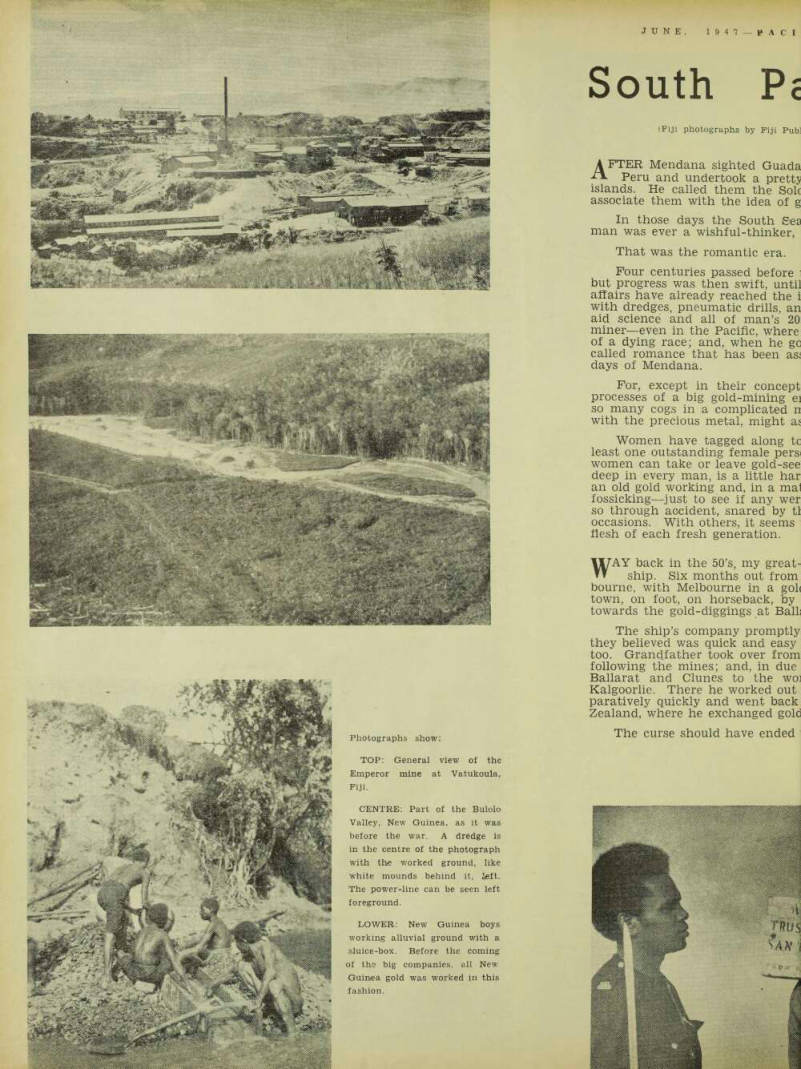
Photographs show: TOP: General view of the Emperor mine at Vatukoula, Fiji.
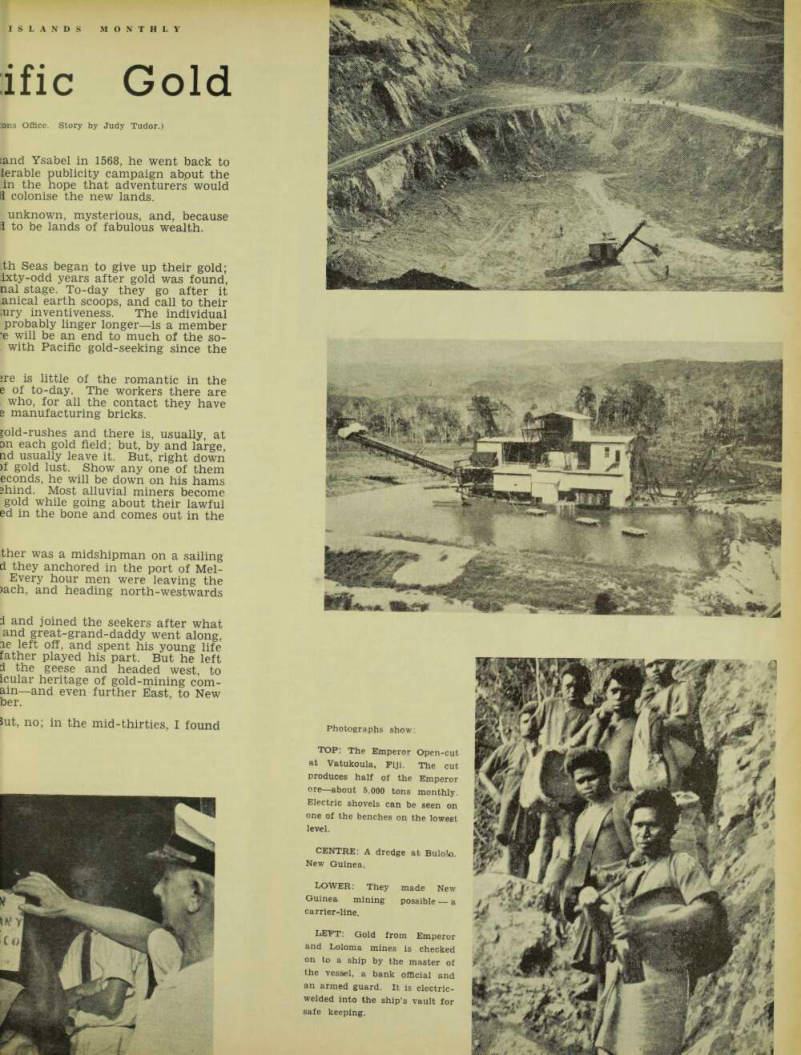
CENTRE: Part of the Bulolo Valley, New Guinea, as it was before the war. A dredge Is in the centre of the photograph with the worked ground, like white mounds behind it, Left.
The power-line can be seen left foreground.
LOWER: New Guinea boys working alluvial ground with a sluice-box. Before the coming of the big companies, all New Guinea gold was worked in this fashion.
x>ns Office. Story by Judy Tudor.) land Ysabel in 1568, he went back to .lerable publicity campaign abput the in the hope that adventurers would li colonise the new lands. unknown, mysterious, and, because i to be lands of fabulous wealth. th Seas began to give up their gold; ixty-odd years after gold was found, nal stage. To-day they go after it anical earth scoops, and call to their airy inventiveness. The individual probably linger longer—is a member *e will be an end to much of the so with Pacific gold-seeking since the ire is little of the romantic in the e of to-day. The workers there are who, for all the contact they have e manufacturing bricks. and there is, usually, at on each gold field; but, by and large, nd usually leave it. But, right down )f gold lust. Show any one of them econds, he will be down on his hams -hind. Most alluvial miners become gold while going about their lawful ed in the bone and comes out in the ther was a midshipman on a sailing d they anchored in the port of Mel- Every hour men were leaving the )ach, and heading north-westwards i and joined the seekers after what and great-grand-daddy went along, le left off, and spent his young life father played his part. But he left ? the geese and headed west, to icular heritage of gold-mining com ain—and even further E'ast, to New ber.
Jut, no; in the mid-thirties, I found
Photographs show; TOP: The Emperor Open-cut at Vatukoula, Fiji. The cut produces half of the Emperor ore—about 5,000 tons monthly.
Electric shovels can be seen on one of the benches on the lowest level.
CENTRE: A dredge at Bulolo, New Guinea.
LOWER: They made New Guinea mining possible a carrier-line.
LEFT: Gold from Emperor and Loloma mines is checked on to a ship by the master of the vessel, a bank official and an armed guard. It is electric welded into the ship’s vault for safe keeping.
myself chasing the same elusive rain bow, in New Guinea, in a passive capacity, it is true, but still chasing.
There was no particular reason why I should; and every reason why I should not.
But I guess this is the end of the golden path as far as our family is concerned. If the next generation wishes to continue the tradition, chances are they will have to hold up a bank; for by the time their time comes there will be little, if any, in dividual mining left to be done.
Even now, mining is a discredited profession. The wealth of the soil should belong to the natives, we are told. To take it, even if in so doing one risks one’s life and fights a pitiless battle against Nature in her most cussed moods, is called ex ploitation !
IN the thirties, Pacific mining was in its hey-day. Miners had gone to Papua over 60 years before, when alluvial mining had begun to peter out in Australia. From there they had infiltrated into New Guinea, which was richest of all. In the thirties, Vatukoula, Fiji, was placed on the gold-mining map with the Theodore mines of Emperor and Loloma. But the Solomons, in spite of its name and Mendana’s early hopes, is still virtually untouched mining territory.
The alluvial miner is usually an unpredictable fellow, who, having risked his neck, his health and prob ably all his worldly wealth on a hazardous venture, often squanders the reward of it all with the book maker, the pub-keeper and the land shark. Only when mining becomes big business are lasting and sane results seen in the community.
To-day, almost all of the gold in the South Seas comes from Fiji and New Guinea. In Fiji, the lode carry ing its peculiar telluride form of gold, is mined hundreds of feet under the earth’s surface, or is torn from a gigantic open-cut by mechanical shovels. Then through the vast mills it goes, ground, roasted and treated by chemicals and whirling machines until finally it emerges as neat gold bricks, ready for shipment overseas.
In the hills above the vast mills, machine-shops and workings, are model villages for Europeans, part- Europeans and natives, who know none of the gamble of gold-mining, who work regular hours, receive re gular pay and many amenities pro vided by a benevolent company whose policy is planned in offices thousands of miles away across the ocean.
In the Bulolo Valley of New Guinea, there is much the same sort of set up, only here the mining is alluvial instead of lode, and dredges in the river flats, instead of mills and min ing shafts, win the metal from Mother Earth. Before the war there was a model community around Bulolo, based on eight dredges, but this was all destroyed when invasion threatened. Now the township is be ing rebuilt, and two of the dredges are already in operation.
WE, as pre-war alluvial miners walked inland from the beach,
with local natives to carry our simple gear, up over the coastal lip of the mountain and down into the valley depths on the other side. Through swamp and over precipice, for hours along the ridges and spurs and native pads; across rivers and up
creeks aching, wet, perspiring, grimy from falls on the greasy trail, stung by mosquitoes and bitten by leeches.
In this way we were introduced to jungle mining.
We learned to “wash a dish,” to speak Pidgin, to adjust ourselves to the business of living a la kanaka in a grass hut; to make bread from weevil infested flour, to live from a can; to teach simple Stone-age men to boil water and make tea.
Then when that creek was finished, we moved on and found fresh fields.
The novelty of living so uncomfort ably close to Nature was wearing off, and the unbounded enthusiasm with which we had attacked the job was tempered now by some experi ence and a rapidly expanding realisation of the problems that con fronted us.
But we lived on in the perpetual wet and damp of the deep valleys and, with nothing more elaborate than a sluice box, a few prospecting dishes and three teams of boys, we got gold.
At Vatakoula, they keep their gold in a vault. We kept ours in an old honey-jar on top of a packing-case cupboard, and when we felt that we had accumulated perhaps £3OO worth, we packed it in an empty dried-yeast can, strapped down the lid with sticking-plaster and then, with lov ing care, sewed it up in the tail of an old, discarded khaki shirt, or a piece of lap-lap, and addressed it to a Sydney bank in indelible pencil.
Two boys went with it to the beach, carrying that can of gold casually in a rucksack amongst our outward mail, and with no special protection or in structions. The journey, out over the mountains and along the beach, staying at night in native villages
along the route, took perhaps five days; but the boys never failed to deliver the goods at the Post Office, where the processes of civilisation took over, and our gold ended as prosaic, neat, entries in the ledgers of the bank in Sydney.
Back at the camp we continued to live our simple life, unworried for the safety of our wealth, which we had trustingly committed to the tender care of a couple of reformed head hunters, the primitive jungle and crocodile-infested coastal rivers. The boys, by their contempt of what we regarded as precious, were able to carry out a duty which in civilisation could only be accomplished by armoured cars, police guards and electrically controlled strong-rooms.
The alluvial miners of New Guinea are filtering back-back to the Sepik the Ramu and the Wewak hinterland.
But there are fewer of them now, and there will be fewer still in the years to come. There is no indication yet that Brown Brother has learned to value gold for itself—and in that, perhaps, he is infinitely wiser than we.
But, due to war, the presence in the Territory of large numbers of Servicemen, and the Australian Gov ernment’s New Deal, since war ended Brown Brother has learned to value money. Gold lust should be the next logical step; and, with that, his assimilation of civilisation will be complete. Already, our left-wing re formists, are telling us that the mineral wealth of the- Islands should be used only for the benefit of the native inhabitants.
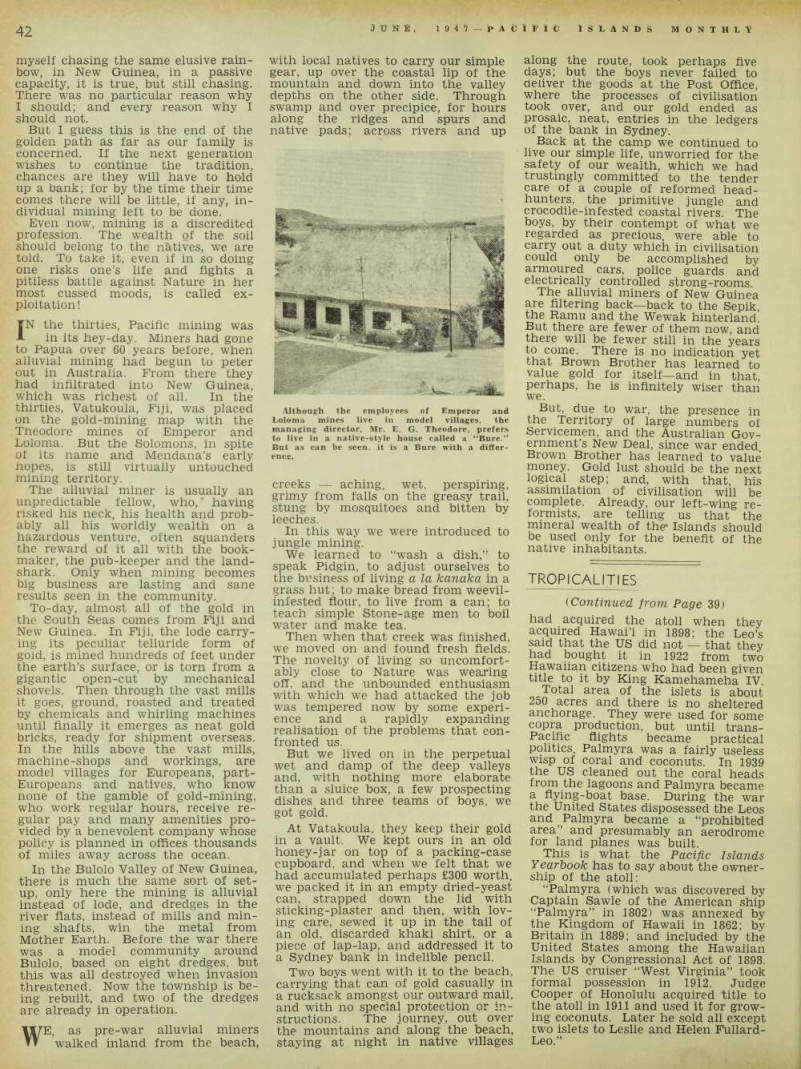
Although the employees of Emperor and Loloma mines live in model villages, the managing director, Mr. E. G. Theodore, prefers to live in a native-style house called a “Bure.”
But as can be seen, it is a Bure with a differ ence.