Magazine Section
p. 39 · Read in the full issue
Territories Talko-alk
(By “Tolala”)
LAST month I mentioned a New Guinea lass who broke into the “Smart Girl Comes to Town” class. Some time later a Sydney Sunday paper picked as its “Sheik of the Week” Mr. Pat Byrne, whom they described as “the handsome man from New Guinea with the lovely flat overlooking Whale Bay . . . doing a Pacific Administration course in Sydney.”
Sounds very nice, too. * * ♦ EVERYONE knows that transport is a general headache these days, fraught with the mysteries of graded priori ties, presumably controlled by Civil Avi ation Pooh-Bahs. An all-time high in regimentation was recently reached when the War Crimes trials reopened at Rabaul and airliners were taxed to their limit. result was that NG residents were “off-loaded” from ’planes on two consecutive occasions to enable Army nersonnel of varying tonnage, and legal luminaries, to proseed northward for the trials. It did not occur to the Army, presumably, to use their own planes for such an operation. Or were there none sufficiently airworthy for the Sydney- Rabaul hop? * ♦ * THIS “off-loading” racket is becoming a menace to Territorians, who find their own priorities are only “deuce high” compared with those held by Gov ernment departments. Big business ex ecutives find they must relinquish seats for junior Government clerks. ♦ ♦ ♦ OLD Rabaul residents will remember Margaret Cilento as a child playing around her parents’ home at Naman ula. (Her father, now Sir Raphael, was then PMO of TNG.) Margaret took up art as a career and recently in Brisbane won the Half Dozen Group of Artists’ travelling scholarship. She will join her
father soon in New York, where he is Director of Displaced Persons for UNO. ♦ * * THUS writes a worried housewife from Port Moresby: “This is a hungry place for fresh fruit and vegetables.
Onions and potatoes are unprocurable.
Fruit is 1/3 a lb., potatoes and onions (when obtainable) 5Jd. a lb., other vege tables 1/5 a lb. Butter is 3/3 a lb., lamb 2/5 a lb., and eggs 3/8 a doz. Bread is 1/1 for a 2 lb. loaf. Wheat for fowls is 22/6 a bushel.” ♦ ♦ * PRICES and supplies in Moresby may be bad enough, but they are noth ing compared to what Rabaul folk have to endure. In Rabaul they are short of everything.
It was the publicised report of the nlieht of Darwin (Capital of Australia’s Northern Territory), however, which roused the authorities into despatching emergency supplies there, although Dar win has nothing on Rabaul. • • ♦ IF New Guinea residents feel that some of Sydjney’s characteristics—such as transport food shortages and labour troubles —have beer* intro duced to New Guinea, they may be in terested to know that Sydney has imported some of NG’s worst features. A plague of “mites” (related to scrub typhus) is renorted from the two suburbs of Hornsby and Hurstville, and radical pre ventive measures have been adopted.
Malarial fever is also reported in the Liverpool area. ♦ * • ANOTHER Sydney epidemic has broken out in Moresby. Residents are suf fering from a series of housebreakine incidents, and the unlighted streets of the town are said to facilitate the work of the marauders.
Unkind critics of the Administration say that the darkened streets are a part of the pro-native policy.
A COMPLAINT of many employers of indentured native labourers in New Guinea is the Administration’s un willingness to punish deserters in any form. Result is that labourers walk off the job, fully realising that they run no risk of penalty for breach of contract.
Equity for both parties is the essence of any British contract, and penalties must be enforced on both parties for breaches of any agreement. That is common law —and common sense. * MOROBE district has riches other than gold for the man with vision and imagination. Jim Pollard, a well known goldfields identity, launched a new post-war industry after purchasing a Yank dump of 540,000 bottles of mosquito lotion for £2OO. A condition of the pur chase was that the lotion should be turned over to a mining company in drums.
With over half a million bottles on hand Pollard saw possibilities. He imported essential oils from Australia and started producing, for the native trade, perfumes hydrogen peroxide for hair bleaching, paint for ceremonial dances and added to his business talc powder purchased from the Army. He is said to be doing a “roaring trade.” • ♦ • BERT GASKIN has recently resigned from the Production Control Board as Commerce Member and intends developing his holding at Taliligap, near Rabaul. Whilst with the PCB he took no active part in the RSS & AILA, of which he was previously president of the New Guinea branch. He now hopes to resume his interests with this organi sation. In recognition of his 20-odd vea'rs’ work for the returned soldiers, the Federal Executive recently made him a Life Member. He was secretary of the Canberra branch before he went to New Guinea in the early ’3o’s. • ♦ * THE native labour position in New Guinea still remains grim. There are, however, according to recent reports, a fair number of labourers offering from the Madang and Sepik areas, but here transport is the difficulty and some re cruits, signed on last December, reached Rabaul only in the middle of March. A quarter of their annual contract is lost in waiting for a ship.
Where local labourers are employed, planters in some districts are able to arrange contracts with chiefs to clean roads, “ring” palms and cut and cure the copra on an all-round basis of £6 a ton, labourers to supply their own food.
Housing, with mosquito-proof sleeping quarters, is supplied by the planters.
Copra produced under these conditions costs from £l2 to £l4 a ton.
Individual “casuals” are employed by other planters for collecting nuts and cutting copra at the rate of 1/- a bag for green copra. New Britain recruits are asking £1 a month wages, with early morning tea and biscuits. This latter amenity is not new many employers have been issuing this ration for years, because they found it paid. If this ser vice is to be made a general practice, then it is up to the Administration to see there are no high import duties on those commodities. All native labour issues, under the Ordinance, should be allowed into the Territory free of duty.
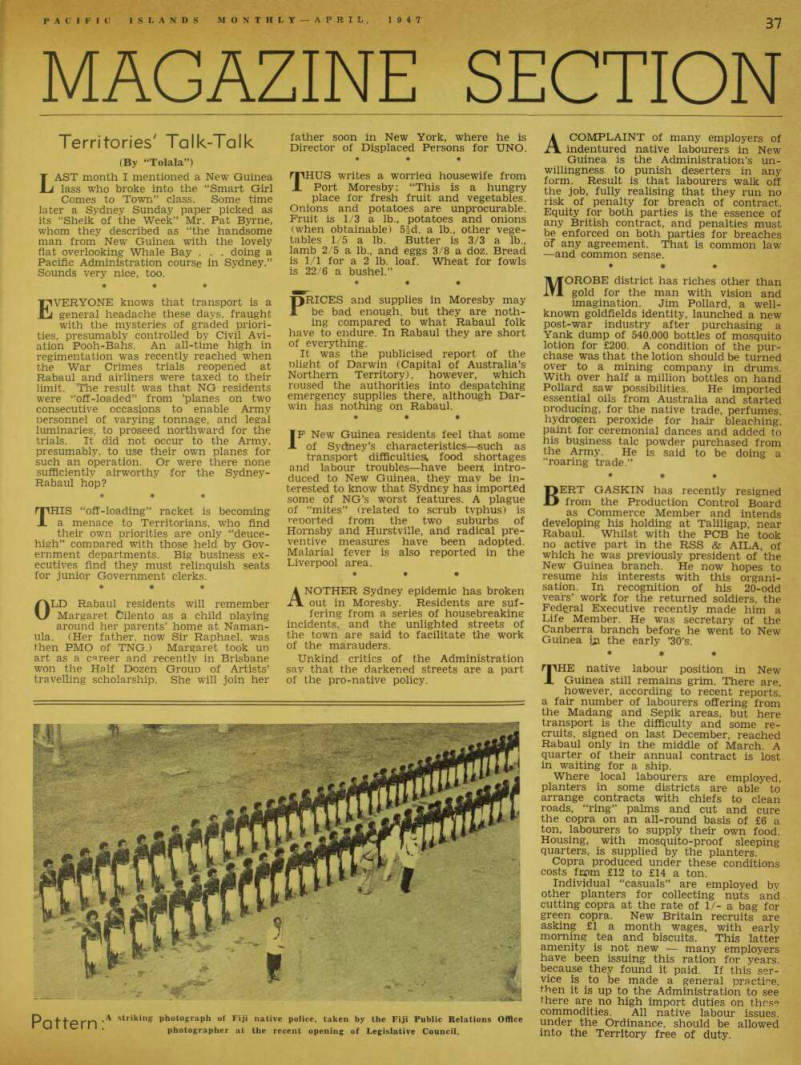
Pattern: A striking photograph of Fiji native police, taken by the Fiji Public Relations Office photographer at the recent opening of Legislative Council.