Sydney Interludes
p. 45 · Read in the full issue
J IKE other residents of Pacific terri tories, Robert Louis Stevenson found it necessary occasionally to visit the centres of comparative civilization. In the Nineties he visited Australia four times; and, like other Island residents, did not always find it to his liking.
By Morwell Hodges
“IjrrHEN I think of Melbourne,” wrote W Robert Louis Stevenson, “I vomit! ... Its flatness, its streets laid out with a square rule, are certain to have a detrimental effect on those who are doomed to dwell by the yellow waters of the Yarra.”
Actually, RLS never saw Melbourne— hence, probably, such caustic criticism.
And he wrote with scant praise of Sydney, describing the GPO as “an ungainly structure with a tower.”
Among the curiously few literary celebrities to honour Australia with a visit, the famous Scot made four trips to the Commonwealth during his years in the Pacific.
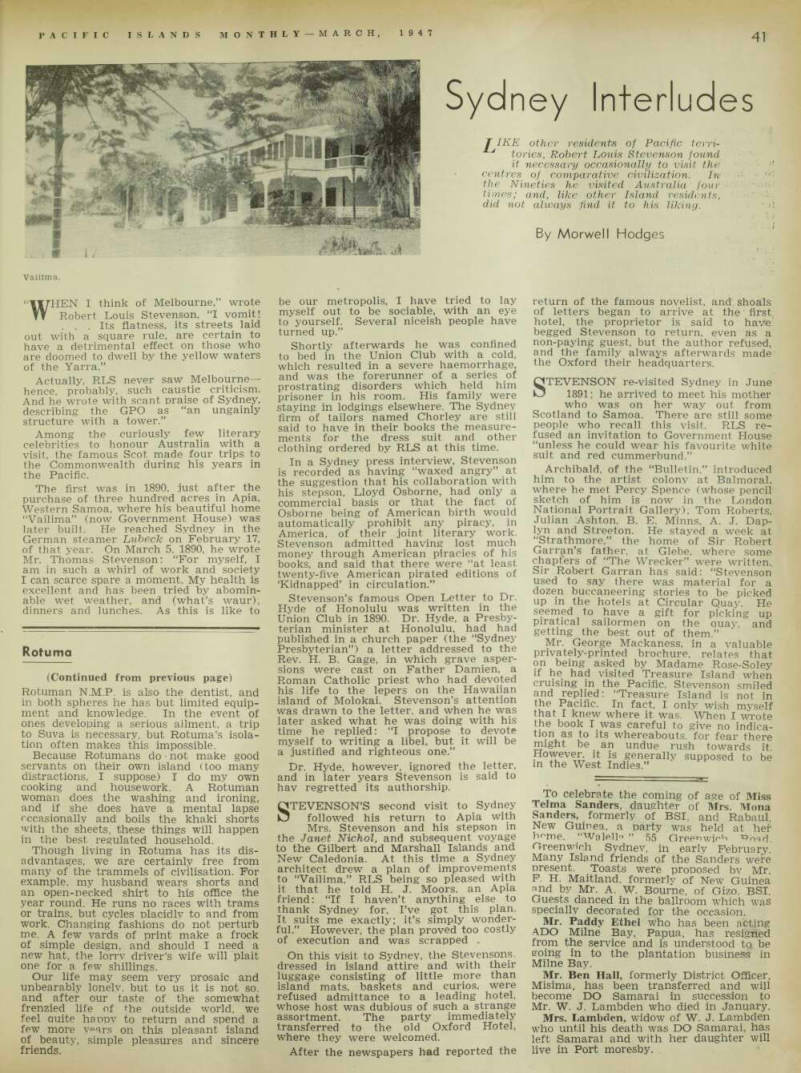
The first was in 1890. just after the purchase of three hundred acres in Apia, Western Samoa, where his beautiful home “Vailima” (now Government House) was later built. He reached Sydney in the German steamer Luheck on February 17, of that year. On March 5. 1890, he wrote Mr. Thomas Stevenson: “For myself, I am in such a whirl of work and society I can scarce spare a moment. My health is excellent and has been tried by abomin able wet weather, and (what’s waur), dinners and lunches. As this is like to
be our metropolis, I have tried to lay myself out to be sociable, with an eye to yourself. Several niceish people have turned up.”
Shortly afterwards he was confined to bed in the Union Club with a cold, which resulted in a severe haemorrhage, and was the forerunner of a series of prostrating disorders which held him prisoner in his room. His family were staying in lodgings elsewhere. The Sydney firm of tailors named Chorley are still said to have in their books the measure ments for the dress suit and other clothing ordered by RLS at this time.
In a Sydney press interview, Stevenson is recorded as having “waxed angry” at the suggestion that his collaboration with his stepson, Lloyd Osborne, had only a commercial basis or that the fact of Osborne being of American birth would automatically prohibit any piracy, in America, of their joint literary work.
Stevenson admitted having lost much money through American piracies of his books, and said that there were “at least twenty-five American pirated editions of ‘Kidnapped’ in circulation.”
Stevenson’s famous Open Letter to Dr.
Hyde of Honolulu was written in the Union Club in 1890. Dr. Hyde, a Presby terian minister at Honolulu, had had published in a church paper (the “Sydney Presbyterian”) a letter addressed to the Rev. H. B. Gage, in which grave asper sions were cast on Father Damien, a Roman Catholic priest who had devoted his life to the lepers on the Hawaiian island of Molokai, Stevenson’s attention was drawn to the letter, and when he was later asked what he was doing with his time he replied: “I propose to devote myself to writing a libel, but it will be a justified and righteous one.”
Dr. Hyde, however, ignored the letter, and in later years Stevenson is said to hav regretted its authorship.
STEVENSON’S second visit to Sydney followed his return to Apia with Mrs. Stevenson and his stepson in the Janet Nichol, and subsequent voyage to the Gilbert and Marshall Islands and New Caledonia. At this time a Sydney architect drew a plan of improvements to “Vailima,” RLS being so pleased with it that he told H. J. Moors, an Apia friend: “If I haven’t anything else to thank Sydney for, I’ve got this plan.
It suits me exactly; it’s simply wonder ful.” However, the plan proved too costly of execution and was scrapped .
On this visit to Sydnev, the Stevensons. dressed in island attire and with their luggage consisting of little more than island mats, baskets and curios, were refused admittance to a leading hotel, whose host was dubious of such a strange assortment. The party immediately transferred to the old Oxford Hotel, where they were welcomed.
After the newspapers had reported the
return of the famous novelist, and shoals of letters began to arrive at the first hotel, the proprietor is said to havte begged Stevenson to return, even as a non-paying guest, but the author refused, and the family always afterwards made the Oxford their headquarters.
STEVENSON re-visited Sydney in June 1891; he arrived to meet his mother who was on her way out from Scotland to Samoa. There are still some people who recall this visit. RLS re fused an invitation to Government House “unless he could wear his favourite white suit and red cummerbund.”
Archibald, of the “Bulletin,” introduced him to the artist colony at Balmoral, where he met Percy Spence (whose pencil sketch of him is now in the London National Portrait Gallery). Tom Roberts, Julian Ashton, B. E. Minns, A. J, Dap lyn and Streeton. He stayed a week at “Strathmore,” the home of Sir Robert Garran’s father, at Glebe, where some chapters of “The Wrecker” were written.
Sir Robert Garran has said: “Stevenson used to say there was material for a dozen buccaneering stories to be picked up in the hotels at Circular Quay. He seemed to have a gift for picking up piratical sailormen on the quay, and getting the best out of them.”
Mr. George Mackaness. in a valuable privately-printed brochure, relates that on being asked by Madame Ro.se-Soley if he had visited Treasure Island when cruising in the Pacific, Stevenson smiled and replied: “Treasure Island is not in the Pacific. In fact, I only wish myself that I knew where it was. When I wrote the book I was careful to give no indica tion as to its whereabouts, for fear there might be an undue rush towards it.
However, it is generally supposed to be in the West Indies.”
To celebrate the coming of age of Miss Telma Sanders, daughter of Mrs. Mona Sanders, formerly of BSI, and Rabaul, New Guinea, a party was held at her b'-'me, “WalelF ” 55 Green ‘Poad.
Greenwich Sydnev, in early February.
Many Island friends of the Sanders were present. Toasts were proposed bv Mr.
F. H. Maitland, formerlv of New Guinea and by Mr. A. W. Bourne, of Gizo. BSI.
Guests danced in the ballroom which was specially decorated for the occasion.
Mr. Paddy Ethel who has been acting ADO Milne Bay, Papua, has resigned from the service and is understood to be eoing in to the plantation business in Milne Bay.
Mr. Ben Hall, formerly District Officer, Misima, has been transferred and will become DO Samarai in succession to Mr. W. J. Lambden who died in January.
Mrs. Lambden, widow of W. J. Lambden who until his death was DO Samarai, has left Samarai and with her daughter will live in Port moresby.
Vailima.