This Is Rotuma
pp. 44-45 · Read in the full issue
By Amel
WE have just spent a holiday in Aus tralia.
Leaving our quiet island home, we found ourselves, within a few days, in the heart of Sydney.
There we wrestled with ration books; gaped open-moutned at the fantastic pnces of most commodities; and frankly shied away from those peculiar objects called “Women’s Hats.”
We enjoyed the twin comforts of gas and electricity. We travelled by aero plane and ship, by train and tram, by ous and car. We wore warm clothes to wnich we were unaccustomed, and ate meat, fruit and vegetables we had not seen for years.
We became two more ants in the teem ing anthill of city life, and emerged with no feeling of envy for those whose whole lives are lived therein.
Everywhere we went, people asked us where we came from, and when we re plied “Rotuma," they stared at us. It became obvious that although Rotuma might be very important to us, it was, to most people, just a strange name, vari ously mis-pronounced “Row-tumour,’’ or “Wrote-to-Ma,” but seldom given its correct pronunciation, “Ro-tooma” (the first “o” as in “go”).
WELL —Rotuma is an island depend ency of Fiji, situated 400 miles north of Suva, 200 miles south of Funafuti (Ellice Group) and 150 miles east of a mysterious place called Patsy Island. It (Rotuma) can be found on most maps, but occasionally (much to our wrath) it is omitted.
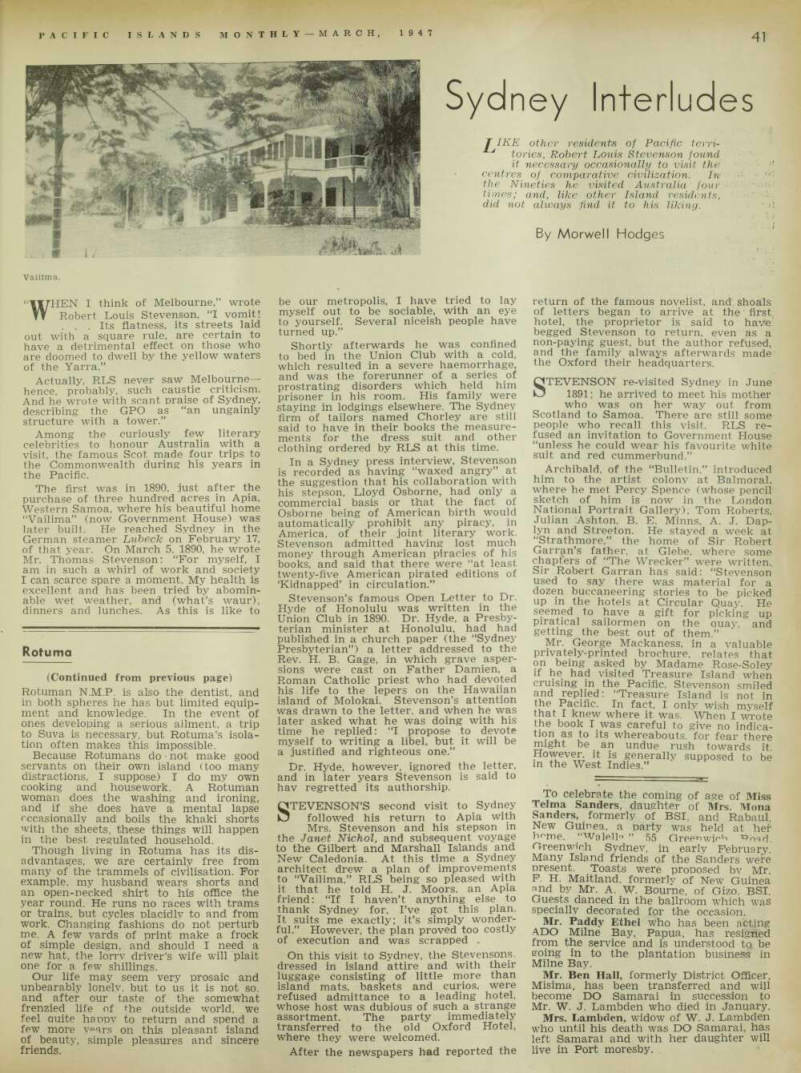
Although, when it does appear on a map, it looks a mere dot, Rotuma is actu ally quite a large island, nine miles long and three miles wide. It is a quaint shape, rather like a big fish, the narrow part of the tail being the isthmus—two to three hundred yards wide—upon which is located the capital city, Motusa. On the waterfront at Motusa are found the stores, wharves and main copra storage sheds of the two firms trading on the island, Burns Philp (S.S.) Co. Ltd. and Morris, Hedstrom Ltd.
Rotuma is rugged for its size, having hills ranging in height from two hundred to eight hundred feet. And it is a beau tiful island, richly green, surrounded by
smaller islands, sapphire sea and snowy beaches.
The rainfall is excessive, but because of lack of reservoirs, most of it is wasted, though the seepage provides a plentiful
(Continued next page)
supply of rather brackish water for the numerous wells on the island.
The volcanic soil, of which Rotuma is mainly composed, will grow almost any thing in the way of tropical fruits and vegetables, while kapok and cocoa also thrive. The main crop, however, is coco nuts, from which approximately 2,500 tons of copra are produced annually. As well many thousands of coconuts are utilised for drinking purposes.
Rotuma’s population consists of 3,000 natives, a dozen Europeans and four In dians. The island supports, also, about 200 head of cattle, some goats and num erous pigs, dogs, horses and poultry.
There are no flying foxes, mongoose, hornets, hawks or toads; but there are mosquitoes, flies, millions of copra beetles (which burrow into the cheese, bog them selves in the jam, or get tangled in your hair), owls which eat chickens, and the landrail, a bird which eats hens’ eggs.
Rotuma has been our home for six years, and we like living there, although we lack many of the comforts of places nearer to civilisation. We have kero sene or benzine lamps, a wood stove and no modern conveniences. We get little variety in vegetables; and fresh meat every six weeks—perhaps. The water sup ply is precarious and likely to give out in a “drought” of a month’s duration.
The motor vessel “Yanawai” makes four calls a year at Rotuma, bringing mail, passengers and fresh supplies of goods for the stores. Sometimes, how ever, she is delayed, and does not come for four months, or even five, and then we feel that we are indeed a neglected and forgotten community. The stores are empty of all luxuries and most necessi ties, and the culinary conjuring becomes fantastic. Once, when there was a period of five months between trips, the stores contained little else but dripping, pitch, linseed oil and rope.
However, if we never saw the “Yana wai” again, we would not starve. The island has an abundance of native food such as yams, taro and tapioca, and when all other fruits' are out of season, the useful banana is always with us. These, helped out with an occasional fowl, a fish or a piece of meat, constitute a per fectly nourishing diet. When the stock of tinned milk is exhausted, and fresh milk is unobtainable, we use coconut milk in many ways.
The perennial heat, and the lack of good medical, dental and mail services are Rotuma’s greatest drawbacks. The
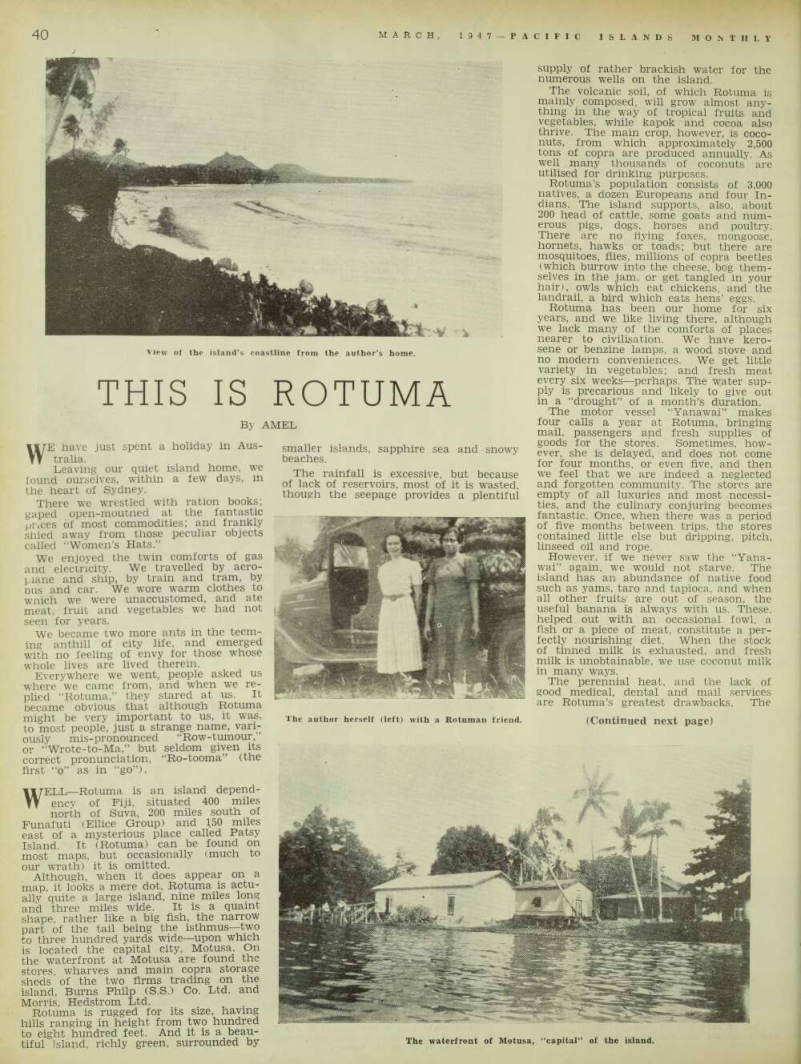
View of the island’s coastline from the author’s home.
The author herself (left) with a Rotuman friend.
The waterfront of Motusa, “capital” of the island.
Rotuman N.M.P. is also the dentist, and in both spheres he has but limited equip ment and knowledge. In the event of ones developing a serious ailment, a trip to Suva is necessary, but Rotuma’s isola tion often makes this impossible.
Because Rotumans do • not make good servants on their own island (too many distractions, I suppose) I do my own cooking and housework. A Rotuman woman does the washing and ironing, and if she does have a mental lapse rccasionally and boils the khaki shorts with the sheets, these things will happen in the best regulated household.
Though living in Rotuma has its dis advantages, we are certainly free from many of the trammels of civilisation. For example, my husband wears shorts and an open-necked shirt to his office the year round. He runs no races with trams or trains, but cycles placidly to and from work. Changing fashions do not perturb me. A few yards of print make a frock of simple design, and should I need a new hat, the lorrv driver’s wife will plait one for a few shillings.
Our life may seem very prosaic and unbearably lonely, but to us it is not so. and after our taste of the somewhat frenzied life of the outside world, we feel Quite happy to return and spend a few more v°ars on this pleasant island of beauty, simple pleasures and sincere friends.