Vale Rabaul!
p. 46 · Read in the full issue
IF you are a stony-hearted realist, them you will applaud the recent Canberra decision to abandon Rabaul and make Kokopo the administrative centre of the New Britain district. If you are a sen timentalist, then you will drop a meta phorical tear at the passing of the town, for Rabaul once was the strong heart of a vigorous and healthy young Terri tory.
In actual years, it had had a brief history: but tradition, like many things in the tropics, matures quickly and Rabaul had tradition, too.
Rabaul, as the capital of New Guinea, came into being in 1910; and in the years that followed experiences came thick and fast. It knew Germans, Australians, and the Japs. It saw two wars, many minor volcanic disturbances and one major emotion, which covered the town with a layer of pumice-dust and ash, and caused its temporary evacuation. Fin ally. it saw invasion and enemy occu pation; and, later, waves of Allied bomb ers that reduced the town and its build ings, its trees and its harbour installa tions to rubble. It saw the cruel sacri fice, in war. of more than 200 of its resi dents. There was little of the old Rabaul left when peace came; nor has there been any permanent rebuilding since.
Why, then, shed tears of regret? Pos sibly because the passing of Rabaul marks the end of an era rich in all ways that the controlled, stereotyped present is not. It is perhaps fitting that it should go now, and make place for a Government inspired and executed town ship to be built, sometime, 20 miles p,way at Kokopo. Virtually none of the imme diate pre-war residents of the township escaped tragedy. If they did not lose their lives, then they lost their property.
The town will be remembered most poignantly by a legion of widows and fatherless children whose lives were changed irrevocably by the abandonment of Rabaul’s finest citizens to the Jap anese in early 1942.
They will remember Rabaul’s tree lined roads —giant casuarinas, rain-trees and
mangoes meeting overhead to provide dark shade from the tropical heat; pretty bungalows behind hibiscus and croton hedges, flanked by flaming bougainvillea and fragrant frangipanni; picnics at Nordup; dances at the club; buying sor ties in Chinatown; the view of the har bour from Namanula hill; a gracious social life; peace, security and isolation from the world’s sordid affairs.
In the manner of such things, they will forget that Rabaul could be small and parochial in viewpoint; that it could be hot and, at times, dusty: that it did in fact exist on the rim of a vast vol cano.
Rabaul, in the days they remember and regret, was Rabaul; the centre of the New Guinea universe.
But Rabaul pumps no life-blood now.
If there is life-blood in the provisional Territorv of Papua-New Guinea, then it flows imperceptibly and is not pumped.
Rabaul, at the extremity of the sprawl ing, unwieldy body that is the new Ter ritory, is in hourly peril of atrophy.
After the eruption of 1937, it was of course decided to move the capital to the mainland: and although this was delayed for a matter of years, it was being car ried out when the Japanese invaded the Territory. That move, if comnleted. would have finished the official life of the town, but it would not have oblit erated the old Rabaul, as the recent de cision threatens to do: once officialdom removes from its temporary, ex-Armv Quarters it occupies now there will be little reason, short of sheer stubborn ness, for the rest of the communtiy to go_on living in Rabaul.
But this may yet be a premature obit uary. A comnlete. artificial harbour must be built at Kokopo and a new Govern ment township constructed. At the nre sent rate of rebuilding in New Guinea, fhat might well be a matter of years, or decades.
Gordon Thomas, who perhaps knows Rabaul better than any man living—he was one of the handful who survived the Japanese occupation—has written this about the town: IN September, 1945, I stood on a ridge at Namanula and gazed down over what used to be Rabaul . . . from days of soc ; al gaiety and economic pros perity it was now merely an area of over grown weeds, with an Australian Army again pitching its tents amongst the kunai grass. Rabaul’s cycle had been completed.
From the swampy flats of 1905, through the years of building and progress, it had now gone back to devastated wilderness.
In May, 1911, I had steamed slowly up the harbour in an old German NDL ship, nnd had seen Rabaul unfold before me, filled with promise. In September, 1945, I climbed aboard a Catalina flying boat and, as we made height to proceed south wards, I looked down imon the rusty wrecks of bombed ships along the fore shores, and a wilderness that once was the town of Rabaul.
The first post-war romance in New Guinea goldfields area was officially an nounced in February when Mr. A. J.
Winterford, onlv son of Mr. and Mrs. A.
Winterford of Wau. became engaged to Miss Jean Hill, eldest daughter of Mr. and Mrs. J. W. Hill of Bulolo. Mr. Winterford Jnr. was formerly a Patrol-Officer in the New Guinea Administration. He is now with the Bulolo Gold Dreding Co.
One of Rabaul’s pre-war bungalows destroyed in the blitz.
Rabaul's swimming pool, completed in 1939.
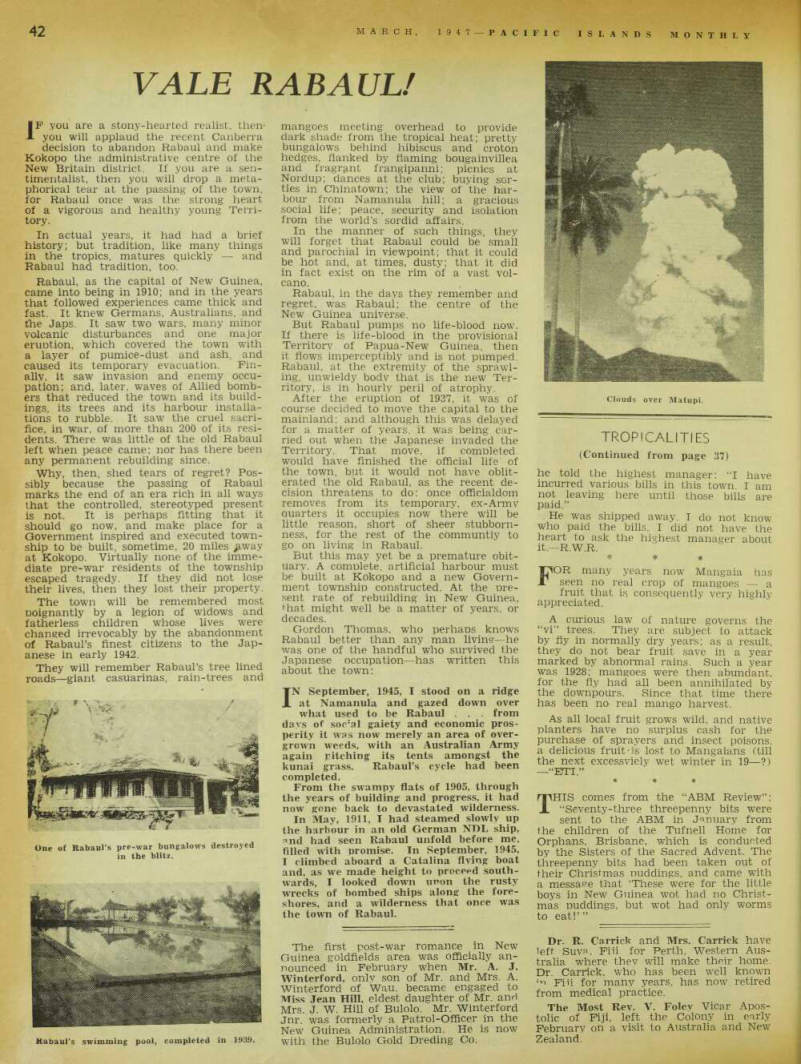
Clouds over Matupi.