She writes of a Glamorous South
p. 38 · Read in the full issue
Seas
THE Pacific, like woman when she shortened her skirts, has lost most of its mystery. No longer is it a region of fairy fantasy or high-coloured romance. It is a squabbling-ground for politicians of conflicting ideologies; or a peg upon which to hang a scientific theory. Glamour is gone with a few exceptions.
One of the exceptions comes to us through Miss Beatrice Grimshaw who. undaunted by changing times has poured out a steady stream of Pacific stories and is still doing so after 40 years all according to the best traditions of the romantic era. Slightly unreal perhaps, paricularly to-day; unashamedly escap ist. But amusing, interesting, gay: Christmassy tinsel in a wqrk-a-day, bureaucratic world of regulations and form-filling.
Miss Grimshaw was born in Northern Ireland with itchy feet and an urge to write. She is still writing at present from her flat in an up-country, New South Wales township and bides her time until better travel facilities permit her to be on her way again.
She had two novels published in London during the war years just past (Lost Child and Rita Regina ); and recently, a Sydney radio station dramatised one of her stories, Nobody’s Island. More are scheduled from the same station.
Altogether Beatrice Grimshaw has had 38 Pacific books published in America and England; some have hit the best seller class; some have been filmed; others translated into French. German, Danish and Swedish. A Pacific record that is not likely to be beaten by the present generation of writers.
SHE started out on her adventures 42 years ago, in a age that invented the cliche that woman’s place was in the home, and when the life of a girl,
as she then was, was likely to be some what limited.
But nothing limited Beatrice Grimshaw.
She got a commission from the London Daily Graphic (not without some effort, one imagines) and crossed to America on her way to the Pacific.
In the South Seas, then a virtually un spoiled region, she lived the life of one of her own heroines. She travelled for months on island schooners, stayed with the Governor of Fiji, spent months in Samoa, Tonga, New Hebrides, Solomons and other islands.
Two years after she had started out from London she was in Papua and from then until 1934 she made Papua her head quarters. One is permitted to wonder, mildly, why she made this wild region, as it was then, her home in preference to the more gracious islands of Polynesia.
Perhaps it is because she met the love of her life there. Judge Hubert Murray (later knighted), Lieutenant-Governor of the Territory, had a close friend —William Little, explorer, gold-miner, pioneer. Miss Grimshaw and he fell in love. He was, she says, a typical Australian and through him she gained her admiration of the Australian people. They became engaged, but before they could marry he died of some obscure and undiagnosed tropical fever. Beatrice remained single; but she still treasures Little’s ring of Papuan gold.
From Papua, Miss Grimshaw travelled to Malaya, Borneo, Bali and others of the Netherlands Indies, to America and made three trips round the world. But always she came back to her Papuan home and with her brother Ramsay even began planting. They grew tobacco suc cessfully until Australian protection for growers in Australia made it uneconomic; then they turned to vanilla.
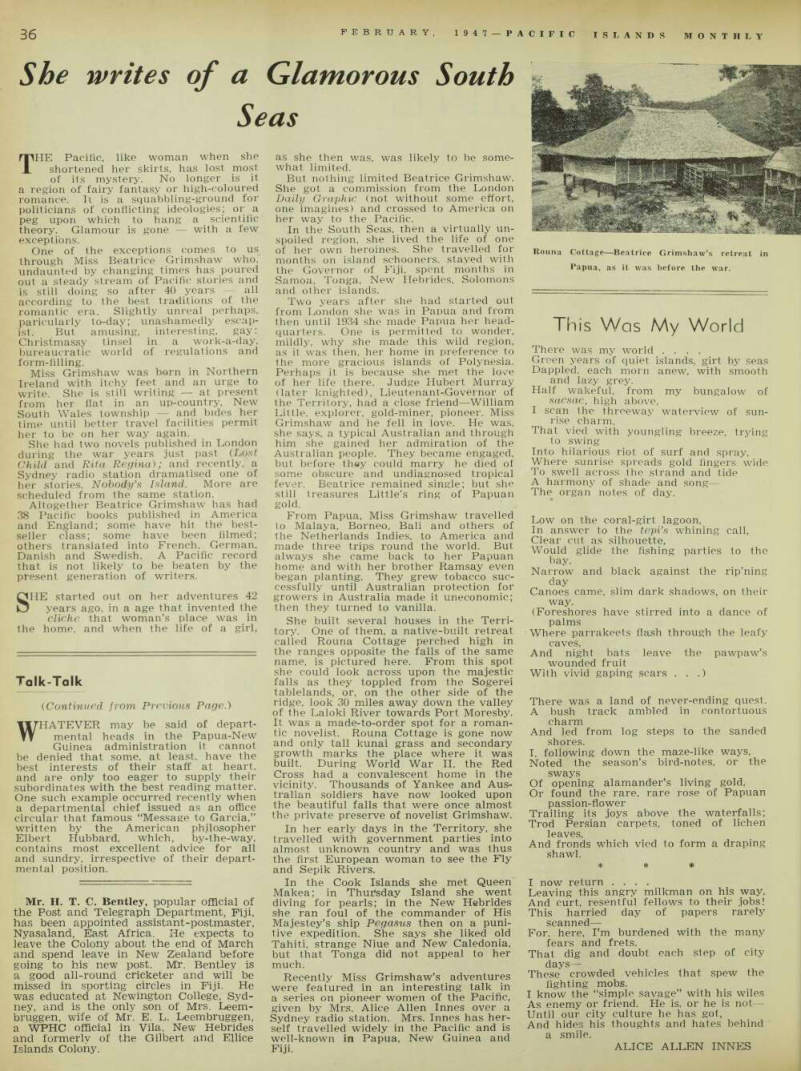
She built several houses in the Terri tory. One of them, a native-built retreat called Rouna Cottage perched high in the ranges opposite the falls of the same name, is pictured here. From this spot she could look across upon the majestic falls as they toppled from the Sogerei tablelands, or, on the other side of the ridge, look 30 miles away down the valley of the Laloki River towards Port Moresby.
It was a made-to-order spot for a roman tic novelist. Rouna Cottage is gone now and only tall kunai grass and secondary growth marks the place where it was built. During World War 11, the Red Cross had a convalescent home in the vicinity. Thousands of Yankee and Aus tralian soldiers have now looked upon the beautiful falls that were once almost the private preserve of novelist Grimshaw.
In her early days in the Territory, she travelled with government parties into almost unknown country and was thus the first European woman to see the Fly and Sepik Rivers.
In the Cook Islands she met Queen Makea; in Thursday Island she went diving for pearls; in the New Hebrides she ran foul of the commander of His Majestey’s ship Pegasus then on a puni tive expedition. She says she liked old Tahiti, strange Niue and New Caledonia, but that Tonga did not appeal to her much.
Recently Miss Grimshaw’s adventures were featured in an interesting talk in a series on pioneer women of the Pacific, given by Mrs. Alice Allen Innes over a Sydney radio station. Mrs. Innes has her self travelled widely in the Pacific and is well-known in Papua, New Guinea and Fiji.
Rouna Cottage—Beatrice Grimshaw’s retreat in Papua, as it was before the war.