Magazine Section
pp. 37-38 · Read in the full issue
Territories Talk-Talk
By "Tolala"
ONE of the important aims of the South Pacific Commission will be trans portation facilities. This should make an appeal to our own folk up in New Guinea, and particularly in the Rabaul area where things are so grim at present. In working for the native interests in this regard the Commission will also be assisting the poor, forgotten European who, apparently, does not come into the picture at all in any of the targets set up at the conference in Canberra.
High-light of the opening session was US Minister Butler’s enthusiasm to get somewhere, and do something. In his closing remarks of his opening address he introduced some rhymed philosophy when he said: We can do as much as we think we can But we’ll never accomplish more; If we’re afraid of ourselves There’s little for us in store.
For the failure comes from the inside first.
It’s there if we only knew it.
And we can win. though we face the worst.
If we feel that we’re going to do it.
Success! It’s found in the soul of us And not in the realm of luck!
The world will furnish the work to do.
But we must provide the pluck.
We can do whatever we think we can.
It’s all in the way we view it.
It’s all in the start we make We must feel that we’re going to do it.”
And what is more he meant every word of it. A close runner-up was UK High Commissioner Williams, who also exuded keen interest. But he did not want the delegates at the conference to get the idea that native welfare was an innova tion, where British administration in the Pacific was concerned: also he did not agree with making haste too quickly in the matter of steering natives along the “path of human betterment.” And that’s a key-note which it is well to follow: Evolution, not revolution.
B B B
OLD-TIME Rabaul residents (but not too old, mark you!) will remember willowy Joan Woodhill. who was one of our local glamour girls, (Her husband, P. J. Woodhill of the New Guinea Crown Law Department died on active service.) She recently hit the news in Sydney papers when she married the chief officer of the Matson liner, Monterey, whom she met last November on a trip to ’Frisco. She is now Mrs.
Robert McKenzie and will make her home in the Golden Gate city, where son Christopher will join her sometime this year. b b a THERE was a small gathering of old New Guineaites in Canberra at the end of last month when glasses were filled to toast the health of Wally Harper, one-time Treasury official in Rabaul who had just arrived over from South Africa, where he is in business, and now sports the typical company director’s front window. Amongst those present were Abie Abraham, Mick Ryan, Claude Barnes and Long Thomas. Abie, by the
way, still keeps his end up on the tennis court, despite the passing years. ■ B ■ THE Wau-Labu road was mentioned recently at the annual meeting of the New Guinea Goldfields Ltd., when Chairman Kruttschnitt sounded a note of warning as to the road’s condi tion. which needed immediate attention. ’Twill be a pity if that traffic artery becomes impassable. It will be more than that; it will be tragic, for it is really the only means of transport for any heavy materials from the coast to the fields. Probably all road-making mechanical appliances have been sold by CDC to Australian interests and shipped south for shire councils and such-like.
Peace has her demands no less than war. ■ ■ ■ lAN INNES, son of Alice Allen Innes is following in his mother’s literary footsteps and collected a “Commenda tion” in the recent Sydney Morning Herald war novel competition with his “This Is My Reckoning,” a story of his experiences, with the RAAF. when he bafied out over France and contacted the Maquis. It is full of thrills and ably written. He collected the MM in France ■ ■ B DELEGATES to the South Pacific con ference at Canberra from Papua- New Guinea were the Administrator (Col, J. K. Murray). Dr. John Gunther (Director of Public Health). Messrs. W.
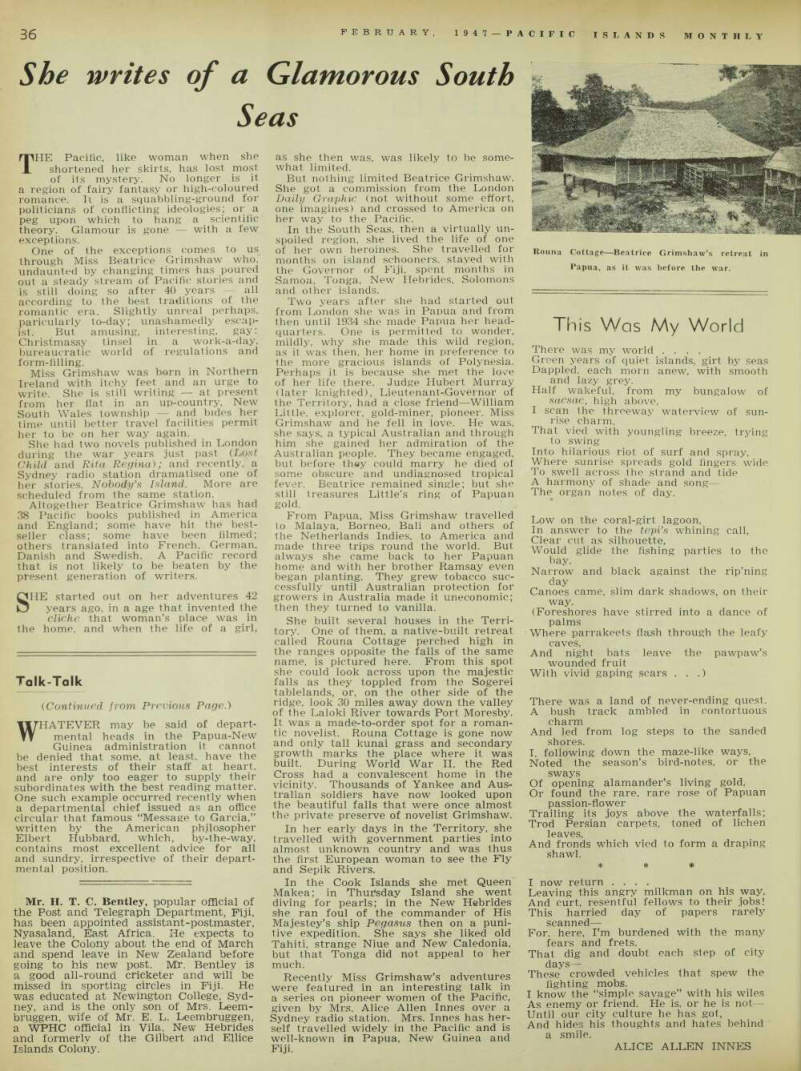
A McCarthy Cartoon of K. C. Mc- Mullen who retired recently from the New Guinea Administration and has joined W. R. Carpenter and Co. Ltd.
Ken McMullen joined the New Guinea Service as a cadet in 1925; was an ADO in Kokopo and at Buka Passage, and, when Rabaul was occupied by the Japs in 1942, was DO, Wau. He helped evacu ate the goldfields area and later served, with the rank of Colonel, in ANGAU and the British Military Administration in Borneo.
When Civil Administration was resumed in Papua-New Guinea, he was appointed to .the Provisional Administration, and became one of the most respected officials in the new set-uo.
C. Groves (Director or Education) and W. Cottrell-Dormer (Director of Agricul ture). The delegation was accompanied by Mesdames J. K. Murray, W, C. Groves and Cottrell-Dormer.
H S B
HIGH cocoa prices prevailing at present, are making New Guinea growers lick their lips, but transport and labour conditions are the biggest handicaps. By the time these obstacles are ironed out prices will probably be down again. Anyway, the recent Aus tralian loan to the NEI makes one wonder how much Australia is committed in reciprocal trade agreements, which mean purchasing tropical products from the Dutch instead of concentrating on developing our own island produce. □ a ■ WHILE the brains of six nations were working out the destinies of Pacific native races at Canberra a friend of mine received a letter from an old cook-boy, who lives not far from a New Britain port. Part of it read: “Plenty boys all talk of new fashion which is coming. I do not want any more new fashion. I had too much during the Japanese time. I want to go to work, but the chief of my village tells me I must not work for less than 6/- a day.
The master says he will not pay so much.
So I have no work. I also have no tobacco and no calico to wear. I have plenty of marks (money) but no store to spend it in, and all my pigs are gone, too. So I do not want new fashion. I want a smoke and want to work. Please send me some stick tobacco, not cigarettes for they soon stink like new fashion.”
And he seems to have something there, too. NZ Deputy Prime Minister (Walter Nash) at the Canberra conference also had something when he said we must not try to make the natives as Euro peans or Americans but try to uplift them for their own benefit. ■ ■ a THE question is, however, can we give them the one without the other?
In the process of uplifting they must naturally absorb our western ideas and habits. There is one tendency for which they have already fallen in many of the native countries of recent times, and that is the gentle art of striking over indus trial matters. Considerable industrial unrest has been reported, simultaneously, from Kenya and Trinidad, to say nothing of the smaller stop-work incidents in New Guinea which are occurring nearly every week in various areas.
B ■ ■ THE Royal Dutch Shell oil company has engaged sixty US engineers to give it a hand in its search for oil in Dutch New Guinea. From all reports they will be starting in a big way this year. Doing the job the Yankee way, and if the same tactics are employed as in other Yank undertaking in the Pacific, the Royal Dutch Shell people should be showing something for their money in record time. It will be interesting to compare the workings on the Dutch side of the border with those on our own side in New Guinea, wherte Australian oil interests have been steadily plugging away for the past twenty-odd years both in Papua and the New Guinea territories, with little to show for it all save “encour aging indications.”
(Continued Next Page )
k. c. McMullen
WHATEVER may be said of depart mental heads in the Papua-New Guinea administration it cannot be denied that some, at least, have the best interests of their staff at heart, and are only too eager to supply their subordinates with the best reading matter.
One such example occurred recently when a departmental chief issued as an office circular that famous “Message to Garcia,” written by the American philosopher Elbert Hubbard, which, by-the-way, contains most excellent advice for all and sundry, irrespective of their depart mental position.
Mr. H. T. C. Bentley, popular official of the Post and Telegraph Department, Fiji, has been appointed assistant-postmaster, Nyasaland, East Africa. He expects to leave the Colony about the end of March and spend leave in New Zealand before going to his new post. Mr. Bentley is a good all-round cricketer and will be missed in sporting circles in Fiji. He was educated at Newington College, Syd ney, and is the only son of Mrs. Leem bruggen, wife of Mr. E. L. Leembruggen, a WPHC official in Vila. New Hebrides and formerly of the Gilbert and Ellice Islands Colony.