Copra
p. 20 · Read in the full issue
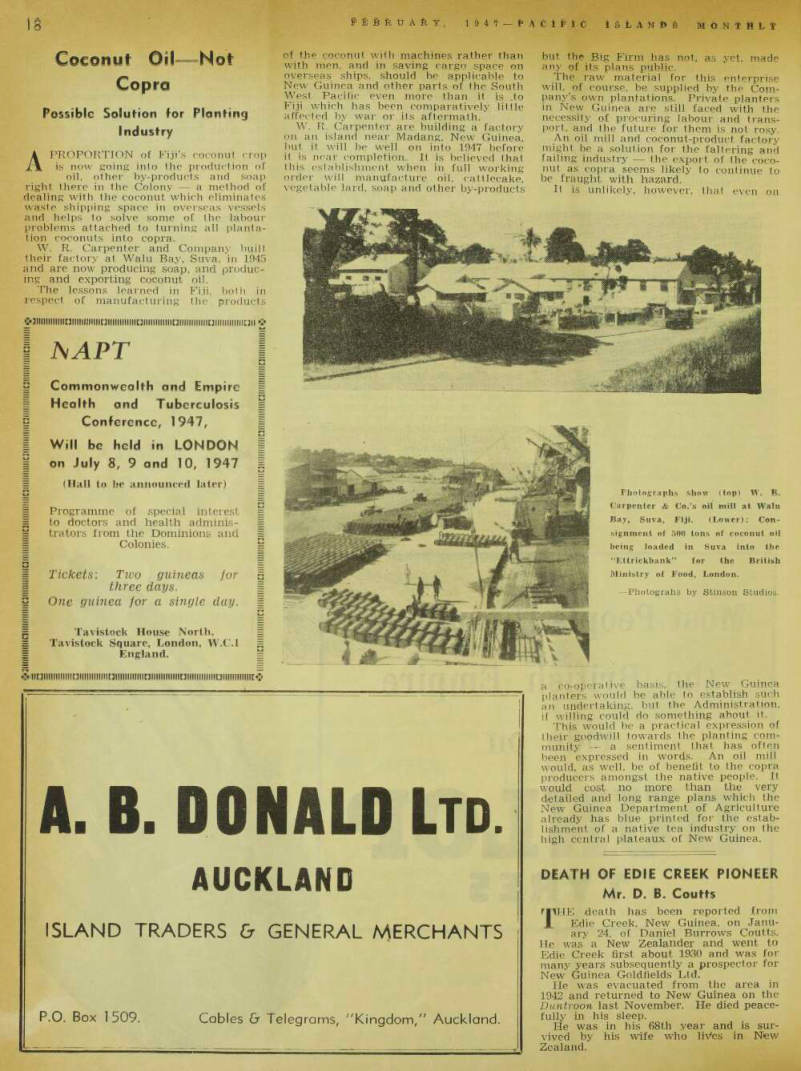
Coconut Oil-Not Copra Possible Solution for Planting Industry
A PROPORTION of Fiji’s coconut crop is now going into the production of oil, other by-products and soap right there in the Colony a method of dealing with the coconut which eliminates waste shipping space in overseas vessels and helps to solve some of the labour problems attached to turning all planta tion coconuts into copra.
W. R. Carpenter and Company built their factory at Walu Bay, Suva, in 1945 and are now producing soap, and produc ing and exporting coconut oil.
The lessons learned in Fiji, both in respect of manufacturing the products
of the coconut with machines rather than with men. and in saving cargo space on overseas ships, should be applicable to New Guinea and other parts of the South West Pacific even more than it is .to Fiji which has been comparatively little affected by war or its aftermath.
W. R. Carpenter are building a factory on an island near Madang, New Guinea, but it will be well on into 1947 before it is near completion. It is believed that this establishment when in full working order will manufacture oil. cattlecake, vegetable lard, soap and other by-products
but the Big Firm has not, as yet, made any of its plans public.
The raw material for this enterprise will, of course, be supplied by the Com pany’s own plantations. Private planters in New Guinea are still faced with the necessity of procuring labour and trans port. and the future for them is not rosy.
An oil mill and coconut-product factory might be a solution for the faltering and failing industry the export of the coco nut as copra seems likely to continue to be fraught with hazard.
It is unlikely, however, that even on
a co-operative basis, the New Guinea planters would be able to establish such an undertaking, but the Administration, if willing could do something about it.
This would be a practical expression of their goodwill towards the planting com munity a sentiment that, has often been expressed in words. An oil mill would, as well, be of benefit to the copra producers amongst the native people. It would cost no more than the very detailed and long range plans which the New Guinea Department of Agriculture already has blue printed for the estab lishment of a native tea industry on the high central plateaux of New Guinea.
Photographs show (top) W. R.
Carpenter & Co.'s oil mill at Walu Bay, Suva, Fiji. (Lower): Con signment of 500 tons of coconut oil being loaded in Suva into the “Ettrickbank” for the British Ministry of Food, London.
Photograhs by Stinson Studios.