"Yankee Doctor"
pp. 18-19 · Read in the full issue
Dead
Story of How S. M. Lambert Conquered Hookworm
rE death occurred, in the United States in January, of Dr. S, M.
Lambert, famous in the world ns the man who conquered one of mankind’s greatest sconces, hookworm, and who wrote one of the world’s best books about the Pacific.
In 1918, Dr, Victor Heiser (Director of the East for the Rockfeller ffil ected Lambert for the anti-hookworm r amnaign in the Pacific; and he was sent to Papua, via Queensland, where he did a Uttlc preliminary investigation.
Lambert, who then was in his thirties, had had tropical experience in Mexico (where he came within an ace of being murdered by rebels) and Costa Rica. He was a man of vision and imagination, and he tackled his new job with an en thusiasm that never waned. It was a Pithy iob. involving the regular examina tion of the excreta of the most lowlv humans; but he kept his mind fixed always on the meaning of the wor 1 " rather than the character of it —and. in his success, he contributed enormously to the wellbeing of all mankind.
Hookworm was as old as the Pyramids -there are references to it in ancient
papyri—but in 1918 medical science had got no further with the treatment of it than a fumbling and ineffective use of chenopodium; and conservative people accepted it as something like marriage— one of the inescapable inconveniences of life. Actually, it was an evil compar able in its effect with malaria. All the tropical races suffered terriblv from the thing—an intestinal worm which laid the foundations of many diseases.
The first Pacific Administrator met by Dr. Lambert, was the late Sir Hubert Murray. Papua’s Governer was kind and hospitable—but he was completely a scep tic where Lambert’s work was concerned —and he was right, to the extent that Lambert accomplished nothing in Papua except a good medical survey—which showed an appalling incidence of hook worm.
During the next three years, Lambert worked very hard, and visited most of the South Pacific. He found hookworm everywhere, and whole communities stricken by sickness as the result of hookworm; but he could discover no ef fective treatment. He settled in Suva, and—although generally he did not get along very well with British officials—
he found a good friend and loyal associ ate in Dr. Aubrey Montague, Chief Med ical Officer. In the years to come, each man conceived for the other a great ad miration and affection. Together, they fought the scourge; and, together, they admitted failure.
Late one afternoon in February 1922, Lambert was sitting in his office in Suva, utterly discouraged. He had been work ing like a tiger, trying to cure hookworm with chenopodium; And he was “feeling the soreness of a middle aged prize fighter who had taken the count in the first round.”
Quite by chance, he picked up the 1921 issue of the Journal of the American Medical Association, and there he saw an article by a veterinary, Maurice C. Hall, called “The Use of Carbon Tetrachloride in the Removal of Hookworm.” Hall had noticed that animals under chloroform frequently emitted intestinal parasites
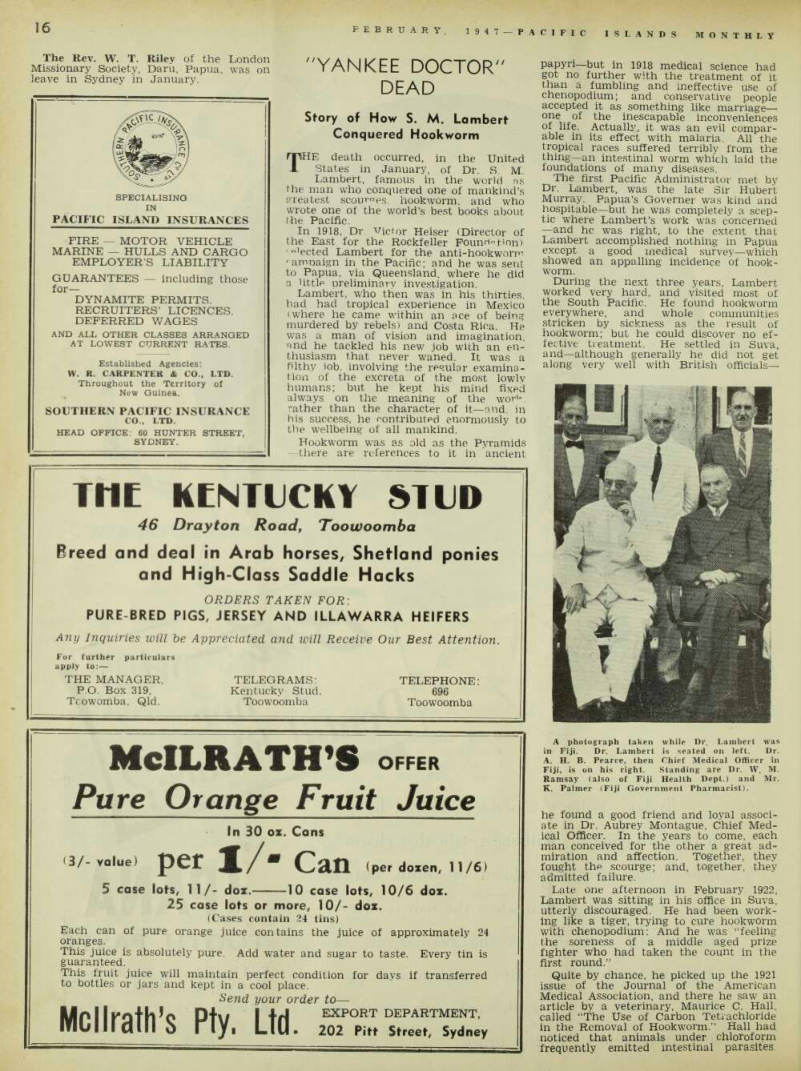
A photograph taken while Dr. Lambert was in Fiji. Dr. Lambert is seated on left. Dr.
A. H. B. Pearce, then Chief Medical Officer in Fiji, is on his right. Standing are Dr. VV. M.
Ramsay (also of Fiji Health Dept.) and Mr.
K. Palmer (Fiji Government Pharmacist).
He had experimented for years, and now ne reported remarkable results with a drug hitherto known only as a cleaning fluid, Tetrachloride. But would the drug be of use with humans? Hall closed his article simply by saying that he had taken a substantial dose and had suffered no harm. It should have poisoned him.
The message of Tetrachloride came to Lambert like an answer to prayer. He went immediately to the hospital labor atory. There he found an unopened bot tle of Tetrachloride. He hurried to Dr.
Montague with the magazine article, and the bottle.
Montague read the article csrefully.
“Lambert, try anything” he sighed. That was the way they all felt in 1922. Lam bert’s story continues: , “We had been trained in the empirical school. Try anything, if there is evidence in its favour. Even the jungle medicine man, for all his black magic, has herbs and simples which the respectable prac titioner might include in his remedies.
“A thousand years before Harvey de monstrated the blood’s circulation, Asi atic wizards were giving chaulmoogra oil for leprosy. True, they gave it wrong— but they gave it. The Incas of Peru taught us the value of quinine for mal aria: they chewed the bark. Before the Crusades, corner barbers were giving mercury to syphilitic noblemen. Up to 50 years ago, the medical profession de pended pretty much on the household remedies your grandmother used to choke down you: as long as they worked they saved many a fine prescription in ab breviated Latin... So we were trying to cure hookworm with a cleansing fluid!”
SO Dr. Lambert, with much trepedation went to the native ward of the
Suva’s War Memorial Hospital, se lected four hookwormy Indians, and gave them a stiff dose of salts. At 7 o’clock next morning his faltering hand admin istered to each 3 c.c of Tetrachloride.
He was, he says, not at all sure whether the drug would cure—or kill.
Then, literally sweating with anxiety he watched them for hours. They merely became drowsy. Finally, he wandered away to his office, and a cigarette.
“The door burst open, and Chris Ken drich tumbled in on me. His look was grave as he said: ‘That tetrachloride—’
“ ‘Are they dead ’ I asked, stiffly.
“‘Dead!’ Chris waved his hands. ‘They’re all jumping out of bed, and simply spouting hookworms!’”
And that was the beginning of the end of hookworm in the Pacific. The Rocke feller Foundation, through Dr. Lambert, and with the enthusiastic help of Dr.
Montague, scored a hundred per cent, success. By 1938—within 16 years— hookworm was not only under control, but rapidly disappearing.
DURING those years, Dr. Lambert and his team roamed the length and breadth of the South Pacific, carry ing on the Rockefeller Campaign. Un conventional. breezy, completely sincere in his friendships, the Yankee doctor was everywhere welcomed and held in esteem.
He had some classical fights with British officials—he loathed red tape and Eng lish stiffness—yet his best friends were individual Britishers. He always was on happy terms with natives, especially Melanesians —he was a master of Pidgin.
As one writer said of him: “He saved life abundantly and he lived life abund antly—this man with a million patients.
His work done —and how!—Dr. Lam
bert retired in 1938. to live in a pleasant place in Walnut Creek. California, and write his book. The book, “A Yankee Doctor in Paradise,” was published in 1941; and in spite of its absurd title, it will remain for all time as one of the best descrintions ever written of life in the South Pacific Islands. In my opinion, there is only one other of recent vintage to compare with it—Eric Feldt’s ‘‘Coast Watchers.”
Dr. Lambert kept one great love close to his heart—the Central Medical School, in Suva: he and Dr. Montague were re sponsible in large measures for its est ablishment in its present form. Because I praised the School, and begged support for it, Dr. Lambert corresponded occas ionallv with me—despite his serious handi cap of failing eyesight.
In 1945, he wrote to me and said “Good bye” -his heart was giving out and he, as a docctor and a realist, accepted the fact that his end was near. His last urgent wishes were for the welfare of the School which, he was convinced, could do so verv much for the welfare of the native races he had saved from wasting disease.
I should like to see erected, somewhere in the South Pacific, a memorial to the unconventional Yankee doctor who con
quered hookworm.
Rwr.
Major J. H. McDonald, formerly Dis trict Officer. Kavieng, who has been Act ing Deputv Administrator in the Liaison Group in Rabaul, has been transferred to Port Moresby where he will be Inspector of District Services. The Liaison Group has now been disbanded.