Anti-Filaria Campaign In Rarotonga
pp. 36-37 · Read in the full issue
The Work of Mr. D. W. Amos Gets Results
From Our Own Correspondent
Rarotonga, Nov. 30
MR. D. W. AMOS, arch-enemy of the filarial mosquitp, and in the opinion of many, one of the greatest benefactors the Pacific Islanders have ever known, left Rarotonga by plane on November 20 at the conclusion of his three months anti-mosquito survey and campaign to inaugurate preventative measures.
Mr. Amos came to Rarotonga at the request of the NZ government with a free hand to take whatever steps he considered necessary or practicable in teaching the people the cause of filariasis and the means of prevention. He brought with him as assistant Isimaili Rakai, one of the best of his young Fijian disciples.
Mrs. Amos also accompanied her husband on this visit.
Before leaving Rarotonga Mr. Amos admitted that he was very tired and badly in need of a rest, but said that he was satisfied that his campaign had achieved results exceeding his own expectations.
The campaign in Rarotonga opened with blood tests, district lectures and systematical inspection of compounds.
Figures compiled from the findings will be available later; in the meantime it appears that the incidence of filarial in fection in Rarotonga is higher than in Fiji.
Four types of mosquitoes were identi fied but only the familiar white striped variety is the carrier of filaria.
Early in his stay Mr. Amos found him self in argument with those people who contended that it was useless to clean up around houses unless the government was first prepared to do something about
.. , . . , * , the draining of swamp areas It tool? * ln to CO J I . VI / 1C ? these folk that the mosquitoes which breed in large bodies of Q nuisance value, but do nol carr T niana. rpIIK problem of fllaria would be a seri- 1 ous one indeed if all mosquitoes were carriers, but fortunately, owing to the breeding habits of the striped mosquite, the conquest of filaria is reasonably practicable. In fact, says Mr. Amos, it is comparatively simple, dependant
upon one essential factor —earnest co operation.
The striped mosquito breeds only in small containers such as empty tins, coco nut shells, knot holes in trees, etc. The eggs may be fastened round the sides of a dry container and retain life for a long period. Then, if the vessel is filled with rain water, the embryos quickly become “wigglers.”
The flight range of the mosquito is only about 150 yards; and when a mosquito has microfilaria developing in its system, it is a very sick insect and as it rapidly weakens its flight range correspondingly shortens so that it must stay ever nearer to the source of food supply human blood.
This infected mosquito does not stay in houses, but lurks in shrubbery and
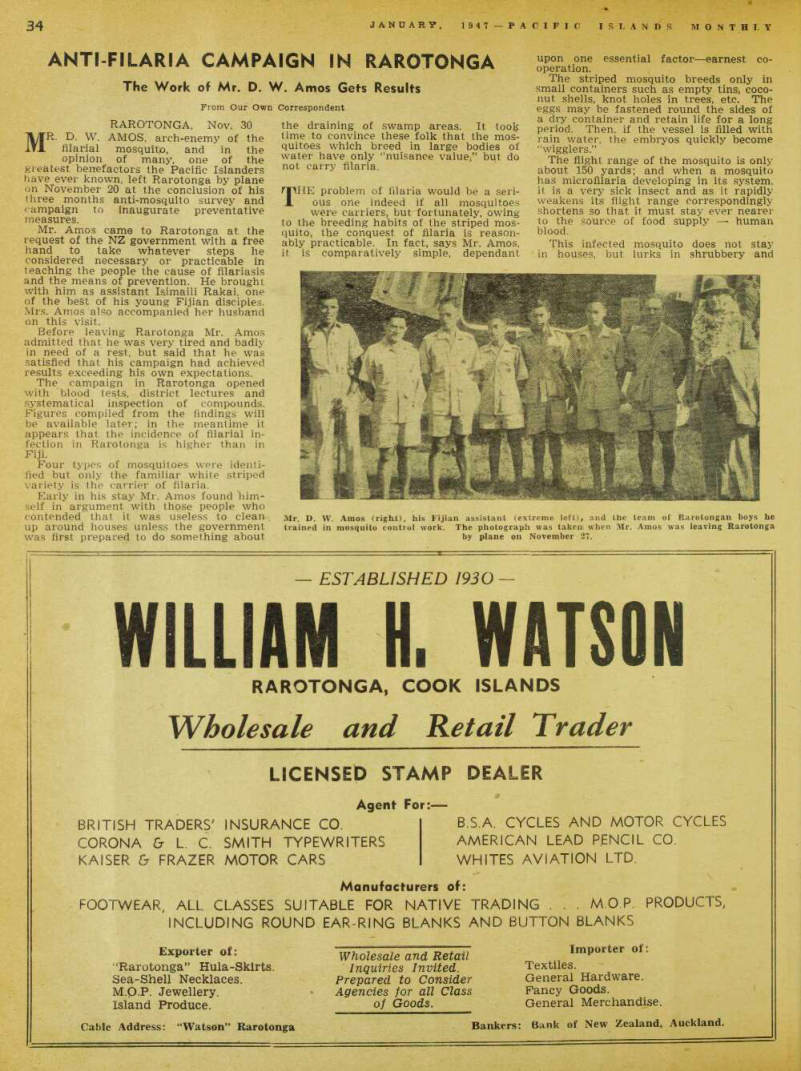
Mr. D. W. Amos (right), his Fijian assistant (extreme left), and the team of Rarotongan boys he trained in mosquito control work. The photograph was taken when Mr. Amos was leaving Rarotonga by plane on November 27.
undergrowth outside. Only in the last days of the mosquito, when it is at its weakest and unable to move far from the house, are the microfilaria able to burst their way from the insect’s throat while it is feeding and so make their way through the skin pores of a human victim.
Mr. Amos emphasises that this sequence of events clearly points the answer to filaria control. Remove and destroy all possible breeding sources and clear away all shrubbery and under growth in the neighbourhood of dwelling places. Ideally, a dwelling place should be kept clean and clear for a circum ference of 150 yards. In close-packed communities complete co-operation is necessary if all homes are to have reason
able protection.
Meat tins, says Mr. Amos, are the curse of the Cook Islands; nowhere has he seen so many empty tins to the square mile as in Rarotonga. One sees them everywhere; around the houses, along the roads and ditches, on the beaches.
As a result of the campaign consider able progress has already been made, especially in the country districts. But it was not easy to get started, and there will be need for constant supervision to ensure that the work has real lasting value. Polynesians are notoriously care less in health matters, and practically have to be forced to take measures for their own good and preservation.
They have always been fatalistic re garding filariasis and the dreaded culmi nating elephantiasis. This attitude in volved Mr. Amos in some lively argu ments which provided scope for his ready wit. Cook Islanders love to use Bible quotations and references in the course of arguments, but Mr. Amos had ready answers. One man said! “God made men and He made mosquitoes—and if He de cided to give me ‘big legs’ that is just my bad luck.” To Which Mr. Amos snappily replied, “But God did not strew empty meat tins all round your house so that the mosquitoes could live with you! And don’t forget that God helps those that helps themselves!”
BUT one thing more than any other captured the attention of the Raro tongans and convinced them that this was not “just another Papa’a with crazy ideas.” Using the new bandaging and massage technique, Mr. Amos has achieved remarkable results in the re duction of elehantoid limbs results which appear to the people as nothing less than miracles. Many advanced and long-standing cases have been reduced to normal or near normal in a few weeks.
The gratitude of these persons can be better imagined than described.
Mr. Amos’ had not originally intended to include manipulation in his programme but he could not refuse to help and once his “miracle-healing” became known there was an increasing flow of patients.
A considerable portion of each day had to be devoted to this work and while adding greatly to the strenuousness of Mr. Amos’ task, it undoubtedly did much to promote interest in the campaign..
During his stay Mr. Amos trained six young Rarotongans to carry on the duties of district mosquito-control inspectors and advisors and they are tackling the job with enthusiasm. Isimaili Rakai is staying on for a few months to super intend the campaign and Mr. Amos will make a return visit later to check progress.
Fruit headed the list of exports from Fiji to New Zealand during October. In that month 917,460 lbs. of bananas (£5,861 value) and pineapples to the value of £2,403 left Suva for the Dom inion. Total value of exports to NZ during the month was £12,126; imports from NZ were valued at £4,840.