500 Bushels Of Rice
p. 35 · Read in the full issue
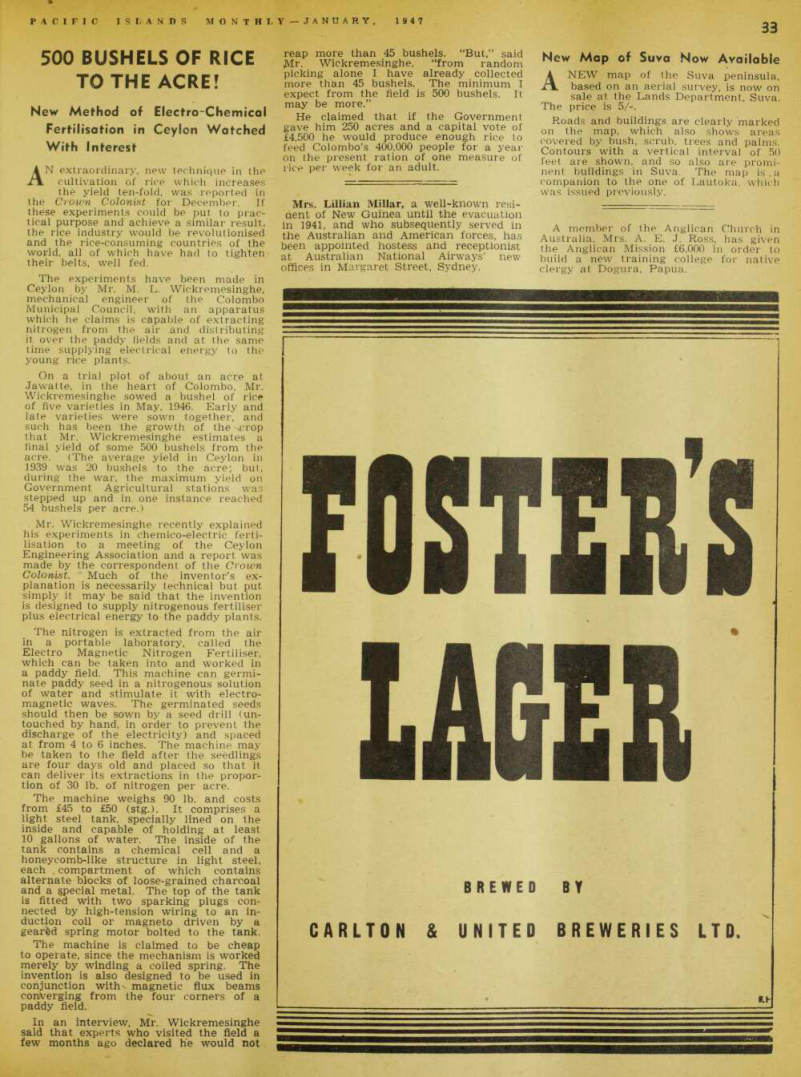
To The Acre!
New Method of Electro-Chemical
Fertilisation in Ceylon Watched
With Interest
AN extraordinary, new technique in the cultivation of rice which increases the yield ten-fold, was reported in the Crown Colonist for December. If these experiments could be put to prac tical purpose and achieve a similar result, the rice industry would be revolutionised and the rice-consuming countries of the world, all of which have had to tighten their belts, well fed.
The experiments have been made in Ceylon by Mr. M. L. Wickremesinghe, mechanical engineer of the Colombo Municipal Council, with an apparatus which he claims is capable of extracting nitrogen from the air and distributing it over the paddy fields and at the same time supplying electrical energy to the young rice plants.
On a trial plot of about an acre at Jawatte, in the heart of Colombo, Mr.
Wickremesinghe sowed a bushel of rice of five varieties in May, 1946. Early and late varieties were sown together, and such has been the growth of the .crop that Mr. Wickremesinghe estimates a final yield of some 500 bushels from the acre. (The average yield in Ceylon in 1939 was 20 bushels to the acre; but, during the war, the maximum yield on Government Agricultural stations was stepped up and in one instance reached 54 bushels per acre.) Mr. Wickremesinghe recently explained his experiments in chemico-electric ferti lisation to a meeting of the Ceylon Engineering Association and a report was made by the correspondent of the Crown Colonist. Much of the inventor’s ex planation is necessarily technical but put simply it may be said that the invention is designed to supply nitrogenous fertiliser plus electrical energy to the paddy plants.
The nitrogen is extracted from the air in a portable laboratory, called the Electro Magnetic Nitrogen Fertiliser, which can be taken into and worked in a paddy field. This machine can germi nate paddy seed in a nitrogenous solution of water and stimulate it with electro magnetic waves. The germinated seeds should then be sown by a seed drill (un touched by hand, in order to prevent the discharge of the electricity) and spaced at from 4 to 6 inches. The machine may be taken to the field after the seedlings are four days old and placed so that it can deliver its extractions in the propor tion of 30 lb. of nitrogen per acre.
The machine weighs 90 lb. and costs from £45 to £5O (stg.). It comprises a light steel tank, specially lined on the inside and capable of holding at least 10 gallons of water. The inside of the tank contains a chemical cell and a honeycomb-like structure in light steel, each compartment of which contains alternate blocks of loose-grained charcoal and a special metal. The top of the tank is fitted with two sparking plugs con nected by high-tension wiring to an in duction coil or magneto driven by a gearfed spring motor bolted to the tank.
The machine is claimed to be cheap to operate, since the mechanism is worked merely by winding a coiled spring. The invention is also designed to be used in conjunction with- magnetic flux beams converging from the four corners of a paddy field.
In an interview, Mr. Wickremesinghe said that experts who visited the field a few months ago declared he would not
reap more than 45 bushels. “But,” said Mr. Wickremesinghe, “from random picking alone I have already collected more than 45 bushels. The minimum I expect from the field is 500 bushels. It may be more.”
He claimed that if the Government gave him 250 acres and a capital vote of £4,500 he would produce enough rice to feed Colombo’s 400,000 people for a year on the present ration of one measure of rice per week for an adult.
Mrs. Lillian Millar, a well-known resi dent of New Guinea until the evacuation in 1941, and who subsequently served in the Australian and American forces, has been appointed hostess and receptionist at Australian National Airways’ new offices in Margaret Street, Sydney.
New Map of Suva Now Available
ANEW map of the Suva peninsula, based on an aerial survey, is now on sale at the Lands Department, Suva.
The price is 5/-.
Roads and buildings are clearly marked on the map, which also shows areas covered by bush, scrub, trees and palms.
Contours with a vertical interval of 50 feet are shown, and so also are promi nent buildings in Suva. The map is . a companion to the one of Lautoka, which was issued previously.
A member of the Anglican Church in Australia, Mrs. A. E. J. Ross, has given the Anglican Mission £6,000 in order to build a new training college for native clergy at Dogura, Papua.