Fiji's Two Wartime Mysteries
p. 46 · Read in the full issue
(By Ex-Sig.)
rE outbreak of war in 1939 produced its full quota of spy scares and minor mysteries in Fiji as well as in other parts of the Empire, and there are two of these mysteries, afterwards exploded, which are probably known only to the few immediately concerned —the military authorities and some members of the then newly formed signal unit of the Fiji De fence Force as it was then called.
Early in the career of the signal unit, listeners with the home-made radio eq uipment then in the possession of the outfit started to pick up regular radio signals on an unusual wavelength—the signals always consisting of groups of fi gures.
The equipment we had in tnose days was generally makeshift, and the home made sets mentioned had been turned out by an NCO who in civil life was a radio mechanic. They were portable, and sometimes they worked, sometimes they didn’t—especially the transmitters.
The first we, in the Signals knew of anything interesting afoot was one night at the close of the weekly evening parade when Captain (now Colonel) Donald Ju nor, the O C., called the unit non-coms
into the orderly room and told us we were going on a stunt.
Radio gear was packed into a couple of cars—the signals unit was notorious for the number of private care owned by all ranks —and the party hied itself to the Indian school-grounds, on the brow of the hill overlooking Suva Point.
There a radio was set up, with direct ional loop, and the late Noel McNally, once a New Zealand Railways Telegraph ist. and consequently expert in the code, adjusted the headphones and listened when the figure-sending station was nicked up. Mac wrote down the figures, for all the use they were—while another member of the party slowly moved the loop till Mac indicated the loudest signals.
The rest of the party then got down to it with an ordinary map, prismatic compass, etc., and plotted a bearing on the line indicated by the loon aerial.
Then there was a general move to an other location—this time on the water front road between the Point and Suva, and the process repeated. The station obliginglv continued to send. Once more, a somewhat primitive directional plot was made, and everybody wanted to have a
look-see at the map, to find out where the two plot intersected.
On the large-scale map it was an easy matter for the skipper to pinpoint the intersection, and off the cars went again, this time in the direction of the Point, and the vital square on the map.
The cars were left some distance from the selected spot, and members of the party closed in as quietly as Army-issue hob-nailed boots would permit.
It looked too good to be true. On what must have been just about the exact spot indicated on the man there was a small shack, obviously Indian-owned and oc cupied; and above it was an unusually large radio aerial—it looked very like a professional job.
The raiding party—which it had now become—took up strategic positions around the building, and Don Junor, accom panied by the radio expert, Les Emery, knocked loudly on the door.
A startled, night-shirted Indian opened up, evidently wondering wildly at the mid night visist of the soldier sahibs. He made no demur to a search and Junor and Emery had a quick look through the tinv shack.
Rather to our disappointment, the only radio equipment in the place was a very ordinary receiver.
It was not until some time later that the nowers-that-be discovered that the signals so eagerly tracked were really emanating from Radio Noumea. I am no radio expert, and I don’t know vet how it worked out that we should pin point that Indian shack at Suva Point. fTIHE second mystery was a case of the JL ioke being on the military in general, Signals in particular. This was an other instance of unidentified signals be ing picked up; but none of the town’s best Morse operators was able to decipher them.
However, there was little doubt in the minds of any who heard them that the staccato stutterings which came over the air at certain times were signals of some kind.
Some of us even started studying Jap anese Morse code, in case they were Jap anese signals; but still the combinations defeated the experts.
However, the authorities decided that a regular watch should be kept, and mem bers of the signals unit were conscripted for the job of watch-keeping.
It was all very hush-hush. There were two watch-keepers on duty at a time, if I remember correctly—and they had to proceed separately and inconspicuously in civilian clothes to the home of Mr. H.
D. Walcot. who had a good set, on which the signals were being picked up regu larly.
There the signalmen listened night after night—presumably for anything which might prove intelligible.
The watch went on for some weeks, and then, without any warning, was called off —another anti-climax.
Someone else had tracked down the mystery “transmitter.”
It appeared that the “signals” emanated from a fault in the teleprinter line con necting the radio station at Suva Point with the office of Cable and Wireless, Ltd., in Suva, the effect being that every time the operator at the Point typed a routine message, a series of unintelligible clicks and pauses radiated from the line, to be picked up on a sensitive receiver.
When the Presbyterian Synod of the Maritime Provinces of Canada met recent ly at the First Presbyterian Church, Pic ton, they commemorated the centenary of the sailing from the Pacific Coast of the Rev. John Geddie to the mission in the New Hebrides.
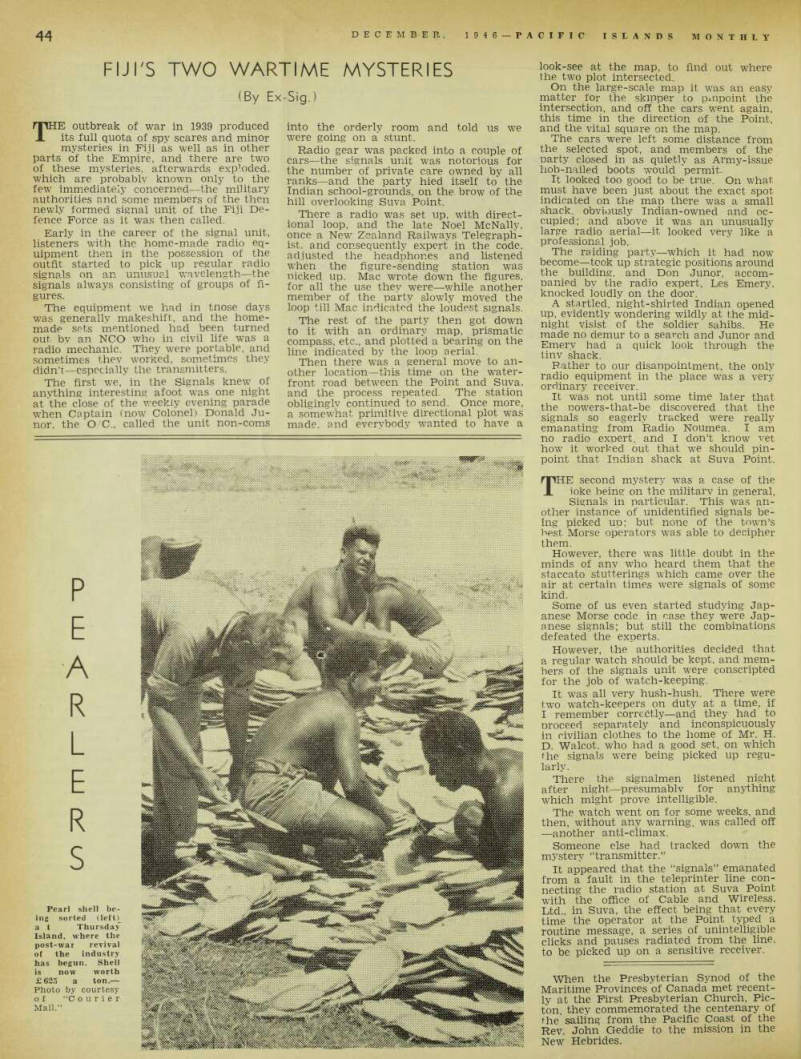
p E A R L E R S Pearl shell be ing sorted at Thursday Island, where the post-war revival of the industry has begun. Shell is now worth £625 a ton. — Photo by courtesy of “Courier Mail.”